MCP Security Audit Server
Herramienta de auditoría de seguridad
Un potente servidor MCP (Protocolo de Contexto de Modelo) que audita las dependencias de los paquetes npm para detectar vulnerabilidades de seguridad. Integrado con el registro remoto de npm para realizar comprobaciones de seguridad en tiempo real.
Características
🔍 Escaneo de vulnerabilidades de seguridad en tiempo real
Integración remota del registro npm
📊 Informes detallados de vulnerabilidad con niveles de gravedad
🛡️ Soporte para múltiples niveles de gravedad (crítico, alto, moderado, bajo)
📦 Compatible con los administradores de paquetes npm/pnpm/yarn
Recomendaciones de soluciones automáticas
Puntuación CVSS y referencias CVE
Instalación mediante herrería
Para instalar la herramienta de auditoría de seguridad para Claude Desktop automáticamente a través de Smithery :
npx -y @smithery/cli install @qianniuspace/mcp-security-audit --client claudeIntegración MCP
Opción 1: Usar NPX (recomendado)
Agregar configuración MCP a Cline/Cursor:
{
"mcpServers": {
"mcp-security-audit": {
"command": "npx",
"args": ["-y", "mcp-security-audit"]
}
}
}Opción 2: Descargar el código fuente y configurarlo manualmente
Clonar el repositorio:
git clone https://github.com/qianniuspace/mcp-security-audit.git
cd mcp-security-auditInstalar dependencias y compilar:
npm install
npm run buildAgregar configuración MCP a Cline/Cursor:
{
"mcpServers": {
"mcp-security-audit": {
"command": "npx",
"args": ["-y", "/path/to/mcp-security-audit/build/index.js"]
}
}
}Related MCP server: audit-mcp-cli
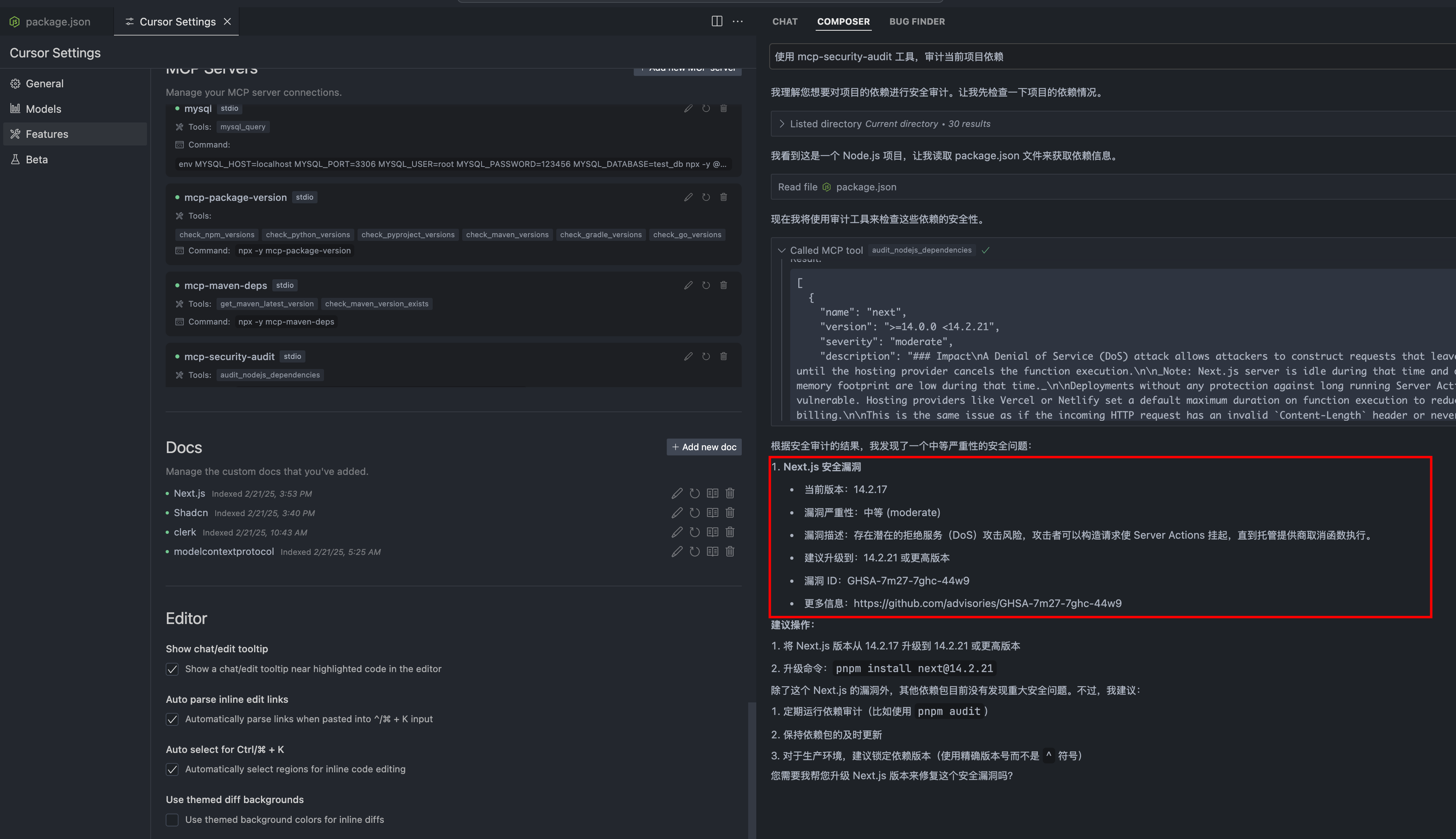
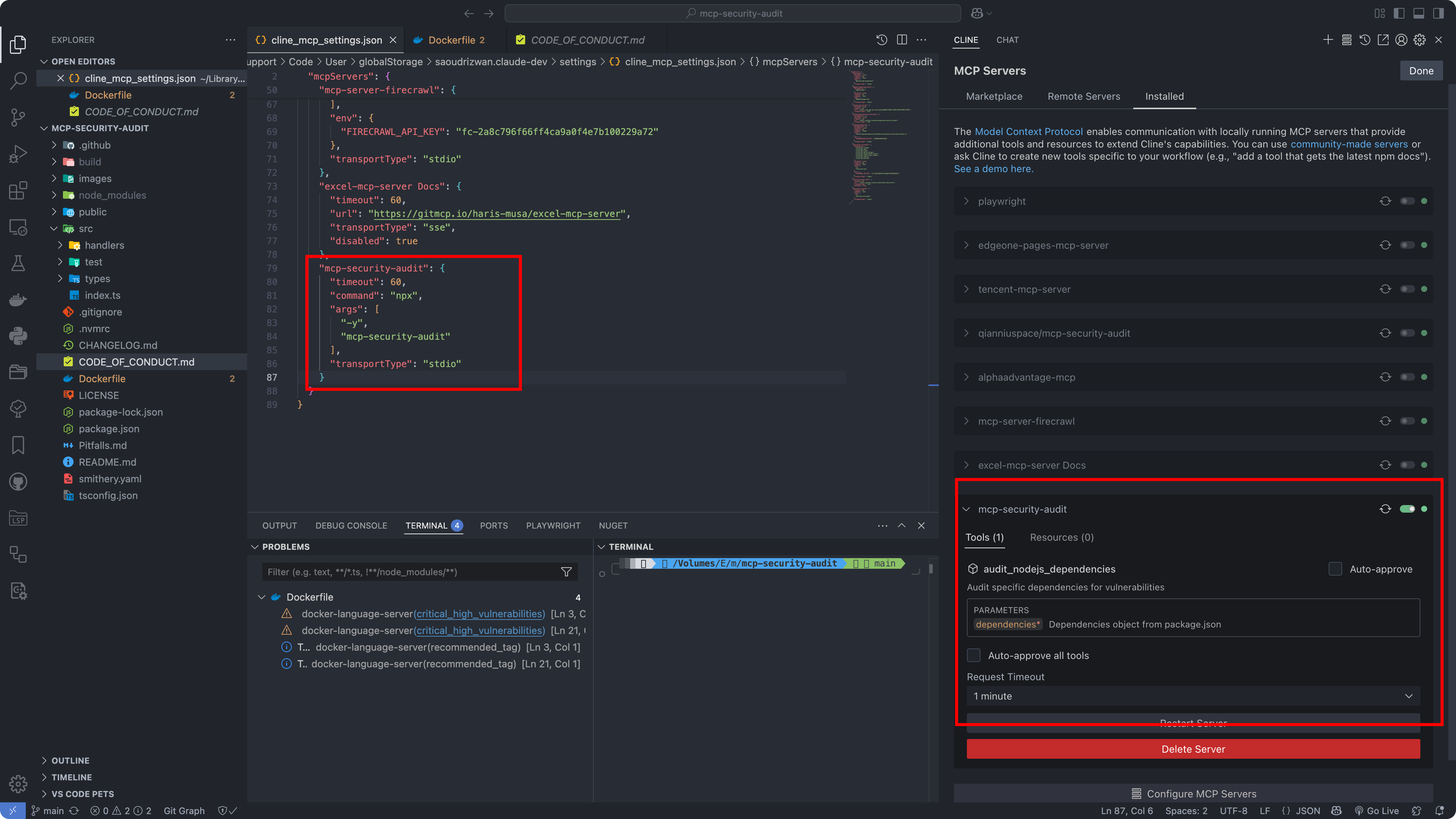
Capturas de pantalla de configuración
Configuración del cursor
Configuración de Cline
Formato de respuesta de la API
La herramienta proporciona información detallada sobre vulnerabilidades, incluidos niveles de gravedad, recomendaciones de solución, puntuaciones CVSS y referencias CVE.
Ejemplos de respuestas
1. Cuando se encuentran vulnerabilidades (Severity-response.json)
{
"content": [{
"vulnerability": {
"packageName": "lodash",
"version": "4.17.15",
"severity": "high",
"description": "Prototype Pollution in lodash",
"cve": "CVE-2020-8203",
"githubAdvisoryId": "GHSA-p6mc-m468-83gw",
"recommendation": "Upgrade to version 4.17.19 or later",
"fixAvailable": true,
"fixedVersion": "4.17.19",
"cvss": {
"score": 7.4,
"vector": "CVSS:3.1/AV:N/AC:H/PR:N/UI:N/S:U/C:H/I:H/A:N"
},
"cwe": ["CWE-1321"],
"url": "https://github.com/advisories/GHSA-p6mc-m468-83gw"
},
"metadata": {
"timestamp": "2024-04-23T10:00:00.000Z",
"packageManager": "npm"
}
}]
}2. Cuando no se encuentran vulnerabilidades (no-Severity-response.json)
{
"content": [{
"vulnerability": null,
"metadata": {
"timestamp": "2024-04-23T10:00:00.000Z",
"packageManager": "npm",
"message": "No known vulnerabilities found"
}
}]
}Desarrollo
Como referencia de desarrollo, consulte los archivos de respuesta de ejemplo en el directorio public :
Severity-response.json : Respuesta de ejemplo cuando se encuentran vulnerabilidades (transformada a partir de la respuesta de la API de auditoría de npm)
no-Severity-response.json : Ejemplo de respuesta cuando no se encuentran vulnerabilidades (transformada a partir de la respuesta de la API de auditoría de npm)
Nota: Las respuestas de ejemplo mostradas arriba se han transformado a partir de las respuestas sin procesar de la API de auditoría de npm para ofrecer un formato más estructurado. Las respuestas originales de la API de auditoría de npm contienen metadatos adicionales y pueden tener una estructura diferente.
Contribuyendo
¡Agradecemos sus contribuciones! Lea nuestra Guía de Contribución para obtener más información sobre nuestro código de conducta y el proceso para enviar solicitudes de incorporación de cambios.
Licencia
Este proyecto está licenciado bajo la licencia MIT: consulte el archivo de LICENCIA para obtener más detalles.
Autor
ESX ( qianniuspace@gmail.com )
Campo de golf
Available Tools
1 toolaudit_nodejs_dependenciesC
Audit specific dependencies for vulnerabilities
| Name | Required | Description | Default |
|---|---|---|---|
| dependencies | Yes | Dependencies object from package.json |
TDQS
Does the description disclose side effects, auth requirements, rate limits, or destructive behavior?
No annotations provided, so description carries full burden. It fails to mention whether the operation is read-only, requires network access, or what happens with the dependencies data.
Agents need to know what a tool does to the world before calling it. Descriptions should go beyond structured annotations to explain consequences.
Is the description appropriately sized, front-loaded, and free of redundancy?
The description is one sentence, no unnecessary words. It is concise but slightly under-informative for its brevity.
Shorter descriptions cost fewer tokens and are easier for agents to parse. Every sentence should earn its place.
Given the tool's complexity, does the description cover enough for an agent to succeed on first attempt?
No output schema and minimal description leave the return value and behavior undocumented. The nested object type is not elaborated.
Complex tools with many parameters or behaviors need more documentation. Simple tools need less. This dimension scales expectations accordingly.
Does the description clarify parameter syntax, constraints, interactions, or defaults beyond what the schema provides?
Schema coverage is 100% with a clear description for the parameter. The tool description adds no additional semantic value beyond the schema.
Input schemas describe structure but not intent. Descriptions should explain non-obvious parameter relationships and valid value ranges.
Does the description clearly state what the tool does and how it differs from similar tools?
The description clearly states it audits dependencies for vulnerabilities, using a verb-object structure. However, without sibling tools, differentiation is not necessary.
Agents choose between tools based on descriptions. A clear purpose with a specific verb and resource helps agents select the right tool.
Does the description explain when to use this tool, when not to, or what alternatives exist?
No guidance on when to use the tool, prerequisites, or alternatives. The description assumes the agent knows the context.
Agents often have multiple tools that could apply. Explicit usage guidance like "use X instead of Y when Z" prevents misuse.
Tool Schema Changelog
Recent tool additions, removals, and schema changes observed during successful MCP inspections.
1 tool update
v1.0.0- First observed
audit_nodejs_dependencies
TDQS
Scored across 1 tool
With only one tool, there is no possibility of confusion between tools. The tool's purpose is clearly stated in its name and description, making it unambiguous.
A single tool name follows a clear verb_noun pattern (audit_nodejs_dependencies) which is consistent with typical MCP naming conventions. There are no other names to compare, but the pattern is clear.
Having only one tool is extremely thin for a security audit server. Auditing dependencies likely requires supporting operations like resolving dependency trees, checking for updates, or generating reports, which are missing.
The server's purpose appears to be auditing Node.js dependencies, but it only offers a single operation that audits dependencies without coverage for other lifecycle steps like viewing audit results, fixing vulnerabilities, or scanning different scopes.
Maintenance
Related MCP Connectors
Detect malicious or vulnerable npm packages: registry search, OSV.dev and GitHub advisory lookups
Provide AI-powered real-time analysis and intelligence on NPM packages, including security, depend…
Query OSV.dev for package vulnerabilities and batch-audit dependency lists via MCP.
Dive into the world of npm with our NPM Package Info MCP. Access crucial metadata about any npm
Related MCP Servers
- AlicenseBqualityCmaintenanceEnables security scanning for npm dependencies by checking manifest and lockfiles against the OSV.dev and Socket.dev vulnerability databases. It provides tools to detect vulnerabilities in specific packages and retrieve detailed technical reports for identified security issues.310 npmMIT
- AlicenseAqualityDmaintenanceLightweight Node.js dependency vulnerability audit tool with CLI and MCP Server modes. Supports npm/pnpm, full dependency chain tracing, remote GitHub repo auditing, and generates Markdown/HTML reports.118 npm1MIT
- AlicenseBqualityDmaintenanceAudits package lockfiles for vulnerabilities, supporting npm, yarn, and pnpm. Runs via CLI or as an MCP server over stdio.111 npm83MIT
- AlicenseAqualityDmaintenanceMCP server that audits npm dependencies against the live registry, providing per-dependency reports on versions behind, deprecation, and license.29 npmMIT