Glama
qianniuspace

MCP Security Audit Server

by qianniuspace

安全审计工具

铁匠徽章 NPM 版本 许可证:MIT

强大的 MCP(模型上下文协议)服务器,可审核 npm 软件包依赖项是否存在安全漏洞。内置远程 npm 注册表集成,可进行实时安全检查。

特征

  • 🔍 实时安全漏洞扫描

  • 🚀 远程 npm 注册表集成

  • 📊 带有严重程度的详细漏洞报告

  • 🛡️ 支持多种严重程度级别(严重、高、中、低)

  • 📦 兼容 npm/pnpm/yarn 包管理器

  • 🔄 自动修复建议

  • 📋 CVSS 评分和 CVE 参考

通过 Smithery 安装

要通过Smithery自动安装 Claude Desktop 的安全审计工具:

npx -y @smithery/cli install @qianniuspace/mcp-security-audit --client claude

MCP 集成

选项 1:使用 NPX(推荐)

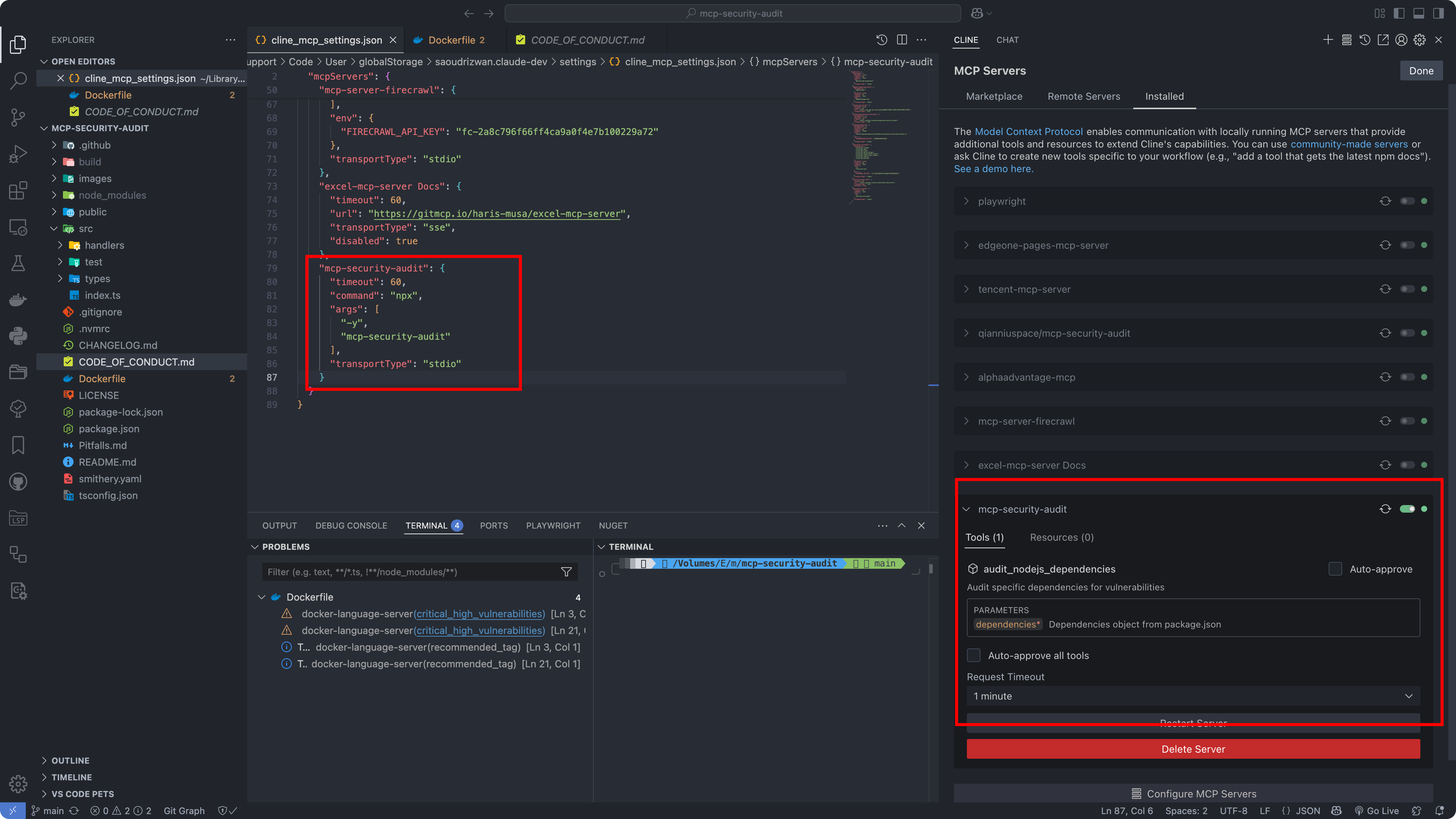
  1. 将 MCP 配置添加到 Cline /Cursor:

{
  "mcpServers": {
    "mcp-security-audit": {
      "command": "npx",
      "args": ["-y", "mcp-security-audit"]
    }
  }
}

选项 2:下载源代码并手动配置

  1. 克隆存储库:

git clone https://github.com/qianniuspace/mcp-security-audit.git
cd mcp-security-audit
  1. 安装依赖项并构建:

npm install
npm run build
  1. 将 MCP 配置添加到 Cline /Cursor:

{
  "mcpServers": {
    "mcp-security-audit": {
      "command": "npx",
      "args": ["-y", "/path/to/mcp-security-audit/build/index.js"]
    }
  }
}

Related MCP server: audit-mcp-cli

配置截图

游标配置
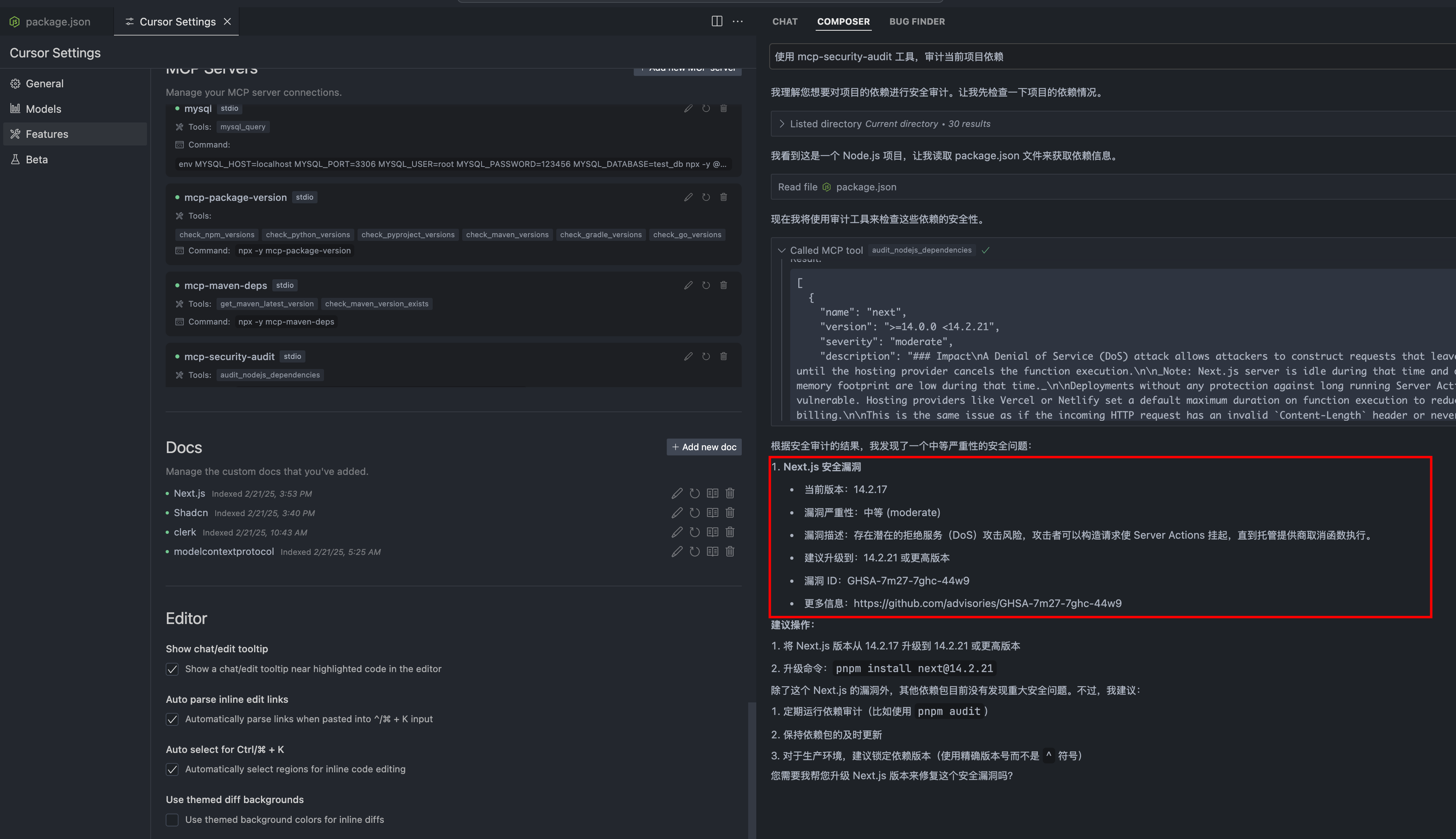
游标配置

克莱恩配置

克莱恩配置

API 响应格式

该工具提供详细的漏洞信息,包括严重程度、修复建议、CVSS 分数和 CVE 参考。

响应示例

1. 发现漏洞时(Severity-response.json)

{
  "content": [{
    "vulnerability": {
      "packageName": "lodash",
      "version": "4.17.15",
      "severity": "high",
      "description": "Prototype Pollution in lodash",
      "cve": "CVE-2020-8203",
      "githubAdvisoryId": "GHSA-p6mc-m468-83gw",
      "recommendation": "Upgrade to version 4.17.19 or later",
      "fixAvailable": true,
      "fixedVersion": "4.17.19",
      "cvss": {
        "score": 7.4,
        "vector": "CVSS:3.1/AV:N/AC:H/PR:N/UI:N/S:U/C:H/I:H/A:N"
      },
      "cwe": ["CWE-1321"],
      "url": "https://github.com/advisories/GHSA-p6mc-m468-83gw"
    },
    "metadata": {
      "timestamp": "2024-04-23T10:00:00.000Z",
      "packageManager": "npm"
    }
  }]
}

2. 未发现漏洞时(no-Severity-response.json)

{
  "content": [{
    "vulnerability": null,
    "metadata": {
      "timestamp": "2024-04-23T10:00:00.000Z",
      "packageManager": "npm",
      "message": "No known vulnerabilities found"
    }
  }]
}

发展

作为开发参考,请查看public目录中的示例响应文件:

注意:上面显示的示例响应是从原始 npm audit API 响应转换而来的,旨在提供更结构化的格式。原始 npm audit API 响应包含其他元数据,并且结构可能有所不同。

贡献

欢迎贡献代码!请阅读我们的贡献指南,详细了解我们的行为准则以及提交 Pull Request 的流程。

执照

该项目根据 MIT 许可证获得许可 - 有关详细信息,请参阅LICENSE文件。

作者

ESX( qianniuspace@gmail.com )

链接

Available Tools

1 tool
audit_nodejs_dependenciesC

Audit specific dependencies for vulnerabilities

ParametersJSON Schema
NameRequiredDescriptionDefault
dependenciesYesDependencies object from package.json

TDQS

C2.9/5.0
Behavior2/5

Does the description disclose side effects, auth requirements, rate limits, or destructive behavior?

No annotations provided, so description carries full burden. It fails to mention whether the operation is read-only, requires network access, or what happens with the dependencies data.

Agents need to know what a tool does to the world before calling it. Descriptions should go beyond structured annotations to explain consequences.

Conciseness4/5

Is the description appropriately sized, front-loaded, and free of redundancy?

The description is one sentence, no unnecessary words. It is concise but slightly under-informative for its brevity.

Shorter descriptions cost fewer tokens and are easier for agents to parse. Every sentence should earn its place.

Completeness2/5

Given the tool's complexity, does the description cover enough for an agent to succeed on first attempt?

No output schema and minimal description leave the return value and behavior undocumented. The nested object type is not elaborated.

Complex tools with many parameters or behaviors need more documentation. Simple tools need less. This dimension scales expectations accordingly.

Parameters3/5

Does the description clarify parameter syntax, constraints, interactions, or defaults beyond what the schema provides?

Schema coverage is 100% with a clear description for the parameter. The tool description adds no additional semantic value beyond the schema.

Input schemas describe structure but not intent. Descriptions should explain non-obvious parameter relationships and valid value ranges.

Purpose4/5

Does the description clearly state what the tool does and how it differs from similar tools?

The description clearly states it audits dependencies for vulnerabilities, using a verb-object structure. However, without sibling tools, differentiation is not necessary.

Agents choose between tools based on descriptions. A clear purpose with a specific verb and resource helps agents select the right tool.

Usage Guidelines2/5

Does the description explain when to use this tool, when not to, or what alternatives exist?

No guidance on when to use the tool, prerequisites, or alternatives. The description assumes the agent knows the context.

Agents often have multiple tools that could apply. Explicit usage guidance like "use X instead of Y when Z" prevents misuse.

Tool Schema Changelog

Recent tool additions, removals, and schema changes observed during successful MCP inspections.

  1. 1 tool updatev1.0.0
    • First observedaudit_nodejs_dependencies

TDQS

C2.9/5.0

Scored across 1 tool

Disambiguation5/5

With only one tool, there is no possibility of confusion between tools. The tool's purpose is clearly stated in its name and description, making it unambiguous.

Naming Consistency5/5

A single tool name follows a clear verb_noun pattern (audit_nodejs_dependencies) which is consistent with typical MCP naming conventions. There are no other names to compare, but the pattern is clear.

Tool Count1/5

Having only one tool is extremely thin for a security audit server. Auditing dependencies likely requires supporting operations like resolving dependency trees, checking for updates, or generating reports, which are missing.

Completeness1/5

The server's purpose appears to be auditing Node.js dependencies, but it only offers a single operation that audits dependencies without coverage for other lifecycle steps like viewing audit results, fixing vulnerabilities, or scanning different scopes.

Maintenance

ActivityInactive
ResponsivenessUnresponsive

Related MCP Connectors

Related MCP Servers

  • A
    license
    B
    quality
    C
    maintenance
    Enables security scanning for npm dependencies by checking manifest and lockfiles against the OSV.dev and Socket.dev vulnerability databases. It provides tools to detect vulnerabilities in specific packages and retrieve detailed technical reports for identified security issues.
    3
    10 npm
    MIT
  • A
    license
    A
    quality
    D
    maintenance
    Lightweight Node.js dependency vulnerability audit tool with CLI and MCP Server modes. Supports npm/pnpm, full dependency chain tracing, remote GitHub repo auditing, and generates Markdown/HTML reports.
    1
    18 npm
    1
    MIT
  • A
    license
    B
    quality
    D
    maintenance
    Audits package lockfiles for vulnerabilities, supporting npm, yarn, and pnpm. Runs via CLI or as an MCP server over stdio.
    1
    11 npm
    83
    MIT