
MCP Infra Lens
Monitors and analyzes Linux infrastructure over SSH, collecting system metrics (CPU, memory, disk, network, processes) to detect anomalies against recorded baselines and explain infrastructure incidents in plain English with health scores and remediation recommendations.
mcp-infra-lens
Explain Linux incidents over SSH with baseline-aware MCP tooling.





Demo
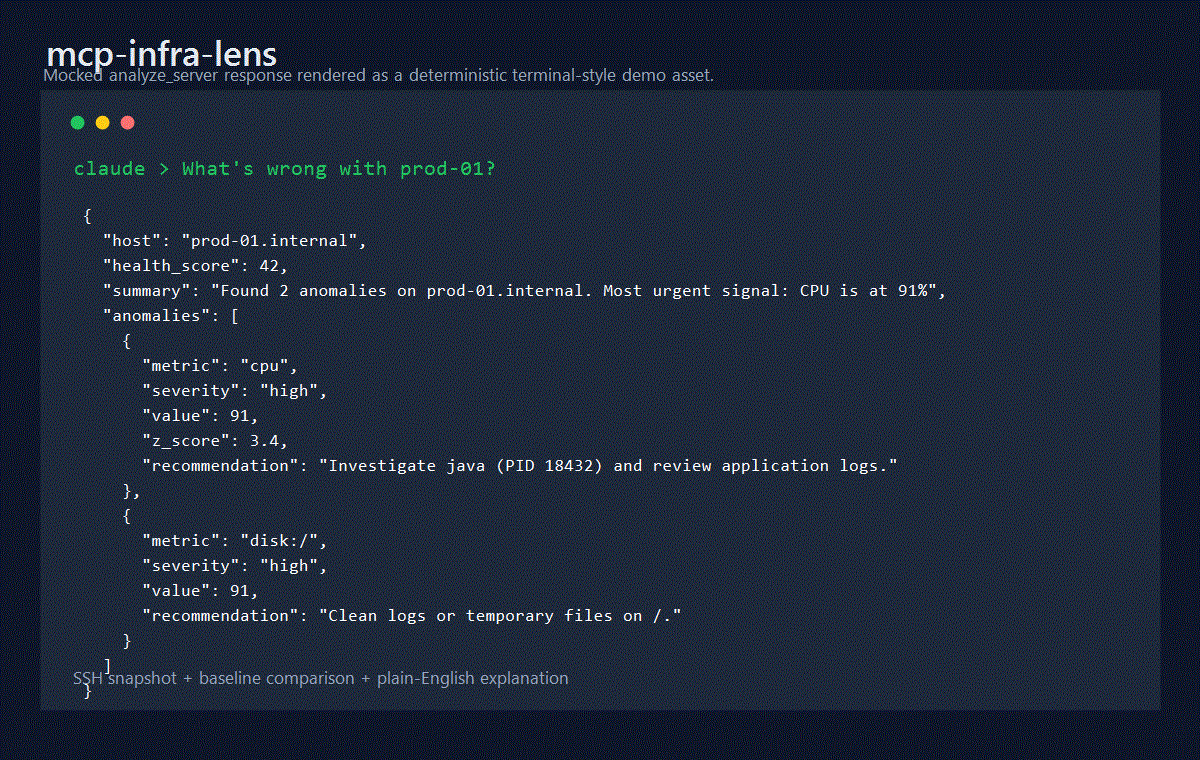
Sample analyze_server response when Claude asks, "What's wrong with prod-01?":
{
  "host": "prod-01.internal",
  "health_score": 42,
  "summary": "Found 2 anomalies on prod-01.internal. Most urgent signal: CPU is at 91% (3.4σ above baseline 28.2%). Load is 7.2/6.8/5.1. Top CPU consumer: java (87%).",
  "anomalies": [
    {
      "metric": "cpu",
      "severity": "high",
      "value": 91,
      "z_score": 3.4,
      "explanation": "CPU is at 91% (3.4σ above baseline 28.2%). Load is 7.2/6.8/5.1. Top CPU consumer: java (87%).",
      "recommendation": "Investigate java (PID 18432) and review application logs or scale-out options."
    },
    {
      "metric": "disk:/",
      "severity": "high",
      "value": 91,
      "explanation": "Disk / is 91% full (182GB/200GB).",
      "recommendation": "Run du -sh //* | sort -rh | head -20 and clean logs or temporary files."
    }
  ]
}
What It Does
mcp-infra-lens connects to Linux hosts over SSH, captures a live infrastructure snapshot, compares it to recently recorded baselines, and explains anomalies in plain English.
Collects CPU, memory, disk, network, process, and OS data without mutating the target host
Records local metric history in SQLite for baselines, comparisons, and trend lookups
Uses z-score analysis for CPU anomaly detection once enough baseline samples exist
Explains the likely cause of pressure, not just the raw metric value
Supports MCP over
stdioand Streamable HTTP
How It Works
flowchart TD
    A["Claude / Cursor / VS Code / Windsurf"] --> B["mcp-infra-lens"]
    B --> C["server-core.ts"]
    C --> D["collector.ts"]
    C --> E["analyzer.ts"]
    C --> F["baseline.ts + db.ts"]
    D --> G["ssh.ts"]
    G --> H["Linux host over SSH"]
    F --> I["SQLite history + baselines"]
analyze_server now performs real sampled collection over the requested duration_minutes, averages CPU and memory pressure across the collection window, persists the resulting snapshot, and then runs anomaly detection against the selected baseline.
Tools
Tool | What it does | Key params |
| Collects a sampled snapshot, stores it, and explains anomalies |
|
| Captures and stores the current point-in-time metrics without analysis |
|
| Saves a labeled healthy-state sample for future comparisons |
|
| Compares the current state to a named baseline and explains the deltas |
|
| Returns historical CPU, memory, or load points from SQLite |
|
Quick Start
1. Run via npx
npx -y mcp-infra-lens2. Claude Desktop
Published package:
{
  "mcpServers": {
    "infra-lens": {
      "command": "npx",
      "args": ["-y", "mcp-infra-lens"],
      "env": {
        "INFRA_LENS_DB": "/Users/you/.mcp-infra-lens/metrics.db"
      }
    }
  }
}
Local development:
{
  "mcpServers": {
    "infra-lens": {
      "command": "node",
      "args": ["/absolute/path/to/mcp-infra-lens/dist/mcp.js"],
      "env": {
        "INFRA_LENS_DB": "/Users/you/.mcp-infra-lens/metrics.db"
      }
    }
  }
}
3. Docker
docker build -t mcp-infra-lens .
docker run --rm -it \
  -v "$HOME/.mcp-infra-lens:/home/appuser/.mcp-infra-lens" \
  mcp-infra-lens
Configuration
Environment variable | Default | Description |
|
| SQLite database path. Use |
|
| Bind address for the HTTP transport |
|
| Port for the HTTP transport |
Health Score
90-100: healthy, no meaningful anomalies detected70-89: mild or isolated pressure40-69: multiple warnings or a major issue in progress0-39: critical condition with urgent remediation needed
Recommended Workflow
Record
record_baselinesamples during healthy operating windows.Use
analyze_serverduring incidents or load spikes.Use
compare_to_baselinefor a tighter differential view against a named baseline.Use
get_historyto inspect trends and separate default snapshots from labeled baseline sessions.
Authentication
The SSH input schema supports:
Password authentication
Inline private key authentication
Optional passphrase support for encrypted keys
Credential fields are redacted from structured logs before they are written to stderr.
Security Notes
SSH collection is read-only on the target host
SSH credentials are never stored in SQLite
Host key verification is permissive in v1 for compatibility; production deployments should restrict outbound network access and plan to enforce strict host verification in a later release
The HTTP transport has no built-in authentication; bind to loopback and place it behind an authenticated reverse proxy in any non-local deployment
See SECURITY.md for the reporting policy and stored-data scope.
Integrations
Claude Desktop
{
  "mcpServers": {
    "infra-lens": {
      "command": "npx",
      "args": ["-y", "mcp-infra-lens"],
      "env": {
        "INFRA_LENS_DB": "/Users/you/.mcp-infra-lens/metrics.db"
      }
    }
  }
}
Cursor IDE
{
  "mcpServers": {
    "infra-lens": {
      "command": "npx",
      "args": ["-y", "mcp-infra-lens"]
    }
  }
}
VS Code (MCP extension)
{
  "inputs": [],
  "servers": {
    "infra-lens": {
      "type": "stdio",
      "command": "npx",
      "args": ["-y", "mcp-infra-lens"]
    }
  }
}
Windsurf
{
  "mcpServers": {
    "infra-lens": {
      "command": "npx",
      "args": ["-y", "mcp-infra-lens"]
    }
  }
}
Docker (HTTP transport)
docker run -d \
  -p 3000:3000 \
  -v $HOME/.mcp-infra-lens:/home/appuser/.mcp-infra-lens \
  ghcr.io/oaslananka/mcp-infra-lens:latest
Then configure your MCP client to use http://localhost:3000.
Docker
The bundled Docker image:
Builds the TypeScript project in a separate stage
Rebuilds
better-sqlite3for the container architecture in both stagesRuns as a non-root
appuserStores SQLite data in
/home/appuser/.mcp-infra-lens/metrics.db
Contributing
Contributions are welcome. Start with CONTRIBUTING.md, then use:
docs/usage.md for tool examples
docs/architecture.md for the component map
docs/testing.md for local validation and publish checks
RELEASE_POLICY.md for npm and MCP Registry versioning rules
AGENTS.md,CLAUDE.md,GEMINI.md,.github/copilot-instructions.md, and.agent/rules/repository.mdfor repository-specific AI coding guidance
Operational / CI Notes
azure-pipelines.ymlis the canonical CI pipeline and now runs aQualitystage on Node 20 and Node 22, publishes JUnit and Cobertura artifacts, and executes Docker-backed SSH e2e coverage on Node 20.azure/pipelines/publish.ymlremains the manual npm release pipeline.azure/pipelines/mirror.ymlremains available for repository mirroring workflowsPublish only after the local pre-publish checklist and CI both pass cleanly on Node 20
Follow RELEASE_POLICY.md when deciding whether a change needs npm, MCP Registry, or registry-only prerelease publication
License
Latest Blog Posts
MCP directory API
We provide all the information about MCP servers via our MCP API.
curl -X GET 'https://glama.ai/api/mcp/v1/servers/oaslananka/mcp-infra-lens'
If you have feedback or need assistance with the MCP directory API, please join our Discord server