
Premiere Pro MCP Server
<div align="center">
# MCP for Adobe Premiere Pro — local MCP server
<!-- mcp-name: io.github.leancoderkavy/premiere-pro -->
**Languages:** English · [Español](README.es.md) · [Português (Brasil)](README.pt-BR.md) · [Français](README.fr.md) · [Deutsch](README.de.md) · [简体中文](README.zh-CN.md) · [繁體中文](README.zh-TW.md) · [日本語](README.ja.md) · [한국어](README.ko.md) · [Русский](README.ru.md) · [العربية](README.ar.md) · [हिन्दी](README.hi.md) · [Italiano](README.it.md) · [Türkçe](README.tr.md) · [Bahasa Indonesia](README.id.md)
[](https://mcptoplist.com/server/glama%2Fleancoderkavy%2Fpremiere-pro-mcp)
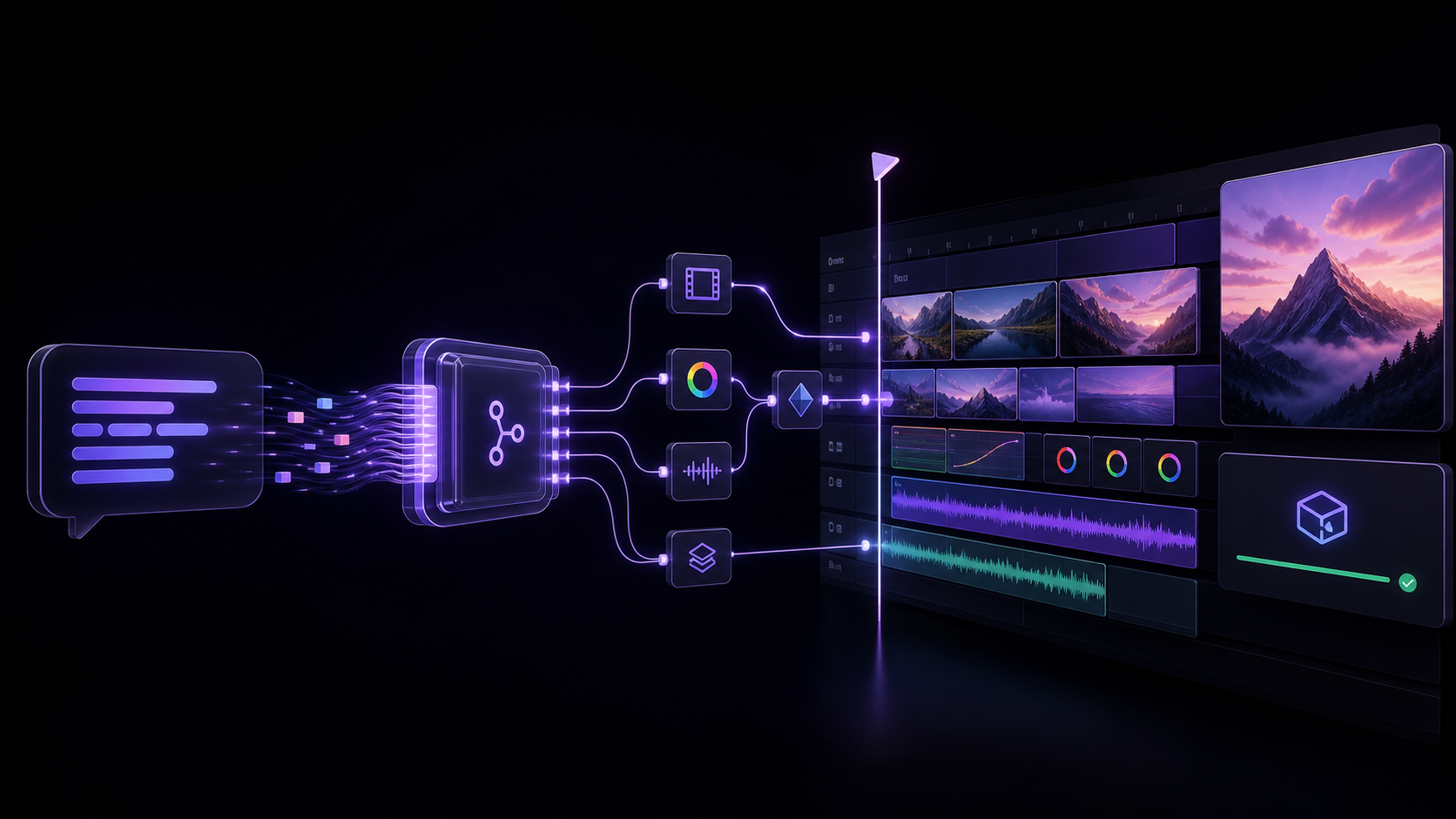
**Adobe Premiere Pro MCP server for reviewable, local-first workflows with compatible AI assistants.**
Premiere Pro automation for Claude, Cursor, Codex, and other MCP clients: AI-assisted editing, project organization, and export checks through Adobe's documented UXP and CEP/ExtendScript APIs.
Free, MIT licensed, local-first, and published to npm as [`premiere-pro-mcp`](https://www.npmjs.com/package/premiere-pro-mcp) — the only package name that installs this project.
[Website](https://premiere-pro-mcp.com/) · [Recorded demo](https://premiere-pro-mcp.com/demo/) · [Compare servers](https://premiere-pro-mcp.com/compare/) · [Setup guides](https://premiere-pro-mcp.com/blog/how-to-set-up-premiere-pro-mcp/) · [Search tools](https://premiere-pro-mcp.com/tools/) · [Troubleshooting](https://premiere-pro-mcp.com/docs/troubleshooting/) · [Release facts](https://premiere-pro-mcp.com/facts/)
Development source: 441 core tools across 67 modules, 4 resources, and 29 guided workflows. A connected UXP host adds 96 capability-gated tools.
The [completed AE render handoff](docs/after-effects-render-handoff.md) previews and confirms importing one finished render into an existing Premiere bin, with host and file rechecks and an import receipt.
[](LICENSE)
[](https://nodejs.org)
[](https://modelcontextprotocol.io/specification/2026-07-28)
[](https://www.npmjs.com/package/premiere-pro-mcp)
[](https://premiere-pro-mcp.com/)
[](https://www.adobe.com/products/premiere.html)
[](https://www.npmjs.com/package/premiere-pro-mcp)
[](https://github.com/leancoderkavy/premiere-pro-mcp/stargazers)
[](https://github.com/leancoderkavy/premiere-pro-mcp/network/members)
[](https://github.com/leancoderkavy/premiere-pro-mcp/issues)
[](https://github.com/leancoderkavy/premiere-pro-mcp/commits)
[](https://buymeacoffee.com/leancoderkavy)
</div>
---
<details>
<summary><strong>Table of contents</strong></summary>
- [What is this?](#what-is-this)
- [Latest release](#latest-release)
- [Current MCP protocol support](#current-mcp-protocol-support)
- [For editors evaluating an AI workflow](#for-editors-evaluating-an-ai-workflow)
- [Quick Start](#quick-start)
- [Easiest supported path: Claude Desktop](#easiest-supported-path-claude-desktop)
- [First proof, before the first edit](#first-proof-before-the-first-edit)
- [Other AI assistants](#other-ai-assistants)
- [Configure your MCP client](#3-configure-your-mcp-client)
- [Verify the bridge in Premiere Pro](#4-verify-the-bridge-in-premiere-pro)
- [Clients and capability coverage](#codex-plugin)
- [Codex plugin](#codex-plugin) · [Claude](#claude) · [GPT-6 Astra tool discovery](#gpt-6-astra-and-agent-tool-discovery) · [GPT-6 Sol and Luna](#gpt-6-sol-and-gpt-6-luna) · [Claude Fable 5.1](#claude-fable-51) · [Claude Opus 5.5](#claude-opus-55)
- [Windows and macOS capability coverage](#windows-and-macos-capability-coverage)
- [After Effects MOGRT studio](#after-effects-mogrt-studio)
- [Collaboration and AI feature boundaries](#collaboration-and-ai-feature-boundaries)
- [Authenticated UXP connection](#authenticated-uxp-connection)
- [Architecture](#architecture)
- [Tools](#tools)
- [MCP Resources](#mcp-resources)
- [Remote Deployment (Fly.io)](#remote-deployment-flyio)
- [Environment Variables](#environment-variables)
- [Project Structure](#project-structure)
- [Technical Details](#technical-details)
- [Frequently asked questions](#frequently-asked-questions)
- [Troubleshooting](#troubleshooting)
- [Star history](#star-history)
- [Support the project](#support-the-project)
- [Contributing](#contributing) · [License](#license)
</details>
## What is this?
**MCP for Adobe Premiere Pro** is the independent, MIT-licensed local MCP server
published as `premiere-pro-mcp` by
[leancoderkavy/premiere-pro-mcp](https://github.com/leancoderkavy/premiere-pro-mcp).
Install this package and its separate Premiere connector to connect a compatible
AI assistant to supported project inspection, timeline editing, and export tools.
Start with `verify_premiere_connection` and make no changes until the bridge works.
### Find the right Adobe Premiere Pro MCP guide
| Goal | Guide |
| --- | --- |
| Understand the local server and connector | [What is Adobe Premiere Pro MCP?](https://premiere-pro-mcp.com/what-is-premiere-pro-mcp/) |
| Connect Claude Desktop, Cursor, or Codex | [Claude Desktop](https://premiere-pro-mcp.com/blog/claude-desktop-premiere-pro-mcp-setup/) · [Cursor](https://premiere-pro-mcp.com/blog/cursor-premiere-pro-mcp-setup/) · [Codex](https://premiere-pro-mcp.com/blog/codex-premiere-pro-mcp-setup/) |
| Choose between similarly named projects | [Source-linked server comparison](https://premiere-pro-mcp.com/compare/) |
| Match a repeatable task to a tool and verification step | [Adobe Premiere Pro automation guide](https://premiere-pro-mcp.com/blog/premiere-pro-workflow-automation/) |
| Check a tool before planning an edit | [Published tool catalog](https://premiere-pro-mcp.com/tools/) |
| Confirm released version and provenance | [Published package facts](https://premiere-pro-mcp.com/facts/) |
An [MCP (Model Context Protocol)](https://modelcontextprotocol.io) server that lets AI assistants like **Claude**, **Windsurf**, **Cursor**, **GitHub Copilot**, or any MCP-compatible client directly control Adobe Premiere Pro — importing media, editing timelines, applying effects, managing keyframes, exporting, and more.
```text
"Add the B-roll clips to V2, apply a cross dissolve between each, color correct them to match the A-roll, and export a 1080p ProRes."
```
### At a glance
| | |
| --- | --- |
| Display name | MCP for Adobe Premiere Pro |
| npm package | `premiere-pro-mcp` |
| Install (npm route) | `npm install -g premiere-pro-mcp` |
| Connector install | `premiere-pro-mcp --install-cep` |
| MCP server name | `io.github.leancoderkavy/premiere-pro` |
| Repository | <https://github.com/leancoderkavy/premiere-pro-mcp> |
| Website | <https://premiere-pro-mcp.com> |
| License | MIT |
| Hosts | Windows and macOS, Premiere Pro 2020-2026 |
This project is independent and is not affiliated with or endorsed by Adobe Inc.
It is also separate from other MCP servers for Premiere Pro. The only npm package
published from this repository is `premiere-pro-mcp`, and no other package name
installs it.
**Comparing similarly named packages?** Both this package and
`adobe-premiere-pro-mcp` declare a `premiere-pro-mcp` executable. Verify the package
and repository before configuring a client. The new
[local configuration helper](docs/client-configuration.md) prints Claude, Cursor,
VS Code, or Codex settings that point directly to this installation. It is a
feature included in v1.15.1 and later.
The current source exposes 441 core tools for supported workflow steps spanning the supported ExtendScript, QE DOM, local media and interchange analysis, revisioned project-context retrieval, safe edit-planning, project-intake preview, review handoff, connection verification, and guarded After Effects MOGRT authoring, batch, library, render-queue, inspection, and Premiere-handoff workflows. A compatible, authenticated UXP panel adds 96 documented, capability-gated tools without replacing the production CEP bridge.
<a id="latest-release"></a>
### Latest release: 1.25.0
The published v1.25.0 npm artifact contains **441 core tools**, 439 in its default profile,
and 535 with a compatible UXP connection. The development catalog above can include
unreleased work. See the [versioned facts and package provenance](https://premiere-pro-mcp.com/facts/).
GitHub releases use `v<SemVer>` for both title and tag, such as `v1.25.0`.
See [release naming and version conventions](docs/release-conventions.md).
### Try a bounded workflow
Choose a setup guide: [Claude Desktop](https://premiere-pro-mcp.com/blog/claude-desktop-premiere-pro-mcp-setup/),
[Codex](https://premiere-pro-mcp.com/blog/codex-premiere-pro-mcp-setup/),
[other local MCP clients](https://premiere-pro-mcp.com/blog/how-to-set-up-premiere-pro-mcp/),
or [ChatGPT connection options](https://premiere-pro-mcp.com/blog/chatgpt-premiere-pro-mcp/).
Download the [workflow starter kit](https://premiere-pro-mcp.com/workflows/) for
synthetic media and three evaluation recipes: a read-only sequence check, an
explicitly confirmed review-frame export, and a product-spot preview. No email is
required. The kit has no recorded Premiere demo or verified host result. Start with
a disposable project and use [setup and recovery](https://premiere-pro-mcp.com/docs/troubleshooting/)
if the connection is unavailable.
### Release highlights
- **1.24.0 mark-write fixes:** temporary overwrite marks and restored project-item marks are written a quarter media frame past the tick boundary, so Premiere 26.5.2 no longer floors them one frame early in `unnest_sequence`, `replace_clip` and `duplicate_clip`.
- **1.24.0 caption style guidance:** `get_caption_style_guidance` accepts a bounded `custom_style` and returns Properties panel and Track Style steps; it is guidance only and applies nothing.
- **1.23.0 bounded workflows:** 41 added core tools and five guided routes cover exact timeline planning, editorial review, interchange/turnover and guarded delivery. The [52-item implementation ledger](docs/filmcraft-improvements.md) records each supported subset and host limit.
- **1.23.0 execution and recovery:** cooperating processes serialize protected edits, retain recovery for uncertain outcomes and report cancellation/partial work explicitly. UXP writes require the matching updated panel; older unversioned panels remain read-only.
- **1.23.0 artifact evidence:** review and delivery checks pin source checksums, inspect actual decoded frames/audio and preserve unknown native-job completion. Local decoder checks do not establish Premiere playback or native round-trip compatibility.
- **1.23.0 import fixes:** folder imports verify actual project-item readback; caption imports validate formats and counts and preserve mutation readback. Export preset discovery avoids proxy ingest presets, and unnesting refuses mixed-media overwrite hazards.
- **1.22.0 readback receipts:** effect writes, stabilization, smart bins, proxies, folder imports, sequence creation, marker deletion and clip selection report what Premiere applied as `verified`, `committed_unverified` or `failed`; `create_subclip`, `add_title` and `update_marker` report the stored values; `set_sequence_frame_rate` lists clips Premiere re-snapped.
- **1.22.0 display codes and proxies:** `set_sequence_display_format` writes Premiere's real display codes (video 100-113, audio 200-201) and maps the older 0-11 and 0-1 inputs onto them; `manage_proxies` toggle can set a known proxy display state; the Windows ACL check waits up to 30 seconds for PowerShell.
- **1.21.0 Claude Desktop startup fix:** the extension starts when optional settings are blank, and Desktop's discover-only probe no longer holds the UXP port, so the real server keeps its UXP tools.
- **1.21.0 frame-grid verification:** project-item marks, sequence In/Out, work area, link/unlink, zero point, transitions, `replace_clip` and `duplicate_clip` verify against Premiere's own frame and sample grids and fail closed; UXP tools snap times to the sequence frame grid.
- **1.20.0 verified range removal:** `ripple_remove_timeline_ranges` previews, then applies a multi-range ripple removal with a single-use confirmation token and clip-level readback (QE razor; experimental).
- **1.20.0 effect safety:** effect colours read and write losslessly, ambiguous property names (for example repeated Lumetri controls) are refused unless `property_index` is given, and `duplicate_clip` copies keep the original length.
- **1.20.0 import and metadata additions:** `import_fcp_xml` can import into the open project, `import_folder` accepts `target_bin`, `get_encoder_presets` pages with `limit`/`offset`, `set_footage_interpretation` sets `field_type`, and XML/AAF/EDL imports through `import_media` no longer report a false error.
- **1.19.1 timeline fixes:** bounded sequence pages with continuation, measured unlinked-clip compatibility, and faster ripple movement with a large-edit opt-in and scaled host waits.
- **1.19.1 safer handoffs:** AME queue-wide start requires explicit opt-in, malformed MOGRT files refuse before host import, and uncertain committed edits retain inspection guidance.
- **1.19.1 transcript and capture fixes:** empty host-attached transcripts can accept guarded imports; stored values and still files do not establish temporal animation. A short actual video export is needed to assess keyframe curves.
- **Editorial planning:** film evidence, transcript cleanup, caption authoring, shorts and chapter planning, rhythm and speaker layouts, timeline QA, and platform delivery plans.
- **Cross-app handoff:** capability-aware workflow routes and guarded After Effects render-to-Premiere handoff.
- **Editing correctness:** verified readback and explicit capability or committed-but-unverified failures across transition, import, effects, source identity, and track operations. Insert edits ripple QE sync-locked tracks instead of silently desyncing neighbours.
- **MOGRT studio:** an optional, separate After Effects CEP connector can
author approval-gated title, callout, quote, and social recipes; constrain
them with local brand kits; batch, publish, queue, inspect, and hand them to
Premiere without claiming visual or completed-render proof.
- **Global-update handoff:** a global npm installation can show its server and
connector update state in the Windows CEP panel and, after explicit
confirmation, update only after Premiere has been quit; it never changes a
project, client configuration, source checkout, or custom npm prefix.
- **Local review planning:** caption timing previews parse caller-supplied
SRT/VTT without writing or importing it, while revision-bound editorial
evidence stays in the opt-in local context index without provider calls.
- **Repair preview:** `premiere-pro-mcp --doctor --plan-fixes` produces a
privacy-safe, no-write repair plan; the narrowly eligible connector repair
still requires an explicit confirmation that Premiere is closed.
- **Auditable guidance:** the universal setup guide, generated public workflow
manifest, and proof runbook make workflow and verification boundaries
inspectable without claiming a licensed-host walkthrough occurred.
- **Faster, clearer delivery:** immutable MCP registration work is reused
safely across stateless requests, and the website gained a lighter,
mobile-first workflow view plus current machine-readable facts and crawl
guidance for its public pages.
- **Explicit boundary:** the hosted endpoint remains an operator-managed MCP
service; unauthenticated callers are rejected and it does not pair users to
local Premiere processes. See the generated [supported action catalog](docs/supported-actions.md)
for individual capability and verification contracts.
See the [v1.25.0 release notes](https://github.com/leancoderkavy/premiere-pro-mcp/releases/tag/v1.25.0)
for complete details. Live installation in Premiere Pro still requires host verification.
### Current MCP protocol support
The server uses the stable TypeScript SDK v2 and serves the `2026-07-28`
stateless protocol over HTTP and stdio, while retaining legacy MCP compatibility
through `2025-11-25`. Modern clients receive discovery, validated routing headers,
cache hints, subscription-stream support, and the formal Premiere extension
capability. See the [complete MCP capability and boundary report](docs/mcp-2026-07-28-capabilities.md).
If an MCP client cannot complete its `server/discover` probe, set
`PREMIERE_MCP_PROTOCOL_MODE=legacy` in that client's server environment and restart
the client. This uses the SDK's base stdio transport and the legacy initialization
handshake only; leave it unset (or `auto`) for modern MCP capabilities.
---
### Guarding multi-project CEP sessions
Every registered tool accepts optional `expected_project_path`, an absolute path to the intended saved Premiere project. Generated CEP scripts compare the active project's host-normalized file path before the tool body; a different, missing or unsaved project refuses without running that body. The guard is scoped to the request and checked for every generated command in a multi-command tool. Omitting it preserves existing behavior.
```json
{"name":"get_project_info","arguments":{"expected_project_path":"/Projects/Film.prproj"}}
```
This protects against accidental active-project switches, not deliberate project switching inside unsafe scripts. It does not select a project or prove media identity. Paths remain in request context and are not telemetry. UXP and After Effects commands refuse this CEP-only guard; UXP workflows use their `expected_snapshot` identity contracts. Local-only tools do not inspect Premiere. Filesystem aliases are not resolved as a claim of project identity.
## For editors evaluating an AI workflow
Before an assistant changes an active project, use the
[Premiere Pro AI workflow checklist](https://premiere-pro-mcp.com/blog/premiere-pro-ai-workflow-checklist/)
to define the target and no-change boundaries, verify the local connection, request
a bounded plan, and inspect the returned result. It is a practical starting point for
assistant editors and post leads testing a repeatable workflow on a duplicate project
or small test sequence.
For product context, see the [Adobe Premiere AI Assistant and MCP comparison](https://premiere-pro-mcp.com/blog/adobe-premiere-ai-assistant-vs-mcp/)
and the [Claude Desktop setup guide](https://premiere-pro-mcp.com/blog/claude-desktop-premiere-pro-mcp-setup/).
If you are deciding between a single local project, an Adobe Production on shared
storage, or a remote Team Project, use the [Premiere Pro collaboration workflow
guide](https://premiere-pro-mcp.com/premiere-pro-collaboration-workflow/) before
you evaluate an MCP path. It links the relevant Adobe guidance, makes no project
inspection request, and ends with the same read-only connection check.
For a concrete first Project Intake preview, choose one of the three
[schema-checked, no-sensitive-data starter templates](https://premiere-pro-mcp.com/project-intake/#starter-template).
They are evaluation samples only: a human policy owner must review and replace
their bins, media rules, and organization rules before a facility uses one.
---
## Quick Start
> ### Install the published package (verify the name)
>
> ```bash
> npm i -g premiere-pro-mcp@1.25.0
> ```
>
> This repository publishes only **`premiere-pro-mcp`**. A differently named package (`adobe-premiere-pro-mcp`) may also declare a `premiere-pro-mcp` executable. Before configuring a client, confirm:
>
> | Check | Expected |
> | --- | --- |
> | Package name | `premiere-pro-mcp` (not `adobe-premiere-pro-mcp`) |
> | Version | `1.25.0` |
> | Homepage / repo | https://premiere-pro-mcp.com/ · https://github.com/leancoderkavy/premiere-pro-mcp |
>
> ```bash
> npm list -g premiere-pro-mcp
> premiere-pro-mcp --version
> npm view premiere-pro-mcp homepage repository.url
> ```
>
> Then continue with `--install-cep`, `--doctor`, and the read-only `verify_premiere_connection` prompt.
### Easiest supported path: Claude Desktop
1. Download the current [Claude Desktop bundle (`.mcpb`)](https://github.com/leancoderkavy/premiere-pro-mcp/releases/download/v1.25.0/premiere-pro-mcp-1.25.0.mcpb).
2. In Claude Desktop, open **Settings > Extensions > Advanced settings > Install Extension**, select the downloaded bundle, and restart Claude Desktop.
3. Download the separate [signed Premiere connector (`.zxp`)](https://github.com/leancoderkavy/premiere-pro-mcp/releases/download/v1.25.0/MCPBridgeCEP.zxp). Open it with your trusted ZXP installer. If your computer has no ZXP installer, use the npm connector installer in **Advanced setup** below.
4. Restart Premiere, open a project, then open **Window > Extensions > MCP for Adobe Premiere Pro**.
5. In Claude, enter: `Safely check my Premiere connection with verify_premiere_connection. Make no changes.`
The Claude bundle contains the local MCP server, so this route does not require Node.js. The Premiere connector is a separate required install. The first prompt is read-only and reports whether the server is installed, configured, connected, and live-verified.
### First proof, before the first edit
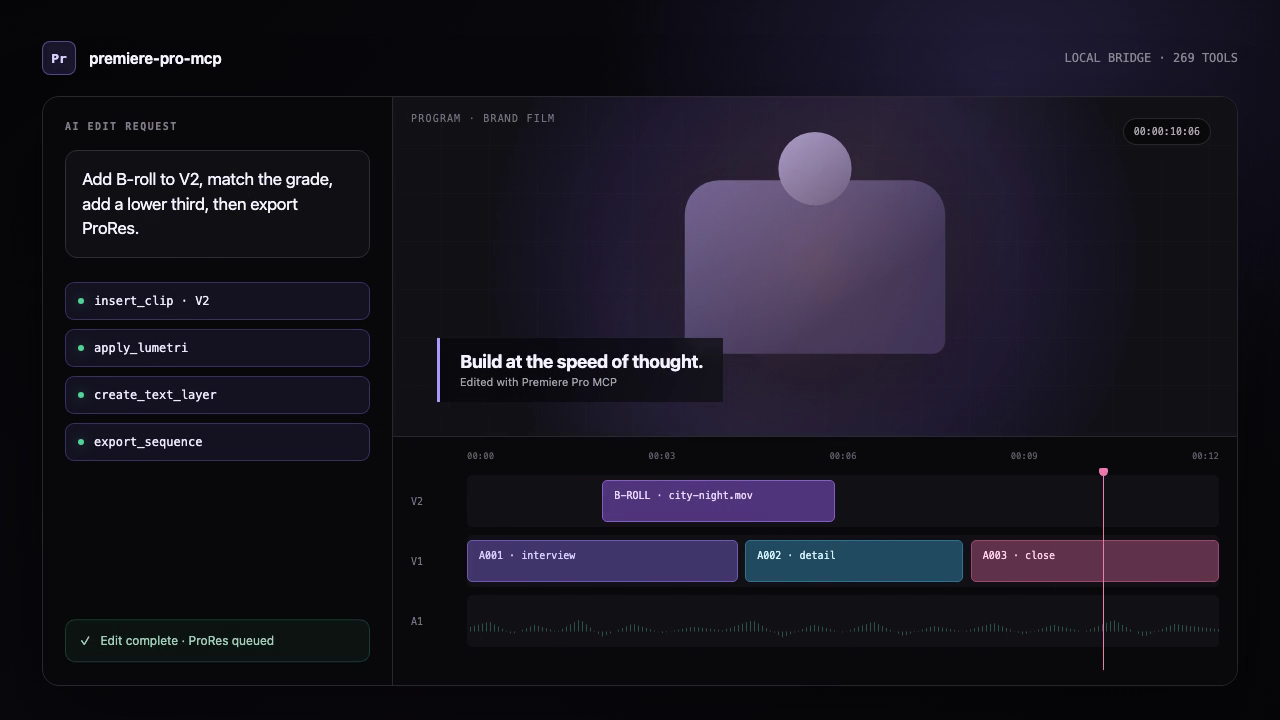
*This is an illustrated workflow, not a Premiere panel screenshot or licensed-host proof.*
1. Open a copied test project and an active sequence in Premiere.
2. Open **Window > Extensions > MCP for Adobe Premiere Pro**. “Running” means the local panel bridge is available; it does not show that an edit completed.
3. Run `premiere-pro-mcp --doctor` to check only local package/configuration readiness.
4. Ask the AI client: `Run verify_premiere_connection. Make no changes.` The returned check is read-only and avoids project names, paths, and media details.
If a bridge, project, or active sequence is missing, fix that setup state before allowing a mutation. For a concise, translatable version of this path, see [quick starts in English, Spanish, and Japanese](docs/quickstart/README.md). The translations are machine-assisted drafts and retain command names in English.
### Other AI assistants
Cursor, VS Code/Copilot, Windsurf, and other MCP clients do not currently have a project-provided one-click installer. Use their MCP settings with the advanced npm route below. Keep the assistant, server, connector, and Premiere on the same computer.
For a portable reference users can download and attach to any AI assistant, see
the [MCP for Adobe Premiere Pro setup guide for AI assistants](premiere-mcp-setup-guide.md).
Attaching the guide provides assistant context; the local server and Premiere
connector still need to be installed separately.
<details>
<summary><strong>Advanced setup: npm or source</strong></summary>
#### Before you begin
- Node.js **20.19 or newer** on Windows or macOS.
- Adobe Premiere Pro **2020–2026**. Keep Premiere, the CEP bridge, and your MCP client on the same computer for the recommended local setup.
- For `trim_clip` and `slip_edit`, install [FFmpeg](https://ffmpeg.org/download.html)
with `ffprobe` on `PATH` (`brew install ffmpeg` on macOS or
`winget install Gyan.FFmpeg` on Windows). These source-range edits are unavailable
without `ffprobe` and accessible media with readable timestamp clocks: they
refuse before mutation when physical source bounds cannot be verified.
FFmpeg also provides the optional `detect_silence` dependency. The production
Docker image already includes it.
#### 1. Install
**Option A — npm:**
```bash
npm install -g premiere-pro-mcp
```
**Option B — Clone from source:**
```bash
git clone https://github.com/leancoderkavy/premiere-pro-mcp.git
cd premiere-pro-mcp
npm install
npm run build
```
#### 2. Install the CEP plugin
**If installed via npm:**
```bash
premiere-pro-mcp --install-cep
```
**If cloned from source:**
```bash
npm run install-cep
```
This installs the plugin into Premiere Pro's per-user extensions folder and enables debug mode.
#### 3. Check the setup
```bash
premiere-pro-mcp --doctor
```
Then ask your MCP client to run `verify_premiere_connection`. The check is read-only.
#### Update an existing installation
New **releases** update the local server and Premiere connector; a deployment of
the hosted MCP service does not replace software on your computer. Fully quit
Premiere before updating the connector.
**Installed globally from npm:**
```bash
premiere-pro-mcp --check-update
premiere-pro-mcp --update
```
`--update` only changes a global npm installation. It installs the published
`latest` package, refreshes the bundled CEP connector, and leaves your MCP
client configuration and projects untouched. Restart Premiere and your MCP
client afterward, then run `verify_premiere_connection` before editing.
**From the MCP for Adobe Premiere Pro panel (Windows global npm install):**
The **MCP updates** card compares the installed global server and connector
with npm `latest`. Choose **Update after quit**, review the confirmation, then
quit Premiere normally. A per-user helper waits for Premiere to exit; it never
force-quits the app, then installs the published npm package and refreshes its
matching connector. This also supports older global installs that predate the
`--update` command.
When you reopen Premiere, the panel reports the result and reminds you to
restart your MCP client and verify the connection. This flow never changes a
project or MCP client configuration. It deliberately will not update a Git
checkout, a custom npm prefix, or a Claude Desktop `.mcpb` bundle.
**Installed from a Git clone:**
```bash
npm run check-update:source
npm run update:source
```
The source updater refuses a checkout with uncommitted files or local commits,
fast-forwards only to its configured upstream, runs `npm ci` and the production
build, then refreshes the CEP connector. This avoids silently overwriting local
code. If you installed the Claude Desktop `.mcpb` bundle, download and install
the newer bundle from the GitHub release instead; Claude controls extension
updates.
#### Remove the CEP connector
Fully quit Premiere, then remove only this connector:
```bash
premiere-pro-mcp --uninstall-cep
```
The uninstaller intentionally leaves Adobe's shared `PlayerDebugMode` setting in place so it does not disrupt other CEP extensions. Remove the MCP server from your AI client's configuration and uninstall the npm package separately if you no longer use it. On macOS, `--uninstall-cep` removes the per-user npm/source install; the signed system-wide `.pkg` route has a separate privileged removal command in [distribution readiness](docs/distribution-readiness.md#connector-removal).
</details>
---
## Publishing to npm
The easiest repeatable path is the token-free GitHub Actions workflow:
1. In the npm package settings, configure GitHub Actions as the trusted publisher for
`leancoderkavy/premiere-pro-mcp` and workflow file `npm-publish.yml`.
2. Allow the `npm publish` action.
3. Open **Actions -> Publish npm -> Run workflow** and keep the default `latest` tag.
The workflow installs dependencies, builds, runs tests, verifies the packed files, refuses to
republish an existing version, then publishes through short-lived OIDC credentials with automatic
provenance. No npm token or recurring OTP is required.
For local publishing, use the guided helper:
```bash
npm run publish:npm
```
Useful local variants:
```bash
npm run publish:npm:dry-run
NPM_OTP=123456 npm run publish:npm
NPM_TOKEN=npm_xxx npm run publish:npm
```
<details>
<summary>Manual installation (macOS)</summary>
```bash
mkdir -p ~/Library/Application\ Support/Adobe/CEP/extensions
ln -s "$(pwd)/cep-plugin" ~/Library/Application\ Support/Adobe/CEP/extensions/MCPBridgeCEP
# Enable unsigned extensions (CSXS 9–14)
for v in 9 10 11 12 13 14; do
defaults write com.adobe.CSXS.$v PlayerDebugMode 1
done
```
</details>
<details>
<summary>Manual installation (Windows)</summary>
1. Copy the `cep-plugin` folder to `%APPDATA%\Adobe\CEP\extensions\MCPBridgeCEP`
2. Open Registry Editor and set these **String (`REG_SZ`)** values to `1` (not DWORD):
- `HKEY_CURRENT_USER\Software\Adobe\CSXS.12\PlayerDebugMode`
- (repeat for CSXS.9 through CSXS.14)
</details>
### 3. Configure your MCP client
If you installed from npm, configure the client to run the global command:
```json
{
"mcpServers": {
"premiere-pro": {
"command": "premiere-pro-mcp"
}
}
}
```
If you cloned the repository instead, use the source-build configuration shown below for your client.
<details>
<summary><strong>Claude Desktop</strong></summary>
Edit `~/Library/Application Support/Claude/claude_desktop_config.json` (macOS) or `%APPDATA%\Claude\claude_desktop_config.json` (Windows):
```json
{
"mcpServers": {
"premiere-pro": {
"command": "node",
"args": ["/absolute/path/to/premiere-pro-mcp/dist/index.js"]
}
}
}
```
</details>
<details>
<summary><strong>Windsurf / Cascade</strong></summary>
Add to your MCP server configuration:
```json
{
"premiere-pro": {
"command": "node",
"args": ["/absolute/path/to/premiere-pro-mcp/dist/index.js"]
}
}
```
</details>
<details>
<summary><strong>Cursor</strong></summary>
Add to `.cursor/mcp.json` in your project or global config:
```json
{
"mcpServers": {
"premiere-pro": {
"command": "node",
"args": ["/absolute/path/to/premiere-pro-mcp/dist/index.js"]
}
}
}
```
After the server is enabled, select Claude Fable 5.1 in Cursor when you want a
longer-horizon session. See [Claude Fable 5.1 workflows](docs/claude-fable-5-1.md).
</details>
<details>
<summary><strong>GitHub Copilot (VS Code)</strong></summary>
Add to your VS Code MCP server configuration:
```json
{
"mcpServers": {
"premiere-pro": {
"command": "node",
"args": ["/absolute/path/to/premiere-pro-mcp/dist/index.js"]
}
}
}
```
</details>
### 4. Verify the bridge in Premiere Pro
1. Open (or restart) Premiere Pro
2. The bridge starts automatically using the default temp directory (or its previously saved setting)
3. Optionally go to **Window > Extensions > MCP for Adobe Premiere Pro** to confirm the green "Running" status or change the **Temp Directory** to match your MCP client config
4. Ask your AI assistant to run `get_capabilities`, then `ping`, with Premiere open.
5. For a safe first request, ask: *"What is my current Premiere Pro project and active sequence? Do not make changes."*
The default bridge directory is derived from the operating system on both sides, so most local setups should not set `PREMIERE_TEMP_DIR`. On macOS, the server resolves the per-user system temporary directory even when a GUI-launched client strips `TMPDIR`, keeping it aligned with Premiere's CEP panel. If you override it, use the same absolute path in the MCP server and CEP panel; Windows and macOS paths are not interchangeable.
### Codex plugin
This repository includes an installable Codex plugin that bundles the local MCP
server with a safety-oriented Premiere editing skill.
From a clone of this repository:
```bash
codex plugin marketplace add .
codex plugin add premiere-pro@premiere-pro-mcp
npx -y premiere-pro-mcp@1.25.0 --install-cep
```
Restart Premiere Pro and start a new Codex session after installation. The plugin
launches `premiere-pro-mcp@1.25.0` through `npx`; the separate CEP installation is
required because the MCP server communicates with the running Premiere host through
the local bridge.
The plugin source lives in [`plugins/premiere-pro`](plugins/premiere-pro), and the
repository marketplace manifest lives in
[`.agents/plugins/marketplace.json`](.agents/plugins/marketplace.json).
### GPT-6 Astra and agent tool discovery
Use the Codex plugin with `codex --model gpt-6-astra` when your account has access.
The server supplies session-aware workflow instructions and bounded tool discovery:
call `get_capabilities` with `{"tool_query":"transcript","tool_limit":10}` to
find relevant operations, their descriptions, and backend requirements. Searches
default to tools registered under the current authority and tool packs.
See [GPT-6 Astra workflows](docs/gpt-6-astra.md) for evidence retrieval, visual
review, execution ordering, and the division between MCP and client capabilities.
### GPT-6 Sol and GPT-6 Luna
Use the Codex plugin with `codex --model gpt-6-sol` for multi-step agentic edits,
or `codex --model gpt-6-luna` for focused, high-volume inspection passes, when
your account has access. Both call the same MCP tools under the same authority,
preview, and readback rules. See [GPT-6 Sol and Luna workflows](docs/gpt-6-sol-luna.md).
### Claude
For Claude Code, add this repository as a marketplace and install the plugin:
```text
/plugin marketplace add leancoderkavy/premiere-pro-mcp
/plugin install premiere-pro@premiere-pro-mcp
```
Then install the Premiere bridge and start a new Claude Code session:
```bash
npx -y premiere-pro-mcp@1.25.0 --install-cep
```
The Claude Code package lives in
[`claude-plugins/premiere-pro`](claude-plugins/premiere-pro), with its marketplace
at [`.claude-plugin/marketplace.json`](.claude-plugin/marketplace.json).
Claude Desktop uses the self-contained MCP Bundle (`.mcpb`) format. Build and
validate the current bundle with:
```bash
npm run build:claude
```
Install the resulting file from `artifacts/` through **Settings > Extensions >
Advanced settings > Install Extension**. The Premiere CEP bridge must still be
installed separately.
### Claude Fable 5.1
Use Cursor, Claude Desktop, or Claude Code with Claude Fable 5.1
(`claude-fable-5-1`) when your account has access. Model selection belongs to the
client; this server does not run an Anthropic model. Fable 5.1 is optional:
other Claude models can call the same MCP tools. If Cursor Privacy Mode or an
Enterprise plan is enabled, an admin must approve Anthropic's Fable data-retention
policy before the model is available.
The server supplies session-aware workflow instructions and bounded tool discovery:
call `get_capabilities` with `{"tool_query":"transcript","tool_limit":10}` to
find relevant operations, their descriptions, and backend requirements. Keep
Premiere mutations serialized even in a long Fable 5.1 session. Image review of
returned frames is not playback or delivery proof.
See [Claude Fable 5.1 workflows](docs/claude-fable-5-1.md) for connection order,
privacy boundaries, evidence retrieval, Cursor's Opus fallback, and the division
between MCP and client capabilities. The public walkthrough is
[How to Use Claude Fable 5.1 with MCP for Adobe Premiere Pro](https://premiere-pro-mcp.com/blog/claude-fable-5-1-premiere-pro-mcp/).
### Claude Opus 5.5
Use Claude Code, Claude Desktop, or Cursor with Claude Opus 5.5
(`claude-opus-5-5`) when your account has access. Model selection belongs to the
client; this server does not run an Anthropic model. Opus 5.5 is optional. Keep
Premiere mutations serialized and preview before apply. See
[Claude Opus 5.5 workflows](docs/claude-opus-5-5.md).
### Windows and macOS capability coverage
| Surface | Windows | macOS | Verification boundary |
| :------ | :------ | :---- | :-------------------- |
| CEP production bridge | Premiere Pro 2020–2026 | Premiere Pro 2020–2026 | Run `get_capabilities`, then `ping` with Premiere open |
| UXP preview bridge | Premiere Pro 25.6+ | Premiere Pro 25.6+ | Live loopback WebSocket and host API verification required |
| npm CEP installer | Copies plugin and verifies `REG_SZ` debug keys | Copies plugin and verifies the installed manifest/debug settings | Restart Premiere after installation |
| AE MOGRT authoring CEP bridge | After Effects 2018+ | After Effects 2018+ | Opens only a saved, workspace-contained AE project; a local ZIP check is not import, playback, or visual verification |
| CI build and unit tests | Node 20, 22, and 24 | Node 20, 22, and 24 | GitHub-hosted OS runners; no Adobe host is available in CI |
`get_capabilities` reports the current operating system, temp directory, CEP/UXP coverage, enabled authority profile, and any live-host verification still required. It also includes the full `tools` catalog generated from the tools registered by the server, including tools disabled by the active profile. Every entry identifies:
- the execution backend (`local`, CEP/ExtendScript, QE, or orchestrator);
- static support status (`supported`, `limited`, `experimental`, or `unsupported`);
- the minimum Premiere version known to the server;
- the required authority and whether the current profile enables it;
- the verification boundary and whether a live Premiere host is required; and
- relevant operational notes.
QE-backed tools are reported as `experimental` because QE is undocumented and can vary between Premiere builds. Authority availability is reported separately from implementation support, so disabling `edit`, for example, does not incorrectly label editing tools as unsupported. Static metadata never claims that a Premiere operation succeeded; use `ping` and inspect each tool result for runtime evidence.
MCP `tools/list` is filtered to the active authority profile. The default
`inspect,edit,export,filesystem` profile advertises 367 of the 369 registered
tools and omits `execute_extendscript` and `evaluate_expression`, which require
explicit `unsafe-script` authority. `ping` and `get_capabilities` remain visible
under every profile so a restricted or misconfigured server can still explain
its state. The call-time capability guard remains authoritative even if listing
metadata is wrong.
### Workflow-scoped discovery packs and structured outputs
By default, the full permitted catalog remains available. Set
`PREMIERE_MCP_TOOL_PACKS` to `essential`, `inspection`, `delivery`, `captions`,
or a comma-separated combination such as `inspection,captions` to reduce the
tool discovery and registered session surface for a focused client. `full` is the explicit
full-catalog mode and cannot be combined with another pack. `ping` and
`get_capabilities` remain listed for diagnosis, and every registered call still
passes through the same capability guard; a pack never grants authority.
Every listed tool now declares the same machine-readable result envelope through
MCP `outputSchema`: `ok`, `tool`, plus `data` on success or `error` on failure.
The tool-specific `data` shape remains versioned by the individual tool result,
so clients can reliably distinguish transport success from a Premiere or local
operation failure without parsing the text block.
### After Effects MOGRT studio
This is a narrow authoring path, not an arbitrary After Effects script runner.
Install the separate local connector, fully restart After Effects, and open
**Window > Extensions > MCP for Adobe After Effects**:
```bash
premiere-pro-mcp --install-after-effects-cep
```
Then open a saved `.aep` project inside an approved workspace and use this order:
1. `verify_after_effects_connection` — read-only connector and saved-project check.
2. `preview_mogrt_recipe` — produces an expiring, one-time plan for one of five
supported recipes: `lower_third`, `title_card`, `callout`, `quote_card`, or
`social_end_card`; it never creates directories or contacts Adobe.
3. `create_mogrt_recipe` with that token and `confirm_export: true` — creates one
composition, saves the open project, and requests one `.mogrt` export.
4. `verify_mogrt_artifact` — checks only local file existence and its ZIP header.
Optional studio paths retain the same preview-and-confirm boundary:
- `validate_mogrt_brand_kit` validates local name-prefix, accent/text colors,
font request, safe-margin, and workspace-contained logo values before they
are passed into a recipe.
- `preview_mogrt_batch` / `create_mogrt_batch` export up to 20 JSON/CSV rows
serially; batches stop on a host error and do not promise rollback.
- `preview_mogrt_library_publish` / `publish_mogrt_to_library` write a new,
immutable `v001`, `v002`, … copy under an already-existing local library.
- `inspect_after_effects_template_source` returns source-comp dimensions,
duration, fonts, layer kinds, and controller names on AE 16.1+, while
`inspect_after_effects_render_templates` lists host template names from an
existing queue item.
- `preview_after_effects_render` / `enqueue_after_effects_render` queue one
exact render but never start it. `preview_mogrt_premiere_handoff` /
`apply_mogrt_premiere_handoff` import into an explicitly named empty
`MOGRT Verify - …` Premiere sequence and read back insertion/control
descriptors.
The authoring connector uses `AFTER_EFFECTS_MCP_TEMP_DIR` (default: the OS temp
directory plus `after-effects-mcp-bridge`), completely separate from
`PREMIERE_TEMP_DIR`. The tool will not create, replace, or switch projects; it
requires the already-open AE project and output directory to be contained by the
same approved workspace. An import/control readback still needs rendered-frame
review before delivery; use `capture_frame` or a separate approved export path.
`inspect_sequence_review_report` creates one read-only handoff report from
Premiere timeline readback: sequence structure, primary-track gaps, disabled
clips, muted tracks, marker timing, and offline-source evidence. It never
returns media paths; marker comments are omitted unless explicitly requested.
The report is not proof of rendered pixels, audio quality, caption accuracy,
rights, or editorial approval.
The MCP handshake reads `serverInfo.version` from the installed `package.json`,
so clients receive the package version that is actually running rather than a
separately maintained literal.
Tools with mixed execution boundaries can provide explicit operational metadata at registration. This is used for local file verification, static feature-support reports, and hybrid local-plus-Premiere validation so the capability catalog does not infer a host dependency from naming alone.
### Collaboration and AI feature boundaries
`get_advanced_feature_support` returns a machine-readable matrix for Productions,
Team Projects, Frame.io, Media Intelligence, Generative Extend, Object Mask,
caption translation, Speech-to-Text, Enhance Speech, Remix, editorial plans,
Premiere AI Assistant, Generative Media, and a future local semantic index. Each
entry includes an explicit access mode: direct, observable-only, artifact-import,
external-provider, user-assisted, unavailable, or planned. Pass an optional
Premiere version, intended backend, confirmed entitlements, and network state to
evaluate prerequisites without conflating them with API availability. It
distinguishes documented APIs from entitlements, network prerequisites, separate
service APIs, and user-assisted operations without using menu automation or
private APIs.
The report tool itself is local: it does not contact Premiere and is callable
through the current MCP server. Each feature entry separately reports whether
its operations are callable through the production CEP transport. Productions
reports only static backend/version eligibility until a UXP host performs live
capability negotiation.
- Productions exposes documented read-only state through UXP, but the production
MCP transport is still CEP.
- Frame.io needs a separately authenticated Frame.io API integration; an account
entitlement alone does not make it callable through Premiere's DOM.
- Transcript JSON import/export is documented in UXP. Starting Speech-to-Text is not.
- `preview_transcript_edit_uxp` and `plan_transcript_rough_cut_uxp` provide a
revision-locked transcript-edit workflow. The planner maps selected transcript
ranges to verified 1x placements in a duplicate sequence and emits descending
split/remove instructions; it does not claim that Adobe exposes native transcript
text deletion or perform an unverified destructive edit.
- The remaining AI operations are user-assisted or unsupported by documented
public APIs. The tool explains what can be inspected after a user completes
the operation and where artifact provenance cannot be established safely.
- The server never uses menu automation, private APIs, clip-name heuristics, or
duration changes as proof that an AI operation occurred.
### Reusable project context
For projects where repeatedly inspecting clips, transcripts, audio, and timeline
placements is expensive, call `manage_project_context` with `action: "capture"`.
The local context engine indexes a bounded active-sequence snapshot, hashes native
project/media paths before persistence, and returns independent source, timeline,
and combined context revisions. Add transcript passages, shot descriptions, audio
observations, or editor notes once with `action: "enrich"`; ordinary trims and moves
update the timeline revision without discarding unchanged source analysis.
Use `search_project_context` to retrieve only evidence relevant to the current
editing intent. `create_context_edit_plan` returns a non-mutating candidate scaffold
and stale-state guards; `create_editorial_plan` adds reviewed organization,
stringout, rough-cut, and caption-artifact routes without calling an LLM or
changing Premiere. Exact identities must still be resolved and passed through the
routed operation's preview/confirmation flow before any application. See the
[project context engine guide](docs/project-context-engine.md) for storage
controls, privacy boundaries, and invalidation behavior; see
[local-first AI editorial workflows](docs/ai-editorial-workflows.md) for the
complete review-and-route workflow.
### Authenticated UXP connection
The MCP server can accept a local UXP panel connection and invoke the UXP commands that are currently implemented:
```bash
PREMIERE_UXP_TOKEN="replace-with-a-long-random-secret" premiere-pro-mcp
```
Generate that secret yourself and enter the same value in the UXP panel (**Window → UXP Plugins**, not the CEP Connector). CEP-only setups do not use a token. The listener binds only to `127.0.0.1:7777`, authenticates the WebSocket upgrade, requires a versioned capability handshake, correlates concurrent requests, and fails pending work on timeout or disconnect. Set `PREMIERE_UXP_PORT` to use another loopback port.
When enabled, MCP discovery includes 96 capability-gated UXP additions. The first expansion covers effects, deterministic timeline selection, selection batches, scene detection, proxy/ingest, relink, metadata, color conformance, read-only Premiere/After Effects environment inspection, Source Monitor audition, storage, and least-privilege workspace access. The second adds Project-panel selection, marker CRUD, single-transaction undoable beat-grid marker application, bin organization, sequence settings, imports, typed effect parameters/keyframes, track-item transforms, atomic J/L split edits, SequenceEditor timeline edits, sequence lifecycle, and AME encoding. The third wave begins with a redacted event journal, conservative AME terminal receipts, explicit host-readiness gates, safe multi-project sessions, lease-based growing-media control, namespaced workflow checkpoints, bounded media-health maintenance, caption-aware track mute state, transactional source trim/framing, guarded sequence-range updates, guarded source-media start timing, and guarded source-media frame-rate/pixel-aspect overrides documented in [the third-wave workflow matrix](docs/third-wave-uxp-workflows.md). The bounded migration surface also includes a non-ripple selected-item lift, native video-transition listing and guarded transactions, native active and explicit-GUID sequence timing inspection, opt-in installed-MOGRT directory inspection without filesystem enumeration, bounded native timeline structure inspection with opt-in source IDs, classification, and broad content category, guarded sequence display-format updates, a capped native Project-panel tree, a double-read Project-panel insertion-bin snapshot, guarded empty/default sequence creation, bounded native Project-panel schema/item-column metadata inspection, guarded direct Project-panel metadata replacements with exact state/readback guards, guarded typed Project metadata schema-field creation with non-field-level readback, guarded direct updates to three named application preferences, guarded transcript JSON replacement for one exact source clip, direct active-track-item identity readback, guarded source-only slips, guarded contiguous three-item slides, guarded append-only timeline duplicates, guarded contiguous same-track ripple deletes, guarded source-project-item color labels resolved from one timeline coordinate, guarded explicit-sequence preview-frame rectangle updates, explicit opt-in source-media provenance paths with bounded double resolution, bounded source-proxy readiness with an explicit attached-path disclosure, guarded static effect-parameter PointF x/y updates, bounded effect-parameter descriptor catalogs, bounded project/sequence Object Mask audits, native FrameRate/TickTime frame-alignment inspection with caller-owned inputs and tick readback, and native TickTime arithmetic over caller-owned canonical tick strings; it does not claim direct empty-track create/delete, global redo support, playback proof, Object Mask counts or visual validity, an atomic Project-panel metadata compare-and-set, app-preference Undo, installed-template availability or compatibility, imported transcript persistence, override-presence/clear semantics, path existence, source lineage or rights, proxy compatibility, general or keyframed effect-parameter value readback, rendered-frame correctness, linked-item sync, or licensed-host validation. A separate [hybrid benchmark gate](docs/uxp-hybrid-benchmark.md) keeps native acceleration disabled until reproducible cross-platform evidence exists. See also [the first stable workflow matrix](docs/uxp-stable-workflows.md), [the next-ten workflow matrix](docs/uxp-next-ten-workflows.md), [the guarded-slip workflow notes](docs/uxp-slip-workflows.md), [the guarded-slide workflow notes](docs/uxp-slide-workflows.md), [the guarded-duplicate workflow notes](docs/uxp-clone-workflows.md), and [the guarded-ripple-delete workflow notes](docs/uxp-ripple-delete-workflows.md). Commands are advertised only while the authenticated local UXP bridge is connected; the host capability handshake remains the authority for support in the running Premiere build. A failed UXP command is never silently retried through CEP because the first operation may have partially succeeded. UXP edits require a matching command-schema/receipt version, durable panel ledger storage and native cryptographic entropy; older unversioned panels remain read-only until the matching panel is installed.
The bounded UXP migration surface also exposes a read-only animated-PointF endpoint-displacement inspection through `automate_effect_parameters_uxp`. It requires one exact component and parameter target plus a strictly increasing time interval, double-reads native endpoint values and their distance, and refuses static, malformed, or changed parameter state. It does not modify Premiere or prove rendered appearance, playback, persistence, Undo, or licensed-host behavior.
The bounded UXP migration surface also exposes guarded static Color effect-parameter RGBA updates through `automate_effect_parameters_uxp`. They require a complete double-read snapshot, explicit confirmation, a valid operation ID, per-parameter serialization, one native transaction, and exact raw-component readback. They reject time-varying parameters and do not claim keyframed Color edits, color management, rendered appearance, playback, persistence, Undo, or licensed-host validation.
The bounded UXP migration surface also exposes guarded typed Project metadata schema-field creation. It requires the exact inspected active-project identity and 12 KiB-bounded panel XML, an explicit confirmation and operation ID, and serializes this bridge's schema and panel-replacement calls per project. Adobe provides no atomic compare-and-set or field-level schema getter: native acceptance and a changed panel XML are evidence only, so the command always returns `committed_unverified` and does not claim field presence, persistence, UI results, Undo, cancellation, or licensed-host validation.
The panel now requests access to one operator-selected workspace instead of declaring full filesystem access. Choose the folder in the panel before invoking a path-based UXP workflow. Media, relink, preset, export, and Source Monitor file paths must remain inside it; the persistent capability token and native root path are never returned over MCP. After a folder is granted, path-based commands resolve each native path through that folder's Entry tree and compare the host `nativePath` against the approved root, so symlink or junction targets outside the workspace still fail closed. If the host Entry cannot be walked and no resolver is supplied, those commands stay unsupported and the CEP fallback remains the path-based compatibility route.
Native transcript editing starts with a read-only, revision-locked planning flow. Use
`get_clip_transcript_uxp` to export the transcript Premiere generated for a source
clip, select source-time ranges from that JSON, and pass its SHA-256 revision to
`preview_transcript_edit_uxp`. The preview sorts and merges ranges and returns a
confirmation token without changing the timeline. Premiere does not expose a
documented operation that directly turns deleted transcript text into timeline cuts,
so automatic application remains withheld until the source-to-sequence mapping and
documented reconstruction path pass live-host validation. `search_clip_transcript_uxp`
provides read-only discovery without substituting an external transcription engine.
Premiere 26.2-26.3 hosts also expose documented UXP workflows for revisioned project
inspection, verified project saves, preset-based sequence creation, OTIO/FCP XML
interchange, transcript-language discovery, Object Mask detection, Adobe Media
Encoder control, track renaming, subclip creation, stable marker inspection,
Source Monitor positioning, and clip transcript detection. Mutations accept optional
idempotency keys and return explicit verification outcomes. See [the Adobe UXP 26.3
coverage matrix](docs/adobe-uxp-26.3-coverage.md) and [the UXP capability
foundation](docs/uxp-capability-foundation.md) for the command matrix and live-host
validation boundary.
The [Premiere surface registry](docs/premiere-surface-registry.md) separately
tracks the Premiere DOM, general UXP JavaScript, HTML/CSS, Spectrum, plugin
guides, UXP Hybrid C++, the standalone Premiere C++ PrSDK, CEP/ExtendScript,
the CEP platform, QE, and pinned competitor sources. The exhaustive
[general UXP JavaScript inventory](docs/uxp-js-api-inventory.md) is generated
from Adobe's pinned declarations, while the exhaustive
[Premiere documentation inventory](docs/premiere-doc-inventory.md) tracks every
page in Adobe's live sitemap. This keeps declaration and documentation
inventory distinct from implementation and licensed-host coverage.
The stable workflow expansion adds native component-chain effects, deterministic
timeline selection, compound selection batches, scene-edit detection, proxy/ingest control, guarded offline
relink, transactional project/XMP metadata, color and footage-conformance
preflight, full Source Monitor audition, and project/Production storage checks.
See [the stable UXP workflow matrix](docs/uxp-stable-workflows.md) for exact
argument, undo, confirmation, and live-host boundaries.
---
## Architecture
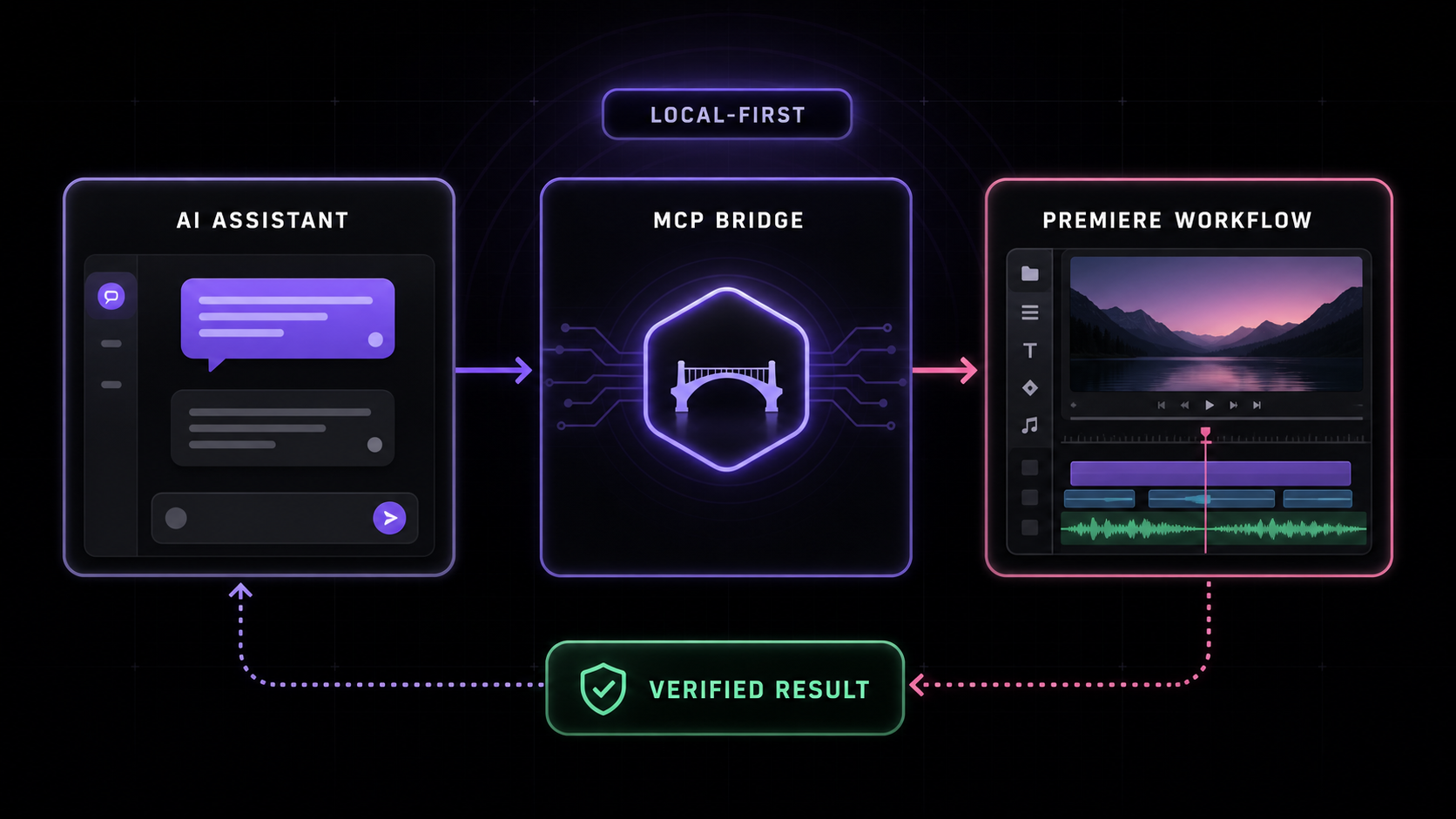
**Local (stdio):**
```text
┌───────────────┐ stdio (MCP) ┌──────────────┐ File-based IPC ┌───────────────┐
│ AI Client │ ◄──────────────► │ MCP Server │ ◄────────────────► │ CEP Plugin │
│ (Claude, │ │ (Node.js / │ .jsx commands │ (runs inside │
│ Windsurf, │ │ TypeScript) │ .json responses │ Premiere) │
│ Cursor, │ └──────────────┘ └──────┬────────┘
│ Copilot) │ │
└───────────────┘ │ evalScript()
▼
┌───────────────┐
│ Premiere Pro │
│ ExtendScript │
│ + QE DOM │
└───────────────┘
```
**Remote (HTTP/SSE — Fly.io):**
```text
┌───────────────┐ HTTP+SSE (MCP) ┌─────────────────────┐ File-based IPC ┌──────────────┐
│ AI Client │ ◄──────────────► │ MCP Server │ ◄────────────────► │ CEP Plugin │
│ (any MCP │ │ premiere-pro-mcp │ .jsx / .json │ (Premiere) │
│ client) │ │ .fly.dev │ shared volume └──────────────┘
└───────────────┘ └─────────────────────┘
```
1. AI client invokes an MCP tool (e.g., `add_to_timeline`)
2. MCP server generates ES3-compatible ExtendScript with helper functions prepended
3. Script is written to a `.jsx` command file in a shared temp directory
4. CEP plugin polls for command files, executes via `CSInterface.evalScript()`
5. Result JSON is written to a response file and returned to the AI
The file-based IPC bridge is simple, reliable, and works across macOS and Windows without network sockets.
---
<a id="tools"></a>
`inspect_unique_object_identity_uxp` is a separate read-only native identity
inspection route. It resolves exactly one project item or sequence, reads the
opaque `UniqueSerializeable` identity twice, and rejects drift without retaining
the value or treating it as edit authority. See the [unique-identity workflow
notes](docs/uxp-unique-identity-workflows.md) for its bounds and proof boundary.
## Film editorial review
`inspect_film_editorial_workflow` validates captured identities and explicit
source/scene coverage, builds marker/stringout/line/beat review artifacts, and
reports revision-bound notes, VFX state, change impact and turnover exceptions.
It performs local inspection; host edits and exports use separate guarded tools.
See [usage, example and remaining execution adapters](docs/film-editorial-workflows.md).
Reviewed assistant-editing tools now provide dialogue candidate decisions, quote paper-edit CSV, batch copy previews, sync-evidence triage, and owned-footage B-roll review. These are local evidence reviews, not new host engines. See [review workflow contracts](docs/editorial-review-workflows.md).
See [Filmcraft improvement ledger](docs/filmcraft-improvements.md) for exact-time
planning, recovery, job observation, temporal evidence and facility workflows.
## Tools (441 core total; 439 under the default profile; 535 with a connected UXP bridge)
The [complete supported-actions catalog](docs/supported-actions.md) lists every
registered core tool, the two tools restricted behind explicit `unsafe-script`
authority, and all 96 authenticated UXP additions with their current action or mode
values. It is generated from the same MCP registration surface returned to clients;
the tables below are a shorter workflow-oriented overview.
### Discovery & Inspection (10 + 10)
| Tool | Description |
| :--- | :---------- |
| `get_project_info` | Current project name, path, sequences, items |
| `get_active_sequence` | Detailed active sequence with all clips |
| `list_project_items` | All items in the project panel |
| `get_full_project_overview` | Comprehensive snapshot: bin tree, sequences, media types |
| `get_full_sequence_info` | Exhaustive sequence data: tracks, clips, effects, markers |
| `get_full_clip_info` | Everything about a clip: effects, keyframes, metadata |
| `get_timeline_summary` | Human-readable overview: duration, coverage %, effects |
| `search_project_items` | Filter by name, extension, offline status, color label |
| `get_premiere_state` | Full snapshot: project, sequence, playhead, selection |
| `inspect_dom_object` | Explore any Premiere Pro DOM object interactively |
| `get_advanced_feature_support` | Collaboration/AI API support, prerequisites, entitlements, and user-assisted boundaries |
| `create_editorial_plan` | Create a review-only local editorial plan from captured project context |
| `preview_editorial_plan` | Revalidate a local editorial plan and return a review receipt without changing Premiere |
| `apply_editorial_organization_plan` | Apply a confirmed organization plan through guarded UXP bin transactions only |
### Project Management (27)
| Tool | Description |
| :--- | :---------- |
| `save_project` / `save_project_as` / `open_project` | File operations |
| `create_project` / `close_project` | Project lifecycle |
| `import_media` / `import_folder` / `import_ae_comps` | Import media and AE comps |
| `create_bin` / `delete_bin` / `rename_bin` / `create_smart_bin` | Bin management |
| `audit_project_structure` | Audit Project-panel layout rules (allowed root names, extension-to-bin, sequences bin, depth, empty bins); optional `apply` with the audit's `plan_token` creates target bins and moves planned items with per-item parent readback. Never deletes or renames |
| `import_sequences` / `import_fcp_xml` | Import from other projects |
| `create_bars_and_tone` | Generate bars & tone media |
| `set_scratch_disk_path` | Configure scratch disks |
| `consolidate_and_transfer` | Project Manager consolidation |
### Timeline & Editing (11 + 27 advanced)
| Tool | Description |
| :--- | :---------- |
| `add_to_timeline` / `overwrite_clip` | Insert and overwrite edits |
| `ripple_delete` | Remove clip and close gap (QE) |
| `roll_edit` / `slide_edit` / `slip_edit` | Professional trim modes (QE) |
| `move_clip_to_track` | Move between tracks (QE) |
| `reverse_clip` / `speed_change` / `set_clip_speed_qe` | Unavailable: Premiere's documented ExtendScript and UXP APIs have no setter for a timeline clip's speed or direction; use `set_clip_duration` for timeline length |
| `split_clip` / `trim_clip` / `move_clip` | Basic edits; trim verifies source points and visible timeline edges |
| `set_clip_duration` | Set a clip's timeline duration or absolute end (extends still images); refuses next-clip overlaps and restores the original end if Premiere clamps |
| `set_clip_properties` | Opacity, scale, rotation, position (speed requests fail before mutation) |
| `link_selection` / `unlink_selection` | Link/unlink A/V |
> **Premiere Pro 26.3 compatibility:** some installations silently ignore QE structural edits
> (`ripple_delete`, razor/split) and existing effect-parameter writes. These tools now verify
> the resulting sequence state and return an error instead of a false success. For structural
> edits, rebuild the wanted source ranges into a new sequence with `create_sequence` and
> `add_to_timeline`. The legacy CEP transition path targets `qeClip.addTransition` (not the
> QE track) and reports success only after DOM transition-count readback. Prefer the connected
> UXP transition tools where available; overlay clips remain a workaround when a legacy QE
> write is rejected or not verified. See [issue #21](https://github.com/leancoderkavy/premiere-pro-mcp/issues/21).
> **Speed, caption, and visual-keyframe boundaries:** Premiere Pro 26.3 may reflect legacy QE
> speed/direction methods, but exposes no supported scripting setter or Time Remapping component
> for timeline-clip speed or direction (documented UXP through 26.3 has only `getSpeed` /
> `isSpeedReversed`). `reverse_clip`,
> `speed_change`, `set_clip_speed_qe`, and `set_clip_properties` with `speed` now stop before host mutation;
> use `set_clip_duration` to change timeline length, or the Speed/Duration UI or pre-rendered media to retime. `add_text_overlay` likewise stops
> before mutation because a raw-text-to-caption API is not exposed; import an `.srt`/`.vtt`
> and use `create_caption_track`, or use a MOGRT/PNG overlay. Keyframe and caption-track
> responses can prove parameter/structure readback only—not rendered pixels—so verify playback
> or exported frames before delivery. On macOS, AME preset discovery scans each installed app
> bundle's `Contents/MediaIO/systempresets`; prefer a Match Source preset for vertical projects.
> **Host limits:** [The capability ledger](docs/host-api-limitations.md) distinguishes
> unavailable APIs, unverified host requests, and property/structure readback.
> A verified parameter or component does not establish rendered appearance.
> **Verified track edits:** `add_track` and `add_tracks` validate requested counts and
> return success only when the active sequence's track counts exactly match the request.
> `overwrite_clip` validates both selected track indices and confirms the requested source
> item appears at the requested frame on a target track. On a Premiere 26.x build that
> ignores any of these calls, the MCP response is an error with the observed state rather
> than a false success. These are automated CEP contracts, not proof of a particular
> licensed host configuration.
`trim_clip` accepts exactly one source-relative `new_in_seconds` or `new_out_seconds` per
call. It refuses retimed clips because CEP cannot prove their source-to-timeline mapping, then
reads both source points and visible timeline start/end/duration before reporting success. The
default `keyframe_policy: "reject"` stops before a trim that would leave effect keyframes beyond
the visible clip; `keyframe_policy: "preserve"` is an explicit opt-in and reports the remaining
count. `keyframe_policy: "hold_last_value"` also keeps them, and makes each animated numeric
parameter hold its edge value: a trim into an animation keys the new edge with the value sampled
there, and an extension past hidden keys anchors the old and new edge at the old edge value. It
refuses before mutation when keys would be revealed or a value cannot be sampled or written
losslessly, and reads every value back at the new edge (`committed_unverified` if one differs). Only edge values are verified; a Bezier segment next to an added key can
reshape between keys. `split_clip` verifies a spanning clip, the expected count increase, and the left/right
cut boundaries. Its QE path cannot prove effect-keyframe redistribution, so a successful result
labels those semantics `unverified`. These are CEP contract checks, not validation in a licensed
Premiere Pro 26.x host.
`set_clip_duration` changes a placed clip's timeline length without touching source in/out
directly: pass exactly one of `duration_seconds` (from the current start) or `end_seconds`
(absolute timeline end). It writes the documented `TrackItem.end` as a tick-based `Time`, refuses
an end that would overlap the next clip on the same track, applies the same `keyframe_policy`
guard as `trim_clip` when shortening, and reads start/end back. If Premiere clamps the end (for
example, video media with no remaining handle, or a still whose project item has in/out points),
the original end is restored and the tool returns an error. Linked audio/video partners are not
adjusted. This is a CEP contract check, not validation in a licensed Premiere Pro host.
### Effects & Color (8)
| Tool | Description |
| :--- | :---------- |
| `apply_effect` / `apply_audio_effect` | Apply by name (QE) |
| `remove_effect` / `remove_all_effects` | Remove effects |
| `color_correct` | Lumetri: exposure, contrast, temperature, etc. |
| `apply_lut` | Apply LUT files |
| `stabilize_clip` | Warp Stabilizer with configurable settings |
> **Premiere 26.x component removal:** `remove_effect` and `remove_effect_by_name`
> require the CEP `Component.remove()` method. Some 26.x components, including
> Essential Sound's **Amplify**, do not expose that method. The tools return an
> actionable capability error and leave the component unchanged; use Effect Controls
> to remove it manually. The QE DOM has no safe targeted-removal fallback.
> **Essential Sound audio automation:** Essential Sound can write ducking or level
> automation to an **Amplify** component rather than the clip's **Volume > Level**.
> `adjust_audio_levels`, `set_clip_volume`, and `get_clip_volume` operate only on
> Volume > Level, so they do not read, change, or verify Amplify automation. Inspect
> the clip's components (or Effect Controls) before treating a Volume readback as the
> clip's final gain.
### Keyframes (8)
| Tool | Description |
| :--- | :---------- |
| `add_keyframe` / `get_keyframes` | Create and read keyframes |
| `remove_keyframe` / `remove_keyframe_range` | Delete keyframes |
| `set_keyframe_interpolation` | Linear / Hold / Bezier |
| `get_value_at_time` | Query interpolated value at any time |
| `set_color_value` | Set color properties on effects |
### Export & Encoding (19)
| Tool | Description |
| :--- | :---------- |
| `export_sequence` | Export via Adobe Media Encoder |
| `export_sequence_job_start` / `get_export_job_status` | Asynchronous AME export job for long renders: returns a job id at once, then reports queued, encoding, completed, or failed with event and output-file evidence |
| `validate_export_preset` | Validate an `.epr` file and resolve its output extension in Premiere |
| `verify_delivery_file` | Verify output size and calculate SHA-256/SHA-512 checksums |
| `capture_frame` | Export frame as PNG, return as base64 image |
| `export_as_fcp_xml` / `export_aaf` / `export_omf` | Interchange formats |
| `export_sequence_edl` | CMX 3600 EDL for one track, generated from timeline readback and self-validated (cuts, reels, drop/non-drop timecode, M2 lines for retimed clips) |
| `encode_project_item` / `encode_file` | Direct encoding |
| `start_batch_encode` | Start render queue |
Documented Premiere UXP exposes format-specific OTIO import/export through
runtime-probed `export_interchange_uxp` and `import_interchange_uxp`. CEP has no
documented native OTIO route. Native EDL, Render and Replace, cloud publishing
and Content Credentials export configuration remain unavailable through the
supported automation contracts. `export_sequence_edl` therefore builds the CMX 3600 list
locally from the clips Premiere reads back and validates it with the same parser
used by `inspect_cmx3600_edl`; it is not a Premiere-native export.
`get_capabilities` reports the remaining delivery gaps explicitly rather than
presenting UI-only operations as available tools.
### Source Monitor & Playback (7 + 4)
| Tool | Description |
| :--- | :---------- |
| `open_in_source` / `close_source_monitor` | Source monitor control |
| `insert_from_source` / `overwrite_from_source` | 3-point editing |
| `play_timeline` / `stop_playback` | Playback control (QE) |
| `play_source_monitor` | Play in source monitor |
### Selection & Clipboard (7 + 7)
| Tool | Description |
| :--- | :---------- |
| `select_clips_by_name` / `select_clips_in_range` | Smart selection |
| `copy_effects_between_clips` | Copy effects via QE |
| `paste_clip_attributes` | Paste Attributes: effect stack, values, and keyframes with per-property readback; masks and differing Blend Mode are reported, not copied |
| `batch_apply_effect` | Apply effect to multiple clips |
| `set_blend_mode` | 27 blend modes |
### Media Properties (16)
| Tool | Description |
| :--- | :---------- |
| `set_offline` / `has_proxy` / `detach_proxy` | Offline/proxy management |
| `set_override_frame_rate` | Override FPS |
| `set_scale_to_frame_size` | Auto-scale to sequence frame |
| `get_xmp_metadata` / `set_xmp_metadata` | Raw XMP access; writes merge a well-formed patch without removing unrelated fields |
| `get_color_space` | Color space info |
### Sequence Management (11)
| Tool | Description |
| :--- | :---------- |
| `create_sequence` / `create_sequence_from_preset` | Create sequences from `.sqpreset` files without opening Premiere's modal dialog |
| `duplicate_sequence` / `delete_sequence` | Manage sequences |
| `auto_reframe_sequence` | Auto-reframe for social media |
| `attach_custom_property` | FCP XML custom properties |
| `unnest_sequence` | Replace nested sequence with its clips |
### Workspace & Captions (2 + 1)
| Tool | Description |
| :--- | :---------- |
| `get_workspaces` / `set_workspace` | Switch workspace layouts |
| `create_caption_track` | Create caption/subtitle tracks |
### Timeline QA (2)
| Tool | Description |
| :--- | :---------- |
| `diff_sequence_snapshots` | Added / removed / moved / trimmed / retimed / renamed / enabled changes between two sequence snapshots with frame deltas and EDL-like lines |
| `audit_timeline_health` | Health score with flash-frame, gap, overlap, repeated-shot, coverage, overlength, and speed findings plus review-frame suggestions |
### Editor Requests: markers, selection, checkpoints, navigation (5)
| Tool | Description |
| :--- | :---------- |
| `add_markers_batch` | Up to 200 sequence or clip markers in one verified request; feed it beat grids from `detect_beats`, chapters from `plan_chapter_markers`, or client notes from `plan_client_notes_checklist` |
| `select_clips_by_pattern` | "Select every other clip": every-Nth selection with offset, name/regex, duration, range, track, and enabled filters, read back after selecting |
| `create_sequence_checkpoint` / `list_sequence_checkpoints` | Named `[checkpoint]` sequence clone before a risky edit, plus a `diff_sequence_snapshots`-ready snapshot of the original |
| `navigate_playhead` | Start, end, in/out, work area, next/previous edit or marker, or frame stepping with position readback |
### Review and Conversation Planning (2)
| Tool | Description |
| :--- | :---------- |
| `plan_client_notes_checklist` | Pasted client or reviewer feedback → prioritized checklist (category, must/should/nice, approvals, questions, timecodes and ranges) and an `add_markers_batch` payload |
| `plan_multicam_angle_switches` | Active-speaker angle switching for stacked camera tracks: minimum holds, crosstalk cover shots, lead-in cuts, cutaways, razor times, per-camera enable ranges, and markers |
Both planners are local and deterministic. Premiere exposes no scripting API
for switching angles inside a multicam source sequence, so the multicam plan
targets synced clips stacked on separate video tracks and is applied through
`razor_all_tracks`, `select_clips_in_range`, `batch_enable_disable`, and
`add_markers_batch` on a checkpointed sequence. See
[editor requests](docs/editor-requests.md) for the community and competitor
evidence behind these tools and their verification boundaries.
### Speaker Layout (2)
| Tool | Description |
| :--- | :---------- |
| `plan_speaker_checkerboard` | Per-speaker segments, split points, and track assignments for checkerboarded dialogue |
| `plan_active_speaker_reframe` | Active-speaker vertical reframe keyframes, or static stacked / side-by-side two-speaker layouts |
### Mask Fit (1)
| Tool | Description |
| :--- | :---------- |
| `compute_mask_fit_motion` | Inspect only: Motion Scale and Position that place a still's subject box (source-image fractions) inside an existing Rounded Crop, Crop, or similar mask, with the math inputs and warnings. Apply with `set_clip_scale` / `set_clip_position`, then check with `capture_frame`. No image analysis. |
### Rhythm Plans (2)
| Tool | Description |
| :--- | :---------- |
| `plan_emphasis_zoom_keyframes` | Punch-in zoom keyframes (Motion Scale + subject-anchored Position) from sentence starts, emphasis words, intervals, or supplied triggers |
| `plan_beat_montage` | Beat-grid shot assignment for a clip list with `add_to_timeline_batch` chunks, trim plan, and beat markers |
### Shorts Intelligence (2)
| Tool | Description |
| :--- | :---------- |
| `rank_short_form_candidates` | Rank sentence-aligned windows as short-form candidates with explainable hook, completeness, density, evidence, and duration-fit scores |
| `plan_chapter_markers` | Lexical-cohesion chapter segmentation with titles, YouTube timestamps, and ready Chapter marker payloads |
### Caption Authoring (3)
| Tool | Description |
| :--- | :---------- |
| `build_caption_artifact` | Word-grouped SRT/VTT captions with karaoke timestamps, emphasis markup, speaker prefixes, and style presets, written inside an approved workspace |
| `check_caption_safe_zone` | Overlap check for caption and graphic rectangles against approximate platform UI zones, with a suggested clear position |
| `retime_caption_file` | Local SRT/VTT retimer for after ripple edits: shift, ripple-remove ranges, ripple-insert a gap, or edit one cue; re-import with `create_caption_track` |
### Reaction Shorts (3)
| Tool | Description |
| :--- | :---------- |
| `plan_reaction_captions` | Stacked speaker-colored caption plan from a word timeline and explicit palette; flash words merge, overlaps stack, unknown speakers stay uncolored |
| `plan_short_subscribe_cta` | Brief subscribe overlay placed about two-thirds through a Short, after an optional hook, with brand-safe styling notes |
| `plan_short_export_folder` | Series-named export path under an approved Shorts root; create the folder when it is missing and keep Cafe and Watch Club assets separate |
### Transcript Word Edits (4)
| Tool | Description |
| :--- | :---------- |
| `plan_filler_word_removal` | Word-level filler removal plan (um, uh, you know…) with frame-snapped removal and keep ranges |
| `plan_pause_tightening` | Shorten long pauses to a target length without deleting speech |
| `plan_word_mute_ranges` | Mute or bleep listed words: padded ranges, ready audio keyframes, redacted text |
| `detect_repeated_takes` | Group near-duplicate retakes and plan removal of all but the kept take |
### Platform Delivery Planning (2)
| Tool | Description |
| :--- | :---------- |
| `plan_platform_delivery_matrix` | Per-platform sequence settings, fit/fill reframe math, duration and file-size fit, caption safe zones, and an ordered clone → reframe → caption → export → verify route |
| `validate_platform_publish_package` | Validate a rendered file plus title, description, hashtags, and content flags against approximate TikTok, Reels, Shorts, YouTube, LinkedIn, X, and Facebook limits |
### Scripting (2)
| Tool | Description |
| :--- | :----------- |
| `execute_extendscript` | Run arbitrary ExtendScript (ES3); requires explicit `unsafe-script` authority |
| `evaluate_expression` | Evaluate a one-line expression; requires explicit `unsafe-script` authority |
### ...and 100+ more
Track targeting, batch operations, markers, audio levels, motion/transform, metadata, sequence settings, navigation, project analysis, and more. Run `get_project_info` to get started — the AI will discover what it needs.
---
## MCP Resources
The server exposes fourteen LLM context resources and nineteen workflow prompts:
| Resource URI | Description |
| :----------- | :---------- |
| `config://premiere-instructions` | Best practices: workflow order, metadata layers, timeline rules, error handling |
| `config://extendscript-reference` | Complete ExtendScript API reference for writing custom scripts |
| `config://premiere-workflows` | Machine-readable catalog for rough cuts, metadata review, dialogue cleanup, captions, and delivery |
| `config://premiere-project-context` | Revisioned local project-context indexing and retrieval workflow |
| `premiere://project/info` | Fresh, path-redacted current-project and active-sequence summary |
| `premiere://project/sequences` | Bounded sequence inventory with stable Premiere IDs |
| `premiere://project/media` | Bounded, path-redacted project-media inventory |
| `premiere://project/bins` | Bounded, path-redacted project-bin inventory |
| `premiere://timeline/active` | Bounded active-timeline tracks, clips, and markers snapshot |
| `premiere://effects/available` | Bounded video/audio effect catalog for planning |
| `premiere://effects/applied` | Bounded active-timeline component inventory |
| `premiere://transitions/available` | Bounded video/audio transition catalog for planning |
| `premiere://export/presets` | Bounded export-preset names and formats, without native paths |
| `premiere://project/metadata` | Path-redacted project and active-timeline summary — not XMP or Project Metadata XML |
The ten `premiere://` snapshots are read-only CEP bridge requests. They include a
revision token for stale-state detection and omit native media, project-tree, preset,
and output paths. A successful snapshot proves bridge readback only—not licensed-host
feature coverage, playback, rendering, or editorial correctness.
---
## Remote Deployment (Fly.io)
The server includes an HTTP/SSE transport (`src/http-server.ts`) for remote access via [mcp-remote](https://github.com/geelen/mcp-remote) or any MCP client that supports Streamable HTTP.
An operator-managed MCP endpoint runs at **https://premiere-pro-mcp.fly.dev/mcp**
(health check: `/health`). The website is **https://premiere-pro-mcp.com**, served
from a separate repository; other paths on the Fly host redirect there.
The endpoint is not a public desktop relay: it cannot connect an authenticated user to
Premiere on that user's computer. Public users should use the local stdio setup
until the separate device-pairing relay is available.
### Connect to an operator-managed instance
```json
{
"mcpServers": {
"premiere-pro": {
"command": "npx",
"args": ["mcp-remote", "https://your-authorized-instance.example/mcp"]
}
}
}
```
The instance must either provision an operator bearer token or use the OAuth
resource-server configuration below. The production endpoint intentionally
returns `401` to callers who have not been authorized.
### Self-host on Fly.io
```bash
# Clone and deploy your own instance
git clone https://github.com/leancoderkavy/premiere-pro-mcp.git
cd premiere-pro-mcp
fly apps create your-app-name
# Required: add bearer token auth. Use a unique, high-entropy secret per deployment.
fly secrets set MCP_AUTH_TOKEN=your-secret-token
fly deploy --remote-only
```
Then connect with:
```json
{
"mcpServers": {
"premiere-pro": {
"command": "npx",
"args": ["mcp-remote", "https://your-app-name.fly.dev/mcp",
"--header", "Authorization: Bearer your-secret-token"]
}
}
}
```
### Trusted-operator OAuth resource-server mode
For an identity-aware operator deployment, configure a real OAuth/OIDC authorization
server rather than distributing `MCP_AUTH_TOKEN`. The authorization server must
support the MCP client's registration model and issue signed access tokens with
an exact audience for this MCP resource.
```bash
fly secrets set \
MCP_OAUTH_ISSUER=https://identity.example.com \
MCP_OAUTH_JWKS_URI=https://identity.example.com/.well-known/jwks.json \
MCP_OAUTH_AUDIENCE=https://your-app-name.fly.dev/mcp \
MCP_PUBLIC_URL=https://your-app-name.fly.dev \
MCP_OAUTH_REQUIRED_SCOPES=premiere:mcp \
MCP_OAUTH_ALLOWED_SUBJECTS=your-provider-user-subject
```
OAuth mode validates the token signature, algorithm, issuer, exact audience,
expiry, issued-at time, subject, and required scopes. It publishes protected
resource metadata at `/.well-known/oauth-protected-resource/mcp` and includes
that URL in the `WWW-Authenticate` challenge. Configuration is fail-closed:
partial OAuth settings, non-HTTPS production URLs, ambiguous OAuth/shared-token
settings, and missing credentials all prevent startup.
`MCP_OAUTH_ALLOWED_SUBJECTS` is mandatory and restricts this single-bridge
deployment to explicitly trusted operator identities. This is an enforcement
boundary, not a public-user device model.
This mode authenticates trusted operators but does **not** yet implement device ownership,
desktop pairing, or per-user Premiere routing. Do not expose editor mutations as
a public multi-user service until an outbound desktop relay and durable
user/device authorization are implemented.
> **Note:** The file bridge still requires the CEP plugin to share the same `PREMIERE_TEMP_DIR`. For cloud deployments this means running a sync agent or using `fly proxy` / WireGuard to reach your local machine.
> `detect_silence` can analyze only media paths available inside the server filesystem; a desktop-only path is not automatically available to a remote Fly machine.
> For a shared or multi-user remote deployment, put a managed identity-aware edge in front of the server and replace the shared bearer secret with per-user authorization. The built-in limiter is intentionally process-local defense in depth, not a substitute for an edge/WAF or account system.
---
## Environment Variables
| Variable | Description | Default |
| :------- | :---------- | :------ |
| `PREMIERE_TEMP_DIR` | Shared temp directory for MCP ↔ CEP communication | OS user temp dir + `/premiere-mcp-bridge` (macOS fallback is independent of `TMPDIR`) |
| `PREMIERE_TIMEOUT_MS` | Command timeout in milliseconds | `30000` |
| `PREMIERE_DEFAULT_SEQUENCE_PRESET` | Override the auto-discovered `.sqpreset` used by `create_sequence` | auto-discovered |
| `PREMIERE_MCP_CAPABILITIES` | Comma-separated authority profile; add `unsafe-script` only when raw scripting is required | `inspect,edit,export,filesystem` |
| `PREMIERE_MCP_DEBUG` | Set to `1` (or `true`) to emit verbose server diagnostics to stderr | unset |
| `PREMIERE_CONTEXT_BACKEND` | Local project-context store: `auto`, `sqlite`, `json`, or `memory` | `auto` |
| `PREMIERE_CONTEXT_DIR` | Override local context storage; unsafe existing ownership/permissions/links are rejected, safe POSIX directories/files tightened to 0700/0600 | OS application-data directory |
| `PORT` | HTTP port (HTTP/SSE transport only) | `3000` |
| `MCP_AUTH_TOKEN` | Operator bearer token for controlled HTTP deployments; mutually exclusive with OAuth mode | unset |
| `MCP_OAUTH_ISSUER` | Exact trusted OAuth/OIDC token issuer URL | unset |
| `MCP_OAUTH_JWKS_URI` | HTTPS JWKS URL used to verify access-token signatures | unset |
| `MCP_OAUTH_AUDIENCE` | Exact MCP resource audience, normally the public `/mcp` URL | unset |
| `MCP_PUBLIC_URL` | Canonical HTTPS origin used in protected-resource discovery | unset |
| `MCP_OAUTH_REQUIRED_SCOPES` | Space- or comma-separated scopes required for `/mcp` | `premiere:mcp` |
| `MCP_OAUTH_ALLOWED_SUBJECTS` | Mandatory comma-separated token-subject allowlist for the single operator bridge | unset |
| `ALLOW_UNAUTHENTICATED` | Set to `1` only for local/test HTTP harnesses; it is rejected when `NODE_ENV=production` | unset |
| `MCP_MAX_REQUEST_BYTES` | Maximum HTTP MCP request body size | `1048576` |
| `MCP_HEADERS_TIMEOUT_MS` | Maximum time to receive request headers | `10000` |
| `MCP_REQUEST_TIMEOUT_MS` | Maximum time to receive an HTTP request | `60000` |
| `MCP_KEEP_ALIVE_TIMEOUT_MS` | Idle keep-alive socket timeout | `5000` |
| `MCP_MAX_REQUESTS_PER_SOCKET` | Requests permitted on one keep-alive socket | `100` |
| `MCP_MAX_CONCURRENT_REQUESTS` | In-flight authenticated MCP request ceiling | `8` |
| `MCP_MAX_CONCURRENT_STREAMS` | Open authenticated SSE stream ceiling; isolated from operation capacity | `32` |
| `PREMIERE_MCP_PROJECT_BACKUP_MAX_BYTES` | Positive integer byte budget for one project backup | `2147483648` (2 GiB) |
| `MCP_RATE_LIMIT_PER_MINUTE` | Per-credential token-bucket refill rate | `120` |
| `MCP_RATE_LIMIT_BURST` | Per-credential short burst allowance | `30` |
| `MCP_MAX_RATE_LIMIT_KEYS` | In-memory rate-limit identity ceiling | `2048` |
| `MCP_TRUST_PROXY` | Set to `1` only behind a proxy that overwrites `X-Forwarded-For` | unset |
| `POSTHOG_API_KEY` | PostHog project token; enables privacy-safe MCP usage telemetry | unset |
| `POSTHOG_HOST` | PostHog ingestion host | `https://us.i.posthog.com` |
| `POSTHOG_ENVIRONMENT` | Environment property attached to telemetry events | `production` |
| `POSTHOG_DISTINCT_ID` | Optional stable anonymous server identifier | Fly machine ID or random boot ID |
When PostHog is enabled, the server records `mcp_connection_attempt`,
`mcp_request`, `mcp_request_rejected`, and `mcp_tool_call`. It also records
`premiere_mcp_activation_completed` only after the read-only
`verify_premiere_connection` check confirms the selected bridge, an open
project, and an active sequence. Events contain bounded operational fields such
as method, tool name, outcome, status code, duration, and selected bridge.
Authentication tokens, IP addresses, MCP arguments, project paths, media names,
and tool results are never sent. Person profiles are disabled for these events.
This signal is an aggregate emission, not proof that an analytics provider
received it, a count of unique people or editors, or evidence that an editing
workflow succeeded. It does not carry a person or editor identifier, so it
cannot safely infer "first value."
---
## Project Structure
```text
premiere-pro-mcp/
├── src/
│ ├── index.ts # Entry point — stdio transport setup
│ ├── http-server.ts # Entry point — HTTP/SSE transport (Fly.io / remote)
│ ├── server.ts # MCP server — registers 441 tools, filtered by authority profile
│ ├── bridge/
│ │ ├── file-bridge.ts # File-based IPC (write .jsx, poll .json)
│ │ └── script-builder.ts # ExtendScript generator with ES3 helpers
│ ├── tools/ # 51 tool modules
│ │ ├── discovery.ts # Project discovery and queries
│ │ ├── recovery.ts # Read-only autosave discovery and private bridge telemetry
│ │ ├── project.ts # Project management and import
│ │ ├── media.ts # Media and proxy management
│ │ ├── sequence.ts # Sequence creation and settings
│ │ ├── timeline.ts # Timeline clip operations
│ │ ├── effects.ts # Effect application and color correction
│ │ ├── transitions.ts # Transition management (QE DOM)
│ │ ├── audio.ts # Audio levels, keyframes, and ffmpeg silence analysis
│ │ ├── av-settings.ts # Documented AV inspection, mapping, and capability boundaries
│ │ ├── text.ts # Text overlays and MOGRTs
│ │ ├── markers.ts # Sequence and clip markers
│ │ ├── tracks.ts # Track add/delete/lock/visibility
│ │ ├── playhead.ts # Playhead, work area, in/out points
│ │ ├── metadata.ts # Metadata, XMP, color labels
│ │ ├── export.ts # Export, frame capture, encoding
│ │ ├── advanced.ts # QE DOM: ripple, roll, slide, slip, speed
│ │ ├── keyframes.ts # Keyframe CRUD and interpolation
│ │ ├── scripting.ts # Execute arbitrary ExtendScript
│ │ ├── inspection.ts # Deep project/sequence/clip inspection
│ │ ├── selection.ts # Clip selection utilities
│ │ ├── clipboard.ts # Copy effects, batch operations
│ │ ├── source-monitor.ts # Source monitor control
│ │ ├── track-targeting.ts # Track targeting, motion, audio props
│ │ ├── utility.ts # Batch ops, analysis, navigation
│ │ ├── health.ts # Connectivity ping
│ │ ├── workspace.ts # Workspace layout switching
│ │ ├── captions.ts # Caption track creation
│ │ ├── playback.ts # Timeline/source playback control
│ │ └── project-manager.ts # Project consolidation/transfer
│ └── resources/
│ └── extendscript-reference.ts # API reference for LLM context
├── cep-plugin/ # CEP panel that runs inside Premiere Pro
│ ├── CSXS/manifest.xml # Extension manifest (PPRO 14.0+)
│ ├── index.html # Panel UI
│ ├── main.js # Bridge polling and script execution
│ ├── host.jsx # ExtendScript entry point
│ └── CSInterface.js # Adobe CEP interface library
├── after-effects-cep-plugin/ # Separate AE CEP bridge for guarded MOGRT recipes
├── scripts/
│ ├── install-cep.sh # macOS CEP installer (symlink + debug mode)
│ └── install-cep.ps1 # Windows CEP installer (copy + REG_SZ debug mode)
├── Dockerfile # Multi-stage Docker build for Fly.io
├── fly.toml # Fly.io deployment config
├── RESEARCH.md # API research and implementation status
├── AGENTS.md # IDE / coding-agent map
├── CONTRIBUTING.md # Contribution guidelines
├── CHANGELOG.md # Version history
└── LICENSE # MIT License
```
---
## Technical Details
### CEP and UXP backends
CEP remains the production backend because it provides broad ExtendScript access and the undocumented **QE DOM** used for effects, ripple deletes, and advanced trims across Premiere Pro 2020–2026. The packaged `uxp-plugin` is a Premiere 25.6+ preview backend for supported frame export, capability discovery, and state events. It does not silently retry failed UXP mutations through CEP.
### ExtendScript Compatibility
All generated scripts use **ES3 syntax** (`var`, manual `for` loops, no arrow functions, no `let`/`const`) since ExtendScript is based on ECMAScript 3. The bridge writes a versioned helper library to the shared temp directory and loads it once per ExtendScript engine via `$.evalFile`; each command then sends only its tool-specific script.
### Security
Metadata privacy: CEP `get_metadata` and `get_xmp_metadata` now default to bounded parsed fields with GPS, serial, author and contact values omitted. Raw packets require explicit packet flags and `include_sensitive: true`; source media paths require `include_media_path: true`. Existing callers expecting raw XML must opt in. Disk context can retain names, transcripts and notes; select `PREMIERE_CONTEXT_BACKEND=memory` to avoid persistence.
Understand the trust model before deploying this: **any client that can reach the MCP
server can control Premiere Pro.** `execute_extendscript` and `evaluate_expression` are
arbitrary-code-execution tools by design and are omitted from discovery and denied at call time
by default. Enable them only by setting
`PREMIERE_MCP_CAPABILITIES=inspect,edit,export,filesystem,unsafe-script`.
- **Run it locally over stdio** unless you have a specific reason not to. That's the safe default.
- **The HTTP transport (`http-server`) requires `MCP_AUTH_TOKEN`** and refuses to start
without it in production. It binds `0.0.0.0` and is remotely reachable, so never expose it publicly
without a strong token and edge controls. `ALLOW_UNAUTHENTICATED=1` is limited to non-production local/test use.
- **The HTTP transport admits only exact `/mcp` Streamable HTTP requests**, enforces
body/socket/request limits, and applies a bounded in-process per-credential rate and concurrency limit before
MCP request parsing or Premiere bridge work begins. It returns `413`, `429`, or `503` on containment failures. Configure an
upstream rate limit and request-size limit too; process-local counters do not protect a multi-machine deployment.
- **The HTTP transport serves no web pages.** It answers only `/mcp`, `/health`, and OAuth
protected-resource metadata under a deny-all Content Security Policy. Other `GET`/`HEAD` paths on
`premiere-pro-mcp.fly.dev` or a `*.premiere-pro-mcp.com` host redirect (`308`) to
`https://premiere-pro-mcp.com`; every other host receives a JSON `404`.
- **Media scans yield between asynchronous filesystem operations** and bound total traversal:
25,000 entries, 5,000 matching files, 2,000 directories, depth 32, a 1,000-directory
pending queue, and a cooperative five-second budget. A stalled OS call can exceed that
elapsed budget. Inspect `scan_incomplete` and `scan_limit_reasons` before treating a
watch baseline as complete; import previews also report `incomplete`.
- **Project backups stream their copy and checksum work** with a configurable byte budget.
Only one backup runs per process; concurrent requests fail promptly. Failed or cancelled
copies are removed without replacing an existing backup.
- **The Docker runner uses the unprivileged `node` user (UID 1000).** Custom bridge or
context volume mounts must be writable by that user and private to the operator.
The default context directory is under `/home/node/.local/state/premiere-pro-mcp`.
- Dependency audits run in CI for both lockfiles. Keep local `.env*`, `.npmrc`, and
private key/certificate files out of commits and Docker build contexts; only
placeholder `.env.example` and `.env.template` files are eligible for Git tracking.
- Both CEP panels validate the bridge directory before writing a heartbeat or polling
commands. Symlinks and directories owned by another user are refused. On POSIX,
directories writable by group/other users are refused by both the server and panels;
tightening permissions alone cannot make previously staged commands trustworthy.
On Windows, only the current user, SYSTEM and Administrators may have write access,
including inherited grants. Windows capability and app-container SIDs (`S-1-15-*`)
are ignored: they are not logon principals and appear as inherited FullControl on
stock `%LOCALAPPDATA%` paths. ACL inspection failures also stop startup. Ancestors must
also prevent other users from replacing the bridge path; a private child inside a
broadly writable parent is insufficient (POSIX sticky temp directories are supported).
Choose a new directory under a private user-owned location if the connector rejects
a shared temp folder, and configure the same path on the server and panel. Do not
copy pending commands from the rejected folder into the new one.
Windows checks invoke PowerShell synchronously before publishing commands, with a
five-second timeout and 64 KiB output cap; this adds command latency rather than
caching a permission decision that could become stale.
- There is a 500 KB script size limit, and a small regex check that rejects `eval()`,
`new Function()`, and `System.callSystem()` in tool-generated scripts. **This is a guard
rail, not a sandbox** — it is trivially bypassable and is not a security boundary. Do not
rely on it to contain untrusted input; the real boundary is who can reach the server.
### QE DOM
Many tools use the undocumented QE DOM (enabled via `app.enableQE()`). These tools are marked with "Uses QE DOM" in their descriptions. The QE DOM provides capabilities unavailable through the standard ExtendScript API:
- Apply effects and transitions by name
- Ripple delete, roll/slide/slip edits
- Set clip speed and reverse
- Frame blending and time interpolation
- Remove all effects from a clip
---
## Frequently asked questions
**What is an MCP server for Adobe Premiere Pro?**
It is a [Model Context Protocol](https://modelcontextprotocol.io) server that gives a
compatible AI assistant structured, reviewable control over supported Adobe Premiere
Pro workflows on your own computer. This project's display name is MCP for Adobe
Premiere Pro; its npm package is `premiere-pro-mcp`.
**How do I use it with Claude?**
Install the [Claude Desktop bundle](#easiest-supported-path-claude-desktop), install
the separate signed Premiere connector, restart Premiere, then ask Claude to run
`verify_premiere_connection` with no changes. That first prompt is read-only.
Claude Fable 5.1 is an optional client model for Cursor, Claude Desktop, or Claude
Code; see [Claude Fable 5.1 workflows](docs/claude-fable-5-1.md).
**Where is the GitHub repository?**
<https://github.com/leancoderkavy/premiere-pro-mcp>. Releases, the signed `.zxp`
connector, and the Claude `.mcpb` bundle are on that repository's
[Releases](https://github.com/leancoderkavy/premiere-pro-mcp/releases) page.
**What is the bridge panel in Premiere Pro?**
A local CEP panel (`Window > Extensions > MCP for Adobe Premiere Pro`) that connects
the server to a running Premiere Pro instance. "Running" in the panel means the local
bridge is available; it does not by itself show that an edit completed. An
authenticated UXP panel is an additional, capability-gated route.
**Is there a setup guide?**
Yes - [`premiere-mcp-setup-guide.md`](premiere-mcp-setup-guide.md) is a portable guide
you can attach to any AI assistant, and <https://premiere-pro-mcp.com/docs/> hosts the
published documentation.
**Does it run on Windows and macOS?**
Both. Node.js 20.19 or newer and Premiere Pro 2020-2026 are required, and the
assistant, server, connector, and Premiere should stay on the same computer.
Individual tool support remains capability- and host-dependent.
**Is this Adobe's AI Assistant?**
No. This is an independent MIT-licensed project, not an Adobe product and not Adobe's
native AI Assistant. It is also distinct from other MCP servers for Premiere Pro;
`premiere-pro-mcp` is the only npm package published from this repository.
**Does local-first mean my AI assistant sends no data to a cloud service?**
The recommended Premiere bridge runs locally. Your AI client's handling of prompts
and tool results still applies. Review its settings before sharing sensitive project
information; local-first is not a universal no-upload guarantee.
**Is every action previewed, undoable, and host-verified?**
Tool contracts differ. Review action modes and approval requirements before calling
an edit. Readback-confirmed results are `verified`; `committed_unverified` means the
host accepted a change but verification is incomplete. Inspect Premiere before
retrying an uncertain mutation. Save a duplicate project for evaluation and confirm
rendered output separately.
**Which Adobe Premiere Pro tasks are good first automation candidates?**
Start with a read-only project and timeline inventory. Then evaluate one bounded
workflow on a duplicate project: approved media imports, bin organization, marker
preparation, or review-frame exports. The [automation guide](https://premiere-pro-mcp.com/blog/premiere-pro-workflow-automation/)
links exact tool contracts and explains what evidence to check. A still-frame export
does not prove playback or audio; a local delivery QC scan does not prove every
platform requirement.
**Where can search engines and AI assistants find current product facts?**
Use the website's [facts page](https://premiere-pro-mcp.com/facts/) and
[generated AI reference](https://premiere-pro-mcp.com/llms.txt), which describe the
integrity-verified published npm artifact. The source counts in this README can
include changes not yet published. Neither catalog counts nor unit tests establish
that an operation succeeded on a particular Premiere host.
**Is it free?**
Yes. The server, the CEP connector, and the documentation are MIT licensed and free
to use.
---
## Troubleshooting
<details>
<summary><strong>CEP plugin doesn't appear in Premiere Pro</strong></summary>
1. Verify debug mode:
- macOS: `defaults read com.adobe.CSXS.12 PlayerDebugMode` should return `1`
- Windows: `reg query "HKCU\SOFTWARE\Adobe\CSXS.12" /v PlayerDebugMode` should report `REG_SZ 1` (a `REG_DWORD` value is not valid for unsigned CEP discovery)
2. Check the plugin exists:
- macOS: `ls ~/Library/Application\ Support/Adobe/CEP/extensions/MCPBridgeCEP`
- Windows: `dir "%APPDATA%\Adobe\CEP\extensions\MCPBridgeCEP"`
3. Completely restart Premiere Pro (not just close/reopen the project)
4. Check the CSXS version matches your Premiere Pro version
5. Run `premiere-pro-mcp --diagnose-cep` to check installation metadata and recent Premiere logs.
Version 1.3.0 and newer installs the signed `artifacts/MCPBridgeCEP.zxp` included in the npm
package on Windows. If diagnostics report `Signature verification failed`, reinstall the latest
npm version, fully quit every Premiere process, run `premiere-pro-mcp --install-cep`, and relaunch.
</details>
<details>
<summary><strong>Commands timeout or hang</strong></summary>
1. Open the CEP panel and verify it shows "Running" with a green dot (the bridge normally starts automatically)
2. Ensure temp directories match between MCP client config and CEP panel
3. Read the timeout error: if it reports an in-flight heartbeat, dismiss any open Premiere modal dialog; without a heartbeat, verify the bridge is running and using the same temp directory
4. Increase timeout: set `PREMIERE_TIMEOUT_MS` to `60000` or higher
5. Try `ping` tool to test basic connectivity
</details>
<details>
<summary><strong>AI client can't see tools</strong></summary>
1. Restart the AI client after editing config
2. Verify the path to `dist/index.js` is absolute and correct
3. Run `node dist/index.js` in a terminal to check for startup errors
4. Ensure `npm run build` completed without errors
</details>
<details>
<summary><strong>QE DOM tools fail</strong></summary>
1. QE tools require an active sequence — open one first
2. Some QE operations are index-based and can fail if clips have been reordered
3. Re-query the sequence structure after QE operations
</details>
---
## Star history
If this project saves you time in Premiere, a star helps other editors find it.
<a href="https://star-history.com/#leancoderkavy/premiere-pro-mcp&Date">
<picture>
<source media="(prefers-color-scheme: dark)" srcset="https://api.star-history.com/svg?repos=leancoderkavy/premiere-pro-mcp&type=Date&theme=dark" />
<source media="(prefers-color-scheme: light)" srcset="https://api.star-history.com/svg?repos=leancoderkavy/premiere-pro-mcp&type=Date" />
<img alt="Star history chart for leancoderkavy/premiere-pro-mcp" src="https://api.star-history.com/svg?repos=leancoderkavy/premiere-pro-mcp&type=Date" width="600" />
</picture>
</a>
---
## Support the project
This is an independently maintained, MIT-licensed project with no company behind it.
Every release is tested against real Premiere versions on both Windows and macOS,
which takes hardware, licenses, and time.
<a href="https://buymeacoffee.com/leancoderkavy">
<img alt="Buy Me A Coffee" src="https://img.shields.io/badge/Buy%20Me%20A%20Coffee-support%20this%20project-FFDD00?style=for-the-badge&logo=buymeacoffee&logoColor=000000" />
</a>
Free ways to help, in order of usefulness:
- ⭐ **Star the repo** — the main way editors discover it
- 🐛 **File a bug** with your Premiere version, OS, and the tool name that failed
- 📝 **Report what worked** on a host version not yet in the [capability coverage table](#windows-and-macos-capability-coverage)
- 🔧 **Open a PR** — see [CONTRIBUTING.md](CONTRIBUTING.md)
Sponsorship funds host verification, signing certificates, and hosting. It does not
buy prioritized support, roadmap influence, or any claim about unverified host behavior.
---
## Contributing
Contributions are welcome! See [CONTRIBUTING.md](CONTRIBUTING.md) for guidelines.
AI agents and IDE assistants should read [AGENTS.md](AGENTS.md).
The evidence-backed [next improvement pull-request roadmap](docs/next-improvement-pr-roadmap.md)
breaks the proposed feature, protocol, reliability, and performance work into ten
reviewable changes with explicit dependencies and live-host acceptance gates.
---
## License
[MIT](LICENSE) — free for personal and commercial use.
TDQS
Scored across 439 tools
With 439 tools there is massive functional overlap: add_to_timeline, insert_from_source, overwrite_clip, overwrite_from_source, add_to_timeline_batch and move_clip all place media on a timeline; five sequence-inspection tools (get_full_sequence_info, get_sequence_structure, get_timeline_summary, inspect_timeline_snapshot, get_active_sequence) return largely the same data; removal is split across remove_from_timeline, remove_selected_clips, ripple_delete, ripple_remove_timeline_ranges, lift_selection and extract_selection. Dozens of tools are documented as always-failing stubs (speed_change, set_clip_speed_qe, reverse_clip, apply_lut, add_text_overlay, nest_clips, replace_clip_media, set_poster_frame, export_aaf, import_edl), creating further misselection traps. An agent cannot reliably pick the right tool from this surface.
Most tools follow snake_case verb_noun (get_clip_properties, add_marker, set_clip_scale), which is readable. But the set mixes many prefix families (get/set/add/create/delete/remove/apply/preview/plan/inspect/verify/export/import) and has deviations like speed_change, can_execute, ping, undo, multiple_undo, and inconsistent singular/plural (add_track vs add_tracks, add_marker vs add_markers_batch).
439 tools for a single application server is an extreme mismatch; the surface is far beyond what any agent can navigate or what the domain warrants. Many near-duplicate CEP/UXP variants and always-failing stubs inflate the count without adding capability.
Coverage of the Premiere domain is genuinely broad (project/bin management, timeline editing, effects, markers, export, media analysis, captions, transcripts), and most lifecycle operations exist. However, several core capabilities are shipped as documented dead ends (clip speed, reverse, LUT application, nest/un-nest via selection, poster frame, EDL import), leaving real gaps that will surprise agents mid-workflow.