Glama
qianniuspace

MCP Security Audit Server

by qianniuspace

Security Audit Tool

NPM version License: MIT

A powerful MCP (Model Context Protocol) Server that audits npm package dependencies for security vulnerabilities. Built with remote npm registry integration for real-time security checks.

Features

  • πŸ” Real-time security vulnerability scanning

  • πŸš€ Remote npm registry integration

  • πŸ“Š Detailed vulnerability reports with severity levels

  • πŸ›‘οΈ Support for multiple severity levels (critical, high, moderate, low)

  • πŸ“¦ Compatible with npm/pnpm/yarn package managers

  • πŸ”„ Automatic fix recommendations

  • πŸ“‹ CVSS scoring and CVE references

Installing via Smithery

To install Security Audit Tool for Claude Desktop automatically via Smithery:

npx -y @smithery/cli install @qianniuspace/mcp-security-audit --client claude

MCP Integration

  1. Add MCP configuration to Cline /Cursor:

{
  "mcpServers": {
    "mcp-security-audit": {
      "command": "npx",
      "args": ["-y", "mcp-security-audit"]
    }
  }
}

Option 2: Download Source Code and Configure Manually

  1. Clone the repository:

git clone https://github.com/qianniuspace/mcp-security-audit.git
cd mcp-security-audit
  1. Install dependencies and build:

npm install
npm run build
  1. Add MCP configuration to Cline /Cursor :

{
  "mcpServers": {
    "mcp-security-audit": {
      "command": "npx",
      "args": ["-y", "/path/to/mcp-security-audit/build/index.js"]
    }
  }
}

Related MCP server: VibeCheck MCP Server

Configuration Screenshots

Cursor Configuration
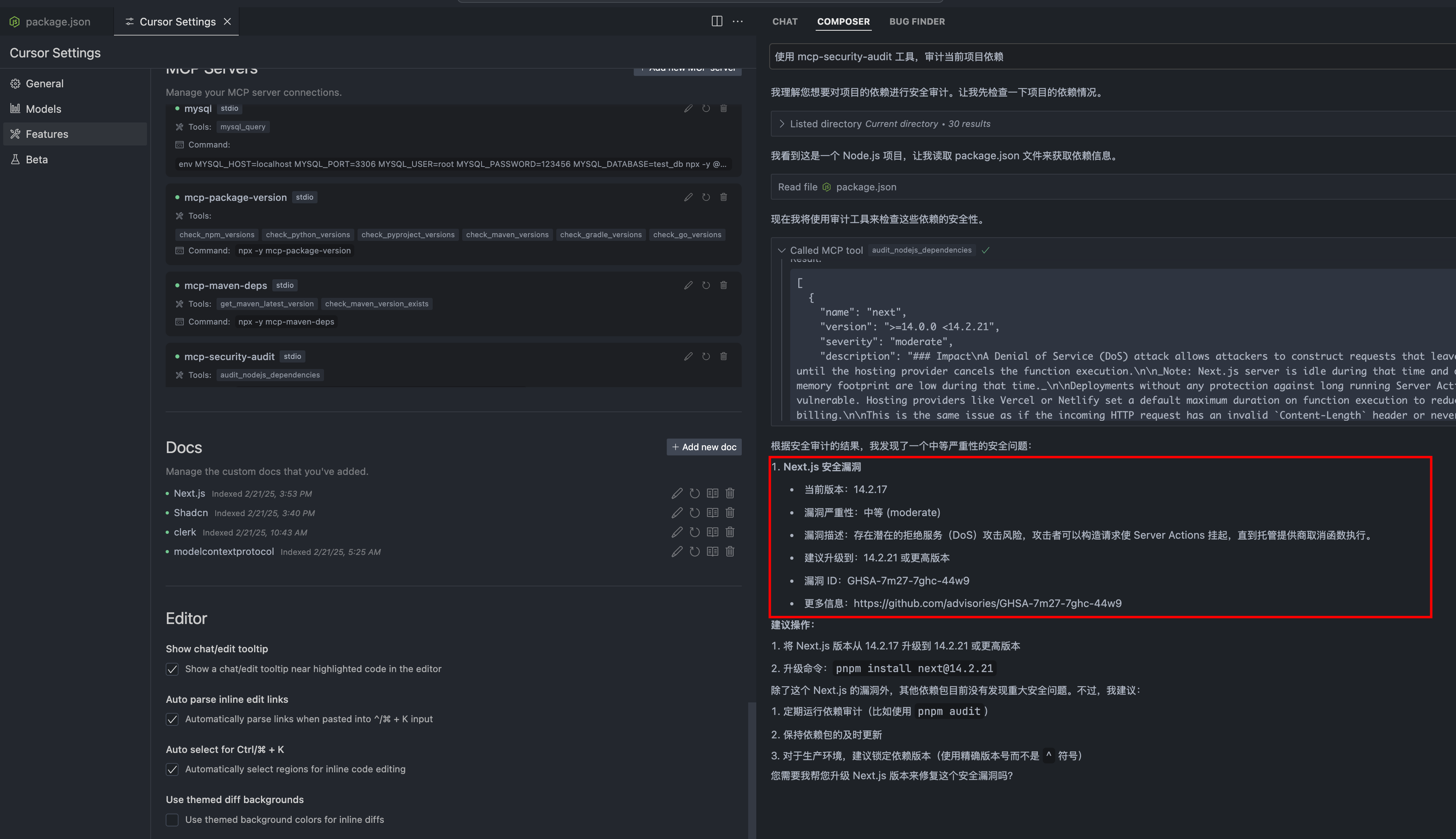
Cursor Configuration

Cline Configuration
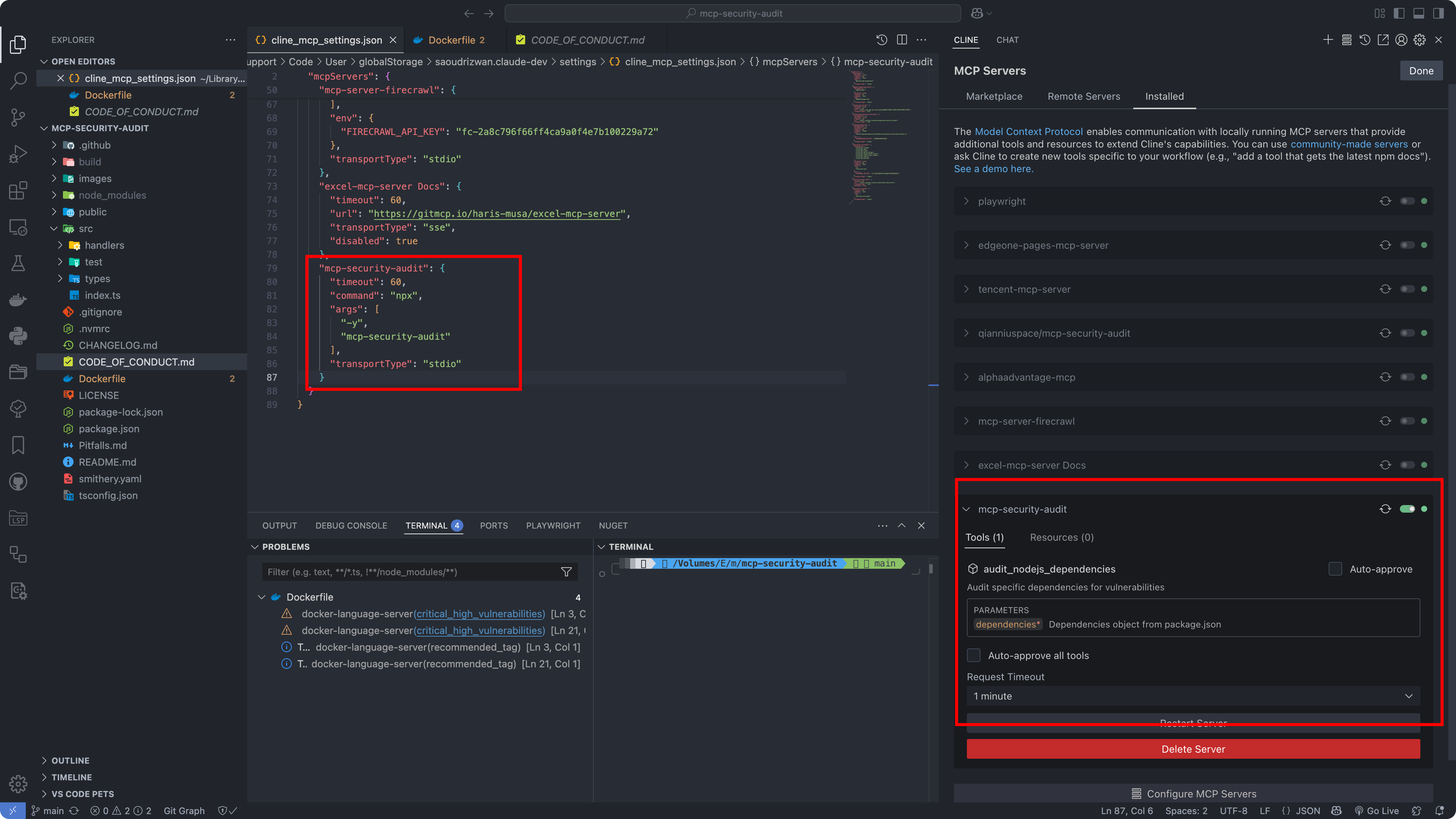
Cline Configuration

API Response Format

The tool provides detailed vulnerability information including severity levels, fix recommendations, CVSS scores, and CVE references.

Response Examples

1. When Vulnerabilities Found (Severity-response.json)

{
  "content": [{
    "vulnerability": {
      "packageName": "lodash",
      "version": "4.17.15",
      "severity": "high",
      "description": "Prototype Pollution in lodash",
      "cve": "CVE-2020-8203",
      "githubAdvisoryId": "GHSA-p6mc-m468-83gw",
      "recommendation": "Upgrade to version 4.17.19 or later",
      "fixAvailable": true,
      "fixedVersion": "4.17.19",
      "cvss": {
        "score": 7.4,
        "vector": "CVSS:3.1/AV:N/AC:H/PR:N/UI:N/S:U/C:H/I:H/A:N"
      },
      "cwe": ["CWE-1321"],
      "url": "https://github.com/advisories/GHSA-p6mc-m468-83gw"
    },
    "metadata": {
      "timestamp": "2024-04-23T10:00:00.000Z",
      "packageManager": "npm"
    }
  }]
}

2. When No Vulnerabilities Found (no-Severity-response.json)

{
  "content": [{
    "vulnerability": null,
    "metadata": {
      "timestamp": "2024-04-23T10:00:00.000Z",
      "packageManager": "npm",
      "message": "No known vulnerabilities found"
    }
  }]
}

Development

For development reference, check the example response files in the public directory:

  • Severity-response.json : Example response when vulnerabilities are found (transformed from npm audit API response)

  • no-Severity-response.json : Example response when no vulnerabilities are found (transformed from npm audit API response)

Note: The example responses shown above are transformed from the raw npm audit API responses to provide a more structured format. The original npm audit API responses contain additional metadata and may have a different structure.

Contributing

Contributions are welcome! Please read our Contributing Guide for details on our code of conduct and the process for submitting pull requests.

License

This project is licensed under the MIT License - see the LICENSE file for details.

Author

ESX (qianniuspace@gmail.com)

Available Tools

1 tool
audit_nodejs_dependenciesC

Audit specific dependencies for vulnerabilities

ParametersJSON Schema
NameRequiredDescriptionDefault
dependenciesYesDependencies object from package.json

TDQS

C2.9/5.0
Behavior2/5

Does the description disclose side effects, auth requirements, rate limits, or destructive behavior?

No annotations provided, so description carries full burden. It fails to mention whether the operation is read-only, requires network access, or what happens with the dependencies data.

Agents need to know what a tool does to the world before calling it. Descriptions should go beyond structured annotations to explain consequences.

Conciseness4/5

Is the description appropriately sized, front-loaded, and free of redundancy?

The description is one sentence, no unnecessary words. It is concise but slightly under-informative for its brevity.

Shorter descriptions cost fewer tokens and are easier for agents to parse. Every sentence should earn its place.

Completeness2/5

Given the tool's complexity, does the description cover enough for an agent to succeed on first attempt?

No output schema and minimal description leave the return value and behavior undocumented. The nested object type is not elaborated.

Complex tools with many parameters or behaviors need more documentation. Simple tools need less. This dimension scales expectations accordingly.

Parameters3/5

Does the description clarify parameter syntax, constraints, interactions, or defaults beyond what the schema provides?

Schema coverage is 100% with a clear description for the parameter. The tool description adds no additional semantic value beyond the schema.

Input schemas describe structure but not intent. Descriptions should explain non-obvious parameter relationships and valid value ranges.

Purpose4/5

Does the description clearly state what the tool does and how it differs from similar tools?

The description clearly states it audits dependencies for vulnerabilities, using a verb-object structure. However, without sibling tools, differentiation is not necessary.

Agents choose between tools based on descriptions. A clear purpose with a specific verb and resource helps agents select the right tool.

Usage Guidelines2/5

Does the description explain when to use this tool, when not to, or what alternatives exist?

No guidance on when to use the tool, prerequisites, or alternatives. The description assumes the agent knows the context.

Agents often have multiple tools that could apply. Explicit usage guidance like "use X instead of Y when Z" prevents misuse.

TDQS

B3/5.0
Disambiguation5/5

With only one tool, there is no possibility of confusion or overlap between tools. The tool's purpose is clearly defined and distinct by default.

Naming Consistency5/5

A single tool inherently has perfect naming consistency, as there are no other tools to compare it against. The naming follows a clear verb_noun pattern.

Tool Count2/5

A single tool for a server named 'MCP Security Audit Server' feels too thin for the apparent scope. Security auditing typically involves multiple operations (e.g., scanning, reporting, remediation), making one tool insufficient for comprehensive coverage.

Completeness1/5

The tool surface is severely incomplete for a security audit domain. It only audits Node.js dependencies, missing critical operations like scanning other languages, generating reports, checking configurations, or handling remediation, which are essential for a full security audit workflow.

Maintenance

ActivityInactive
ResponsivenessSyncing

Resources

Unclaimed servers have limited discoverability.

Looking for Admin?

If you are the server author, to access and configure the admin panel.

Related MCP Connectors

Related MCP Servers

  • A
    license
    B
    quality
    C
    maintenance
    Enables security scanning for npm dependencies by checking manifest and lockfiles against the OSV.dev and Socket.dev vulnerability databases. It provides tools to detect vulnerabilities in specific packages and retrieve detailed technical reports for identified security issues.
    3
    22
    MIT
  • A
    license
    A
    quality
    D
    maintenance
    An AI-powered security audit tool that analyzes codebases for vulnerabilities using real-time MITRE CWE data and npm audit. It enables users to perform comprehensive scans for authentication issues, exposed secrets, and dependency risks with structured remediation steps.
    2
    11
    MIT
  • A
    license
    Not graded
    quality
    C
    maintenance
    An MCP server for searching, inspecting, and evaluating NPM packages through health scoring and license risk assessments. It provides comprehensive package analysis including maintenance status, popularity trends, and security vulnerability reports to help users make informed dependency decisions.
    3
    MIT
  • A
    license
    A
    quality
    D
    maintenance
    Lightweight Node.js dependency vulnerability audit tool with CLI and MCP Server modes. Supports npm/pnpm, full dependency chain tracing, remote GitHub repo auditing, and generates Markdown/HTML reports.
    1
    21
    1
    MIT

Latest Blog Posts

MCP directory API

We provide all the information about MCP servers via our MCP API.

curl -X GET 'https://glama.ai/api/mcp/v1/servers/qianniuspace/mcp-security-audit'

If you have feedback or need assistance with the MCP directory API, please join our Discord server