Korea Tourism API MCP Server
Connects to the GitHub repository where the MCP server code is hosted, providing access to source code, issue tracking, and CI/CD workflows for the Korea Tourism API integration.
Distributes the MCP server as a Python package through PyPI, enabling easy installation and updates of the Korea Tourism API integration.
Click on "Install Server".
Wait a few minutes for the server to deploy. Once ready, it will show a "Started" state.
In the chat, type
@followed by the MCP server name and your instructions, e.g., "@Korea Tourism API MCP Serverfind traditional Korean restaurants in Seoul near Gyeongbokgung Palace"
That's it! The server will respond to your query, and you can continue using it as needed.
Here is a step-by-step guide with screenshots.
Korea Tourism API MCP Server ✈️
Unlock the wonders of South Korean tourism directly within your AI assistant! This project provides a Model Context Protocol (MCP) server powered by the official Korea Tourism Organization (KTO) API. Equip your AI with the ability to discover vibrant festivals, serene temples, delicious restaurants, comfortable accommodations, and much more across Korea.
Links:
PyPI Package: https://pypi.org/project/mcp-korea-tourism-api/
GitHub Repository: https://github.com/harimkang/mcp-korea-tourism-api
Releases: https://github.com/harimkang/mcp-korea-tourism-api/releases
✨ Features
Comprehensive Search: Find tourist spots, cultural sites, events, food, lodging, and shopping via keywords, area, or location.
Rich Details: Access descriptions, operating hours, admission fees, photos, addresses, and contact information.
Location-Aware: Discover attractions near specific GPS coordinates.
Timely Information: Find festivals and events based on date ranges.
Multilingual Support: Get information in various languages supported by the KTO API (including English).
Supported Languages: English, Japanese, Simplified Chinese, Traditional Chinese, Russian, Spanese, German, French
Efficient & Resilient:
Response Caching: Uses time-to-live (TTL) caching to store results and reduce redundant API calls, improving speed.
Rate Limiting: Respects API usage limits to prevent errors.
Automatic Retries: Automatically retries requests in case of temporary network or server issues.
MCP Standard: Seamlessly integrates with AI assistants supporting the Model Context Protocol.
Related MCP server: mcp-tour
⚠️ Prerequisites
Before you begin, you must obtain an API key from the Korea Tourism Organization (KTO) Data Portal.
Visit the KTO Data Portal (or the specific portal for the tourism API if available).
Register and request an API key for the "TourAPI" services (you might need to look for services providing information like
areaBasedList,searchKeyword,detailCommon, etc.).Keep your Service Key (API Key) safe. It will be required during installation or runtime.
You need to apply for the API below to make a request for each language.
Simplified Chinese: https://www.data.go.kr/data/15101764/openapi.do
Traditional Chinese: https://www.data.go.kr/data/15101769/openapi.do
🚀 Installation & Running
You can run this MCP server using either uv (a fast Python package installer and runner) or Docker.
Installing via Smithery
To install Korea Tourism API MCP Server for Claude Desktop automatically via Smithery:
npx -y @smithery/cli install @harimkang/mcp-korea-tourism-api --client claudeOption 1: Using uv (Recommended for local development)
Clone the repository:
git clone https://github.com/harimkang/mcp-korea-tourism-api.git cd mcp-korea-tourism-apiSet the API Key Environment Variable: Replace
"YOUR_KTO_API_KEY"with the actual key you obtained.# On macOS/Linux export KOREA_TOURISM_API_KEY="YOUR_KTO_API_KEY" # On Windows (Command Prompt) # set KOREA_TOURISM_API_KEY="YOUR_KTO_API_KEY" # On Windows (PowerShell) # $env:KOREA_TOURISM_API_KEY="YOUR_KTO_API_KEY"Note: For persistent storage, add this line to your shell's configuration file (e.g.,
.zshrc,.bashrc, or use system environment variable settings).Install dependencies and run the server: This command uses
uvto install dependencies based onuv.lock(if available) orpyproject.tomland then runs the server module.# Install Dependency with uv uv sync # Default: stdio transport (for MCP clients) uv run -m mcp_tourism.server # HTTP transport for web applications uv run -m mcp_tourism.server --transport streamable-http --host 127.0.0.1 --port 8000 # SSE transport for real-time applications uv run -m mcp_tourism.server --transport sse --host 127.0.0.1 --port 8080 # Using environment variables export MCP_TRANSPORT=streamable-http export MCP_HOST=0.0.0.0 export MCP_PORT=3000 uv run -m mcp_tourism.serverThe server will start and listen for MCP requests via the specified transport protocol.
Option 2: Using Docker (Recommended for isolated environment/deployment)
Clone the repository:
git clone https://github.com/harimkang/mcp-korea-tourism-api.git cd mcp-korea-tourism-apiBuild the Docker Image: You can build the image with different transport configurations:
# Default build (stdio transport) docker build -t mcp-korea-tourism-api . # Build with HTTP transport configuration docker build -t mcp-korea-tourism-api \ --build-arg MCP_TRANSPORT=streamable-http \ --build-arg MCP_HOST=0.0.0.0 \ --build-arg MCP_PORT=8000 \ --build-arg MCP_PATH=/mcp \ --build-arg MCP_LOG_LEVEL=INFO \ . # Build with SSE transport configuration docker build -t mcp-korea-tourism-api \ --build-arg MCP_TRANSPORT=sse \ --build-arg MCP_HOST=0.0.0.0 \ --build-arg MCP_PORT=8080 \ .Run the Docker Container: You can run the container with different transport configurations:
Stdio Transport (Default - for MCP clients):
docker run --rm -it \ -e KOREA_TOURISM_API_KEY="YOUR_KTO_API_KEY" \ mcp-korea-tourism-apiHTTP Transport (for web applications):
# Using runtime environment variables docker run --rm -p 8000:8000 \ -e KOREA_TOURISM_API_KEY="YOUR_KTO_API_KEY" \ -e MCP_TRANSPORT=streamable-http \ -e MCP_HOST=0.0.0.0 \ -e MCP_PORT=8000 \ mcp-korea-tourism-api # Check health: curl http://localhost:8000/healthSSE Transport (for real-time applications):
docker run --rm -p 8080:8080 \ -e KOREA_TOURISM_API_KEY="YOUR_KTO_API_KEY" \ -e MCP_TRANSPORT=sse \ -e MCP_HOST=0.0.0.0 \ -e MCP_PORT=8080 \ mcp-korea-tourism-apiUsing Docker Compose (Recommended):
# Copy and configure environment variables cp docker.env.example .env # Edit .env file with your API key and preferred settings # Run with HTTP transport (default profile) docker-compose up mcp-tourism-http # Run with SSE transport docker-compose --profile sse up mcp-tourism-sse # Run development setup with debug logging docker-compose --profile dev up mcp-tourism-dev
🔧 Transport Configuration
The Korea Tourism API MCP Server supports multiple transport protocols to accommodate different use cases:
Available Transports
stdio(Default): Standard input/output transport for direct MCP client integrationBest for: Claude Desktop, Cursor, and other MCP-compatible AI assistants
Configuration: No additional setup required
streamable-http: HTTP-based transport for web applicationsBest for: Web applications, REST API integration, load balancers
Features: HTTP endpoints, health checks, JSON responses
Default endpoint:
http://localhost:8000/mcp
sse: Server-Sent Events transport for real-time applicationsBest for: Real-time web applications, event-driven architectures
Features: Real-time streaming, persistent connections
Default endpoint:
http://localhost:8080/mcp
Configuration Options
You can configure the server using command line arguments or environment variables:
Setting | CLI Argument | Environment Variable | Default | Description |
Transport |
|
|
| Transport protocol to use |
Host |
|
|
| Host address for HTTP transports |
Port |
|
|
| Port for HTTP transports |
Path |
|
|
| Path for HTTP endpoints |
Log Level |
|
|
| Logging level |
Command Line Examples
# Get help for all available options
python -m mcp_tourism.server --help
# Run with HTTP transport on custom port
python -m mcp_tourism.server --transport streamable-http --port 3000 --log-level DEBUG
# Run with SSE transport
python -m mcp_tourism.server --transport sse --host 0.0.0.0 --port 8080Environment Variable Examples
# Set environment variables
export MCP_TRANSPORT=streamable-http
export MCP_HOST=0.0.0.0
export MCP_PORT=8000
export MCP_LOG_LEVEL=INFO
export KOREA_TOURISM_API_KEY="your_api_key_here"
# Run the server
python -m mcp_tourism.serverHealth Check
For HTTP and SSE transports, a health check endpoint is available at /health:
# Check server health
curl http://localhost:8000/health
# Example response
{
"status": "healthy",
"service": "Korea Tourism API MCP Server",
"transport": "streamable-http",
"timestamp": 1640995200.0
}🛠️ Integrating with Cursor
To use this MCP server within Cursor:
Ensure the Docker container is runnable: Follow the Docker installation steps above to build the image (
mcp-korea-tourism-api). You don't need to manually run the container; Cursor will do that.Locate your
mcp.jsonfile: This file configures MCP tools for Cursor. You can usually find it via Cursor's settings or potentially in a path like~/.cursor/mcp.jsonor similar.Add or Update the MCP Configuration: Add the following JSON object to the list within your
mcp.jsonfile. If you already have an entry for this tool, update itscommand. Replace"YOUR_KTO_API_KEY"with your actual key.
{ "mcpServers": { "korea-tourism": { "command": "docker", "args": [ "run", "--rm", "-i", "-e", "KOREA_TOURISM_API_KEY=YOUR_KTO_API_KEY", "mcp-korea-tourism-api" ] } } }OR Use uv [local directory]
{ "mcpServers": { "korea-tourism": { "command": "uv", "args": [ "--directory", "{LOCAL_PATH}/mcp-korea-tourism-api", "run", "-m", "mcp_tourism.server" ], "env": { "KOREA_TOURISM_API_KEY": "YOUR_KTO_API_KEY" } } } }Save
mcp.json.Restart Cursor or Reload MCP Tools: Cursor should now detect the tool and use Docker to run it when needed.
🛠️ MCP Tools Provided
This server exposes the following tools for AI assistants:
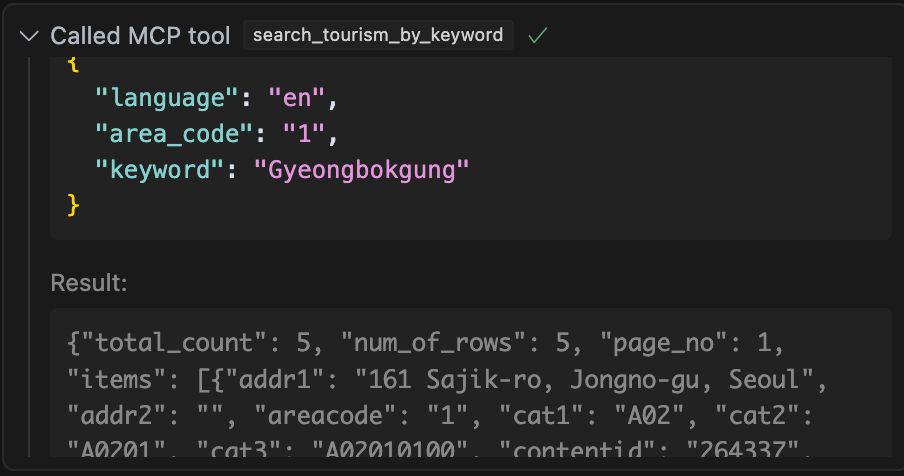
search_tourism_by_keyword: Search for tourism information using keywords (e.g., "Gyeongbokgung", "Bibimbap"). Filter by content type, area code.
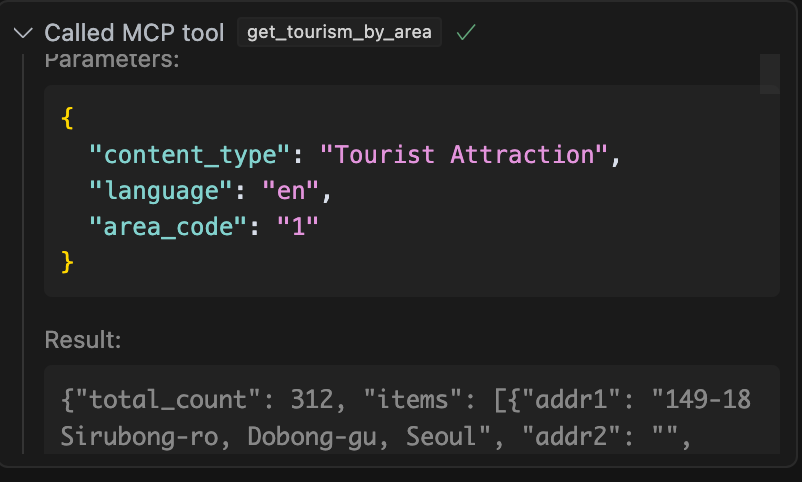
get_tourism_by_area: Browse tourism information by geographic area codes (e.g., Seoul='1'). Filter by content type, district code.
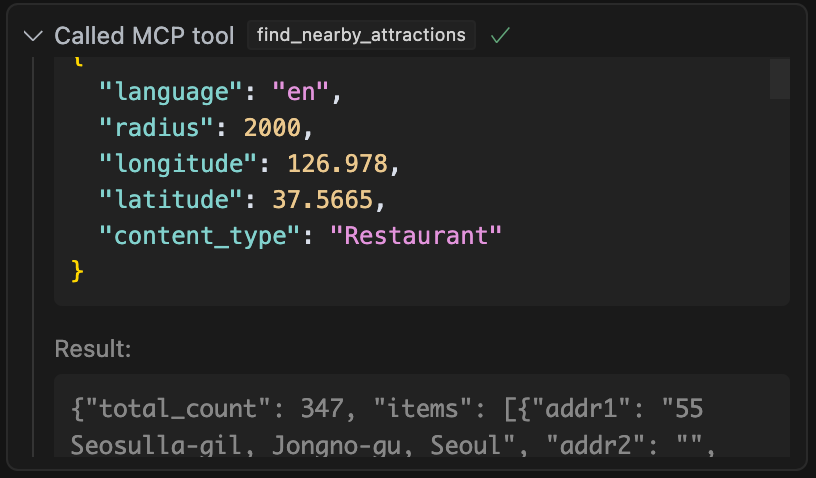
find_nearby_attractions: Discover tourism spots near specific GPS coordinates (longitude, latitude). Filter by radius and content type.
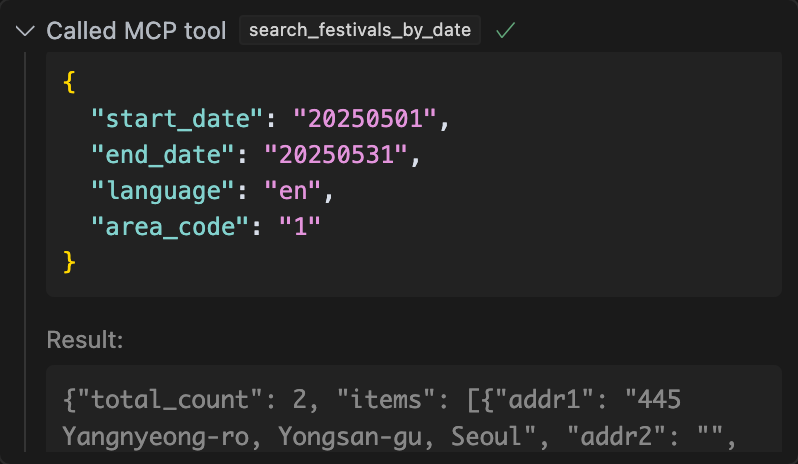
search_festivals_by_date: Find festivals occurring within a specified date range (YYYYMMDD). Filter by area code.
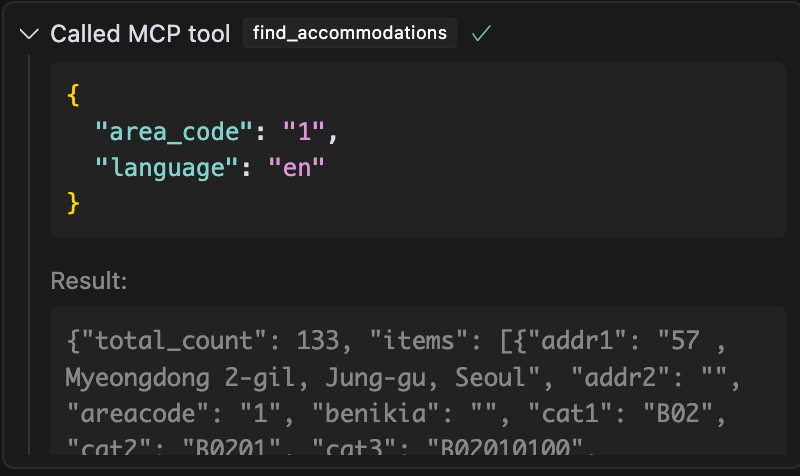
find_accommodations: Search for hotels, guesthouses, etc. Filter by area and district code.
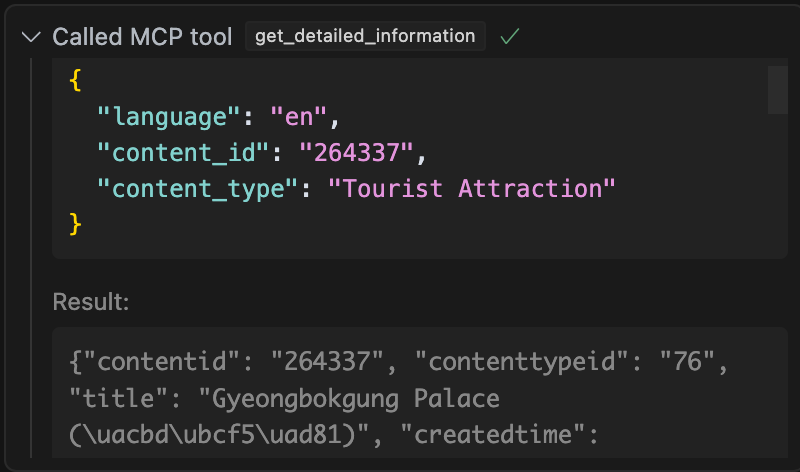
get_detailed_information: Retrieve comprehensive details (overview, usage time, parking, etc.) for a specific item using its Content ID. Filter by content type.
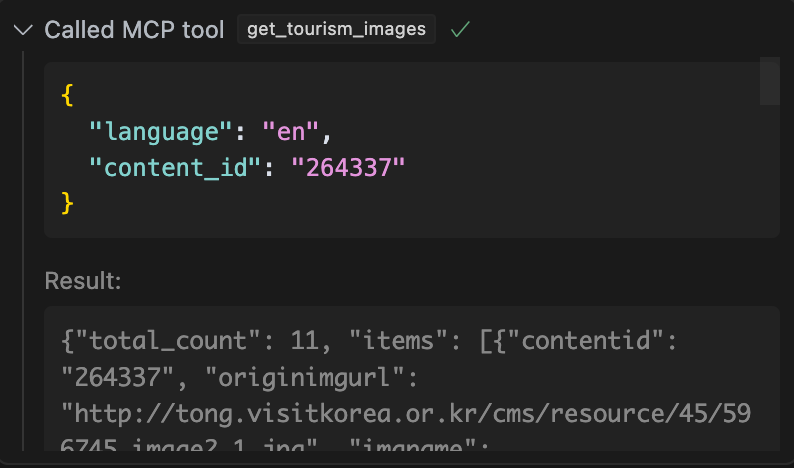
get_tourism_images: Get image URLs associated with a specific tourism item using its Content ID.
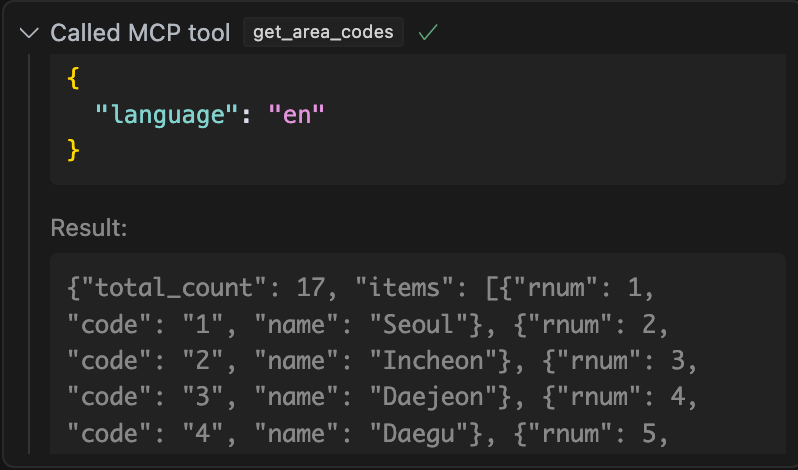
get_area_codes: Retrieve area codes (for cities/provinces) and optionally sub-area (district) codes.
⚙️ Requirements (for uv method)
Python 3.12+
uvinstalled (pip install uv)
Example Usage
An AI assistant integrated with this MCP could handle queries like:
"Find restaurants near Myeongdong station."
"Show me pictures of Bulguksa Temple."
"Are there any festivals in Busan next month?"
"Tell me more about Gyeongbokgung Palace, content ID 264337."
Available Tools
8 toolsfind_accommodationsA
Find accommodations in Korea by area.
This tool searches for accommodation options (hotels, guesthouses, pensions, etc.) in a specific area in Korea. It provides detailed information about lodging facilities including location, contact information, and special certifications.
Args: area_code (str, optional): Area code. Valid values: - "1" (Seoul) - "2" (Incheon) - "3" (Daejeon) - "4" (Daegu) - "5" (Gwangju) - "6" (Busan) - "7" (Ulsan) - "8" (Sejong) - "31" (Gyeonggi-do) - "32" (Gangwon-do) - "33" (Chungcheongbuk-do) - "34" (Chungcheongnam-do) - "35" (Gyeongsangbuk-do) - "36" (Gyeongsangnam-do) - "37" (Jeonbuk-do) - "38" (Jeollanam-do) - "39" (Jeju-do) sigungu_code (str, optional): Sigungu (district) code within the area language (str, optional): Language for results (default: "en"). Supported: - "en" (English) - "jp" (Japanese) - "zh-cn" (Simplified Chinese) - "zh-tw" (Traditional Chinese) - "de" (German) - "fr" (French) - "es" (Spanish) - "ru" (Russian) page (int, optional): Page number for pagination (default: 1, min: 1) rows (int, optional): Number of items per page (default: 20, max: 100) filter (list[str], optional): List of keys to include in each result item (whitelist). - If filter is None or an empty list ([]), all fields are returned. - If filter contains values, only the specified keys will be included in each item, and all other keys will be removed.
Returns: dict: Accommodation options with structure: { "total_count": int, # Total number of matching items "num_of_rows": int, # Number of items per page "page_no": int, # Current page number "items": [ # List of accommodation items { "title": str, # Name of the accommodation "addr1": str, # Primary address "addr2": str, # Secondary address "areacode": str, # Area code "sigungucode": str, # Sigungu code "contentid": str, # Unique content ID "contenttypeid": str, # Content type ID "createdtime": str, # Creation timestamp "firstimage": str, # URL of main image "firstimage2": str, # URL of thumbnail image "mapx": str, # Longitude "mapy": str, # Latitude "mlevel": str, # Map level "tel": str, # Phone number "cat1": str, # Category 1 code "cat2": str, # Category 2 code "cat3": str, # Category 3 code "hanok": str, # Korean traditional house flag "benikia": str, # Benikia hotel flag "goodstay": str # Goodstay accommodation flag } # ... more items ] }
Example: find_accommodations("1", "1", "en", 1, 20)
| Name | Required | Description | Default |
|---|---|---|---|
| area_code | No | ||
| sigungu_code | No | ||
| language | No | ||
| page | No | ||
| rows | No | ||
| filter | No |
TDQS
Does the description disclose side effects, auth requirements, rate limits, or destructive behavior?
No annotations provided, but the description discloses it is a read-only search (find accommodations) and details the return structure, pagination, and filter behavior. It does not mention permissions or side effects, but covers key behavioral aspects.
Agents need to know what a tool does to the world before calling it. Descriptions should go beyond structured annotations to explain consequences.
Is the description appropriately sized, front-loaded, and free of redundancy?
The description is well-structured with Args, Returns, and Example sections, front-loading the purpose. It is somewhat lengthy due to full return structure, but each sentence adds value given the number of parameters and output detail.
Shorter descriptions cost fewer tokens and are easier for agents to parse. Every sentence should earn its place.
Given the tool's complexity, does the description cover enough for an agent to succeed on first attempt?
The description covers all 6 parameters, their valid values, default values, return structure, and includes an example. However, it does not explain the relationship between area_code and sigungu_code or error conditions, leaving minor gaps.
Complex tools with many parameters or behaviors need more documentation. Simple tools need less. This dimension scales expectations accordingly.
Does the description clarify parameter syntax, constraints, interactions, or defaults beyond what the schema provides?
The description adds significant meaning beyond the schema: it lists all valid area codes with locations, supported languages, explains filter as a whitelist, and provides default values and constraints (max rows). This compensates for the 0% schema description coverage.
Input schemas describe structure but not intent. Descriptions should explain non-obvious parameter relationships and valid value ranges.
Does the description clearly state what the tool does and how it differs from similar tools?
The description clearly states it finds accommodations in Korea by area, listing specific types (hotels, guesthouses, pensions). It distinguishes from sibling tools like find_nearby_attractions and search_tourism_by_keyword by focusing on accommodation listings with area codes.
Agents choose between tools based on descriptions. A clear purpose with a specific verb and resource helps agents select the right tool.
Does the description explain when to use this tool, when not to, or what alternatives exist?
The description provides valid values for area_code and language, and explains the filter parameter, but does not explicitly guide when to use this tool vs alternatives like search_tourism_by_keyword or get_tourism_by_area. Usage is implied but not directly stated.
Agents often have multiple tools that could apply. Explicit usage guidance like "use X instead of Y when Z" prevents misuse.
find_nearby_attractionsA
Find tourism attractions near a specific location in Korea.
This tool performs a location-based search to find tourism items within a specified radius of given GPS coordinates. It's useful for finding nearby attractions, restaurants, or other tourism facilities when you know a specific location.
Args: longitude (float): Longitude coordinate (e.g., 126.9780 for Seoul) latitude (float): Latitude coordinate (e.g., 37.5665 for Seoul) radius (int, optional): Search radius in meters (default: 1000, max: 20000) content_type (str, optional): Type of content to filter. Valid values: - "Tourist Attraction" (default) - "Cultural Facility" - "Festival Event" - "Leisure Activity" - "Accommodation" - "Shopping" - "Restaurant" - "Transportation" language (str, optional): Language for results (default: "en"). Supported: - "en" (English) - "jp" (Japanese) - "zh-cn" (Simplified Chinese) - "zh-tw" (Traditional Chinese) - "de" (German) - "fr" (French) - "es" (Spanish) - "ru" (Russian) page (int, optional): Page number for pagination (default: 1, min: 1) rows (int, optional): Number of items per page (default: 20, max: 100) filter (list[str], optional): List of keys to include in each result item (whitelist). - If filter is None or an empty list ([]), all fields are returned. - If filter contains values, only the specified keys will be included in each item, and all other keys will be removed.
Returns: dict: Nearby tourism attractions with structure: { "total_count": int, # Total number of matching items "num_of_rows": int, # Number of items per page "page_no": int, # Current page number "search_radius": int, # Search radius used "items": [ # List of tourism items { "title": str, # Name of the attraction/place "addr1": str, # Primary address "addr2": str, # Secondary address "areacode": str, # Area code "sigungucode": str, # Sigungu code "cat1": str, # Category 1 code "cat2": str, # Category 2 code "cat3": str, # Category 3 code "contentid": str, # Unique content ID "contenttypeid": str, # Content type ID "createdtime": str, # Creation timestamp "modifiedtime": str, # Last modified timestamp "tel": str, # Phone number "firstimage": str, # URL of main image "firstimage2": str, # URL of thumbnail image "mapx": str, # Longitude "mapy": str, # Latitude "mlevel": str, # Map level "dist": str # Distance from the specified coordinates } # ... more items ] }
Example: find_nearby_attractions(126.9780, 37.5665, 1000, "Tourist Attraction", "en", 1, 10)
| Name | Required | Description | Default |
|---|---|---|---|
| longitude | Yes | ||
| latitude | Yes | ||
| radius | No | ||
| content_type | No | ||
| language | No | ||
| page | No | ||
| rows | No | ||
| filter | No |
TDQS
Does the description disclose side effects, auth requirements, rate limits, or destructive behavior?
No annotations exist; description discloses param behavior and return structure but lacks details on rate limits, authentication, or any side effects. Adequate but not fully transparent.
Agents need to know what a tool does to the world before calling it. Descriptions should go beyond structured annotations to explain consequences.
Is the description appropriately sized, front-loaded, and free of redundancy?
Well-structured with clear sections (description, args, returns, example). Slightly repetitive of defaults from schema but still efficient and front-loaded.
Shorter descriptions cost fewer tokens and are easier for agents to parse. Every sentence should earn its place.
Given the tool's complexity, does the description cover enough for an agent to succeed on first attempt?
Given 8 params, no annotations, and no output schema, the description is exceptionally complete—includes full return structure, param details, and example. Covers pagination and filtering thoroughly.
Complex tools with many parameters or behaviors need more documentation. Simple tools need less. This dimension scales expectations accordingly.
Does the description clarify parameter syntax, constraints, interactions, or defaults beyond what the schema provides?
Schema coverage is 0%, yet description fully details each parameter with types, defaults, valid values (e.g., content_type list, filter whitelist logic), adding extensive meaning beyond the schema.
Input schemas describe structure but not intent. Descriptions should explain non-obvious parameter relationships and valid value ranges.
Does the description clearly state what the tool does and how it differs from similar tools?
Clearly states 'Find tourism attractions near a specific location in Korea' with a specific verb and resource, explicitly distinguishing it from siblings like find_accommodations.
Agents choose between tools based on descriptions. A clear purpose with a specific verb and resource helps agents select the right tool.
Does the description explain when to use this tool, when not to, or what alternatives exist?
Provides clear context for use ('useful for finding nearby attractions when you know a specific location'), but does not explicitly mention when not to use or compare with alternatives like get_tourism_by_area.
Agents often have multiple tools that could apply. Explicit usage guidance like "use X instead of Y when Z" prevents misuse.
get_area_codesA
Get area codes for regions in Korea.
This tool retrieves area codes and their corresponding names for Korean regions. It can be used to get top-level area codes (provinces/cities) or sub-area codes (districts/counties) within a specific area.
Args: parent_area_code (str, optional): Parent area code to get sub-areas - If None: Returns top-level area codes (provinces/cities) - If provided: Returns sigungu codes for that area language (str, optional): Language for results (default: "en"). Supported: - "en" (English) - "jp" (Japanese) - "zh-cn" (Simplified Chinese) - "zh-tw" (Traditional Chinese) - "de" (German) - "fr" (French) - "es" (Spanish) - "ru" (Russian) page (int, optional): Page number for pagination (default: 1, min: 1) rows (int, optional): Number of items per page (default: 100, max: 100)
Returns: dict: Area codes with structure: { "total_count": int, # Total number of matching items "parent_area_code": str, # Parent area code used (or null) "items": [ # List of area code items { "code": str, # Area code value "name": str, # Area name "rnum": str # Row number } # ... more items ] }
Available area codes: - "1" (Seoul) - "2" (Incheon) - "3" (Daejeon) - "4" (Daegu) - "5" (Gwangju) - "6" (Busan) - "7" (Ulsan) - "8" (Sejong) - "31" (Gyeonggi-do) - "32" (Gangwon-do) - "33" (Chungcheongbuk-do) - "34" (Chungcheongnam-do) - "35" (Gyeongsangbuk-do) - "36" (Gyeongsangnam-do) - "37" (Jeonbuk-do) - "38" (Jeollanam-do) - "39" (Jeju-do)
Example: get_area_codes(None, "en", 1, 50) # Get top-level areas get_area_codes("1", "en", 1, 50) # Get districts in Seoul
| Name | Required | Description | Default |
|---|---|---|---|
| parent_area_code | No | ||
| language | No | ||
| page | No | ||
| rows | No |
TDQS
Does the description disclose side effects, auth requirements, rate limits, or destructive behavior?
No annotations are provided, so the description carries full burden. It explains retrieval behavior, return structure, pagination, defaults, and available codes without omissions.
Agents need to know what a tool does to the world before calling it. Descriptions should go beyond structured annotations to explain consequences.
Is the description appropriately sized, front-loaded, and free of redundancy?
The description is well-structured with sections, but includes a long list of area codes and examples. No wasted sentences, though slightly lengthy.
Shorter descriptions cost fewer tokens and are easier for agents to parse. Every sentence should earn its place.
Given the tool's complexity, does the description cover enough for an agent to succeed on first attempt?
No output schema exists, so the description provides a full return dict structure. It covers all parameters, defaults, limits, and examples, making it complete for the tool's complexity.
Complex tools with many parameters or behaviors need more documentation. Simple tools need less. This dimension scales expectations accordingly.
Does the description clarify parameter syntax, constraints, interactions, or defaults beyond what the schema provides?
With schema description coverage at 0%, the description fully compensates by detailing each parameter's behavior, language options, and pagination defaults, plus the return structure.
Input schemas describe structure but not intent. Descriptions should explain non-obvious parameter relationships and valid value ranges.
Does the description clearly state what the tool does and how it differs from similar tools?
The description states 'Get area codes for regions in Korea' with a clear verb and resource. It explains top-level and sub-area retrieval, distinguishing from sibling tourism tools.
Agents choose between tools based on descriptions. A clear purpose with a specific verb and resource helps agents select the right tool.
Does the description explain when to use this tool, when not to, or what alternatives exist?
The 'Args' section and examples explain when to use parent_area_code (None for top-level, provided for sub-areas). However, it lacks explicit 'use this when not' and alternatives, though sibling tools are clearly different.
Agents often have multiple tools that could apply. Explicit usage guidance like "use X instead of Y when Z" prevents misuse.
get_detailed_informationA
Get detailed information about a specific tourism item in Korea.
This tool retrieves comprehensive details about a specific tourism item by its content ID. It combines common information, introduction details, and additional information to provide a complete picture of the tourism item.
Args: content_id (str): Content ID of the tourism item (obtained from other search functions) content_type (str, optional): Type of content. Valid values: - "Tourist Attraction" - "Cultural Facility" - "Festival Event" - "Leisure Activity" - "Accommodation" - "Shopping" - "Restaurant" - "Transportation" language (str, optional): Language for results (default: "en"). Supported: - "en" (English) - "jp" (Japanese) - "zh-cn" (Simplified Chinese) - "zh-tw" (Traditional Chinese) - "de" (German) - "fr" (French) - "es" (Spanish) - "ru" (Russian)
Returns: dict: Detailed information with structure: { # Common information "title": str, # Name of the item "contentid": str, # Unique content ID "contenttypeid": str, # Content type ID "addr1": str, # Primary address "addr2": str, # Secondary address "areacode": str, # Area code "sigungucode": str, # Sigungu code "cat1": str, # Category 1 code "cat2": str, # Category 2 code "cat3": str, # Category 3 code "mapx": str, # Longitude "mapy": str, # Latitude "mlevel": str, # Map level "overview": str, # Detailed description "tel": str, # Phone number "telname": str, # Contact name "homepage": str, # Website URL "firstimage": str, # URL of main image "firstimage2": str, # URL of thumbnail image "createdtime": str, # Creation timestamp "modifiedtime": str, # Last modified timestamp "zipcode": str, # Postal code
# Introduction details (varies by content type)
"infocenter": str, # Information center (for attractions)
"restdate": str, # Rest/closing days
"usetime": str, # Hours of operation
"parking": str, # Parking information
# ... other type-specific fields
# Additional information
"additional_info": [ # List of additional details
{
"infoname": str, # Name of the information
"infotext": str, # Detailed text information
"fldgubun": str, # Field division code
"serialnum": str # Serial number
}
# ... more items
]
}Example: get_detailed_information("126508", "Tourist Attraction", "en")
| Name | Required | Description | Default |
|---|---|---|---|
| content_id | Yes | ||
| content_type | No | ||
| language | No |
TDQS
Does the description disclose side effects, auth requirements, rate limits, or destructive behavior?
With no annotations provided, the description covers the retrieval nature and output structure comprehensively. It does not mention any side effects, authentication, or constraints, but for a simple read-oriented tool the transparency is adequate.
Agents need to know what a tool does to the world before calling it. Descriptions should go beyond structured annotations to explain consequences.
Is the description appropriately sized, front-loaded, and free of redundancy?
The description is well-structured with Args, Returns, and Example sections. It is front-loaded with the purpose, and every sentence adds value. There is no redundancy or fluff.
Shorter descriptions cost fewer tokens and are easier for agents to parse. Every sentence should earn its place.
Given the tool's complexity, does the description cover enough for an agent to succeed on first attempt?
Despite no output schema, the description provides a detailed return structure with nested fields and an example call. All three parameters are fully explained, and the tool's behavior (combining common info, introduction, additional info) is explicitly stated.
Complex tools with many parameters or behaviors need more documentation. Simple tools need less. This dimension scales expectations accordingly.
Does the description clarify parameter syntax, constraints, interactions, or defaults beyond what the schema provides?
The schema provides only types and nullability with 0% description coverage. The description adds full semantics: content_id's purpose and source, content_type's valid values (8 options), and language's supported codes. This exceeds what schema offers.
Input schemas describe structure but not intent. Descriptions should explain non-obvious parameter relationships and valid value ranges.
Does the description clearly state what the tool does and how it differs from similar tools?
The description clearly states the tool retrieves detailed information about a specific tourism item in Korea by content ID, which is a specific verb+resource pairing. It implicitly distinguishes it from sibling tools that search or list items.
Agents choose between tools based on descriptions. A clear purpose with a specific verb and resource helps agents select the right tool.
Does the description explain when to use this tool, when not to, or what alternatives exist?
The description mentions the content_id is obtained from other search functions, implying a usage sequence. However, it does not explicitly list when to use this tool versus alternatives like find_accommodations or search_tourism_by_keyword.
Agents often have multiple tools that could apply. Explicit usage guidance like "use X instead of Y when Z" prevents misuse.
get_tourism_by_areaA
Browse tourism information by geographic areas in Korea.
This tool retrieves tourism items from a specific geographic area in Korea. It allows filtering by area code, sigungu (district) code, and content type to find relevant tourism information in a particular region.
Args: area_code (str): Area code. Valid values: - "1" (Seoul) - "2" (Incheon) - "3" (Daejeon) - "4" (Daegu) - "5" (Gwangju) - "6" (Busan) - "7" (Ulsan) - "8" (Sejong) - "31" (Gyeonggi-do) - "32" (Gangwon-do) - "33" (Chungcheongbuk-do) - "34" (Chungcheongnam-do) - "35" (Gyeongsangbuk-do) - "36" (Gyeongsangnam-do) - "37" (Jeonbuk-do) - "38" (Jeollanam-do) - "39" (Jeju-do) sigungu_code (str, optional): Sigungu (district) code within the area content_type (str, optional): Type of content to filter. Valid values: - "Tourist Attraction" (default) - "Cultural Facility" - "Festival Event" - "Leisure Activity" - "Accommodation" - "Shopping" - "Restaurant" - "Transportation" language (str, optional): Language for results (default: "en"). Supported: - "en" (English) - "jp" (Japanese) - "zh-cn" (Simplified Chinese) - "zh-tw" (Traditional Chinese) - "de" (German) - "fr" (French) - "es" (Spanish) - "ru" (Russian) page (int, optional): Page number for pagination (default: 1, min: 1) rows (int, optional): Number of items per page (default: 20, max: 100) filter (list[str], optional): List of keys to include in each result item (whitelist). - If filter is None or an empty list ([]), all fields are returned. - If filter contains values, only the specified keys will be included in each item, and all other keys will be removed.
Returns: dict: Area-based tourism information with structure: { "total_count": int, # Total number of matching items "num_of_rows": int, # Number of items per page "page_no": int, # Current page number "items": [ # List of tourism items { "title": str, # Name of the attraction/place "addr1": str, # Primary address "addr2": str, # Secondary address "areacode": str, # Area code "sigungucode": str, # Sigungu code "cat1": str, # Category 1 code "cat2": str, # Category 2 code "cat3": str, # Category 3 code "contentid": str, # Unique content ID "contenttypeid": str, # Content type ID "createdtime": str, # Creation timestamp "modifiedtime": str, # Last modified timestamp "tel": str, # Phone number "firstimage": str, # URL of main image "firstimage2": str, # URL of thumbnail image "mapx": str, # Longitude "mapy": str, # Latitude "zipcode": str, # Postal code "mlevel": str # Map level } # ... more items ] }
Example: get_tourism_by_area("1", "1", "Tourist Attraction", "en", 1, 20)
| Name | Required | Description | Default |
|---|---|---|---|
| area_code | Yes | ||
| sigungu_code | No | ||
| content_type | No | ||
| language | No | ||
| page | No | ||
| rows | No | ||
| filter | No |
TDQS
Does the description disclose side effects, auth requirements, rate limits, or destructive behavior?
No annotations are provided, so the description carries the full burden. It describes a read operation (retrieve, browse) but does not explicitly state that it is read-only, non-destructive, or any auth requirements. The return structure is documented, but side effects or permissions are not disclosed.
Agents need to know what a tool does to the world before calling it. Descriptions should go beyond structured annotations to explain consequences.
Is the description appropriately sized, front-loaded, and free of redundancy?
The description is well-structured with a clear overview, followed by detailed parameter docs, return structure, and an example. It is front-loaded with purpose and each section adds valuable information without redundancy.
Shorter descriptions cost fewer tokens and are easier for agents to parse. Every sentence should earn its place.
Given the tool's complexity, does the description cover enough for an agent to succeed on first attempt?
Given the complexity (7 parameters, no output schema), the description covers all essential aspects: purpose, each parameter's valid values and defaults, pagination, response structure, and an example. It is complete enough for an agent to invoke correctly.
Complex tools with many parameters or behaviors need more documentation. Simple tools need less. This dimension scales expectations accordingly.
Does the description clarify parameter syntax, constraints, interactions, or defaults beyond what the schema provides?
The schema has 0% description coverage, but the description compensates fully by enumerating valid values for area_code, sigungu_code, content_type, language, and explaining defaults, optionality, and the effect of the filter parameter. This adds significant meaning beyond the bare schema.
Input schemas describe structure but not intent. Descriptions should explain non-obvious parameter relationships and valid value ranges.
Does the description clearly state what the tool does and how it differs from similar tools?
The description clearly states the tool retrieves tourism items by geographic area, using specific verb 'browse tourism information' and resource 'by geographic areas'. It distinguishes from sibling tools like find_nearby_attractions (location-based) and search_tourism_by_keyword (keyword-based) by focusing on area-based filtering.
Agents choose between tools based on descriptions. A clear purpose with a specific verb and resource helps agents select the right tool.
Does the description explain when to use this tool, when not to, or what alternatives exist?
The description explains the tool's use for area-based browsing and lists filtering options, but does not explicitly state when not to use it or mention alternatives. The context of sibling tools implies differentiation, but explicit usage guidelines are missing.
Agents often have multiple tools that could apply. Explicit usage guidance like "use X instead of Y when Z" prevents misuse.
get_tourism_imagesA
Get images for a specific tourism item in Korea.
This tool retrieves all available images for a specific tourism item by its content ID. It provides both original and thumbnail image URLs along with image metadata.
Args: content_id (str): Content ID of the tourism item (obtained from other search functions) language (str, optional): Language for results (default: "en"). Supported: - "en" (English) - "jp" (Japanese) - "zh-cn" (Simplified Chinese) - "zh-tw" (Traditional Chinese) - "de" (German) - "fr" (French) - "es" (Spanish) - "ru" (Russian) page (int, optional): Page number for pagination (default: 1, min: 1) rows (int, optional): Number of items per page (default: 20, max: 100)
Returns: dict: Images with structure: { "total_count": int, # Total number of matching items "content_id": str, # Content ID this image belongs to "items": [ # List of image items { "contentid": str, # Content ID this image belongs to "imgname": str, # Image name "originimgurl": str, # URL of original image "smallimageurl": str, # URL of small/thumbnail image "serialnum": str, # Serial number "cpyrhtDivCd": str # Copyright division code } # ... more items ] }
Example: get_tourism_images("126508", "en", 1, 10)
| Name | Required | Description | Default |
|---|---|---|---|
| content_id | Yes | ||
| language | No | ||
| page | No | ||
| rows | No |
TDQS
Does the description disclose side effects, auth requirements, rate limits, or destructive behavior?
Despite no annotations, the description discloses the return structure with all fields and image URLs, providing good transparency. It doesn't mention rate limits or auth, but for a read-only image retrieval tool, the behavioral context is adequate.
Agents need to know what a tool does to the world before calling it. Descriptions should go beyond structured annotations to explain consequences.
Is the description appropriately sized, front-loaded, and free of redundancy?
The description is well-structured with sections and an example, but is somewhat lengthy due to the return schema. It remains clear and organized, with no superfluous sentences.
Shorter descriptions cost fewer tokens and are easier for agents to parse. Every sentence should earn its place.
Given the tool's complexity, does the description cover enough for an agent to succeed on first attempt?
Given the lack of output schema and annotations, the description compensates fully by including a complete return schema, parameter details, and an example. It covers all necessary aspects for correct tool invocation.
Complex tools with many parameters or behaviors need more documentation. Simple tools need less. This dimension scales expectations accordingly.
Does the description clarify parameter syntax, constraints, interactions, or defaults beyond what the schema provides?
Schema coverage is 0%, but the description provides full semantic detail for all 4 parameters: content_id source, language options with codes, page and rows with defaults and constraints. This adds essential meaning beyond the schema.
Input schemas describe structure but not intent. Descriptions should explain non-obvious parameter relationships and valid value ranges.
Does the description clearly state what the tool does and how it differs from similar tools?
The description clearly states it retrieves images for a specific tourism item by content ID, providing original and thumbnail URLs. It distinguishes from sibling tools like search_tourism_by_keyword or get_detailed_information by focusing on image retrieval.
Agents choose between tools based on descriptions. A clear purpose with a specific verb and resource helps agents select the right tool.
Does the description explain when to use this tool, when not to, or what alternatives exist?
The description explains this tool is used after obtaining a content ID from other search functions. While it doesn't explicitly state when not to use or list alternatives, the context is clear and the usage intent is well-defined.
Agents often have multiple tools that could apply. Explicit usage guidance like "use X instead of Y when Z" prevents misuse.
search_festivals_by_dateA
Find festivals in Korea by date range.
This tool searches for festivals and events occurring within a specified date range. It's useful for finding cultural events, celebrations, and festivals happening during a particular period or ongoing events.
Args: start_date (str): Start date in YYYYMMDD format (e.g., "20250501" for May 1, 2025) end_date (str, optional): End date in YYYYMMDD format (e.g., "20250531" for May 31, 2025) If not provided, searches for events starting from the start_date area_code (str, optional): Area code to filter results. Valid values: - "1" (Seoul) - "2" (Incheon) - "3" (Daejeon) - "4" (Daegu) - "5" (Gwangju) - "6" (Busan) - "7" (Ulsan) - "8" (Sejong) - "31" (Gyeonggi-do) - "32" (Gangwon-do) - "33" (Chungcheongbuk-do) - "34" (Chungcheongnam-do) - "35" (Gyeongsangbuk-do) - "36" (Gyeongsangnam-do) - "37" (Jeonbuk-do) - "38" (Jeollanam-do) - "39" (Jeju-do) language (str, optional): Language for results (default: "en"). Supported: - "en" (English) - "jp" (Japanese) - "zh-cn" (Simplified Chinese) - "zh-tw" (Traditional Chinese) - "de" (German) - "fr" (French) - "es" (Spanish) - "ru" (Russian) page (int, optional): Page number for pagination (default: 1, min: 1) rows (int, optional): Number of items per page (default: 20, max: 100) filter (list[str], optional): List of keys to include in each result item (whitelist). - If filter is None or an empty list ([]), all fields are returned. - If filter contains values, only the specified keys will be included in each item, and all other keys will be removed.
Returns: dict: Festivals within the specified date range with structure: { "total_count": int, # Total number of matching items "num_of_rows": int, # Number of items per page "page_no": int, # Current page number "start_date": str, # Search start date "end_date": str, # Search end date or "ongoing" "items": [ # List of festival items { "title": str, # Name of the festival "addr1": str, # Primary address "addr2": str, # Secondary address "areacode": str, # Area code "contentid": str, # Unique content ID "contenttypeid": str, # Content type ID "createdtime": str, # Creation timestamp "eventstartdate": str, # Festival start date "eventenddate": str, # Festival end date "firstimage": str, # URL of main image "firstimage2": str, # URL of thumbnail image "mapx": str, # Longitude "mapy": str, # Latitude "mlevel": str, # Map level "tel": str, # Phone number "cat1": str, # Category 1 code "cat2": str, # Category 2 code "cat3": str # Category 3 code } # ... more items ] }
Example: search_festivals_by_date("20250501", "20250531", "1", "en", 1, 20)
| Name | Required | Description | Default |
|---|---|---|---|
| start_date | Yes | ||
| end_date | No | ||
| area_code | No | ||
| language | No | ||
| page | No | ||
| rows | No | ||
| filter | No |
TDQS
Does the description disclose side effects, auth requirements, rate limits, or destructive behavior?
No annotations are provided, so the description carries full burden. It discloses the search behavior, parameters, and return structure but does not explicitly state read-only nature, error handling, or potential side effects. Additional context like empty result handling is missing.
Agents need to know what a tool does to the world before calling it. Descriptions should go beyond structured annotations to explain consequences.
Is the description appropriately sized, front-loaded, and free of redundancy?
The description is well-structured with clear sections (intro, args, returns, example) and uses bullet points and code blocks. While it is relatively lengthy, every part serves a purpose without redundancy, earning a high score for structure.
Shorter descriptions cost fewer tokens and are easier for agents to parse. Every sentence should earn its place.
Given the tool's complexity, does the description cover enough for an agent to succeed on first attempt?
Given the tool has 7 parameters, no output schema, and no annotations, the description provides comprehensive coverage: all parameters explained, return structure defined, and example usage. It fulfills the contextual needs for an AI agent to use the tool effectively.
Complex tools with many parameters or behaviors need more documentation. Simple tools need less. This dimension scales expectations accordingly.
Does the description clarify parameter syntax, constraints, interactions, or defaults beyond what the schema provides?
With 0% schema description coverage, the description fully compensates by detailing each parameter: start_date format, end_date optionality, area_code with all valid values, language support, pagination limits, and filter whitelist behavior. This adds significant meaning beyond the raw schema.
Input schemas describe structure but not intent. Descriptions should explain non-obvious parameter relationships and valid value ranges.
Does the description clearly state what the tool does and how it differs from similar tools?
The description clearly states 'Find festivals in Korea by date range' with a specific verb and resource, and it distinguishes this tool from siblings like find_accommodations and search_tourism_by_keyword by focusing on date-based festival searches.
Agents choose between tools based on descriptions. A clear purpose with a specific verb and resource helps agents select the right tool.
Does the description explain when to use this tool, when not to, or what alternatives exist?
The description explains the tool is useful for finding cultural events by date range but does not explicitly mention when not to use it or provide alternatives from sibling tools. The usage context is implied but lacks exclusions or comparative guidance.
Agents often have multiple tools that could apply. Explicit usage guidance like "use X instead of Y when Z" prevents misuse.
search_tourism_by_keywordA
Search for tourism information in Korea by keyword.
This tool searches through the Korea Tourism Organization database for tourism items matching the specified keyword. It supports filtering by content type, area, and provides paginated results with detailed information.
Args: keyword (str): Search keyword (e.g., "Gyeongbokgung", "Hanok", "Bibimbap") content_type (str, optional): Type of content to search for. Valid values: - "Tourist Attraction" (default) - "Cultural Facility" - "Festival Event" - "Leisure Activity" - "Accommodation" - "Shopping" - "Restaurant" - "Transportation" area_code (str, optional): Area code to filter results. Valid values: - "1" (Seoul) - "2" (Incheon) - "3" (Daejeon) - "4" (Daegu) - "5" (Gwangju) - "6" (Busan) - "7" (Ulsan) - "8" (Sejong) - "31" (Gyeonggi-do) - "32" (Gangwon-do) - "33" (Chungcheongbuk-do) - "34" (Chungcheongnam-do) - "35" (Gyeongsangbuk-do) - "36" (Gyeongsangnam-do) - "37" (Jeonbuk-do) - "38" (Jeollanam-do) - "39" (Jeju-do) language (str, optional): Language for results (default: "en"). Supported: - "en" (English) - "jp" (Japanese) - "zh-cn" (Simplified Chinese) - "zh-tw" (Traditional Chinese) - "de" (German) - "fr" (French) - "es" (Spanish) - "ru" (Russian) page (int, optional): Page number for pagination (default: 1, min: 1) rows (int, optional): Number of items per page (default: 20, max: 100) filter (list[str], optional): List of keys to include in each result item (whitelist). - If filter is None or an empty list ([]), all fields are returned. - If filter contains values, only the specified keys will be included in each item, and all other keys will be removed.
Returns: dict: Search results with structure: { "total_count": int, # Total number of matching items "num_of_rows": int, # Number of items per page "page_no": int, # Current page number "items": [ # List of tourism items { "title": str, # Name of the attraction/place "addr1": str, # Primary address "addr2": str, # Secondary address "areacode": str, # Area code "sigungucode": str, # Sigungu code "cat1": str, # Category 1 code "cat2": str, # Category 2 code "cat3": str, # Category 3 code "contentid": str, # Unique content ID "contenttypeid": str, # Content type ID "createdtime": str, # Creation timestamp "modifiedtime": str, # Last modified timestamp "tel": str, # Phone number "firstimage": str, # URL of main image "firstimage2": str, # URL of thumbnail image "mapx": str, # Longitude "mapy": str, # Latitude "mlevel": str, # Map level "cpyrhtDivCd": str # Copyright division code } # ... more items ] }
Example: search_tourism_by_keyword("Gyeongbokgung", "Tourist Attraction", "1", "en", 1, 10)
| Name | Required | Description | Default |
|---|---|---|---|
| keyword | Yes | ||
| content_type | No | ||
| area_code | No | ||
| language | No | ||
| page | No | ||
| rows | No | ||
| filter | No |
TDQS
Does the description disclose side effects, auth requirements, rate limits, or destructive behavior?
With no annotations, the description shoulders the full burden of behavioral disclosure. It clearly indicates it's a read operation, describes pagination, language options, filter behavior, and the exact return structure, providing comprehensive transparency beyond implicit expectations.
Agents need to know what a tool does to the world before calling it. Descriptions should go beyond structured annotations to explain consequences.
Is the description appropriately sized, front-loaded, and free of redundancy?
The description is well-structured with clear sections (Args, Returns, Example) and front-loaded purpose. However, it is verbose, especially in listing all area codes and language options. A more concise format (e.g., referring to enums) could improve efficiency without losing information.
Shorter descriptions cost fewer tokens and are easier for agents to parse. Every sentence should earn its place.
Given the tool's complexity, does the description cover enough for an agent to succeed on first attempt?
Given 7 parameters, no output schema, and no annotations, the description covers all needed context: parameter details, return structure, pagination, and an example. It is fully sufficient for an agent to invoke the tool correctly.
Complex tools with many parameters or behaviors need more documentation. Simple tools need less. This dimension scales expectations accordingly.
Does the description clarify parameter syntax, constraints, interactions, or defaults beyond what the schema provides?
The input schema lacks enum values and descriptions for parameters like content_type and area_code. The description supplies all valid values and default behaviors (e.g., filter whitelist logic), adding immense value beyond the schema. All 7 parameters are thoroughly explained.
Input schemas describe structure but not intent. Descriptions should explain non-obvious parameter relationships and valid value ranges.
Does the description clearly state what the tool does and how it differs from similar tools?
The description clearly states it searches for tourism information in Korea by keyword, specifying the database (Korea Tourism Organization) and the broad scope of tourism items. It distinguishes itself from siblings by being a keyword-based general search, but does not explicitly compare to alternatives.
Agents choose between tools based on descriptions. A clear purpose with a specific verb and resource helps agents select the right tool.
Does the description explain when to use this tool, when not to, or what alternatives exist?
The description does not provide any guidance on when to use this tool versus other tools like 'find_accommodations' or 'get_tourism_by_area'. No conditions or exclusions are mentioned, leaving the agent to infer usage from context.
Agents often have multiple tools that could apply. Explicit usage guidance like "use X instead of Y when Z" prevents misuse.
Tool Schema Changelog
Recent tool additions, removals, and schema changes observed during successful MCP inspections. Dates show when Glama detected each change.
8 tool updates
v0.1.2- First observed
find_accommodations - First observed
find_nearby_attractions - First observed
get_area_codes - First observed
get_detailed_information - First observed
get_tourism_by_area - First observed
get_tourism_images - First observed
search_festivals_by_date - First observed
search_tourism_by_keyword
TDQS
Each tool has a distinct purpose: finding accommodations, searching by keyword, by area, by location, getting details, images, area codes, and festivals by date. No overlapping responsibilities.
All tool names follow a consistent verb_noun pattern using snake_case: find_accommodations, find_nearby_attractions, get_area_codes, get_detailed_information, etc. The pattern is uniform.
With 8 tools, the set is well-scoped for a tourism API. It covers search, filters, details, images, area codes, and festivals without being overly large or minimal.
The tool set covers the major discovery and detail retrieval needs: by area, keyword, location, festivals, accommodations, and details/images. Minor gap: no tool for user reviews or itineraries, but core workflows are supported.
Maintenance
Resources
Unclaimed servers have limited discoverability.
Looking for Admin?
If you are the server author, to access and configure the admin panel.
Related MCP Connectors
Official Seoul tourism data in 7 languages, in cooperation with the Seoul Tourism Organization.
- mcpweaveOAuthcom.mcpweave
Korea-native MCP gateway: Korean commerce, payments, messaging, gov & finance APIs for AI agents.
- HeyYumiOAuthai.heyyumi
Ground your AI in verified Korean venue data: search & book across Seoul, Gyeonggi, Busan, Jeju.
Give AI assistants access to real-time data. Search the web, compare flights, find hotels, and more.
Related MCP Servers
- AlicenseNot gradedqualityDmaintenanceEnables exploration and interaction with South Korea's Public Data Portal (OpenAPI) through keyword search, standard documentation retrieval, and direct API endpoint calls with automatic service key injection.11Apache 2.0
- FlicenseNot gradedqualityCmaintenanceIntegrates the Korea Tourism Organization's API to provide tourist spot recommendations and detailed information, including attractions, food, and accommodation.1-
- AlicenseNot gradedqualityDmaintenanceIntegrates Korean APIs (Naver, Kakao, TMAP) into LLM applications for search, maps, and directions.10MIT
- AlicenseNot gradedqualityDmaintenanceEnables AI agents to search and retrieve information about KTO-certified medical tourism facilities in South Korea, including area-based, location-based, and keyword search, with multilingual support.6,2971MIT
Latest Blog Posts
- Who's Calling? MCP Hosts Are an Identity Blind Spot (And the Spec Knows It)By Om-Shree-0709 on .mcpAgent IdentityOAuth 2.1
- Your AI Chatbot Just Exposed Your CEO's Salary to an InternBy Om-Shree-0709 on .Agent IdentityMCP SecurityOAuth Delegation
- Why MCP Servers Need Execution Sandboxing (And Why Your Current Stack Isn't Enough)By Om-Shree-0709 on .Agentic AiPrompt InjectionWebAssembly
MCP directory API
We provide all the information about MCP servers via our MCP API.
curl -X GET 'https://glama.ai/api/mcp/v1/servers/harimkang/mcp-korea-tourism-api'
If you have feedback or need assistance with the MCP directory API, please join our Discord server