A
licenseC
qualityC
maintenanceA Model Context Protocol server that provides image generation capabilities using the Ideogram API, allowing users to create images from text prompts with customizable parameters.
1
9 npm
5
MIT

一个简单的模型上下文协议 (MCP) 服务器,用于使用 ImgFlip API 生成表情包。该服务器支持 AI 模型和工具根据用户提示生成表情包图片。
服务器实现了一个名为generateMeme的单一工具。
该工具接受以下参数:
templateNumericId :要使用的 meme 模板的数字 ID。
text0 :第一个占位符的文本。
text1 :第二个占位符的文本。
Related MCP server: MCP TemplateIO
您可以使用meme-mcp NPM 包在客户端中配置 meme 生成器服务器。以下是 Claude Desktop 的示例配置(设置 -> 开发者 -> 编辑配置):
{
  "mcpServers": {
    "meme": {
      "command": "npx",
      "args": ["-y", "meme-mcp"],
      "env": {
        "IMGFLIP_USERNAME": "<IMGFLIP USERNAME>",
        "IMGFLIP_PASSWORD": "<IMGFLIP PASSWORD>"
      }
    }
  }
}注意:您需要在ImgFlip上创建一个免费帐户才能获取您的用户名和密码。
有时 Claude Desktop 会无法找到正确版本的npx (尤其是在使用 NVM 的情况下,详情请参阅此问题)。在这种情况下,您可以手动全局安装meme-mcp ,然后直接使用。
npm install -g meme-mcp你可以在终端中运行which node来找到node可执行文件的路径。之后,你的配置应该如下所示:
{
  "mcpServers": {
    "meme": {
      "command": "/Users/<USERNAME>/.nvm/versions/node/v20.18.2/bin/node",
      "args": ["/Users/<USERNAME>/.nvm/versions/node/v20.18.2/lib/node_modules/meme-mcp/dist/index.js"],
      "env": {
        "IMGFLIP_USERNAME": "<IMGFLIP USERNAME>",
        "IMGFLIP_PASSWORD": "<IMGFLIP PASSWORD>"
      }
    }
  }
}配置完 Claude Desktop 后,你需要重启它,然后你就会在聊天输入框右下角看到一个小锤子图标。之后,你就可以请求 Claude 为你生成表情包了。
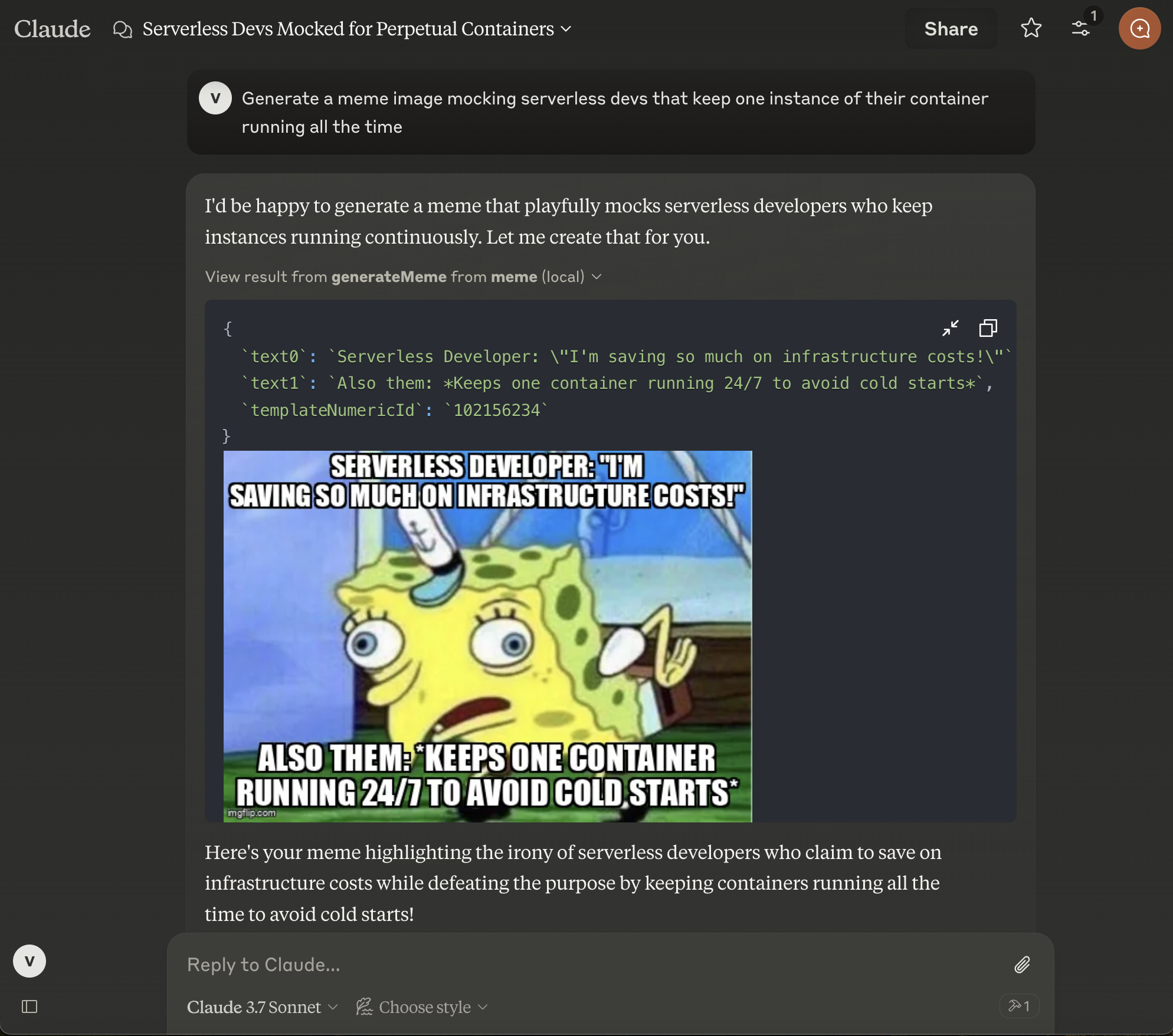
这个项目由Vladimir Haltakov创建,纯粹是为了好玩。如果你觉得有趣,可以在 X @haltakov上给我留言。
Generate a meme image from Imgflip using the numeric template id and text
| Name | Required | Description | Default |
|---|---|---|---|
| templateNumericId | Yes | ||
| text0 | Yes | ||
| text1 | No |
Does the description disclose side effects, auth requirements, rate limits, or destructive behavior?
No annotations are provided, so the description carries the full burden of behavioral disclosure. It mentions generating a meme image but fails to describe key behaviors such as whether this is a read-only or mutating operation, potential rate limits, authentication needs, or what the output looks like (e.g., image URL or data). This leaves significant gaps in understanding the tool's behavior.
Agents need to know what a tool does to the world before calling it. Descriptions should go beyond structured annotations to explain consequences.
Is the description appropriately sized, front-loaded, and free of redundancy?
The description is a single, efficient sentence that directly states the tool's function without unnecessary words. It is front-loaded with the core action and includes essential details (source and inputs), making it highly concise and well-structured for quick comprehension.
Shorter descriptions cost fewer tokens and are easier for agents to parse. Every sentence should earn its place.
Given the tool's complexity, does the description cover enough for an agent to succeed on first attempt?
Given the tool's complexity (3 parameters, no output schema, no annotations), the description is incomplete. It lacks details on parameter meanings, behavioral traits, output format, and usage context. For a tool that generates external content, more information is needed to guide effective use, making it inadequate for the context.
Complex tools with many parameters or behaviors need more documentation. Simple tools need less. This dimension scales expectations accordingly.
Does the description clarify parameter syntax, constraints, interactions, or defaults beyond what the schema provides?
Schema description coverage is 0%, meaning the schema provides no descriptions for the three parameters. The description adds minimal semantics by naming the parameters ('numeric template id and text'), but it doesn't explain what 'templateNumericId', 'text0', or 'text1' represent, their formats, or examples. This insufficiently compensates for the lack of schema documentation.
Input schemas describe structure but not intent. Descriptions should explain non-obvious parameter relationships and valid value ranges.
Does the description clearly state what the tool does and how it differs from similar tools?
The description clearly states the action ('Generate a meme image') and the resource ('from Imgflip'), specifying the verb and target. It mentions the required inputs (template id and text), making the purpose specific. However, without sibling tools, it doesn't need to differentiate from alternatives, so it falls short of a perfect score.
Agents choose between tools based on descriptions. A clear purpose with a specific verb and resource helps agents select the right tool.
Does the description explain when to use this tool, when not to, or what alternatives exist?
The description provides no guidance on when to use this tool versus alternatives, prerequisites, or context for its application. It simply states what the tool does without indicating appropriate scenarios or limitations, leaving the agent with minimal usage direction.
Agents often have multiple tools that could apply. Explicit usage guidance like "use X instead of Y when Z" prevents misuse.
Recent tool additions, removals, and schema changes observed during successful MCP inspections.
generateMemeScored across 1 tool
With only one tool, there is no possibility of ambiguity or overlap between tools. The tool's purpose is clearly defined and distinct by default.
A single tool inherently has perfect naming consistency, as there are no other tools to compare it against. The tool name uses camelCase, which is consistent within itself.
A single tool is too few for a server named 'Meme MCP Server', which suggests a broader scope for meme-related operations. This minimal set limits functionality and feels incomplete for the domain.
The tool surface is severely incomplete for meme generation. It only offers generation via a specific template ID, lacking operations like listing templates, searching memes, editing, or managing meme content, which are typical for such a domain.
MCP server for meme generation, template search, caption rendering, and AI meme creation.
Imgflip MCP — wraps Imgflip API (free, no auth for template listing)
A comprehensive Model Context Protocol (MCP) server that enables AI assistants to interact with yo…
MCP server for Qwen Image 3 AI image generation