
A
licenseNot graded
qualityD
maintenanceA Model Context Protocol server that allows LLMs to interact with web content through standardized tools, currently supporting web scraping functionality.
1
MIT

Allows installation and usage of the 12306-mcp package via npm to provide train ticket search functionality to AI models
Click on "Deploy Server".
Wait a few minutes for the server to deploy. Once ready, it will show a "Started" state.
In the chat, type @ followed by the MCP server name and your instructions, e.g., "@12306-MCP find train tickets from Beijing to Shanghai for tomorrow"
That's it! The server will respond to your query, and you can continue using it as needed.
Here is a step-by-step guide with screenshots.
A 12306 ticket search server based on the Model Context Protocol (MCP). The server provides a simple API interface that allows users to search for 12306 tickets.
基于 Model Context Protocol (MCP) 的12306购票搜索服务器。提供了简单的API接口,允许大模型利用接口搜索12306购票信息。
1、在 Cursor 中使用
可以智能选票还能生成途径站点可视化地图!
教程:Cursor + 12306 MCP,实现AI智能选票还能生成精美网站
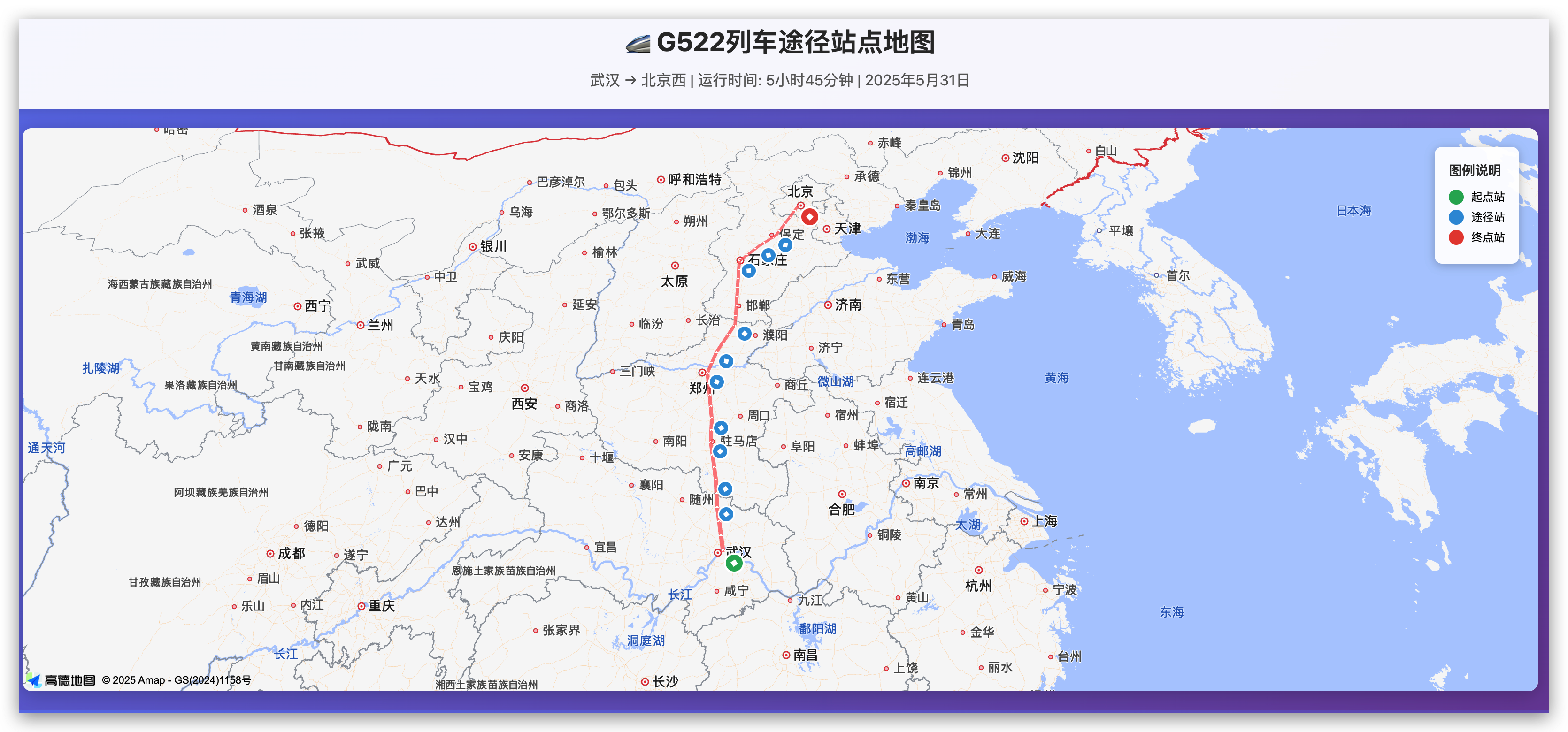
在yb.html中可直接用浏览器打开

2、用阿里云百炼做智能体
教程:阿里百炼+12306 MCP,打造AI智能选票智能体,超酷的!
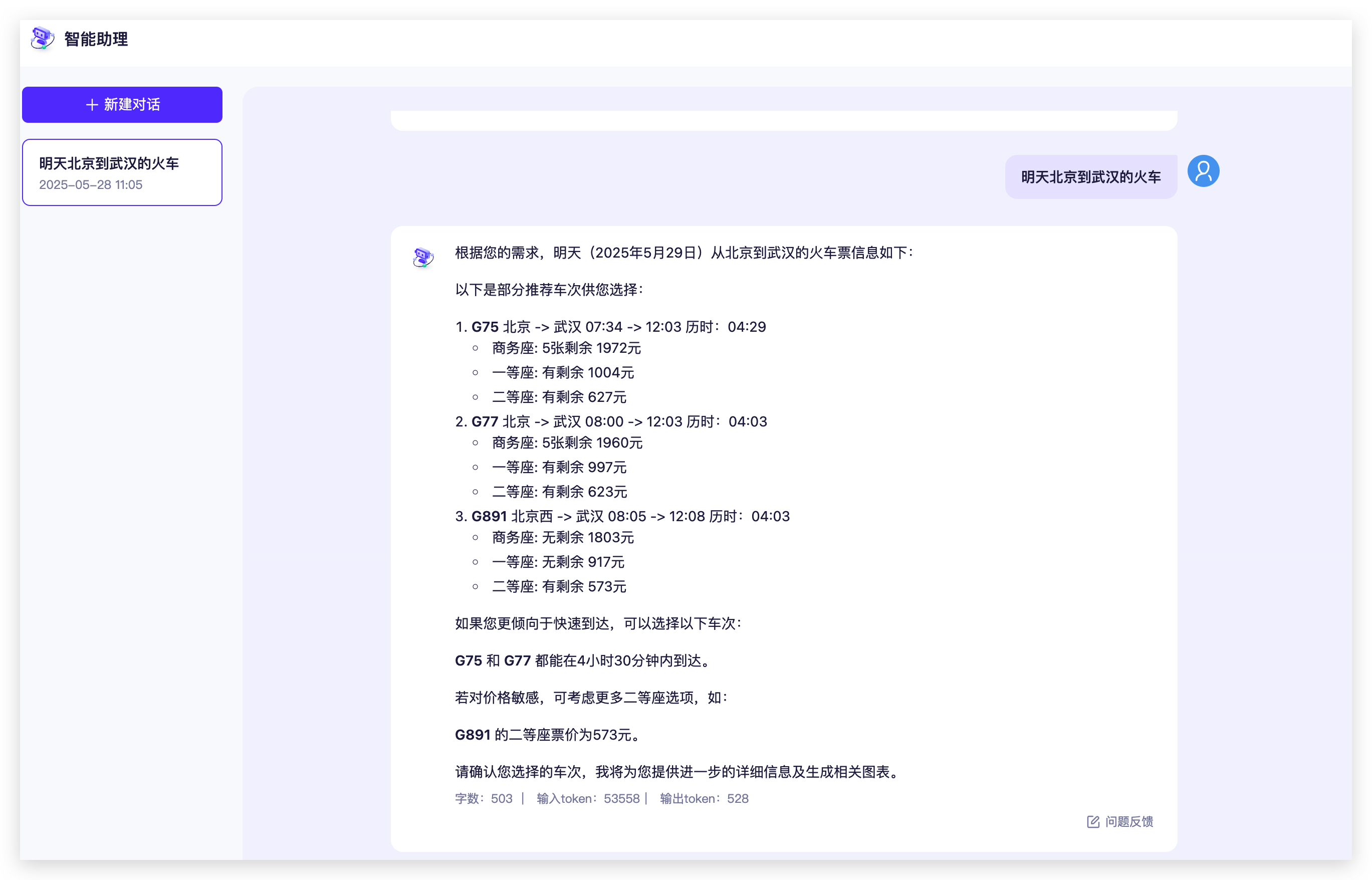
我在后天想从西安出发去往郑州,请推荐出合理的车票,并推荐三天后返程的车票,
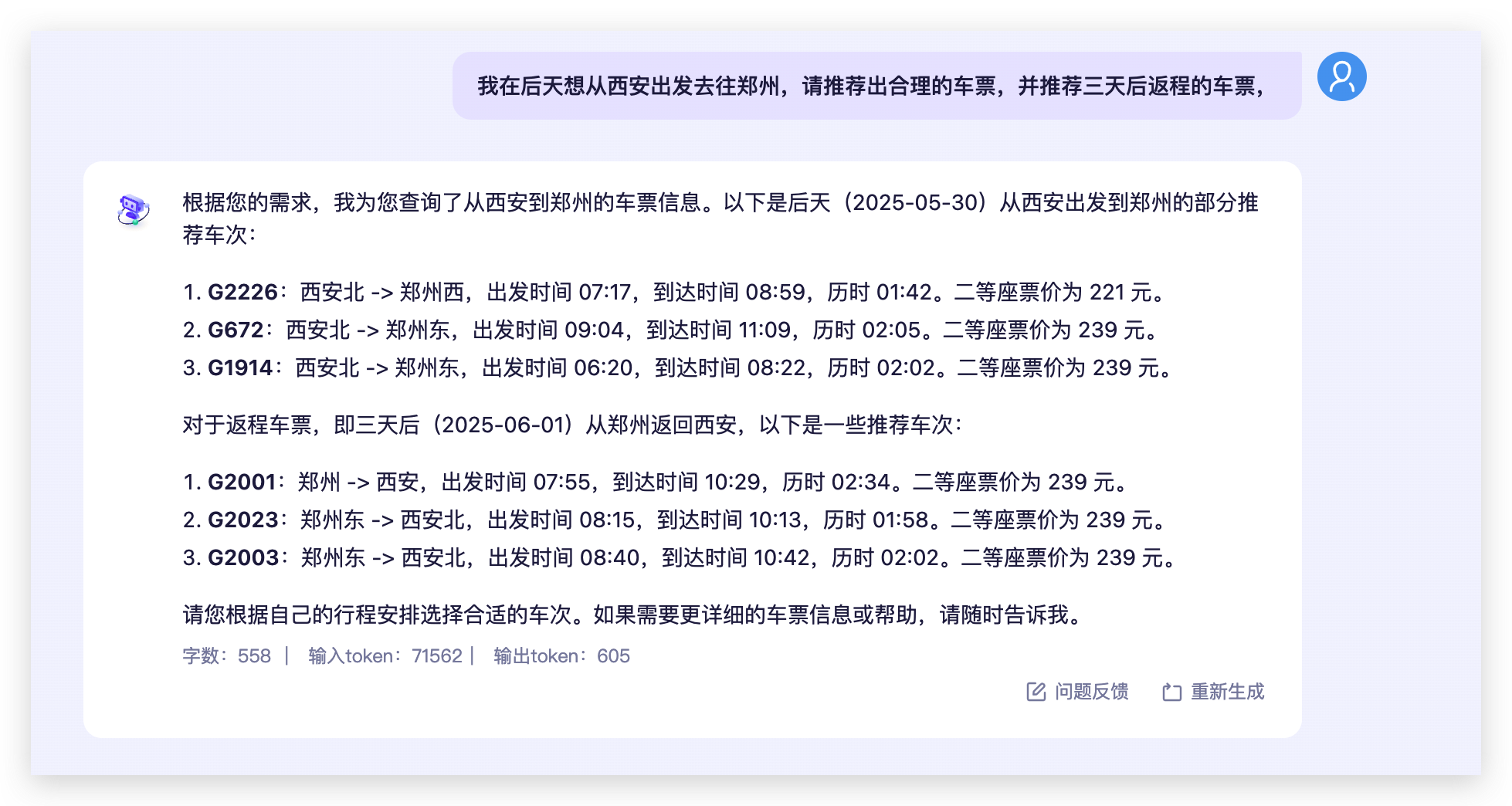
还能对比各个列车票价,做个图表,更直观了。
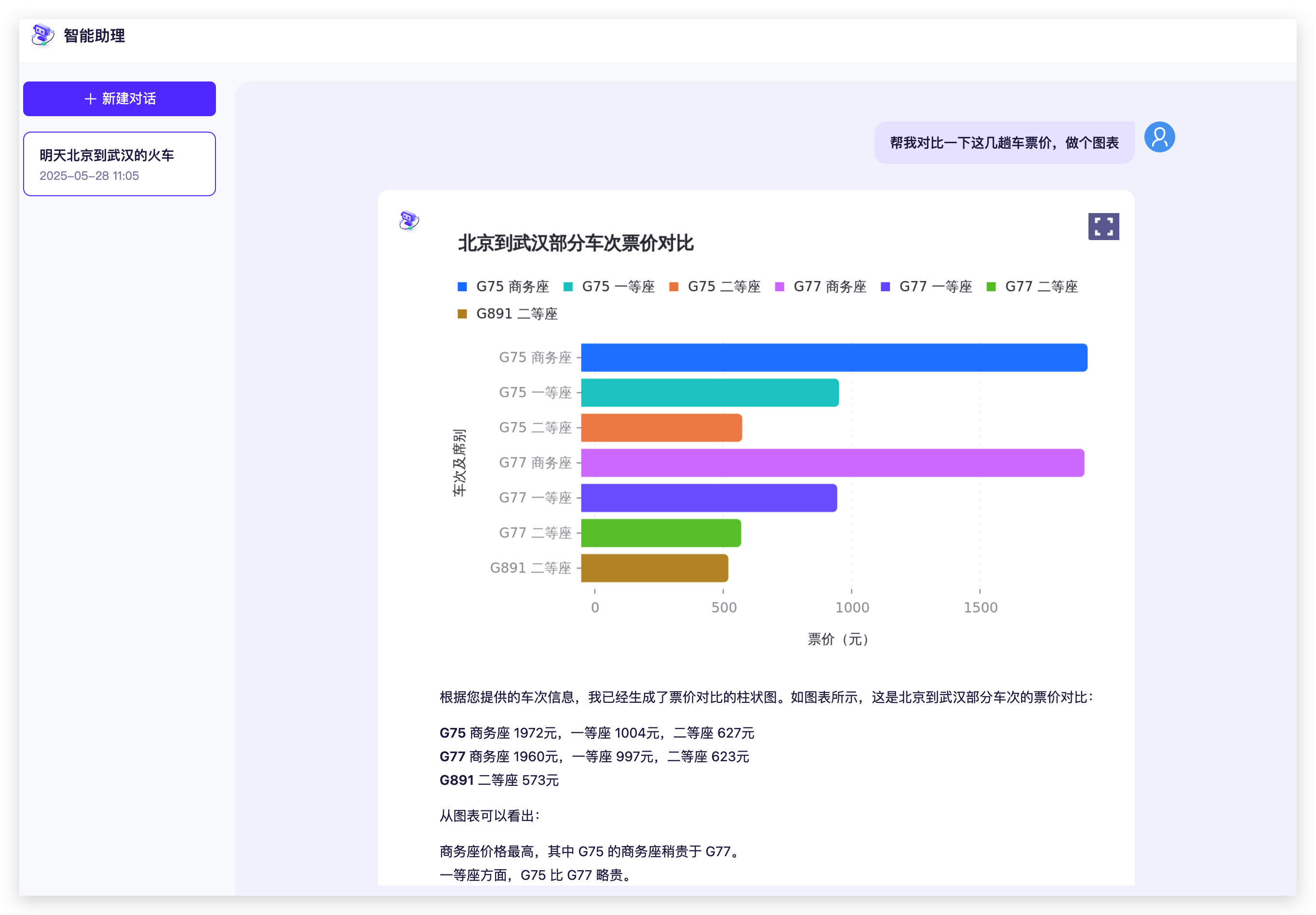
同样能让他生成列车停靠站点地图:
还能生成途径站点的旅行攻略。这里我的逻辑是先让他去网上搜,搜不到就调用文生图模型,由 AI 生成图片。

阿里自带的这个生图 MCP 感觉能力还是挺强的。

感觉跟真的也差不多啊,哈哈哈。
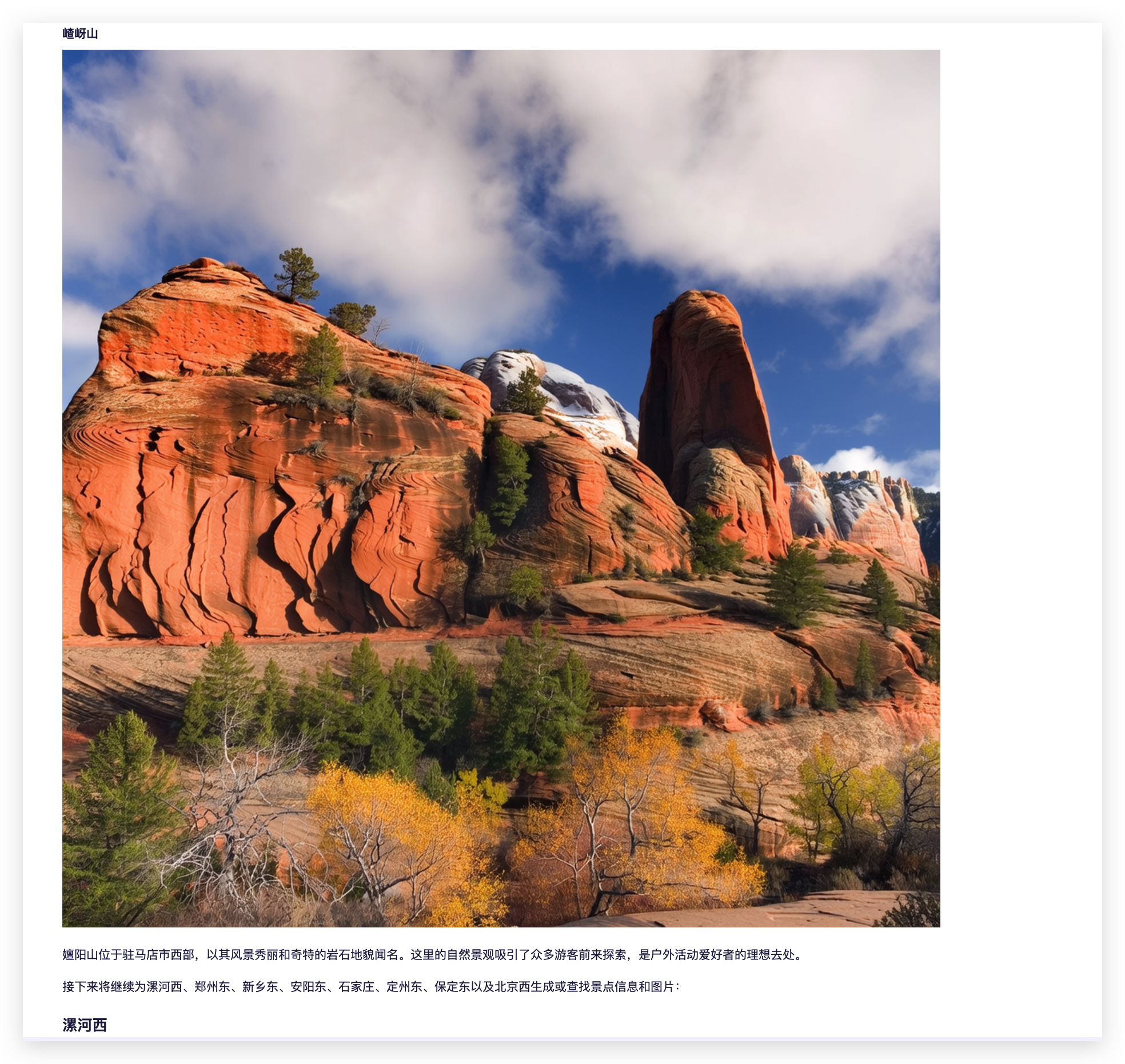
说实话,在火车上看着自己坐的这一趟列车途径的城市,看着这些景点,心中难免有一丝丝的冲动。

Related MCP server: 12306-mcp
功能描述 | 状态 |
查询12306购票信息 | ✅ 已完成 |
过滤列车信息 | ✅ 已完成 |
过站查询 | ✅ 已完成 |
中转查询 | ✅ 已完成 |
其余接口,欢迎提feature | 🚧 计划内 |
git clone https://github.com/freestylefly/12306-mcp.git
npm inpm run build
node ./build/index.js{
"mcpServers": {
"12306-mcp": {
"command": "npx",
"args": [
"-y",
"12306-mcp"
]
}
}
}本项目原自12306-MCP ,感谢作者,本项目仅用于学习,欢迎催更。
mcp-server-weread :🚀基于 Model Context Protocol (MCP) 的12306购票搜索服务器。提供了简单的API接口,允许大模型利用接口搜索12306购票信息。
12306-MCP :🚀一个为微信读书提供MCP(Model Context Protocol)服务的工具,支持将微信读书的书籍、笔记和划线数据提供给支持MCP的大语言模型客户端,如Claude Desktop。
CodeCanvas :📚本代码仓库是作者苍何多年从事一线互联网Java开发的学习历程技术汇总,旨在为大家提供一个清晰详细的学习教程,侧重点更倾向编写Java核心内容。💪🏻
PmHub :🔥PmHub 是一套基于 SpringCloud & LLM 的微服务智能项目管理系统,这个项目旨在帮助小伙伴们快速掌握微服务/分布式项目的架构设计和开发流程,如果想在校招或者社招中拿到一个满意的 offer,PmHub 将是一个非常 nice 的选择。
微信搜 苍何 或扫描下方二维码关注苍何的原创公众号,回复 AI 即可和 5000+ 好友一同探讨AI,一同学习MCP。

MIT License (MIT) The above copyright notice and this permission notice shall be included in all copies or substantial portions of the Software.
Copyright (c) 2025-2026 12306-MCP
获取当前日期,以上海时区(Asia/Shanghai, UTC+8)为准,返回格式为 "yyyy-MM-dd"。主要用于解析用户提到的相对日期(如“明天”、“下周三”),为其他需要日期的接口提供准确的日期输入。
| Name | Required | Description | Default |
|---|---|---|---|
No parameters | |||
Does the description disclose side effects, auth requirements, rate limits, or destructive behavior?
With no annotations provided, the description carries the full burden of behavioral disclosure. It effectively describes key behavioral traits: timezone specificity (Asia/Shanghai), return format (yyyy-MM-dd), and the tool's role in date parsing workflows. It doesn't mention performance characteristics or error conditions, but covers the essential operational behavior.
Agents need to know what a tool does to the world before calling it. Descriptions should go beyond structured annotations to explain consequences.
Is the description appropriately sized, front-loaded, and free of redundancy?
Two well-structured sentences with zero waste. The first sentence states what the tool does (purpose, timezone, format). The second sentence explains when to use it (usage context). Every element serves a clear purpose.
Shorter descriptions cost fewer tokens and are easier for agents to parse. Every sentence should earn its place.
Given the tool's complexity, does the description cover enough for an agent to succeed on first attempt?
For a simple 0-parameter tool with no output schema, the description provides excellent context about timezone, format, and usage scenarios. It doesn't need to explain return values since the format is specified. The only minor gap is lack of explicit mention about what happens on errors or edge cases.
Complex tools with many parameters or behaviors need more documentation. Simple tools need less. This dimension scales expectations accordingly.
Does the description clarify parameter syntax, constraints, interactions, or defaults beyond what the schema provides?
The tool has 0 parameters with 100% schema description coverage, so the baseline is 4. The description appropriately doesn't discuss parameters since none exist, focusing instead on the tool's output and usage context.
Input schemas describe structure but not intent. Descriptions should explain non-obvious parameter relationships and valid value ranges.
Does the description clearly state what the tool does and how it differs from similar tools?
The description clearly states the tool's purpose: '获取当前日期' (get current date) with specific details about timezone (Asia/Shanghai, UTC+8) and return format (yyyy-MM-dd). It distinguishes itself from sibling tools by focusing on date retrieval rather than train/ticket/station operations.
Agents choose between tools based on descriptions. A clear purpose with a specific verb and resource helps agents select the right tool.
Does the description explain when to use this tool, when not to, or what alternatives exist?
Explicitly states when to use this tool: '主要用于解析用户提到的相对日期(如“明天”、“下周三”),为其他需要日期的接口提供准确的日期输入' (mainly used to parse relative dates mentioned by users like 'tomorrow' or 'next Wednesday', providing accurate date input for other interfaces that need dates). This gives clear context about its intended use case.
Agents often have multiple tools that could apply. Explicit usage guidance like "use X instead of Y when Z" prevents misuse.
查询12306中转余票信息。尚且只支持查询前十条。
| Name | Required | Description | Default |
|---|---|---|---|
| date | Yes | 查询日期,格式为 "yyyy-MM-dd"。如果用户提供的是相对日期(如“明天”),请务必先调用 `get-current-date` 接口获取当前日期,并计算出目标日期。 | |
| fromStation | Yes | 出发地的 `station_code` 。必须是通过 `get-station-code-by-name` 或 `get-station-code-of-city` 接口查询得到的编码,严禁直接使用中文地名。 | |
| toStation | Yes | 出发地的 `station_code` 。必须是通过 `get-station-code-by-name` 或 `get-station-code-of-city` 接口查询得到的编码,严禁直接使用中文地名。 | |
| middleStation | No | 中转地的 `station_code` ,可选。必须是通过 `get-station-code-by-name` 或 `get-station-code-of-city` 接口查询得到的编码,严禁直接使用中文地名。 | |
| showWZ | No | 是否显示无座车,默认不显示无座车。 | |
| trainFilterFlags | No | 车次筛选条件,默认为空。从以下标志中选取多个条件组合[G(高铁/城际),D(动车),Z(直达特快),T(特快),K(快速),O(其他),F(复兴号),S(智能动车组)] |
Does the description disclose side effects, auth requirements, rate limits, or destructive behavior?
With no annotations provided, the description carries the full burden of behavioral disclosure. It mentions a limitation ('只支持查询前十条' - only supports querying the first ten results), which is useful, but fails to describe other critical behaviors such as response format, error handling, authentication needs, or rate limits. For a query tool with six parameters, this leaves significant gaps.
Agents need to know what a tool does to the world before calling it. Descriptions should go beyond structured annotations to explain consequences.
Is the description appropriately sized, front-loaded, and free of redundancy?
The description is concise with two sentences: one stating the purpose and one noting a limitation. It is front-loaded with the core function and avoids unnecessary details, though it could be slightly more structured for clarity.
Shorter descriptions cost fewer tokens and are easier for agents to parse. Every sentence should earn its place.
Given the tool's complexity, does the description cover enough for an agent to succeed on first attempt?
Given the complexity (6 parameters, no annotations, no output schema), the description is incomplete. It lacks information on output format, error conditions, and how results are structured, which is critical for an AI agent to use this tool effectively. The limitation mentioned is helpful but insufficient for full contextual understanding.
Complex tools with many parameters or behaviors need more documentation. Simple tools need less. This dimension scales expectations accordingly.
Does the description clarify parameter syntax, constraints, interactions, or defaults beyond what the schema provides?
Schema description coverage is 100%, meaning all parameters are well-documented in the input schema itself. The description adds no additional parameter semantics beyond what the schema provides, so it meets the baseline of 3 without compensating or adding extra value.
Input schemas describe structure but not intent. Descriptions should explain non-obvious parameter relationships and valid value ranges.
Does the description clearly state what the tool does and how it differs from similar tools?
The description clearly states the verb ('查询' meaning 'query') and resource ('12306中转余票信息' meaning '12306 interline ticket availability information'), making the purpose specific and understandable. However, it doesn't explicitly differentiate from sibling tools like 'get-tickets' (which likely queries direct tickets), leaving room for ambiguity.
Agents choose between tools based on descriptions. A clear purpose with a specific verb and resource helps agents select the right tool.
Does the description explain when to use this tool, when not to, or what alternatives exist?
The description implies usage by stating it '只支持查询前十条' (only supports querying the first ten results), which suggests a limitation on result scope. However, it lacks explicit guidance on when to use this tool versus alternatives like 'get-tickets' or how it relates to sibling tools, relying on implicit context.
Agents often have multiple tools that could apply. Explicit usage guidance like "use X instead of Y when Z" prevents misuse.
通过车站的 station_telecode 查询车站的详细信息,包括名称、拼音、所属城市等。此接口主要用于在已知 telecode 的情况下获取更完整的车站数据,或用于特殊查询及调试目的。一般用户对话流程中较少直接触发。
| Name | Required | Description | Default |
|---|---|---|---|
| stationTelecode | Yes | 车站的 `station_telecode` (3位字母编码) |
Does the description disclose side effects, auth requirements, rate limits, or destructive behavior?
No annotations are provided, so the description carries the burden. It discloses that the operation is a lookup and lists sample output fields, but it does not describe the exact return structure, error behavior, or any constraints such as case sensitivity. This leaves moderate ambiguity for a tool without an output schema.
Agents need to know what a tool does to the world before calling it. Descriptions should go beyond structured annotations to explain consequences.
Is the description appropriately sized, front-loaded, and free of redundancy?
Two concise sentences, with the core behavior in the first sentence and usage context in the second. There is no redundant or filler content.
Shorter descriptions cost fewer tokens and are easier for agents to parse. Every sentence should earn its place.
Given the tool's complexity, does the description cover enough for an agent to succeed on first attempt?
For a simple single-parameter lookup, the description provides enough detail: what the input is, what kind of data is returned, and when to use it. The absence of an output schema is partially mitigated by the sample fields, though the exact response shape is not specified.
Complex tools with many parameters or behaviors need more documentation. Simple tools need less. This dimension scales expectations accordingly.
Does the description clarify parameter syntax, constraints, interactions, or defaults beyond what the schema provides?
The schema already provides 100% coverage for the single parameter, including its type and the '3位字母编码' format. The description only reinforces the stationTelecode concept without adding meaningful semantic detail beyond the schema, so the baseline of 3 applies.
Input schemas describe structure but not intent. Descriptions should explain non-obvious parameter relationships and valid value ranges.
Does the description clearly state what the tool does and how it differs from similar tools?
The description states a specific verb (查询), resource (车站 by station_telecode), and expected fields (名称、拼音、所属城市). This distinguishes it from sibling tools that query by name or city, since it is explicitly keyed by telecode.
Agents choose between tools based on descriptions. A clear purpose with a specific verb and resource helps agents select the right tool.
Does the description explain when to use this tool, when not to, or what alternatives exist?
It clearly says this is for cases where the telecode is already known, and for special/debugging use, and notes it is seldom triggered in normal conversation flow. It does not name specific sibling alternatives, but the context is sufficient for selection.
Agents often have multiple tools that could apply. Explicit usage guidance like "use X instead of Y when Z" prevents misuse.
通过具体的中文车站名查询其 station_code 和车站名。此接口主要用于在用户提供具体车站名作为出发地或到达地时,为接口准备 station_code 参数。
| Name | Required | Description | Default |
|---|---|---|---|
| stationNames | Yes | 具体的中文车站名称,例如:"北京南", "上海虹桥"。若要查询多个站点,请用|分割,比如"北京南|上海虹桥"。 |
Does the description disclose side effects, auth requirements, rate limits, or destructive behavior?
No annotations are provided, so the description alone must convey behavioral traits. It states the tool queries station codes and names, implying a read operation, but does not disclose any additional behavioral context such as rate limits, permissions, or side effects.
Agents need to know what a tool does to the world before calling it. Descriptions should go beyond structured annotations to explain consequences.
Is the description appropriately sized, front-loaded, and free of redundancy?
The description is extremely concise with two short sentences. It provides essential information without any redundancy or filler.
Shorter descriptions cost fewer tokens and are easier for agents to parse. Every sentence should earn its place.
Given the tool's complexity, does the description cover enough for an agent to succeed on first attempt?
The tool has a single parameter and no output schema. The description explains the typical use case and the purpose clearly. It does not describe the output format, but given the simplicity, the description is fairly complete.
Complex tools with many parameters or behaviors need more documentation. Simple tools need less. This dimension scales expectations accordingly.
Does the description clarify parameter syntax, constraints, interactions, or defaults beyond what the schema provides?
Schema coverage is 100%, with the input parameter well-described in the schema. The description adds no new semantic information beyond restating its purpose, so the baseline of 3 is appropriate.
Input schemas describe structure but not intent. Descriptions should explain non-obvious parameter relationships and valid value ranges.
Does the description clearly state what the tool does and how it differs from similar tools?
The description clearly states the verb "查询" (query) and the specific resource (station_code and station name). It differentiates from sibling tools by specifying "by names", as opposed to by telecode or city code.
Agents choose between tools based on descriptions. A clear purpose with a specific verb and resource helps agents select the right tool.
Does the description explain when to use this tool, when not to, or what alternatives exist?
The description explicitly states when to use the tool: "当用户提供具体车站名作为出发地或到达地时" (when the user provides a specific station name as departure or arrival). It does not mention alternatives or when not to use, but the context is clear.
Agents often have multiple tools that could apply. Explicit usage guidance like "use X instead of Y when Z" prevents misuse.
通过中文城市名查询代表该城市的 station_code。此接口主要用于在用户提供城市名作为出发地或到达地时,为接口准备 station_code 参数。
| Name | Required | Description | Default |
|---|---|---|---|
| citys | Yes | 要查询的城市,比如"北京"。若要查询多个城市,请用|分割,比如"北京|上海"。 |
Does the description disclose side effects, auth requirements, rate limits, or destructive behavior?
No annotations are provided, so the description must carry the full burden. It does not disclose behavioral traits such as return format, error handling, or effects. The tool can query multiple cities but the description does not explain the response structure (e.g., if it returns a list or mapping). This lack of detail harms transparency.
Agents need to know what a tool does to the world before calling it. Descriptions should go beyond structured annotations to explain consequences.
Is the description appropriately sized, front-loaded, and free of redundancy?
The description is composed of two concise sentences that convey the core functionality and usage context. It is front-loaded and contains no unnecessary words, achieving high efficiency.
Shorter descriptions cost fewer tokens and are easier for agents to parse. Every sentence should earn its place.
Given the tool's complexity, does the description cover enough for an agent to succeed on first attempt?
With no output schema, the description does not explain return values, which is a gap. The tool has one required parameter and is relatively simple, so the description covers the essential context but lacks details on output format and error conditions. It is adequate but not fully complete.
Complex tools with many parameters or behaviors need more documentation. Simple tools need less. This dimension scales expectations accordingly.
Does the description clarify parameter syntax, constraints, interactions, or defaults beyond what the schema provides?
The input schema has 100% coverage with a clear description of the 'citys' parameter, including format and examples. The description adds little beyond the schema, only reiterating the purpose. The baseline is 3, and while the description provides context, it does not significantly enhance parameter understanding.
Input schemas describe structure but not intent. Descriptions should explain non-obvious parameter relationships and valid value ranges.
Does the description clearly state what the tool does and how it differs from similar tools?
The description clearly states the tool queries `station_code` by Chinese city name, using the verb 'query'. It specifies the resource (station_code) and differentiates from siblings by mentioning multiple cities via pipe. The title, though misspelled, does not detract.
Agents choose between tools based on descriptions. A clear purpose with a specific verb and resource helps agents select the right tool.
Does the description explain when to use this tool, when not to, or what alternatives exist?
The description explicitly states when to use: when the user provides a city name as departure or arrival. It implies the context for preparing the station_code parameter but does not explicitly mention alternatives or when not to use it, which is acceptable given sibling tool names suggest different criteria.
Agents often have multiple tools that could apply. Explicit usage guidance like "use X instead of Y when Z" prevents misuse.
通过中文城市名查询该城市 所有 火车站的名称及其对应的 station_code,结果是一个包含多个车站信息的列表。当用户想了解一个城市有哪些火车站,或者不确定具体从哪个车站出发/到达时可以使用此接口。
| Name | Required | Description | Default |
|---|---|---|---|
| city | Yes | 中文城市名称,例如:"北京", "上海" |
Does the description disclose side effects, auth requirements, rate limits, or destructive behavior?
No annotations are provided, so the description carries full burden. It discloses the output format ('结果是一个包含多个车站信息的列表' - result is a list containing multiple station information) and scope ('所有' - all stations), but lacks details on error handling, rate limits, authentication needs, or whether the query is case-sensitive for Chinese city names. It adequately describes core behavior but misses operational nuances.
Agents need to know what a tool does to the world before calling it. Descriptions should go beyond structured annotations to explain consequences.
Is the description appropriately sized, front-loaded, and free of redundancy?
The description is efficiently structured in two sentences: the first explains what the tool does and its output, the second provides usage guidelines. Every sentence adds value without redundancy, and it's appropriately sized for the tool's complexity.
Shorter descriptions cost fewer tokens and are easier for agents to parse. Every sentence should earn its place.
Given the tool's complexity, does the description cover enough for an agent to succeed on first attempt?
Given the tool's low complexity (1 parameter, no annotations, no output schema), the description is mostly complete: it covers purpose, usage, output format, and parameter context. However, it lacks details on error cases (e.g., invalid city names) and exact return structure, which would be helpful since there's no output schema. It's sufficient but has minor gaps.
Complex tools with many parameters or behaviors need more documentation. Simple tools need less. This dimension scales expectations accordingly.
Does the description clarify parameter syntax, constraints, interactions, or defaults beyond what the schema provides?
Schema description coverage is 100%, so the baseline is 3. The description adds value by emphasizing the parameter must be a '中文城市名' (Chinese city name) and providing context that it's used to query '所有' (all) stations, which clarifies the parameter's role beyond the schema's basic type and example. However, it doesn't add syntax or format details beyond what the schema provides.
Input schemas describe structure but not intent. Descriptions should explain non-obvious parameter relationships and valid value ranges.
Does the description clearly state what the tool does and how it differs from similar tools?
The description clearly states the specific action ('查询' - query) and resource ('火车站的名称及其对应的 station_code'), explicitly distinguishes scope ('所有' - all stations in the city), and differentiates from siblings like 'get-station-by-telecode' (which uses telecode) and 'get-station-code-by-names' (which uses station names).
Agents choose between tools based on descriptions. A clear purpose with a specific verb and resource helps agents select the right tool.
Does the description explain when to use this tool, when not to, or what alternatives exist?
The description explicitly states when to use this tool ('当用户想了解一个城市有哪些火车站,或者不确定具体从哪个车站出发/到达时' - when users want to know which stations a city has or are unsure about departure/arrival stations), providing clear context for its application without needing to mention specific alternatives since the sibling tools serve different purposes.
Agents often have multiple tools that could apply. Explicit usage guidance like "use X instead of Y when Z" prevents misuse.
查询12306余票信息。
| Name | Required | Description | Default |
|---|---|---|---|
| date | Yes | 查询日期,格式为 "yyyy-MM-dd"。如果用户提供的是相对日期(如“明天”),请务必先调用 `get-current-date` 接口获取当前日期,并计算出目标日期。 | |
| fromStation | Yes | 出发地的 `station_code` 。必须是通过 `get-station-code-by-name` 或 `get-station-code-of-city` 接口查询得到的编码,严禁直接使用中文地名。 | |
| toStation | Yes | 到达地的 `station_code` 。必须是通过 `get-station-code-by-name` 或 `get-station-code-of-city` 接口查询得到的编码,严禁直接使用中文地名。 | |
| trainFilterFlags | No | 车次筛选条件,默认为空,即不筛选。例如用户说“高铁票”,则应使用 "G"。可选标志:[G(高铁/城际),D(动车),Z(直达特快),T(特快),K(快速),O(其他),F(复兴号),S(智能动车组)] |
Does the description disclose side effects, auth requirements, rate limits, or destructive behavior?
With no annotations provided, the description carries full burden for behavioral disclosure. '查询' (query) implies a read-only operation, but the description doesn't explicitly state whether this requires authentication, has rate limits, returns paginated results, or what happens on errors. For a ticket query tool with zero annotation coverage, this represents significant behavioral gaps that could affect agent decision-making.
Agents need to know what a tool does to the world before calling it. Descriptions should go beyond structured annotations to explain consequences.
Is the description appropriately sized, front-loaded, and free of redundancy?
The description is extremely concise at just 8 Chinese characters ('查询12306余票信息'), making it front-loaded and efficient with zero wasted words. Every character serves the purpose of identifying the tool's function. This represents optimal conciseness for a tool description.
Shorter descriptions cost fewer tokens and are easier for agents to parse. Every sentence should earn its place.
Given the tool's complexity, does the description cover enough for an agent to succeed on first attempt?
Given the complexity of a ticket query system with 4 parameters, no annotations, and no output schema, the description is insufficiently complete. It doesn't explain what information is returned (ticket types, prices, availability status), how results are structured, or any behavioral constraints. The agent would need to infer too much about this tool's operation from the minimal description.
Complex tools with many parameters or behaviors need more documentation. Simple tools need less. This dimension scales expectations accordingly.
Does the description clarify parameter syntax, constraints, interactions, or defaults beyond what the schema provides?
The description provides no parameter information beyond what's already in the schema. With 100% schema description coverage, all 4 parameters (date, fromStation, toStation, trainFilterFlags) are well-documented in the schema with format requirements, dependencies on other tools, and usage examples. The baseline score of 3 reflects that the schema does the heavy lifting while the description adds no additional parameter semantics.
Input schemas describe structure but not intent. Descriptions should explain non-obvious parameter relationships and valid value ranges.
Does the description clearly state what the tool does and how it differs from similar tools?
The description '查询12306余票信息' clearly states the purpose as querying ticket availability from the 12306 system. It specifies the verb '查询' (query) and resource '余票信息' (ticket availability), making the tool's function unambiguous. However, it doesn't explicitly differentiate from sibling tools like 'get-interline-tickets' which might handle different ticket types or routes.
Agents choose between tools based on descriptions. A clear purpose with a specific verb and resource helps agents select the right tool.
Does the description explain when to use this tool, when not to, or what alternatives exist?
The description provides implied usage context through the Chinese text, suggesting it's for checking ticket availability on China's 12306 railway system. However, it lacks explicit guidance on when to use this tool versus alternatives like 'get-interline-tickets' or when not to use it. The input schema provides some usage hints (like calling other tools first for date/station codes), but these aren't part of the description itself.
Agents often have multiple tools that could apply. Explicit usage guidance like "use X instead of Y when Z" prevents misuse.
查询特定列车车次在指定区间内的途径车站、到站时间、出发时间及停留时间等详细经停信息。当用户询问某趟具体列车的经停站时使用此接口。
| Name | Required | Description | Default |
|---|---|---|---|
| trainNo | Yes | 要查询的实际车次编号 `train_no`,例如 "240000G10336",而非"G1033"。此编号通常可以从 `get-tickets` 的查询结果中获取,或者由用户直接提供。 | |
| fromStationTelecode | Yes | 该列车行程的**出发站**的 `station_telecode` (3位字母编码`)。通常来自 `get-tickets` 结果中的 `telecode` 字段,或者通过 `get-station-code-by-name` 得到。 | |
| toStationTelecode | Yes | 该列车行程的**到达站**的 `station_telecode` (3位字母编码)。通常来自 `get-tickets` 结果中的 `telecode` 字段,或者通过 `get-station-code-by-name` 得到。 | |
| departDate | Yes | 列车从 `fromStationTelecode` 指定的车站出发的日期 (格式: yyyy-MM-dd)。如果用户提供的是相对日期,请务必先调用 `get-current-date` 解析。 |
Does the description disclose side effects, auth requirements, rate limits, or destructive behavior?
No annotations are provided, so the description carries full burden. It clearly describes what the tool returns (stop stations, arrival/departure times, dwell times) but doesn't mention error conditions, rate limits, authentication needs, or response format. For a query tool with no annotation coverage, this provides basic behavioral information but lacks operational details.
Agents need to know what a tool does to the world before calling it. Descriptions should go beyond structured annotations to explain consequences.
Is the description appropriately sized, front-loaded, and free of redundancy?
Two well-structured sentences with zero waste. First sentence defines the tool's purpose and scope, second sentence provides clear usage guidance. Every word earns its place with no redundancy or unnecessary elaboration.
Shorter descriptions cost fewer tokens and are easier for agents to parse. Every sentence should earn its place.
Given the tool's complexity, does the description cover enough for an agent to succeed on first attempt?
For a query tool with 4 required parameters, 100% schema coverage, but no annotations and no output schema, the description provides adequate purpose and usage context. However, it doesn't describe the return format or structure, which would be helpful given the absence of an output schema. The description is complete enough for basic understanding but lacks output details.
Complex tools with many parameters or behaviors need more documentation. Simple tools need less. This dimension scales expectations accordingly.
Does the description clarify parameter syntax, constraints, interactions, or defaults beyond what the schema provides?
Schema description coverage is 100%, so the schema already fully documents all 4 parameters. The description doesn't add any parameter-specific information beyond what's in the schema descriptions. Baseline 3 is appropriate when the schema does all the parameter documentation work.
Input schemas describe structure but not intent. Descriptions should explain non-obvious parameter relationships and valid value ranges.
Does the description clearly state what the tool does and how it differs from similar tools?
The description clearly states the specific verb ('查询' - query) and resource ('特定列车车次在指定区间内的途径车站、到站时间、出发时间及停留时间等详细经停信息' - detailed stop information for specific train routes). It distinguishes from siblings by specifying it's for '具体列车的经停站' (specific train stop stations), unlike general ticket or station lookup tools.
Agents choose between tools based on descriptions. A clear purpose with a specific verb and resource helps agents select the right tool.
Does the description explain when to use this tool, when not to, or what alternatives exist?
Explicitly states '当用户询问某趟具体列车的经停站时使用此接口' (use this interface when users ask about specific train stop stations), providing clear when-to-use guidance. It distinguishes from alternatives by specifying it's for detailed stop information rather than ticket availability or station codes.
Agents often have multiple tools that could apply. Explicit usage guidance like "use X instead of Y when Z" prevents misuse.
Recent tool additions, removals, and schema changes observed during successful MCP inspections.
v1.0.0get-current-date1 field changedInput schema / additionalPropertiesRemoved value: -falseget-current-dateget-interline-ticketsget-station-by-telecodeget-station-code-by-namesget-station-code-of-citysget-stations-code-in-cityget-ticketsget-train-route-stationsScored across 8 tools
Each tool has a clearly distinct purpose with no overlap. Tools target specific functions like date retrieval, station code lookup (by telecode, names, cities, or stations in a city), ticket queries (direct and interline), and train route details, making misselection unlikely.
All tools follow a consistent verb_noun pattern with 'get-' prefix (e.g., get-current-date, get-tickets). The naming is uniform and predictable, enhancing readability and usability.
With 8 tools, the server is well-scoped for querying 12306 train data. Each tool serves a specific role in the workflow, from station code resolution to ticket and route queries, without being overly sparse or bloated.
The toolset covers core functionalities like date handling, station code retrieval, ticket queries, and route details, supporting key user workflows. A minor gap is the lack of booking or purchase tools, but this is reasonable for a query-focused server.
MCP server for China Railway 12306 ticket availability: schedules and seats by Chinese station name.
A comprehensive Model Context Protocol (MCP) server that enables AI assistants to interact with yo…
A Model Context Protocol server for Wix AI tools
The Mercado Pago MCP Server implements the Model Context Protocol to provide AI agents and LLMs with access to Mercado Pago's APIs and tools within compatible development environments. It acts as an intermediary that translates Mercado Pago resources into executable functions (tools) that AI applications can invoke to perform actions and automate flows. The server simplifies integration, enables using documentation to implement or improve code, and optimizes operations through natural language interactions without manual implementations.