

AGPL 3.0

LinkedIn MCP Assistant
by ertiqah
LiGo + LinkedIn MCP Runner

第一个由 GPT 驱动的创意副驾驶根据您的实际 LinkedIn 内容进行训练。
创建帖子。分析哪些内容有效。用你的声音重写。所有功能均可通过 Claude 或 ChatGPT 实现,并由你之前的帖子提供支持。
这是什么?
这是**LiGo 模型上下文协议 (MCP)**的官方运行器代码库。该协议允许基于 GPT 的助手提取您的 LinkedIn 上下文,并像策略师一样做出响应。它可与 Claude 和 ChatGPT 兼容。
借助 MCP,您的助手可以回答以下问题:
你最近发的哪篇文章最受关注
你的写作风格实际上听起来像什么
如何帮助你像创始人一样发布、重写或集思广益
只需正常地与它对话即可(如果你知道怎么做的话——顺便说一句,即使不知道,我也不会评判你)。它可以访问你所有公开的领英数据(当然,需要你的同意)。
Related MCP server: linkedctl
如何开始
克劳德·塞普
点击**“生成安装命令”**
如果未登录,您将被引导至 LiGo 进行身份验证
复制命令并在终端中运行
打开 Claude 并开始聊天
示例提示:
分析一下我最近的五篇文章。哪些内容有效?给我一些建议,告诉我接下来应该写些什么。
ChatGPT(自定义GPT)
无需安装。
出现提示时使用 LiGo 进行身份验证
开始使用 CustomGPT
示例提示:
重写此内容,使其听起来更像我最近的帖子,并使内容更有趣。
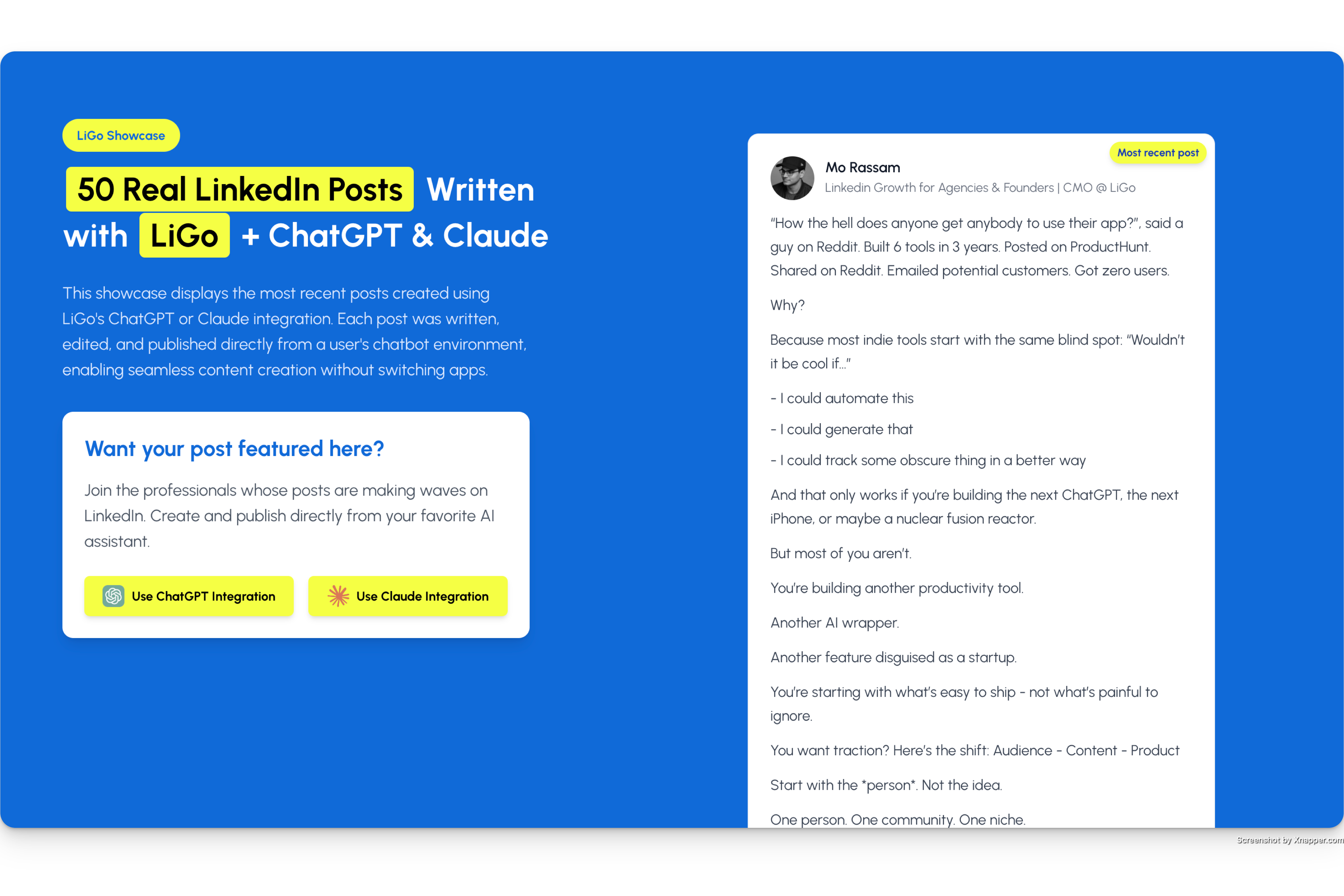
实际操作: MCP 排行榜
我们展示了使用 MCP 集成发布的最新 50 篇帖子,其中包括:
完整帖子
LinkedIn 原始帖子的链接
作者姓名
这就像一个公开的信息流,是一个实时演示。没错,它确实能营造出健康的“错失恐惧症”(FOMO),还能为你的帖子添加永久的反向链接。SEO 效果显著。
为什么重要
老实说,让你的 GPT/Claude 项目与你的 Linkedin 活动保持同步有点麻烦(假设你有一个)。
我们想:“如果 GPT 可以连接到我们的 Linkedin 个人资料,这样我就可以告诉它去查看,那不是很好吗?”
然后就发生了这样的事。
但这还不是全部。
它是更广泛的LiGo 平台的一部分,该平台涵盖评论、分析、CRM 等功能。快去看看吧。

另请查看
Chrome 扩展程序:直接从 LinkedIn 发表评论和发帖。
帖子改写工具:将草稿转换为适合 LinkedIn 的帖子。
什么是 LiGo?:完整的产品概述。
保持更新
此 README 将成为 MCP 运行器更新的规范来源。
如需反馈、改进或集成想法,请打开问题或通过ligo.ertiqah.com/contact联系我们。
Available Tools
10 toolsanalyze_linkedin_chatA
Ask questions about the user's LinkedIn profile, content, or network, with support for multi-turn conversations.
ParametersJSON Schema
| Name | Required | Description | Default |
|---|---|---|---|
| query | Yes | The question or request about LinkedIn data to be analyzed. | |
| conversation_history | No | Optional. Previous messages in the conversation for context. Each message must have 'role' (user/assistant) and 'content' (text). |
TDQS
A3.5/5.0
Behavior2/5
Does the description disclose side effects, auth requirements, rate limits, or destructive behavior?
No annotations are provided, so the description carries the full burden of behavioral disclosure. It only mentions multi-turn conversation support but omits critical traits such as whether the tool is read-only, authentication requirements, or any side effects. Given the lack of annotations, this is insufficient.
Agents need to know what a tool does to the world before calling it. Descriptions should go beyond structured annotations to explain consequences.
Conciseness5/5
Is the description appropriately sized, front-loaded, and free of redundancy?
The description is a single, front-loaded sentence that conveys the core functionality and key feature (multi-turn) efficiently. No extraneous information.
Shorter descriptions cost fewer tokens and are easier for agents to parse. Every sentence should earn its place.
Completeness3/5
Given the tool's complexity, does the description cover enough for an agent to succeed on first attempt?
The description explains what the tool does but does not specify the output format or return value, which is notable given the absence of an output schema. For a conversational Q&A tool, stating that it returns answers or analysis would improve completeness. The multi-turn support is a plus, but the overall context lacks details on behavior and results.
Complex tools with many parameters or behaviors need more documentation. Simple tools need less. This dimension scales expectations accordingly.
Parameters3/5
Does the description clarify parameter syntax, constraints, interactions, or defaults beyond what the schema provides?
The input schema has 100% coverage, with both parameters clearly described. The description adds the context of 'multi-turn conversations', which implicitly explains the conversation_history parameter, but does not provide additional meaning beyond the schema. Baseline of 3 is appropriate.
Input schemas describe structure but not intent. Descriptions should explain non-obvious parameter relationships and valid value ranges.
Purpose5/5
Does the description clearly state what the tool does and how it differs from similar tools?
The description clearly states the tool's purpose: 'Ask questions about the user's LinkedIn profile, content, or network' with multi-turn support. It distinguishes itself from sibling tools like get_linkedin_profile and get_linkedin_posts by focusing on analysis and conversation rather than retrieval or publishing.
Agents choose between tools based on descriptions. A clear purpose with a specific verb and resource helps agents select the right tool.
Usage Guidelines3/5
Does the description explain when to use this tool, when not to, or what alternatives exist?
The description implies usage for analytical questions about LinkedIn data, but it does not provide explicit guidance on when to use this tool versus alternatives (e.g., get_linkedin_profile for raw data). No exclusion criteria or alternative references are given.
Agents often have multiple tools that could apply. Explicit usage guidance like "use X instead of Y when Z" prevents misuse.
generate_linkedin_postA
Generate three LinkedIn post variants from any content (article, newsletter, notes, etc.) to optimize engagement.
ParametersJSON Schema
| Name | Required | Description | Default |
|---|---|---|---|
| content | Yes | The source content to transform into LinkedIn posts. Can be articles, emails, newsletters, notes, etc. | |
| content_type | No | Optional. A short description of the content type (e.g., 'article', 'newsletter', 'notes'). Defaults to 'article'. |
TDQS
A3.8/5.0
Behavior3/5
Does the description disclose side effects, auth requirements, rate limits, or destructive behavior?
With no annotations, the description carries full burden. It discloses that it generates three variants for engagement, which is a read-like operation. However, it does not mention authentication requirements, rate limits, or any side effects. The output is implied but not structurally documented.
Agents need to know what a tool does to the world before calling it. Descriptions should go beyond structured annotations to explain consequences.
Conciseness5/5
Is the description appropriately sized, front-loaded, and free of redundancy?
The description is a single sentence that conveys purpose, input source, and output count. It is concise and front-loaded with the key information. Every word is purposeful and nothing is wasted.
Shorter descriptions cost fewer tokens and are easier for agents to parse. Every sentence should earn its place.
Completeness4/5
Given the tool's complexity, does the description cover enough for an agent to succeed on first attempt?
Given no output schema, the description explicitly states the output (three LinkedIn post variants), which is sufficient. The tool is simple (two parameters, one required) and the context from siblings helps. It adequately covers what the agent needs to know.
Complex tools with many parameters or behaviors need more documentation. Simple tools need less. This dimension scales expectations accordingly.
Parameters3/5
Does the description clarify parameter syntax, constraints, interactions, or defaults beyond what the schema provides?
Schema coverage is 100% and both parameters are already described well in the schema. The description adds no additional meaning beyond summarizing the content parameter as 'any content (article, newsletter, notes, etc.)'. Baseline score of 3 is appropriate.
Input schemas describe structure but not intent. Descriptions should explain non-obvious parameter relationships and valid value ranges.
Purpose5/5
Does the description clearly state what the tool does and how it differs from similar tools?
The description clearly states the tool generates three LinkedIn post variants from any content to optimize engagement. It uses specific verbs ('generate') and resources ('LinkedIn post variants'), and distinguishes from siblings like publish_linkedin_post or get_linkedin_posts.
Agents choose between tools based on descriptions. A clear purpose with a specific verb and resource helps agents select the right tool.
Usage Guidelines3/5
Does the description explain when to use this tool, when not to, or what alternatives exist?
The description implies it should be used when you have source content to transform into posts, but does not explicitly state when to use this tool versus alternatives like analyze_linkedin_chat or schedule_linkedin_post. No exclusions or when-not-to-use guidance is provided.
Agents often have multiple tools that could apply. Explicit usage guidance like "use X instead of Y when Z" prevents misuse.
get_linkedin_postsB
Retrieve the user's recent LinkedIn posts with engagement metrics.
ParametersJSON Schema
| Name | Required | Description | Default |
|---|---|---|---|
| limit | No | Optional. Number of posts to retrieve (1-20). Defaults to 5. |
TDQS
B3.3/5.0
Behavior2/5
Does the description disclose side effects, auth requirements, rate limits, or destructive behavior?
No annotations are provided, so the description must carry the burden of behavioral disclosure. It does not mention any side effects, authentication requirements, rate limits, or whether the data is cached. The word 'recent' is vague and does not specify time window.
Agents need to know what a tool does to the world before calling it. Descriptions should go beyond structured annotations to explain consequences.
Conciseness5/5
Is the description appropriately sized, front-loaded, and free of redundancy?
The description is a single sentence that conveys the core purpose without any wasted words. It is concise and front-loaded with the action and resource.
Shorter descriptions cost fewer tokens and are easier for agents to parse. Every sentence should earn its place.
Completeness3/5
Given the tool's complexity, does the description cover enough for an agent to succeed on first attempt?
The tool is simple with one optional parameter and no output schema. The description mentions engagement metrics but does not specify what those metrics are, how results are ordered, or the time range for 'recent'. It is minimally adequate but could benefit from more detail.
Complex tools with many parameters or behaviors need more documentation. Simple tools need less. This dimension scales expectations accordingly.
Parameters3/5
Does the description clarify parameter syntax, constraints, interactions, or defaults beyond what the schema provides?
The schema coverage is 100% (the limit parameter is fully described). The description does not add any additional meaning to the parameter beyond what is in the schema, but the schema itself is sufficient. Baseline 3 is appropriate.
Input schemas describe structure but not intent. Descriptions should explain non-obvious parameter relationships and valid value ranges.
Purpose5/5
Does the description clearly state what the tool does and how it differs from similar tools?
The description clearly states the tool retrieves the user's recent LinkedIn posts with engagement metrics, using a specific verb (Retrieve) and resource (posts). It distinguishes from siblings like generate_linkedin_post (creation) and publish_linkedin_post (publishing) by focusing on retrieval.
Agents choose between tools based on descriptions. A clear purpose with a specific verb and resource helps agents select the right tool.
Usage Guidelines2/5
Does the description explain when to use this tool, when not to, or what alternatives exist?
No guidance is provided on when to use this tool versus siblings. For example, refresh_linkedin_posts might also retrieve posts but with a different purpose. The description lacks any context for selection criteria or exclusions.
Agents often have multiple tools that could apply. Explicit usage guidance like "use X instead of Y when Z" prevents misuse.
get_linkedin_profileA
Retrieve the user's LinkedIn profile information including headline, summary, experience, and education.
ParametersJSON Schema
| Name | Required | Description | Default |
|---|---|---|---|
No parameters | |||
TDQS
A3.7/5.0
Behavior3/5
Does the description disclose side effects, auth requirements, rate limits, or destructive behavior?
With no annotations, the description carries full burden. It correctly implies a read-only operation ('retrieve') but does not disclose any specific behavioral traits, rate limits, or authentication requirements. The description is adequate but not enhanced.
Agents need to know what a tool does to the world before calling it. Descriptions should go beyond structured annotations to explain consequences.
Conciseness5/5
Is the description appropriately sized, front-loaded, and free of redundancy?
The description is a single, well-structured sentence that immediately conveys the tool's purpose. Every word adds value, with no redundancy or filler.
Shorter descriptions cost fewer tokens and are easier for agents to parse. Every sentence should earn its place.
Completeness3/5
Given the tool's complexity, does the description cover enough for an agent to succeed on first attempt?
For a simple retrieval tool with no parameters and no output schema, the description lists included fields but fails to clarify which profile is retrieved (e.g., current user's profile vs. a previously set URL). Given sibling 'set_linkedin_url', additional context would improve completeness.
Complex tools with many parameters or behaviors need more documentation. Simple tools need less. This dimension scales expectations accordingly.
Parameters4/5
Does the description clarify parameter syntax, constraints, interactions, or defaults beyond what the schema provides?
The input schema has no parameters, and schema coverage is 100%. According to rules, 0 parameters gives a baseline of 4. The description does not need to add parameter information.
Input schemas describe structure but not intent. Descriptions should explain non-obvious parameter relationships and valid value ranges.
Purpose5/5
Does the description clearly state what the tool does and how it differs from similar tools?
The description clearly states the verb 'retrieve' and the resource 'LinkedIn profile information', listing specific fields like headline, summary, experience, and education. It effectively distinguishes from siblings like 'get_linkedin_posts' and 'refresh_linkedin_profile'.
Agents choose between tools based on descriptions. A clear purpose with a specific verb and resource helps agents select the right tool.
Usage Guidelines2/5
Does the description explain when to use this tool, when not to, or what alternatives exist?
No guidance is provided on when to use this tool versus alternatives such as 'refresh_linkedin_profile' or any prerequisites. The description lacks context about the intended use case or conditions.
Agents often have multiple tools that could apply. Explicit usage guidance like "use X instead of Y when Z" prevents misuse.
publish_linkedin_postB
Publish a text post to LinkedIn, optionally including media (images/videos) specified by URL.
ParametersJSON Schema
| Name | Required | Description | Default |
|---|---|---|---|
| post_text | Yes | The text content of the LinkedIn post. | |
| media | No | Optional. A list of media items to attach to the post. Each item must have a 'file_url' pointing to a direct image or video URL and a 'filename'. |
TDQS
B3.4/5.0
Behavior2/5
Does the description disclose side effects, auth requirements, rate limits, or destructive behavior?
No annotations provided. The description only indicates a create/mutation action without disclosing side effects, error handling, rate limits, or return information.
Agents need to know what a tool does to the world before calling it. Descriptions should go beyond structured annotations to explain consequences.
Conciseness5/5
Is the description appropriately sized, front-loaded, and free of redundancy?
Single, front-loaded sentence with no redundancy. Efficient delivery of core purpose.
Shorter descriptions cost fewer tokens and are easier for agents to parse. Every sentence should earn its place.
Completeness2/5
Given the tool's complexity, does the description cover enough for an agent to succeed on first attempt?
Missing behavioral context (e.g., success output, error cases) and media constraints (formats, size limits). For a tool with no output schema, description should clarify return value.
Complex tools with many parameters or behaviors need more documentation. Simple tools need less. This dimension scales expectations accordingly.
Parameters3/5
Does the description clarify parameter syntax, constraints, interactions, or defaults beyond what the schema provides?
Schema covers both parameters with descriptions. The description slightly reinforces media type as images/videos by URL, but adds no new constraints or formatting details beyond schema.
Input schemas describe structure but not intent. Descriptions should explain non-obvious parameter relationships and valid value ranges.
Purpose5/5
Does the description clearly state what the tool does and how it differs from similar tools?
The description clearly states the action (publish), the target resource (text post to LinkedIn), and optional media. It effectively distinguishes from siblings like schedule_linkedin_post and generate_linkedin_post.
Agents choose between tools based on descriptions. A clear purpose with a specific verb and resource helps agents select the right tool.
Usage Guidelines3/5
Does the description explain when to use this tool, when not to, or what alternatives exist?
The description implies usage for immediate publishing, but does not explicitly state when to use this tool over alternatives like schedule_linkedin_post or under what conditions media is supported.
Agents often have multiple tools that could apply. Explicit usage guidance like "use X instead of Y when Z" prevents misuse.
publish_twitter_postC
Publish a text post (tweet) to Twitter.
ParametersJSON Schema
| Name | Required | Description | Default |
|---|---|---|---|
| post_text | Yes | The text content of the tweet (maximum 280 characters). |
TDQS
C2.9/5.0
Behavior2/5
Does the description disclose side effects, auth requirements, rate limits, or destructive behavior?
No annotations provided, so the description alone must disclose behavior. It only states the core action, with no mention of authentication, rate limits, or post limits beyond what the schema's parameter description covers.
Agents need to know what a tool does to the world before calling it. Descriptions should go beyond structured annotations to explain consequences.
Conciseness5/5
Is the description appropriately sized, front-loaded, and free of redundancy?
The description is a single sentence that conveys the essential purpose without any wasted words. It is front-loaded and concise.
Shorter descriptions cost fewer tokens and are easier for agents to parse. Every sentence should earn its place.
Completeness2/5
Given the tool's complexity, does the description cover enough for an agent to succeed on first attempt?
Despite having only one parameter and no output schema, the description fails to mention return values or side effects. For a write operation, behavioral details like authentication requirements or success/failure indicators are missing.
Complex tools with many parameters or behaviors need more documentation. Simple tools need less. This dimension scales expectations accordingly.
Parameters3/5
Does the description clarify parameter syntax, constraints, interactions, or defaults beyond what the schema provides?
Schema description coverage is 100% for the single parameter, so the baseline is 3. The tool description adds nothing beyond what the schema already provides.
Input schemas describe structure but not intent. Descriptions should explain non-obvious parameter relationships and valid value ranges.
Purpose4/5
Does the description clearly state what the tool does and how it differs from similar tools?
The description clearly identifies the action (publish), the resource (text post/tweet), and the platform (Twitter). It distinguishes from sibling tools which are all LinkedIn-related.
Agents choose between tools based on descriptions. A clear purpose with a specific verb and resource helps agents select the right tool.
Usage Guidelines2/5
Does the description explain when to use this tool, when not to, or what alternatives exist?
No explicit guidance on when to use this tool or when not to; no alternatives mentioned. The context signals that it is for Twitter, but usage context is minimal.
Agents often have multiple tools that could apply. Explicit usage guidance like "use X instead of Y when Z" prevents misuse.
refresh_linkedin_postsA
Force a refresh of LinkedIn posts data to capture recently published content.
ParametersJSON Schema
| Name | Required | Description | Default |
|---|---|---|---|
No parameters | |||
TDQS
A3.7/5.0
Behavior2/5
Does the description disclose side effects, auth requirements, rate limits, or destructive behavior?
No annotations are provided, so the description must fully disclose behavior. It states 'Force a refresh' but does not explain side effects (e.g., whether existing data is overwritten, if the operation is synchronous or asynchronous, or any rate limits). The description is too minimal for a mutating action.
Agents need to know what a tool does to the world before calling it. Descriptions should go beyond structured annotations to explain consequences.
Conciseness5/5
Is the description appropriately sized, front-loaded, and free of redundancy?
The description is a single clear sentence that is front-loaded with the verb and resource. Every word contributes meaning, no fluff.
Shorter descriptions cost fewer tokens and are easier for agents to parse. Every sentence should earn its place.
Completeness3/5
Given the tool's complexity, does the description cover enough for an agent to succeed on first attempt?
The tool is simple (no parameters, no output schema), but the description lacks completeness regarding follow-up actions. For example, it does not mention that results can be retrieved via get_linkedin_posts. Adequate but not fully contextualized.
Complex tools with many parameters or behaviors need more documentation. Simple tools need less. This dimension scales expectations accordingly.
Parameters4/5
Does the description clarify parameter syntax, constraints, interactions, or defaults beyond what the schema provides?
The input schema has zero parameters and 100% coverage (no fields to document). The description adds meaning by explaining the purpose of the tool (refresh) beyond the empty schema. Given no parameters, a baseline of 4 is appropriate.
Input schemas describe structure but not intent. Descriptions should explain non-obvious parameter relationships and valid value ranges.
Purpose5/5
Does the description clearly state what the tool does and how it differs from similar tools?
The description clearly states the action ('Force a refresh') and the resource ('LinkedIn posts data') with a specific goal ('to capture recently published content'). It distinguishes from siblings like get_linkedin_posts (which retrieves) and publish_linkedin_post (which creates).
Agents choose between tools based on descriptions. A clear purpose with a specific verb and resource helps agents select the right tool.
Usage Guidelines3/5
Does the description explain when to use this tool, when not to, or what alternatives exist?
The description implies usage when needing to capture recent content, but does not provide explicit guidance on when to use this tool versus alternatives like get_linkedin_posts (which might already fetch recent data) or schedule_linkedin_post. No exclusions or prerequisites are mentioned.
Agents often have multiple tools that could apply. Explicit usage guidance like "use X instead of Y when Z" prevents misuse.
refresh_linkedin_profileA
Force a refresh of the LinkedIn profile data to update any recent changes.
ParametersJSON Schema
| Name | Required | Description | Default |
|---|---|---|---|
No parameters | |||
TDQS
A3.8/5.0
Behavior2/5
Does the description disclose side effects, auth requirements, rate limits, or destructive behavior?
No annotations provided, so description carries full burden. It says 'force a refresh' implying a mutation, but does not disclose side effects (e.g., rate limits, API calls, potential delays, or data loss). Lacks details on what happens during refresh.
Agents need to know what a tool does to the world before calling it. Descriptions should go beyond structured annotations to explain consequences.
Conciseness5/5
Is the description appropriately sized, front-loaded, and free of redundancy?
Single sentence conveying essential purpose without redundancy. No unnecessary words, highly efficient.
Shorter descriptions cost fewer tokens and are easier for agents to parse. Every sentence should earn its place.
Completeness4/5
Given the tool's complexity, does the description cover enough for an agent to succeed on first attempt?
Given zero parameters and no output schema, description is adequate for a simple force-refresh operation. However, it could mention that the operation is asynchronous or may take time, but the simplicity keeps it complete enough.
Complex tools with many parameters or behaviors need more documentation. Simple tools need less. This dimension scales expectations accordingly.
Parameters4/5
Does the description clarify parameter syntax, constraints, interactions, or defaults beyond what the schema provides?
Input schema has zero parameters, so schema coverage is 100%. Baseline is 4. Description adds no additional parameter info, but none is needed.
Input schemas describe structure but not intent. Descriptions should explain non-obvious parameter relationships and valid value ranges.
Purpose5/5
Does the description clearly state what the tool does and how it differs from similar tools?
Description clearly states it forces a refresh of LinkedIn profile data to update recent changes. It specifies the resource (LinkedIn profile) and action (refresh), and distinguishes from sibling tools like get_linkedin_profile (read-only) and refresh_linkedin_posts (different resource).
Agents choose between tools based on descriptions. A clear purpose with a specific verb and resource helps agents select the right tool.
Usage Guidelines3/5
Does the description explain when to use this tool, when not to, or what alternatives exist?
The description implies usage for updating stale data, but does not explicitly state when to use versus alternatives like get_linkedin_profile. No mention of prerequisites or when not to use.
Agents often have multiple tools that could apply. Explicit usage guidance like "use X instead of Y when Z" prevents misuse.
schedule_linkedin_postA
Schedule a text post for LinkedIn at a specific future date and time, optionally including media (images/videos) specified by URL.
ParametersJSON Schema
| Name | Required | Description | Default |
|---|---|---|---|
| post_text | Yes | The text content of the LinkedIn post to be scheduled. | |
| scheduled_date | Yes | The date and time to publish the post, in ISO 8601 format (e.g., '2025-12-31T10:00:00Z' or '2025-12-31T15:30:00+05:30'). Must be in the future. | |
| media | No | Optional. A list of media items to attach to the post. Each item must have a 'file_url' pointing to a direct image or video URL and a 'filename'. |
TDQS
A4/5.0
Behavior3/5
Does the description disclose side effects, auth requirements, rate limits, or destructive behavior?
No annotations provided, so the description must carry behavioral info. It discloses the tool schedules at a future date, but does not mention side effects (e.g., will the post be automatically published?), rate limits, or error handling for past dates (though schema enforces future). Adequate but not rich.
Agents need to know what a tool does to the world before calling it. Descriptions should go beyond structured annotations to explain consequences.
Conciseness5/5
Is the description appropriately sized, front-loaded, and free of redundancy?
Single sentence, front-loaded with the action and resource. No wasted words. Every part earns its place.
Shorter descriptions cost fewer tokens and are easier for agents to parse. Every sentence should earn its place.
Completeness4/5
Given the tool's complexity, does the description cover enough for an agent to succeed on first attempt?
For a tool with 3 parameters and no output schema, the description covers the main purpose and optional media. It lacks mention of return value or confirmation, but still provides sufficient context for an agent to use it correctly.
Complex tools with many parameters or behaviors need more documentation. Simple tools need less. This dimension scales expectations accordingly.
Parameters3/5
Does the description clarify parameter syntax, constraints, interactions, or defaults beyond what the schema provides?
Schema coverage is 100% with descriptions for all parameters. The description adds minimal extra meaning beyond 'optionally including media'. Baseline 3 is appropriate as the schema does the heavy lifting.
Input schemas describe structure but not intent. Descriptions should explain non-obvious parameter relationships and valid value ranges.
Purpose5/5
Does the description clearly state what the tool does and how it differs from similar tools?
The description clearly states the tool schedules a text post for LinkedIn at a specific future time, optionally with media. It uses specific verb (schedule) and resource (LinkedIn post), and the sibling 'publish_linkedin_post' implies immediate publishing, distinguishing this tool.
Agents choose between tools based on descriptions. A clear purpose with a specific verb and resource helps agents select the right tool.
Usage Guidelines4/5
Does the description explain when to use this tool, when not to, or what alternatives exist?
The description implies usage for scheduling future posts, and the sibling 'publish_linkedin_post' suggests an alternative for immediate publishing. However, it lacks explicit when-not-to-use or conditions like authentication requirements.
Agents often have multiple tools that could apply. Explicit usage guidance like "use X instead of Y when Z" prevents misuse.
set_linkedin_urlA
Set or update the LinkedIn profile URL to analyze. Required before using profile/posts retrieval tools if not set previously.
ParametersJSON Schema
| Name | Required | Description | Default |
|---|---|---|---|
| linkedin_url | Yes | The full LinkedIn profile URL (e.g., https://www.linkedin.com/in/username/) |
TDQS
A3.8/5.0
Behavior2/5
Does the description disclose side effects, auth requirements, rate limits, or destructive behavior?
No annotations are provided, so the description carries full burden. It only says 'Set or update' but does not disclose effects like overwriting behavior or persistence, leaving behavioral uncertainty.
Agents need to know what a tool does to the world before calling it. Descriptions should go beyond structured annotations to explain consequences.
Conciseness5/5
Is the description appropriately sized, front-loaded, and free of redundancy?
Two sentences, front-loaded with verb+resource, no filler words. Every sentence serves a purpose.
Shorter descriptions cost fewer tokens and are easier for agents to parse. Every sentence should earn its place.
Completeness4/5
Given the tool's complexity, does the description cover enough for an agent to succeed on first attempt?
For a simple setter tool with one parameter and no output schema, the description adequately explains its role as a prerequisite. It could mention return behavior but is mostly complete.
Complex tools with many parameters or behaviors need more documentation. Simple tools need less. This dimension scales expectations accordingly.
Parameters3/5
Does the description clarify parameter syntax, constraints, interactions, or defaults beyond what the schema provides?
Schema description coverage is 100% with the parameter already well-described. The tool description adds no additional semantics beyond what the schema provides, so baseline 3 is appropriate.
Input schemas describe structure but not intent. Descriptions should explain non-obvious parameter relationships and valid value ranges.
Purpose5/5
Does the description clearly state what the tool does and how it differs from similar tools?
The description clearly states the verb 'Set or update' and the resource 'LinkedIn profile URL', and it distinguishes itself from sibling tools by being a prerequisite for profile/posts retrieval tools.
Agents choose between tools based on descriptions. A clear purpose with a specific verb and resource helps agents select the right tool.
Usage Guidelines4/5
Does the description explain when to use this tool, when not to, or what alternatives exist?
The description explicitly states when to use: 'Required before using profile/posts retrieval tools if not set previously'. It provides clear usage context but does not explicitly mention when not to use or alternatives.
Agents often have multiple tools that could apply. Explicit usage guidance like "use X instead of Y when Z" prevents misuse.
Tool Schema Changelog
Recent tool additions, removals, and schema changes observed during successful MCP inspections.
10 tool updates
- First observed
analyze_linkedin_chat - First observed
generate_linkedin_post - First observed
get_linkedin_posts - First observed
get_linkedin_profile - First observed
publish_linkedin_post - First observed
publish_twitter_post - First observed
refresh_linkedin_posts - First observed
refresh_linkedin_profile - First observed
schedule_linkedin_post - First observed
set_linkedin_url
TDQS
A3.8/5.0
Scored across 10 tools
Disambiguation5/5
Each tool has a clearly distinct purpose: profile retrieval, post retrieval, post generation, publishing, scheduling, refreshing, URL setting, and chat analysis. There is no overlap or ambiguity between them.
Naming Consistency5/5
All tool names follow a consistent verb_noun pattern in snake_case (e.g., generate_linkedin_post, refresh_linkedin_profile). The naming is predictable and uniform, with the only minor outlier being publish_twitter_post, which still adheres to the same pattern.
Tool Count5/5
With 10 tools, the set is well-scoped for a LinkedIn assistant. It covers essential operations without being overwhelming or too sparse. Each tool earns its place.
Completeness5/5
The tool set covers the core LinkedIn workflows: profile retrieval, post listing, generation, publishing, scheduling, refreshing, and interactive chat. The inclusion of a Twitter publishing tool is a slight extension but does not create a gap in LinkedIn functionality.
Maintenance
ActivityInactive
ResponsivenessNo issues
Related MCP Connectors
MCP server for LeadDelta — manage LinkedIn connections and CRM data via AI assistants.
Managed LinkedIn MCP server for AI agents: search, connect, message and enrich on accounts you own.
LinkedIn API as MCP tools to retrieve profile data and publish content. Powered by HAPI MCP.
Related MCP Servers
- AlicenseNot gradedqualityAmaintenanceMCP for what few things LinkedIn allows via API47 npm2AGPL 3.0
- AlicenseAqualityAmaintenance22-tool local stdio LinkedIn MCP with installed Chrome/manual login: profile, job, company and inbox reads; guided offline setup and safety limits. Core 3.0.0 publication pending. Unofficial; current provider compatibility, first-use cohorts, erasure and Windows privacy proof remain unverified. No mandatory paid service or remote hosting.22272 npm10MIT
- AlicenseNot gradedqualityDmaintenanceAn MCP server that enables AI assistants to interact with LinkedIn, including job search, profile viewing, resume/cover letter generation, and application tracking.MIT