bank-mcp
🏦 bank-mcp
Geben Sie Ihrem KI-Assistenten sicheren, schreibgeschützten Zugriff auf Ihre Bankkonten.
Die meisten Menschen verwalten ihre Finanzen, indem sie sich bei Bankportalen anmelden, CSV-Dateien herunterladen und Tabellenkalkulationen erstellen. bank-mcp beseitigt diese Reibungsverluste, indem es Ihrem KI-Assistenten ermöglicht, Ihre Bankkonten direkt abzufragen – Kontostände, Transaktionen, Ausgabenaufschlüsselungen – durch natürliche Konversation. Es verbindet sich über das Model Context Protocol mit echten Bank-APIs, sodass jeder MCP-kompatible Client (Claude Code, Claude Desktop und andere) Ihre Finanzen verstehen kann.
5 Anbieter, über 15.000 Institute — US-amerikanische und europäische Banken abgedeckt
Von Natur aus schreibgeschützt — kein Schreibzugriff, keine Überweisungen, keine Änderungen
Funktioniert mit jedem MCP-Client — Claude Code, Claude Desktop, Cursor und mehr
Erweiterbare Architektur — fügen Sie Ihren eigenen Anbieter in unter 100 Zeilen hinzu
Inhaltsverzeichnis
Related MCP server: Lunch Flow MCP Server
Unterstützte Anbieter
Anbieter | Region | Institute | Authentifizierungsmethode | Einrichtungsaufwand |
Europa | 2.000+ | RSA-Schlüssel + Sitzung | Mittel | |
USA | 7.000+ | mTLS-Zertifikat | Mittel | |
USA / CA / EU | 12.000+ | Client-ID + Secret | Einfach | |
Europa | 3.400+ | OAuth2-Token | Einfach | |
Mock | Demo | — | Keine | Sofort |
US-Banken
Unterstützt durch Plaid und Teller – deckt die Top 20 US-Institute und Tausende weitere ab:
JPMorgan Chase · Bank of America · Wells Fargo · Citibank · Capital One · U.S. Bank · PNC · Truist · Goldman Sachs · TD Bank · Citizens · Fifth Third · M&T Bank · Huntington · KeyBank · Ally · Regions · BMO · American Express · USAA
Europäische Banken
Unterstützt durch Enable Banking und Tink – deckt große Banken in der EU und im Vereinigten Königreich ab:
HSBC · BNP Paribas · Deutsche Bank · ING · Crédit Agricole · Santander · Société Générale · UniCredit · Intesa Sanpaolo · Barclays · Lloyds · BBVA · CaixaBank · Commerzbank · Rabobank · ABN AMRO · Swedbank · Handelsbanken · Nordea · PKO Bank Polski
Schnellstart
1. Führen Sie den Einrichtungsassistenten aus
npx @bank-mcp/server initDer interaktive Assistent führt Sie durch alles – Anbieterauswahl, Anmeldedaten, Bankautorisierung und Kontoverifizierung – alles mit einer ausgefeilten Terminal-Benutzeroberfläche:
┌ bank-mcp — Connect your bank account
│
◇ Choose your banking provider
│ Plaid / Teller / Tink / Enable Banking
│
◇ Environment
│ Sandbox / Development / Production
│
◇ Found 3 account(s) ─────────────────────────╮
│ ****1591 (Bank of America Platinum Card) │
│ ****3588 (Bank of America My Checking) │
│ ****2450 (Bank of America Essential Savings)│
├───────────────────────────────────────────────╯
│
└ Setup complete!2. Zu Ihrem MCP-Client hinzufügen
Am Ende der Einrichtung fragt der Assistent, welchen MCP-Client Sie verwenden, und zeigt die genaue Konfiguration an:
Claude Code — ein Befehl:
claude mcp add bank -- npx @bank-mcp/serverCursor — hinzufügen zu
.cursor/mcp.jsonWindsurf — hinzufügen zu
~/.codeium/windsurf/mcp_config.jsonGemini CLI — hinzufügen zu
~/.gemini/settings.jsonCodex CLI — hinzufügen zu
~/.codex/config.json
Verwenden Sie ein anderes Tool? Siehe Client-Einrichtung für alle unterstützten Clients, einschließlich Claude Desktop, VS Code und Zed.
3. Ausprobieren
Fragen Sie Ihren KI-Assistenten in natürlicher Sprache nach Ihren Finanzen:
"What's my checking account balance?"
"Show my spending by category this month"
"Find all Amazon purchases over $50"
"Compare my spending this month vs last month"Demo-Modus
Sie haben noch keine Bankdaten? Starten Sie mit realistischen Fake-Daten:
npx @bank-mcp/server --mockDies startet mit einem Mock-Anbieter, der deterministische Beispielkonten und Transaktionen generiert – perfekt zum Testen Ihrer Einrichtung oder zum Aufbau auf bank-mcp, bevor Sie echte Konten verbinden.
Client-Einrichtung
bank-mcp funktioniert mit jedem MCP-kompatiblen Client. Wählen Sie Ihr Tool unten aus.
Claude Code
Hinzufügen zu .mcp.json in Ihrem Projektstammverzeichnis (oder ~/.claude/.mcp.json für alle Projekte):
{
"mcpServers": {
"bank": {
"command": "npx",
"args": ["@bank-mcp/server"]
}
}
}Oder über die CLI hinzufügen:
claude mcp add bank -- npx @bank-mcp/serverClaude Desktop
Hinzufügen zu Ihrer claude_desktop_config.json:
{
"mcpServers": {
"bank": {
"command": "npx",
"args": ["@bank-mcp/server"]
}
}
}Speicherort der Konfigurationsdatei:
macOS:
~/Library/Application Support/Claude/claude_desktop_config.jsonWindows:
%APPDATA%\Claude\claude_desktop_config.json
Cursor
Hinzufügen zu .cursor/mcp.json in Ihrem Projektstammverzeichnis (oder global unter ~/.cursor/mcp.json):
{
"mcpServers": {
"bank": {
"command": "npx",
"args": ["@bank-mcp/server"]
}
}
}VS Code (Copilot)
Hinzufügen zu .vscode/mcp.json in Ihrem Arbeitsbereich:
{
"servers": {
"bank": {
"type": "stdio",
"command": "npx",
"args": ["@bank-mcp/server"]
}
}
}Windsurf
Hinzufügen zu ~/.codeium/windsurf/mcp_config.json:
{
"mcpServers": {
"bank": {
"command": "npx",
"args": ["@bank-mcp/server"]
}
}
}OpenAI Codex CLI
Hinzufügen zu ~/.codex/config.toml (oder .codex/config.toml in Ihrem Projekt):
[mcp_servers.bank]
command = "npx"
args = ["@bank-mcp/server"]Oder über die CLI hinzufügen:
codex mcp add bank -- npx @bank-mcp/serverGemini CLI
Hinzufügen zu ~/.gemini/settings.json (oder .gemini/settings.json in Ihrem Projekt):
{
"mcpServers": {
"bank": {
"command": "npx",
"args": ["@bank-mcp/server"]
}
}
}Zed
Hinzufügen zu Ihrer Zed settings.json:
{
"context_servers": {
"bank": {
"command": {
"path": "npx",
"args": ["@bank-mcp/server"]
}
}
}
}Sehen Sie Ihr Tool nicht? bank-mcp verwendet den Standard-MCP-stdio-Transport. Jeder Client, der MCP-stdio-Server unterstützt, kann sich mit
npx @bank-mcp/serverals Befehl verbinden.
Verfügbare Tools
Tool | Beschreibung | Wichtige Parameter |
| Alle Bankkonten über Verbindungen hinweg auflisten |
|
| Transaktionen mit Filterung abrufen |
|
| Volltextsuche in Beschreibungen und Händlern |
|
| Aktuelle und verfügbare Kontostände |
|
| Ausgaben gruppiert nach Händler oder Kategorie |
|
Screenshots
Alle Beispiele unten verwenden Claude Code mit dem Mock-Anbieter (npx @bank-mcp/server --mock).
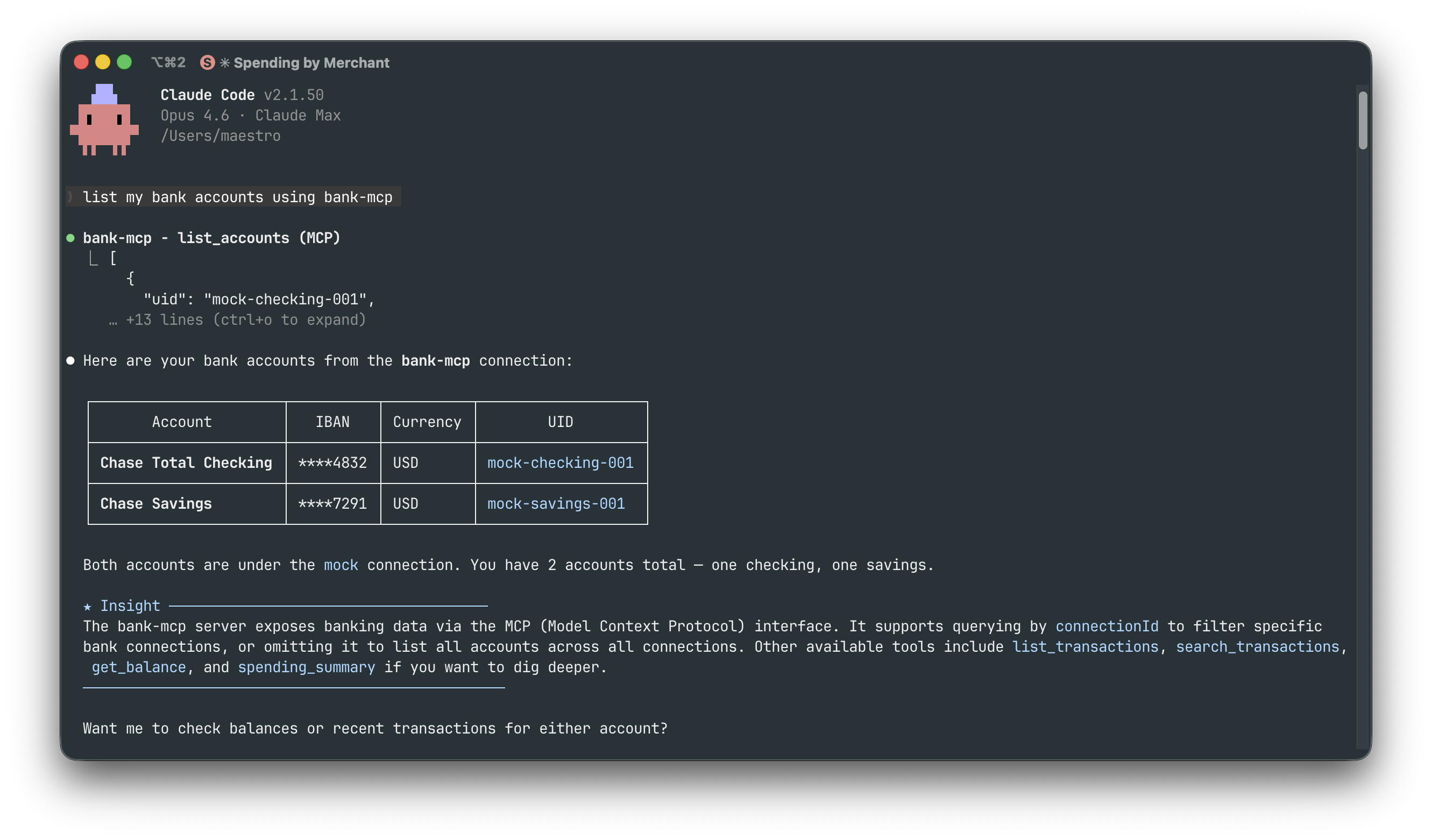
Konten auflisten — "List my bank accounts"
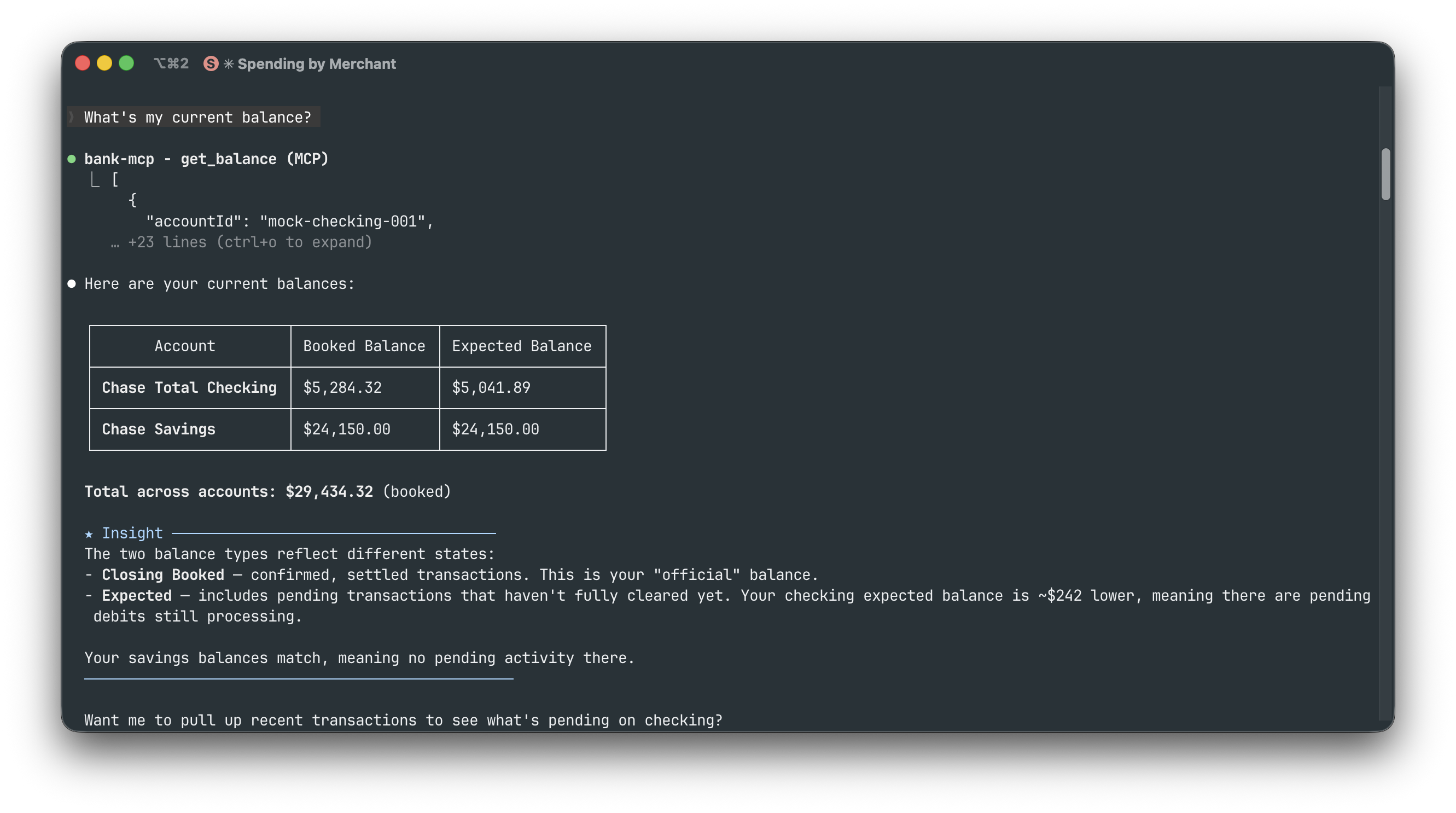
Kontostände prüfen — "What's my current balance?"
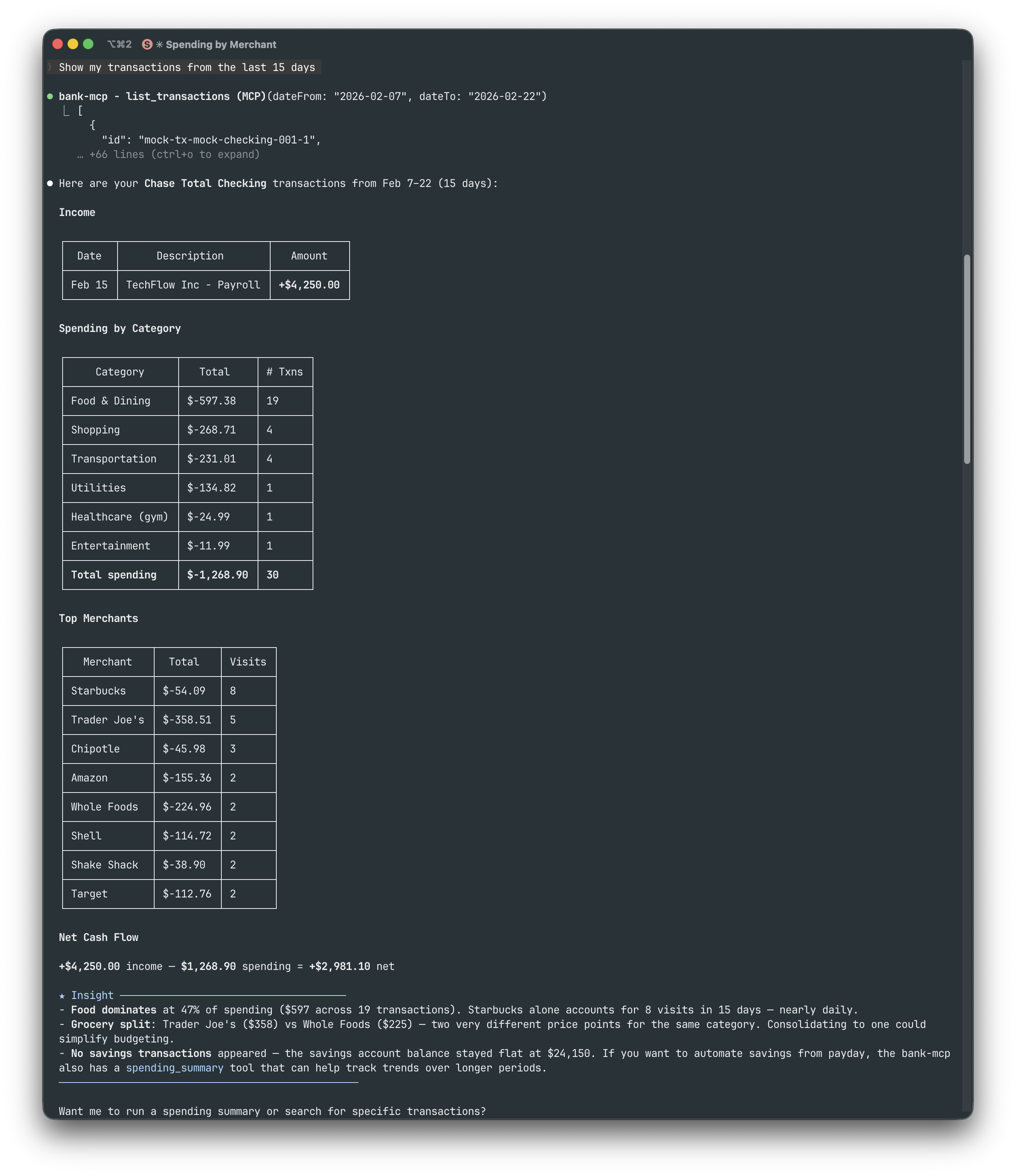
Transaktionsverlauf — "Show my transactions from the last 15 days"
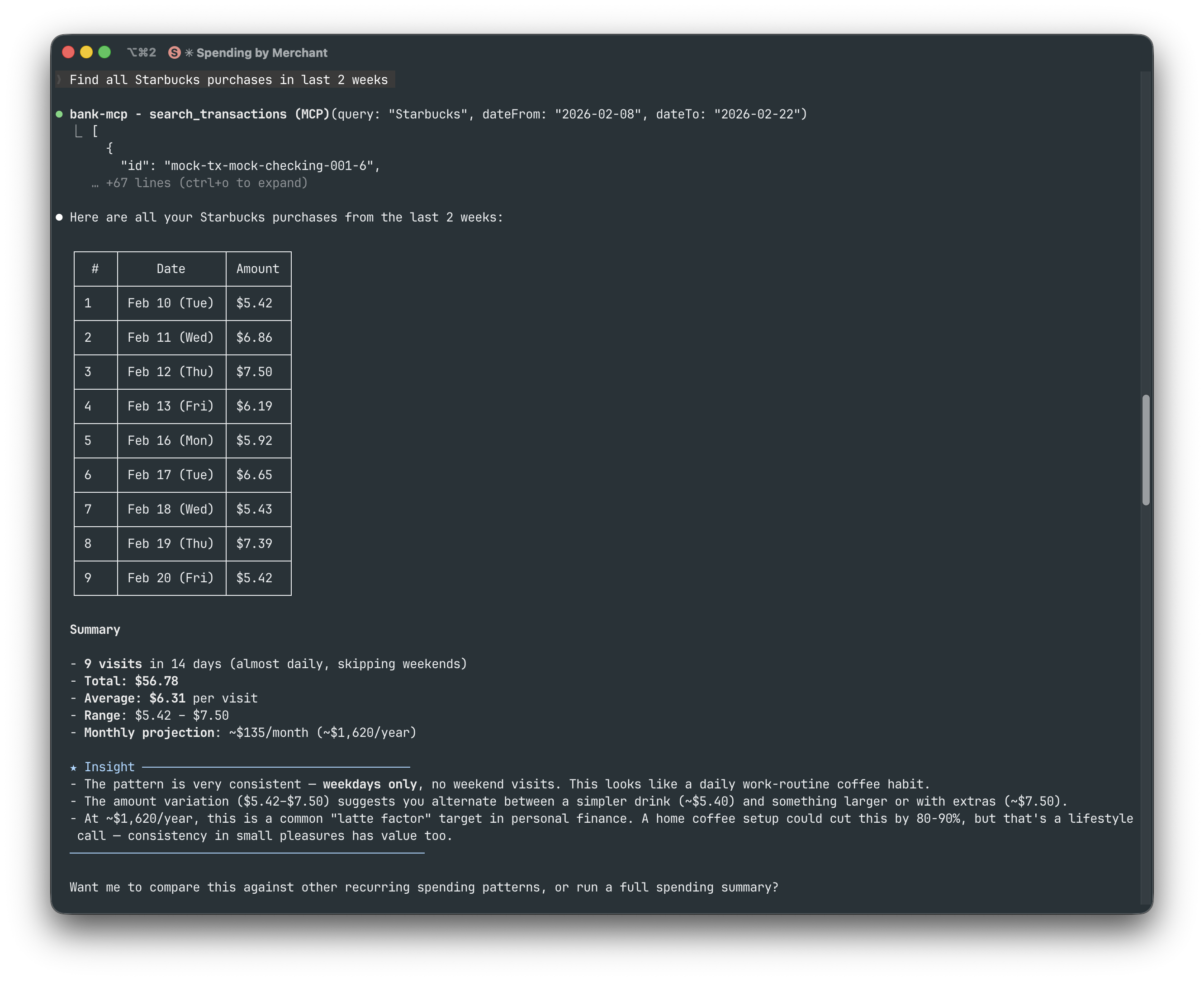
Transaktionen suchen — "Find all Starbucks purchases in last 2 weeks"
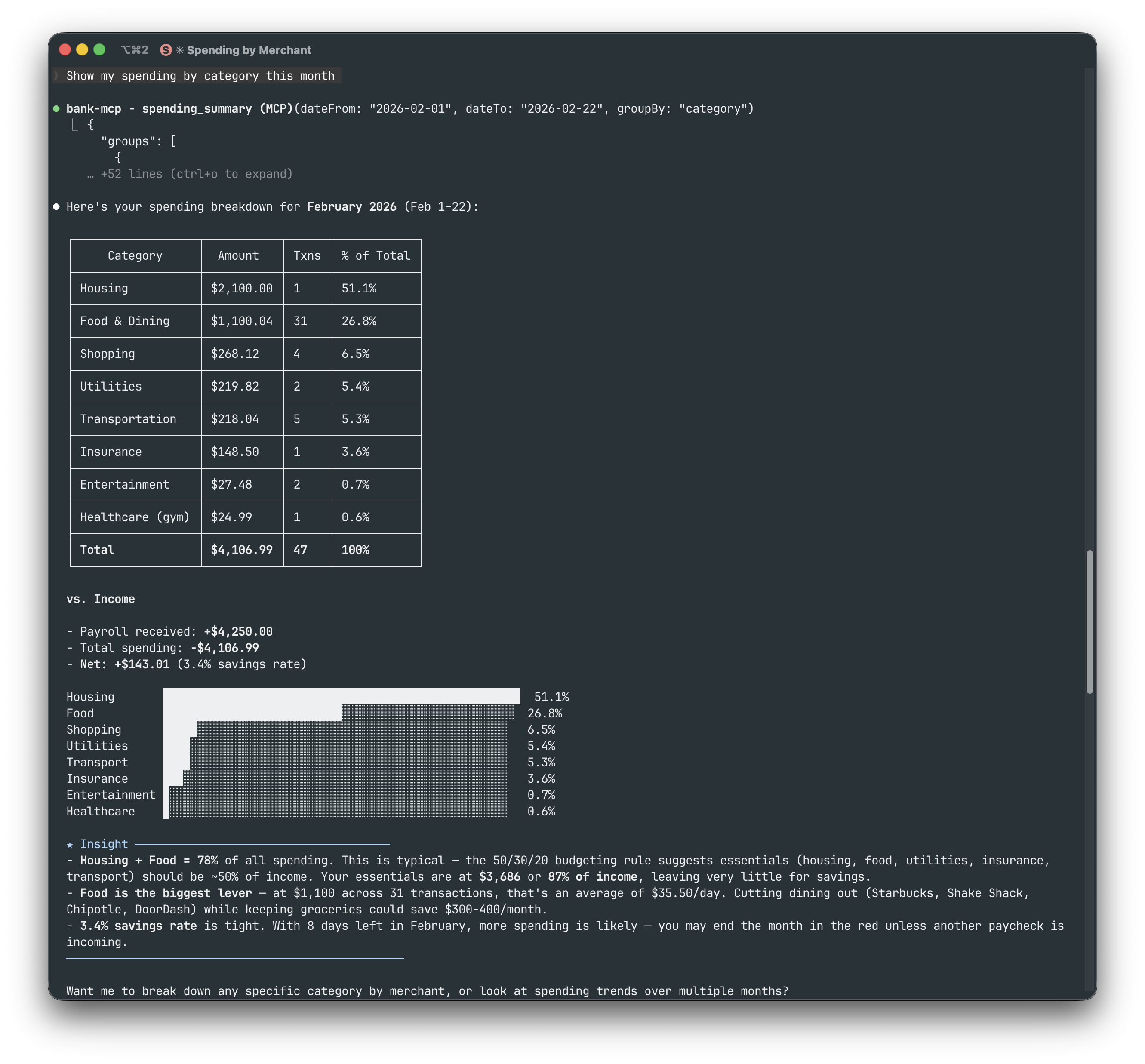
Ausgaben nach Kategorie — "Show my spending by category this month"
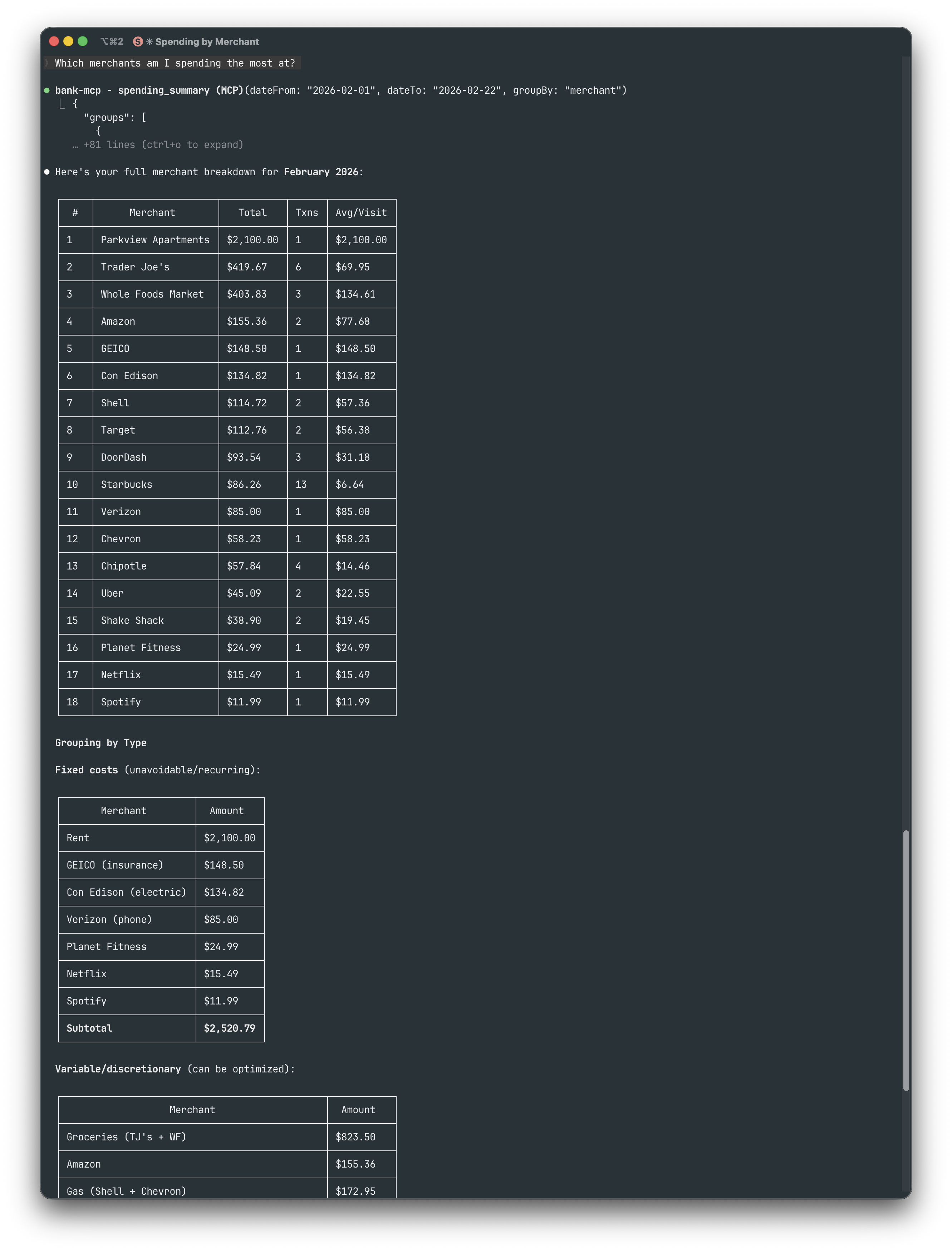
Top-Händler — "Which merchants am I spending the most at?"
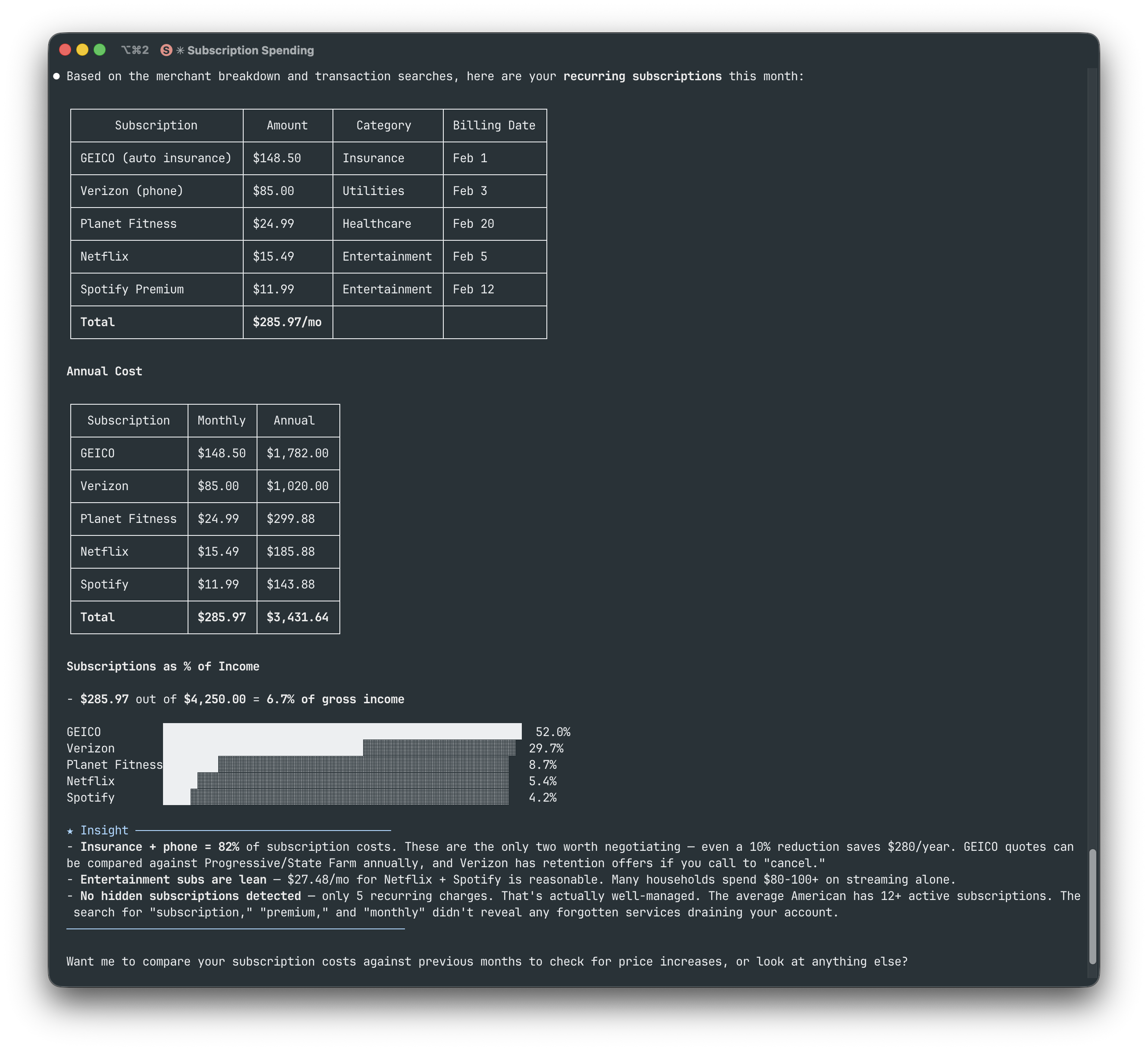
Abonnement-Tracking — "Show my recurring subscriptions"
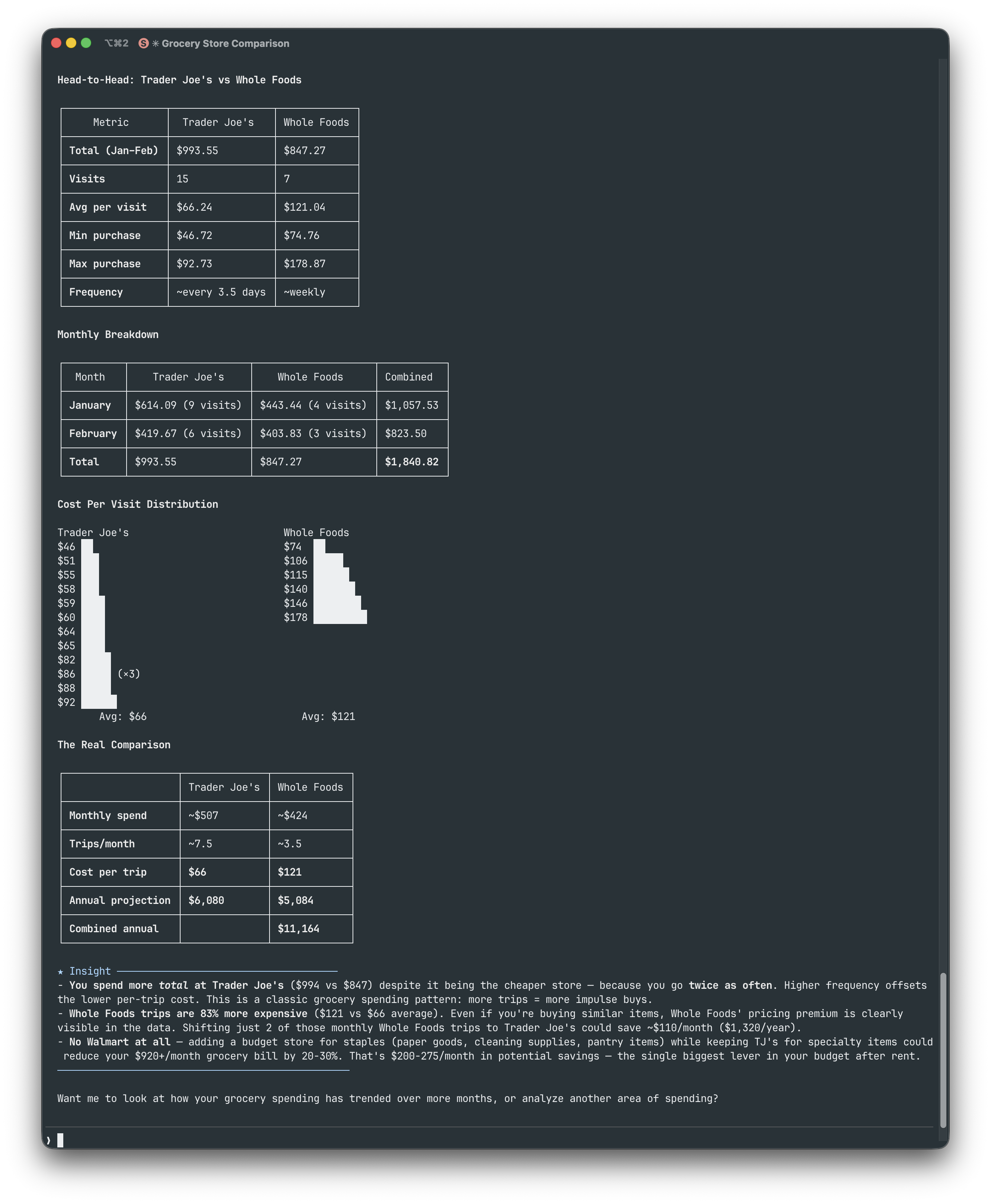
Lebensmittelvergleich — "Compare Trader Joe's vs Whole Foods spending"
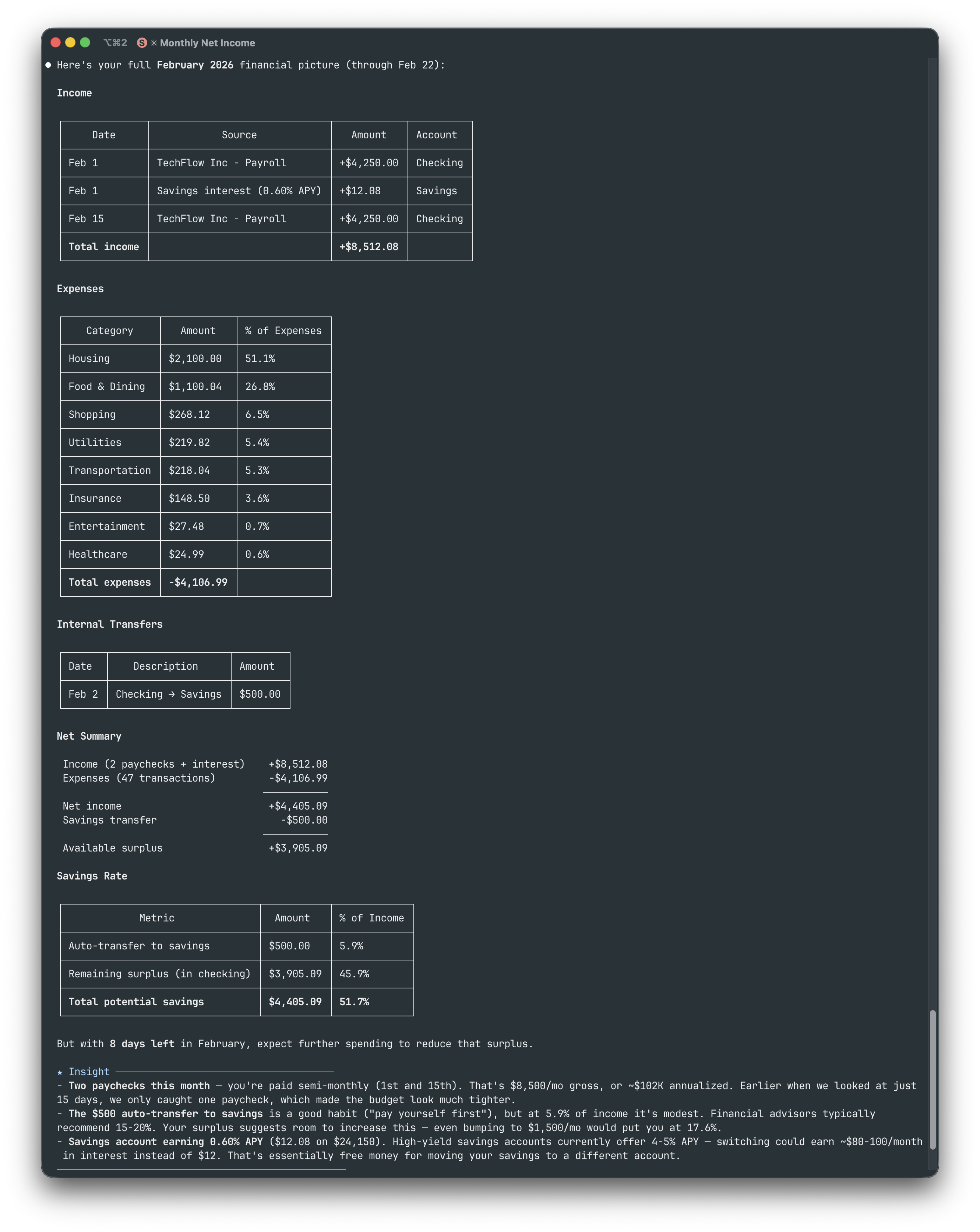
Vollständiges Finanzbild — "Give me my full February financial picture"
Architektur
Dateistruktur
~/.bank-mcp/
config.json # Connections & credentials (permissions: 600)
keys/ # RSA keys and certificates
src/
providers/
base.ts # Abstract BankProvider class
registry.ts # Provider registration
enable-banking/ # PSD2 via Enable Banking API
teller/ # US banks via mTLS
plaid/ # US/CA/EU via Plaid API
tink/ # EU Open Banking via Tink API
mock/ # Deterministic fake data
tools/ # MCP tool implementations
utils/
cache.ts # In-memory TTL cache
http.ts # Fetch with timeout + retryAnbieter-Schnittstelle
Jeder Anbieter erweitert dieselbe abstrakte Klasse, was es einfach macht, neue Integrationen hinzuzufügen:
abstract class BankProvider {
abstract listAccounts(config): Promise<BankAccount[]>;
abstract listTransactions(config, accountId, filter?): Promise<Transaction[]>;
abstract getBalance(config, accountId): Promise<Balance[]>;
abstract getConfigSchema(): ConfigField[];
}Anleitungen zur Anbietereinrichtung
Enable Banking (PSD2)
Was Sie benötigen:
[ ] Ein Enable Banking-Konto mit einer registrierten App
[ ] Ihren privaten RSA-Schlüssel (
.pem-Datei, heruntergeladen bei der Erstellung der App)
npx @bank-mcp/server init
# Select: Enable Banking → enter App ID + key path
# Pick your country → select your bank
# Log in at your bank → paste the redirect URL
# → Session created, accounts verified!Tipp: Der Assistent übernimmt den gesamten OAuth-Ablauf – Einrichtung der Redirect-URI, Bankauswahl und Sitzungserstellung. Sitzungen laufen nach 90 Tagen ab (PSD2-Verordnung); führen Sie
initerneut aus, um sie zu aktualisieren.
Teller (US-Banken)
Was Sie benötigen:
[ ] Ein Teller-Entwicklerkonto
[ ] Ihre Anwendungs-ID (aus dem Teller-Dashboard)
npx @bank-mcp/server init
# Select: Teller → enter Application ID
# Pick environment (sandbox for testing)
# → Teller Connect opens in your browser
# → Link your bank, token captured automatically!Tipp: Starten Sie mit Sandbox – keine Zertifikate erforderlich, sofortige Testdaten. Für Entwicklung/Produktion fragt der Assistent nach mTLS-Zertifikatspfaden. Der kostenlose Tarif unterstützt bis zu 100 Live-Verbindungen.
Plaid (USA/CA/EU)
Was Sie benötigen:
[ ] Ein Plaid-Entwicklerkonto (kostenlose Registrierung)
[ ] Ihre Client-ID und Ihr Secret (aus dem Plaid-Dashboard)
npx @bank-mcp/server init
# Select: Plaid → enter client ID + secret
# Pick environment (sandbox for testing)
# → Sandbox: token created automatically!
# → Dev/Prod: paste an existing access tokenTipp: Starten Sie mit Sandbox – der Assistent erstellt automatisch ein Test-Token, kein Browser erforderlich. Plaid bietet die reichhaltigste Transaktionskategorisierung – 104 Unterkategorien mit Konfidenzwerten – ideal für LLM-gesteuerte Ausgabenanalysen.
Tink (EU Open Banking)
Was Sie benötigen:
[ ] Ein Tink-Entwicklerkonto (kostenlos zum Testen)
[ ] Ihre Client-ID und Ihr Client-Secret (aus der Tink Console)
npx @bank-mcp/server init
# Select: Tink → enter Client ID + Secret
# Pick your market (country)
# → Tink Link opens in your browser
# → Connect your bank, paste redirect URLTipp: Tink deckt über 3.400 Banken in ganz Europa ab. Verwenden Sie für die Sandbox die Demo-Bank mit Test-Anmeldedaten (im Assistenten angezeigt). Transaktionen beinhalten PFM-Kategorien mit Händleranreicherung.
Caching
Alle Daten werden im Arbeitsspeicher zwischengespeichert (keine Festplattenpersistenz – der Cache stirbt mit dem Prozess):
Daten | TTL | Warum |
Kontenliste | 1 Stunde | Konten ändern sich selten; minimiert API-Aufrufe |
Transaktionen | 15 Minuten | Saldiert neue Transaktionen vs. Aktualität |
Kontostände | 5 Minuten | Am zeitkritischsten; Benutzer erwarten aktuelle Daten |
Der Cache ist pro Verbindung und pro Konto. Ein Neustart des Servers löscht alle Caches.
Mehrere Verbindungen
Konfigurieren Sie so viele Bankverbindungen, wie Sie benötigen – sogar über verschiedene Anbieter hinweg:
{
"connections": [
{ "id": "ing-main", "provider": "enable-banking", "..." : "..." },
{ "id": "chase-checking", "provider": "plaid", "..." : "..." },
{ "id": "revolut", "provider": "tink", "..." : "..." }
]
}Alle Tools akzeptieren einen optionalen connectionId-Parameter, um eine bestimmte Verbindung anzusprechen. Wenn dieser weggelassen wird, wird jede Verbindung abgefragt und die Ergebnisse werden zusammengeführt – sodass "Zeige alle meine Kontostände" automatisch bankübergreifend funktioniert.
Sicherheit
Designprinzipien
bank-mcp verarbeitet sensible Finanzdaten. Seine Sicherheitslage basiert auf der Minimierung der Angriffsfläche:
Von Natur aus schreibgeschützt — die
BankProvider-Schnittstelle macht nur Lesemethoden verfügbar (listAccounts,listTransactions,getBalance). Es gibt keine Schreibmethoden – keine Überweisungen, keine Kontenänderungen, keine Zahlungsinitiierung. Dies wird auf Typebene erzwungen, nicht durch Konvention.Kein Netzwerk-Listener — bank-mcp läuft als stdio-Prozess (stdin/stdout), nicht als HTTP-Server. Es gibt keinen offenen Port, keine Angriffsfläche aus dem Netzwerk.
Minimale Abhängigkeiten — nur 4 Laufzeitabhängigkeiten (
@modelcontextprotocol/sdk,@clack/prompts,jsonwebtoken,zod). Weniger Abhängigkeiten bedeuten weniger Risiken in der Lieferkette.Open Source
Available Tools
5 toolsget_balanceA
Get current account balance(s). Returns closing booked balance and expected balance when available.
| Name | Required | Description | Default |
|---|---|---|---|
| connectionId | No | ||
| accountId | No | Account UID. If omitted, returns balances for all accounts. |
TDQS
Does the description disclose side effects, auth requirements, rate limits, or destructive behavior?
With no annotations, the description must fully disclose behavior. It does mention the return types ('closing booked balance' and 'expected balance'), which is helpful, but it does not address whether the tool is read-only, if it requires authentication (implicit via connectionId), or any side effects.
Agents need to know what a tool does to the world before calling it. Descriptions should go beyond structured annotations to explain consequences.
Is the description appropriately sized, front-loaded, and free of redundancy?
The description is two sentences, no redundant words, and directly addresses the tool's purpose and output. Every sentence adds value.
Shorter descriptions cost fewer tokens and are easier for agents to parse. Every sentence should earn its place.
Given the tool's complexity, does the description cover enough for an agent to succeed on first attempt?
For a simple balance retrieval tool with two parameters and no output schema, the description is mostly complete. It covers the output type and the optionality of accountId. However, it could clarify terms like 'closing booked balance' and 'expected balance' for better clarity.
Complex tools with many parameters or behaviors need more documentation. Simple tools need less. This dimension scales expectations accordingly.
Does the description clarify parameter syntax, constraints, interactions, or defaults beyond what the schema provides?
Schema description coverage is 50% (only accountId has a description). The description for accountId adds useful context: 'If omitted, returns balances for all accounts.' However, connectionId lacks a description in both schema and tool description, leaving its meaning unclear.
Input schemas describe structure but not intent. Descriptions should explain non-obvious parameter relationships and valid value ranges.
Does the description clearly state what the tool does and how it differs from similar tools?
The description clearly states the verb 'Get' and the resource 'current account balance(s)', and specifies that it returns 'closing booked balance and expected balance'. This distinguishes it from sibling tools like list_accounts or list_transactions, which deal with other account data.
Agents choose between tools based on descriptions. A clear purpose with a specific verb and resource helps agents select the right tool.
Does the description explain when to use this tool, when not to, or what alternatives exist?
No guidance is provided on when to use this tool versus alternatives. There is no mention of prerequisites, when to prefer get_balance over list_accounts or spending_summary, or any exclusions.
Agents often have multiple tools that could apply. Explicit usage guidance like "use X instead of Y when Z" prevents misuse.
list_accountsB
List all bank accounts across configured connections. Returns account UIDs, IBANs, names, and currencies.
| Name | Required | Description | Default |
|---|---|---|---|
| connectionId | No | Connection ID to query. If omitted, queries all connections. |
TDQS
Does the description disclose side effects, auth requirements, rate limits, or destructive behavior?
No annotations exist, so the description must cover behavioral traits. It does not mention that this is a read-only operation, nor any potential performance considerations, rate limits, or required permissions.
Agents need to know what a tool does to the world before calling it. Descriptions should go beyond structured annotations to explain consequences.
Is the description appropriately sized, front-loaded, and free of redundancy?
Two short sentences: one describing the action and scope, one describing the output. No redundant information, efficient and front-loaded.
Shorter descriptions cost fewer tokens and are easier for agents to parse. Every sentence should earn its place.
Given the tool's complexity, does the description cover enough for an agent to succeed on first attempt?
For a simple list tool with no output schema and no annotations, the description is adequate but lacks usage guidelines and behavioral context. It covers the basic purpose and return fields but not when or how to use effectively.
Complex tools with many parameters or behaviors need more documentation. Simple tools need less. This dimension scales expectations accordingly.
Does the description clarify parameter syntax, constraints, interactions, or defaults beyond what the schema provides?
The schema covers 100% of the single parameter with a clear description. The tool description adds no additional semantics beyond stating it lists accounts, so baseline score of 3 is appropriate.
Input schemas describe structure but not intent. Descriptions should explain non-obvious parameter relationships and valid value ranges.
Does the description clearly state what the tool does and how it differs from similar tools?
The description clearly states the tool lists all bank accounts across configured connections and specifies the returned fields (UIDs, IBANs, names, currencies). It distinguishes from siblings like get_balance or list_transactions by focusing on account listing.
Agents choose between tools based on descriptions. A clear purpose with a specific verb and resource helps agents select the right tool.
Does the description explain when to use this tool, when not to, or what alternatives exist?
No guidance on when to use this tool versus alternatives (e.g., get_balance for a single account). No explicit conditions or prerequisites provided.
Agents often have multiple tools that could apply. Explicit usage guidance like "use X instead of Y when Z" prevents misuse.
list_transactionsB
List bank transactions with optional filters. Defaults to last 90 days. Supports date range, amount range, and debit/credit type filtering.
| Name | Required | Description | Default |
|---|---|---|---|
| connectionId | No | Connection ID. If omitted, queries all connections. | |
| accountId | No | Account UID. If omitted, queries all accounts. | |
| dateFrom | No | Start date (YYYY-MM-DD). Defaults to 90 days ago. | |
| dateTo | No | End date (YYYY-MM-DD). Defaults to today. | |
| amountMin | No | Minimum absolute amount. | |
| amountMax | No | Maximum absolute amount. | |
| type | No | Filter by transaction type. | |
| limit | No | Maximum number of transactions to return. |
TDQS
Does the description disclose side effects, auth requirements, rate limits, or destructive behavior?
No annotations are provided, so the description carries the full burden. It discloses default date range and optional filters, but does not state that the operation is read-only, nor mention pagination, rate limits, or any side effects. This is a significant gap for a tool with 8 parameters.
Agents need to know what a tool does to the world before calling it. Descriptions should go beyond structured annotations to explain consequences.
Is the description appropriately sized, front-loaded, and free of redundancy?
Two sentences, front-loaded with the primary action and resource. Every sentence adds value: first states purpose and filters, second gives default behavior. No waste.
Shorter descriptions cost fewer tokens and are easier for agents to parse. Every sentence should earn its place.
Given the tool's complexity, does the description cover enough for an agent to succeed on first attempt?
For a list tool with 8 parameters and no output schema, the description covers defaults and filter types, but does not explain return value, pagination behavior, or typical usage scenarios. Schema descriptions fill some gaps, but overall completeness is adequate but not thorough.
Complex tools with many parameters or behaviors need more documentation. Simple tools need less. This dimension scales expectations accordingly.
Does the description clarify parameter syntax, constraints, interactions, or defaults beyond what the schema provides?
Schema description coverage is 100%, so baseline is 3. The description adds little beyond the schema – it mentions 'debit/credit type filtering' which is already in the enum, and 'amount range' which is covered by 'amountMin' and 'amountMax'. No new semantic insight.
Input schemas describe structure but not intent. Descriptions should explain non-obvious parameter relationships and valid value ranges.
Does the description clearly state what the tool does and how it differs from similar tools?
The description clearly states the tool lists bank transactions with optional filters. It is a specific verb-resource pairing. However, it does not differentiate from sibling 'search_transactions', which may have overlapping functionality.
Agents choose between tools based on descriptions. A clear purpose with a specific verb and resource helps agents select the right tool.
Does the description explain when to use this tool, when not to, or what alternatives exist?
The description implies usage for listing transactions with filters and mentions a default 90-day window, but lacks explicit guidance on when to use this tool versus alternatives like 'search_transactions' or 'spending_summary'. No exclusions are stated.
Agents often have multiple tools that could apply. Explicit usage guidance like "use X instead of Y when Z" prevents misuse.
search_transactionsA
Full-text search across transaction descriptions, merchant names, and references. Use for finding specific payments or payees.
| Name | Required | Description | Default |
|---|---|---|---|
| query | Yes | Search text — matched against description, merchant name, and reference. | |
| connectionId | No | ||
| dateFrom | No | ||
| dateTo | No | ||
| limit | No | Max results. Default 50. |
TDQS
Does the description disclose side effects, auth requirements, rate limits, or destructive behavior?
With no annotations provided, the description carries the full burden. It describes the search operation but does not disclose whether it is read-only, any performance implications, pagination behavior, or error handling. The word 'search' implies read but is not explicit.
Agents need to know what a tool does to the world before calling it. Descriptions should go beyond structured annotations to explain consequences.
Is the description appropriately sized, front-loaded, and free of redundancy?
The description is two sentences long with no extraneous words. The first sentence states the action, the second provides usage context. Every word earns its place.
Shorter descriptions cost fewer tokens and are easier for agents to parse. Every sentence should earn its place.
Given the tool's complexity, does the description cover enough for an agent to succeed on first attempt?
The tool has 5 parameters (1 required) and no output schema. While the purpose is clear, the description fails to explain optional parameters like connectionId, dateFrom, dateTo, and does not describe return format or behavior for edge cases. This leaves gaps for effective use.
Complex tools with many parameters or behaviors need more documentation. Simple tools need less. This dimension scales expectations accordingly.
Does the description clarify parameter syntax, constraints, interactions, or defaults beyond what the schema provides?
Schema description coverage is 40% (only query and limit have descriptions). The description adds semantics for query (full-text across specific fields) but does not explain connectionId, dateFrom, or dateTo. With low schema coverage, the description should compensate but does not fully.
Input schemas describe structure but not intent. Descriptions should explain non-obvious parameter relationships and valid value ranges.
Does the description clearly state what the tool does and how it differs from similar tools?
The description clearly states it is a 'full-text search across transaction descriptions, merchant names, and references' with a specific use case of 'finding specific payments or payees'. This distinctly separates it from sibling tools like list_transactions which likely list all transactions without search.
Agents choose between tools based on descriptions. A clear purpose with a specific verb and resource helps agents select the right tool.
Does the description explain when to use this tool, when not to, or what alternatives exist?
The description indicates when to use the tool ('for finding specific payments or payees') but does not explicitly mention when not to use it or compare to alternatives like list_transactions. The guidance is clear but lacks explicit exclusionary context.
Agents often have multiple tools that could apply. Explicit usage guidance like "use X instead of Y when Z" prevents misuse.
spending_summaryC
Group expenses by merchant or category with totals. Shows where money is being spent. Use groupBy "merchant" for vendor breakdown, "category" for category breakdown.
| Name | Required | Description | Default |
|---|---|---|---|
| connectionId | No | ||
| dateFrom | No | ||
| dateTo | No | ||
| groupBy | No | Group expenses by "merchant" (default) or "category". | |
| limit | No | Max groups to return (default 20, sorted by total spent). |
TDQS
Does the description disclose side effects, auth requirements, rate limits, or destructive behavior?
No annotations are provided, so the description carries full responsibility. It mentions grouping and totals but omits critical behavioral details such as the ability to filter by date range (dateFrom, dateTo) and the default limit and sorting behavior, which are only present in the schema.
Agents need to know what a tool does to the world before calling it. Descriptions should go beyond structured annotations to explain consequences.
Is the description appropriately sized, front-loaded, and free of redundancy?
The description is brief, with three clear sentences that front-load the purpose. It avoids unnecessary detail and is easy to parse, though it could be slightly more structured.
Shorter descriptions cost fewer tokens and are easier for agents to parse. Every sentence should earn its place.
Given the tool's complexity, does the description cover enough for an agent to succeed on first attempt?
Given five parameters and no output schema, the description omits important context such as the meaning of dateFrom/dateTo for filtering and the default limit of 20. It also lacks any hint of the return format beyond 'totals', making it incomplete for an agent to use effectively.
Complex tools with many parameters or behaviors need more documentation. Simple tools need less. This dimension scales expectations accordingly.
Does the description clarify parameter syntax, constraints, interactions, or defaults beyond what the schema provides?
The description adds minimal value beyond the input schema: it reiterates the groupBy options but does not explain the purpose of connectionId, dateFrom, dateTo, or limit beyond what the schema already provides. With 40% schema coverage, the description should compensate more.
Input schemas describe structure but not intent. Descriptions should explain non-obvious parameter relationships and valid value ranges.
Does the description clearly state what the tool does and how it differs from similar tools?
The description clearly states the tool groups expenses by merchant or category with totals, showing where money is spent. It distinguishes from sibling tools like list_transactions and get_balance by focusing on aggregation rather than raw data or balances.
Agents choose between tools based on descriptions. A clear purpose with a specific verb and resource helps agents select the right tool.
Does the description explain when to use this tool, when not to, or what alternatives exist?
The description suggests when to use each groupBy option but does not provide explicit guidance on when to use this tool versus alternatives like search_transactions or list_transactions. The context is implied but not directly contrasted.
Agents often have multiple tools that could apply. Explicit usage guidance like "use X instead of Y when Z" prevents misuse.
Tool Schema Changelog
Recent tool additions, removals, and schema changes observed during successful MCP inspections.
5 tool updates
v0.1.0- First observed
get_balance - First observed
list_accounts - First observed
list_transactions - First observed
search_transactions - First observed
spending_summary
TDQS
Scored across 5 tools
Each tool has a clearly distinct purpose: get_balance for balances, list_accounts for account listing, list_transactions for filtered transaction lists, search_transactions for full-text search, spending_summary for aggregation. No overlap.
All tool names use a consistent snake_case verb_noun or descriptive pattern (get_balance, list_accounts, list_transactions, search_transactions, spending_summary). No mixing of conventions.
5 tools is well-scoped for a banking data retrieval server. Each tool covers a core function without redundancy, and the count feels natural for the domain.
The set covers balance, accounts, transactions (with search and filters), and spending summaries. Minor gaps include no individual transaction detail endpoint, but search can retrieve specifics. Overall solid coverage for read-only banking information.
Maintenance
Related MCP Connectors
Read-only bank access for your AI agent. Connects Claude, ChatGPT, Cursor, Gemini, Codex.
Connects AI agents to live, verified financial data from 18,000+ institutions — ready to reason from
- BankSyncOAuthio.banksync
Connect AI agents to bank accounts, transactions, balances, and investments.
Chat with your bank data: balances, transactions, budgets, bills. Reads only, never moves money.
Related MCP Servers
- AlicenseNot gradedqualityCmaintenanceEnables AI assistants to access and analyze MonarchMoney personal finance data through natural language queries. Provides comprehensive financial insights including account balances, transaction analysis, budget tracking, and spending patterns with enterprise-grade security.9MIT
- AlicenseNot gradedqualityDmaintenanceEnables AI assistants to access financial data from 20,000+ banks across 40+ countries, allowing users to query account balances, transactions, and spending patterns through natural language.4MIT
- FlicenseNot gradedqualityFmaintenanceAn AI-powered financial management engine that enables budgeting, smart expense tracking, and affordability analytics via the Model Context Protocol. It allows AI assistants to interact with financial data through natural language for tasks like category detection, bulk expense ingestion, and budget impact predictions.1-
- AlicenseNot gradedqualityDmaintenanceConnects AI assistants to 500+ financial data tools from 40+ providers via the Model Context Protocol, enabling natural language queries for financial data.1MIT