
A
licenseB
qualityD
maintenanceMCP server for npm — search packages, check bundle sizes, scan vulnerabilities, compare downloads, inspect dependencies.
8
37 npm
1
MIT

模型上下文协议服务器允许您通过调用npm search命令来搜索 npm 包。
search_npm_packages - 搜索 npm 包。
必需参数:
query (字符串):搜索查询。
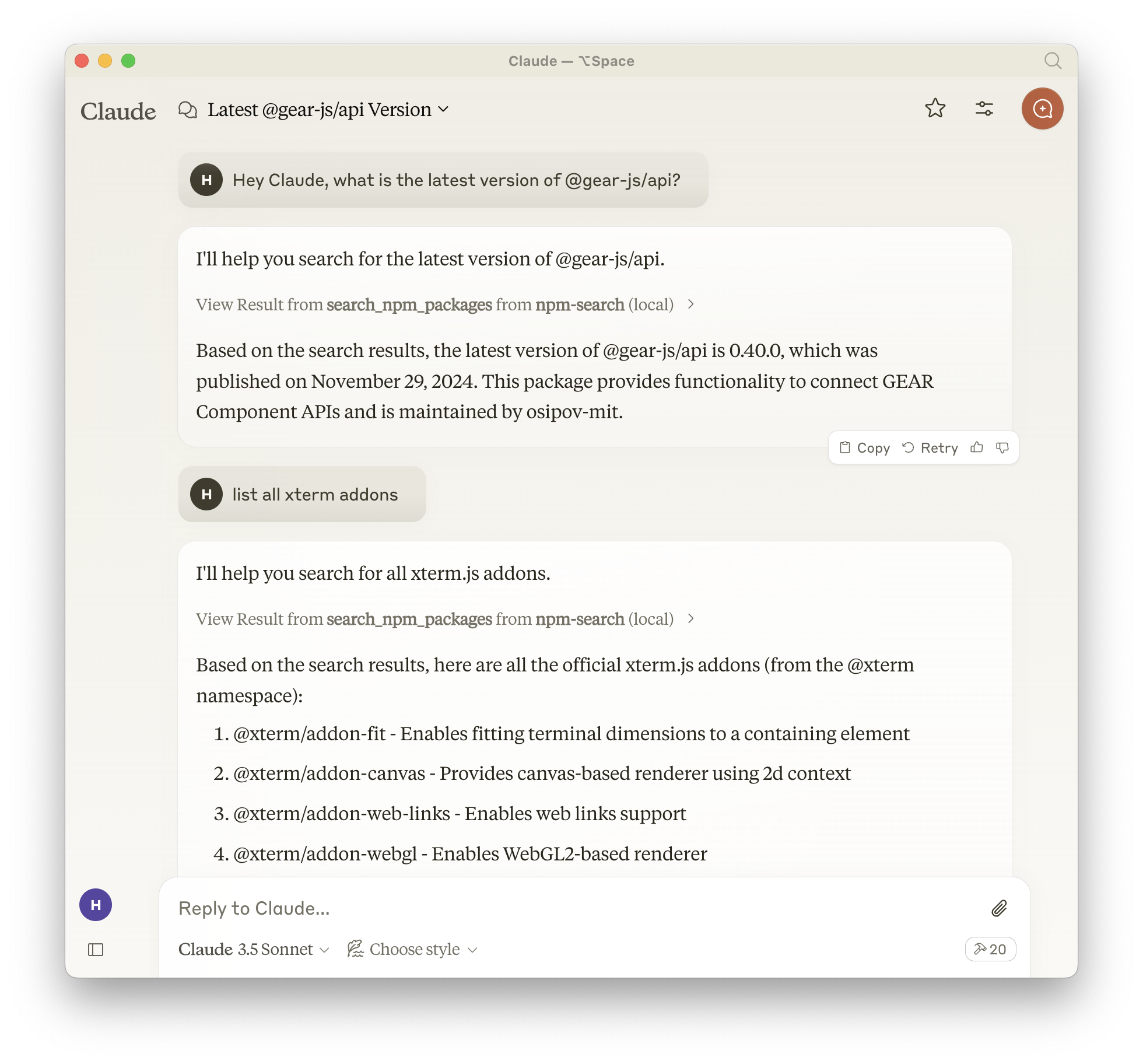
要通过Smithery自动为 Claude Desktop 安装 npm-search :
npx -y @smithery/cli install npm-search-mcp-server --client claude或者,您可以通过 npm 安装npm-search-mcp-server :
npm install -g npm-search-mcp-server安装后,您可以使用以下命令运行它:
npm-search-mcp-server使用uv时无需特殊安装。我们将使用uvx直接运行npm-search-mcp-server 。
Related MCP server: mcp-server-npm
添加到您的 Claude 设置:
"mcpServers": {
  "npm-search": {
    "command": "npx",
    "args": ["-y", "npm-search-mcp-server"]
  }
}
"mcpServers": {
"npm-search": {
"command": "uvx",
"args": ["npm-search-mcp-server"]
}
}添加到您的 Zed settings.json:
"context_servers": {
  "npm-search-mcp-server": {
    "command": "npx",
    "args": ["-y", "npm-search-mcp-server"]
  }
},
"context_servers": [
"npm-search-mcp-server": {
"command": "uvx",
"args": ["npm-search-mcp-server"]
}
],搜索 npm 包:
{
  "name": "search_npm_packages",
  "arguments": {
    "query": "express"
  }
}
回复:
{
  "results": [
    {
      "name": "express",
      "description": "Fast, unopinionated, minimalist web framework",
      "version": "4.17.1",
      "author": "TJ Holowaychuk",
      "license": "MIT"
    },
    ...
  ]
}您可以使用 MCP 检查器来调试服务器。对于 uvx 安装:
npx @modelcontextprotocol/inspector npx -y npm-search-mcp-server或者,如果您已将软件包安装在特定目录中或正在其上进行开发:
cd path/to/servers/src/npm-search
npx @modelcontextprotocol/inspector uv run npm-search-mcp-server“在 npm 上搜索 express 包”
“查找与 React 相关的包”
“向我展示用于 Web 开发的 npm 包”
Docker 构建:
cd src/npm-search
docker build -t mcp/npm-search .我们鼓励您为扩展和改进 npm-search-mcp-server 做出贡献。无论您是想添加新的 npm 相关工具、增强现有功能还是改进文档,您的贡献都弥足珍贵。
有关其他 MCP 服务器和实现模式的示例,请参阅: https://github.com/modelcontextprotocol/servers
欢迎提交 Pull 请求!欢迎贡献新想法、错误修复或改进,让 npm-search-mcp-server 更加强大实用。
npm-search-mcp-server 采用 MIT 许可证。这意味着您可以自由使用、修改和分发该软件,但需遵守 MIT 许可证的条款和条件。更多详细信息,请参阅项目仓库中的 LICENSE 文件。
Search for npm packages
| Name | Required | Description | Default |
|---|---|---|---|
| query | Yes | Search query |
Does the description disclose side effects, auth requirements, rate limits, or destructive behavior?
No annotations are provided, so the description carries the full burden of behavioral disclosure. It only states the action ('Search for npm packages') without detailing traits like rate limits, authentication needs, pagination, or response format. This leaves significant gaps in understanding how the tool behaves in practice.
Agents need to know what a tool does to the world before calling it. Descriptions should go beyond structured annotations to explain consequences.
Is the description appropriately sized, front-loaded, and free of redundancy?
The description is a single, efficient sentence with no wasted words, making it appropriately concise. However, it lacks front-loaded critical information and could benefit from more structure to enhance clarity, but it avoids unnecessary verbosity.
Shorter descriptions cost fewer tokens and are easier for agents to parse. Every sentence should earn its place.
Given the tool's complexity, does the description cover enough for an agent to succeed on first attempt?
Given the tool's simplicity (1 parameter, no output schema, no annotations), the description is incomplete. It fails to address behavioral aspects like search result format, limitations, or error handling, which are essential for an agent to use the tool effectively despite the low complexity.
Complex tools with many parameters or behaviors need more documentation. Simple tools need less. This dimension scales expectations accordingly.
Does the description clarify parameter syntax, constraints, interactions, or defaults beyond what the schema provides?
The input schema has 100% description coverage, with the 'query' parameter documented as 'Search query'. The description does not add any meaning beyond this, such as examples or constraints on the query format. With high schema coverage, the baseline score of 3 is appropriate as the schema handles the parameter documentation adequately.
Input schemas describe structure but not intent. Descriptions should explain non-obvious parameter relationships and valid value ranges.
Does the description clearly state what the tool does and how it differs from similar tools?
The description 'Search for npm packages' clearly states the verb (search) and resource (npm packages), making the basic purpose understandable. However, it lacks specificity about what kind of search this is (e.g., keyword search, advanced filtering) and doesn't differentiate from potential siblings since none exist, though it remains somewhat vague in scope.
Agents choose between tools based on descriptions. A clear purpose with a specific verb and resource helps agents select the right tool.
Does the description explain when to use this tool, when not to, or what alternatives exist?
The description provides no guidance on when to use this tool versus alternatives, prerequisites, or context for its application. With no sibling tools, this is less critical, but it still offers no usage instructions, leaving the agent to infer based on the tool name alone.
Agents often have multiple tools that could apply. Explicit usage guidance like "use X instead of Y when Z" prevents misuse.
Recent tool additions, removals, and schema changes observed during successful MCP inspections.
v1.0.0search_npm_packagesScored across 1 tool
With only one tool, there is no possibility of confusion or overlap between tools. The tool's purpose is clearly defined and distinct by default.
A single tool inherently has perfect naming consistency, as there are no other tools to compare against. The name 'search_npm_packages' follows a clear verb_noun pattern.
One tool is too few for a server named 'npm-search-mcp-server', which suggests a broader npm-related scope. A single search tool feels thin and incomplete for interacting with npm packages beyond basic searches.
The tool surface is severely incomplete for npm package management. It only provides search functionality, lacking essential operations like getting package details, checking versions, or managing dependencies, which are core to the domain.
MCP server for hex.pm and hexdocs.pm: search, inspect, compare, and audit Elixir packages
Publish and discover MCP servers via the official MCP Registry. Powered by HAPI MCP server.