

F
licenseNot graded
qualityD
maintenanceA Model Context Protocol server that enables controlling Spotify playback through natural language commands in MCP clients like Cursor or Claude for Desktop.
1
-

Spotify 用の FastMCP ツール。
リンク: https://drive.google.com/file/d/1jGGQBzeXSKSJijeUwFZLdvrKPmPuogGd/
Related MCP server: Spotify MCP Server
このリポジトリをクローンする
リポジトリのルートに.envファイルを作成し、Spotify API の認証情報を追加します ( .env.exampleからコピーします)
Spotify 開発者ダッシュボードにアクセスしてアプリを作成することで、資格情報を取得できます。
カーソル設定 > 機能 > MCPサーバー > + 新しいMCPサーバーを追加に移動します
名前: Spotify、タイプ: コマンド、コマンド: uv --directory <path-to-repository/mcp-spotify> run main.py
ツールがインストールされたはずです。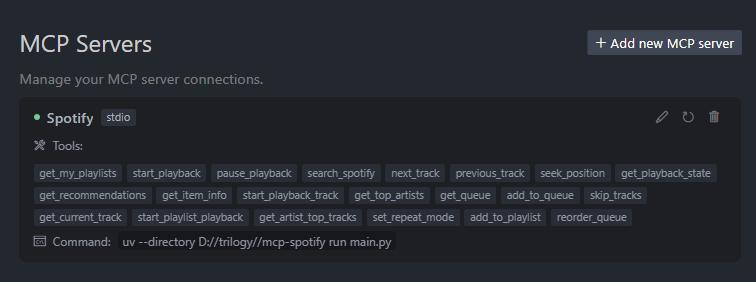
Composer 「エージェント」モードで開くと、Spotify プレーヤーをカーソルで制御できるようになります。(アクティブなデバイスで Spotify が開いていることを確認してください)
以下は、Cursor Composer を介して Spotify MCP ツールと対話する方法を紹介する会話の例です。
ユーザー: 「プレイリストを見せてください。」
応答: 「プレイリストはこちらです: チルバイブス、ワークアウトミックス、トップヒット。」
ユーザー: 「『Chill Vibes』プレイリストを再生して。」
ユーザー: 「曲を一時停止します。」
応答: 「再生が一時停止されました。」
ユーザー: 「曲を再開してください。」
応答: 「再生を再開しています...」
ユーザー: 「これは何の曲ですか?」
応答: 「アラン・ウォーカーの『Faded』を聴いています。」
ユーザー: 「このアーティストについて教えてください。人気の曲もいくつか教えてください。」
応答: 「アーティスト情報: アラン・ウォーカー」
ユーザー: 「過去 6 か月間のトップアーティストを表示してください。」
応答: 「最もよく再生されるアーティストは次のとおりです...」
ユーザー: 「Coldplay を検索してください。」
応答: 「見つかったアーティスト: Coldplay。彼らのトップトラックは次のとおりです...」
ユーザー: 「『Fix You』という曲を再生してください。」
応答: 「『Fix You』の再生を開始しています...」
ユーザー: 「キューを見せてください。」
応答: 「現在のキュー: トラック 1、トラック 2、トラック 3...」
ユーザー: 「『Paradise』をキューに追加してください。」
応答: 「Coldplay の『Paradise』をキューに追加しました。」
ユーザー: 「『Paradise』をキューの上へ移動してください。」
ユーザー: 「繰り返し設定してください。」
ユーザー: 「この曲が好きです。似たような曲をいくつかお勧めください。」
回答: 「このトラックに基づいたいくつかの推奨事項を以下に示します...」
ユーザー: 「このトラックを「Chill Vibes」プレイリストに追加してください。」
利用可能な追加機能:
トラック内の特定の位置をシークする
詳細な再生状態を表示
複数のトラックを一度にスキップする
さらに多くの機能のサポートをご希望の場合は、お気軽に問題を提起してください。
Add tracks to a playlist
Args:
    playlist_id: Spotify playlist ID
    track_ids: List of track IDs to add
Inputs: playlist_id (required), track_ids (required).
Add a track to the queue
Args:
    track_id: Spotify track ID to add
Inputs: track_id (required).
Get top tracks for an artist
Args:
    artist_id: Spotify artist ID
Inputs: artist_id (required).
Get information about the currently playing track
Inputs: no named parameters.
Get detailed information about a Spotify item
Args:
    item_id: Spotify ID
    type: One of 'track', 'album', 'artist', 'playlist'
Inputs: item_id (required), type.
FastMCP tool to get user playlists using SpotifyClient.
Inputs: no named parameters.
Get current playback information
Inputs: no named parameters.
Get the current queue of tracks
Inputs: no named parameters.
Get Spotify recommendations based on seeds
Args:
    seed_artists: Comma-separated artist IDs
    seed_tracks: Comma-separated track IDs
    seed_genres: Comma-separated genres
    limit: Number of recommendations
Inputs: seed_artists, seed_tracks, seed_genres, limit.
Get user's top artists from Spotify
Args:
    limit: Number of artists (max 50)
    time_range: One of 'short_term' (4 weeks), 'medium_term' (6 months), 'long_term' (all time)
Inputs: limit, time_range.
Skip to next track in queue
Inputs: no named parameters.
FastMCP tool to pause playback on spotify.
Inputs: no named parameters.
Go back to previous track
Inputs: no named parameters.
Reorder tracks in queue by moving a track to a different position
Args:
    range_start: Position of track to move
    insert_before: Position to insert the track
Inputs: range_start (required), insert_before (required).
Search Spotify for tracks, artists, albums, or playlists.
Args:
    query: Search term
    type: One of 'track', 'artist', 'album', 'playlist'
    limit: Max number of results
Inputs: query (required), type, limit.
Seek to position in current track
Args:
    position_ms: Position in milliseconds
Inputs: position_ms (required).
Set repeat mode for playback
Args:
    state: One of 'track', 'context', or 'off'
Inputs: state (required).
Skip multiple tracks at once
Args:
    num_skips: Number of tracks to skip (default: 1)
Inputs: num_skips.
FastMCP tool to resume playback on the currently active Spotify device.
Inputs: no named parameters.
Start playback of a specific track on Spotify
Args:
    track_uri: Spotify URI of the track (e.g. 'spotify:track:1234...')
    device_id: Optional device to play on
Inputs: track_uri (required), device_id.
Start playback of a specific playlist
Args:
    playlist_id: Spotify playlist ID
    device_id: Optional device to play on
Inputs: playlist_id (required), device_id.
Recent tool additions, removals, and schema changes observed during successful MCP inspections.
Loading tool schema changelog…
Scored across 21 tools
Most tools have distinct purposes targeting specific Spotify resources and actions, with clear boundaries between playback control, queue management, and content retrieval. However, some overlap exists between 'skip_tracks' and 'next_track'/'previous_track', and 'start_playback' vs 'start_playback_track'/'start_playlist_playback' could cause confusion about which to use for resuming vs starting specific content.
The server maintains strong consistency with snake_case naming throughout and mostly follows verb_noun patterns (e.g., 'get_current_track', 'add_to_queue', 'search_spotify'). Minor deviations include 'get_item_info' (noun_verb) and some tools using 'playback' while others use 'track'/'playlist' in similar contexts, but the overall pattern remains clear and predictable.
With 21 tools, this feels borderline heavy for a music streaming interface. While Spotify's API is feature-rich, the tool set includes some redundancy (e.g., multiple skip/playback variants) that could potentially be consolidated. The count is manageable but approaches the upper limit of what feels well-scoped for this domain.
The tool surface provides comprehensive coverage of Spotify's core functionality including playback control (play/pause/skip/seek/repeat), queue management, content retrieval (tracks/artists/playlists/recommendations), search capabilities, and user data access. There are no obvious gaps for typical agent workflows, with CRUD-like operations well-represented across the music streaming domain.
Spotify MCP server for ChatGPT, Claude and any AI agent: search songs and artists, list playlists, read playlist songs, create playlist, add songs to playlist, remove songs from playlist, set playlist public or private and save to Liked Songs in your own Spotify account. Cotlet works in the account through your Cloud Browser, a real Chrome where you sign in to Spotify yourself; Cotlet does not store your password and you need no Spotify API key. About the official Spotify API: Spotify has a full Web API and, since 23 Apr 2026, an official connector for Claude (checked 5 Nov 2026). The API needs an app you register, and in development mode the app owner must have Premium and the app allows 5 users; unlimited users need a registered business with at least 250,000 monthly users. Setup and FAQ: https://cotlet.dev/integrations/spotify-api-mcp-server
Generate AI music via the Lacuna Music API from MCP clients like Claude Desktop & Code.
Spotify MCP — Web API via client_credentials OAuth
ScoreStarling is an all-in-one AI sheet music assistant. Ask for anything to do with sheet music: transcribe a song from audio, video or a link, read a PDF or photo, add chords, change the key, make it easier, turn it into guitar TAB or jianpu, or arrange it for another instrument. Every change lands on a real score you can hear, fix and download (PDF, MIDI, MusicXML, guitar TAB, jianpu, audio). Hosted remote server with OAuth sign-in. Free accounts get monthly credits and free previews; prices are at scorestarling.com/pricing. Setup: https://scorestarling.com/mcp