
A
licenseB
qualityD
maintenanceProvides 10 structured reasoning strategies (Chain of Thought, ReAct, Tree of Thoughts, etc.) for complex problem-solving with session persistence, branching, and tool integration capabilities.
3
85 npm
28
MIT

The mcp-wisdom server provides 9 philosophy-grounded thinking frameworks to help with decision-making, anxiety management, clarity, and perspective, integrated with AI assistants like Claude through MCP.
Stoic Tools:
Separate controllable from uncontrollable - Reduce anxiety by identifying what's within your power using Epictetus's dichotomy of control
Visualize worst-case scenarios - Mentally prepare for potential failures through premeditatio malorum
Gain mortality perspective - Clarify priorities using memento mori awareness
Cognitive & Mindfulness Tools:
Detect cognitive biases - Scan reasoning for thinking errors using Kahneman's System 1/2 framework before important decisions
Create mindful pauses - Use the STOP practice to reduce reactivity between stimulus and response
Strategic Tools:
Assess action timing - Determine optimal timing using Musashi's principles
Analyze complex challenges - Apply Musashi's Five Rings framework (Earth, Water, Fire, Wind, Void) to strategic situations
Meta Tools:
Clarify thinking - Examine assumptions through Socratic questioning
Get framework recommendations - Find the most appropriate philosophical tool for your situation
Click on "Deploy Server".
Wait a few minutes for the server to deploy. Once ready, it will show a "Started" state.
In the chat, type @ followed by the MCP server name and your instructions, e.g., "@mcp-wisdom Apply the dichotomy of control to my anxiety about this job interview"
That's it! The server will respond to your query, and you can continue using it as needed.
Here is a step-by-step guide with screenshots.


Philosophy-grounded thinking frameworks for Claude
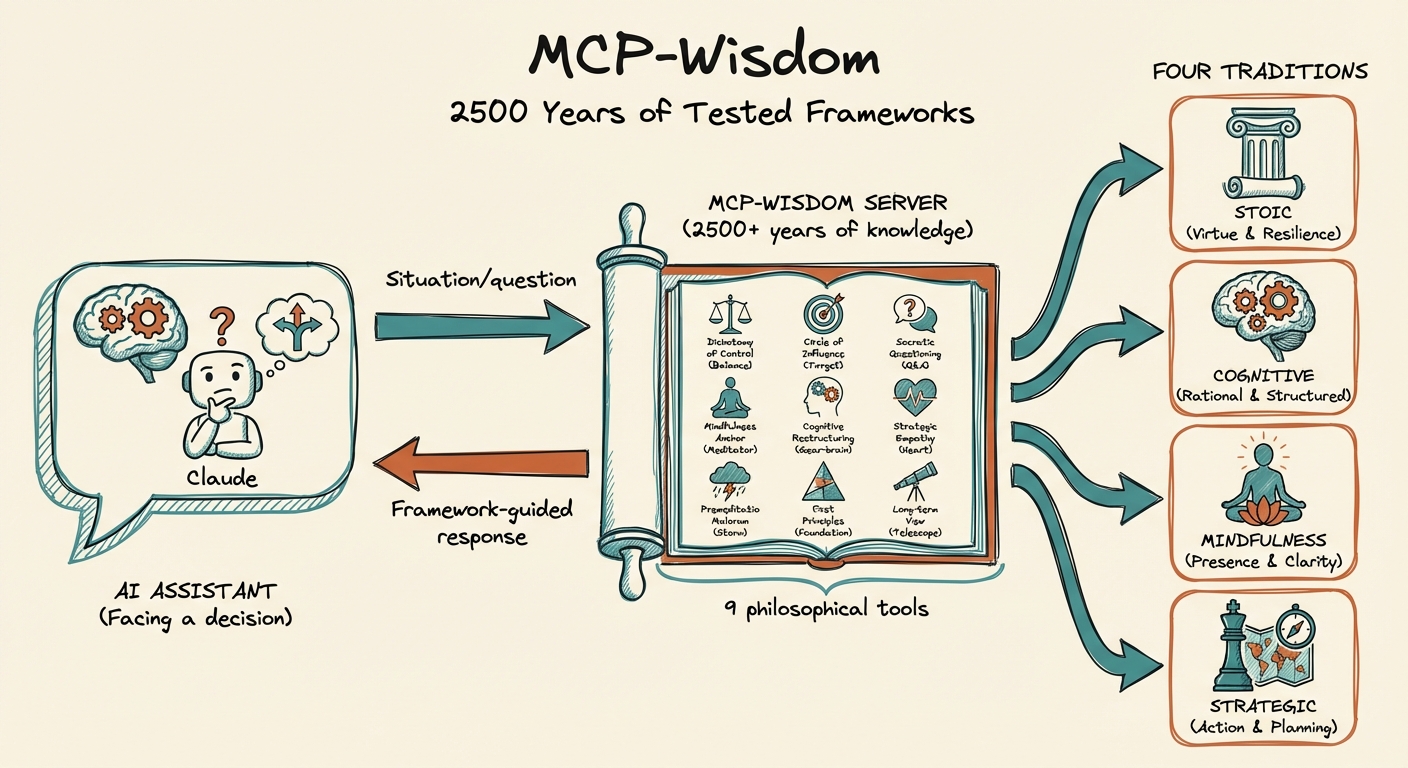 - an MCP server providing Stoic, Cognitive, Mindfulness, and Strategic wisdom tools.
"Think better with 2,500 years of tested frameworks"
mcp-wisdom provides 9 philosophical thinking tools that Claude can use to help with decisions, anxiety, biases, timing, and perspective. Each tool draws from specific philosophical traditions with embedded wisdom quotes.
Related MCP server: think-mcp
npm install -g mcp-wisdomOr run directly with npx:
npx mcp-wisdomAdd to your Claude Desktop config (~/Library/Application Support/Claude/claude_desktop_config.json on macOS):
{
  "mcpServers": {
    "wisdom": {
      "command": "npx",
      "args": ["-y", "mcp-wisdom"]
    }
  }
}claude mcp add wisdom -- npx -y mcp-wisdomTool | Purpose | Use When |
| Separate controllable from uncontrollable | Anxious about outcomes |
| Visualize worst case scenarios | Worried about failure |
| Mortality perspective | Need clarity on priorities |
Tool | Purpose | Use When |
| Detect thinking errors | Making important decisions |
Tool | Purpose | Use When |
| Create space before reacting | Feeling rushed or reactive |
Tool | Purpose | Use When |
| Assess readiness for action | Deciding when to act |
| Analyze through five elements | Facing complex challenges |
Tool | Purpose | Use When |
| Socratic questioning | Thinking feels unclear |
| Recommend best framework | Unsure which tool to use |
Situation | Tool |
"I'm anxious about the outcome" |
|
"What if this fails?" |
|
"Does this really matter?" |
|
"Am I thinking clearly?" |
|
"I need to slow down" |
|
"Is now the right time?" |
|
"This is complex" |
|
"What do I actually mean?" |
|
"Which framework should I use?" |
|
Tools draw from these philosophical traditions:
Stoicism: Epictetus, Marcus Aurelius, Seneca
Cognitive Science: Daniel Kahneman, Amos Tversky
Mindfulness: Thich Nhat Hanh, Viktor Frankl
Strategic: Miyamoto Musashi (Book of Five Rings)
Socratic: Socrates, Plato
Ask Claude:
"Use the dichotomy of control to help me with my job interview anxiety"
"Scan my reasoning about this investment for cognitive biases"
"Help me decide if now is the right time to launch this product"
"I need perspective on whether to take this job offer"
Claude will use the appropriate wisdom tool to provide structured philosophical guidance.
wisdom-pack - Slash command version for Claude Code
See CHANGELOG.md for a history of changes to this project.
MIT
Apply Socratic questioning to clarify terms, examine assumptions, and reach better understanding. Use when thinking feels unclear.
| Name | Required | Description | Default |
|---|---|---|---|
| statement | Yes | The belief, position, or concept to examine |
Does the description disclose side effects, auth requirements, rate limits, or destructive behavior?
No annotations are provided, so the description carries the full burden of behavioral disclosure. It mentions the method (Socratic questioning) and goal (better understanding) but lacks details on what the tool actually does behaviorally—e.g., whether it generates questions, provides analysis, requires specific inputs beyond the statement, or has any limitations like response length or processing time. This leaves significant gaps in understanding how the tool operates.
Agents need to know what a tool does to the world before calling it. Descriptions should go beyond structured annotations to explain consequences.
Is the description appropriately sized, front-loaded, and free of redundancy?
The description is highly concise and front-loaded, consisting of two clear sentences that directly state the tool's purpose and usage context without any redundant or extraneous information. Every word earns its place, making it efficient for an AI agent to parse.
Shorter descriptions cost fewer tokens and are easier for agents to parse. Every sentence should earn its place.
Given the tool's complexity, does the description cover enough for an agent to succeed on first attempt?
Given the complexity of a tool that applies Socratic questioning, the lack of annotations, and no output schema, the description is incomplete. It doesn't explain what the tool returns (e.g., questions, insights, or a structured analysis), how it handles different types of statements, or any behavioral traits, leaving the agent with insufficient context for effective use.
Complex tools with many parameters or behaviors need more documentation. Simple tools need less. This dimension scales expectations accordingly.
Does the description clarify parameter syntax, constraints, interactions, or defaults beyond what the schema provides?
The input schema has 100% description coverage, with the 'statement' parameter well-documented as 'The belief, position, or concept to examine.' The description doesn't add any additional semantic context beyond this, such as examples or formatting tips, but the schema provides adequate baseline information, justifying a score of 3.
Input schemas describe structure but not intent. Descriptions should explain non-obvious parameter relationships and valid value ranges.
Does the description clearly state what the tool does and how it differs from similar tools?
The description clearly states the tool's purpose: 'Apply Socratic questioning to clarify terms, examine assumptions, and reach better understanding.' It specifies the method (Socratic questioning), actions (clarify, examine, reach), and goal (better understanding). However, it doesn't explicitly differentiate from sibling tools like 'wisdom_cognitive_bias_scan' or 'wisdom_ground' beyond the general 'thinking feels unclear' context.
Agents choose between tools based on descriptions. A clear purpose with a specific verb and resource helps agents select the right tool.
Does the description explain when to use this tool, when not to, or what alternatives exist?
The description provides implied usage guidance with 'Use when thinking feels unclear,' which gives a general context for application. However, it doesn't offer explicit when-not-to-use advice or name alternatives among the sibling tools, leaving the agent to infer distinctions based on tool names alone.
Agents often have multiple tools that could apply. Explicit usage guidance like "use X instead of Y when Z" prevents misuse.
Scan reasoning or decisions for cognitive biases using Kahneman's System 1/2 framework. Use before making important decisions.
| Name | Required | Description | Default |
|---|---|---|---|
| reasoning | Yes | The reasoning, decision, or belief to check for biases |
Does the description disclose side effects, auth requirements, rate limits, or destructive behavior?
No annotations are provided, so the description carries the full burden of behavioral disclosure. It mentions the framework but does not detail what biases are checked, how results are presented, or any limitations (e.g., accuracy, processing time). For a tool with no annotations, this leaves significant gaps in understanding its behavior and output.
Agents need to know what a tool does to the world before calling it. Descriptions should go beyond structured annotations to explain consequences.
Is the description appropriately sized, front-loaded, and free of redundancy?
The description is concise and front-loaded, consisting of two sentences that directly state the tool's function and usage context without unnecessary words. Every sentence adds value, making it efficient and easy to understand.
Shorter descriptions cost fewer tokens and are easier for agents to parse. Every sentence should earn its place.
Given the tool's complexity, does the description cover enough for an agent to succeed on first attempt?
Given the tool's complexity (involves cognitive bias analysis) and lack of annotations and output schema, the description is minimally adequate. It specifies the purpose and usage but lacks details on behavior, output format, or error handling. For a tool with no structured output information, more completeness would be beneficial.
Complex tools with many parameters or behaviors need more documentation. Simple tools need less. This dimension scales expectations accordingly.
Does the description clarify parameter syntax, constraints, interactions, or defaults beyond what the schema provides?
The input schema has 100% description coverage, with the parameter 'reasoning' well-defined in the schema. The description adds no additional parameter details beyond what the schema provides, such as examples or format specifics. With high schema coverage, the baseline score of 3 is appropriate as the description does not compensate but also does not detract.
Input schemas describe structure but not intent. Descriptions should explain non-obvious parameter relationships and valid value ranges.
Does the description clearly state what the tool does and how it differs from similar tools?
The description clearly states the tool's purpose with a specific verb ('scan') and resource ('reasoning or decisions'), specifying the framework used ('Kahneman's System 1/2 framework'). It distinguishes itself from siblings by focusing on cognitive bias detection rather than clarification, grounding, mindfulness, or strategic analysis.
Agents choose between tools based on descriptions. A clear purpose with a specific verb and resource helps agents select the right tool.
Does the description explain when to use this tool, when not to, or what alternatives exist?
The description provides explicit guidance on when to use the tool ('before making important decisions'), which gives clear context for its application. However, it does not specify when not to use it or name alternatives among the sibling tools, such as when to choose this over 'wisdom_clarify' or 'wisdom_ground'.
Agents often have multiple tools that could apply. Explicit usage guidance like "use X instead of Y when Z" prevents misuse.
Analyze a situation and recommend which philosophical framework(s) would be most helpful. Use when unsure which wisdom tool to apply.
| Name | Required | Description | Default |
|---|---|---|---|
| situation | Yes | The situation, decision, or concern to analyze |
Does the description disclose side effects, auth requirements, rate limits, or destructive behavior?
No annotations are provided, so the description carries the full burden of behavioral disclosure. It mentions the tool 'analyze' and 'recommend,' but does not disclose key behavioral traits such as whether it's read-only or mutative, what the output format might be (e.g., list of frameworks, explanations), or any constraints like rate limits or authentication needs. This leaves significant gaps in understanding how the tool behaves beyond its basic purpose.
Agents need to know what a tool does to the world before calling it. Descriptions should go beyond structured annotations to explain consequences.
Is the description appropriately sized, front-loaded, and free of redundancy?
The description is concise and well-structured, consisting of two sentences that directly state the purpose and usage guidelines without any unnecessary information. Every sentence earns its place by providing essential context, making it efficient and easy to parse for an AI agent.
Shorter descriptions cost fewer tokens and are easier for agents to parse. Every sentence should earn its place.
Given the tool's complexity, does the description cover enough for an agent to succeed on first attempt?
Given the tool's complexity (analysis and recommendation with no output schema) and lack of annotations, the description is moderately complete. It covers purpose and usage well, but lacks details on behavioral aspects and output, which are important for a tool that likely returns recommendations. It is adequate for basic selection but could be more informative about what to expect from the tool's operation.
Complex tools with many parameters or behaviors need more documentation. Simple tools need less. This dimension scales expectations accordingly.
Does the description clarify parameter syntax, constraints, interactions, or defaults beyond what the schema provides?
The input schema has 100% description coverage, with the parameter 'situation' documented as 'The situation, decision, or concern to analyze.' The description adds no additional semantic meaning beyond this, as it does not elaborate on parameter usage, examples, or constraints. According to the rules, with high schema coverage (>80%), the baseline is 3, which is appropriate here since the schema adequately covers the parameter.
Input schemas describe structure but not intent. Descriptions should explain non-obvious parameter relationships and valid value ranges.
Does the description clearly state what the tool does and how it differs from similar tools?
The description clearly states the tool's purpose: 'Analyze a situation and recommend which philosophical framework(s) would be most helpful.' It specifies the verb ('analyze' and 'recommend') and resource ('situation' and 'philosophical framework(s)'), but does not explicitly differentiate it from all sibling tools beyond stating it's for when 'unsure which wisdom tool to apply.' This makes it clear but not fully distinct from siblings like 'wisdom_clarify' or 'wisdom_cognitive_bias_scan' that might also analyze situations.
Agents choose between tools based on descriptions. A clear purpose with a specific verb and resource helps agents select the right tool.
Does the description explain when to use this tool, when not to, or what alternatives exist?
The description provides explicit usage guidance: 'Use when unsure which wisdom tool to apply.' This clearly indicates when to use this tool versus alternatives, such as the sibling tools listed, making it easy for an AI agent to select this tool in the appropriate context without ambiguity.
Agents often have multiple tools that could apply. Explicit usage guidance like "use X instead of Y when Z" prevents misuse.
Create space between stimulus and response using the STOP practice. Use when feeling reactive or rushed.
| Name | Required | Description | Default |
|---|---|---|---|
| situation | Yes | What's prompting the need for pause |
Does the description disclose side effects, auth requirements, rate limits, or destructive behavior?
No annotations are provided, so the description carries the full burden of behavioral disclosure. It mentions the 'STOP practice' but doesn't explain what that entails (e.g., steps involved, expected duration, or what the tool actually does operationally). For a tool with no annotations, this leaves significant gaps in understanding its behavior, such as whether it provides guidance, logs data, or interacts with external systems.
Agents need to know what a tool does to the world before calling it. Descriptions should go beyond structured annotations to explain consequences.
Is the description appropriately sized, front-loaded, and free of redundancy?
The description is very concise and front-loaded, consisting of two sentences that directly state the purpose and usage guidelines. Every sentence earns its place by providing essential information without unnecessary details, making it efficient and easy to parse for an AI agent.
Shorter descriptions cost fewer tokens and are easier for agents to parse. Every sentence should earn its place.
Given the tool's complexity, does the description cover enough for an agent to succeed on first attempt?
Given the tool's complexity (a mindfulness practice tool with one parameter) and the lack of annotations and output schema, the description is minimally adequate. It covers the basic purpose and when to use it but lacks details on behavioral aspects and output. For a tool with no structured data beyond the input schema, it should do more to explain what the tool actually does and what results to expect.
Complex tools with many parameters or behaviors need more documentation. Simple tools need less. This dimension scales expectations accordingly.
Does the description clarify parameter syntax, constraints, interactions, or defaults beyond what the schema provides?
The input schema has 100% description coverage, with the parameter 'situation' documented as 'What's prompting the need for pause.' The description doesn't add any additional meaning beyond this, such as examples or constraints. Since the schema coverage is high, the baseline score is 3, as the schema adequately handles the parameter semantics without extra help from the description.
Input schemas describe structure but not intent. Descriptions should explain non-obvious parameter relationships and valid value ranges.
Does the description clearly state what the tool does and how it differs from similar tools?
The description clearly states the tool's purpose: 'Create space between stimulus and response using the STOP practice.' It specifies the verb ('create space'), method ('STOP practice'), and context ('between stimulus and response'), which is more specific than just restating the name. However, it doesn't explicitly differentiate this from sibling tools like 'wisdom_ground' or 'wisdom_clarify', which might also involve mindfulness or reflection.
Agents choose between tools based on descriptions. A clear purpose with a specific verb and resource helps agents select the right tool.
Does the description explain when to use this tool, when not to, or what alternatives exist?
The description provides clear usage context: 'Use when feeling reactive or rushed.' This gives a specific scenario for when to invoke the tool, helping the agent decide appropriately. However, it doesn't mention when not to use it or name alternatives among the sibling tools, such as comparing it to 'wisdom_stoic_dichotomy' for emotional regulation.
Agents often have multiple tools that could apply. Explicit usage guidance like "use X instead of Y when Z" prevents misuse.
Apply Epictetus's dichotomy of control to separate what's in your power from what isn't. Use when feeling anxious about outcomes or uncertain what to focus on.
| Name | Required | Description | Default |
|---|---|---|---|
| situation | Yes | The situation, decision, or concern to analyze |
Does the description disclose side effects, auth requirements, rate limits, or destructive behavior?
No annotations are provided, so the description carries the full burden of behavioral disclosure. It mentions the philosophical framework (Epictetus's dichotomy) and use cases, but it doesn't describe what the tool actually does behaviorally—e.g., whether it provides analysis, advice, or structured output, or any operational details like response format or limitations. This leaves significant gaps for an AI agent to understand how to invoke it effectively.
Agents need to know what a tool does to the world before calling it. Descriptions should go beyond structured annotations to explain consequences.
Is the description appropriately sized, front-loaded, and free of redundancy?
The description is highly concise and front-loaded, consisting of two sentences that directly state the purpose and usage guidelines without any wasted words. Every sentence earns its place by providing essential information, making it efficient and easy to parse.
Shorter descriptions cost fewer tokens and are easier for agents to parse. Every sentence should earn its place.
Given the tool's complexity, does the description cover enough for an agent to succeed on first attempt?
Given the tool's complexity (philosophical analysis with no output schema and no annotations), the description is moderately complete. It covers purpose and usage but lacks details on behavioral output, return values, or deeper context needed for full understanding. With no output schema, the description should ideally explain what the tool returns, but it doesn't, leaving gaps in completeness for effective agent use.
Complex tools with many parameters or behaviors need more documentation. Simple tools need less. This dimension scales expectations accordingly.
Does the description clarify parameter syntax, constraints, interactions, or defaults beyond what the schema provides?
The input schema has 100% description coverage, with one parameter 'situation' described as 'The situation, decision, or concern to analyze.' The description adds no additional parameter semantics beyond this, as it doesn't elaborate on format, examples, or constraints. Given the high schema coverage, the baseline score of 3 is appropriate, as the schema does the heavy lifting without extra value from the description.
Input schemas describe structure but not intent. Descriptions should explain non-obvious parameter relationships and valid value ranges.
Does the description clearly state what the tool does and how it differs from similar tools?
The description clearly states the tool's purpose: 'Apply Epictetus's dichotomy of control to separate what's in your power from what isn't.' This specifies the action (apply) and resource (dichotomy of control), though it doesn't explicitly differentiate from sibling tools like 'wisdom_stoic_premeditation' or 'wisdom_stoic_memento_mori' which might also involve Stoic philosophy.
Agents choose between tools based on descriptions. A clear purpose with a specific verb and resource helps agents select the right tool.
Does the description explain when to use this tool, when not to, or what alternatives exist?
The description provides clear context for when to use the tool: 'Use when feeling anxious about outcomes or uncertain what to focus on.' This gives practical guidance on the emotional or situational triggers, but it doesn't specify when not to use it or mention alternatives among the sibling tools, such as 'wisdom_clarify' or 'wisdom_cognitive_bias_scan' for similar concerns.
Agents often have multiple tools that could apply. Explicit usage guidance like "use X instead of Y when Z" prevents misuse.
Apply memento mori - use mortality awareness to gain perspective and clarify priorities. Use when needing perspective on what truly matters.
| Name | Required | Description | Default |
|---|---|---|---|
| situation | Yes | The decision or concern to view through mortality lens |
Does the description disclose side effects, auth requirements, rate limits, or destructive behavior?
No annotations are provided, so the description carries the full burden of behavioral disclosure. It describes the tool's function (applying memento mori for perspective) but lacks details on behavioral traits like whether it's read-only or mutative, what the output format might be, any rate limits, or permission requirements. For a tool with no annotation coverage, this leaves significant gaps in understanding how it behaves operationally.
Agents need to know what a tool does to the world before calling it. Descriptions should go beyond structured annotations to explain consequences.
Is the description appropriately sized, front-loaded, and free of redundancy?
The description is extremely concise and front-loaded, consisting of just two sentences that directly state the purpose and usage guidelines. Every word earns its place, with no redundant or vague language, making it efficient and easy to parse quickly.
Shorter descriptions cost fewer tokens and are easier for agents to parse. Every sentence should earn its place.
Given the tool's complexity, does the description cover enough for an agent to succeed on first attempt?
Given the tool's complexity (a conceptual wisdom tool with one parameter) and the lack of annotations and output schema, the description is minimally adequate. It covers the core purpose and when to use it but doesn't address behavioral aspects or output details. For a tool with no structured data beyond the input schema, it should do more to compensate, such as hinting at what the tool returns or any side effects.
Complex tools with many parameters or behaviors need more documentation. Simple tools need less. This dimension scales expectations accordingly.
Does the description clarify parameter syntax, constraints, interactions, or defaults beyond what the schema provides?
The description does not mention the 'situation' parameter at all, leaving its semantics entirely to the input schema, which has 100% coverage with a clear description ('The decision or concern to view through mortality lens'). Since schema coverage is high, the baseline score is 3, as the description adds no additional meaning beyond what the schema already provides.
Input schemas describe structure but not intent. Descriptions should explain non-obvious parameter relationships and valid value ranges.
Does the description clearly state what the tool does and how it differs from similar tools?
The description clearly states the tool's purpose: 'Apply memento mori - use mortality awareness to gain perspective and clarify priorities.' This specifies both the action ('apply memento mori') and the outcome ('gain perspective and clarify priorities'), making it distinct from generic advice tools. However, it doesn't explicitly differentiate from sibling tools like 'wisdom_stoic_premeditation' or 'wisdom_clarify' that might also involve perspective-shifting.
Agents choose between tools based on descriptions. A clear purpose with a specific verb and resource helps agents select the right tool.
Does the description explain when to use this tool, when not to, or what alternatives exist?
The description provides clear context for when to use it: 'Use when needing perspective on what truly matters.' This gives a specific trigger (needing perspective) and focus (what truly matters), which helps guide selection. However, it doesn't mention when NOT to use it or explicitly name alternatives among the sibling tools, such as when other wisdom tools might be more appropriate.
Agents often have multiple tools that could apply. Explicit usage guidance like "use X instead of Y when Z" prevents misuse.
Practice premeditatio malorum - visualize worst case scenarios to reduce fear and prepare mentally. Use when worried about potential failures.
| Name | Required | Description | Default |
|---|---|---|---|
| fear | Yes | What you're worried might happen or go wrong |
Does the description disclose side effects, auth requirements, rate limits, or destructive behavior?
With no annotations provided, the description carries the full burden of behavioral disclosure. It describes the tool's function ('visualize worst case scenarios') and intended outcome ('reduce fear and prepare mentally'), but lacks details on implementation (e.g., how visualization is structured, output format, or any limitations). It doesn't contradict annotations, but could offer more behavioral context.
Agents need to know what a tool does to the world before calling it. Descriptions should go beyond structured annotations to explain consequences.
Is the description appropriately sized, front-loaded, and free of redundancy?
The description is front-loaded and efficient, consisting of two sentences that directly convey purpose and usage without redundancy. Every sentence earns its place by providing essential information, making it appropriately sized for the tool's complexity.
Shorter descriptions cost fewer tokens and are easier for agents to parse. Every sentence should earn its place.
Given the tool's complexity, does the description cover enough for an agent to succeed on first attempt?
Given the tool's low complexity (1 parameter, no output schema, no annotations), the description is largely complete. It explains what the tool does and when to use it, though it could benefit from more behavioral details (e.g., how the visualization works). The lack of output schema means the description doesn't need to cover return values, keeping it adequate.
Complex tools with many parameters or behaviors need more documentation. Simple tools need less. This dimension scales expectations accordingly.
Does the description clarify parameter syntax, constraints, interactions, or defaults beyond what the schema provides?
The input schema has 100% description coverage, with the parameter 'fear' well-documented. The description adds no additional parameter semantics beyond what the schema provides, but since schema coverage is high, the baseline score of 3 is appropriate as the description doesn't need to compensate.
Input schemas describe structure but not intent. Descriptions should explain non-obvious parameter relationships and valid value ranges.
Does the description clearly state what the tool does and how it differs from similar tools?
The description clearly states the tool's purpose with a specific verb ('visualize worst case scenarios') and resource ('fear'), and distinguishes it from siblings by referencing the Stoic concept 'premeditatio malorum'. It goes beyond a tautology by explaining the psychological benefit ('reduce fear and prepare mentally').
Agents choose between tools based on descriptions. A clear purpose with a specific verb and resource helps agents select the right tool.
Does the description explain when to use this tool, when not to, or what alternatives exist?
The description explicitly states when to use the tool ('Use when worried about potential failures'), providing clear context for its application. This directly addresses the agent's decision-making by linking the tool to a specific emotional state, which is helpful given the sibling tools focus on different wisdom practices.
Agents often have multiple tools that could apply. Explicit usage guidance like "use X instead of Y when Z" prevents misuse.
Apply Musashi's Five Rings framework (Earth, Water, Fire, Wind, Void) to analyze a strategic situation. Use for complex challenges.
| Name | Required | Description | Default |
|---|---|---|---|
| challenge | Yes | The challenge or endeavor to analyze strategically |
Does the description disclose side effects, auth requirements, rate limits, or destructive behavior?
No annotations are provided, so the description carries the full burden of behavioral disclosure. It mentions the framework and its use for analysis but doesn't describe what the tool actually does behaviorally—e.g., whether it returns structured insights, how it processes the input, or any limitations like response format or processing time. This leaves significant gaps for an AI agent to understand the tool's operation.
Agents need to know what a tool does to the world before calling it. Descriptions should go beyond structured annotations to explain consequences.
Is the description appropriately sized, front-loaded, and free of redundancy?
The description is extremely concise and front-loaded, consisting of just two sentences that directly state the purpose and usage. Every word earns its place with no redundancy or unnecessary details, making it efficient for an AI agent to parse quickly.
Shorter descriptions cost fewer tokens and are easier for agents to parse. Every sentence should earn its place.
Given the tool's complexity, does the description cover enough for an agent to succeed on first attempt?
Given the complexity of applying a philosophical framework and the lack of annotations and output schema, the description is incomplete. It doesn't explain what the tool returns (e.g., insights per ring, recommendations), how the analysis is structured, or any behavioral traits. This makes it inadequate for an AI agent to fully understand the tool's context and expected outcomes.
Complex tools with many parameters or behaviors need more documentation. Simple tools need less. This dimension scales expectations accordingly.
Does the description clarify parameter syntax, constraints, interactions, or defaults beyond what the schema provides?
The input schema has 100% description coverage, with the 'challenge' parameter well-documented as 'The challenge or endeavor to analyze strategically.' The description adds no additional parameter semantics beyond this, such as examples or constraints. With high schema coverage, the baseline score of 3 is appropriate as the schema handles the heavy lifting.
Input schemas describe structure but not intent. Descriptions should explain non-obvious parameter relationships and valid value ranges.
Does the description clearly state what the tool does and how it differs from similar tools?
The description clearly states the tool's purpose: 'Apply Musashi's Five Rings framework... to analyze a strategic situation.' It specifies the verb (apply/analyze) and resource (framework), though it doesn't explicitly differentiate from sibling tools like 'wisdom_strategic_timing' or 'wisdom_clarify' beyond mentioning 'complex challenges.'
Agents choose between tools based on descriptions. A clear purpose with a specific verb and resource helps agents select the right tool.
Does the description explain when to use this tool, when not to, or what alternatives exist?
The description provides some guidance with 'Use for complex challenges,' implying context for when to apply this tool. However, it doesn't specify when not to use it or name alternatives among the siblings, such as 'wisdom_strategic_timing' for timing-related analysis or 'wisdom_stoic_dichotomy' for different philosophical approaches.
Agents often have multiple tools that could apply. Explicit usage guidance like "use X instead of Y when Z" prevents misuse.
Assess whether now is the right time for action using Musashi's timing principles. Use when deciding whether to act now or wait.
| Name | Required | Description | Default |
|---|---|---|---|
| action | Yes | The action or decision you're considering timing |
Does the description disclose side effects, auth requirements, rate limits, or destructive behavior?
No annotations are provided, so the description carries the full burden of behavioral disclosure. It mentions the tool 'assesses' timing using principles, but doesn't describe what the assessment entails (e.g., returns a recommendation, score, or analysis), potential side effects, or any constraints like rate limits. For a tool with no annotations, this is a significant gap in transparency.
Agents need to know what a tool does to the world before calling it. Descriptions should go beyond structured annotations to explain consequences.
Is the description appropriately sized, front-loaded, and free of redundancy?
The description is two sentences, front-loaded with the core purpose and followed by usage guidance. Every sentence earns its place by providing essential information without redundancy, making it highly efficient and well-structured.
Shorter descriptions cost fewer tokens and are easier for agents to parse. Every sentence should earn its place.
Given the tool's complexity, does the description cover enough for an agent to succeed on first attempt?
Given the tool's complexity (assessing timing with principles), no annotations, and no output schema, the description is moderately complete. It covers purpose and usage but lacks details on behavior, return values, or deeper context. This is adequate for a simple tool but leaves gaps that could hinder effective use by an AI agent.
Complex tools with many parameters or behaviors need more documentation. Simple tools need less. This dimension scales expectations accordingly.
Does the description clarify parameter syntax, constraints, interactions, or defaults beyond what the schema provides?
The input schema has 100% description coverage, with one parameter 'action' documented as 'The action or decision you're considering timing'. The description doesn't add any further meaning beyond this, such as examples or format details. With high schema coverage, the baseline is 3, as the schema does the heavy lifting.
Input schemas describe structure but not intent. Descriptions should explain non-obvious parameter relationships and valid value ranges.
Does the description clearly state what the tool does and how it differs from similar tools?
The description clearly states the tool's purpose: 'Assess whether now is the right time for action using Musashi's timing principles.' It specifies the verb ('assess'), resource ('timing'), and methodology ('Musashi's timing principles'), making it distinct from siblings like 'wisdom_clarify' or 'wisdom_stoic_dichotomy'. However, it doesn't explicitly differentiate from 'wisdom_strategic_five_rings', which might also involve strategic principles, leaving some ambiguity.
Agents choose between tools based on descriptions. A clear purpose with a specific verb and resource helps agents select the right tool.
Does the description explain when to use this tool, when not to, or what alternatives exist?
The description provides clear context for usage: 'Use when deciding whether to act now or wait.' This gives a specific scenario (timing decisions) and implies alternatives (acting vs. waiting). However, it doesn't explicitly mention when not to use it or name alternative tools (e.g., 'wisdom_mindful_pause' for pausing), so it falls short of a perfect score.
Agents often have multiple tools that could apply. Explicit usage guidance like "use X instead of Y when Z" prevents misuse.
Recent tool additions, removals, and schema changes observed during successful MCP inspections.
wisdom_clarifywisdom_cognitive_bias_scanwisdom_groundwisdom_mindful_pausewisdom_stoic_dichotomywisdom_stoic_memento_moriwisdom_stoic_premeditationwisdom_strategic_five_ringswisdom_strategic_timingScored across 9 tools
Every tool has a clearly distinct purpose with no overlap: Socratic questioning, cognitive bias scanning, framework recommendation, mindfulness, three distinct Stoic practices, and two strategic analysis tools. The descriptions explicitly differentiate their applications, making misselection unlikely.
All tools follow a consistent 'wisdom_' prefix with descriptive suffixes (e.g., 'clarify', 'cognitive_bias_scan', 'stoic_dichotomy'), using snake_case uniformly. This predictable pattern enhances readability and agent usability.
Nine tools are well-scoped for a wisdom/decision-support server, covering diverse philosophical and strategic frameworks without redundancy. Each tool earns its place by addressing specific cognitive or situational needs, avoiding both thinness and bloat.
The toolset provides complete coverage for its domain of wisdom and decision-making, including clarification, bias detection, mindfulness, Stoic practices, and strategic analysis. No obvious gaps exist; agents can handle various scenarios from reactive emotions to complex planning.
A governed, nonclinical reasoning system that helps people and AI agents make sense of difficult moments and choose a grounded next step. Use Clarity OS for overthinking, emotional activation, uncertainty, decision friction, conflicting priorities, repeating patterns, or difficult conversations. It returns structured, safety-governed clarity while preserving uncertainty, personal agency, and appropriate nonclinical boundaries.
Deterministic reasoning stack for AI agents: simulate, decide & compute, plus cross-domain tools.
Stress-test a decision through named thinkers' lenses: assumptions, counter-arguments, receipt.
Brain dump, routines, task planning, focus, and instant thought retrieval