
A
licenseNot graded
qualityD
maintenanceA Model Context Protocol server that enables Claude to execute SQL queries on Snowflake databases with automatic connection lifecycle management.
45
MIT

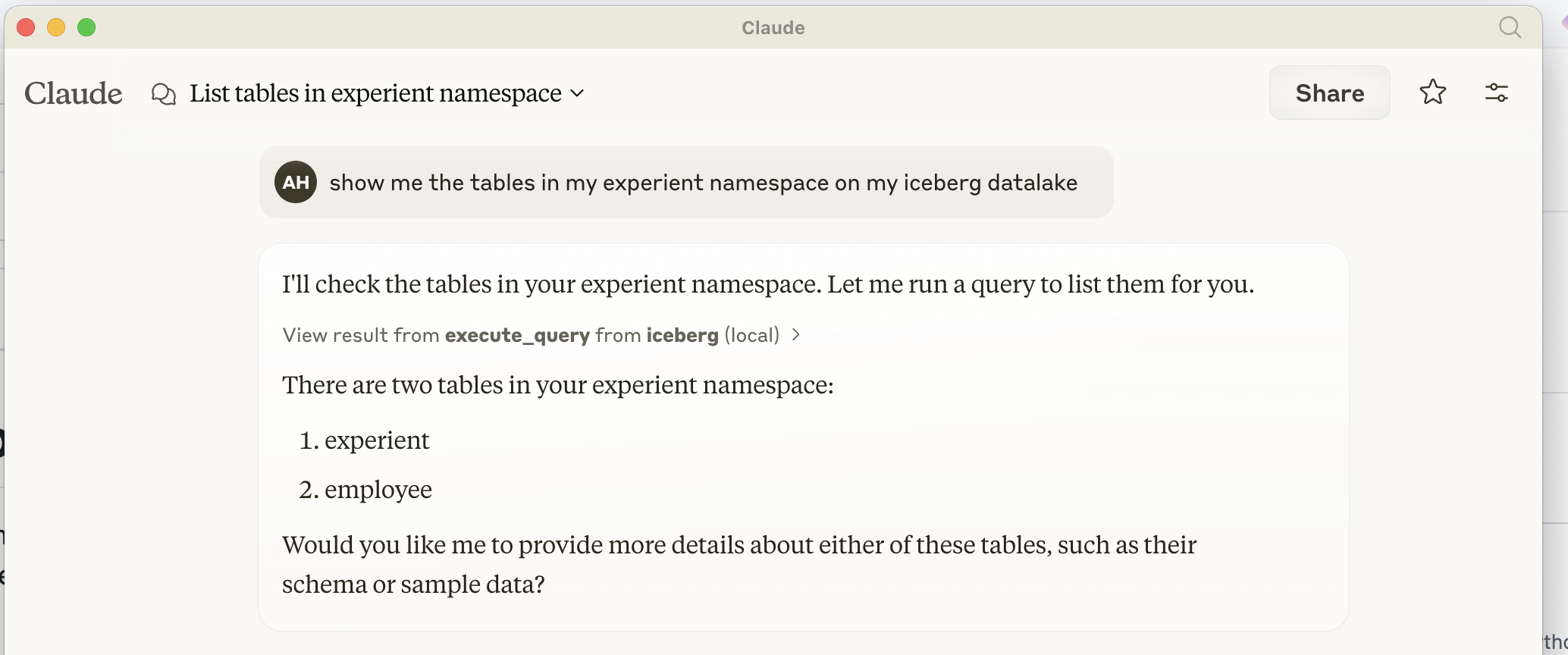
Apache Iceberg와 상호 작용하기 위한 MCP(Model Context Protocol) 서버 구현입니다. 이 서버는 Claude Desktop을 통해 Iceberg 테이블을 쿼리하고 관리하기 위한 SQL 인터페이스를 제공합니다.
Related MCP server: Databricks MCP Server
Smithery를 통해 Claude Desktop용 MCP Iceberg Catalog를 자동으로 설치하려면:
지엑스피1
필수 조건
Python 3.10 이상
UV 패키지 설치 프로그램(권장) 또는 pip
Iceberg REST 카탈로그 및 S3 호환 스토리지에 액세스
Claude Desktop에 설치하는 방법 claude_desktop_config.json 에 다음 구성을 추가합니다.
{
  "mcpServers": {
    "iceberg": {
      "command": "uv",
      "args": [
        "--directory",
        "PATH_TO_/mcp-iceberg-service",
        "run",
        "mcp-server-iceberg"
      ],
      "env": {
        "ICEBERG_CATALOG_URI" : "http://localhost:8181",
        "ICEBERG_WAREHOUSE" : "YOUR ICEBERG WAREHOUSE NAME",
        "S3_ENDPOINT" : "OPTIONAL IF USING S3",
        "AWS_ACCESS_KEY_ID" : "YOUR S3 ACCESS KEY",
        "AWS_SECRET_ACCESS_KEY" : "YOUR S3 SECRET KEY"
      }
    }
  }
}MCP 서버는 세 가지 주요 구성 요소로 구성됩니다.
MCP 프로토콜 핸들러
Claude와의 통신을 위한 모델 컨텍스트 프로토콜을 구현합니다.
stdio를 통해 요청/응답 주기를 처리합니다.
서버 수명 주기 및 초기화를 관리합니다.
쿼리 프로세서
sqlparse 사용하여 SQL 쿼리를 구문 분석합니다.
운영 지원:
테이블 목록
설명 표
선택하다
끼워 넣다
아이스버그 통합
테이블 작업에 pyiceberg 사용합니다.
효율적인 데이터 처리를 위해 PyArrow와 통합
카탈로그 연결 및 테이블 작업을 관리합니다.
서버는 PyIceberg를 여러 가지 방법으로 활용합니다.
카탈로그 관리
REST 카탈로그에 연결합니다
테이블 메타데이터를 관리합니다
네임스페이스 작업을 처리합니다
데이터 운영
PyIceberg와 PyArrow 유형 간 변환
PyArrow 테이블을 통해 데이터 삽입을 처리합니다.
테이블 스키마와 필드 유형을 관리합니다.
쿼리 실행
SQL을 PyIceberg 작업으로 변환합니다.
데이터 스캐닝 및 필터링을 처리합니다
결과 집합 변환을 관리합니다
쿼리 작업
[ ] UPDATE 작업 구현
[ ] DELETE 지원 추가
[ ] 스키마 정의를 사용한 CREATE TABLE 지원
[ ] ALTER TABLE 작업 추가
[ ] 테이블 파티셔닝 지원 구현
데이터 유형
[ ] 복합 유형(배열, 맵, 구조체) 지원
[ ] 시간대 처리에 타임스탬프 추가
[ ] 10진수 형식 지원
[ ] 중첩 필드 지원 추가
성능 개선
[ ] 일괄 삽입 구현
[ ] 쿼리 최적화 추가
[ ] 병렬 스캔 지원
[ ] 자주 액세스되는 데이터에 대한 캐싱 계층 추가
보안 기능
[ ] 인증 메커니즘 추가
[ ] 역할 기반 접근 제어 구현
[ ] 행 수준 보안 추가
[ ] 암호화된 연결 지원
모니터링 및 관리
[ ] 메트릭 수집 추가
[ ] 쿼리 로깅 구현
[ ] 성능 모니터링 추가
[ ] 테이블 유지 관리 작업 지원
오류 처리
[ ] 오류 메시지 개선
[ ] 일시적인 실패에 대한 재시도 메커니즘 추가
[ ] 거래 지원 구현
[ ] 데이터 검증 추가
Execute a query on Iceberg tables
| Name | Required | Description | Default |
|---|---|---|---|
| query | Yes | Query to execute (supports: LIST TABLES, DESCRIBE TABLE, SELECT, CREATE TABLE) |
Does the description disclose side effects, auth requirements, rate limits, or destructive behavior?
With no annotations provided, the description carries the full burden of behavioral disclosure but offers minimal information. It mentions the query types supported (LIST TABLES, DESCRIBE TABLE, SELECT, CREATE TABLE), which adds some context, but fails to address critical aspects like permissions needed, whether it's read-only or mutating, error handling, or output format expectations.
Agents need to know what a tool does to the world before calling it. Descriptions should go beyond structured annotations to explain consequences.
Is the description appropriately sized, front-loaded, and free of redundancy?
The description is a single, efficient sentence that directly states the tool's purpose without unnecessary words. It is appropriately sized and front-loaded, making it easy to understand at a glance.
Shorter descriptions cost fewer tokens and are easier for agents to parse. Every sentence should earn its place.
Given the tool's complexity, does the description cover enough for an agent to succeed on first attempt?
Given the complexity of a query execution tool with no annotations and no output schema, the description is insufficient. It lacks details on behavioral traits, error handling, permissions, or what to expect from results, leaving significant gaps for an AI agent to operate effectively.
Complex tools with many parameters or behaviors need more documentation. Simple tools need less. This dimension scales expectations accordingly.
Does the description clarify parameter syntax, constraints, interactions, or defaults beyond what the schema provides?
The input schema has 100% description coverage, explicitly documenting the 'query' parameter with supported query types. The description does not add any additional semantic details beyond what the schema already provides, so it meets the baseline for adequate but unremarkable coverage.
Input schemas describe structure but not intent. Descriptions should explain non-obvious parameter relationships and valid value ranges.
Does the description clearly state what the tool does and how it differs from similar tools?
The description clearly states the action ('Execute a query') and target resource ('on Iceberg tables'), providing a specific verb+resource combination. However, with no sibling tools mentioned, it cannot demonstrate differentiation from alternatives, so it falls short of a perfect score.
Agents choose between tools based on descriptions. A clear purpose with a specific verb and resource helps agents select the right tool.
Does the description explain when to use this tool, when not to, or what alternatives exist?
The description provides no guidance on when to use this tool versus alternatives, prerequisites, or contextual constraints. It merely states what the tool does without indicating appropriate scenarios or limitations.
Agents often have multiple tools that could apply. Explicit usage guidance like "use X instead of Y when Z" prevents misuse.
Recent tool additions, removals, and schema changes observed during successful MCP inspections. Dates show when Glama detected each change.
v1.0.0execute_queryWith only one tool, there is no possibility of ambiguity or overlap between tools, as there are no other tools to confuse it with. The tool's purpose is clearly defined and distinct by default.
Since there is only one tool, naming consistency is inherently perfect with no deviations or mixed conventions to evaluate. The tool name follows a clear verb_noun pattern (execute_query).
A single tool is too few for a catalog server, which typically requires operations like list_tables, get_table, create_table, or update_metadata to be useful. This minimal set severely limits functionality and scope.
The tool set is severely incomplete for an Iceberg catalog domain, lacking basic CRUD operations such as listing, creating, or managing tables. With only a query execution tool, agents cannot perform essential catalog tasks, leading to dead ends.
Unclaimed servers have limited discoverability.
If you are the server author, to access and configure the admin panel.
The BigQuery remote MCP server is a fully managed service that uses the Model Context Protocol to connect AI applications and LLMs to BigQuery data sources. It provides secure, standardized tools for AI agents to list datasets and tables, retrieve schemas, generate and execute SQL queries through natural language, and analyze data—enabling direct access to enterprise analytics data without requiring manual SQL coding.
Query your warehouse or a CSV with Claude/ChatGPT over MCP, governed by table-level ACL + audit.
A comprehensive Model Context Protocol (MCP) server that enables AI assistants to interact with yo…
Query your org's data in natural language — read-only MCP access to SQL, NoSQL, files & warehouses.
We provide all the information about MCP servers via our MCP API.
curl -X GET 'https://glama.ai/api/mcp/v1/servers/ahodroj/mcp-iceberg-service'
If you have feedback or need assistance with the MCP directory API, please join our Discord server