MCP Scholarly Server
mcp-scholary MCP 서버
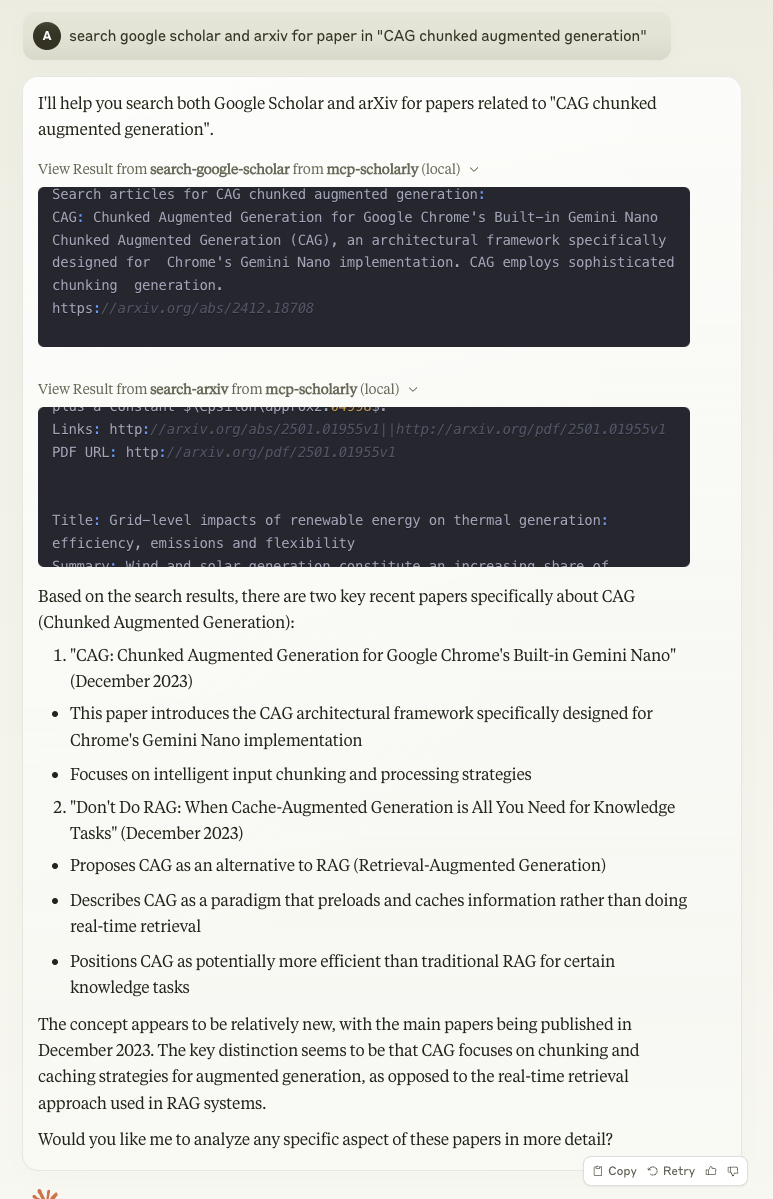
정확한 학술 논문을 검색하는 MCP 서버입니다. 더 많은 학술 검색 엔진이 곧 추가될 예정입니다.
구성 요소
도구
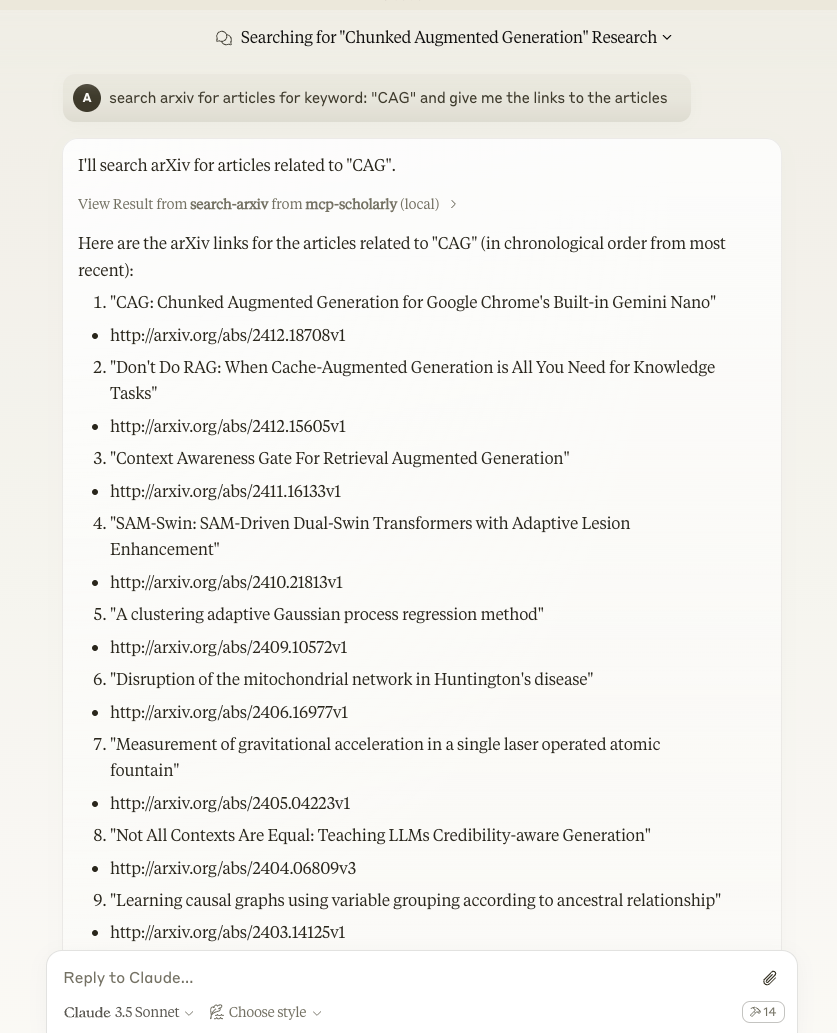
서버는 하나의 도구를 구현합니다.
search-arxiv: 주어진 키워드와 관련된 기사를 arxiv에서 검색합니다.
필수 문자열 인수로 "키워드"를 사용합니다.
Related MCP server: arXiv MCP Server
빠른 시작
설치하다
클로드 데스크탑
MacOS의 경우: ~/Library/Application\ Support/Claude/claude_desktop_config.json Windows의 경우: %APPDATA%/Claude/claude_desktop_config.json
또는 Docker를 사용하는 경우
Smithery를 통해 설치
Smithery를 통해 Claude Desktop에 mcp-scholarly를 자동으로 설치하려면:
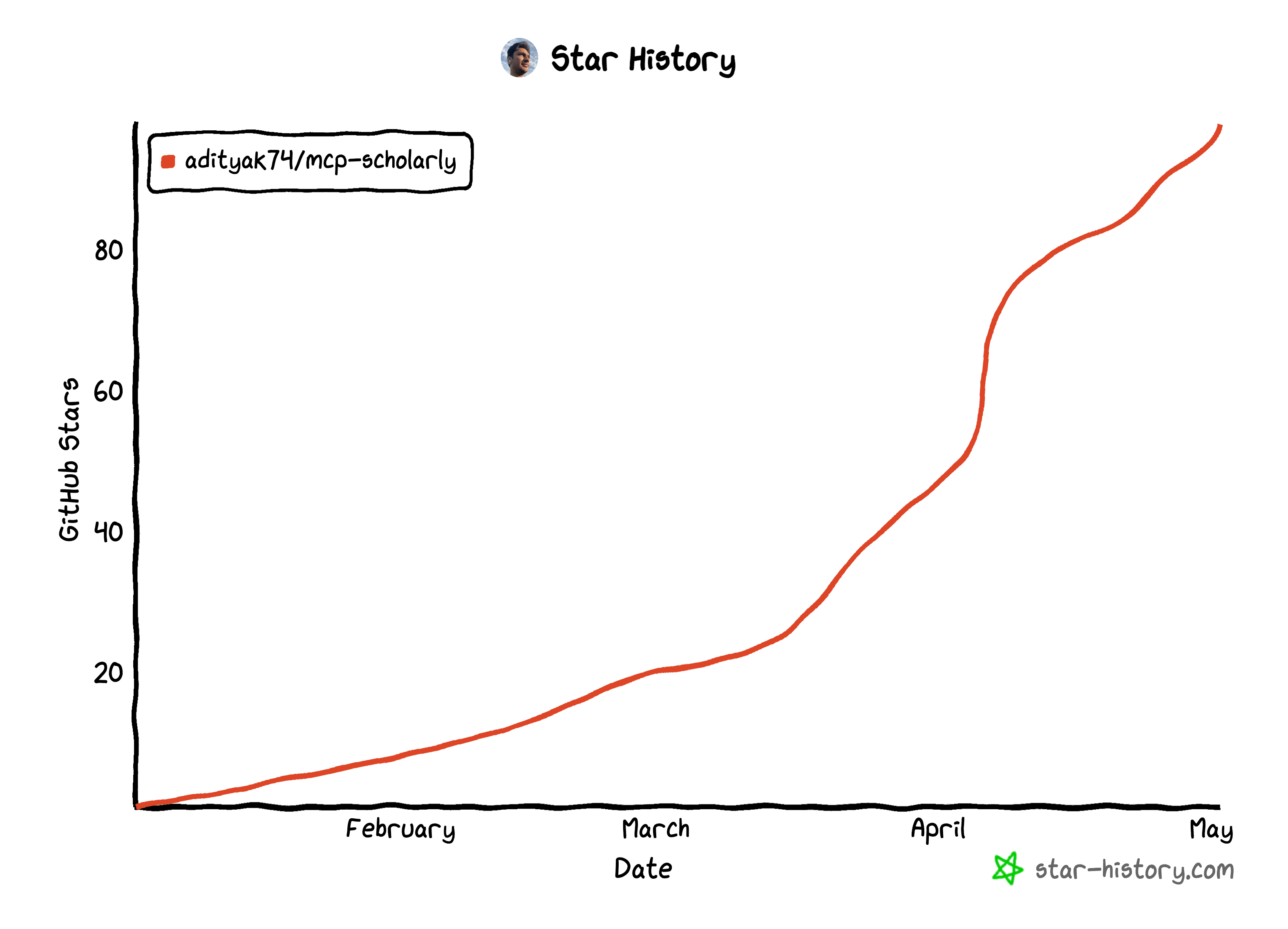
지엑스피1
개발
건축 및 출판
배포를 위해 패키지를 준비하려면:
종속성 동기화 및 잠금 파일 업데이트:
uv sync패키지 배포 빌드:
uv build이렇게 하면 dist/ 디렉토리에 소스와 휠 배포판이 생성됩니다.
PyPI에 게시:
uv publish참고: 환경 변수나 명령 플래그를 통해 PyPI 자격 증명을 설정해야 합니다.
토큰:
--token또는UV_PUBLISH_TOKEN또는 사용자 이름/비밀번호:
--username/UV_PUBLISH_USERNAME및--password/UV_PUBLISH_PASSWORD
디버깅
MCP 서버는 stdio를 통해 실행되므로 디버깅이 어려울 수 있습니다. 최상의 디버깅 환경을 위해서는 MCP Inspector 사용을 강력히 권장합니다.
다음 명령을 사용하여 npm 통해 MCP Inspector를 시작할 수 있습니다.
npx @modelcontextprotocol/inspector uv --directory /Users/adityakarnam/PycharmProjects/mcp-scholarly/mcp-scholarly run mcp-scholarlyInspector를 실행하면 브라우저에서 접근하여 디버깅을 시작할 수 있는 URL이 표시됩니다.
Available Tools
2 toolssearch-arxivC
Search arxiv for articles related to the given keyword.
| Name | Required | Description | Default |
|---|---|---|---|
| keyword | Yes |
TDQS
Does the description disclose side effects, auth requirements, rate limits, or destructive behavior?
With no annotations provided, the description carries the full burden of behavioral disclosure but offers minimal information. It mentions searching but doesn't cover aspects like rate limits, authentication needs, result formats, pagination, or error handling, which are critical for a search tool.
Agents need to know what a tool does to the world before calling it. Descriptions should go beyond structured annotations to explain consequences.
Is the description appropriately sized, front-loaded, and free of redundancy?
The description is a single, efficient sentence that gets straight to the point without unnecessary words. It's appropriately sized for a simple tool, though it could be slightly more informative without losing conciseness.
Shorter descriptions cost fewer tokens and are easier for agents to parse. Every sentence should earn its place.
Given the tool's complexity, does the description cover enough for an agent to succeed on first attempt?
Given the tool's complexity (a search function with one parameter) and the lack of annotations and output schema, the description is incomplete. It doesn't address behavioral traits, parameter details, or expected outputs, making it inadequate for effective agent use.
Complex tools with many parameters or behaviors need more documentation. Simple tools need less. This dimension scales expectations accordingly.
Does the description clarify parameter syntax, constraints, interactions, or defaults beyond what the schema provides?
The input schema has 0% description coverage, so the description must compensate but adds little beyond the schema. It implies 'keyword' is used for searching but doesn't explain its semantics, such as how it's matched (e.g., title, abstract, full-text) or any constraints, leaving the parameter poorly defined.
Input schemas describe structure but not intent. Descriptions should explain non-obvious parameter relationships and valid value ranges.
Does the description clearly state what the tool does and how it differs from similar tools?
The description clearly states the tool's purpose with a specific verb ('search') and resource ('arxiv for articles'), making it immediately understandable. However, it doesn't differentiate from its sibling tool 'search-google-scholar' beyond mentioning the platform, which prevents a perfect score.
Agents choose between tools based on descriptions. A clear purpose with a specific verb and resource helps agents select the right tool.
Does the description explain when to use this tool, when not to, or what alternatives exist?
The description provides no guidance on when to use this tool versus its sibling 'search-google-scholar' or any alternatives. It lacks context about use cases, exclusions, or prerequisites, leaving the agent without direction for tool selection.
Agents often have multiple tools that could apply. Explicit usage guidance like "use X instead of Y when Z" prevents misuse.
search-google-scholarC
Search google scholar for articles related to the given keyword.
| Name | Required | Description | Default |
|---|---|---|---|
| keyword | Yes |
TDQS
Does the description disclose side effects, auth requirements, rate limits, or destructive behavior?
No annotations are provided, so the description carries the full burden of behavioral disclosure. It only states the basic action of searching, without mentioning rate limits, authentication needs, result formats, pagination, or potential side effects. This is inadequate for a search tool with zero annotation coverage.
Agents need to know what a tool does to the world before calling it. Descriptions should go beyond structured annotations to explain consequences.
Is the description appropriately sized, front-loaded, and free of redundancy?
The description is a single, efficient sentence that directly states the tool's function without unnecessary words. It is appropriately sized and front-loaded, making it easy to parse quickly.
Shorter descriptions cost fewer tokens and are easier for agents to parse. Every sentence should earn its place.
Given the tool's complexity, does the description cover enough for an agent to succeed on first attempt?
Given the lack of annotations, no output schema, and low schema description coverage, the description is incomplete. It doesn't address behavioral aspects like result handling or limitations, nor does it provide enough context for effective use in a multi-tool environment with a sibling tool.
Complex tools with many parameters or behaviors need more documentation. Simple tools need less. This dimension scales expectations accordingly.
Does the description clarify parameter syntax, constraints, interactions, or defaults beyond what the schema provides?
The schema description coverage is 0%, and the description adds minimal value beyond the schema. It mentions 'keyword' as the input but doesn't explain what constitutes a valid keyword, how it's used in the search, or any constraints. With one undocumented parameter, the description fails to compensate for the coverage gap.
Input schemas describe structure but not intent. Descriptions should explain non-obvious parameter relationships and valid value ranges.
Does the description clearly state what the tool does and how it differs from similar tools?
The description clearly states the tool's purpose as searching Google Scholar for articles related to a keyword, providing a specific verb ('search') and resource ('Google Scholar articles'). However, it doesn't explicitly differentiate from its sibling tool 'search-arxiv', which likely searches a different academic database, so it doesn't reach the highest score.
Agents choose between tools based on descriptions. A clear purpose with a specific verb and resource helps agents select the right tool.
Does the description explain when to use this tool, when not to, or what alternatives exist?
The description provides no guidance on when to use this tool versus alternatives. It doesn't mention the sibling tool 'search-arxiv' or any other search options, nor does it specify contexts where Google Scholar is preferred over other databases. This leaves the agent with minimal usage direction.
Agents often have multiple tools that could apply. Explicit usage guidance like "use X instead of Y when Z" prevents misuse.
Tool Schema Changelog
Recent tool additions, removals, and schema changes observed during successful MCP inspections.
2 tool updates
- First observed
search-arxiv - First observed
search-google-scholar
TDQS
Scored across 2 tools
The two tools have clearly distinct purposes: one searches ArXiv specifically, while the other searches Google Scholar. There is no overlap in their functionality, and an agent can easily choose the appropriate tool based on the desired academic database.
Both tools follow a consistent verb_noun pattern with 'search' as the verb and the database name as the noun (arxiv, google-scholar). The naming is uniform and predictable across the set.
With only 2 tools, the server feels thin for a 'Scholarly Server' that might be expected to handle broader academic tasks. While search is a core function, typical scholarly workflows could benefit from additional tools like fetching article details, citations, or managing references.
The server is severely incomplete for a scholarly domain, as it only provides search functionality without any tools for retrieving full articles, accessing metadata, or performing follow-up actions like citation analysis. This leaves significant gaps that could hinder agent workflows.
Maintenance
Related MCP Connectors
Academic research search across PubMed and arXiv
Academic paper search, scientific literature, citation analysis, arXiv & semantic related-work.
Search arXiv/Semantic Scholar/OpenAlex + medical evidence (PubMed/Europe PMC) + LaTeX/PDF tools.
Find academic papers across major sources like arXiv, PubMed, bioRxiv, and more. Download PDFs whe…
Related MCP Servers
- FlicenseNot gradedqualityDmaintenanceEnables querying and discovering the latest arXiv papers by category or keyword, providing structured metadata including titles, authors, summaries, and links for research assistance and literature review workflows.-
- AlicenseBqualityDmaintenanceEnables searching and retrieving academic papers from arXiv by various criteria including title, author, and category, with support for extracting full text content from PDFs.4MIT
- FlicenseNot gradedqualityDmaintenanceEnables searching and retrieving academic papers from arXiv by topic, allowing users to discover research papers and extract their metadata including titles, authors, abstracts, and PDF links through natural language queries.-
- FlicenseNot gradedqualityDmaintenanceEnables searching, downloading, and analyzing academic papers from arXiv and Semantic Scholar to extract key insights and citation metrics. It facilitates autonomous knowledge acquisition by processing research findings and integrating them into persistent AI memory systems.-
Appeared in Searches
- Tools and Techniques for Testing Electron.js Apps
- Academic Research Tools for Finding, Downloading, Reading, and Writing Articles
- Analysis of Key Points in China's 2025 No. 1 Central Document and Its Relation to New Energy and Rural Revitalization
- An overview of semiotics and its concepts
- A server for conducting deep research