
MIT

json-mcp-server
JSON MCP
모델 컨텍스트 프로토콜(MCP) 서버는 LLM이 JSON 파일과 효율적으로 상호 작용할 수 있도록 지원합니다. JSON MCP를 사용하면 정의된 조건에 따라 JSON 파일 내에서 데이터를 분할 , 병합 및 검색하고, 유효성을 검사할 수 있습니다.
🌟 주요 특징
✅ 빠르고 가벼움
✅ LLM 친화적 기능
Related MCP server: mcp-server-test
🎥 데모
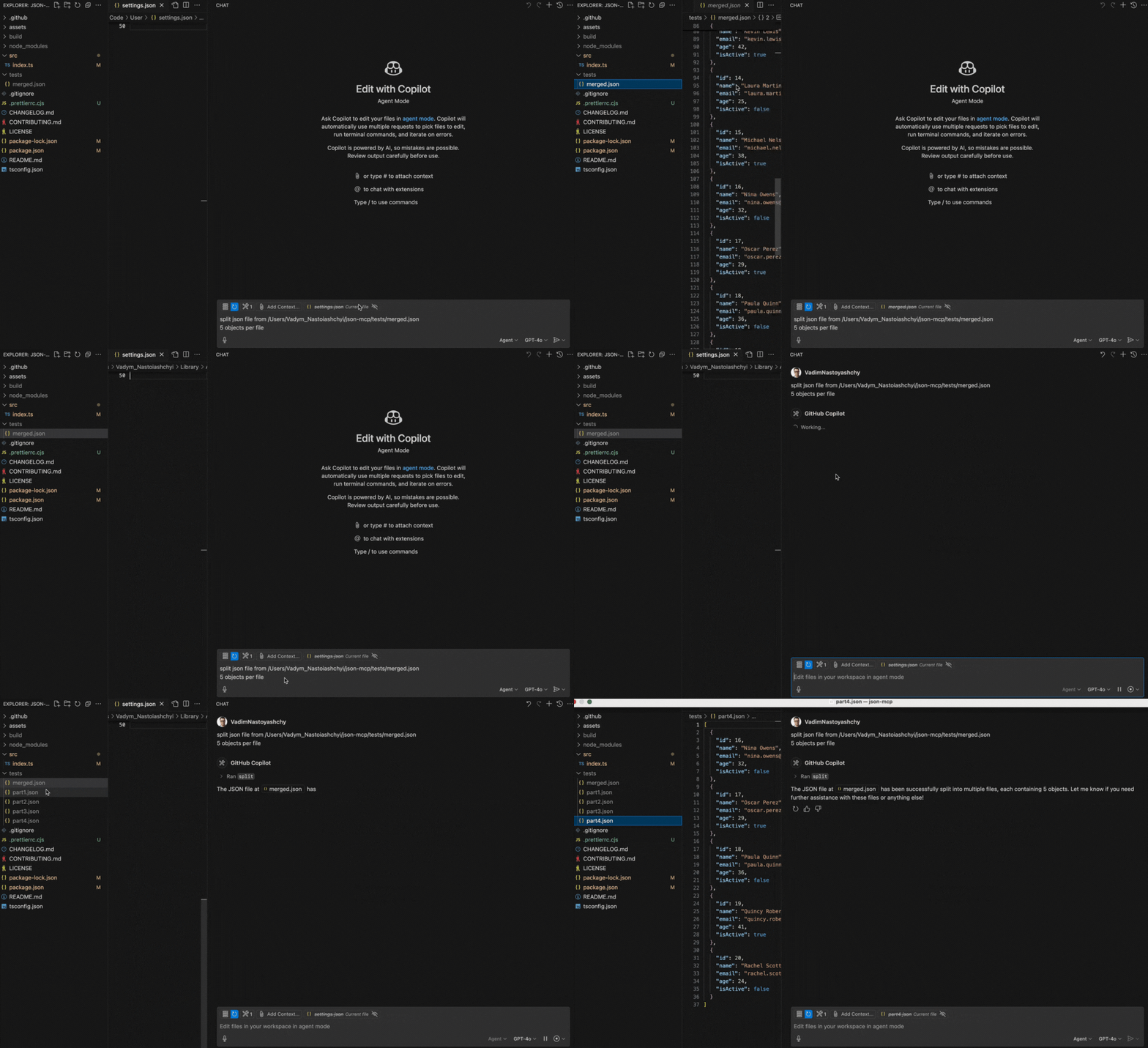
아래는 split 기능을 보여주는 데모입니다.
🔧 사용 사례(도구)
1. split
JSON 파일을 지정된 수의 객체로 분할합니다.
참고: 파일 경로를 제공해야 합니다.
프롬프트 예:
지엑스피1
2. merge
JSON 파일을 하나의 JSON 파일로 병합
참고: 폴더 경로를 제공해야 합니다.
프롬프트 예:
Merge json files from /Users/json-mcp/tests⚙️ 구성
VS 코드 수동 구성
VS Code에서 JSON MCP 서버를 수동으로 구성하려면 사용자 설정(JSON) 파일을 업데이트하세요.
{
  "mcp": {
    "servers": {
      "json-mcp-server": {
        "command": "npx",
        "args": ["json-mcp-server@latest"]
      }
    }
  }
}
VS Code에 설치
VS Code CLI를 사용하여 JSON MCP 서버를 설치할 수 있습니다.
# For VS Code
code --add-mcp '{"name":"json-mcp-server","command":"npx","args": ["json-mcp-server@latest"]}'
설치 후 JSON MCP 서버를 VS Code의 GitHub Copilot 에이전트와 함께 사용할 수 있습니다.
클로드 데스크탑
Smithery를 통해 Claude Desktop에 json-mcp를 자동으로 설치하려면:
npx -y @smithery/cli install @VadimNastoyashchy/json-mcp --client claude⚙️ 설치 서버
전역적으로 설치
npm install -g json-mcp-server@latest글로벌 설치 후 실행
json-mcp-server최신 버전의 npx 사용(권장)
npx json-mcp-server@latestAvailable Tools
2 toolsmergeC
Merge JSON files into a one JSON file
ParametersJSON Schema
| Name | Required | Description | Default |
|---|---|---|---|
| path | Yes |
TDQS
C2.6/5.0
Behavior2/5
Does the description disclose side effects, auth requirements, rate limits, or destructive behavior?
No annotations provided. The description only says 'merge', without disclosing critical behaviors like conflict resolution, merge strategy (shallow vs deep), output location, or whether it modifies input files.
Agents need to know what a tool does to the world before calling it. Descriptions should go beyond structured annotations to explain consequences.
Conciseness3/5
Is the description appropriately sized, front-loaded, and free of redundancy?
The description is a single short sentence, which is concise but sacrifices clarity. It is front-loaded but lacks necessary detail.
Shorter descriptions cost fewer tokens and are easier for agents to parse. Every sentence should earn its place.
Completeness2/5
Given the tool's complexity, does the description cover enough for an agent to succeed on first attempt?
Given one parameter, no output schema, and no annotations, the description is too incomplete. It does not explain merge behavior, input constraints, or output format, leaving significant gaps for an agent.
Complex tools with many parameters or behaviors need more documentation. Simple tools need less. This dimension scales expectations accordingly.
Parameters2/5
Does the description clarify parameter syntax, constraints, interactions, or defaults beyond what the schema provides?
The input schema has 0% description coverage for the 'path' parameter, and the description does not explain what 'path' represents. It could be a file path or directory; the ambiguity reduces usefulness.
Input schemas describe structure but not intent. Descriptions should explain non-obvious parameter relationships and valid value ranges.
Purpose4/5
Does the description clearly state what the tool does and how it differs from similar tools?
The description clearly states the tool merges JSON files into one, with a verb 'merge' and resource 'JSON files'. It distinguishes from the sibling 'split' by being the opposite operation. However, it lacks specificity about what 'path' refers to (a single file? a directory?)
Agents choose between tools based on descriptions. A clear purpose with a specific verb and resource helps agents select the right tool.
Usage Guidelines2/5
Does the description explain when to use this tool, when not to, or what alternatives exist?
No guidance on when to use this tool versus alternatives. The sibling 'split' suggests a complementary tool, but no explicit when-to-use or when-not-to-use is given.
Agents often have multiple tools that could apply. Explicit usage guidance like "use X instead of Y when Z" prevents misuse.
splitB
Split a JSON file into a specified number of objects
ParametersJSON Schema
| Name | Required | Description | Default |
|---|---|---|---|
| path | Yes | ||
| numObjects | Yes |
TDQS
B3.1/5.0
Behavior2/5
Does the description disclose side effects, auth requirements, rate limits, or destructive behavior?
The description does not disclose side effects (e.g., whether the original file is modified or a new file created), required permissions, or other behavioral traits. With no annotations, the description carries the full burden but provides minimal info.
Agents need to know what a tool does to the world before calling it. Descriptions should go beyond structured annotations to explain consequences.
Conciseness4/5
Is the description appropriately sized, front-loaded, and free of redundancy?
Single sentence, no unnecessary words. However, the description could benefit from additional structure to cover key behavioral aspects.
Shorter descriptions cost fewer tokens and are easier for agents to parse. Every sentence should earn its place.
Completeness3/5
Given the tool's complexity, does the description cover enough for an agent to succeed on first attempt?
For a simple tool with two parameters, the description is minimally adequate but leaves questions unanswered, such as output behavior and impact on input file. Missing details reduce completeness.
Complex tools with many parameters or behaviors need more documentation. Simple tools need less. This dimension scales expectations accordingly.
Parameters2/5
Does the description clarify parameter syntax, constraints, interactions, or defaults beyond what the schema provides?
Schema coverage is 0%, and the description adds no meaning beyond the schema. For example, 'path' and 'numObjects' are not detailed—no clarification on file format, location constraints, or how numObjects is applied.
Input schemas describe structure but not intent. Descriptions should explain non-obvious parameter relationships and valid value ranges.
Purpose5/5
Does the description clearly state what the tool does and how it differs from similar tools?
The description clearly states the action (split) and the resource (JSON file). It distinguishes from the sibling tool 'merge' by implying opposite functionality.
Agents choose between tools based on descriptions. A clear purpose with a specific verb and resource helps agents select the right tool.
Usage Guidelines2/5
Does the description explain when to use this tool, when not to, or what alternatives exist?
No guidance on when to use this tool versus alternatives (e.g., 'merge'). No context about prerequisites or exclusions.
Agents often have multiple tools that could apply. Explicit usage guidance like "use X instead of Y when Z" prevents misuse.
Tool Schema Changelog
Recent tool additions, removals, and schema changes observed during successful MCP inspections.
2 tool updates
v1.0.0- First observed
merge - First observed
split
TDQS
B3.3/5.0
Scored across 2 tools
Disambiguation5/5
Merge and split are clearly opposite operations. An agent can easily distinguish their purposes without ambiguity.
Naming Consistency5/5
Both tools use concise, single-word verbs (merge, split) following a consistent pattern.
Tool Count4/5
Two tools is slightly below the typical well-scoped range, but the server's narrow focus on merge/split operations justifies this minimal set.
Completeness4/5
The server covers the core merge and split operations for JSON files. Minor gaps like transform or validate exist, but the surface is complete for its stated purpose.
Maintenance
ActivityInactive
ResponsivenessNo issues
Related MCP Connectors
The official MCP Server for the Mux API
MCP server for progressive tool usage at any scale (see https://klavis.ai)
Related MCP Servers
- -
- AlicenseNot gradedqualityBmaintenanceJson AI - MCP server providing AI-powered tools and automation by MEOK AI Labs13 npm39 PyPIMIT
- AlicenseNot gradedqualityAmaintenanceMCP server for reading, querying, and filtering local JSON files with extended JSONPath syntax, supporting sorting, aggregations, and complex conditions.369 npm2MIT