A
licenseA
qualityD
maintenanceAn implementation of persistent memory for Claude using a local knowledge graph, allowing the AI to remember information about users across conversations with customizable storage location.
11
62
JavaScript
MIT


Die Context-Engineering-Engine für KI-Agenten: Senden Sie nur das, was sich geändert hat.
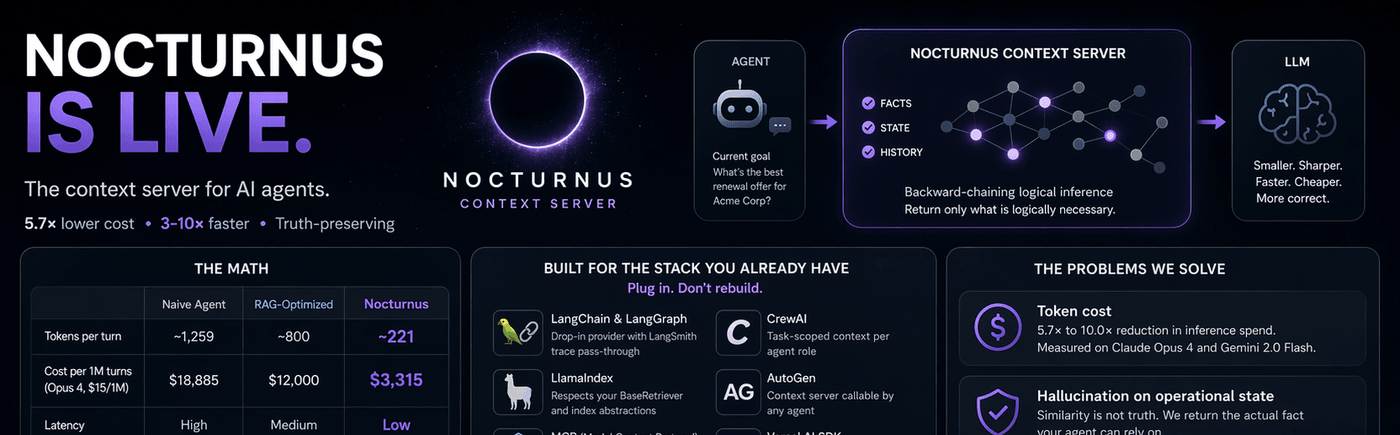
# ❌ Without NocturnusAI — replay everything, every turn
messages = system_prompt + full_history + tool_outputs   # ~1,259 tokens/turn
response = llm(messages)                                 # $13,600/mo at scale

# ✅ With NocturnusAI — send only what changed
ctx = nocturnus.process_turns(raw_turns)                 # extract → infer → delta
messages = system_prompt + ctx.briefing_delta             # ~221 tokens/turn
response = llm(messages)                                 # $2,400/mo. Same accuracy.
Related MCP server: RelayPlane
Gemessen an Live-APIs. 15-stufiges Produktsupport-Gespräch. Echte usage.input_tokens-Zählungen. Probieren Sie es selbst aus.
Naive Wiedergabe | RAG-optimiert | NocturnusAI | |
Tokens pro Schritt | ~1.259 | ~800 | ~221 |
Kosten pro Monat (1K Anfragen/Std., Opus 4, $15/1M) | $13.600 | $12.000 | $2.400 |
Latenz | hoch | mittel | niedrig |
Wahrheitserhaltend | nein | nein | ja |
Claude Opus 4: 5,7-fache Reduzierung. Gemini 2.0 Flash: 10,0-fache. Vollständige Berechnungen.
pip install nocturnusai          # Python
npm install nocturnusai-sdk      # TypeScript
docker run -p 9300:9300 ghcr.io/auctalis/nocturnusai:latest  # Docker
Oder verwenden Sie den Einrichtungsassistenten:
curl -fsSL https://raw.githubusercontent.com/Auctalis/nocturnusai/main/install.sh | bashReproduzierbare Token-Reduzierung — Benchmark im Repo, Methodik veröffentlicht, führen Sie es mit Ihrer eigenen Arbeitslast aus
Deterministische Inferenz — gleiche Abfrage, gleiches Ergebnis, jedes Mal. Kein Embedding-Drift, kein Glücksspiel mit Kosinus-Ähnlichkeit
Wahrheitserhaltung — widerrufen Sie einen Fakt, alle abgeleiteten Schlussfolgerungen werden automatisch widerrufen. Kein veralteter Kontext, keine Halluzinationen beim operativen Status
Lässt sich in bestehende Stacks integrieren — LangChain, LlamaIndex, CrewAI, AutoGen, MCP, Vercel AI SDK, OpenAI Agents SDK, Mastra
Benchmarkbar gegenüber naiver Wiedergabe — Zahlen abgeleitet, nicht erfunden. Jeder Anspruch lässt sich auf eine Notebook-Zelle zurückführen
Framework | Integration | Link |
LangChain / LangGraph | Drop-in | |
CrewAI | Aufgabenbezogener Kontext pro Agentenrolle | |
AutoGen | Kontext-Server, aufrufbar durch jeden Agenten | |
MCP | Spezifikationskonformer Server für Claude Desktop, Cursor, Continue | |
OpenAI Agents SDK | Kontext-Middleware, keine Tool-Änderungen erforderlich | |
Vercel AI SDK | Edge-kompatibler Adapter für Next.js, Nuxt, SvelteKit | |
Python SDK |
| |
TypeScript SDK |
|
Drei Schritte. Jeder Schritt.
Extrahieren — rohe Gesprächsschritte → strukturierte Fakten via LLM-Extraktion
Schlussfolgern — logische Inferenz durch Rückwärtsverkettung findet nur die Fakten, die vom aktuellen Ziel des Agenten aus erreichbar sind
Delta zurückgeben — ein briefingDelta, das nur das enthält, was sich seit dem letzten Schritt geändert hat
Dies ist keine Vektorsuche. Es ist keine Zusammenfassung. Es ist deterministische Inferenz auf einer Logik-Engine — Hexastore-Indizierung, Rückwärtsverkettung und Wahrheitserhaltung.
LLM für natürlichsprachliche Schritte erforderlich. Die folgenden Beispiele senden rohe Textschritte durch ein LLM, um strukturierte Fakten zu extrahieren. Wenn Sie den Server ohne LLM-Anbieter starten, liefern natürlichsprachliche Schritte null Fakten. Siehe Schnellstart für Einrichtungsoptionen oder verwenden Sie die Prädikat-Syntax (z. B.
"customer_tier(acme_corp, enterprise)"), die ohne LLM funktioniert.
POST /contextcurl -X POST http://localhost:9300/context \
-H 'Content-Type: application/json' \
-H 'X-Tenant-ID: default' \
-d '{
"turns": [
"user: Customer says they are enterprise and blocked on SLA credits.",
"tool: CRM says account is Acme Corp with a 2M ARR contract.",
"agent: Last week support promised to review SLA eligibility.",
"tool: Billing note says renewal is due next month."
],
"maxFacts": 12
}'POST /memory/contextcurl -X POST http://localhost:9300/memory/context \
-H 'Content-Type: application/json' \
-H 'X-Tenant-ID: default' \
-d '{
"goals": [{"predicate":"eligible_for_sla","args":["acme_corp"]}],
"maxFacts": 12,
"sessionId": "ticket-42"
}'POST /context/diffcurl -X POST http://localhost:9300/context/diff \
-H 'Content-Type: application/json' \
-H 'X-Tenant-ID: default' \
-d '{"sessionId": "ticket-42", "maxFacts": 12}'Gibt nur added und removed Einträge zwischen Snapshots zurück.
POST /context/session/clearcurl -X POST http://localhost:9300/context/session/clear \
-H 'Content-Type: application/json' \
-H 'X-Tenant-ID: default' \
-d '{"sessionId":"ticket-42"}'from nocturnusai import SyncNocturnusAIClient
with SyncNocturnusAIClient("http://localhost:9300") as client:
ctx = client.process_turns(
turns=[
"user: Customer says they are enterprise and blocked on SLA credits.",
"tool: CRM says account is Acme Corp with a 2M ARR contract.",
],
scope="ticket-42",
session_id="ticket-42",
)
diff = client.diff_context(session_id="ticket-42", max_facts=12)
client.clear_context_session("ticket-42")
print(ctx.briefing_delta)import { NocturnusAIClient } from 'nocturnusai-sdk';
const client = new NocturnusAIClient({
baseUrl: 'http://localhost:9300',
tenantId: 'default',
});
const ctx = await client.processTurns({
turns: [
'user: Customer says they are enterprise and blocked on SLA credits.',
'tool: CRM says account is Acme Corp with a 2M ARR contract.',
],
scope: 'ticket-42',
sessionId: 'ticket-42',
});
const diff = await client.diffContext({ sessionId: 'ticket-42', maxFacts: 12 });
await client.clearContextSession('ticket-42');
console.log(ctx.briefingDelta);{
"mcpServers": {
"nocturnus": {
"url": "http://localhost:9300/mcp/sse",
"transport": "sse"
}
}
}Verwenden Sie das context-Tool bei jedem Schritt für ein nach Relevanz sortiertes Arbeitsset. Koppeln Sie MCP mit den HTTP-Kontext-Endpunkten, wenn Sie zielorientierte Zusammenstellung und Diffs benötigen.
Wenn Sie Backend-Mechaniken benötigen, bietet NocturnusAI diese:
Deterministische Fakten- und Regelspeicherung
Rückwärtsverkettende Inferenz mit Beweisketten
Wahrheitserhaltung und Umgang mit Widersprüchen
Zeitliche Fakten mit ttl, validFrom und validUntil
Multi-Tenancy via X-Database und X-Tenant-ID
MCP-, REST-, Python SDK-, TypeScript SDK- und CLI-Oberflächen über dieselbe Engine
docker run -d --name nocturnusai -p 9300:9300 \
  --restart unless-stopped \
  -v nocturnusai-data:/data \
  ghcr.io/auctalis/nocturnusai:latest
curl http://localhost:9300/health # Verify it's runningdocker run -d --name nocturnusai -p 9300:9300 \
--add-host=host.docker.internal:host-gateway \
-e LLM_PROVIDER=ollama \
-e LLM_MODEL=granite3.3:8b \
-e LLM_BASE_URL=http://host.docker.internal:11434/v1 \
-e EXTRACTION_ENABLED=true \
ghcr.io/auctalis/nocturnusai:latestmake up-ollama && make smokenocturnusai # Interactive REPL
nocturnusai -e "context 10" # Salience-ranked working set
nocturnusai -e "compress" # POST /memory/compress
nocturnusai -e "cleanup 0.05" # POST /memory/cleanupVollständige Doku: nocturnus.ai
Der Workflow zur Schritt-Reduzierung | |
Rohe Schritte → optimieren → diff → löschen | |
REST-Endpunkte und Antwortformate | |
Python- und TypeScript-Client-Methoden | |
LangChain, CrewAI, AutoGen, MCP und mehr | |
Gemessene Token-Reduzierung bei Live-APIs | |
Jede Zahl, abgeleitet | |
Die Extraktion → Inferenz → Delta-Pipeline |
git clone https://github.com/Auctalis/nocturnusai.git && cd nocturnusai

make up                                        # Server using .env.example defaults
make up-ollama                                 # + Ollama (reuses host or starts bundled)
make up-monitoring                             # + Prometheus + Grafana
make smoke # Verify health + context endpointErfordert JDK 17+.
./gradlew :nocturnusai-server:run              # HTTP server on :9300
./gradlew :nocturnusai-cli:run                 # Interactive REPL (JVM)
./gradlew :nocturnusai-cli:nativeCompile       # Build native binary
./gradlew test # Full test suiteSiehe CONTRIBUTING.md. Issues mit dem Label good first issue sind gute Einstiegspunkte.
Melden Sie Schwachstellen privat über GitHub Security Advisories. Siehe SECURITY.md.
Business Source License 1.1 (SPDX: BUSL-1.1). Kostenlos für die interne Nutzung — einschließlich interner Produktion — innerhalb Ihrer eigenen Organisation. Das Anbieten von NocturnusAI oder wesentlicher Funktionalität als Produkt/gehosteter Dienst für Dritte erfordert eine kommerzielle Lizenz (licensing@nocturnus.ai). Wandelt sich am 19.02.2030 in Apache 2.0 um. Siehe LICENSE und DISCLAIMER.md.
RECHTLICHER & SICHERHEITSHINWEIS
NocturnusAI ist eine deterministische Reasoning-Engine, aber ihre Ausgabe ist nur so zuverlässig wie die ihr bereitgestellten Fakten.
Keine Gewährleistung der Wahrheit. "Verifiziert" bezieht sich auf die logische Konsistenz der Inferenz, nicht auf die Genauigkeit von Behauptungen in der realen Welt.
Nicht für autonome Entscheidungen mit hohem Risiko. Verwenden Sie diese Engine nicht für unüberwachte medizinische, finanzielle, rechtliche oder sicherheitskritische Entscheidungen ohne einen unabhängigen menschlichen Verifizierungsschritt.
Nur Logik-Ebene. NocturnusAI liefert Informationen und Inferenz; sie führt keine Aktionen aus.
Keine Haftung. Siehe DISCLAIMER.md und LICENSE.
Compute aggregations over matching facts. Supports COUNT, SUM, MIN, MAX, and AVG over a numeric argument at a specified position. Example: COUNT all score(player, ?) facts, or AVG scores at argIndex=1. Side effects: none (read-only). Auth: requires X-Tenant-ID header; FACT_READ permission when auth is enabled. Rate-limited per principal. Errors: VALIDATION_ERROR on unknown operation or missing argIndex for numeric ops.
Inputs: predicate (required), args (required), operation (required), argIndex, +1 more.
Query the knowledge base using multi-step logical reasoning (backward chaining with unification). Finds all provable answers by applying rules and matching facts. Use ?-prefixed variables for unknowns; optionally returns full proof chains. Side effects: none (read-only). Auth: requires X-Tenant-ID header; FACT_READ permission when auth is enabled. Rate-limited per principal. Errors: VALIDATION_ERROR on bad args; result set bounded by INFERENCE_MAX_RESULTS (default 10,000) to prevent OOM.
Inputs: predicate (required), args (required), scope, withProof, +1 more.
Assert multiple facts in a single call for efficiency. Non-transactional: each fact is attempted independently — contradictions are reported without aborting the batch. Returns counts of successful and failed assertions. Side effects: mutates state (additive) — partial successes persist even if other facts in the batch fail. Auth: requires X-Tenant-ID header; FACT_WRITE permission when auth is enabled. Rate-limited per principal. Errors: VALIDATION_ERROR on malformed input; per-fact failures returned in the response's errors array.
Inputs: facts (required).
Run memory decay and eviction. Expires facts past their TTL and evicts low-salience facts when memory exceeds capacity. Call periodically in long-running agent sessions to prevent unbounded growth. Side effects: DESTRUCTIVE — permanently removes evicted and expired facts (irreversible). Auth: requires X-Tenant-ID header; FACT_WRITE permission when auth is enabled. Rate-limited per principal. Errors: VALIDATION_ERROR on bad threshold.
Inputs: threshold.
Run memory consolidation: detects repeated episodic patterns (e.g., 'user asked about X five times') and creates semantic summaries. Reduces memory footprint in long-running sessions while preserving essential knowledge. Side effects: mutates state (additive) — creates new summary facts; original facts remain intact. Auth: requires X-Tenant-ID header; FACT_WRITE permission when auth is enabled. Rate-limited per principal. Errors: VALIDATION_ERROR on bad args.
Inputs: no named parameters.
Get the most relevant knowledge for the current reasoning step, ranked by composite salience (recency × frequency × priority). Returns a token-optimized context window in 'predicate', 'natural', or 'structured' format. Pass goals for goal-driven selection, sessionId for incremental diffs across turns. Side effects: read-only for stored facts (salience access counters may update internally). Auth: requires X-Tenant-ID header; FACT_READ permission when auth is enabled. Rate-limited per principal. Errors: VALIDATION_ERROR on bad args.
Inputs: maxFacts, minSalience, predicates, scope, +6 more.
Delete a named scope and all facts within it. Use to clean up completed or abandoned hypothetical reasoning branches. Side effects: DESTRUCTIVE and IRREVERSIBLE — permanently removes all facts in the scope; cascades TMS retraction for any derived facts. Auth: requires X-Tenant-ID header; FACT_WRITE permission when auth is enabled. Rate-limited per principal. Errors: VALIDATION_ERROR if scope name is blank.
Inputs: scope (required).
Retract a fact from the knowledge base. Inverse of 'tell'. Side effects: DESTRUCTIVE — triggers cascading retraction of any knowledge derived from this fact via the Truth Maintenance System (irreversible). Auth: requires X-Tenant-ID header; FACT_WRITE permission when auth is enabled. Rate-limited per principal. Errors: VALIDATION_ERROR on bad args (no error if the fact was not present).
Inputs: predicate (required), args (required), scope.
Fork a knowledge base scope — creates an independent copy of all facts in the source scope under a new target scope name. Use for hypothetical reasoning ('What if Alice moves to London?') without modifying the main knowledge base. Similar to git branch for knowledge. Side effects: mutates state (additive) — creates a new scope with copied facts; source scope is unchanged. Auth: requires X-Tenant-ID header; FACT_WRITE permission when auth is enabled. Rate-limited per principal. Errors: VALIDATION_ERROR if targetScope is blank or already exists.
Inputs: targetScope (required), sourceScope.
List all named scopes in the knowledge base. Shows what hypothetical contexts or reasoning branches exist. The global (unscoped) partition is always present but not listed. Side effects: none (read-only). Auth: requires X-Tenant-ID header; FACT_READ permission when auth is enabled. Rate-limited per principal. Errors: none under normal operation.
Inputs: no named parameters.
Merge facts from one scope into another (default: global). Use to commit hypothetical reasoning back into the main knowledge base. Strategy controls conflict handling: SOURCE_WINS overwrites, TARGET_WINS keeps existing, KEEP_BOTH retains both, REJECT aborts on conflict. Side effects: mutates the target scope; may overwrite existing facts depending on strategy (potentially destructive under SOURCE_WINS). Auth: requires X-Tenant-ID header; FACT_WRITE permission when auth is enabled. Rate-limited per principal. Errors: VALIDATION_ERROR on unknown strategy; CONFLICT_ERROR when strategy=REJECT and conflicts are found.
Inputs: sourceScope (required), targetScope, strategy.
Discover the knowledge base schema. Lists all predicates currently stored with arity (argument count), fact count, and whether they have associated rules. Use this before querying to understand what knowledge is available. Side effects: none (read-only). Auth: requires X-Tenant-ID header; FACT_READ permission when auth is enabled. Rate-limited per principal. Errors: none under normal operation.
Inputs: scope.
Time-travel query: recall what was known at a specific point in time. Returns facts valid at the given timestamp, respecting temporal bounds (validFrom, validUntil, ttl). Useful for debugging agent behavior or reconstructing past state. Side effects: none (read-only). Auth: requires X-Tenant-ID header; FACT_READ permission when auth is enabled. Rate-limited per principal. Errors: VALIDATION_ERROR on bad args or missing timestamp.
Inputs: predicate (required), args (required), timestamp (required), scope.
Retract all facts matching a pattern in a single call. Use ?-prefixed variables as wildcards to retract multiple facts at once. Returns the count and list of retracted facts. Side effects: DESTRUCTIVE — removes multiple facts and cascades TMS retraction for each removed fact (irreversible). Auth: requires X-Tenant-ID header; FACT_WRITE permission when auth is enabled. Rate-limited per principal. Errors: VALIDATION_ERROR on bad args.
Inputs: predicate (required), args (required), scope.
Define a logical rule for automatic reasoning. When body conditions hold, head becomes derivable via backward chaining. Use ?-prefixed variables; supports Negation-as-Failure. Example: 'If ?x is human AND NOT god(?x), THEN ?x is mortal'. Side effects: mutates state (additive) — rules remain active until explicitly removed. Auth: requires X-Tenant-ID header; RULE_WRITE permission when auth is enabled. Rate-limited per principal. Errors: VALIDATION_ERROR on malformed rules.
Inputs: head (required), body (required), scope.
Assert a fact into the knowledge base. Stores knowledge queryable via logical reasoning. Supports TTL expiration, confidence scoring, and configurable conflict resolution. Side effects: mutates state (additive) — stored facts persist until retracted or expired. Auth: requires X-Tenant-ID header for tenant isolation; FACT_WRITE permission when auth is enabled. Rate-limited per principal. Errors: VALIDATION_ERROR on bad args, CONFLICT_ERROR on contradictions when conflictStrategy=REJECT.
Inputs: predicate (required), args (required), scope, negated, +4 more.
Recent tool additions, removals, and schema changes observed during successful MCP inspections.
Loading tool schema changelog…
Scored across 16 tools
Each tool targets a distinct operation: tell/forget/retract_pattern for facts, teach for rules, ask/aggregate/context/recall for queries, scope management tools, and memory maintenance tools. No two tools have overlapping purposes; clear boundaries between them.
Naming is mixed: some tools use verb_noun (bulk_assert, delete_scope), others are single verbs (ask, forget), and one is a noun (context). While each name is individually clear, the lack of a consistent pattern reduces predictability.
16 tools is slightly above the typical range but justified by the complexity of the knowledge base domain (fact management, rules, queries, scopes, memory). Each tool serves a clear purpose.
The surface covers core CRUD for facts, queries, scopes, schema discovery, and memory management. A minor gap is the absence of a tool to list or remove defined rules, but the overall coverage is strong.
Cuts coding agent token burn up to 72% continuously via contradiction-free memory & verification.
Agent FinOps Spend Guard, Deterministic Budget Passport, LLM Token Cost Router & VIP Discounts.
Up to 90% fewer tokens: deterministic, declared tool calls, each with a receipt and an audit trail.
Universal memory for AI agents and tools. Save, organize and search context anywhere.