
Enables natural language interaction with MariaDB databases, providing conversational access to data querying and management functions.
Supports conversational interaction with MySQL databases, allowing users to query and manage data using natural language.
Allows direct interaction with PostgreSQL databases through natural language queries, enabling conversational data exploration and manipulation.
Leverages SQLAlchemy as the underlying ORM to provide consistent database access across different database engines.
Facilitates natural language communication with SQLite databases, allowing conversational data exploration and manipulation.
Click on "Install Server".
Wait a few minutes for the server to deploy. Once ready, it will show a "Started" state.
In the chat, type
@followed by the MCP server name and your instructions, e.g., "@MCP-Pythonshow me the top 5 customers by total orders"
That's it! The server will respond to your query, and you can continue using it as needed.
Here is a step-by-step guide with screenshots.
Talk with Your Database Using MCP
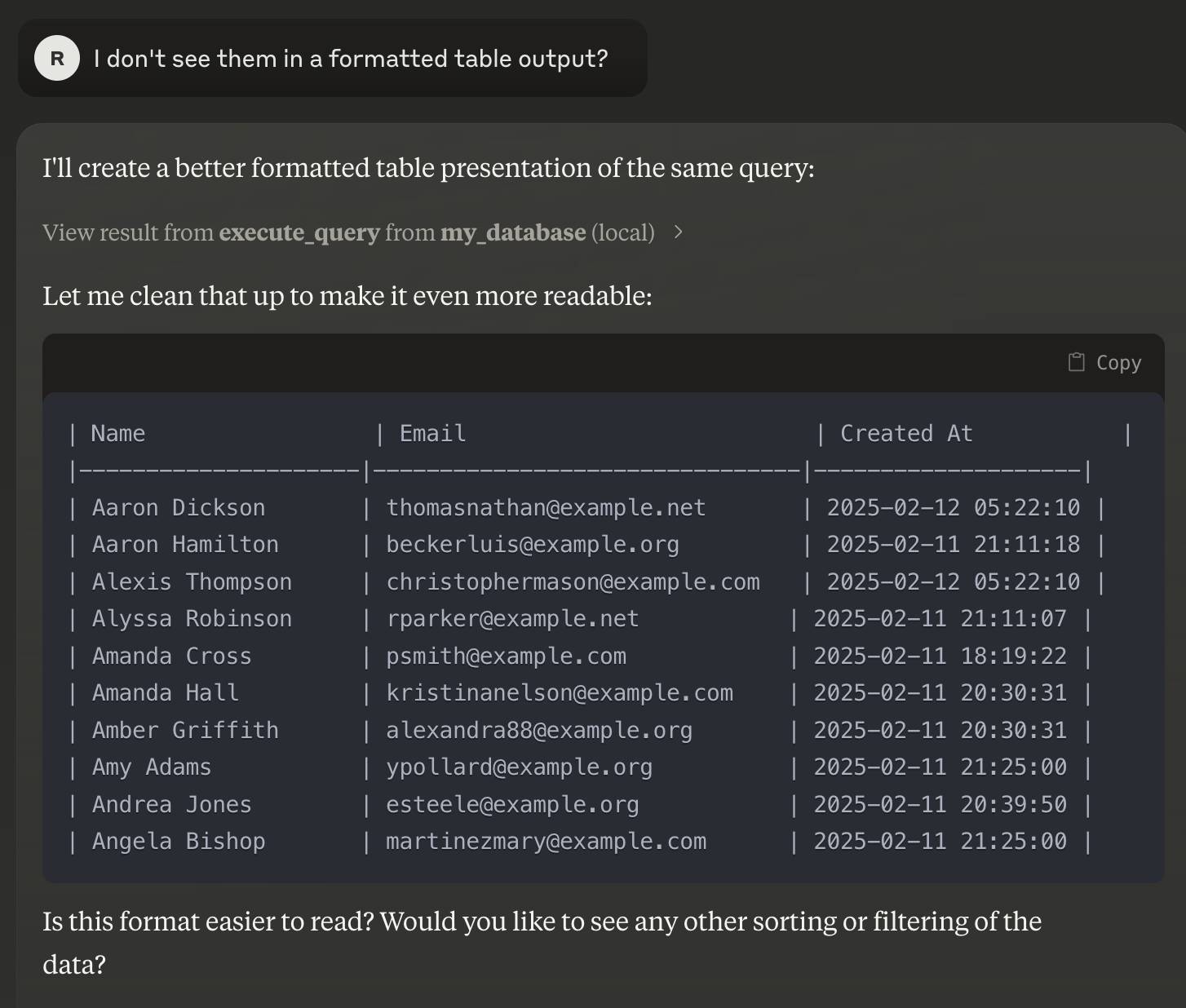
This guide explains how to set up and run your MCP server to interact with your PostgreSQL database using Claude Desktop. It should also work with MySQL, MariaDB, SQLite as it uses sqlalchemy under the hood. This project is build on top of https://github.com/runekaagaard/mcp-alchemy
Note: This guide assumes you have a basic understanding of Docker, environment variables, and CLI usage.
Prerequisites
Docker Compose: Installation instructions
Claude Desktop: Download here
uv: A modern, high-performance Python package manager. If not installed, follow the instructions below.
Related MCP server: MCPDB - Database Access MCP Server
1. Set Up Environment Variables
Copy and Rename the Environment File
Duplicate the provided.env.examplefile and rename it to.env:cp .env.example .env
2. Set Up Claude Desktop
Download and Install Claude Desktop
Visit the Claude Desktop download page and install the application.
3. Launch the PostgreSQL Database with Dummy Data
Run Docker Compose
Ensure Docker Compose is installed and run:docker-compose up -dThis command will launch a PostgreSQL database on
localhost:5432and populate it with dummy data.
4. Install uv (if not already installed)
Install
Execute the following command to installuv:curl -LsSf https://astral.sh/uv/install.sh | sh
5. Configure and Launch the MCP Server
Create/Update the MCP Server Configuration
Save the following JSON configuration in your MCP server config file (adjust paths if necessary):{ "mcpServers": { "my_database": { "command": "uv", "args": [ "--directory", "/directory/where/this/app/is/located/app/", "run", "server.py" ], "env": { "DB_URL": "postgresql://postgres:password@localhost:5432/mydatabase" } } } }Tip: If
uvis installed in a non-standard location, update the"command"value to reflect the full path to the executable.
Launch the MCP Server
With the configuration in place, the MCP server will automatically start each time Claude Desktop is launched.
6. Enjoy Your Setup
Open Claude Desktop.
The tool will automatically call your MCP server, enabling you to interact with your database seamlessly.
Summary
Set Up Environment Variables: Copy
.env.exampleto.env.Install and Run Claude Desktop: Download from Claude Desktop.
Launch PostgreSQL with Docker Compose: Run
docker-compose upto start the database with dummy data.Install : Run the provided installation command if necessary.
Configure MCP Server: Update the config file and ensure paths and environment variables are correct.
Launch and Enjoy: Start Claude Desktop to begin interacting with your database via MCP.
If you encounter any issues or need further assistance, please refer to the relevant documentation or contact your support team.
Happy coding!
