
F
licenseB
qualityD
maintenanceA Model Context Protocol server that enables users to kickoff and monitor deployed CrewAI workflows through Claude Desktop.
2
59
-

!注意:本项目会持续更新,集成新的平台。如果您没有看到应该可用的服务,或者 Claude 无法识别某个平台,请从新克隆的仓库运行
npm run build进行更新。最后更新:2025-04-26T20:08:00Z (UTC) - 添加了 Docker 状态集成
监控世界上使用最广泛的数字平台(GitHub、Slack、Discord 等)
获取特定服务的详细状态信息
检查每个平台内特定组件的状态
使用类似status --github命令进行简单的查询界面。
实时更新服务状态
Related MCP server: mcp-rss-aggregator
点击任意时间戳即可跳转到视频的相应部分
00:00 - LinkedIn平台状态评估
对领英的运营状况进行全面分析,包括对领英官网 (LinkedIn.com)、领英学习 (LinkedIn Learning)、营销活动管理器 (Campaign Manager)、销售导航 (Sales Navigator)、招聘系统 (Recruiter) 和人才解决方案等核心服务的详细检查。所有系统均已确认全面运行,且服务零中断。
00:20 - GitHub 基础设施状态概述
对 GitHub 服务可用性进行详细评估,涵盖 Git 操作、API 请求、操作、Webhook、问题、拉取请求、程序包、页面、代码空间和 Copilot 功能等关键组件。已确认所有 GitHub 服务的运行状态。
00:40 - Vercel 平台可靠性分析
深入考察 Vercel 的全球边缘网络和部署基础架构,并提供 API、仪表板、构建、无服务器功能、边缘功能和全球 CDN 位置等核心服务的全面状态报告。所有 Vercel 服务均已在所有区域验证正常运行。
01:08 - Cloudflare 网络状态检查
对 Cloudflare 全球基础设施状况进行广泛分析,详细说明跨地理区域和特定服务组件的服务可用性。发现多个区域(非洲、亚洲、欧洲、拉丁美洲、中东、北美)的性能下降,但核心服务仍在正常运行。包括对正在维护的区域数据中心的详细评估和技术影响分析。
01:46 -全球运营状况报告
综合概览所有主要技术平台和服务提供商的运营状况,重点介绍全面运营的服务(GitHub、Vercel、Netlify、Asana、Atlassian 等)以及性能下降的服务(Cloudflare、Twilio)。此外,还为依赖受影响服务的组织提供战略建议。
Node.js 16 或更高版本
克劳德桌面
互联网连接以访问状态 API
克隆或下载此存储库:
git clone https://github.com/imprvhub/mcp-status-observer
cd mcp-status-observer
安装依赖项:
npm install构建项目:
npm run build运行 MCP 服务器有两种方式:
打开终端或命令提示符
导航到项目目录
直接运行服务器:
node build/index.js使用 Claude Desktop 时,请保持此终端窗口打开。服务器将一直运行,直到您关闭终端。
Claude Desktop 可以在需要时自动启动 MCP 服务器。设置方法如下:
Claude Desktop 配置文件位于:
macOS : ~/Library/Application Support/Claude/claude_desktop_config.json
Windows : %APPDATA%\Claude\claude_desktop_config.json
Linux : ~/.config/Claude/claude_desktop_config.json
编辑此文件以添加 Status Observer MCP 配置。如果该文件不存在,请创建它:
{
  "mcpServers": {
    "statusObserver": {
      "command": "node",
      "args": ["ABSOLUTE_PATH_TO_DIRECTORY/mcp-status-observer/build/index.js"]
    }
  }
}重要提示:将ABSOLUTE_PATH_TO_DIRECTORY替换为您安装 MCP 的完整绝对路径
macOS/Linux 示例: /Users/username/mcp-status-observer
Windows 示例: C:\\Users\\username\\mcp-status-observer
如果您已配置其他 MCP,只需在“mcpServers”对象中添加“statusObserver”部分即可。以下是包含多个 MCP 的配置示例:
{
  "mcpServers": {
    "otherMcp1": {
      "command": "...",
      "args": ["..."]
    },
    "otherMcp2": {
      "command": "...",
      "args": ["..."]
    },
    "statusObserver": {
      "command": "node",
      "args": [
        "ABSOLUTE_PATH_TO_DIRECTORY/mcp-status-observer/build/index.js"
      ]
    }
  }
}根据claude_desktop_config.json文件中的配置,当 Claude Desktop 需要时,MCP 服务器将自动启动。
修改配置后重启Claude Desktop
在 Claude 中,使用status命令与 Status Observer MCP Server 进行交互
MCP 服务器作为 Claude Desktop 管理的子进程运行
Status Observer MCP 提供了一个名为status的工具,其中包含几个命令:
命令 | 描述 | 参数 | 例子 |
| 列出所有可用平台 | 没有任何 |
|
| 获取特定平台的状态 | 平台名称 |
|
| 获取所有平台的状态 | 没有任何 |
|
以下是如何使用 Claude 的状态观察器的各种示例:
status --all
status --amplitude
status --anthropic
status --asana
status --atlassian
status --cloudflare
status --digitalocean
status --discord
status --docker
status --dropbox
status --gcp
status --gemini
status --github
status --linkedin
status --netlify
status --npm
status --openai
status --reddit
status --slack
status --twilio
status --vercel
status --x
status list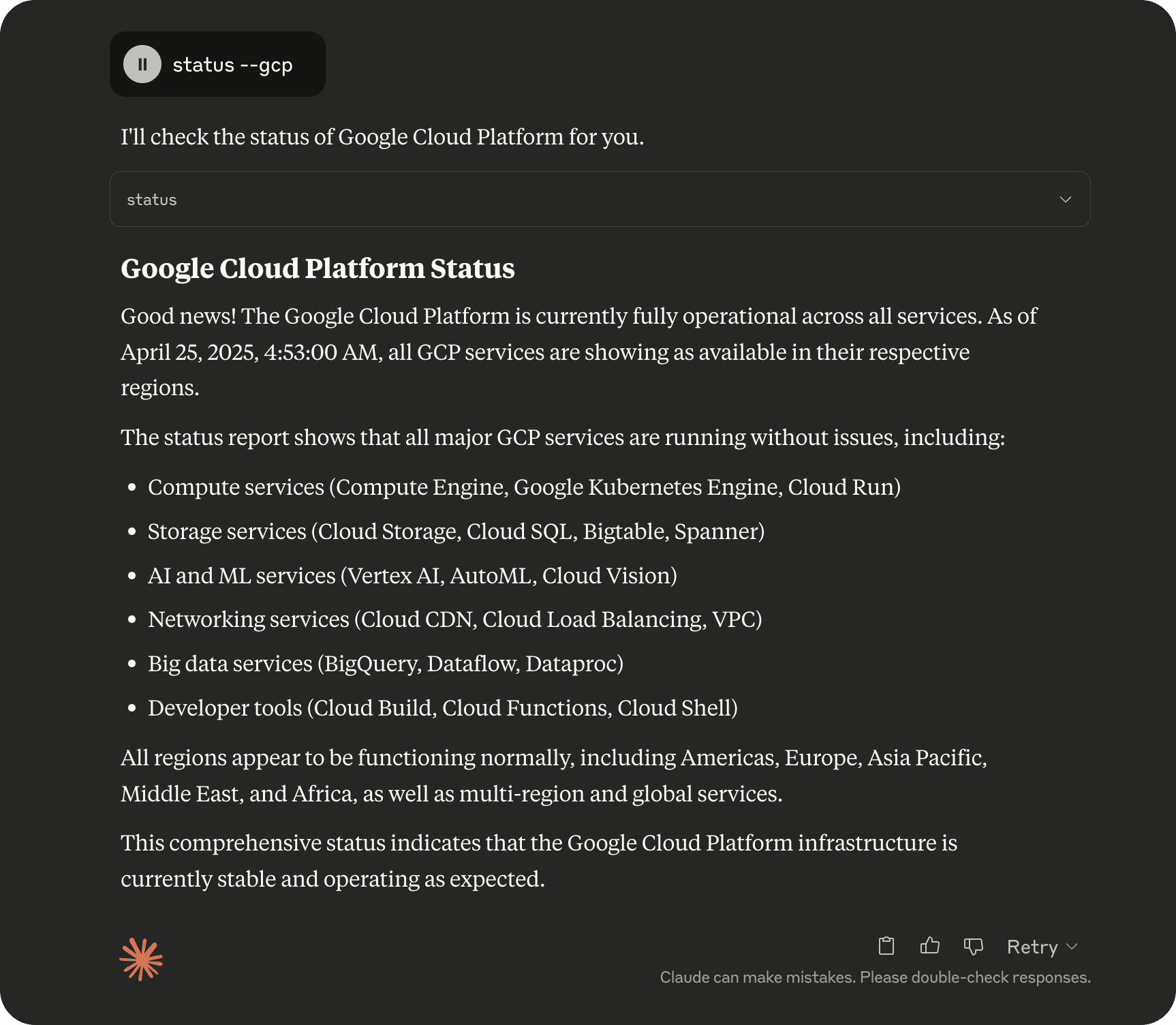
您还可以使用自然语言与 MCP 进行交互。Claude 会解析这些请求并使用相应的命令:
“您能检查一下 Google Cloud Platform 服务现在是否存在问题吗?”
“Claude 或 Anthropic API 最近有出现什么问题吗?”
“OpenAI 目前是否遇到任何中断?”
“LinkedIn 目前的状态如何?”
“Pull Request 被关闭了?GitHub 的状态怎么样?”
“您能告诉我谷歌的 Gemini AI 目前是否遇到任何服务中断或中断吗?”
检查 Docker Hub 自动构建是否遇到任何中断
“显示各大平台的状态”
如果您在 Claude Desktop 中看到错误“MCP Status Observer:服务器已断开连接”:
验证服务器正在运行:
打开终端并从项目目录手动运行node build/index.js
如果服务器启动成功,则使用 Claude 并保持此终端打开
检查您的配置:
确保claude_desktop_config.json中的绝对路径对于您的系统来说是正确的
仔细检查 Windows 路径是否使用了双反斜杠 ( \\ )
验证您使用的文件系统根目录的完整路径
如果状态观察器工具没有出现在 Claude 中:
确保配置后重新启动 Claude Desktop
检查 Claude Desktop 日志中是否存在任何 MCP 通信错误
确保 MCP 服务器进程正在运行(手动运行以确认)
验证 MCP 服务器是否已在 Claude Desktop MCP 注册表中正确注册
检查服务器是否正在运行:
Windows :打开任务管理器,转到“详细信息”选项卡,然后查找“node.exe”
macOS/Linux :打开终端并运行ps aux | grep node
如果您没有看到服务器运行,请手动启动它或使用自动启动方法。
贡献者可以通过修改src/index.ts中的initializePlatforms方法,轻松添加对其他平台的支持。流程非常简单:
识别平台的状态 API 端点
使用具有以下参数的addPlatform方法添加新条目:
id :平台的唯一标识符(小写,无空格)
name :平台的显示名称
url :状态 API 端点 URL
description :平台的简要描述
例子:
this.addPlatform('newservice', 'New Service', 'https://status.newservice.com/api/v2/summary.json', 'Description of the service');不同的状态 API 可能返回不同格式的数据。如果新平台的 API 返回的数据格式与现有代码无法处理,您可能需要为该平台添加特定的解析逻辑。
该项目根据 Mozilla 公共许可证 2.0 获得许可 - 有关详细信息,请参阅LICENSE文件。
Check the operational status of major digital platforms, read from each vendor's official status API. Covers AI providers (Anthropic, OpenAI, Gemini), clouds (GCP, Cloudflare, DigitalOcean, Vercel, Netlify, Supabase) and developer or workplace tools (GitHub, Docker, npm, Slack, Atlassian, Discord, Dropbox, Twilio, Asana, Reddit, LinkedIn, Amplitude).
| Name | Required | Description | Default |
|---|---|---|---|
| command | Yes | 'list' to see every supported platform, 'all' for a one-line summary of each, or a platform id such as 'github', 'anthropic' or 'gcp'. A leading '--' is accepted too (e.g. '--github'). |
Does the description disclose side effects, auth requirements, rate limits, or destructive behavior?
No annotations are provided, so the description carries the full burden. It discloses a meaningful behavioral trait — data is read from each vendor's official status API, implying live external reads rather than cached/local data — but says nothing about rate limits, authentication, latency, caching, or failure behavior when a vendor API is unreachable.
Agents need to know what a tool does to the world before calling it. Descriptions should go beyond structured annotations to explain consequences.
Is the description appropriately sized, front-loaded, and free of redundancy?
Two sentences, front-loaded with the purpose before the coverage list. The long provider enumeration is justified because no enums exist in the schema, though it is dense enough to slightly dilute the core statement.
Shorter descriptions cost fewer tokens and are easier for agents to parse. Every sentence should earn its place.
Given the tool's complexity, does the description cover enough for an agent to succeed on first attempt?
For a single-parameter read tool with no output schema, the description is nearly sufficient: purpose, data source, and valid platform values are all covered. The one gap is that it never hints at the shape of the returned status information (e.g., per-platform status codes), leaving the agent to discover it empirically.
Complex tools with many parameters or behaviors need more documentation. Simple tools need less. This dimension scales expectations accordingly.
Does the description clarify parameter syntax, constraints, interactions, or defaults beyond what the schema provides?
Schema coverage is 100% and already documents 'list', 'all', and platform ids, so the baseline is 3. The description adds value beyond the schema by enumerating the concrete platform identifiers (github, anthropic, gcp, etc.), which compensates for the absence of any enum constraint on the command parameter.
Input schemas describe structure but not intent. Descriptions should explain non-obvious parameter relationships and valid value ranges.
Does the description clearly state what the tool does and how it differs from similar tools?
States a specific verb ('Check') and resource ('operational status of major digital platforms') and clarifies the data source ('each vendor's official status API'). The enumeration of covered providers makes the scope unambiguous even though no sibling tools exist to differentiate from.
Agents choose between tools based on descriptions. A clear purpose with a specific verb and resource helps agents select the right tool.
Does the description explain when to use this tool, when not to, or what alternatives exist?
Implies its use case (checking platform status) but offers no explicit when-to-use/when-not guidance or prerequisites. With no sibling tools, there is little to route against, so the omission is less costly, but the description still never says under what circumstances an agent should reach for this tool.
Agents often have multiple tools that could apply. Explicit usage guidance like "use X instead of Y when Z" prevents misuse.
Recent tool additions, removals, and schema changes observed during successful MCP inspections.
v0.8.0status1 field changedInput schema / properties / command / descriptionPrevious value: -"Command to execute (list, --all, or platform with -- prefix like --github)"New value: +"'list' to see every supported platform, 'all' for a one-line summary of each, or a platform id such as 'github', 'anthropic' or 'gcp'. A leading '--' is accepted too (e.g. '--github')."v1.0.0statusScored across 1 tool
With only a single tool, there is no possibility of confusion or misselection between tools. The one tool's purpose is unambiguous.
The lone tool 'status' is a simple, readable noun name. There is no naming pattern to violate, though it does not follow a verb_noun convention.
A single tool for a status-checking service is thin but arguably sufficient since it is a read-only fetch. It covers many vendors under one operation, making the surface borderline minimal.
The tool covers a broad set of vendors' status APIs, fulfilling the core domain purpose. However, it lacks operations for filtering by vendor, incident history, or per-service detail, which are minor gaps.
Uptime, SSL, DNS and domain monitoring you can talk to from Claude or any MCP client.
Model Context Protocol server for Studex tools, notifications, and profile integrations
A Model Context Protocol server for Wix AI tools
A comprehensive Model Context Protocol (MCP) server that enables AI assistants to interact with yo…