Glama
angheljf

NYTimes Article Search MCP Server

by angheljf

纽约时报文章搜索 MCP 服务器

铁匠徽章

这是一个基于 TypeScript 的 MCP 服务器,允许根据关键字搜索过去 30 天的《纽约时报》文章。它通过以下方式演示了 MCP 的核心概念:

  • 文章搜索工具

  • 与纽约时报 API 集成

纽约时报文章搜索

特征

工具

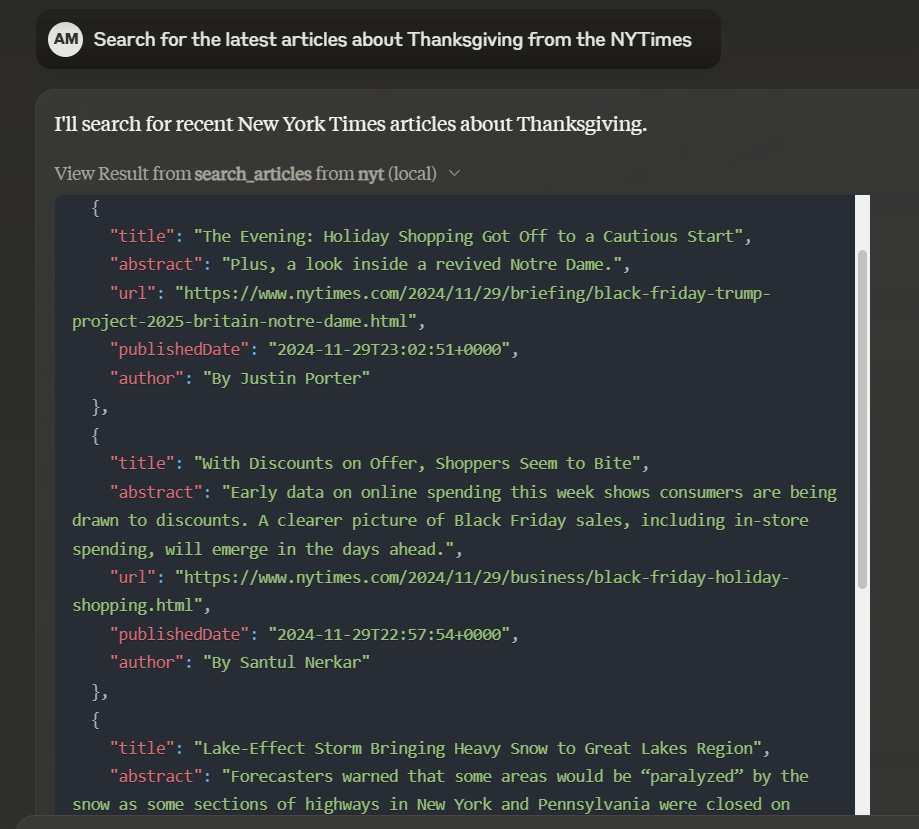
  • search_articles - 根据关键字搜索过去 30 天的《纽约时报》文章

    • keyword作为必需参数

    • 返回包含标题、摘要、URL、发布日期和作者的文章列表

Related MCP server: image-reader MCP Server

发展

安装依赖项:

npm install

构建服务器:

npm run build

对于使用自动重建的开发:

npm run watch

调试

由于 MCP 服务器通过 stdio 进行通信,调试起来可能比较困难。我们推荐使用MCP Inspector ,它以包脚本的形式提供:

npm run inspector

检查器将提供一个 URL 来访问浏览器中的调试工具。

安装

通过 Smithery 安装

要通过Smithery自动安装 NYTimes Article Search for Claude Desktop:

npx -y @smithery/cli install nyt --client claude

手动安装

要与 Claude Desktop 一起使用,请添加服务器配置:

在 MacOS 上: ~/Library/Application Support/Claude/claude_desktop_config.json在 Windows 上: %APPDATA%/Claude/claude_desktop_config.json

{
  "mcpServers": {
    "nyt": {
      "command": "node",
      "args": ["path/to/your/build/index.js"],
      "env": {
        "NYTIMES_API_KEY": "your_api_key_here"
      }
    }
  }
}

环境变量

在项目根目录中创建一个.env文件并添加您的纽约时报 API 密钥:

NYTIMES_API_KEY=your_api_key_here

运行服务器

构建项目后,您可以使用以下命令运行服务器:

node build/index.js

服务器将启动并通过 stdio 监听 MCP 请求。

执照

该项目已获得 MIT 许可。

Available Tools

1 tool
search_articlesC

Search NYTimes articles from the last 30 days based on a keyword

ParametersJSON Schema
NameRequiredDescriptionDefault
keywordYesKeyword to search for in articles

TDQS

C2.9/5.0
Behavior2/5

Does the description disclose side effects, auth requirements, rate limits, or destructive behavior?

No annotations are provided, so the description carries the full burden of behavioral disclosure. It mentions the 30-day time constraint, which is useful, but fails to describe critical behaviors such as response format, pagination, error handling, or any rate limits. For a search tool with zero annotation coverage, this leaves significant gaps.

Agents need to know what a tool does to the world before calling it. Descriptions should go beyond structured annotations to explain consequences.

Conciseness5/5

Is the description appropriately sized, front-loaded, and free of redundancy?

The description is a single, efficient sentence that front-loads the core functionality without unnecessary words. Every part ('Search NYTimes articles from the last 30 days based on a keyword') contributes directly to understanding the tool's purpose.

Shorter descriptions cost fewer tokens and are easier for agents to parse. Every sentence should earn its place.

Completeness2/5

Given the tool's complexity, does the description cover enough for an agent to succeed on first attempt?

Given the lack of annotations and output schema, the description is incomplete. It covers the basic purpose and time constraint but omits details on behavioral traits, response structure, and usage guidelines. For a search tool, this leaves the agent with insufficient context to use it effectively.

Complex tools with many parameters or behaviors need more documentation. Simple tools need less. This dimension scales expectations accordingly.

Parameters3/5

Does the description clarify parameter syntax, constraints, interactions, or defaults beyond what the schema provides?

Schema description coverage is 100%, with the parameter 'keyword' well-documented in the schema. The description adds minimal value by implying keyword-based filtering but doesn't provide additional semantics like search syntax or examples. Baseline 3 is appropriate when the schema handles parameter documentation effectively.

Input schemas describe structure but not intent. Descriptions should explain non-obvious parameter relationships and valid value ranges.

Purpose4/5

Does the description clearly state what the tool does and how it differs from similar tools?

The description clearly states the action ('Search NYTimes articles') and resource ('articles'), specifying the scope ('from the last 30 days') and filtering criteria ('based on a keyword'). It lacks sibling tool differentiation, but since there are no sibling tools, this doesn't reduce clarity.

Agents choose between tools based on descriptions. A clear purpose with a specific verb and resource helps agents select the right tool.

Usage Guidelines2/5

Does the description explain when to use this tool, when not to, or what alternatives exist?

The description provides basic context (searching recent articles by keyword) but offers no explicit guidance on when to use this tool versus alternatives, prerequisites, or exclusions. Without siblings, the need for differentiation is lower, but it still lacks usage context like rate limits or authentication needs.

Agents often have multiple tools that could apply. Explicit usage guidance like "use X instead of Y when Z" prevents misuse.

Tool Schema Changelog

Recent tool additions, removals, and schema changes observed during successful MCP inspections.

  1. 1 tool updatev1.0.0
    • First observedsearch_articles

TDQS

B3.1/5.0

Scored across 1 tool

Disambiguation5/5

With only one tool, there is no possibility of ambiguity or overlap between tools. The single tool 'search_articles' has a clearly defined and distinct purpose.

Naming Consistency5/5

The single tool name follows a clear verb_noun pattern ('search_articles'), and with only one tool, there is no inconsistency to evaluate. The naming is straightforward and appropriate.

Tool Count2/5

One tool is too few for a server with the apparent scope of 'NYTimes Article Search,' which suggests a domain that could benefit from additional operations like filtering by date, retrieving article details, or accessing different sections. A single search tool feels thin and limits functionality.

Completeness2/5

The tool surface is severely incomplete for the domain. While search is a core function, there are obvious gaps such as the inability to retrieve full article content, filter beyond keywords, or access other NYTimes data like sections or authors. This will likely cause agent failures when more comprehensive interactions are needed.

Maintenance

ActivityInactive
ResponsivenessNo issues

Related MCP Connectors

Related MCP Servers