Secure Remote MCP Servers using Azure API Management (Experimental)

Azure API Management acts as the AI Gateway for MCP servers.
This sample implements the latest MCP Authorization specification
This is a sequence diagram to understand the flow.
Deploy Remote MCP Server to Azure
Register Microsoft.App resource provider.
If you are using Azure CLI, run az provider register --namespace Microsoft.App --wait.
If you are using Azure PowerShell, run Register-AzResourceProvider -ProviderNamespace Microsoft.App. Then run (Get-AzResourceProvider -ProviderNamespace Microsoft.App).RegistrationState after some time to check if the registration is complete.
Run this azd command to provision the api management service, function app(with code) and all other required Azure resources
Test with MCP Inspector
In a new terminal window, install and run MCP Inspector
npx @modelcontextprotocol/inspector
CTRL click to load the MCP Inspector web app from the URL displayed by the app (e.g. http://127.0.0.1:6274/#resources)
Set the transport type to SSE
Set the URL to your running API Management SSE endpoint displayed after azd up and Connect:
https://<apim-servicename-from-azd-output>.azure-api.net/mcp/sse
List Tools. Click on a tool and Run Tool.
Related MCP server: Azure APIM + MCP Server Demo
Technical Architecture Overview
This solution deploys a secure MCP (Model Context Protocol) server infrastructure on Azure. The architecture implements a multi-layered security model with Azure API Management serving as an intelligent gateway that handles authentication, authorization, and request routing.
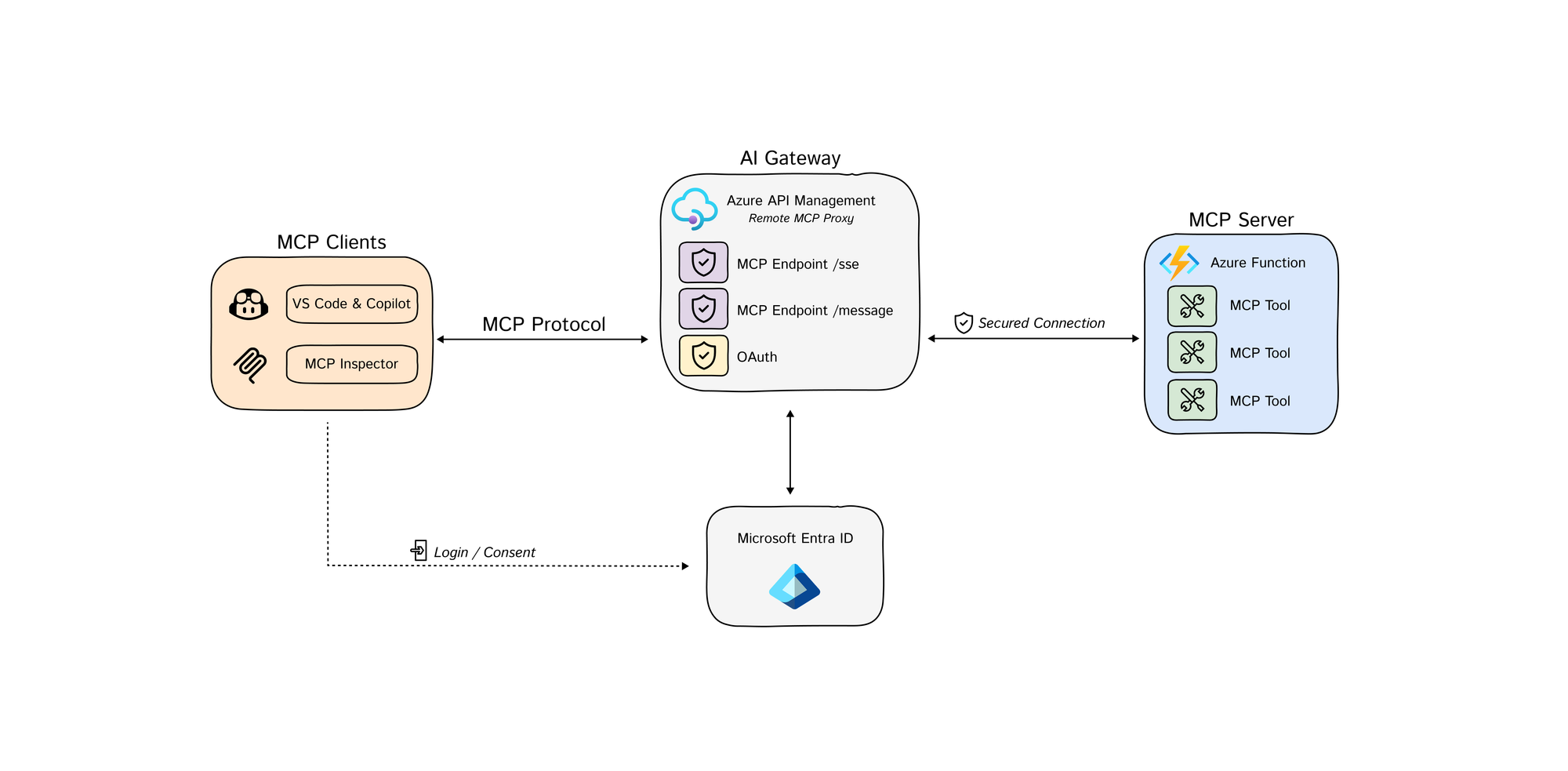
Deployed Azure Resources
The infrastructure provisions the following Azure resources:
Core Gateway Infrastructure
Backend Compute
Storage and Data
Security and Identity
Monitoring and Observability
Optional Network Security
Why These Resources?
Azure API Management serves as the security perimeter, implementing:
OAuth 2.0/PKCE authentication flows per MCP specification
Session key encryption/decryption for secure API access
Request validation and header injection
Rate limiting and throttling capabilities
Centralized policy management
Azure Functions provides:
Serverless, pay-per-use compute model
Native integration with Azure services
Automatic scaling based on demand
Built-in monitoring and diagnostics
Managed Identities eliminate the need for:
Service credentials management
Secret rotation processes
Credential exposure risks
Azure API Management Configuration Details
The APIM instance is configured with two primary APIs that work together to implement the MCP authorization specification:
OAuth API (/oauth/*)
This API implements the complete OAuth 2.0 authorization server functionality required by the MCP specification:
Endpoints and Operations
Authorization Endpoint (GET /authorize)
Consent Management (GET/POST /consent)
OAuth Metadata Endpoint (GET /.well-known/oauth-authorization-server)
Purpose: Publishes OAuth server configuration per RFC 8414
Returns: JSON metadata about supported endpoints, flows, and capabilities
Client Registration (POST /register)
Token Endpoint (POST /token)
Named Values and Configuration
The OAuth API uses several APIM Named Values for configuration:
McpClientId - The registered Entra ID application client ID
EntraIDFicClientId - Service identity client ID for token exchange
APIMGatewayURL - Base URL for callback and metadata endpoints
OAuthScopes - Requested OAuth scopes (openid + Microsoft Graph)
EncryptionKey / EncryptionIV - For session key encryption
MCP API (/mcp/*)
This API provides the actual MCP protocol endpoints with security enforcement:
Endpoints and Operations
Server-Sent Events Endpoint (GET /sse)
Message Endpoint (POST /message)
Security Policy Implementation
The MCP API applies a comprehensive security policy to all operations:
Authorization Header Validation
<check-header name="Authorization" failed-check-httpcode="401"
              failed-check-error-message="Not authorized" ignore-case="false" />
Session Key Decryption
Extracts encrypted session key from Authorization header
Decrypts using AES with stored key and IV
Validates token format and structure
Token Cache Lookup
<cache-lookup-value key="@($"EntraToken-{context.Variables.GetValueOrDefault("decryptedSessionKey")}")"
                    variable-name="accessToken" />
Access Token Validation
Backend Authentication
<set-header name="x-functions-key" exists-action="override">
    <value>{{function-host-key}}</value>
</set-header>
Security Model
The solution implements a sophisticated multi-layer security model:
Layer 1: OAuth 2.0/PKCE Authentication
MCP clients must complete full OAuth flow with Entra ID
PKCE prevents authorization code interception attacks
User consent management with persistent preferences
Layer 2: Session Key Encryption
Access tokens are never exposed to MCP clients
Encrypted session keys provide time-bounded access
AES encryption with secure key management in APIM
Layer 3: Function-Level Security
Function host keys protect direct access to Azure Functions
Managed identity ensures secure service-to-service communication
Network isolation available via VNet integration
Layer 4: Azure Platform Security
All traffic encrypted in transit (TLS)
Storage access via managed identities
Audit logging through Application Insights
This layered approach ensures that even if one security boundary is compromised, multiple additional protections remain in place.