
AlibabaCloud DevOps MCP Server
Provides comprehensive integration with Alibaba Cloud's Yunxiao DevOps platform, enabling code repository management, work item tracking, pipeline automation, package management, and application delivery capabilities for enterprise development teams.
Click on "Deploy Server".
Wait a few minutes for the server to deploy. Once ready, it will show a "Started" state.
In the chat, type
@followed by the MCP server name and your instructions, e.g., "@AlibabaCloud DevOps MCP Servershow me the latest pipeline runs for project 'mobile-app'"
That's it! The server will respond to your query, and you can continue using it as needed.
Here is a step-by-step guide with screenshots.
alibabacloud-devops-mcp-server
AlibabaCloud Devops MCP Server provides AI assistants with the ability to interact with the Yunxiao platform, enabling them to read work item contents in projects, automatically write code after understanding requirements, and submit code merge requests. Enterprise development teams can use it to assist with code reviews, optimize task management, reduce repetitive operations, and thus focus on more important innovation and product delivery.
Features
alibabacloud-devops-mcp-server provides the following capabilities for AI assistants:
Code Repository Management: Query code repositories and their branches, create branches
File Operations: Create, update, delete, and retrieve code file content
Code Review: Create and manage code review processes
Project Management: Search projects, get project details
Pipeline Management: Get pipeline details, get pipeline list, create a pipeline run instance, get the latest pipeline run instance, get pipeline run details, get pipeline run list, Query / Run a pipeline deployment task
Package Management: Get package repository details list, Get artifacts details list, Get single artifact details
Application Delivery: Create and manage deployment orders, applications, orchestrations, variable groups, templates, tags, global variables, and deployment resources
Tools
alibabacloud-devops-mcp-server integrates various tools, including:
Organization Management
get_current_organization_Info: Get current user's organization informationget_user_organizations: Get the list of organizations the current user has joinedget_organization_role: Get information about an organization roleget_organization_departments: Get the list of departments in an organizationget_organization_department_info: Get information about a department in an organizationget_organization_department_ancestors: Get the ancestors of a department in an organizationget_organization_members: Get the list of members in an organizationget_organization_member_info: Get information about a member in an organizationget_organization_member_info_by_user_id: Get information about a member in an organization by user IDsearch_organization_members: Search for organization memberslist_organization_roles: List organization rolesget_organization_role: Get information about an organization role
Code Management Tools
create_branch: Create a branchdelete_branch: Delete a branchget_branch: Get branch informationlist_branches: Get branch listcreate_file: Create a filedelete_file: Delete a fileget_file_blobs: Get file contentlist_files: Query file treeupdate_file: Update file contentcreate_change_request: Create a merge requestcreate_change_request_comment: Create a comment on a merge requestget_change_request: Query merge requestlist_change_request_patch_sets: Query merge request version listlist_change_request: Query merge request listlist_change_request_comments: Query merge request comment listget_compare: Compare codeget_repository: Get repository detailslist_repositories: Get repository list
Project Management Tools
get_project: Get project detailssearch_projects: Search projectsget_sprint: Get sprint detailslist_sprints: List sprints in a projectget_work_item: Get work item detailssearch_workitems: Search work itemsget_work_item_types: get work item typescreate_work_item: create work itemlist_all_work_item_types: List all work item types in an organizationlist_work_item_types: List work item types in a project spaceget_work_item_type: Get details of a specific work item typelist_work_item_relation_work_item_types: List work item types that can be related to a specific work itemget_work_item_type_field_config: Get field configuration for a specific work item typeget_work_item_workflow: Get workflow information for a specific work item typelist_work_item_comments: List comments for a specific work itemcreate_work_item_comment: Create a comment for a specific work itemlist_current_user_effort_records: [Project Management] 获取用户的实际工时明细,结束时间和开始时间的间隔不能大于6个月list_effort_records: [Project Management] 获取实际工时明细create_effort_record: [Project Management] 登记实际工时list_estimated_efforts: [Project Management] 获取预计工时明细create_estimated_effort: [Project Management] 登记预计工时update_effort_record: [Project Management] 更新登记实际工时update_estimated_effort: [Project Management] 更新登记预计工时
Pipeline Management Tools
get_pipeline: Get pipeline detailslist_pipelines: Get pipeline listsmart_list_pipelines: Smart pipeline search with natural language time referencescreate_pipeline_run: Create a pipeline run instanceget_latest_pipeline_run: Get the latest pipeline run instanceget_pipeline_run: Get pipeline run detailslist_pipeline_runs: Get pipeline run listlist_pipeline_jobs_by_category: Get pipeline execution tasks by categorylist_pipeline_job_historys: Get the execution history of a pipeline taskexecute_pipeline_job_run: Manually run a pipeline taskget_pipeline_job_run_log: Get the execution logs of a pipeline joblist_service_connections: List service connections in organizationcreate_pipeline_from_description: Automatically generates YAML configuration and creates pipelineupdate_pipeline: Update an existing pipeline in Yunxiao by pipelineId. Use this to update pipeline YAML, stages, jobs, etc.
Resource Member Management Tools
create_resource_member: Create a resource memberdelete_resource_member: Delete a resource memberlist_resource_members: Get a list of resource membersupdate_resource_member: Update a resource memberupdate_resource_owner: Transfer resource owner
Tag Management Tools
create_tag: Create a tagcreate_tag_group: Create a tag grouplist_tag_groups: Get a list of tag groupsdelete_tag_group: Delete a tag groupupdate_tag_group: Update a tag groupget_tag_group: Get a tag groupdelete_tag: Delete a tagupdate_tag: Update a tag
VM Deploy Order Management Tools
stop_vm_deploy_order: Stop VM deploy orderskip_vm_deploy_machine: Skip VM deploy machineretry_vm_deploy_machine: Retry VM deploy machineresume_vm_deploy_order: Resume VM deploy orderget_vm_deploy_order: Get VM deploy order detailsget_vm_deploy_machine_log: Get VM deploy machine log
Packages Management Tools
list_package_repositories: Get package repositories details listlist_artifacts: Get artifacts details listget_artifact: Get single artifact details
Application Delivery Tools
create_change_order: [application delivery] 创建部署单list_change_order_versions: [application delivery] 查看部署单版本列表get_change_order: [application delivery] 读取部署单使用的物料和工单状态list_change_order_job_logs: [application delivery] 查询环境部署单日志find_task_operation_log: [application delivery] 查询部署任务执行日志,其中通常包含下游部署引擎的调度细节信息execute_job_action: [application delivery] 操作环境部署单list_change_orders_by_origin: [application delivery] 根据创建来源查询部署单list_applications: [application delivery] List applications in an organization with paginationget_application: [application delivery] Get application details by namecreate_application: [application delivery] Create a new applicationupdate_application: [application delivery] Update an existing applicationget_latest_orchestration: [application delivery] Get the latest orchestration for an environmentlist_app_orchestration: [application delivery] List application orchestrationscreate_app_orchestration: [application delivery] Create an application orchestrationdelete_app_orchestration: [application delivery] Delete an application orchestrationget_app_orchestration: [application delivery] Get an application orchestrationupdate_app_orchestration: [application delivery] Update an application orchestrationget_env_variable_groups: [application delivery] Get variable groups for an environmentcreate_variable_group: [application delivery] Create a variable groupdelete_variable_group: [application delivery] Delete a variable groupget_variable_group: [application delivery] Get a variable groupupdate_variable_group: [application delivery] Update a variable groupget_app_variable_groups: [application delivery] Get variable groups for an applicationget_app_variable_groups_revision: [application delivery] Get the revision of variable groups for an applicationsearch_app_templates: [application delivery] Search application templatescreate_app_tag: [application delivery] Create an application tagupdate_app_tag: [application delivery] Update an application tagsearch_app_tags: [application delivery] Search application tagsupdate_app_tag_bind: [application delivery] Update application tag bindingscreate_global_var: [application delivery] Create a global variable groupget_global_var: [application delivery] Get a global variable groupupdate_global_var: [application delivery] Update a global variable grouplist_global_vars: [application delivery] List global variable groupsget_machine_deploy_log: [application delivery] Get machine deployment logadd_host_list_to_host_group: [application delivery] Add host list to host groupadd_host_list_to_deploy_group: [application delivery] Add host list to deploy group
Usage
Prerequisites
node version >= 18.0.0
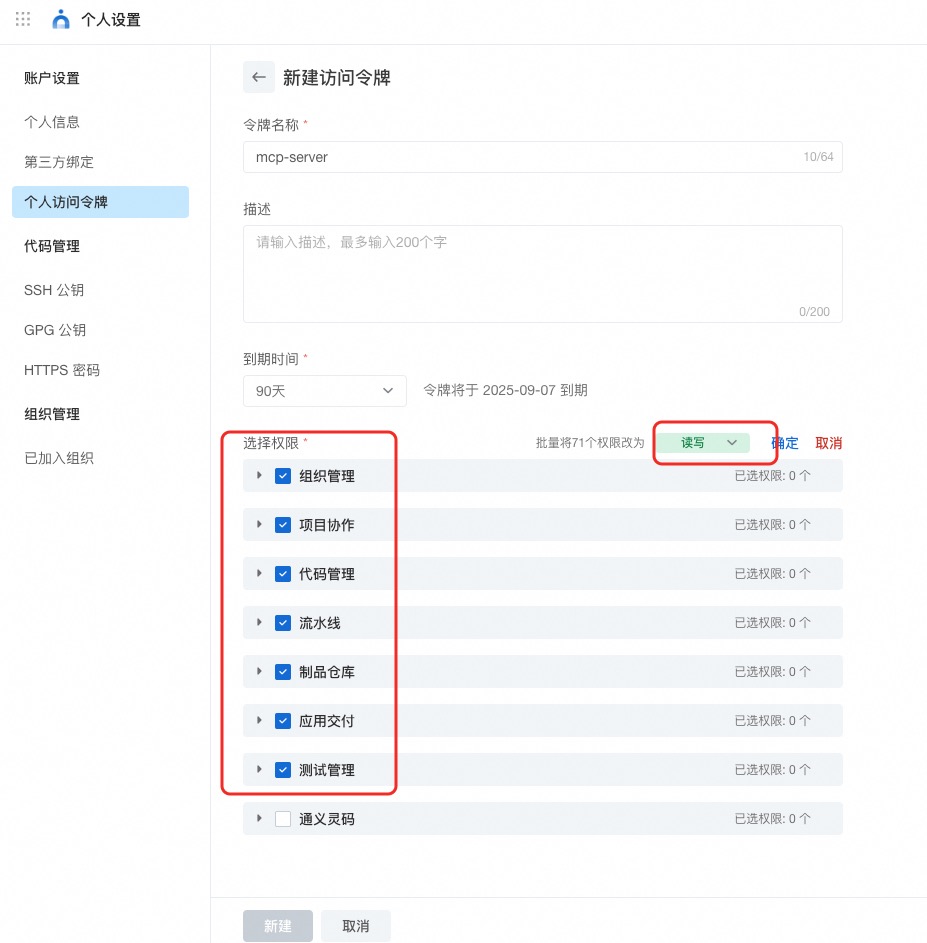
AlibabaCloud Devops Personal Access Token, click here to obtain. Grant read and write permissions to all APIs under organization management, project collaboration, code management, pipeline management, artifact repository management, application delivery and testing management.
Installing via Smithery
To install AlibabaCloud DevOps Server for Claude Desktop automatically via Smithery:
npx -y @smithery/cli install @aliyun/alibabacloud-devops-mcp-server --client claudeInstall Yunxiao MCP server via MCP marketplace
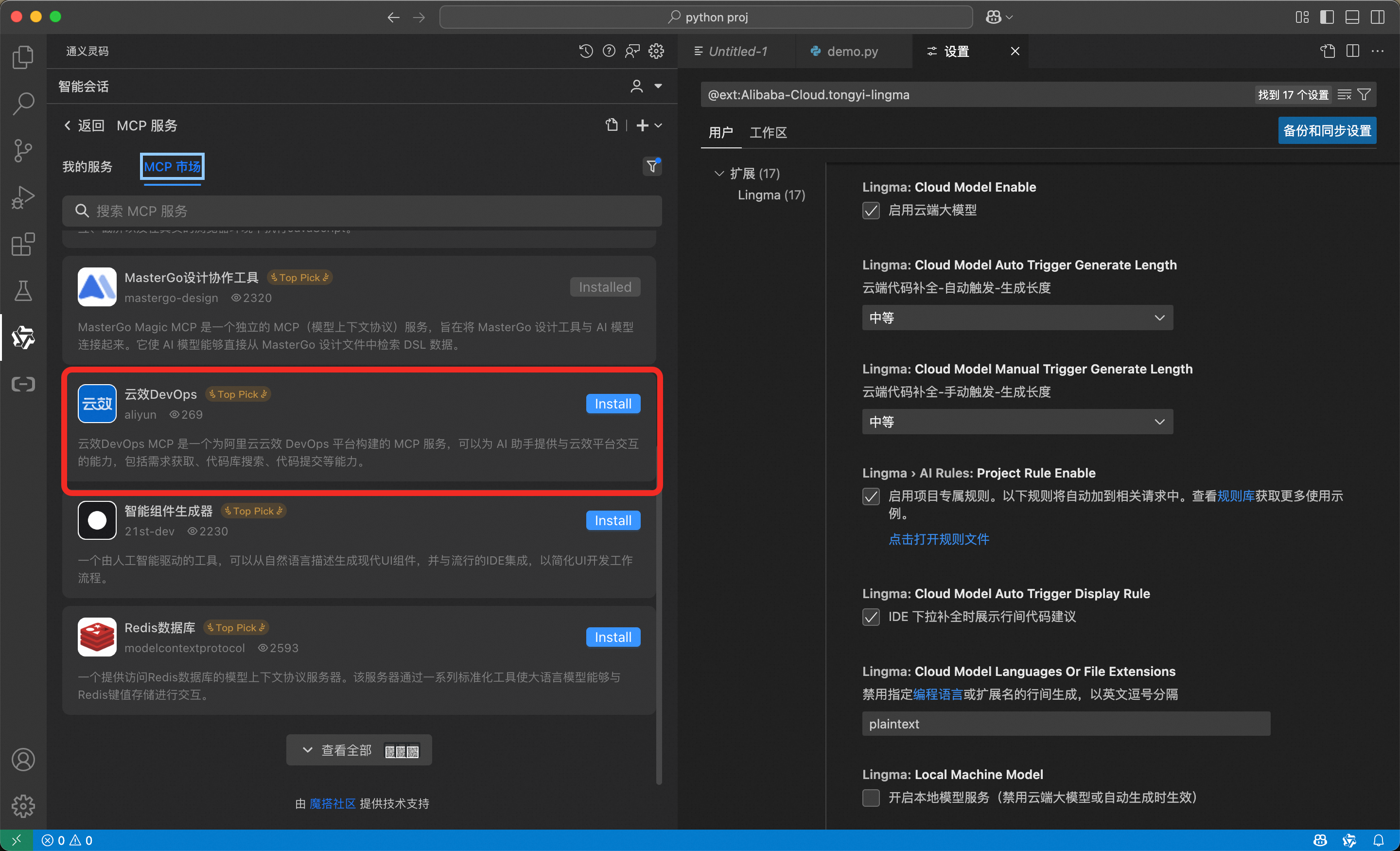
The MCP market built into Lingma (AlibabaCloud Tongyi Lingma) has already provided the AlibabaCloud Devops MCP service. To install it, simply enter the MCP market in Lingma and search for "Yunxiao DevOps", then click install.
Run MCP Server via NPX/Cursor/Claude code etc.
{
  "mcpServers": {
    "yunxiao": {
      "command": "npx",
      "args": [
        "-y",
        "alibabacloud-devops-mcp-server"
      ],
      "env": {
        "YUNXIAO_ACCESS_TOKEN": "<YOUR_TOKEN>"
      }
    }
  }
}
Run MCP Server via Docker Container
Option 1: Use Official Image (Recommended)
You can use the official Docker image without building it yourself:
# Pull the official image
docker pull build-steps-public-registry.cn-beijing.cr.aliyuncs.com/build-steps/alibabacloud-devops-mcp-server:v0.2.0
Then use the official image name in your docker run commands instead of alibabacloud/alibabacloud-devops-mcp-server.
Option 2: Build Your Own Image
If you prefer to build the image yourself:
docker build -t alibabacloud/alibabacloud-devops-mcp-server .2. Run the Container
The MCP server supports three modes: stdio mode (default), SSE mode, and HTTP mode (Streamable HTTP).
Stdio Mode (for MCP clients)
Run the container directly (using official image):
docker run -i --rm \
  -e YUNXIAO_ACCESS_TOKEN="your_token_here" \
  build-steps-public-registry.cn-beijing.cr.aliyuncs.com/build-steps/alibabacloud-devops-mcp-server:v0.2.0
Or use an environment file:
# Create .env file with: YUNXIAO_ACCESS_TOKEN=your_token_here
docker run -i --rm \
  --env-file .env \
build-steps-public-registry.cn-beijing.cr.aliyuncs.com/build-steps/alibabacloud-devops-mcp-server:v0.2.0Note: If you built your own image, replace the image name with
alibabacloud/alibabacloud-devops-mcp-server.
SSE Mode (for HTTP access)
Run the container in background (using official image):
docker run -d --name yunxiao-mcp \
  -p 3000:3000 \
  -e YUNXIAO_ACCESS_TOKEN="your_token_here" \
  -e PORT=3000 \
  -e MCP_TRANSPORT=sse \
  build-steps-public-registry.cn-beijing.cr.aliyuncs.com/build-steps/alibabacloud-devops-mcp-server:v0.2.0 \
node dist/index.js --sseNote: If you built your own image, replace the image name with
alibabacloud/alibabacloud-devops-mcp-server.
The server will be available at:
SSE endpoint:
http://localhost:3000/sseMessages endpoint:
http://localhost:3000/messages?sessionId=<session-id>
HTTP Mode (Streamable HTTP for smithery.ai)
Run the container in background (using official image):
docker run -d --name yunxiao-mcp \
  -p 3000:3000 \
  -e YUNXIAO_ACCESS_TOKEN="your_token_here" \
  -e PORT=3000 \
  -e MCP_TRANSPORT=http \
  build-steps-public-registry.cn-beijing.cr.aliyuncs.com/build-steps/alibabacloud-devops-mcp-server:v0.2.0 \
  node dist/index.js --http
Or use npm script:
npm run start:httpNote: If you built your own image, replace the image name with
alibabacloud/alibabacloud-devops-mcp-server.
The server will be available at:
MCP endpoint:
http://localhost:3000/mcp
This mode is compatible with smithery.ai platform deployment requirements.
View logs:
docker logs -f yunxiao-mcpStop the container:
docker stop yunxiao-mcp3. Configure MCP Client (for stdio mode)
If you're using a MCP client (like Claude Desktop, Cursor, etc.), configure it to use Docker:
{
  "mcpServers": {
    "yunxiao": {
      "command": "docker",
      "args": [
        "run",
        "-i",
        "--rm",
        "-e",
        "YUNXIAO_ACCESS_TOKEN",
        "build-steps-public-registry.cn-beijing.cr.aliyuncs.com/build-steps/alibabacloud-devops-mcp-server:v0.2.0"
      ],
      "env": {
        "YUNXIAO_ACCESS_TOKEN": "<YOUR_TOKEN>"
      }
    }
  }
}Note: If you built your own image, replace the image name with
alibabacloud/alibabacloud-devops-mcp-server.
Run MCP Server via Docker Compose
Environment Setup
cd alibabacloud-devops-mcp-server
cp .env.example
Running the Services:
docker compose up -dConfigure MCP Server
{
  "mcpServers": {
    "yunxiao": {
      "url":"http://localhost:3000/sse"
    }
  }
}
HTTP/SSE Mode with Custom Tokens
When running in HTTP or SSE mode, each user can use their own token by passing it as a query parameter or request header:
Via query parameter:
# For SSE mode
http://localhost:3000/sse?yunxiao_access_token=USER_SPECIFIC_TOKEN

# For HTTP mode
http://localhost:3000/mcp?yunxiao_access_token=USER_SPECIFIC_TOKEN
Via request header:
x-yunxiao-token: USER_SPECIFIC_TOKENThis allows multiple users to share the same service while using their own individual tokens for authentication.
Toolsets
The server now supports toolsets, allowing you to enable only the tools you need. This can reduce the number of tools presented to the AI assistant and improve performance.
Available toolsets:
base: Base tools that are always loaded (get_current_user, get_current_organization_info, get_user_organizations)code-management: Code repository management tools (includes commit management tools)organization-management: Organization management tools (excluding base tools)project-management: Project management tools (includes effort management tools)pipeline-management: Pipeline management tools (includes service connections, resource member, and VM deploy order tools)packages-management: Package repository management toolsapplication-delivery: Application delivery tools
To use toolsets, you can specify them via command line arguments or environment variables:
Via command line argument:
npx -y alibabacloud-devops-mcp-server --toolsets=code-management,project-managementVia environment variable:
DEVOPS_TOOLSETS=code-management,project-management npx -y alibabacloud-devops-mcp-serverIf no toolsets are specified, all tools will be enabled by default.
Contact Us
Contact Us
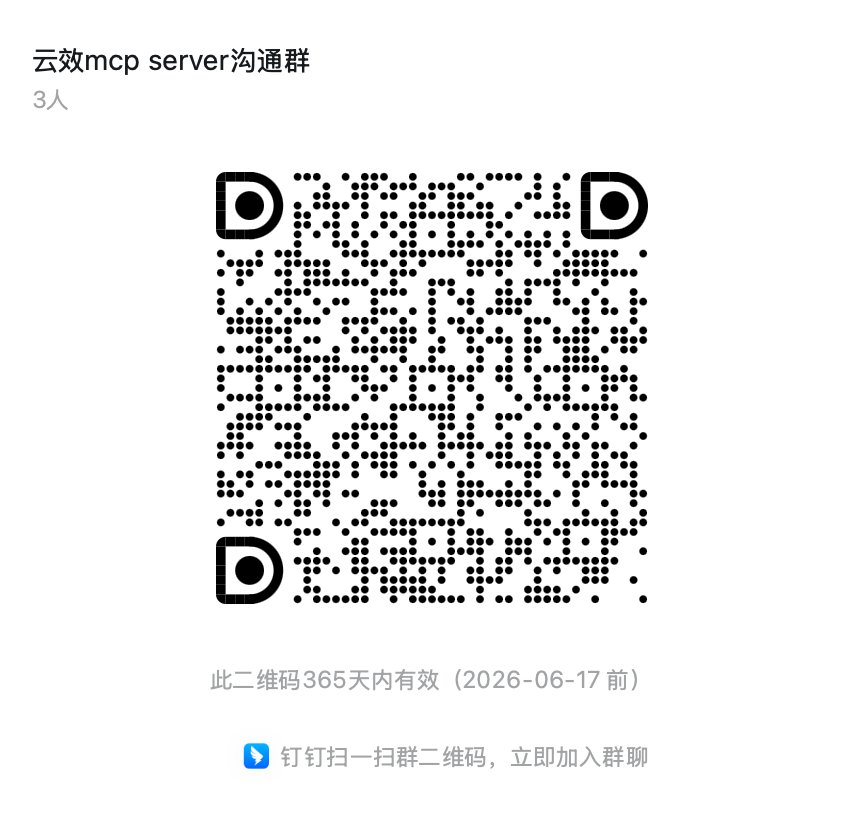
If you have any questions, please join the Alibaba Cloud Devops discussion group (134400004101) for discussion.
Related Links
Available Tools
130 toolsadd_host_list_to_deploy_groupC
[application delivery] Add host list to deploy group
| Name | Required | Description | Default |
|---|---|---|---|
| organizationId | Yes | 组织ID | |
| instanceName | Yes | 主机集群名称(非主机集群显示名) | |
| groupName | Yes | 部署组名称(非部署组显示名) | |
| hostSns | Yes | ecs主机实例id列表(主机类型暂只支持ecs) |
TDQS
Does the description disclose side effects, auth requirements, rate limits, or destructive behavior?
With no annotations provided, the description carries the full burden of behavioral disclosure but offers minimal insight. It mentions '[application delivery]' as context but doesn't explain whether this is a mutating operation, its side effects (e.g., if it triggers deployments), permission requirements, or error handling. This leaves critical behavioral traits unspecified.
Agents need to know what a tool does to the world before calling it. Descriptions should go beyond structured annotations to explain consequences.
Is the description appropriately sized, front-loaded, and free of redundancy?
The description is brief and front-loaded with the core action, consisting of a single phrase. However, it lacks structure (e.g., no separation of purpose from context) and could be more informative without sacrificing conciseness, as it currently under-specifies key details.
Shorter descriptions cost fewer tokens and are easier for agents to parse. Every sentence should earn its place.
Given the tool's complexity, does the description cover enough for an agent to succeed on first attempt?
Given the complexity of a mutating operation (adding hosts to a deploy group) with no annotations and no output schema, the description is incomplete. It fails to address behavioral aspects like mutation effects, return values, or error conditions, leaving significant gaps for an AI agent to understand the tool's full context.
Complex tools with many parameters or behaviors need more documentation. Simple tools need less. This dimension scales expectations accordingly.
Does the description clarify parameter syntax, constraints, interactions, or defaults beyond what the schema provides?
The schema description coverage is 100%, with clear parameter descriptions in Chinese (e.g., '组织ID' for organizationId). The tool description adds no additional parameter semantics beyond what's in the schema, so it meets the baseline score of 3 for adequate but not enhanced coverage.
Input schemas describe structure but not intent. Descriptions should explain non-obvious parameter relationships and valid value ranges.
Does the description clearly state what the tool does and how it differs from similar tools?
The description states the action ('Add host list') and target ('to deploy group'), which clarifies the basic purpose. However, it's vague about what 'add' entails (e.g., appending vs. replacing) and doesn't distinguish it from the sibling tool 'add_host_list_to_host_group', leaving ambiguity about when to use one over the other.
Agents choose between tools based on descriptions. A clear purpose with a specific verb and resource helps agents select the right tool.
Does the description explain when to use this tool, when not to, or what alternatives exist?
No guidance is provided on when to use this tool versus alternatives like 'add_host_list_to_host_group' or other deployment-related tools. The description lacks context about prerequisites, dependencies, or typical scenarios for adding hosts to a deploy group.
Agents often have multiple tools that could apply. Explicit usage guidance like "use X instead of Y when Z" prevents misuse.
add_host_list_to_host_groupC
[application delivery] Add host list to host group
| Name | Required | Description | Default |
|---|---|---|---|
| organizationId | Yes | 组织ID | |
| instanceName | Yes | 主机集群名称(非主机集群显示名) | |
| hostSns | Yes | ecs主机实例id列表(主机类型暂只支持ecs) |
TDQS
Does the description disclose side effects, auth requirements, rate limits, or destructive behavior?
With no annotations provided, the description carries the full burden of behavioral disclosure. It states 'Add' which implies a write/mutation operation, but provides no information about permissions required, whether the operation is idempotent, what happens if hosts already exist in the group, error conditions, or what the response looks like. For a mutation tool with zero annotation coverage, this is insufficient.
Agents need to know what a tool does to the world before calling it. Descriptions should go beyond structured annotations to explain consequences.
Is the description appropriately sized, front-loaded, and free of redundancy?
The description is extremely concise at just 6 words. It's front-loaded with the core action and resource. However, the bracketed '[application delivery]' adds minimal value and could be considered wasted space that could have been used for more useful information.
Shorter descriptions cost fewer tokens and are easier for agents to parse. Every sentence should earn its place.
Given the tool's complexity, does the description cover enough for an agent to succeed on first attempt?
For a mutation tool with 3 required parameters, no annotations, and no output schema, the description is inadequate. It doesn't explain what happens after the operation, what success/failure looks like, or any side effects. The description should provide more context about the operation's behavior and outcomes given the lack of structured metadata.
Complex tools with many parameters or behaviors need more documentation. Simple tools need less. This dimension scales expectations accordingly.
Does the description clarify parameter syntax, constraints, interactions, or defaults beyond what the schema provides?
The schema description coverage is 100%, so the schema already documents all three parameters thoroughly. The description adds no additional parameter information beyond what's in the schema. According to the scoring rules, when schema coverage is high (>80%), the baseline is 3 even with no param info in the description.
Input schemas describe structure but not intent. Descriptions should explain non-obvious parameter relationships and valid value ranges.
Does the description clearly state what the tool does and how it differs from similar tools?
The description clearly states the action ('Add host list') and target resource ('to host group'), making the purpose immediately understandable. It distinguishes from the sibling 'add_host_list_to_deploy_group' by specifying 'host group' rather than 'deploy group'. However, it doesn't fully differentiate beyond the resource name difference.
Agents choose between tools based on descriptions. A clear purpose with a specific verb and resource helps agents select the right tool.
Does the description explain when to use this tool, when not to, or what alternatives exist?
The description provides no guidance on when to use this tool versus alternatives. It doesn't mention prerequisites, constraints, or when to choose this over similar tools like 'add_host_list_to_deploy_group'. The only contextual hint is the bracketed '[application delivery]' which is too vague to be actionable.
Agents often have multiple tools that could apply. Explicit usage guidance like "use X instead of Y when Z" prevents misuse.
cancel_change_requestC
[application delivery] Cancel a change request
| Name | Required | Description | Default |
|---|---|---|---|
| organizationId | Yes | 组织ID | |
| appName | Yes | 应用名 | |
| sn | Yes | 变更标识符 |
TDQS
Does the description disclose side effects, auth requirements, rate limits, or destructive behavior?
With no annotations provided, the description carries the full burden of behavioral disclosure. It states the tool cancels a change request, implying a destructive mutation, but doesn't specify if this is reversible, requires permissions, affects related resources, or has side effects. This leaves significant gaps in understanding the tool's behavior.
Agents need to know what a tool does to the world before calling it. Descriptions should go beyond structured annotations to explain consequences.
Is the description appropriately sized, front-loaded, and free of redundancy?
The description is extremely concise with a single phrase, 'Cancel a change request', and includes a bracketed context '[application delivery]' that efficiently sets the domain. There is no wasted verbiage, making it front-loaded and easy to parse, though this brevity contributes to gaps in other dimensions.
Shorter descriptions cost fewer tokens and are easier for agents to parse. Every sentence should earn its place.
Given the tool's complexity, does the description cover enough for an agent to succeed on first attempt?
Given the tool's complexity as a destructive operation with no annotations and no output schema, the description is incomplete. It fails to explain the outcome of cancellation, error conditions, or how it interacts with sibling tools like 'close_change_request'. For a mutation tool in a rich context, more detail is needed to guide effective use.
Complex tools with many parameters or behaviors need more documentation. Simple tools need less. This dimension scales expectations accordingly.
Does the description clarify parameter syntax, constraints, interactions, or defaults beyond what the schema provides?
The input schema has 100% description coverage, with parameters 'organizationId', 'appName', and 'sn' documented in Chinese. The description adds no additional semantic context about these parameters, such as format examples or relationships. Since schema coverage is high, the baseline score of 3 is appropriate, as the description doesn't compensate but doesn't detract either.
Input schemas describe structure but not intent. Descriptions should explain non-obvious parameter relationships and valid value ranges.
Does the description clearly state what the tool does and how it differs from similar tools?
The description 'Cancel a change request' clearly states the action (cancel) and resource (change request), providing a basic purpose. However, it lacks specificity about what 'cancel' entails (e.g., aborting, marking as obsolete) and doesn't distinguish from the sibling tool 'close_change_request', making it vague in comparison.
Agents choose between tools based on descriptions. A clear purpose with a specific verb and resource helps agents select the right tool.
Does the description explain when to use this tool, when not to, or what alternatives exist?
The description offers no guidance on when to use this tool versus alternatives like 'close_change_request' or other change request-related tools. It doesn't mention prerequisites, conditions for cancellation, or what happens after cancellation, leaving the agent without usage context.
Agents often have multiple tools that could apply. Explicit usage guidance like "use X instead of Y when Z" prevents misuse.
close_change_requestC
[application delivery] Close a change request
| Name | Required | Description | Default |
|---|---|---|---|
| organizationId | Yes | 组织ID | |
| appName | Yes | 应用名 | |
| sn | Yes | 变更标识符 |
TDQS
Does the description disclose side effects, auth requirements, rate limits, or destructive behavior?
With no annotations, the description carries full burden but only states the action without behavioral details. It doesn't disclose if closing is reversible, requires permissions, affects related entities, or has side effects—critical for a mutation tool.
Agents need to know what a tool does to the world before calling it. Descriptions should go beyond structured annotations to explain consequences.
Is the description appropriately sized, front-loaded, and free of redundancy?
Extremely concise with two bracketed words and a clear verb-noun phrase. Every element adds value: domain context and core action, with no wasted words.
Shorter descriptions cost fewer tokens and are easier for agents to parse. Every sentence should earn its place.
Given the tool's complexity, does the description cover enough for an agent to succeed on first attempt?
Inadequate for a mutation tool with no annotations or output schema. The description lacks behavioral transparency, usage context, and outcome details, leaving significant gaps for agent understanding.
Complex tools with many parameters or behaviors need more documentation. Simple tools need less. This dimension scales expectations accordingly.
Does the description clarify parameter syntax, constraints, interactions, or defaults beyond what the schema provides?
Schema description coverage is 100%, so parameters are documented in the schema. The description adds no additional parameter context beyond implying 'sn' identifies the change request, aligning with the baseline for high schema coverage.
Input schemas describe structure but not intent. Descriptions should explain non-obvious parameter relationships and valid value ranges.
Does the description clearly state what the tool does and how it differs from similar tools?
The description clearly states the action ('Close') and resource ('a change request'), with the bracketed context '[application delivery]' providing domain specificity. It distinguishes from sibling 'cancel_change_request' by implying a different state transition, though not explicitly.
Agents choose between tools based on descriptions. A clear purpose with a specific verb and resource helps agents select the right tool.
Does the description explain when to use this tool, when not to, or what alternatives exist?
No explicit guidance on when to use this tool versus alternatives like 'cancel_change_request' or other change request operations. The description assumes context but doesn't provide usage rules or prerequisites.
Agents often have multiple tools that could apply. Explicit usage guidance like "use X instead of Y when Z" prevents misuse.
compareC
[Code Management] Query code to compare content
| Name | Required | Description | Default |
|---|---|---|---|
| organizationId | Yes | Organization ID, can be found in the basic information page of the organization admin console | |
| repositoryId | Yes | Repository ID or a combination of organization ID and repository name, for example: 2835387 or organizationId%2Frepo-name (Note: slashes need to be URL encoded as %2F) | |
| from | Yes | Can be CommitSHA, branch name or tag name | |
| to | Yes | Can be CommitSHA, branch name or tag name | |
| sourceType | No | Options: branch, tag; if it's a commit comparison, you can omit this; if it's a branch comparison, you need to provide: branch, or you can omit it but ensure there are no branch or tag name conflicts; if it's a tag comparison, you need to provide: tag; if there are branches and tags with the same name, you need to strictly provide branch or tag | |
| targetType | No | Options: branch, tag; if it's a commit comparison, you can omit this; if it's a branch comparison, you need to provide: branch, or you can omit it but ensure there are no branch or tag name conflicts; if it's a tag comparison, you need to provide: tag; if there are branches and tags with the same name, you need to strictly provide branch or tag | |
| straight | No | Whether to use Merge-Base: straight=false means using Merge-Base; straight=true means not using Merge-Base; default is false, meaning using Merge-Base |
TDQS
Does the description disclose side effects, auth requirements, rate limits, or destructive behavior?
No annotations are provided, so the description must disclose behavioral traits. It only states 'Query code to compare content' without mentioning whether the operation is read-only, what the output format is (e.g., diff), or any side effects. This is insufficient for an agent to understand tool behavior.
Agents need to know what a tool does to the world before calling it. Descriptions should go beyond structured annotations to explain consequences.
Is the description appropriately sized, front-loaded, and free of redundancy?
The description is a single sentence with a prefix, which is concise but not particularly informative. It could be more detailed without being overly long.
Shorter descriptions cost fewer tokens and are easier for agents to parse. Every sentence should earn its place.
Given the tool's complexity, does the description cover enough for an agent to succeed on first attempt?
With 7 parameters, no output schema, and no annotations, the description is too brief to be complete. It does not explain what the tool returns, how to handle different reference types, or any constraints (e.g., repository access).
Complex tools with many parameters or behaviors need more documentation. Simple tools need less. This dimension scales expectations accordingly.
Does the description clarify parameter syntax, constraints, interactions, or defaults beyond what the schema provides?
Schema description coverage is 100%, meaning each parameter is already well-documented in the schema. The description adds no additional meaning beyond the schema; thus a baseline score of 3 is appropriate.
Input schemas describe structure but not intent. Descriptions should explain non-obvious parameter relationships and valid value ranges.
Does the description clearly state what the tool does and how it differs from similar tools?
The description 'Query code to compare content' along with the input schema (from/to parameters accepting commit SHA, branch, or tag names) clearly indicates the tool compares two code references. However, it could explicitly state that it compares commits, branches, or tags.
Agents choose between tools based on descriptions. A clear purpose with a specific verb and resource helps agents select the right tool.
Does the description explain when to use this tool, when not to, or what alternatives exist?
No guidance on when to use this tool versus alternatives like get_file_blobs or list_branches. The description does not mention prerequisites or when not to use it.
Agents often have multiple tools that could apply. Explicit usage guidance like "use X instead of Y when Z" prevents misuse.
create_applicationC
[application delivery] Create a new application
| Name | Required | Description | Default |
|---|---|---|---|
| organizationId | Yes | 组织id | |
| name | Yes | 应用名 | |
| appTemplateName | No | 应用模板唯一名 | |
| description | No | 应用描述 | |
| ownerId | No | 应用 owner ID | |
| tags | No | 应用标签 |
TDQS
Does the description disclose side effects, auth requirements, rate limits, or destructive behavior?
No annotations are provided, so the description carries the full burden of behavioral disclosure. It states 'Create a new application', implying a write/mutation operation, but doesn't cover critical aspects like required permissions, whether this is idempotent, what happens on failure, or the expected output format. For a creation tool with zero annotation coverage, this leaves significant behavioral gaps unaddressed.
Agents need to know what a tool does to the world before calling it. Descriptions should go beyond structured annotations to explain consequences.
Is the description appropriately sized, front-loaded, and free of redundancy?
The description is very brief—just two phrases: '[application delivery] Create a new application'. It's front-loaded with the core action and resource, with no wasted words. However, the bracketed context hint feels tacked-on and could be integrated more smoothly, slightly reducing clarity.
Shorter descriptions cost fewer tokens and are easier for agents to parse. Every sentence should earn its place.
Given the tool's complexity, does the description cover enough for an agent to succeed on first attempt?
Given the complexity of creating an application (a mutation with 6 parameters, 2 required), no annotations, and no output schema, the description is insufficient. It doesn't explain what an 'application' entails, the implications of creation, error handling, or return values. The bracketed hint adds minimal context, leaving the agent with inadequate information for reliable tool invocation.
Complex tools with many parameters or behaviors need more documentation. Simple tools need less. This dimension scales expectations accordingly.
Does the description clarify parameter syntax, constraints, interactions, or defaults beyond what the schema provides?
Schema description coverage is 100%, with all parameters documented in the schema itself (e.g., 'organizationId' as '组织id', 'name' as '应用名'). The description adds no parameter-specific information beyond what's in the schema. According to the rules, with high schema coverage (>80%), the baseline score is 3 even without param details in the description.
Input schemas describe structure but not intent. Descriptions should explain non-obvious parameter relationships and valid value ranges.
Does the description clearly state what the tool does and how it differs from similar tools?
The description states the action ('Create') and resource ('new application'), which is clear but basic. It doesn't distinguish this from sibling tools like 'create_app_orchestration' or 'create_app_tag', nor does it specify what an 'application' means in this context beyond the bracketed hint '[application delivery]'. The purpose is understandable but lacks specificity about the domain or differentiation from similar creation tools.
Agents choose between tools based on descriptions. A clear purpose with a specific verb and resource helps agents select the right tool.
Does the description explain when to use this tool, when not to, or what alternatives exist?
The description provides no guidance on when to use this tool versus alternatives. With many sibling tools like 'create_app_orchestration' or 'update_application', there's no indication of prerequisites, typical scenarios, or exclusions. The bracketed '[application delivery]' hints at a context but is too vague to serve as actionable usage guidance.
Agents often have multiple tools that could apply. Explicit usage guidance like "use X instead of Y when Z" prevents misuse.
create_app_orchestrationC
[application delivery] Create an application orchestration
| Name | Required | Description | Default |
|---|---|---|---|
| organizationId | Yes | 组织ID | |
| appName | Yes | 应用名 | |
| templateId | Yes | 编排模板 ID | |
| templateType | Yes | 编排模板类型 |
TDQS
Does the description disclose side effects, auth requirements, rate limits, or destructive behavior?
No annotations are provided, so the description carries full burden for behavioral disclosure. 'Create' implies a write/mutation operation, but the description doesn't address permissions needed, whether this is idempotent, what happens on failure, or what the expected output looks like. For a creation tool with zero annotation coverage, this leaves significant behavioral questions unanswered.
Agents need to know what a tool does to the world before calling it. Descriptions should go beyond structured annotations to explain consequences.
Is the description appropriately sized, front-loaded, and free of redundancy?
The description is extremely concise at just two bracketed words plus the main statement. It's front-loaded with the core action and resource. There's zero wasted language or redundancy. While it may be too brief for completeness, it earns full marks for conciseness.
Shorter descriptions cost fewer tokens and are easier for agents to parse. Every sentence should earn its place.
Given the tool's complexity, does the description cover enough for an agent to succeed on first attempt?
For a creation tool with 4 required parameters, no annotations, and no output schema, the description is insufficient. It doesn't explain what an 'application orchestration' is, what happens after creation, error conditions, or relationship to other resources. The high parameter count and mutation nature demand more contextual information than provided.
Complex tools with many parameters or behaviors need more documentation. Simple tools need less. This dimension scales expectations accordingly.
Does the description clarify parameter syntax, constraints, interactions, or defaults beyond what the schema provides?
Schema description coverage is 100%, so all parameters are documented in the schema itself. The description adds no additional parameter information beyond what's already in the schema. The baseline score of 3 reflects adequate coverage through the schema alone, though the description contributes nothing extra about parameter meaning or usage.
Input schemas describe structure but not intent. Descriptions should explain non-obvious parameter relationships and valid value ranges.
Does the description clearly state what the tool does and how it differs from similar tools?
The description states 'Create an application orchestration' which clearly indicates a creation action on an application orchestration resource. However, it's somewhat vague about what 'application orchestration' entails and doesn't distinguish from sibling tools like 'create_application' or 'create_appstack_change_request' which also create related resources. The bracketed '[application delivery]' adds some context but remains general.
Agents choose between tools based on descriptions. A clear purpose with a specific verb and resource helps agents select the right tool.
Does the description explain when to use this tool, when not to, or what alternatives exist?
The description provides no guidance on when to use this tool versus alternatives. With many sibling tools that create various resources (applications, change requests, pipelines, etc.), there's no indication of when this specific orchestration creation is appropriate versus other creation tools. No prerequisites, exclusions, or alternative tools are mentioned.
Agents often have multiple tools that could apply. Explicit usage guidance like "use X instead of Y when Z" prevents misuse.
create_appstack_change_requestC
[application delivery] Create a change request
| Name | Required | Description | Default |
|---|---|---|---|
| organizationId | Yes | 组织ID | |
| appName | Yes | 应用名 | |
| appCodeRepoSn | Yes | 应用代码仓库标识符 | |
| autoDeleteBranchWhenEnd | Yes | 变更结束时候是否自动删除分支 | |
| branchName | Yes | 应用代码分支名称 | |
| createBranch | Yes | 是否创建分支 | |
| ownerAccountId | No | 变更负责人账号 | |
| ownerId | No | 变更负责人 | |
| title | Yes | 变更标题 |
TDQS
Does the description disclose side effects, auth requirements, rate limits, or destructive behavior?
With no annotations provided, the description carries the full burden of behavioral disclosure. 'Create a change request' implies a write/mutation operation, but the description doesn't address critical behavioral aspects: what permissions are required, whether this triggers workflows or approvals, what happens to existing resources, or what the expected outcome looks like. For a creation tool with 9 parameters and no annotation coverage, this is a significant gap in transparency.
Agents need to know what a tool does to the world before calling it. Descriptions should go beyond structured annotations to explain consequences.
Is the description appropriately sized, front-loaded, and free of redundancy?
The description is extremely concise at just two words plus a bracketed context. While this represents efficient communication, it borders on under-specification given the tool's complexity. The front-loaded '[application delivery]' context is helpful, but the core description 'Create a change request' is too minimal to be truly helpful for agent decision-making.
Shorter descriptions cost fewer tokens and are easier for agents to parse. Every sentence should earn its place.
Given the tool's complexity, does the description cover enough for an agent to succeed on first attempt?
Given the tool's complexity (9 parameters, 7 required, mutation operation), absence of annotations, and lack of output schema, the description is insufficiently complete. It doesn't explain what a successful creation returns, what validation occurs, or how this tool fits within the broader change management workflow. The agent would struggle to use this tool effectively based solely on the description.
Complex tools with many parameters or behaviors need more documentation. Simple tools need less. This dimension scales expectations accordingly.
Does the description clarify parameter syntax, constraints, interactions, or defaults beyond what the schema provides?
The description provides no parameter-specific information beyond the tool's purpose. However, with 100% schema description coverage (all 9 parameters have descriptions in Chinese), the schema carries the heavy lifting. The baseline score of 3 reflects adequate parameter documentation through the schema alone, though the description adds no additional semantic context about how parameters relate to each other or their collective purpose.
Input schemas describe structure but not intent. Descriptions should explain non-obvious parameter relationships and valid value ranges.
Does the description clearly state what the tool does and how it differs from similar tools?
The description 'Create a change request' is a tautology that essentially restates the tool name 'create_appstack_change_request'. It adds minimal value by specifying '[application delivery]' as a domain context, but fails to clearly articulate what a 'change request' entails or what resource it creates. Compared to siblings like 'create_change_request' and 'create_change_order', it doesn't distinguish its specific purpose within the change management system.
Agents choose between tools based on descriptions. A clear purpose with a specific verb and resource helps agents select the right tool.
Does the description explain when to use this tool, when not to, or what alternatives exist?
The description provides no guidance on when to use this tool versus alternatives. With multiple sibling tools for creating various entities (change requests, change orders, applications, branches, etc.), there's no indication of prerequisites, appropriate contexts, or differentiation from similar tools like 'create_change_request'. The agent receives no help in selecting this specific tool over others.
Agents often have multiple tools that could apply. Explicit usage guidance like "use X instead of Y when Z" prevents misuse.
create_app_tagC
[application delivery] Create an application tag
| Name | Required | Description | Default |
|---|---|---|---|
| organizationId | Yes | 组织ID | |
| name | Yes | 应用标签名称 | |
| color | Yes | 标签颜色:#66acab 蓝绿色, #7b9ab4 蓝灰色, #698cd4 明亮的蓝色, #4676e5 强烈的蓝色, #5c68c1 深蓝紫色, #9f76dA 紫色, #6bAe3f 绿色, #ae9e6b 土黄色, #a7bc60 浅绿, #ae785e 棕色, #eb933e 橙色, #d75644 红色 |
TDQS
Does the description disclose side effects, auth requirements, rate limits, or destructive behavior?
No annotations are provided, so the description carries full burden. 'Create' implies a write/mutation operation, but the description doesn't disclose any behavioral traits: no mention of permissions required, whether creation is idempotent, what happens on duplicate names, what the response contains, or any rate limits. For a mutation tool with zero annotation coverage, this is a significant gap in behavioral transparency.
Agents need to know what a tool does to the world before calling it. Descriptions should go beyond structured annotations to explain consequences.
Is the description appropriately sized, front-loaded, and free of redundancy?
The description is extremely concise at just 4 words plus a bracketed context hint. It's front-loaded with the core action. However, the bracketed '[application delivery]' feels somewhat cryptic and doesn't clearly earn its place in such a minimal description. Overall it's efficient but could be more informative.
Shorter descriptions cost fewer tokens and are easier for agents to parse. Every sentence should earn its place.
Given the tool's complexity, does the description cover enough for an agent to succeed on first attempt?
For a mutation tool with no annotations and no output schema, the description is incomplete. It doesn't explain what happens after creation, what gets returned, error conditions, or how this tool fits within the broader application tag management workflow. Given the complexity of creating resources in what appears to be a DevOps/application delivery system, more context is needed.
Complex tools with many parameters or behaviors need more documentation. Simple tools need less. This dimension scales expectations accordingly.
Does the description clarify parameter syntax, constraints, interactions, or defaults beyond what the schema provides?
Schema description coverage is 100%, with all three parameters clearly documented in the schema (organizationId, name, color with color value examples). The description adds no parameter information beyond what's already in the schema. According to scoring rules, when schema coverage is high (>80%), the baseline is 3 even with no param info in the description.
Input schemas describe structure but not intent. Descriptions should explain non-obvious parameter relationships and valid value ranges.
Does the description clearly state what the tool does and how it differs from similar tools?
The description states 'Create an application tag' which clearly indicates a creation action on a specific resource (application tag). However, it doesn't differentiate from sibling tools like 'update_app_tag' or 'search_app_tags' beyond the basic verb. The bracketed '[application delivery]' provides some context but doesn't fully specify the tool's unique purpose within the sibling set.
Agents choose between tools based on descriptions. A clear purpose with a specific verb and resource helps agents select the right tool.
Does the description explain when to use this tool, when not to, or what alternatives exist?
No guidance is provided about when to use this tool versus alternatives. There's no mention of prerequisites (e.g., needing an organization context), when not to use it, or how it relates to sibling tools like 'update_app_tag' or 'search_app_tags'. The description simply states what it does without contextual usage information.
Agents often have multiple tools that could apply. Explicit usage guidance like "use X instead of Y when Z" prevents misuse.
create_branchB
[Code Management] Create a new branch in a Codeup repository
| Name | Required | Description | Default |
|---|---|---|---|
| organizationId | Yes | Organization ID, can be found in the basic information page of the organization admin console | |
| repositoryId | Yes | Repository ID or a combination of organization ID and repository name, for example: 2835387 or organizationId%2Frepo-name (Note: slashes need to be URL encoded as %2F) | |
| branch | Yes | Name of the branch to be created | |
| ref | No | Source branch name, the new branch will be created based on this branch, default value is master | master |
TDQS
Does the description disclose side effects, auth requirements, rate limits, or destructive behavior?
No annotations provided, so the description must disclose behavioral aspects. It does not mention that the tool uses a source branch (ref with default 'master'), whether it fails if branch exists, or any side effects. The description is too minimal for a mutation tool.
Agents need to know what a tool does to the world before calling it. Descriptions should go beyond structured annotations to explain consequences.
Is the description appropriately sized, front-loaded, and free of redundancy?
A single, front-loaded sentence with a category tag. No unnecessary words or repetition. Every part contributes to understanding the basic purpose.
Shorter descriptions cost fewer tokens and are easier for agents to parse. Every sentence should earn its place.
Given the tool's complexity, does the description cover enough for an agent to succeed on first attempt?
For a creation tool with no output schema or annotations, the description lacks essential context such as success indicators, error conditions, or behavioral expectations. It fails to prepare the agent for proper use.
Complex tools with many parameters or behaviors need more documentation. Simple tools need less. This dimension scales expectations accordingly.
Does the description clarify parameter syntax, constraints, interactions, or defaults beyond what the schema provides?
Schema coverage is 100% and the schema already has detailed descriptions for parameters (e.g., ref default, repositoryId format). The tool description adds no additional value beyond the schema, meeting the baseline of 3.
Input schemas describe structure but not intent. Descriptions should explain non-obvious parameter relationships and valid value ranges.
Does the description clearly state what the tool does and how it differs from similar tools?
The description clearly states the action (create) and resource (new branch in a Codeup repository). It distinguishes itself from sibling tools like delete_branch, get_branch, and list_branches by specifying creation.
Agents choose between tools based on descriptions. A clear purpose with a specific verb and resource helps agents select the right tool.
Does the description explain when to use this tool, when not to, or what alternatives exist?
No explicit guidance on when to use this tool versus alternatives (e.g., for creating a repository vs. branch). No mention of prerequisites such as required permissions or repository existence.
Agents often have multiple tools that could apply. Explicit usage guidance like "use X instead of Y when Z" prevents misuse.
create_change_orderC
[application delivery] 创建部署单
| Name | Required | Description | Default |
|---|---|---|---|
| organizationId | Yes | 组织ID | |
| appName | Yes | 应用名 | |
| changeOrder | Yes |
TDQS
Does the description disclose side effects, auth requirements, rate limits, or destructive behavior?
No annotations are provided, so the description carries full burden. '创建部署单' implies a write/mutation operation, but it doesn't disclose behavioral traits like required permissions, whether this triggers immediate deployment, what happens on success/failure, rate limits, or side effects. The description is too minimal to provide meaningful behavioral context.
Agents need to know what a tool does to the world before calling it. Descriptions should go beyond structured annotations to explain consequences.
Is the description appropriately sized, front-loaded, and free of redundancy?
The description is extremely concise ('[application delivery] 创建部署单') but arguably under-specified rather than efficiently informative. While front-loaded, it lacks necessary detail for a tool with complex parameters and no annotations. The single phrase doesn't earn its place by providing sufficient context.
Shorter descriptions cost fewer tokens and are easier for agents to parse. Every sentence should earn its place.
Given the tool's complexity, does the description cover enough for an agent to succeed on first attempt?
Given the tool's complexity (3 parameters with nested objects, no annotations, no output schema), the description is incomplete. It doesn't address what the tool returns, error conditions, or the operational impact of creating a change order. For a mutation tool in a crowded sibling space, this minimal description leaves critical gaps.
Complex tools with many parameters or behaviors need more documentation. Simple tools need less. This dimension scales expectations accordingly.
Does the description clarify parameter syntax, constraints, interactions, or defaults beyond what the schema provides?
Schema description coverage is 67%, and the description adds no parameter information beyond what's in the schema. It doesn't explain the purpose of organizationId, appName, or the changeOrder object structure. With 3 parameters and nested objects, the description fails to compensate for the 33% coverage gap, maintaining the baseline 3.
Input schemas describe structure but not intent. Descriptions should explain non-obvious parameter relationships and valid value ranges.
Does the description clearly state what the tool does and how it differs from similar tools?
The description '[application delivery] 创建部署单' clearly states the action ('创建' meaning 'create') and resource ('部署单' meaning 'change order/deployment order') in the context of application delivery. It distinguishes from siblings like 'create_change_request' by specifying deployment orders rather than change requests, though it doesn't explicitly contrast them.
Agents choose between tools based on descriptions. A clear purpose with a specific verb and resource helps agents select the right tool.
Does the description explain when to use this tool, when not to, or what alternatives exist?
The description provides no guidance on when to use this tool versus alternatives. With many sibling tools like 'create_change_request', 'create_application', and various deployment-related tools, there's no indication of prerequisites, appropriate contexts, or exclusions for creating change orders.
Agents often have multiple tools that could apply. Explicit usage guidance like "use X instead of Y when Z" prevents misuse.
create_change_requestC
[Code Management] Create a new change request
| Name | Required | Description | Default |
|---|---|---|---|
| organizationId | Yes | Organization ID, can be found in the basic information page of the organization admin console | |
| repositoryId | Yes | Repository ID or a combination of organization ID and repository name, for example: 2835387 or organizationId%2Frepo-name (Note: slashes need to be URL encoded as %2F) | |
| title | Yes | Title, no more than 256 characters | |
| description | No | Description, no more than 10000 characters | |
| sourceBranch | Yes | Source branch name | |
| sourceProjectId | No | Source repository ID (if not provided, will try to get automatically) | |
| targetBranch | Yes | Target branch name | |
| targetProjectId | No | Target repository ID (if not provided, will try to get automatically) | |
| reviewerUserIds | No | Reviewer user ID list | |
| workItemIds | No | Associated work item ID list | |
| createFrom | No | Creation source. Possible values: WEB (created from web page), COMMAND_LINE (created from command line). Default is WEB | WEB |
TDQS
Does the description disclose side effects, auth requirements, rate limits, or destructive behavior?
No annotations are provided, so the description carries the full burden of behavioral disclosure. It states 'Create a new change request' but lacks details on permissions required, whether it's idempotent, what happens on failure, or the expected output format. For a mutation tool with 11 parameters, this is a significant gap in transparency.
Agents need to know what a tool does to the world before calling it. Descriptions should go beyond structured annotations to explain consequences.
Is the description appropriately sized, front-loaded, and free of redundancy?
The description is extremely concise with just two parts: a domain context '[Code Management]' and the core action 'Create a new change request'. It's front-loaded and wastes no words, making it efficient for quick understanding.
Shorter descriptions cost fewer tokens and are easier for agents to parse. Every sentence should earn its place.
Given the tool's complexity, does the description cover enough for an agent to succeed on first attempt?
Given the complexity (11 parameters, no output schema, no annotations), the description is insufficient. It doesn't explain what a 'change request' entails in this system, how it differs from similar tools, or what the creation process involves. For a tool with many parameters and no structured behavioral hints, more context is needed.
Complex tools with many parameters or behaviors need more documentation. Simple tools need less. This dimension scales expectations accordingly.
Does the description clarify parameter syntax, constraints, interactions, or defaults beyond what the schema provides?
The input schema has 100% description coverage, providing clear documentation for all 11 parameters. The description adds no additional parameter information beyond the schema, so it meets the baseline of 3 where the schema does the heavy lifting without compensating for any gaps.
Input schemas describe structure but not intent. Descriptions should explain non-obvious parameter relationships and valid value ranges.
Does the description clearly state what the tool does and how it differs from similar tools?
The description clearly states the action ('Create') and resource ('change request') with the context '[Code Management]', making the purpose evident. However, it doesn't differentiate from sibling tools like 'create_change_order' or 'create_appstack_change_request', which likely serve similar but distinct purposes in the same domain.
Agents choose between tools based on descriptions. A clear purpose with a specific verb and resource helps agents select the right tool.
Does the description explain when to use this tool, when not to, or what alternatives exist?
The description provides no guidance on when to use this tool versus alternatives. With siblings like 'create_change_order' and 'create_appstack_change_request' present, there's no indication of the specific scenarios, prerequisites, or differences between these creation tools, leaving the agent without usage context.
Agents often have multiple tools that could apply. Explicit usage guidance like "use X instead of Y when Z" prevents misuse.
create_change_request_commentC
[Code Management] Create a comment on a change request
| Name | Required | Description | Default |
|---|---|---|---|
| organizationId | Yes | Organization ID, can be found in the basic information page of the organization admin console | |
| repositoryId | Yes | Repository ID or a combination of organization ID and repository name, for example: 2835387 or organizationId%2Frepo-name (Note: slashes need to be URL encoded as %2F) | |
| localId | Yes | Local ID, represents the nth merge request in the repository | |
| comment_type | No | Comment type. Possible values: GLOBAL_COMMENT, INLINE_COMMENT | GLOBAL_COMMENT |
| content | Yes | Comment content, length must be between 1 and 65535 | |
| draft | No | Whether it is a draft comment | |
| resolved | No | Whether to mark as resolved | |
| patchset_biz_id | Yes | Associated version ID, if it's INLINE_COMMENT, choose one from from_patchset_biz_id or to_patchset_biz_id | |
| file_path | No | File name, only for inline comments | |
| line_number | No | Line number, only for inline comments | |
| from_patchset_biz_id | No | Start version ID for comparison, required for INLINE_COMMENT type | |
| to_patchset_biz_id | No | Target version ID for comparison, required for INLINE_COMMENT type | |
| parent_comment_biz_id | No | Parent comment ID |
TDQS
Does the description disclose side effects, auth requirements, rate limits, or destructive behavior?
With no annotations provided, the description carries full burden for behavioral disclosure. It states it 'creates' (implying a write/mutation operation) but doesn't mention required permissions, whether comments are editable/deletable, rate limits, or what happens on success/failure. This is inadequate for a mutation tool with zero annotation coverage.
Agents need to know what a tool does to the world before calling it. Descriptions should go beyond structured annotations to explain consequences.
Is the description appropriately sized, front-loaded, and free of redundancy?
The description is a single, efficient sentence with zero wasted words. It's appropriately sized and front-loaded with the essential information.
Shorter descriptions cost fewer tokens and are easier for agents to parse. Every sentence should earn its place.
Given the tool's complexity, does the description cover enough for an agent to succeed on first attempt?
For a mutation tool with 13 parameters, no annotations, and no output schema, the description is insufficient. It doesn't explain what happens after creation (e.g., comment ID returned?), error conditions, or behavioral constraints. The 100% schema coverage helps with parameters but doesn't compensate for missing behavioral context.
Complex tools with many parameters or behaviors need more documentation. Simple tools need less. This dimension scales expectations accordingly.
Does the description clarify parameter syntax, constraints, interactions, or defaults beyond what the schema provides?
Schema description coverage is 100%, so the schema already documents all 13 parameters thoroughly. The description adds no additional parameter information beyond what's in the schema, meeting the baseline for high coverage.
Input schemas describe structure but not intent. Descriptions should explain non-obvious parameter relationships and valid value ranges.
Does the description clearly state what the tool does and how it differs from similar tools?
The description clearly states the action ('Create a comment') and resource ('on a change request') with a domain context ('[Code Management]'). It distinguishes from siblings like 'create_commit_comment' by specifying 'change request' rather than 'commit', but doesn't explicitly differentiate from 'create_work_item_comment' or other comment tools.
Agents choose between tools based on descriptions. A clear purpose with a specific verb and resource helps agents select the right tool.
Does the description explain when to use this tool, when not to, or what alternatives exist?
No guidance on when to use this tool versus alternatives like 'create_commit_comment' or 'create_work_item_comment' is provided. The description only states what it does, not when it's appropriate or what prerequisites might be needed.
Agents often have multiple tools that could apply. Explicit usage guidance like "use X instead of Y when Z" prevents misuse.
create_commit_commentB
[Code Management] Create a comment on a commit
| Name | Required | Description | Default |
|---|---|---|---|
| organizationId | Yes | 组织ID | |
| repositoryId | Yes | 代码库ID或者URL-Encoder编码的全路径 | |
| sha | Yes | 提交的SHA值 | |
| content | Yes | commit的评论内容 |
TDQS
Does the description disclose side effects, auth requirements, rate limits, or destructive behavior?
No annotations are provided, and the description fails to disclose behavioral traits beyond the basic creation action. There is no mention of authentication requirements, side effects, rate limits, or whether the comment is immediately visible.
Agents need to know what a tool does to the world before calling it. Descriptions should go beyond structured annotations to explain consequences.
Is the description appropriately sized, front-loaded, and free of redundancy?
The description is remarkably concise at 5 words plus a prefix. It front-loads the purpose but could be more structured.
Shorter descriptions cost fewer tokens and are easier for agents to parse. Every sentence should earn its place.
Given the tool's complexity, does the description cover enough for an agent to succeed on first attempt?
The tool has no output schema, yet the description does not explain what the tool returns (e.g., the created comment object or a success message). Given the simple create action, the description should at least mention the response format.
Complex tools with many parameters or behaviors need more documentation. Simple tools need less. This dimension scales expectations accordingly.
Does the description clarify parameter syntax, constraints, interactions, or defaults beyond what the schema provides?
The input schema has 100% parameter description coverage, so the description adds no extra meaning. Baseline score of 3 is appropriate as the schema already documents the parameters sufficiently.
Input schemas describe structure but not intent. Descriptions should explain non-obvious parameter relationships and valid value ranges.
Does the description clearly state what the tool does and how it differs from similar tools?
The description clearly states the action ('Create a comment') and the target resource ('on a commit'). This distinguishes it from sibling tools like 'create_change_request_comment' and 'create_work_item_comment' which operate on different objects.
Agents choose between tools based on descriptions. A clear purpose with a specific verb and resource helps agents select the right tool.
Does the description explain when to use this tool, when not to, or what alternatives exist?
The description provides no guidance on when to use this tool versus alternatives, nor does it mention any prerequisites or exclusions. The agent is left to infer context from the tool name alone.
Agents often have multiple tools that could apply. Explicit usage guidance like "use X instead of Y when Z" prevents misuse.
create_effort_recordC
[Project Management] 登记实际工时
| Name | Required | Description | Default |
|---|---|---|---|
| id | Yes | 工作项唯一标识 | |
| organizationId | Yes | organizationId | |
| actualTime | Yes | 实际工时 | |
| description | No | 工作描述 | |
| gmtEnd | Yes | 工作开始结束日期 | |
| gmtStart | Yes | 工作开始日期 | |
| operatorId | No | 操作者的useId,个人token时该参数无效 | |
| workType | No | 工作类型 |
TDQS
Does the description disclose side effects, auth requirements, rate limits, or destructive behavior?
The description only states the action 'register actual working hours' without disclosing behavioral traits like permissions, idempotency, or side effects. With no annotations, this is insufficient.
Agents need to know what a tool does to the world before calling it. Descriptions should go beyond structured annotations to explain consequences.
Is the description appropriately sized, front-loaded, and free of redundancy?
The description is very concise with a single sentence and a category prefix. No redundancy, but it is too brief to be fully informative.
Shorter descriptions cost fewer tokens and are easier for agents to parse. Every sentence should earn its place.
Given the tool's complexity, does the description cover enough for an agent to succeed on first attempt?
The tool has 8 parameters and no output schema, yet the description provides no context about return values, error handling, or workflow integration. It is minimally adequate.
Complex tools with many parameters or behaviors need more documentation. Simple tools need less. This dimension scales expectations accordingly.
Does the description clarify parameter syntax, constraints, interactions, or defaults beyond what the schema provides?
The input schema has 100% parameter description coverage, so the schema already documents semantics. The description adds no additional meaning beyond the schema.
Input schemas describe structure but not intent. Descriptions should explain non-obvious parameter relationships and valid value ranges.
Does the description clearly state what the tool does and how it differs from similar tools?
The description clearly states that this tool registers actual working hours, a specific and direct purpose. However, it does not distinguish from sibling tools like create_estimated_effort or update_effort_record, limiting clarity in context.
Agents choose between tools based on descriptions. A clear purpose with a specific verb and resource helps agents select the right tool.
Does the description explain when to use this tool, when not to, or what alternatives exist?
No guidance on when to use this tool versus alternatives. The description provides a category label but no usage context, prerequisites, or exclusions.
Agents often have multiple tools that could apply. Explicit usage guidance like "use X instead of Y when Z" prevents misuse.
create_estimated_effortC
[Project Management] 登记预计工时
| Name | Required | Description | Default |
|---|---|---|---|
| id | Yes | 工作项唯一标识 | |
| organizationId | Yes | organizationId | |
| description | No | 工作描述 | |
| operatorId | No | 操作者的useId,个人token时该参数无效 | |
| owner | Yes | 负责人,填userId | |
| spentTime | Yes | 预计工时 | |
| workType | No | 工作类别 |
TDQS
Does the description disclose side effects, auth requirements, rate limits, or destructive behavior?
The description is a single phrase with no behavioral details. Since annotations are absent, the description must disclose side effects, required permissions, or constraints, but it does not. The tool creates a resource, but that is implied, not explicit.
Agents need to know what a tool does to the world before calling it. Descriptions should go beyond structured annotations to explain consequences.
Is the description appropriately sized, front-loaded, and free of redundancy?
The description is extremely brief (one short phrase) but under-specified for a tool with 7 parameters. It is concise to a fault, lacking necessary detail without earning its place.
Shorter descriptions cost fewer tokens and are easier for agents to parse. Every sentence should earn its place.
Given the tool's complexity, does the description cover enough for an agent to succeed on first attempt?
Given the tool's complexity (7 parameters, no output schema or annotations), the description provides minimal context. It does not explain return behavior, required context, or how it integrates with other tools, making it inadequate.
Complex tools with many parameters or behaviors need more documentation. Simple tools need less. This dimension scales expectations accordingly.
Does the description clarify parameter syntax, constraints, interactions, or defaults beyond what the schema provides?
All 7 parameters have descriptions in the input schema (100% coverage), so the schema carries the semantic burden. The description adds no information about parameters, meeting the baseline score of 3.
Input schemas describe structure but not intent. Descriptions should explain non-obvious parameter relationships and valid value ranges.
Does the description clearly state what the tool does and how it differs from similar tools?
The description states '登记预计工时' (register estimated hours), which indicates a specific action and resource. However, it does not differentiate from the sibling tool 'create_effort_record', and the title is null, making the purpose somewhat vague without context.
Agents choose between tools based on descriptions. A clear purpose with a specific verb and resource helps agents select the right tool.
Does the description explain when to use this tool, when not to, or what alternatives exist?
No usage guidelines are provided. The description does not specify when to use this tool versus alternatives like 'create_effort_record' or 'list_estimated_efforts', leaving the agent without guidance.
Agents often have multiple tools that could apply. Explicit usage guidance like "use X instead of Y when Z" prevents misuse.
create_fileC
[Code Management] Create a new file in a Codeup repository
| Name | Required | Description | Default |
|---|---|---|---|
| organizationId | Yes | Organization ID, can be found in the basic information page of the organization admin console | |
| repositoryId | Yes | Repository ID or a combination of organization ID and repository name, for example: 2835387 or organizationId%2Frepo-name (Note: slashes need to be URL encoded as %2F) | |
| filePath | Yes | File path, needs to be URL encoded, for example: /src/main/java/com/aliyun/test.java | |
| content | Yes | File content | |
| commitMessage | Yes | Commit message, not empty, no more than 102400 characters | |
| branch | Yes | Branch name | |
| encoding | No | Encoding rule, options {text, base64}, default is text |
TDQS
Does the description disclose side effects, auth requirements, rate limits, or destructive behavior?
No annotations are provided, so the description carries full responsibility. It does not disclose behavioral details such as whether the tool overwrites existing files, whether it requires specific permissions, or what happens on error. The minimal description leaves significant gaps.
Agents need to know what a tool does to the world before calling it. Descriptions should go beyond structured annotations to explain consequences.
Is the description appropriately sized, front-loaded, and free of redundancy?
The description is very short (one sentence), which is concise but arguably too brief for a tool with 7 parameters. It lacks structure or elaboration, making it merely adequate.
Shorter descriptions cost fewer tokens and are easier for agents to parse. Every sentence should earn its place.
Given the tool's complexity, does the description cover enough for an agent to succeed on first attempt?
Given the tool has 7 parameters, no output schema, and no annotations, the description is insufficient. It does not address return values, error handling, or usage constraints, making it incomplete for reliable agent invocation.
Complex tools with many parameters or behaviors need more documentation. Simple tools need less. This dimension scales expectations accordingly.
Does the description clarify parameter syntax, constraints, interactions, or defaults beyond what the schema provides?
The schema covers 100% of parameters with descriptions, so the description does not need to add much. However, it adds no additional semantic context beyond what is already in the schema, earning a baseline of 3.
Input schemas describe structure but not intent. Descriptions should explain non-obvious parameter relationships and valid value ranges.
Does the description clearly state what the tool does and how it differs from similar tools?
The description clearly states the action 'Create' and the resource 'new file' within a 'Codeup repository'. It distinguishes from sibling tools like update_file and delete_file, but could be more specific about the context.
Agents choose between tools based on descriptions. A clear purpose with a specific verb and resource helps agents select the right tool.
Does the description explain when to use this tool, when not to, or what alternatives exist?
The description provides no guidance on when to use this tool versus alternatives, nor does it mention prerequisites or conditions. For example, it does not clarify that this tool creates a file on a branch with a commit message.
Agents often have multiple tools that could apply. Explicit usage guidance like "use X instead of Y when Z" prevents misuse.
create_global_varC
[application delivery] Create a global variable group
| Name | Required | Description | Default |
|---|---|---|---|
| organizationId | Yes | 组织ID | |
| displayName | Yes | 全局变量组显示名称 | |
| name | Yes | 全局变量组名称 | |
| content | No | 变量列表 | |
| message | No | 全局变量组信息 | |
| ownerId | No | 全局变量组拥有者 |
TDQS
Does the description disclose side effects, auth requirements, rate limits, or destructive behavior?
No annotations are provided, so the description carries full burden. It states this is a creation operation, implying mutation, but doesn't disclose behavioral traits like permissions required, whether the creation is idempotent, what happens on conflicts, or what the response contains. For a mutation tool with zero annotation coverage, this leaves significant gaps in understanding how it behaves.
Agents need to know what a tool does to the world before calling it. Descriptions should go beyond structured annotations to explain consequences.
Is the description appropriately sized, front-loaded, and free of redundancy?
The description is a single, efficient sentence with no wasted words. It's front-loaded with the core action and resource. However, the bracketed '[application delivery]' prefix adds minimal value and could be integrated more smoothly.
Shorter descriptions cost fewer tokens and are easier for agents to parse. Every sentence should earn its place.
Given the tool's complexity, does the description cover enough for an agent to succeed on first attempt?
Given this is a mutation tool with 6 parameters, no annotations, and no output schema, the description is incomplete. It doesn't address key contextual aspects like what the tool returns, error conditions, or how it fits into the broader system (e.g., relationship to other variable tools). The agent lacks sufficient information to use this tool effectively.
Complex tools with many parameters or behaviors need more documentation. Simple tools need less. This dimension scales expectations accordingly.
Does the description clarify parameter syntax, constraints, interactions, or defaults beyond what the schema provides?
Schema description coverage is 100%, so parameters are documented in the schema. The description adds no additional meaning about parameters beyond what's in the schema (e.g., it doesn't explain relationships between 'displayName' and 'name', or clarify the 'content' array structure). Baseline 3 is appropriate when the schema does the heavy lifting.
Input schemas describe structure but not intent. Descriptions should explain non-obvious parameter relationships and valid value ranges.
Does the description clearly state what the tool does and how it differs from similar tools?
The description states the action ('Create') and resource ('global variable group'), which is clear but basic. It doesn't distinguish this tool from sibling 'create_variable_group' or explain what makes a 'global' variable group different from other variable groups in the system. The purpose is understandable but lacks specificity for sibling differentiation.
Agents choose between tools based on descriptions. A clear purpose with a specific verb and resource helps agents select the right tool.
Does the description explain when to use this tool, when not to, or what alternatives exist?
No guidance is provided on when to use this tool versus alternatives like 'create_variable_group' or 'update_global_var'. The description doesn't mention prerequisites, constraints, or typical use cases. Without this context, an agent must infer usage from the tool name alone.
Agents often have multiple tools that could apply. Explicit usage guidance like "use X instead of Y when Z" prevents misuse.
create_pipeline_from_descriptionA
[Pipeline Management] Create a pipeline using structured parameters extracted from user descriptions and environment context.
🔧 Built-in Capabilities:
✅ Automatically retrieves default service connection IDs when not specified
✅ Handles repository and service connection logic internally
✅ Auto-extracts project name from repository URL (git@host:org/repo.git → repo)
✅ Supports both IDE detection and explicit parameter specification
📖 Recommended Workflow:
🎯 PARSE user description for explicit parameters
🔍 DETECT missing info from IDE environment FIRST:
Run
git config --get remote.origin.url→ repoUrlRun
git branch --show-current→ branchAuto-extract serviceName from repoUrl
Check project files for tech stack:
pom.xml → buildLanguage='java', buildTool='maven'
build.gradle → buildLanguage='java', buildTool='gradle'
package.json + package-lock.json → buildLanguage='nodejs', buildTool='npm'
package.json + yarn.lock → buildLanguage='nodejs', buildTool='yarn'
requirements.txt → buildLanguage='python', buildTool='pip'
go.mod → buildLanguage='go', buildTool='go'
*.csproj → buildLanguage='dotnet', buildTool='dotnet'
🚀 CALL this tool with collected parameters
⚠️ Important Guidelines:
DO NOT call list_repositories unless user explicitly asks to choose from available repositories
DO NOT call list_service_connections unless user explicitly asks to choose from available connections
ALWAYS try IDE detection first before making any API calls
If IDE detection fails, THEN consider API calls as fallback
🎯 Parameter Priority:
👤 USER EXPLICIT (highest) - buildLanguage, buildTool, versions, deployTarget
🔍 IDE DETECTION (preferred) - repoUrl, branch, serviceName, tech stack
🤖 TOOL DEFAULTS (automatic) - serviceConnectionId, organizationId
🔍 IDE Detection Rules (MUST TRY FIRST):
📂 Repository:
git config --get remote.origin.url→ repoUrl🌿 Branch:
git branch --show-current→ branch🏷️ Service Name: Auto-extracted from repoUrl (git@host:org/repo.git → repo)
☕ Java Maven: pom.xml exists → buildLanguage='java', buildTool='maven'
🏗️ Java Gradle: build.gradle exists → buildLanguage='java', buildTool='gradle'
🟢 Node npm: package.json + package-lock.json → buildLanguage='nodejs', buildTool='npm'
🧶 Node yarn: package.json + yarn.lock → buildLanguage='nodejs', buildTool='yarn'
🐍 Python: requirements.txt → buildLanguage='python', buildTool='pip'
🐹 Go: go.mod → buildLanguage='go', buildTool='go'
💙 .NET: *.csproj → buildLanguage='dotnet', buildTool='dotnet'
📝 Version Detection (from project files):
☕ JDK: Read pom.xml <maven.compiler.source> → jdkVersion
🟢 Node: Read package.json engines.node → nodeVersion
🐍 Python: Read .python-version, pyproject.toml → pythonVersion
🐹 Go: Read go.mod go directive → goVersion
🎯 Deployment Parsing:
'部署到主机/VM/虚拟机' → deployTarget='vm'
'部署到Kubernetes/K8s' → deployTarget='k8s'
'只构建/构建制品' → deployTarget='none'
🔗 Service Connection Strategy (3 scenarios):
User specifies ID explicitly (e.g., '使用服务连接ID abc123') → ✅ Pass serviceConnectionId=abc123 directly, NO list_service_connections call needed
User doesn't specify any ID (most common case) → ✅ Pass serviceConnectionId=null, tool will auto-retrieve default ID internally
User wants to choose from available options (e.g., '显示可用的服务连接让我选择') → 🔍 Call list_service_connections first, then let user choose, then create pipeline
🤔 When to Use Other Tools:
User asks to "select from available repositories" → use list_repositories first
User wants to "choose from service connections" → use list_service_connections first
User wants to see options before deciding → gather info first, then create
For quick creation with current repo → directly use IDE detection
✅ Required: organizationId, name, buildLanguage, buildTool
| Name | Required | Description | Default |
|---|---|---|---|
| organizationId | Yes | Organization ID, can be found in the basic information page of the organization admin console | |
| name | Yes | Pipeline name (required). LLM should generate a meaningful name based on user's request | |
| buildLanguage | Yes | Programming language (REQUIRED). LLM should detect from project files: pom.xml→java, package.json→nodejs, requirements.txt→python, go.mod→go, *.csproj→dotnet | |
| buildTool | Yes | Build tool (REQUIRED). LLM should infer from buildLanguage and project files: java+pom.xml→maven, java+build.gradle→gradle, nodejs+package-lock.json→npm, nodejs+yarn.lock→yarn, python→pip, go→go, dotnet→dotnet | |
| deployTarget | No | Deployment target from user description. vm: Virtual Machine/Host deployment, k8s: Kubernetes deployment, none: Build only without deployment. Default: none | |
| repoUrl | No | Repository URL (LLM should get from 'git config --get remote.origin.url') | |
| branch | No | Git branch (LLM should get from 'git branch --show-current') | |
| serviceName | No | Service name (LLM can derive from repository name or project directory name) | |
| serviceConnectionId | No | Service connection UUID for repository access | |
| jdkVersion | No | JDK version for Java projects (LLM should read from pom.xml or gradle.properties). Options: 1.6, 1.7, 1.8, 11, 17, 21. Default: 1.8 | |
| mavenVersion | No | Maven version for Java projects. Options: 3.6.1, 3.6.3, 3.8.4, 3.9.3. Default: 3.6.3 | |
| nodeVersion | No | Node.js version for Node projects (LLM should read from package.json engines.node or .nvmrc). Options: 16.8, 18.12, 20. Default: 18.12 | |
| pythonVersion | No | Python version for Python projects (LLM should read from .python-version or pyproject.toml). Options: 3.9, 3.12. Default: 3.12 | |
| goVersion | No | Go version for Go projects (LLM should read from go.mod). Options: 1.19.x, 1.20.x, 1.21.x. Default: 1.21.x | |
| kubectlVersion | No | Kubectl version for Kubernetes apply. Options: 1.25.16, 1.26.12, 1.27.9. Default: 1.27.9 | |
| buildCommand | No | Custom build command to override default | |
| testCommand | No | Custom test command to override default | |
| uploadType | No | Artifact upload type. flowPublic: Yunxiao public storage space, packages: Organization private generic package repository. Default: packages | |
| artifactName | No | Custom artifact name. Default: 'Artifacts_${PIPELINE_ID}' | |
| artifactVersion | No | Artifact version number, required when uploadType is packages. Default: '1.0' | |
| packagesServiceConnection | No | Packages service connection UUID, required when uploadType is packages | |
| packagesRepoId | No | Packages generic repository ID, required when uploadType is packages. Default: 'flow_generic_repo' | |
| includePathInArtifact | No | Whether to include full path in artifact. Default: false | |
| machineGroupId | No | Machine group UUID for VM deployment (required when deployTarget=vm) | |
| executeUser | No | User for executing deployment scripts (root, admin). Default: root | |
| artifactDownloadPath | No | Path to download artifacts on target machine for VM deployment. Default: /home/admin/app/package.tgz | |
| deployCommand | No | Custom deploy command for VM deployment | |
| pauseStrategy | No | Pause strategy for VM deployment. firstBatchPause: The first batch is paused. noPause: No pause. eachBatchPause: Pause each batch. Default: firstBatchPause | |
| batchNumber | No | Number of batches for VM deployment. Default: 2 | |
| kubernetesClusterId | No | Kubernetes cluster ID for K8s deployment (required when deployTarget=k8s) | |
| namespace | No | Kubernetes namespace for K8s deployment | |
| dockerImage | No | Docker image name for container deployment | |
| yamlPath | No | Path to Kubernetes YAML file for K8s deployment |
TDQS
Does the description disclose side effects, auth requirements, rate limits, or destructive behavior?
With no annotations provided, the description carries the full burden of behavioral disclosure. It effectively describes key behaviors: automatic retrieval of defaults (e.g., 'Automatically retrieves default service connection IDs'), internal handling of repository logic, and fallback strategies. It lacks details on error handling or rate limits, but covers essential operational traits.
Agents need to know what a tool does to the world before calling it. Descriptions should go beyond structured annotations to explain consequences.
Is the description appropriately sized, front-loaded, and free of redundancy?
The description is well-structured with sections like 'Built-in Capabilities' and 'Important Guidelines', but it is excessively long and includes redundant details (e.g., repeated IDE detection rules). Some content could be condensed without losing clarity, as not every sentence earns its place efficiently.
Shorter descriptions cost fewer tokens and are easier for agents to parse. Every sentence should earn its place.
Given the tool's complexity, does the description cover enough for an agent to succeed on first attempt?
Given the tool's high complexity (33 parameters, no output schema, no annotations), the description is remarkably complete. It covers purpose, usage workflows, parameter semantics, behavioral traits, and integration with sibling tools. It compensates for the lack of structured metadata, providing all necessary context for effective tool invocation.
Complex tools with many parameters or behaviors need more documentation. Simple tools need less. This dimension scales expectations accordingly.
Does the description clarify parameter syntax, constraints, interactions, or defaults beyond what the schema provides?
Schema description coverage is 100%, so the baseline is 3. The description adds significant value by explaining parameter priorities (e.g., 'Parameter Priority: 1. USER EXPLICIT...'), detection rules (e.g., 'IDE Detection Rules'), and contextual mappings (e.g., deployment parsing from Chinese phrases). This goes beyond schema documentation, justifying a higher score.
Input schemas describe structure but not intent. Descriptions should explain non-obvious parameter relationships and valid value ranges.
Does the description clearly state what the tool does and how it differs from similar tools?
The description clearly states the tool's purpose: 'Create a pipeline using structured parameters extracted from user descriptions and environment context.' It specifies the verb ('create'), resource ('pipeline'), and distinguishes it from siblings by emphasizing parameter extraction from descriptions and context, unlike generic creation tools.
Agents choose between tools based on descriptions. A clear purpose with a specific verb and resource helps agents select the right tool.
Does the description explain when to use this tool, when not to, or what alternatives exist?
The description provides explicit guidance on when to use this tool versus alternatives. It includes detailed workflows (e.g., 'ALWAYS try IDE detection first'), explicit exclusions (e.g., 'DO NOT call list_repositories unless user explicitly asks'), and references to sibling tools like list_repositories and list_service_connections for specific scenarios.
Agents often have multiple tools that could apply. Explicit usage guidance like "use X instead of Y when Z" prevents misuse.
create_pipeline_runC
[Pipeline Management] Run a pipeline with optional parameters
| Name | Required | Description | Default |
|---|---|---|---|
| organizationId | Yes | Organization ID, can be found in the basic information page of the organization admin console | |
| pipelineId | Yes | Pipeline ID to run | |
| params | No | Pipeline run parameters in JSON string format. Can include: branchModeBranchs(array), envs(object), runningBranchs(object), runningTags(object), runningPipelineArtifacts(object), runningAcrArtifacts(object), runningPackagesArtifacts(object), comment(string), needCreateBranch(boolean), releaseBranch(string) | |
| description | No | Natural language description of how to run the pipeline, e.g. 'Run pipeline using branch mode with branches main and develop' | |
| branches | No | Branches to use in branch mode or specific branches for repositories | |
| branchMode | No | Whether to run in branch mode | |
| releaseBranch | No | Specific release branch to use | |
| createReleaseBranch | No | Whether to create a release branch | |
| environmentVariables | No | Environment variables for the pipeline run | |
| repositories | No | Specific repository configurations |
TDQS
Does the description disclose side effects, auth requirements, rate limits, or destructive behavior?
With no annotations provided, the description carries full burden but only states the action without behavioral details. It doesn't disclose if this is a mutation (likely, given 'create' in name), what permissions are required, rate limits, or what happens on success/failure (e.g., returns a run ID). This leaves critical operational traits unspecified.
Agents need to know what a tool does to the world before calling it. Descriptions should go beyond structured annotations to explain consequences.
Is the description appropriately sized, front-loaded, and free of redundancy?
The description is brief and front-loaded with the core action, but the bracketed '[Pipeline Management]' adds minimal value and could be omitted. It's efficient with no wasted sentences, though slightly under-specified given the tool's complexity.
Shorter descriptions cost fewer tokens and are easier for agents to parse. Every sentence should earn its place.
Given the tool's complexity, does the description cover enough for an agent to succeed on first attempt?
For a mutation tool with 10 parameters, no annotations, and no output schema, the description is incomplete. It fails to explain what the tool returns (e.g., a run object or status), error conditions, or side effects, leaving significant gaps for an agent to use it correctly.
Complex tools with many parameters or behaviors need more documentation. Simple tools need less. This dimension scales expectations accordingly.
Does the description clarify parameter syntax, constraints, interactions, or defaults beyond what the schema provides?
Schema description coverage is 100%, so the schema fully documents all 10 parameters. The description adds no additional meaning beyond mentioning 'optional parameters', which is redundant. Baseline 3 is appropriate as the schema handles parameter semantics adequately.
Input schemas describe structure but not intent. Descriptions should explain non-obvious parameter relationships and valid value ranges.
Does the description clearly state what the tool does and how it differs from similar tools?
The description states the action ('Run a pipeline') and mentions optional parameters, but it's vague about what 'run' entails (e.g., triggering execution, creating a run record). It doesn't differentiate from sibling tools like 'execute_pipeline_job_run' or 'get_pipeline_run', leaving ambiguity in scope.
Agents choose between tools based on descriptions. A clear purpose with a specific verb and resource helps agents select the right tool.
Does the description explain when to use this tool, when not to, or what alternatives exist?
No guidance is provided on when to use this tool versus alternatives like 'execute_pipeline_job_run' or 'create_pipeline_from_description'. The description lacks context about prerequisites, such as needing an existing pipeline, or exclusions, making it unclear in the broader toolset.
Agents often have multiple tools that could apply. Explicit usage guidance like "use X instead of Y when Z" prevents misuse.
create_resource_memberC
[Resource Member Management] Create a resource member
| Name | Required | Description | Default |
|---|---|---|---|
| organizationId | Yes | 企业Id | |
| resourceType | Yes | 资源类型 pipeline 流水线 hostGroup 主机组 | |
| resourceId | Yes | 资源Id | |
| roleName | Yes | 角色部署组 hostGroup: user(成员,使用权限) admin(管理员,使用编辑权限) owner(拥有者,所有权限) 流水线 pipeline: owner(拥有者,所有权限) admin(管理员,查看、运行、编辑权限) member(运行权限) viewer(查看权限) | |
| userId | Yes | 用户id |
TDQS
Does the description disclose side effects, auth requirements, rate limits, or destructive behavior?
With no annotations provided, the description carries the full burden of behavioral disclosure. 'Create' implies a write/mutation operation, but the description doesn't mention permission requirements, whether this operation is idempotent, what happens on duplicate attempts, or what the response looks like. For a creation tool with zero annotation coverage, this is a significant gap in behavioral information.
Agents need to know what a tool does to the world before calling it. Descriptions should go beyond structured annotations to explain consequences.
Is the description appropriately sized, front-loaded, and free of redundancy?
The description is extremely concise with just two parts: a bracketed category '[Resource Member Management]' and the core statement 'Create a resource member'. There's no wasted language, though the category label adds minimal value. The structure is front-loaded with the essential action.
Shorter descriptions cost fewer tokens and are easier for agents to parse. Every sentence should earn its place.
Given the tool's complexity, does the description cover enough for an agent to succeed on first attempt?
For a creation tool with 5 required parameters and no annotations or output schema, the description is inadequate. It doesn't explain what a 'resource member' is, what happens after creation, error conditions, or the relationship between resource types and role names. The schema provides parameter details but the description fails to provide the necessary contextual understanding for effective tool use.
Complex tools with many parameters or behaviors need more documentation. Simple tools need less. This dimension scales expectations accordingly.
Does the description clarify parameter syntax, constraints, interactions, or defaults beyond what the schema provides?
Schema description coverage is 100%, so the schema already documents all 5 parameters thoroughly. The description adds no additional parameter information beyond what's in the schema. According to the scoring rules, when schema coverage is high (>80%), the baseline is 3 even with no param info in the description, which applies here.
Input schemas describe structure but not intent. Descriptions should explain non-obvious parameter relationships and valid value ranges.
Does the description clearly state what the tool does and how it differs from similar tools?
The description states 'Create a resource member' which provides a basic verb+resource combination, but it's vague about what a 'resource member' actually is. While it distinguishes from siblings like 'delete_resource_member' and 'update_resource_member', it doesn't clarify what type of resource is being referenced (pipeline or hostGroup) or what 'member' means in this context.
Agents choose between tools based on descriptions. A clear purpose with a specific verb and resource helps agents select the right tool.
Does the description explain when to use this tool, when not to, or what alternatives exist?
The description provides no guidance on when to use this tool versus alternatives. There's no mention of prerequisites, when this operation is appropriate, or what other tools might be used for related operations. The sibling tools include 'list_resource_members' which would logically be used before this one, but this relationship isn't indicated.
Agents often have multiple tools that could apply. Explicit usage guidance like "use X instead of Y when Z" prevents misuse.
create_sprintC
[Project Management] Create a new sprint
| Name | Required | Description | Default |
|---|---|---|---|
| organizationId | Yes | Organization ID | |
| projectId | Yes | Project unique identifier | |
| name | Yes | Sprint name | |
| owners | Yes | Sprint owner user IDs | |
| startDate | No | Date string in YYYY-MM-DD format | |
| endDate | No | Date string in YYYY-MM-DD format | |
| description | No | Sprint description | |
| capacityHours | No | Sprint capacity hours |
TDQS
Does the description disclose side effects, auth requirements, rate limits, or destructive behavior?
No annotations provided; the description fails to disclose any behavioral traits such as side effects, authorization requirements, or idempotency, leaving the agent underinformed.
Agents need to know what a tool does to the world before calling it. Descriptions should go beyond structured annotations to explain consequences.
Is the description appropriately sized, front-loaded, and free of redundancy?
The description is a single sentence, but it lacks substantive content. It is under-specified rather than efficiently concise.
Shorter descriptions cost fewer tokens and are easier for agents to parse. Every sentence should earn its place.
Given the tool's complexity, does the description cover enough for an agent to succeed on first attempt?
With 8 parameters, 4 required, no output schema, and no annotations, the description is grossly incomplete. Does not explain parameter relationships, return values, or error handling.
Complex tools with many parameters or behaviors need more documentation. Simple tools need less. This dimension scales expectations accordingly.
Does the description clarify parameter syntax, constraints, interactions, or defaults beyond what the schema provides?
Schema description coverage is 100%, so baseline is 3. The description adds no extra meaning beyond the schema, but does not detract.
Input schemas describe structure but not intent. Descriptions should explain non-obvious parameter relationships and valid value ranges.
Does the description clearly state what the tool does and how it differs from similar tools?
Description clearly states 'Create a new sprint' with project management context, distinguishing it from sibling tools like update_sprint or delete_sprint.
Agents choose between tools based on descriptions. A clear purpose with a specific verb and resource helps agents select the right tool.
Does the description explain when to use this tool, when not to, or what alternatives exist?
No guidance on when to use this tool versus alternatives such as create_work_item or create_version. Lacks prerequisites or context for usage.
Agents often have multiple tools that could apply. Explicit usage guidance like "use X instead of Y when Z" prevents misuse.
create_variable_groupC
[application delivery] Create a variable group
| Name | Required | Description | Default |
|---|---|---|---|
| organizationId | Yes | 组织ID | |
| appName | Yes | 应用名 | |
| branchName | No | 版本分支,默认 master | |
| displayName | No | 变量组展示名 | |
| fromRevisionSha | Yes | 变量组版本号 | |
| message | No | 变量组描述信息 | |
| name | No | 变量组唯一名 | |
| vars | No | 变量列表 |
TDQS
Does the description disclose side effects, auth requirements, rate limits, or destructive behavior?
With no annotations provided, the description carries the full burden of behavioral disclosure. 'Create' implies a write/mutation operation, but the description doesn't disclose any behavioral traits: it doesn't mention permissions required, whether the operation is idempotent, what happens on conflicts (e.g., duplicate names), or what the response contains. For a creation tool with 8 parameters, this leaves critical gaps.
Agents need to know what a tool does to the world before calling it. Descriptions should go beyond structured annotations to explain consequences.
Is the description appropriately sized, front-loaded, and free of redundancy?
The description is extremely concise at just two words plus a bracketed context. There's no wasted verbiage or redundant information. While it's under-specified, it's not wordy or poorly structured.
Shorter descriptions cost fewer tokens and are easier for agents to parse. Every sentence should earn its place.
Given the tool's complexity, does the description cover enough for an agent to succeed on first attempt?
For a creation tool with 8 parameters, no annotations, and no output schema, the description is severely incomplete. It doesn't explain what a variable group is, when to create one, what the operation returns, or any behavioral considerations. The agent would struggle to use this tool correctly without additional context.
Complex tools with many parameters or behaviors need more documentation. Simple tools need less. This dimension scales expectations accordingly.
Does the description clarify parameter syntax, constraints, interactions, or defaults beyond what the schema provides?
Schema description coverage is 100%, so the schema already documents all 8 parameters with descriptions in Chinese. The English description adds no parameter information beyond what's in the schema. According to scoring rules, when schema coverage is high (>80%), the baseline is 3 even with no param info in the description.
Input schemas describe structure but not intent. Descriptions should explain non-obvious parameter relationships and valid value ranges.
Does the description clearly state what the tool does and how it differs from similar tools?
The description 'Create a variable group' is a tautology that merely restates the tool name. It adds no specificity about what a variable group is, what resource it creates, or how it differs from sibling tools like 'create_global_var' or 'update_variable_group'. The bracketed '[application delivery]' provides minimal context but doesn't clarify the action.
Agents choose between tools based on descriptions. A clear purpose with a specific verb and resource helps agents select the right tool.
Does the description explain when to use this tool, when not to, or what alternatives exist?
There is no guidance on when to use this tool versus alternatives like 'create_global_var' or 'update_variable_group'. The description doesn't mention prerequisites, dependencies, or appropriate contexts for creating a variable group versus other variable-related operations.
Agents often have multiple tools that could apply. Explicit usage guidance like "use X instead of Y when Z" prevents misuse.
create_work_itemC
[Project Management] Create a work item
| Name | Required | Description | Default |
|---|---|---|---|
| organizationId | Yes | Organization ID | |
| spaceId | Yes | Space ID, project unique identifier | |
| subject | Yes | Work item title | |
| workitemTypeId | Yes | Work item type ID | |
| assignedTo | Yes | Assignee user ID | |
| customFieldValues | No | Custom field values | |
| description | No | Work item description | |
| labels | No | Associated label IDs | |
| parentId | No | Parent work item ID | |
| participants | No | Participant user IDs | |
| sprint | No | Associated sprint ID | |
| trackers | No | CC user IDs | |
| verifier | No | Verifier user ID | |
| versions | No | Associated version IDs |
TDQS
Does the description disclose side effects, auth requirements, rate limits, or destructive behavior?
No annotations are provided, so the description carries the full burden of behavioral disclosure. It only states 'Create a work item', which implies a write operation but lacks details on permissions, side effects (e.g., if it triggers notifications), error handling, or response format. For a mutation tool with 14 parameters and no annotations, this is a significant gap in transparency.
Agents need to know what a tool does to the world before calling it. Descriptions should go beyond structured annotations to explain consequences.
Is the description appropriately sized, front-loaded, and free of redundancy?
The description is extremely concise with a single phrase, '[Project Management] Create a work item', which is front-loaded and wastes no words. However, it may be overly terse given the tool's complexity, as it omits necessary context that could justify a slightly longer description for clarity.
Shorter descriptions cost fewer tokens and are easier for agents to parse. Every sentence should earn its place.
Given the tool's complexity, does the description cover enough for an agent to succeed on first attempt?
Given the tool's complexity (14 parameters, no annotations, no output schema, and many sibling tools), the description is incomplete. It fails to explain behavioral aspects, usage context, or output expectations, relying solely on the schema for parameters. This leaves gaps in understanding how the tool operates and integrates with other tools, making it inadequate for the agent's needs.
Complex tools with many parameters or behaviors need more documentation. Simple tools need less. This dimension scales expectations accordingly.
Does the description clarify parameter syntax, constraints, interactions, or defaults beyond what the schema provides?
Schema description coverage is 100%, with all 14 parameters well-documented in the input schema (e.g., 'Organization ID', 'Work item title'). The description adds no parameter-specific information beyond the schema, so it meets the baseline of 3 by not detracting but also not compensating, as the schema already provides comprehensive details.
Input schemas describe structure but not intent. Descriptions should explain non-obvious parameter relationships and valid value ranges.
Does the description clearly state what the tool does and how it differs from similar tools?
The description '[Project Management] Create a work item' states the basic verb ('Create') and resource ('work item') with a domain context hint ('Project Management'), which is clear but vague. It doesn't specify what a 'work item' entails (e.g., task, bug, feature) or differentiate from sibling tools like 'create_change_request' or 'create_sprint', leaving the purpose somewhat ambiguous despite being understandable.
Agents choose between tools based on descriptions. A clear purpose with a specific verb and resource helps agents select the right tool.
Does the description explain when to use this tool, when not to, or what alternatives exist?
The description provides no guidance on when to use this tool versus alternatives. With many sibling tools (e.g., 'create_change_request', 'create_sprint', 'create_work_item_comment'), there's no indication of context, prerequisites, or exclusions, leaving the agent to infer usage based on names alone, which is insufficient for effective tool selection.
Agents often have multiple tools that could apply. Explicit usage guidance like "use X instead of Y when Z" prevents misuse.
create_work_item_commentB
[Project Management] Create a comment for a specific work item
| Name | Required | Description | Default |
|---|---|---|---|
| organizationId | Yes | 企业ID,可在组织管理后台的基本信息页面获取 | |
| workItemId | Yes | 工作项ID | |
| content | Yes | 评论内容 |
TDQS
Does the description disclose side effects, auth requirements, rate limits, or destructive behavior?
No annotations provided, so description carries full burden. It only states 'Create a comment' but does not disclose permissions, side effects, or return behavior for a write operation.
Agents need to know what a tool does to the world before calling it. Descriptions should go beyond structured annotations to explain consequences.
Is the description appropriately sized, front-loaded, and free of redundancy?
Single sentence with domain tag, efficient and front-loaded. Could be slightly more concise but no waste.
Shorter descriptions cost fewer tokens and are easier for agents to parse. Every sentence should earn its place.
Given the tool's complexity, does the description cover enough for an agent to succeed on first attempt?
No output schema, description does not explain what the tool returns (e.g., the created comment or success message). Lacks context for a complete understanding.
Complex tools with many parameters or behaviors need more documentation. Simple tools need less. This dimension scales expectations accordingly.
Does the description clarify parameter syntax, constraints, interactions, or defaults beyond what the schema provides?
Schema coverage is 100% with descriptions for all 3 parameters. Description adds no extra meaning beyond schema, baseline 3 is appropriate.
Input schemas describe structure but not intent. Descriptions should explain non-obvious parameter relationships and valid value ranges.
Does the description clearly state what the tool does and how it differs from similar tools?
Description clearly states the tool creates a comment for a work item, with a domain tag. It distinguishes from sibling tools like create_change_request_comment and list_work_item_comments.
Agents choose between tools based on descriptions. A clear purpose with a specific verb and resource helps agents select the right tool.
Does the description explain when to use this tool, when not to, or what alternatives exist?
No guidance on when to use this tool versus alternatives, no when-not or prerequisites mentioned. Implied usage but not explicit.
Agents often have multiple tools that could apply. Explicit usage guidance like "use X instead of Y when Z" prevents misuse.
delete_app_orchestrationC
[application delivery] Delete an application orchestration
| Name | Required | Description | Default |
|---|---|---|---|
| organizationId | Yes | 组织ID | |
| appName | Yes | 应用名 | |
| sn | Yes | 应用编排唯一序列号 |
TDQS
Does the description disclose side effects, auth requirements, rate limits, or destructive behavior?
No annotations are provided, so the description carries full burden. It states 'Delete', implying a destructive mutation, but doesn't disclose critical behavioral traits like whether deletion is permanent/reversible, required permissions, side effects, or error conditions. This is inadequate for a destructive operation with zero annotation coverage.
Agents need to know what a tool does to the world before calling it. Descriptions should go beyond structured annotations to explain consequences.
Is the description appropriately sized, front-loaded, and free of redundancy?
The description is extremely concise with a single sentence and no wasted words. It's front-loaded with the core action and resource, making it efficient and easy to parse, though this brevity contributes to gaps in other dimensions.
Shorter descriptions cost fewer tokens and are easier for agents to parse. Every sentence should earn its place.
Given the tool's complexity, does the description cover enough for an agent to succeed on first attempt?
For a destructive deletion tool with no annotations and no output schema, the description is incomplete. It lacks behavioral context, usage guidelines, and details on what happens post-deletion (e.g., confirmation, response format). Given the complexity and risk of deletion, more information is needed to guide the agent effectively.
Complex tools with many parameters or behaviors need more documentation. Simple tools need less. This dimension scales expectations accordingly.
Does the description clarify parameter syntax, constraints, interactions, or defaults beyond what the schema provides?
Schema description coverage is 100%, with all three parameters documented in the schema (organizationId, appName, sn). The description adds no additional parameter semantics beyond what the schema provides, so it meets the baseline of 3 without compensating or enhancing understanding.
Input schemas describe structure but not intent. Descriptions should explain non-obvious parameter relationships and valid value ranges.
Does the description clearly state what the tool does and how it differs from similar tools?
The description clearly states the action ('Delete') and resource ('an application orchestration'), making the purpose understandable. However, it doesn't differentiate from sibling tools like 'delete_branch' or 'delete_file', and the bracketed '[application delivery]' prefix adds minor context but isn't fully integrated into the purpose statement.
Agents choose between tools based on descriptions. A clear purpose with a specific verb and resource helps agents select the right tool.
Does the description explain when to use this tool, when not to, or what alternatives exist?
No guidance is provided on when to use this tool versus alternatives. Sibling tools include 'delete_branch', 'delete_file', and others, but the description doesn't specify prerequisites, exclusions, or comparative use cases, leaving the agent to infer usage from the tool name alone.
Agents often have multiple tools that could apply. Explicit usage guidance like "use X instead of Y when Z" prevents misuse.
delete_branchB
[Code Management] Delete a branch from a Codeup repository
| Name | Required | Description | Default |
|---|---|---|---|
| organizationId | Yes | Organization ID, can be found in the basic information page of the organization admin console | |
| repositoryId | Yes | Repository ID or a combination of organization ID and repository name, for example: 2835387 or organizationId%2Frepo-name (Note: slashes need to be URL encoded as %2F) | |
| branchName | Yes | Branch name (use URL-Encoder for encoding, example: feature%2Fdev) |
TDQS
Does the description disclose side effects, auth requirements, rate limits, or destructive behavior?
No annotations provided; the description only states the action without disclosing behavioral traits like irreversibility, side effects, or failure conditions (e.g., protected branches).
Agents need to know what a tool does to the world before calling it. Descriptions should go beyond structured annotations to explain consequences.
Is the description appropriately sized, front-loaded, and free of redundancy?
The description is a single concise sentence with no wasted words, but it could be slightly improved by including key usage context.
Shorter descriptions cost fewer tokens and are easier for agents to parse. Every sentence should earn its place.
Given the tool's complexity, does the description cover enough for an agent to succeed on first attempt?
As a destructive operation with no output schema, the description lacks essential context such as whether the deletion is permanent, whether it can delete the default branch, or any rollback options.
Complex tools with many parameters or behaviors need more documentation. Simple tools need less. This dimension scales expectations accordingly.
Does the description clarify parameter syntax, constraints, interactions, or defaults beyond what the schema provides?
Schema coverage is 100%, providing descriptions for all 3 parameters. The tool description adds no extra meaning beyond the schema, earning a baseline of 3.
Input schemas describe structure but not intent. Descriptions should explain non-obvious parameter relationships and valid value ranges.
Does the description clearly state what the tool does and how it differs from similar tools?
The description clearly states the verb 'Delete' and the resource 'a branch from a Codeup repository', distinguishing it from sibling tools like create_branch or list_branches.
Agents choose between tools based on descriptions. A clear purpose with a specific verb and resource helps agents select the right tool.
Does the description explain when to use this tool, when not to, or what alternatives exist?
No guidance on when to use this tool versus alternatives, or any preconditions like branch protection or default branch restrictions.
Agents often have multiple tools that could apply. Explicit usage guidance like "use X instead of Y when Z" prevents misuse.
delete_fileB
[Code Management] Delete a file from a Codeup repository
| Name | Required | Description | Default |
|---|---|---|---|
| organizationId | Yes | Organization ID, can be found in the basic information page of the organization admin console | |
| repositoryId | Yes | Repository ID or a combination of organization ID and repository name, for example: 2835387 or organizationId%2Frepo-name (Note: slashes need to be URL encoded as %2F) | |
| filePath | Yes | File path, needs to be URL encoded, for example: /src/main/java/com/aliyun/test.java | |
| commitMessage | Yes | Commit message | |
| branch | Yes | Branch name |
TDQS
Does the description disclose side effects, auth requirements, rate limits, or destructive behavior?
No annotations provided, so description carries full burden. It only states the action without mentioning destructive nature, permission requirements, or side effects.
Agents need to know what a tool does to the world before calling it. Descriptions should go beyond structured annotations to explain consequences.
Is the description appropriately sized, front-loaded, and free of redundancy?
The description is a single sentence but lacks structure and substance; it is under-developed and not well-organized.
Shorter descriptions cost fewer tokens and are easier for agents to parse. Every sentence should earn its place.
Given the tool's complexity, does the description cover enough for an agent to succeed on first attempt?
For a tool with 5 required parameters and no output schema or annotations, the description is too brief. It does not cover return values, error conditions, or important behavioral details like commit creation.
Complex tools with many parameters or behaviors need more documentation. Simple tools need less. This dimension scales expectations accordingly.
Does the description clarify parameter syntax, constraints, interactions, or defaults beyond what the schema provides?
All parameters have descriptions in the schema (100% coverage), and the description adds no extra meaning beyond what's already there. Baseline score of 3.
Input schemas describe structure but not intent. Descriptions should explain non-obvious parameter relationships and valid value ranges.
Does the description clearly state what the tool does and how it differs from similar tools?
The description clearly states the action (delete) and the resource (file from a Codeup repository), with a category tag. It effectively distinguishes from sibling tools like create_file or update_file.
Agents choose between tools based on descriptions. A clear purpose with a specific verb and resource helps agents select the right tool.
Does the description explain when to use this tool, when not to, or what alternatives exist?
No guidance on when to use this tool versus alternatives, no prerequisites, no error handling or required setup mentioned.
Agents often have multiple tools that could apply. Explicit usage guidance like "use X instead of Y when Z" prevents misuse.
delete_resource_memberC
[Resource Member Management] Delete a resource member
| Name | Required | Description | Default |
|---|---|---|---|
| organizationId | Yes | 企业Id | |
| resourceType | Yes | 资源类型 pipeline 流水线 hostGroup 主机组 | |
| resourceId | Yes | 资源Id | |
| userId | Yes | 用户Id |
TDQS
Does the description disclose side effects, auth requirements, rate limits, or destructive behavior?
No annotations are provided, so the description carries the full burden of behavioral disclosure. While 'Delete' implies a destructive operation, the description doesn't specify whether this action is reversible, what permissions are required, or what happens to associated data. It also doesn't describe the response format or error conditions, leaving significant gaps for a mutation tool.
Agents need to know what a tool does to the world before calling it. Descriptions should go beyond structured annotations to explain consequences.
Is the description appropriately sized, front-loaded, and free of redundancy?
The description is very brief—just one sentence with a bracketed prefix—making it efficient and front-loaded. However, it borders on under-specification given the tool's complexity, as it lacks details that would help an agent use it correctly. Every word earns its place, but more content might be warranted.
Shorter descriptions cost fewer tokens and are easier for agents to parse. Every sentence should earn its place.
Given the tool's complexity, does the description cover enough for an agent to succeed on first attempt?
Given the tool's destructive nature, lack of annotations, and absence of an output schema, the description is insufficient. It doesn't explain what 'resource member' means in this context, what the deletion entails, or what to expect upon success/failure. For a 4-parameter mutation tool with no structured safety hints, this leaves the agent poorly informed.
Complex tools with many parameters or behaviors need more documentation. Simple tools need less. This dimension scales expectations accordingly.
Does the description clarify parameter syntax, constraints, interactions, or defaults beyond what the schema provides?
The schema description coverage is 100%, with clear parameter descriptions in the input schema (e.g., 'resourceType' explains possible values like 'pipeline' and 'hostGroup'). The tool description adds no additional parameter information beyond what's in the schema, so it meets the baseline of 3 where the schema does the heavy lifting.
Input schemas describe structure but not intent. Descriptions should explain non-obvious parameter relationships and valid value ranges.
Does the description clearly state what the tool does and how it differs from similar tools?
The description states the action ('Delete') and target ('resource member'), which provides a basic understanding of the tool's function. However, it's somewhat vague about what constitutes a 'resource member' and doesn't distinguish this tool from sibling tools like 'delete_app_orchestration' or 'delete_branch' beyond the resource type. The bracketed '[Resource Member Management]' adds some context but doesn't fully clarify the specific domain.
Agents choose between tools based on descriptions. A clear purpose with a specific verb and resource helps agents select the right tool.
Does the description explain when to use this tool, when not to, or what alternatives exist?
The description provides no guidance on when to use this tool versus alternatives. It doesn't mention prerequisites (e.g., needing to list resource members first), exclusions (e.g., cannot delete owners), or related tools like 'list_resource_members' or 'update_resource_member' from the sibling list. The agent must infer usage from the tool name alone.
Agents often have multiple tools that could apply. Explicit usage guidance like "use X instead of Y when Z" prevents misuse.
delete_variable_groupC
[application delivery] Delete a variable group
| Name | Required | Description | Default |
|---|---|---|---|
| organizationId | Yes | 组织ID | |
| appName | Yes | 应用名 | |
| variableGroupName | Yes | 变量组名 |
TDQS
Does the description disclose side effects, auth requirements, rate limits, or destructive behavior?
No annotations are provided, so the description carries the full burden. It states the tool performs a deletion, implying a destructive mutation, but doesn't disclose critical behavioral traits: whether deletion is permanent or reversible, required permissions, side effects (e.g., impact on dependent configurations), error conditions, or response format. For a destructive tool with zero annotation coverage, this is a significant gap.
Agents need to know what a tool does to the world before calling it. Descriptions should go beyond structured annotations to explain consequences.
Is the description appropriately sized, front-loaded, and free of redundancy?
The description is extremely concise—a single sentence with no wasted words. It front-loads the key action and resource, making it easy to parse. Every element (bracketed context, verb, object) earns its place efficiently.
Shorter descriptions cost fewer tokens and are easier for agents to parse. Every sentence should earn its place.
Given the tool's complexity, does the description cover enough for an agent to succeed on first attempt?
Given the tool's complexity (destructive mutation with 3 parameters), lack of annotations, and no output schema, the description is incomplete. It doesn't cover behavioral aspects like safety, permissions, or return values, leaving gaps for an AI agent to operate safely. For a deletion tool, this is inadequate despite the concise purpose statement.
Complex tools with many parameters or behaviors need more documentation. Simple tools need less. This dimension scales expectations accordingly.
Does the description clarify parameter syntax, constraints, interactions, or defaults beyond what the schema provides?
Schema description coverage is 100%, with all three parameters documented in the schema (organizationId, appName, variableGroupName). The description adds no parameter-specific information beyond implying these are needed to identify the variable group. With high schema coverage, the baseline is 3, as the description doesn't enhance parameter understanding but doesn't detract either.
Input schemas describe structure but not intent. Descriptions should explain non-obvious parameter relationships and valid value ranges.
Does the description clearly state what the tool does and how it differs from similar tools?
The description clearly states the action ('Delete') and target resource ('a variable group'), with the bracketed context '[application delivery]' providing domain specificity. It distinguishes from sibling tools like 'create_variable_group' and 'update_variable_group' by the verb, though it doesn't explicitly contrast them. The purpose is unambiguous but lacks explicit sibling differentiation.
Agents choose between tools based on descriptions. A clear purpose with a specific verb and resource helps agents select the right tool.
Does the description explain when to use this tool, when not to, or what alternatives exist?
No guidance is provided on when to use this tool versus alternatives. It doesn't mention prerequisites (e.g., needing to identify the variable group first), consequences of deletion, or when to choose deletion over other operations like updating. The description is purely declarative without usage context.
Agents often have multiple tools that could apply. Explicit usage guidance like "use X instead of Y when Z" prevents misuse.
execute_job_actionC
[application delivery] 操作环境部署单
| Name | Required | Description | Default |
|---|---|---|---|
| organizationId | Yes | 组织ID | |
| appName | Yes | 应用名 | |
| changeOrderSn | Yes | 部署单编号,即 changeOrder.sn | |
| jobSn | Yes | 环境部署单编号,即 job.sn | |
| action | Yes |
TDQS
Does the description disclose side effects, auth requirements, rate limits, or destructive behavior?
With no annotations provided, the description carries full burden but offers minimal behavioral insight. It implies a deployment-related action but doesn't disclose critical traits like whether it's destructive, requires specific permissions, has side effects, or returns any output. The vague phrasing fails to compensate for the lack of structured annotations.
Agents need to know what a tool does to the world before calling it. Descriptions should go beyond structured annotations to explain consequences.
Is the description appropriately sized, front-loaded, and free of redundancy?
While concise with a single phrase, the description is under-specified rather than efficiently structured. It fails to front-load essential information and doesn't use its limited space effectively to clarify purpose or usage, making it more of a placeholder than a helpful summary.
Shorter descriptions cost fewer tokens and are easier for agents to parse. Every sentence should earn its place.
Given the tool's complexity, does the description cover enough for an agent to succeed on first attempt?
For a tool with 5 required parameters, nested objects, no output schema, and no annotations, the description is inadequate. It doesn't address the complexity of the action object, potential side effects, or expected outcomes. Given the rich input schema and lack of other structured data, the description should provide more contextual completeness.
Complex tools with many parameters or behaviors need more documentation. Simple tools need less. This dimension scales expectations accordingly.
Does the description clarify parameter syntax, constraints, interactions, or defaults beyond what the schema provides?
Schema description coverage is 80%, providing a solid baseline. The description adds no parameter-specific information beyond what the schema already documents (e.g., organizationId, actionType with enum values). It doesn't explain relationships between parameters or usage nuances, so it meets but doesn't exceed the baseline expectation.
Input schemas describe structure but not intent. Descriptions should explain non-obvious parameter relationships and valid value ranges.
Does the description clearly state what the tool does and how it differs from similar tools?
The description '[application delivery] 操作环境部署单' is vague and tautological. It restates the tool name 'execute_job_action' in Chinese ('操作环境部署单' translates to 'operate environment deployment order'), providing no specific verb or resource clarification. It fails to distinguish this tool from siblings like 'execute_pipeline_job_run' or 'cancel_change_request'.
Agents choose between tools based on descriptions. A clear purpose with a specific verb and resource helps agents select the right tool.
Does the description explain when to use this tool, when not to, or what alternatives exist?
No guidance is provided on when to use this tool versus alternatives. The description offers no context about prerequisites, timing, or distinctions from similar tools (e.g., 'cancel_change_request', 'stop_vm_deploy_order'). This leaves the agent with no usage direction.
Agents often have multiple tools that could apply. Explicit usage guidance like "use X instead of Y when Z" prevents misuse.
execute_pipeline_job_runC
[Pipeline Management] Manually run a pipeline task. Start a specific job in a pipeline run instance.
| Name | Required | Description | Default |
|---|---|---|---|
| organizationId | Yes | Organization ID, can be found in the basic information page of the organization admin console | |
| pipelineId | Yes | Pipeline ID | |
| pipelineRunId | Yes | Pipeline run instance ID | |
| jobId | Yes | Job ID for the pipeline run task |
TDQS
Does the description disclose side effects, auth requirements, rate limits, or destructive behavior?
With no annotations provided, the description carries full burden for behavioral disclosure. It implies a write operation ('run', 'start') but doesn't specify permissions, side effects, or response format. This is inadequate for a mutation tool, as it lacks details on execution triggers or error handling.
Agents need to know what a tool does to the world before calling it. Descriptions should go beyond structured annotations to explain consequences.
Is the description appropriately sized, front-loaded, and free of redundancy?
The description is brief and front-loaded with the core action, using two efficient sentences. However, the first sentence includes a bracketed category '[Pipeline Management]' that adds minimal value, slightly reducing conciseness.
Shorter descriptions cost fewer tokens and are easier for agents to parse. Every sentence should earn its place.
Given the tool's complexity, does the description cover enough for an agent to succeed on first attempt?
Given the complexity of a mutation tool with no annotations and no output schema, the description is incomplete. It fails to explain what happens after execution, potential errors, or dependencies, leaving significant gaps for agent understanding.
Complex tools with many parameters or behaviors need more documentation. Simple tools need less. This dimension scales expectations accordingly.
Does the description clarify parameter syntax, constraints, interactions, or defaults beyond what the schema provides?
The input schema has 100% description coverage, fully documenting all four required parameters. The description adds no extra meaning beyond the schema, such as explaining relationships between parameters. Baseline 3 is appropriate since the schema does the heavy lifting.
Input schemas describe structure but not intent. Descriptions should explain non-obvious parameter relationships and valid value ranges.
Does the description clearly state what the tool does and how it differs from similar tools?
The description clearly states the action ('Manually run', 'Start') and resource ('pipeline task', 'specific job in a pipeline run instance'), making the purpose understandable. However, it doesn't differentiate from sibling tools like 'execute_job_action' or 'create_pipeline_run', which could be related operations, so it doesn't reach a perfect score.
Agents choose between tools based on descriptions. A clear purpose with a specific verb and resource helps agents select the right tool.
Does the description explain when to use this tool, when not to, or what alternatives exist?
The description provides no guidance on when to use this tool versus alternatives. It doesn't mention prerequisites, such as needing an existing pipeline run, or contrast with tools like 'execute_job_action' or 'create_pipeline_run', leaving the agent without context for selection.
Agents often have multiple tools that could apply. Explicit usage guidance like "use X instead of Y when Z" prevents misuse.
find_task_operation_logC
[application delivery] 查询部署任务执行日志,其中通常包含下游部署引擎的调度细节信息
| Name | Required | Description | Default |
|---|---|---|---|
| organizationId | Yes | 组织ID | |
| appName | Yes | ||
| changeOrderSn | Yes | ||
| jobSn | Yes | ||
| stageSn | Yes | ||
| taskSn | Yes |
TDQS
Does the description disclose side effects, auth requirements, rate limits, or destructive behavior?
No annotations are provided, so the description carries full burden. It states this is a query operation ('查询'), implying read-only behavior, but doesn't disclose authentication requirements, rate limits, pagination, error conditions, or what format/log level the logs are returned in. For a log retrieval tool with 6 required parameters and no annotation coverage, this is insufficient behavioral disclosure.
Agents need to know what a tool does to the world before calling it. Descriptions should go beyond structured annotations to explain consequences.
Is the description appropriately sized, front-loaded, and free of redundancy?
The description is a single, efficient sentence in Chinese that states the core purpose. It's appropriately sized for a simple query tool, though it could be more front-loaded with key usage information. No wasted words or redundancy.
Shorter descriptions cost fewer tokens and are easier for agents to parse. Every sentence should earn its place.
Given the tool's complexity, does the description cover enough for an agent to succeed on first attempt?
For a tool with 6 required parameters, 0% enum coverage, no output schema, and no annotations, the description is inadequate. It doesn't explain the parameter hierarchy, return format, error handling, or how it differs from sibling log tools. The context signals indicate high complexity, but the description doesn't provide enough information for an agent to use it correctly without guessing.
Complex tools with many parameters or behaviors need more documentation. Simple tools need less. This dimension scales expectations accordingly.
Does the description clarify parameter syntax, constraints, interactions, or defaults beyond what the schema provides?
Schema description coverage is only 17% (1 of 6 parameters described). The description mentions logs contain 'downstream deployment engine scheduling details,' which hints at the content but doesn't explain any parameters. It doesn't clarify what organizationId, appName, changeOrderSn, jobSn, stageSn, or taskSn represent or how they relate to the deployment task hierarchy. The description adds minimal value beyond the sparse schema.
Input schemas describe structure but not intent. Descriptions should explain non-obvious parameter relationships and valid value ranges.
Does the description clearly state what the tool does and how it differs from similar tools?
The description clearly states the tool's purpose: '查询部署任务执行日志' (query deployment task execution logs). It specifies the resource (deployment task logs) and indicates these logs contain downstream deployment engine scheduling details. However, it doesn't explicitly differentiate from sibling tools like 'get_machine_deploy_log' or 'get_vm_deploy_machine_log', which appear to be related log retrieval tools.
Agents choose between tools based on descriptions. A clear purpose with a specific verb and resource helps agents select the right tool.
Does the description explain when to use this tool, when not to, or what alternatives exist?
The description provides no guidance on when to use this tool versus alternatives. It doesn't mention prerequisites, appropriate contexts, or exclusions. With multiple sibling tools for retrieving logs (e.g., get_machine_deploy_log, get_vm_deploy_machine_log, list_change_order_job_logs), the absence of differentiation is a significant gap.
Agents often have multiple tools that could apply. Explicit usage guidance like "use X instead of Y when Z" prevents misuse.
generate_pipeline_yamlA
[Pipeline Management] Generate only the YAML configuration for a pipeline without creating it.
📋 Use Cases:
Preview YAML before creating pipeline
Generate YAML for manual deployment
Debug pipeline configuration
📖 Recommended Workflow:
🎯 Parse user description for explicit parameters
🔍 If missing context, prefer IDE detection (terminal + file reading) over API calls
🚀 Call this tool with collected parameters
💡 Parameter Collection Strategy:
For QUICK pipeline creation: Use IDE detection (git config, file reading)
For PRECISE parameter selection: Consider list_repositories, list_service_connections when needed
Balance efficiency vs. accuracy based on user intent
⚡ Built-in capabilities: Handles default service connections internally, auto-extracts project name from repo URL
| Name | Required | Description | Default |
|---|---|---|---|
| organizationId | Yes | Organization ID, can be found in the basic information page of the organization admin console | |
| name | Yes | Pipeline name (required). LLM should generate a meaningful name based on user's request | |
| buildLanguage | Yes | Programming language (REQUIRED). LLM should detect from project files: pom.xml→java, package.json→nodejs, requirements.txt→python, go.mod→go, *.csproj→dotnet | |
| buildTool | Yes | Build tool (REQUIRED). LLM should infer from buildLanguage and project files: java+pom.xml→maven, java+build.gradle→gradle, nodejs+package-lock.json→npm, nodejs+yarn.lock→yarn, python→pip, go→go, dotnet→dotnet | |
| deployTarget | No | Deployment target from user description. vm: Virtual Machine/Host deployment, k8s: Kubernetes deployment, none: Build only without deployment. Default: none | |
| repoUrl | No | Repository URL (LLM should get from 'git config --get remote.origin.url') | |
| branch | No | Git branch (LLM should get from 'git branch --show-current') | |
| serviceName | No | Service name (LLM can derive from repository name or project directory name) | |
| serviceConnectionId | No | Service connection UUID for repository access | |
| jdkVersion | No | JDK version for Java projects (LLM should read from pom.xml or gradle.properties). Options: 1.6, 1.7, 1.8, 11, 17, 21. Default: 1.8 | |
| mavenVersion | No | Maven version for Java projects. Options: 3.6.1, 3.6.3, 3.8.4, 3.9.3. Default: 3.6.3 | |
| nodeVersion | No | Node.js version for Node projects (LLM should read from package.json engines.node or .nvmrc). Options: 16.8, 18.12, 20. Default: 18.12 | |
| pythonVersion | No | Python version for Python projects (LLM should read from .python-version or pyproject.toml). Options: 3.9, 3.12. Default: 3.12 | |
| goVersion | No | Go version for Go projects (LLM should read from go.mod). Options: 1.19.x, 1.20.x, 1.21.x. Default: 1.21.x | |
| kubectlVersion | No | Kubectl version for Kubernetes apply. Options: 1.25.16, 1.26.12, 1.27.9. Default: 1.27.9 | |
| buildCommand | No | Custom build command to override default | |
| testCommand | No | Custom test command to override default | |
| uploadType | No | Artifact upload type. flowPublic: Yunxiao public storage space, packages: Organization private generic package repository. Default: packages | |
| artifactName | No | Custom artifact name. Default: 'Artifacts_${PIPELINE_ID}' | |
| artifactVersion | No | Artifact version number, required when uploadType is packages. Default: '1.0' | |
| packagesServiceConnection | No | Packages service connection UUID, required when uploadType is packages | |
| packagesRepoId | No | Packages generic repository ID, required when uploadType is packages. Default: 'flow_generic_repo' | |
| includePathInArtifact | No | Whether to include full path in artifact. Default: false | |
| machineGroupId | No | Machine group UUID for VM deployment (required when deployTarget=vm) | |
| executeUser | No | User for executing deployment scripts (root, admin). Default: root | |
| artifactDownloadPath | No | Path to download artifacts on target machine for VM deployment. Default: /home/admin/app/package.tgz | |
| deployCommand | No | Custom deploy command for VM deployment | |
| pauseStrategy | No | Pause strategy for VM deployment. firstBatchPause: The first batch is paused. noPause: No pause. eachBatchPause: Pause each batch. Default: firstBatchPause | |
| batchNumber | No | Number of batches for VM deployment. Default: 2 | |
| kubernetesClusterId | No | Kubernetes cluster ID for K8s deployment (required when deployTarget=k8s) | |
| namespace | No | Kubernetes namespace for K8s deployment | |
| dockerImage | No | Docker image name for container deployment | |
| yamlPath | No | Path to Kubernetes YAML file for K8s deployment |
TDQS
Does the description disclose side effects, auth requirements, rate limits, or destructive behavior?
With no annotations provided, the description carries full burden. It discloses key behavioral traits: the tool generates YAML without creating anything (non-destructive), handles defaults internally, auto-extracts project names, and provides guidance on parameter collection strategies (IDE detection vs API calls). However, it doesn't mention rate limits, authentication needs, or error behaviors, leaving some gaps for a tool with 33 parameters.
Agents need to know what a tool does to the world before calling it. Descriptions should go beyond structured annotations to explain consequences.
Is the description appropriately sized, front-loaded, and free of redundancy?
The description is well-structured with sections (Use Cases, Recommended Workflow, etc.), but it's verbose for a tool description. Sentences like 'Balance efficiency vs. accuracy based on user intent' don't directly help tool invocation. While front-loaded with the core purpose, it includes instructional content that might be better placed in agent guidelines rather than the tool description itself.
Shorter descriptions cost fewer tokens and are easier for agents to parse. Every sentence should earn its place.
Given the tool's complexity, does the description cover enough for an agent to succeed on first attempt?
Given the tool's complexity (33 parameters, no output schema, no annotations), the description does a good job of providing context. It explains the tool's role in a workflow, when to use it, and behavioral aspects. However, for such a parameter-heavy tool, it could better summarize key parameters or constraints beyond what's in the schema, and it doesn't describe the output format (YAML structure).
Complex tools with many parameters or behaviors need more documentation. Simple tools need less. This dimension scales expectations accordingly.
Does the description clarify parameter syntax, constraints, interactions, or defaults beyond what the schema provides?
Schema description coverage is 100%, so the schema already documents all 33 parameters thoroughly. The description adds minimal parameter-specific semantics beyond the schema—it mentions 'auto-extracts project name from repo URL' (related to 'repoUrl') and 'handles default service connections internally' (related to 'serviceConnectionId'), but most parameter context is already in the schema. Baseline 3 is appropriate given the comprehensive schema coverage.
Input schemas describe structure but not intent. Descriptions should explain non-obvious parameter relationships and valid value ranges.
Does the description clearly state what the tool does and how it differs from similar tools?
The description clearly states the tool's purpose: 'Generate only the YAML configuration for a pipeline without creating it.' This is a specific verb ('generate') + resource ('YAML configuration') that distinguishes it from sibling tools like 'create_pipeline_from_description' (which would actually create the pipeline). The description explicitly contrasts with creation, establishing a clear boundary.
Agents choose between tools based on descriptions. A clear purpose with a specific verb and resource helps agents select the right tool.
Does the description explain when to use this tool, when not to, or what alternatives exist?
The description provides explicit usage guidance through the '📋 Use Cases' section (preview, manual deployment, debug) and the '📖 Recommended Workflow' with step-by-step instructions. It distinguishes when to use this tool (for YAML generation only) versus alternatives like 'create_pipeline_from_description' (implied for actual creation). The '💡 Parameter Collection Strategy' further clarifies context-based decision-making.
Agents often have multiple tools that could apply. Explicit usage guidance like "use X instead of Y when Z" prevents misuse.
get_applicationC
[application delivery] Get application details by name
| Name | Required | Description | Default |
|---|---|---|---|
| organizationId | Yes | 组织id | |
| appName | Yes | 应用名 |
TDQS
Does the description disclose side effects, auth requirements, rate limits, or destructive behavior?
No annotations are provided, so the description carries full burden. It states this is a 'Get' operation (implying read-only), but doesn't disclose behavioral traits like authentication requirements, rate limits, error conditions, or what happens if the application doesn't exist. For a read operation with no annotation coverage, this leaves significant gaps.
Agents need to know what a tool does to the world before calling it. Descriptions should go beyond structured annotations to explain consequences.
Is the description appropriately sized, front-loaded, and free of redundancy?
The description is brief and front-loaded with the core purpose. The bracketed prefix '[application delivery]' could be considered slightly extraneous but provides domain context. Two concise phrases communicate the essential information without wasted words.
Shorter descriptions cost fewer tokens and are easier for agents to parse. Every sentence should earn its place.
Given the tool's complexity, does the description cover enough for an agent to succeed on first attempt?
For a read operation with no annotations and no output schema, the description is incomplete. It doesn't explain what 'details' are returned, potential response formats, or error handling. Given the complexity implied by sibling tools (many application management operations), more context about the return value and typical usage would be helpful.
Complex tools with many parameters or behaviors need more documentation. Simple tools need less. This dimension scales expectations accordingly.
Does the description clarify parameter syntax, constraints, interactions, or defaults beyond what the schema provides?
Schema description coverage is 100%, with both parameters ('organizationId' and 'appName') documented in the schema. The description mentions 'by name' which aligns with 'appName', but adds no additional semantic context beyond what the schema already provides. Baseline 3 is appropriate when schema does the heavy lifting.
Input schemas describe structure but not intent. Descriptions should explain non-obvious parameter relationships and valid value ranges.
Does the description clearly state what the tool does and how it differs from similar tools?
The description states the tool's purpose as 'Get application details by name' which includes a verb ('Get') and resource ('application details'), but it's vague about what 'details' include. The bracketed prefix '[application delivery]' adds some context but doesn't clarify the scope. It doesn't distinguish from sibling 'list_applications' which presumably lists multiple applications.
Agents choose between tools based on descriptions. A clear purpose with a specific verb and resource helps agents select the right tool.
Does the description explain when to use this tool, when not to, or what alternatives exist?
No guidance is provided on when to use this tool versus alternatives like 'list_applications' or 'get_app_orchestration'. The description doesn't mention prerequisites, constraints, or typical use cases. The agent must infer usage from the tool name and parameters alone.
Agents often have multiple tools that could apply. Explicit usage guidance like "use X instead of Y when Z" prevents misuse.
get_app_orchestrationC
[application delivery] Get an application orchestration
| Name | Required | Description | Default |
|---|---|---|---|
| organizationId | Yes | 组织ID | |
| appName | Yes | 应用名 | |
| sn | Yes | 应用编排唯一序列号,未指定 tag 和 sha 时将查找最新版本 | |
| tagName | No | 编排 tag | |
| sha | No | 编排 commit sha |
TDQS
Does the description disclose side effects, auth requirements, rate limits, or destructive behavior?
With no annotations provided, the description carries full burden for behavioral disclosure but offers minimal information. It indicates this is a read operation ('Get'), but doesn't describe what format the orchestration data returns, whether it's a complete configuration or partial view, authentication requirements, rate limits, or error conditions. The description adds almost no behavioral context beyond the basic verb.
Agents need to know what a tool does to the world before calling it. Descriptions should go beyond structured annotations to explain consequences.
Is the description appropriately sized, front-loaded, and free of redundancy?
The description is extremely concise - just one phrase in brackets. While this is efficient, it borders on under-specification rather than optimal conciseness. The bracketed domain context is front-loaded, but the core description is minimal. Every word earns its place, but more content would be beneficial.
Shorter descriptions cost fewer tokens and are easier for agents to parse. Every sentence should earn its place.
Given the tool's complexity, does the description cover enough for an agent to succeed on first attempt?
For a tool with 5 parameters, no annotations, and no output schema, the description is inadequate. It doesn't explain what an 'application orchestration' is in this context, what data structure is returned, or how this differs from similar tools. The combination of complex parameters and lack of structured metadata means the description should provide more contextual completeness than it does.
Complex tools with many parameters or behaviors need more documentation. Simple tools need less. This dimension scales expectations accordingly.
Does the description clarify parameter syntax, constraints, interactions, or defaults beyond what the schema provides?
The schema has 100% description coverage (all 5 parameters documented in Chinese), so the baseline is 3. The English description adds no parameter information beyond what's in the schema - it doesn't explain the relationship between 'sn', 'tagName', and 'sha' parameters, or clarify what happens when different combinations are specified. The schema descriptions provide the essential documentation.
Input schemas describe structure but not intent. Descriptions should explain non-obvious parameter relationships and valid value ranges.
Does the description clearly state what the tool does and how it differs from similar tools?
The description '[application delivery] Get an application orchestration' is tautological - it essentially restates the tool name 'get_app_orchestration' with minimal additional context. While it specifies the domain ('application delivery'), it doesn't clearly articulate what an 'application orchestration' is or what specific data/configuration this tool retrieves compared to similar tools like 'get_latest_orchestration' or 'list_app_orchestration'.
Agents choose between tools based on descriptions. A clear purpose with a specific verb and resource helps agents select the right tool.
Does the description explain when to use this tool, when not to, or what alternatives exist?
The description provides zero guidance on when to use this tool versus alternatives. With sibling tools like 'get_latest_orchestration' (which presumably gets the latest version) and 'list_app_orchestration' (which likely lists multiple), there's no indication of when this specific 'get' operation is appropriate versus those alternatives, nor any prerequisites or contextual constraints mentioned.
Agents often have multiple tools that could apply. Explicit usage guidance like "use X instead of Y when Z" prevents misuse.
get_app_variable_groupsC
[application delivery] Get variable groups for an application
| Name | Required | Description | Default |
|---|---|---|---|
| organizationId | Yes | 组织ID | |
| appName | Yes | 应用名 |
TDQS
Does the description disclose side effects, auth requirements, rate limits, or destructive behavior?
No annotations are provided, so the description carries the full burden of behavioral disclosure. It only states the action ('Get'), implying a read-only operation, but doesn't specify whether it requires authentication, has rate limits, returns paginated results, or what the output format might be. For a tool with no annotations, this is inadequate.
Agents need to know what a tool does to the world before calling it. Descriptions should go beyond structured annotations to explain consequences.
Is the description appropriately sized, front-loaded, and free of redundancy?
The description is a single, efficient sentence with no wasted words. It's front-loaded with the key action and resource, making it easy to parse quickly. However, it could be slightly more informative without sacrificing brevity.
Shorter descriptions cost fewer tokens and are easier for agents to parse. Every sentence should earn its place.
Given the tool's complexity, does the description cover enough for an agent to succeed on first attempt?
Given the lack of annotations and output schema, the description is incomplete. It doesn't explain what 'variable groups' are, what data is returned, or any behavioral traits like error handling. For a tool in a complex domain with many siblings, this leaves significant gaps for the agent to understand its role and usage.
Complex tools with many parameters or behaviors need more documentation. Simple tools need less. This dimension scales expectations accordingly.
Does the description clarify parameter syntax, constraints, interactions, or defaults beyond what the schema provides?
The schema description coverage is 100%, with clear descriptions for 'organizationId' and 'appName'. The description doesn't add any meaning beyond what the schema provides, such as explaining the relationship between these parameters or their expected formats. Baseline 3 is appropriate since the schema does the heavy lifting.
Input schemas describe structure but not intent. Descriptions should explain non-obvious parameter relationships and valid value ranges.
Does the description clearly state what the tool does and how it differs from similar tools?
The description states the action ('Get') and resource ('variable groups for an application'), which clarifies the basic purpose. However, it lacks specificity about what 'variable groups' are or what data is returned, and it doesn't differentiate from sibling tools like 'get_variable_group' or 'get_env_variable_groups', making it somewhat vague.
Agents choose between tools based on descriptions. A clear purpose with a specific verb and resource helps agents select the right tool.
Does the description explain when to use this tool, when not to, or what alternatives exist?
No guidance is provided on when to use this tool versus alternatives. The description doesn't mention prerequisites, context, or exclusions, leaving the agent to infer usage from the tool name alone. This is a significant gap in helping the agent select the right tool among many similar ones.
Agents often have multiple tools that could apply. Explicit usage guidance like "use X instead of Y when Z" prevents misuse.
get_app_variable_groups_revisionC
[application delivery] Get the revision of variable groups for an application
| Name | Required | Description | Default |
|---|---|---|---|
| organizationId | Yes | 组织ID | |
| appName | Yes | 应用名 |
TDQS
Does the description disclose side effects, auth requirements, rate limits, or destructive behavior?
With no annotations provided, the description carries full burden for behavioral disclosure. It states this is a 'Get' operation, implying read-only behavior, but doesn't specify whether it requires authentication, has rate limits, returns structured data, or what format the revision information takes. For a tool with zero annotation coverage, this leaves significant behavioral gaps.
Agents need to know what a tool does to the world before calling it. Descriptions should go beyond structured annotations to explain consequences.
Is the description appropriately sized, front-loaded, and free of redundancy?
The description is a single, efficient sentence that communicates the core purpose without unnecessary words. It's appropriately sized for a simple lookup tool, though it could benefit from slightly more context about what 'revision' entails.
Shorter descriptions cost fewer tokens and are easier for agents to parse. Every sentence should earn its place.
Given the tool's complexity, does the description cover enough for an agent to succeed on first attempt?
For a tool with no annotations and no output schema, the description is insufficiently complete. It doesn't explain what 'revision' means in this context, what format the return value takes, or how this differs from related variable group operations. Given the complexity of application delivery systems, more context about this specific revision query would be helpful.
Complex tools with many parameters or behaviors need more documentation. Simple tools need less. This dimension scales expectations accordingly.
Does the description clarify parameter syntax, constraints, interactions, or defaults beyond what the schema provides?
Schema description coverage is 100%, with both parameters ('organizationId' and 'appName') clearly documented in Chinese. The description adds no additional parameter information beyond what's in the schema. According to scoring rules, when schema coverage is high (>80%), the baseline is 3 even with no param info in the description.
Input schemas describe structure but not intent. Descriptions should explain non-obvious parameter relationships and valid value ranges.
Does the description clearly state what the tool does and how it differs from similar tools?
The description clearly states the action ('Get') and target resource ('revision of variable groups for an application'), making the purpose understandable. It distinguishes itself from sibling 'get_app_variable_groups' by specifying 'revision' rather than the groups themselves. However, it doesn't fully explain what 'revision' means in this context.
Agents choose between tools based on descriptions. A clear purpose with a specific verb and resource helps agents select the right tool.
Does the description explain when to use this tool, when not to, or what alternatives exist?
The description provides no guidance on when to use this tool versus alternatives like 'get_app_variable_groups' or 'get_variable_group'. There's no mention of prerequisites, typical use cases, or what distinguishes this revision-focused query from other variable group operations.
Agents often have multiple tools that could apply. Explicit usage guidance like "use X instead of Y when Z" prevents misuse.
get_artifactC
[Packages Management] Get information about a single artifact in a package repository
| Name | Required | Description | Default |
|---|---|---|---|
| organizationId | Yes | Organization ID | |
| repoId | Yes | Repository ID | |
| id | Yes | Artifact ID, can be obtained from ListArtifacts API | |
| repoType | Yes | Repository type, available values: GENERIC/DOCKER/MAVEN/NPM/NUGET/PYPI |
TDQS
Does the description disclose side effects, auth requirements, rate limits, or destructive behavior?
With no annotations provided, the description carries the full burden of behavioral disclosure. It states this is a read operation ('Get information'), which implies it's non-destructive, but doesn't mention authentication requirements, rate limits, error conditions, or what information is returned. For a tool with 4 required parameters and no output schema, this leaves significant gaps in understanding its behavior.
Agents need to know what a tool does to the world before calling it. Descriptions should go beyond structured annotations to explain consequences.
Is the description appropriately sized, front-loaded, and free of redundancy?
The description is a single, efficient sentence that gets straight to the point with no wasted words. It's appropriately sized for a simple retrieval tool and front-loads the core purpose immediately.
Shorter descriptions cost fewer tokens and are easier for agents to parse. Every sentence should earn its place.
Given the tool's complexity, does the description cover enough for an agent to succeed on first attempt?
For a tool with 4 required parameters, no annotations, and no output schema, the description is insufficiently complete. It doesn't explain what 'information' is returned, how errors are handled, or provide any context about the package repository system. The agent would need to rely heavily on parameter descriptions and trial-and-error to use this effectively.
Complex tools with many parameters or behaviors need more documentation. Simple tools need less. This dimension scales expectations accordingly.
Does the description clarify parameter syntax, constraints, interactions, or defaults beyond what the schema provides?
Schema description coverage is 100%, with all parameters clearly documented in the input schema. The description adds no additional parameter information beyond what's already in the schema (e.g., it doesn't explain relationships between parameters or provide examples). This meets the baseline expectation when schema coverage is complete.
Input schemas describe structure but not intent. Descriptions should explain non-obvious parameter relationships and valid value ranges.
Does the description clearly state what the tool does and how it differs from similar tools?
The description clearly states the verb 'Get information about' and the resource 'a single artifact in a package repository', which is specific and actionable. However, it doesn't explicitly differentiate from its sibling 'list_artifacts', which appears to list multiple artifacts rather than retrieve details for a single one.
Agents choose between tools based on descriptions. A clear purpose with a specific verb and resource helps agents select the right tool.
Does the description explain when to use this tool, when not to, or what alternatives exist?
The description provides no guidance on when to use this tool versus alternatives like 'list_artifacts' or other artifact-related tools. It lacks context about prerequisites (e.g., needing artifact ID from list_artifacts) or typical use cases, leaving the agent to infer usage from parameter descriptions alone.
Agents often have multiple tools that could apply. Explicit usage guidance like "use X instead of Y when Z" prevents misuse.
get_branchA
[Code Management] Get information about a branch in a Codeup repository
| Name | Required | Description | Default |
|---|---|---|---|
| organizationId | Yes | Organization ID, can be found in the basic information page of the organization admin console | |
| repositoryId | Yes | Repository ID or a combination of organization ID and repository name, for example: 2835387 or organizationId%2Frepo-name (Note: slashes need to be URL encoded as %2F) | |
| branchName | Yes | Branch name (if it contains special characters, use URL encoding), example: master or feature%2Fdev |
TDQS
Does the description disclose side effects, auth requirements, rate limits, or destructive behavior?
No annotations provided, so description carries full burden. It states it retrieves information but does not specify what information is returned, read-only nature, or required permissions. Minimally sufficient but could be more detailed.
Agents need to know what a tool does to the world before calling it. Descriptions should go beyond structured annotations to explain consequences.
Is the description appropriately sized, front-loaded, and free of redundancy?
Single sentence with a useful category prefix. No wasted words, front-loaded with the core purpose. Ideal length for a simple tool.
Shorter descriptions cost fewer tokens and are easier for agents to parse. Every sentence should earn its place.
Given the tool's complexity, does the description cover enough for an agent to succeed on first attempt?
With 3 required params, no output schema, and no annotations, the description is minimal. It does not describe the return value or additional behavior. Adequate for a simple get, but more context would improve completeness.
Complex tools with many parameters or behaviors need more documentation. Simple tools need less. This dimension scales expectations accordingly.
Does the description clarify parameter syntax, constraints, interactions, or defaults beyond what the schema provides?
Schema description coverage is 100%, with clear descriptions for each parameter (e.g., URL encoding for branchName, repositoryId format). Description adds no extra meaning beyond the schema, baseline score of 3 is appropriate.
Input schemas describe structure but not intent. Descriptions should explain non-obvious parameter relationships and valid value ranges.
Does the description clearly state what the tool does and how it differs from similar tools?
The description clearly states the action ('Get information') and resource ('a branch in a Codeup repository'), with a category prefix. It distinguishes from siblings like 'list_branches' which lists branches, and 'create_branch' which creates.
Agents choose between tools based on descriptions. A clear purpose with a specific verb and resource helps agents select the right tool.
Does the description explain when to use this tool, when not to, or what alternatives exist?
The description implies usage for retrieving details of a specific branch, but does not explicitly state when to use it over alternatives like 'list_branches' or provide any exclusions or prerequisites.
Agents often have multiple tools that could apply. Explicit usage guidance like "use X instead of Y when Z" prevents misuse.
get_change_orderC
[application delivery] 读取部署单使用的物料和工单状态
| Name | Required | Description | Default |
|---|---|---|---|
| organizationId | Yes | 组织ID | |
| appName | Yes | 应用名 | |
| changeOrderSn | Yes | 部署单编号 |
TDQS
Does the description disclose side effects, auth requirements, rate limits, or destructive behavior?
No annotations are provided, so the description carries the full burden of behavioral disclosure. While '读取' (read) implies this is likely a read-only operation, the description doesn't explicitly state this or disclose other behavioral traits like authentication requirements, rate limits, error conditions, or what happens when parameters are invalid. For a tool with no annotation coverage, this is a significant gap.
Agents need to know what a tool does to the world before calling it. Descriptions should go beyond structured annotations to explain consequences.
Is the description appropriately sized, front-loaded, and free of redundancy?
The description is extremely concise - a single Chinese sentence that directly states the tool's purpose. There's no wasted verbiage or unnecessary elaboration. The bracketed '[application delivery]' prefix provides helpful context, though it could be more integrated into the sentence structure.
Shorter descriptions cost fewer tokens and are easier for agents to parse. Every sentence should earn its place.
Given the tool's complexity, does the description cover enough for an agent to succeed on first attempt?
For a read operation with no annotations and no output schema, the description is insufficient. It doesn't explain what information is returned (beyond mentioning '物料和工单状态' - materials and work order status), doesn't indicate if this is a single record lookup versus a list operation, and provides no context about error conditions or typical usage patterns. Given the complexity implied by three required parameters and the lack of structured metadata, the description should do more.
Complex tools with many parameters or behaviors need more documentation. Simple tools need less. This dimension scales expectations accordingly.
Does the description clarify parameter syntax, constraints, interactions, or defaults beyond what the schema provides?
The schema description coverage is 100%, with all three parameters clearly documented in Chinese. The description doesn't add any meaningful parameter semantics beyond what's already in the schema - it doesn't explain relationships between parameters, provide examples, or clarify edge cases. With complete schema coverage, the baseline score of 3 is appropriate.
Input schemas describe structure but not intent. Descriptions should explain non-obvious parameter relationships and valid value ranges.
Does the description clearly state what the tool does and how it differs from similar tools?
The description clearly states the tool's purpose: '读取部署单使用的物料和工单状态' (read deployment order materials and work order status). It specifies the verb '读取' (read) and the resource '部署单' (deployment order), making it clear this is a read operation. However, it doesn't explicitly differentiate from sibling tools like 'get_change_request' or 'list_change_orders_by_origin', which appear to be related read operations.
Agents choose between tools based on descriptions. A clear purpose with a specific verb and resource helps agents select the right tool.
Does the description explain when to use this tool, when not to, or what alternatives exist?
The description provides no guidance on when to use this tool versus alternatives. With multiple sibling tools that appear to retrieve change/order-related information (get_change_request, list_change_orders_by_origin, list_change_order_versions, etc.), there's no indication of what makes this tool unique or when it should be preferred over those other options.
Agents often have multiple tools that could apply. Explicit usage guidance like "use X instead of Y when Z" prevents misuse.
get_change_requestC
[Code Management] Get information about a change request
| Name | Required | Description | Default |
|---|---|---|---|
| organizationId | Yes | Organization ID, can be found in the basic information page of the organization admin console | |
| repositoryId | Yes | Repository ID or a combination of organization ID and repository name, for example: 2835387 or organizationId%2Frepo-name (Note: slashes need to be URL encoded as %2F) | |
| localId | Yes | Local ID, represents the nth merge request in the repository |
TDQS
Does the description disclose side effects, auth requirements, rate limits, or destructive behavior?
No annotations are provided, so the description carries the full burden of behavioral disclosure. It mentions 'Get information' but fails to specify whether this is a read-only operation, what permissions are required, how errors are handled, or the format of returned data. For a tool with no annotation coverage, this leaves critical behavioral traits undocumented.
Agents need to know what a tool does to the world before calling it. Descriptions should go beyond structured annotations to explain consequences.
Is the description appropriately sized, front-loaded, and free of redundancy?
The description is brief and front-loaded with a single sentence, efficiently stating the tool's purpose without unnecessary elaboration. However, the '[Code Management]' tag, while helpful, could be integrated more smoothly, and the lack of follow-up details slightly reduces effectiveness.
Shorter descriptions cost fewer tokens and are easier for agents to parse. Every sentence should earn its place.
Given the tool's complexity, does the description cover enough for an agent to succeed on first attempt?
Given no annotations and no output schema, the description is incomplete for a tool with three required parameters. It fails to explain what information is returned, error conditions, or behavioral nuances, leaving significant gaps in understanding how to effectively use the tool in context.
Complex tools with many parameters or behaviors need more documentation. Simple tools need less. This dimension scales expectations accordingly.
Does the description clarify parameter syntax, constraints, interactions, or defaults beyond what the schema provides?
Schema description coverage is 100%, so the input schema fully documents the three required parameters (organizationId, repositoryId, localId). The description adds no additional parameter semantics beyond the schema, such as examples or constraints, resulting in a baseline score of 3 where the schema does the heavy lifting.
Input schemas describe structure but not intent. Descriptions should explain non-obvious parameter relationships and valid value ranges.
Does the description clearly state what the tool does and how it differs from similar tools?
The description states the tool's purpose as 'Get information about a change request' with a '[Code Management]' context tag, which clarifies the verb ('Get') and resource ('change request'). However, it doesn't differentiate from sibling tools like 'get_change_order' or 'list_change_requests', leaving the scope ambiguous between retrieving a single item versus listing multiple items.
Agents choose between tools based on descriptions. A clear purpose with a specific verb and resource helps agents select the right tool.
Does the description explain when to use this tool, when not to, or what alternatives exist?
No guidance is provided on when to use this tool versus alternatives. With siblings like 'list_change_requests' (for listing) and 'get_change_order' (for similar single-item retrieval of orders), the description lacks explicit comparisons or context for selection, offering only basic functional intent.
Agents often have multiple tools that could apply. Explicit usage guidance like "use X instead of Y when Z" prevents misuse.
get_change_request_audit_itemsB
[application delivery] Get audit items for a change request
| Name | Required | Description | Default |
|---|---|---|---|
| organizationId | Yes | 组织ID | |
| appName | Yes | 应用名 | |
| sn | Yes | 变更标识符 | |
| refType | Yes | 关联类型 |
TDQS
Does the description disclose side effects, auth requirements, rate limits, or destructive behavior?
No annotations are provided, so the description carries the full burden of behavioral disclosure. While 'Get' implies a read-only operation, the description doesn't specify whether this requires specific permissions, what format the audit items are returned in, whether results are paginated, or any rate limits. For a tool with four required parameters and no annotation coverage, this leaves significant behavioral gaps.
Agents need to know what a tool does to the world before calling it. Descriptions should go beyond structured annotations to explain consequences.
Is the description appropriately sized, front-loaded, and free of redundancy?
The description is extremely concise - a single sentence with the domain context in brackets. Every word serves a purpose: it identifies the domain, the action, and the target resource. There's no redundancy or unnecessary elaboration, making it efficiently front-loaded.
Shorter descriptions cost fewer tokens and are easier for agents to parse. Every sentence should earn its place.
Given the tool's complexity, does the description cover enough for an agent to succeed on first attempt?
For a read operation with 100% schema coverage but no annotations and no output schema, the description provides the basic purpose but lacks behavioral context. It doesn't explain what 'audit items' consist of, their format, or any constraints on retrieval. The description is minimally adequate given the structured schema support but doesn't fully compensate for the missing output schema and behavioral transparency.
Complex tools with many parameters or behaviors need more documentation. Simple tools need less. This dimension scales expectations accordingly.
Does the description clarify parameter syntax, constraints, interactions, or defaults beyond what the schema provides?
Schema description coverage is 100%, with all four parameters documented in the schema (organizationId, appName, sn, refType). The description doesn't add any parameter-specific information beyond what's already in the schema descriptions. According to the rules, when schema coverage is high (>80%), the baseline score is 3 even without additional param info in the description.
Input schemas describe structure but not intent. Descriptions should explain non-obvious parameter relationships and valid value ranges.
Does the description clearly state what the tool does and how it differs from similar tools?
The description clearly states the action ('Get audit items') and the target resource ('for a change request'), with the bracketed '[application delivery]' providing domain context. It distinguishes this as a retrieval operation rather than a creation or modification tool. However, it doesn't explicitly differentiate from potential sibling audit-related tools (none are listed in siblings, but the distinction isn't articulated).
Agents choose between tools based on descriptions. A clear purpose with a specific verb and resource helps agents select the right tool.
Does the description explain when to use this tool, when not to, or what alternatives exist?
The description provides no guidance on when to use this tool versus alternatives. There's no mention of prerequisites, timing considerations, or comparison to other audit or change request tools. The agent must infer usage from the tool name and parameters alone, with no explicit contextual direction.
Agents often have multiple tools that could apply. Explicit usage guidance like "use X instead of Y when Z" prevents misuse.
get_commitC
[Code Management] Get information about a commit
| Name | Required | Description | Default |
|---|---|---|---|
| organizationId | Yes | 组织ID | |
| repositoryId | Yes | 代码库ID或者URL-Encoder编码的全路径 | |
| sha | Yes | 提交ID,即Commit SHA值 |
TDQS
Does the description disclose side effects, auth requirements, rate limits, or destructive behavior?
With no annotations, the description carries the full burden of behavioral disclosure. It only states 'Get information', which implies a read operation, but does not confirm idempotency, authentication needs, or any side effects.
Agents need to know what a tool does to the world before calling it. Descriptions should go beyond structured annotations to explain consequences.
Is the description appropriately sized, front-loaded, and free of redundancy?
The description is extremely concise (one line with category prefix), but it sacrifices informative content. It is not structured with any guidance beyond the bare minimum.
Shorter descriptions cost fewer tokens and are easier for agents to parse. Every sentence should earn its place.
Given the tool's complexity, does the description cover enough for an agent to succeed on first attempt?
For a simple retrieve tool with no output schema or annotations, the description lacks completeness. It does not describe the response format, how to format the SHA, or any edge cases, leaving the agent under-informed.
Complex tools with many parameters or behaviors need more documentation. Simple tools need less. This dimension scales expectations accordingly.
Does the description clarify parameter syntax, constraints, interactions, or defaults beyond what the schema provides?
Schema coverage is 100% with descriptions for all three parameters. The tool description adds no extra meaning beyond the schema, so baseline score of 3 applies.
Input schemas describe structure but not intent. Descriptions should explain non-obvious parameter relationships and valid value ranges.
Does the description clearly state what the tool does and how it differs from similar tools?
The description clearly states the verb 'Get' and resource 'commit', differentiating from sibling tools like list_commits and compare. However, it does not specify what 'information' means.
Agents choose between tools based on descriptions. A clear purpose with a specific verb and resource helps agents select the right tool.
Does the description explain when to use this tool, when not to, or what alternatives exist?
No usage guidelines are provided. There is no indication of when to use this tool versus siblings like compare or list_commits, nor any prerequisites mentioned.
Agents often have multiple tools that could apply. Explicit usage guidance like "use X instead of Y when Z" prevents misuse.
get_current_organization_infoA
Get information about the current user and organization based on the token. In the absence of an explicitly specified organization ID, this result will take precedence.
| Name | Required | Description | Default |
|---|---|---|---|
No parameters | |||
TDQS
Does the description disclose side effects, auth requirements, rate limits, or destructive behavior?
No annotations provided, so description carries full burden. Mentions token-based query and precedence, but lacks details on error conditions or side effects. Adequate but could be more thorough.
Agents need to know what a tool does to the world before calling it. Descriptions should go beyond structured annotations to explain consequences.
Is the description appropriately sized, front-loaded, and free of redundancy?
Two sentences, front-loaded with purpose, no wasted words. Efficient and clear.
Shorter descriptions cost fewer tokens and are easier for agents to parse. Every sentence should earn its place.
Given the tool's complexity, does the description cover enough for an agent to succeed on first attempt?
No output schema and no annotations; description does not specify return values or structure. Precedence behavior is mentioned but not fully explained. Some gaps remain.
Complex tools with many parameters or behaviors need more documentation. Simple tools need less. This dimension scales expectations accordingly.
Does the description clarify parameter syntax, constraints, interactions, or defaults beyond what the schema provides?
No parameters exist, so baseline 4 per rules. Description adds nothing about parameters, which is acceptable as none are needed.
Input schemas describe structure but not intent. Descriptions should explain non-obvious parameter relationships and valid value ranges.
Does the description clearly state what the tool does and how it differs from similar tools?
The description clearly states it gets info about current user and organization based on the token, distinguishing it from sibling tools that require explicit IDs like get_organization_department_info.
Agents choose between tools based on descriptions. A clear purpose with a specific verb and resource helps agents select the right tool.
Does the description explain when to use this tool, when not to, or what alternatives exist?
Mentions precedence when no org ID is specified, implying use when lacking a specific ID. Does not explicitly state when to avoid, but context from sibling names provides implicit guidance.
Agents often have multiple tools that could apply. Explicit usage guidance like "use X instead of Y when Z" prevents misuse.
get_current_userA
Get information about the current user based on the token. In the absence of an explicitly specified user ID, this result will take precedence.
| Name | Required | Description | Default |
|---|---|---|---|
No parameters | |||
TDQS
Does the description disclose side effects, auth requirements, rate limits, or destructive behavior?
The description explains the tool returns info based on token but does not detail the return format, potential errors (e.g., invalid token), or any side effects. Given no annotations, it partially meets the burden.
Agents need to know what a tool does to the world before calling it. Descriptions should go beyond structured annotations to explain consequences.
Is the description appropriately sized, front-loaded, and free of redundancy?
The description is two sentences long, front-loading the core action, and every word adds value without redundancy.
Shorter descriptions cost fewer tokens and are easier for agents to parse. Every sentence should earn its place.
Given the tool's complexity, does the description cover enough for an agent to succeed on first attempt?
For a simple read operation with no parameters and no output schema, the description is largely sufficient but could briefly mention the read-only nature or typical fields returned to fully inform the agent.
Complex tools with many parameters or behaviors need more documentation. Simple tools need less. This dimension scales expectations accordingly.
Does the description clarify parameter syntax, constraints, interactions, or defaults beyond what the schema provides?
The tool has zero parameters and the schema covers 100% of them (none). The description does not need to add parameter information, so it meets the baseline for this dimension.
Input schemas describe structure but not intent. Descriptions should explain non-obvious parameter relationships and valid value ranges.
Does the description clearly state what the tool does and how it differs from similar tools?
The description clearly states the tool retrieves current user information based on the token, and highlights that it takes precedence over explicit user IDs, distinguishing it from sibling tools that require a user ID parameter.
Agents choose between tools based on descriptions. A clear purpose with a specific verb and resource helps agents select the right tool.
Does the description explain when to use this tool, when not to, or what alternatives exist?
The description implies use when the agent needs the authenticated user's info without an explicit user ID, but it does not explicitly state when not to use it or provide alternative tool names for different contexts.
Agents often have multiple tools that could apply. Explicit usage guidance like "use X instead of Y when Z" prevents misuse.
get_env_variable_groupsC
[application delivery] Get variable groups for an environment
| Name | Required | Description | Default |
|---|---|---|---|
| organizationId | Yes | 组织ID | |
| appName | Yes | 应用名 | |
| envName | Yes | 环境名 |
TDQS
Does the description disclose side effects, auth requirements, rate limits, or destructive behavior?
No annotations are provided, so the description carries the full burden of behavioral disclosure. While 'Get' implies a read-only operation, the description doesn't specify whether this requires authentication, what permissions are needed, how results are returned (e.g., pagination, format), or any rate limits. This is a significant gap for a tool with no annotation coverage.
Agents need to know what a tool does to the world before calling it. Descriptions should go beyond structured annotations to explain consequences.
Is the description appropriately sized, front-loaded, and free of redundancy?
The description is a single, efficient sentence that front-loads the domain context and core action. There's no wasted verbiage or redundancy, making it easy to parse quickly.
Shorter descriptions cost fewer tokens and are easier for agents to parse. Every sentence should earn its place.
Given the tool's complexity, does the description cover enough for an agent to succeed on first attempt?
For a tool with no annotations and no output schema, the description is insufficient. It lacks behavioral details (e.g., safety, response format) and usage context, which are critical for an agent to invoke it correctly. While the schema covers parameters well, the overall context is incomplete.
Complex tools with many parameters or behaviors need more documentation. Simple tools need less. This dimension scales expectations accordingly.
Does the description clarify parameter syntax, constraints, interactions, or defaults beyond what the schema provides?
The schema description coverage is 100%, with all three parameters ('organizationId', 'appName', 'envName') documented in the schema. The description adds no additional parameter context beyond implying these are needed to scope the environment. This meets the baseline score of 3 when schema coverage is high.
Input schemas describe structure but not intent. Descriptions should explain non-obvious parameter relationships and valid value ranges.
Does the description clearly state what the tool does and how it differs from similar tools?
The description clearly states the action ('Get') and target resource ('variable groups for an environment') with domain context ('[application delivery]'), making the purpose immediately understandable. However, it doesn't differentiate from sibling tools like 'get_app_variable_groups' or 'get_variable_group', which appear to retrieve similar resources but for different scopes.
Agents choose between tools based on descriptions. A clear purpose with a specific verb and resource helps agents select the right tool.
Does the description explain when to use this tool, when not to, or what alternatives exist?
No guidance is provided on when to use this tool versus alternatives. The description doesn't mention prerequisites, constraints, or relationships to sibling tools like 'get_app_variable_groups' or 'get_variable_group', leaving the agent to infer usage context from the tool name alone.
Agents often have multiple tools that could apply. Explicit usage guidance like "use X instead of Y when Z" prevents misuse.
get_file_blobsC
[Code Management] Get file content from a Codeup repository
| Name | Required | Description | Default |
|---|---|---|---|
| organizationId | Yes | Organization ID, can be found in the basic information page of the organization admin console | |
| repositoryId | Yes | Repository ID or a combination of organization ID and repository name, for example: 2835387 or organizationId%2Frepo-name (Note: slashes need to be URL encoded as %2F) | |
| filePath | Yes | File path, needs to be URL encoded, for example: /src/main/java/com/aliyun/test.java | |
| ref | Yes | Reference name, usually branch name, can be branch name, tag name or commit SHA. If not provided, the default branch of the repository will be used, such as master |
TDQS
Does the description disclose side effects, auth requirements, rate limits, or destructive behavior?
No annotations exist, so the description must cover behavioral aspects. It only states 'get file content', implying a read operation, but omits details such as error handling, authentication needs, rate limits, or whether the content is returned raw or encoded.
Agents need to know what a tool does to the world before calling it. Descriptions should go beyond structured annotations to explain consequences.
Is the description appropriately sized, front-loaded, and free of redundancy?
The description is a single sentence with a category prefix, which is concise and front-loaded. However, it is slightly too terse and could include more useful information without significant length increase.
Shorter descriptions cost fewer tokens and are easier for agents to parse. Every sentence should earn its place.
Given the tool's complexity, does the description cover enough for an agent to succeed on first attempt?
Without an output schema, the description should clarify the return format (e.g., raw content, base64). No mention of error conditions or edge cases. For a simple retrieval tool, this is incomplete.
Complex tools with many parameters or behaviors need more documentation. Simple tools need less. This dimension scales expectations accordingly.
Does the description clarify parameter syntax, constraints, interactions, or defaults beyond what the schema provides?
Schema coverage is 100% with all parameters described. The description adds no additional semantic value beyond the schema; baseline of 3 is appropriate.
Input schemas describe structure but not intent. Descriptions should explain non-obvious parameter relationships and valid value ranges.
Does the description clearly state what the tool does and how it differs from similar tools?
The description clearly states it retrieves file content from a Codeup repository, using a specific verb and resource. It distinguishes from sibling tools like list_files (listing files) or compare, but could be more explicit about what 'content' entails.
Agents choose between tools based on descriptions. A clear purpose with a specific verb and resource helps agents select the right tool.
Does the description explain when to use this tool, when not to, or what alternatives exist?
No guidance is provided on when to use this tool versus alternatives. For example, there is no mention that this tool should be used for retrieving raw file content, while list_files is for metadata.
Agents often have multiple tools that could apply. Explicit usage guidance like "use X instead of Y when Z" prevents misuse.
get_global_varC
[application delivery] Get a global variable group
| Name | Required | Description | Default |
|---|---|---|---|
| organizationId | Yes | 组织ID | |
| name | Yes | 全局变量组名称 | |
| revisionSha | No | 全局变量组版本 |
TDQS
Does the description disclose side effects, auth requirements, rate limits, or destructive behavior?
With no annotations provided, the description carries the full burden of behavioral disclosure. It states 'Get', implying a read operation, but doesn't specify permissions, rate limits, or what happens if the variable group doesn't exist. The description lacks details on return format, error handling, or any side effects, which is insufficient for a tool with no annotation coverage.
Agents need to know what a tool does to the world before calling it. Descriptions should go beyond structured annotations to explain consequences.
Is the description appropriately sized, front-loaded, and free of redundancy?
The description is a single, efficient sentence with no wasted words, making it easy to parse. However, it could be improved by front-loading more critical information, such as distinguishing it from siblings. The brevity is appropriate but leaves room for enhancement in clarity.
Shorter descriptions cost fewer tokens and are easier for agents to parse. Every sentence should earn its place.
Given the tool's complexity, does the description cover enough for an agent to succeed on first attempt?
Given no annotations and no output schema, the description is incomplete. It doesn't explain what a 'global variable group' entails, how it differs from other variable tools, or what the return value includes. For a tool with three parameters and no structured output information, more context is needed to ensure proper usage and understanding.
Complex tools with many parameters or behaviors need more documentation. Simple tools need less. This dimension scales expectations accordingly.
Does the description clarify parameter syntax, constraints, interactions, or defaults beyond what the schema provides?
Schema description coverage is 100%, meaning all parameters (organizationId, name, revisionSha) are documented in the schema. The description adds no additional meaning beyond the schema, such as explaining relationships between parameters or usage examples. Baseline score of 3 is appropriate since the schema handles parameter documentation adequately.
Input schemas describe structure but not intent. Descriptions should explain non-obvious parameter relationships and valid value ranges.
Does the description clearly state what the tool does and how it differs from similar tools?
The description 'Get a global variable group' clearly states the verb ('Get') and resource ('global variable group'), making the purpose understandable. However, it doesn't differentiate from sibling tools like 'get_variable_group' or 'get_app_variable_groups', leaving ambiguity about scope or specificity. The description is functional but lacks distinction from similar tools.
Agents choose between tools based on descriptions. A clear purpose with a specific verb and resource helps agents select the right tool.
Does the description explain when to use this tool, when not to, or what alternatives exist?
No guidance is provided on when to use this tool versus alternatives such as 'get_variable_group' or 'list_global_vars'. The description offers no context about prerequisites, exclusions, or comparisons, leaving the agent to infer usage based on name alone. This lack of explicit guidance reduces effectiveness in tool selection.
Agents often have multiple tools that could apply. Explicit usage guidance like "use X instead of Y when Z" prevents misuse.
get_latest_orchestrationC
[application delivery] Get the latest orchestration for an environment
| Name | Required | Description | Default |
|---|---|---|---|
| organizationId | Yes | 组织ID | |
| appName | Yes | 应用名 | |
| envName | Yes | 环境名 |
TDQS
Does the description disclose side effects, auth requirements, rate limits, or destructive behavior?
No annotations are provided, so the description carries full burden. It states it's a 'Get' operation, implying read-only behavior, but doesn't disclose any behavioral traits such as authentication requirements, rate limits, error conditions, or what 'latest' means (e.g., most recent by time, version, or status). For a tool with no annotation coverage, this leaves significant gaps in understanding its behavior.
Agents need to know what a tool does to the world before calling it. Descriptions should go beyond structured annotations to explain consequences.
Is the description appropriately sized, front-loaded, and free of redundancy?
The description is a single, efficient sentence with zero waste. It's front-loaded with the key action and resource, and the bracketed context '[application delivery]' is minimal but relevant. Every word earns its place, making it highly concise and well-structured.
Shorter descriptions cost fewer tokens and are easier for agents to parse. Every sentence should earn its place.
Given the tool's complexity, does the description cover enough for an agent to succeed on first attempt?
Given no annotations, no output schema, and a read operation with three parameters, the description is incomplete. It lacks details on return values, error handling, or behavioral constraints. While the schema covers parameters, the overall context for an AI agent to use this tool effectively is insufficient, especially compared to other tools in the sibling list that might have similar purposes.
Complex tools with many parameters or behaviors need more documentation. Simple tools need less. This dimension scales expectations accordingly.
Does the description clarify parameter syntax, constraints, interactions, or defaults beyond what the schema provides?
Schema description coverage is 100%, with all three parameters documented in the schema (organizationId, appName, envName). The description doesn't add any semantic context beyond what's in the schema, such as explaining relationships between parameters or format expectations. Baseline 3 is appropriate since the schema does the heavy lifting, but no extra value is added.
Input schemas describe structure but not intent. Descriptions should explain non-obvious parameter relationships and valid value ranges.
Does the description clearly state what the tool does and how it differs from similar tools?
The description clearly states the verb ('Get') and resource ('latest orchestration for an environment'), specifying it's for application delivery. It distinguishes from siblings like 'get_app_orchestration' by focusing on the 'latest' version. However, it doesn't explicitly differentiate from other retrieval tools in the same domain beyond the 'latest' qualifier.
Agents choose between tools based on descriptions. A clear purpose with a specific verb and resource helps agents select the right tool.
Does the description explain when to use this tool, when not to, or what alternatives exist?
The description provides no guidance on when to use this tool versus alternatives. It doesn't mention prerequisites, when not to use it, or compare it to similar tools like 'get_app_orchestration' or 'list_app_orchestration' from the sibling list. The context '[application delivery]' is minimal and doesn't constitute meaningful usage guidance.
Agents often have multiple tools that could apply. Explicit usage guidance like "use X instead of Y when Z" prevents misuse.
get_latest_pipeline_runB
[Pipeline Management] Get information about the latest pipeline run
| Name | Required | Description | Default |
|---|---|---|---|
| organizationId | Yes | Organization ID, can be found in the basic information page of the organization admin console | |
| pipelineId | Yes | Pipeline ID to get the latest run information |
TDQS
Does the description disclose side effects, auth requirements, rate limits, or destructive behavior?
No annotations are provided, so the description carries the full burden of behavioral disclosure. It states the tool 'Get information about the latest pipeline run', which implies a read-only operation, but doesn't clarify aspects like authentication requirements, rate limits, error conditions, or what specific information is returned (e.g., status, logs, metadata). For a tool with zero annotation coverage, this leaves significant gaps in understanding its behavior.
Agents need to know what a tool does to the world before calling it. Descriptions should go beyond structured annotations to explain consequences.
Is the description appropriately sized, front-loaded, and free of redundancy?
The description is extremely concise and front-loaded, consisting of a single sentence that directly states the tool's purpose. There is no wasted verbiage or unnecessary details, making it efficient and easy to parse.
Shorter descriptions cost fewer tokens and are easier for agents to parse. Every sentence should earn its place.
Given the tool's complexity, does the description cover enough for an agent to succeed on first attempt?
Given the tool's low complexity (2 required parameters, no nested objects) and high schema coverage, the description is minimally adequate. However, with no annotations and no output schema, it lacks details on behavioral traits and return values, which could hinder an agent's ability to use it effectively in more complex scenarios.
Complex tools with many parameters or behaviors need more documentation. Simple tools need less. This dimension scales expectations accordingly.
Does the description clarify parameter syntax, constraints, interactions, or defaults beyond what the schema provides?
The input schema has 100% description coverage, with clear documentation for both parameters ('organizationId' and 'pipelineId'). The description doesn't add any additional meaning beyond what the schema provides, such as explaining how these IDs relate to the 'latest' run or providing examples. Given the high schema coverage, a baseline score of 3 is appropriate.
Input schemas describe structure but not intent. Descriptions should explain non-obvious parameter relationships and valid value ranges.
Does the description clearly state what the tool does and how it differs from similar tools?
The description clearly states the tool's purpose with a specific verb ('Get') and resource ('latest pipeline run'), making it immediately understandable. However, it doesn't explicitly differentiate from sibling tools like 'get_pipeline_run' or 'list_pipeline_runs', which might retrieve different scopes of pipeline run information.
Agents choose between tools based on descriptions. A clear purpose with a specific verb and resource helps agents select the right tool.
Does the description explain when to use this tool, when not to, or what alternatives exist?
The description provides no guidance on when to use this tool versus alternatives. There are multiple sibling tools related to pipelines (e.g., 'get_pipeline_run', 'list_pipeline_runs', 'get_pipeline'), but the description doesn't specify that this tool is for the 'latest' run only, leaving usage context implied rather than explicit.
Agents often have multiple tools that could apply. Explicit usage guidance like "use X instead of Y when Z" prevents misuse.
get_machine_deploy_logC
[application delivery] Get machine deployment log
| Name | Required | Description | Default |
|---|---|---|---|
| organizationId | Yes | 组织ID | |
| tunnelId | Yes | 隧道ID | |
| machineSn | Yes | 主机序列号 |
TDQS
Does the description disclose side effects, auth requirements, rate limits, or destructive behavior?
With no annotations provided, the description carries the full burden of behavioral disclosure. It only states the action ('Get') without detailing what the log contains, format, permissions required, rate limits, or whether it's a read-only operation. This leaves significant gaps in understanding the tool's behavior and constraints.
Agents need to know what a tool does to the world before calling it. Descriptions should go beyond structured annotations to explain consequences.
Is the description appropriately sized, front-loaded, and free of redundancy?
The description is extremely concise with just two bracketed words and a short phrase, making it front-loaded and waste-free. However, it borders on under-specification, as more detail could improve clarity without sacrificing brevity.
Shorter descriptions cost fewer tokens and are easier for agents to parse. Every sentence should earn its place.
Given the tool's complexity, does the description cover enough for an agent to succeed on first attempt?
For a tool with 3 required parameters, no annotations, and no output schema, the description is inadequate. It fails to explain what the deployment log contains, its format, or usage context, leaving the agent with insufficient information to effectively use the tool despite the complete parameter schema.
Complex tools with many parameters or behaviors need more documentation. Simple tools need less. This dimension scales expectations accordingly.
Does the description clarify parameter syntax, constraints, interactions, or defaults beyond what the schema provides?
Schema description coverage is 100%, so the input schema fully documents the three required parameters (organizationId, tunnelId, machineSn). The description adds no additional parameter information beyond what's in the schema, meeting the baseline score for high schema coverage without extra value.
Input schemas describe structure but not intent. Descriptions should explain non-obvious parameter relationships and valid value ranges.
Does the description clearly state what the tool does and how it differs from similar tools?
The description states the tool's purpose as 'Get machine deployment log' with the context '[application delivery]', which provides a clear verb ('Get') and resource ('machine deployment log'). However, it doesn't differentiate from sibling tools like 'get_vm_deploy_machine_log' or 'find_task_operation_log', leaving ambiguity about when to use this specific tool versus similar alternatives.
Agents choose between tools based on descriptions. A clear purpose with a specific verb and resource helps agents select the right tool.
Does the description explain when to use this tool, when not to, or what alternatives exist?
No guidance is provided on when to use this tool versus alternatives. The description lacks context about prerequisites, timing, or comparisons to sibling tools such as 'get_vm_deploy_machine_log', leaving the agent without direction on tool selection.
Agents often have multiple tools that could apply. Explicit usage guidance like "use X instead of Y when Z" prevents misuse.
get_organization_department_ancestorsB
Get the ancestors of a department in an organization
| Name | Required | Description | Default |
|---|---|---|---|
| organizationId | Yes | Organization ID | |
| id | Yes | Department ID |
TDQS
Does the description disclose side effects, auth requirements, rate limits, or destructive behavior?
No annotations provided, so description must disclose behavior. It only says 'Get', implying a read operation, but does not describe whether it returns direct parent only or full chain, permissions needed, or any side effects.
Agents need to know what a tool does to the world before calling it. Descriptions should go beyond structured annotations to explain consequences.
Is the description appropriately sized, front-loaded, and free of redundancy?
The description is a single, clear sentence with no extraneous words. It is appropriately sized, though slightly under-specified.
Shorter descriptions cost fewer tokens and are easier for agents to parse. Every sentence should earn its place.
Given the tool's complexity, does the description cover enough for an agent to succeed on first attempt?
No output schema exists, so description should elaborate on the return format (e.g., list of department IDs/objects, hierarchical structure). It does not, leaving the agent uncertain about what ancestors are returned.
Complex tools with many parameters or behaviors need more documentation. Simple tools need less. This dimension scales expectations accordingly.
Does the description clarify parameter syntax, constraints, interactions, or defaults beyond what the schema provides?
Schema coverage is 100% with descriptive property names and descriptions. The description adds no further meaning to parameters beyond what's already in the schema.
Input schemas describe structure but not intent. Descriptions should explain non-obvious parameter relationships and valid value ranges.
Does the description clearly state what the tool does and how it differs from similar tools?
The description clearly states the action ('Get') and the resource ('ancestors of a department in an organization'), distinguishing it from siblings like get_organization_department_info and list_organization_departments.
Agents choose between tools based on descriptions. A clear purpose with a specific verb and resource helps agents select the right tool.
Does the description explain when to use this tool, when not to, or what alternatives exist?
No guidance on when to use this tool versus alternatives (e.g., get_organization_department_info for direct info, list_organization_departments for listing). Does not specify prerequisites or invocation context.
Agents often have multiple tools that could apply. Explicit usage guidance like "use X instead of Y when Z" prevents misuse.
get_organization_department_infoC
Get information about a department in an organization
| Name | Required | Description | Default |
|---|---|---|---|
| organizationId | Yes | Organization ID | |
| id | Yes | Department ID |
TDQS
Does the description disclose side effects, auth requirements, rate limits, or destructive behavior?
With no annotations present, the description carries full responsibility for behavioral disclosure. It merely states 'Get information,' implying a read operation, but omits details such as permission requirements, side effects, or rate limits.
Agents need to know what a tool does to the world before calling it. Descriptions should go beyond structured annotations to explain consequences.
Is the description appropriately sized, front-loaded, and free of redundancy?
The description is a single concise sentence of 8 words. While it is succinct, it could beneficially include more detail without becoming verbose.
Shorter descriptions cost fewer tokens and are easier for agents to parse. Every sentence should earn its place.
Given the tool's complexity, does the description cover enough for an agent to succeed on first attempt?
Given no output schema and no explanation of what 'information' is returned, the description is incomplete. Users cannot anticipate what fields or data to expect, and there is no context relative to sibling tools.
Complex tools with many parameters or behaviors need more documentation. Simple tools need less. This dimension scales expectations accordingly.
Does the description clarify parameter syntax, constraints, interactions, or defaults beyond what the schema provides?
Schema description coverage is 100% for both parameters (organizationId and id). The description adds no additional meaning beyond the schema, so a baseline score of 3 is appropriate.
Input schemas describe structure but not intent. Descriptions should explain non-obvious parameter relationships and valid value ranges.
Does the description clearly state what the tool does and how it differs from similar tools?
The description says 'Get information about a department in an organization,' which clearly indicates a read operation for a single department. However, it does not distinguish from siblings like list_organization_departments or get_organization_department_ancestors.
Agents choose between tools based on descriptions. A clear purpose with a specific verb and resource helps agents select the right tool.
Does the description explain when to use this tool, when not to, or what alternatives exist?
No guidance is provided on when to use this tool versus alternatives. There is no mention of prerequisites, context, or exclusions.
Agents often have multiple tools that could apply. Explicit usage guidance like "use X instead of Y when Z" prevents misuse.
get_organization_member_infoC
Get information about a member in an organization
| Name | Required | Description | Default |
|---|---|---|---|
| organizationId | Yes | 组织 ID | |
| memberId | Yes | 成员 ID |
TDQS
Does the description disclose side effects, auth requirements, rate limits, or destructive behavior?
No annotations are provided, and the description does not disclose behavioral traits such as read-only nature, required permissions, or rate limits. It simply states 'Get information' without elaboration.
Agents need to know what a tool does to the world before calling it. Descriptions should go beyond structured annotations to explain consequences.
Is the description appropriately sized, front-loaded, and free of redundancy?
The description is a single, clear sentence with no wasted words. It is appropriately front-loaded and concise.
Shorter descriptions cost fewer tokens and are easier for agents to parse. Every sentence should earn its place.
Given the tool's complexity, does the description cover enough for an agent to succeed on first attempt?
Given the absence of an output schema, the description does not inform the agent about the structure or fields of the returned information. Behavioral context is also missing, making the tool definition incomplete for complex scenarios.
Complex tools with many parameters or behaviors need more documentation. Simple tools need less. This dimension scales expectations accordingly.
Does the description clarify parameter syntax, constraints, interactions, or defaults beyond what the schema provides?
Schema description coverage is 100%, with each parameter having a short description. However, the description adds no additional meaning beyond what the schema already provides. Baseline 3 is appropriate.
Input schemas describe structure but not intent. Descriptions should explain non-obvious parameter relationships and valid value ranges.
Does the description clearly state what the tool does and how it differs from similar tools?
The description clearly states the verb 'Get' and the resource 'information about a member in an organization'. However, it does not distinguish this tool from sibling tools like 'get_organization_member_info_by_user_id', which have overlapping purposes.
Agents choose between tools based on descriptions. A clear purpose with a specific verb and resource helps agents select the right tool.
Does the description explain when to use this tool, when not to, or what alternatives exist?
No guidance is provided on when to use this tool versus related siblings such as 'search_organization_members' or 'list_organization_members'. The description lacks context for selection.
Agents often have multiple tools that could apply. Explicit usage guidance like "use X instead of Y when Z" prevents misuse.
get_organization_member_info_by_user_idB
Get information about a member in an organization by user ID
| Name | Required | Description | Default |
|---|---|---|---|
| organizationId | Yes | 组织 ID | |
| userId | Yes | 用户 ID |
TDQS
Does the description disclose side effects, auth requirements, rate limits, or destructive behavior?
With no annotations, the description must carry the full burden. It only states 'Get information', implying a read operation, but provides no details about permissions, response structure, or any behavioral constraints beyond the basic action.
Agents need to know what a tool does to the world before calling it. Descriptions should go beyond structured annotations to explain consequences.
Is the description appropriately sized, front-loaded, and free of redundancy?
A single sentence that is concise and front-loaded with the key action and resource. No wasted words.
Shorter descriptions cost fewer tokens and are easier for agents to parse. Every sentence should earn its place.
Given the tool's complexity, does the description cover enough for an agent to succeed on first attempt?
For a simple get-by-ID tool, the description is adequate but lacks context about the output (no output schema), permissions, or differentiation from sibling tools, which is needed for full completeness.
Complex tools with many parameters or behaviors need more documentation. Simple tools need less. This dimension scales expectations accordingly.
Does the description clarify parameter syntax, constraints, interactions, or defaults beyond what the schema provides?
The input schema already describes both parameters with 100% coverage, so the description adds minimal additional meaning. It references 'by user ID', but this is essentially a restatement of the parameter name.
Input schemas describe structure but not intent. Descriptions should explain non-obvious parameter relationships and valid value ranges.
Does the description clearly state what the tool does and how it differs from similar tools?
The description clearly states the verb 'Get' and the resource 'information about a member in an organization' with the specific method 'by user ID'. However, it does not distinguish itself from the sibling tool 'get_organization_member_info', which may have a similar purpose.
Agents choose between tools based on descriptions. A clear purpose with a specific verb and resource helps agents select the right tool.
Does the description explain when to use this tool, when not to, or what alternatives exist?
No guidance is provided on when to use this tool versus alternatives like 'get_organization_member_info' or 'search_organization_members'. The description lacks context about prerequisites or when not to use it.
Agents often have multiple tools that could apply. Explicit usage guidance like "use X instead of Y when Z" prevents misuse.
get_organization_roleB
[Organization Management] Get information about an organization role
| Name | Required | Description | Default |
|---|---|---|---|
| organizationId | Yes | Organization ID | |
| roleId | Yes | Role ID |
TDQS
Does the description disclose side effects, auth requirements, rate limits, or destructive behavior?
With no annotations, the description should disclose behavioral traits. It only states 'get information', omitting permissions, rate limits, or any side effects. Minimal transparency.
Agents need to know what a tool does to the world before calling it. Descriptions should go beyond structured annotations to explain consequences.
Is the description appropriately sized, front-loaded, and free of redundancy?
Single sentence is efficient and front-loaded. However, it lacks some detail, but for a simple tool it is adequately concise.
Shorter descriptions cost fewer tokens and are easier for agents to parse. Every sentence should earn its place.
Given the tool's complexity, does the description cover enough for an agent to succeed on first attempt?
Given no output schema, the description should explain what information is returned. It only says 'information' generically. Adequate but incomplete for full context.
Complex tools with many parameters or behaviors need more documentation. Simple tools need less. This dimension scales expectations accordingly.
Does the description clarify parameter syntax, constraints, interactions, or defaults beyond what the schema provides?
Schema covers 100% of parameters with descriptions. The description adds no extra meaning beyond the schema. Baseline 3 is appropriate.
Input schemas describe structure but not intent. Descriptions should explain non-obvious parameter relationships and valid value ranges.
Does the description clearly state what the tool does and how it differs from similar tools?
Description clearly states 'Get information about an organization role', which is a specific verb+resource. It distinguishes from sibling tool 'list_organization_roles' (which lists all roles) and other get tools.
Agents choose between tools based on descriptions. A clear purpose with a specific verb and resource helps agents select the right tool.
Does the description explain when to use this tool, when not to, or what alternatives exist?
No guidance on when to use this tool versus alternatives like list_organization_roles or get_organization_member_info. No when-not or prerequisite information.
Agents often have multiple tools that could apply. Explicit usage guidance like "use X instead of Y when Z" prevents misuse.
get_pipelineC
[Pipeline Management] Get details of a specific pipeline in an organization
| Name | Required | Description | Default |
|---|---|---|---|
| organizationId | Yes | Organization ID, can be found in the basic information page of the organization admin console | |
| pipelineId | Yes | Pipeline ID |
TDQS
Does the description disclose side effects, auth requirements, rate limits, or destructive behavior?
No annotations are provided, so the description carries the full burden of behavioral disclosure. It mentions 'Get details' but does not specify what details are included, whether authentication is required, if there are rate limits, or the response format. This leaves significant gaps in understanding the tool's behavior beyond its basic function.
Agents need to know what a tool does to the world before calling it. Descriptions should go beyond structured annotations to explain consequences.
Is the description appropriately sized, front-loaded, and free of redundancy?
The description is extremely concise and front-loaded, consisting of a single, efficient sentence that directly states the tool's purpose. There is no wasted language or unnecessary elaboration, making it easy to parse and understand quickly.
Shorter descriptions cost fewer tokens and are easier for agents to parse. Every sentence should earn its place.
Given the tool's complexity, does the description cover enough for an agent to succeed on first attempt?
Given the lack of annotations and output schema, the description is incomplete for a tool that retrieves details. It does not explain what details are returned, potential errors, or behavioral traits like permissions or limitations. This leaves the agent with insufficient information to fully utilize the tool in complex scenarios.
Complex tools with many parameters or behaviors need more documentation. Simple tools need less. This dimension scales expectations accordingly.
Does the description clarify parameter syntax, constraints, interactions, or defaults beyond what the schema provides?
The input schema has 100% description coverage, clearly documenting both required parameters ('organizationId' and 'pipelineId') with their purposes. The description does not add any additional meaning beyond the schema, such as parameter interactions or usage examples, so it meets the baseline score for adequate but minimal value addition.
Input schemas describe structure but not intent. Descriptions should explain non-obvious parameter relationships and valid value ranges.
Does the description clearly state what the tool does and how it differs from similar tools?
The description clearly states the tool's purpose as 'Get details of a specific pipeline in an organization,' which includes a specific verb ('Get'), resource ('pipeline'), and scope ('in an organization'). However, it does not distinguish this tool from sibling tools like 'get_pipeline_run' or 'list_pipelines,' which might retrieve related information, so it falls short of a perfect score.
Agents choose between tools based on descriptions. A clear purpose with a specific verb and resource helps agents select the right tool.
Does the description explain when to use this tool, when not to, or what alternatives exist?
The description provides no guidance on when to use this tool versus alternatives, such as 'list_pipelines' for multiple pipelines or 'get_pipeline_run' for run details. It lacks explicit instructions on prerequisites, exclusions, or contextual usage, offering only a basic statement of purpose without operational context.
Agents often have multiple tools that could apply. Explicit usage guidance like "use X instead of Y when Z" prevents misuse.
get_pipeline_job_run_logC
[Pipeline Management] Get the execution logs of a pipeline job. Retrieve the log content for a specific job in a pipeline run.
| Name | Required | Description | Default |
|---|---|---|---|
| organizationId | Yes | Organization ID, can be found in the basic information page of the organization admin console | |
| pipelineId | Yes | Pipeline ID | |
| pipelineRunId | Yes | Pipeline run instance ID | |
| jobId | Yes | Job ID of the pipeline run task |
TDQS
Does the description disclose side effects, auth requirements, rate limits, or destructive behavior?
With no annotations provided, the description carries full burden but lacks behavioral details. It doesn't disclose whether this is a read-only operation (implied by 'Get'), what format/log-level the logs are in, if there are rate limits, authentication needs, or pagination for large logs. The description is minimal and misses key operational context.
Agents need to know what a tool does to the world before calling it. Descriptions should go beyond structured annotations to explain consequences.
Is the description appropriately sized, front-loaded, and free of redundancy?
The description is concise and front-loaded with the main purpose in the first sentence. The second sentence reinforces the scope but could be integrated more efficiently. No wasted words, though it could be slightly more structured for clarity.
Shorter descriptions cost fewer tokens and are easier for agents to parse. Every sentence should earn its place.
Given the tool's complexity, does the description cover enough for an agent to succeed on first attempt?
Given no annotations and no output schema, the description is incomplete. It doesn't explain the return format (e.g., text, JSON, structured logs), error conditions, or behavioral traits like whether logs are streamed or truncated. For a log retrieval tool with 4 required parameters, this leaves significant gaps for an AI agent.
Complex tools with many parameters or behaviors need more documentation. Simple tools need less. This dimension scales expectations accordingly.
Does the description clarify parameter syntax, constraints, interactions, or defaults beyond what the schema provides?
Schema description coverage is 100%, so parameters are well-documented in the schema. The description adds no additional parameter semantics beyond implying the tool retrieves logs for a specific job, which is already clear from parameter names like 'jobId'. Baseline 3 is appropriate as the schema does the heavy lifting.
Input schemas describe structure but not intent. Descriptions should explain non-obvious parameter relationships and valid value ranges.
Does the description clearly state what the tool does and how it differs from similar tools?
The description clearly states the verb 'Get' and resource 'execution logs of a pipeline job', specifying it retrieves log content for a specific job in a pipeline run. It distinguishes from siblings like 'get_pipeline_run' or 'list_pipeline_job_historys' by focusing on logs, but doesn't explicitly differentiate from similar tools like 'get_machine_deploy_log' or 'find_task_operation_log'.
Agents choose between tools based on descriptions. A clear purpose with a specific verb and resource helps agents select the right tool.
Does the description explain when to use this tool, when not to, or what alternatives exist?
No guidance on when to use this tool versus alternatives is provided. The description mentions retrieving logs for a specific job, but doesn't specify prerequisites (e.g., job must be completed), or contrast with other log-related tools like 'get_machine_deploy_log' or 'list_change_order_job_logs'.
Agents often have multiple tools that could apply. Explicit usage guidance like "use X instead of Y when Z" prevents misuse.
get_pipeline_runC
[Pipeline Management] Get details of a specific pipeline run instance
| Name | Required | Description | Default |
|---|---|---|---|
| organizationId | Yes | Organization ID, can be found in the basic information page of the organization admin console | |
| pipelineId | Yes | Pipeline ID | |
| pipelineRunId | Yes | Pipeline run ID to retrieve details for |
TDQS
Does the description disclose side effects, auth requirements, rate limits, or destructive behavior?
With no annotations provided, the description carries full burden for behavioral disclosure. It states this is a read operation ('Get details'), which implies it's non-destructive, but doesn't mention authentication requirements, rate limits, error conditions, or what details are returned. For a tool with no annotation coverage, this leaves significant gaps.
Agents need to know what a tool does to the world before calling it. Descriptions should go beyond structured annotations to explain consequences.
Is the description appropriately sized, front-loaded, and free of redundancy?
The description is extremely concise - just one sentence that efficiently communicates the core purpose. The bracketed '[Pipeline Management]' prefix provides helpful categorization without adding unnecessary length.
Shorter descriptions cost fewer tokens and are easier for agents to parse. Every sentence should earn its place.
Given the tool's complexity, does the description cover enough for an agent to succeed on first attempt?
For a read operation with no annotations and no output schema, the description is insufficient. It doesn't explain what 'details' are returned, potential error conditions, or how this differs from similar sibling tools. The combination of no annotations and no output schema means the description should do more heavy lifting.
Complex tools with many parameters or behaviors need more documentation. Simple tools need less. This dimension scales expectations accordingly.
Does the description clarify parameter syntax, constraints, interactions, or defaults beyond what the schema provides?
Schema description coverage is 100%, so all parameters are documented in the schema. The description doesn't add any additional parameter context beyond what's already in the schema descriptions. This meets the baseline expectation when schema coverage is complete.
Input schemas describe structure but not intent. Descriptions should explain non-obvious parameter relationships and valid value ranges.
Does the description clearly state what the tool does and how it differs from similar tools?
The description clearly states the verb ('Get details') and resource ('specific pipeline run instance'), making the purpose unambiguous. However, it doesn't differentiate from sibling tools like 'get_latest_pipeline_run' or 'list_pipeline_runs', which appear to serve related but distinct purposes.
Agents choose between tools based on descriptions. A clear purpose with a specific verb and resource helps agents select the right tool.
Does the description explain when to use this tool, when not to, or what alternatives exist?
No guidance is provided on when to use this tool versus alternatives like 'get_latest_pipeline_run' or 'list_pipeline_runs'. The description only states what it does, not when it's appropriate or what prerequisites might exist.
Agents often have multiple tools that could apply. Explicit usage guidance like "use X instead of Y when Z" prevents misuse.
get_projectB
[Project Management] Get information about a Yunxiao project
| Name | Required | Description | Default |
|---|---|---|---|
| organizationId | Yes | Organization ID | |
| id | Yes | Project unique identifier |
TDQS
Does the description disclose side effects, auth requirements, rate limits, or destructive behavior?
No annotations provided, so description must disclose behavioral traits. It only says 'Get information' without specifying return fields, permissions, or side effects (though read-only likely). Insufficient for safe invocation.
Agents need to know what a tool does to the world before calling it. Descriptions should go beyond structured annotations to explain consequences.
Is the description appropriately sized, front-loaded, and free of redundancy?
Single sentence with no waste. However, front-loading could be improved by placing key info (e.g., resource type) more prominently. Still efficient.
Shorter descriptions cost fewer tokens and are easier for agents to parse. Every sentence should earn its place.
Given the tool's complexity, does the description cover enough for an agent to succeed on first attempt?
No output schema provided, and description does not explain return value structure or content. For a retrieval tool, this is a significant gap in completeness.
Complex tools with many parameters or behaviors need more documentation. Simple tools need less. This dimension scales expectations accordingly.
Does the description clarify parameter syntax, constraints, interactions, or defaults beyond what the schema provides?
Schema covers 100% of parameters with descriptions. The description adds no further meaning beyond 'get information', so baseline 3 is appropriate.
Input schemas describe structure but not intent. Descriptions should explain non-obvious parameter relationships and valid value ranges.
Does the description clearly state what the tool does and how it differs from similar tools?
The description clearly states 'Get information about a Yunxiao project', using a specific verb and resource. Among siblings with many get_* tools, it distinguishes by resource type.
Agents choose between tools based on descriptions. A clear purpose with a specific verb and resource helps agents select the right tool.
Does the description explain when to use this tool, when not to, or what alternatives exist?
No explicit guidance on when to use this tool vs alternatives like search_projects. Usage is implied but not detailed, lacking when-not or prerequisites.
Agents often have multiple tools that could apply. Explicit usage guidance like "use X instead of Y when Z" prevents misuse.
get_repositoryC
[Code Management] Get information about a Codeup repository
| Name | Required | Description | Default |
|---|---|---|---|
| organizationId | Yes | Organization ID, can be found in the basic information page of the organization admin console | |
| repositoryId | Yes | Repository ID or a combination of organization ID and repository name, for example: 2835387 or organizationId%2Frepo-name (Note: slashes need to be URL encoded as %2F) |
TDQS
Does the description disclose side effects, auth requirements, rate limits, or destructive behavior?
No annotations are present, and the description fails to disclose any behavioral traits such as read-only nature, required permissions, or potential side effects. It simply states 'Get information'.
Agents need to know what a tool does to the world before calling it. Descriptions should go beyond structured annotations to explain consequences.
Is the description appropriately sized, front-loaded, and free of redundancy?
The description is a single sentence, which is concise but lacks structure. It does not front-load key information beyond the category label.
Shorter descriptions cost fewer tokens and are easier for agents to parse. Every sentence should earn its place.
Given the tool's complexity, does the description cover enough for an agent to succeed on first attempt?
Given the absence of an output schema, the description should clarify what information is returned. It fails to do so, leaving the agent guessing about the tool's output.
Complex tools with many parameters or behaviors need more documentation. Simple tools need less. This dimension scales expectations accordingly.
Does the description clarify parameter syntax, constraints, interactions, or defaults beyond what the schema provides?
The input schema already describes both parameters with 100% coverage. The description adds no additional meaning beyond what is in the schema, meeting the baseline expectation.
Input schemas describe structure but not intent. Descriptions should explain non-obvious parameter relationships and valid value ranges.
Does the description clearly state what the tool does and how it differs from similar tools?
The description clearly indicates a 'get' action on a 'repository' resource, specifying 'Codeup repository' which distinguishes from sibling tools like get_branch. However, it lacks detail on what specific information is retrieved.
Agents choose between tools based on descriptions. A clear purpose with a specific verb and resource helps agents select the right tool.
Does the description explain when to use this tool, when not to, or what alternatives exist?
No guidance is provided on when to use this tool versus alternatives like list_repositories or get_branch. There is no mention of prerequisites or conditions.
Agents often have multiple tools that could apply. Explicit usage guidance like "use X instead of Y when Z" prevents misuse.
get_sprintB
[Project Management] Get information about a sprint
| Name | Required | Description | Default |
|---|---|---|---|
| organizationId | Yes | Organization ID | |
| projectId | Yes | Project unique identifier | |
| id | Yes | Sprint unique identifier |
TDQS
Does the description disclose side effects, auth requirements, rate limits, or destructive behavior?
No annotations are provided, so the description carries full burden for behavioral disclosure. It only states 'Get information' which implies a read operation, but lacks details on permissions, side effects, or response characteristics. This is minimal for a data retrieval tool.
Agents need to know what a tool does to the world before calling it. Descriptions should go beyond structured annotations to explain consequences.
Is the description appropriately sized, front-loaded, and free of redundancy?
The description is a single, focused sentence with a domain tag. It is efficient and front-loaded, avoiding unnecessary words while conveying the core purpose. Slightly more detail could be added without harming conciseness.
Shorter descriptions cost fewer tokens and are easier for agents to parse. Every sentence should earn its place.
Given the tool's complexity, does the description cover enough for an agent to succeed on first attempt?
No output schema is present, and the description does not explain what information is returned (e.g., sprint name, dates, status). For a simple 'get' tool, the description should hint at the response content or data fields to set expectations.
Complex tools with many parameters or behaviors need more documentation. Simple tools need less. This dimension scales expectations accordingly.
Does the description clarify parameter syntax, constraints, interactions, or defaults beyond what the schema provides?
Schema description coverage is 100%, with each parameter already documented with clear descriptions (id, projectId, organizationId). The tool description adds no additional semantic value beyond the schema, so a baseline score of 3 is appropriate.
Input schemas describe structure but not intent. Descriptions should explain non-obvious parameter relationships and valid value ranges.
Does the description clearly state what the tool does and how it differs from similar tools?
The description clearly states 'Get information about a sprint' with a domain prefix, which communicates a specific verb and resource. It effectively distinguishes from sibling tools like list_sprints (which returns multiple) and create_sprint (which creates). The purpose is unambiguous.
Agents choose between tools based on descriptions. A clear purpose with a specific verb and resource helps agents select the right tool.
Does the description explain when to use this tool, when not to, or what alternatives exist?
No usage guidance is provided. The description does not mention when to use this tool versus alternatives like list_sprints for multiple sprints or update_sprint for modifications. An agent would lack context for choosing between similar tools.
Agents often have multiple tools that could apply. Explicit usage guidance like "use X instead of Y when Z" prevents misuse.
get_user_organizationsA
Get the list of organizations the current user belongs to
| Name | Required | Description | Default |
|---|---|---|---|
No parameters | |||
TDQS
Does the description disclose side effects, auth requirements, rate limits, or destructive behavior?
No annotations are provided, and the description lacks details on authentication requirements, return format, or behavior for users with no organizations. A minimal read operation is implied but not fully disclosed.
Agents need to know what a tool does to the world before calling it. Descriptions should go beyond structured annotations to explain consequences.
Is the description appropriately sized, front-loaded, and free of redundancy?
The description is a single, clear sentence with no unnecessary words, ideal for a simple parameterless tool.
Shorter descriptions cost fewer tokens and are easier for agents to parse. Every sentence should earn its place.
Given the tool's complexity, does the description cover enough for an agent to succeed on first attempt?
For a straightforward list operation with no parameters and no output schema, the description is sufficient. However, it could mention that it returns multiple organizations to avoid confusion with get_current_organization_info.
Complex tools with many parameters or behaviors need more documentation. Simple tools need less. This dimension scales expectations accordingly.
Does the description clarify parameter syntax, constraints, interactions, or defaults beyond what the schema provides?
The tool has zero parameters; the description adds meaning by explaining the output (list of organizations) beyond the empty schema.
Input schemas describe structure but not intent. Descriptions should explain non-obvious parameter relationships and valid value ranges.
Does the description clearly state what the tool does and how it differs from similar tools?
The description clearly specifies the verb 'Get' and the resource 'list of organizations the current user belongs to', distinguishing it from sibling tools that focus on single organization or departments.
Agents choose between tools based on descriptions. A clear purpose with a specific verb and resource helps agents select the right tool.
Does the description explain when to use this tool, when not to, or what alternatives exist?
No explicit guidance on when to use this tool versus alternatives like get_current_organization_info, though the name and description imply it is for listing all user organizations.
Agents often have multiple tools that could apply. Explicit usage guidance like "use X instead of Y when Z" prevents misuse.
get_variable_groupC
[application delivery] Get a variable group
| Name | Required | Description | Default |
|---|---|---|---|
| organizationId | Yes | 组织ID | |
| appName | Yes | 应用名 | |
| variableGroupName | Yes | 变量组名 |
TDQS
Does the description disclose side effects, auth requirements, rate limits, or destructive behavior?
No annotations are provided, so the description carries the full burden. It only states it's a 'Get' operation, implying read-only behavior, but doesn't disclose any behavioral traits like authentication needs, rate limits, error handling, or what the return value includes. This leaves significant gaps for a tool with three required parameters.
Agents need to know what a tool does to the world before calling it. Descriptions should go beyond structured annotations to explain consequences.
Is the description appropriately sized, front-loaded, and free of redundancy?
The description is extremely concise with a single sentence and no wasted words. It's front-loaded with the key action and resource, making it efficient and easy to parse, though this brevity contributes to gaps in other dimensions.
Shorter descriptions cost fewer tokens and are easier for agents to parse. Every sentence should earn its place.
Given the tool's complexity, does the description cover enough for an agent to succeed on first attempt?
Given no annotations, no output schema, and three required parameters, the description is incomplete. It lacks details on behavioral aspects, return values, and differentiation from siblings. For a tool in a complex domain with many alternatives, this minimal description is insufficient for effective use.
Complex tools with many parameters or behaviors need more documentation. Simple tools need less. This dimension scales expectations accordingly.
Does the description clarify parameter syntax, constraints, interactions, or defaults beyond what the schema provides?
Schema description coverage is 100%, with clear parameter descriptions in Chinese (e.g., '组织ID' for organizationId). The description adds no additional meaning beyond the schema, such as explaining relationships between parameters or usage examples. Baseline 3 is appropriate as the schema handles documentation adequately.
Input schemas describe structure but not intent. Descriptions should explain non-obvious parameter relationships and valid value ranges.
Does the description clearly state what the tool does and how it differs from similar tools?
The description states the action ('Get') and resource ('a variable group') with a domain context hint ('[application delivery]'), which clarifies the purpose. However, it doesn't differentiate from sibling tools like 'get_app_variable_groups' or 'get_env_variable_groups', leaving ambiguity about scope or specificity.
Agents choose between tools based on descriptions. A clear purpose with a specific verb and resource helps agents select the right tool.
Does the description explain when to use this tool, when not to, or what alternatives exist?
No guidance is provided on when to use this tool versus alternatives such as 'get_app_variable_groups' or 'get_env_variable_groups'. The description lacks context about prerequisites, exclusions, or comparisons to sibling tools, offering no usage direction.
Agents often have multiple tools that could apply. Explicit usage guidance like "use X instead of Y when Z" prevents misuse.
get_vm_deploy_machine_logC
[VM Deploy Order Management] Get VM deploy machine log
| Name | Required | Description | Default |
|---|---|---|---|
| organizationId | Yes | 企业Id | |
| pipelineId | Yes | 流水线Id | |
| deployOrderId | Yes | 部署单Id | |
| machineSn | Yes | 机器sn |
TDQS
Does the description disclose side effects, auth requirements, rate limits, or destructive behavior?
With no annotations, the description carries full burden but only states the action without behavioral details. It doesn't disclose if it's read-only, requires permissions, involves rate limits, or what the output format is, leaving critical operational traits unspecified.
Agents need to know what a tool does to the world before calling it. Descriptions should go beyond structured annotations to explain consequences.
Is the description appropriately sized, front-loaded, and free of redundancy?
The description is brief and front-loaded, with no wasted words. However, it lacks structure or elaboration that could enhance clarity, making it efficient but potentially under-specified for its purpose.
Shorter descriptions cost fewer tokens and are easier for agents to parse. Every sentence should earn its place.
Given the tool's complexity, does the description cover enough for an agent to succeed on first attempt?
For a tool with 4 required parameters and no annotations or output schema, the description is incomplete. It doesn't explain return values, error conditions, or usage context, failing to compensate for the lack of structured metadata, which is inadequate given the tool's complexity.
Complex tools with many parameters or behaviors need more documentation. Simple tools need less. This dimension scales expectations accordingly.
Does the description clarify parameter syntax, constraints, interactions, or defaults beyond what the schema provides?
Schema description coverage is 100%, so parameters are documented in the schema. The description adds no extra meaning beyond implying a hierarchical relationship (organization → pipeline → deploy order → machine), but this is minimal value over the schema's clear parameter descriptions.
Input schemas describe structure but not intent. Descriptions should explain non-obvious parameter relationships and valid value ranges.
Does the description clearly state what the tool does and how it differs from similar tools?
The description states the action ('Get') and resource ('VM deploy machine log'), but it's vague about what 'get' entails—whether it retrieves, downloads, or streams logs. It doesn't differentiate from sibling tools like 'get_machine_deploy_log' or 'get_pipeline_job_run_log', leaving ambiguity in scope.
Agents choose between tools based on descriptions. A clear purpose with a specific verb and resource helps agents select the right tool.
Does the description explain when to use this tool, when not to, or what alternatives exist?
No guidance on when to use this tool versus alternatives is provided. The description lacks context about prerequisites, timing, or related tools, offering no help in distinguishing it from similar logging tools in the sibling list.
Agents often have multiple tools that could apply. Explicit usage guidance like "use X instead of Y when Z" prevents misuse.
get_vm_deploy_orderC
[VM Deploy Order Management] Get VM deploy order details
| Name | Required | Description | Default |
|---|---|---|---|
| organizationId | Yes | 企业Id | |
| pipelineId | Yes | 流水线Id | |
| deployOrderId | Yes | 部署单Id |
TDQS
Does the description disclose side effects, auth requirements, rate limits, or destructive behavior?
No annotations are provided, so the description carries full burden for behavioral disclosure. While 'Get' implies a read operation, the description doesn't specify whether this requires specific permissions, what format the details are returned in, whether it's paginated, or if there are rate limits. For a tool with 3 required parameters and no annotation coverage, this is a significant gap in behavioral context.
Agents need to know what a tool does to the world before calling it. Descriptions should go beyond structured annotations to explain consequences.
Is the description appropriately sized, front-loaded, and free of redundancy?
The description is extremely concise at just two sentences, with zero wasted words. The bracketed prefix '[VM Deploy Order Management]' provides helpful categorization, and the main statement is direct. However, the extreme brevity comes at the cost of completeness, which is reflected in other dimension scores.
Shorter descriptions cost fewer tokens and are easier for agents to parse. Every sentence should earn its place.
Given the tool's complexity, does the description cover enough for an agent to succeed on first attempt?
For a tool with 3 required parameters, no annotations, and no output schema, the description is insufficiently complete. It doesn't explain what 'details' are returned, what format they come in, or provide any context about the VM deploy order domain. The agent would need to guess about the return structure and behavioral characteristics.
Complex tools with many parameters or behaviors need more documentation. Simple tools need less. This dimension scales expectations accordingly.
Does the description clarify parameter syntax, constraints, interactions, or defaults beyond what the schema provides?
Schema description coverage is 100%, so the schema already documents all three parameters (organizationId, pipelineId, deployOrderId) with descriptions. The tool description adds no additional parameter information beyond what's in the schema. According to scoring rules, when schema coverage is high (>80%), the baseline is 3 even with no param info in the description.
Input schemas describe structure but not intent. Descriptions should explain non-obvious parameter relationships and valid value ranges.
Does the description clearly state what the tool does and how it differs from similar tools?
The description 'Get VM deploy order details' clearly states the verb ('Get') and resource ('VM deploy order details'), but it's vague about what specific details are retrieved. It doesn't distinguish this tool from potential siblings like 'get_change_order' or 'get_pipeline_run' that might also retrieve order-like entities in this system.
Agents choose between tools based on descriptions. A clear purpose with a specific verb and resource helps agents select the right tool.
Does the description explain when to use this tool, when not to, or what alternatives exist?
The description provides no guidance on when to use this tool versus alternatives. With many sibling tools (over 100), there's no indication whether this is the primary way to retrieve VM deploy orders or if other tools like 'list_change_orders_by_origin' might serve similar purposes. No prerequisites or context for usage are mentioned.
Agents often have multiple tools that could apply. Explicit usage guidance like "use X instead of Y when Z" prevents misuse.
get_work_itemC
[Project Management] Get information about a work item
| Name | Required | Description | Default |
|---|---|---|---|
| organizationId | Yes | Organization ID, can be found in the basic information page of the organization admin console | |
| workItemId | Yes | Work item unique identifier, required parameter |
TDQS
Does the description disclose side effects, auth requirements, rate limits, or destructive behavior?
No annotations or behavioral details beyond the verb 'get'. Does not disclose permissions, error handling, or what happens if item not found.
Agents need to know what a tool does to the world before calling it. Descriptions should go beyond structured annotations to explain consequences.
Is the description appropriately sized, front-loaded, and free of redundancy?
The single sentence is concise but lacks structure. It is not overly long, but fails to provide efficient, informative content.
Shorter descriptions cost fewer tokens and are easier for agents to parse. Every sentence should earn its place.
Given the tool's complexity, does the description cover enough for an agent to succeed on first attempt?
Given no output schema and no annotations, the description should compensate by explaining return values or usage notes. It does not, making it incomplete.
Complex tools with many parameters or behaviors need more documentation. Simple tools need less. This dimension scales expectations accordingly.
Does the description clarify parameter syntax, constraints, interactions, or defaults beyond what the schema provides?
Schema descriptions cover both parameters fully, so baseline is 3. The description adds no extra meaning beyond the schema.
Input schemas describe structure but not intent. Descriptions should explain non-obvious parameter relationships and valid value ranges.
Does the description clearly state what the tool does and how it differs from similar tools?
The description clearly identifies the domain and action: 'Get information about a work item' in project management. It distinguishes from create/update/delete siblings, but less specific than the HIGH example.
Agents choose between tools based on descriptions. A clear purpose with a specific verb and resource helps agents select the right tool.
Does the description explain when to use this tool, when not to, or what alternatives exist?
No guidance on when to use this tool versus alternatives like get_work_item_type or get_work_item_workflow. Lacks context for selection.
Agents often have multiple tools that could apply. Explicit usage guidance like "use X instead of Y when Z" prevents misuse.
get_work_item_typeC
[Project Management] Get details of a specific work item type
| Name | Required | Description | Default |
|---|---|---|---|
| organizationId | Yes | 企业ID,可在组织管理后台的基本信息页面获取 | |
| id | Yes | 工作项类型ID |
TDQS
Does the description disclose side effects, auth requirements, rate limits, or destructive behavior?
No annotations are provided, and the description does not disclose behavioral traits such as read-only nature, required permissions, or potential errors. The minimal description leans entirely on the tool name and prefix.
Agents need to know what a tool does to the world before calling it. Descriptions should go beyond structured annotations to explain consequences.
Is the description appropriately sized, front-loaded, and free of redundancy?
The description is very concise with a single sentence and a prefix. It is front-loaded but the prefix adds minimal value. No waste, but could be slightly more informative.
Shorter descriptions cost fewer tokens and are easier for agents to parse. Every sentence should earn its place.
Given the tool's complexity, does the description cover enough for an agent to succeed on first attempt?
Given no output schema and no annotations, the description is too brief. It does not explain what details are returned, error handling, or any side effects, leaving the agent with insufficient context.
Complex tools with many parameters or behaviors need more documentation. Simple tools need less. This dimension scales expectations accordingly.
Does the description clarify parameter syntax, constraints, interactions, or defaults beyond what the schema provides?
Schema description coverage is 100%, so the baseline is 3. The description does not add any meaning beyond what the schema's Chinese descriptions already provide.
Input schemas describe structure but not intent. Descriptions should explain non-obvious parameter relationships and valid value ranges.
Does the description clearly state what the tool does and how it differs from similar tools?
The description clearly states the verb 'Get' and resource 'details of a specific work item type', making the tool's purpose understandable. However, it does not differentiate from sibling tools like 'get_work_item' or 'list_all_work_item_types'.
Agents choose between tools based on descriptions. A clear purpose with a specific verb and resource helps agents select the right tool.
Does the description explain when to use this tool, when not to, or what alternatives exist?
The description provides no guidance on when to use this tool versus alternatives. With many sibling tools, explicit when-to-use or when-not-to-use information is missing.
Agents often have multiple tools that could apply. Explicit usage guidance like "use X instead of Y when Z" prevents misuse.
get_work_item_type_field_configC
[Project Management] Get field configuration for a specific work item type
| Name | Required | Description | Default |
|---|---|---|---|
| organizationId | Yes | 企业ID,可在组织管理后台的基本信息页面获取 | |
| projectId | Yes | 项目唯一标识 | |
| workItemTypeId | Yes | 工作项类型ID |
TDQS
Does the description disclose side effects, auth requirements, rate limits, or destructive behavior?
No annotations exist, so the description must carry the full burden. It only states 'Get field configuration', implying read-only but fails to disclose any behavioral details like whether it returns all fields, what happens on failure, or any rate limits.
Agents need to know what a tool does to the world before calling it. Descriptions should go beyond structured annotations to explain consequences.
Is the description appropriately sized, front-loaded, and free of redundancy?
The description is a single sentence that efficiently conveys the tool's purpose. It is appropriately sized, though could include slightly more detail without becoming verbose.
Shorter descriptions cost fewer tokens and are easier for agents to parse. Every sentence should earn its place.
Given the tool's complexity, does the description cover enough for an agent to succeed on first attempt?
For a simple retrieval tool with no output schema, the description should explain what 'field configuration' includes. The lack of such detail and no annotation coverage makes the description incomplete for selecting and invoking correctly.
Complex tools with many parameters or behaviors need more documentation. Simple tools need less. This dimension scales expectations accordingly.
Does the description clarify parameter syntax, constraints, interactions, or defaults beyond what the schema provides?
Schema coverage is 100%, so parameters are fully documented in the schema. The description adds no extra context about the parameters, meeting the baseline of 3.
Input schemas describe structure but not intent. Descriptions should explain non-obvious parameter relationships and valid value ranges.
Does the description clearly state what the tool does and how it differs from similar tools?
The description clearly states the tool retrieves field configuration for a work item type, distinguishing it from sibling get tools like get_work_item_type or get_work_item_workflow. However, it could be more specific about what 'field configuration' entails.
Agents choose between tools based on descriptions. A clear purpose with a specific verb and resource helps agents select the right tool.
Does the description explain when to use this tool, when not to, or what alternatives exist?
No guidance is provided on when to use this tool instead of alternatives. With many sibling get tools, the lack of usage context limits correct selection.
Agents often have multiple tools that could apply. Explicit usage guidance like "use X instead of Y when Z" prevents misuse.
get_work_item_typesB
[Project Management] Get the list of work item types for a project
| Name | Required | Description | Default |
|---|---|---|---|
| organizationId | Yes | Organization ID | |
| id | Yes | Project unique identifier | |
| category | Yes | Work item type category, optional values: Req, Bug, Task, etc. |
TDQS
Does the description disclose side effects, auth requirements, rate limits, or destructive behavior?
No annotations provided, and description only says 'Get the list' without disclosing read-only nature, error handling, or rate limits. Minimal behavioral context beyond the verb.
Agents need to know what a tool does to the world before calling it. Descriptions should go beyond structured annotations to explain consequences.
Is the description appropriately sized, front-loaded, and free of redundancy?
Single sentence with no wasted words, directly conveys purpose. Efficient and appropriately sized.
Shorter descriptions cost fewer tokens and are easier for agents to parse. Every sentence should earn its place.
Given the tool's complexity, does the description cover enough for an agent to succeed on first attempt?
No output schema, so return format unknown. Does not differentiate from sibling list_all_work_item_types. Missing details like scope (project-specific vs all) and any filtering behavior.
Complex tools with many parameters or behaviors need more documentation. Simple tools need less. This dimension scales expectations accordingly.
Does the description clarify parameter syntax, constraints, interactions, or defaults beyond what the schema provides?
Schema covers all 3 parameters with descriptions (100% coverage). Description adds no additional meaning beyond what schema already provides, meeting baseline.
Input schemas describe structure but not intent. Descriptions should explain non-obvious parameter relationships and valid value ranges.
Does the description clearly state what the tool does and how it differs from similar tools?
Description clearly states the verb 'Get' and resource 'list of work item types for a project', distinguishing it from siblings like get_work_item_type (single type) and list_all_work_item_types (all projects).
Agents choose between tools based on descriptions. A clear purpose with a specific verb and resource helps agents select the right tool.
Does the description explain when to use this tool, when not to, or what alternatives exist?
No guidance on when to use this tool over alternatives like list_all_work_item_types or get_work_item_type. No exclusions or context provided.
Agents often have multiple tools that could apply. Explicit usage guidance like "use X instead of Y when Z" prevents misuse.
get_work_item_workflowC
[Project Management] Get workflow information for a specific work item type
| Name | Required | Description | Default |
|---|---|---|---|
| organizationId | Yes | 企业ID,可在组织管理后台的基本信息页面获取 | |
| projectId | Yes | 项目唯一标识 | |
| workItemTypeId | Yes | 工作项类型ID |
TDQS
Does the description disclose side effects, auth requirements, rate limits, or destructive behavior?
No annotations are provided, and the description does not disclose any behavioral traits such as whether this is a read-only operation, authentication requirements, or side effects. Minimal disclosure.
Agents need to know what a tool does to the world before calling it. Descriptions should go beyond structured annotations to explain consequences.
Is the description appropriately sized, front-loaded, and free of redundancy?
Single sentence with no unnecessary words. However, it could be slightly more structured to include purpose and scope.
Shorter descriptions cost fewer tokens and are easier for agents to parse. Every sentence should earn its place.
Given the tool's complexity, does the description cover enough for an agent to succeed on first attempt?
With 3 required parameters and no output schema, the description is too brief. It does not explain what 'workflow information' encompasses, leaving the agent without expectations of the return value.
Complex tools with many parameters or behaviors need more documentation. Simple tools need less. This dimension scales expectations accordingly.
Does the description clarify parameter syntax, constraints, interactions, or defaults beyond what the schema provides?
Schema coverage is 100% with descriptions for all 3 parameters. The description adds no extra meaning beyond the schema, so baseline 3 is appropriate.
Input schemas describe structure but not intent. Descriptions should explain non-obvious parameter relationships and valid value ranges.
Does the description clearly state what the tool does and how it differs from similar tools?
Description clearly states the tool retrieves workflow information for a specific work item type. However, it does not differentiate from related siblings like get_work_item_type or get_work_item, which could cause confusion.
Agents choose between tools based on descriptions. A clear purpose with a specific verb and resource helps agents select the right tool.
Does the description explain when to use this tool, when not to, or what alternatives exist?
No guidance on when to use this tool versus alternatives. Lacks prerequisites, context, or exclusions, leaving the agent to infer usage.
Agents often have multiple tools that could apply. Explicit usage guidance like "use X instead of Y when Z" prevents misuse.
list_all_work_item_typesC
[Project Management] List all work item types in an organization
| Name | Required | Description | Default |
|---|---|---|---|
| organizationId | Yes | 企业ID,可在组织管理后台的基本信息页面获取 |
TDQS
Does the description disclose side effects, auth requirements, rate limits, or destructive behavior?
The description implies a read operation ('list') but does not disclose any behavioral traits beyond basic semantics. Since annotations are absent, the description fails to inform about idempotency, side effects, or performance implications.
Agents need to know what a tool does to the world before calling it. Descriptions should go beyond structured annotations to explain consequences.
Is the description appropriately sized, front-loaded, and free of redundancy?
The description is a single sentence with no extraneous content, achieving high conciseness. However, it could be slightly more structured by including output details.
Shorter descriptions cost fewer tokens and are easier for agents to parse. Every sentence should earn its place.
Given the tool's complexity, does the description cover enough for an agent to succeed on first attempt?
The description lacks crucial context such as what the list returns (e.g., names, IDs, types). With no output schema and many sibling tools, the description is insufficient for complete task understanding.
Complex tools with many parameters or behaviors need more documentation. Simple tools need less. This dimension scales expectations accordingly.
Does the description clarify parameter syntax, constraints, interactions, or defaults beyond what the schema provides?
The single parameter 'organizationId' is fully described in the schema (100% coverage). The description adds no additional meaning beyond the schema, which is adequate but not enhanced.
Input schemas describe structure but not intent. Descriptions should explain non-obvious parameter relationships and valid value ranges.
Does the description clearly state what the tool does and how it differs from similar tools?
The description clearly states the action 'List all work item types' and the scope 'in an organization'. However, it does not differentiate from sibling tools like 'list_work_item_types' or 'get_work_item_types', which may have similar purposes.
Agents choose between tools based on descriptions. A clear purpose with a specific verb and resource helps agents select the right tool.
Does the description explain when to use this tool, when not to, or what alternatives exist?
No usage guidance is provided. There is no indication of when to use this tool versus alternatives such as 'get_work_item_types' or 'list_work_item_types'. The description lacks any when-to-use or when-not-to-use context.
Agents often have multiple tools that could apply. Explicit usage guidance like "use X instead of Y when Z" prevents misuse.
list_applicationsC
[application delivery] List applications in an organization with pagination
| Name | Required | Description | Default |
|---|---|---|---|
| organizationId | Yes | 组织id | |
| pagination | No | 分页模式参数,目前只支持键集分页 keyset 模式 | keyset |
| perPage | No | 分页尺寸参数,决定一页最多返回多少对象 | |
| orderBy | No | 分页排序属性,决定根据何种属性进行记录排序;推荐在实现严格遍历时,使用 id 属性 | id |
| sort | No | 分页排序为升降序,asc 为升序,desc 为降序;推荐在实现严格遍历时,使用升序 | asc |
| nextToken | No | 分页 token,获取第一页数据时无需传入,否则需要传入前一页查询结果中的 nextToken 字段 |
TDQS
Does the description disclose side effects, auth requirements, rate limits, or destructive behavior?
With no annotations provided, the description carries the full burden of behavioral disclosure. It mentions pagination, which is useful, but lacks critical details: it doesn't specify the response format (e.g., list of objects with fields), error conditions (e.g., invalid organizationId), rate limits, authentication requirements, or whether it's a read-only operation (implied by 'List' but not explicit). For a tool with 6 parameters and no annotation coverage, this is inadequate.
Agents need to know what a tool does to the world before calling it. Descriptions should go beyond structured annotations to explain consequences.
Is the description appropriately sized, front-loaded, and free of redundancy?
The description is a single, efficient sentence that front-loads the core purpose. It avoids redundancy and wastes no words, though it could be slightly more structured (e.g., separating scope from behavior). It appropriately balances brevity with key information.
Shorter descriptions cost fewer tokens and are easier for agents to parse. Every sentence should earn its place.
Given the tool's complexity, does the description cover enough for an agent to succeed on first attempt?
Given the complexity (6 parameters, no annotations, no output schema), the description is incomplete. It lacks details on the return value (critical for a list tool), error handling, authentication, and usage context. While it mentions pagination, it doesn't explain how results are structured or what 'application delivery' implies. For a tool with significant parameter complexity and no structured output, more descriptive guidance is needed.
Complex tools with many parameters or behaviors need more documentation. Simple tools need less. This dimension scales expectations accordingly.
Does the description clarify parameter syntax, constraints, interactions, or defaults beyond what the schema provides?
Schema description coverage is 100%, so the schema fully documents all 6 parameters (organizationId, pagination, perPage, orderBy, sort, nextToken). The description adds no parameter-specific information beyond mentioning 'pagination' generically. According to the rules, when schema coverage is high (>80%), the baseline score is 3 even with no param info in the description.
Input schemas describe structure but not intent. Descriptions should explain non-obvious parameter relationships and valid value ranges.
Does the description clearly state what the tool does and how it differs from similar tools?
The description clearly states the verb ('List') and resource ('applications'), and specifies the scope ('in an organization with pagination'). It distinguishes from siblings like 'get_application' (singular retrieval) and 'search_workitems' (different resource type), but doesn't explicitly differentiate from other list tools like 'list_pipelines' or 'list_repositories' beyond the resource name.
Agents choose between tools based on descriptions. A clear purpose with a specific verb and resource helps agents select the right tool.
Does the description explain when to use this tool, when not to, or what alternatives exist?
No guidance is provided on when to use this tool versus alternatives. The description doesn't mention prerequisites (e.g., needing organization access), exclusions, or comparisons to similar list operations like 'list_all_work_item_types' or 'search_projects'. The agent must infer usage solely from the tool name and parameters.
Agents often have multiple tools that could apply. Explicit usage guidance like "use X instead of Y when Z" prevents misuse.
list_app_orchestrationC
[application delivery] List application orchestrations
| Name | Required | Description | Default |
|---|---|---|---|
| organizationId | Yes | 组织ID | |
| appName | Yes | 应用名 |
TDQS
Does the description disclose side effects, auth requirements, rate limits, or destructive behavior?
No annotations are provided, so the description carries the full burden of behavioral disclosure. It only states the action ('List') without detailing traits like pagination, sorting, filtering beyond the parameters, rate limits, or authentication needs. For a list operation with no annotation coverage, this leaves critical behavioral aspects unspecified, though it doesn't contradict any annotations.
Agents need to know what a tool does to the world before calling it. Descriptions should go beyond structured annotations to explain consequences.
Is the description appropriately sized, front-loaded, and free of redundancy?
The description is very concise with a single sentence and no wasted words. However, the bracketed '[application delivery]' feels slightly extraneous and could be integrated more smoothly. Overall, it's front-loaded and efficient, though minimalism limits informativeness.
Shorter descriptions cost fewer tokens and are easier for agents to parse. Every sentence should earn its place.
Given the tool's complexity, does the description cover enough for an agent to succeed on first attempt?
Given the lack of annotations and output schema, the description is incomplete for a list tool with two required parameters. It doesn't explain what 'application orchestrations' entail, the return format, or how parameters affect the listing (e.g., filtering logic). For a tool in a complex domain with many siblings, more context is needed to ensure proper usage.
Complex tools with many parameters or behaviors need more documentation. Simple tools need less. This dimension scales expectations accordingly.
Does the description clarify parameter syntax, constraints, interactions, or defaults beyond what the schema provides?
Schema description coverage is 100%, with clear parameter descriptions ('组织ID' and '应用名'), so the schema already documents the inputs adequately. The description adds no additional meaning about the parameters, such as format examples or constraints beyond what the schema provides. This meets the baseline for high schema coverage but doesn't enhance understanding.
Input schemas describe structure but not intent. Descriptions should explain non-obvious parameter relationships and valid value ranges.
Does the description clearly state what the tool does and how it differs from similar tools?
The description states the action ('List') and resource ('application orchestrations'), which is clear but basic. It does not differentiate from sibling tools like 'list_applications' or 'get_app_orchestration', leaving ambiguity about scope (e.g., whether it lists all orchestrations or filtered ones). The bracketed '[application delivery]' adds minimal context but doesn't specify the tool's exact purpose beyond the verb and noun.
Agents choose between tools based on descriptions. A clear purpose with a specific verb and resource helps agents select the right tool.
Does the description explain when to use this tool, when not to, or what alternatives exist?
No guidance is provided on when to use this tool versus alternatives. With siblings like 'list_applications' and 'get_app_orchestration', the description lacks any indication of context, prerequisites, or exclusions. This forces the agent to infer usage from the name alone, which is insufficient for effective tool selection.
Agents often have multiple tools that could apply. Explicit usage guidance like "use X instead of Y when Z" prevents misuse.
list_artifactsC
[Packages Management] List artifacts in a package repository with filtering options
| Name | Required | Description | Default |
|---|---|---|---|
| organizationId | Yes | Organization ID | |
| repoId | Yes | Repository ID | |
| repoType | Yes | Repository type, available values: GENERIC/DOCKER/MAVEN/NPM/NUGET | |
| page | No | Current page number | |
| perPage | No | Number of items per page, default is 10 | |
| search | No | Search by package name | |
| orderBy | No | Sort method: latestUpdate - by latest update time in milliseconds; gmtDownload - by latest download time in milliseconds | latestUpdate |
| sort | No | Sort order: asc - ascending; desc - descending | desc |
TDQS
Does the description disclose side effects, auth requirements, rate limits, or destructive behavior?
No annotations are provided, so the description carries full burden for behavioral disclosure. It mentions 'filtering options' but doesn't explain key behaviors: that this is a read-only operation (implied by 'list'), that it supports pagination (page/perPage), sorting (orderBy/sort), or search functionality. For a tool with 8 parameters and no annotation coverage, this leaves significant gaps in understanding how the tool behaves.
Agents need to know what a tool does to the world before calling it. Descriptions should go beyond structured annotations to explain consequences.
Is the description appropriately sized, front-loaded, and free of redundancy?
The description is a single, efficient sentence that gets straight to the point. It's appropriately sized for a list operation, though it could be slightly more informative without losing conciseness. The bracketed '[Packages Management]' prefix adds some context but isn't strictly necessary.
Shorter descriptions cost fewer tokens and are easier for agents to parse. Every sentence should earn its place.
Given the tool's complexity, does the description cover enough for an agent to succeed on first attempt?
Given the tool's complexity (8 parameters, no output schema, no annotations), the description is insufficient. It doesn't explain what 'artifacts' are in this context, what the output looks like, or how pagination/search/sorting work together. For a list tool with rich filtering capabilities, more context is needed to help an agent use it effectively.
Complex tools with many parameters or behaviors need more documentation. Simple tools need less. This dimension scales expectations accordingly.
Does the description clarify parameter syntax, constraints, interactions, or defaults beyond what the schema provides?
Schema description coverage is 100%, meaning all parameters are documented in the schema itself. The description adds minimal value beyond the schema by mentioning 'filtering options' (which hints at search, orderBy, sort parameters) but doesn't provide additional context about parameter relationships or usage. This meets the baseline score when schema coverage is high.
Input schemas describe structure but not intent. Descriptions should explain non-obvious parameter relationships and valid value ranges.
Does the description clearly state what the tool does and how it differs from similar tools?
The description clearly states the action ('List artifacts') and the resource ('in a package repository'), making the purpose understandable. It also mentions 'with filtering options' which adds specificity. However, it doesn't explicitly differentiate this tool from other list_* tools in the sibling set (like list_package_repositories or list_files), which prevents a perfect score.
Agents choose between tools based on descriptions. A clear purpose with a specific verb and resource helps agents select the right tool.
Does the description explain when to use this tool, when not to, or what alternatives exist?
The description provides no guidance on when to use this tool versus alternatives. It doesn't mention prerequisites (like needing to know organizationId, repoId, and repoType first), nor does it suggest when filtering is appropriate. The sibling tools include list_package_repositories, which might logically precede this tool, but no such relationship is indicated.
Agents often have multiple tools that could apply. Explicit usage guidance like "use X instead of Y when Z" prevents misuse.
list_branchesB
[Code Management] List branches in a Codeup repository
| Name | Required | Description | Default |
|---|---|---|---|
| organizationId | Yes | Organization ID, can be found in the basic information page of the organization admin console | |
| repositoryId | Yes | Repository ID or a combination of organization ID and repository name, for example: 2835387 or organizationId%2Frepo-name (Note: slashes need to be URL encoded as %2F) | |
| page | No | Page number | |
| perPage | No | Items per page | |
| sort | No | Sort order: name_asc - name ascending, name_desc - name descending, updated_asc - update time ascending, updated_desc - update time descending | name_asc |
| search | No | Search query |
TDQS
Does the description disclose side effects, auth requirements, rate limits, or destructive behavior?
No annotations provided; the description only says 'list branches', omitting behavioral details like pagination, sorting, or search capabilities that are defined only in the schema. Does not compensate for missing annotations.
Agents need to know what a tool does to the world before calling it. Descriptions should go beyond structured annotations to explain consequences.
Is the description appropriately sized, front-loaded, and free of redundancy?
Single sentence with a category prefix is front-loaded and concise. However, it may be too brief given the complexity of the tool.
Shorter descriptions cost fewer tokens and are easier for agents to parse. Every sentence should earn its place.
Given the tool's complexity, does the description cover enough for an agent to succeed on first attempt?
No output schema and no description of return format or behavior. With 6 parameters covering pagination, sorting, and search, the description is too sparse to be fully instructive.
Complex tools with many parameters or behaviors need more documentation. Simple tools need less. This dimension scales expectations accordingly.
Does the description clarify parameter syntax, constraints, interactions, or defaults beyond what the schema provides?
Schema covers 100% of parameters with descriptions; the description does not add meaning beyond what the schema already provides. Baseline score of 3 applies.
Input schemas describe structure but not intent. Descriptions should explain non-obvious parameter relationships and valid value ranges.
Does the description clearly state what the tool does and how it differs from similar tools?
The description clearly states 'List branches in a Codeup repository', specifying the action and resource, and distinguishes from sibling tools like create_branch, get_branch, or delete_branch.
Agents choose between tools based on descriptions. A clear purpose with a specific verb and resource helps agents select the right tool.
Does the description explain when to use this tool, when not to, or what alternatives exist?
No guidance on when to use this tool versus alternatives such as get_branch for a single branch or compare for branch comparison. Agents receive no context for selection.
Agents often have multiple tools that could apply. Explicit usage guidance like "use X instead of Y when Z" prevents misuse.
list_change_order_job_logsC
[application delivery] 查询环境部署单日志
| Name | Required | Description | Default |
|---|---|---|---|
| organizationId | Yes | 组织ID | |
| appName | Yes | 应用名 | |
| changeOrderSn | Yes | 部署单号 | |
| jobSn | Yes | 作业单号 | |
| current | No | ||
| pageSize | No |
TDQS
Does the description disclose side effects, auth requirements, rate limits, or destructive behavior?
With no annotations provided, the description carries full burden for behavioral disclosure. The description only states it's a query operation, but doesn't reveal whether this is a read-only operation, what permissions might be required, whether results are paginated (though parameters suggest they are), or what format/log level the logs contain. For a logging tool with 6 parameters, this is insufficient behavioral context.
Agents need to know what a tool does to the world before calling it. Descriptions should go beyond structured annotations to explain consequences.
Is the description appropriately sized, front-loaded, and free of redundancy?
The description is extremely concise - just one Chinese phrase. While this is efficient, it's arguably too brief for a tool with 6 parameters. However, it's front-loaded with the core purpose and contains no wasted words. The single sentence earns its place but leaves significant information gaps.
Shorter descriptions cost fewer tokens and are easier for agents to parse. Every sentence should earn its place.
Given the tool's complexity, does the description cover enough for an agent to succeed on first attempt?
For a tool with 6 parameters, no annotations, and no output schema, the description is inadequate. It doesn't explain what kind of logs are returned, their format, or typical use cases. The sibling tools include multiple logging-related tools, making context even more important. The description fails to provide the necessary context for an agent to understand when and how to use this tool effectively.
Complex tools with many parameters or behaviors need more documentation. Simple tools need less. This dimension scales expectations accordingly.
Does the description clarify parameter syntax, constraints, interactions, or defaults beyond what the schema provides?
Schema description coverage is 67% (4 of 6 parameters have descriptions). The description adds no additional parameter information beyond what's in the schema. It doesn't explain relationships between parameters (e.g., that jobSn is a sub-component of changeOrderSn) or provide examples of valid values. The baseline is 3 since the schema does most of the work, but the description doesn't compensate for the 33% coverage gap.
Input schemas describe structure but not intent. Descriptions should explain non-obvious parameter relationships and valid value ranges.
Does the description clearly state what the tool does and how it differs from similar tools?
The description states '查询环境部署单日志' which translates to 'query environment deployment order logs' - this provides a basic verb+resource combination. However, it's somewhat vague about what exactly is being queried (logs for a specific job within a deployment order) and doesn't distinguish this tool from similar logging tools in the sibling list like 'get_machine_deploy_log' or 'get_pipeline_job_run_log'. The purpose is understandable but lacks specificity.
Agents choose between tools based on descriptions. A clear purpose with a specific verb and resource helps agents select the right tool.
Does the description explain when to use this tool, when not to, or what alternatives exist?
The description provides no guidance on when to use this tool versus alternatives. With multiple logging-related tools in the sibling list (get_machine_deploy_log, get_pipeline_job_run_log, find_task_operation_log), there's no indication of what makes this tool distinct or when it should be preferred. No context about prerequisites or typical use cases is provided.
Agents often have multiple tools that could apply. Explicit usage guidance like "use X instead of Y when Z" prevents misuse.
list_change_orders_by_originC
[application delivery] 根据创建来源查询部署单
| Name | Required | Description | Default |
|---|---|---|---|
| organizationId | Yes | 组织ID | |
| originType | Yes | 创建来源类型 | |
| originId | Yes | 创建来源标识 | |
| appName | No | 应用名 | |
| envName | No | 环境名 |
TDQS
Does the description disclose side effects, auth requirements, rate limits, or destructive behavior?
No annotations are provided, so the description carries the full burden of behavioral disclosure. The description only states it queries deployment orders by creation origin, without mentioning whether this is a read-only operation, what permissions might be required, how results are returned (pagination, sorting, etc.), or any rate limits. For a query tool with zero annotation coverage, this leaves significant behavioral gaps that could affect agent usage.
Agents need to know what a tool does to the world before calling it. Descriptions should go beyond structured annotations to explain consequences.
Is the description appropriately sized, front-loaded, and free of redundancy?
The description is extremely concise at just one sentence in Chinese, which efficiently conveys the core purpose. However, it could be more front-loaded with additional context about when to use it. There's no wasted language, but it might be too brief given the tool's complexity and the lack of annotations.
Shorter descriptions cost fewer tokens and are easier for agents to parse. Every sentence should earn its place.
Given the tool's complexity, does the description cover enough for an agent to succeed on first attempt?
Given the tool has 5 parameters (3 required), no annotations, and no output schema, the description is inadequate. It doesn't explain what the tool returns, how results are structured, whether there's pagination, or any error conditions. For a query tool with multiple filtering parameters in a complex application delivery context, more completeness is needed to guide effective agent usage.
Complex tools with many parameters or behaviors need more documentation. Simple tools need less. This dimension scales expectations accordingly.
Does the description clarify parameter syntax, constraints, interactions, or defaults beyond what the schema provides?
Schema description coverage is 100%, so all parameters are documented in the schema itself. The description adds no additional parameter information beyond what's in the schema - it doesn't explain what 'originType' values might be acceptable, what 'appName' and 'envName' filtering does, or provide examples. With complete schema coverage, the baseline is 3, but the description doesn't enhance parameter understanding beyond the schema.
Input schemas describe structure but not intent. Descriptions should explain non-obvious parameter relationships and valid value ranges.
Does the description clearly state what the tool does and how it differs from similar tools?
The description '[application delivery] 根据创建来源查询部署单' states the tool queries deployment orders by creation origin, which is a clear purpose. However, it's somewhat vague about what 'deployment orders' specifically are and doesn't explicitly distinguish this from sibling tools like 'list_change_orders' or 'list_change_requests' that might have similar functionality. The Chinese phrase '部署单' could be interpreted as 'deployment orders' or 'change orders,' but the English tool name clarifies it's about change orders.
Agents choose between tools based on descriptions. A clear purpose with a specific verb and resource helps agents select the right tool.
Does the description explain when to use this tool, when not to, or what alternatives exist?
The description provides no guidance on when to use this tool versus alternatives. With many sibling tools like 'list_change_orders', 'list_change_requests', and 'get_change_order', there's no indication of how this tool differs or when it's the appropriate choice. The description mentions querying by creation origin, but doesn't explain when that filtering is needed versus other filtering methods available in other tools.
Agents often have multiple tools that could apply. Explicit usage guidance like "use X instead of Y when Z" prevents misuse.
list_change_order_versionsC
[application delivery] 查看部署单版本列表
| Name | Required | Description | Default |
|---|---|---|---|
| organizationId | Yes | 组织ID | |
| appName | Yes | 应用名 | |
| envNames | No | 环境标识列表,如不需按环境过滤,请置空 | |
| creators | No | 创建人云效账号id列表,如不需按创建人过滤,请置空 | |
| current | No | 当前页号(从 1 开始,默认取 1) | |
| pageSize | No | 分页记录数(默认 10 条) |
TDQS
Does the description disclose side effects, auth requirements, rate limits, or destructive behavior?
No annotations are provided, so the description carries the full burden of behavioral disclosure. It states '查看' (view), implying a read-only operation, but doesn't confirm safety (e.g., no side effects), describe output format (e.g., list structure, pagination details), or mention rate limits or authentication needs. For a list tool with no annotations, this leaves significant behavioral traits undocumented, though it correctly implies a non-destructive action.
Agents need to know what a tool does to the world before calling it. Descriptions should go beyond structured annotations to explain consequences.
Is the description appropriately sized, front-loaded, and free of redundancy?
The description is a single, efficient sentence in Chinese: '[application delivery] 查看部署单版本列表'. It's front-loaded with the domain and action, with zero wasted words. However, it could be slightly more structured by explicitly stating it's a filtered list tool, but its brevity is generally effective for conveying the core purpose without redundancy.
Shorter descriptions cost fewer tokens and are easier for agents to parse. Every sentence should earn its place.
Given the tool's complexity, does the description cover enough for an agent to succeed on first attempt?
Given the tool's complexity (6 parameters, filtering, pagination), lack of annotations, and no output schema, the description is incomplete. It doesn't address behavioral aspects like read-only safety, output format, or error handling, nor does it provide usage context. While the schema covers parameters well, the description fails to compensate for missing annotations and output details, making it inadequate for full understanding.
Complex tools with many parameters or behaviors need more documentation. Simple tools need less. This dimension scales expectations accordingly.
Does the description clarify parameter syntax, constraints, interactions, or defaults beyond what the schema provides?
Schema description coverage is 100%, with all parameters well-documented in the schema (e.g., organizationId, appName, envNames for filtering, pagination defaults). The description adds no additional parameter semantics beyond the schema, such as explaining relationships between filters or typical use cases. With high schema coverage, the baseline score of 3 is appropriate, as the schema does the heavy lifting without extra value from the description.
Input schemas describe structure but not intent. Descriptions should explain non-obvious parameter relationships and valid value ranges.
Does the description clearly state what the tool does and how it differs from similar tools?
The description '[application delivery] 查看部署单版本列表' states the purpose as viewing a list of deployment order versions, which is clear but vague. It specifies the domain (application delivery) and resource (deployment order versions), but lacks specificity about what 'list' entails (e.g., filtered, paginated) and doesn't differentiate from siblings like 'list_change_orders_by_origin' or 'list_change_requests'. This is adequate but has gaps in distinguishing functionality.
Agents choose between tools based on descriptions. A clear purpose with a specific verb and resource helps agents select the right tool.
Does the description explain when to use this tool, when not to, or what alternatives exist?
The description provides no guidance on when to use this tool versus alternatives. It doesn't mention prerequisites, such as needing organization and app context, or compare it to sibling tools like 'get_change_order' (for single version) or 'list_change_orders_by_origin' (for different filtering). Without explicit or implied usage context, users must infer from parameters alone, leading to potential misuse.
Agents often have multiple tools that could apply. Explicit usage guidance like "use X instead of Y when Z" prevents misuse.
list_change_request_commentsC
[Code Management] List comments on a change request
| Name | Required | Description | Default |
|---|---|---|---|
| organizationId | Yes | Organization ID, can be found in the basic information page of the organization admin console | |
| repositoryId | Yes | Repository ID or a combination of organization ID and repository name, for example: 2835387 or organizationId%2Frepo-name (Note: slashes need to be URL encoded as %2F) | |
| localId | Yes | Change request local ID | |
| patchSetBizIds | No | Associated version ID list, each comment is associated with a version, indicating which version the comment was posted on, for global comments, it's associated with the latest merge source version | |
| commentType | No | Comment type. Possible values: GLOBAL_COMMENT, INLINE_COMMENT | GLOBAL_COMMENT |
| state | No | Comment state. Possible values: OPENED, DRAFT | OPENED |
| resolved | No | Whether marked as resolved | |
| filePath | No | Filter by file path (for inline comments) |
TDQS
Does the description disclose side effects, auth requirements, rate limits, or destructive behavior?
With no annotations provided, the description carries the full burden of behavioral disclosure but only states the basic action. It does not cover critical aspects like whether this is a read-only operation, pagination behavior, rate limits, authentication needs, or what the output looks like, which are essential for a tool with 8 parameters.
Agents need to know what a tool does to the world before calling it. Descriptions should go beyond structured annotations to explain consequences.
Is the description appropriately sized, front-loaded, and free of redundancy?
The description is extremely concise with a single sentence that front-loads the core purpose efficiently. There is no wasted verbiage, and every word earns its place, making it structurally optimal for quick comprehension.
Shorter descriptions cost fewer tokens and are easier for agents to parse. Every sentence should earn its place.
Given the tool's complexity, does the description cover enough for an agent to succeed on first attempt?
Given the complexity (8 parameters, no annotations, no output schema), the description is insufficiently complete. It lacks details on behavioral traits, output format, error handling, or usage context, leaving significant gaps for an agent to understand how to effectively invoke this tool.
Complex tools with many parameters or behaviors need more documentation. Simple tools need less. This dimension scales expectations accordingly.
Does the description clarify parameter syntax, constraints, interactions, or defaults beyond what the schema provides?
The schema description coverage is 100%, meaning all parameters are documented in the schema itself. The description adds no additional parameter semantics beyond what the schema provides, so it meets the baseline score of 3 without compensating or detracting.
Input schemas describe structure but not intent. Descriptions should explain non-obvious parameter relationships and valid value ranges.
Does the description clearly state what the tool does and how it differs from similar tools?
The description clearly states the verb ('List') and resource ('comments on a change request') with a domain context ('[Code Management]'), making the purpose unambiguous. However, it does not explicitly differentiate from sibling tools like 'list_work_item_comments' or 'create_change_request_comment', which would be needed for a score of 5.
Agents choose between tools based on descriptions. A clear purpose with a specific verb and resource helps agents select the right tool.
Does the description explain when to use this tool, when not to, or what alternatives exist?
The description provides no guidance on when to use this tool versus alternatives, such as filtering scenarios or prerequisites. It lacks any mention of when-not-to-use or sibling tool comparisons, leaving usage context entirely implicit.
Agents often have multiple tools that could apply. Explicit usage guidance like "use X instead of Y when Z" prevents misuse.
list_change_request_executionsC
[application delivery] List change request executions
| Name | Required | Description | Default |
|---|---|---|---|
| organizationId | Yes | 组织ID | |
| appName | Yes | 应用名 | |
| sn | Yes | 变更标识符 | |
| perPage | No | 分页尺寸参数,决定一页最多返回多少对象 | |
| page | No | 页面分页时使用,用于获取下一页内容,默认第1页 | |
| orderBy | No | 分页排序属性,决定根据何种属性进行记录排序;推荐在实现严格遍历时,使用 id 属性 | |
| sort | No | 分页排序升降序,asc 为升序,desc 为降序;推荐在实现严格遍历时,使用升序 | |
| releaseWorkflowSn | Yes | 流程唯一标识 | |
| releaseStageSn | Yes | 阶段唯一标识 |
TDQS
Does the description disclose side effects, auth requirements, rate limits, or destructive behavior?
No annotations are provided, so the description carries full burden. It only states it's a list operation, implying read-only behavior, but doesn't disclose pagination details (implied by parameters), rate limits, authentication needs, or what constitutes an 'execution' versus a 'change request'. For a tool with 9 parameters and no output schema, this is insufficient behavioral context.
Agents need to know what a tool does to the world before calling it. Descriptions should go beyond structured annotations to explain consequences.
Is the description appropriately sized, front-loaded, and free of redundancy?
The description is extremely concise—just two words plus a domain tag—with no wasted words. However, it's arguably too brief given the tool's complexity (9 parameters, no output schema), bordering on under-specification rather than optimal conciseness. It's front-loaded but lacks substance.
Shorter descriptions cost fewer tokens and are easier for agents to parse. Every sentence should earn its place.
Given the tool's complexity, does the description cover enough for an agent to succeed on first attempt?
Given the tool's complexity (9 parameters, 5 required), lack of annotations, and no output schema, the description is inadequate. It doesn't explain what 'executions' are, how results are structured, or usage context. The schema handles parameters well, but the description fails to provide necessary operational and domain context for effective tool selection and invocation.
Complex tools with many parameters or behaviors need more documentation. Simple tools need less. This dimension scales expectations accordingly.
Does the description clarify parameter syntax, constraints, interactions, or defaults beyond what the schema provides?
Schema description coverage is 100%, providing detailed parameter documentation (e.g., '分页尺寸参数,决定一页最多返回多少对象' for perPage). The description adds no parameter semantics beyond the schema, but the schema is comprehensive, meeting the baseline score of 3 for high coverage without extra value from the description.
Input schemas describe structure but not intent. Descriptions should explain non-obvious parameter relationships and valid value ranges.
Does the description clearly state what the tool does and how it differs from similar tools?
The description 'List change request executions' restates the tool name with minimal context. While it includes a domain tag '[application delivery]', it doesn't specify what 'executions' means or how this differs from sibling tools like 'list_change_requests' or 'list_change_orders_by_origin'. The purpose is vague beyond the basic verb-noun pairing.
Agents choose between tools based on descriptions. A clear purpose with a specific verb and resource helps agents select the right tool.
Does the description explain when to use this tool, when not to, or what alternatives exist?
No guidance is provided on when to use this tool versus alternatives. With multiple sibling tools related to change requests (e.g., 'list_change_requests', 'get_change_request', 'list_change_orders_by_origin'), the description offers no differentiation, prerequisites, or context for selection. This leaves the agent guessing about appropriate use cases.
Agents often have multiple tools that could apply. Explicit usage guidance like "use X instead of Y when Z" prevents misuse.
list_change_request_patch_setsC
[Code Management] List patch sets for a change request
| Name | Required | Description | Default |
|---|---|---|---|
| organizationId | Yes | Organization ID, can be found in the basic information page of the organization admin console | |
| repositoryId | Yes | Repository ID or a combination of organization ID and repository name, for example: 2835387 or organizationId%2Frepo-name (Note: slashes need to be URL encoded as %2F) | |
| localId | Yes | Local ID, represents the nth merge request in the repository |
TDQS
Does the description disclose side effects, auth requirements, rate limits, or destructive behavior?
With no annotations provided, the description carries the full burden of behavioral disclosure. It states it's a list operation, implying read-only behavior, but doesn't specify output format, pagination, rate limits, authentication needs, or error conditions. For a tool with three required parameters and no annotations, this leaves significant behavioral gaps.
Agents need to know what a tool does to the world before calling it. Descriptions should go beyond structured annotations to explain consequences.
Is the description appropriately sized, front-loaded, and free of redundancy?
The description is a single, efficient sentence that front-loads the domain context and core functionality. There's no wasted text, and it immediately communicates the tool's purpose without unnecessary elaboration.
Shorter descriptions cost fewer tokens and are easier for agents to parse. Every sentence should earn its place.
Given the tool's complexity, does the description cover enough for an agent to succeed on first attempt?
Given the tool has three required parameters, no annotations, and no output schema, the description is incomplete. It doesn't address what the output looks like, how results are structured, or any behavioral constraints. For a list operation in a code management context, more context about return values and usage would be expected.
Complex tools with many parameters or behaviors need more documentation. Simple tools need less. This dimension scales expectations accordingly.
Does the description clarify parameter syntax, constraints, interactions, or defaults beyond what the schema provides?
The schema description coverage is 100%, with all three parameters clearly documented in the schema. The description adds no additional parameter semantics beyond what's in the schema (e.g., it doesn't explain relationships between parameters or provide examples). This meets the baseline for high schema coverage.
Input schemas describe structure but not intent. Descriptions should explain non-obvious parameter relationships and valid value ranges.
Does the description clearly state what the tool does and how it differs from similar tools?
The description clearly states the action ('List') and resource ('patch sets for a change request') with domain context ('[Code Management]'). It distinguishes from siblings like 'list_change_requests' or 'list_change_request_comments' by specifying patch sets. However, it doesn't explicitly contrast with these siblings in the description text itself.
Agents choose between tools based on descriptions. A clear purpose with a specific verb and resource helps agents select the right tool.
Does the description explain when to use this tool, when not to, or what alternatives exist?
The description provides no guidance on when to use this tool versus alternatives. It doesn't mention prerequisites (e.g., needing a valid change request ID), when not to use it, or how it differs from other list tools like 'list_change_requests' or 'list_change_request_comments' beyond the resource name.
Agents often have multiple tools that could apply. Explicit usage guidance like "use X instead of Y when Z" prevents misuse.
list_change_requestsC
[Code Management] List change requests
| Name | Required | Description | Default |
|---|---|---|---|
| organizationId | Yes | Organization ID, can be found in the basic information page of the organization admin console | |
| page | No | Page number | |
| perPage | No | Items per page | |
| projectIds | No | Repository ID or a combination of organization ID and repository name list, for example: 2835387 or organizationId%2Frepo-name (Note: slashes need to be URL encoded as %2F), multiple separated by commas | |
| authorIds | No | Creator user ID list, multiple separated by commas | |
| reviewerIds | No | Reviewer user ID list, multiple separated by commas | |
| state | No | Merge request filter status. Possible values: opened, merged, closed. Default is null, which queries all statuses | |
| search | No | Title keyword search | |
| orderBy | No | Sort field. Possible values: created_at (creation time), updated_at (update time, default) | updated_at |
| sort | No | Sort order. Possible values: asc (ascending), desc (descending, default) | desc |
| createdBefore | No | Start creation time, time format is ISO 8601, for example: 2019-03-15T08:00:00Z | |
| createdAfter | No | End creation time, time format is ISO 8601, for example: 2019-03-15T08:00:00Z |
TDQS
Does the description disclose side effects, auth requirements, rate limits, or destructive behavior?
No annotations are provided, so the description carries full burden. It states 'List change requests' but doesn't disclose behavioral traits such as pagination behavior (implied by parameters but not described), rate limits, authentication requirements, or what the output looks like (no output schema). The description is minimal and fails to add meaningful context beyond the basic action.
Agents need to know what a tool does to the world before calling it. Descriptions should go beyond structured annotations to explain consequences.
Is the description appropriately sized, front-loaded, and free of redundancy?
The description is concise with two words and a bracketed context, but it's under-specified rather than efficiently informative. It front-loads the action but lacks necessary detail for clarity. While not verbose, it fails to earn its place by omitting key information, making it more of a placeholder than a helpful summary.
Shorter descriptions cost fewer tokens and are easier for agents to parse. Every sentence should earn its place.
Given the tool's complexity, does the description cover enough for an agent to succeed on first attempt?
Given 12 parameters, no annotations, and no output schema, the description is incomplete. It doesn't address the tool's complexity, such as filtering options, pagination behavior, or return format. For a list operation with many optional parameters, more context is needed to guide effective use, leaving significant gaps in understanding.
Complex tools with many parameters or behaviors need more documentation. Simple tools need less. This dimension scales expectations accordingly.
Does the description clarify parameter syntax, constraints, interactions, or defaults beyond what the schema provides?
Schema description coverage is 100%, so parameters are well-documented in the schema. The description adds no parameter semantics beyond implying listing functionality. It doesn't explain relationships between parameters (e.g., filtering combinations) or usage examples. Baseline 3 is appropriate as the schema handles parameter documentation adequately.
Input schemas describe structure but not intent. Descriptions should explain non-obvious parameter relationships and valid value ranges.
Does the description clearly state what the tool does and how it differs from similar tools?
The description '[Code Management] List change requests' restates the tool name with minimal context. It specifies the action ('List') and resource ('change requests') but lacks specificity about what change requests are (e.g., merge requests, pull requests) or scope details. Compared to siblings like 'get_change_request' (singular) or 'list_change_request_comments', it doesn't clearly differentiate beyond the plural form.
Agents choose between tools based on descriptions. A clear purpose with a specific verb and resource helps agents select the right tool.
Does the description explain when to use this tool, when not to, or what alternatives exist?
No guidance is provided on when to use this tool versus alternatives. Sibling tools include 'get_change_request' (singular fetch), 'list_change_request_comments' (related comments), and 'search_workitems' (broader search), but the description doesn't mention these or specify contexts like filtering needs or pagination scenarios. Usage is implied only by the name.
Agents often have multiple tools that could apply. Explicit usage guidance like "use X instead of Y when Z" prevents misuse.
list_change_request_work_itemsC
[application delivery] List work items for a change request
| Name | Required | Description | Default |
|---|---|---|---|
| organizationId | Yes | 组织ID | |
| appName | Yes | 应用名 | |
| sn | Yes | 变更标识符 |
TDQS
Does the description disclose side effects, auth requirements, rate limits, or destructive behavior?
No annotations are provided, so the description carries full burden. It does not disclose behavioral traits like whether this is a read-only operation, if it requires specific permissions, pagination behavior, or rate limits. The description only states the action without any operational context.
Agents need to know what a tool does to the world before calling it. Descriptions should go beyond structured annotations to explain consequences.
Is the description appropriately sized, front-loaded, and free of redundancy?
The description is brief and front-loaded with the core action. However, the bracketed '[application delivery]' is somewhat ambiguous and could be integrated more smoothly. It avoids unnecessary verbosity but lacks structural clarity.
Shorter descriptions cost fewer tokens and are easier for agents to parse. Every sentence should earn its place.
Given the tool's complexity, does the description cover enough for an agent to succeed on first attempt?
Given no annotations and no output schema, the description is incomplete. It does not explain what the tool returns (e.g., list format, fields) or behavioral aspects like error handling. For a tool with three required parameters and no structured output documentation, more context is needed.
Complex tools with many parameters or behaviors need more documentation. Simple tools need less. This dimension scales expectations accordingly.
Does the description clarify parameter syntax, constraints, interactions, or defaults beyond what the schema provides?
Schema description coverage is 100%, so the schema already documents all parameters (organizationId, appName, sn). The description does not add any meaning beyond what the schema provides, such as explaining relationships between parameters or usage examples. Baseline 3 is appropriate when schema does the heavy lifting.
Input schemas describe structure but not intent. Descriptions should explain non-obvious parameter relationships and valid value ranges.
Does the description clearly state what the tool does and how it differs from similar tools?
The description states the tool lists work items for a change request, which is a clear verb+resource combination. However, it does not differentiate from sibling tools like 'list_work_item_comments' or 'search_workitems', nor does it specify scope (e.g., all work items or filtered ones). The bracketed '[application delivery]' adds some context but is vague.
Agents choose between tools based on descriptions. A clear purpose with a specific verb and resource helps agents select the right tool.
Does the description explain when to use this tool, when not to, or what alternatives exist?
No explicit guidance is provided on when to use this tool versus alternatives. The description lacks context about prerequisites, such as needing a valid change request identifier, and does not mention sibling tools like 'get_work_item' or 'search_workitems' for comparison.
Agents often have multiple tools that could apply. Explicit usage guidance like "use X instead of Y when Z" prevents misuse.
list_commitsB
[Code Management] List commits in a Codeup repository
| Name | Required | Description | Default |
|---|---|---|---|
| organizationId | Yes | 组织ID | |
| repositoryId | Yes | 代码库ID或者URL-Encoder编码的全路径 | |
| refName | Yes | 分支名称、标签名称或提交版本,默认为代码库默认分支 | |
| since | No | 提交起始时间,格式:YYYY-MM-DDTHH:MM:SSZ | |
| until | No | 提交截止时间,格式:YYYY-MM-DDTHH:MM:SSZ | |
| page | No | 页码 | |
| perPage | No | 每页大小 | |
| path | No | 文件路径 | |
| search | No | 搜索关键字 | |
| showSignature | No | 是否展示签名 | |
| committerIds | No | 提交人ID列表(多个ID以逗号隔开) |
TDQS
Does the description disclose side effects, auth requirements, rate limits, or destructive behavior?
Annotations are absent, so description should disclose behavioral traits. It does not mention pagination, filtering, authentication, or rate limits. Only states basic function.
Agents need to know what a tool does to the world before calling it. Descriptions should go beyond structured annotations to explain consequences.
Is the description appropriately sized, front-loaded, and free of redundancy?
Single sentence is concise but under-specified. No structure or additional details. Could be improved without losing conciseness.
Shorter descriptions cost fewer tokens and are easier for agents to parse. Every sentence should earn its place.
Given the tool's complexity, does the description cover enough for an agent to succeed on first attempt?
With 11 parameters, no output schema, and many siblings, the description is too brief. Lacks details on response format, pagination behavior, or usage patterns.
Complex tools with many parameters or behaviors need more documentation. Simple tools need less. This dimension scales expectations accordingly.
Does the description clarify parameter syntax, constraints, interactions, or defaults beyond what the schema provides?
Schema description coverage is 100%, so baseline is 3. Description adds no additional meaning beyond schema; e.g., 'since' and 'until' formats are in schema but not highlighted.
Input schemas describe structure but not intent. Descriptions should explain non-obvious parameter relationships and valid value ranges.
Does the description clearly state what the tool does and how it differs from similar tools?
The description clearly states it lists commits in a repository, which is a specific verb+resource. It distinguishes from siblings like get_commit (singular) and other tools.
Agents choose between tools based on descriptions. A clear purpose with a specific verb and resource helps agents select the right tool.
Does the description explain when to use this tool, when not to, or what alternatives exist?
No guidance on when to use this tool vs alternatives like get_commit, search, or other list tools. No context on prerequisites or exclusions.
Agents often have multiple tools that could apply. Explicit usage guidance like "use X instead of Y when Z" prevents misuse.
list_current_user_effort_recordsB
[Project Management] 获取用户的实际工时明细,结束时间和开始时间的间隔不能大于6个月
| Name | Required | Description | Default |
|---|---|---|---|
| organizationId | Yes | organizationId | |
| startDate | Yes | 工作的开始时间,格式为yyyy-MM-dd | |
| endDate | Yes | 工作的结束时间,格式为yyyy-MM-dd |
TDQS
Does the description disclose side effects, auth requirements, rate limits, or destructive behavior?
With no annotations provided, the description carries full burden but only mentions the constraint. It does not disclose whether the operation is read-only, pagination behavior, authentication requirements, or other behavioral traits beyond the basic function.
Agents need to know what a tool does to the world before calling it. Descriptions should go beyond structured annotations to explain consequences.
Is the description appropriately sized, front-loaded, and free of redundancy?
The description is a single sentence with a category tag, making it concise and front-loaded. It is efficient with no unnecessary words.
Shorter descriptions cost fewer tokens and are easier for agents to parse. Every sentence should earn its place.
Given the tool's complexity, does the description cover enough for an agent to succeed on first attempt?
Given no output schema and no annotations, the description provides the core purpose and a key constraint. It is adequate for a simple list operation but lacks details on output format, error cases, or additional behavior.
Complex tools with many parameters or behaviors need more documentation. Simple tools need less. This dimension scales expectations accordingly.
Does the description clarify parameter syntax, constraints, interactions, or defaults beyond what the schema provides?
Schema coverage is 100%, so parameters are documented. The description adds the constraint about the date interval, which is not in the schema, providing additional context. However, it does not elaborate on parameter meaning beyond the schema's descriptions.
Input schemas describe structure but not intent. Descriptions should explain non-obvious parameter relationships and valid value ranges.
Does the description clearly state what the tool does and how it differs from similar tools?
The description clearly states the tool retrieves the current user's actual effort details with a specific constraint on the date interval. It distinguishes itself from sibling tools like list_effort_records by specifying 'current_user', though it doesn't explicitly differentiate.
Agents choose between tools based on descriptions. A clear purpose with a specific verb and resource helps agents select the right tool.
Does the description explain when to use this tool, when not to, or what alternatives exist?
The description provides a constraint that the interval between start and end dates cannot exceed 6 months, which guides usage. However, it does not provide explicit guidance on when to use this tool versus siblings like list_effort_records or create_effort_record.
Agents often have multiple tools that could apply. Explicit usage guidance like "use X instead of Y when Z" prevents misuse.
list_effort_recordsC
[Project Management] 获取实际工时明细
| Name | Required | Description | Default |
|---|---|---|---|
| id | Yes | 工作项唯一标识 | |
| organizationId | Yes | organizationId |
TDQS
Does the description disclose side effects, auth requirements, rate limits, or destructive behavior?
No annotations are provided, and the description does not disclose any behavioral traits such as read-only behavior, potential errors, or limitations. The agent cannot determine if this is a safe read operation or if it has side effects.
Agents need to know what a tool does to the world before calling it. Descriptions should go beyond structured annotations to explain consequences.
Is the description appropriately sized, front-loaded, and free of redundancy?
The description is a single short sentence, which is concise and front-loaded. However, it may be too brief, sacrificing detail for brevity.
Shorter descriptions cost fewer tokens and are easier for agents to parse. Every sentence should earn its place.
Given the tool's complexity, does the description cover enough for an agent to succeed on first attempt?
Given the lack of output schema and annotations, the description should provide more context about return values, pagination, or filtering behavior. It falls short in making the tool fully understandable.
Complex tools with many parameters or behaviors need more documentation. Simple tools need less. This dimension scales expectations accordingly.
Does the description clarify parameter syntax, constraints, interactions, or defaults beyond what the schema provides?
The input schema covers 100% of parameters with descriptions, so the schema handles parameter semantics. The description adds no additional context about how parameters affect the query.
Input schemas describe structure but not intent. Descriptions should explain non-obvious parameter relationships and valid value ranges.
Does the description clearly state what the tool does and how it differs from similar tools?
The description '获取实际工时明细' indicates it retrieves actual effort details, which aligns with the tool's name. However, it lacks specificity about what constitutes an 'effort record' and does not distinguish itself from sibling tools like list_current_user_effort_records.
Agents choose between tools based on descriptions. A clear purpose with a specific verb and resource helps agents select the right tool.
Does the description explain when to use this tool, when not to, or what alternatives exist?
The description provides no guidance on when to use this tool versus alternatives. There are no usage conditions, prerequisites, or examples, leaving the agent to infer applicability.
Agents often have multiple tools that could apply. Explicit usage guidance like "use X instead of Y when Z" prevents misuse.
list_estimated_effortsC
[Project Management] 获取预计工时明细
| Name | Required | Description | Default |
|---|---|---|---|
| id | Yes | 工作项唯一标识 | |
| organizationId | Yes | organizationId |
TDQS
Does the description disclose side effects, auth requirements, rate limits, or destructive behavior?
No annotations are provided, and the description does not disclose any behavioral traits such as read-only nature, permissions required, or side effects. The description fails to compensate for the missing annotations, providing zero behavioral transparency.
Agents need to know what a tool does to the world before calling it. Descriptions should go beyond structured annotations to explain consequences.
Is the description appropriately sized, front-loaded, and free of redundancy?
The description is extremely concise, a single short sentence with a category tag. Every part is useful, and it is front-loaded with the '[Project Management]' tag. No wasted words.
Shorter descriptions cost fewer tokens and are easier for agents to parse. Every sentence should earn its place.
Given the tool's complexity, does the description cover enough for an agent to succeed on first attempt?
Given the simplicity of the tool (2 parameters, no output schema, no annotations), the description is still incomplete. It does not explain what the output looks like, if any filtering is applied, or any other context beyond the name. The agent lacks enough information to fully understand the tool's behavior.
Complex tools with many parameters or behaviors need more documentation. Simple tools need less. This dimension scales expectations accordingly.
Does the description clarify parameter syntax, constraints, interactions, or defaults beyond what the schema provides?
Schema description coverage is 100%, with both parameters having basic Chinese descriptions. The tool's description adds no additional meaning beyond the schema, so the baseline score of 3 applies. No extra semantic value is contributed.
Input schemas describe structure but not intent. Descriptions should explain non-obvious parameter relationships and valid value ranges.
Does the description clearly state what the tool does and how it differs from similar tools?
The description uses a clear verb ('获取' meaning 'get/list') and specifies the resource ('预计工时明细' meaning 'estimated effort details'). However, it does not differentiate from sibling tools like 'list_effort_records' which might be confused with listing actual effort records. The purpose is clear but lacks distinction.
Agents choose between tools based on descriptions. A clear purpose with a specific verb and resource helps agents select the right tool.
Does the description explain when to use this tool, when not to, or what alternatives exist?
There is no guidance on when to use this tool versus alternatives. No when-to-use or when-not-to-use information is provided, leaving the agent without context for selection.
Agents often have multiple tools that could apply. Explicit usage guidance like "use X instead of Y when Z" prevents misuse.
list_filesC
[Code Management] List file tree from a Codeup repository
| Name | Required | Description | Default |
|---|---|---|---|
| organizationId | Yes | Organization ID, can be found in the basic information page of the organization admin console | |
| repositoryId | Yes | Repository ID or a combination of organization ID and repository name, for example: 2835387 or organizationId%2Frepo-name (Note: slashes need to be URL encoded as %2F) | |
| path | No | Specific path to query, for example to query files in the src/main directory | |
| ref | No | Reference name, usually branch name, can be branch name, tag name or commit SHA. If not provided, the default branch of the repository will be used, such as master | |
| type | No | File tree retrieval method: DIRECT - only get the current directory, default method; RECURSIVE - recursively find all files under the current path; FLATTEN - flat display (if it is a directory, recursively find until the subdirectory contains files or multiple directories) | RECURSIVE |
TDQS
Does the description disclose side effects, auth requirements, rate limits, or destructive behavior?
No annotations are provided, so the description must disclose behavioral details. It only states 'List file tree' without mentioning pagination, sorting, limits, or what metadata is returned. This is insufficient for a tool with 5 parameters.
Agents need to know what a tool does to the world before calling it. Descriptions should go beyond structured annotations to explain consequences.
Is the description appropriately sized, front-loaded, and free of redundancy?
The description is a single sentence that is concise and not wasteful. However, it is not front-loaded with critical usage context, but it avoids redundancy.
Shorter descriptions cost fewer tokens and are easier for agents to parse. Every sentence should earn its place.
Given the tool's complexity, does the description cover enough for an agent to succeed on first attempt?
Given the complexity (5 parameters, no output schema), the description is too terse. It fails to explain what 'file tree' means, how the response looks, or any edge cases. Sibling tools like get_file_blobs or create_file provide more context.
Complex tools with many parameters or behaviors need more documentation. Simple tools need less. This dimension scales expectations accordingly.
Does the description clarify parameter syntax, constraints, interactions, or defaults beyond what the schema provides?
Schema coverage is 100% (all parameters have descriptions in the input schema). The description adds no extra meaning beyond what the schema already provides, so baseline 3 is appropriate.
Input schemas describe structure but not intent. Descriptions should explain non-obvious parameter relationships and valid value ranges.
Does the description clearly state what the tool does and how it differs from similar tools?
The description clearly states the action ('List') and resource ('file tree from a Codeup repository'), distinguishing it from other tools like get_file_blobs or create_file. However, it is somewhat vague about the exact scope of 'file tree' (directory listing vs. full tree).
Agents choose between tools based on descriptions. A clear purpose with a specific verb and resource helps agents select the right tool.
Does the description explain when to use this tool, when not to, or what alternatives exist?
The description provides no guidance on when to use this tool versus alternatives, such as get_file_blobs for file contents or other file operations. No context or exclusions are given.
Agents often have multiple tools that could apply. Explicit usage guidance like "use X instead of Y when Z" prevents misuse.
list_global_varsC
[application delivery] List global variable groups
| Name | Required | Description | Default |
|---|---|---|---|
| organizationId | Yes | 组织ID | |
| current | Yes | 当前页码 | |
| pageSize | Yes | 每页大小 | |
| search | No | 查询关键字 |
TDQS
Does the description disclose side effects, auth requirements, rate limits, or destructive behavior?
No annotations are provided, so the description carries the full burden of behavioral disclosure. It states it's a list operation, implying read-only behavior, but doesn't clarify if it's paginated (hinted by parameters but not explicit), what the output format is (no output schema), or any limitations (e.g., rate limits, permissions required). The description lacks details on how results are structured or any side effects, which is a significant gap for a tool with no annotation coverage.
Agents need to know what a tool does to the world before calling it. Descriptions should go beyond structured annotations to explain consequences.
Is the description appropriately sized, front-loaded, and free of redundancy?
The description is very concise—just one sentence with a bracketed context hint. It's front-loaded with the core action and resource, with no wasted words. However, the brevity comes at the cost of clarity and completeness, as it lacks necessary details for effective tool use.
Shorter descriptions cost fewer tokens and are easier for agents to parse. Every sentence should earn its place.
Given the tool's complexity, does the description cover enough for an agent to succeed on first attempt?
Given the tool's complexity (a list operation with 4 parameters, no output schema, and no annotations), the description is incomplete. It doesn't explain the output format, pagination behavior (implied by parameters but not described), or how 'global variable groups' relate to other variable tools in the sibling list. Without annotations or an output schema, the description should provide more context to guide the agent effectively.
Complex tools with many parameters or behaviors need more documentation. Simple tools need less. This dimension scales expectations accordingly.
Does the description clarify parameter syntax, constraints, interactions, or defaults beyond what the schema provides?
Schema description coverage is 100%, so the schema fully documents all four parameters (organizationId, current, pageSize, search) with descriptions in Chinese. The description adds no additional parameter semantics beyond implying a searchable list, which doesn't compensate for or enhance the schema. This meets the baseline score of 3, as the schema handles the parameter documentation adequately.
Input schemas describe structure but not intent. Descriptions should explain non-obvious parameter relationships and valid value ranges.
Does the description clearly state what the tool does and how it differs from similar tools?
The description states the action ('List') and resource ('global variable groups'), which provides a basic understanding of purpose. However, it's vague about what 'global variable groups' are in this context (e.g., configuration variables, environment settings) and doesn't differentiate from sibling tools like 'get_global_var' (which likely retrieves a single variable) or 'get_app_variable_groups' (which might be application-specific). The bracketed '[application delivery]' adds some context but remains ambiguous.
Agents choose between tools based on descriptions. A clear purpose with a specific verb and resource helps agents select the right tool.
Does the description explain when to use this tool, when not to, or what alternatives exist?
The description offers no guidance on when to use this tool versus alternatives. It doesn't mention sibling tools like 'get_global_var' (for single variable retrieval) or 'get_app_variable_groups' (for application-specific variables), nor does it specify prerequisites such as needing organization access or typical use cases (e.g., auditing, configuration management). This leaves the agent to infer usage from the tool name alone.
Agents often have multiple tools that could apply. Explicit usage guidance like "use X instead of Y when Z" prevents misuse.
list_organization_departmentsC
Get the list of departments in an organization
| Name | Required | Description | Default |
|---|---|---|---|
| organizationId | Yes | Organization ID | |
| parentId | No | Parent department ID |
TDQS
Does the description disclose side effects, auth requirements, rate limits, or destructive behavior?
With no annotations provided, the description carries the full burden of behavioral disclosure. It implies a read operation but does not state whether the list is paginated, sorted, or includes nested departments. It also fails to mention behavior under invalid parameters or rate limits.
Agents need to know what a tool does to the world before calling it. Descriptions should go beyond structured annotations to explain consequences.
Is the description appropriately sized, front-loaded, and free of redundancy?
The description is a single, short sentence that is efficient but lacks structure. It gets straight to the point but could benefit from additional context or formatting to improve readability without being verbose.
Shorter descriptions cost fewer tokens and are easier for agents to parse. Every sentence should earn its place.
Given the tool's complexity, does the description cover enough for an agent to succeed on first attempt?
For a simple list operation with a well-documented schema, the description is minimally adequate. However, given the lack of annotations and output schema, it fails to fully set expectations about pagination, filtering behavior, or error responses, leaving the agent partially uninformed.
Complex tools with many parameters or behaviors need more documentation. Simple tools need less. This dimension scales expectations accordingly.
Does the description clarify parameter syntax, constraints, interactions, or defaults beyond what the schema provides?
All parameters are already documented in the input schema (100% coverage), so the description adds no new semantics beyond what the schema provides. Baseline score of 3 is appropriate as the description does not detract but also does not enhance parameter understanding.
Input schemas describe structure but not intent. Descriptions should explain non-obvious parameter relationships and valid value ranges.
Does the description clearly state what the tool does and how it differs from similar tools?
The description clearly states the verb 'get' and resource 'departments' within an organization, distinguishing it from sibling tools like 'get_organization_department_info' which focuses on a single department. However, it could be more specific about whether it returns all departments or just top-level ones.
Agents choose between tools based on descriptions. A clear purpose with a specific verb and resource helps agents select the right tool.
Does the description explain when to use this tool, when not to, or what alternatives exist?
No guidance is provided on when to use this tool versus alternatives. For example, it does not mention that 'get_organization_department_info' is for retrieving a single department or that 'get_organization_department_ancestors' is for hierarchical queries. This lack of context forces the agent to infer usage from the name alone.
Agents often have multiple tools that could apply. Explicit usage guidance like "use X instead of Y when Z" prevents misuse.
list_organization_membersC
list user members in an organization
| Name | Required | Description | Default |
|---|---|---|---|
| organizationId | Yes | Organization ID | |
| page | No | Page number | |
| perPage | No | Page size |
TDQS
Does the description disclose side effects, auth requirements, rate limits, or destructive behavior?
With no annotations, the description alone should disclose behavior. It only states the basic listing action, omitting details on pagination, error handling, authentication needs, or expected response structure.
Agents need to know what a tool does to the world before calling it. Descriptions should go beyond structured annotations to explain consequences.
Is the description appropriately sized, front-loaded, and free of redundancy?
The description is a single sentence that is concise and front-loaded. It contains no extraneous information, though it could be slightly more informative without losing conciseness.
Shorter descriptions cost fewer tokens and are easier for agents to parse. Every sentence should earn its place.
Given the tool's complexity, does the description cover enough for an agent to succeed on first attempt?
Given the tool has three parameters and no output schema, the description fails to clarify pagination behavior, default values, or the scope of members returned. This leaves significant gaps for an agent to use the tool correctly.
Complex tools with many parameters or behaviors need more documentation. Simple tools need less. This dimension scales expectations accordingly.
Does the description clarify parameter syntax, constraints, interactions, or defaults beyond what the schema provides?
All three parameters (page, perPage, organizationId) are described in the input schema with 100% coverage. The description adds no further context beyond what is already in the schema, earning a baseline score.
Input schemas describe structure but not intent. Descriptions should explain non-obvious parameter relationships and valid value ranges.
Does the description clearly state what the tool does and how it differs from similar tools?
The description 'list user members in an organization' clearly indicates the action (list) and resource (user members within an organization). It is specific and distinguishes from siblings like 'search_organization_members', though it does not explicitly contrast with similar list tools.
Agents choose between tools based on descriptions. A clear purpose with a specific verb and resource helps agents select the right tool.
Does the description explain when to use this tool, when not to, or what alternatives exist?
No guidance is provided on when to use this tool versus alternatives like 'search_organization_members' or 'get_organization_member_info'. There is no advice on prerequisites or exclusions.
Agents often have multiple tools that could apply. Explicit usage guidance like "use X instead of Y when Z" prevents misuse.
list_organization_rolesB
[Organization Management] List organization roles
| Name | Required | Description | Default |
|---|---|---|---|
| organizationId | Yes | Organization ID |
TDQS
Does the description disclose side effects, auth requirements, rate limits, or destructive behavior?
No annotations are provided, so the description carries full burden for behavioral disclosure. It only states 'List organization roles' without mentioning that it is a read-only operation, any authentication requirements, rate limits, or behavior when no roles exist. Minimal transparency.
Agents need to know what a tool does to the world before calling it. Descriptions should go beyond structured annotations to explain consequences.
Is the description appropriately sized, front-loaded, and free of redundancy?
The description is a single concise sentence with a category prefix, front-loading context. It contains no waste, though it could be slightly more informative without losing conciseness.
Shorter descriptions cost fewer tokens and are easier for agents to parse. Every sentence should earn its place.
Given the tool's complexity, does the description cover enough for an agent to succeed on first attempt?
Given no output schema, the description should ideally hint at the return format (e.g., list of role objects). It also does not mention pagination or any additional context needed for effective use. The description is incomplete for a tool with simple parameters but no output schema.
Complex tools with many parameters or behaviors need more documentation. Simple tools need less. This dimension scales expectations accordingly.
Does the description clarify parameter syntax, constraints, interactions, or defaults beyond what the schema provides?
The input schema has one parameter (organizationId) with a description, achieving 100% schema coverage. The description adds no additional meaning beyond what the schema provides, so the baseline score of 3 is appropriate.
Input schemas describe structure but not intent. Descriptions should explain non-obvious parameter relationships and valid value ranges.
Does the description clearly state what the tool does and how it differs from similar tools?
The description explicitly states 'List' as the verb and 'organization roles' as the resource, clearly indicating the tool's function. It distinguishes from sibling tools like 'get_organization_role' which retrieves a single role.
Agents choose between tools based on descriptions. A clear purpose with a specific verb and resource helps agents select the right tool.
Does the description explain when to use this tool, when not to, or what alternatives exist?
The description provides a category hint '[Organization Management]' but does not explicitly state when to use this tool over alternatives (e.g., 'get_organization_role' for a specific role) or any prerequisites. Usage context is implied rather than explicit.
Agents often have multiple tools that could apply. Explicit usage guidance like "use X instead of Y when Z" prevents misuse.
list_package_repositoriesC
[Packages Management] List package repositories in an organization with filtering options
| Name | Required | Description | Default |
|---|---|---|---|
| organizationId | Yes | Organization ID | |
| repoTypes | No | Repository types, available values: GENERIC/DOCKER/MAVEN/NPM/NUGET, multiple types can be separated by commas | |
| repoCategories | No | Repository modes, available values: Hybrid/Local/Proxy/ProxyCache/Group, multiple modes can be separated by commas | |
| perPage | No | Number of items per page, default value is 8 | |
| page | No | Current page number |
TDQS
Does the description disclose side effects, auth requirements, rate limits, or destructive behavior?
No annotations are provided, so the description carries the full burden. It mentions 'filtering options' but does not disclose critical behavioral traits such as pagination behavior (implied by parameters but not stated), rate limits, authentication needs, or what the output looks like. This is inadequate for a tool with multiple parameters and no output schema.
Agents need to know what a tool does to the world before calling it. Descriptions should go beyond structured annotations to explain consequences.
Is the description appropriately sized, front-loaded, and free of redundancy?
The description is a single, efficient sentence that front-loads the core purpose. It could be slightly more structured by explicitly mentioning pagination or output format, but it avoids unnecessary verbosity.
Shorter descriptions cost fewer tokens and are easier for agents to parse. Every sentence should earn its place.
Given the tool's complexity, does the description cover enough for an agent to succeed on first attempt?
Given the complexity (5 parameters, no annotations, no output schema), the description is incomplete. It does not explain the return values, pagination behavior, or error conditions, leaving significant gaps for an AI agent to understand how to use the tool effectively.
Complex tools with many parameters or behaviors need more documentation. Simple tools need less. This dimension scales expectations accordingly.
Does the description clarify parameter syntax, constraints, interactions, or defaults beyond what the schema provides?
The schema description coverage is 100%, so the schema fully documents all parameters. The description adds no additional meaning beyond mentioning 'filtering options', which is already covered in the schema. This meets the baseline for high schema coverage.
Input schemas describe structure but not intent. Descriptions should explain non-obvious parameter relationships and valid value ranges.
Does the description clearly state what the tool does and how it differs from similar tools?
The description clearly states the action ('List') and resource ('package repositories in an organization'), making the purpose evident. However, it does not differentiate this tool from other list tools in the sibling set (e.g., list_repositories, list_applications), which would require a 5.
Agents choose between tools based on descriptions. A clear purpose with a specific verb and resource helps agents select the right tool.
Does the description explain when to use this tool, when not to, or what alternatives exist?
The description mentions 'filtering options' but provides no explicit guidance on when to use this tool versus alternatives. With many sibling tools present, there is no indication of when this specific listing tool is appropriate, leaving usage unclear.
Agents often have multiple tools that could apply. Explicit usage guidance like "use X instead of Y when Z" prevents misuse.
list_pipeline_job_historysC
[Pipeline Management] Get the execution history of a pipeline task. Retrieve all execution records for a specific task in a pipeline.
| Name | Required | Description | Default |
|---|---|---|---|
| organizationId | Yes | Organization ID, can be found in the basic information page of the organization admin console | |
| pipelineId | Yes | Pipeline ID | |
| category | Yes | Task category, currently only supports DEPLOY | |
| identifier | Yes | Task identifier | |
| perPage | No | Number of items per page, default 10, max 30 | |
| page | No | Page number, default 1 |
TDQS
Does the description disclose side effects, auth requirements, rate limits, or destructive behavior?
No annotations are provided, so the description carries the full burden of behavioral disclosure. It states the tool retrieves history but doesn't cover critical aspects like whether it's read-only, if it requires specific permissions, pagination behavior (implied by parameters but not explained), rate limits, or error handling. For a tool with 6 parameters and no annotations, this is a significant gap, warranting a score of 2.
Agents need to know what a tool does to the world before calling it. Descriptions should go beyond structured annotations to explain consequences.
Is the description appropriately sized, front-loaded, and free of redundancy?
The description is front-loaded and efficient, consisting of two clear sentences that state the purpose without unnecessary details. It avoids redundancy and wastes no words, making it easy to parse. However, it could be slightly improved by integrating usage hints, but as-is, it's well-structured and concise.
Shorter descriptions cost fewer tokens and are easier for agents to parse. Every sentence should earn its place.
Given the tool's complexity, does the description cover enough for an agent to succeed on first attempt?
Given the tool's complexity (6 parameters, no output schema, and no annotations), the description is incomplete. It lacks behavioral details (e.g., pagination, auth needs), usage guidelines, and doesn't compensate for the absence of an output schema by describing return values. For a history retrieval tool with multiple inputs, this leaves significant gaps for an AI agent.
Complex tools with many parameters or behaviors need more documentation. Simple tools need less. This dimension scales expectations accordingly.
Does the description clarify parameter syntax, constraints, interactions, or defaults beyond what the schema provides?
Schema description coverage is 100%, meaning all parameters are documented in the input schema. The description doesn't add any extra meaning or context beyond what the schema provides (e.g., it doesn't explain relationships between parameters like 'pipelineId' and 'identifier'). Since the schema does the heavy lifting, the baseline score of 3 is appropriate, as the description offers no additional parameter insights.
Input schemas describe structure but not intent. Descriptions should explain non-obvious parameter relationships and valid value ranges.
Does the description clearly state what the tool does and how it differs from similar tools?
The description clearly states the tool's purpose: 'Get the execution history of a pipeline task' and 'Retrieve all execution records for a specific task in a pipeline.' It specifies the verb ('get', 'retrieve') and resource ('execution history', 'execution records'), making the action clear. However, it doesn't explicitly differentiate from sibling tools like 'list_pipeline_jobs_by_category' or 'list_pipeline_runs', which might have overlapping functionality, so it doesn't reach a 5.
Agents choose between tools based on descriptions. A clear purpose with a specific verb and resource helps agents select the right tool.
Does the description explain when to use this tool, when not to, or what alternatives exist?
The description provides no guidance on when to use this tool versus alternatives. It doesn't mention any prerequisites, exclusions, or comparisons to sibling tools such as 'list_pipeline_jobs_by_category' or 'list_pipeline_runs', leaving the agent without context for selection. This lack of usage instructions results in a low score.
Agents often have multiple tools that could apply. Explicit usage guidance like "use X instead of Y when Z" prevents misuse.
list_pipeline_jobs_by_categoryB
[Pipeline Management] Get pipeline execution tasks by category. Currently only supports DEPLOY category.
| Name | Required | Description | Default |
|---|---|---|---|
| organizationId | Yes | Organization ID, can be found in the basic information page of the organization admin console | |
| pipelineId | Yes | Pipeline ID | |
| category | Yes | Task category, currently only supports DEPLOY |
TDQS
Does the description disclose side effects, auth requirements, rate limits, or destructive behavior?
No annotations are provided, so the description carries the full burden. It discloses that the tool 'currently only supports DEPLOY category', which is a behavioral constraint. However, it doesn't mention whether this is a read-only operation (implied by 'get' but not explicit), potential side effects, authentication needs, rate limits, or return format. For a tool with no annotation coverage, this leaves significant behavioral gaps.
Agents need to know what a tool does to the world before calling it. Descriptions should go beyond structured annotations to explain consequences.
Is the description appropriately sized, front-loaded, and free of redundancy?
The description is concise and front-loaded: the first sentence states the core purpose, and the second adds a critical constraint. Both sentences earn their place by providing essential information without redundancy. It could be slightly more structured (e.g., bullet points), but it's efficiently sized for the tool's complexity.
Shorter descriptions cost fewer tokens and are easier for agents to parse. Every sentence should earn its place.
Given the tool's complexity, does the description cover enough for an agent to succeed on first attempt?
Given 3 parameters with full schema coverage and no output schema, the description is minimally complete. It covers the purpose and a key constraint (DEPLOY-only), but lacks details on behavioral aspects like read-only nature, error handling, or return values. For a tool with no annotations and no output schema, it should do more to compensate, but it meets a basic threshold.
Complex tools with many parameters or behaviors need more documentation. Simple tools need less. This dimension scales expectations accordingly.
Does the description clarify parameter syntax, constraints, interactions, or defaults beyond what the schema provides?
Schema description coverage is 100%, so the schema already documents all three parameters (organizationId, pipelineId, category) with descriptions. The description adds minimal value beyond the schema by reinforcing the category constraint ('currently only supports DEPLOY'), but doesn't provide additional syntax, format details, or examples. Baseline 3 is appropriate when schema does most of the work.
Input schemas describe structure but not intent. Descriptions should explain non-obvious parameter relationships and valid value ranges.
Does the description clearly state what the tool does and how it differs from similar tools?
The description clearly states the tool's purpose: 'Get pipeline execution tasks by category' (verb+resource). It specifies the resource type ('pipeline execution tasks') and operation ('get'), which is clear. However, it doesn't explicitly differentiate from sibling tools like 'list_pipeline_job_historys' or 'list_pipeline_runs', though the 'by category' aspect provides some distinction. It's not tautological with the name, which adds 'list' vs 'get' nuance.
Agents choose between tools based on descriptions. A clear purpose with a specific verb and resource helps agents select the right tool.
Does the description explain when to use this tool, when not to, or what alternatives exist?
The description provides implied usage guidance by stating 'Currently only supports DEPLOY category', which suggests when to use it (for DEPLOY tasks) and hints at limitations. However, it doesn't explicitly say when to use this tool vs alternatives like 'list_pipeline_job_historys' or provide clear exclusions. The guidance is present but not comprehensive.
Agents often have multiple tools that could apply. Explicit usage guidance like "use X instead of Y when Z" prevents misuse.
list_pipeline_runsC
[Pipeline Management] Get a list of pipeline run instances with filtering options
| Name | Required | Description | Default |
|---|---|---|---|
| organizationId | Yes | Organization ID, can be found in the basic information page of the organization admin console | |
| pipelineId | Yes | Pipeline ID to list runs for | |
| perPage | No | Number of items per page, default 10, max 30 | |
| page | No | Page number, default 1 | |
| startTime | No | Execution start time filter in milliseconds timestamp format | |
| endTime | No | Execution end time filter in milliseconds timestamp format | |
| status | No | Run status filter: FAIL, SUCCESS, or RUNNING | |
| triggerMode | No | Trigger mode filter: 1-Manual, 2-Scheduled, 3-Code commit, 5-Pipeline, 6-Webhook |
TDQS
Does the description disclose side effects, auth requirements, rate limits, or destructive behavior?
No annotations are provided, so the description carries full burden. It states the tool retrieves a list with filtering, but lacks critical behavioral details: whether it's paginated (implied by 'perPage' and 'page' parameters but not confirmed), rate limits, authentication requirements, error handling, or output format. For a read operation with 8 parameters, this leaves significant gaps in understanding how the tool behaves.
Agents need to know what a tool does to the world before calling it. Descriptions should go beyond structured annotations to explain consequences.
Is the description appropriately sized, front-loaded, and free of redundancy?
The description is a single, efficient sentence that front-loads the core purpose ('Get a list of pipeline run instances') and includes key feature ('with filtering options'). It avoids redundancy and wastes no words, though it could be slightly more structured by explicitly separating purpose from capabilities.
Shorter descriptions cost fewer tokens and are easier for agents to parse. Every sentence should earn its place.
Given the tool's complexity, does the description cover enough for an agent to succeed on first attempt?
Given the tool's complexity (8 parameters, no output schema, no annotations), the description is incomplete. It doesn't address output structure, pagination behavior, error cases, or authentication needs. For a list operation with multiple filters, more context is needed to ensure the agent can use it effectively beyond basic parameter passing.
Complex tools with many parameters or behaviors need more documentation. Simple tools need less. This dimension scales expectations accordingly.
Does the description clarify parameter syntax, constraints, interactions, or defaults beyond what the schema provides?
Schema description coverage is 100%, so parameters are well-documented in the schema. The description adds minimal value by mentioning 'filtering options', which aligns with parameters like 'status', 'triggerMode', and time filters, but doesn't provide additional context beyond what the schema already explains. Baseline 3 is appropriate as the schema does the heavy lifting.
Input schemas describe structure but not intent. Descriptions should explain non-obvious parameter relationships and valid value ranges.
Does the description clearly state what the tool does and how it differs from similar tools?
The description clearly states the action ('Get a list') and resource ('pipeline run instances'), and mentions filtering options. It distinguishes from siblings like 'get_pipeline_run' (singular) and 'list_pipelines' (different resource), but doesn't explicitly contrast with 'list_pipeline_job_historys' or 'get_latest_pipeline_run', which are related but not identical. The purpose is specific and actionable.
Agents choose between tools based on descriptions. A clear purpose with a specific verb and resource helps agents select the right tool.
Does the description explain when to use this tool, when not to, or what alternatives exist?
The description provides no guidance on when to use this tool versus alternatives. It doesn't mention prerequisites (e.g., needing organization and pipeline IDs), compare to siblings like 'get_pipeline_run' (for a single run) or 'list_pipeline_job_historys' (for job-level details), or specify contexts where filtering is essential. Usage is implied but not articulated.
Agents often have multiple tools that could apply. Explicit usage guidance like "use X instead of Y when Z" prevents misuse.
list_pipelinesB
[Pipeline Management] Get a list of pipelines in an organization with filtering options
| Name | Required | Description | Default |
|---|---|---|---|
| organizationId | Yes | Organization ID, can be found in the basic information page of the organization admin console | |
| createStartTime | No | Creation start time in milliseconds timestamp format (e.g., 1729178040000). For filtering pipelines created after this time. | |
| createEndTime | No | Creation end time in milliseconds timestamp format (e.g., 1729178040000). For filtering pipelines created before this time. | |
| executeStartTime | No | Execution start time in milliseconds timestamp format (e.g., 1729178040000). For filtering pipelines executed after this time. | |
| executeEndTime | No | Execution end time in milliseconds timestamp format (e.g., 1729178040000). For filtering pipelines executed before this time. | |
| pipelineName | No | Pipeline name for filtering | |
| statusList | No | Pipeline status list, comma separated (SUCCESS,RUNNING,FAIL,CANCELED,WAITING) | |
| perPage | No | Number of items per page, default 10, max 30 | |
| page | No | Page number, default 1 |
TDQS
Does the description disclose side effects, auth requirements, rate limits, or destructive behavior?
No annotations are provided, so the description carries full burden. It states it's a read operation ('Get a list'), which is clear, but lacks details on permissions, rate limits, pagination behavior, or what happens with no results. For a tool with 9 parameters and no annotations, this is insufficient.
Agents need to know what a tool does to the world before calling it. Descriptions should go beyond structured annotations to explain consequences.
Is the description appropriately sized, front-loaded, and free of redundancy?
The description is a single, efficient sentence that front-loads the core purpose ('Get a list of pipelines'). It includes a category tag ('[Pipeline Management]') and key feature ('with filtering options') without unnecessary words.
Shorter descriptions cost fewer tokens and are easier for agents to parse. Every sentence should earn its place.
Given the tool's complexity, does the description cover enough for an agent to succeed on first attempt?
Given the tool's complexity (9 parameters, no output schema, no annotations), the description is adequate but has clear gaps. It covers the basic purpose but lacks behavioral context, usage guidelines, and output details, making it minimally viable but incomplete for effective agent use.
Complex tools with many parameters or behaviors need more documentation. Simple tools need less. This dimension scales expectations accordingly.
Does the description clarify parameter syntax, constraints, interactions, or defaults beyond what the schema provides?
Schema description coverage is 100%, so the schema fully documents all parameters. The description adds minimal value by mentioning 'filtering options', which aligns with the schema but doesn't provide additional syntax or format details beyond what's already covered.
Input schemas describe structure but not intent. Descriptions should explain non-obvious parameter relationships and valid value ranges.
Does the description clearly state what the tool does and how it differs from similar tools?
The description clearly states the verb ('Get a list') and resource ('pipelines in an organization'), making the purpose specific and understandable. However, it doesn't explicitly differentiate from sibling tools like 'smart_list_pipelines' or 'list_pipeline_runs', which prevents a perfect score.
Agents choose between tools based on descriptions. A clear purpose with a specific verb and resource helps agents select the right tool.
Does the description explain when to use this tool, when not to, or what alternatives exist?
The description provides minimal guidance with 'with filtering options' but lacks explicit when-to-use instructions, prerequisites, or alternatives. It doesn't mention when to choose this over 'smart_list_pipelines' or other list tools, leaving usage unclear.
Agents often have multiple tools that could apply. Explicit usage guidance like "use X instead of Y when Z" prevents misuse.
list_repositoriesA
[Code Management] Get the CodeUp Repository List.
A Repository serves as a unit for managing source code and is distinct from a Project.
Use Case:
View my repositories
| Name | Required | Description | Default |
|---|---|---|---|
| organizationId | Yes | Organization ID, can be found in the basic information page of the organization admin console | |
| page | No | Page number, default starts from 1, generally should not exceed 150 pages | |
| perPage | No | Items per page, default 20, value range [1, 100] | |
| orderBy | No | Sort field, options include {created_at, name, path, last_activity_at}, default is created_at | created_at |
| sort | No | Sort order, options include {asc, desc}, default is desc | desc |
| search | No | Search keyword, used to fuzzy match repository paths | |
| archived | No | Whether archived |
TDQS
Does the description disclose side effects, auth requirements, rate limits, or destructive behavior?
No annotations are provided, so the description carries the full burden. It describes a list operation but omits details about pagination behavior (e.g., default page size, maximum pages) or side effects. As a read operation, it is non-destructive, but this is not explicitly stated.
Agents need to know what a tool does to the world before calling it. Descriptions should go beyond structured annotations to explain consequences.
Is the description appropriately sized, front-loaded, and free of redundancy?
The description is relatively short and front-loaded with the purpose. The 'Use Case' section adds little value and could be removed, but overall it is well-structured.
Shorter descriptions cost fewer tokens and are easier for agents to parse. Every sentence should earn its place.
Given the tool's complexity, does the description cover enough for an agent to succeed on first attempt?
With 7 parameters and no output schema, the description covers all input parameters but does not describe the return format or pagination details. This is adequate but incomplete for an API that returns a list.
Complex tools with many parameters or behaviors need more documentation. Simple tools need less. This dimension scales expectations accordingly.
Does the description clarify parameter syntax, constraints, interactions, or defaults beyond what the schema provides?
Schema description coverage is 100% for all 7 parameters, so the baseline is 3. The description adds minimal extra context (e.g., for 'organizationId' where to find it), but mostly repeats schema information without adding significant meaning.
Input schemas describe structure but not intent. Descriptions should explain non-obvious parameter relationships and valid value ranges.
Does the description clearly state what the tool does and how it differs from similar tools?
The description clearly states 'Get the CodeUp Repository List' and distinguishes it from a Project. Among siblings like 'get_repository', it uniquely identifies listing repositories.
Agents choose between tools based on descriptions. A clear purpose with a specific verb and resource helps agents select the right tool.
Does the description explain when to use this tool, when not to, or what alternatives exist?
The description provides a use case 'View my repositories', but does not explicitly differentiate when to use this tool over alternatives like 'get_repository' (single) or 'list_branches'. No when-not or explicit exclusions are given.
Agents often have multiple tools that could apply. Explicit usage guidance like "use X instead of Y when Z" prevents misuse.
list_resource_membersC
[Resource Member Management] Get a list of resource members
| Name | Required | Description | Default |
|---|---|---|---|
| organizationId | Yes | 企业Id | |
| resourceType | Yes | 资源类型 pipeline 流水线 hostGroup 主机组 | |
| resourceId | Yes | 资源Id |
TDQS
Does the description disclose side effects, auth requirements, rate limits, or destructive behavior?
With no annotations provided, the description carries full burden for behavioral disclosure. It states this is a 'Get' operation, implying read-only behavior, but doesn't specify whether it returns all members or paginated results, what format the output takes, or any authentication/rate limit considerations. For a list operation with zero annotation coverage, this leaves significant behavioral gaps.
Agents need to know what a tool does to the world before calling it. Descriptions should go beyond structured annotations to explain consequences.
Is the description appropriately sized, front-loaded, and free of redundancy?
The description is brief and to the point - just two phrases. The bracketed category at the beginning provides some organizational context without being verbose. However, the second phrase could be more specific about what 'resource members' means in this system.
Shorter descriptions cost fewer tokens and are easier for agents to parse. Every sentence should earn its place.
Given the tool's complexity, does the description cover enough for an agent to succeed on first attempt?
For a tool with 3 required parameters, no annotations, and no output schema, the description is insufficient. It doesn't explain what constitutes a 'resource member' in this system, what the output format looks like, or how this tool relates to other member-management tools in the sibling set. The description leaves too many contextual questions unanswered.
Complex tools with many parameters or behaviors need more documentation. Simple tools need less. This dimension scales expectations accordingly.
Does the description clarify parameter syntax, constraints, interactions, or defaults beyond what the schema provides?
Schema description coverage is 100%, so the schema already documents all three parameters with their types and basic descriptions. The description adds no additional parameter information beyond what's in the schema - it doesn't explain the relationship between resourceType and resourceId, or provide examples of valid resource types beyond what's hinted in the schema. Baseline 3 is appropriate when the schema does the heavy lifting.
Input schemas describe structure but not intent. Descriptions should explain non-obvious parameter relationships and valid value ranges.
Does the description clearly state what the tool does and how it differs from similar tools?
The description clearly states the verb ('Get') and resource ('list of resource members'), making the purpose understandable. However, it doesn't distinguish this tool from other list_* tools in the sibling set, nor does it specify what 'resource members' are in this context beyond what the parameters indicate.
Agents choose between tools based on descriptions. A clear purpose with a specific verb and resource helps agents select the right tool.
Does the description explain when to use this tool, when not to, or what alternatives exist?
The description provides no guidance on when to use this tool versus alternatives. While there are sibling tools like 'list_organization_members' and 'get_organization_member_info', the description doesn't explain how this tool differs or when it's appropriate. The bracketed '[Resource Member Management]' suggests a category but offers no practical usage context.
Agents often have multiple tools that could apply. Explicit usage guidance like "use X instead of Y when Z" prevents misuse.
list_service_connectionsB
[Service Connection Management] List service connections in an organization with filtering options
| Name | Required | Description | Default |
|---|---|---|---|
| organizationId | Yes | 组织ID,可在组织管理后台的基本信息页面获取 | |
| serviceConnectionType | Yes | 服务连接类型: aliyun_code-阿里云代码, codeup-Codeup, gitee-码云, github-Github, ack-容器服务Kubernetes(ACK), docker_register_aliyun-容器镜像服务(ACR), ecs-ECS主机, edas-企业级分布式应用(EDAS), emas-移动研发平台(EMAS), fc-阿里云函数计算(FC), kubernetes-自建k8s集群, oss-对象存储(OSS), packages-制品仓库, ros-资源编排服务(ROS), sae-Serverless应用引擎(SAE) |
TDQS
Does the description disclose side effects, auth requirements, rate limits, or destructive behavior?
No annotations are provided, so the description carries the full burden. It states it's a list operation, implying read-only behavior, but lacks details on permissions, pagination, rate limits, or response format. The description is minimal and does not compensate for the absence of annotations.
Agents need to know what a tool does to the world before calling it. Descriptions should go beyond structured annotations to explain consequences.
Is the description appropriately sized, front-loaded, and free of redundancy?
The description is a single, efficient sentence that front-loads the core purpose ('List service connections in an organization') and adds a brief qualifier ('with filtering options'). There is no wasted wording or redundancy.
Shorter descriptions cost fewer tokens and are easier for agents to parse. Every sentence should earn its place.
Given the tool's complexity, does the description cover enough for an agent to succeed on first attempt?
Given the tool's complexity (simple list with filtering), 100% schema coverage, and no output schema, the description is adequate but minimal. It covers the basic purpose but lacks behavioral details (e.g., response structure, error handling) that would be helpful for an agent, especially without annotations.
Complex tools with many parameters or behaviors need more documentation. Simple tools need less. This dimension scales expectations accordingly.
Does the description clarify parameter syntax, constraints, interactions, or defaults beyond what the schema provides?
Schema description coverage is 100%, with clear descriptions for both parameters (organizationId and serviceConnectionType with enum values). The description adds no additional parameter semantics beyond what the schema provides, so it meets the baseline score for high schema coverage.
Input schemas describe structure but not intent. Descriptions should explain non-obvious parameter relationships and valid value ranges.
Does the description clearly state what the tool does and how it differs from similar tools?
The description clearly states the action ('List') and resource ('service connections in an organization'), making the purpose evident. However, it does not explicitly differentiate this tool from other list tools in the sibling set (e.g., list_applications, list_branches), which prevents a perfect score.
Agents choose between tools based on descriptions. A clear purpose with a specific verb and resource helps agents select the right tool.
Does the description explain when to use this tool, when not to, or what alternatives exist?
The description mentions 'with filtering options', which implies usage for filtered listing, but provides no explicit guidance on when to use this tool versus alternatives (e.g., other list tools or search functions). No context on prerequisites or exclusions is given.
Agents often have multiple tools that could apply. Explicit usage guidance like "use X instead of Y when Z" prevents misuse.
list_sprintsB
[Project Management] List sprints in a project
| Name | Required | Description | Default |
|---|---|---|---|
| organizationId | Yes | Organization ID | |
| id | Yes | Project unique identifier | |
| status | No | Filter by status: TODO, DOING, ARCHIVED | |
| page | No | Page number | |
| perPage | No | Page size |
TDQS
Does the description disclose side effects, auth requirements, rate limits, or destructive behavior?
No annotations provided; description does not disclose behavioral traits such as pagination, ordering, or side effects. Minimal transparency for a listing operation.
Agents need to know what a tool does to the world before calling it. Descriptions should go beyond structured annotations to explain consequences.
Is the description appropriately sized, front-loaded, and free of redundancy?
Extremely concise one-sentence description, front-loaded with domain category. No unnecessary words.
Shorter descriptions cost fewer tokens and are easier for agents to parse. Every sentence should earn its place.
Given the tool's complexity, does the description cover enough for an agent to succeed on first attempt?
With 5 parameters, no output schema, and no annotations, the description lacks details on pagination, status filtering, or return structure, making it incomplete for effective use.
Complex tools with many parameters or behaviors need more documentation. Simple tools need less. This dimension scales expectations accordingly.
Does the description clarify parameter syntax, constraints, interactions, or defaults beyond what the schema provides?
Parameter schema covers 100% with descriptions; the tool description adds no extra meaning beyond what the schema provides. Baseline score applies.
Input schemas describe structure but not intent. Descriptions should explain non-obvious parameter relationships and valid value ranges.
Does the description clearly state what the tool does and how it differs from similar tools?
The description clearly states the tool lists sprints in a project, specifying the domain and resource. It distinguishes from sibling list tools targeting other entities.
Agents choose between tools based on descriptions. A clear purpose with a specific verb and resource helps agents select the right tool.
Does the description explain when to use this tool, when not to, or what alternatives exist?
No guidance on when to use this tool versus alternatives like get_sprint. No context on appropriate scenarios or exclusions.
Agents often have multiple tools that could apply. Explicit usage guidance like "use X instead of Y when Z" prevents misuse.
list_work_item_commentsB
[Project Management] List comments for a specific work item
| Name | Required | Description | Default |
|---|---|---|---|
| organizationId | Yes | 企业ID,可在组织管理后台的基本信息页面获取 | |
| workItemId | Yes | 工作项ID | |
| page | No | 页码 | |
| perPage | No | 每页条数 |
TDQS
Does the description disclose side effects, auth requirements, rate limits, or destructive behavior?
With no annotations, the description carries the full burden but only says 'List comments'. It does not disclose read-only nature, sorting, error conditions, or other behaviors. This is insufficient for transparency.
Agents need to know what a tool does to the world before calling it. Descriptions should go beyond structured annotations to explain consequences.
Is the description appropriately sized, front-loaded, and free of redundancy?
Single sentence, no fluff, efficiently communicates the core purpose.
Shorter descriptions cost fewer tokens and are easier for agents to parse. Every sentence should earn its place.
Given the tool's complexity, does the description cover enough for an agent to succeed on first attempt?
Simple tool, but description omits details like default pagination, order, or output format. Without an output schema, more context would help an agent understand expected results.
Complex tools with many parameters or behaviors need more documentation. Simple tools need less. This dimension scales expectations accordingly.
Does the description clarify parameter syntax, constraints, interactions, or defaults beyond what the schema provides?
Schema description coverage is 100%, so baseline is 3. The description adds minimal value beyond reinforcing the workItemId role. Pagination and organizationId are not explained further.
Input schemas describe structure but not intent. Descriptions should explain non-obvious parameter relationships and valid value ranges.
Does the description clearly state what the tool does and how it differs from similar tools?
Description clearly states verb 'list' and resource 'comments' for a specific work item, distinguishing from sibling tools like list_workitem_activities. It could be more specific about pagination but is adequate.
Agents choose between tools based on descriptions. A clear purpose with a specific verb and resource helps agents select the right tool.
Does the description explain when to use this tool, when not to, or what alternatives exist?
No guidance on when to use this tool versus alternatives such as create_work_item_comment or other list tools. No prerequisites or context provided.
Agents often have multiple tools that could apply. Explicit usage guidance like "use X instead of Y when Z" prevents misuse.
list_work_item_relation_work_item_typesB
[Project Management] List work item types that can be related to a specific work item
| Name | Required | Description | Default |
|---|---|---|---|
| organizationId | Yes | 企业ID,可在组织管理后台的基本信息页面获取 | |
| workItemTypeId | Yes | 工作项类型ID | |
| relationType | No | 关联类型,可选值为 PARENT、SUB、ASSOCIATED,DEPEND_ON, DEPENDED_BY 分别对应父项,子项,关联项,依赖项,支撑项。 |
TDQS
Does the description disclose side effects, auth requirements, rate limits, or destructive behavior?
No annotations provided. The description does not disclose behavioral aspects like read-only nature, pagination, or any side effects. It only states the basic purpose.
Agents need to know what a tool does to the world before calling it. Descriptions should go beyond structured annotations to explain consequences.
Is the description appropriately sized, front-loaded, and free of redundancy?
The description is a single sentence, concise and focused. The '[Project Management]' prefix adds context but is slightly redundant.
Shorter descriptions cost fewer tokens and are easier for agents to parse. Every sentence should earn its place.
Given the tool's complexity, does the description cover enough for an agent to succeed on first attempt?
No output schema exists, but the tool is a simple list operation. The description does not mention return format or error handling, but it is adequate for basic understanding.
Complex tools with many parameters or behaviors need more documentation. Simple tools need less. This dimension scales expectations accordingly.
Does the description clarify parameter syntax, constraints, interactions, or defaults beyond what the schema provides?
Schema coverage is 100%, so the schema already documents all parameters well. The description adds no additional meaning beyond the schema definitions.
Input schemas describe structure but not intent. Descriptions should explain non-obvious parameter relationships and valid value ranges.
Does the description clearly state what the tool does and how it differs from similar tools?
The description clearly states the action ('List') and the resource ('work item types that can be related to a specific work item'). It is specific and distinguishes from siblings like list_work_item_types (lists all types).
Agents choose between tools based on descriptions. A clear purpose with a specific verb and resource helps agents select the right tool.
Does the description explain when to use this tool, when not to, or what alternatives exist?
No guidance on when to use this tool vs alternatives. Lacks explicit context about prerequisites or scenarios where this listing is appropriate.
Agents often have multiple tools that could apply. Explicit usage guidance like "use X instead of Y when Z" prevents misuse.
list_work_item_typesB
[Project Management] List work item types in a project space
| Name | Required | Description | Default |
|---|---|---|---|
| organizationId | Yes | 企业ID,可在组织管理后台的基本信息页面获取 | |
| projectId | Yes | 项目唯一标识 | |
| category | No | 工作项类型,可选值为 Req,Bug,Task 等。 |
TDQS
Does the description disclose side effects, auth requirements, rate limits, or destructive behavior?
With no annotations, the description carries full burden for behavioral disclosure. It does not mention read-only nature, idempotency, permission requirements, or side effects. For a list operation, stating it is a read-only query would improve transparency.
Agents need to know what a tool does to the world before calling it. Descriptions should go beyond structured annotations to explain consequences.
Is the description appropriately sized, front-loaded, and free of redundancy?
The description is a single sentence that is concise and front-loaded with the category label. It avoids unnecessary words, though it could be slightly more informative without sacrificing brevity.
Shorter descriptions cost fewer tokens and are easier for agents to parse. Every sentence should earn its place.
Given the tool's complexity, does the description cover enough for an agent to succeed on first attempt?
For a simple list tool with no output schema and no annotations, the description is minimally adequate but could be more complete. It lacks mention of the return type (array of work item types) or that the category parameter is optional.
Complex tools with many parameters or behaviors need more documentation. Simple tools need less. This dimension scales expectations accordingly.
Does the description clarify parameter syntax, constraints, interactions, or defaults beyond what the schema provides?
The input schema has 100% description coverage for all three parameters, but the tool's description adds no additional meaning beyond what the schema already provides. Baseline 3 is appropriate; no extra value is contributed.
Input schemas describe structure but not intent. Descriptions should explain non-obvious parameter relationships and valid value ranges.
Does the description clearly state what the tool does and how it differs from similar tools?
The description clearly states the action ('List') and resource ('work item types') within a specific context ('in a project space'), making the tool's purpose unambiguous. It distinguishes from siblings like 'list_all_work_item_types' which likely performs a global listing.
Agents choose between tools based on descriptions. A clear purpose with a specific verb and resource helps agents select the right tool.
Does the description explain when to use this tool, when not to, or what alternatives exist?
No guidance is provided on when to use this tool versus its alternatives (e.g., list_all_work_item_types, get_work_item_type). The description lacks any 'when-to-use' or 'when-not-to-use' information, leaving the agent without decision support.
Agents often have multiple tools that could apply. Explicit usage guidance like "use X instead of Y when Z" prevents misuse.
resume_vm_deploy_orderD
[VM Deploy Order Management] Resume VM deploy order
| Name | Required | Description | Default |
|---|---|---|---|
| organizationId | Yes | 企业Id | |
| pipelineId | Yes | 流水线Id | |
| deployOrderId | Yes | 部署单Id |
TDQS
Does the description disclose side effects, auth requirements, rate limits, or destructive behavior?
No annotations are provided, so the description carries the full burden of behavioral disclosure. It merely states the action 'resume' without explaining what this entails—such as whether it restarts a paused deployment, requires specific permissions, has side effects, or impacts other operations. This leaves critical behavioral traits unspecified for a mutation tool.
Agents need to know what a tool does to the world before calling it. Descriptions should go beyond structured annotations to explain consequences.
Is the description appropriately sized, front-loaded, and free of redundancy?
The description is extremely concise with a single phrase, but it under-specifies rather than being efficiently informative. While it avoids verbosity, it fails to provide necessary context, making it more of a placeholder than a well-structured description that front-loads key information.
Shorter descriptions cost fewer tokens and are easier for agents to parse. Every sentence should earn its place.
Given the tool's complexity, does the description cover enough for an agent to succeed on first attempt?
Given the complexity of a mutation tool with no annotations and no output schema, the description is insufficiently complete. It lacks details on behavior, side effects, prerequisites, and expected outcomes, leaving significant gaps for an AI agent to understand and correctly invoke the tool in context with its siblings.
Complex tools with many parameters or behaviors need more documentation. Simple tools need less. This dimension scales expectations accordingly.
Does the description clarify parameter syntax, constraints, interactions, or defaults beyond what the schema provides?
Schema description coverage is 100%, with all three parameters clearly documented in the input schema (organizationId, pipelineId, deployOrderId). The description adds no additional semantic context about these parameters, such as their interrelationships or usage examples. The baseline score of 3 reflects adequate parameter documentation solely from the schema.
Input schemas describe structure but not intent. Descriptions should explain non-obvious parameter relationships and valid value ranges.
Does the description clearly state what the tool does and how it differs from similar tools?
The description 'Resume VM deploy order' is essentially a tautology that restates the tool name with minimal elaboration. It specifies the verb 'resume' and resource 'VM deploy order' but lacks specificity about what 'resuming' entails operationally, and it doesn't distinguish this tool from sibling tools like 'stop_vm_deploy_order' or 'retry_vm_deploy_machine' in terms of scope or effect.
Agents choose between tools based on descriptions. A clear purpose with a specific verb and resource helps agents select the right tool.
Does the description explain when to use this tool, when not to, or what alternatives exist?
The description provides no guidance on when to use this tool versus alternatives, prerequisites, or exclusions. It doesn't mention related tools like 'stop_vm_deploy_order' or 'retry_vm_deploy_machine', nor does it specify conditions under which resuming is applicable (e.g., after a stop or failure).
Agents often have multiple tools that could apply. Explicit usage guidance like "use X instead of Y when Z" prevents misuse.
retry_vm_deploy_machineC
[VM Deploy Order Management] Retry VM deploy machine
| Name | Required | Description | Default |
|---|---|---|---|
| organizationId | Yes | 企业Id | |
| pipelineId | Yes | 流水线Id | |
| deployOrderId | Yes | 部署单Id | |
| machineSn | Yes | 机器sn |
TDQS
Does the description disclose side effects, auth requirements, rate limits, or destructive behavior?
With no annotations provided, the description carries full burden for behavioral disclosure. 'Retry' implies a mutation/action on a failed deployment, but the description doesn't specify what happens during retry, whether it's idempotent, what permissions are required, or what the expected outcome is. For a mutation tool with zero annotation coverage, this leaves significant behavioral questions unanswered.
Agents need to know what a tool does to the world before calling it. Descriptions should go beyond structured annotations to explain consequences.
Is the description appropriately sized, front-loaded, and free of redundancy?
The description is extremely concise with just two bracketed context words and the core action. While efficient, it borders on under-specification rather than optimal conciseness. Every word earns its place, but more words might be needed for adequate clarity.
Shorter descriptions cost fewer tokens and are easier for agents to parse. Every sentence should earn its place.
Given the tool's complexity, does the description cover enough for an agent to succeed on first attempt?
For a mutation tool with no annotations and no output schema, the description is insufficient. It doesn't explain what 'retry' entails operationally, what happens to the machine being retried, what success/failure looks like, or how this differs from similar operations. The 100% schema coverage helps with parameters, but the core behavioral context is missing.
Complex tools with many parameters or behaviors need more documentation. Simple tools need less. This dimension scales expectations accordingly.
Does the description clarify parameter syntax, constraints, interactions, or defaults beyond what the schema provides?
Schema description coverage is 100% with all parameters documented in Chinese ('企业Id', '流水线Id', etc.), so the schema does the heavy lifting. The description adds no parameter information beyond what's in the schema - it doesn't explain relationships between parameters or provide context about what these IDs represent. Baseline 3 is appropriate when schema documentation is complete.
Input schemas describe structure but not intent. Descriptions should explain non-obvious parameter relationships and valid value ranges.
Does the description clearly state what the tool does and how it differs from similar tools?
The description states the tool retries VM deploy machine, which is a specific verb+resource combination. However, it doesn't distinguish this from sibling tools like 'skip_vm_deploy_machine' or 'resume_vm_deploy_order' - it's unclear what 'retry' means versus 'skip' or 'resume' in this context. The bracketed context '[VM Deploy Order Management]' provides some domain context but doesn't clarify the specific action.
Agents choose between tools based on descriptions. A clear purpose with a specific verb and resource helps agents select the right tool.
Does the description explain when to use this tool, when not to, or what alternatives exist?
No guidance is provided about when to use this tool versus alternatives. There's no mention of prerequisites (e.g., when a deploy machine has failed), when not to use it, or how it differs from similar sibling tools like 'skip_vm_deploy_machine' or 'resume_vm_deploy_order'. The description assumes the user already knows when retry is appropriate.
Agents often have multiple tools that could apply. Explicit usage guidance like "use X instead of Y when Z" prevents misuse.
search_app_tagsC
[application delivery] Search application tags
| Name | Required | Description | Default |
|---|---|---|---|
| organizationId | Yes | 组织ID | |
| current | No | 页数,从1开始。默认值为1 | |
| pageSize | No | 本页返回的数量,默认值为10 | |
| orderBy | No | 排序方式,支持tagName和id,默认为id | |
| sort | No | 排序方式,支持asc和desc,默认为desc | |
| search | No | 应用标签名称的模糊搜索 |
TDQS
Does the description disclose side effects, auth requirements, rate limits, or destructive behavior?
With no annotations provided, the description carries full burden but offers minimal behavioral insight. It implies a read-only search operation but doesn't disclose pagination behavior, rate limits, authentication needs, or what happens on errors. The description lacks details on output format or any constraints beyond the basic action.
Agents need to know what a tool does to the world before calling it. Descriptions should go beyond structured annotations to explain consequences.
Is the description appropriately sized, front-loaded, and free of redundancy?
The description is very concise with just two words plus a bracketed context, making it front-loaded and waste-free. However, it's arguably too brief, bordering on under-specified, which slightly reduces its effectiveness despite efficient structure.
Shorter descriptions cost fewer tokens and are easier for agents to parse. Every sentence should earn its place.
Given the tool's complexity, does the description cover enough for an agent to succeed on first attempt?
Given no annotations and no output schema, the description is incomplete for a search tool with 6 parameters. It fails to explain what the search returns, how results are structured, or any behavioral nuances. For a tool in a complex domain (application delivery), this minimal description leaves significant gaps.
Complex tools with many parameters or behaviors need more documentation. Simple tools need less. This dimension scales expectations accordingly.
Does the description clarify parameter syntax, constraints, interactions, or defaults beyond what the schema provides?
Schema description coverage is 100%, so the schema fully documents all 6 parameters. The description adds no additional meaning beyond implying 'search' relates to 'application tags', which is already clear from the tool name. Baseline score of 3 is appropriate as the schema handles parameter documentation adequately.
Input schemas describe structure but not intent. Descriptions should explain non-obvious parameter relationships and valid value ranges.
Does the description clearly state what the tool does and how it differs from similar tools?
The description '[application delivery] Search application tags' states the action (search) and resource (application tags), but it's vague about scope and lacks differentiation from siblings like 'search_app_templates' or 'search_workitems'. It doesn't specify what 'application tags' are or what the search returns.
Agents choose between tools based on descriptions. A clear purpose with a specific verb and resource helps agents select the right tool.
Does the description explain when to use this tool, when not to, or what alternatives exist?
No guidance is provided on when to use this tool versus alternatives. The description doesn't mention prerequisites (e.g., needing organizationId), exclusions, or compare it to similar tools like 'list_applications' or 'search_app_templates', leaving the agent to infer usage from context alone.
Agents often have multiple tools that could apply. Explicit usage guidance like "use X instead of Y when Z" prevents misuse.
search_app_templatesC
[application delivery] Search application templates
| Name | Required | Description | Default |
|---|---|---|---|
| organizationId | Yes | 组织ID | |
| pagination | No | 分页模式参数,目前只支持键集分页 keyset 模式 | keyset |
| perPage | No | 分页尺寸参数,决定一页最多返回多少对象 | |
| orderBy | No | 分页排序属性,决定根据何种属性进行记录排序;推荐在实现严格遍历时,使用 id 属性 | id |
| sort | No | 分页排序升降序,asc 为升序,desc 为降序;推荐在实现严格遍历时,使用升序 | asc |
| nextToken | No | 键集分页 token,获取第一页数据时无需传入,否则需要传入前一页查询结果中的 nextToken 字段 | |
| displayNameKeyword | No | 按展示名进行模糊搜索的关键字 | |
| page | No | 页码分页时使用,用于获取下一页内容 |
TDQS
Does the description disclose side effects, auth requirements, rate limits, or destructive behavior?
No annotations are provided, so the description carries full burden. It only states the action ('Search') without disclosing behavioral traits like pagination behavior, rate limits, authentication requirements, or what constitutes a 'template'. The description fails to compensate for the lack of annotations, offering minimal insight into how the tool behaves.
Agents need to know what a tool does to the world before calling it. Descriptions should go beyond structured annotations to explain consequences.
Is the description appropriately sized, front-loaded, and free of redundancy?
The description is extremely concise—just two bracketed words and a phrase. It's front-loaded but arguably under-specified rather than efficiently informative. There's no wasted text, but it lacks substance. A higher score is reserved for descriptions that balance brevity with useful content.
Shorter descriptions cost fewer tokens and are easier for agents to parse. Every sentence should earn its place.
Given the tool's complexity, does the description cover enough for an agent to succeed on first attempt?
For a search tool with 8 parameters, no annotations, and no output schema, the description is incomplete. It doesn't explain the search scope, result format, or error conditions. The schema covers parameter mechanics, but the description fails to provide the contextual understanding needed for effective tool selection and use, especially given the complexity implied by multiple pagination parameters.
Complex tools with many parameters or behaviors need more documentation. Simple tools need less. This dimension scales expectations accordingly.
Does the description clarify parameter syntax, constraints, interactions, or defaults beyond what the schema provides?
Schema description coverage is 100%, so parameters are fully documented in the schema. The description adds no additional meaning about parameters beyond implying a search over 'application templates'. It doesn't clarify relationships between parameters (e.g., pagination modes) or provide examples. Baseline 3 is appropriate as the schema does the heavy lifting.
Input schemas describe structure but not intent. Descriptions should explain non-obvious parameter relationships and valid value ranges.
Does the description clearly state what the tool does and how it differs from similar tools?
The description '[application delivery] Search application templates' restates the tool name with minimal elaboration. It specifies the resource ('application templates') but lacks a clear verb beyond 'Search' and doesn't differentiate from sibling search tools like 'search_app_tags' or 'search_workitems'. This is borderline tautological with only a bracketed context hint.
Agents choose between tools based on descriptions. A clear purpose with a specific verb and resource helps agents select the right tool.
Does the description explain when to use this tool, when not to, or what alternatives exist?
The description provides no guidance on when to use this tool versus alternatives. It doesn't mention prerequisites, typical use cases, or how it differs from other search or list tools in the sibling set (e.g., 'list_applications', 'search_app_tags'). This leaves the agent with no contextual usage information.
Agents often have multiple tools that could apply. Explicit usage guidance like "use X instead of Y when Z" prevents misuse.
search_organization_membersC
[Organization Management] Search for organization members
| Name | Required | Description | Default |
|---|---|---|---|
| organizationId | Yes | Organization ID, can be found in the basic information page of the organization admin console | |
| deptIds | No | Department IDs to search for | |
| query | No | Search query | |
| includeChildren | No | Whether to include sub-departments | |
| nextToken | No | Next token for pagination | |
| roleIds | No | Role IDs to search for | |
| statuses | No | User statuses, posibble values: ENABLED,DISABLED,UNDELETED,DELETED,NORMAL_USING,UNVISITED。ENABLED=NORMAL_USING+UNVISITED;UNDELETED=ENABLED+DISABLED | |
| page | No | Current page number, defaults to 1 | |
| perPage | No | Number of items per page, defaults to 100 |
TDQS
Does the description disclose side effects, auth requirements, rate limits, or destructive behavior?
No annotations provided, and the description is too brief. It does not disclose any behavioral traits such as whether it is readonly, permissions required, or response format. The agent has no behavioral context beyond the schema.
Agents need to know what a tool does to the world before calling it. Descriptions should go beyond structured annotations to explain consequences.
Is the description appropriately sized, front-loaded, and free of redundancy?
The description is very concise (one line), but it sacrifices informativeness. It is not well-structured with key information upfront. Every word is used, but the content is minimal.
Shorter descriptions cost fewer tokens and are easier for agents to parse. Every sentence should earn its place.
Given the tool's complexity, does the description cover enough for an agent to succeed on first attempt?
With 9 parameters, no output schema, and no annotations, the description is severely lacking. It does not explain return values, pagination behavior, or any other contextual details, making it incomplete for an agent to use effectively.
Complex tools with many parameters or behaviors need more documentation. Simple tools need less. This dimension scales expectations accordingly.
Does the description clarify parameter syntax, constraints, interactions, or defaults beyond what the schema provides?
Schema description coverage is 100%, so baseline is 3. The description adds no extra meaning to the parameters; it merely restates the name. The schema descriptions are sufficient, but the tool description does not enhance them.
Input schemas describe structure but not intent. Descriptions should explain non-obvious parameter relationships and valid value ranges.
Does the description clearly state what the tool does and how it differs from similar tools?
The description states 'Search for organization members', which conveys the main action, but it does not differentiate from the sibling tool 'list_organization_members'. The agent may not know when to use search vs list.
Agents choose between tools based on descriptions. A clear purpose with a specific verb and resource helps agents select the right tool.
Does the description explain when to use this tool, when not to, or what alternatives exist?
No guidance on when to use this tool vs alternatives. The description does not mention context like filtering or pagination, nor does it exclude cases where list_organization_members would be more appropriate.
Agents often have multiple tools that could apply. Explicit usage guidance like "use X instead of Y when Z" prevents misuse.
search_projectsC
[Project Management] Search for Yunxiao Project List. A Project is a project management unit that includes work items and sprints, and it is different from a code repository (Repository).
Use Cases:
Query projects I am involved in Query projects I have created
| Name | Required | Description | Default |
|---|---|---|---|
| organizationId | Yes | Organization ID | |
| name | No | Text contained in project name | |
| status | No | Project status ID, multiple separated by commas | |
| createdAfter | No | Created not earlier than, format: YYYY-MM-DD | |
| createdBefore | No | Created not later than, format: YYYY-MM-DD | |
| creator | No | Creator | |
| adminUserId | No | Project administrator user ID, should use userId returned from getCurrentOrganizationInfoFunc or user-provided user ID, multiple IDs separated by commas | |
| logicalStatus | No | Logical status, e.g., NORMAL | |
| scenarioFilter | No | Predefined filter scenarios: 'manage' (projects I manage), 'participate' (projects I participate in), 'favorite' (projects I favorited). Will be used to construct appropriate extraConditions. Requires userId from getCurrentOrganizationInfoFunc. | |
| userId | No | User ID to use with scenarioFilter, should be the userId returned from getCurrentOrganizationInfoFunc | |
| advancedConditions | No | Advanced filter conditions, JSON format | |
| extraConditions | No | Additional filter conditions as JSON string. Should be constructed similar to the conditions parameter. For common scenarios: 1) For 'projects I manage': use fieldIdentifier 'project.admin' with the user ID; 2) For 'projects I participate in': use fieldIdentifier 'users' with the user ID; 3) For 'projects I favorited': use fieldIdentifier 'collectMembers' with the user ID. Example: JSON.stringify({conditionGroups:[[{className:'user',fieldIdentifier:'project.admin',format:'multiList',operator:'CONTAINS',value:[userId]}]]}) | |
| orderBy | No | Sort field, default is gmtCreate, supports: gmtCreate (creation time), name (name) | gmtCreate |
| page | No | Pagination parameter, page number | |
| perPage | No | Pagination parameter, page size, 0-200, default value is 20 | |
| sort | No | Sort order, default is desc, options: desc (descending), asc (ascending) | desc |
TDQS
Does the description disclose side effects, auth requirements, rate limits, or destructive behavior?
No annotations exist, so the description must carry the full burden. It states 'Search' implying read-only, but does not explicitly confirm no side effects, rate limits, or other behavioral traits. No mention of pagination behavior or handling of empty results.
Agents need to know what a tool does to the world before calling it. Descriptions should go beyond structured annotations to explain consequences.
Is the description appropriately sized, front-loaded, and free of redundancy?
Relatively concise, with a helpful definition of 'project' and two use cases. The bracket prefix '[Project Management]' is unnecessary but not harmful. It could be more structured (e.g., bullet points for use cases).
Shorter descriptions cost fewer tokens and are easier for agents to parse. Every sentence should earn its place.
Given the tool's complexity, does the description cover enough for an agent to succeed on first attempt?
With 16 parameters and no output schema, the description is insufficient. It omits explanations of complex parameters (scenarioFilter, extraConditions) and does not clarify how to combine filters. The two use cases are too simplistic for the tool's capabilities.
Complex tools with many parameters or behaviors need more documentation. Simple tools need less. This dimension scales expectations accordingly.
Does the description clarify parameter syntax, constraints, interactions, or defaults beyond what the schema provides?
All 16 parameters have schema descriptions (100% coverage). The description adds no extra semantic value beyond the schema, e.g., it does not explain how scenarioFilter relates to the use cases or how to properly construct extraConditions. Baseline score applies due to high coverage.
Input schemas describe structure but not intent. Descriptions should explain non-obvious parameter relationships and valid value ranges.
Does the description clearly state what the tool does and how it differs from similar tools?
The description clearly states it searches for a project list and distinguishes projects from code repositories. However, it does not differentiate from sibling tools like get_project (single project retrieval) or search_workitems (searching for work items), leaving ambiguity.
Agents choose between tools based on descriptions. A clear purpose with a specific verb and resource helps agents select the right tool.
Does the description explain when to use this tool, when not to, or what alternatives exist?
Only two use cases are given ('projects I am involved in' and 'projects I have created'), but no guidance on when to use this tool versus alternatives like get_project or search_programs. No exclusions or context-specific conditions are provided.
Agents often have multiple tools that could apply. Explicit usage guidance like "use X instead of Y when Z" prevents misuse.
search_workitemsC
[Project Management] Search work items with various filter conditions
| Name | Required | Description | Default |
|---|---|---|---|
| organizationId | Yes | Organization ID | |
| category | Yes | Search for work item types, such as Req (requirement), Task (task), Bug (defect), etc., multiple values separated by commas | |
| spaceId | Yes | Project ID, project unique identifier | |
| subject | No | Text contained in the title | |
| status | No | Status ID, multiple separated by commas. Status names and their IDs: Pending Confirmation (28), Pending Processing (100005), Reopened (30), Deferred Fix (34), Confirmed (32), Selected (625489), In Analysis (154395), Analysis Complete (165115), In Progress (100010), In Design (156603), Design Complete (307012), In Development (142838), Development Complete (100011), In Testing (100012) | |
| createdAfter | No | Created not earlier than, format: YYYY-MM-DD | |
| createdBefore | No | Created not later than, format: YYYY-MM-DD | |
| updatedAfter | No | Updated not earlier than, format: YYYY-MM-DD | |
| updatedBefore | No | Updated not later than, format: YYYY-MM-DD | |
| creator | No | Creator user ID, multiple values separated by commas. Special value 'self' can be used to represent the current user | |
| assignedTo | No | Assignee user ID, multiple values separated by commas. Special value 'self' can be used to represent the current user | |
| advancedConditions | No | Advanced filter conditions, JSON format | |
| orderBy | No | Sort field, default is gmtCreate. Possible values: gmtCreate, subject, status, priority, assignedTo | gmtCreate |
| includeDetails | No | Set to true when you need work item descriptions/detailed content. This automatically fetches missing descriptions instead of requiring separate get_work_item calls. RECOMMENDED: Use includeDetails=true when user asks for 'detailed content', 'descriptions', or 'full information' of work items. This is more efficient than calling get_work_item multiple times. Default is false |
TDQS
Does the description disclose side effects, auth requirements, rate limits, or destructive behavior?
No annotations are provided, so the description carries the full burden of behavioral disclosure. It mentions 'various filter conditions' but doesn't describe key behaviors like pagination, rate limits, authentication needs, or what happens on errors. For a search tool with 14 parameters, this lack of operational context is a significant gap.
Agents need to know what a tool does to the world before calling it. Descriptions should go beyond structured annotations to explain consequences.
Is the description appropriately sized, front-loaded, and free of redundancy?
The description is a single, efficient sentence: '[Project Management] Search work items with various filter conditions.' It's front-loaded with the core action and avoids unnecessary words, though the bracketed context could be integrated more smoothly.
Shorter descriptions cost fewer tokens and are easier for agents to parse. Every sentence should earn its place.
Given the tool's complexity, does the description cover enough for an agent to succeed on first attempt?
Given the complexity (14 parameters, no output schema, no annotations), the description is incomplete. It doesn't explain the return format, pagination, error handling, or how results are structured. For a search tool in a rich sibling environment, more context is needed to guide effective use.
Complex tools with many parameters or behaviors need more documentation. Simple tools need less. This dimension scales expectations accordingly.
Does the description clarify parameter syntax, constraints, interactions, or defaults beyond what the schema provides?
Schema description coverage is 100%, so the schema fully documents all 14 parameters with detailed descriptions, enums, and defaults. The description adds no additional parameter semantics beyond implying filtering, which is already covered. Baseline 3 is appropriate as the schema does the heavy lifting.
Input schemas describe structure but not intent. Descriptions should explain non-obvious parameter relationships and valid value ranges.
Does the description clearly state what the tool does and how it differs from similar tools?
The description clearly states the tool's purpose: 'Search work items with various filter conditions.' It specifies the verb ('search') and resource ('work items'), and the '[Project Management]' context helps. However, it doesn't explicitly differentiate from sibling tools like 'get_work_item' or 'list_work_item_comments,' which reduces clarity in distinguishing use cases.
Agents choose between tools based on descriptions. A clear purpose with a specific verb and resource helps agents select the right tool.
Does the description explain when to use this tool, when not to, or what alternatives exist?
The description provides no guidance on when to use this tool versus alternatives. With many sibling tools (e.g., 'get_work_item' for single items, 'list_work_item_comments' for comments), there's no mention of scenarios, prerequisites, or exclusions. This leaves the agent without direction on tool selection.
Agents often have multiple tools that could apply. Explicit usage guidance like "use X instead of Y when Z" prevents misuse.
skip_vm_deploy_machineC
[VM Deploy Order Management] Skip VM deploy machine
| Name | Required | Description | Default |
|---|---|---|---|
| organizationId | Yes | 企业Id | |
| pipelineId | Yes | 流水线Id | |
| deployOrderId | Yes | 部署单Id | |
| machineSn | Yes | 机器sn |
TDQS
Does the description disclose side effects, auth requirements, rate limits, or destructive behavior?
With no annotations provided, the description carries the full burden of behavioral disclosure. It mentions 'skip' but doesn't clarify if this is a destructive action, requires specific permissions, affects deployment status, or has side effects like logging. For a deployment management tool, this lack of detail is a significant gap.
Agents need to know what a tool does to the world before calling it. Descriptions should go beyond structured annotations to explain consequences.
Is the description appropriately sized, front-loaded, and free of redundancy?
The description is brief and front-loaded with the core action ('Skip VM deploy machine'), but it includes a bracketed context ('[VM Deploy Order Management]') that adds minimal value. It's efficient with no wasted sentences, though slightly cluttered.
Shorter descriptions cost fewer tokens and are easier for agents to parse. Every sentence should earn its place.
Given the tool's complexity, does the description cover enough for an agent to succeed on first attempt?
Given the complexity of deployment management, no annotations, and no output schema, the description is incomplete. It fails to explain what 'skip' means operationally, what happens after skipping (e.g., deployment continues without the machine), or any error conditions, leaving the agent with insufficient context for safe use.
Complex tools with many parameters or behaviors need more documentation. Simple tools need less. This dimension scales expectations accordingly.
Does the description clarify parameter syntax, constraints, interactions, or defaults beyond what the schema provides?
Schema description coverage is 100%, so the schema already documents all four parameters (organizationId, pipelineId, deployOrderId, machineSn) with descriptions in Chinese. The description adds no additional meaning or context about these parameters, such as their relationships or typical values, meeting the baseline for high schema coverage.
Input schemas describe structure but not intent. Descriptions should explain non-obvious parameter relationships and valid value ranges.
Does the description clearly state what the tool does and how it differs from similar tools?
The description states the tool is for 'Skip VM deploy machine' within 'VM Deploy Order Management', indicating it skips a machine in a deployment process. However, it's vague about what 'skip' entails (e.g., bypassing, postponing, or canceling deployment for that machine) and doesn't distinguish it from sibling tools like 'stop_vm_deploy_order' or 'retry_vm_deploy_machine', which also manage VM deployments.
Agents choose between tools based on descriptions. A clear purpose with a specific verb and resource helps agents select the right tool.
Does the description explain when to use this tool, when not to, or what alternatives exist?
No guidance is provided on when to use this tool versus alternatives. The description lacks context on prerequisites, timing (e.g., during deployment failures), or comparisons to siblings like 'retry_vm_deploy_machine' or 'stop_vm_deploy_order', leaving the agent without clear usage instructions.
Agents often have multiple tools that could apply. Explicit usage guidance like "use X instead of Y when Z" prevents misuse.
smart_list_pipelinesC
[Pipeline Management] Intelligently search pipelines with natural language time references (e.g., 'today', 'this week')
| Name | Required | Description | Default |
|---|---|---|---|
| organizationId | Yes | Organization ID | |
| timeReference | No | Natural language time reference such as 'today', 'yesterday', 'this week', 'last month', etc. | |
| pipelineName | No | Pipeline name filter | |
| statusList | No | Pipeline status list, comma separated (SUCCESS,RUNNING,FAIL,CANCELED,WAITING) | |
| perPage | No | Number of items per page | |
| page | No | Page number |
TDQS
Does the description disclose side effects, auth requirements, rate limits, or destructive behavior?
No annotations are provided, so the description carries the full burden of behavioral disclosure. It mentions 'intelligently search' and natural language processing, which hints at smart behavior, but doesn't clarify critical aspects like whether this is a read-only operation, what the output format is, if there are rate limits, or how errors are handled. For a search tool with zero annotation coverage, this leaves significant gaps in understanding its behavior.
Agents need to know what a tool does to the world before calling it. Descriptions should go beyond structured annotations to explain consequences.
Is the description appropriately sized, front-loaded, and free of redundancy?
The description is extremely concise and front-loaded, consisting of just one sentence that efficiently conveys the core functionality. Every word earns its place, with no wasted text. The bracketed '[Pipeline Management]' provides quick context, and the example time references add clarity without verbosity.
Shorter descriptions cost fewer tokens and are easier for agents to parse. Every sentence should earn its place.
Given the tool's complexity, does the description cover enough for an agent to succeed on first attempt?
Given the complexity of a search tool with six parameters and no annotations or output schema, the description is incomplete. It lacks information on behavioral traits, output format, error handling, and usage distinctions from siblings. While concise, it doesn't provide enough context for an agent to confidently invoke this tool without guessing about its behavior or results.
Complex tools with many parameters or behaviors need more documentation. Simple tools need less. This dimension scales expectations accordingly.
Does the description clarify parameter syntax, constraints, interactions, or defaults beyond what the schema provides?
The schema description coverage is 100%, so the schema already documents all six parameters thoroughly. The description adds minimal value beyond the schema by emphasizing the 'natural language time references' feature for the 'timeReference' parameter. However, it doesn't provide additional context for other parameters like 'organizationId' or 'statusList'. Baseline 3 is appropriate when the schema does most of the work.
Input schemas describe structure but not intent. Descriptions should explain non-obvious parameter relationships and valid value ranges.
Does the description clearly state what the tool does and how it differs from similar tools?
The description clearly states the tool's purpose: 'Intelligently search pipelines with natural language time references.' It specifies the verb ('search'), resource ('pipelines'), and key capability ('natural language time references'). However, it doesn't explicitly differentiate from sibling tools like 'list_pipelines' or 'search_workitems' beyond mentioning the natural language feature.
Agents choose between tools based on descriptions. A clear purpose with a specific verb and resource helps agents select the right tool.
Does the description explain when to use this tool, when not to, or what alternatives exist?
The description provides minimal usage guidance, only implying to use it when you need to search pipelines with natural language time references. It doesn't specify when to use this tool versus alternatives like 'list_pipelines' or 'search_workitems', nor does it mention prerequisites or exclusions. The guidance is too vague for effective tool selection.
Agents often have multiple tools that could apply. Explicit usage guidance like "use X instead of Y when Z" prevents misuse.
stop_vm_deploy_orderC
[VM Deploy Order Management] Stop VM deploy order
| Name | Required | Description | Default |
|---|---|---|---|
| organizationId | Yes | 企业Id | |
| pipelineId | Yes | 流水线Id | |
| deployOrderId | Yes | 部署单Id |
TDQS
Does the description disclose side effects, auth requirements, rate limits, or destructive behavior?
With no annotations provided, the description carries full burden for behavioral disclosure but offers none. It doesn't indicate whether this is a destructive operation, what permissions are required, whether it's reversible, what happens to associated resources, or what the expected outcome is (e.g., order status change). The description is purely functional without behavioral context.
Agents need to know what a tool does to the world before calling it. Descriptions should go beyond structured annotations to explain consequences.
Is the description appropriately sized, front-loaded, and free of redundancy?
The description is extremely concise—just two words plus a bracketed prefix—with no wasted verbiage. However, the prefix '[VM Deploy Order Management]' adds minimal value and could be integrated more smoothly. The structure is front-loaded but under-specified, leaning toward brevity over clarity.
Shorter descriptions cost fewer tokens and are easier for agents to parse. Every sentence should earn its place.
Given the tool's complexity, does the description cover enough for an agent to succeed on first attempt?
For a mutation tool ('stop') with no annotations and no output schema, the description is incomplete. It doesn't explain what 'stopping' entails behaviorally, what the result looks like, or error conditions. Given the complexity implied by three required IDs and the lack of structured safety hints, the description fails to provide adequate context for safe and effective use.
Complex tools with many parameters or behaviors need more documentation. Simple tools need less. This dimension scales expectations accordingly.
Does the description clarify parameter syntax, constraints, interactions, or defaults beyond what the schema provides?
Schema description coverage is 100%, with all three parameters clearly documented in Chinese ('企业Id', '流水线Id', '部署单Id'). The description adds no additional parameter semantics beyond what the schema provides, such as format examples or inter-parameter relationships. Given the high schema coverage, a baseline score of 3 is appropriate.
Input schemas describe structure but not intent. Descriptions should explain non-obvious parameter relationships and valid value ranges.
Does the description clearly state what the tool does and how it differs from similar tools?
The description 'Stop VM deploy order' is essentially a tautology that restates the tool name with minimal elaboration. It specifies the verb 'stop' and resource 'VM deploy order' but lacks specificity about what stopping entails (e.g., halting execution, canceling pending tasks) and doesn't distinguish it from sibling tools like 'cancel_change_request' or 'resume_vm_deploy_order' beyond the resource name.
Agents choose between tools based on descriptions. A clear purpose with a specific verb and resource helps agents select the right tool.
Does the description explain when to use this tool, when not to, or what alternatives exist?
The description provides no guidance on when to use this tool versus alternatives. It doesn't mention prerequisites (e.g., the deploy order must be running), exclusions (e.g., cannot stop completed orders), or comparisons to similar tools like 'cancel_change_request' or 'resume_vm_deploy_order', leaving the agent with no context for decision-making.
Agents often have multiple tools that could apply. Explicit usage guidance like "use X instead of Y when Z" prevents misuse.
update_applicationC
[application delivery] Update an existing application
| Name | Required | Description | Default |
|---|---|---|---|
| organizationId | Yes | 组织id | |
| appName | Yes | 应用名 | |
| ownerId | No | 应用 owner ID |
TDQS
Does the description disclose side effects, auth requirements, rate limits, or destructive behavior?
No annotations are provided, so the description carries the full burden of behavioral disclosure. It states 'Update' implies a mutation, but doesn't describe permissions required, whether changes are reversible, side effects, or response format. For a mutation tool with zero annotation coverage, this is a significant gap in transparency about how the tool behaves.
Agents need to know what a tool does to the world before calling it. Descriptions should go beyond structured annotations to explain consequences.
Is the description appropriately sized, front-loaded, and free of redundancy?
The description is very concise with just one sentence plus a bracketed context hint. It's front-loaded with the core action. However, the bracketed '[application delivery]' feels like metadata that could be integrated more smoothly, and the extreme brevity borders on under-specification rather than optimal conciseness.
Shorter descriptions cost fewer tokens and are easier for agents to parse. Every sentence should earn its place.
Given the tool's complexity, does the description cover enough for an agent to succeed on first attempt?
Given this is a mutation tool with no annotations, no output schema, and 3 parameters, the description is incomplete. It doesn't explain what fields can be updated, what the update does, error conditions, or return values. For a tool that modifies applications in what appears to be a complex DevOps environment, this leaves critical gaps for an AI agent.
Complex tools with many parameters or behaviors need more documentation. Simple tools need less. This dimension scales expectations accordingly.
Does the description clarify parameter syntax, constraints, interactions, or defaults beyond what the schema provides?
Schema description coverage is 100%, so the schema already documents all three parameters (organizationId, appName, ownerId) with descriptions. The tool description adds no additional parameter information beyond what's in the schema. According to scoring rules, when schema coverage is high (>80%), the baseline is 3 even with no param info in the description.
Input schemas describe structure but not intent. Descriptions should explain non-obvious parameter relationships and valid value ranges.
Does the description clearly state what the tool does and how it differs from similar tools?
The description states the verb ('Update') and resource ('an existing application'), providing a basic purpose. However, it's vague about what aspects of the application are updated and doesn't differentiate from sibling tools like 'update_app_orchestration' or 'update_app_tag' that also update application-related entities. The bracketed '[application delivery]' adds some context but isn't specific enough for full clarity.
Agents choose between tools based on descriptions. A clear purpose with a specific verb and resource helps agents select the right tool.
Does the description explain when to use this tool, when not to, or what alternatives exist?
No guidance is provided on when to use this tool versus alternatives. With siblings like 'create_application' and 'get_application', the description doesn't specify prerequisites (e.g., an application must exist) or contrast with other update tools (e.g., 'update_app_orchestration' for orchestration vs. this for general updates). This leaves the agent guessing about appropriate contexts.
Agents often have multiple tools that could apply. Explicit usage guidance like "use X instead of Y when Z" prevents misuse.
update_app_orchestrationC
[application delivery] Update an application orchestration
| Name | Required | Description | Default |
|---|---|---|---|
| organizationId | Yes | 组织ID | |
| appName | Yes | 应用名 | |
| sn | Yes | 应用编排唯一序列号 | |
| branchName | No | 本次提交的编排分支,不填写则使用默认主干 | |
| commitMessage | No | 本次提交的描述信息 | |
| description | No | 编排描述 | |
| fromRevisionSha | No | 本次提交的基线版本 SHA 值 | |
| name | Yes | 编排名 | |
| spec | No | 编排规范 |
TDQS
Does the description disclose side effects, auth requirements, rate limits, or destructive behavior?
No annotations are provided, so the description carries full burden for behavioral disclosure. 'Update' implies a mutation operation, but the description doesn't mention required permissions, whether changes are reversible, potential side effects, or what happens to unspecified fields. It lacks critical context about this being a version-controlled operation (implied by parameters like 'commitMessage' and 'fromRevisionSha' but not explained).
Agents need to know what a tool does to the world before calling it. Descriptions should go beyond structured annotations to explain consequences.
Is the description appropriately sized, front-loaded, and free of redundancy?
The description is extremely concise at just 6 words, with zero wasted language. However, this brevity comes at the cost of being under-specified - it's so short that it fails to convey necessary information. The structure is simple but lacks the front-loaded clarity needed for tool selection.
Shorter descriptions cost fewer tokens and are easier for agents to parse. Every sentence should earn its place.
Given the tool's complexity, does the description cover enough for an agent to succeed on first attempt?
For a complex mutation tool with 9 parameters (including nested objects), no annotations, and no output schema, the description is severely inadequate. It doesn't explain the version control aspect, commit behavior, or what 'orchestration' entails in this context. The agent would struggle to understand when and how to use this tool effectively given the rich parameter schema.
Complex tools with many parameters or behaviors need more documentation. Simple tools need less. This dimension scales expectations accordingly.
Does the description clarify parameter syntax, constraints, interactions, or defaults beyond what the schema provides?
Schema description coverage is 100%, so the schema already documents all 9 parameters thoroughly. The description adds no additional parameter semantics beyond what's in the schema - it doesn't explain relationships between parameters (e.g., that 'sn' identifies the specific orchestration to update) or provide usage examples. This meets the baseline for high schema coverage but doesn't add value.
Input schemas describe structure but not intent. Descriptions should explain non-obvious parameter relationships and valid value ranges.
Does the description clearly state what the tool does and how it differs from similar tools?
The description 'Update an application orchestration' is a tautology that essentially restates the tool name 'update_app_orchestration'. While it specifies the resource ('application orchestration'), it lacks specificity about what aspects are updated or how this differs from sibling tools like 'update_application' or 'update_pipeline'. The bracketed '[application delivery]' adds minimal context but doesn't clarify the core action.
Agents choose between tools based on descriptions. A clear purpose with a specific verb and resource helps agents select the right tool.
Does the description explain when to use this tool, when not to, or what alternatives exist?
The description provides zero guidance on when to use this tool versus alternatives. With multiple sibling update tools (e.g., update_application, update_pipeline, update_app_tag), there's no indication of what makes this tool distinct, what prerequisites exist, or when it should be selected over other update operations. This leaves the agent guessing about appropriate contexts.
Agents often have multiple tools that could apply. Explicit usage guidance like "use X instead of Y when Z" prevents misuse.
update_app_tagC
[application delivery] Update an application tag
| Name | Required | Description | Default |
|---|---|---|---|
| organizationId | Yes | 组织ID | |
| name | Yes | 应用标签名称 | |
| newName | Yes | 要修改为的新的应用标签名称,如无需修改,请确保与原name相同 | |
| color | No | 应用标签颜色:#66acab 蓝绿色, #7b9ab4 蓝灰色, #698cd4 明亮的蓝色, #4676e5 强烈的蓝色, #5c68c1 深蓝紫色, #9f76dA 紫色, #6bAe3f 绿色, #ae9e6b 土黄色, #a7bc60 浅绿, #ae785e 棕色, #eb933e 橙色, #d75644 红色。若不填写则保持原有颜色不变 |
TDQS
Does the description disclose side effects, auth requirements, rate limits, or destructive behavior?
With no annotations provided, the description carries the full burden of behavioral disclosure. While 'Update' implies a mutation operation, the description doesn't specify required permissions, whether changes are reversible, error conditions, or what happens to existing data. It mentions '[application delivery]' context but doesn't explain how that affects behavior.
Agents need to know what a tool does to the world before calling it. Descriptions should go beyond structured annotations to explain consequences.
Is the description appropriately sized, front-loaded, and free of redundancy?
The description is extremely concise with just one phrase, which is efficient. However, the bracketed '[application delivery]' context feels tacked on rather than integrated, and the single-sentence approach leaves important behavioral information unaddressed.
Shorter descriptions cost fewer tokens and are easier for agents to parse. Every sentence should earn its place.
Given the tool's complexity, does the description cover enough for an agent to succeed on first attempt?
For a mutation tool with no annotations and no output schema, the description is insufficient. It doesn't explain what happens after the update, what gets returned, error conditions, or how this operation fits into the broader application delivery context. The 100% schema coverage helps with parameters but doesn't compensate for missing behavioral context.
Complex tools with many parameters or behaviors need more documentation. Simple tools need less. This dimension scales expectations accordingly.
Does the description clarify parameter syntax, constraints, interactions, or defaults beyond what the schema provides?
Schema description coverage is 100%, so the schema already documents all parameters thoroughly. The description adds no additional parameter information beyond what's in the schema. The baseline score of 3 reflects adequate parameter documentation through the schema alone.
Input schemas describe structure but not intent. Descriptions should explain non-obvious parameter relationships and valid value ranges.
Does the description clearly state what the tool does and how it differs from similar tools?
The description clearly states the action ('Update') and resource ('application tag'), making the purpose understandable. However, it doesn't differentiate from sibling tools like 'update_app_tag_bind' or 'create_app_tag', which would require more specificity about what distinguishes this particular update operation.
Agents choose between tools based on descriptions. A clear purpose with a specific verb and resource helps agents select the right tool.
Does the description explain when to use this tool, when not to, or what alternatives exist?
The description provides no guidance on when to use this tool versus alternatives. There's no mention of prerequisites, when this tool is appropriate versus creating a new tag, or how it relates to sibling tools like 'search_app_tags' or 'create_app_tag'.
Agents often have multiple tools that could apply. Explicit usage guidance like "use X instead of Y when Z" prevents misuse.
update_app_tag_bindB
[application delivery] Update application tag bindings
| Name | Required | Description | Default |
|---|---|---|---|
| organizationId | Yes | 组织ID | |
| appName | Yes | 应用名 | |
| tagNames | Yes | 要绑定的应用标签名称列表。注意:tagNames中不存在的应用标签将被忽略。如果tagNames中的所有应用标签都不存在,或者tagNames为空数组,则会清空当前应用的应用标签列表 |
TDQS
Does the description disclose side effects, auth requirements, rate limits, or destructive behavior?
With no annotations provided, the description carries full burden for behavioral disclosure. It states the action is an update operation, implying mutation. The description doesn't address permissions needed, whether changes are reversible, rate limits, or what happens to existing bindings not mentioned. However, the input schema description provides crucial behavioral context about how tagNames parameter works (ignoring non-existent tags, clearing when empty).
Agents need to know what a tool does to the world before calling it. Descriptions should go beyond structured annotations to explain consequences.
Is the description appropriately sized, front-loaded, and free of redundancy?
The description is extremely concise - just 7 words including the bracketed context. Every word contributes meaning: domain context, action, and target. However, the brevity comes at the cost of completeness, as noted in other dimensions. The structure is front-loaded with the essential information.
Shorter descriptions cost fewer tokens and are easier for agents to parse. Every sentence should earn its place.
Given the tool's complexity, does the description cover enough for an agent to succeed on first attempt?
For a mutation tool with no annotations and no output schema, the description is minimally adequate. The schema provides good parameter documentation, but the description lacks crucial context about behavioral implications, error conditions, and what the tool returns. The agent knows what the tool does but not the full consequences of using it.
Complex tools with many parameters or behaviors need more documentation. Simple tools need less. This dimension scales expectations accordingly.
Does the description clarify parameter syntax, constraints, interactions, or defaults beyond what the schema provides?
Schema description coverage is 100%, with all three parameters well-documented in the schema itself. The description adds no additional parameter information beyond what's already in the schema descriptions. The baseline score of 3 reflects adequate coverage through the schema alone, with no value added by the description text.
Input schemas describe structure but not intent. Descriptions should explain non-obvious parameter relationships and valid value ranges.
Does the description clearly state what the tool does and how it differs from similar tools?
The description clearly states the action ('Update') and target ('application tag bindings'), with the bracketed context '[application delivery]' providing domain specificity. It distinguishes from siblings like 'update_app_tag' (which likely modifies tag definitions rather than bindings) and 'update_application' (which modifies app properties). However, it doesn't explicitly contrast with these alternatives in the description text itself.
Agents choose between tools based on descriptions. A clear purpose with a specific verb and resource helps agents select the right tool.
Does the description explain when to use this tool, when not to, or what alternatives exist?
No guidance is provided on when to use this tool versus alternatives. The description doesn't mention prerequisites, appropriate contexts, or exclusions. With many sibling tools in the application management domain, the agent receives no help in selecting this specific binding update tool over other update operations.
Agents often have multiple tools that could apply. Explicit usage guidance like "use X instead of Y when Z" prevents misuse.
update_effort_recordC
[Project Management] 更新登记实际工时
| Name | Required | Description | Default |
|---|---|---|---|
| organizationId | Yes | organizationId | |
| workitemId | Yes | 工作项唯一标识 | |
| id | Yes | 工时记录唯一标识 | |
| actualTime | Yes | 实际工时 | |
| description | No | 工作描述 | |
| gmtEnd | Yes | 工作开始结束日期 | |
| gmtStart | Yes | 工作开始日期 | |
| operatorId | No | 操作者的useId,个人token时该参数无效 | |
| workType | No | 工作类型 |
TDQS
Does the description disclose side effects, auth requirements, rate limits, or destructive behavior?
No annotations provided, and the description is minimal. It does not disclose behavioral traits like update semantics (partial vs full replacement), authorization needs, or side effects.
Agents need to know what a tool does to the world before calling it. Descriptions should go beyond structured annotations to explain consequences.
Is the description appropriately sized, front-loaded, and free of redundancy?
Single sentence with a category prefix. No unnecessary information, but could be slightly more detailed without losing conciseness.
Shorter descriptions cost fewer tokens and are easier for agents to parse. Every sentence should earn its place.
Given the tool's complexity, does the description cover enough for an agent to succeed on first attempt?
For a tool with 9 parameters and no output schema, the description is too minimal. It lacks information on return values, update behavior, and how it relates to sibling tools like list_effort_records.
Complex tools with many parameters or behaviors need more documentation. Simple tools need less. This dimension scales expectations accordingly.
Does the description clarify parameter syntax, constraints, interactions, or defaults beyond what the schema provides?
Schema coverage is 100%, so each parameter has a description. The tool description adds no additional parameter meaning, meeting the baseline for high coverage.
Input schemas describe structure but not intent. Descriptions should explain non-obvious parameter relationships and valid value ranges.
Does the description clearly state what the tool does and how it differs from similar tools?
The description clearly states the tool updates actual work hours in project management. However, it does not differentiate from sibling tools like create_effort_record.
Agents choose between tools based on descriptions. A clear purpose with a specific verb and resource helps agents select the right tool.
Does the description explain when to use this tool, when not to, or what alternatives exist?
No guidance on when to use this tool versus alternatives, such as create_effort_record for new entries or list_effort_records for viewing. No prerequisites or exclusions.
Agents often have multiple tools that could apply. Explicit usage guidance like "use X instead of Y when Z" prevents misuse.
update_estimated_effortC
[Project Management] 更新登记预计工时
| Name | Required | Description | Default |
|---|---|---|---|
| organizationId | Yes | organizationId | |
| workitemId | Yes | 工作项唯一标识 | |
| id | Yes | 预计工时记录唯一标识 | |
| description | No | 工作描述 | |
| operatorId | No | 操作者的useId,个人token时该参数无效 | |
| owner | Yes | 负责人,填userId | |
| spentTime | Yes | 预计工时 | |
| workType | No | 工作类别 |
TDQS
Does the description disclose side effects, auth requirements, rate limits, or destructive behavior?
With no annotations, the description must convey behavioral traits. It only states the action (update) without mentioning permissions, idempotency, side effects, or return behavior. This is insufficient for safe invocation.
Agents need to know what a tool does to the world before calling it. Descriptions should go beyond structured annotations to explain consequences.
Is the description appropriately sized, front-loaded, and free of redundancy?
The description is very short and front-loaded with a category label. It is concise but lacks structure or additional information. Just barely adequate.
Shorter descriptions cost fewer tokens and are easier for agents to parse. Every sentence should earn its place.
Given the tool's complexity, does the description cover enough for an agent to succeed on first attempt?
Given 8 parameters, 5 required, no output schema, and no annotations, the description does not provide sufficient context such as return type, default behavior, or relationships with siblings. Incomplete for an agent to use effectively.
Complex tools with many parameters or behaviors need more documentation. Simple tools need less. This dimension scales expectations accordingly.
Does the description clarify parameter syntax, constraints, interactions, or defaults beyond what the schema provides?
Schema descriptions cover all 8 parameters with usable detail. The description adds no additional parameter information, so the baseline of 3 is appropriate.
Input schemas describe structure but not intent. Descriptions should explain non-obvious parameter relationships and valid value ranges.
Does the description clearly state what the tool does and how it differs from similar tools?
The description states it updates estimated effort, which is a clear verb+resource pair, and pairs with 'create_estimated_effort' sibling. However, it does not differentiate from the sibling 'update_effort_record', and the meaning of 'estimated effort' vs 'effort record' is ambiguous.
Agents choose between tools based on descriptions. A clear purpose with a specific verb and resource helps agents select the right tool.
Does the description explain when to use this tool, when not to, or what alternatives exist?
No guidance on when to use this tool vs alternatives like 'update_effort_record' or 'create_estimated_effort'. The description lacks contextual pointers for selection.
Agents often have multiple tools that could apply. Explicit usage guidance like "use X instead of Y when Z" prevents misuse.
update_fileB
[Code Management] Update an existing file in a Codeup repository
| Name | Required | Description | Default |
|---|---|---|---|
| organizationId | Yes | Organization ID, can be found in the basic information page of the organization admin console | |
| repositoryId | Yes | Repository ID or a combination of organization ID and repository name, for example: 2835387 or organizationId%2Frepo-name (Note: slashes need to be URL encoded as %2F) | |
| filePath | Yes | File path, needs to be URL encoded, for example: /src/main/java/com/aliyun/test.java | |
| content | Yes | File content | |
| commitMessage | Yes | Commit message, not empty, no more than 102400 characters | |
| branch | Yes | Branch name | |
| encoding | No | Encoding rule, options {text, base64}, default is text | text |
TDQS
Does the description disclose side effects, auth requirements, rate limits, or destructive behavior?
No annotations provided; description only states 'Update an existing file' without disclosing behaviors like error handling, permission requirements, or idempotency.
Agents need to know what a tool does to the world before calling it. Descriptions should go beyond structured annotations to explain consequences.
Is the description appropriately sized, front-loaded, and free of redundancy?
Single sentence with category prefix; no wasted words, though could include more detail without sacrificing conciseness.
Shorter descriptions cost fewer tokens and are easier for agents to parse. Every sentence should earn its place.
Given the tool's complexity, does the description cover enough for an agent to succeed on first attempt?
Given 7 parameters (6 required), no output schema, and complexity (encoding, URL encoding), the description is too minimal; lacks information about return values, errors, or workflow.
Complex tools with many parameters or behaviors need more documentation. Simple tools need less. This dimension scales expectations accordingly.
Does the description clarify parameter syntax, constraints, interactions, or defaults beyond what the schema provides?
Schema covers 100% of parameters with descriptions; the description adds no extra meaning beyond the schema, but baseline 3 is appropriate given coverage.
Input schemas describe structure but not intent. Descriptions should explain non-obvious parameter relationships and valid value ranges.
Does the description clearly state what the tool does and how it differs from similar tools?
The description clearly states the verb 'Update' and resource 'file' within a 'Codeup repository', distinguishing it from sibling tools like create_file and delete_file.
Agents choose between tools based on descriptions. A clear purpose with a specific verb and resource helps agents select the right tool.
Does the description explain when to use this tool, when not to, or what alternatives exist?
No guidance on when to use this tool versus alternatives (e.g., create_file for new files). Lacks context on prerequisites or exclusionary conditions.
Agents often have multiple tools that could apply. Explicit usage guidance like "use X instead of Y when Z" prevents misuse.
update_global_varC
[application delivery] Update a global variable group
| Name | Required | Description | Default |
|---|---|---|---|
| organizationId | Yes | 组织ID | |
| name | Yes | 全局变量组名称 | |
| content | Yes | 变量列表 | |
| fromRevisionSha | Yes | 更新源版本信息 | |
| message | No | 全局变量组信息 |
TDQS
Does the description disclose side effects, auth requirements, rate limits, or destructive behavior?
With no annotations provided, the description carries full burden but provides minimal behavioral insight. It states this is an update operation (implying mutation) but doesn't disclose permission requirements, whether changes are reversible, rate limits, or what happens to existing content not mentioned. The '[application delivery]' context is helpful but insufficient for a mutation tool.
Agents need to know what a tool does to the world before calling it. Descriptions should go beyond structured annotations to explain consequences.
Is the description appropriately sized, front-loaded, and free of redundancy?
Extremely concise single sentence with zero waste. The description is front-loaded with the core action and resource, though it could benefit from more detail given the mutation nature.
Shorter descriptions cost fewer tokens and are easier for agents to parse. Every sentence should earn its place.
Given the tool's complexity, does the description cover enough for an agent to succeed on first attempt?
For a mutation tool with 5 parameters, no annotations, and no output schema, the description is incomplete. It doesn't explain what 'update' entails (overwrite vs. merge), success/failure behavior, or return values. The '[application delivery]' context helps but doesn't compensate for missing behavioral details.
Complex tools with many parameters or behaviors need more documentation. Simple tools need less. This dimension scales expectations accordingly.
Does the description clarify parameter syntax, constraints, interactions, or defaults beyond what the schema provides?
Schema description coverage is 100%, so the schema already documents all 5 parameters thoroughly. The description adds no additional parameter semantics beyond what's in the schema (organizationId, name, content array with key/value/description, fromRevisionSha, message). Baseline 3 is appropriate when schema does the heavy lifting.
Input schemas describe structure but not intent. Descriptions should explain non-obvious parameter relationships and valid value ranges.
Does the description clearly state what the tool does and how it differs from similar tools?
The description clearly states the action ('Update') and resource ('global variable group') with the context domain '[application delivery]'. It distinguishes from sibling 'create_global_var' by specifying update vs. create, but doesn't differentiate from other update tools like 'update_variable_group' or 'update_app_variable_groups'.
Agents choose between tools based on descriptions. A clear purpose with a specific verb and resource helps agents select the right tool.
Does the description explain when to use this tool, when not to, or what alternatives exist?
No explicit guidance on when to use this tool versus alternatives. The description doesn't mention prerequisites (e.g., existing variable group), when not to use it, or how it differs from similar update tools in the sibling list like 'update_variable_group'.
Agents often have multiple tools that could apply. Explicit usage guidance like "use X instead of Y when Z" prevents misuse.
update_pipelineC
[Pipeline Management] Update an existing pipeline in Yunxiao by pipelineId. Use this to update pipeline YAML, stages, jobs, etc.
| Name | Required | Description | Default |
|---|---|---|---|
| organizationId | Yes | Organization ID | |
| pipelineId | Yes | Pipeline ID | |
| content | Yes | Pipeline YAML content | |
| name | Yes | Pipeline name, max 60 chars |
TDQS
Does the description disclose side effects, auth requirements, rate limits, or destructive behavior?
No annotations are provided, so the description carries full burden. It implies a mutation operation ('Update') but doesn't disclose behavioral traits like required permissions, whether changes are reversible, rate limits, or what happens to unspecified fields. The mention of updatable elements ('YAML, stages, jobs, etc.') adds some context, but critical mutation details are missing.
Agents need to know what a tool does to the world before calling it. Descriptions should go beyond structured annotations to explain consequences.
Is the description appropriately sized, front-loaded, and free of redundancy?
The description is brief and front-loaded with the core purpose. Both sentences are relevant: the first states what the tool does, and the second adds usage context. There's no wasted verbiage, though it could be slightly more structured for clarity.
Shorter descriptions cost fewer tokens and are easier for agents to parse. Every sentence should earn its place.
Given the tool's complexity, does the description cover enough for an agent to succeed on first attempt?
For a mutation tool with 4 parameters, no annotations, and no output schema, the description is inadequate. It lacks details on behavioral implications (e.g., side effects, error handling), doesn't explain the return value, and provides minimal guidance on usage. Given the complexity and lack of structured data, it should do more to compensate.
Complex tools with many parameters or behaviors need more documentation. Simple tools need less. This dimension scales expectations accordingly.
Does the description clarify parameter syntax, constraints, interactions, or defaults beyond what the schema provides?
Schema description coverage is 100%, so the schema fully documents all 4 parameters. The description adds minimal value by implying 'content' relates to 'pipeline YAML' and 'name' is part of the update, but doesn't provide syntax, format, or constraints beyond what's in the schema. This meets the baseline for high schema coverage.
Input schemas describe structure but not intent. Descriptions should explain non-obvious parameter relationships and valid value ranges.
Does the description clearly state what the tool does and how it differs from similar tools?
The description clearly states the action ('Update'), resource ('an existing pipeline in Yunxiao'), and key updatable elements ('pipeline YAML, stages, jobs, etc.'). It distinguishes from sibling tools like 'create_pipeline_from_description' by specifying it's for existing pipelines, though it doesn't explicitly contrast with other update tools like 'update_application'.
Agents choose between tools based on descriptions. A clear purpose with a specific verb and resource helps agents select the right tool.
Does the description explain when to use this tool, when not to, or what alternatives exist?
The description provides minimal guidance: it mentions 'Use this to update pipeline YAML, stages, jobs, etc.' but offers no context on when to choose this over alternatives like 'update_application' or 'update_app_orchestration', nor any prerequisites or constraints beyond needing an existing pipeline. No explicit when-not-to-use or comparison information is included.
Agents often have multiple tools that could apply. Explicit usage guidance like "use X instead of Y when Z" prevents misuse.
update_resource_memberC
[Resource Member Management] Update a resource member
| Name | Required | Description | Default |
|---|---|---|---|
| organizationId | Yes | 企业Id | |
| resourceType | Yes | 资源类型 pipeline 流水线 hostGroup 主机组 | |
| resourceId | Yes | 资源Id | |
| roleName | Yes | 角色部署组 hostGroup: user(成员,使用权限) admin(管理员,使用编辑权限) 流水线 pipeline: admin(管理员,查看、运行、编辑权限) member(运行权限) viewer(查看权限) | |
| userId | Yes | 用户id |
TDQS
Does the description disclose side effects, auth requirements, rate limits, or destructive behavior?
With no annotations provided, the description carries the full burden but only states the action without behavioral details. It doesn't disclose permissions required, whether changes are reversible, rate limits, or response format, which is inadequate for a mutation tool with zero annotation coverage.
Agents need to know what a tool does to the world before calling it. Descriptions should go beyond structured annotations to explain consequences.
Is the description appropriately sized, front-loaded, and free of redundancy?
The description is brief and front-loaded with the core action, avoiding unnecessary words. However, it's slightly under-specified as it could benefit from a bit more detail to enhance clarity without losing efficiency.
Shorter descriptions cost fewer tokens and are easier for agents to parse. Every sentence should earn its place.
Given the tool's complexity, does the description cover enough for an agent to succeed on first attempt?
Given the complexity of a 5-parameter mutation tool with no annotations and no output schema, the description is incomplete. It lacks details on behavioral traits, usage context, and expected outcomes, failing to compensate for the missing structured information.
Complex tools with many parameters or behaviors need more documentation. Simple tools need less. This dimension scales expectations accordingly.
Does the description clarify parameter syntax, constraints, interactions, or defaults beyond what the schema provides?
Schema description coverage is 100%, so the schema already documents all 5 parameters thoroughly. The description adds no additional meaning beyond what's in the schema, such as explaining relationships between parameters or usage examples, meeting the baseline for high schema coverage.
Input schemas describe structure but not intent. Descriptions should explain non-obvious parameter relationships and valid value ranges.
Does the description clearly state what the tool does and how it differs from similar tools?
The description states the verb 'Update' and the resource 'resource member', which clarifies the basic action. However, it's vague about what specifically gets updated (e.g., roles, permissions) and doesn't differentiate from sibling tools like 'update_resource_owner' or 'create_resource_member', missing specific details that would distinguish it clearly.
Agents choose between tools based on descriptions. A clear purpose with a specific verb and resource helps agents select the right tool.
Does the description explain when to use this tool, when not to, or what alternatives exist?
No guidance is provided on when to use this tool versus alternatives. It doesn't mention prerequisites, such as needing existing resource members, or compare it to related tools like 'create_resource_member' or 'delete_resource_member', leaving the agent without context for selection.
Agents often have multiple tools that could apply. Explicit usage guidance like "use X instead of Y when Z" prevents misuse.
update_resource_ownerC
[Resource Member Management] Transfer resource owner
| Name | Required | Description | Default |
|---|---|---|---|
| organizationId | Yes | 企业Id | |
| resourceType | Yes | 资源类型 pipeline 流水线 hostGroup 主机组 | |
| resourceId | Yes | 资源Id | |
| newOwnerId | Yes | 新拥有者用户Id |
TDQS
Does the description disclose side effects, auth requirements, rate limits, or destructive behavior?
With no annotations provided, the description carries the full burden of behavioral disclosure. It states 'Transfer resource owner,' implying a mutation operation, but fails to specify critical details such as required permissions, whether the change is reversible, effects on existing access controls, or error conditions. This leaves significant gaps for safe and effective use.
Agents need to know what a tool does to the world before calling it. Descriptions should go beyond structured annotations to explain consequences.
Is the description appropriately sized, front-loaded, and free of redundancy?
The description is brief and to the point, consisting of a single phrase that conveys the core action. It avoids unnecessary elaboration, though the bracketed '[Resource Member Management]' adds minimal value without further explanation.
Shorter descriptions cost fewer tokens and are easier for agents to parse. Every sentence should earn its place.
Given the tool's complexity, does the description cover enough for an agent to succeed on first attempt?
Given the absence of annotations and output schema, and the tool's mutation nature (ownership transfer), the description is insufficient. It lacks details on behavioral implications, error handling, or result format, making it incomplete for safe operation in a complex system with many sibling tools.
Complex tools with many parameters or behaviors need more documentation. Simple tools need less. This dimension scales expectations accordingly.
Does the description clarify parameter syntax, constraints, interactions, or defaults beyond what the schema provides?
The input schema has 100% description coverage, clearly documenting all four required parameters (organizationId, resourceType, resourceId, newOwnerId). The description adds no additional semantic context beyond what the schema provides, such as examples or constraints on resourceType values. Thus, it meets the baseline for high schema coverage.
Input schemas describe structure but not intent. Descriptions should explain non-obvious parameter relationships and valid value ranges.
Does the description clearly state what the tool does and how it differs from similar tools?
The description clearly states the action ('Transfer resource owner') and resource ('resource'), making the purpose evident. However, it doesn't explicitly differentiate from sibling tools like 'update_resource_member' or 'create_resource_member', which appear related to resource member management but serve different functions.
Agents choose between tools based on descriptions. A clear purpose with a specific verb and resource helps agents select the right tool.
Does the description explain when to use this tool, when not to, or what alternatives exist?
The description provides no guidance on when to use this tool versus alternatives. It lacks context about prerequisites (e.g., permissions needed), scenarios where ownership transfer is appropriate, or how it differs from similar tools like 'update_resource_member' for modifying other member attributes.
Agents often have multiple tools that could apply. Explicit usage guidance like "use X instead of Y when Z" prevents misuse.
update_sprintC
[Project Management] Update an existing sprint
| Name | Required | Description | Default |
|---|---|---|---|
| organizationId | Yes | Organization ID | |
| projectId | Yes | Project unique identifier | |
| id | Yes | Sprint unique identifier | |
| name | Yes | Sprint name | |
| owners | No | Sprint owner user IDs | |
| startDate | No | Date string in YYYY-MM-DD format | |
| endDate | No | Date string in YYYY-MM-DD format | |
| description | No | Sprint description | |
| capacityHours | No | Sprint capacity hours |
TDQS
Does the description disclose side effects, auth requirements, rate limits, or destructive behavior?
No annotations exist, so the description must disclose behavioral traits. However, it only says 'update' and does not indicate whether the update is partial or full, whether it is destructive (overwrites fields), what happens if required fields are omitted, or what the response contains. This is a critical failure given the tool modifies data.
Agents need to know what a tool does to the world before calling it. Descriptions should go beyond structured annotations to explain consequences.
Is the description appropriately sized, front-loaded, and free of redundancy?
At one sentence, it is concise, but it is too sparse, omitting important details like scope and behavior. The bracketed '[Project Management]' category is mildly helpful but does not earn a higher score.
Shorter descriptions cost fewer tokens and are easier for agents to parse. Every sentence should earn its place.
Given the tool's complexity, does the description cover enough for an agent to succeed on first attempt?
For a tool with 9 parameters, no output schema, and no annotations, the description is severely incomplete. It fails to explain return values, side effects, or parameter interactions, making it insufficient for correct agent invocation.
Complex tools with many parameters or behaviors need more documentation. Simple tools need less. This dimension scales expectations accordingly.
Does the description clarify parameter syntax, constraints, interactions, or defaults beyond what the schema provides?
Schema description coverage is 100%, so each parameter already has a description. The tool description adds no new information beyond the schema, but the baseline is 3 due to high coverage. The description does not clarify parameter relationships or constraints not in the schema.
Input schemas describe structure but not intent. Descriptions should explain non-obvious parameter relationships and valid value ranges.
Does the description clearly state what the tool does and how it differs from similar tools?
The description states 'Update an existing sprint', which is a clear verb+resource pairing, but it does not specify what aspects of the sprint are updatable (e.g., name, dates, capacity) or distinguish this from the sibling 'create_sprint' tool. It is not a tautology but lacks specificity.
Agents choose between tools based on descriptions. A clear purpose with a specific verb and resource helps agents select the right tool.
Does the description explain when to use this tool, when not to, or what alternatives exist?
No guidance is provided on when to use this tool versus alternatives like 'create_sprint' or other update tools. There is no mention of prerequisites, context, or scenarios where this tool is appropriate or inappropriate.
Agents often have multiple tools that could apply. Explicit usage guidance like "use X instead of Y when Z" prevents misuse.
update_variable_groupC
[application delivery] Update a variable group
| Name | Required | Description | Default |
|---|---|---|---|
| organizationId | Yes | 组织ID | |
| appName | Yes | 应用名 | |
| variableGroupName | Yes | 变量组名 | |
| branchName | No | 版本分支,默认 master | |
| displayName | No | 变量组展示名 | |
| fromRevisionSha | Yes | 变量组版本号 | |
| message | No | 变量组描述信息 | |
| name | No | 变量组唯一名 | |
| vars | No | 变量列表 |
TDQS
Does the description disclose side effects, auth requirements, rate limits, or destructive behavior?
With no annotations provided, the description carries the full burden of behavioral disclosure. It states 'Update a variable group', implying a mutation operation, but doesn't disclose any behavioral traits like required permissions, whether the update is idempotent, potential side effects, or error conditions. This leaves significant gaps for an agent to understand how to invoke it safely and effectively.
Agents need to know what a tool does to the world before calling it. Descriptions should go beyond structured annotations to explain consequences.
Is the description appropriately sized, front-loaded, and free of redundancy?
The description is very concise—just one phrase—and front-loaded with the core action. There's no wasted text, making it efficient to parse. However, it might be overly terse, lacking necessary detail for a mutation tool with 9 parameters, which slightly reduces its effectiveness despite the brevity.
Shorter descriptions cost fewer tokens and are easier for agents to parse. Every sentence should earn its place.
Given the tool's complexity, does the description cover enough for an agent to succeed on first attempt?
For a mutation tool with 9 parameters, no annotations, and no output schema, the description is incomplete. It doesn't explain what the tool returns, error handling, or behavioral nuances. The high schema coverage helps with inputs, but the overall context for safe and correct usage is lacking, making it inadequate for an agent to fully understand the tool's operation.
Complex tools with many parameters or behaviors need more documentation. Simple tools need less. This dimension scales expectations accordingly.
Does the description clarify parameter syntax, constraints, interactions, or defaults beyond what the schema provides?
The schema description coverage is 100%, meaning all parameters are documented in the input schema itself. The description adds no additional semantic information about parameters beyond what's in the schema (e.g., it doesn't explain relationships between fields like 'variableGroupName' and 'name'). Given the high schema coverage, the baseline score of 3 is appropriate, as the description doesn't compensate but also doesn't detract.
Input schemas describe structure but not intent. Descriptions should explain non-obvious parameter relationships and valid value ranges.
Does the description clearly state what the tool does and how it differs from similar tools?
The description states the action ('Update') and resource ('a variable group'), which provides a basic purpose. However, it lacks specificity about what aspects of a variable group are updated and doesn't differentiate from sibling tools like 'create_variable_group' or 'delete_variable_group' beyond the verb. The '[application delivery]' prefix adds some context but doesn't fully clarify the scope.
Agents choose between tools based on descriptions. A clear purpose with a specific verb and resource helps agents select the right tool.
Does the description explain when to use this tool, when not to, or what alternatives exist?
No guidance is provided on when to use this tool versus alternatives like 'create_variable_group' or 'delete_variable_group'. The description doesn't mention prerequisites, such as needing an existing variable group to update, or any context-specific conditions for its use. It merely states the action without usage context.
Agents often have multiple tools that could apply. Explicit usage guidance like "use X instead of Y when Z" prevents misuse.
update_work_itemC
[Project Management] Update a work item
| Name | Required | Description | Default |
|---|---|---|---|
| organizationId | Yes | Organization ID | |
| workItemId | Yes | Work item ID | |
| updateWorkItemFields | Yes |
TDQS
Does the description disclose side effects, auth requirements, rate limits, or destructive behavior?
No annotations are provided, so the description carries the full burden. It states 'Update a work item' which implies a mutation, but doesn't disclose behavioral traits like required permissions, whether updates are partial or full, side effects, error conditions, or response format. This is inadequate for a mutation tool with zero annotation coverage.
Agents need to know what a tool does to the world before calling it. Descriptions should go beyond structured annotations to explain consequences.
Is the description appropriately sized, front-loaded, and free of redundancy?
The description is extremely concise with just one phrase, front-loaded with the context and action. There is no wasted text, making it efficient for quick scanning.
Shorter descriptions cost fewer tokens and are easier for agents to parse. Every sentence should earn its place.
Given the tool's complexity, does the description cover enough for an agent to succeed on first attempt?
Given the complexity (3 parameters with nested objects), lack of annotations, and no output schema, the description is incomplete. It doesn't provide enough information for an AI agent to understand how to properly invoke this tool, what to expect in return, or the implications of the update operation.
Complex tools with many parameters or behaviors need more documentation. Simple tools need less. This dimension scales expectations accordingly.
Does the description clarify parameter syntax, constraints, interactions, or defaults beyond what the schema provides?
The description adds no parameter semantics beyond what the input schema provides. With 67% schema description coverage (parameters like 'organizationId' and 'workItemId' are documented, but nested fields lack descriptions), the baseline is 3. The description doesn't compensate for the coverage gap by explaining the 'updateWorkItemFields' object or its nested properties.
Input schemas describe structure but not intent. Descriptions should explain non-obvious parameter relationships and valid value ranges.
Does the description clearly state what the tool does and how it differs from similar tools?
The description clearly states the action ('Update') and resource ('a work item'), and the '[Project Management]' context helps scope it. However, it doesn't differentiate from sibling tools like 'update_application' or 'update_sprint', which are also update operations in the same domain.
Agents choose between tools based on descriptions. A clear purpose with a specific verb and resource helps agents select the right tool.
Does the description explain when to use this tool, when not to, or what alternatives exist?
The description provides no guidance on when to use this tool versus alternatives. It doesn't mention prerequisites (e.g., needing an existing work item), exclusions, or comparisons to similar tools like 'create_work_item' or 'get_work_item'.
Agents often have multiple tools that could apply. Explicit usage guidance like "use X instead of Y when Z" prevents misuse.
Tool Schema Changelog
Recent tool additions, removals, and schema changes observed during successful MCP inspections.
130 tool updates
v1.0.0- Removed
add_host_list_to_deploy_group - Removed
add_host_list_to_host_group - Removed
cancel_change_request - Removed
close_change_request - Removed
compare - Removed
create_app_orchestration - Removed
create_app_tag - Removed
create_application - Removed
create_appstack_change_request - Removed
create_branch - Removed
create_change_order - Removed
create_change_request - Removed
create_change_request_comment - Removed
create_commit_comment - Removed
create_effort_record - Removed
create_estimated_effort - Removed
create_file - Removed
create_global_var - Removed
create_pipeline_from_description - Removed
create_pipeline_run - Removed
create_resource_member - Removed
create_sprint - Removed
create_variable_group - Removed
create_work_item - Removed
create_work_item_comment - Removed
delete_app_orchestration - Removed
delete_branch - Removed
delete_file - Removed
delete_resource_member - Removed
delete_variable_group - Removed
execute_job_action - Removed
execute_pipeline_job_run - Removed
find_task_operation_log - Removed
generate_pipeline_yaml - Removed
get_app_orchestration - Removed
get_app_variable_groups - Removed
get_app_variable_groups_revision - Removed
get_application - Removed
get_artifact - Removed
get_branch - Removed
get_change_order - Removed
get_change_request - Removed
get_change_request_audit_items - Removed
get_commit - Removed
get_current_organization_info - Removed
get_current_user - Removed
get_env_variable_groups - Removed
get_file_blobs - Removed
get_global_var - Removed
get_latest_orchestration - Removed
get_latest_pipeline_run - Removed
get_machine_deploy_log - Removed
get_organization_department_ancestors - Removed
get_organization_department_info - Removed
get_organization_member_info - Removed
get_organization_member_info_by_user_id - Removed
get_organization_role - Removed
get_pipeline - Removed
get_pipeline_job_run_log - Removed
get_pipeline_run - Removed
get_project - Removed
get_repository - Removed
get_sprint - Removed
get_user_organizations - Removed
get_variable_group - Removed
get_vm_deploy_machine_log - Removed
get_vm_deploy_order - Removed
get_work_item - Removed
get_work_item_type - Removed
get_work_item_type_field_config - Removed
get_work_item_types - Removed
get_work_item_workflow - Removed
list_all_work_item_types - Removed
list_app_orchestration - Removed
list_applications - Removed
list_artifacts - Removed
list_branches - Removed
list_change_order_job_logs - Removed
list_change_order_versions - Removed
list_change_orders_by_origin - Removed
list_change_request_comments - Removed
list_change_request_executions - Removed
list_change_request_patch_sets - Removed
list_change_request_work_items - Removed
list_change_requests - Removed
list_commits - Removed
list_current_user_effort_records - Removed
list_effort_records - Removed
list_estimated_efforts - Removed
list_files - Removed
list_global_vars - Removed
list_organization_departments - Removed
list_organization_members - Removed
list_organization_roles - Removed
list_package_repositories - Removed
list_pipeline_job_historys - Removed
list_pipeline_jobs_by_category - Removed
list_pipeline_runs - Removed
list_pipelines - Removed
list_repositories - Removed
list_resource_members - Removed
list_service_connections - Removed
list_sprints - Removed
list_work_item_comments - Removed
list_work_item_relation_work_item_types - Removed
list_work_item_types - Removed
resume_vm_deploy_order - Removed
retry_vm_deploy_machine - Removed
search_app_tags - Removed
search_app_templates - Removed
search_organization_members - Removed
search_projects - Removed
search_workitems - Removed
skip_vm_deploy_machine - Removed
smart_list_pipelines - Removed
stop_vm_deploy_order - Removed
update_app_orchestration - Removed
update_app_tag - Removed
update_app_tag_bind - Removed
update_application - Removed
update_effort_record - Removed
update_estimated_effort - Removed
update_file - Removed
update_global_var - Removed
update_pipeline - Removed
update_resource_member - Removed
update_resource_owner - Removed
update_sprint - Removed
update_variable_group - Removed
update_work_item
130 tool updates
- First observed
add_host_list_to_deploy_group - First observed
add_host_list_to_host_group - First observed
cancel_change_request - First observed
close_change_request - First observed
compare - First observed
create_app_orchestration - First observed
create_app_tag - First observed
create_application - First observed
create_appstack_change_request - First observed
create_branch - First observed
create_change_order - First observed
create_change_request - First observed
create_change_request_comment - First observed
create_commit_comment - First observed
create_effort_record - First observed
create_estimated_effort - First observed
create_file - First observed
create_global_var - First observed
create_pipeline_from_description - First observed
create_pipeline_run - First observed
create_resource_member - First observed
create_sprint - First observed
create_variable_group - First observed
create_work_item - First observed
create_work_item_comment - First observed
delete_app_orchestration - First observed
delete_branch - First observed
delete_file - First observed
delete_resource_member - First observed
delete_variable_group - First observed
execute_job_action - First observed
execute_pipeline_job_run - First observed
find_task_operation_log - First observed
generate_pipeline_yaml - First observed
get_app_orchestration - First observed
get_app_variable_groups - First observed
get_app_variable_groups_revision - First observed
get_application - First observed
get_artifact - First observed
get_branch - First observed
get_change_order - First observed
get_change_request - First observed
get_change_request_audit_items - First observed
get_commit - First observed
get_current_organization_info - First observed
get_current_user - First observed
get_env_variable_groups - First observed
get_file_blobs - First observed
get_global_var - First observed
get_latest_orchestration - First observed
get_latest_pipeline_run - First observed
get_machine_deploy_log - First observed
get_organization_department_ancestors - First observed
get_organization_department_info - First observed
get_organization_member_info - First observed
get_organization_member_info_by_user_id - First observed
get_organization_role - First observed
get_pipeline - First observed
get_pipeline_job_run_log - First observed
get_pipeline_run - First observed
get_project - First observed
get_repository - First observed
get_sprint - First observed
get_user_organizations - First observed
get_variable_group - First observed
get_vm_deploy_machine_log - First observed
get_vm_deploy_order - First observed
get_work_item - First observed
get_work_item_type - First observed
get_work_item_type_field_config - First observed
get_work_item_types - First observed
get_work_item_workflow - First observed
list_all_work_item_types - First observed
list_app_orchestration - First observed
list_applications - First observed
list_artifacts - First observed
list_branches - First observed
list_change_order_job_logs - First observed
list_change_order_versions - First observed
list_change_orders_by_origin - First observed
list_change_request_comments - First observed
list_change_request_executions - First observed
list_change_request_patch_sets - First observed
list_change_request_work_items - First observed
list_change_requests - First observed
list_commits - First observed
list_current_user_effort_records - First observed
list_effort_records - First observed
list_estimated_efforts - First observed
list_files - First observed
list_global_vars - First observed
list_organization_departments - First observed
list_organization_members - First observed
list_organization_roles - First observed
list_package_repositories - First observed
list_pipeline_job_historys - First observed
list_pipeline_jobs_by_category - First observed
list_pipeline_runs - First observed
list_pipelines - First observed
list_repositories - First observed
list_resource_members - First observed
list_service_connections - First observed
list_sprints - First observed
list_work_item_comments - First observed
list_work_item_relation_work_item_types - First observed
list_work_item_types - First observed
resume_vm_deploy_order - First observed
retry_vm_deploy_machine - First observed
search_app_tags - First observed
search_app_templates - First observed
search_organization_members - First observed
search_projects - First observed
search_workitems - First observed
skip_vm_deploy_machine - First observed
smart_list_pipelines - First observed
stop_vm_deploy_order - First observed
update_app_orchestration - First observed
update_app_tag - First observed
update_app_tag_bind - First observed
update_application - First observed
update_effort_record - First observed
update_estimated_effort - First observed
update_file - First observed
update_global_var - First observed
update_pipeline - First observed
update_resource_member - First observed
update_resource_owner - First observed
update_sprint - First observed
update_variable_group - First observed
update_work_item
TDQS
Scored across 130 tools
The tool set covers multiple domains (application delivery, code management, pipeline management, etc.) with generally distinct purposes within each domain, but there is some overlap that could cause confusion. For example, multiple tools involve 'change requests' across different domains (e.g., create_change_request in Code Management vs. create_appstack_change_request in application delivery), and tools like list_change_requests and list_change_request_executions have unclear boundaries. Descriptions help, but the sheer number of tools increases ambiguity risk.
Tool names follow a consistent verb_noun pattern throughout (e.g., create_application, list_repositories, update_work_item), with minor deviations like mixed language descriptions (some in English, some in Chinese) and occasional verbose names (e.g., get_organization_department_ancestors). The naming is predictable and readable, though not perfectly uniform due to these language and length variations.
With 130 tools, the count is excessive for a single MCP server, making it overwhelming and difficult to navigate. While the server covers a broad DevOps scope, the tool surface feels bloated with many specialized or redundant tools (e.g., multiple list and get variants for similar resources). A more focused set of 20-50 tools would be more manageable and appropriate.
The tool set provides comprehensive coverage across its intended domains (application delivery, code management, pipeline management, project management, etc.), with full CRUD operations for most resources (e.g., create, get, list, update, delete for applications, pipelines, work items). There are no obvious gaps; agents can perform end-to-end workflows without dead ends, supported by detailed descriptions and built-in capabilities.
Related MCP Connectors
AI-native git hosting — repos, PRs, issues, CI gates, and AI code review over MCP (60 tools).
Plan Salesforce deploys, open pull requests and trigger pipelines from your AI client.
Deploy and manage Jade Hosting projects from AI clients. Jade account and OAuth required.
Operate GitHub from your AI assistant: repos, PRs, issues, Actions. Previews and read-only mode.

