

A
licenseA
qualityF
maintenanceA Model Context Protocol (MCP) server that provides tools for searching and fetching information from Hacker News.
4
76
MIT

该项目是一个从GeekNews获取文章的模型上下文协议 (MCP) 服务器。它是用 Python 实现的,并使用 BeautifulSoup 执行网页抓取。
|
|
|
|
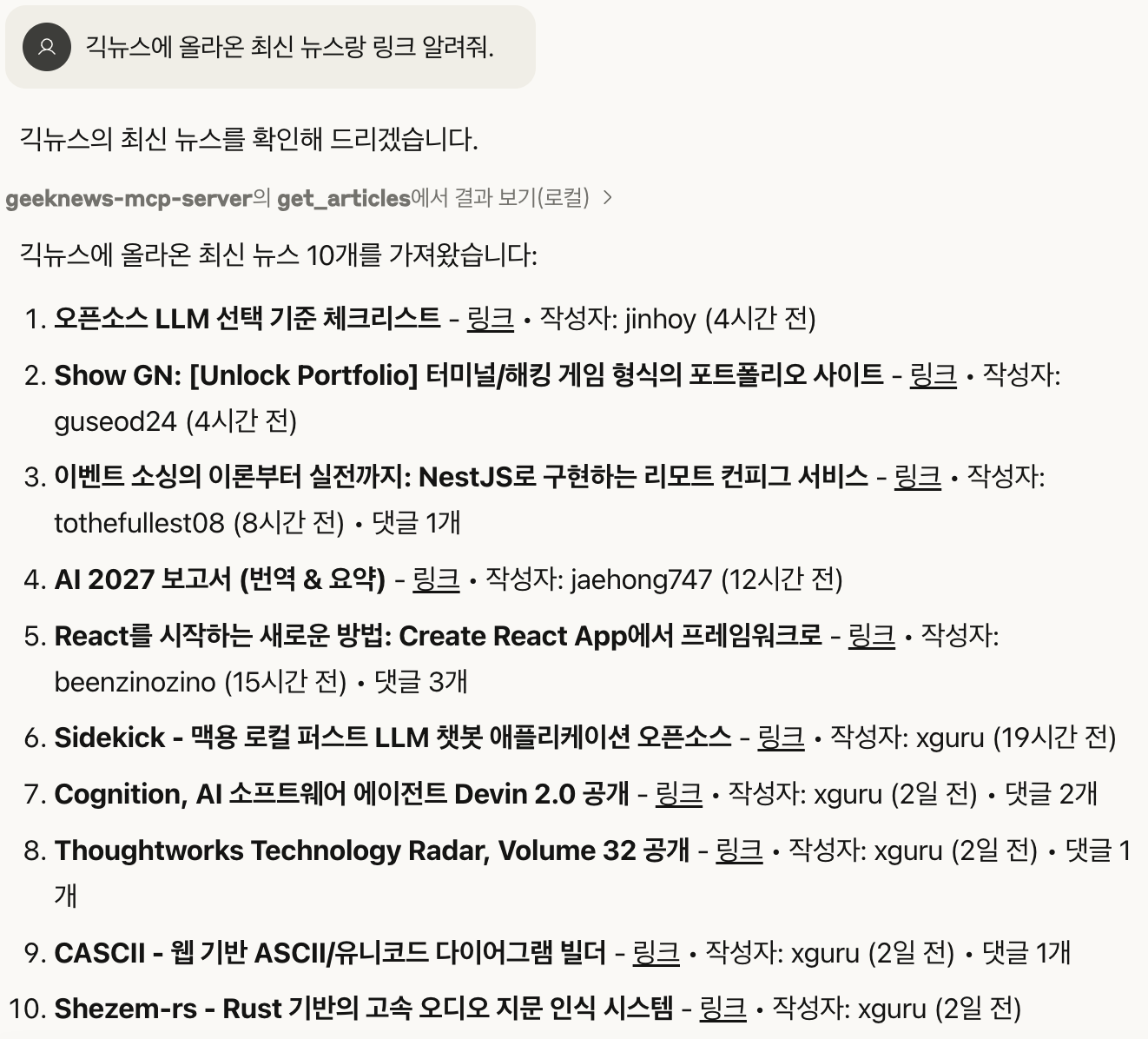
get_articles工具:能够从 GeekNews 获取文章
您可以指定文章类型(热门、新、询问、显示)和要返回的文章数量。
每个回复包含标题、URL、积分、作者、时间、评论数、排名信息。
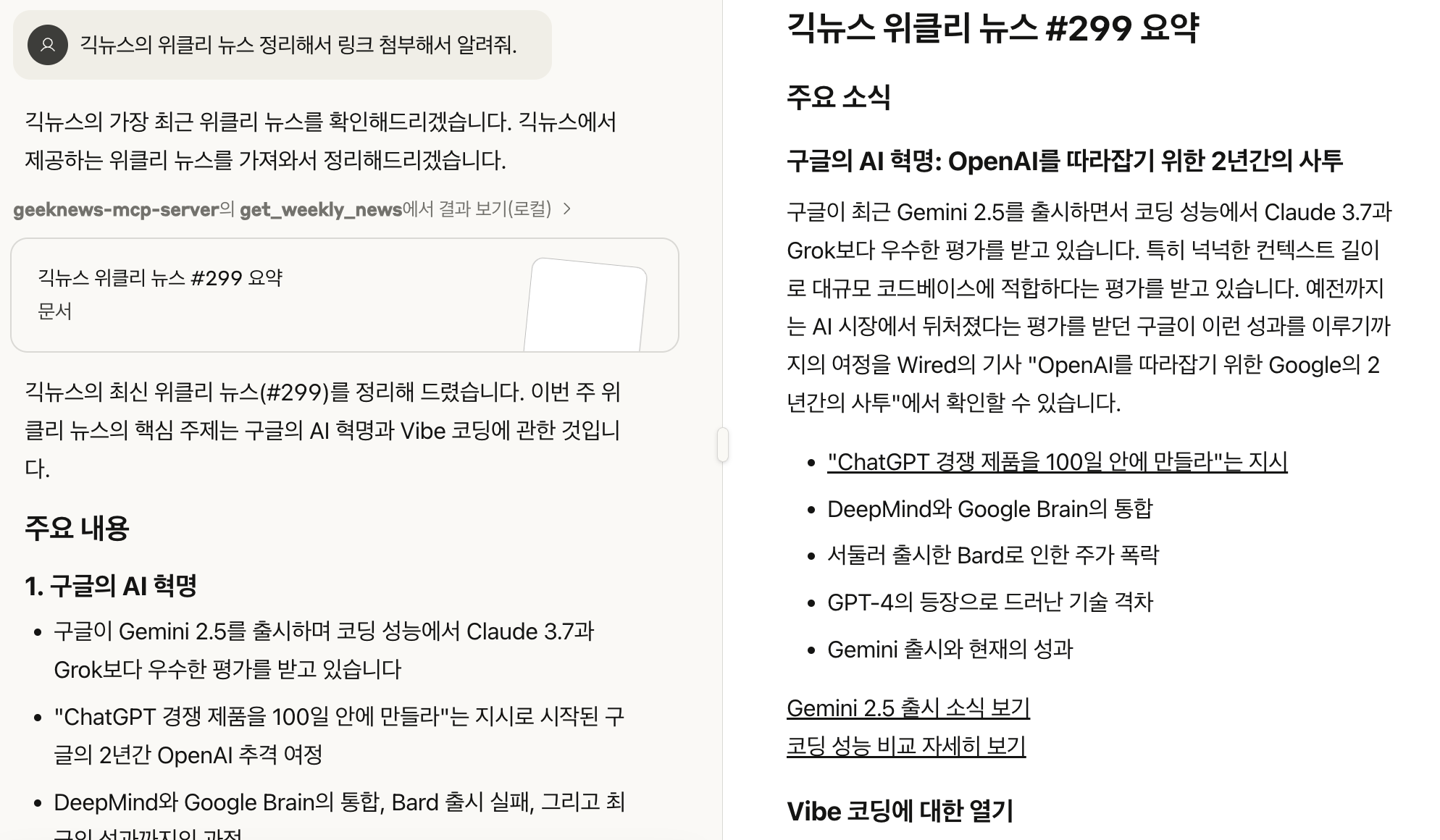
get_weekly_news工具:能够从 GeekNews 获取每周新闻
您可以指定特定的每周新闻 ID 或检索最新的每周新闻。
提供每周新闻的标题、编号、ID、内容、URL、条目列表等信息。
每个项目包含标题、URL 和排名信息。
Related MCP server: Mozilla Readability Parser MCP Server
使用 Smithery 安装
将服务器信息添加到 MCP 设置文件
{
"mcpServers": {
   "geeknews-mcp-server": {
      "command": "npx",
      "args": [
      "-y",
      "@smithery/cli@latest",
      "run",
      "@the0807/geeknews-mcp-server",
      "--key",
      "smithery에서 발급 받은 키"
      ]
   }
}
}Git 克隆
git clone https://github.com/the0807/GeekNews-MCP-Server
cd GeekNews-MCP-Server
使用 uv 设置环境
uv sync运行虚拟环境
uv venv
source .venv/bin/activate
使用 MCP Inspector 测试您的服务器
uv run mcp
mcp dev main.py

# 터미널에 나오는 URL(MCP Inspector)로 접속하여 서버 테스트src/models.py :定义存储文章信息的数据类。
src/parser.py :解析 GeekNews 网站的 HTML 以提取文章信息。
src/client.py :从 GeekNews 网站获取数据的 HTTP 客户端。
src/config.py :定义设置和常量
src/server.py :MCP 服务器实现
main.py :服务器执行入口点
[!笔记]
该服务器依赖于 GeekNews 网站的 HTML 结构。如果您的网站结构发生变化,您可能需要更新您的解析逻辑。
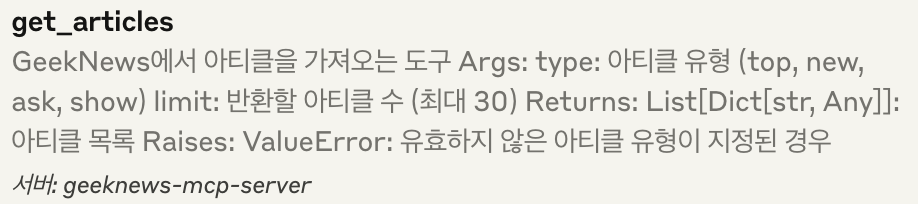
        GeekNews에서 아티클을 가져오는 도구

        Args:
            type: 아티클 유형 (top, new, ask, show)
            limit: 반환할 아티클 수 (최대 30)

        Returns:
            List[Dict[str, Any]]: 아티클 목록

        Raises:
            ValueError: 유효하지 않은 아티클 유형이 지정된 경우
| Name | Required | Description | Default |
|---|---|---|---|
| type | No | top | |
| limit | No |
Does the description disclose side effects, auth requirements, rate limits, or destructive behavior?
With no annotations provided, the description carries the full burden of behavioral disclosure. It mentions the return type (List[Dict[str, Any]]) and raises a ValueError for invalid types, adding some context. However, it doesn't cover important aspects like rate limits, authentication needs, or whether it's read-only/destructive, leaving gaps for a tool with parameters.
Agents need to know what a tool does to the world before calling it. Descriptions should go beyond structured annotations to explain consequences.
Is the description appropriately sized, front-loaded, and free of redundancy?
The description is well-structured with sections for Args, Returns, and Raises, making it easy to scan. It's appropriately sized with no redundant sentences. However, the initial purpose statement could be more front-loaded for immediate clarity, though it's still efficient.
Shorter descriptions cost fewer tokens and are easier for agents to parse. Every sentence should earn its place.
Given the tool's complexity, does the description cover enough for an agent to succeed on first attempt?
Given the tool has 2 parameters, no annotations, and no output schema, the description is moderately complete. It covers parameters and return values adequately but lacks behavioral details like error handling beyond ValueError, performance constraints, or sibling tool differentiation. It's sufficient for basic use but has clear gaps for full contextual understanding.
Complex tools with many parameters or behaviors need more documentation. Simple tools need less. This dimension scales expectations accordingly.
Does the description clarify parameter syntax, constraints, interactions, or defaults beyond what the schema provides?
The description adds significant meaning beyond the input schema, which has 0% description coverage. It explains that 'type' is the article type with valid values (top, new, ask, show) and 'limit' is the number of articles to return with a maximum of 30. This fully compensates for the schema's lack of descriptions, providing clear semantics for both parameters.
Input schemas describe structure but not intent. Descriptions should explain non-obvious parameter relationships and valid value ranges.
Does the description clearly state what the tool does and how it differs from similar tools?
The description clearly states the tool's purpose: 'GeekNews에서 아티클을 가져오는 도구' (Get articles from GeekNews). It specifies the verb '가져오는' (get/fetch) and resource '아티클' (articles), making the action explicit. However, it doesn't distinguish from the sibling tool 'get_weekly_news', which likely serves a different purpose but isn't contrasted here.
Agents choose between tools based on descriptions. A clear purpose with a specific verb and resource helps agents select the right tool.
Does the description explain when to use this tool, when not to, or what alternatives exist?
The description provides no guidance on when to use this tool versus alternatives. It mentions parameters and returns but doesn't explain context, prerequisites, or comparisons to 'get_weekly_news'. Usage is implied through parameter details but lacks explicit when/when-not instructions.
Agents often have multiple tools that could apply. Explicit usage guidance like "use X instead of Y when Z" prevents misuse.
        GeekNews에서 주간 뉴스를 가져오는 도구

        Args:
            weekly_id: 주간 뉴스 ID (빈 문자열인 경우 가장 최근 주간 뉴스를 가져옴)

        Returns:
            Dict[str, Any]: 주간 뉴스 정보
| Name | Required | Description | Default |
|---|---|---|---|
| weekly_id | No |
Does the description disclose side effects, auth requirements, rate limits, or destructive behavior?
With no annotations provided, the description carries the full burden of behavioral disclosure. It states the tool fetches weekly news but doesn't describe what '가져오는' entails (e.g., read-only operation, data format, potential errors, or rate limits). For a tool with zero annotation coverage, this leaves significant gaps in understanding its behavior and safety profile.
Agents need to know what a tool does to the world before calling it. Descriptions should go beyond structured annotations to explain consequences.
Is the description appropriately sized, front-loaded, and free of redundancy?
The description is appropriately sized and front-loaded, with the core purpose stated first in a single sentence. The Args and Returns sections are structured clearly, though the inclusion of type hints like 'Dict[str, Any]' adds minor verbosity without schema support. Overall, it's efficient with minimal waste.
Shorter descriptions cost fewer tokens and are easier for agents to parse. Every sentence should earn its place.
Given the tool's complexity, does the description cover enough for an agent to succeed on first attempt?
Given the tool's low complexity (1 parameter, no output schema, no annotations), the description is somewhat complete but has gaps. It covers the parameter semantics well but lacks behavioral details and usage guidelines relative to the sibling tool. Without annotations or output schema, more context on what the tool returns or how it behaves would improve completeness.
Complex tools with many parameters or behaviors need more documentation. Simple tools need less. This dimension scales expectations accordingly.
Does the description clarify parameter syntax, constraints, interactions, or defaults beyond what the schema provides?
The description adds meaningful semantics beyond the input schema, which has 0% coverage. It explains that 'weekly_id' is a weekly news ID and specifies that an empty string fetches the most recent weekly news, clarifying the parameter's purpose and default behavior. This compensates well for the lack of schema documentation.
Input schemas describe structure but not intent. Descriptions should explain non-obvious parameter relationships and valid value ranges.
Does the description clearly state what the tool does and how it differs from similar tools?
The description clearly states the tool's purpose: 'GeekNews에서 주간 뉴스를 가져오는 도구' (Get weekly news from GeekNews). It specifies the verb '가져오는' (get/fetch) and the resource '주간 뉴스' (weekly news). However, it doesn't explicitly differentiate from the sibling tool 'get_articles', which might also retrieve news content, leaving some ambiguity about when to use each.
Agents choose between tools based on descriptions. A clear purpose with a specific verb and resource helps agents select the right tool.
Does the description explain when to use this tool, when not to, or what alternatives exist?
The description provides no guidance on when to use this tool versus alternatives like 'get_articles'. It mentions that an empty weekly_id fetches the most recent weekly news, which is a usage hint, but lacks explicit context, prerequisites, or exclusions for tool selection.
Agents often have multiple tools that could apply. Explicit usage guidance like "use X instead of Y when Z" prevents misuse.
Recent tool additions, removals, and schema changes observed during successful MCP inspections.
get_articlesget_weekly_newsScored across 2 tools
The two tools have clearly distinct purposes: get_articles retrieves articles by type (top, new, ask, show) with a limit parameter, while get_weekly_news fetches weekly news by ID or the most recent one. There is no overlap in functionality or ambiguity between them.
Both tools follow a consistent verb_noun naming pattern (get_articles and get_weekly_news), using snake_case throughout. The naming is predictable and readable without any deviations or mixed conventions.
With only 2 tools, the server feels thin and under-scoped for a news domain. While the tools cover basic retrieval, there are likely missing operations (e.g., searching, filtering, or interacting with articles) that would enhance functionality, making the count too low for comprehensive coverage.
The tool surface is severely incomplete for a news server. It only provides read operations (get_articles and get_weekly_news) with no support for creating, updating, deleting, or searching articles. This lack of CRUD/lifecycle coverage will limit agent capabilities and cause failures in more complex workflows.
Programmatic web-scraping MCP server powered by x402 micro-transactions on Base.
A comprehensive Model Context Protocol (MCP) server that enables AI assistants to interact with yo…
One MCP server for 180+ live web-data APIs returning clean JSON from sites that block scrapers.
BGG MCP provides access to the BoardGameGeek API through the Model Context Protocol, enabling retr…