Glama
tarun7r

cricket-mcp-server

by tarun7r

Cricket MCP Server

A Model Context Protocol (MCP) server that provides comprehensive cricket data from Cricbuzz. This server offers real-time cricket statistics, player information, match schedules, and news updates.

Features

  • Player Statistics: Get detailed cricket player stats including batting and bowling records across all formats (Test, ODI, T20)

  • Live Matches: Fetch currently ongoing cricket matches

  • Match Schedule: Get upcoming cricket match schedules

  • Cricket News: Latest cricket news and updates

  • ICC Rankings: Official ICC rankings for batting, bowling, all-rounders, and teams across Test, ODI, and T20 formats

  • Match Scorecards: Detailed match analysis with batting and bowling statistics

  • Live Commentary: Recent ball-by-ball updates for a given match URL

  • Web Search: Internet search with titles/snippets for cricket topics

Related MCP server: Soccer MCP Server

Installation

  1. Clone or download this repository

  2. Install the required dependencies:

pip install -r requirements.txt

Demo: Gradio Web UI

You can interact with the Cricket MCP Server using a conversational web interface powered by Gradio and Gemini.

1. Set your Gemini API key

You need a Google Gemini API key to use the conversational agent. Set it as an environment variable:

export GOOGLE_API_KEY="your-gemini-api-key"

2. Run the Gradio demo

python3 cricket_gradio.py

This will launch a web UI in your browser where you can chat with the cricket assistant, ask for stats, live matches, news, and more.

Tip: The chat UI supports conversation memory and rich responses.
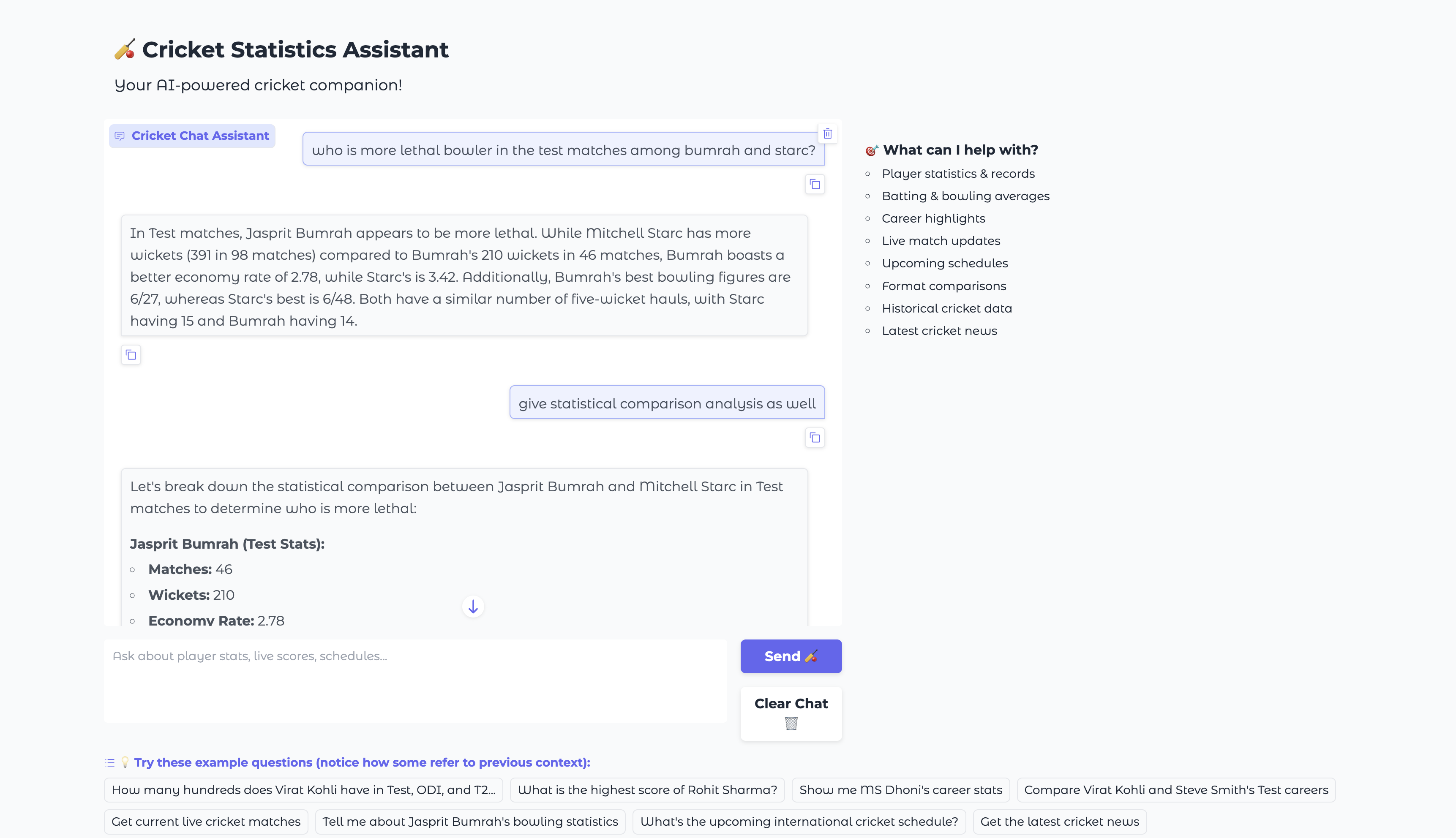
Demo Screenshot

Usage

Running as an MCP Server

The server can be integrated with MCP clients. Here's how to configure it:


    {
        "cricket": {
            "command": "python3",
            "args": ["cricket_server.py"],
            "transport": "stdio",
        }
    }

For a more flexible setup, you can use environment variables to define the python executable and server script path.

Running Standalone

For testing purposes, you can run the server directly:

python3 cricket_server.py

Available Tools

1. get_player_stats

Get comprehensive cricket player statistics.

Parameters:

  • player_name (str): Name of the cricket player

  • match_format (str, optional): Specific format ("Test", "ODI", "T20"). If not provided, returns all formats.

Returns:

  • Player basic info (name, country, role, image)

  • ICC rankings for batting and bowling

  • Detailed batting statistics

  • Detailed bowling statistics

Example:

# Get all stats for a player
stats = get_player_stats("Virat Kohli")

# Get only T20 stats
t20_stats = get_player_stats("Virat Kohli", "T20")

2. get_live_matches

Get currently live cricket matches.

Returns: List of live match information including teams and current status.

3. get_cricket_schedule

Get upcoming cricket match schedule.

Returns: List of upcoming international cricket matches with dates and details.

4. get_cricket_news

Get the latest cricket news.

Returns: List of cricket news articles with headlines, descriptions, timestamps, and categories.

5. get_icc_rankings

Get official ICC cricket rankings for various categories.

Parameters:

  • category (str): The ranking category. Must be one of: "batting", "bowling", "all-rounder", or "teams".

Returns: Dictionary with rankings for Test, ODI, and T20 formats. Each format contains a list of players or teams with their position, name, country, and rating.

Example:

# Get batting rankings
batting_rankings = get_icc_rankings("batting")

# Get bowling rankings
bowling_rankings = get_icc_rankings("bowling")

# Get team rankings
team_rankings = get_icc_rankings("teams")

6. get_match_details

Get detailed scorecard for a specific cricket match.

Parameters:

  • match_url (str): The URL of the match on Cricbuzz (can be obtained from get_live_matches).

Returns: Dictionary containing match details including match title, result, and detailed scorecard for each innings with batting and bowling statistics.

7. get_live_commentary

Get recent live commentary for a specific cricket match.

Parameters:

  • match_url (str): Cricbuzz match page URL (general match or direct commentary tab)

  • limit (int, optional): Max number of recent items to return (default 20)

Returns: Dictionary containing title, commentary_url, and events (list of commentary lines).

Example:

commentary = get_live_commentary("https://www.cricbuzz.com/live-cricket-scorecard/12345")

Search the web and return results with titles and snippets.

Parameters:

  • query (str): Search query

  • num_results (int, optional): Number of results (default 5)

  • site_filter (str, optional): Restrict to a domain like cricbuzz.com

Returns: List of results: { "title": str, "url": str, "snippet": str }.

9. search_live_commentary

Search for live commentary and updates for cricket matches on the web.

Parameters:

  • match_description (str, optional): Full match description (e.g., "Zimbabwe vs New Zealand 2nd Test")

  • team1 (str, optional): First team name

  • team2 (str, optional): Second team name

Returns: List of web search results for live commentary and match updates from cricket news sites.

Example:

# Search by match description
results = search_live_commentary(match_description="Zimbabwe vs New Zealand 2nd Test")

# Search by team names
results = search_live_commentary(team1="Zimbabwe", team2="New Zealand")

Data Source

This server scrapes data from Cricbuzz.com and uses Google Search for player profile discovery. Please ensure you comply with the website's terms of service and use responsibly.

Dependencies

  • fastmcp: MCP server framework

  • requests: HTTP library for web scraping

  • beautifulsoup4: HTML parsing library

  • lxml: XML/HTML parser

  • googlesearch-python: Google search API wrapper

Configuration

The server runs on stdio transport by default. No additional configuration is required for basic usage.

Error Handling

The server includes comprehensive error handling for:

  • Network connectivity issues

  • Invalid player names

  • Missing data on Cricbuzz

  • Search failures

MCP Directory Badge

Add this badge to your README to show your server is listed and safe:

License

This project is licensed under the MIT License. See the LICENSE file for details.

Contributing

Feel free to submit issues and enhancement requests!

Disclaimer

This tool scrapes data from public websites. The authors are not responsible for any misuse or violation of website terms of service. Use responsibly and ensure compliance with applicable terms and conditions.

Available Tools

9 tools
get_cricket_newsB

Get the latest cricket news from Cricbuzz.

Returns: list: A list of dictionaries, each containing news details including headline, description, timestamp, category, and a direct URL to the article.

ParametersJSON Schema
NameRequiredDescriptionDefault

No parameters

TDQS

B3.2/5.0
Behavior2/5

Does the description disclose side effects, auth requirements, rate limits, or destructive behavior?

With no annotations provided, the description carries the full burden of behavioral disclosure. It states the tool returns a list of news details, which is helpful, but lacks critical information such as whether it's a read-only operation, potential rate limits, authentication needs, or data freshness (e.g., how 'latest' is defined). This leaves significant gaps in understanding the tool's behavior beyond basic output.

Agents need to know what a tool does to the world before calling it. Descriptions should go beyond structured annotations to explain consequences.

Conciseness5/5

Is the description appropriately sized, front-loaded, and free of redundancy?

The description is front-loaded with the core purpose in the first sentence, followed by a clear 'Returns:' section detailing the output structure. Every sentence adds value: the first explains what the tool does, and the second specifies the return format. There is no wasted text, making it efficient and well-structured.

Shorter descriptions cost fewer tokens and are easier for agents to parse. Every sentence should earn its place.

Completeness3/5

Given the tool's complexity, does the description cover enough for an agent to succeed on first attempt?

Given the tool's low complexity (0 parameters, no annotations, no output schema), the description is minimally complete. It explains the purpose and return format, which is adequate for a simple read operation. However, it lacks context on behavioral aspects like data sources or limitations, which could be important for an agent to use it effectively, especially without annotations to fill those gaps.

Complex tools with many parameters or behaviors need more documentation. Simple tools need less. This dimension scales expectations accordingly.

Parameters4/5

Does the description clarify parameter syntax, constraints, interactions, or defaults beyond what the schema provides?

The input schema has 0 parameters with 100% coverage, so no parameter documentation is needed. The description appropriately doesn't discuss parameters, focusing instead on the return value. This meets the baseline for tools with no parameters, as it doesn't add unnecessary information beyond what the schema provides.

Input schemas describe structure but not intent. Descriptions should explain non-obvious parameter relationships and valid value ranges.

Purpose4/5

Does the description clearly state what the tool does and how it differs from similar tools?

The description clearly states the verb 'Get' and the resource 'latest cricket news from Cricbuzz', making the purpose specific and understandable. However, it doesn't explicitly differentiate from sibling tools like 'get_cricket_schedule' or 'web_search', which could also provide cricket-related information but through different mechanisms or sources.

Agents choose between tools based on descriptions. A clear purpose with a specific verb and resource helps agents select the right tool.

Usage Guidelines2/5

Does the description explain when to use this tool, when not to, or what alternatives exist?

The description provides no guidance on when to use this tool versus alternatives. It doesn't mention sibling tools like 'get_cricket_schedule' for schedules or 'web_search' for broader searches, leaving the agent without context for tool selection. The only implied usage is for retrieving cricket news, but no exclusions or comparisons are provided.

Agents often have multiple tools that could apply. Explicit usage guidance like "use X instead of Y when Z" prevents misuse.

get_cricket_scheduleB

Get upcoming cricket match schedule from Cricbuzz.

Returns: list: A list of dictionaries, each representing a match with series name, match description, and a link to the match if available.

ParametersJSON Schema
NameRequiredDescriptionDefault

No parameters

TDQS

B3.4/5.0
Behavior3/5

Does the description disclose side effects, auth requirements, rate limits, or destructive behavior?

No annotations are provided, so the description carries the full burden of behavioral disclosure. It states the tool fetches data from Cricbuzz and returns a list of match dictionaries, which covers basic functionality. However, it lacks details on rate limits, error handling, authentication needs, or data freshness, leaving gaps in behavioral understanding for a tool with external dependencies.

Agents need to know what a tool does to the world before calling it. Descriptions should go beyond structured annotations to explain consequences.

Conciseness5/5

Is the description appropriately sized, front-loaded, and free of redundancy?

The description is front-loaded with the core purpose in the first sentence, followed by a clear returns section. Every sentence adds value: the first defines the action, and the second specifies the output format. There is no wasted text, making it highly efficient and well-structured.

Shorter descriptions cost fewer tokens and are easier for agents to parse. Every sentence should earn its place.

Completeness3/5

Given the tool's complexity, does the description cover enough for an agent to succeed on first attempt?

Given the tool's simplicity (0 parameters, no output schema, no annotations), the description is minimally adequate. It explains what the tool does and the return format, but lacks context on data sources, limitations, or error cases. For a tool fetching external data, more completeness (e.g., noting it's read-only, or potential delays) would be beneficial.

Complex tools with many parameters or behaviors need more documentation. Simple tools need less. This dimension scales expectations accordingly.

Parameters4/5

Does the description clarify parameter syntax, constraints, interactions, or defaults beyond what the schema provides?

The tool has 0 parameters, and schema description coverage is 100% (though empty). The description doesn't need to add parameter semantics, so it meets the baseline of 4 for zero-parameter tools. It appropriately focuses on output behavior instead.

Input schemas describe structure but not intent. Descriptions should explain non-obvious parameter relationships and valid value ranges.

Purpose4/5

Does the description clearly state what the tool does and how it differs from similar tools?

The description clearly states the tool's purpose: 'Get upcoming cricket match schedule from Cricbuzz.' It specifies the verb ('Get'), resource ('upcoming cricket match schedule'), and source ('Cricbuzz'). However, it doesn't explicitly differentiate from sibling tools like 'get_live_matches' or 'get_match_details' beyond the 'upcoming' qualifier, which is why it doesn't reach a score of 5.

Agents choose between tools based on descriptions. A clear purpose with a specific verb and resource helps agents select the right tool.

Usage Guidelines2/5

Does the description explain when to use this tool, when not to, or what alternatives exist?

The description provides no guidance on when to use this tool versus alternatives. It doesn't mention sibling tools like 'get_live_matches' (for current matches) or 'get_match_details' (for specific match info), nor does it specify any prerequisites or exclusions. The agent must infer usage from the 'upcoming' keyword alone, which is insufficient for clear differentiation.

Agents often have multiple tools that could apply. Explicit usage guidance like "use X instead of Y when Z" prevents misuse.

get_icc_rankingsA

Fetches official ICC cricket rankings for various categories. Use this tool to answer questions about top players and teams in Test, ODI, and T20 formats.

For example, you can answer questions like:

  • "Who are the top 10 ODI batsmen?"

  • "Show me the test bowling rankings."

  • "What are the T20 team rankings?"

  • "icc ranking odi batsman"

Args: category (str): The ranking category. Must be one of: "batting", "bowling", "all-rounder", or "teams".

Returns: dict: A dictionary with rankings for Test, ODI, and T20 formats. Each format contains a list of players or teams with their position, name, country, and rating.

ParametersJSON Schema
NameRequiredDescriptionDefault
categoryYes

TDQS

A4.4/5.0
Behavior3/5

Does the description disclose side effects, auth requirements, rate limits, or destructive behavior?

With no annotations provided, the description carries the full burden. It mentions the tool fetches 'official' rankings, implying authoritative data, but lacks details on rate limits, authentication needs, or potential data freshness issues. The description doesn't contradict any annotations (none exist), but could provide more behavioral context.

Agents need to know what a tool does to the world before calling it. Descriptions should go beyond structured annotations to explain consequences.

Conciseness5/5

Is the description appropriately sized, front-loaded, and free of redundancy?

The description is efficiently structured with a clear purpose statement, usage guidance, concrete examples, and parameter/return documentation. Every sentence adds value without redundancy, and it's appropriately sized for the tool's complexity.

Shorter descriptions cost fewer tokens and are easier for agents to parse. Every sentence should earn its place.

Completeness4/5

Given the tool's complexity, does the description cover enough for an agent to succeed on first attempt?

Given the single parameter and no output schema, the description provides complete usage context including parameter details and return format. It could slightly improve by mentioning if the tool returns all formats simultaneously or requires separate calls, but overall it's quite comprehensive for this tool's scope.

Complex tools with many parameters or behaviors need more documentation. Simple tools need less. This dimension scales expectations accordingly.

Parameters4/5

Does the description clarify parameter syntax, constraints, interactions, or defaults beyond what the schema provides?

The schema has 0% description coverage, but the description fully compensates by clearly explaining the single parameter 'category' with its valid values ('batting', 'bowling', 'all-rounder', or 'teams') and purpose. This adds significant meaning beyond the bare schema.

Input schemas describe structure but not intent. Descriptions should explain non-obvious parameter relationships and valid value ranges.

Purpose5/5

Does the description clearly state what the tool does and how it differs from similar tools?

The description clearly states the specific action ('Fetches official ICC cricket rankings') and resource ('for various categories'), distinguishing it from sibling tools like get_cricket_news or get_player_stats by focusing exclusively on rankings rather than news, schedules, or statistics.

Agents choose between tools based on descriptions. A clear purpose with a specific verb and resource helps agents select the right tool.

Usage Guidelines5/5

Does the description explain when to use this tool, when not to, or what alternatives exist?

It explicitly states when to use this tool ('to answer questions about top players and teams in Test, ODI, and T20 formats') and provides concrete examples of questions it can answer, clearly differentiating its purpose from alternatives like get_player_stats or web_search.

Agents often have multiple tools that could apply. Explicit usage guidance like "use X instead of Y when Z" prevents misuse.

get_live_commentaryA

Get recent live commentary events for a Cricbuzz match.

Args: match_url (str): Cricbuzz match URL. Can be a general match page; the commentary tab will be resolved automatically. limit (int): Maximum number of recent commentary items to return.

Returns: dict: {"title": str, "commentary_url": str, "events": [{"text": str}]}

ParametersJSON Schema
NameRequiredDescriptionDefault
limitNo
match_urlYes

TDQS

A3.9/5.0
Behavior2/5

Does the description disclose side effects, auth requirements, rate limits, or destructive behavior?

No annotations are provided, so the description carries the full burden of behavioral disclosure. It mentions that the tool returns recent commentary events and handles URL resolution automatically, but lacks details on permissions, rate limits, error handling, or whether it's read-only. For a tool with no annotations, this leaves significant behavioral gaps.

Agents need to know what a tool does to the world before calling it. Descriptions should go beyond structured annotations to explain consequences.

Conciseness5/5

Is the description appropriately sized, front-loaded, and free of redundancy?

The description is front-loaded with the core purpose, followed by structured Args and Returns sections. Every sentence earns its place by providing essential information without redundancy, making it highly efficient and well-organized.

Shorter descriptions cost fewer tokens and are easier for agents to parse. Every sentence should earn its place.

Completeness3/5

Given the tool's complexity, does the description cover enough for an agent to succeed on first attempt?

Given no annotations, 0% schema coverage, and no output schema, the description does a decent job explaining parameters and return structure. However, it lacks details on behavioral aspects like error cases or operational constraints, which are important for a tool interacting with external data. It's adequate but has clear gaps in completeness.

Complex tools with many parameters or behaviors need more documentation. Simple tools need less. This dimension scales expectations accordingly.

Parameters4/5

Does the description clarify parameter syntax, constraints, interactions, or defaults beyond what the schema provides?

Schema description coverage is 0%, so the description must compensate. It adds meaningful semantics: match_url is explained as a Cricbuzz URL where the commentary tab is resolved automatically, and limit specifies the maximum number of recent items. This clarifies beyond the schema's basic types, though it doesn't cover all potential nuances like URL format constraints.

Input schemas describe structure but not intent. Descriptions should explain non-obvious parameter relationships and valid value ranges.

Purpose5/5

Does the description clearly state what the tool does and how it differs from similar tools?

The description clearly states the specific action ('Get recent live commentary events') and resource ('for a Cricbuzz match'), distinguishing it from siblings like get_match_details or get_live_matches. It precisely identifies what the tool retrieves without being vague or tautological.

Agents choose between tools based on descriptions. A clear purpose with a specific verb and resource helps agents select the right tool.

Usage Guidelines4/5

Does the description explain when to use this tool, when not to, or what alternatives exist?

The description provides clear context for when to use this tool—for live commentary events on Cricbuzz matches. It implicitly distinguishes from siblings like get_cricket_news or get_player_stats by focusing on commentary. However, it does not explicitly state when not to use it or name alternatives like search_live_commentary for more specific queries.

Agents often have multiple tools that could apply. Explicit usage guidance like "use X instead of Y when Z" prevents misuse.

get_live_matchesB

Get live cricket matches from Cricbuzz.

Returns: list: A list of dictionaries, each containing the match description and a URL. Example: [{"match": "IND vs AUS...", "url": "https://..."}]

ParametersJSON Schema
NameRequiredDescriptionDefault

No parameters

TDQS

B3.3/5.0
Behavior3/5

Does the description disclose side effects, auth requirements, rate limits, or destructive behavior?

With no annotations provided, the description carries the full burden of behavioral disclosure. It describes the return format (list of dictionaries with match description and URL) and provides an example, which is helpful. However, it doesn't mention important behavioral aspects like whether this requires authentication, rate limits, or how frequently the data updates.

Agents need to know what a tool does to the world before calling it. Descriptions should go beyond structured annotations to explain consequences.

Conciseness4/5

Is the description appropriately sized, front-loaded, and free of redundancy?

The description is efficiently structured with a clear purpose statement followed by return format details and an example. Every sentence adds value, though the example could be slightly more concise.

Shorter descriptions cost fewer tokens and are easier for agents to parse. Every sentence should earn its place.

Completeness3/5

Given the tool's complexity, does the description cover enough for an agent to succeed on first attempt?

For a parameterless tool with no annotations and no output schema, the description provides adequate information about what the tool returns. However, it lacks context about data freshness, potential limitations, or how it differs from sibling tools, leaving some gaps in understanding when and how to use it effectively.

Complex tools with many parameters or behaviors need more documentation. Simple tools need less. This dimension scales expectations accordingly.

Parameters4/5

Does the description clarify parameter syntax, constraints, interactions, or defaults beyond what the schema provides?

Since there are 0 parameters (schema coverage is 100%), the baseline score is 4. The description appropriately doesn't discuss parameters, focusing instead on the return value, which is correct for a parameterless tool.

Input schemas describe structure but not intent. Descriptions should explain non-obvious parameter relationships and valid value ranges.

Purpose4/5

Does the description clearly state what the tool does and how it differs from similar tools?

The description clearly states the action ('Get live cricket matches') and source ('from Cricbuzz'), providing a specific verb+resource combination. However, it doesn't explicitly differentiate from sibling tools like 'get_match_details' or 'get_cricket_schedule', which might also involve match information.

Agents choose between tools based on descriptions. A clear purpose with a specific verb and resource helps agents select the right tool.

Usage Guidelines2/5

Does the description explain when to use this tool, when not to, or what alternatives exist?

The description provides no guidance on when to use this tool versus alternatives like 'get_match_details' for specific matches or 'get_cricket_schedule' for upcoming matches. It simply states what the tool does without context about appropriate use cases.

Agents often have multiple tools that could apply. Explicit usage guidance like "use X instead of Y when Z" prevents misuse.

get_match_detailsA

Get detailed scorecard for a specific cricket match from a Cricbuzz URL.

Args: match_url (str): The URL of the match on Cricbuzz (can be obtained from get_live_matches).

Returns: dict: A dictionary containing match details including: - Match title and result. - A scorecard for each innings with batting and bowling stats.

ParametersJSON Schema
NameRequiredDescriptionDefault
match_urlYes

TDQS

A4.3/5.0
Behavior3/5

Does the description disclose side effects, auth requirements, rate limits, or destructive behavior?

With no annotations provided, the description carries the full burden of behavioral disclosure. It describes what the tool returns (match details and scorecards) which is helpful, but doesn't mention potential limitations like rate limits, authentication needs, error conditions, or what happens with invalid URLs. It provides basic behavioral context but lacks operational details.

Agents need to know what a tool does to the world before calling it. Descriptions should go beyond structured annotations to explain consequences.

Conciseness5/5

Is the description appropriately sized, front-loaded, and free of redundancy?

The description is perfectly structured and front-loaded: the first sentence states the core purpose, followed by clear Args and Returns sections. Every sentence earns its place by providing essential information without redundancy. The formatting with clear sections enhances readability.

Shorter descriptions cost fewer tokens and are easier for agents to parse. Every sentence should earn its place.

Completeness4/5

Given the tool's complexity, does the description cover enough for an agent to succeed on first attempt?

Given the tool's moderate complexity (single parameter, no output schema, no annotations), the description is quite complete. It explains the purpose, parameter, and return format. The main gap is the lack of output schema which would help structure expectations, but the Returns section provides good semantic information about what to expect.

Complex tools with many parameters or behaviors need more documentation. Simple tools need less. This dimension scales expectations accordingly.

Parameters5/5

Does the description clarify parameter syntax, constraints, interactions, or defaults beyond what the schema provides?

With 0% schema description coverage and only 1 parameter, the description fully compensates by clearly explaining the match_url parameter: what it is ('URL of the match on Cricbuzz'), its format (str), and where to obtain it ('can be obtained from get_live_matches'). This adds significant value beyond the bare schema.

Input schemas describe structure but not intent. Descriptions should explain non-obvious parameter relationships and valid value ranges.

Purpose5/5

Does the description clearly state what the tool does and how it differs from similar tools?

The description clearly states the specific action ('Get detailed scorecard'), resource ('for a specific cricket match'), and source ('from a Cricbuzz URL'). It distinguishes itself from siblings like get_live_matches (which lists matches) and get_live_commentary (which provides commentary rather than scorecard details).

Agents choose between tools based on descriptions. A clear purpose with a specific verb and resource helps agents select the right tool.

Usage Guidelines4/5

Does the description explain when to use this tool, when not to, or what alternatives exist?

The description provides clear context on when to use this tool: when you have a match URL from get_live_matches and need detailed scorecard information. It doesn't explicitly state when NOT to use it or name alternatives, but the context is sufficient for most scenarios.

Agents often have multiple tools that could apply. Explicit usage guidance like "use X instead of Y when Z" prevents misuse.

get_player_statsA

Get comprehensive cricket player statistics including batting and bowling data from Cricbuzz.

Args: player_name (str): The name of the cricket player. match_format (str, optional): The match format to get stats for. Can be "Test", "ODI", or "T20". If not provided, all stats are returned.

Returns: dict: A dictionary containing complete player statistics including: - Basic info (name, country, role, image) - ICC rankings for batting and bowling - Detailed batting stats (matches, runs, average, strike rate, centuries, fifties) - Detailed bowling stats (balls, runs, wickets, best figures, economy, five-wicket hauls) If match_format is specified, returns stats for that format only.

ParametersJSON Schema
NameRequiredDescriptionDefault
match_formatNo
player_nameYes

TDQS

A4.2/5.0
Behavior4/5

Does the description disclose side effects, auth requirements, rate limits, or destructive behavior?

No annotations are provided, so the description carries the full burden. It discloses key behavioral traits: it fetches data from Cricbuzz, returns comprehensive stats in a dictionary format, and explains how the optional match_format parameter affects output (returns all stats if not provided, format-specific if specified). It does not mention rate limits, authentication needs, or error handling, but covers core functionality adequately.

Agents need to know what a tool does to the world before calling it. Descriptions should go beyond structured annotations to explain consequences.

Conciseness4/5

Is the description appropriately sized, front-loaded, and free of redundancy?

The description is well-structured with a clear purpose statement, Args section, and Returns section. It is appropriately sized and front-loaded, with every sentence adding value. It could be slightly more concise by integrating the optional parameter effect into the Args section, but overall it is efficient.

Shorter descriptions cost fewer tokens and are easier for agents to parse. Every sentence should earn its place.

Completeness4/5

Given the tool's complexity, does the description cover enough for an agent to succeed on first attempt?

Given no annotations, 0% schema coverage, and no output schema, the description provides good completeness. It covers purpose, parameters, return format, and data source. It lacks details on error cases, rate limits, or authentication, but for a read-only data-fetching tool, it is sufficiently complete to guide an agent.

Complex tools with many parameters or behaviors need more documentation. Simple tools need less. This dimension scales expectations accordingly.

Parameters5/5

Does the description clarify parameter syntax, constraints, interactions, or defaults beyond what the schema provides?

Schema description coverage is 0%, so the description must compensate. It adds significant meaning beyond the schema: it explains that player_name is required and match_format is optional, specifies valid values for match_format ('Test', 'ODI', 'T20'), and describes the effect of match_format on output. This fully documents both parameters with clear semantics.

Input schemas describe structure but not intent. Descriptions should explain non-obvious parameter relationships and valid value ranges.

Purpose5/5

Does the description clearly state what the tool does and how it differs from similar tools?

The description clearly states the tool's purpose: 'Get comprehensive cricket player statistics including batting and bowling data from Cricbuzz.' It specifies the verb ('Get'), resource ('cricket player statistics'), and scope ('comprehensive...including batting and bowling data'), distinguishing it from sibling tools like get_icc_rankings or get_match_details.

Agents choose between tools based on descriptions. A clear purpose with a specific verb and resource helps agents select the right tool.

Usage Guidelines3/5

Does the description explain when to use this tool, when not to, or what alternatives exist?

The description implies usage through the 'Args' and 'Returns' sections, suggesting when to use it (for player stats) and how parameters affect results (match_format optional). However, it lacks explicit guidance on when to use this tool versus alternatives like get_icc_rankings or get_match_details, and does not mention any prerequisites or exclusions.

Agents often have multiple tools that could apply. Explicit usage guidance like "use X instead of Y when Z" prevents misuse.

search_live_commentaryC

Search for live commentary and updates for cricket matches on the web.

Args: match_description (str, optional): Full match description (e.g., "Zimbabwe vs New Zealand 2nd Test") team1 (str, optional): First team name team2 (str, optional): Second team name

Returns: list: Web search results for live commentary and match updates

ParametersJSON Schema
NameRequiredDescriptionDefault
match_descriptionNo
team1No
team2No

TDQS

C2.9/5.0
Behavior2/5

Does the description disclose side effects, auth requirements, rate limits, or destructive behavior?

No annotations are provided, so the description carries the full burden of behavioral disclosure. It states the tool performs a web search and returns results, but it doesn't cover critical aspects like whether it's read-only (implied by 'search' but not explicit), rate limits, authentication needs, or what happens with partial/no inputs. For a search tool with zero annotation coverage, this leaves significant gaps in understanding its behavior.

Agents need to know what a tool does to the world before calling it. Descriptions should go beyond structured annotations to explain consequences.

Conciseness4/5

Is the description appropriately sized, front-loaded, and free of redundancy?

The description is well-structured and appropriately sized, with a clear purpose statement followed by separate 'Args' and 'Returns' sections. Every sentence adds value, and there's no redundant information. It could be slightly more concise by integrating the sections more fluidly, but overall it's efficient and front-loaded.

Shorter descriptions cost fewer tokens and are easier for agents to parse. Every sentence should earn its place.

Completeness2/5

Given the tool's complexity, does the description cover enough for an agent to succeed on first attempt?

Given the complexity of a search tool with 3 parameters, 0% schema description coverage, no annotations, and no output schema, the description is incomplete. It covers the basic purpose and parameters but lacks behavioral details, usage guidelines, and output specifics (e.g., result format, error handling). For a tool that interacts with web data, this leaves too many unknowns for reliable agent invocation.

Complex tools with many parameters or behaviors need more documentation. Simple tools need less. This dimension scales expectations accordingly.

Parameters3/5

Does the description clarify parameter syntax, constraints, interactions, or defaults beyond what the schema provides?

The description includes an 'Args' section that lists three optional parameters with brief examples (e.g., 'Zimbabwe vs New Zealand 2nd Test'), adding meaning beyond the input schema, which has 0% description coverage. However, it doesn't fully compensate for the schema gap—it lacks details on parameter interactions, format constraints, or how searches work with multiple/partial inputs. With 3 parameters at 0% schema coverage, the description provides basic but incomplete semantic context.

Input schemas describe structure but not intent. Descriptions should explain non-obvious parameter relationships and valid value ranges.

Purpose4/5

Does the description clearly state what the tool does and how it differs from similar tools?

The description clearly states the tool's purpose: 'Search for live commentary and updates for cricket matches on the web.' It specifies the verb ('search'), resource ('live commentary and updates'), and domain ('cricket matches on the web'), making it easy to understand. However, it doesn't explicitly differentiate from sibling tools like 'get_live_commentary' or 'web_search', which prevents a perfect score.

Agents choose between tools based on descriptions. A clear purpose with a specific verb and resource helps agents select the right tool.

Usage Guidelines2/5

Does the description explain when to use this tool, when not to, or what alternatives exist?

The description provides no guidance on when to use this tool versus alternatives. It doesn't mention sibling tools like 'get_live_commentary' (which might fetch commentary directly without web search) or 'web_search' (a general search tool), nor does it specify prerequisites or exclusions. Usage is implied by the purpose but lacks explicit context.

Agents often have multiple tools that could apply. Explicit usage guidance like "use X instead of Y when Z" prevents misuse.

Tool Schema Changelog

Recent tool additions, removals, and schema changes observed during successful MCP inspections.

  1. 9 tool updatesv1.0.0
    • First observedget_cricket_news
    • First observedget_cricket_schedule
    • First observedget_icc_rankings
    • First observedget_live_commentary
    • First observedget_live_matches
    • First observedget_match_details
    • First observedget_player_stats
    • First observedsearch_live_commentary
    • First observedweb_search

TDQS

A3.7/5.0

Scored across 9 tools

Disambiguation4/5

Most tools have distinct purposes (news, schedule, rankings, live matches, match details, player stats), but there is some overlap between get_live_commentary and search_live_commentary which could cause confusion. The web_search tool also overlaps with other tools but serves as a general fallback.

Naming Consistency5/5

All tools follow a consistent snake_case naming pattern with a clear verb_noun structure (e.g., get_cricket_news, get_icc_rankings). The naming is predictable and easy to understand across all nine tools.

Tool Count5/5

Nine tools is well-scoped for a cricket information server, covering key areas like news, schedules, rankings, live matches, details, player stats, and search. Each tool serves a specific function without being excessive or insufficient for the domain.

Completeness4/5

The tool set provides comprehensive coverage for cricket data retrieval, including news, schedules, rankings, live updates, match details, and player stats. A minor gap is the lack of historical data tools (e.g., past match archives or historical rankings), but core workflows are well-supported.

Maintenance

ActivityInactive
ResponsivenessUnresponsive

Resources

Unclaimed servers have limited discoverability.

Looking for Admin?

If you are the server author, to access and configure the admin panel.

Related MCP Connectors

Related MCP Servers

  • A
    license
    B
    quality
    A
    maintenance
    A Model Context Protocol server that provides access to Fantasy Premier League data, allowing users to compare players, find team information, view gameweek data, and get FPL-related advice through Claude for Desktop and other MCP-compatible clients.
    23
    79
    MIT
  • F
    license
    Not graded
    quality
    D
    maintenance
    Provides programmatic access to comprehensive football statistics and live match data via API-Football, enabling applications to retrieve league standings, team fixtures, player statistics, and real-time match events.
    6
    -
  • F
    license
    Not graded
    quality
    D
    maintenance
    An MCP Server that enables interaction with MLB scores and statistics via the SportsData.io MLB V3 Scores API, allowing users to access baseball data through natural language queries.
    -
  • A
    license
    B
    quality
    A
    maintenance
    Search and retrieve news articles and trending keywords from Google News and Google Trends. Summarize articles and extract keywords using optional NLP and LLM Sampling to get concise insights.
    5
    89
    MIT