OLS MCP Server
Large Language Models are notoriously bad at working with ontologies, often hallucinating terms or their identifiers. This server provides a reliable way to access and query ontologies, ensuring accurate and up-to-date information.

This repository contains a Model Context Protocol (MCP) server providing access to the Ontology Lookup Service (OLS) API. This server enables AI assistants to search for and retrieve ontological terms, concepts, and hierarchies from various biological and medical ontologies.
This server is designed to work seamlessly with AI assistants like Claude Desktop, allowing users to query ontologies using natural language. It supports a wide range of ontologies, including Gene Ontology (GO), Human Phenotype Ontology (HP), and many others.
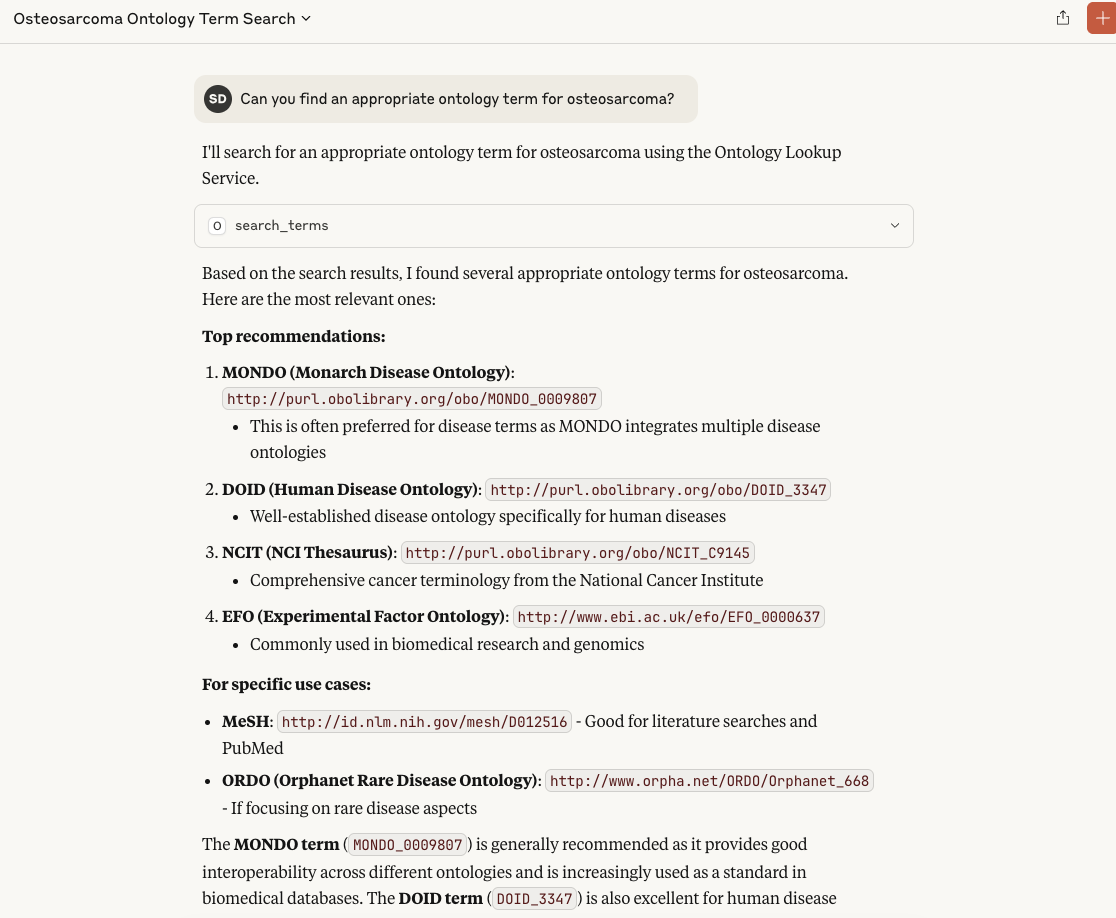
Without (top part of image below) and with mcp server engaged (bottom of figure below):

Features
The OLS MCP Server provides the following tools:
🔍 Search Terms: Search for terms across ontologies with flexible filtering
📚 Search Ontologies: Discover available ontologies and their metadata
ℹ️ Get Ontology Information: Retrieve detailed information about specific ontologies
🎯 Get Term Information: Get comprehensive details about specific terms
🌳 Get Term Children: Find direct child terms in ontological hierarchies
👨👩👧👦 Get Term Ancestors: Retrieve parent terms and ancestors
🤖 Find Similar Terms: Discover semantically similar terms using LLM embeddings
Related MCP server: mcp-ubergraph-query
Supported Ontologies
The server works with any ontology available through the EBI Ontology Lookup Service, including:
GO (Gene Ontology)
EFO (Experimental Factor Ontology)
HP (Human Phenotype Ontology)
MONDO (Monarch Disease Ontology)
ChEBI (Chemical Entities of Biological Interest)
UBERON (Uber-anatomy ontology)
And many more...
Installation
Prerequisites
Python 3.12 or higher
uv package manager
Install uv (if not already installed)
# macOS/Linux
curl -LsSf https://astral.sh/uv/install.sh | sh

# Windows
powershell -c "irm https://astral.sh/uv/install.ps1 | iex"
Install the OLS MCP Server
# Clone the repository
git clone https://github.com/seandavi/ols-mcp-server.git
cd ols-mcp-server

# Install dependencies
uv sync

# Install as a tool (optional)
uv tool install .
Configuration
Claude Desktop Configuration
To use this server with Claude Desktop, add the following configuration to your Claude Desktop config file:
macOS: ~/Library/Application Support/Claude/claude_desktop_config.json
Windows: %APPDATA%\Claude\claude_desktop_config.json
{
  "mcpServers": {
    "ols-mcp-server": {
      "command": "uv",
      "args": [
        "tool",
        "run",
        "ols-mcp-server"
      ],
      "env": {}
    }
  }
}
Alternative Configuration (if installed as tool)
If you installed the server as a uv tool, you can use this simpler configuration:
{
  "mcpServers": {
    "ols-mcp-server": {
      "command": "ols-mcp-server",
      "args": [],
      "env": {}
    }
  }
}
Usage Examples
Once configured with Claude Desktop, you can use natural language to interact with the OLS API:
Searching for Terms
"Search for terms related to diabetes in the Human Phenotype Ontology"
"Find all terms containing 'apoptosis' in the Gene Ontology"
Getting Ontology Information
"Tell me about the Gene Ontology"
"What ontologies are available for chemical compounds?"
Exploring Term Hierarchies
"Show me the children of the term 'metabolic process' in GO"
"What are the ancestor terms for HP:0000118?"
Finding Similar Terms
"Find terms similar to 'heart development' in the Gene Ontology"
Development Setup
Setting up the Development Environment
Clone the repository:
git clone <repository-url>
cd ols-mcp-server
Install dependencies:
Activate the virtual environment:
source .venv/bin/activate  # macOS/Linux
# or
.venv\Scripts\activate     # Windows
Code Quality
# Format code
uv run ruff format

# Lint code
uv run ruff check

# Type checking
uv run mypy src/
Adding New Features
Add new tools in src/ols_mcp_server/server.py using the @mcp.tool() decorator
Create models in src/ols_mcp_server/models.py for structured responses
Update tests to cover new functionality
Update documentation as needed
API Documentation
The server interacts with the EBI Ontology Lookup Service API v2. Key endpoints:
Search: https://www.ebi.ac.uk/ols4/api/search
Ontologies: https://www.ebi.ac.uk/ols4/api/v2/ontologies
Terms: https://www.ebi.ac.uk/ols4/api/terms
Hierarchies: https://www.ebi.ac.uk/ols4/api/v2/ontologies/{ontology}/classes/{term}/children
Troubleshooting
Common Issues
Server not found: Ensure the path to the server is correct in your Claude config
Permission errors: Make sure the server script is executable
Network errors: Check your internet connection and firewall settings
Python version: Ensure you're using Python 3.12 or higher
Contributing
Fork the repository
Create a feature branch: git checkout -b feature-name
Make your changes
Run tests: uv run pytest
Format code: uv run ruff format
Submit a pull request
]
Acknowledgments