
A
licenseB
qualityD
maintenanceEnables AI models to perform MySQL database operations through a standardized interface, supporting secure connections, query execution, and comprehensive schema management.
7
153 npm
33
MIT

The MCP MySQL Server provides a secure interface for managing MySQL databases, enabling comprehensive data operations and schema manipulation.
Database Connection: Connect using URL or separate host, user, password, and database parameters
Data Operations: Execute SELECT, INSERT, UPDATE, and DELETE queries to retrieve and modify data
Schema Management: List tables, retrieve detailed table structure information, create new tables with defined fields and indexes, and add columns to existing tables
Security & Monitoring: Validate SQL statements, prevent dangerous operations (DROP, TRUNCATE, ALTER), protect against SQL injection, and monitor database connection status
Supports configuration through environment variables or .env files for setting database connection parameters and service options.
Uses Express as the web server foundation with added security features through helmet and cors middleware, including rate limiting.
Provides tools for executing SQL queries, retrieving database table structures, checking connection status, and managing data safely with validation against dangerous operations and SQL injection.
Built for Node.js runtime (version 18+) for cross-platform database connectivity and service management.
Click on "Deploy Server".
Wait a few minutes for the server to deploy. Once ready, it will show a "Started" state.
In the chat, type @ followed by the MCP server name and your instructions, e.g., "@MCP MySQL Server show me the top 10 customers by total purchases"
That's it! The server will respond to your query, and you can continue using it as needed.
Here is a step-by-step guide with screenshots.
MCP MySQL Server 是一个基于 @modelcontextprotocol/sdk 的 MySQL 工具服务,支持 SQL 查询、表结构获取、连接检测等功能,适用于 AI 代理、自动化工具等场景。
Related MCP server: MySQL MCP Server
执行 SQL 查询(SELECT、INSERT、UPDATE、DELETE)
获取数据库表结构信息
检测数据库连接状态
SQL 语句和参数安全校验
优雅的服务启动与关闭
入口文件:src/index.js 启动和管理 MCP 服务器实例
服务实现:src/server.js 实现 MCP Server,注册工具、处理请求
数据库管理:src/database.js 管理 MySQL 连接池、执行 SQL、获取表结构
配置管理:src/config.js 支持 .env 环境变量和默认配置
安全校验:src/validators.js 校验 SQL 语句和参数,防止危险操作和注入
克隆项目
git clone https://github.com/yourname/mcp-mysql-server.git
cd mcp-mysql-server
安装依赖
npm install配置数据库连接(可选,支持 .env 文件)
DB_HOST=localhost
DB_PORT=3306
DB_USER=root
DB_PASSWORD=yourpassword
DB_NAME=yourdatabase
启动服务
node src/index.js支持通过环境变量或 .env 文件配置数据库和服务参数
主要配置项见 src/config.js
使用 mysql2/promise 实现高效的连接池和异步 SQL 执行
所有 SQL 语句和参数均经过安全校验,防止危险操作和 SQL 注入
MCP Server 支持三大工具:
execute_sql:执行 SQL 查询
get_tables_info:获取所有表及字段结构
get_connection_status:检测数据库连接
优雅处理进程信号,支持平滑关闭
禁止 DROP/TRUNCATE/ALTER 等危险操作
检查常见 SQL 注入模式
限制参数数量,防止滥用
禁用多语句执行
通过 Cursor Settings -> MCP Add new global MCP server,可以将 MCP 服务添加为全局可用。这意味着你配置的 MCP 服务将在所有项目中生效。
也可以只针对 项目级别 添加
在项目的 .cursor目录下,新建一个 mcp.json文件进行配置,这样的设置只会对特定项目生效。
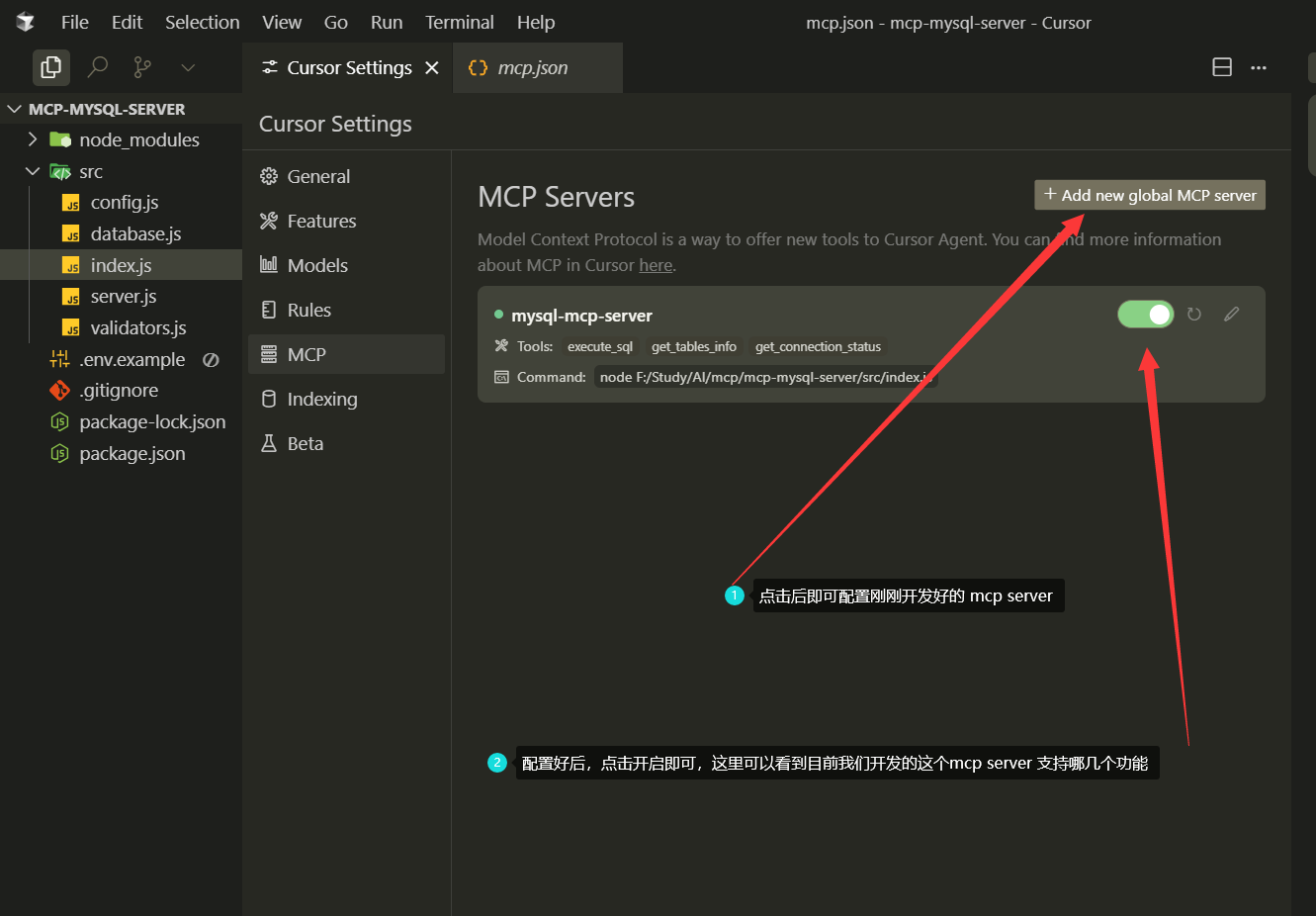
mcp server 的格式是如何呢

配置 server 基本格式规范
{
  "mcpServers": {
    "<server-name>": {
      "command": "<启动命令>",
      "args": ["<参数1>", "<参数2>", ...],
      "env": {
        "<环境变量名1>": "<值1>",
        "<环境变量名2>": "<值2>",
        ...
      },
      "transport": "<传输协议>",
      "port": <端口号>,
      "host": "<主机地址>"
    }
  }
}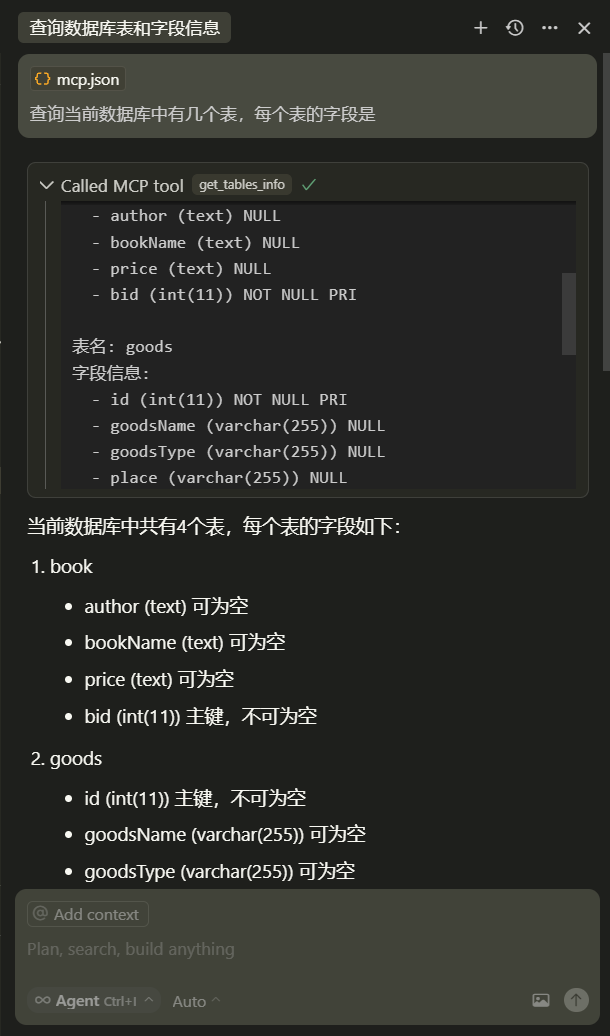


看到这里,是不是觉得很神奇?我们用自然语言描述需求,AI助手自动生成并执行SQL,然后分析结果给出结论。
欢迎提交 Issue 和 PR 参与贡献!
Add a new column to existing table
| Name | Required | Description | Default |
|---|---|---|---|
| table | Yes | ||
| field | Yes |
Does the description disclose side effects, auth requirements, rate limits, or destructive behavior?
With no annotations provided, the description carries full burden for behavioral disclosure. It states this is a mutation operation ('Add'), implying it modifies the database schema, but doesn't mention permissions required, whether it's reversible, potential side effects on existing data, or error conditions. This leaves significant gaps for a tool that alters database structure.
Agents need to know what a tool does to the world before calling it. Descriptions should go beyond structured annotations to explain consequences.
Is the description appropriately sized, front-loaded, and free of redundancy?
The description is a single, efficient sentence that gets straight to the point with no wasted words. It's appropriately sized for a simple tool and front-loads the core action without unnecessary elaboration.
Shorter descriptions cost fewer tokens and are easier for agents to parse. Every sentence should earn its place.
Given the tool's complexity, does the description cover enough for an agent to succeed on first attempt?
Given the complexity (database schema mutation with nested parameters), lack of annotations, and no output schema, the description is inadequate. It doesn't cover behavioral aspects like permissions or side effects, parameter details, or what to expect upon success/failure. For a tool that modifies database structure, this leaves too many unknowns for safe and effective use.
Complex tools with many parameters or behaviors need more documentation. Simple tools need less. This dimension scales expectations accordingly.
Does the description clarify parameter syntax, constraints, interactions, or defaults beyond what the schema provides?
Schema description coverage is 0%, so the description must compensate but fails to do so. It doesn't explain what 'table' and 'field' parameters represent, their expected formats, or the nested structure of 'field' with properties like 'name', 'type', 'nullable', etc. The description adds no meaningful parameter context beyond what's minimally implied by the tool name.
Input schemas describe structure but not intent. Descriptions should explain non-obvious parameter relationships and valid value ranges.
Does the description clearly state what the tool does and how it differs from similar tools?
The description clearly states the action ('Add') and the target resource ('new column to existing table'), making the purpose immediately understandable. It doesn't distinguish from siblings like 'create_table' or 'describe_table', but it's specific enough to avoid confusion with other database operations.
Agents choose between tools based on descriptions. A clear purpose with a specific verb and resource helps agents select the right tool.
Does the description explain when to use this tool, when not to, or what alternatives exist?
The description provides no guidance on when to use this tool versus alternatives like 'create_table' for new tables or 'execute' for general SQL commands. There's no mention of prerequisites, such as needing an existing table, or any context about when this operation is appropriate versus other schema modifications.
Agents often have multiple tools that could apply. Explicit usage guidance like "use X instead of Y when Z" prevents misuse.
Connect to MySQL database using URL or config
| Name | Required | Description | Default |
|---|---|---|---|
| url | No | Database URL (mysql://user:pass@host:port/db) | |
| workspace | No | Project workspace path | |
| host | No | ||
| port | No | Database port (default: 3306) | |
| user | No | ||
| password | No | ||
| database | No |
Does the description disclose side effects, auth requirements, rate limits, or destructive behavior?
No annotations are provided, so the description carries the full burden of behavioral disclosure. It states the tool connects to a database but doesn't describe what happens after connection (e.g., whether it returns a connection object, sets a default session, or requires subsequent tools to reference this connection). It also omits critical details like authentication requirements, error handling, timeout behavior, or whether connections are persistent. For a tool with potential security and state implications, this is inadequate.
Agents need to know what a tool does to the world before calling it. Descriptions should go beyond structured annotations to explain consequences.
Is the description appropriately sized, front-loaded, and free of redundancy?
The description is a single, efficient sentence that front-loads the core purpose ('Connect to MySQL database') and adds necessary detail ('using URL or config'). There is no wasted language, repetition, or unnecessary elaboration, making it easy to parse quickly.
Shorter descriptions cost fewer tokens and are easier for agents to parse. Every sentence should earn its place.
Given the tool's complexity, does the description cover enough for an agent to succeed on first attempt?
Given the complexity of a database connection tool with 7 parameters, no annotations, and no output schema, the description is incomplete. It doesn't address what the tool returns (e.g., a connection handle, success status), how errors are handled, or the implications of the connection (e.g., whether it's shared across tools). For a foundational tool in a database server, this leaves too many unknowns for effective agent use.
Complex tools with many parameters or behaviors need more documentation. Simple tools need less. This dimension scales expectations accordingly.
Does the description clarify parameter syntax, constraints, interactions, or defaults beyond what the schema provides?
The description mentions 'using URL or config,' which loosely maps to the parameters (e.g., 'url' for URL-based connection and other parameters for config-based). However, with 7 parameters and only 43% schema description coverage, the description doesn't compensate for the undocumented parameters like 'host,' 'user,' 'password,' and 'database.' It also fails to explain the relationship between parameters (e.g., if 'url' is provided, are other parameters ignored?) or the 'workspace' parameter's purpose.
Input schemas describe structure but not intent. Descriptions should explain non-obvious parameter relationships and valid value ranges.
Does the description clearly state what the tool does and how it differs from similar tools?
The description clearly states the action ('Connect to MySQL database') and the resource ('MySQL database'), with the method ('using URL or config') providing additional specificity. It distinguishes from siblings like 'execute' or 'query' by focusing on establishing a connection rather than performing operations. However, it doesn't explicitly differentiate from potential connection-related tools that might exist in other contexts.
Agents choose between tools based on descriptions. A clear purpose with a specific verb and resource helps agents select the right tool.
Does the description explain when to use this tool, when not to, or what alternatives exist?
The description provides no guidance on when to use this tool versus alternatives. It doesn't mention prerequisites (e.g., whether this must be called before other database operations), nor does it clarify if it's for initial setup, reconnection, or switching contexts. With siblings like 'execute' and 'query' that likely require an active connection, the lack of usage context is a significant gap.
Agents often have multiple tools that could apply. Explicit usage guidance like "use X instead of Y when Z" prevents misuse.
Create a new table in the database
| Name | Required | Description | Default |
|---|---|---|---|
| table | Yes | Table name | |
| fields | Yes | ||
| indexes | No |
Does the description disclose side effects, auth requirements, rate limits, or destructive behavior?
With no annotations provided, the description carries the full burden of behavioral disclosure. It states 'Create' which implies a write/mutation operation, but doesn't cover critical aspects like required permissions, whether the operation is idempotent, error handling, or what happens on conflicts (e.g., if the table already exists). This leaves significant gaps for a tool that modifies database state.
Agents need to know what a tool does to the world before calling it. Descriptions should go beyond structured annotations to explain consequences.
Is the description appropriately sized, front-loaded, and free of redundancy?
The description is a single, efficient sentence that directly states the tool's purpose without unnecessary words. It's front-loaded and wastes no space, making it easy for an agent to parse quickly.
Shorter descriptions cost fewer tokens and are easier for agents to parse. Every sentence should earn its place.
Given the tool's complexity, does the description cover enough for an agent to succeed on first attempt?
For a tool with 3 parameters, low schema description coverage (33%), no annotations, and no output schema, the description is inadequate. It doesn't compensate for the missing behavioral context (e.g., mutation effects, error cases) or parameter details, leaving the agent poorly equipped to use this tool correctly in a database environment.
Complex tools with many parameters or behaviors need more documentation. Simple tools need less. This dimension scales expectations accordingly.
Does the description clarify parameter syntax, constraints, interactions, or defaults beyond what the schema provides?
Schema description coverage is low at 33%, with only the 'table' parameter documented. The description adds no parameter semantics beyond what the schema provides—it doesn't explain the purpose of 'fields' or 'indexes', their structure, or constraints. However, the schema itself defines these parameters with detailed properties, providing some baseline understanding despite the coverage gap.
Input schemas describe structure but not intent. Descriptions should explain non-obvious parameter relationships and valid value ranges.
Does the description clearly state what the tool does and how it differs from similar tools?
The description clearly states the action ('Create') and resource ('new table in the database'), providing a specific verb+resource combination. However, it doesn't differentiate from sibling tools like 'add_column' or 'execute', which might also involve database modifications, leaving room for ambiguity.
Agents choose between tools based on descriptions. A clear purpose with a specific verb and resource helps agents select the right tool.
Does the description explain when to use this tool, when not to, or what alternatives exist?
No guidance is provided on when to use this tool versus alternatives. For example, it doesn't mention prerequisites like needing an existing database connection (which 'connect_db' might handle) or when to use 'execute' for other SQL operations, leaving the agent without contextual usage cues.
Agents often have multiple tools that could apply. Explicit usage guidance like "use X instead of Y when Z" prevents misuse.
Get table structure
| Name | Required | Description | Default |
|---|---|---|---|
| table | Yes | Table name |
Does the description disclose side effects, auth requirements, rate limits, or destructive behavior?
No annotations are provided, and the description fails to disclose behavioral traits like read-only nature, side effects, or required permissions. It simply states the function without additional context.
Agents need to know what a tool does to the world before calling it. Descriptions should go beyond structured annotations to explain consequences.
Is the description appropriately sized, front-loaded, and free of redundancy?
The description is extremely concise (two words), front-loaded, and gets straight to the point. However, it could benefit from a bit more detail without sacrificing brevity.
Shorter descriptions cost fewer tokens and are easier for agents to parse. Every sentence should earn its place.
Given the tool's complexity, does the description cover enough for an agent to succeed on first attempt?
Given the tool is simple with one parameter and no output schema, the description is minimal but adequate for a basic understanding. However, it doesn't specify what 'structure' includes (e.g., columns, types), leaving some ambiguity.
Complex tools with many parameters or behaviors need more documentation. Simple tools need less. This dimension scales expectations accordingly.
Does the description clarify parameter syntax, constraints, interactions, or defaults beyond what the schema provides?
Schema coverage is 100% with the only parameter 'table' described as 'Table name'. The description adds no new meaning beyond the schema, so baseline 3 is appropriate.
Input schemas describe structure but not intent. Descriptions should explain non-obvious parameter relationships and valid value ranges.
Does the description clearly state what the tool does and how it differs from similar tools?
The description 'Get table structure' clearly states the verb (Get) and resource (table structure), and distinguishes the tool from siblings like execute, list_tables, and query, which have different purposes.
Agents choose between tools based on descriptions. A clear purpose with a specific verb and resource helps agents select the right tool.
Does the description explain when to use this tool, when not to, or what alternatives exist?
The description provides no guidance on when to use this tool vs alternatives, such as list_tables or query. It lacks context on when not to use it or any prerequisites.
Agents often have multiple tools that could apply. Explicit usage guidance like "use X instead of Y when Z" prevents misuse.
Execute an INSERT, UPDATE, or DELETE query
| Name | Required | Description | Default |
|---|---|---|---|
| sql | Yes | The SQL query string (INSERT, UPDATE, DELETE) to execute. | |
| params | No | An optional array of parameters (as strings) to bind to the SQL query placeholders (e.g., ?). |
Does the description disclose side effects, auth requirements, rate limits, or destructive behavior?
With no annotations provided, the description carries the full burden of behavioral disclosure. It states the tool executes SQL queries but fails to mention critical traits like authentication requirements, transaction handling, error behavior, or potential side effects (e.g., data modification risks). This leaves significant gaps in understanding the tool's behavior.
Agents need to know what a tool does to the world before calling it. Descriptions should go beyond structured annotations to explain consequences.
Is the description appropriately sized, front-loaded, and free of redundancy?
The description is extremely concise and front-loaded, consisting of a single, direct sentence that states the tool's purpose without any unnecessary words. Every part of the sentence earns its place by clearly conveying the core functionality.
Shorter descriptions cost fewer tokens and are easier for agents to parse. Every sentence should earn its place.
Given the tool's complexity, does the description cover enough for an agent to succeed on first attempt?
Given the complexity of executing SQL queries (a potentially destructive operation), the lack of annotations, and no output schema, the description is incomplete. It does not address safety considerations, return values, or error handling, making it inadequate for informed tool selection and invocation.
Complex tools with many parameters or behaviors need more documentation. Simple tools need less. This dimension scales expectations accordingly.
Does the description clarify parameter syntax, constraints, interactions, or defaults beyond what the schema provides?
The schema description coverage is 100%, so the input schema already documents both parameters ('sql' and 'params') thoroughly. The description adds no additional semantic meaning beyond what the schema provides, such as examples or constraints, resulting in a baseline score of 3.
Input schemas describe structure but not intent. Descriptions should explain non-obvious parameter relationships and valid value ranges.
Does the description clearly state what the tool does and how it differs from similar tools?
The description clearly states the action ('Execute') and the type of operations ('INSERT, UPDATE, or DELETE query'), making the purpose specific and understandable. However, it does not explicitly distinguish this tool from sibling tools like 'query' (which might handle SELECT queries), leaving room for ambiguity in differentiation.
Agents choose between tools based on descriptions. A clear purpose with a specific verb and resource helps agents select the right tool.
Does the description explain when to use this tool, when not to, or what alternatives exist?
The description provides no guidance on when to use this tool versus alternatives, such as 'query' for SELECT operations or other siblings for schema modifications. It lacks explicit instructions on prerequisites, context, or exclusions, offering minimal usage direction.
Agents often have multiple tools that could apply. Explicit usage guidance like "use X instead of Y when Z" prevents misuse.
List all tables in the database
| Name | Required | Description | Default |
|---|---|---|---|
No parameters | |||
Does the description disclose side effects, auth requirements, rate limits, or destructive behavior?
There are no annotations, so the description must fully disclose behavior. It merely states 'List all tables', which implies a read operation, but omits details on permissions, output format, or performance implications.
Agents need to know what a tool does to the world before calling it. Descriptions should go beyond structured annotations to explain consequences.
Is the description appropriately sized, front-loaded, and free of redundancy?
The description is a single, efficient sentence with no unnecessary words. It is appropriately front-loaded but lacks any structural enhancement like bullet points that could aid readability.
Shorter descriptions cost fewer tokens and are easier for agents to parse. Every sentence should earn its place.
Given the tool's complexity, does the description cover enough for an agent to succeed on first attempt?
Given no output schema or annotations, the description should explain what 'list' returns (e.g., table names, schemas). Without this, an agent may not know how to use the result. Sibling tools like 'describe_table' suggest additional context might be needed.
Complex tools with many parameters or behaviors need more documentation. Simple tools need less. This dimension scales expectations accordingly.
Does the description clarify parameter syntax, constraints, interactions, or defaults beyond what the schema provides?
The tool has no parameters, so the description cannot add parameter meaning. Baseline for zero parameters is 4, and the description is sufficient for the parameterless case.
Input schemas describe structure but not intent. Descriptions should explain non-obvious parameter relationships and valid value ranges.
Does the description clearly state what the tool does and how it differs from similar tools?
The description clearly states the tool lists all tables in the database. While it distinguishes from 'describe_table' by listing instead of describing, it does not explicitly differentiate from potential siblings like 'query' or 'execute'.
Agents choose between tools based on descriptions. A clear purpose with a specific verb and resource helps agents select the right tool.
Does the description explain when to use this tool, when not to, or what alternatives exist?
The description provides no guidance on when to use this tool versus its siblings (describe_table, execute, query). It is implied that it retrieves table names, but no context on prerequisites or alternatives.
Agents often have multiple tools that could apply. Explicit usage guidance like "use X instead of Y when Z" prevents misuse.
Execute a SELECT query
| Name | Required | Description | Default |
|---|---|---|---|
| sql | Yes | The SQL SELECT query string to execute. | |
| params | No | An optional array of parameters (as strings) to bind to the SQL query placeholders (e.g., ?). |
Does the description disclose side effects, auth requirements, rate limits, or destructive behavior?
With no annotations provided, the description carries the full burden of behavioral disclosure. 'Execute a SELECT query' implies a read-only operation, but it doesn't specify critical behaviors: whether it requires an active connection, handles errors, returns results in a specific format, has rate limits, or affects database state. For a tool with zero annotation coverage, this is a significant gap in transparency.
Agents need to know what a tool does to the world before calling it. Descriptions should go beyond structured annotations to explain consequences.
Is the description appropriately sized, front-loaded, and free of redundancy?
The description is a single, efficient sentence with zero waste—'Execute a SELECT query' is front-loaded and precisely conveys the core action. Every word earns its place, making it highly concise and well-structured for quick comprehension.
Shorter descriptions cost fewer tokens and are easier for agents to parse. Every sentence should earn its place.
Given the tool's complexity, does the description cover enough for an agent to succeed on first attempt?
Given the complexity of SQL execution (requires connection, error handling, result formatting) and the lack of annotations and output schema, the description is incomplete. It doesn't address prerequisites, behavioral traits, or return values, leaving the agent with insufficient context to use the tool effectively beyond basic parameter passing.
Complex tools with many parameters or behaviors need more documentation. Simple tools need less. This dimension scales expectations accordingly.
Does the description clarify parameter syntax, constraints, interactions, or defaults beyond what the schema provides?
Schema description coverage is 100%, so the schema fully documents both parameters ('sql' and 'params'). The description adds no additional meaning beyond what's in the schema—it doesn't explain parameter interactions, syntax examples, or constraints. Baseline 3 is appropriate when the schema does all the work.
Input schemas describe structure but not intent. Descriptions should explain non-obvious parameter relationships and valid value ranges.
Does the description clearly state what the tool does and how it differs from similar tools?
The description 'Execute a SELECT query' clearly states the verb ('Execute') and resource ('SELECT query'), making the purpose unambiguous. It distinguishes from siblings like 'execute' (which might handle other SQL types) by specifying SELECT queries only. However, it doesn't explicitly differentiate from all siblings (e.g., 'describe_table' also reads data), so it's not a perfect 5.
Agents choose between tools based on descriptions. A clear purpose with a specific verb and resource helps agents select the right tool.
Does the description explain when to use this tool, when not to, or what alternatives exist?
The description provides no guidance on when to use this tool versus alternatives like 'execute', 'list_tables', or 'describe_table'. It doesn't mention prerequisites (e.g., database connection), exclusions (e.g., non-SELECT queries), or contextual cues. This leaves the agent to infer usage from the name and schema alone.
Agents often have multiple tools that could apply. Explicit usage guidance like "use X instead of Y when Z" prevents misuse.
Recent tool additions, removals, and schema changes observed during successful MCP inspections.
v1.0.0connect_db1 field changedInput schema / properties / portAdded value: +{
+ "description": "Database port (default: 3306)",
+ "optional": true,
+ "type": "number"
+}add_columnconnect_dbcreate_tabledescribe_tableexecutelist_tablesqueryScored across 7 tools
Each tool has a clearly distinct purpose with no overlap: add_column modifies table structure, connect_db handles connections, create_table creates tables, describe_table inspects structure, execute handles write queries, list_tables enumerates tables, and query handles read queries. The separation between execute (for INSERT/UPDATE/DELETE) and query (for SELECT) is particularly well-defined.
All tools follow a consistent verb_noun pattern with clear, descriptive names in snake_case: add_column, connect_db, create_table, describe_table, execute, list_tables, query. The naming convention is uniform throughout the set, making it easy to predict tool functions.
With 7 tools, this server is well-scoped for MySQL database operations. Each tool serves a distinct, essential function in the database management workflow, from connection and table listing to query execution and schema modification. The count is neither too sparse nor bloated.
The tool set covers core MySQL operations effectively: connection management, table CRUD (create, list, describe), schema modification (add_column), and query execution (both read and write). A minor gap is the lack of tools for deleting tables or columns, which might require workarounds using execute, but the surface is otherwise complete for basic database interactions.
PostgreSQL, MySQL, and SQL Server in one session. 26 read-only MCP tools for AI agents.
Query Postgres, MySQL, SQL Server, Oracle, BigQuery, ClickHouse and Redshift from your AI client.
Query and update Teable records, manage tables, and access the Teable API with AI agents.
PostgreSQL, MySQL, OpenAPI/Swagger, and shared Agent Memory with scoped access.