
Linux MCP daemon
<div align="center">

</div>
# Linux MCP Daemon
[](https://nucleusv.github.io/linux-mcp-daemon/)
[](https://github.com/nucleusv/linux-mcp-daemon/releases)
[](LICENSE)
[](https://glama.ai/mcp/servers/nucleusv/linux-mcp-daemon)
A high-performance, Go-based Model Context Protocol (MCP) daemon (`mcpd`) designed to securely bridge AI agents directly with the Linux operating system.
## Overview
This project implements a zero-dependency (kernel-first) philosophy. It allows AI agents to introspect and interact with the host Linux system directly via raw syscalls and the Virtual File System (`/proc`, `/sys`) without requiring bloated third-party parsing libraries.
Communication happens directly between the AI agent and the daemon via Server-Sent Events (SSE) and JSON-RPC over HTTPS on port 9091 (TLS is on by default, with a self-signed certificate generated on first start).
## Why
An AI agent that helps run a server needs to see it - load, memory, disks, processes, services, logs, the network - and sometimes to act on it. The usual way is an SSH shell, and a shell is everything at once: any command, any file the account can reach, with `sudo` all of root, and hard to tell afterwards what was done. `mcpd` gives the agent typed tools instead of a shell:
- **Diagnose without a shell.** "Why is the site slow?" - `processes/top`, `memory/usage`, `disks/usage`, `logs/journal-control`, `logs/dmesg`, `network/connections`, `services/list` answer it, with structured output (`json`/`yaml`) the agent doesn't have to scrape from `top` or `df`.
- **Root per tool, not per session.** A user runs every tool as its own OS account; root is granted per tool in `mcp-sudo.yaml` and limited by paths, network destinations and sysctl keys - "may read `/var/log` as root and restart services" rather than "is root".
- **One agent, one account, one token.** Each agent gets its own user, and every call is logged with the user, tool, arguments (secrets redacted) and result - an audit trail of what the agent did.
- **Small and self-contained.** One static Go binary, reading `/proc`, `/sys` and systemd over D-Bus itself; it runs on a bare host, in Docker or in Kubernetes, and `linuxctl` gives people the same tools as a kubectl-like CLI.
> **Grant carefully.** A root grant is root for an agent that follows instructions found in what it reads. Some grants that look narrow are full root (writes to `/etc`, `services/manage`, sysctl writes). Read [Permissions and Risks](https://nucleusv.github.io/linux-mcp-daemon/configuration/permissions-and-risks) before granting anything.
## How It Works
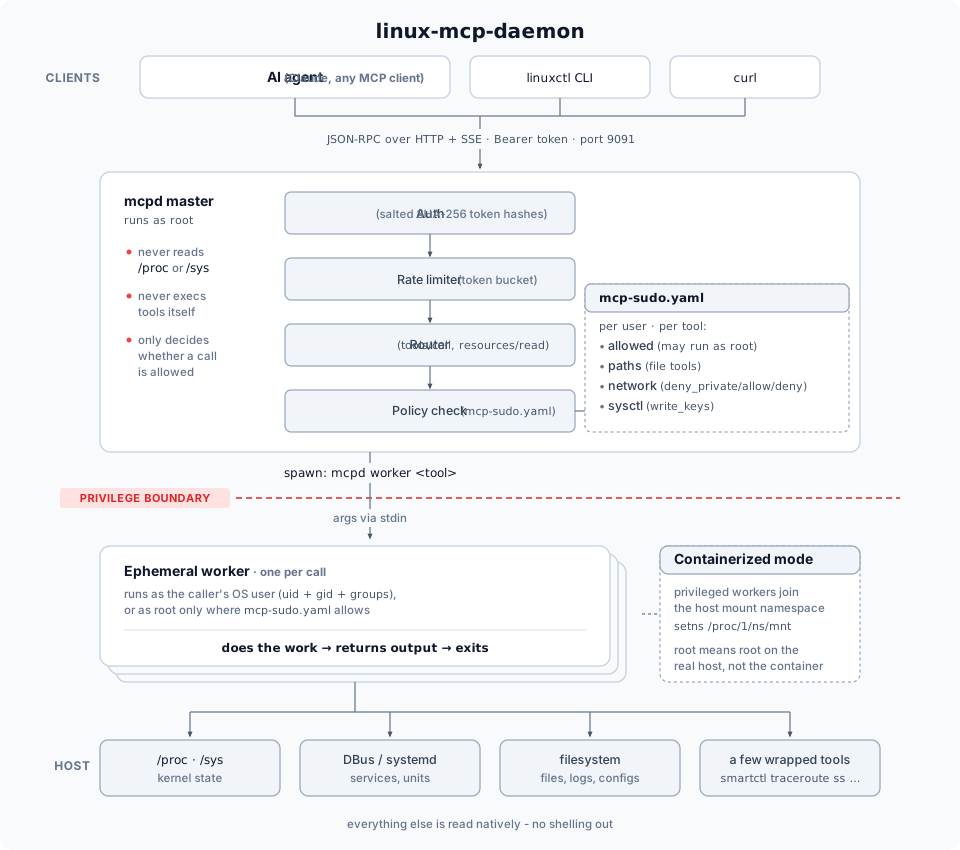
- **Every tool/resource call spawns a fresh worker process and exits.** There's no long-lived state per call - `internal/worker/spawner.go` re-execs the `mcpd` binary itself in `worker` mode (arguments on stdin, never argv), with `syscall.Credential{Uid, Gid, Groups}` set to a real OS account resolved via `user.Lookup()`. This is the actual privilege isolation, not a config flag: an unprivileged user's worker process is a genuinely different Linux UID than a privileged one's.
- **`configs/mcp-sudo.yaml` decides, per user and per tool, whether `privileged: true` is honored.** Two grants exist for resources specifically (see `ARCHITECTURE.md`'s gotcha section) - one for the resource URI itself, one for the internal worker tool name behind it.
- **When `mcpd` runs containerized** (`configs/daemon.yaml`'s `worker.containerized: true`, this project's actual Kubernetes deployment), a privileged worker also joins the real host's mount namespace (`setns(CLONE_NEWNS)` on `/proc/1/ns/mnt`, no external `nsenter` binary) - so `privileged: true` means root on the real host, not just root inside the daemon's own container image.
- **Bearer tokens are salted+hashed** in `users.yaml` (`token_salt` + `token_hash`, `sha256`, constant-time compared; the file is `0600`), not stored in plaintext. Users and grants are edited only locally, on the host, via `linuxctl <verb> mcpd user` and `linuxctl edit mcpd config` (validated like `visudo`) - there is no MCP tool that edits them, so nothing with just a bearer token can grant itself anything. The running daemon applies changes without a restart through `daemon/reload-config`, which only re-reads the files and rejects invalid ones (see [Daemon User Administration](docs/website/docs/linuxctl/mcpd-admin.md)).
- **Every read is schema-driven, not hand-listed.** `linuxctl` fetches `tools/list`/`resources/list`/`resources/templates/list` from the live daemon on every invocation and resolves its `<verb> <group> [keyword]` grammar against that - a new tool added server-side is immediately usable client-side with zero code changes.
## Features
- **Direct AI Interaction:** HTTP/SSE transport for immediate agent-to-daemon communication.
- **Strict Security:** Rate limiting, salted+hashed Bearer token authentication, and directory traversal protection.
- **Privilege Separation:** Master daemon runs as root, spinning up ephemeral unprivileged/privileged workers based on rules defined in `configs/mcp-sudo.yaml`.
- **High Performance:** Uses `singleflight` deduplication and TTL caching for efficient system introspection.
- **Docker & Kubernetes Ready:** Fully containerized with a multi-stage Docker build and Kubernetes deployment manifests that allow safe host introspection.
## Get started
### Install on Linux (systemd)
```bash
curl -fsSL https://raw.githubusercontent.com/nucleusv/linux-mcp-daemon/main/scripts/install.sh | sudo bash
```
Needs `sudo` and `curl` on an amd64/arm64 host (in a bare `ubuntu`/`debian` container: `apt update && apt install -y curl ca-certificates`, then pipe to `bash` as root). This downloads the latest release for your architecture (amd64/arm64), **verifies its sha256 checksum**, installs `mcpd` and `linuxctl` to `/usr/local/bin`, writes clean configs to `/etc/mcpd/configs` (no default users or tokens), creates a first user `mcp` and **prints its token once**, and starts the `mcpd` systemd service. Then:
```bash
export MCP_SERVER=https://127.0.0.1:9091
export MCP_TLS_FINGERPRINT=<printed by the installer>
export MCP_TOKEN=<token printed by the installer>
linuxctl get system os-release
linuxctl get processes top
```
- **Upgrade:** run the same command again - configs are kept, the service restarts only if `mcpd` changed. From v0.1.0, grant your first user `daemon/reload-config` once - see [Upgrading](https://nucleusv.github.io/linux-mcp-daemon/installation/#upgrading).
- **Pin a version / name the user:** `... | sudo bash -s -- --version v0.1.0 --user alice`
- **More users:** each needs an OS account of the same name - see [Adding more users](https://nucleusv.github.io/linux-mcp-daemon/installation/#adding-more-users).
- **Uninstall:** `... | sudo bash -s -- --uninstall` (add `--purge` to delete `/etc/mcpd`; the `mcp` OS account stays - `sudo userdel -r mcp`)
- **Packages:** `.deb` and `.rpm` for amd64/arm64 on every [release](https://github.com/nucleusv/linux-mcp-daemon/releases) - `sudo apt install ./linux-mcp-daemon_<version>_amd64.deb` or `sudo dnf install ./linux-mcp-daemon-<version>-1.x86_64.rpm`, then the [next steps](https://nucleusv.github.io/linux-mcp-daemon/installation/#packages-deb-rpm) it prints.
- **Container image:** `ghcr.io/nucleusv/linux-mcp-daemon` (amd64/arm64) - setup steps in the [installation docs](https://nucleusv.github.io/linux-mcp-daemon/installation/).
- **macOS (CLI only):** the same script installs just `linuxctl` - `curl -fsSL .../install.sh | bash -s -- --bin-dir ~/.local/bin`, then `export PATH="$HOME/.local/bin:$PATH"` (not on macOS's default PATH) - to drive a remote mcpd.
> mcpd listens on all interfaces over **TLS** (a self-signed certificate it creates on first start; clients pin its fingerprint). Plain HTTP is off by default - bearer tokens would travel in clear text. Root access for tools is granted per user and per tool in `mcp-sudo.yaml`.
Full guide: [Installation](https://nucleusv.github.io/linux-mcp-daemon/installation/) · [Connect an AI agent](https://nucleusv.github.io/linux-mcp-daemon/ai-agent-configuration/) · [mcp-sudo.yaml](https://nucleusv.github.io/linux-mcp-daemon/configuration/mcp-sudo/)
## Development: build from source
### 1. Build and Deploy the Server (`mcpd`)
1. Build the Docker image:
```bash
./scripts/build.sh
```
2. Deploy to your local Kubernetes cluster:
```bash
./scripts/deploy.sh
```
### 2. Build the Client (`linuxctl`)
You can build the CLI client directly on your host machine (e.g. macOS):
```bash
./scripts/build-cli.sh # writes executables/linuxctl
export PATH="$PWD/executables:$PATH" # so the examples below run as written
```
Installed from a release (`install.sh`, `.deb`/`.rpm`), `linuxctl` is already on your `PATH`.
### 3. Usage (local development)
The daemon runs on port `9091`. You can connect via your AI client using SSE, or use the `linuxctl` CLI tool:
```bash
# Set your token as an environment variable
export MCP_TOKEN="your_token_here"
# Ping the daemon
linuxctl ping
```
`linuxctl` speaks a small verb/group grammar (`linuxctl <verb> <group> [target-keyword] [args]`) and dynamically discovers every tool and resource from the running daemon - there's no separate client-side command list to keep in sync. Full reference: [linuxctl docs](docs/website/docs/linuxctl/overview.md) or `man linuxctl`. Every example below shows both forms: `linuxctl`, and the raw MCP JSON-RPC `curl` call it resolves to - the full per-tool/resource reference with these side by side for every single one lives at [MCP API docs](docs/website/docs/mcp-api/overview.md).
### Calling the API directly with curl
`mcpd` speaks JSON-RPC 2.0 over HTTP + SSE, not plain request/response HTTP - every call is a two-step handshake: open an SSE stream to get a one-time POST endpoint, then POST the JSON-RPC request there (the actual result streams back on the SSE connection, not in the POST's response body):
```bash
# 1. Open the SSE stream in the background and capture the endpoint it prints
curl -N -s --cacert mcpd.crt -H "Authorization: Bearer $MCP_TOKEN" https://localhost:9091/sse &
# server sends: event: endpoint / data: /message?session_id=...
# 2. POST a request to that endpoint
curl -s --cacert mcpd.crt -X POST "https://localhost:9091/message?session_id=<from step 1>" \
-H "Authorization: Bearer $MCP_TOKEN" \
-H "Content-Type: application/json" \
-d '{"jsonrpc": "2.0", "id": "1", "method": "tools/list"}'
# 3. Watch the SSE stream from step 1 for the matching "id": "1" response
```
Every example below follows this exact pattern - only the `-d` payload changes.
### Files
```bash
# List a directory, as a table (get is the sole read verb - one result or many, same as kubectl)
$ linuxctl get files list /var/log --output table
MODIFIED NAME SIZE IS_DIR
2026-09-22 18:38:14 alternatives.log 6522 false
2026-09-22 18:38:10 apt 4096 true
...
```
```bash
curl -s -X POST "$ENDPOINT" -H "Authorization: Bearer $MCP_TOKEN" -H "Content-Type: application/json" \
-d '{"jsonrpc":"2.0","id":"1","method":"tools/call","params":{"name":"files/list","arguments":{"path":"/var/log","output_format":"table"}}}'
```
```bash
# Read a single file's contents (bare - no keyword needed, files' only other read candidate)
linuxctl get files /etc/hosts
```
```bash
curl -s -X POST "$ENDPOINT" -H "Authorization: Bearer $MCP_TOKEN" -H "Content-Type: application/json" \
-d '{"jsonrpc":"2.0","id":"1","method":"tools/call","params":{"name":"files/read","arguments":{"path":"/etc/hosts"}}}'
```
### Resources (direct by URI)
```bash
# Read a static resource directly by URI (resource URIs always use scheme://path)
$ linuxctl resource os://uname
Sysname: Linux
Nodename: desktop-control-plane
Release: 7.0.12-linuxkit
...
```
```bash
curl -s -X POST "$ENDPOINT" -H "Authorization: Bearer $MCP_TOKEN" -H "Content-Type: application/json" \
-d '{"jsonrpc":"2.0","id":"1","method":"resources/read","params":{"uri":"os://uname"}}'
```
### Disks
```bash
# Native partition geometry - parsed from /sys/class/block, no fdisk dependency
linuxctl get disks partitions vda --output json
```
```bash
curl -s -X POST "$ENDPOINT" -H "Authorization: Bearer $MCP_TOKEN" -H "Content-Type: application/json" \
-d '{"jsonrpc":"2.0","id":"1","method":"tools/call","params":{"name":"disks/partitions","arguments":{"device":"vda","output_format":"json"}}}'
```
```bash
# Run a privileged tool (requires a root rule in configs/mcp-sudo.yaml)
linuxctl get disks free / --privileged true
```
```bash
curl -s -X POST "$ENDPOINT" -H "Authorization: Bearer $MCP_TOKEN" -H "Content-Type: application/json" \
-d '{"jsonrpc":"2.0","id":"1","method":"tools/call","params":{"name":"disks/free","arguments":{"path":"/","privileged":true}}}'
```
### Processes: one result vs many, and rich detail
```bash
# Same underlying tool - bare form lists many, a specific PID filters to one
linuxctl get processes --sort_by mem --limit 5
linuxctl get processes 1234
```
```bash
curl -s -X POST "$ENDPOINT" -H "Authorization: Bearer $MCP_TOKEN" -H "Content-Type: application/json" \
-d '{"jsonrpc":"2.0","id":"1","method":"tools/call","params":{"name":"processes/list","arguments":{"pid":1234}}}'
```
```bash
# Rich aggregated detail (combines several reads, excludes secret-shaped data like environ)
linuxctl describe processes 1234
```
```bash
# describe aggregates multiple resources/read calls client-side - e.g. one of them:
curl -s -X POST "$ENDPOINT" -H "Authorization: Bearer $MCP_TOKEN" -H "Content-Type: application/json" \
-d '{"jsonrpc":"2.0","id":"1","method":"resources/read","params":{"uri":"process://1234/status"}}'
```
### Logs (host-only tool, requires `privileged: true` in containerized deployments)
```bash
# journalctl only exists on the host, never in this daemon's own image
linuxctl get logs journal --unit kubelet.service --boot true --privileged true
```
```bash
curl -s -X POST "$ENDPOINT" -H "Authorization: Bearer $MCP_TOKEN" -H "Content-Type: application/json" \
-d '{"jsonrpc":"2.0","id":"1","method":"tools/call","params":{"name":"logs/journal-control","arguments":{"unit":"kubelet.service","boot":true,"privileged":true}}}'
```
### Mutations (services, kernel)
```bash
linuxctl restart system services nginx.service --privileged true
linuxctl update kernel sysctl net.ipv4.ip_forward 1 --privileged true
```
```bash
curl -s -X POST "$ENDPOINT" -H "Authorization: Bearer $MCP_TOKEN" -H "Content-Type: application/json" \
-d '{"jsonrpc":"2.0","id":"1","method":"tools/call","params":{"name":"services/manage","arguments":{"service":"nginx.service","action":"restart","privileged":true}}}'
```
### Docker (read, lifecycle, exec)
Talks to the Docker Engine API over its socket - no `docker` CLI needed. Every `docker/*` tool needs its own grant in `mcp-sudo.yaml`; the ones that name a container also need a `containers:` list, so an agent only touches the containers you list.
```bash
linuxctl get docker containers --all true # running and stopped
linuxctl get docker images
linuxctl get docker network bridge # one network's full configuration
linuxctl get docker container web-1 status # computed runtime summary (state, health, uptime, limits)
linuxctl resource docker-container://web-1/stats # the same templates by URI: docker-container://, docker-image://, docker-volume://, docker-network://
linuxctl get docker logs web-1 --lines 50
# needs docker/manage and docker/exec grants that list web-1
linuxctl restart docker web-1
linuxctl exec docker web-1 ls /usr/share/nginx/html
linuxctl exec docker web-1 -- ls --color /etc # after `--` everything goes to the container as-is
```
### Crontabs
Read, list and replace crontabs with the `crontab` command's own rules (`cron.allow`/`cron.deny` still apply). **Writing a crontab schedules commands as that user, and the job survives the end of the session and the revocation of the token** - read the [crontab risks](https://nucleusv.github.io/linux-mcp-daemon/next/configuration/permissions-and-risks#crontabs) before you grant it.
```bash
linuxctl get crontabs # my own crontab, exactly as `crontab -l` prints it
linuxctl update crontabs --content "$(cat mycron.txt)" # replace my whole crontab
linuxctl edit crontabs # open it in $EDITOR, write back if unchanged meanwhile
# another user's crontab: sudo plus a rule naming that account in mcp-sudo.yaml
linuxctl get crontabs --privileged true # the users you may view that have a crontab
linuxctl get crontabs test_user --privileged true
linuxctl update crontabs test_user --privileged true --content "$(cat test_user.cron)"
```
### Introspecting the MCP protocol itself
```bash
linuxctl get mcp-api info # raw initialize response: protocol version + declared capabilities
linuxctl get mcp-api tools # every tool, by literal name
linuxctl get mcp-api resources # every static resource + template
linuxctl get mcp-api prompts # reports plainly that mcpd doesn't implement this MCP capability
```
```bash
curl -s -X POST "$ENDPOINT" -H "Authorization: Bearer $MCP_TOKEN" -H "Content-Type: application/json" \
-d '{"jsonrpc":"2.0","id":"1","method":"initialize","params":{"protocolVersion":"2024-11-05","capabilities":{},"clientInfo":{"name":"curl","version":"1.0"}}}'
```
### Direct-by-name escape hatches (bypassing the verb grammar)
```bash
linuxctl tool files/list --path /tmp # symmetric with `resource <uri>` above
```
```bash
curl -s -X POST "$ENDPOINT" -H "Authorization: Bearer $MCP_TOKEN" -H "Content-Type: application/json" \
-d '{"jsonrpc":"2.0","id":"1","method":"tools/call","params":{"name":"files/list","arguments":{"path":"/tmp"}}}'
```
### Daemon user/token administration (local-only, no network call at all)
```bash
linuxctl create mcpd user alice # generates a token, prints it once, writes to configs/*.yaml directly
linuxctl list mcpd users
```
There's no curl equivalent for this group - see [Daemon User Administration](docs/website/docs/linuxctl/mcpd-admin.md) for why it's deliberately kept off the network entirely.
## Project Structure
- `cmd/mcpd/`: Main server application entrypoint.
- `cmd/linuxctl/`: The CLI client application.
- `configs/`: Configuration files (Daemon config, Sudo rules).
- `internal/`: Encapsulated business logic:
- `auth/`: Per-user rate limiting.
- `config/`: `daemon.yaml`, `users.yaml` and `mcp-sudo.yaml` parsing and validation (shared by mcpd and `linuxctl`).
- `rpc/`: MCP JSON-RPC handlers - tool/resource registry, authorization, config reload.
- `worker/`: Spawns each call as a short-lived worker under the caller's OS account (or root).
- `tools/`, `resources/`: One package per tool and resource.
- `fsafe/`: Opening paths without following symlinks (openat with O_NOFOLLOW).
- `kernel/`, `procstat/`: Parsing `/proc` (sockets, processes).
- `logging/`: Leveled, structured logging.
- `netpolicy/`: Network destination policy for `network/curl` and `network/ping`.
- `k8s/`: Kubernetes deployment manifests.
- `scripts/`: Build and deployment automation.
## Releases
Pushing a SemVer tag (`git tag -a v0.1.0 -m v0.1.0 && git push origin v0.1.0`) runs [`.github/workflows/release.yml`](.github/workflows/release.yml): tests, then [GoReleaser](.goreleaser.yaml) publishes per-platform archives, `checksums.txt` and a changelog to GitHub Releases, and a multi-arch image to `ghcr.io/nucleusv/linux-mcp-daemon`.
## License
[Apache License 2.0](LICENSE) - see also [NOTICE](NOTICE).
[](https://glama.ai/mcp/servers/nucleusv/linux-mcp-daemon)
TDQS
Scored across 48 tools
Tools are grouped by domain prefixes (docker/, files/, disks/, etc.) and each has a clearly distinct purpose, with descriptions that explicitly cross-reference sibling tools to guide selection. Some overlap exists in listing tools (e.g., processes/list vs processes/top, multiple disk tools) but descriptions resolve ambiguity effectively.
All names follow a consistent namespace/identifier pattern using lowercase and slashes (e.g., files/list, docker/containers, network/ping). The pattern mixes verb-style and noun-style identifiers, so it is not a pure verb_noun convention, but the structure is predictable throughout.
48 tools is far above the typical 3–15 range and well into the 'too many' category. While the server covers a broad Linux administration domain, many tools are very granular (e.g., seven disk-related tools) and could be consolidated without losing functionality.
Significant lifecycle gaps exist: no file delete, move, or copy; no user creation/modification; no Docker container creation, image pull, or build; no package installation. These missing operations will cause agent failures for common administrative tasks, though read-heavy coverage and mutation via grants are present.