NebulaGraph MCP Server
Enables configuration of the NebulaGraph MCP server via environment variables and .env files for storing connection details and credentials.
Hosts the server's repository and provides CI/CD workflows for testing and linting through GitHub Actions.
Provides access to NebulaGraph databases, enabling graph exploration through schema discovery, query execution, and graph algorithm shortcuts for AI agents to interact with graph data.
Enables distribution and installation of the NebulaGraph MCP server through the Python Package Index, allowing users to easily install the server using pip.
Runs on Python runtime, supporting multiple Python versions as indicated by the PyPI version badge.
Click on "Install Server".
Wait a few minutes for the server to deploy. Once ready, it will show a "Started" state.
In the chat, type
@followed by the MCP server name and your instructions, e.g., "@NebulaGraph MCP Servershow me the schema of the social network graph"
That's it! The server will respond to your query, and you can continue using it as needed.
Here is a step-by-step guide with screenshots.
Model Context Protocol Server for NebulaGraph
A Model Context Protocol (MCP) server implementation that provides access to NebulaGraph.
Features
Seamless access to NebulaGraph 3.x .
Get ready for graph exploration, you know, Schema, Query, and a few shortcut algorithms.
Follow Model Context Protocol, ready to integrate with LLM tooling systems.
Simple command-line interface with support for configuration via environment variables and .env files.

Related MCP server: mcp-graphql
Installation
pip install nebulagraph-mcp-serverUsage
nebulagraph-mcp-server will load configs from .env, for example:
NEBULA_VERSION=v3 # only v3 is supported
NEBULA_HOST=<your-nebulagraph-server-host>
NEBULA_PORT=<your-nebulagraph-server-port>
NEBULA_USER=<your-nebulagraph-server-user>
NEBULA_PASSWORD=<your-nebulagraph-server-password>It requires the value of
NEBULA_VERSIONto be equal to v3 until we are ready for v5.
Development
npx @modelcontextprotocol/inspector \
uv run nebulagraph-mcp-serverCredits
The layout and workflow of this repo is copied from mcp-server-opendal.
Available Tools
5 toolsexecute_queryC
Execute a query Args: query: The query to execute space: The space to use Returns: The results of the query
| Name | Required | Description | Default |
|---|---|---|---|
| query | Yes | ||
| space | Yes |
TDQS
Does the description disclose side effects, auth requirements, rate limits, or destructive behavior?
With no annotations provided, the description carries the full burden of behavioral disclosure. It mentions executing a query and returning results but lacks details on permissions, rate limits, side effects, or error handling. This is inadequate for a mutation tool with zero annotation coverage.
Agents need to know what a tool does to the world before calling it. Descriptions should go beyond structured annotations to explain consequences.
Is the description appropriately sized, front-loaded, and free of redundancy?
The description is brief and structured with sections for Args and Returns, making it easy to scan. However, it's under-specified rather than concise, as key details are missing, but the format is efficient.
Shorter descriptions cost fewer tokens and are easier for agents to parse. Every sentence should earn its place.
Given the tool's complexity, does the description cover enough for an agent to succeed on first attempt?
Given no annotations, no output schema, and low schema coverage, the description is incomplete. It fails to explain query types, space context, result format, or error scenarios, leaving significant gaps for a tool with 2 required parameters.
Complex tools with many parameters or behaviors need more documentation. Simple tools need less. This dimension scales expectations accordingly.
Does the description clarify parameter syntax, constraints, interactions, or defaults beyond what the schema provides?
Schema description coverage is 0%, so the description must compensate. It lists parameters 'query' and 'space' but provides minimal semantics beyond their names (e.g., no format, examples, or constraints). This adds little value over the bare schema.
Input schemas describe structure but not intent. Descriptions should explain non-obvious parameter relationships and valid value ranges.
Does the description clearly state what the tool does and how it differs from similar tools?
The description states the tool 'Execute a query' which provides a basic verb+resource combination, but it's vague about what type of query (e.g., database, graph, search) and doesn't distinguish from siblings like 'find_neighbors' or 'get_space_schema'. It's not tautological but lacks specificity.
Agents choose between tools based on descriptions. A clear purpose with a specific verb and resource helps agents select the right tool.
Does the description explain when to use this tool, when not to, or what alternatives exist?
No guidance is provided on when to use this tool versus alternatives like 'find_neighbors' or 'list_spaces'. The description only lists arguments and returns, offering no context or exclusions for usage.
Agents often have multiple tools that could apply. Explicit usage guidance like "use X instead of Y when Z" prevents misuse.
find_neighborsC
Find the neighbors of the specified vertex Args: vertex: The vertex ID to query space: The space to use depth: The depth of the query, default is 1 Returns: The neighbors of the specified vertex
| Name | Required | Description | Default |
|---|---|---|---|
| vertex | Yes | ||
| space | Yes | ||
| depth | No |
TDQS
Does the description disclose side effects, auth requirements, rate limits, or destructive behavior?
No annotations are provided, so the description carries the full burden of behavioral disclosure. It mentions that the tool returns neighbors, but does not describe traits like whether it's read-only, if it has side effects, performance characteristics, error handling, or rate limits. For a query tool with zero annotation coverage, this is a significant gap, though it doesn't contradict any annotations.
Agents need to know what a tool does to the world before calling it. Descriptions should go beyond structured annotations to explain consequences.
Is the description appropriately sized, front-loaded, and free of redundancy?
The description is structured with sections for 'Args' and 'Returns', which is helpful, but it includes redundant information (e.g., repeating 'The neighbors of the specified vertex' in the Returns section). It is front-loaded with the core purpose, but some sentences could be more efficient (e.g., the Returns section adds little beyond the initial statement). Overall, it's adequately concise but not optimally streamlined.
Shorter descriptions cost fewer tokens and are easier for agents to parse. Every sentence should earn its place.
Given the tool's complexity, does the description cover enough for an agent to succeed on first attempt?
Given the tool has 3 parameters, no annotations, no output schema, and 0% schema description coverage, the description is incomplete. It covers the basic purpose and parameter meanings but lacks crucial context: it doesn't explain what a 'neighbor' entails (e.g., direct connections, types of relationships), the structure of the return value, error conditions, or how it integrates with sibling tools. For a graph query tool, this leaves significant gaps for an AI agent.
Complex tools with many parameters or behaviors need more documentation. Simple tools need less. This dimension scales expectations accordingly.
Does the description clarify parameter syntax, constraints, interactions, or defaults beyond what the schema provides?
Schema description coverage is 0%, so the schema provides no parameter descriptions. The description adds basic semantics: it explains that 'vertex' is the 'vertex ID to query', 'space' is 'The space to use', and 'depth' is 'The depth of the query, default is 1'. This compensates partially by clarifying what each parameter represents, but it lacks details like format, constraints, or examples (e.g., what a 'space' is or valid 'depth' ranges).
Input schemas describe structure but not intent. Descriptions should explain non-obvious parameter relationships and valid value ranges.
Does the description clearly state what the tool does and how it differs from similar tools?
The description clearly states the tool's purpose: 'Find the neighbors of the specified vertex' with a specific verb ('Find') and resource ('neighbors of the specified vertex'). It distinguishes from siblings like 'find_path' (which finds paths) and 'execute_query' (which executes queries), though it doesn't explicitly mention these distinctions. The purpose is not tautological (it explains what 'find_neighbors' means) and is not misleading.
Agents choose between tools based on descriptions. A clear purpose with a specific verb and resource helps agents select the right tool.
Does the description explain when to use this tool, when not to, or what alternatives exist?
The description provides no guidance on when to use this tool versus alternatives. It does not mention sibling tools like 'find_path' (for finding paths between vertices) or 'execute_query' (for general queries), nor does it specify contexts or exclusions. Usage is implied only by the tool's name and purpose, with no explicit instructions.
Agents often have multiple tools that could apply. Explicit usage guidance like "use X instead of Y when Z" prevents misuse.
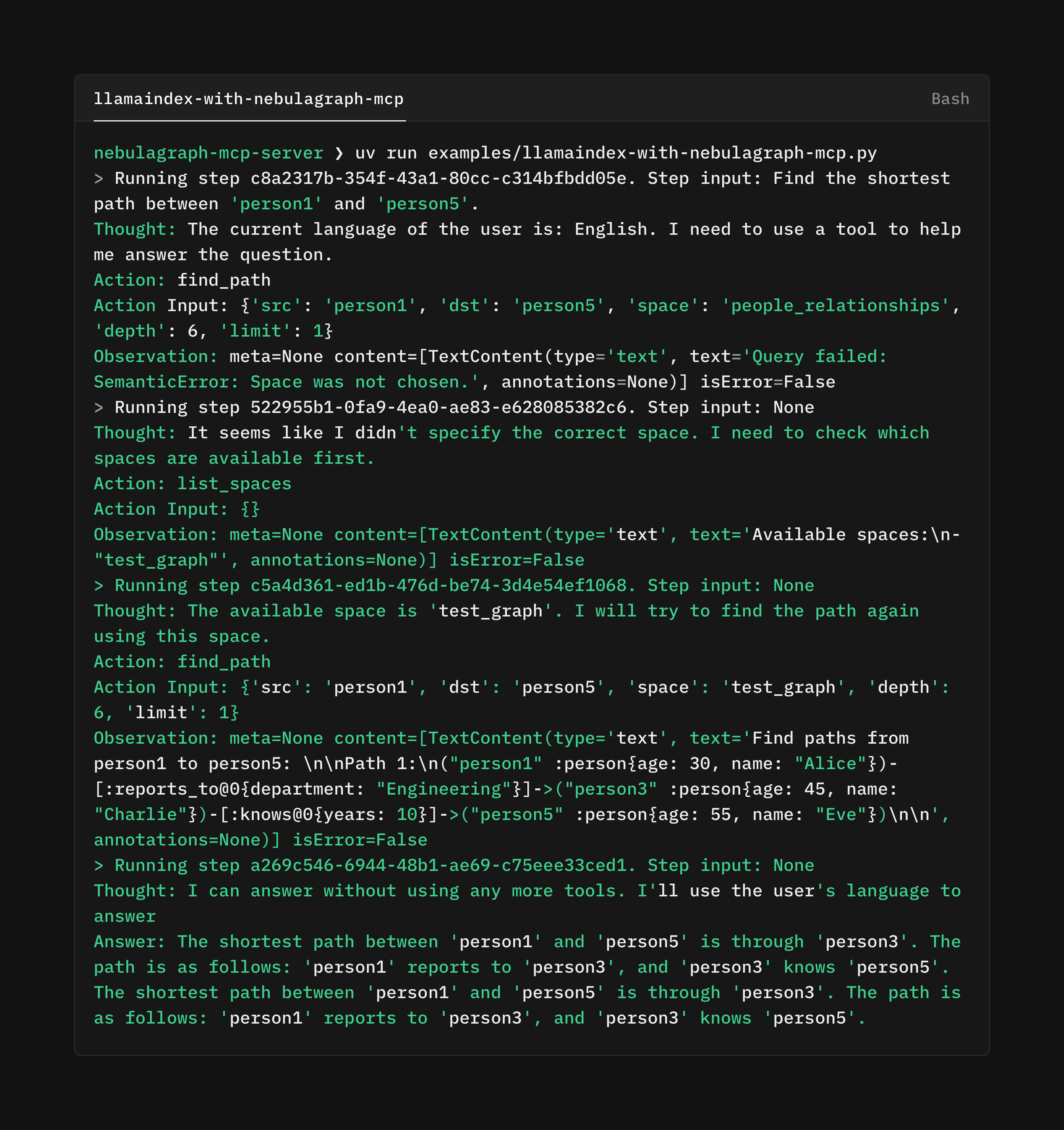
find_pathC
Find paths between two vertices Args: src: The source vertex ID dst: The destination vertex ID space: The space to use depth: The maximum path depth limit: The maximum number of paths to return Returns: The path results
| Name | Required | Description | Default |
|---|---|---|---|
| src | Yes | ||
| dst | Yes | ||
| space | Yes | ||
| depth | No | ||
| limit | No |
TDQS
Does the description disclose side effects, auth requirements, rate limits, or destructive behavior?
With no annotations provided, the description carries the full burden of behavioral disclosure. It states what the tool does but doesn't describe important behavioral traits: whether this is a read-only operation, computational complexity, timeout risks, authentication requirements, or rate limits. The description is minimal and lacks behavioral context beyond the basic function.
Agents need to know what a tool does to the world before calling it. Descriptions should go beyond structured annotations to explain consequences.
Is the description appropriately sized, front-loaded, and free of redundancy?
The description is structured with clear sections (Args, Returns) but includes redundant information. The parameter listing repeats what's in the schema without adding value. 'Returns: The path results' is vague and doesn't earn its place. The core purpose statement is front-loaded but could be more efficient.
Shorter descriptions cost fewer tokens and are easier for agents to parse. Every sentence should earn its place.
Given the tool's complexity, does the description cover enough for an agent to succeed on first attempt?
For a 5-parameter tool with no annotations and no output schema, the description is incomplete. It doesn't explain what a 'path' consists of, what format the results take, error conditions, or performance characteristics. The agent lacks sufficient context to use this tool effectively beyond basic parameter passing.
Complex tools with many parameters or behaviors need more documentation. Simple tools need less. This dimension scales expectations accordingly.
Does the description clarify parameter syntax, constraints, interactions, or defaults beyond what the schema provides?
The description lists all 5 parameters with brief labels, but with 0% schema description coverage, it doesn't fully compensate. It adds basic meaning (e.g., 'src' is 'source vertex ID') but lacks details on format, constraints, or examples. The schema provides titles and types, but the description adds minimal semantic value beyond what's already in the schema structure.
Input schemas describe structure but not intent. Descriptions should explain non-obvious parameter relationships and valid value ranges.
Does the description clearly state what the tool does and how it differs from similar tools?
The description clearly states the tool's purpose: 'Find paths between two vertices' which is a specific verb+resource combination. It distinguishes itself from sibling tools like 'find_neighbors' (which likely finds adjacent vertices) and 'execute_query' (more general). However, it doesn't explicitly differentiate from siblings beyond the core function.
Agents choose between tools based on descriptions. A clear purpose with a specific verb and resource helps agents select the right tool.
Does the description explain when to use this tool, when not to, or what alternatives exist?
The description provides no guidance on when to use this tool versus alternatives. There's no mention of prerequisites, when this tool is appropriate compared to 'find_neighbors' or 'execute_query', or any constraints on usage. The agent must infer usage from the tool name and parameters alone.
Agents often have multiple tools that could apply. Explicit usage guidance like "use X instead of Y when Z" prevents misuse.
get_space_schemaC
Get the schema information of the specified space Args: space: The space to get the schema for Returns: The schema information of the specified space
| Name | Required | Description | Default |
|---|---|---|---|
| space | Yes |
TDQS
Does the description disclose side effects, auth requirements, rate limits, or destructive behavior?
With no annotations provided, the description carries the full burden of behavioral disclosure. It states this is a read operation ('Get'), but doesn't describe what 'schema information' includes, whether there are permissions required, rate limits, error conditions, or what format the return data takes. For a tool with zero annotation coverage, this is inadequate.
Agents need to know what a tool does to the world before calling it. Descriptions should go beyond structured annotations to explain consequences.
Is the description appropriately sized, front-loaded, and free of redundancy?
The description is appropriately concise with three sentences that each serve a purpose: stating the tool's function, documenting the parameter, and describing the return. It's front-loaded with the core purpose first. The structure is clear but could be slightly more polished.
Shorter descriptions cost fewer tokens and are easier for agents to parse. Every sentence should earn its place.
Given the tool's complexity, does the description cover enough for an agent to succeed on first attempt?
Given the tool has no annotations, no output schema, and minimal parameter documentation, the description is incomplete. It doesn't explain what 'schema information' means in this context, what format it returns, or any behavioral aspects. For a tool that presumably returns structured data about schemas, this leaves too much undefined.
Complex tools with many parameters or behaviors need more documentation. Simple tools need less. This dimension scales expectations accordingly.
Does the description clarify parameter syntax, constraints, interactions, or defaults beyond what the schema provides?
Schema description coverage is 0%, so the description must compensate. It documents the single parameter ('space') and explains it's 'The space to get the schema for', which adds semantic meaning beyond the schema's basic type information. However, it doesn't explain what constitutes a valid 'space' value or provide examples, leaving significant gaps.
Input schemas describe structure but not intent. Descriptions should explain non-obvious parameter relationships and valid value ranges.
Does the description clearly state what the tool does and how it differs from similar tools?
The description clearly states the tool's purpose with a specific verb ('Get') and resource ('schema information of the specified space'). It distinguishes from siblings like 'list_spaces' (which lists spaces) and 'execute_query' (which runs queries). However, it doesn't explicitly differentiate from potential schema-related tools that might exist elsewhere.
Agents choose between tools based on descriptions. A clear purpose with a specific verb and resource helps agents select the right tool.
Does the description explain when to use this tool, when not to, or what alternatives exist?
No guidance is provided on when to use this tool versus alternatives. The description doesn't mention prerequisites, when this tool is appropriate versus other schema discovery methods, or any constraints on its use. It simply states what the tool does without context.
Agents often have multiple tools that could apply. Explicit usage guidance like "use X instead of Y when Z" prevents misuse.
list_spacesC
List all available spaces Returns: The available spaces
| Name | Required | Description | Default |
|---|---|---|---|
No parameters | |||
TDQS
Does the description disclose side effects, auth requirements, rate limits, or destructive behavior?
No annotations are provided, so the description carries full burden. It mentions the tool returns 'The available spaces' but doesn't disclose behavioral traits like whether this is a read-only operation, if it requires authentication, how results are formatted (e.g., pagination, ordering), or potential rate limits. This leaves significant gaps for a tool with no annotation coverage.
Agents need to know what a tool does to the world before calling it. Descriptions should go beyond structured annotations to explain consequences.
Is the description appropriately sized, front-loaded, and free of redundancy?
The description is appropriately sized with two short sentences, but it's not perfectly structured. The first sentence states the purpose clearly, but the second sentence ('Returns: The available spaces') is redundant and adds little value, slightly reducing efficiency. Overall, it's concise but could be more streamlined.
Shorter descriptions cost fewer tokens and are easier for agents to parse. Every sentence should earn its place.
Given the tool's complexity, does the description cover enough for an agent to succeed on first attempt?
Given the tool's simplicity (0 parameters, no output schema), the description is incomplete. It lacks details on what 'spaces' are, how results are returned (e.g., list format, metadata), and behavioral context like safety or performance. Without annotations or output schema, the description should provide more context to be fully helpful.
Complex tools with many parameters or behaviors need more documentation. Simple tools need less. This dimension scales expectations accordingly.
Does the description clarify parameter syntax, constraints, interactions, or defaults beyond what the schema provides?
The tool has 0 parameters, and schema description coverage is 100%, so there's no need for parameter details in the description. The baseline for 0 parameters is 4, as the description appropriately doesn't discuss parameters that don't exist, and the schema fully covers the input structure.
Input schemas describe structure but not intent. Descriptions should explain non-obvious parameter relationships and valid value ranges.
Does the description clearly state what the tool does and how it differs from similar tools?
The description states the tool's purpose ('List all available spaces') which is clear but vague. It doesn't specify what 'spaces' are or how they differ from other resources, and doesn't distinguish this from sibling tools like 'get_space_schema' or 'find_neighbors'. The purpose is understandable but lacks specificity.
Agents choose between tools based on descriptions. A clear purpose with a specific verb and resource helps agents select the right tool.
Does the description explain when to use this tool, when not to, or what alternatives exist?
No guidance is provided on when to use this tool versus alternatives. The description doesn't mention sibling tools like 'get_space_schema' for schema information or 'find_neighbors' for relationships, nor does it specify prerequisites or appropriate contexts for listing spaces versus other operations.
Agents often have multiple tools that could apply. Explicit usage guidance like "use X instead of Y when Z" prevents misuse.
Tool Schema Changelog
Recent tool additions, removals, and schema changes observed during successful MCP inspections. Dates show when Glama detected each change.
5 tool updates
v1.0.0- First observed
execute_query - First observed
find_neighbors - First observed
find_path - First observed
get_space_schema - First observed
list_spaces
TDQS
Scored across 5 tools
Each tool has a clearly distinct purpose with no overlap: execute_query for general queries, find_neighbors for vertex adjacency, find_path for pathfinding, get_space_schema for schema inspection, and list_spaces for space enumeration. The descriptions reinforce these distinct functions, making tool selection unambiguous.
All tool names follow a consistent verb_noun pattern (e.g., execute_query, find_neighbors, list_spaces) with clear, descriptive verbs. There are no deviations in style or convention, making the naming predictable and easy to understand across the set.
With 5 tools, this server is well-scoped for graph database operations, covering essential functions like querying, traversal, pathfinding, and schema management. Each tool earns its place without feeling excessive or insufficient for the domain.
The tool set provides strong coverage for core graph operations, including query execution, neighbor and path finding, and space/schema inspection. A minor gap exists in CRUD operations for vertices or edges (e.g., create, update, delete), but agents can likely work around this with queries.
Maintenance
Resources
Unclaimed servers have limited discoverability.
Looking for Admin?
If you are the server author, to access and configure the admin panel.
Related MCP Connectors
A comprehensive Model Context Protocol (MCP) server that enables AI assistants to interact with yo…
The Grafbase MCP server sits in front of a GraphQL API and exposes an MCP protocol-compliant interface that allows AI agents and LLMs to explore and query GraphQL APIs using natural language. It provides tools to search schemas, introspect types and fields, and execute GraphQL queries while minimizing context bloat by returning only relevant schema subsets, with built-in support for authentication, authorization, and configurable access control.
A Model Context Protocol server for Wix AI tools
Model Context Protocol server for the Apideck Unified API. Connect any MCP-compatible agent framework to 100+ accounting systems, HRIS platforms, file storage providers, and more through one integration. More information https://www.apideck.com/mcp-server
Related MCP Servers
- AlicenseAqualityAmaintenanceA Model Context Protocol server implementation that enables AI assistants to securely interact with GreptimeDB, allowing them to explore database schema, read data, and execute SQL queries through a controlled interface.1329MIT
- AlicenseNot gradedqualityDmaintenanceA Model Context Protocol server that enables LLMs to interact with GraphQL APIs by providing schema introspection and query execution capabilities.8393MIT
- AlicenseNot gradedqualityDmaintenanceA Model Context Protocol server that enables LLMs to interact with GraphQL APIs by providing schema introspection and query execution capabilities.11MIT

Memgraph MCP Serverofficial
-licenseCqualityNot gradedmaintenanceA lightweight server implementation of the Model Context Protocol that connects Memgraph database with LLMs, allowing users to interact with graph databases through natural language.125-
Latest Blog Posts
- Who's Calling? MCP Hosts Are an Identity Blind Spot (And the Spec Knows It)By Om-Shree-0709 on .mcpAgent IdentityOAuth 2.1
- Your AI Chatbot Just Exposed Your CEO's Salary to an InternBy Om-Shree-0709 on .Agent IdentityMCP SecurityOAuth Delegation
- Why MCP Servers Need Execution Sandboxing (And Why Your Current Stack Isn't Enough)By Om-Shree-0709 on .Agentic AiPrompt InjectionWebAssembly
MCP directory API
We provide all the information about MCP servers via our MCP API.
curl -X GET 'https://glama.ai/api/mcp/v1/servers/nebula-contrib/nebulagraph-mcp-server'
If you have feedback or need assistance with the MCP directory API, please join our Discord server