



Enapter MCP Serverofficial
A
licenseNot graded
qualityD
maintenanceMCP server providing tools for AI-agents to interact with Enapter EMS.
Apache 2.0

Este es un servidor de Protocolo de Contexto Modelo (MCP) para Tibber , un proveedor de energía noruego.
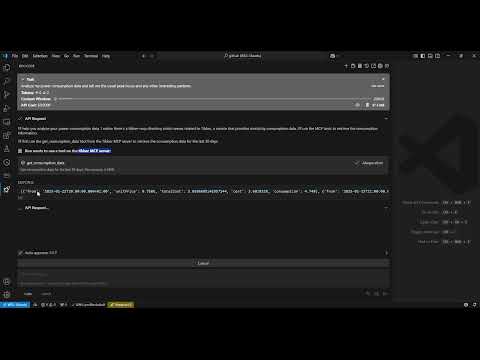
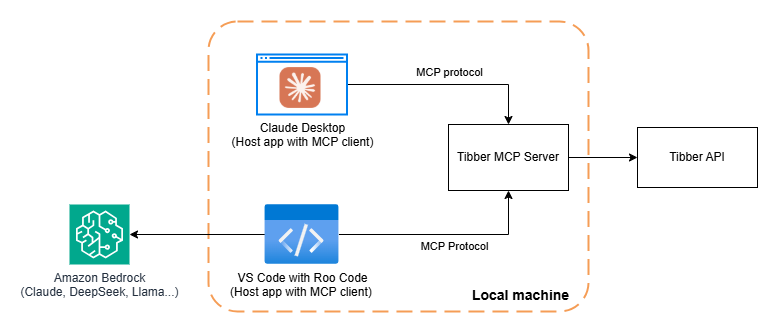
Puede ejecutar el servidor MCP localmente y acceder a él a través de diferentes hosts como Claude Desktop o Roo Code .
Para más detalles, consulta mi publicación del blog:
Creación de un servidor Tibber MCP: Conecte su agente de IA a los datos de consumo de energía
El servidor Tibber MCP proporciona a un agente de IA una forma conveniente de interactuar con la API de Tibber y consultar información como los precios actuales de la energía y sus datos de consumo de energía.
Related MCP server: Tigo Energy MCP Server
Una vez conectado al servidor MCP, puede hacer preguntas como:
Analice mis datos de consumo energético y presente las horas pico habituales y cualquier otro patrón interesante en un formato fácil de leer.
"¿Cuándo utilicé más energía ayer?"
¿Cuánta energía consumí ayer a las 7 de la mañana?
"¿Cuál es el precio actual de la energía?"
"Enumera las 3 horas más baratas del día de mañana."
"¿El precio de la energía será más alto o más bajo mañana?"
Python 3.12
Token de API de Tibber (puede obtenerlo en el portal para desarrolladores de Tibber )
Instalar uv :
# On macOS and Linux
curl -LsSf https://astral.sh/uv/install.sh | sh
# On Windows
powershell -ExecutionPolicy ByPass -c "irm https://astral.sh/uv/install.ps1 | iex"Clonar este repositorio:
git clone https://github.com/linkcd/tibber-mcp.git
cd tibber-mcp
Configure el entorno virtual de Python e instale las dependencias:
uv venv --python 3.12 && source .venv/bin/activate && uv pip install --requirement pyproject.tomlEn Claude Desktop o Roo Code en VS
{
   "mcpServers":{
      "tibber":{
         "command":"uv",
         "args":[
            "--directory",
            "[PATH-TO-ROOT-OF-THE-CLONED-TIBBER-MCP-FOLDER]",
            "run",
            "server.py"
         ],
         "env":{
            "TIBBER_API_TOKEN":"[YOUR-TIBBER-TOKEN]"
         }
      }
   }
}
IMPORTANTE : Reemplace
[YOUR-TIBBER-TOKEN]con su token real. Nunca envíe credenciales reales al control de versiones.
Ejecute el servidor localmente y ejecute el inspector MCP en él
npx @modelcontextprotocol/inspector -e TIBBER_API_TOKEN=[YOUR-TIBBER-TOKEN] python server.pyEl servidor expone las siguientes herramientas que LLM puede utilizar:
get_consumption_data() : Obtiene los datos de consumo por hora de los últimos 30 días, como período de tiempo, costo total, costo de energía base y kwh consumidos
get_price_and_home_info() : Obtener información de precios (actual, hoy y mañana) e información de la vivienda (propietario, dirección, suscripción...)
Get the hourly consumption data for the last 30 days, such as time period, total cost, base energy cost, and consumpted kwh.
| Name | Required | Description | Default |
|---|---|---|---|
No parameters | |||
Does the description disclose side effects, auth requirements, rate limits, or destructive behavior?
No annotations are provided, so the description carries the full burden of behavioral disclosure. It describes the data returned but doesn't cover critical aspects like whether this is a read-only operation, potential rate limits, authentication needs, error conditions, or response format. For a data retrieval tool with zero annotation coverage, this is a significant gap in transparency.
Agents need to know what a tool does to the world before calling it. Descriptions should go beyond structured annotations to explain consequences.
Is the description appropriately sized, front-loaded, and free of redundancy?
The description is a single, efficient sentence that front-loads the key action and scope. It lists data fields concisely without redundancy. However, it could be slightly more structured by separating the action from the data details, but overall it's appropriately sized with minimal waste.
Shorter descriptions cost fewer tokens and are easier for agents to parse. Every sentence should earn its place.
Given the tool's complexity, does the description cover enough for an agent to succeed on first attempt?
Given the tool's complexity (data retrieval with no parameters) and lack of annotations and output schema, the description is incomplete. It covers what data is fetched but omits behavioral traits, usage context, and output details. For a tool with no structured support, the description should provide more comprehensive guidance to aid the agent effectively.
Complex tools with many parameters or behaviors need more documentation. Simple tools need less. This dimension scales expectations accordingly.
Does the description clarify parameter syntax, constraints, interactions, or defaults beyond what the schema provides?
The input schema has 0 parameters with 100% coverage, so the schema fully documents the lack of inputs. The description doesn't need to add parameter details, as there are none to explain. It implies the tool operates without user-provided parameters, which aligns with the schema. Baseline is 4 for zero parameters, as the description doesn't contradict or add unnecessary info.
Input schemas describe structure but not intent. Descriptions should explain non-obvious parameter relationships and valid value ranges.
Does the description clearly state what the tool does and how it differs from similar tools?
The description clearly states the action ('Get') and resource ('hourly consumption data'), specifying the time range ('last 30 days') and data fields (e.g., time period, total cost). It distinguishes from the sibling tool 'get_price_and_home_info' by focusing on consumption rather than price/home info, though it doesn't explicitly name the sibling. The purpose is specific but lacks explicit sibling differentiation.
Agents choose between tools based on descriptions. A clear purpose with a specific verb and resource helps agents select the right tool.
Does the description explain when to use this tool, when not to, or what alternatives exist?
The description provides no guidance on when to use this tool versus alternatives, such as the sibling tool 'get_price_and_home_info'. It mentions the data scope but doesn't explain use cases, prerequisites, or exclusions. This leaves the agent without clear context for tool selection.
Agents often have multiple tools that could apply. Explicit usage guidance like "use X instead of Y when Z" prevents misuse.
Get the infomation of: 1. current price, with price break down, price level, and currency 2. hourly price and price level of today 3. hourly price and price level of tomorrow 4. home address info, timezone etc the currency is applying to all prices
| Name | Required | Description | Default |
|---|---|---|---|
No parameters | |||
Does the description disclose side effects, auth requirements, rate limits, or destructive behavior?
With no annotations provided, the description carries full burden for behavioral disclosure. It describes what data is returned but doesn't mention whether this is a read-only operation, potential rate limits, authentication needs, or error conditions. It lacks critical behavioral context for an agent.
Agents need to know what a tool does to the world before calling it. Descriptions should go beyond structured annotations to explain consequences.
Is the description appropriately sized, front-loaded, and free of redundancy?
The description is structured as a bulleted list which helps organization, but contains minor spelling errors ('infomation') and could be more front-loaded. The information is reasonably concise but not optimally polished.
Shorter descriptions cost fewer tokens and are easier for agents to parse. Every sentence should earn its place.
Given the tool's complexity, does the description cover enough for an agent to succeed on first attempt?
For a tool with no parameters and no output schema, the description adequately explains what data is returned (price breakdowns, home info). However, without annotations or output schema, it should ideally provide more behavioral context about the operation's characteristics and return format.
Complex tools with many parameters or behaviors need more documentation. Simple tools need less. This dimension scales expectations accordingly.
Does the description clarify parameter syntax, constraints, interactions, or defaults beyond what the schema provides?
The tool has 0 parameters with 100% schema description coverage, so the schema already fully documents the empty parameter set. The description appropriately doesn't discuss parameters, maintaining focus on what the tool returns rather than what it accepts.
Input schemas describe structure but not intent. Descriptions should explain non-obvious parameter relationships and valid value ranges.
Does the description clearly state what the tool does and how it differs from similar tools?
The description clearly states the tool retrieves price information (current, hourly today/tomorrow) and home address/timezone data. It specifies the verb 'Get' and resources (price data, home info), though it doesn't explicitly differentiate from the sibling tool 'get_consumption_data'.
Agents choose between tools based on descriptions. A clear purpose with a specific verb and resource helps agents select the right tool.
Does the description explain when to use this tool, when not to, or what alternatives exist?
No guidance is provided on when to use this tool versus the sibling 'get_consumption_data'. The description lists what data is retrieved but doesn't specify use cases, prerequisites, or alternatives.
Agents often have multiple tools that could apply. Explicit usage guidance like "use X instead of Y when Z" prevents misuse.
Recent tool additions, removals, and schema changes observed during successful MCP inspections.
get_consumption_dataget_price_and_home_infoScored across 2 tools
The two tools have clearly distinct purposes: one focuses on consumption data (historical usage and costs), while the other focuses on price information and home details (current, forecasted pricing and location/timezone). There is no overlap in functionality, making it easy for an agent to select the correct tool based on the query.
Both tools follow a consistent verb_noun pattern with 'get_' prefix and descriptive names (get_consumption_data and get_price_and_home_info). The naming is predictable and readable, adhering to a clear convention throughout the set.
With only 2 tools, the server feels thin for a domain like energy/utility management, which typically involves more operations such as setting preferences, controlling devices, or accessing billing history. While the tools cover key data retrieval aspects, the count is borderline low for comprehensive agent interaction.
The tools provide good read-only coverage for consumption and pricing data, but there are notable gaps: no update/delete operations, no ability to manage home settings or devices, and no support for actions like adjusting energy usage or handling billing. This limits the server to data retrieval only, which may cause agent failures in broader utility management tasks.
MCP server exposing the Backtest360 engine API as tools for AI agents.
The official Model Context Protocol server for Ambee. It gives any MCP-compatible AI assistant — Claude, ChatGPT, Cursor, VS Code, Ollama, and more direct access to live air quality, pollen, and weather data. To get started, including information on signing up and obtaining your Ambee key, check out the Ambee documentation on https://docs.ambeedata.com
Nifty's MCP server — exposes tasks, projects, messages, and files as tools for AI agents.
MCP server wrapping the Tesla Fleet API and TeslaMate API