A
licenseNot graded
qualityD
maintenanceMCP server for using various search tools like Tavily API.
Planning to support various search tools (i.e. wiki search, searxng, etc)
3
MIT

This server provides tools to interact with the Yu-Gi-Oh! card database (ygocdb.com) through the Model Context Protocol (MCP):
Search Yu-Gi-Oh! cards by keywords, including card names and effect text
Get detailed card information by providing a specific card ID
Retrieve card images by specifying a card ID
Provides containerized deployment of the MCP server, supporting both interactive stdio mode and Streamable HTTP mode with port mapping.
Allows running the server through Node.js using NPX, supporting both stdio mode and Streamable HTTP mode for flexible deployment options.
Click on "Deploy Server".
Wait a few minutes for the server to deploy. Once ready, it will show a "Started" state.
In the chat, type @ followed by the MCP server name and your instructions, e.g., "@ygocdb-mcp search for Dark Magician card details"
That's it! The server will respond to your query, and you can continue using it as needed.
Here is a step-by-step guide with screenshots.
English | 中文
一个基于 Model Context Protocol (MCP) 的服务端,用于与 百鸽(ygocdb.com)等 API 交互。提供了一系列工具来查询游戏王中文卡牌信息。
本服务端基于游戏王卡牌数据库的公开 API。
卡牌搜索: https://ygocdb.com/api/v0/?search=关键字
卡牌图片: https://cdn.233.momobako.com/ygopro/pics/<id>.jpg
Related MCP server: Internetsearch-mcp-server
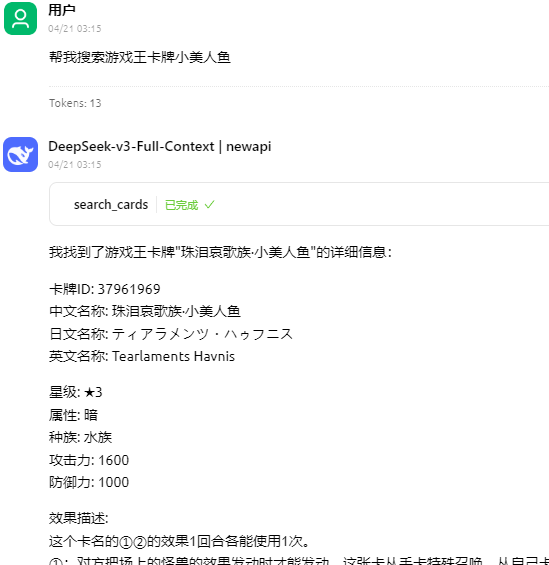
search_cards
通过关键字搜索游戏王卡牌,可以搜索卡牌名称、效果文本等。
get_card_by_id
通过卡牌ID获取单张游戏王卡牌的详细信息。
get_card_image
通过卡牌ID获取游戏王卡牌的图片。
# 全局安装
npm install -g ygocdb-mcp-server

# 或直接运行(推荐)
npx ygocdb-mcp-server# 克隆项目
git clone <repository-url>
cd ygocdb-mcp
# 安装依赖
npm install
# 构建项目
npm run build
# 运行 STDIO 模式
npm run start:stdio
# 运行 HTTP 模式
npm run start:http服务端支持两种运行模式:
用于与 Claude Desktop 等 MCP 客户端直接集成:
npm run start:stdio用于容器部署或 HTTP 客户端访问:
npm run start:httpHTTP 服务器将在端口 8081 上启动,端点为 http://localhost:8081/mcp
在 claude_desktop_config.json 中添加配置:
{
  "mcpServers": {
    "ygocdb": {
      "command": "npx",
      "args": ["ygocdb-mcp-server"]
    }
  }
}{
"mcpServers": {
"ygocdb": {
"command": "node",
"args": ["path/to/ygocdb-mcp/dist/index.js"],
"cwd": "path/to/ygocdb-mcp"
}
}
}# 构建镜像
docker build -t ygocdb-mcp .
# 运行 STDIO 模式(用于集成)
docker run -i --rm ygocdb-mcp
# 运行 HTTP 模式(用于服务)
docker run -p 8081:8081 ygocdb-mcp项目使用 cross-env 确保在所有平台上正确设置环境变量:
Windows: npm run start:http 或 npm run start:stdio
macOS/Linux: npm run start:http 或 npm run start:stdio
Docker: 自动使用 HTTP 模式
通过卡牌ID获取单张游戏王卡牌的详细信息
| Name | Required | Description | Default |
|---|---|---|---|
| id | Yes | 游戏王卡牌ID,通常为八位数字 |
Does the description disclose side effects, auth requirements, rate limits, or destructive behavior?
Annotations already declare readOnlyHint=true (safe read operation) and openWorldHint=true (may return unknown data). The description adds the specific scope of '单张游戏王卡牌' (single Yu-Gi-Oh! card), which provides useful context beyond annotations. However, it doesn't disclose additional behavioral traits like error handling, rate limits, or response format details.
Agents need to know what a tool does to the world before calling it. Descriptions should go beyond structured annotations to explain consequences.
Is the description appropriately sized, front-loaded, and free of redundancy?
The description is a single, efficient sentence that directly states the tool's purpose with zero wasted words. It's appropriately sized for a simple lookup tool and front-loaded with essential information.
Shorter descriptions cost fewer tokens and are easier for agents to parse. Every sentence should earn its place.
Given the tool's complexity, does the description cover enough for an agent to succeed on first attempt?
For a simple read operation with good annotations (readOnlyHint, openWorldHint) and full schema coverage, the description is minimally adequate. However, with no output schema, it doesn't explain what '详细信息' (detailed information) includes, leaving gaps about return values. The tool's low complexity keeps it from being incomplete, but it could be more comprehensive.
Complex tools with many parameters or behaviors need more documentation. Simple tools need less. This dimension scales expectations accordingly.
Does the description clarify parameter syntax, constraints, interactions, or defaults beyond what the schema provides?
Schema description coverage is 100%, with the parameter 'id' fully documented in the schema as '游戏王卡牌ID,通常为八位数字' (Yu-Gi-Oh! card ID, usually an eight-digit number). The description doesn't add any parameter semantics beyond what the schema already provides, so baseline 3 is appropriate.
Input schemas describe structure but not intent. Descriptions should explain non-obvious parameter relationships and valid value ranges.
Does the description clearly state what the tool does and how it differs from similar tools?
The description clearly states the tool's purpose: '通过卡牌ID获取单张游戏王卡牌的详细信息' (Get detailed information of a single Yu-Gi-Oh! card by card ID). It specifies the verb '获取' (get) and resource '卡牌详细信息' (card details), but doesn't explicitly differentiate from sibling tools like 'search_cards' which likely searches by criteria rather than specific ID.
Agents choose between tools based on descriptions. A clear purpose with a specific verb and resource helps agents select the right tool.
Does the description explain when to use this tool, when not to, or what alternatives exist?
The description implies usage context (when you have a specific card ID), but doesn't explicitly state when to use this tool versus alternatives like 'search_cards' or 'get_card_image'. No guidance on prerequisites, exclusions, or comparative scenarios is provided.
Agents often have multiple tools that could apply. Explicit usage guidance like "use X instead of Y when Z" prevents misuse.
通过卡牌ID获取游戏王卡牌的图片
| Name | Required | Description | Default |
|---|---|---|---|
| id | Yes | 游戏王卡牌ID,可以使用search_cards工具搜索 |
Does the description disclose side effects, auth requirements, rate limits, or destructive behavior?
Annotations already provide readOnlyHint=true and openWorldHint=true, indicating safe read-only access to potentially unknown data. The description adds context about retrieving images specifically, but doesn't disclose additional behavioral traits like image format, size, error handling, or rate limits that would be valuable beyond annotations.
Agents need to know what a tool does to the world before calling it. Descriptions should go beyond structured annotations to explain consequences.
Is the description appropriately sized, front-loaded, and free of redundancy?
The description is a single, efficient sentence in Chinese that directly states the tool's purpose without any fluff. It's appropriately sized and front-loaded with the core functionality, earning its place clearly.
Shorter descriptions cost fewer tokens and are easier for agents to parse. Every sentence should earn its place.
Given the tool's complexity, does the description cover enough for an agent to succeed on first attempt?
Given the tool's low complexity (single parameter, read-only), rich annotations (readOnlyHint, openWorldHint), and 100% schema coverage, the description is reasonably complete. However, without an output schema, it doesn't explain return values (e.g., image format, error responses), leaving a minor gap for a tool that fetches binary data.
Complex tools with many parameters or behaviors need more documentation. Simple tools need less. This dimension scales expectations accordingly.
Does the description clarify parameter syntax, constraints, interactions, or defaults beyond what the schema provides?
Schema description coverage is 100%, with the parameter 'id' fully documented in the schema as '游戏王卡牌ID,可以使用search_cards工具搜索'. The description adds no additional parameter semantics beyond what the schema provides, so it meets the baseline for high schema coverage.
Input schemas describe structure but not intent. Descriptions should explain non-obvious parameter relationships and valid value ranges.
Does the description clearly state what the tool does and how it differs from similar tools?
The description clearly states the verb ('获取' - get) and resource ('游戏王卡牌的图片' - Yu-Gi-Oh card image) with specific scope ('通过卡牌ID' - via card ID). It distinguishes from sibling 'get_card_by_id' by focusing on images rather than general card data, but doesn't explicitly mention 'search_cards' as a source for IDs.
Agents choose between tools based on descriptions. A clear purpose with a specific verb and resource helps agents select the right tool.
Does the description explain when to use this tool, when not to, or what alternatives exist?
The description implies usage when needing card images specifically, and the input schema references 'search_cards' as a way to find IDs. However, it lacks explicit guidance on when to choose this tool over 'get_card_by_id' (which might also return images) or clear prerequisites beyond having a card ID.
Agents often have multiple tools that could apply. Explicit usage guidance like "use X instead of Y when Z" prevents misuse.
通过关键字搜索游戏王卡牌,可以搜索卡牌名称、效果文本等。
| Name | Required | Description | Default |
|---|---|---|---|
| query | Yes | 搜索关键字,可以是卡牌名称、效果描述等 |
Does the description disclose side effects, auth requirements, rate limits, or destructive behavior?
Annotations already provide readOnlyHint=true (safe read operation) and openWorldHint=true (open-ended querying), so the description doesn't need to repeat these. It adds some context by specifying searchable fields (name, effect text), but doesn't disclose behavioral traits like result limits, sorting, pagination, or error handling. With annotations covering safety and scope, this is adequate but not rich in additional behavioral details.
Agents need to know what a tool does to the world before calling it. Descriptions should go beyond structured annotations to explain consequences.
Is the description appropriately sized, front-loaded, and free of redundancy?
The description is a single, efficient sentence in Chinese that directly states the tool's function without redundancy. It's front-loaded with the core action ('通过关键字搜索游戏王卡牌') and adds necessary detail ('可以搜索卡牌名称、效果文本等'). There's zero waste, making it highly concise and well-structured for quick understanding.
Shorter descriptions cost fewer tokens and are easier for agents to parse. Every sentence should earn its place.
Given the tool's complexity, does the description cover enough for an agent to succeed on first attempt?
Given the tool's low complexity (single parameter, no output schema), annotations provide safety and scope hints, and the description covers the basic purpose, this is minimally viable. However, it lacks details on output format (e.g., what data is returned), error cases, or integration with siblings, leaving gaps that could hinder effective use by an AI agent in more complex scenarios.
Complex tools with many parameters or behaviors need more documentation. Simple tools need less. This dimension scales expectations accordingly.
Does the description clarify parameter syntax, constraints, interactions, or defaults beyond what the schema provides?
The input schema has 100% description coverage, with the 'query' parameter documented as supporting card names and effect descriptions. The description adds minimal value by restating this in Chinese ('可以搜索卡牌名称、效果文本等'), but doesn't provide extra semantics like query syntax examples, character limits, or language support. Baseline 3 is appropriate since the schema does the heavy lifting.
Input schemas describe structure but not intent. Descriptions should explain non-obvious parameter relationships and valid value ranges.
Does the description clearly state what the tool does and how it differs from similar tools?
The description clearly states the tool's purpose: searching Yu-Gi-Oh cards by keyword across name and effect text. It uses specific verbs ('搜索' - search) and resources ('游戏王卡牌' - Yu-Gi-Oh cards). However, it doesn't explicitly distinguish from sibling tools like get_card_by_id (which retrieves by ID) or get_card_image (which fetches images), leaving some ambiguity about when to choose this over alternatives.
Agents choose between tools based on descriptions. A clear purpose with a specific verb and resource helps agents select the right tool.
Does the description explain when to use this tool, when not to, or what alternatives exist?
The description provides no guidance on when to use this tool versus alternatives. It mentions what can be searched (name, effect text) but doesn't specify scenarios where this is preferred over get_card_by_id (e.g., for exact ID-based lookup) or get_card_image (e.g., for visual content). There's no mention of prerequisites, limitations, or exclusions, leaving usage context implied at best.
Agents often have multiple tools that could apply. Explicit usage guidance like "use X instead of Y when Z" prevents misuse.
Recent tool additions, removals, and schema changes observed during successful MCP inspections.
v1.0.0get_card_by_idget_card_imagesearch_cardsScored across 3 tools
Each tool has a clearly distinct purpose: get_card_by_id retrieves detailed card information, get_card_image fetches the card's image, and search_cards performs keyword-based searches. There is no overlap in functionality, making it easy for an agent to select the correct tool without confusion.
All tool names follow a consistent verb_noun pattern with snake_case (e.g., get_card_by_id, get_card_image, search_cards). The naming is predictable and readable, with no deviations or mixed conventions.
With only 3 tools, the set feels thin for a card database server, as it lacks operations like updating, deleting, or managing card collections. However, it covers basic retrieval and search functions adequately for its limited scope.
The tools provide good read/search coverage (get and search), but there are notable gaps in CRUD operations—no create, update, or delete functions. This limits the server to querying only, which may cause dead ends for agents needing to modify data.
MCP server for GLM chat completions using Zhipu AI models via AceDataCloud
MCP server for OpenAI API (chat completions, image generation, embeddings) via AceDataCloud
MCP server for AI dialogue using various LLM models via AceDataCloud
MCP server for the Vulners.com API