iris-eval/mcp-server
Iris — The Agent Eval Standard for MCP

Know whether your AI agents are actually good enough to ship. Iris is an open-source MCP server that scores output quality, catches safety failures, and enforces cost budgets across all your agents. Any MCP-compatible agent discovers and uses it automatically — no SDK, no code changes.
The Problem
Your agents are running in production. Infrastructure monitoring sees 200 OK and moves on. It has no idea the agent just:
Leaked a social security number in its response
Hallucinated an answer with zero factual grounding
Burned $0.47 on a single query — 4.7x your budget threshold
Made 6 tool calls when 2 would have sufficed
Iris evaluates all of it.
Related MCP server: runmeter
What You Get
Trace Logging | Hierarchical span trees with per-tool-call latency, token usage, and cost in USD. Stored in SQLite, queryable instantly. |
Output Evaluation | 13 built-in rules across 4 categories: completeness, relevance, safety, cost. PII detection (10 patterns: SSN, credit card, phone, email, IBAN, DOB, MRN, IP, API key, passport), prompt injection (13 patterns), stub-output detection, hallucination markers (17 hedging phrases + fabricated-citation heuristic). Add custom rules with Zod schemas. |
Cost Visibility | Aggregate cost across all agents over any time window. Set budget thresholds. Get flagged when agents overspend. |
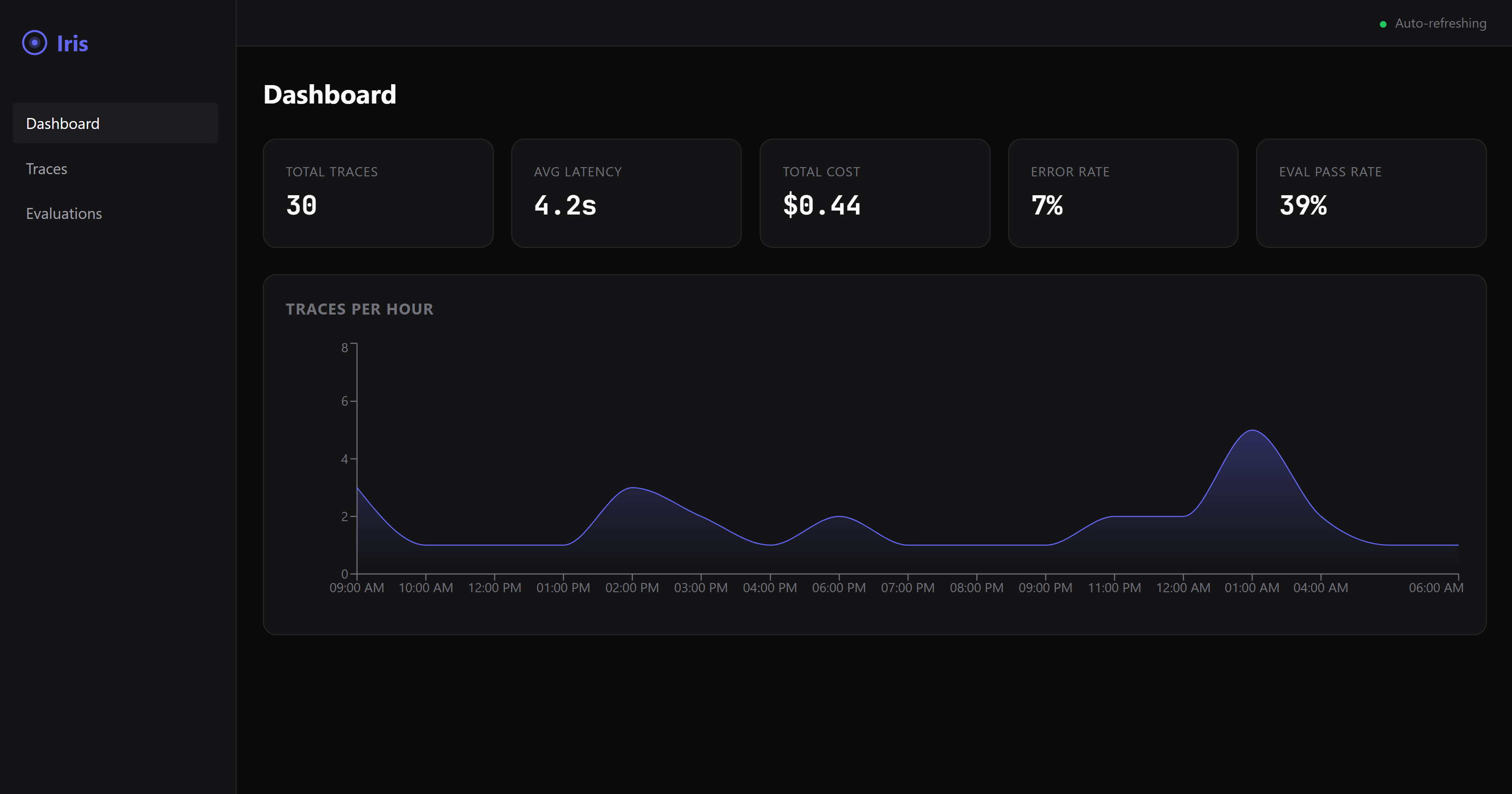
Web Dashboard | Real-time dark-mode UI with trace visualization, eval results, and cost breakdowns. |
Requires Node.js 20 or later. Check with node --version.
Quickstart
Add Iris to your MCP config. Works with Claude Desktop, Cursor, Windsurf, and any MCP-compatible agent.
{
"mcpServers": {
"iris-eval": {
"command": "npx",
"args": ["@iris-eval/mcp-server"]
}
}
}That's it. Your agent discovers Iris and starts logging traces automatically.
Turn on the dashboard
Iris ships with a real-time web dashboard showing traces, eval results, cost breakdowns, and rule pass-rates. It's off by default so the MCP server stays lightweight — flip it on with a flag.
{
"mcpServers": {
"iris-eval": {
"command": "npx",
"args": ["@iris-eval/mcp-server", "--dashboard"]
}
}
}Then open http://localhost:6920 after your agent runs a trace. The same dashboard is available via CLI:
npx @iris-eval/mcp-server --dashboardClaude Desktop
Edit your MCP config file:
macOS:
~/Library/Application Support/Claude/claude_desktop_config.jsonWindows:
%APPDATA%\Claude\claude_desktop_config.json
Add the JSON config above, then restart Claude Desktop.
Claude Code
claude mcp add --transport stdio iris-eval -- npx @iris-eval/mcp-serverThen restart the session (/clear or relaunch) for tools to load.
Windows note: Do not use
cmd /cwrapper — it causes path parsing issues. Thenpxcommand works directly.
Cursor / Windsurf
Add to your workspace .cursor/mcp.json or global MCP settings using the JSON config above.
Other Install Methods
# Global install (recommended for persistent data and faster startup)
npm install -g @iris-eval/mcp-server
iris-mcp --dashboard
# Docker
docker run -p 3000:3000 -v iris-data:/data ghcr.io/iris-eval/mcp-serverTip: Global install (
npm install -g) stores traces persistently at~/.iris/iris.db. Withnpx, traces persist in the same location, but startup is slower due to package resolution.
MCP Tools
Iris registers nine tools that any MCP-compatible agent can invoke — full rule + trace lifecycle + LLM-as-judge + semantic citation verification:
log_trace— Log an agent execution with spans, tool calls, token usage, and costevaluate_output— Score output quality against completeness, relevance, safety, and cost rules (heuristic, deterministic, free)get_traces— Query stored traces with filtering, pagination, and time-range supportlist_rules— Enumerate deployed custom eval rules (read-only)deploy_rule— Register a new custom eval rule so it fires on everyevaluate_outputof that categorydelete_rule— Remove a deployed custom rule (destructive, idempotent)delete_trace— Remove a single stored trace by ID (destructive, tenant-scoped)evaluate_with_llm_judge— Semantic eval via LLM (Anthropic or OpenAI). Five templates: accuracy, helpfulness, safety, correctness, faithfulness. Cost-capped, per-eval pricing disclosed. Bring your own API key (IRIS_ANTHROPIC_API_KEYorIRIS_OPENAI_API_KEY) — Iris doesn't proxy or relay LLM calls.verify_citations— Extract citations from output (numbered, author-year, URLs, DOIs), fetch sources behind an SSRF-guarded + domain-allowlisted resolver, and use an LLM judge to check whether each source actually supports the cited claim. Opt-in outbound HTTP. Same BYOK requirement asevaluate_with_llm_judge.
When IRIS_OTEL_ENDPOINT is configured, log_trace calls also emit a best-effort OTLP/HTTP JSON export to any OpenTelemetry collector (Jaeger, Grafana Tempo, Datadog OTLP, Honeycomb, etc). See docs/otel-integration.md.
Full tool schemas and configuration: iris-eval.com
Cloud Tier (Coming Soon)
Self-hosted Iris runs on your machine with SQLite. As your team's eval needs grow, the cloud tier adds PostgreSQL, team dashboards, alerting on quality regressions, and managed infrastructure.
Join the waitlist to get early access.
Examples
Claude Desktop setup — MCP config for stdio and HTTP modes
TypeScript — MCP SDK client — connect and invoke tools
HTTP transport (TS + Python) — full client code for REST-style integration
LangChain instrumentation (Python, conceptual) — scaffold showing the shape; needs your agent code to be runnable
CrewAI instrumentation (Python, conceptual) — scaffold; same caveat
Community
GitHub Issues — Bug reports and feature requests
GitHub Discussions — Questions and ideas
Contributing Guide — How to contribute
Roadmap — What's coming next
CLI Arguments
Flag | Default | Description |
|
| Transport type: |
|
| HTTP transport port |
|
| SQLite database path |
|
| Config file path |
| — | API key for HTTP authentication |
|
| Enable web dashboard |
|
| Dashboard port |
Environment Variables
Variable | Description |
| Transport type ( |
| HTTP transport port |
| HTTP transport host (default |
| SQLite database path |
| Log level: |
| Enable web dashboard ( |
| Dashboard port (default |
| API key for HTTP authentication |
| Comma-separated allowed CORS origins |
CLI flags take precedence over environment variables when both are set.
Security
When using HTTP transport, Iris includes:
API key authentication with timing-safe comparison
CORS restricted to localhost by default
Rate limiting (100 req/min API, 20 req/min MCP)
Helmet security headers
Zod input validation on all routes
ReDoS-safe regex for custom eval rules
1MB request body limits
# Production deployment
iris-mcp --transport http --port 3000 --api-key "$(openssl rand -hex 32)" --dashboardIris won't start / ERR_MODULE_NOT_FOUND
You may have a cached older version. Clear the npx cache and retry:
npx --yes @iris-eval/mcp-server@latestOr install globally to avoid cache issues entirely:
npm install -g @iris-eval/mcp-server@latestTools not showing up in Claude Code
MCP tools only load at session start. After adding iris-eval, restart the session with /clear or relaunch the terminal.
Version check
Verify which version is running:
npx @iris-eval/mcp-server --help
# Shows "Iris — MCP-Native Agent Eval Server vX.Y.Z"Updating
# If using npx (clears cache and fetches latest)
npx --yes @iris-eval/mcp-server@latest
# If installed globally
npm update -g @iris-eval/mcp-serverNode.js version
Iris requires Node.js 20 or later. Node 18 reached EOL in April 2025 and is not supported.
node --version # Must be v20.x or v22.x+Windows: cmd /c not needed
Claude Code's /doctor may suggest wrapping npx with cmd /c. This is not needed and causes path parsing issues. Use npx directly:
# Correct
claude mcp add --transport stdio iris-eval -- npx @iris-eval/mcp-server
# Wrong (causes /c to be parsed as a path)
claude mcp add --transport stdio iris-eval -- cmd /c "npx @iris-eval/mcp-server"If Iris is useful to you, consider starring the repo — it helps others find it.
MIT Licensed.
Available Tools
12 toolscompare_runsCompare RunsARead-onlyIdempotent
Did this change make the agent worse? Compares two runs: worse, better, equivalent, or too little evidence to tell.
What it does. Pairs by case_key (McNemar exact), else Newcombe. A rule counts only where it ran; no better if the second run was judged on less. Refuses unlike runs unless force. Local, no model call. Full detail: iris://capabilities.
When not to use it. To score one output (evaluate_output). As a gate: it reports; blocking is your policy.
Returns. JSON: comparable, incomparable_because, forced, method, before, after, difference, paired, worse, better, improvement_withheld, call, smallest_detectable, equivalent_within, coverage, critical_rises, rules_tested, regressions, improvements, discordant, discordant_total, summary, dataset.
Errors. IRIS_INVALID_ARGUMENT (empty run id, no baseline, bad margin or dataset); IRIS_STORAGE_ERROR. Failures return {"error":{code,message,recovery}} with isError; follow recovery.
Siblings. log_trace — record into a run; get_traces — find a run's traces.
Inputs: after (required), force, before, dataset, +1 more. Returns: call, after, worse, before, +19 more
compare_tracesCompare TracesARead-onlyIdempotent
How reliably does the agent answer the same question? Per-case pass rates, flaky cases, and an interval that respects repeats.
What it does. Groups evaluations by case_key (or session) and reports each case's pass rate with a Wilson interval, the flaky cases least reliable first, and an overall rate over cases, with an exact interval, rather than over pooled attempts. Deterministic, local, no model call. Full detail: iris://capabilities.
When not to use it. To compare two runs (compare_runs). To score an output (evaluate_output).
Returns. JSON: case_key, group_by, question, cases, attempts, overall, pooled, flaky_cases, by_case, summary.
Errors. IRIS_STORAGE_ERROR. No matching evaluations is cases 0, not an error. Failures return {"error":{code,message,recovery}} with isError; follow recovery.
Siblings. compare_runs — compare two runs against each other; log_trace — record an execution with a case_key; get_traces — read the traces themselves.
Inputs: run, session, case_key, group_by, +2 more. Returns: cases, pooled, by_case, overall, +6 more
delete_ruleDelete or Disable Custom RuleADestructive
Remove a deployed custom rule — or, with enabled, disable or re-enable it without removing it — effective on the next evaluate_output call.
What it does. Without enabled: deletes the rule and writes an audit entry; deleted is false when no rule has that id. With enabled: false stops it firing and keeps it stored, true re-enables it. Past evaluations are untouched. Full detail: iris://capabilities.
When not to use it. On built-in rules (they are not in the store). To replace a rule (deploy_rule with replace: true).
Returns. JSON: deleted, rule_id, toggled, enabled, rule.
Errors. IRIS_STORAGE_ERROR. A malformed rule_id is refused. Failures return {"error":{code,message,recovery}} with isError; follow recovery.
Siblings. deploy_rule — add or replace a rule; list_rules — find the id; evaluate_output — where the rule fires.
Inputs: rule_id (required), enabled. Returns: rule, deleted, enabled, rule_id, +1 more
delete_traceDelete TraceADestructive
Remove one stored trace by id; its spans go with it, and every evaluation linked to it keeps its verdict and loses its text.
What it does. Linked evaluations keep their verdicts and scores; their text is erased and erased_at is stamped. deleted is false when no trace has that id. Every deletion is audited at iris://audit. Full detail: iris://capabilities.
When not to use it. To expire data in bulk (retention.days). To change a trace: traces are immutable.
Returns. JSON: deleted, trace_id.
Errors. IRIS_STORAGE_ERROR. A malformed trace_id is refused. Failures return {"error":{code,message,recovery}} with isError; follow recovery.
Siblings. log_trace — store a trace; get_traces — find the trace to delete; delete_rule — the equivalent for custom rules.
Inputs: trace_id (required). Returns: deleted, trace_id
deploy_ruleDeploy Custom RuleA
Deploy a custom rule that fires on every future evaluate_output call of its bundle — persisted, active immediately, audited.
What it does. Stores the rule and loads it into the running engine. eval_type says WHEN it fires (that bundle, and eval_type="all"); severity says what a failure does: low and medium lower the score, high and critical fail the verdict. definition.type picks the check, definition.config its keys. A taken name is refused unless replace is true. Full detail: iris://capabilities.
When not to use it. For a one-off check (custom_rules on evaluate_output). To pause a rule (delete_rule with enabled: false).
Returns. JSON: rule, replaced, warning.
Errors. IRIS_DUPLICATE_RULE; IRIS_INVALID_RULE_CONFIG, naming the field; IRIS_STORAGE_ERROR. Failures return {"error":{code,message,recovery}} with isError; follow recovery.
Siblings. list_rules — see what is deployed; delete_rule — remove or disable; evaluate_output — where it fires.
Inputs: name (required), definition (required), replace, evalType, +5 more. Returns: rule, warning, replaced
evaluate_outputEvaluate OutputAIdempotent
Score an output with deterministic rules: a ship verdict with its basis, per-rule evidence, what was unjudged.
What it does. eval_type picks a bundle or all (the default). A rule missing its input SKIPS, never passes: input is REQUIRED when eval_type="relevance"; tool_calls, tools, cost_usd, expected feed the rest. trace_id alone scores the stored trace. Full detail: iris://capabilities.
When not to use it. For semantic judgment (evaluate_with_llm_judge). As an input firewall: the rules read the output.
Returns. JSON: id, trace_id, reference_trace_id, verdict, coverage, provenance, run_id, interpretations, erased_at, eval_type, score, passed, rule_results, rules_evaluated, rules_skipped, insufficient_data, critical_failures, critical_skipped, categories, note, rules_changed.
Errors. IRIS_UNKNOWN_TRACE (nothing written); IRIS_STORAGE_ERROR. Failures return {"error":{code,message,recovery}} with isError; follow recovery.
Siblings. log_trace — record the run first; list_rules — what each rule needs.
Inputs: input, tools, output, cost_usd, +7 more. Returns: Nested evaluation fields: https://iris-eval.com/response-schema-v1.json
evaluate_runsEvaluate RunsAIdempotent
Re-score every trace in a run under the current rules into a new run, so a rules change is compared, not overwritten.
What it does. Writes the verdicts into a NEW run; the source run is never modified. Traces already scored under the current ruleset are skipped, so a repeat call does no work. Local, no model call. Full detail: iris://capabilities.
When not to use it. To score a new execution (log_trace, then evaluate_output).
Returns. JSON: source_run, run, ruleset_hash, traces, evaluated, already_current, failed, passed, not_checked, summary, rules_changed.
Errors. IRIS_INVALID_ARGUMENT (empty run id, or the target run holds verdicts); IRIS_UNKNOWN_TRACE (source run empty); IRIS_STORAGE_ERROR. Unscorable traces are listed in failed. Failures return {"error":{code,message,recovery}} with isError; follow recovery.
Siblings. compare_runs — compare the two runs after; evaluate_output — re-score one trace; get_traces — read a run.
Inputs: run (required), into, label. Returns: run, failed, passed, traces, +7 more
evaluate_with_llm_judgeEvaluate With LLM JudgeA
Score an output with an LLM judge on your own key: a 0..1 score, a rationale, the spend.
What it does. Calls Anthropic or OpenAI with IRIS_ANTHROPIC_API_KEY or IRIS_OPENAI_API_KEY; Iris never proxies. correctness needs expected, relevance input, faithfulness source_material. Worst-case cost is checked against max_cost_usd first. Full detail: iris://capabilities.
When not to use it. For length, keyword, PII or cost checks (evaluate_output, free).
Returns. JSON: id, reference_trace_id, score, passed, verdict, pass_threshold, self_reported_pass, disagreement, rationale, dimensions, model, provider, template, input_tokens, output_tokens, cost_usd, latency_ms, raw_response_id, warnings.
Errors. IRIS_JUDGE_NOT_ENABLED (recovery has the steps); IRIS_JUDGE_UNKNOWN_MODEL; IRIS_UNKNOWN_TRACE; IRIS_BUDGET_EXCEEDED; IRIS_PROVIDER_ERROR. Failures return {"error":{code,message,recovery}} with isError; follow recovery.
Siblings. evaluate_output — the free deterministic path; verify_citations — citation grounding.
Inputs: model (required), output (required), template (required), input, +9 more. Returns: id, model, score, passed, +15 more
get_tracesGet TracesARead-onlyIdempotent
Query stored traces with filters, pagination and sorting; optionally with the dashboard summary.
What it does. Read-only, local. Exact-match agent_name and framework, inclusive since and until, min_score and max_score on each trace's latest evaluation, and q: full-text search, ranked, with a snippet. limit is 1..1000 (default 50). A crossed range is refused, never returned as an empty page. Full detail: iris://capabilities.
When not to use it. To score a trace (evaluate_output) or create one (log_trace). As a live stream: poll with backoff.
Returns. JSON: untrusted, traces, total, limit, offset, summary, search.
Errors. IRIS_STORAGE_ERROR. Out-of-range bounds are refused, naming the values; no match is total 0, not an error. Failures return {"error":{code,message,recovery}} with isError; follow recovery.
Siblings. log_trace — record an execution; evaluate_output — score one output; delete_trace — remove one trace.
Inputs: q, limit, since, until, +10 more. Returns: limit, total, offset, search, +3 more
list_rulesList RulesARead-onlyIdempotent
The rule inventory: every built-in rule with what it needs, its effective criticality and published accuracy, plus every deployed custom rule.
What it does. Read-only, no network. built_in is never narrowed by the filters; a rule whose needs are absent skips, never passes. Read critical and criticalSource before trusting passed: true. rules is the custom-rule store, filterable by eval_type and enabled_only. Full detail: iris://capabilities.
When not to use it. To add, remove or pause a rule (deploy_rule, delete_rule); built-in rules cannot be.
Returns. JSON: untrusted, rules, total, enabled_count, built_in, quarantined, plugins.
Errors. IRIS_INTERNAL_ERROR if the store cannot be read; a missing store is an empty list. Failures return {"error":{code,message,recovery}} with isError; follow recovery.
Siblings. deploy_rule — add a custom rule; delete_rule — remove, disable or re-enable one; evaluate_output — run the rules.
Inputs: eval_type, enabled_only. Returns: rules, total, plugins, built_in, +3 more
log_traceLog TraceA
Store one agent execution (input, output, tool calls, spans, cost, tokens) and get the trace_id later calls key on.
What it does. Writes one immutable trace to local storage; nothing is deduplicated. Only agent_name is required; store tool_calls, tools, cost and input/output so the rules can judge them. evaluate: true (with output) also scores it in this call, exactly as evaluate_output would. Full detail: iris://capabilities.
When not to use it. To score a stored trace (evaluate_output with its trace_id). To change one (delete_trace, then log again).
Returns. JSON: trace_id, status, cost_usd, cost_source, cost_estimate, evaluation.
Errors. IRIS_STORAGE_ERROR; IRIS_INVALID_ARGUMENT when evaluate is true without output. Unknown or malformed arguments are refused, naming the valid keys. Failures return {"error":{code,message,recovery}} with isError; follow recovery.
Siblings. evaluate_output — score the stored output; get_traces — query what was logged; delete_trace — remove one trace.
Inputs: agent_name (required), run, input, spans, +13 more. Returns: Nested evaluation fields: https://iris-eval.com/response-schema-v1.json
verify_citationsVerify CitationsA
Is each citation in an output supported by its source? Extracts, fetches (opt-in, SSRF-guarded) and judges on your key.
What it does. Fetches only if the operator set IRIS_CITATION_ALLOW_FETCH=1, blocking private addresses. One judge call per resolved citation, within max_cost_usd_total. overall_score: supported / judged; null if none judged. Full detail: iris://capabilities.
When not to use it. With no citations (evaluate_output). Without IRIS_ANTHROPIC_API_KEY or IRIS_OPENAI_API_KEY.
Returns. JSON: id, reference_trace_id, overall_score, passed, verdict, total_unsupported, total_citations_found, total_resolved, total_judged, total_supported, total_cost_usd, warnings, citations.
Errors. IRIS_JUDGE_NOT_ENABLED, IRIS_JUDGE_UNKNOWN_MODEL, IRIS_UNKNOWN_TRACE (before any spend); IRIS_JUDGE_FAILED when every judge call failed. Failures return {"error":{code,message,recovery}} with isError; follow recovery.
Siblings. evaluate_with_llm_judge — semantic scoring; evaluate_output — the free deterministic path.
Inputs: model (required), output (required), provider, trace_id, +6 more. Returns: id, passed, verdict, warnings, +9 more
Tool Schema Changelog
Recent tool additions, removals, and schema changes observed during successful MCP inspections.
Loading tool schema changelog…
TDQS
Scored across 12 tools
Three evaluation entry points (evaluate_output, evaluate_with_llm_judge, evaluate_runs) and two comparison tools (compare_runs, compare_traces) superficially overlap, but each description states its scope and an explicit 'when not to use it' that routes to the sibling. The only genuinely soft boundary is compare_runs vs compare_traces (cross-run regression vs per-case reliability), which a careful agent can still resolve from the descriptions.
Nearly everything follows verb_noun snake_case (log_trace, delete_trace, deploy_rule, list_rules, compare_runs, evaluate_output). Minor deviations: get_traces uses 'get' where the equivalent read for rules is 'list_rules', and evaluate_with_llm_judge is a long outlier pattern. Readable and predictable overall.
12 tools for an eval/observability server: traces (log/get/delete), rules (deploy/list/delete-toggle), evaluation (deterministic/LLM/re-run), analysis (compare runs/traces), and citation verification. Each tool occupies a distinct slot with no filler.
Trace lifecycle, rule lifecycle (create/replace/disable/enable/delete), evaluation, and regression analysis are all covered; immutability and replace-via-deploy are documented rather than gaps. Minor gaps: no list_runs or run-listing tool (run ids must be discovered through get_traces), and data retention/export is only reachable via configuration, not a tool.
Maintenance
Related MCP Connectors
MCP observability. Query live traffic, errors, duration, and alerts from your AI agent.
MCP server for building and testing AI agents with multi-model experimentation and insights.
Hosted MCP server for LLM cost estimation, model comparison, and budget-aware routing.
AgentGuard — 20-tool AI safety MCP: policy preflight, risk scoring, audit logging, rate limits.
Related MCP Servers
- AlicenseNot gradedqualityDmaintenanceMCP server for AI agent security guardrails. Provides input validation, prompt injection detection, PII redaction, output filtering, policy enforcement, rate limiting, and comprehensive audit logging.111 npm1MIT
- AlicenseAqualityFmaintenanceAn MCP server that provides cost and reliability observability for LLM and agent workflows. It records model calls and allows querying and aggregating telemetry data through MCP tools.6MIT
- AlicenseAqualityDmaintenanceMCP server for AI agent observability, providing trace and span logging, search, latency/tokens/cost metrics, and anomaly detection using an in-memory buffer.6MIT
- AlicenseAqualityBmaintenanceMCP server exposing AI agent observability tools: list, inspect, and deterministically replay recorded agent execution traces for debugging failures.1108 PyPIApache 2.0