
A
licenseB
qualityD
maintenanceA Model Context Protocol server implementation to query the NIST National Vulnerability Database (NVD) via its API.
2
15
MIT


从国家漏洞数据库 (NVD) 检索 CVE 信息的 MCP 服务器。
安装以下内容。
Related MCP server: MCP Vulnerability Checker Server
[!NOTE] 该项目采用
uv。
同步依赖项并更新锁文件。
uv sync使用MCP 检查器。
按如下方式启动 MCP 检查器:
npx @modelcontextprotocol/inspector uv --directory /path/to/mcp-nvd run mcp-nvd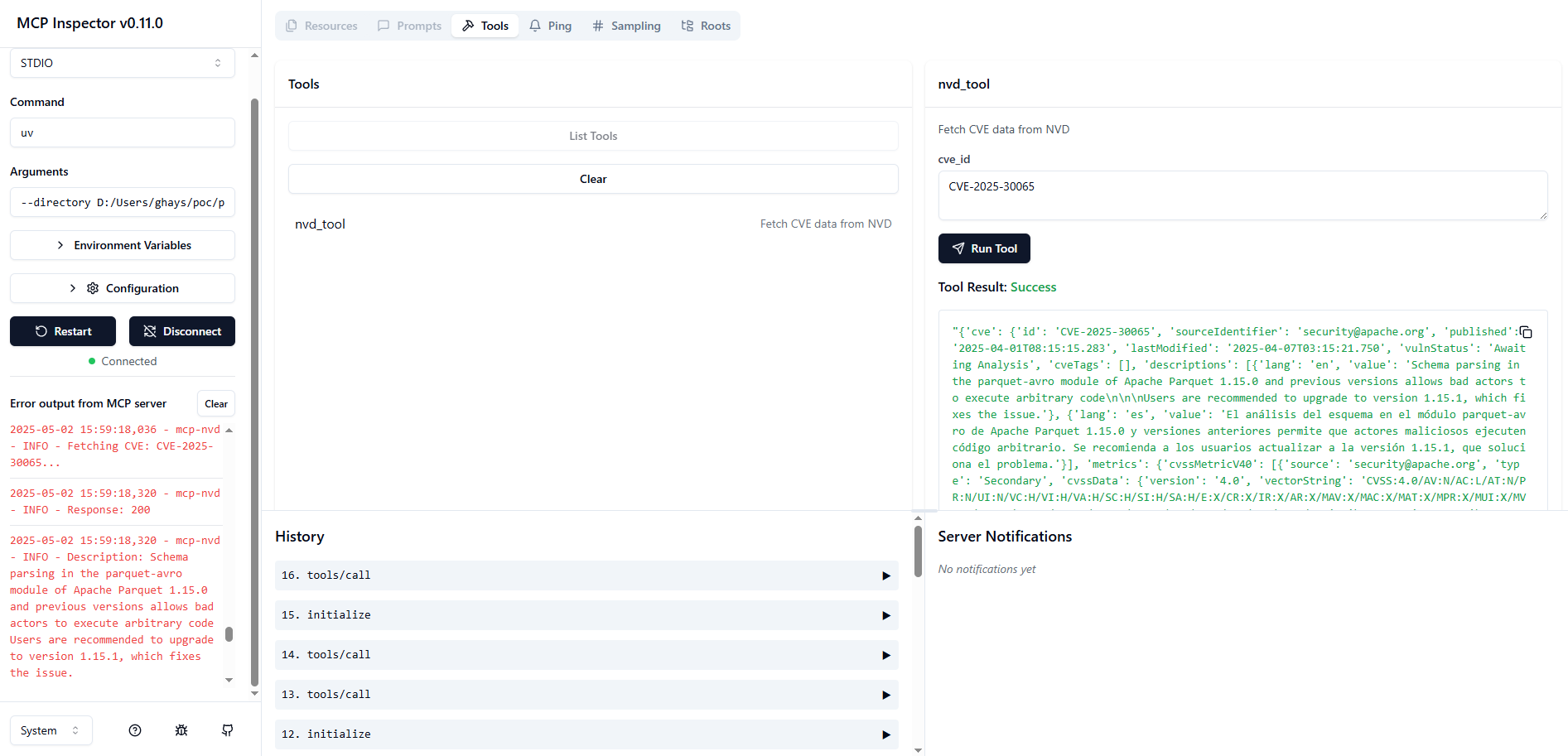
Fetch CVE data from NVD
| Name | Required | Description | Default |
|---|---|---|---|
| cve_id | Yes | The CVE ID to fetch data for. |
Does the description disclose side effects, auth requirements, rate limits, or destructive behavior?
With no annotations provided, the description carries the full burden of behavioral disclosure. 'Fetch CVE data from NVD' implies a read-only operation, but it doesn't specify rate limits, authentication requirements, error conditions, response format, or whether it's idempotent. For a tool with zero annotation coverage, this is insufficient.
Agents need to know what a tool does to the world before calling it. Descriptions should go beyond structured annotations to explain consequences.
Is the description appropriately sized, front-loaded, and free of redundancy?
The description is extremely concise at just four words, front-loading the essential information with zero wasted words. It efficiently communicates the core purpose without unnecessary elaboration.
Shorter descriptions cost fewer tokens and are easier for agents to parse. Every sentence should earn its place.
Given the tool's complexity, does the description cover enough for an agent to succeed on first attempt?
For a tool with no annotations and no output schema, the description is inadequate. It doesn't explain what 'CVE data' includes, the format of returned information, potential errors, or any behavioral characteristics. The description fails to compensate for the lack of structured metadata.
Complex tools with many parameters or behaviors need more documentation. Simple tools need less. This dimension scales expectations accordingly.
Does the description clarify parameter syntax, constraints, interactions, or defaults beyond what the schema provides?
The schema description coverage is 100%, with the single parameter 'cve_id' fully documented in the schema. The description doesn't add any parameter-specific information beyond what's already in the schema, so the baseline score of 3 is appropriate.
Input schemas describe structure but not intent. Descriptions should explain non-obvious parameter relationships and valid value ranges.
Does the description clearly state what the tool does and how it differs from similar tools?
The description 'Fetch CVE data from NVD' clearly states the action (fetch) and resource (CVE data from NVD), making the tool's purpose immediately understandable. It doesn't distinguish from siblings, but there are no sibling tools on this server, so a 4 is appropriate rather than a 5.
Agents choose between tools based on descriptions. A clear purpose with a specific verb and resource helps agents select the right tool.
Does the description explain when to use this tool, when not to, or what alternatives exist?
The description provides no guidance on when to use this tool versus alternatives, prerequisites, or limitations. It simply states what the tool does without any context about appropriate usage scenarios or constraints.
Agents often have multiple tools that could apply. Explicit usage guidance like "use X instead of Y when Z" prevents misuse.
Recent tool additions, removals, and schema changes observed during successful MCP inspections.
v1.0.0nvd_toolScored across 1 tool
With only one tool, there is no possibility of ambiguity or overlap between tools. The single tool 'nvd_tool' has a clear and distinct purpose of fetching CVE data from NVD.
A single tool inherently has perfect naming consistency as there are no other tools to compare against. The name 'nvd_tool' follows a simple noun-based pattern appropriate for its function.
One tool is generally too few for most server purposes, especially for a data source like NVD which typically supports multiple operations (e.g., search by CVE ID, filter by date, get recent vulnerabilities). This feels thin and limited in scope.
The tool surface is severely incomplete for an NVD server. While fetching CVE data is a core function, obvious gaps include searching, filtering, pagination, and accessing specific vulnerability details, which are essential for comprehensive CVE data interaction.
Real-time CVE, exploit, and vulnerability intelligence for AI assistants (350K+ CVEs, 115K+ PoCs)
CVE lookups (NVD) and dependency-manifest audits (OSV) for AI agents. No API keys.
CVE lookups (NVD) and dependency-manifest audits (OSV) for AI agents. No API keys.
A Model Context Protocol server for Wix AI tools