
shopops-mcp
Server Quality Checklist
Latest release: v1.2.4
- Disambiguation5/5
Each tool targets a distinct aspect of shop operations (customers, inventory, orders, pricing, products, reports, store management). Even similar tools like customers_churn and customers_segment have clear differences in scope and output. There is no overlap that would cause confusion.
Naming Consistency5/5All tool names follow a consistent 'domain_verb' pattern using snake_case (e.g., customers_churn, inventory_forecast, order_anomalies). This makes it easy to infer the tool's purpose and domain from its name.
Tool Count5/5With 12 tools, the server covers all essential aspects of shop operations without being overwhelming. Each tool serves a clear purpose, and the count is appropriate for the server's scope.
Completeness5/5The tool set provides comprehensive coverage for analyzing and managing a shop: customer segmentation and churn, inventory status and forecasting, order anomaly detection, pricing analysis and optimization, product performance, daily/weekly reports, and store connectivity. There are no obvious gaps for the intended use case.
Average 4.1/5 across 12 of 12 tools scored.
See the Tool Scores section below for per-tool breakdowns.
- No community issues in the last 6 months
- 6 commits in the last 12 weeks
- Last stable release on
- No critical vulnerability alerts
- No high-severity vulnerability alerts
- No code scanning findings
- CI is failing
This repository is licensed under MIT License.
This repository includes a README.md file.
No tool usage detected in the last 30 days. Usage tracking helps demonstrate server value.
Tip: use the "Try in Browser" feature on the server page to seed initial usage.
This repository includes a glama.json configuration file.
If you are the author, simply .
If the server belongs to an organization, first add
glama.jsonto the root of your repository:{ "$schema": "https://glama.ai/mcp/schemas/server.json", "maintainers": [ "your-github-username" ] }Then . Browse examples.
Add related servers to improve discoverability.
How to sync the server with GitHub?
Servers are automatically synced at least once per day, but you can also sync manually at any time to instantly update the server profile.
To manually sync the server, click the "Sync Server" button in the MCP server admin interface.
How is the quality score calculated?
The overall quality score combines two components: Tool Definition Quality (70%) and Server Coherence (30%).
Tool Definition Quality measures how well each tool describes itself to AI agents. Every tool is scored 1–5 across six dimensions: Purpose Clarity (25%), Usage Guidelines (20%), Behavioral Transparency (20%), Parameter Semantics (15%), Conciseness & Structure (10%), and Contextual Completeness (10%). The server-level definition quality score is calculated as 60% mean TDQS + 40% minimum TDQS, so a single poorly described tool pulls the score down.
Server Coherence evaluates how well the tools work together as a set, scoring four dimensions equally: Disambiguation (can agents tell tools apart?), Naming Consistency, Tool Count Appropriateness, and Completeness (are there gaps in the tool surface?).
Tiers are derived from the overall score: A (≥3.5), B (≥3.0), C (≥2.0), D (≥1.0), F (<1.0). B and above is considered passing.
Tool Scores
- Behavior4/5
Does the description disclose side effects, auth requirements, rate limits, or destructive behavior?
Annotations already declare readOnlyHint, destructiveHint, idempotentHint, and openWorldHint. The description adds value by detailing the output segments and the 'actionable recommendations' tag, providing context beyond annotations.
Agents need to know what a tool does to the world before calling it. Descriptions should go beyond structured annotations to explain consequences.
Conciseness5/5Is the description appropriately sized, front-loaded, and free of redundancy?
Two sentences, no filler. The first sentence immediately states the core function, and the second adds segment names and value proposition. Efficient and well-structured.
Shorter descriptions cost fewer tokens and are easier for agents to parse. Every sentence should earn its place.
Completeness4/5Given the tool's complexity, does the description cover enough for an agent to succeed on first attempt?
Given the simple parameter set and annotations, the description covers the tool's purpose and output well. However, it could explain what 'actionable recommendations' entails or how results are presented, but overall sufficient.
Complex tools with many parameters or behaviors need more documentation. Simple tools need less. This dimension scales expectations accordingly.
Parameters3/5Does the description clarify parameter syntax, constraints, interactions, or defaults beyond what the schema provides?
Schema coverage is 100% with a well-described store_id parameter. The description adds no additional semantics beyond the schema, so it meets the baseline but does not exceed it.
Input schemas describe structure but not intent. Descriptions should explain non-obvious parameter relationships and valid value ranges.
Purpose5/5Does the description clearly state what the tool does and how it differs from similar tools?
The description clearly states the tool performs RFM customer segmentation, listing specific segments (Champions, Loyal, etc.) and mentions actionable recommendations. This provides a clear and specific purpose, distinguishing it from other tools.
Agents choose between tools based on descriptions. A clear purpose with a specific verb and resource helps agents select the right tool.
Usage Guidelines2/5Does the description explain when to use this tool, when not to, or what alternatives exist?
No guidance on when to use this tool versus siblings like customers_churn. The description does not specify ideal scenarios or exclusions, leaving the agent to infer usage.
Agents often have multiple tools that could apply. Explicit usage guidance like "use X instead of Y when Z" prevents misuse.
- Behavior3/5
Does the description disclose side effects, auth requirements, rate limits, or destructive behavior?
Annotations already indicate read-only, non-destructive, and idempotent behavior. The description adds that it includes trends, margins, and velocity, which is helpful but does not disclose any behavioral nuances beyond the annotations.
Agents need to know what a tool does to the world before calling it. Descriptions should go beyond structured annotations to explain consequences.
Conciseness5/5Is the description appropriately sized, front-loaded, and free of redundancy?
The description is two sentences with no redundancy. It front-loads the purpose and defines the ABC categories succinctly.
Shorter descriptions cost fewer tokens and are easier for agents to parse. Every sentence should earn its place.
Completeness4/5Given the tool's complexity, does the description cover enough for an agent to succeed on first attempt?
While no output schema exists, the description covers key report components (trends, margins, velocity). It is sufficiently complete for a read-only report tool given the annotations and schema.
Complex tools with many parameters or behaviors need more documentation. Simple tools need less. This dimension scales expectations accordingly.
Parameters3/5Does the description clarify parameter syntax, constraints, interactions, or defaults beyond what the schema provides?
Schema coverage is 100%, so baseline is 3. The description does not add meaning beyond what the schema provides for store_id and period_days; it only mentions high-level report contents.
Input schemas describe structure but not intent. Descriptions should explain non-obvious parameter relationships and valid value ranges.
Purpose5/5Does the description clearly state what the tool does and how it differs from similar tools?
The description clearly states the tool generates a product performance report with ABC analysis, defining the revenue thresholds for categories A, B, and C. This distinguishes it from sibling tools like inventory_forecast or pricing_analyze.
Agents choose between tools based on descriptions. A clear purpose with a specific verb and resource helps agents select the right tool.
Usage Guidelines3/5Does the description explain when to use this tool, when not to, or what alternatives exist?
The description implies usage for ABC analysis but does not explicitly state when to use this tool versus alternatives like report_daily or inventory_status. No exclusions or alternative suggestions are provided.
Agents often have multiple tools that could apply. Explicit usage guidance like "use X instead of Y when Z" prevents misuse.
- Behavior3/5
Does the description disclose side effects, auth requirements, rate limits, or destructive behavior?
Annotations already declare readOnlyHint=true, destructiveHint=false, idempotentHint=true, so the tool's safety profile is clear. The description adds the list of report contents but does not disclose additional behavioral details such as data aggregation method, timezone handling (though partially covered in date parameter), or performance characteristics.
Agents need to know what a tool does to the world before calling it. Descriptions should go beyond structured annotations to explain consequences.
Conciseness5/5Is the description appropriately sized, front-loaded, and free of redundancy?
The description is a single sentence of 14 words, front-loaded with the purpose ('Daily operational report') followed by a concise list of contents. Every phrase adds value, with no redundant or irrelevant information.
Shorter descriptions cost fewer tokens and are easier for agents to parse. Every sentence should earn its place.
Completeness4/5Given the tool's complexity, does the description cover enough for an agent to succeed on first attempt?
Given no output schema, the description enumerates all major report sections (orders, revenue, products, customers, alerts, anomalies), providing adequate context for an agent. Minor omission: no mention of the output format (e.g., JSON, table) or whether the report returns aggregated data for the exact day versus a rolling window.
Complex tools with many parameters or behaviors need more documentation. Simple tools need less. This dimension scales expectations accordingly.
Parameters3/5Does the description clarify parameter syntax, constraints, interactions, or defaults beyond what the schema provides?
Schema description coverage is 100% for both parameters (store_id and date). The tool description does not add new meaning beyond what the schema already provides, so a baseline of 3 is appropriate.
Input schemas describe structure but not intent. Descriptions should explain non-obvious parameter relationships and valid value ranges.
Purpose5/5Does the description clearly state what the tool does and how it differs from similar tools?
The description clearly states it provides a 'daily operational report' containing specific metrics: orders, revenue, top products, new vs returning customers, low stock alerts, and anomaly count. This differentiates it from the sibling tool 'report_weekly' which likely covers a different time period, and from other analytics tools like 'order_anomalies' which focus on a single metric.
Agents choose between tools based on descriptions. A clear purpose with a specific verb and resource helps agents select the right tool.
Usage Guidelines3/5Does the description explain when to use this tool, when not to, or what alternatives exist?
The description implies the tool is for generating a daily summary, but does not explicitly state when to use it over alternatives like 'report_weekly' or when a more granular tool like 'order_anomalies' would be preferred. No guidance on exclusions or prerequisites is provided.
Agents often have multiple tools that could apply. Explicit usage guidance like "use X instead of Y when Z" prevents misuse.
- Behavior3/5
Does the description disclose side effects, auth requirements, rate limits, or destructive behavior?
Annotations already indicate read-only, non-destructive, idempotent behavior. The description adds context about AI-generated insights but does not detail data freshness, authorization requirements, or return format. No contradiction with annotations.
Agents need to know what a tool does to the world before calling it. Descriptions should go beyond structured annotations to explain consequences.
Conciseness5/5Is the description appropriately sized, front-loaded, and free of redundancy?
The description is a single, efficient sentence that conveys all necessary information without redundancy. It is front-loaded with the core purpose and lists specific components.
Shorter descriptions cost fewer tokens and are easier for agents to parse. Every sentence should earn its place.
Completeness4/5Given the tool's complexity, does the description cover enough for an agent to succeed on first attempt?
Given a single parameter, no output schema, and moderate complexity, the description covers the report's contents well. It could mention that it compares to the previous week, but overall it is sufficiently complete.
Complex tools with many parameters or behaviors need more documentation. Simple tools need less. This dimension scales expectations accordingly.
Parameters3/5Does the description clarify parameter syntax, constraints, interactions, or defaults beyond what the schema provides?
The input schema has one parameter (store_id) with a comprehensive description (100% coverage). The description does not add further parameter meaning beyond what the schema provides, so a baseline score of 3 is appropriate.
Input schemas describe structure but not intent. Descriptions should explain non-obvious parameter relationships and valid value ranges.
Purpose5/5Does the description clearly state what the tool does and how it differs from similar tools?
The description clearly states the tool produces a weekly trend report covering revenue/order changes, customer segments, trending products, and AI insights. It uses specific verbs and resources, distinguishing it from siblings like report_daily.
Agents choose between tools based on descriptions. A clear purpose with a specific verb and resource helps agents select the right tool.
Usage Guidelines3/5Does the description explain when to use this tool, when not to, or what alternatives exist?
The description implies usage for generating weekly reports but does not explicitly state when to use this tool versus alternatives (e.g., report_daily). No exclusions or prerequisites are mentioned.
Agents often have multiple tools that could apply. Explicit usage guidance like "use X instead of Y when Z" prevents misuse.
- Behavior4/5
Does the description disclose side effects, auth requirements, rate limits, or destructive behavior?
Annotations already declare the tool read-only and idempotent. The description adds that it uses moving-average sales velocity and returns specific outputs (reorder points, safety stock, suggested reorder quantities), providing useful behavioral context beyond annotations.
Agents need to know what a tool does to the world before calling it. Descriptions should go beyond structured annotations to explain consequences.
Conciseness5/5Is the description appropriately sized, front-loaded, and free of redundancy?
The description is two sentences, front-loading the purpose and method, followed by return values. No extraneous information.
Shorter descriptions cost fewer tokens and are easier for agents to parse. Every sentence should earn its place.
Completeness4/5Given the tool's complexity, does the description cover enough for an agent to succeed on first attempt?
Given the annotations and full schema coverage, the description adequately covers purpose and output. It lacks details on the moving-average window or data recency, but the tool is straightforward.
Complex tools with many parameters or behaviors need more documentation. Simple tools need less. This dimension scales expectations accordingly.
Parameters3/5Does the description clarify parameter syntax, constraints, interactions, or defaults beyond what the schema provides?
Schema coverage is 100%, so the description adds no new meaning to the parameters beyond what the schema already provides.
Input schemas describe structure but not intent. Descriptions should explain non-obvious parameter relationships and valid value ranges.
Purpose5/5Does the description clearly state what the tool does and how it differs from similar tools?
The description clearly states the tool predicts stock depletion dates using moving-average sales velocity, distinguishing it from sibling tools like inventory_status or order_anomalies.
Agents choose between tools based on descriptions. A clear purpose with a specific verb and resource helps agents select the right tool.
Usage Guidelines3/5Does the description explain when to use this tool, when not to, or what alternatives exist?
The description does not explicitly state when to use this tool versus alternatives, nor does it provide exclusions or prerequisites.
Agents often have multiple tools that could apply. Explicit usage guidance like "use X instead of Y when Z" prevents misuse.
- Behavior3/5
Does the description disclose side effects, auth requirements, rate limits, or destructive behavior?
Annotations (readOnlyHint=true, destructiveHint=false, idempotentHint=true) already cover safety and idempotency. The description adds the return format but does not disclose potential performance implications, data freshness, or other behavioral traits beyond what annotations provide.
Agents need to know what a tool does to the world before calling it. Descriptions should go beyond structured annotations to explain consequences.
Conciseness5/5Is the description appropriately sized, front-loaded, and free of redundancy?
The description is concise with two sentences, front-loading the main purpose. It lists output fields efficiently and includes parameter usage, with no redundant or vague statements.
Shorter descriptions cost fewer tokens and are easier for agents to parse. Every sentence should earn its place.
Completeness4/5Given the tool's complexity, does the description cover enough for an agent to succeed on first attempt?
Given moderate complexity (2 params, no output schema), the description covers purpose, output structure, and parameter usage. Sibling tools are present, but no guidance on when to use this vs. 'pricing_optimize' is missing, and pagination or error handling are not addressed. Still, it is largely complete.
Complex tools with many parameters or behaviors need more documentation. Simple tools need less. This dimension scales expectations accordingly.
Parameters3/5Does the description clarify parameter syntax, constraints, interactions, or defaults beyond what the schema provides?
Schema description coverage is 100%, and the description largely restates the schema's parameter descriptions. It adds no new semantic meaning; the instruction to use product_id for scoping is already in the schema. Thus baseline score of 3 is appropriate.
Input schemas describe structure but not intent. Descriptions should explain non-obvious parameter relationships and valid value ranges.
Purpose5/5Does the description clearly state what the tool does and how it differs from similar tools?
The description clearly states it analyzes pricing with margin calculation, sales velocity, and rule-based price optimization suggestions. It specifies the exact output fields, making it distinct from siblings like 'pricing_optimize' which likely focuses on applying changes rather than analysis.
Agents choose between tools based on descriptions. A clear purpose with a specific verb and resource helps agents select the right tool.
Usage Guidelines4/5Does the description explain when to use this tool, when not to, or what alternatives exist?
The description gives clear guidance on parameter usage: 'Pass product_id to scope to a single product, omit for full catalog.' It does not explicitly mention when not to use or compare with siblings, but the usage context is well stated.
Agents often have multiple tools that could apply. Explicit usage guidance like "use X instead of Y when Z" prevents misuse.
- Behavior4/5
Does the description disclose side effects, auth requirements, rate limits, or destructive behavior?
Annotations already declare readOnlyHint=true and destructiveHint=false, so safety is clear. The description adds behavioral details about what anomalies are detected and the output structure (fields like order_id, anomaly_type, severity). It does not cover rate limits or time range precision, but overall adds value beyond annotations.
Agents need to know what a tool does to the world before calling it. Descriptions should go beyond structured annotations to explain consequences.
Conciseness5/5Is the description appropriately sized, front-loaded, and free of redundancy?
The description is two sentences, first defining the tool's function and second detailing the output and use cases. Every word is functional, with no redundancy.
Shorter descriptions cost fewer tokens and are easier for agents to parse. Every sentence should earn its place.
Completeness4/5Given the tool's complexity, does the description cover enough for an agent to succeed on first attempt?
With one well-documented parameter and a detailed output description (even without an output schema), the tool is fairly complete. Missing explicit mention of time range for 'recent orders' is a minor gap.
Complex tools with many parameters or behaviors need more documentation. Simple tools need less. This dimension scales expectations accordingly.
Parameters3/5Does the description clarify parameter syntax, constraints, interactions, or defaults beyond what the schema provides?
The input schema has 100% coverage with a detailed description for store_id. The tool description does not add additional parameter semantics beyond what the schema provides, so the baseline of 3 is appropriate.
Input schemas describe structure but not intent. Descriptions should explain non-obvious parameter relationships and valid value ranges.
Purpose5/5Does the description clearly state what the tool does and how it differs from similar tools?
The description clearly states 'Statistical anomaly detection on recent orders' and lists specific anomaly types, making the tool's purpose explicit. It distinguishes itself from sibling tools like customers_churn or inventory_forecast which focus on different domains.
Agents choose between tools based on descriptions. A clear purpose with a specific verb and resource helps agents select the right tool.
Usage Guidelines4/5Does the description explain when to use this tool, when not to, or what alternatives exist?
The description mentions 'Useful for fraud detection and revenue spike investigation,' providing context. However, it does not explicitly state when not to use the tool or compare it to alternatives, missing a bit on usage boundaries.
Agents often have multiple tools that could apply. Explicit usage guidance like "use X instead of Y when Z" prevents misuse.
- Behavior4/5
Does the description disclose side effects, auth requirements, rate limits, or destructive behavior?
Description discloses mutation behavior (connect creates, sync refreshes), return payload structure, and that credentials are never returned. Annotations are sparse (readOnlyHint=false, destructiveHint=false) and description adds value by detailing the sync process and security note.
Agents need to know what a tool does to the world before calling it. Descriptions should go beyond structured annotations to explain consequences.
Conciseness5/5Is the description appropriately sized, front-loaded, and free of redundancy?
Three short, focused sentences: first introduces actions, second describes return payload, third notes credentials. No superfluous words, front-loaded with actionable information.
Shorter descriptions cost fewer tokens and are easier for agents to parse. Every sentence should earn its place.
Completeness4/5Given the tool's complexity, does the description cover enough for an agent to succeed on first attempt?
Covers main actions and return format. Missing details on error handling, rate limits, or prerequisites (e.g., platform-specific requirements). OpenWorldHint suggests external API calls but not explicitly stated. Still mostly complete for a connection management tool.
Complex tools with many parameters or behaviors need more documentation. Simple tools need less. This dimension scales expectations accordingly.
Parameters3/5Does the description clarify parameter syntax, constraints, interactions, or defaults beyond what the schema provides?
Schema covers 100% of parameters with descriptions. The description adds high-level context (return format, credential security) but does not significantly enhance parameter meaning beyond what the schema provides. Baseline 3 is appropriate.
Input schemas describe structure but not intent. Descriptions should explain non-obvious parameter relationships and valid value ranges.
Purpose5/5Does the description clearly state what the tool does and how it differs from similar tools?
Description clearly states the tool manages Shopify/WooCommerce connections with three specific actions (connect, sync, list), each with distinct purposes. It distinguishes from sibling tools which focus on other domains like customers, inventory, orders, etc.
Agents choose between tools based on descriptions. A clear purpose with a specific verb and resource helps agents select the right tool.
Usage Guidelines4/5Does the description explain when to use this tool, when not to, or what alternatives exist?
The description explains when to use each action (connect for new store, sync for existing, list to show all). While it doesn't explicitly say when not to use or list alternatives, the context is clear given the tool's focused scope.
Agents often have multiple tools that could apply. Explicit usage guidance like "use X instead of Y when Z" prevents misuse.
- Behavior4/5
Does the description disclose side effects, auth requirements, rate limits, or destructive behavior?
Annotations already declare readOnlyHint=true, destructiveHint=false, idempotentHint=true. The description adds value by detailing the return object structure (at_risk, hibernating, lost arrays with specific fields and win_back_recommendation), which is beyond what annotations provide.
Agents need to know what a tool does to the world before calling it. Descriptions should go beyond structured annotations to explain consequences.
Conciseness5/5Is the description appropriately sized, front-loaded, and free of redundancy?
The description is two sentences, front-loaded with the core function, and efficiently conveys purpose and return format without any fluff. Every sentence earns its place.
Shorter descriptions cost fewer tokens and are easier for agents to parse. Every sentence should earn its place.
Completeness5/5Given the tool's complexity, does the description cover enough for an agent to succeed on first attempt?
Given the low complexity (1 parameter, no output schema), the description covers purpose, usage, and return structure comprehensively. Annotations provide safety traits. No gaps remain.
Complex tools with many parameters or behaviors need more documentation. Simple tools need less. This dimension scales expectations accordingly.
Parameters3/5Does the description clarify parameter syntax, constraints, interactions, or defaults beyond what the schema provides?
Schema coverage is 100% with a single well-described parameter (store_id). The description adds no extra meaning beyond the schema, so baseline 3 is appropriate.
Input schemas describe structure but not intent. Descriptions should explain non-obvious parameter relationships and valid value ranges.
Purpose5/5Does the description clearly state what the tool does and how it differs from similar tools?
The description uses specific verb+resource ('Identify customers at risk of churning') and clearly distinguishes from sibling tools like customers_segment and order_anomalies by focusing on churn risk based on RFM signals.
Agents choose between tools based on descriptions. A clear purpose with a specific verb and resource helps agents select the right tool.
Usage Guidelines4/5Does the description explain when to use this tool, when not to, or what alternatives exist?
The description explicitly states 'Use this for targeted re-engagement campaigns,' providing clear context. It does not mention when not to use or list alternatives, but the use case is well-defined.
Agents often have multiple tools that could apply. Explicit usage guidance like "use X instead of Y when Z" prevents misuse.
- Behavior5/5
Does the description disclose side effects, auth requirements, rate limits, or destructive behavior?
The description adds value beyond annotations by detailing the output structure (summary object, two arrays, fields per item) and sorting behavior (by quantity ascending). It confirms read-only and idempotent nature, which aligns with annotations.
Agents need to know what a tool does to the world before calling it. Descriptions should go beyond structured annotations to explain consequences.
Conciseness5/5Is the description appropriately sized, front-loaded, and free of redundancy?
The description is a concise three-sentence paragraph, front-loading the purpose and then providing necessary details. Every sentence adds value with no redundancy.
Shorter descriptions cost fewer tokens and are easier for agents to parse. Every sentence should earn its place.
Completeness5/5Given the tool's complexity, does the description cover enough for an agent to succeed on first attempt?
Despite no output schema, the description fully explains the return value format and fields. Combined with clear purpose and parameter info, the tool definition is complete for an agent to use and interpret results.
Complex tools with many parameters or behaviors need more documentation. Simple tools need less. This dimension scales expectations accordingly.
Parameters3/5Does the description clarify parameter syntax, constraints, interactions, or defaults beyond what the schema provides?
The input schema provides 100% coverage for store_id with a detailed description linking to other tools. The tool description adds no additional meaning for the parameter, so baseline score of 3 is appropriate.
Input schemas describe structure but not intent. Descriptions should explain non-obvious parameter relationships and valid value ranges.
Purpose5/5Does the description clearly state what the tool does and how it differs from similar tools?
The description clearly states it provides a 'snapshot of current stock levels' for a connected store, listing specific output fields and sorting. It distinguishes from siblings (e.g., inventory_forecast, product_performance) by focusing on current status.
Agents choose between tools based on descriptions. A clear purpose with a specific verb and resource helps agents select the right tool.
Usage Guidelines3/5Does the description explain when to use this tool, when not to, or what alternatives exist?
The description does not explicitly state when to use this tool vs alternatives or provide exclusions. It implies usage for current stock checks but lacks guidance like 'use for real-time inventory view; for predictions use inventory_forecast'.
Agents often have multiple tools that could apply. Explicit usage guidance like "use X instead of Y when Z" prevents misuse.
- Behavior4/5
Does the description disclose side effects, auth requirements, rate limits, or destructive behavior?
Annotations already declare readOnlyHint and idempotentHint; description adds return structure, sorting, and filtering behavior, enhancing transparency without contradiction.
Agents need to know what a tool does to the world before calling it. Descriptions should go beyond structured annotations to explain consequences.
Conciseness5/5Is the description appropriately sized, front-loaded, and free of redundancy?
Two efficient sentences: first defines purpose, second adds usage guidance and return details. No wasted words.
Shorter descriptions cost fewer tokens and are easier for agents to parse. Every sentence should earn its place.
Completeness5/5Given the tool's complexity, does the description cover enough for an agent to succeed on first attempt?
Despite no output schema, description fully details return format, fields, and sorting. Simple input is well-covered. Complete for intended use.
Complex tools with many parameters or behaviors need more documentation. Simple tools need less. This dimension scales expectations accordingly.
Parameters3/5Does the description clarify parameter syntax, constraints, interactions, or defaults beyond what the schema provides?
Schema coverage is 100%, and description adds minor context about where to obtain store_id, but does not significantly enhance schema meaning.
Input schemas describe structure but not intent. Descriptions should explain non-obvious parameter relationships and valid value ranges.
Purpose5/5Does the description clearly state what the tool does and how it differs from similar tools?
Description explicitly states it provides filtered pricing recommendations only for products with suggested changes, clearly distinguishing it from sibling pricing_analyze.
Agents choose between tools based on descriptions. A clear purpose with a specific verb and resource helps agents select the right tool.
Usage Guidelines5/5Does the description explain when to use this tool, when not to, or what alternatives exist?
Directly instructs to use this tool instead of pricing_analyze when only actionable changes are needed, providing explicit context.
Agents often have multiple tools that could apply. Explicit usage guidance like "use X instead of Y when Z" prevents misuse.
- Behavior4/5
Does the description disclose side effects, auth requirements, rate limits, or destructive behavior?
Annotations already indicate non-destructive, non-read-only, and non-idempotent. Description adds rich detail on what is created (20 products, 40 customers across 6 archetype buckets, 150+ orders) and that each call creates a new unique ID, but does not disclose any potential limits or side effects beyond creation.
Agents need to know what a tool does to the world before calling it. Descriptions should go beyond structured annotations to explain consequences.
Conciseness5/5Is the description appropriately sized, front-loaded, and free of redundancy?
Description is concise, front-loaded with the main purpose, and structured logically from creation details to usage notes. Every sentence adds value.
Shorter descriptions cost fewer tokens and are easier for agents to parse. Every sentence should earn its place.
Completeness5/5Given the tool's complexity, does the description cover enough for an agent to succeed on first attempt?
Given no parameters and no output schema, the description is fully complete: it explains what the tool does, why to use it, what it returns (store_id plus counts), and how it fits with sibling tools.
Complex tools with many parameters or behaviors need more documentation. Simple tools need less. This dimension scales expectations accordingly.
Parameters4/5Does the description clarify parameter syntax, constraints, interactions, or defaults beyond what the schema provides?
No parameters exist; schema coverage is 100%. With zero parameters, baseline is 4, and the description appropriately provides no additional parameter info.
Input schemas describe structure but not intent. Descriptions should explain non-obvious parameter relationships and valid value ranges.
Purpose5/5Does the description clearly state what the tool does and how it differs from similar tools?
Description clearly states it creates a realistic demo store with specific counts of products, customers, and orders, and explicitly distinguishes from sibling tools like store_connect by noting it works without real credentials.
Agents choose between tools based on descriptions. A clear purpose with a specific verb and resource helps agents select the right tool.
Usage Guidelines5/5Does the description explain when to use this tool, when not to, or what alternatives exist?
Explicitly states when to use (explore ShopOps without real credentials) and that it's safe to call multiple times, with each call producing a new unique store. Mentions that other tools will work on the returned store_id.
Agents often have multiple tools that could apply. Explicit usage guidance like "use X instead of Y when Z" prevents misuse.
GitHub Badge
Glama performs regular codebase and documentation scans to:
- Confirm that the MCP server is working as expected.
- Confirm that there are no obvious security issues.
- Evaluate tool definition quality.
Our badge communicates server capabilities, safety, and installation instructions.
Card Badge
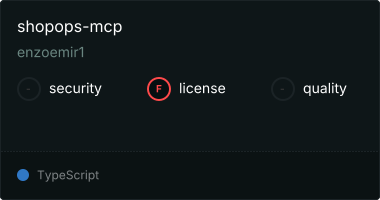
Copy to your README.md:
Score Badge

Copy to your README.md:
Latest Blog Posts
- Who's Calling? MCP Hosts Are an Identity Blind Spot (And the Spec Knows It)By Om-Shree-0709 on .mcpAgent IdentityOAuth 2.1
- Your AI Chatbot Just Exposed Your CEO's Salary to an InternBy Om-Shree-0709 on .Agent IdentityMCP SecurityOAuth Delegation
- Why MCP Servers Need Execution Sandboxing (And Why Your Current Stack Isn't Enough)By Om-Shree-0709 on .Agentic AiPrompt InjectionWebAssembly
MCP directory API
We provide all the information about MCP servers via our MCP API.
curl -X GET 'https://glama.ai/api/mcp/v1/servers/enzoemir1/shopops-mcp'
If you have feedback or need assistance with the MCP directory API, please join our Discord server