
A
licenseB
qualityB
maintenanceA Model Context Protocol server that retrieves information from Wikipedia to provide context to LLMs, allowing users to search articles, get summaries, full content, sections, and links from Wikipedia.
22
294
MIT

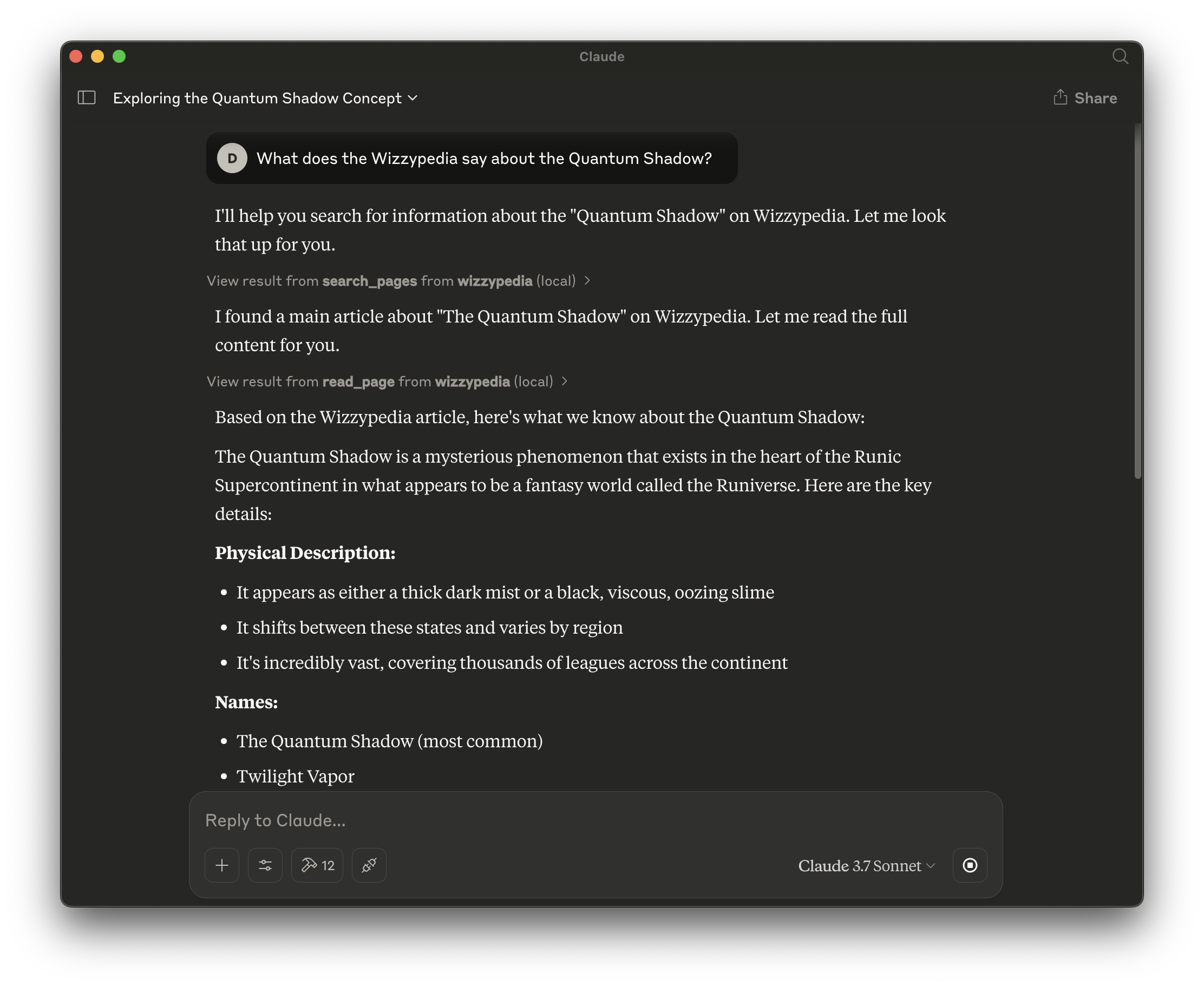
이는 Cursor나 Claude Desktop과 같은 MCP 지원 편집기와 함께 작동하도록 설계된, Wizzpedia API와 상호 작용하기 위한 MCP(Model Context Protocol) 서버입니다.
즉, MCP가 활성화된 모든 도구에서 Wizzypedia 에 쿼리를 보내거나 쓸 수 있습니다.
위키 페이지 검색(읽기 전용)
페이지 내용 읽기(읽기 전용)
페이지 기록 보기(읽기 전용)
목록 페이지 카테고리(읽기 전용)
새 페이지 만들기(인증 필요)
기존 페이지 업데이트(인증 필요)
Related MCP server: mediawiki-mcp-server
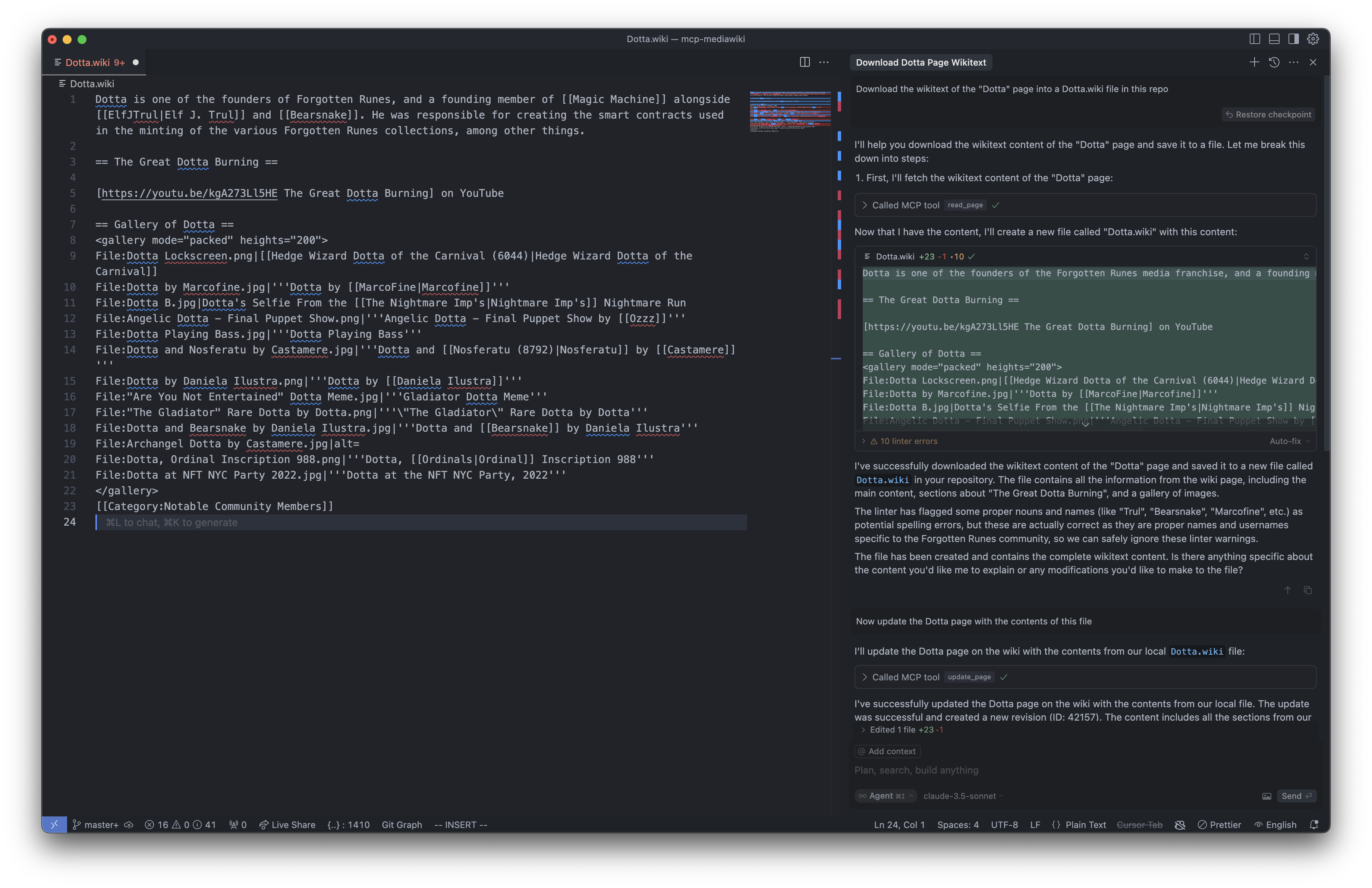
사용자: "Dotta" 페이지의 위키 텍스트를 이 저장소의 Dotta.wiki 파일로 다운로드하세요.
AI: "Dotta" 페이지의 위키텍스트 콘텐츠를 다운로드하여 파일로 저장하는 것을 도와드리겠습니다. 단계별로 설명해 드리겠습니다. 먼저 "Dotta" 페이지의 위키텍스트 콘텐츠를 가져옵니다. ...
// Dotta.wiki 페이지가 생성되었습니다.
// 이제 로컬에서 Dotta.wiki를 편집할 수 있습니다.
사용자: 이제 이 파일의 내용으로 Dotta 페이지를 업데이트하세요.
AI: 로컬 파일의 내용을 사용하여 위키의 도타 페이지를 성공적으로 업데이트했습니다. 업데이트가 성공적으로 완료되어 새 개정판(ID: 42157)이 생성되었습니다. 이 내용에는 소개, 위대한 도타 소각 섹션, 그리고 이미지 갤러리를 포함하여 로컬 파일의 모든 섹션이 포함되어 있습니다.
서버는 두 가지 모드로 실행될 수 있습니다.
익명 모드(기본값) : 읽기 작업만 가능합니다.
인증 모드 : 읽기 및 쓰기 작업이 모두 가능합니다.
인증 자격 증명은 쓰기 작업(페이지 생성/업데이트)을 수행해야 하는 경우에만 필요합니다.
MCP 서버는 읽기 전용 또는 인증 모드로 구성할 수 있습니다. 필요에 맞는 구성을 선택하세요.
이 구성에서는 읽기 작업(검색, 페이지 보기 등)만 허용됩니다.
커서 ( ~/.cursor/mcp.json )의 경우:
지엑스피1
Claude Desktop (macOS에서는 ~/Library/Application Support/Claude/claude_desktop_config.json , Windows에서는 %APPDATA%\Claude\claude_desktop_config.json )의 경우:
{
  "mcpServers": {
    "wizzypedia": {
      "command": "npx",
      "args": ["-y", "wizzypedia-mcp-server"]
    }
  }
}이 구성을 사용하면 읽기 및 쓰기 작업(페이지 생성/업데이트)이 모두 가능합니다.
커서 ( ~/.cursor/mcp.json )의 경우:
{
  "mcpServers": {
    "wizzypedia": {
      "command": "npx",
      "args": [
        "-y",
        "wizzypedia-mcp-server",
        "--login",
        "your-username",
        "--password",
        "your-password"
      ]
    }
  }
}
Claude Desktop (macOS에서는 ~/Library/Application Support/Claude/claude_desktop_config.json , Windows에서는 %APPDATA%\Claude\claude_desktop_config.json )의 경우:
{
  "mcpServers": {
    "wizzypedia": {
      "command": "npx",
      "args": [
        "-y",
        "wizzypedia-mcp-server",
        "--login",
        "your-username",
        "--password",
        "your-password"
      ]
    }
  }
}서버는 다음과 같은 MCP 도구를 제공합니다.
읽기 전용 도구(인증 필요 없음):
search_pages - 위키에서 페이지 검색
read_page - 페이지의 원시 위키텍스트 콘텐츠를 가져옵니다
get_page_history - 페이지의 개정 내역 가져오기
get_categories - 페이지가 속한 카테고리 가져오기
도구 작성(인증 필요):
create_page - 새로운 위키 페이지 만들기
update_page - 기존 위키 페이지 업데이트
서버가 실행되면 Cursor 또는 다른 MCP 호환 클라이언트에서 서버에 연결할 수 있습니다. 이를 통해 다음과 같은 작업을 수행할 수 있습니다.
위키 콘텐츠 검색
편집기에 위키 콘텐츠 로드
로컬에서 콘텐츠 편집
변경 사항을 위키에 다시 저장합니다(인증 필요)
npm install
npm run build서버를 읽기 전용 모드로 실행합니다.
# Basic read-only mode
node dist/index.js

# With custom API URL
node dist/index.js --api-url="https://en.wikipedia.org/w/api.php"

# Using npx
npx wizzypedia-mcp-server
쓰기 액세스를 위해 인증을 사용하여 실행:
# With environment variables
export MEDIAWIKI_API_URL="https://en.wikipedia.org/w/api.php"
export MEDIAWIKI_USERNAME="YourUsername"
export MEDIAWIKI_PASSWORD="YourPassword"
node dist/index.js

# Or with command line arguments
node dist/index.js --api-url="https://en.wikipedia.org/w/api.php" --login="YourUsername" --password="YourPassword"

# Or using npx
npx wizzypedia-mcp-server --login YourUsername --password YourPasswordMIT
Create a new wiki page
| Name | Required | Description | Default |
|---|---|---|---|
| title | Yes | Title of the new page | |
| content | Yes | Wiki content for the new page | |
| summary | No | Edit summary | Created via MCP |
Does the description disclose side effects, auth requirements, rate limits, or destructive behavior?
With no annotations provided, the description carries full burden for behavioral disclosure. While 'Create' implies a write operation, it doesn't address permissions needed, whether the page becomes immediately visible, error conditions, or what happens on duplicate titles. This is inadequate for a mutation tool.
Agents need to know what a tool does to the world before calling it. Descriptions should go beyond structured annotations to explain consequences.
Is the description appropriately sized, front-loaded, and free of redundancy?
The description is a single, efficient sentence with zero wasted words. It's appropriately sized and front-loaded with the core purpose.
Shorter descriptions cost fewer tokens and are easier for agents to parse. Every sentence should earn its place.
Given the tool's complexity, does the description cover enough for an agent to succeed on first attempt?
For a creation tool with no annotations and no output schema, the description is insufficient. It doesn't explain what happens after creation, potential side effects, or error handling. Given the complexity of creating a wiki page, more context is needed.
Complex tools with many parameters or behaviors need more documentation. Simple tools need less. This dimension scales expectations accordingly.
Does the description clarify parameter syntax, constraints, interactions, or defaults beyond what the schema provides?
Schema description coverage is 100%, so the schema already documents all three parameters thoroughly. The description adds no additional parameter information beyond what's in the schema, meeting the baseline for high coverage.
Input schemas describe structure but not intent. Descriptions should explain non-obvious parameter relationships and valid value ranges.
Does the description clearly state what the tool does and how it differs from similar tools?
The description clearly states the action ('Create') and resource ('new wiki page'), making the purpose immediately understandable. It doesn't differentiate from sibling tools like 'update_page', but it's not vague or tautological.
Agents choose between tools based on descriptions. A clear purpose with a specific verb and resource helps agents select the right tool.
Does the description explain when to use this tool, when not to, or what alternatives exist?
The description provides no guidance on when to use this tool versus alternatives like 'update_page' or 'read_page'. There's no mention of prerequisites, context, or exclusions for usage.
Agents often have multiple tools that could apply. Explicit usage guidance like "use X instead of Y when Z" prevents misuse.
Get categories a page belongs to
| Name | Required | Description | Default |
|---|---|---|---|
| title | Yes | Title of the page |
Does the description disclose side effects, auth requirements, rate limits, or destructive behavior?
With no annotations provided, the description carries the full burden of behavioral disclosure but offers minimal information. It implies a read-only operation ('Get') but doesn't specify aspects like authentication needs, rate limits, error conditions, or what happens if the page doesn't exist. For a tool with zero annotation coverage, this leaves significant gaps in understanding its behavior.
Agents need to know what a tool does to the world before calling it. Descriptions should go beyond structured annotations to explain consequences.
Is the description appropriately sized, front-loaded, and free of redundancy?
The description is extremely concise and front-loaded, consisting of a single, clear sentence that directly states the tool's purpose without any wasted words. Every part of the sentence earns its place by conveying essential information, making it efficient and easy to parse.
Shorter descriptions cost fewer tokens and are easier for agents to parse. Every sentence should earn its place.
Given the tool's complexity, does the description cover enough for an agent to succeed on first attempt?
Given the lack of annotations and output schema, the description is incomplete for effective tool use. It doesn't explain what the tool returns (e.g., a list of category names, IDs, or full objects), error handling, or dependencies. For a tool with no structured output or behavioral hints, the description should provide more context to compensate.
Complex tools with many parameters or behaviors need more documentation. Simple tools need less. This dimension scales expectations accordingly.
Does the description clarify parameter syntax, constraints, interactions, or defaults beyond what the schema provides?
The input schema has 100% description coverage, with the 'title' parameter fully documented in the schema itself. The description adds no additional meaning beyond what the schema provides (e.g., it doesn't clarify format expectations or edge cases for the title). Thus, it meets the baseline score of 3, as the schema handles the heavy lifting for parameter semantics.
Input schemas describe structure but not intent. Descriptions should explain non-obvious parameter relationships and valid value ranges.
Does the description clearly state what the tool does and how it differs from similar tools?
The description clearly states the tool's purpose with a specific verb ('Get') and resource ('categories a page belongs to'), making it immediately understandable. It distinguishes itself from siblings like 'get_page_history' or 'read_page' by focusing on page categorization rather than content or history. However, it doesn't explicitly differentiate from all siblings (e.g., 'search_pages' might also involve categories), keeping it from a perfect score.
Agents choose between tools based on descriptions. A clear purpose with a specific verb and resource helps agents select the right tool.
Does the description explain when to use this tool, when not to, or what alternatives exist?
The description provides no guidance on when to use this tool versus alternatives. It doesn't mention prerequisites (e.g., needing an existing page), exclusions, or comparisons to siblings like 'search_pages' which might also retrieve category-related data. Without such context, the agent must infer usage based on the tool name alone.
Agents often have multiple tools that could apply. Explicit usage guidance like "use X instead of Y when Z" prevents misuse.
Get revision history of a page
| Name | Required | Description | Default |
|---|---|---|---|
| title | Yes | Title of the page | |
| limit | No | Maximum number of revisions to return (default: 10) |
Does the description disclose side effects, auth requirements, rate limits, or destructive behavior?
No annotations are provided, so the description carries the full burden of behavioral disclosure. It states the action but does not describe key traits such as whether this is a read-only operation, if it requires authentication, how revisions are ordered (e.g., chronological), or what the output format looks like. This leaves significant gaps in understanding the tool's behavior.
Agents need to know what a tool does to the world before calling it. Descriptions should go beyond structured annotations to explain consequences.
Is the description appropriately sized, front-loaded, and free of redundancy?
The description is a single, efficient sentence that directly states the tool's purpose without unnecessary words. It is front-loaded with the core action and resource, making it easy to parse quickly. Every part of the sentence earns its place by conveying essential information.
Shorter descriptions cost fewer tokens and are easier for agents to parse. Every sentence should earn its place.
Given the tool's complexity, does the description cover enough for an agent to succeed on first attempt?
Given the complexity of retrieving revision history (which may involve multiple revisions, ordering, and metadata), the description is incomplete. It lacks details on output structure, error handling, or behavioral traits like pagination or rate limits. With no annotations and no output schema, the description does not provide enough context for effective use.
Complex tools with many parameters or behaviors need more documentation. Simple tools need less. This dimension scales expectations accordingly.
Does the description clarify parameter syntax, constraints, interactions, or defaults beyond what the schema provides?
The input schema has 100% description coverage, clearly documenting both parameters ('title' and 'limit' with a default). The description does not add any meaning beyond the schema, such as explaining what constitutes a 'revision' or how the limit affects performance. Since the schema does the heavy lifting, the baseline score of 3 is appropriate.
Input schemas describe structure but not intent. Descriptions should explain non-obvious parameter relationships and valid value ranges.
Does the description clearly state what the tool does and how it differs from similar tools?
The description clearly states the verb ('Get') and resource ('revision history of a page'), making the purpose understandable. However, it does not distinguish this tool from potential siblings like 'read_page' or 'search_pages' in terms of scope or output type, which prevents a perfect score.
Agents choose between tools based on descriptions. A clear purpose with a specific verb and resource helps agents select the right tool.
Does the description explain when to use this tool, when not to, or what alternatives exist?
The description provides no guidance on when to use this tool versus alternatives. For example, it does not specify if this is for auditing changes, comparing versions, or recovering content, nor does it mention prerequisites like needing the page title. Without such context, the agent lacks direction on appropriate usage scenarios.
Agents often have multiple tools that could apply. Explicit usage guidance like "use X instead of Y when Z" prevents misuse.
Fetch the raw wikitext content of a page
| Name | Required | Description | Default |
|---|---|---|---|
| title | Yes | Title of the page to read |
Does the description disclose side effects, auth requirements, rate limits, or destructive behavior?
With no annotations provided, the description carries the full burden of behavioral disclosure. It states what the tool does ('fetch raw wikitext') but doesn't describe any behavioral traits like error handling (e.g., what happens if the page doesn't exist), performance characteristics, authentication requirements, or rate limits. For a read operation with zero annotation coverage, this leaves significant gaps in understanding how the tool behaves in practice.
Agents need to know what a tool does to the world before calling it. Descriptions should go beyond structured annotations to explain consequences.
Is the description appropriately sized, front-loaded, and free of redundancy?
The description is a single, efficient sentence that immediately communicates the core functionality without any wasted words. It's front-loaded with the essential information and there's no unnecessary elaboration. Every word earns its place in this compact description.
Shorter descriptions cost fewer tokens and are easier for agents to parse. Every sentence should earn its place.
Given the tool's complexity, does the description cover enough for an agent to succeed on first attempt?
Given the tool's simplicity (single parameter, read-only operation) and 100% schema coverage, the description is adequate but incomplete. It lacks output information (no output schema exists), doesn't mention error cases or behavioral constraints, and provides minimal context about when to use it. For a basic read tool, it meets minimum requirements but doesn't provide the completeness needed for optimal agent understanding.
Complex tools with many parameters or behaviors need more documentation. Simple tools need less. This dimension scales expectations accordingly.
Does the description clarify parameter syntax, constraints, interactions, or defaults beyond what the schema provides?
The input schema has 100% description coverage, with the single parameter 'title' clearly documented in the schema. The description doesn't add any parameter-specific information beyond what the schema provides (it doesn't explain formatting, constraints, or examples for the title parameter). With high schema coverage, the baseline score of 3 is appropriate since the schema does the heavy lifting.
Input schemas describe structure but not intent. Descriptions should explain non-obvious parameter relationships and valid value ranges.
Does the description clearly state what the tool does and how it differs from similar tools?
The description clearly states the action ('fetch') and resource ('raw wikitext content of a page'), making the purpose immediately understandable. It distinguishes from siblings like 'get_page_history' (historical data) and 'search_pages' (searching), though it doesn't explicitly mention these alternatives. The verb+resource combination is specific but could be more precise about what distinguishes it from similar read operations.
Agents choose between tools based on descriptions. A clear purpose with a specific verb and resource helps agents select the right tool.
Does the description explain when to use this tool, when not to, or what alternatives exist?
The description implies usage when raw wikitext is needed, but provides no explicit guidance on when to use this tool versus alternatives like 'get_categories' or 'search_pages'. There's no mention of prerequisites, error conditions, or typical use cases. The context is clear from the description alone, but lacks the explicit when/when-not guidance that would elevate the score.
Agents often have multiple tools that could apply. Explicit usage guidance like "use X instead of Y when Z" prevents misuse.
Search for pages in the wiki using keywords
| Name | Required | Description | Default |
|---|---|---|---|
| query | Yes | Search query string | |
| limit | No | Maximum number of results to return (default: 10, max: 50) |
Does the description disclose side effects, auth requirements, rate limits, or destructive behavior?
No annotations are provided, so the description carries the full burden of behavioral disclosure. The description only states the basic action ('search for pages') without covering key behavioral traits such as whether this is a read-only operation, how results are sorted or ranked, if there are rate limits, authentication requirements, or what the return format looks like. For a search tool with zero annotation coverage, this is a significant gap in transparency.
Agents need to know what a tool does to the world before calling it. Descriptions should go beyond structured annotations to explain consequences.
Is the description appropriately sized, front-loaded, and free of redundancy?
The description is a single, efficient sentence that directly states the tool's purpose without unnecessary words. It is appropriately sized and front-loaded, with every part earning its place by conveying the core functionality. There is zero waste or redundancy.
Shorter descriptions cost fewer tokens and are easier for agents to parse. Every sentence should earn its place.
Given the tool's complexity, does the description cover enough for an agent to succeed on first attempt?
Given the complexity of a search operation, lack of annotations, and no output schema, the description is incomplete. It doesn't explain what the search returns (e.g., page titles, snippets, IDs), how results are structured, or any behavioral aspects like pagination or error handling. The description alone is insufficient for an agent to fully understand how to use this tool effectively in context.
Complex tools with many parameters or behaviors need more documentation. Simple tools need less. This dimension scales expectations accordingly.
Does the description clarify parameter syntax, constraints, interactions, or defaults beyond what the schema provides?
The input schema has 100% description coverage, with clear documentation for both parameters ('query' and 'limit'), including defaults and constraints. The description adds no additional parameter semantics beyond what the schema provides, such as explaining search syntax or result types. With high schema coverage, the baseline score of 3 is appropriate as the description doesn't compensate but also doesn't detract.
Input schemas describe structure but not intent. Descriptions should explain non-obvious parameter relationships and valid value ranges.
Does the description clearly state what the tool does and how it differs from similar tools?
The description clearly states the tool's purpose as 'Search for pages in the wiki using keywords', which includes a specific verb ('search'), resource ('pages in the wiki'), and method ('using keywords'). However, it doesn't explicitly distinguish this search tool from potential sibling alternatives like 'read_page' or 'get_categories', which could also involve finding content. The description is clear but lacks sibling differentiation.
Agents choose between tools based on descriptions. A clear purpose with a specific verb and resource helps agents select the right tool.
Does the description explain when to use this tool, when not to, or what alternatives exist?
The description provides no guidance on when to use this tool versus alternatives. It doesn't mention when to prefer 'search_pages' over 'read_page' for finding specific content, or how it relates to 'get_categories' for browsing. There are no exclusions, prerequisites, or context provided, leaving the agent to infer usage from the tool name alone.
Agents often have multiple tools that could apply. Explicit usage guidance like "use X instead of Y when Z" prevents misuse.
Update an existing wiki page
| Name | Required | Description | Default |
|---|---|---|---|
| title | Yes | Title of the page to update | |
| content | Yes | New wiki content for the page | |
| summary | No | Edit summary | Updated via MCP |
Does the description disclose side effects, auth requirements, rate limits, or destructive behavior?
With no annotations provided, the description carries full burden for behavioral disclosure. 'Update' implies a mutation operation, but the description doesn't specify permissions required, whether changes are reversible, rate limits, or what happens if the page doesn't exist. This leaves significant behavioral gaps for a write operation.
Agents need to know what a tool does to the world before calling it. Descriptions should go beyond structured annotations to explain consequences.
Is the description appropriately sized, front-loaded, and free of redundancy?
The description is a single, clear sentence with zero wasted words. It's front-loaded with the essential information (update + wiki page) and doesn't include unnecessary elaboration or repetition.
Shorter descriptions cost fewer tokens and are easier for agents to parse. Every sentence should earn its place.
Given the tool's complexity, does the description cover enough for an agent to succeed on first attempt?
For a mutation tool with no annotations and no output schema, the description is insufficient. It doesn't explain what the tool returns, error conditions, or behavioral constraints. Given the complexity of updating a wiki page (which could involve permissions, versioning, etc.), more context is needed.
Complex tools with many parameters or behaviors need more documentation. Simple tools need less. This dimension scales expectations accordingly.
Does the description clarify parameter syntax, constraints, interactions, or defaults beyond what the schema provides?
Schema description coverage is 100%, so all parameters are documented in the schema. The description doesn't add any parameter-specific information beyond what the schema already provides (title, content, summary). This meets the baseline for high schema coverage but doesn't enhance understanding.
Input schemas describe structure but not intent. Descriptions should explain non-obvious parameter relationships and valid value ranges.
Does the description clearly state what the tool does and how it differs from similar tools?
The description clearly states the action ('Update') and resource ('an existing wiki page'), making the purpose immediately understandable. It distinguishes from siblings like 'create_page' (new vs existing) and 'read_page' (read vs update), though it doesn't explicitly mention these distinctions in the text itself.
Agents choose between tools based on descriptions. A clear purpose with a specific verb and resource helps agents select the right tool.
Does the description explain when to use this tool, when not to, or what alternatives exist?
The description provides no guidance on when to use this tool versus alternatives like 'create_page' for new pages or 'read_page' for viewing. It doesn't mention prerequisites (e.g., page must exist) or contextual considerations, leaving the agent to infer usage from the tool name alone.
Agents often have multiple tools that could apply. Explicit usage guidance like "use X instead of Y when Z" prevents misuse.
Recent tool additions, removals, and schema changes observed during successful MCP inspections. Dates show when Glama detected each change.
create_pageget_categoriesget_page_historyread_pagesearch_pagesupdate_pageEvery tool has a clearly distinct purpose with no ambiguity: create_page, read_page, update_page handle the page lifecycle, while get_categories, get_page_history, and search_pages provide specific metadata and discovery functions. There is no overlap in functionality that could cause misselection.
All tool names follow a consistent verb_noun pattern with snake_case (e.g., create_page, get_categories, update_page). The naming is predictable and readable throughout the set, with no deviations in style or convention.
With 6 tools, this server is well-scoped for a wiki domain, covering core operations like CRUD for pages, search, and metadata retrieval. Each tool earns its place without feeling thin or bloated, aligning with typical server sizes of 3-15 tools.
The tool set provides complete coverage for wiki operations: create, read, update for pages (though delete is omitted, which is common in wikis to preserve history), plus search and metadata tools (categories, history). There are no obvious gaps that would cause agent failures in this domain.
Unclaimed servers have limited discoverability.
If you are the server author, to access and configure the admin panel.
A comprehensive Model Context Protocol (MCP) server that enables AI assistants to interact with yo…
A Model Context Protocol server for Wix AI tools
Driflyte MCP server which lets AI assistants query topic-specific knowledge from web and GitHub.
We provide all the information about MCP servers via our MCP API.
curl -X GET 'https://glama.ai/api/mcp/v1/servers/cryppadotta/mcp-wizzypedia'
If you have feedback or need assistance with the MCP directory API, please join our Discord server