A
licenseNot graded
qualityD
maintenanceA fully MCP-compliant, open-source maritime data service that provides real-time vessel tracking, port information, route planning, and weather/tide data for maritime applications.
15
MIT

Click on "Deploy Server".
Wait a few minutes for the server to deploy. Once ready, it will show a "Started" state.
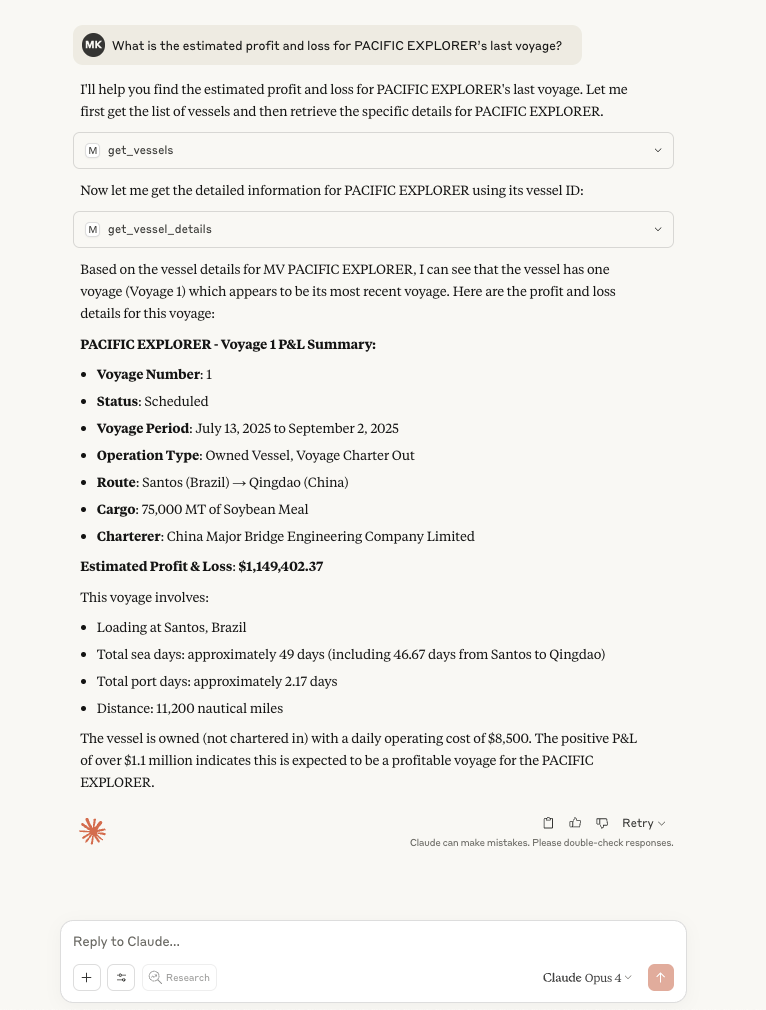
In the chat, type @ followed by the MCP server name and your instructions, e.g., "@Marlo MCP show me the latest voyage details for vessel Sea Breeze"
That's it! The server will respond to your query, and you can continue using it as needed.
Here is a step-by-step guide with screenshots.
A Python client for interacting with the Marlo MCP (Model Context Protocol) server. This package provides an async client for making authenticated requests to the MCP API and includes example tools for vessel data retrieval.
Marlo is a finance and operations platform designed for maritime and shipping companies.
Marlo helps shipping businesses manage their entire operations from a single platform. It offers tools for:
Voyage Management: Plan routes, track progress, and log updates for each voyage.
Banking: Manage accounts in multiple currencies, send and receive payments, and access maritime-focused banking features like global accounts and borderless cards.
Loans & Finance: Request and track loans for cargo contracts, demurrage, and other financing needs. It also helps monitor covenants and keep financial records in order.
Analytics: View up-to-date financial and operational data in one dashboard, including cashflow, valuations, and credit scores.
Accounting: Sync with accounting software to maintain accurate financial records.
Email Integration: Centralize all chartering and operations emails with filters and tags for easy sorting.
Risk & Compliance: Track compliance, screen counterparties against global sanctions lists, monitor loan terms, and manage carbon intensity and emissions reporting.
Marlo is designed for various roles in the maritime industry, including CEOs, CFOs, chartering managers, operations managers, accountants, vessel owners, operators, and commercial managers. Its goal is to simplify operations, ensure compliance, and help maritime businesses grow. To subscribe to Marlo or request a demo, simply email our team at support@marlo.online. We're happy to help you get started!
Related MCP server: Maersk Vessel Deadlines MCP Server
Async HTTP client for Marlo MCP API
Easy authentication via API key
Example usage for vessel data retrieval
here the example use for consume the mcp server
{
    "mcpServers": {
        "marlo-mcp": {
            "command": "uvx",
            "args": ["marlo-mcp"],
            "env": {
                "MARLO_MCP_API_KEY": "<your-api-key>"
            }
        }
    }
}
For Claude Desktop, you can install and interact with it right away by running:
mcp install PATH/TO/main.py -v MARLO_MCP_API_KEY=<your-api-key>The Marlo MCP client provides the following tools:
get_vessels: Get all available vessels with minimal vessel details
get_vessel_details: Get details of a specific vessel
create_vessel: Create a new vessel
search_ports: Search multiple ports
search_cargos: Search for cargos
get_all_charter_specialists: Get all available charter specialists
search_charterer_contacts: Search for charterer contacts
get_all_voyages: Get all voyages
get_voyage_details: Get details of a specific voyage
get_voyage_profit_and_loss: Get voyage profit and loss
get_all_estimates_sheet: Get all estimates sheet
get_estimate_sheet_details: Get details of a specific estimate sheet
get_all_cargo_books: Get all cargo books
get_cargo_book_details: Get details of a specific cargo book
list_all_vessel_fixtures: List all vessel fixtures
get_vessel_fixture_details: Get details of a specific vessel fixture
get_voyage_contacts: Get voyage contacts
get_voyage_contacts_financial_details: Get financial details for voyage contacts
get_vessel_fixture_contacts: Get contacts for a vessel fixture
get_vessel_fixture_contacts_financial_details: Get financial details for vessel fixture contacts
get_invoice_details: Get invoice details
get_bill_details: Get bill details
voyage_port_disbursements: Get voyage port disbursements
get_voyage_laytime: Get voyage laytime
list_all_customers: List all customers
list_all_vendors: List all vendors
list_all_lendors: List all lendors
get_customer_details: Get customer details
get_vendor_details: Get vendor details
list_all_bills: List all bills
list_all_invoices: List all invoices
get_journal_entries: Get journal entries
list_all_vendor_credits: List all vendor credits
get_vendor_credit_details: Get vendor credit details
list_all_credit_notes: List all credit notes
get_credit_note_details: Get credit note details
list_all_external_loans: List all external loans
get_external_loan_details: Get external loan details
list_all_marlo_loans: List all marlo loans
get_market_rates: List all market rates
get_market_rate_details: Get market rate details
get_covenant: Get covenant
get_credit_score: Get credit score
get_interest_rates: List all interest rates
list_all_sanctions_case_manager: List all sanctions case manager
get_sanctions_case_manager_details: Get sanctions case manager details
search_sanctions: Search sanctions
search_individual_sanction: Search individual sanction
list_all_bank_accounts: List all bank accounts
list_all_bank_transactions: List all bank transactions
get_profit_loss: Get profit and loss data
get_balance_sheet: Get balance sheet data
get_global_search_vessel_list: Get a global search vessel list
get_vessel_valuation: Get vessel valuation
list_approval_transactions: List approval transactions
get_global_account_currency_balance: Get a global account currency balance
list_all_global_accounts: List all global accounts
list_all_payouts: List all payouts
get_payout_details: Get payout details
get_company_valuation: Get a valuation of company
get_operational_cashflow: Get operational cashflow data
get_cashbalance_streams: Get cashbalance streams data
get_all_borrowers_summary_for_lender: Get summary of all borrowers with their loan statistics and portfolio totals
get_borrower_financial_details_for_lender: Get comprehensive financial analysis and loan details for a specific borrower company
MIT © 2025 Marlo
create a new vessel
| Name | Required | Description | Default |
|---|---|---|---|
| vessel | Yes |
Does the description disclose side effects, auth requirements, rate limits, or destructive behavior?
No annotations are provided, so the description carries the full burden of behavioral disclosure. The description 'create a new vessel' implies a write/mutation operation, but provides no information about permissions required, whether this is a destructive operation, what happens on success/failure, or any rate limits. For a creation tool with zero annotation coverage, this is completely inadequate.
Agents need to know what a tool does to the world before calling it. Descriptions should go beyond structured annotations to explain consequences.
Is the description appropriately sized, front-loaded, and free of redundancy?
The description is extremely concise at just three words. While this conciseness comes at the expense of completeness, the description is front-loaded and contains zero wasted words. Every word in 'create a new vessel' contributes directly to the core purpose statement.
Shorter descriptions cost fewer tokens and are easier for agents to parse. Every sentence should earn its place.
Given the tool's complexity, does the description cover enough for an agent to succeed on first attempt?
Given the complexity of the input schema (with 1 parameter that contains over 100 nested properties, 8 of which are required), no annotations, and no output schema, the description is completely inadequate. A creation tool with such a complex schema needs much more context about what data is required, what happens after creation, and any behavioral constraints.
Complex tools with many parameters or behaviors need more documentation. Simple tools need less. This dimension scales expectations accordingly.
Does the description clarify parameter syntax, constraints, interactions, or defaults beyond what the schema provides?
The schema description coverage is 0%, meaning none of the parameters have descriptions in the schema. The tool description provides no information about parameters whatsoever, not even mentioning that a complex 'vessel' object is required. With 0% schema coverage and no parameter information in the description, this fails to compensate for the documentation gap.
Input schemas describe structure but not intent. Descriptions should explain non-obvious parameter relationships and valid value ranges.
Does the description clearly state what the tool does and how it differs from similar tools?
The description 'create a new vessel' is a tautology that essentially restates the tool name. It provides a verb ('create') and resource ('vessel'), but lacks any specificity about what creating a vessel entails in this context or how it differs from other vessel-related operations. It doesn't distinguish from sibling tools like 'get_vessels' or 'get_vessel_details'.
Agents choose between tools based on descriptions. A clear purpose with a specific verb and resource helps agents select the right tool.
Does the description explain when to use this tool, when not to, or what alternatives exist?
The description provides absolutely no guidance on when to use this tool versus alternatives. There's no mention of prerequisites, when this operation is appropriate, or what other tools might be used for related operations. Given the complex schema with many required fields, this lack of usage guidance is particularly problematic.
Agents often have multiple tools that could apply. Explicit usage guidance like "use X instead of Y when Z" prevents misuse.
Get summary of all borrowers with their loan statistics and portfolio totals
| Name | Required | Description | Default |
|---|---|---|---|
No parameters | |||
Does the description disclose side effects, auth requirements, rate limits, or destructive behavior?
No annotations are provided, so the description carries the full burden of behavioral disclosure. It mentions retrieving a summary but does not specify whether this is a read-only operation, if it requires authentication, what the output format looks like (e.g., aggregated totals vs. detailed lists), or any rate limits. This leaves significant gaps in understanding how the tool behaves in practice.
Agents need to know what a tool does to the world before calling it. Descriptions should go beyond structured annotations to explain consequences.
Is the description appropriately sized, front-loaded, and free of redundancy?
The description is a single, efficient sentence that directly states the tool's purpose without unnecessary words. It is front-loaded with the key action and resource, making it easy to parse quickly, which is ideal for conciseness in tool definitions.
Shorter descriptions cost fewer tokens and are easier for agents to parse. Every sentence should earn its place.
Given the tool's complexity, does the description cover enough for an agent to succeed on first attempt?
Given the tool has no input parameters and no output schema, the description adequately covers the basic purpose. However, it lacks details on behavioral aspects like authentication needs, return format, or error handling, which are important for a tool that retrieves financial summaries. Without annotations or output schema, the description should provide more context to be fully complete.
Complex tools with many parameters or behaviors need more documentation. Simple tools need less. This dimension scales expectations accordingly.
Does the description clarify parameter syntax, constraints, interactions, or defaults beyond what the schema provides?
The input schema has 0 parameters with 100% coverage, meaning no parameters are documented in the schema. The description does not add parameter details, but since there are no parameters, this is acceptable. It implies the tool operates without inputs, which is clear from context, so it meets the baseline for parameter semantics without needing extra explanation.
Input schemas describe structure but not intent. Descriptions should explain non-obvious parameter relationships and valid value ranges.
Does the description clearly state what the tool does and how it differs from similar tools?
The description clearly states the action ('Get summary') and target resource ('all borrowers with their loan statistics and portfolio totals'), making the purpose evident. However, it does not explicitly differentiate this tool from sibling tools like 'get_borrower_financial_details_for_lender' or 'list_all_lendors', which might offer overlapping or related data, so it falls short of a perfect score.
Agents choose between tools based on descriptions. A clear purpose with a specific verb and resource helps agents select the right tool.
Does the description explain when to use this tool, when not to, or what alternatives exist?
The description provides no guidance on when to use this tool versus alternatives, such as 'get_borrower_financial_details_for_lender' for detailed per-borrower data or 'list_all_lendors' for lender lists. Without explicit context or exclusions, users must infer usage based on the tool name alone, which is insufficient for optimal selection.
Agents often have multiple tools that could apply. Explicit usage guidance like "use X instead of Y when Z" prevents misuse.
Get all cargo books
| Name | Required | Description | Default |
|---|---|---|---|
No parameters | |||
Does the description disclose side effects, auth requirements, rate limits, or destructive behavior?
No annotations are provided, so the description carries the full burden. It only states the action ('Get') without disclosing behavioral traits like whether it's read-only, paginated, rate-limited, or what the return format is. This is inadequate for a tool with no annotation coverage.
Agents need to know what a tool does to the world before calling it. Descriptions should go beyond structured annotations to explain consequences.
Is the description appropriately sized, front-loaded, and free of redundancy?
The description is a single, efficient sentence with no wasted words, making it appropriately concise. However, it's under-specified rather than optimally structured, as it lacks necessary context for clarity.
Shorter descriptions cost fewer tokens and are easier for agents to parse. Every sentence should earn its place.
Given the tool's complexity, does the description cover enough for an agent to succeed on first attempt?
Given no annotations, no output schema, and a simple purpose, the description is incomplete. It fails to explain what 'cargo books' are, how results are returned, or any behavioral aspects, making it insufficient for effective tool use.
Complex tools with many parameters or behaviors need more documentation. Simple tools need less. This dimension scales expectations accordingly.
Does the description clarify parameter syntax, constraints, interactions, or defaults beyond what the schema provides?
The tool has 0 parameters, and schema description coverage is 100%, so no parameter information is needed. The description doesn't add param details, but that's acceptable here, warranting a baseline score above 3 due to the lack of parameters.
Input schemas describe structure but not intent. Descriptions should explain non-obvious parameter relationships and valid value ranges.
Does the description clearly state what the tool does and how it differs from similar tools?
The description 'Get all cargo books' states the verb ('Get') and resource ('cargo books'), but it's vague about what 'cargo books' are and doesn't distinguish from siblings like 'get_cargo_book_details' or 'search_cargos'. It provides a basic purpose but lacks specificity and differentiation.
Agents choose between tools based on descriptions. A clear purpose with a specific verb and resource helps agents select the right tool.
Does the description explain when to use this tool, when not to, or what alternatives exist?
No guidance is provided on when to use this tool versus alternatives such as 'get_cargo_book_details' for specific details or 'search_cargos' for filtered queries. The description offers no context, prerequisites, or exclusions, leaving usage unclear.
Agents often have multiple tools that could apply. Explicit usage guidance like "use X instead of Y when Z" prevents misuse.
Get all available charter specialists
| Name | Required | Description | Default |
|---|---|---|---|
No parameters | |||
Does the description disclose side effects, auth requirements, rate limits, or destructive behavior?
With no annotations provided, the description carries full burden for behavioral disclosure but only states what the tool does at a surface level. It doesn't describe whether this returns a complete list or paginated results, what format the output takes, whether there are rate limits, authentication requirements, or any other operational characteristics.
Agents need to know what a tool does to the world before calling it. Descriptions should go beyond structured annotations to explain consequences.
Is the description appropriately sized, front-loaded, and free of redundancy?
The description is a single, efficient sentence that communicates the core purpose without any wasted words. It's appropriately sized for a simple retrieval tool with no parameters, making it easy for an agent to parse quickly.
Shorter descriptions cost fewer tokens and are easier for agents to parse. Every sentence should earn its place.
Given the tool's complexity, does the description cover enough for an agent to succeed on first attempt?
For a tool with no annotations, no output schema, and many similar sibling tools, the description is insufficiently complete. It doesn't explain what constitutes a 'charter specialist' in this domain, how results are structured, or how this differs from other contact-related tools, leaving significant gaps for an agent to understand proper usage.
Complex tools with many parameters or behaviors need more documentation. Simple tools need less. This dimension scales expectations accordingly.
Does the description clarify parameter syntax, constraints, interactions, or defaults beyond what the schema provides?
The tool has zero parameters with 100% schema description coverage, so the schema already fully documents the input requirements. The description appropriately doesn't add parameter information, maintaining focus on the tool's purpose rather than redundant details.
Input schemas describe structure but not intent. Descriptions should explain non-obvious parameter relationships and valid value ranges.
Does the description clearly state what the tool does and how it differs from similar tools?
The description clearly states the action ('Get') and resource ('all available charter specialists'), making the purpose immediately understandable. However, it doesn't differentiate from sibling tools like 'search_charterer_contacts' or explain what distinguishes 'charter specialists' from other contact types in this domain.
Agents choose between tools based on descriptions. A clear purpose with a specific verb and resource helps agents select the right tool.
Does the description explain when to use this tool, when not to, or what alternatives exist?
The description provides no guidance on when to use this tool versus alternatives like 'search_charterer_contacts' or 'get_vessel_fixture_contacts'. There's no mention of prerequisites, context, or limitations that would help an agent choose appropriately among the many sibling tools.
Agents often have multiple tools that could apply. Explicit usage guidance like "use X instead of Y when Z" prevents misuse.
Get all estimates sheet
| Name | Required | Description | Default |
|---|---|---|---|
No parameters | |||
Does the description disclose side effects, auth requirements, rate limits, or destructive behavior?
With no annotations provided, the description carries full burden for behavioral disclosure. It only states the action ('Get') without indicating whether this is a read-only operation, if it requires authentication, what the output format might be, or any rate limits. For a tool with zero annotation coverage, this minimal description fails to provide necessary behavioral context.
Agents need to know what a tool does to the world before calling it. Descriptions should go beyond structured annotations to explain consequences.
Is the description appropriately sized, front-loaded, and free of redundancy?
The description is extremely concise with just three words, front-loading the core action and resource. There is no wasted language or unnecessary elaboration, making it efficient for quick scanning while still conveying the basic intent.
Shorter descriptions cost fewer tokens and are easier for agents to parse. Every sentence should earn its place.
Given the tool's complexity, does the description cover enough for an agent to succeed on first attempt?
Given the tool has no annotations, no output schema, and 0 parameters, the description is insufficiently complete. It lacks details on what 'estimates sheet' means, what data it returns, or how it differs from similar tools. For a tool in a context with many sibling data retrieval tools, more contextual information is needed to guide proper use.
Complex tools with many parameters or behaviors need more documentation. Simple tools need less. This dimension scales expectations accordingly.
Does the description clarify parameter syntax, constraints, interactions, or defaults beyond what the schema provides?
The tool has 0 parameters with 100% schema description coverage, so the schema fully documents the absence of inputs. The description doesn't need to add parameter semantics, and it doesn't incorrectly suggest any parameters. A baseline of 4 is appropriate since no parameter information is required beyond what the schema provides.
Input schemas describe structure but not intent. Descriptions should explain non-obvious parameter relationships and valid value ranges.
Does the description clearly state what the tool does and how it differs from similar tools?
The description 'Get all estimates sheet' is a tautology that essentially restates the tool name. It specifies the verb 'Get' and resource 'estimates sheet' but lacks specificity about what 'all' entails or what format/scope the estimates sheet covers. Compared to sibling tools like 'get_estimate_sheet_details' (which likely provides detailed data), this tool's purpose is vague and doesn't clearly differentiate itself.
Agents choose between tools based on descriptions. A clear purpose with a specific verb and resource helps agents select the right tool.
Does the description explain when to use this tool, when not to, or what alternatives exist?
No guidance is provided on when to use this tool versus alternatives. Given sibling tools like 'get_estimate_sheet_details' (for detailed data) and various list tools (e.g., 'list_all_bills'), the description offers no context on whether this tool retrieves summaries, aggregates, or raw data, leaving the agent without usage direction.
Agents often have multiple tools that could apply. Explicit usage guidance like "use X instead of Y when Z" prevents misuse.
Get all voyages
| Name | Required | Description | Default |
|---|---|---|---|
No parameters | |||
Does the description disclose side effects, auth requirements, rate limits, or destructive behavior?
No annotations are provided, so the description must fully disclose behavioral traits. 'Get all voyages' only implies a read operation without details on permissions, rate limits, pagination, or response format. It lacks critical information such as whether this is a safe, read-only call or if it has side effects, making it inadequate for transparency.
Agents need to know what a tool does to the world before calling it. Descriptions should go beyond structured annotations to explain consequences.
Is the description appropriately sized, front-loaded, and free of redundancy?
The description 'Get all voyages' is extremely concise, consisting of three words. While it avoids unnecessary verbosity, it is under-specified rather than efficiently informative. Every word earns its place, but the brevity comes at the cost of clarity, making it more of a placeholder than a helpful description.
Shorter descriptions cost fewer tokens and are easier for agents to parse. Every sentence should earn its place.
Given the tool's complexity, does the description cover enough for an agent to succeed on first attempt?
Given the tool's complexity (a list operation with no parameters) and the absence of annotations and output schema, the description is incomplete. It fails to explain what 'all voyages' includes (e.g., scope, format, or limitations) or the behavioral context, leaving significant gaps for the agent to infer usage and results.
Complex tools with many parameters or behaviors need more documentation. Simple tools need less. This dimension scales expectations accordingly.
Does the description clarify parameter syntax, constraints, interactions, or defaults beyond what the schema provides?
The tool has 0 parameters with 100% schema description coverage, meaning the schema fully documents the absence of inputs. The description does not add parameter semantics, but since no parameters exist, this is acceptable. A baseline of 4 is appropriate as the description need not compensate for any gaps, though it doesn't enhance understanding beyond the schema.
Input schemas describe structure but not intent. Descriptions should explain non-obvious parameter relationships and valid value ranges.
Does the description clearly state what the tool does and how it differs from similar tools?
The description 'Get all voyages' is a tautology that merely restates the tool name without adding meaningful context. It specifies the verb 'Get' and resource 'voyages', but lacks specificity about what 'all voyages' entails (e.g., scope, format, or filtering). Compared to siblings like 'get_voyage_details' or 'get_voyage_profit_and_loss', it fails to distinguish its purpose clearly, making it vague in practice.
Agents choose between tools based on descriptions. A clear purpose with a specific verb and resource helps agents select the right tool.
Does the description explain when to use this tool, when not to, or what alternatives exist?
The description provides no guidance on when to use this tool versus alternatives. With siblings such as 'get_voyage_details' (for specific voyages) and 'get_voyage_profit_and_loss' (for financial data), there is no indication of context, exclusions, or prerequisites. This absence of usage instructions leaves the agent without direction in selecting among related tools.
Agents often have multiple tools that could apply. Explicit usage guidance like "use X instead of Y when Z" prevents misuse.
get balance sheet data
| Name | Required | Description | Default |
|---|---|---|---|
| period_length | Yes | ||
| periods_to_compare | Yes | ||
| start_month | Yes |
Does the description disclose side effects, auth requirements, rate limits, or destructive behavior?
With no annotations provided, the description carries full burden but fails to disclose any behavioral traits. It doesn't indicate if this is a read-only operation, what permissions are required, how data is returned, or any rate limits or constraints, making it inadequate for a tool with three required parameters.
Agents need to know what a tool does to the world before calling it. Descriptions should go beyond structured annotations to explain consequences.
Is the description appropriately sized, front-loaded, and free of redundancy?
The description is extremely concise with no wasted words, consisting of a single three-word phrase. It is front-loaded but under-specified, which is a completeness issue rather than a conciseness one—it efficiently states its limited purpose.
Shorter descriptions cost fewer tokens and are easier for agents to parse. Every sentence should earn its place.
Given the tool's complexity, does the description cover enough for an agent to succeed on first attempt?
Given the tool's complexity (three required parameters), lack of annotations, 0% schema coverage, and no output schema, the description is severely incomplete. It doesn't explain what balance sheet data includes, how parameters work, or what the tool returns, making it inadequate for effective use.
Complex tools with many parameters or behaviors need more documentation. Simple tools need less. This dimension scales expectations accordingly.
Does the description clarify parameter syntax, constraints, interactions, or defaults beyond what the schema provides?
Schema description coverage is 0%, meaning parameters are undocumented in the schema. The description adds no information about what period_length, periods_to_compare, or start_month mean, their expected formats, or how they affect the balance sheet data, failing to compensate for the schema gap.
Input schemas describe structure but not intent. Descriptions should explain non-obvious parameter relationships and valid value ranges.
Does the description clearly state what the tool does and how it differs from similar tools?
The description 'get balance sheet data' restates the tool name with minimal elaboration, making it a tautology. It specifies the resource (balance sheet data) but lacks a clear verb beyond 'get' and doesn't distinguish this tool from sibling financial data tools like get_profit_loss or get_operational_cashflow.
Agents choose between tools based on descriptions. A clear purpose with a specific verb and resource helps agents select the right tool.
Does the description explain when to use this tool, when not to, or what alternatives exist?
No guidance is provided on when to use this tool versus alternatives. The description offers no context about prerequisites, appropriate scenarios, or comparisons to sibling tools like get_profit_loss or get_company_valuation, leaving usage entirely ambiguous.
Agents often have multiple tools that could apply. Explicit usage guidance like "use X instead of Y when Z" prevents misuse.
Get a bill details
| Name | Required | Description | Default |
|---|---|---|---|
| bill_id | Yes |
Does the description disclose side effects, auth requirements, rate limits, or destructive behavior?
No annotations are provided, so the description carries the full burden of behavioral disclosure. 'Get a bill details' implies a read operation but doesn't specify whether it's safe, requires authentication, has rate limits, or what the output format might be. It lacks any behavioral context beyond the basic verb, leaving the agent with minimal understanding of how the tool behaves.
Agents need to know what a tool does to the world before calling it. Descriptions should go beyond structured annotations to explain consequences.
Is the description appropriately sized, front-loaded, and free of redundancy?
The description is extremely concise ('Get a bill details'), which could be efficient if it were informative. However, it's under-specified rather than appropriately concise—it lacks necessary details for a tool with 1 parameter and no annotations. The structure is simple but doesn't front-load critical information.
Shorter descriptions cost fewer tokens and are easier for agents to parse. Every sentence should earn its place.
Given the tool's complexity, does the description cover enough for an agent to succeed on first attempt?
Given the tool has 1 parameter with no schema descriptions, no annotations, and no output schema, the description is completely inadequate. It doesn't explain the tool's purpose in context, parameter usage, behavioral traits, or what to expect in return. For a tool in a financial/operational domain with many siblings, this leaves significant gaps.
Complex tools with many parameters or behaviors need more documentation. Simple tools need less. This dimension scales expectations accordingly.
Does the description clarify parameter syntax, constraints, interactions, or defaults beyond what the schema provides?
The input schema has 1 parameter with 0% description coverage, meaning the schema provides no semantic information about 'bill_id'. The description doesn't mention parameters at all, failing to compensate for the schema gap. It doesn't explain what a 'bill_id' is, its format, or where to find it, leaving the parameter undocumented.
Input schemas describe structure but not intent. Descriptions should explain non-obvious parameter relationships and valid value ranges.
Does the description clearly state what the tool does and how it differs from similar tools?
The description 'Get a bill details' is a tautology that essentially restates the tool name with minor grammatical issues. It doesn't specify what 'bill' refers to in this domain or what details are retrieved. While it includes a verb ('Get'), it lacks specificity about the resource scope or what distinguishes it from sibling tools like 'list_all_bills' or 'get_invoice_details'.
Agents choose between tools based on descriptions. A clear purpose with a specific verb and resource helps agents select the right tool.
Does the description explain when to use this tool, when not to, or what alternatives exist?
The description provides no guidance on when to use this tool versus alternatives. There are multiple sibling tools that might relate to bills (e.g., 'list_all_bills', 'get_invoice_details'), but the description doesn't clarify whether this is for detailed views, specific bill types, or other contexts. No prerequisites, exclusions, or comparative information is mentioned.
Agents often have multiple tools that could apply. Explicit usage guidance like "use X instead of Y when Z" prevents misuse.
Get comprehensive financial analysis and loan details for a specific borrower company
| Name | Required | Description | Default |
|---|---|---|---|
| borrower_company_id | Yes |
Does the description disclose side effects, auth requirements, rate limits, or destructive behavior?
No annotations are provided, so the description carries the full burden of behavioral disclosure. It implies a read-only operation ('Get') but does not specify permissions required, data freshness, rate limits, or what constitutes 'comprehensive' analysis. This leaves gaps in understanding the tool's behavior and constraints.
Agents need to know what a tool does to the world before calling it. Descriptions should go beyond structured annotations to explain consequences.
Is the description appropriately sized, front-loaded, and free of redundancy?
The description is a single, efficient sentence that directly states the tool's purpose without unnecessary words. It is front-loaded and wastes no space, making it easy to parse quickly.
Shorter descriptions cost fewer tokens and are easier for agents to parse. Every sentence should earn its place.
Given the tool's complexity, does the description cover enough for an agent to succeed on first attempt?
Given the complexity of financial analysis, lack of annotations, no output schema, and 0% schema description coverage, the description is insufficient. It does not detail the scope of 'comprehensive' analysis, return format, or error handling, leaving significant gaps for effective tool use.
Complex tools with many parameters or behaviors need more documentation. Simple tools need less. This dimension scales expectations accordingly.
Does the description clarify parameter syntax, constraints, interactions, or defaults beyond what the schema provides?
Schema description coverage is 0%, so the schema provides no parameter details. The description mentions 'for a specific borrower company', which hints at the 'borrower_company_id' parameter but does not explain its format, source, or validation. This adds minimal semantic value, aligning with the baseline for low coverage without full compensation.
Input schemas describe structure but not intent. Descriptions should explain non-obvious parameter relationships and valid value ranges.
Does the description clearly state what the tool does and how it differs from similar tools?
The description clearly states the verb ('Get') and resource ('comprehensive financial analysis and loan details for a specific borrower company'), making the purpose explicit. However, it does not explicitly differentiate from sibling tools like 'get_company_valuation' or 'get_credit_score', which might also provide financial insights, so it falls short of a perfect score.
Agents choose between tools based on descriptions. A clear purpose with a specific verb and resource helps agents select the right tool.
Does the description explain when to use this tool, when not to, or what alternatives exist?
The description provides no guidance on when to use this tool versus alternatives. It does not mention prerequisites, such as needing a borrower company ID, or compare it to sibling tools like 'get_all_borrowers_summary_for_lender' for broader overviews versus detailed analysis here.
Agents often have multiple tools that could apply. Explicit usage guidance like "use X instead of Y when Z" prevents misuse.
Get cargo book details
| Name | Required | Description | Default |
|---|---|---|---|
| cargo_book_id | Yes |
Does the description disclose side effects, auth requirements, rate limits, or destructive behavior?
No annotations are provided, so the description must fully disclose behavioral traits. It states 'Get', implying a read operation, but lacks details on permissions, rate limits, error handling, or response format. For a tool with zero annotation coverage, this minimal description fails to provide necessary behavioral context for safe and effective use.
Agents need to know what a tool does to the world before calling it. Descriptions should go beyond structured annotations to explain consequences.
Is the description appropriately sized, front-loaded, and free of redundancy?
The description is extremely concise at three words, with no wasted language. It is front-loaded and to the point, though this brevity contributes to its inadequacy in other dimensions. In terms of structure and efficiency, it earns full marks for being minimal.
Shorter descriptions cost fewer tokens and are easier for agents to parse. Every sentence should earn its place.
Given the tool's complexity, does the description cover enough for an agent to succeed on first attempt?
Given the tool's complexity (a read operation with a required parameter), lack of annotations, 0% schema description coverage, and no output schema, the description is completely inadequate. It fails to compensate for missing structured data, providing no context on behavior, parameters, or outputs, making it insufficient for effective tool use.
Complex tools with many parameters or behaviors need more documentation. Simple tools need less. This dimension scales expectations accordingly.
Does the description clarify parameter syntax, constraints, interactions, or defaults beyond what the schema provides?
The input schema has 1 parameter with 0% description coverage, meaning the schema provides no semantic information. The description adds no parameter details beyond what's implied by the tool name. It doesn't explain what 'cargo_book_id' represents, its format (UUID), or how to obtain it, leaving the parameter undocumented.
Input schemas describe structure but not intent. Descriptions should explain non-obvious parameter relationships and valid value ranges.
Does the description clearly state what the tool does and how it differs from similar tools?
The description 'Get cargo book details' is a tautology that essentially restates the tool name. While it indicates the verb 'Get' and resource 'cargo book details', it doesn't specify what 'details' include or differentiate this tool from sibling tools like 'get_all_cargo_books' or 'search_cargos'. The purpose is vague beyond the basic action.
Agents choose between tools based on descriptions. A clear purpose with a specific verb and resource helps agents select the right tool.
Does the description explain when to use this tool, when not to, or what alternatives exist?
No guidance is provided on when to use this tool versus alternatives. With sibling tools like 'get_all_cargo_books' (likely for listing) and 'search_cargos' (likely for filtering), the description offers no context on prerequisites, appropriate scenarios, or distinctions, leaving the agent to guess based on naming alone.
Agents often have multiple tools that could apply. Explicit usage guidance like "use X instead of Y when Z" prevents misuse.
Get cashbalance streams data
| Name | Required | Description | Default |
|---|---|---|---|
No parameters | |||
Does the description disclose side effects, auth requirements, rate limits, or destructive behavior?
With no annotations provided, the description carries full responsibility for behavioral disclosure but offers none. It doesn't indicate whether this is a read-only operation, whether it requires authentication, what format the data returns in, whether there are rate limits, or any error conditions. The description provides only the basic action without any operational context.
Agents need to know what a tool does to the world before calling it. Descriptions should go beyond structured annotations to explain consequences.
Is the description appropriately sized, front-loaded, and free of redundancy?
The description is extremely concise at just four words, which could be appropriate for a simple tool. However, this brevity comes at the cost of being under-specified rather than efficiently informative. While it's front-loaded with the core action, it lacks the additional context that would make it genuinely helpful.
Shorter descriptions cost fewer tokens and are easier for agents to parse. Every sentence should earn its place.
Given the tool's complexity, does the description cover enough for an agent to succeed on first attempt?
Given the complexity of financial data tools and the absence of both annotations and an output schema, the description is insufficient. It doesn't explain what 'cashbalance streams' are, what data fields are returned, or how this differs from other financial reporting tools in the sibling list. For a tool in a domain with many similar alternatives, more contextual information is needed.
Complex tools with many parameters or behaviors need more documentation. Simple tools need less. This dimension scales expectations accordingly.
Does the description clarify parameter syntax, constraints, interactions, or defaults beyond what the schema provides?
The tool has zero parameters, and the input schema has 100% description coverage (though empty). The description doesn't need to explain any parameters, which is appropriate. Since there are no parameters to document, a baseline of 4 is warranted as the description doesn't create confusion about expected inputs.
Input schemas describe structure but not intent. Descriptions should explain non-obvious parameter relationships and valid value ranges.
Does the description clearly state what the tool does and how it differs from similar tools?
The description 'Get cashbalance streams data' is essentially a tautology that restates the tool name with minimal elaboration. While it indicates a retrieval action ('Get') and a resource type ('cashbalance streams data'), it lacks specificity about what 'cashbalance streams' actually are or what data fields are included. It doesn't distinguish this tool from its many sibling 'get_' tools beyond the resource name.
Agents choose between tools based on descriptions. A clear purpose with a specific verb and resource helps agents select the right tool.
Does the description explain when to use this tool, when not to, or what alternatives exist?
The description provides no guidance on when to use this tool versus alternatives. With 70+ sibling tools including various financial data retrieval tools (like get_balance_sheet, get_operational_cashflow, get_profit_loss), there's no indication of what makes 'cashbalance streams' distinct or when this specific data type is needed. No prerequisites, exclusions, or comparison to similar tools are mentioned.
Agents often have multiple tools that could apply. Explicit usage guidance like "use X instead of Y when Z" prevents misuse.
Get a valuation of company
| Name | Required | Description | Default |
|---|---|---|---|
No parameters | |||
Does the description disclose side effects, auth requirements, rate limits, or destructive behavior?
No annotations are provided, so the description carries the full burden. It states 'Get a valuation' but doesn't disclose behavioral traits such as whether this is a read-only operation, requires authentication, has rate limits, returns real-time or historical data, or what format the valuation takes. This is a significant gap for a tool with zero annotation coverage.
Agents need to know what a tool does to the world before calling it. Descriptions should go beyond structured annotations to explain consequences.
Is the description appropriately sized, front-loaded, and free of redundancy?
The description is a single, efficient sentence with no wasted words, making it front-loaded and easy to parse. However, it's under-specified for a financial tool, leaning toward brevity over completeness, which slightly reduces its effectiveness.
Shorter descriptions cost fewer tokens and are easier for agents to parse. Every sentence should earn its place.
Given the tool's complexity, does the description cover enough for an agent to succeed on first attempt?
Given the complexity of financial valuation, lack of annotations, no output schema, and many sibling tools, the description is incomplete. It doesn't explain what 'valuation' entails, return format, or usage context, leaving the agent with insufficient information to use the tool effectively in this rich environment.
Complex tools with many parameters or behaviors need more documentation. Simple tools need less. This dimension scales expectations accordingly.
Does the description clarify parameter syntax, constraints, interactions, or defaults beyond what the schema provides?
The tool has 0 parameters with 100% schema description coverage, so the schema fully documents the inputs. The description doesn't need to add parameter semantics, and it appropriately doesn't mention any. Baseline is 4 for zero parameters, as it avoids unnecessary details.
Input schemas describe structure but not intent. Descriptions should explain non-obvious parameter relationships and valid value ranges.
Does the description clearly state what the tool does and how it differs from similar tools?
The description 'Get a valuation of company' clearly states the action (get) and resource (company valuation), but it's vague about what constitutes 'valuation' (e.g., financial metrics, market value) and doesn't distinguish it from sibling tools like 'get_vessel_valuation' or 'get_balance_sheet', which might provide related financial data. It avoids tautology by not merely restating the name.
Agents choose between tools based on descriptions. A clear purpose with a specific verb and resource helps agents select the right tool.
Does the description explain when to use this tool, when not to, or what alternatives exist?
No guidance is provided on when to use this tool versus alternatives. With many sibling tools like 'get_balance_sheet' or 'get_profit_loss' that might offer financial insights, the description lacks context, prerequisites, or exclusions, leaving the agent to guess based on tool names alone.
Agents often have multiple tools that could apply. Explicit usage guidance like "use X instead of Y when Z" prevents misuse.
get covenant
| Name | Required | Description | Default |
|---|---|---|---|
No parameters | |||
Does the description disclose side effects, auth requirements, rate limits, or destructive behavior?
No annotations are provided, so the description carries the full burden of behavioral disclosure. 'get covenant' gives no indication of whether this is a read-only operation, what permissions might be required, whether it returns a single item or list, what format the response takes, or any rate limits or constraints. The description provides zero behavioral context.
Agents need to know what a tool does to the world before calling it. Descriptions should go beyond structured annotations to explain consequences.
Is the description appropriately sized, front-loaded, and free of redundancy?
While technically concise with just two words, this represents under-specification rather than effective conciseness. The description fails to convey essential information about the tool's purpose and usage, making it inefficient for an AI agent trying to understand when and how to invoke this tool among dozens of alternatives.
Shorter descriptions cost fewer tokens and are easier for agents to parse. Every sentence should earn its place.
Given the tool's complexity, does the description cover enough for an agent to succeed on first attempt?
Given the complexity implied by the domain (financial/maritime operations with over 60 sibling tools), no annotations, and no output schema, the description is completely inadequate. It provides no information about what a 'covenant' is in this system, what data is returned, or how this tool fits within the broader API ecosystem.
Complex tools with many parameters or behaviors need more documentation. Simple tools need less. This dimension scales expectations accordingly.
Does the description clarify parameter syntax, constraints, interactions, or defaults beyond what the schema provides?
The tool has 0 parameters with 100% schema description coverage, so the schema fully documents the parameter situation (none required). The description doesn't need to compensate for any parameter gaps, and while it doesn't add any parameter semantics beyond the schema, the baseline for a zero-parameter tool with complete schema coverage is appropriately set at 4.
Input schemas describe structure but not intent. Descriptions should explain non-obvious parameter relationships and valid value ranges.
Does the description clearly state what the tool does and how it differs from similar tools?
The description 'get covenant' is a tautology that merely restates the tool name without providing any meaningful information about what the tool actually does. It doesn't specify what resource is being retrieved, what a 'covenant' represents in this context, or what distinguishes this from sibling tools like 'get_balance_sheet' or 'get_credit_score'.
Agents choose between tools based on descriptions. A clear purpose with a specific verb and resource helps agents select the right tool.
Does the description explain when to use this tool, when not to, or what alternatives exist?
The description provides absolutely no guidance about when to use this tool versus alternatives. With numerous sibling tools available (over 60), there's no indication of what specific type of data this tool retrieves or what context would warrant selecting 'get_covenant' over other 'get_' or 'list_all_' tools.
Agents often have multiple tools that could apply. Explicit usage guidance like "use X instead of Y when Z" prevents misuse.
get credit note details
| Name | Required | Description | Default |
|---|---|---|---|
| credit_note_id | Yes |
Does the description disclose side effects, auth requirements, rate limits, or destructive behavior?
No annotations are provided, so the description carries the full burden of behavioral disclosure. The description only states 'get credit note details', which implies a read operation but reveals nothing about permissions required, rate limits, error conditions, response format, or whether it's idempotent. For a tool with zero annotation coverage, this is completely inadequate behavioral transparency.
Agents need to know what a tool does to the world before calling it. Descriptions should go beyond structured annotations to explain consequences.
Is the description appropriately sized, front-loaded, and free of redundancy?
While technically concise with just three words, this is an example of under-specification rather than effective conciseness. The description fails to provide necessary information that would help an agent use the tool correctly. Every word should earn its place, but here the words don't provide enough value to justify their inclusion.
Shorter descriptions cost fewer tokens and are easier for agents to parse. Every sentence should earn its place.
Given the tool's complexity, does the description cover enough for an agent to succeed on first attempt?
Given the tool's complexity (retrieving specific entity details), complete lack of annotations, 0% schema description coverage, and no output schema, the description is woefully incomplete. It doesn't explain what 'details' include, how results are structured, error handling, or any behavioral aspects. The agent cannot effectively use this tool based on the provided description alone.
Complex tools with many parameters or behaviors need more documentation. Simple tools need less. This dimension scales expectations accordingly.
Does the description clarify parameter syntax, constraints, interactions, or defaults beyond what the schema provides?
The input schema has 0% description coverage, meaning the single parameter 'credit_note_id' is undocumented in the schema. The description provides no information about this parameter—no explanation of what a credit note ID is, where to find it, format requirements, or examples. With low schema coverage and no compensation in the description, parameter understanding is severely lacking.
Input schemas describe structure but not intent. Descriptions should explain non-obvious parameter relationships and valid value ranges.
Does the description clearly state what the tool does and how it differs from similar tools?
The description 'get credit note details' is a tautology that essentially restates the tool name. It specifies the verb 'get' and resource 'credit note details', but provides no additional clarity about what 'details' includes or how this differs from sibling tools like 'list_all_credit_notes'. The purpose is minimally stated but lacks differentiation.
Agents choose between tools based on descriptions. A clear purpose with a specific verb and resource helps agents select the right tool.
Does the description explain when to use this tool, when not to, or what alternatives exist?
The description provides no guidance on when to use this tool versus alternatives. There is no mention of prerequisites, when this tool is appropriate compared to 'list_all_credit_notes' or other sibling tools, or any contextual usage instructions. The agent receives zero guidance on tool selection.
Agents often have multiple tools that could apply. Explicit usage guidance like "use X instead of Y when Z" prevents misuse.
get credit score
| Name | Required | Description | Default |
|---|---|---|---|
No parameters | |||
Does the description disclose side effects, auth requirements, rate limits, or destructive behavior?
No annotations are provided, so the description carries the full burden of behavioral disclosure. 'get credit score' implies a read operation but doesn't disclose any behavioral traits such as authentication requirements, rate limits, data freshness, error conditions, or what the return format might be. This leaves the agent with significant uncertainty about how the tool behaves.
Agents need to know what a tool does to the world before calling it. Descriptions should go beyond structured annotations to explain consequences.
Is the description appropriately sized, front-loaded, and free of redundancy?
The description is extremely concise ('get credit score'), which could be efficient if it were informative. However, it's under-specified rather than appropriately concise—it lacks necessary details that would help the agent. While it's front-loaded (the entire description is the purpose), it fails to earn its place by being too vague.
Shorter descriptions cost fewer tokens and are easier for agents to parse. Every sentence should earn its place.
Given the tool's complexity, does the description cover enough for an agent to succeed on first attempt?
Given the complexity of a credit score tool (likely involving sensitive financial data) and the absence of annotations and output schema, the description is incomplete. It doesn't explain what the tool returns, any prerequisites, or how it fits into the broader context of sibling tools. This leaves the agent poorly equipped to use the tool effectively.
Complex tools with many parameters or behaviors need more documentation. Simple tools need less. This dimension scales expectations accordingly.
Does the description clarify parameter syntax, constraints, interactions, or defaults beyond what the schema provides?
The tool has 0 parameters with 100% schema description coverage, so the schema fully documents the lack of inputs. The description doesn't need to add parameter semantics, and it doesn't contradict the schema. A baseline of 4 is appropriate since there are no parameters to explain, and the description doesn't introduce confusion about inputs.
Input schemas describe structure but not intent. Descriptions should explain non-obvious parameter relationships and valid value ranges.
Does the description clearly state what the tool does and how it differs from similar tools?
The description 'get credit score' is a tautology that merely restates the tool name without adding any meaningful context. It doesn't specify whose credit score (individual, company, borrower), from what system, or with what scope. While it does contain the verb 'get' and resource 'credit score,' it lacks the specificity needed to distinguish it from potential alternatives or understand its exact function.
Agents choose between tools based on descriptions. A clear purpose with a specific verb and resource helps agents select the right tool.
Does the description explain when to use this tool, when not to, or what alternatives exist?
The description provides no guidance on when to use this tool versus alternatives. Given the sibling tools include various financial and borrower-related tools (like 'get_borrower_financial_details_for_lender'), there's no indication of whether this tool is for a specific entity type, context, or purpose. The agent receives no help in selecting this tool appropriately.
Agents often have multiple tools that could apply. Explicit usage guidance like "use X instead of Y when Z" prevents misuse.
get customer details
| Name | Required | Description | Default |
|---|---|---|---|
| customer_id | Yes |
Does the description disclose side effects, auth requirements, rate limits, or destructive behavior?
With no annotations provided, the description carries full burden for behavioral disclosure but offers none. It doesn't indicate whether this is a read-only operation, what permissions are needed, how errors are handled, or what the return format looks like. This is inadequate for a tool with unknown behavioral traits.
Agents need to know what a tool does to the world before calling it. Descriptions should go beyond structured annotations to explain consequences.
Is the description appropriately sized, front-loaded, and free of redundancy?
While concise with only two words, this is under-specification rather than effective brevity. The description fails to provide necessary information, making it inefficient for the agent's understanding. It lacks any structured explanation or front-loaded key details.
Shorter descriptions cost fewer tokens and are easier for agents to parse. Every sentence should earn its place.
Given the tool's complexity, does the description cover enough for an agent to succeed on first attempt?
Given the tool's complexity (1 required parameter) and lack of annotations or output schema, the description is completely inadequate. It doesn't explain what the tool returns, how to use it correctly, or any behavioral context, leaving the agent with insufficient information to invoke the tool effectively.
Complex tools with many parameters or behaviors need more documentation. Simple tools need less. This dimension scales expectations accordingly.
Does the description clarify parameter syntax, constraints, interactions, or defaults beyond what the schema provides?
Schema description coverage is 0%, meaning the parameter 'customer_id' is undocumented in the schema. The description adds no information about this parameter—no explanation of what constitutes a valid customer_id, where to find it, or format requirements. This leaves the parameter's semantics completely unspecified.
Input schemas describe structure but not intent. Descriptions should explain non-obvious parameter relationships and valid value ranges.
Does the description clearly state what the tool does and how it differs from similar tools?
The description 'get customer details' is a tautology that merely restates the tool name without adding specificity. It doesn't clarify what 'details' include or differentiate this tool from sibling tools like 'list_all_customers' or 'get_vendor_details' that might retrieve similar information.
Agents choose between tools based on descriptions. A clear purpose with a specific verb and resource helps agents select the right tool.
Does the description explain when to use this tool, when not to, or what alternatives exist?
No guidance is provided on when to use this tool versus alternatives like 'list_all_customers' or other get_* tools. The description offers no context about prerequisites, appropriate scenarios, or exclusions, leaving the agent with no usage direction.
Agents often have multiple tools that could apply. Explicit usage guidance like "use X instead of Y when Z" prevents misuse.
get details of a specific estimate sheet
| Name | Required | Description | Default |
|---|---|---|---|
| estimate_sheet_id | Yes |
Does the description disclose side effects, auth requirements, rate limits, or destructive behavior?
With no annotations provided, the description carries the full burden of behavioral disclosure. It implies a read-only operation ('get'), but doesn't specify permissions required, rate limits, error conditions, or what the return format looks like. For a tool with zero annotation coverage, this leaves significant behavioral gaps.
Agents need to know what a tool does to the world before calling it. Descriptions should go beyond structured annotations to explain consequences.
Is the description appropriately sized, front-loaded, and free of redundancy?
The description is a single, efficient sentence that directly states the tool's purpose without unnecessary words. It's appropriately sized and front-loaded, with zero wasted content.
Shorter descriptions cost fewer tokens and are easier for agents to parse. Every sentence should earn its place.
Given the tool's complexity, does the description cover enough for an agent to succeed on first attempt?
Given the tool's complexity (single parameter but no schema documentation), lack of annotations, and absence of an output schema, the description is incomplete. It doesn't explain what 'details' include, how to obtain the required ID, or what the response contains, leaving too many gaps for effective use.
Complex tools with many parameters or behaviors need more documentation. Simple tools need less. This dimension scales expectations accordingly.
Does the description clarify parameter syntax, constraints, interactions, or defaults beyond what the schema provides?
The schema description coverage is 0%, meaning the single parameter 'estimate_sheet_id' has no documentation in the schema. The description adds no information about this parameter—it doesn't explain what an estimate sheet ID is, where to find it, or its format (UUID). This fails to compensate for the schema's lack of documentation.
Input schemas describe structure but not intent. Descriptions should explain non-obvious parameter relationships and valid value ranges.
Does the description clearly state what the tool does and how it differs from similar tools?
The description states the tool's purpose as 'get details of a specific estimate sheet', which includes a verb ('get') and resource ('estimate sheet'), making it clear this is a retrieval operation. However, it doesn't differentiate from sibling tools like 'get_all_estimates_sheet' or explain what 'details' specifically means, leaving it somewhat vague compared to alternatives.
Agents choose between tools based on descriptions. A clear purpose with a specific verb and resource helps agents select the right tool.
Does the description explain when to use this tool, when not to, or what alternatives exist?
The description provides no guidance on when to use this tool versus alternatives. It doesn't mention when to choose this over 'get_all_estimates_sheet' or other sibling tools, nor does it specify prerequisites or contextual constraints for usage.
Agents often have multiple tools that could apply. Explicit usage guidance like "use X instead of Y when Z" prevents misuse.
get external loan details
| Name | Required | Description | Default |
|---|---|---|---|
| application_id | Yes |
Does the description disclose side effects, auth requirements, rate limits, or destructive behavior?
No annotations are provided, so the description carries the full burden of behavioral disclosure. It only states the action ('get') without explaining whether this is a read-only operation, what permissions are required, how data is returned (e.g., format, pagination), or any side effects like rate limits. This leaves critical behavioral traits unspecified for a tool that likely accesses financial data.
Agents need to know what a tool does to the world before calling it. Descriptions should go beyond structured annotations to explain consequences.
Is the description appropriately sized, front-loaded, and free of redundancy?
The description is extremely concise ('get external loan details'), which could be efficient if it were informative. However, it's under-specified rather than appropriately sized—it lacks necessary details about purpose, usage, or parameters. While front-loaded, it fails to earn its place with substantive content.
Shorter descriptions cost fewer tokens and are easier for agents to parse. Every sentence should earn its place.
Given the tool's complexity, does the description cover enough for an agent to succeed on first attempt?
Given the complexity of financial data tools, no annotations, 0% schema coverage, and no output schema, the description is completely inadequate. It doesn't compensate for the lack of structured data, leaving the agent without guidance on behavior, parameters, or return values. This is insufficient for a tool that likely requires precise invocation.
Complex tools with many parameters or behaviors need more documentation. Simple tools need less. This dimension scales expectations accordingly.
Does the description clarify parameter syntax, constraints, interactions, or defaults beyond what the schema provides?
The input schema has 0% description coverage, with one required parameter 'application_id' undocumented in both schema and description. The description adds no meaning beyond the schema—it doesn't explain what an 'application_id' is, its format, or how it relates to external loans. For a single parameter with no schema documentation, this is a significant gap.
Input schemas describe structure but not intent. Descriptions should explain non-obvious parameter relationships and valid value ranges.
Does the description clearly state what the tool does and how it differs from similar tools?
The description 'get external loan details' is essentially a tautology that restates the tool name with minimal elaboration. It specifies the resource ('external loan details') but lacks a clear verb beyond 'get' and doesn't distinguish this tool from siblings like 'get_marlo_loan_details' or 'list_all_external_loans'. The purpose is vague about what specific details are retrieved.
Agents choose between tools based on descriptions. A clear purpose with a specific verb and resource helps agents select the right tool.
Does the description explain when to use this tool, when not to, or what alternatives exist?
No guidance is provided on when to use this tool versus alternatives. With siblings like 'get_marlo_loan_details' and 'list_all_external_loans', the description fails to indicate whether this tool is for individual loan details, batch retrieval, or filtering. There's no mention of prerequisites, context, or exclusions.
Agents often have multiple tools that could apply. Explicit usage guidance like "use X instead of Y when Z" prevents misuse.
Get fleet details
| Name | Required | Description | Default |
|---|---|---|---|
| fleet_id | Yes |
Does the description disclose side effects, auth requirements, rate limits, or destructive behavior?
No annotations are provided, so the description carries full burden for behavioral disclosure. It fails to indicate whether this is a read-only operation, if it requires authentication, what the output format might be, or any error conditions. For a tool with no annotation coverage, this lack of behavioral information is a significant gap.
Agents need to know what a tool does to the world before calling it. Descriptions should go beyond structured annotations to explain consequences.
Is the description appropriately sized, front-loaded, and free of redundancy?
The description is extremely concise with no wasted words, consisting of a single three-word phrase. It is front-loaded and efficiently communicates the basic intent, though this brevity contributes to its lack of detail in other dimensions.
Shorter descriptions cost fewer tokens and are easier for agents to parse. Every sentence should earn its place.
Given the tool's complexity, does the description cover enough for an agent to succeed on first attempt?
Given the tool's complexity (a read operation with a required parameter), lack of annotations, 0% schema description coverage, and no output schema, the description is severely incomplete. It does not address parameter meaning, behavioral traits, usage context, or output expectations, making it insufficient for effective tool invocation.
Complex tools with many parameters or behaviors need more documentation. Simple tools need less. This dimension scales expectations accordingly.
Does the description clarify parameter syntax, constraints, interactions, or defaults beyond what the schema provides?
Schema description coverage is 0%, meaning the schema provides no descriptions for parameters. The description does not mention the 'fleet_id' parameter at all, leaving its purpose, format (UUID), or necessity unexplained. With one required parameter and no compensation in the description, this is inadequate.
Input schemas describe structure but not intent. Descriptions should explain non-obvious parameter relationships and valid value ranges.
Does the description clearly state what the tool does and how it differs from similar tools?
The description 'Get fleet details' is a tautology that restates the tool name without adding meaningful specificity. It mentions the resource ('fleet') but lacks details about what 'details' includes or how this differs from sibling tools like 'get_fleets' (which likely lists fleets) or 'get_vessel_details' (which focuses on vessels). This provides minimal guidance beyond the obvious.
Agents choose between tools based on descriptions. A clear purpose with a specific verb and resource helps agents select the right tool.
Does the description explain when to use this tool, when not to, or what alternatives exist?
The description offers no guidance on when to use this tool versus alternatives. It does not mention prerequisites (e.g., needing a fleet_id), differentiate it from sibling tools like 'get_fleets' (which may list fleets without details), or specify use cases. This leaves the agent with no context for tool selection.
Agents often have multiple tools that could apply. Explicit usage guidance like "use X instead of Y when Z" prevents misuse.
Get all available fleets
| Name | Required | Description | Default |
|---|---|---|---|
No parameters | |||
Does the description disclose side effects, auth requirements, rate limits, or destructive behavior?
No annotations are provided, so the description carries the full burden of behavioral disclosure. It states a read operation ('Get') but doesn't clarify if this is a safe, read-only action, whether it requires authentication, what the return format looks like (e.g., list, pagination), or any rate limits. This is inadequate for a tool with zero annotation coverage.
Agents need to know what a tool does to the world before calling it. Descriptions should go beyond structured annotations to explain consequences.
Is the description appropriately sized, front-loaded, and free of redundancy?
The description is a single, efficient sentence with zero wasted words. It's front-loaded with the core action and resource, making it easy to parse quickly. Every part of the sentence earns its place by conveying essential information.
Shorter descriptions cost fewer tokens and are easier for agents to parse. Every sentence should earn its place.
Given the tool's complexity, does the description cover enough for an agent to succeed on first attempt?
Given the tool's simplicity (0 parameters, no output schema), the description is minimally adequate. However, with no annotations and no output schema, it fails to address behavioral aspects like return format or safety, which are important even for simple tools. It meets basic needs but leaves gaps in context.
Complex tools with many parameters or behaviors need more documentation. Simple tools need less. This dimension scales expectations accordingly.
Does the description clarify parameter syntax, constraints, interactions, or defaults beyond what the schema provides?
The tool has 0 parameters with 100% schema description coverage, so the schema fully documents the lack of inputs. The description doesn't need to add parameter details, but it implicitly confirms no filtering or arguments are required by stating 'all available fleets'. This aligns perfectly with the schema, justifying a score above baseline.
Input schemas describe structure but not intent. Descriptions should explain non-obvious parameter relationships and valid value ranges.
Does the description clearly state what the tool does and how it differs from similar tools?
The description clearly states the tool's purpose with a specific verb ('Get') and resource ('all available fleets'), making it immediately understandable. However, it doesn't distinguish this tool from its sibling 'get_fleet_details' or explain what differentiates 'fleets' from 'vessels' (another sibling tool), which prevents a perfect score.
Agents choose between tools based on descriptions. A clear purpose with a specific verb and resource helps agents select the right tool.
Does the description explain when to use this tool, when not to, or what alternatives exist?
The description provides no guidance on when to use this tool versus alternatives like 'get_fleet_details' or 'get_vessels'. It lacks context about whether this is for listing summaries versus detailed views, or any prerequisites for usage, leaving the agent to infer based on naming alone.
Agents often have multiple tools that could apply. Explicit usage guidance like "use X instead of Y when Z" prevents misuse.
Get a global account currency balance
| Name | Required | Description | Default |
|---|---|---|---|
No parameters | |||
Does the description disclose side effects, auth requirements, rate limits, or destructive behavior?
With no annotations, the description carries full burden but only states the action without behavioral details. It doesn't disclose if this is a read-only operation, requires authentication, has rate limits, or what the output format might be (e.g., numeric balance, currency type).
Agents need to know what a tool does to the world before calling it. Descriptions should go beyond structured annotations to explain consequences.
Is the description appropriately sized, front-loaded, and free of redundancy?
The description is a single, efficient sentence with no wasted words, making it easy to parse. However, it could be more front-loaded with additional context, but it's appropriately sized for the simple tool.
Shorter descriptions cost fewer tokens and are easier for agents to parse. Every sentence should earn its place.
Given the tool's complexity, does the description cover enough for an agent to succeed on first attempt?
Given no annotations and no output schema, the description is incomplete. It doesn't explain what a 'global account' is, the return value (e.g., balance amount, currency), or behavioral aspects, leaving significant gaps for an AI agent to infer.
Complex tools with many parameters or behaviors need more documentation. Simple tools need less. This dimension scales expectations accordingly.
Does the description clarify parameter syntax, constraints, interactions, or defaults beyond what the schema provides?
The input schema has 0 parameters with 100% coverage, so no parameter documentation is needed. The description doesn't add param info, but that's acceptable here; baseline is 4 since it doesn't need to compensate for gaps.
Input schemas describe structure but not intent. Descriptions should explain non-obvious parameter relationships and valid value ranges.
Does the description clearly state what the tool does and how it differs from similar tools?
The description states the tool's purpose ('Get a global account currency balance') with a clear verb ('Get') and resource ('global account currency balance'), but it doesn't differentiate from siblings like 'get_balance_sheet' or 'list_all_global_accounts'. It's vague about what a 'global account' entails in this context.
Agents choose between tools based on descriptions. A clear purpose with a specific verb and resource helps agents select the right tool.
Does the description explain when to use this tool, when not to, or what alternatives exist?
No guidance is provided on when to use this tool versus alternatives. The description lacks context about prerequisites, such as whether a global account must exist, or comparisons to sibling tools like 'get_balance_sheet' for broader financial data.
Agents often have multiple tools that could apply. Explicit usage guidance like "use X instead of Y when Z" prevents misuse.
Get a global search vessel valuation list
| Name | Required | Description | Default |
|---|---|---|---|
No parameters | |||
Does the description disclose side effects, auth requirements, rate limits, or destructive behavior?
No annotations are provided, so the description carries full burden. It only states it 'gets' a list, implying a read operation, but doesn't disclose behavioral traits such as whether it requires authentication, has rate limits, returns paginated results, or what format the valuation list includes. For a tool with no annotations, this is a significant gap in transparency.
Agents need to know what a tool does to the world before calling it. Descriptions should go beyond structured annotations to explain consequences.
Is the description appropriately sized, front-loaded, and free of redundancy?
The description is a single, efficient sentence: 'Get a global search vessel valuation list'. It's front-loaded with the core action and resource, with no wasted words. However, it could be slightly more structured by clarifying terms like 'global search' to improve clarity without adding bulk.
Shorter descriptions cost fewer tokens and are easier for agents to parse. Every sentence should earn its place.
Given the tool's complexity, does the description cover enough for an agent to succeed on first attempt?
Given the complexity implied by 'global search' and 'valuation list', and with no annotations or output schema, the description is incomplete. It doesn't explain what the tool returns (e.g., list format, valuation metrics), how it differs from similar tools, or any prerequisites. For a tool in a rich context with many siblings, this leaves too many unknowns.
Complex tools with many parameters or behaviors need more documentation. Simple tools need less. This dimension scales expectations accordingly.
Does the description clarify parameter syntax, constraints, interactions, or defaults beyond what the schema provides?
The tool has 0 parameters with 100% schema description coverage, so the schema fully documents the lack of inputs. The description adds no parameter information, which is appropriate here. A baseline of 4 is given since no parameters exist, and the description doesn't need to compensate for any gaps.
Input schemas describe structure but not intent. Descriptions should explain non-obvious parameter relationships and valid value ranges.
Does the description clearly state what the tool does and how it differs from similar tools?
The description states the tool 'Get a global search vessel valuation list' which indicates it retrieves valuation data for vessels. However, it's vague about what 'global search' means (search criteria? worldwide scope?) and doesn't clearly distinguish from siblings like 'get_vessel_valuation' or 'get_vessels' which might overlap in functionality. The purpose is understandable but lacks specificity.
Agents choose between tools based on descriptions. A clear purpose with a specific verb and resource helps agents select the right tool.
Does the description explain when to use this tool, when not to, or what alternatives exist?
No guidance is provided on when to use this tool versus alternatives. With many sibling tools like 'get_vessel_valuation', 'get_vessels', and 'get_vessel_details', the description doesn't specify if this is for aggregated valuations, filtered searches, or other contexts. It leaves the agent to guess based on the name alone.
Agents often have multiple tools that could apply. Explicit usage guidance like "use X instead of Y when Z" prevents misuse.
get interest rates
| Name | Required | Description | Default |
|---|---|---|---|
No parameters | |||
Does the description disclose side effects, auth requirements, rate limits, or destructive behavior?
No annotations are provided, so the description carries the full burden of behavioral disclosure. However, it offers no information beyond the basic action of 'getting' data. It doesn't specify whether this is a read-only operation, if it requires authentication, what the return format might be, or any potential side effects like rate limits. This is inadequate for a tool with zero annotation coverage.
Agents need to know what a tool does to the world before calling it. Descriptions should go beyond structured annotations to explain consequences.
Is the description appropriately sized, front-loaded, and free of redundancy?
While the description is extremely concise ('get interest rates'), this brevity stems from under-specification rather than efficient communication. It lacks necessary details and structure, failing to provide a clear, front-loaded explanation of the tool's purpose or behavior. Conciseness should not come at the cost of clarity, making this score low.
Shorter descriptions cost fewer tokens and are easier for agents to parse. Every sentence should earn its place.
Given the tool's complexity, does the description cover enough for an agent to succeed on first attempt?
Given the complexity of financial data tools and the lack of annotations or output schema, the description is insufficient. It doesn't explain what 'interest rates' entail, the scope of data returned, or how results are structured. With no output schema to clarify return values, the description should provide more context to be complete, but it does not.
Complex tools with many parameters or behaviors need more documentation. Simple tools need less. This dimension scales expectations accordingly.
Does the description clarify parameter syntax, constraints, interactions, or defaults beyond what the schema provides?
The tool has 0 parameters, and the schema description coverage is 100% (since there are no parameters to describe). In such cases, the baseline score is 4, as there are no parameters for the description to compensate for or add meaning to. The description doesn't need to explain parameters, so this dimension is inherently well-covered.
Input schemas describe structure but not intent. Descriptions should explain non-obvious parameter relationships and valid value ranges.
Does the description clearly state what the tool does and how it differs from similar tools?
The description 'get interest rates' is a tautology that merely restates the tool name without adding any meaningful clarification. It doesn't specify what type of interest rates (e.g., current market rates, historical rates, specific to loans or investments), nor does it distinguish this tool from potential sibling tools that might also retrieve financial data. While it indicates a retrieval action, the purpose remains vague and under-specified.
Agents choose between tools based on descriptions. A clear purpose with a specific verb and resource helps agents select the right tool.
Does the description explain when to use this tool, when not to, or what alternatives exist?
The description provides no guidance on when to use this tool versus alternatives. It doesn't mention any context, prerequisites, or exclusions, and given the many sibling tools (e.g., get_market_rates, get_market_rate_details), there's no indication of how this tool differs or when it should be selected. This leaves the agent without any usage direction.
Agents often have multiple tools that could apply. Explicit usage guidance like "use X instead of Y when Z" prevents misuse.
Get a invoice details
| Name | Required | Description | Default |
|---|---|---|---|
| invoice_id | Yes |
Does the description disclose side effects, auth requirements, rate limits, or destructive behavior?
No annotations are provided, so the description carries full burden for behavioral disclosure. It only states the basic action ('Get') without any information about permissions required, rate limits, error conditions, response format, or whether this is a read-only operation. This is inadequate for a tool with no annotation coverage.
Agents need to know what a tool does to the world before calling it. Descriptions should go beyond structured annotations to explain consequences.
Is the description appropriately sized, front-loaded, and free of redundancy?
The description is extremely brief (3 words) which could be efficient, but it's under-specified rather than appropriately concise. While front-loaded with the core action, it lacks necessary detail that would make brevity a virtue. The grammatical error ('a invoice') also detracts from quality.
Shorter descriptions cost fewer tokens and are easier for agents to parse. Every sentence should earn its place.
Given the tool's complexity, does the description cover enough for an agent to succeed on first attempt?
For a tool with no annotations, 0% schema description coverage, and no output schema, the description is completely inadequate. It doesn't explain what 'invoice details' includes, how results are structured, error handling, or any behavioral characteristics. This leaves the agent with insufficient information to use the tool effectively.
Complex tools with many parameters or behaviors need more documentation. Simple tools need less. This dimension scales expectations accordingly.
Does the description clarify parameter syntax, constraints, interactions, or defaults beyond what the schema provides?
Schema description coverage is 0%, meaning the single parameter 'invoice_id' has no documentation in the schema. The description provides no additional information about this parameter - no format requirements, examples, or constraints. With low schema coverage, the description fails to compensate by explaining parameter meaning or usage.
Input schemas describe structure but not intent. Descriptions should explain non-obvious parameter relationships and valid value ranges.
Does the description clearly state what the tool does and how it differs from similar tools?
The description 'Get a invoice details' is a tautology that essentially restates the tool name with minor grammatical issues ('a invoice' instead of 'an invoice'). It specifies the resource (invoice details) but lacks a clear verb beyond 'Get' and doesn't differentiate from sibling tools like 'get_bill_details' or 'get_credit_note_details' that might retrieve similar financial documents.
Agents choose between tools based on descriptions. A clear purpose with a specific verb and resource helps agents select the right tool.
Does the description explain when to use this tool, when not to, or what alternatives exist?
No guidance is provided on when to use this tool versus alternatives. With many sibling tools like 'get_bill_details', 'get_credit_note_details', and 'list_all_invoices', the description offers no context about distinctions, prerequisites, or appropriate scenarios for selecting this specific invoice retrieval tool.
Agents often have multiple tools that could apply. Explicit usage guidance like "use X instead of Y when Z" prevents misuse.
get journal entries
| Name | Required | Description | Default |
|---|---|---|---|
No parameters | |||
Does the description disclose side effects, auth requirements, rate limits, or destructive behavior?
No annotations are provided, so the description must fully disclose behavioral traits. 'get journal entries' implies a read operation but offers no details on permissions, rate limits, pagination, or return format. It fails to describe what 'journal entries' entail (e.g., financial records, logs) or any constraints, making it inadequate for a tool with zero annotation coverage.
Agents need to know what a tool does to the world before calling it. Descriptions should go beyond structured annotations to explain consequences.
Is the description appropriately sized, front-loaded, and free of redundancy?
The description is overly concise to the point of under-specification. 'get journal entries' is a single phrase that fails to provide necessary context, making it inefficient rather than succinct. It lacks front-loaded critical information and does not earn its place with meaningful content.
Shorter descriptions cost fewer tokens and are easier for agents to parse. Every sentence should earn its place.
Given the tool's complexity, does the description cover enough for an agent to succeed on first attempt?
Given the lack of annotations and output schema, the description is incomplete. It does not explain what 'journal entries' are, how they are returned, or any behavioral aspects, leaving significant gaps. For a tool in a context with many sibling tools, this minimal description fails to provide adequate guidance for an AI agent.
Complex tools with many parameters or behaviors need more documentation. Simple tools need less. This dimension scales expectations accordingly.
Does the description clarify parameter syntax, constraints, interactions, or defaults beyond what the schema provides?
The tool has 0 parameters with 100% schema description coverage, meaning the schema fully documents the lack of inputs. The description does not add parameter information, but since there are no parameters, this is acceptable. A baseline of 4 is appropriate as the description does not need to compensate for missing param details.
Input schemas describe structure but not intent. Descriptions should explain non-obvious parameter relationships and valid value ranges.
Does the description clearly state what the tool does and how it differs from similar tools?
The description 'get journal entries' is a tautology that restates the tool name without adding meaningful context. It specifies the verb 'get' and resource 'journal entries', but lacks detail about scope, format, or filtering, making it vague compared to more specific sibling tools like 'get_all_voyages' or 'get_essel_details'. It does not distinguish itself from potential alternatives.
Agents choose between tools based on descriptions. A clear purpose with a specific verb and resource helps agents select the right tool.
Does the description explain when to use this tool, when not to, or what alternatives exist?
The description provides no guidance on when to use this tool versus alternatives. It does not mention any context, prerequisites, or exclusions, and with sibling tools like 'list_all_transactions' or 'get_all_borrowers_summary_for_lender', there is no indication of how this tool differs in usage. This leaves the agent without direction for selection.
Agents often have multiple tools that could apply. Explicit usage guidance like "use X instead of Y when Z" prevents misuse.
get market rate details
| Name | Required | Description | Default |
|---|---|---|---|
| api_identifier | Yes |
Does the description disclose side effects, auth requirements, rate limits, or destructive behavior?
No annotations are provided, so the description must fully disclose behavioral traits. The description 'get market rate details' only indicates a read operation but fails to specify whether it's safe, idempotent, or has side effects. It doesn't mention authentication requirements, rate limits, error conditions, or what the return format looks like. For a tool with zero annotation coverage, this is completely inadequate.
Agents need to know what a tool does to the world before calling it. Descriptions should go beyond structured annotations to explain consequences.
Is the description appropriately sized, front-loaded, and free of redundancy?
The description is extremely concise ('get market rate details'), which could be a strength if it were informative. However, it's under-specified rather than efficiently structured—it lacks front-loaded critical information and doesn't use its brevity to convey essential details. While not verbose, it fails to earn its place with meaningful content.
Shorter descriptions cost fewer tokens and are easier for agents to parse. Every sentence should earn its place.
Given the tool's complexity, does the description cover enough for an agent to succeed on first attempt?
Given the tool's complexity (1 parameter with no schema documentation, no annotations, no output schema), the description is severely incomplete. It doesn't explain what market rates are, what details are returned, how to use the parameter, or behavioral aspects. For a tool in a domain with many siblings (e.g., financial/maritime data), this leaves the agent with insufficient context to operate effectively.
Complex tools with many parameters or behaviors need more documentation. Simple tools need less. This dimension scales expectations accordingly.
Does the description clarify parameter syntax, constraints, interactions, or defaults beyond what the schema provides?
The input schema has 1 parameter with 0% description coverage, meaning the parameter 'api_identifier' is undocumented in the schema. The description provides no information about this parameter—what it represents, valid values, format, or examples. With no parameter details in either the schema or description, the agent cannot understand how to invoke the tool correctly.
Input schemas describe structure but not intent. Descriptions should explain non-obvious parameter relationships and valid value ranges.
Does the description clearly state what the tool does and how it differs from similar tools?
The description 'get market rate details' is a tautology that essentially restates the tool name without adding meaningful context. It specifies a verb ('get') and resource ('market rate details'), but lacks specificity about what market rates are or what details are retrieved. Compared to sibling tools like 'get_market_rates' (likely a list operation) and 'get_interest_rates', it doesn't clearly differentiate its purpose.
Agents choose between tools based on descriptions. A clear purpose with a specific verb and resource helps agents select the right tool.
Does the description explain when to use this tool, when not to, or what alternatives exist?
The description provides no guidance on when to use this tool versus alternatives. There is no mention of prerequisites, appropriate contexts, or comparisons to sibling tools like 'get_market_rates' or 'get_interest_rates'. Without any usage instructions, an agent cannot determine when this tool is the correct choice.
Agents often have multiple tools that could apply. Explicit usage guidance like "use X instead of Y when Z" prevents misuse.
get market rates
| Name | Required | Description | Default |
|---|---|---|---|
No parameters | |||
Does the description disclose side effects, auth requirements, rate limits, or destructive behavior?
With no annotations provided, the description carries the full burden of behavioral disclosure but fails completely. It doesn't indicate whether this is a read-only operation, what data format to expect, whether there are rate limits or authentication requirements, or what happens on errors. 'get market rates' implies data retrieval but provides zero insight into how that retrieval behaves or what constraints exist.
Agents need to know what a tool does to the world before calling it. Descriptions should go beyond structured annotations to explain consequences.
Is the description appropriately sized, front-loaded, and free of redundancy?
While technically concise with only two words, this description suffers from severe under-specification rather than effective brevity. It doesn't front-load important information or structure content meaningfully—it's just the bare minimum restatement of the tool name. True conciseness would efficiently convey purpose and context, which this lacks entirely.
Shorter descriptions cost fewer tokens and are easier for agents to parse. Every sentence should earn its place.
Given the tool's complexity, does the description cover enough for an agent to succeed on first attempt?
Given the complexity implied by 'market rates' in a financial/shipping context and the absence of both annotations and an output schema, the description is completely inadequate. It doesn't explain what data is returned, in what format, or under what conditions. For a tool that presumably returns important financial data, this minimal description leaves the agent guessing about fundamental aspects of the tool's operation and output.
Complex tools with many parameters or behaviors need more documentation. Simple tools need less. This dimension scales expectations accordingly.
Does the description clarify parameter syntax, constraints, interactions, or defaults beyond what the schema provides?
The tool has zero parameters (parameter count: 0), and the schema description coverage is 100% (though with no parameters to describe). The description doesn't mention parameters, which is appropriate since none exist. A baseline score of 4 is warranted because there are no parameters whose semantics need explanation beyond what the schema already provides (which is nothing, correctly).
Input schemas describe structure but not intent. Descriptions should explain non-obvious parameter relationships and valid value ranges.
Does the description clearly state what the tool does and how it differs from similar tools?
The description 'get market rates' is essentially a tautology that restates the tool name without adding meaningful context. It doesn't specify what market rates are being retrieved (e.g., interest rates, commodity prices, shipping rates) or what format the data comes in. While it does contain a verb ('get') and resource ('market rates'), it's too vague to distinguish this tool from siblings like 'get_interest_rates' or 'get_vessel_valuation' that might also involve rate data.
Agents choose between tools based on descriptions. A clear purpose with a specific verb and resource helps agents select the right tool.
Does the description explain when to use this tool, when not to, or what alternatives exist?
The description provides absolutely no guidance about when to use this tool versus alternatives. It doesn't mention any prerequisites, context for usage, or relationships to sibling tools like 'get_market_rate_details' (which might provide more granular data) or 'get_interest_rates' (which might be a subset). The agent receives no help in determining appropriate scenarios for this tool's invocation.
Agents often have multiple tools that could apply. Explicit usage guidance like "use X instead of Y when Z" prevents misuse.
get marlo loan details
| Name | Required | Description | Default |
|---|---|---|---|
| application_id | Yes |
Does the description disclose side effects, auth requirements, rate limits, or destructive behavior?
With no annotations provided, the description carries full burden for behavioral disclosure but provides none. It doesn't indicate whether this is a read-only operation, whether it requires specific permissions, what format the details are returned in, whether there are rate limits, or any other behavioral characteristics. The description is completely inadequate for a tool that presumably retrieves financial data.
Agents need to know what a tool does to the world before calling it. Descriptions should go beyond structured annotations to explain consequences.
Is the description appropriately sized, front-loaded, and free of redundancy?
The description is extremely concise (three words) but this brevity comes at the cost of being under-specified rather than efficiently informative. While it's front-loaded with the core action, it lacks any additional context that would help an agent understand how to use the tool effectively.
Shorter descriptions cost fewer tokens and are easier for agents to parse. Every sentence should earn its place.
Given the tool's complexity, does the description cover enough for an agent to succeed on first attempt?
Given the complexity of financial/loan data retrieval, no annotations, no output schema, and 0% schema description coverage, this description is completely inadequate. It provides minimal information about purpose and zero guidance on usage, parameters, behavior, or expected results. For a tool that likely returns structured financial data, this level of documentation is insufficient.
Complex tools with many parameters or behaviors need more documentation. Simple tools need less. This dimension scales expectations accordingly.
Does the description clarify parameter syntax, constraints, interactions, or defaults beyond what the schema provides?
Schema description coverage is 0%, so the description must compensate but fails to do so. The single parameter 'application_id' is completely undocumented in both schema and description. The description doesn't mention the parameter at all, provide examples of valid application IDs, explain where to find them, or clarify what format they should be in.
Input schemas describe structure but not intent. Descriptions should explain non-obvious parameter relationships and valid value ranges.
Does the description clearly state what the tool does and how it differs from similar tools?
The description 'get marlo loan details' is essentially a tautology that restates the tool name with minor grammatical adjustment. It specifies the verb 'get' and resource 'marlo loan details', but doesn't clarify what 'marlo loan' refers to or what specific details are retrieved. It doesn't distinguish this tool from sibling tools like 'get_external_loan_details' or 'list_all_marlo_loans'.
Agents choose between tools based on descriptions. A clear purpose with a specific verb and resource helps agents select the right tool.
Does the description explain when to use this tool, when not to, or what alternatives exist?
The description provides zero guidance about when to use this tool versus alternatives. There are multiple related tools in the sibling list (get_external_loan_details, list_all_marlo_loans, get_balance_sheet, get_credit_score) that might serve similar purposes, but no context is given about when this specific tool is appropriate versus those alternatives.
Agents often have multiple tools that could apply. Explicit usage guidance like "use X instead of Y when Z" prevents misuse.
Get operational cashflow data
| Name | Required | Description | Default |
|---|---|---|---|
| period_length | Yes | ||
| periods_to_compare | Yes | ||
| start_month | Yes |
Does the description disclose side effects, auth requirements, rate limits, or destructive behavior?
With no annotations provided, the description carries the full burden of behavioral disclosure but offers no information on traits such as read-only vs. destructive operations, authentication needs, rate limits, or response format. It fails to describe what 'get' entails operationally, making it inadequate for a tool with parameters.
Agents need to know what a tool does to the world before calling it. Descriptions should go beyond structured annotations to explain consequences.
Is the description appropriately sized, front-loaded, and free of redundancy?
The description is concise with a single sentence, but this brevity results in under-specification rather than efficient communication. It's front-loaded but lacks necessary detail, making it insufficiently informative despite its compact structure.
Shorter descriptions cost fewer tokens and are easier for agents to parse. Every sentence should earn its place.
Given the tool's complexity, does the description cover enough for an agent to succeed on first attempt?
Given the tool's complexity (3 required parameters), lack of annotations, 0% schema coverage, and no output schema, the description is severely incomplete. It doesn't compensate for missing structured data, failing to explain behavior, parameters, or return values, making it inadequate for effective tool use.
Complex tools with many parameters or behaviors need more documentation. Simple tools need less. This dimension scales expectations accordingly.
Does the description clarify parameter syntax, constraints, interactions, or defaults beyond what the schema provides?
The schema description coverage is 0%, meaning parameters 'period_length', 'periods_to_compare', and 'start_month' are undocumented in the schema. The description adds no semantic information about these parameters, such as their purpose, expected formats (e.g., date strings, numeric values), or how they interact, leaving them completely unexplained.
Input schemas describe structure but not intent. Descriptions should explain non-obvious parameter relationships and valid value ranges.
Does the description clearly state what the tool does and how it differs from similar tools?
The description 'Get operational cashflow data' restates the tool name with minimal elaboration, making it a tautology. It specifies the resource ('operational cashflow data') but lacks a clear verb beyond 'get' and doesn't differentiate from sibling tools like 'get_cashbalance_streams' or 'get_profit_loss', which might retrieve related financial data.
Agents choose between tools based on descriptions. A clear purpose with a specific verb and resource helps agents select the right tool.
Does the description explain when to use this tool, when not to, or what alternatives exist?
No guidance is provided on when to use this tool versus alternatives. It doesn't mention prerequisites, context, or exclusions, leaving the agent with no information to choose between this and other financial data tools like 'get_balance_sheet' or 'get_profit_loss'.
Agents often have multiple tools that could apply. Explicit usage guidance like "use X instead of Y when Z" prevents misuse.
Get payout details
| Name | Required | Description | Default |
|---|---|---|---|
| payout_id | Yes |
Does the description disclose side effects, auth requirements, rate limits, or destructive behavior?
No annotations are provided, so the description carries full burden but fails to disclose any behavioral traits. It doesn't indicate if this is a read-only operation, what permissions are required, how errors are handled, or what the output format might be, leaving the agent with insufficient context for safe invocation.
Agents need to know what a tool does to the world before calling it. Descriptions should go beyond structured annotations to explain consequences.
Is the description appropriately sized, front-loaded, and free of redundancy?
While concise with only three words, the description is under-specified rather than efficiently informative. It lacks front-loaded critical details and wastes the opportunity to clarify purpose or usage in a single sentence, making it ineffective despite its brevity.
Shorter descriptions cost fewer tokens and are easier for agents to parse. Every sentence should earn its place.
Given the tool's complexity, does the description cover enough for an agent to succeed on first attempt?
Given the tool's complexity (a financial detail retrieval with one required parameter), absence of annotations, 0% schema coverage, and no output schema, the description is completely inadequate. It fails to compensate for missing structured data, leaving the agent unable to understand how to use the tool correctly.
Complex tools with many parameters or behaviors need more documentation. Simple tools need less. This dimension scales expectations accordingly.
Does the description clarify parameter syntax, constraints, interactions, or defaults beyond what the schema provides?
Schema description coverage is 0%, meaning the parameter 'payout_id' is undocumented in the schema. The description adds no information about this parameter—no explanation of what a payout_id is, its format, where to obtain it, or examples. This leaves the agent guessing about required input.
Input schemas describe structure but not intent. Descriptions should explain non-obvious parameter relationships and valid value ranges.
Does the description clearly state what the tool does and how it differs from similar tools?
The description 'Get payout details' is a tautology that restates the tool name without adding meaningful specificity. It doesn't clarify what 'payout details' include or distinguish this tool from sibling tools like 'list_all_payouts' or 'get_bill_details' that might handle related financial data.
Agents choose between tools based on descriptions. A clear purpose with a specific verb and resource helps agents select the right tool.
Does the description explain when to use this tool, when not to, or what alternatives exist?
The description provides no guidance on when to use this tool versus alternatives. It doesn't mention prerequisites like needing a payout_id, nor does it differentiate from sibling tools such as 'list_all_payouts' for browsing payouts or 'get_bill_details' for other financial records.
Agents often have multiple tools that could apply. Explicit usage guidance like "use X instead of Y when Z" prevents misuse.
get profit and loss data
| Name | Required | Description | Default |
|---|---|---|---|
| period_length | Yes | ||
| periods_to_compare | Yes | ||
| start_month | Yes |
Does the description disclose side effects, auth requirements, rate limits, or destructive behavior?
With no annotations provided, the description carries the full burden of behavioral disclosure but fails completely. It doesn't indicate whether this is a read-only operation, whether it requires authentication, what format the data returns in, whether there are rate limits, or any other behavioral characteristics. The description provides no information beyond the basic purpose statement.
Agents need to know what a tool does to the world before calling it. Descriptions should go beyond structured annotations to explain consequences.
Is the description appropriately sized, front-loaded, and free of redundancy?
The description is extremely concise at just three words, but this brevity comes at the cost of being under-specified rather than efficiently informative. While it's front-loaded with the core purpose, it lacks the necessary detail to be truly helpful. The single phrase doesn't waste words, but it also doesn't provide enough substance.
Shorter descriptions cost fewer tokens and are easier for agents to parse. Every sentence should earn its place.
Given the tool's complexity, does the description cover enough for an agent to succeed on first attempt?
For a tool with three required parameters, no annotations, no output schema, and 0% schema description coverage, the description is completely inadequate. It fails to compensate for the lack of structured documentation, leaving the agent without necessary information about parameter usage, behavioral characteristics, or output format. The description doesn't provide enough context for the agent to use this tool effectively.
Complex tools with many parameters or behaviors need more documentation. Simple tools need less. This dimension scales expectations accordingly.
Does the description clarify parameter syntax, constraints, interactions, or defaults beyond what the schema provides?
With 0% schema description coverage and three required parameters (period_length, periods_to_compare, start_month), the description provides no information about what these parameters mean or how they should be used. The description doesn't mention any parameters at all, leaving the agent with completely undocumented inputs. This is a critical gap given the schema provides only titles without descriptions.
Input schemas describe structure but not intent. Descriptions should explain non-obvious parameter relationships and valid value ranges.
Does the description clearly state what the tool does and how it differs from similar tools?
The description 'get profit and loss data' is a tautology that essentially restates the tool name 'get_profit_loss' without adding meaningful specificity. It doesn't specify what type of profit/loss data (e.g., for what entity, over what scope), nor does it distinguish this tool from sibling 'get_voyage_profit_and_loss' which appears to serve a similar purpose for voyages. The description lacks a clear verb+resource combination that would help the agent understand what exactly is being retrieved.
Agents choose between tools based on descriptions. A clear purpose with a specific verb and resource helps agents select the right tool.
Does the description explain when to use this tool, when not to, or what alternatives exist?
The description provides absolutely no guidance on when to use this tool versus alternatives. There is no mention of context, prerequisites, or comparison to sibling tools like 'get_voyage_profit_and_loss' or 'get_balance_sheet'. The agent receives no help in determining whether this is the appropriate tool for retrieving profit/loss information versus other available options.
Agents often have multiple tools that could apply. Explicit usage guidance like "use X instead of Y when Z" prevents misuse.
get sanctions case manager details
| Name | Required | Description | Default |
|---|---|---|---|
| source_id | Yes |
Does the description disclose side effects, auth requirements, rate limits, or destructive behavior?
With no annotations provided, the description carries the full burden of behavioral disclosure but fails completely. It doesn't indicate whether this is a read-only operation, whether it requires specific permissions, what format the results come in, whether there are rate limits, or any other behavioral characteristics. The description provides only the most basic functional statement with zero behavioral context.
Agents need to know what a tool does to the world before calling it. Descriptions should go beyond structured annotations to explain consequences.
Is the description appropriately sized, front-loaded, and free of redundancy?
The description is extremely concise - just three words - which could be seen as efficient. However, this brevity comes at the cost of being severely under-specified. While it's not verbose or repetitive, it fails to provide necessary information, making this more of an under-specification problem than true conciseness.
Shorter descriptions cost fewer tokens and are easier for agents to parse. Every sentence should earn its place.
Given the tool's complexity, does the description cover enough for an agent to succeed on first attempt?
Given the complexity of sanctions case management in what appears to be a financial/maritime system, with no annotations, no output schema, and 0% schema description coverage, this description is completely inadequate. It provides only the most basic functional statement without any context about what details are returned, how they're structured, what permissions are needed, or how this differs from related tools.
Complex tools with many parameters or behaviors need more documentation. Simple tools need less. This dimension scales expectations accordingly.
Does the description clarify parameter syntax, constraints, interactions, or defaults beyond what the schema provides?
The schema description coverage is 0%, meaning the single parameter 'source_id' has no documentation in the schema. The description provides absolutely no information about what this parameter represents, what format it should be in, where to find valid values, or what it identifies. This leaves the parameter completely undocumented and mysterious to an AI agent.
Input schemas describe structure but not intent. Descriptions should explain non-obvious parameter relationships and valid value ranges.
Does the description clearly state what the tool does and how it differs from similar tools?
The description 'get sanctions case manager details' is essentially a tautology that restates the tool name with minimal elaboration. While it indicates the tool retrieves information about sanctions case managers, it doesn't specify what kind of details are retrieved, how they differ from other sanctions-related tools, or what makes this distinct from sibling tools like 'list_all_sanctions_case_manager' or 'search_sanctions'.
Agents choose between tools based on descriptions. A clear purpose with a specific verb and resource helps agents select the right tool.
Does the description explain when to use this tool, when not to, or what alternatives exist?
The description provides absolutely no guidance on when to use this tool versus alternatives. There are multiple related sibling tools (list_all_sanctions_case_manager, search_sanctions, search_individual_sanction) that likely serve different purposes, but the description offers no context about when this specific tool is appropriate versus those alternatives.
Agents often have multiple tools that could apply. Explicit usage guidance like "use X instead of Y when Z" prevents misuse.
get vendor credit details
| Name | Required | Description | Default |
|---|---|---|---|
| vendor_credit_id | Yes |
Does the description disclose side effects, auth requirements, rate limits, or destructive behavior?
No annotations are provided, so the description must fully disclose behavioral traits. It only states the action 'get' without indicating whether this is a read-only operation, what permissions are required, how errors are handled, or the format of returned data. For a tool with no annotation coverage, this is a significant gap in transparency.
Agents need to know what a tool does to the world before calling it. Descriptions should go beyond structured annotations to explain consequences.
Is the description appropriately sized, front-loaded, and free of redundancy?
The description is extremely concise with no wasted words, consisting of a single phrase that directly states the tool's function. It is front-loaded and efficiently communicates the core purpose without unnecessary elaboration, though this brevity contributes to gaps in other dimensions.
Shorter descriptions cost fewer tokens and are easier for agents to parse. Every sentence should earn its place.
Given the tool's complexity, does the description cover enough for an agent to succeed on first attempt?
Given the tool's complexity (a read operation with 1 parameter), lack of annotations, and no output schema, the description is incomplete. It fails to provide necessary context such as return data structure, error conditions, or how it integrates with sibling tools. This leaves the agent under-informed for effective tool invocation.
Complex tools with many parameters or behaviors need more documentation. Simple tools need less. This dimension scales expectations accordingly.
Does the description clarify parameter syntax, constraints, interactions, or defaults beyond what the schema provides?
Schema description coverage is 0%, so the description must compensate for undocumented parameters. It mentions 'vendor credit details' but does not explain the 'vendor_credit_id' parameter, such as its format, source, or validation rules. With 1 parameter fully undocumented in the schema, the description adds minimal semantic value beyond the parameter name.
Input schemas describe structure but not intent. Descriptions should explain non-obvious parameter relationships and valid value ranges.
Does the description clearly state what the tool does and how it differs from similar tools?
The description 'get vendor credit details' is essentially a tautology that restates the tool name with minimal elaboration. It specifies the verb 'get' and resource 'vendor credit details', but lacks any distinguishing context about what details are retrieved or how this differs from sibling tools like 'list_all_vendor_credits' or 'get_vendor_details'. This provides only basic purpose without specificity.
Agents choose between tools based on descriptions. A clear purpose with a specific verb and resource helps agents select the right tool.
Does the description explain when to use this tool, when not to, or what alternatives exist?
No guidance is provided on when to use this tool versus alternatives. The description does not mention prerequisites, appropriate contexts, or comparisons to sibling tools such as 'list_all_vendor_credits' for listing multiple credits or 'get_vendor_details' for vendor information. This leaves the agent without usage direction.
Agents often have multiple tools that could apply. Explicit usage guidance like "use X instead of Y when Z" prevents misuse.
get vendor details
| Name | Required | Description | Default |
|---|---|---|---|
| vendor_id | Yes |
Does the description disclose side effects, auth requirements, rate limits, or destructive behavior?
With no annotations provided, the description carries full burden for behavioral disclosure but offers none. It doesn't indicate whether this is a read-only operation, what permissions might be required, whether it has side effects, rate limits, or what format the response takes. The description fails to provide any behavioral context beyond the basic action implied by 'get'.
Agents need to know what a tool does to the world before calling it. Descriptions should go beyond structured annotations to explain consequences.
Is the description appropriately sized, front-loaded, and free of redundancy?
The description is extremely concise at just three words, which could be appropriate if it were more informative. However, this brevity borders on under-specification rather than effective conciseness. It's front-loaded in the sense that there's nothing to front-load beyond the basic phrase.
Shorter descriptions cost fewer tokens and are easier for agents to parse. Every sentence should earn its place.
Given the tool's complexity, does the description cover enough for an agent to succeed on first attempt?
Given that this is a tool with one parameter (0% schema coverage), no annotations, no output schema, and multiple sibling tools, the description is completely inadequate. It provides minimal information about what the tool does and zero guidance on usage, parameters, behavior, or differentiation from similar tools. The description fails to provide the necessary context for effective tool selection and invocation.
Complex tools with many parameters or behaviors need more documentation. Simple tools need less. This dimension scales expectations accordingly.
Does the description clarify parameter syntax, constraints, interactions, or defaults beyond what the schema provides?
The schema description coverage is 0%, meaning the single parameter 'vendor_id' has no documentation in the schema. The description provides no additional parameter information whatsoever - it doesn't explain what a vendor_id is, where to find it, what format it takes, or provide any examples. While there's only one parameter, the description fails to compensate for the complete lack of schema documentation.
Input schemas describe structure but not intent. Descriptions should explain non-obvious parameter relationships and valid value ranges.
Does the description clearly state what the tool does and how it differs from similar tools?
The description 'get vendor details' is a tautology that restates the tool name without adding specificity. It doesn't explain what 'details' means or how this differs from sibling tools like 'get_customer_details' or 'list_all_vendors'. While the verb 'get' and resource 'vendor' are clear, the description lacks meaningful differentiation from similar tools.
Agents choose between tools based on descriptions. A clear purpose with a specific verb and resource helps agents select the right tool.
Does the description explain when to use this tool, when not to, or what alternatives exist?
The description provides absolutely no guidance about when to use this tool versus alternatives. With sibling tools like 'list_all_vendors' (likely for listing multiple vendors) and 'get_customer_details' (for a different entity type), the agent receives no indication about when this specific vendor details tool is appropriate versus other vendor-related tools.
Agents often have multiple tools that could apply. Explicit usage guidance like "use X instead of Y when Z" prevents misuse.
Get vessel details
| Name | Required | Description | Default |
|---|---|---|---|
| vessel_id | Yes |
Does the description disclose side effects, auth requirements, rate limits, or destructive behavior?
With no annotations provided, the description carries full burden but offers no behavioral insights. It does not disclose whether this is a read-only operation, requires authentication, has rate limits, returns structured data, or involves side effects. The single verb 'Get' implies retrieval but lacks depth on behavior or constraints.
Agents need to know what a tool does to the world before calling it. Descriptions should go beyond structured annotations to explain consequences.
Is the description appropriately sized, front-loaded, and free of redundancy?
The description is extremely concise ('Get vessel details'), which is front-loaded but under-specified rather than efficiently informative. It avoids redundancy but fails to provide necessary context, making brevity a drawback rather than a strength for tool selection.
Shorter descriptions cost fewer tokens and are easier for agents to parse. Every sentence should earn its place.
Given the tool's complexity, does the description cover enough for an agent to succeed on first attempt?
Given the tool's complexity (a read operation with one parameter), lack of annotations, 0% schema coverage, and no output schema, the description is severely incomplete. It does not cover purpose differentiation, usage, behavior, parameters, or return values, failing to support effective agent invocation.
Complex tools with many parameters or behaviors need more documentation. Simple tools need less. This dimension scales expectations accordingly.
Does the description clarify parameter syntax, constraints, interactions, or defaults beyond what the schema provides?
Schema description coverage is 0%, so the description must compensate but adds no parameter information. It does not explain what 'vessel_id' represents (e.g., a UUID identifier for vessels), its format, or where to obtain it, leaving the single required parameter undocumented beyond the schema's basic type and title.
Input schemas describe structure but not intent. Descriptions should explain non-obvious parameter relationships and valid value ranges.
Does the description clearly state what the tool does and how it differs from similar tools?
The description 'Get vessel details' restates the tool name with minimal elaboration, making it tautological. While it indicates a read operation on vessel resources, it lacks specificity about what details are retrieved or how this differs from sibling tools like 'get_vessels' (which likely lists vessels) or 'get_vessel_valuation' (which focuses on valuation).
Agents choose between tools based on descriptions. A clear purpose with a specific verb and resource helps agents select the right tool.
Does the description explain when to use this tool, when not to, or what alternatives exist?
No guidance is provided on when to use this tool versus alternatives. It does not mention prerequisites (e.g., needing a vessel_id), contrast with sibling tools (e.g., 'get_vessels' for listing or 'get_vessel_fixture_details' for specific aspects), or specify contexts where it is appropriate, leaving the agent without usage direction.
Agents often have multiple tools that could apply. Explicit usage guidance like "use X instead of Y when Z" prevents misuse.
get contacts for a vessel fixture
| Name | Required | Description | Default |
|---|---|---|---|
| vessel_fixture_id | Yes |
Does the description disclose side effects, auth requirements, rate limits, or destructive behavior?
With no annotations provided, the description carries the full burden of behavioral disclosure. It only states the action ('get contacts') without detailing traits such as read-only vs. mutative behavior, authentication needs, rate limits, or response format. This is a significant gap for a tool with zero annotation coverage.
Agents need to know what a tool does to the world before calling it. Descriptions should go beyond structured annotations to explain consequences.
Is the description appropriately sized, front-loaded, and free of redundancy?
The description is a single, efficient sentence with no wasted words. It's appropriately sized for a simple tool and front-loaded with the core action, making it easy to parse quickly.
Shorter descriptions cost fewer tokens and are easier for agents to parse. Every sentence should earn its place.
Given the tool's complexity, does the description cover enough for an agent to succeed on first attempt?
Given the complexity of a tool with one parameter, no annotations, and no output schema, the description is incomplete. It lacks details on behavior, parameter usage, and return values, leaving the agent with insufficient information to use the tool effectively in context with its siblings.
Complex tools with many parameters or behaviors need more documentation. Simple tools need less. This dimension scales expectations accordingly.
Does the description clarify parameter syntax, constraints, interactions, or defaults beyond what the schema provides?
The schema description coverage is 0%, and the description adds no parameter information beyond what's implied by the tool name. It doesn't explain the 'vessel_fixture_id' parameter's semantics, format, or how to obtain it, failing to compensate for the lack of schema documentation.
Input schemas describe structure but not intent. Descriptions should explain non-obvious parameter relationships and valid value ranges.
Does the description clearly state what the tool does and how it differs from similar tools?
The description states the tool's purpose as 'get contacts for a vessel fixture', which is a clear verb+resource combination. However, it lacks specificity about what type of contacts (e.g., charterers, brokers, agents) and doesn't differentiate from sibling tools like 'get_voyage_contacts' or 'get_vessel_fixture_contacts_financial_details', making it vague in context.
Agents choose between tools based on descriptions. A clear purpose with a specific verb and resource helps agents select the right tool.
Does the description explain when to use this tool, when not to, or what alternatives exist?
No guidance is provided on when to use this tool versus alternatives. The description doesn't mention prerequisites, exclusions, or compare it to similar tools like 'get_voyage_contacts', leaving the agent with no usage context beyond the basic purpose.
Agents often have multiple tools that could apply. Explicit usage guidance like "use X instead of Y when Z" prevents misuse.
Get vessel fixture contacts financial details (bills, invoices, payments, etc.)
| Name | Required | Description | Default |
|---|---|---|---|
| vessel_fixture_id | Yes | ||
| contact_id | Yes | ||
| contact_type | Yes |
Does the description disclose side effects, auth requirements, rate limits, or destructive behavior?
No annotations are provided, so the description carries the full burden of behavioral disclosure. It implies a read operation ('Get') but does not specify permissions, rate limits, error handling, or response format. This is inadequate for a tool with three required parameters and no output schema.
Agents need to know what a tool does to the world before calling it. Descriptions should go beyond structured annotations to explain consequences.
Is the description appropriately sized, front-loaded, and free of redundancy?
The description is a single, efficient sentence that directly states the tool's purpose without unnecessary words. It is appropriately sized and front-loaded, though it could benefit from more detail given the complexity.
Shorter descriptions cost fewer tokens and are easier for agents to parse. Every sentence should earn its place.
Given the tool's complexity, does the description cover enough for an agent to succeed on first attempt?
Given the tool has three required parameters, no annotations, and no output schema, the description is incomplete. It does not provide enough context for an agent to understand how to use the tool effectively, missing details on parameters, behavior, and expected results.
Complex tools with many parameters or behaviors need more documentation. Simple tools need less. This dimension scales expectations accordingly.
Does the description clarify parameter syntax, constraints, interactions, or defaults beyond what the schema provides?
Schema description coverage is 0%, so the schema provides no parameter details. The description does not explain what 'vessel_fixture_id', 'contact_id', or 'contact_type' mean, their formats, or valid values, failing to compensate for the lack of schema documentation.
Input schemas describe structure but not intent. Descriptions should explain non-obvious parameter relationships and valid value ranges.
Does the description clearly state what the tool does and how it differs from similar tools?
The description states the tool retrieves financial details for vessel fixture contacts, specifying the resource (vessel fixture contacts) and scope (financial details like bills, invoices, payments). However, it does not differentiate from sibling tools like 'get_vessel_fixture_contacts' or 'get_voyage_contacts_financial_details', making it somewhat vague in comparison.
Agents choose between tools based on descriptions. A clear purpose with a specific verb and resource helps agents select the right tool.
Does the description explain when to use this tool, when not to, or what alternatives exist?
No guidance is provided on when to use this tool versus alternatives. The description lacks context on prerequisites, such as needing specific IDs, or exclusions, leaving the agent without clear usage instructions.
Agents often have multiple tools that could apply. Explicit usage guidance like "use X instead of Y when Z" prevents misuse.
get details of a specific vessel fixture
| Name | Required | Description | Default |
|---|---|---|---|
| vessel_fixture_id | Yes |
Does the description disclose side effects, auth requirements, rate limits, or destructive behavior?
No annotations are provided, so the description carries the full burden of behavioral disclosure. It states the tool 'get details,' implying a read-only operation, but does not specify aspects like authentication requirements, rate limits, error handling, or the format of returned details. This leaves significant gaps in understanding the tool's behavior.
Agents need to know what a tool does to the world before calling it. Descriptions should go beyond structured annotations to explain consequences.
Is the description appropriately sized, front-loaded, and free of redundancy?
The description is a single, straightforward sentence that efficiently conveys the core action. It is front-loaded with the main purpose and avoids unnecessary words, though it could be slightly more informative without losing conciseness.
Shorter descriptions cost fewer tokens and are easier for agents to parse. Every sentence should earn its place.
Given the tool's complexity, does the description cover enough for an agent to succeed on first attempt?
Given the lack of annotations and output schema, the description is incomplete for a tool that retrieves details. It does not cover what details are returned, how they are structured, or any behavioral traits like pagination or error cases. This makes it insufficient for an AI agent to fully understand the tool's context and usage.
Complex tools with many parameters or behaviors need more documentation. Simple tools need less. This dimension scales expectations accordingly.
Does the description clarify parameter syntax, constraints, interactions, or defaults beyond what the schema provides?
The input schema has 1 parameter with 0% description coverage, but the description adds no semantic information beyond implying a 'vessel_fixture_id' is needed. It does not explain what a vessel fixture is, the format of the ID beyond the schema's 'uuid' hint, or any constraints. With low schema coverage, the description fails to compensate adequately, resulting in a baseline score.
Input schemas describe structure but not intent. Descriptions should explain non-obvious parameter relationships and valid value ranges.
Does the description clearly state what the tool does and how it differs from similar tools?
The description states the tool's purpose as 'get details of a specific vessel fixture,' which includes a verb ('get') and resource ('vessel fixture'), making it clear what the tool does. However, it does not differentiate from sibling tools like 'get_vessel_details' or 'get_voyage_details,' leaving ambiguity about the specific scope of 'vessel fixture' versus other related entities.
Agents choose between tools based on descriptions. A clear purpose with a specific verb and resource helps agents select the right tool.
Does the description explain when to use this tool, when not to, or what alternatives exist?
The description provides no guidance on when to use this tool versus alternatives. It does not mention prerequisites, context for selecting it over similar tools (e.g., 'get_vessel_details' or 'list_all_vessel_fixtures'), or any exclusions, relying solely on the tool name for inference.
Agents often have multiple tools that could apply. Explicit usage guidance like "use X instead of Y when Z" prevents misuse.
Get vessel all available vessels with minimal vessel details
| Name | Required | Description | Default |
|---|---|---|---|
No parameters | |||
Does the description disclose side effects, auth requirements, rate limits, or destructive behavior?
With no annotations, the description carries full burden but only states it retrieves vessels with minimal details. It doesn't disclose whether this is a read-only operation, if it requires authentication, how results are formatted, or any rate limits—leaving significant behavioral gaps.
Agents need to know what a tool does to the world before calling it. Descriptions should go beyond structured annotations to explain consequences.
Is the description appropriately sized, front-loaded, and free of redundancy?
The description is brief but contains redundant phrasing ('vessel all available vessels'). It's front-loaded with the core purpose, but could be more polished (e.g., 'Get all available vessels with minimal details').
Shorter descriptions cost fewer tokens and are easier for agents to parse. Every sentence should earn its place.
Given the tool's complexity, does the description cover enough for an agent to succeed on first attempt?
For a tool with no annotations and no output schema, the description is insufficient. It doesn't explain what 'minimal details' includes, the return format, or any prerequisites—leaving the agent with inadequate context for effective use.
Complex tools with many parameters or behaviors need more documentation. Simple tools need less. This dimension scales expectations accordingly.
Does the description clarify parameter syntax, constraints, interactions, or defaults beyond what the schema provides?
The tool has 0 parameters with 100% schema description coverage, so no parameter documentation is needed. The description appropriately doesn't discuss parameters, earning a baseline high score for this dimension.
Input schemas describe structure but not intent. Descriptions should explain non-obvious parameter relationships and valid value ranges.
Does the description clearly state what the tool does and how it differs from similar tools?
The description clearly states the action ('Get') and resource ('vessel all available vessels'), though the phrasing is slightly awkward. It distinguishes from sibling 'get_vessel_details' by specifying 'minimal vessel details' rather than comprehensive details, providing some differentiation.
Agents choose between tools based on descriptions. A clear purpose with a specific verb and resource helps agents select the right tool.
Does the description explain when to use this tool, when not to, or what alternatives exist?
No explicit guidance on when to use this tool versus alternatives like 'get_vessel_details' or 'get_fleet_details' is provided. The description implies it returns minimal details, but doesn't specify use cases or exclusions.
Agents often have multiple tools that could apply. Explicit usage guidance like "use X instead of Y when Z" prevents misuse.
Get vessel valuation
| Name | Required | Description | Default |
|---|---|---|---|
| data | Yes |
Does the description disclose side effects, auth requirements, rate limits, or destructive behavior?
No annotations are provided, so the description carries the full burden of behavioral disclosure. However, it offers no information about whether this is a read-only operation, if it requires authentication, what data sources it uses, potential rate limits, or what happens on failure. For a tool with complex nested parameters (as seen in the schema), this lack of behavioral context is a significant gap.
Agents need to know what a tool does to the world before calling it. Descriptions should go beyond structured annotations to explain consequences.
Is the description appropriately sized, front-loaded, and free of redundancy?
The description is extremely concise with just three words, which could be seen as efficient. However, this brevity results in under-specification rather than true conciseness. It's front-loaded but fails to convey necessary information, making it inadequate despite its short length.
Shorter descriptions cost fewer tokens and are easier for agents to parse. Every sentence should earn its place.
Given the tool's complexity, does the description cover enough for an agent to succeed on first attempt?
Given the complexity (nested parameters with 0% schema coverage, no annotations, and no output schema), the description is completely inadequate. It doesn't explain the tool's purpose beyond the name, provides no parameter guidance, and offers no behavioral context. This leaves the AI agent with insufficient information to use the tool effectively.
Complex tools with many parameters or behaviors need more documentation. Simple tools need less. This dimension scales expectations accordingly.
Does the description clarify parameter syntax, constraints, interactions, or defaults beyond what the schema provides?
Schema description coverage is 0%, meaning none of the parameters are documented in the schema. The description 'Get vessel valuation' provides no information about parameters, not even hinting at the required 'data' object or its nested structures (dcf and other with fields like imo, scrap_price, name, vessel_type). This leaves all parameters completely undocumented.
Input schemas describe structure but not intent. Descriptions should explain non-obvious parameter relationships and valid value ranges.
Does the description clearly state what the tool does and how it differs from similar tools?
The description 'Get vessel valuation' is a tautology that merely restates the tool name without adding any meaningful clarification. It doesn't specify what type of valuation (e.g., market value, scrap value, DCF-based) or what the output represents. While it includes the verb 'get' and resource 'vessel valuation,' it lacks the specificity needed to distinguish it from potential alternatives or understand its exact function.
Agents choose between tools based on descriptions. A clear purpose with a specific verb and resource helps agents select the right tool.
Does the description explain when to use this tool, when not to, or what alternatives exist?
The description provides no guidance on when to use this tool versus alternatives. It doesn't mention any prerequisites, context for use, or comparison with sibling tools like 'get_company_valuation' or 'get_vessel_details.' Without this information, an AI agent cannot determine appropriate usage scenarios.
Agents often have multiple tools that could apply. Explicit usage guidance like "use X instead of Y when Z" prevents misuse.
get voyage contacts
| Name | Required | Description | Default |
|---|---|---|---|
| voyage_id | Yes |
Does the description disclose side effects, auth requirements, rate limits, or destructive behavior?
No annotations are provided, so the description carries the full burden of behavioral disclosure. It fails to describe any behavioral traits: it doesn't indicate if this is a read-only operation, what permissions might be required, whether it returns a list or single object, or any rate limits or side effects. The description is too minimal to provide useful behavioral context.
Agents need to know what a tool does to the world before calling it. Descriptions should go beyond structured annotations to explain consequences.
Is the description appropriately sized, front-loaded, and free of redundancy?
The description is only three words, which is overly concise to the point of under-specification. While it avoids unnecessary words, it lacks essential details that would help an agent use the tool effectively. It's not front-loaded with critical information, as it merely repeats the tool name.
Shorter descriptions cost fewer tokens and are easier for agents to parse. Every sentence should earn its place.
Given the tool's complexity, does the description cover enough for an agent to succeed on first attempt?
Given the tool's complexity (1 required parameter, no annotations, no output schema), the description is completely inadequate. It doesn't explain what the tool returns, how to interpret results, or any contextual nuances. For a tool that likely returns contact data, this leaves significant gaps in understanding its functionality.
Complex tools with many parameters or behaviors need more documentation. Simple tools need less. This dimension scales expectations accordingly.
Does the description clarify parameter syntax, constraints, interactions, or defaults beyond what the schema provides?
The input schema has 1 parameter with 0% description coverage, and the description adds no information about the 'voyage_id' parameter. It doesn't explain what a voyage ID is, where to find it, or its format (UUID). With low schema coverage and no compensation in the description, this leaves the parameter's meaning unclear.
Input schemas describe structure but not intent. Descriptions should explain non-obvious parameter relationships and valid value ranges.
Does the description clearly state what the tool does and how it differs from similar tools?
The description 'get voyage contacts' is essentially a tautology that restates the tool name with minimal elaboration. It indicates the tool retrieves contacts related to voyages but lacks specificity about what type of contacts (e.g., charterers, agents, brokers) or what information is returned. Compared to sibling tools like 'get_voyage_details' or 'get_voyage_contacts_financial_details', it doesn't clearly differentiate its scope.
Agents choose between tools based on descriptions. A clear purpose with a specific verb and resource helps agents select the right tool.
Does the description explain when to use this tool, when not to, or what alternatives exist?
The description provides no guidance on when to use this tool versus alternatives. It doesn't mention prerequisites, context for use, or differentiate from sibling tools such as 'get_voyage_contacts_financial_details' or 'search_charterer_contacts'. Without any usage instructions, the agent must infer when this tool is appropriate.
Agents often have multiple tools that could apply. Explicit usage guidance like "use X instead of Y when Z" prevents misuse.
Get financial details (bills, invoices, payments, etc.) for voyage contacts
| Name | Required | Description | Default |
|---|---|---|---|
| voyage_id | Yes | ||
| contact_id | Yes | ||
| contact_type | Yes |
Does the description disclose side effects, auth requirements, rate limits, or destructive behavior?
With no annotations provided, the description carries the full burden of behavioral disclosure. It states it's a 'Get' operation, implying read-only, but doesn't clarify permissions, data sensitivity, rate limits, or response format. This is inadequate for a tool accessing financial details, which typically require careful handling.
Agents need to know what a tool does to the world before calling it. Descriptions should go beyond structured annotations to explain consequences.
Is the description appropriately sized, front-loaded, and free of redundancy?
The description is a single, efficient sentence with no wasted words. It front-loads the core purpose and uses parentheses to clarify scope, making it easy to parse quickly.
Shorter descriptions cost fewer tokens and are easier for agents to parse. Every sentence should earn its place.
Given the tool's complexity, does the description cover enough for an agent to succeed on first attempt?
Given the complexity (financial data access), lack of annotations, 0% schema coverage, and no output schema, the description is incomplete. It doesn't address key aspects like security, data format, or error handling, leaving significant gaps for an agent to operate safely and effectively.
Complex tools with many parameters or behaviors need more documentation. Simple tools need less. This dimension scales expectations accordingly.
Does the description clarify parameter syntax, constraints, interactions, or defaults beyond what the schema provides?
Schema description coverage is 0%, so the schema provides no parameter details. The description doesn't explain any parameters, leaving 'voyage_id', 'contact_id', and 'contact_type' entirely undocumented. It fails to compensate for the schema gap, offering no guidance on what these IDs represent or valid 'contact_type' values.
Input schemas describe structure but not intent. Descriptions should explain non-obvious parameter relationships and valid value ranges.
Does the description clearly state what the tool does and how it differs from similar tools?
The description clearly states the verb ('Get') and resource ('financial details for voyage contacts'), specifying the scope of financial details (bills, invoices, payments, etc.). It distinguishes from siblings like 'get_voyage_contacts' (general contacts) and 'get_voyage_profit_and_loss' (profit metrics), but doesn't explicitly differentiate from 'get_vessel_fixture_contacts_financial_details' (similar for vessel fixtures).
Agents choose between tools based on descriptions. A clear purpose with a specific verb and resource helps agents select the right tool.
Does the description explain when to use this tool, when not to, or what alternatives exist?
No guidance is provided on when to use this tool versus alternatives. It doesn't mention prerequisites, context (e.g., after identifying voyage contacts), or exclusions, leaving the agent to infer usage from the name and parameters alone.
Agents often have multiple tools that could apply. Explicit usage guidance like "use X instead of Y when Z" prevents misuse.
Get voyage details
| Name | Required | Description | Default |
|---|---|---|---|
| voyage_id | Yes |
Does the description disclose side effects, auth requirements, rate limits, or destructive behavior?
No annotations are provided, so the description carries full responsibility for behavioral disclosure. 'Get voyage details' reveals nothing about whether this is a read-only operation, what permissions are required, whether it has side effects, rate limits, error conditions, or what format the output takes. This leaves the agent with no understanding of the tool's behavior beyond the minimal verb.
Agents need to know what a tool does to the world before calling it. Descriptions should go beyond structured annotations to explain consequences.
Is the description appropriately sized, front-loaded, and free of redundancy?
The description is extremely concise at just three words, which could be appropriate if it were more informative. However, this brevity results in under-specification rather than efficient communication. While front-loaded, it lacks the substance needed to be truly helpful, making it more sparse than optimally concise.
Shorter descriptions cost fewer tokens and are easier for agents to parse. Every sentence should earn its place.
Given the tool's complexity, does the description cover enough for an agent to succeed on first attempt?
Given the complexity implied by sibling tools (multiple voyage-related operations), no annotations, no output schema, and 0% schema description coverage, this description is completely inadequate. It doesn't explain what 'voyage details' includes, how results are structured, or any behavioral aspects, leaving the agent with insufficient information to use the tool effectively.
Complex tools with many parameters or behaviors need more documentation. Simple tools need less. This dimension scales expectations accordingly.
Does the description clarify parameter syntax, constraints, interactions, or defaults beyond what the schema provides?
The input schema has 0% description coverage, with only a single parameter 'voyage_id' documented structurally as a UUID. The description provides no additional information about what a voyage_id represents, where to find it, format expectations beyond UUID, or how this parameter affects the operation. With low schema coverage, the description fails to compensate.
Input schemas describe structure but not intent. Descriptions should explain non-obvious parameter relationships and valid value ranges.
Does the description clearly state what the tool does and how it differs from similar tools?
The description 'Get voyage details' is a tautology that merely restates the tool name without adding specificity. It doesn't explain what 'voyage details' includes or how this differs from sibling tools like 'get_voyage_profit_and_loss' or 'get_voyage_laytime'. The verb 'get' is generic and doesn't clarify the scope or nature of the retrieval operation.
Agents choose between tools based on descriptions. A clear purpose with a specific verb and resource helps agents select the right tool.
Does the description explain when to use this tool, when not to, or what alternatives exist?
No guidance is provided on when to use this tool versus alternatives. With multiple voyage-related sibling tools (e.g., 'get_all_voyages', 'get_voyage_profit_and_loss', 'get_voyage_laytime'), the description offers no context about when this specific tool is appropriate, what prerequisites might exist, or how it complements other tools in the server.
Agents often have multiple tools that could apply. Explicit usage guidance like "use X instead of Y when Z" prevents misuse.
Get voyage laytime
| Name | Required | Description | Default |
|---|---|---|---|
| voyage_id | Yes |
Does the description disclose side effects, auth requirements, rate limits, or destructive behavior?
No annotations are provided, so the description must fully disclose behavioral traits. It only states the action 'Get' without explaining whether this is a read-only operation, what data is returned (e.g., laytime calculations, status), potential side effects, or error conditions. This lack of detail fails to compensate for the missing annotations.
Agents need to know what a tool does to the world before calling it. Descriptions should go beyond structured annotations to explain consequences.
Is the description appropriately sized, front-loaded, and free of redundancy?
The description is extremely concise with no wasted words, consisting of a single three-word phrase. It is front-loaded and efficiently communicates the core action, though this brevity contributes to its lack of detail in other dimensions.
Shorter descriptions cost fewer tokens and are easier for agents to parse. Every sentence should earn its place.
Given the tool's complexity, does the description cover enough for an agent to succeed on first attempt?
Given the complexity implied by 'laytime' (likely involving calculations or contractual data), no annotations, no output schema, and 0% schema coverage, the description is completely inadequate. It fails to explain what the tool returns, how it behaves, or its context among sibling tools, leaving critical gaps for agent understanding.
Complex tools with many parameters or behaviors need more documentation. Simple tools need less. This dimension scales expectations accordingly.
Does the description clarify parameter syntax, constraints, interactions, or defaults beyond what the schema provides?
Schema description coverage is 0%, so the description must add meaning beyond the input schema. It mentions 'voyage laytime' but does not clarify the 'voyage_id' parameter's role (e.g., how to obtain it, format expectations beyond UUID). With 1 undocumented parameter, the description provides minimal semantic context, insufficient to compensate for the coverage gap.
Input schemas describe structure but not intent. Descriptions should explain non-obvious parameter relationships and valid value ranges.
Does the description clearly state what the tool does and how it differs from similar tools?
The description 'Get voyage laytime' is a tautology that restates the tool name with minimal elaboration. It specifies the verb 'Get' and resource 'voyage laytime', but lacks detail on what 'laytime' entails (e.g., time calculations, contractual terms) or how it differs from siblings like 'get_voyage_details'. This makes it vague and minimally informative beyond the name.
Agents choose between tools based on descriptions. A clear purpose with a specific verb and resource helps agents select the right tool.
Does the description explain when to use this tool, when not to, or what alternatives exist?
The description provides no guidance on when to use this tool versus alternatives. It does not mention prerequisites (e.g., needing a voyage_id), exclusions, or comparisons to sibling tools like 'get_voyage_details' or 'get_voyage_profit_and_loss'. This absence leaves the agent without context for tool selection.
Agents often have multiple tools that could apply. Explicit usage guidance like "use X instead of Y when Z" prevents misuse.
Get voyage profit and loss
| Name | Required | Description | Default |
|---|---|---|---|
| data | Yes |
Does the description disclose side effects, auth requirements, rate limits, or destructive behavior?
No annotations are provided, so the description carries full burden for behavioral disclosure. It only states the action ('get') without detailing traits such as read-only status, authentication needs, rate limits, error handling, or output format. This leaves critical behavioral aspects unspecified for a tool that likely involves financial data retrieval.
Agents need to know what a tool does to the world before calling it. Descriptions should go beyond structured annotations to explain consequences.
Is the description appropriately sized, front-loaded, and free of redundancy?
The description is overly concise to the point of under-specification—a single phrase with no structure or elaboration. While brief, it doesn't earn its place by adding value; it's more a placeholder than a helpful guide, lacking front-loaded information or explanatory sentences.
Shorter descriptions cost fewer tokens and are easier for agents to parse. Every sentence should earn its place.
Given the tool's complexity, does the description cover enough for an agent to succeed on first attempt?
Given the complexity implied by financial data ('profit and loss'), no annotations, no output schema, and poor schema coverage, the description is severely incomplete. It doesn't address what the tool returns, how to interpret results, or any contextual nuances, making it inadequate for effective tool use.
Complex tools with many parameters or behaviors need more documentation. Simple tools need less. This dimension scales expectations accordingly.
Does the description clarify parameter syntax, constraints, interactions, or defaults beyond what the schema provides?
The description provides no information about parameters, while the input schema has 0% description coverage (parameter 'data' is undocumented in schema descriptions). With one required parameter and no guidance in the description, the AI agent lacks essential semantics for correct invocation, failing to compensate for the schema gap.
Input schemas describe structure but not intent. Descriptions should explain non-obvious parameter relationships and valid value ranges.
Does the description clearly state what the tool does and how it differs from similar tools?
The description 'Get voyage profit and loss' is a tautology that essentially restates the tool name without adding meaningful context. It specifies the resource ('voyage profit and loss') but lacks a clear, distinct verb beyond 'get' and doesn't differentiate from sibling tools like 'get_profit_loss' or 'get_voyage_details', leaving ambiguity about scope and specificity.
Agents choose between tools based on descriptions. A clear purpose with a specific verb and resource helps agents select the right tool.
Does the description explain when to use this tool, when not to, or what alternatives exist?
No guidance is provided on when to use this tool versus alternatives. With sibling tools like 'get_profit_loss' and 'get_voyage_details' present, the description fails to indicate context, prerequisites, or distinctions, offering no help for an AI agent in selecting the appropriate tool among similar options.
Agents often have multiple tools that could apply. Explicit usage guidance like "use X instead of Y when Z" prevents misuse.
list all bank accounts
| Name | Required | Description | Default |
|---|---|---|---|
No parameters | |||
Does the description disclose side effects, auth requirements, rate limits, or destructive behavior?
No annotations are provided, so the description carries full burden for behavioral disclosure. 'list all bank accounts' implies a read-only operation but doesn't specify permissions, rate limits, pagination, or return format. This is inadequate for a tool with zero annotation coverage.
Agents need to know what a tool does to the world before calling it. Descriptions should go beyond structured annotations to explain consequences.
Is the description appropriately sized, front-loaded, and free of redundancy?
The description is a single, efficient phrase with no wasted words. It's appropriately sized for a simple tool and front-loads the core action, making it easy to parse quickly.
Shorter descriptions cost fewer tokens and are easier for agents to parse. Every sentence should earn its place.
Given the tool's complexity, does the description cover enough for an agent to succeed on first attempt?
Given no annotations and no output schema, the description is incomplete. It lacks behavioral details (e.g., what data is returned, any constraints) and doesn't compensate for the missing structured information, making it insufficient for reliable tool invocation.
Complex tools with many parameters or behaviors need more documentation. Simple tools need less. This dimension scales expectations accordingly.
Does the description clarify parameter syntax, constraints, interactions, or defaults beyond what the schema provides?
The tool has 0 parameters with 100% schema description coverage, so no parameter documentation is needed. The description doesn't add param info, but that's acceptable given the schema fully covers the empty parameter set, warranting a baseline score above minimum.
Input schemas describe structure but not intent. Descriptions should explain non-obvious parameter relationships and valid value ranges.
Does the description clearly state what the tool does and how it differs from similar tools?
The description 'list all bank accounts' clearly states the verb ('list') and resource ('bank accounts'), making the purpose understandable. However, it doesn't distinguish this tool from similar siblings like 'list_all_transactions' or 'list_all_global_accounts' that might also involve financial data, leaving some ambiguity about scope.
Agents choose between tools based on descriptions. A clear purpose with a specific verb and resource helps agents select the right tool.
Does the description explain when to use this tool, when not to, or what alternatives exist?
The description provides no guidance on when to use this tool versus alternatives. With many sibling tools (e.g., 'get_balance_sheet', 'list_all_transactions'), there's no indication of context, prerequisites, or exclusions, leaving the agent to infer usage.
Agents often have multiple tools that could apply. Explicit usage guidance like "use X instead of Y when Z" prevents misuse.
list all bank transactions
| Name | Required | Description | Default |
|---|---|---|---|
| bank_id | Yes | ||
| status | No | ||
| date_range | No | ||
| amount_min | No | ||
| amount_max | No | ||
| base_type | No | ||
| search | No | ||
| currency_code | No | ||
| page | No | ||
| per_page | No |
Does the description disclose side effects, auth requirements, rate limits, or destructive behavior?
With no annotations provided, the description carries the full burden of behavioral disclosure but fails completely. It doesn't indicate whether this is a read-only operation, whether it requires authentication, what the response format might be, or any rate limits. For a tool with 10 parameters that presumably queries financial data, this lack of behavioral context is a critical gap.
Agents need to know what a tool does to the world before calling it. Descriptions should go beyond structured annotations to explain consequences.
Is the description appropriately sized, front-loaded, and free of redundancy?
The description is maximally concise at just three words, with no wasted language. While this conciseness comes at the cost of completeness, the description is perfectly structured in being front-loaded with the core function. Every word earns its place, even if that place is insufficient for proper tool understanding.
Shorter descriptions cost fewer tokens and are easier for agents to parse. Every sentence should earn its place.
Given the tool's complexity, does the description cover enough for an agent to succeed on first attempt?
Given the complexity (10 parameters, 1 required), complete lack of annotations, 0% schema description coverage, and no output schema, the description is completely inadequate. It doesn't explain what the tool returns, how to interpret parameters, behavioral characteristics, or differentiation from similar tools. For a financial data query tool, this minimal description fails to provide necessary context.
Complex tools with many parameters or behaviors need more documentation. Simple tools need less. This dimension scales expectations accordingly.
Does the description clarify parameter syntax, constraints, interactions, or defaults beyond what the schema provides?
The description provides zero information about any of the 10 parameters, despite 0% schema description coverage. With parameters like 'bank_id', 'status', 'date_range', 'amount_min/max', 'base_type', 'search', 'currency_code', 'page', and 'per_page', the description doesn't explain what these mean, their formats, or how they affect the listing. This leaves all parameter semantics undocumented.
Input schemas describe structure but not intent. Descriptions should explain non-obvious parameter relationships and valid value ranges.
Does the description clearly state what the tool does and how it differs from similar tools?
The description 'list all bank transactions' is a tautology that merely restates the tool name without adding specificity. It doesn't distinguish this tool from sibling tools like 'list_all_transactions' or clarify what 'all' means in context. The description lacks a clear verb+resource combination that explains what makes this tool unique.
Agents choose between tools based on descriptions. A clear purpose with a specific verb and resource helps agents select the right tool.
Does the description explain when to use this tool, when not to, or what alternatives exist?
The description provides absolutely no guidance on when to use this tool versus alternatives. With sibling tools like 'list_all_transactions' and 'list_all_bank_accounts' available, there's no indication of when this specific bank transaction listing tool is appropriate versus other listing tools. No context, prerequisites, or exclusions are mentioned.
Agents often have multiple tools that could apply. Explicit usage guidance like "use X instead of Y when Z" prevents misuse.
list all bills
| Name | Required | Description | Default |
|---|---|---|---|
| data | Yes |
Does the description disclose side effects, auth requirements, rate limits, or destructive behavior?
With no annotations provided, the description carries the full burden of behavioral disclosure but offers nothing beyond the basic operation name. It doesn't indicate whether this is a read-only operation, whether it requires authentication, what the response format might be, whether it supports pagination (though the schema suggests it does), or any rate limits. This leaves the agent completely in the dark about behavioral characteristics.
Agents need to know what a tool does to the world before calling it. Descriptions should go beyond structured annotations to explain consequences.
Is the description appropriately sized, front-loaded, and free of redundancy?
While technically concise with just three words, this represents under-specification rather than effective brevity. The description fails to provide any meaningful information that would help an agent understand or use the tool. Every word earns its place only in the most literal sense, but the description as a whole fails to serve its purpose.
Shorter descriptions cost fewer tokens and are easier for agents to parse. Every sentence should earn its place.
Given the tool's complexity, does the description cover enough for an agent to succeed on first attempt?
Given the complexity (13 properties in the query object), absence of annotations, and lack of output schema, the description is completely inadequate. It provides no information about what the tool returns, how to filter results, authentication requirements, or error conditions. For a data retrieval tool with rich filtering capabilities, this minimal description leaves the agent unable to use the tool effectively.
Complex tools with many parameters or behaviors need more documentation. Simple tools need less. This dimension scales expectations accordingly.
Does the description clarify parameter syntax, constraints, interactions, or defaults beyond what the schema provides?
The description provides zero information about parameters, while the schema has 0% description coverage (though it does have parameter definitions with descriptions). The description doesn't mention any filtering, sorting, or pagination capabilities that the schema reveals. For a tool with 1 required parameter (a complex object with 13 properties), this represents a critical gap in understanding how to use the tool effectively.
Input schemas describe structure but not intent. Descriptions should explain non-obvious parameter relationships and valid value ranges.
Does the description clearly state what the tool does and how it differs from similar tools?
The description 'list all bills' is essentially a tautology that restates the tool name without adding meaningful context. While it indicates a listing operation on bills, it doesn't specify scope, format, or any distinguishing characteristics from sibling tools like 'get_bill_details' or other list_* tools. It provides the minimum verb+resource pairing but lacks specificity.
Agents choose between tools based on descriptions. A clear purpose with a specific verb and resource helps agents select the right tool.
Does the description explain when to use this tool, when not to, or what alternatives exist?
The description provides absolutely no guidance on when to use this tool versus alternatives. With sibling tools like 'get_bill_details' and 'list_all_invoices' present, there's no indication of whether this tool should be used for summaries versus details, filtering capabilities, or any prerequisites. The agent receives zero contextual usage information.
Agents often have multiple tools that could apply. Explicit usage guidance like "use X instead of Y when Z" prevents misuse.
list all credit notes
| Name | Required | Description | Default |
|---|---|---|---|
No parameters | |||
Does the description disclose side effects, auth requirements, rate limits, or destructive behavior?
With no annotations provided, the description carries the full burden of behavioral disclosure but offers none. It doesn't indicate whether this is a read-only operation, what permissions might be required, whether results are paginated, what format they're returned in, or any rate limits or constraints. The description fails to provide any behavioral context beyond the basic action.
Agents need to know what a tool does to the world before calling it. Descriptions should go beyond structured annotations to explain consequences.
Is the description appropriately sized, front-loaded, and free of redundancy?
The description is extremely concise at just three words, but this brevity comes at the cost of being under-specified rather than efficiently informative. While there's no wasted text, the description fails to provide the minimal necessary context for effective tool selection and use.
Shorter descriptions cost fewer tokens and are easier for agents to parse. Every sentence should earn its place.
Given the tool's complexity, does the description cover enough for an agent to succeed on first attempt?
For a tool with no annotations and no output schema, the description is completely inadequate. It doesn't explain what credit notes are in this domain, what data is returned, whether there are any constraints or prerequisites, or how this differs from related tools. The agent would be operating with insufficient information to use this tool effectively.
Complex tools with many parameters or behaviors need more documentation. Simple tools need less. This dimension scales expectations accordingly.
Does the description clarify parameter syntax, constraints, interactions, or defaults beyond what the schema provides?
The tool has 0 parameters with 100% schema description coverage, so the schema fully documents the absence of inputs. The description doesn't need to compensate for any parameter gaps, and 'list all credit notes' appropriately implies no filtering parameters are required. This meets the baseline expectation for parameterless tools.
Input schemas describe structure but not intent. Descriptions should explain non-obvious parameter relationships and valid value ranges.
Does the description clearly state what the tool does and how it differs from similar tools?
The description 'list all credit notes' is a tautology that merely restates the tool name without adding specificity. It doesn't clarify what 'credit notes' are in this context, what format they're returned in, or how this differs from sibling tools like 'get_credit_note_details' or 'list_all_vendor_credits'.
Agents choose between tools based on descriptions. A clear purpose with a specific verb and resource helps agents select the right tool.
Does the description explain when to use this tool, when not to, or what alternatives exist?
The description provides absolutely no guidance on when to use this tool versus alternatives. With sibling tools like 'get_credit_note_details' (likely for specific notes) and 'list_all_vendor_credits' (potentially overlapping domain), the agent has no indication of when this particular listing tool is appropriate.
Agents often have multiple tools that could apply. Explicit usage guidance like "use X instead of Y when Z" prevents misuse.
list all customers
| Name | Required | Description | Default |
|---|---|---|---|
| page | No | ||
| per_page | No | ||
| search | No |
Does the description disclose side effects, auth requirements, rate limits, or destructive behavior?
With no annotations provided, the description carries full burden but offers no behavioral information. It doesn't indicate whether this is a read-only operation, whether it requires authentication, what the return format might be, or any rate limits. 'list all customers' implies pagination (supported by parameters) but this isn't explicitly stated in the description.
Agents need to know what a tool does to the world before calling it. Descriptions should go beyond structured annotations to explain consequences.
Is the description appropriately sized, front-loaded, and free of redundancy?
The description is extremely concise at just three words, but this represents under-specification rather than effective brevity. While front-loaded with the core action, it lacks necessary detail. The structure is minimal but fails to convey adequate information.
Shorter descriptions cost fewer tokens and are easier for agents to parse. Every sentence should earn its place.
Given the tool's complexity, does the description cover enough for an agent to succeed on first attempt?
For a tool with 3 parameters, 0% schema coverage, no annotations, and no output schema, the description is completely inadequate. It doesn't explain what the tool returns, how parameters work, or any behavioral characteristics. The description fails to provide the contextual information needed for proper tool invocation.
Complex tools with many parameters or behaviors need more documentation. Simple tools need less. This dimension scales expectations accordingly.
Does the description clarify parameter syntax, constraints, interactions, or defaults beyond what the schema provides?
With 0% schema description coverage for 3 parameters, the description provides no parameter information whatsoever. It doesn't mention pagination, search capabilities, or any input requirements. The schema shows 'page', 'per_page', and 'search' parameters, but the description fails to compensate for the complete lack of schema documentation.
Input schemas describe structure but not intent. Descriptions should explain non-obvious parameter relationships and valid value ranges.
Does the description clearly state what the tool does and how it differs from similar tools?
The description 'list all customers' is a tautology that restates the tool name without adding specificity. It doesn't distinguish this tool from sibling list tools like 'list_all_vendors' or 'list_all_bank_accounts' beyond the resource type. While it identifies the resource as 'customers', it lacks detail about scope, format, or verb specificity beyond the obvious.
Agents choose between tools based on descriptions. A clear purpose with a specific verb and resource helps agents select the right tool.
Does the description explain when to use this tool, when not to, or what alternatives exist?
No guidance is provided about when to use this tool versus alternatives. There's no mention of sibling tools like 'get_customer_details' for specific customer retrieval, nor any context about filtering capabilities (despite the 'search' parameter). The description offers zero usage context or exclusions.
Agents often have multiple tools that could apply. Explicit usage guidance like "use X instead of Y when Z" prevents misuse.
list all exteral loans
| Name | Required | Description | Default |
|---|---|---|---|
No parameters | |||
Does the description disclose side effects, auth requirements, rate limits, or destructive behavior?
No annotations are provided, so the description must fully disclose behavioral traits. It only states the action ('list all exteral loans') without any details on permissions required, rate limits, pagination, sorting, or what the output includes (e.g., loan IDs, amounts, statuses). This is inadequate for a tool with zero annotation coverage.
Agents need to know what a tool does to the world before calling it. Descriptions should go beyond structured annotations to explain consequences.
Is the description appropriately sized, front-loaded, and free of redundancy?
The description is a single, misspelled phrase ('list all exteral loans') that is under-specified rather than concise. It lacks structure, such as front-loading key details or providing any additional context, making it inefficient despite its brevity.
Shorter descriptions cost fewer tokens and are easier for agents to parse. Every sentence should earn its place.
Given the tool's complexity, does the description cover enough for an agent to succeed on first attempt?
Given no annotations, no output schema, and a simple listing function, the description is incomplete. It fails to explain what 'list' entails (e.g., returns a summary vs. full details, potential filters, or format), leaving gaps in understanding the tool's behavior and output.
Complex tools with many parameters or behaviors need more documentation. Simple tools need less. This dimension scales expectations accordingly.
Does the description clarify parameter syntax, constraints, interactions, or defaults beyond what the schema provides?
The tool has 0 parameters with 100% schema description coverage, meaning the schema fully documents the lack of inputs. The description does not add parameter information, which is unnecessary here. A baseline of 4 is appropriate as no parameters exist, and the schema handles this completely.
Input schemas describe structure but not intent. Descriptions should explain non-obvious parameter relationships and valid value ranges.
Does the description clearly state what the tool does and how it differs from similar tools?
The description 'list all exteral loans' restates the tool name with a spelling error ('exteral' instead of 'external'), making it essentially tautological. It does specify a verb ('list') and resource ('external loans'), but fails to differentiate from sibling tools like 'get_external_loan_details' or 'list_all_marlo_loans', which suggests similar listing functions for related resources.
Agents choose between tools based on descriptions. A clear purpose with a specific verb and resource helps agents select the right tool.
Does the description explain when to use this tool, when not to, or what alternatives exist?
The description provides no guidance on when to use this tool versus alternatives. It does not mention any context, prerequisites, or exclusions, nor does it refer to sibling tools like 'get_external_loan_details' for detailed views or 'list_all_marlo_loans' for related loan types. This leaves the agent with no usage direction.
Agents often have multiple tools that could apply. Explicit usage guidance like "use X instead of Y when Z" prevents misuse.
List all global accounts
| Name | Required | Description | Default |
|---|---|---|---|
No parameters | |||
Does the description disclose side effects, auth requirements, rate limits, or destructive behavior?
No annotations are provided, so the description carries full burden. 'List all global accounts' implies a read-only operation, but it doesn't disclose any behavioral traits such as whether it returns all accounts at once or uses pagination, what format the output takes, or any authentication requirements. The description is minimal and lacks essential operational context.
Agents need to know what a tool does to the world before calling it. Descriptions should go beyond structured annotations to explain consequences.
Is the description appropriately sized, front-loaded, and free of redundancy?
The description is a single, efficient sentence: 'List all global accounts'. It's front-loaded with the core action and resource, with no wasted words. This is appropriately concise for a simple listing tool with no parameters.
Shorter descriptions cost fewer tokens and are easier for agents to parse. Every sentence should earn its place.
Given the tool's complexity, does the description cover enough for an agent to succeed on first attempt?
Given the complexity (a listing tool with no parameters but no output schema) and lack of annotations, the description is incomplete. It doesn't explain what 'global accounts' are, what data is returned, or any behavioral aspects like pagination or error handling. For a tool in a context with many similar siblings, more detail is needed to ensure correct usage.
Complex tools with many parameters or behaviors need more documentation. Simple tools need less. This dimension scales expectations accordingly.
Does the description clarify parameter syntax, constraints, interactions, or defaults beyond what the schema provides?
The tool has 0 parameters, and the input schema has 100% description coverage (though empty). The description doesn't need to add parameter semantics, as there are none to document. A baseline of 4 is appropriate since no parameters exist, and the description doesn't introduce confusion about inputs.
Input schemas describe structure but not intent. Descriptions should explain non-obvious parameter relationships and valid value ranges.
Does the description clearly state what the tool does and how it differs from similar tools?
The description states the tool's purpose as 'List all global accounts', which clearly indicates it retrieves account information. However, it doesn't specify what constitutes a 'global account' or differentiate this from similar sibling tools like 'list_all_bank_accounts' or 'get_global_account_currency_balance', leaving the scope somewhat vague.
Agents choose between tools based on descriptions. A clear purpose with a specific verb and resource helps agents select the right tool.
Does the description explain when to use this tool, when not to, or what alternatives exist?
The description provides no guidance on when to use this tool versus alternatives. With many sibling tools that also retrieve account-related data (e.g., 'list_all_bank_accounts', 'get_global_account_currency_balance'), there's no indication of whether this tool is for a specific type of account, a comprehensive list, or how it differs from other listing tools.
Agents often have multiple tools that could apply. Explicit usage guidance like "use X instead of Y when Z" prevents misuse.
list all invoices
| Name | Required | Description | Default |
|---|---|---|---|
| data | Yes |
Does the description disclose side effects, auth requirements, rate limits, or destructive behavior?
With no annotations provided, the description carries full burden but offers no behavioral details. It does not disclose whether this is a read-only operation, if it requires authentication, how results are returned (e.g., pagination), or any rate limits, making it inadequate for safe and effective use.
Agents need to know what a tool does to the world before calling it. Descriptions should go beyond structured annotations to explain consequences.
Is the description appropriately sized, front-loaded, and free of redundancy?
The description is extremely concise with three words, which is front-loaded but under-specified. While not verbose, it lacks necessary detail, making brevity a detriment rather than a strength in this context.
Shorter descriptions cost fewer tokens and are easier for agents to parse. Every sentence should earn its place.
Given the tool's complexity, does the description cover enough for an agent to succeed on first attempt?
Given the complexity (12 parameters, no output schema, no annotations), the description is severely incomplete. It does not address parameter usage, return values, error handling, or behavioral traits, leaving critical gaps for a tool with significant input requirements.
Complex tools with many parameters or behaviors need more documentation. Simple tools need less. This dimension scales expectations accordingly.
Does the description clarify parameter syntax, constraints, interactions, or defaults beyond what the schema provides?
Schema description coverage is 0%, and the description provides no information about parameters. The input schema includes 12 parameters (e.g., client_status, page, filter), but the description does not explain their purposes, formats, or how they affect the listing, failing to compensate for the lack of schema descriptions.
Input schemas describe structure but not intent. Descriptions should explain non-obvious parameter relationships and valid value ranges.
Does the description clearly state what the tool does and how it differs from similar tools?
The description 'list all invoices' restates the tool name with minimal elaboration, making it a tautology. While it indicates the verb 'list' and resource 'invoices', it lacks specificity about scope or differentiation from sibling tools like 'get_invoice_details' or other list tools, falling short of clear purpose definition.
Agents choose between tools based on descriptions. A clear purpose with a specific verb and resource helps agents select the right tool.
Does the description explain when to use this tool, when not to, or what alternatives exist?
No guidance is provided on when to use this tool versus alternatives. It does not mention prerequisites, context for filtering invoices, or comparisons to sibling tools like 'list_all_bills' or 'get_invoice_details', leaving the agent without usage direction.
Agents often have multiple tools that could apply. Explicit usage guidance like "use X instead of Y when Z" prevents misuse.
list all lendors
| Name | Required | Description | Default |
|---|---|---|---|
| page | No | ||
| per_page | No | ||
| search | No |
Does the description disclose side effects, auth requirements, rate limits, or destructive behavior?
No annotations are provided, so the description carries full burden for behavioral disclosure. 'list all lendors' gives no information about whether this is a read-only operation, whether it requires authentication, what the return format looks like, whether there are rate limits, or how pagination works. The description provides zero behavioral context beyond the basic action implied by the name.
Agents need to know what a tool does to the world before calling it. Descriptions should go beyond structured annotations to explain consequences.
Is the description appropriately sized, front-loaded, and free of redundancy?
The description is extremely concise at just 3 words, which could be appropriate if it were more informative. However, this brevity comes at the cost of under-specification rather than efficient communication. It's front-loaded in the sense that there's nothing to structure, but it fails to convey necessary information.
Shorter descriptions cost fewer tokens and are easier for agents to parse. Every sentence should earn its place.
Given the tool's complexity, does the description cover enough for an agent to succeed on first attempt?
Given the tool has 3 parameters with 0% schema description coverage, no annotations, and no output schema, the description is completely inadequate. For a list operation with pagination and search capabilities, the description should explain what 'lendors' are in this context, how results are returned, and basic usage patterns. The current description provides none of this essential context.
Complex tools with many parameters or behaviors need more documentation. Simple tools need less. This dimension scales expectations accordingly.
Does the description clarify parameter syntax, constraints, interactions, or defaults beyond what the schema provides?
The description mentions no parameters at all, while the schema has 3 parameters (page, per_page, search) with 0% schema description coverage. The description doesn't compensate for this gap - it doesn't explain that this is a paginated endpoint, that search functionality exists, or what the default pagination values are. The agent would have to infer parameter usage from the schema alone.
Input schemas describe structure but not intent. Descriptions should explain non-obvious parameter relationships and valid value ranges.
Does the description clearly state what the tool does and how it differs from similar tools?
The description 'list all lendors' is a tautology that merely restates the tool name without adding meaningful context. It doesn't specify what 'lendors' are in this domain (likely lenders in a financial/loan context) or what specific data is returned. While the verb 'list' is clear, the resource 'lendors' is ambiguous without domain explanation.
Agents choose between tools based on descriptions. A clear purpose with a specific verb and resource helps agents select the right tool.
Does the description explain when to use this tool, when not to, or what alternatives exist?
The description provides absolutely no guidance on when to use this tool versus alternatives. With multiple sibling tools like 'get_all_borrowers_summary_for_lender', 'get_customer_details', and other list_* tools, there's no indication of how this tool differs or when it's the appropriate choice. No context about filtering, scoping, or prerequisites is mentioned.
Agents often have multiple tools that could apply. Explicit usage guidance like "use X instead of Y when Z" prevents misuse.
list all marlo loans
| Name | Required | Description | Default |
|---|---|---|---|
No parameters | |||
Does the description disclose side effects, auth requirements, rate limits, or destructive behavior?
No annotations are provided, so the description carries full burden. It states a read operation ('list'), implying it's non-destructive, but doesn't disclose behavioral traits like pagination, sorting, filtering, rate limits, authentication needs, or return format. This is inadequate for a tool with zero annotation coverage.
Agents need to know what a tool does to the world before calling it. Descriptions should go beyond structured annotations to explain consequences.
Is the description appropriately sized, front-loaded, and free of redundancy?
The description is a single, efficient phrase with no wasted words. It's appropriately sized and front-loaded, making it easy to scan, though its brevity contributes to gaps in other dimensions.
Shorter descriptions cost fewer tokens and are easier for agents to parse. Every sentence should earn its place.
Given the tool's complexity, does the description cover enough for an agent to succeed on first attempt?
Given no annotations, no output schema, and multiple sibling tools, the description is incomplete. It lacks details on behavior, output format, and differentiation from alternatives, making it insufficient for an agent to use effectively in this complex context.
Complex tools with many parameters or behaviors need more documentation. Simple tools need less. This dimension scales expectations accordingly.
Does the description clarify parameter syntax, constraints, interactions, or defaults beyond what the schema provides?
The tool has 0 parameters with 100% schema description coverage, so no parameter documentation is needed. The description doesn't add param info, but that's acceptable given the baseline of 4 for zero parameters, as it doesn't need to compensate for any gaps.
Input schemas describe structure but not intent. Descriptions should explain non-obvious parameter relationships and valid value ranges.
Does the description clearly state what the tool does and how it differs from similar tools?
The description 'list all marlo loans' clearly states the verb ('list') and resource ('marlo loans'), but it's vague about scope and format. It doesn't distinguish from sibling tools like 'get_marlo_loan_details' or 'list_all_external_loans', leaving ambiguity about what 'marlo loans' specifically refers to versus other loan-related tools.
Agents choose between tools based on descriptions. A clear purpose with a specific verb and resource helps agents select the right tool.
Does the description explain when to use this tool, when not to, or what alternatives exist?
No guidance is provided on when to use this tool versus alternatives. With siblings like 'get_marlo_loan_details' (likely for specific loans) and 'list_all_external_loans' (potentially overlapping), the description offers no context on use cases, prerequisites, or exclusions.
Agents often have multiple tools that could apply. Explicit usage guidance like "use X instead of Y when Z" prevents misuse.
List all payouts
| Name | Required | Description | Default |
|---|---|---|---|
No parameters | |||
Does the description disclose side effects, auth requirements, rate limits, or destructive behavior?
No annotations are provided, so the description carries the full burden of behavioral disclosure. 'List all payouts' implies a read-only operation but doesn't specify permissions, rate limits, pagination, or return format. For a tool with zero annotation coverage, this leaves critical behavioral traits undocumented.
Agents need to know what a tool does to the world before calling it. Descriptions should go beyond structured annotations to explain consequences.
Is the description appropriately sized, front-loaded, and free of redundancy?
The description is a single, efficient sentence with zero wasted words. It's front-loaded and appropriately sized for a simple tool, making it easy to parse quickly.
Shorter descriptions cost fewer tokens and are easier for agents to parse. Every sentence should earn its place.
Given the tool's complexity, does the description cover enough for an agent to succeed on first attempt?
Given the lack of annotations and output schema, the description is incomplete. It doesn't explain what a 'payout' entails, the return format, or any behavioral constraints. For a tool in a financial context with many siblings, more context is needed to ensure correct usage.
Complex tools with many parameters or behaviors need more documentation. Simple tools need less. This dimension scales expectations accordingly.
Does the description clarify parameter syntax, constraints, interactions, or defaults beyond what the schema provides?
The input schema has 0 parameters with 100% coverage, so no parameter documentation is needed. The description doesn't add param details, which is appropriate, earning a baseline score of 4 for not introducing unnecessary information.
Input schemas describe structure but not intent. Descriptions should explain non-obvious parameter relationships and valid value ranges.
Does the description clearly state what the tool does and how it differs from similar tools?
The description 'List all payouts' clearly states the verb ('List') and resource ('payouts'), but it's vague about scope and format. It doesn't differentiate from sibling tools like 'get_payout_details' or 'list_all_transactions', leaving ambiguity about what constitutes a 'payout' versus other financial records.
Agents choose between tools based on descriptions. A clear purpose with a specific verb and resource helps agents select the right tool.
Does the description explain when to use this tool, when not to, or what alternatives exist?
No guidance is provided on when to use this tool versus alternatives. With siblings like 'get_payout_details' (likely for specific payouts) and 'list_all_transactions' (possibly broader), the description offers no context on use cases, prerequisites, or exclusions.
Agents often have multiple tools that could apply. Explicit usage guidance like "use X instead of Y when Z" prevents misuse.
list all sanctions case manager
| Name | Required | Description | Default |
|---|---|---|---|
| page | Yes | ||
| per_page | Yes | ||
| schema | No |
Does the description disclose side effects, auth requirements, rate limits, or destructive behavior?
No annotations are provided, so the description carries the full burden of behavioral disclosure. However, it offers no information about what the tool does beyond listing something. It doesn't indicate whether this is a read-only operation, if it requires authentication, what the output format might be, or any limitations like pagination behavior (implied by parameters but not described). This lack of detail makes it inadequate for understanding the tool's behavior.
Agents need to know what a tool does to the world before calling it. Descriptions should go beyond structured annotations to explain consequences.
Is the description appropriately sized, front-loaded, and free of redundancy?
The description is extremely concise—just four words—which could be seen as efficient. However, this brevity leads to under-specification rather than true conciseness, as it omits necessary details. It's front-loaded but lacks substance, making it minimally structured but not helpful.
Shorter descriptions cost fewer tokens and are easier for agents to parse. Every sentence should earn its place.
Given the tool's complexity, does the description cover enough for an agent to succeed on first attempt?
Given the tool's complexity (3 parameters, no annotations, no output schema), the description is severely incomplete. It doesn't explain what the tool returns, how to use the parameters, or any behavioral aspects. For a list operation with pagination parameters, this lack of context makes the tool difficult to use correctly, failing to meet basic informational needs.
Complex tools with many parameters or behaviors need more documentation. Simple tools need less. This dimension scales expectations accordingly.
Does the description clarify parameter syntax, constraints, interactions, or defaults beyond what the schema provides?
The schema description coverage is 0%, meaning none of the three parameters (page, per_page, schema) are documented in the schema. The description adds no information about these parameters—it doesn't explain what they control, their expected values, or their purpose (e.g., pagination or filtering). This leaves all parameters semantically undefined, failing to compensate for the schema gap.
Input schemas describe structure but not intent. Descriptions should explain non-obvious parameter relationships and valid value ranges.
Does the description clearly state what the tool does and how it differs from similar tools?
The description 'list all sanctions case manager' is a tautology that essentially restates the tool name. It doesn't specify what resource is being listed (e.g., case managers, cases, or something else), nor does it clarify what 'sanctions case manager' refers to. While it includes a verb ('list'), the object remains ambiguous, making the purpose vague rather than specific.
Agents choose between tools based on descriptions. A clear purpose with a specific verb and resource helps agents select the right tool.
Does the description explain when to use this tool, when not to, or what alternatives exist?
The description provides no guidance on when to use this tool versus alternatives. It doesn't mention any prerequisites, context for use, or differentiate it from sibling tools like 'get_sanctions_case_manager_details' or 'search_sanctions'. This absence leaves the agent without direction on appropriate usage scenarios.
Agents often have multiple tools that could apply. Explicit usage guidance like "use X instead of Y when Z" prevents misuse.
List all transactions
| Name | Required | Description | Default |
|---|---|---|---|
No parameters | |||
Does the description disclose side effects, auth requirements, rate limits, or destructive behavior?
No annotations are provided, so the description must fully disclose behavioral traits, but it fails to do so. It doesn't indicate if this is a read-only operation, what permissions are needed, if there are rate limits, pagination, or what the output format might be, leaving critical behavioral aspects unspecified.
Agents need to know what a tool does to the world before calling it. Descriptions should go beyond structured annotations to explain consequences.
Is the description appropriately sized, front-loaded, and free of redundancy?
The description is extremely concise with just three words, but this brevity leads to under-specification rather than efficiency. It's front-loaded but lacks necessary detail, making it more sparse than helpful, though it avoids redundancy.
Shorter descriptions cost fewer tokens and are easier for agents to parse. Every sentence should earn its place.
Given the tool's complexity, does the description cover enough for an agent to succeed on first attempt?
Given the complexity implied by sibling tools and the lack of annotations and output schema, the description is incomplete. It doesn't explain what 'transactions' means in this context, the return format, or any behavioral constraints, failing to provide enough information for effective tool use.
Complex tools with many parameters or behaviors need more documentation. Simple tools need less. This dimension scales expectations accordingly.
Does the description clarify parameter syntax, constraints, interactions, or defaults beyond what the schema provides?
The tool has 0 parameters with 100% schema description coverage, so no parameter information is needed in the description. The baseline for this scenario is 4, as the description doesn't need to compensate for any parameter gaps, though it could theoretically add context about implicit filters.
Input schemas describe structure but not intent. Descriptions should explain non-obvious parameter relationships and valid value ranges.
Does the description clearly state what the tool does and how it differs from similar tools?
The description 'List all transactions' is a tautology that merely restates the tool name without adding specificity. It doesn't clarify what type of transactions (financial, shipping, etc.) or what scope 'all' entails, making it vague compared to sibling tools like 'list_all_bank_transactions' or 'list_approval_transactions' which provide more context.
Agents choose between tools based on descriptions. A clear purpose with a specific verb and resource helps agents select the right tool.
Does the description explain when to use this tool, when not to, or what alternatives exist?
No guidance is provided on when to use this tool versus alternatives. With sibling tools like 'list_all_bank_transactions' and 'list_approval_transactions' that might overlap, the description offers no differentiation, prerequisites, or exclusions, leaving the agent without usage context.
Agents often have multiple tools that could apply. Explicit usage guidance like "use X instead of Y when Z" prevents misuse.
list all vendor credits
| Name | Required | Description | Default |
|---|---|---|---|
No parameters | |||
Does the description disclose side effects, auth requirements, rate limits, or destructive behavior?
No annotations are provided, so the description carries the full burden of behavioral disclosure. It states only 'list all vendor credits', which implies a read-only operation but fails to specify critical details such as pagination, sorting, filtering capabilities, error conditions, or output format. For a tool with zero annotation coverage, this is a significant gap in transparency.
Agents need to know what a tool does to the world before calling it. Descriptions should go beyond structured annotations to explain consequences.
Is the description appropriately sized, front-loaded, and free of redundancy?
The description is extremely concise—just three words—but this brevity results in under-specification rather than efficiency. While it avoids unnecessary words, it fails to provide essential context that would help an agent use the tool effectively. In this case, conciseness comes at the cost of clarity and completeness.
Shorter descriptions cost fewer tokens and are easier for agents to parse. Every sentence should earn its place.
Given the tool's complexity, does the description cover enough for an agent to succeed on first attempt?
Given the lack of annotations and output schema, the description is incomplete for a list operation. It does not explain what 'vendor credits' are in this context, how results are returned (e.g., array format, pagination), or any limitations. While the 0-parameter schema reduces complexity, the description still misses basic behavioral and contextual details needed for effective tool use.
Complex tools with many parameters or behaviors need more documentation. Simple tools need less. This dimension scales expectations accordingly.
Does the description clarify parameter syntax, constraints, interactions, or defaults beyond what the schema provides?
The tool has 0 parameters with 100% schema description coverage, meaning no parameters are documented in the schema. The description does not mention any parameters, which is appropriate since none exist. According to the rules, 0 parameters warrants a baseline score of 4, as there is no need to compensate for missing parameter information.
Input schemas describe structure but not intent. Descriptions should explain non-obvious parameter relationships and valid value ranges.
Does the description clearly state what the tool does and how it differs from similar tools?
The description 'list all vendor credits' is a tautology that merely restates the tool name without adding meaningful context. While it indicates the verb 'list' and resource 'vendor credits', it lacks specificity about scope, format, or what distinguishes it from sibling tools like 'get_vendor_credit_details' or 'list_all_credit_notes'. This minimal statement fails to clarify the tool's exact purpose beyond its name.
Agents choose between tools based on descriptions. A clear purpose with a specific verb and resource helps agents select the right tool.
Does the description explain when to use this tool, when not to, or what alternatives exist?
No guidance is provided on when to use this tool versus alternatives. With sibling tools like 'get_vendor_credit_details' (likely for specific records) and 'list_all_credit_notes' (possibly a related resource), the description offers no context, prerequisites, or distinctions. This absence leaves the agent without direction on appropriate usage scenarios.
Agents often have multiple tools that could apply. Explicit usage guidance like "use X instead of Y when Z" prevents misuse.
list all vendors
| Name | Required | Description | Default |
|---|---|---|---|
| page | No | ||
| per_page | No | ||
| search | No |
Does the description disclose side effects, auth requirements, rate limits, or destructive behavior?
With no annotations provided, the description carries the full burden of behavioral disclosure but offers minimal information. 'list all vendors' implies a read-only operation but doesn't specify whether this requires authentication, what permissions are needed, whether results are paginated (though parameters suggest they are), or what format the output takes. The description doesn't mention rate limits, error conditions, or any side effects.
Agents need to know what a tool does to the world before calling it. Descriptions should go beyond structured annotations to explain consequences.
Is the description appropriately sized, front-loaded, and free of redundancy?
The description is extremely concise at just three words, which could be appropriate if it were more informative. There's no wasted verbiage, but it's arguably under-specified rather than efficiently concise. The structure is simple but doesn't follow best practices of front-loading the most important information.
Shorter descriptions cost fewer tokens and are easier for agents to parse. Every sentence should earn its place.
Given the tool's complexity, does the description cover enough for an agent to succeed on first attempt?
For a tool with 3 parameters, no annotations, and no output schema, the description is inadequate. It doesn't explain what a 'vendor' represents in this system, what fields are returned, how results are ordered, or any limitations on the listing. The context signals show this is a non-trivial tool (3 parameters, pagination, search capability) that deserves more complete documentation than a three-word tautology.
Complex tools with many parameters or behaviors need more documentation. Simple tools need less. This dimension scales expectations accordingly.
Does the description clarify parameter syntax, constraints, interactions, or defaults beyond what the schema provides?
The description provides no parameter information whatsoever, while the schema has 3 parameters with 0% description coverage. However, the parameter names (page, per_page, search) are reasonably self-explanatory for a listing operation, suggesting pagination and search functionality. The description doesn't add value beyond what can be inferred from parameter names, but the baseline is 3 since the schema provides the structure even without descriptions.
Input schemas describe structure but not intent. Descriptions should explain non-obvious parameter relationships and valid value ranges.
Does the description clearly state what the tool does and how it differs from similar tools?
The description 'list all vendors' is a tautology that essentially restates the tool name without adding meaningful specificity. It doesn't distinguish this tool from other list_all_* tools in the sibling set, nor does it specify what constitutes a 'vendor' in this context. While the verb 'list' is clear, the resource 'vendors' lacks context about what domain or system these vendors belong to.
Agents choose between tools based on descriptions. A clear purpose with a specific verb and resource helps agents select the right tool.
Does the description explain when to use this tool, when not to, or what alternatives exist?
The description provides no guidance on when to use this tool versus alternatives. With sibling tools like 'get_vendor_details' and 'list_all_customers' available, there's no indication of when this list operation is appropriate versus retrieving individual details or listing other entity types. No prerequisites, exclusions, or comparison to similar tools are mentioned.
Agents often have multiple tools that could apply. Explicit usage guidance like "use X instead of Y when Z" prevents misuse.
list all vessel fixtures
| Name | Required | Description | Default |
|---|---|---|---|
No parameters | |||
Does the description disclose side effects, auth requirements, rate limits, or destructive behavior?
No annotations are provided, so the description carries the full burden of behavioral disclosure. It only states the action ('list all') without any information about permissions required, rate limits, pagination, output format, or whether it's a read-only operation. For a tool with zero annotation coverage, this is a significant gap that leaves the agent guessing about critical behavioral traits.
Agents need to know what a tool does to the world before calling it. Descriptions should go beyond structured annotations to explain consequences.
Is the description appropriately sized, front-loaded, and free of redundancy?
The description is extremely concise ('list all vessel fixtures') but arguably under-specified rather than efficiently informative. While it uses minimal words, it lacks necessary context that would make it truly helpful. It's front-loaded in the sense that it's only one phrase, but that phrase doesn't earn its place by adding value beyond the tool name.
Shorter descriptions cost fewer tokens and are easier for agents to parse. Every sentence should earn its place.
Given the tool's complexity, does the description cover enough for an agent to succeed on first attempt?
Given the complexity of listing operations (often involving pagination, filtering, or sorting), no annotations, and no output schema, the description is incomplete. It doesn't address what the output contains, how results are structured, or any limitations. For a tool in a domain with many sibling tools, more context is needed to guide the agent effectively.
Complex tools with many parameters or behaviors need more documentation. Simple tools need less. This dimension scales expectations accordingly.
Does the description clarify parameter syntax, constraints, interactions, or defaults beyond what the schema provides?
The tool has 0 parameters, and the input schema has 100% description coverage (though empty). The description doesn't need to explain parameters, and it correctly doesn't mention any. A baseline of 4 is appropriate since there are no parameters to document, and the description doesn't misleadingly suggest otherwise.
Input schemas describe structure but not intent. Descriptions should explain non-obvious parameter relationships and valid value ranges.
Does the description clearly state what the tool does and how it differs from similar tools?
The description 'list all vessel fixtures' is a tautology that essentially restates the tool name without adding meaningful clarification. It specifies the verb 'list' and resource 'vessel fixtures' but lacks detail about what vessel fixtures are or the scope of 'all' (e.g., unfiltered, across all time). Compared to siblings like 'get_vessel_fixture_details' or 'get_vessel_fixture_contacts', it doesn't clearly differentiate beyond implying a broader listing function.
Agents choose between tools based on descriptions. A clear purpose with a specific verb and resource helps agents select the right tool.
Does the description explain when to use this tool, when not to, or what alternatives exist?
The description provides no guidance on when to use this tool versus alternatives. It doesn't mention prerequisites, context (e.g., for reporting or overview purposes), or exclusions. Given siblings like 'get_vessel_fixture_details' (for specific items) and 'get_vessel_fixture_contacts' (for related data), the lack of comparative guidance leaves the agent to infer usage based on naming alone.
Agents often have multiple tools that could apply. Explicit usage guidance like "use X instead of Y when Z" prevents misuse.
List approval transactions
| Name | Required | Description | Default |
|---|---|---|---|
No parameters | |||
Does the description disclose side effects, auth requirements, rate limits, or destructive behavior?
No annotations are provided, so the description carries the full burden of behavioral disclosure. However, it only states the action ('List') without any details on permissions, rate limits, pagination, or what constitutes an 'approval transaction'. This leaves critical behavioral traits unspecified.
Agents need to know what a tool does to the world before calling it. Descriptions should go beyond structured annotations to explain consequences.
Is the description appropriately sized, front-loaded, and free of redundancy?
The description is extremely concise with just three words, but this brevity comes at the cost of under-specification. While it is front-loaded, it lacks necessary detail to be genuinely helpful, making it more sparse than efficiently concise.
Shorter descriptions cost fewer tokens and are easier for agents to parse. Every sentence should earn its place.
Given the tool's complexity, does the description cover enough for an agent to succeed on first attempt?
Given the lack of annotations and output schema, the description is incomplete. It fails to explain what 'approval transactions' are, how results are returned, or any behavioral aspects, leaving significant gaps for a tool that likely retrieves data.
Complex tools with many parameters or behaviors need more documentation. Simple tools need less. This dimension scales expectations accordingly.
Does the description clarify parameter syntax, constraints, interactions, or defaults beyond what the schema provides?
The tool has 0 parameters, and the schema description coverage is 100%, so there are no parameters to document. The description does not need to compensate for any gaps, and it correctly implies no input requirements, aligning with the schema.
Input schemas describe structure but not intent. Descriptions should explain non-obvious parameter relationships and valid value ranges.
Does the description clearly state what the tool does and how it differs from similar tools?
The description 'List approval transactions' is a tautology that essentially restates the tool name. It provides no additional information about what specific resource or scope is involved, nor does it differentiate from sibling tools like 'list_all_transactions' or 'list_all_bank_transactions' which might handle similar data.
Agents choose between tools based on descriptions. A clear purpose with a specific verb and resource helps agents select the right tool.
Does the description explain when to use this tool, when not to, or what alternatives exist?
No guidance is provided on when to use this tool versus alternatives. The description does not mention any context, prerequisites, or exclusions, leaving the agent with no information about appropriate usage scenarios.
Agents often have multiple tools that could apply. Explicit usage guidance like "use X instead of Y when Z" prevents misuse.
Search cargos
| Name | Required | Description | Default |
|---|---|---|---|
| cargo_name | Yes |
Does the description disclose side effects, auth requirements, rate limits, or destructive behavior?
No annotations are provided, so the description carries the full burden of behavioral disclosure. 'Search cargos' implies a read-only operation but doesn't specify whether it returns partial matches, exact matches, paginated results, error conditions, or any performance characteristics. For a search tool with zero annotation coverage, this leaves critical behavioral traits undocumented.
Agents need to know what a tool does to the world before calling it. Descriptions should go beyond structured annotations to explain consequences.
Is the description appropriately sized, front-loaded, and free of redundancy?
While 'Search cargos' is extremely brief, this brevity results in under-specification rather than effective conciseness. The two words don't provide enough information to be useful, making it inefficient for an AI agent. A truly concise description would still include essential context without waste, which this lacks.
Shorter descriptions cost fewer tokens and are easier for agents to parse. Every sentence should earn its place.
Given the tool's complexity, does the description cover enough for an agent to succeed on first attempt?
Given the complexity of a search operation with 1 parameter, no annotations, and no output schema, the description is completely inadequate. It doesn't explain what the tool returns, how results are structured, any limitations, or error handling. For a tool that likely returns multiple results, this omission is significant and leaves the agent guessing.
Complex tools with many parameters or behaviors need more documentation. Simple tools need less. This dimension scales expectations accordingly.
Does the description clarify parameter syntax, constraints, interactions, or defaults beyond what the schema provides?
The input schema has 1 parameter with 0% description coverage, and the tool description doesn't mention any parameters. The description 'Search cargos' doesn't explain what 'cargo_name' represents, how it's used in the search (e.g., substring matching, case sensitivity), or any constraints. With low schema coverage and no parameter details in the description, this fails to add value beyond the bare schema.
Input schemas describe structure but not intent. Descriptions should explain non-obvious parameter relationships and valid value ranges.
Does the description clearly state what the tool does and how it differs from similar tools?
The description 'Search cargos' is a tautology that essentially restates the tool name without adding meaningful specificity. It doesn't clarify what 'search' entails (e.g., filtering, matching criteria) or what 'cargos' refers to in this domain context. While it mentions the verb and resource, it lacks the differentiation needed to distinguish it from sibling tools like 'get_all_cargo_books' or 'get_cargo_book_details'.
Agents choose between tools based on descriptions. A clear purpose with a specific verb and resource helps agents select the right tool.
Does the description explain when to use this tool, when not to, or what alternatives exist?
The description provides no guidance on when to use this tool versus alternatives. There are multiple sibling tools related to cargo (e.g., 'get_all_cargo_books', 'get_cargo_book_details'), but the description doesn't indicate whether this is for basic name-based lookup, comprehensive filtering, or another purpose. No context, exclusions, or prerequisites are mentioned.
Agents often have multiple tools that could apply. Explicit usage guidance like "use X instead of Y when Z" prevents misuse.
Search charterer contacts
| Name | Required | Description | Default |
|---|---|---|---|
| charterer_name | Yes |
Does the description disclose side effects, auth requirements, rate limits, or destructive behavior?
With no annotations provided, the description carries the full burden of behavioral disclosure but offers no information on traits like read-only vs. destructive operations, authentication needs, rate limits, or expected output format. It fails to describe what the search returns or any constraints, making it inadequate for a tool with unknown behavior.
Agents need to know what a tool does to the world before calling it. Descriptions should go beyond structured annotations to explain consequences.
Is the description appropriately sized, front-loaded, and free of redundancy?
The description is extremely concise with just three words, which could be seen as efficient. However, it is under-specified rather than appropriately sized, as it lacks necessary details for a functional tool. It is front-loaded but does not earn its place with useful information.
Shorter descriptions cost fewer tokens and are easier for agents to parse. Every sentence should earn its place.
Given the tool's complexity, does the description cover enough for an agent to succeed on first attempt?
Given the tool's complexity (a search function with one parameter), absence of annotations, 0% schema coverage, and no output schema, the description is completely inadequate. It does not provide enough context for an agent to understand how to use the tool effectively, missing critical details on behavior, parameters, and results.
Complex tools with many parameters or behaviors need more documentation. Simple tools need less. This dimension scales expectations accordingly.
Does the description clarify parameter syntax, constraints, interactions, or defaults beyond what the schema provides?
The input schema has 0% description coverage, with one required parameter 'charterer_name' undocumented. The description does not add any meaning beyond the schema, such as explaining what a charterer name entails, format expectations, or search behavior. This leaves the parameter semantics unclear, failing to compensate for the low schema coverage.
Input schemas describe structure but not intent. Descriptions should explain non-obvious parameter relationships and valid value ranges.
Does the description clearly state what the tool does and how it differs from similar tools?
The description 'Search charterer contacts' restates the tool name with minimal elaboration, making it a tautology. It specifies the verb 'search' and resource 'charterer contacts', but lacks detail on what constitutes a charterer contact or the search scope, failing to differentiate from sibling tools like 'get_vessel_fixture_contacts' or 'get_voyage_contacts'.
Agents choose between tools based on descriptions. A clear purpose with a specific verb and resource helps agents select the right tool.
Does the description explain when to use this tool, when not to, or what alternatives exist?
No guidance is provided on when to use this tool versus alternatives. The description does not mention context, prerequisites, or exclusions, leaving the agent without direction on its appropriate application compared to other contact-related tools in the sibling list.
Agents often have multiple tools that could apply. Explicit usage guidance like "use X instead of Y when Z" prevents misuse.
search individual sanction
| Name | Required | Description | Default |
|---|---|---|---|
| source_id | Yes |
Does the description disclose side effects, auth requirements, rate limits, or destructive behavior?
No annotations are provided, so the description carries the full burden of behavioral disclosure. However, it offers no information about the tool's behavior—such as whether it's read-only or mutative, what permissions are required, how results are returned (e.g., pagination, format), or any rate limits. The description fails to add any value beyond the minimal name restatement, leaving critical behavioral traits unspecified.
Agents need to know what a tool does to the world before calling it. Descriptions should go beyond structured annotations to explain consequences.
Is the description appropriately sized, front-loaded, and free of redundancy?
The description is overly concise to the point of under-specification—it consists of only three words that repeat the tool name. While brevity is often a virtue, here it fails to convey necessary information, making it inefficient rather than concise. There is no structure or front-loading of key details, as it lacks any explanatory content.
Shorter descriptions cost fewer tokens and are easier for agents to parse. Every sentence should earn its place.
Given the tool's complexity, does the description cover enough for an agent to succeed on first attempt?
Given the tool's complexity (a search operation with one parameter), the absence of annotations, and no output schema, the description is severely incomplete. It doesn't explain what the tool does, how to use it, what the parameter means, or what to expect in return. For a tool that likely interacts with sanctions data—a sensitive domain—this lack of context makes it inadequate for safe and effective use by an AI agent.
Complex tools with many parameters or behaviors need more documentation. Simple tools need less. This dimension scales expectations accordingly.
Does the description clarify parameter syntax, constraints, interactions, or defaults beyond what the schema provides?
The description does not mention or explain the single parameter 'source_id', nor does it provide any context about its meaning, format, or usage. With a schema description coverage of 0%, the schema only indicates it's a required string titled 'Source Id', but the description adds no semantic information to clarify what this ID represents (e.g., a database identifier, external reference, or search key). This leaves the parameter poorly documented.
Input schemas describe structure but not intent. Descriptions should explain non-obvious parameter relationships and valid value ranges.
Does the description clearly state what the tool does and how it differs from similar tools?
The description 'search individual sanction' is essentially a tautology that restates the tool name without adding meaningful context. It doesn't specify what 'search' entails (e.g., retrieving, filtering, or looking up), what constitutes an 'individual sanction' (e.g., a person, entity, or record), or how the search operates. While it mentions the resource ('individual sanction'), the verb 'search' is too vague to distinguish this tool from sibling tools like 'search_sanctions' or 'get_sanctions_case_manager_details'.
Agents choose between tools based on descriptions. A clear purpose with a specific verb and resource helps agents select the right tool.
Does the description explain when to use this tool, when not to, or what alternatives exist?
The description provides no guidance on when to use this tool versus alternatives. It doesn't mention any context, prerequisites, or exclusions, nor does it refer to sibling tools like 'search_sanctions' or 'list_all_sanctions_case_manager' for comparison. Without this information, an AI agent cannot determine the appropriate scenarios for invoking this tool over others in the same domain.
Agents often have multiple tools that could apply. Explicit usage guidance like "use X instead of Y when Z" prevents misuse.
Search multiple ports
| Name | Required | Description | Default |
|---|---|---|---|
| port_names | Yes |
Does the description disclose side effects, auth requirements, rate limits, or destructive behavior?
With no annotations provided, the description carries the full burden of behavioral disclosure but offers no information. It does not indicate whether this is a read-only or mutative operation, what the search returns, any rate limits, authentication requirements, or other behavioral traits, making it inadequate for a tool with unknown behavior.
Agents need to know what a tool does to the world before calling it. Descriptions should go beyond structured annotations to explain consequences.
Is the description appropriately sized, front-loaded, and free of redundancy?
The description is extremely concise with only three words, 'Search multiple ports', which is front-loaded and wastes no space. However, this conciseness comes at the cost of under-specification, but structurally, it is efficient.
Shorter descriptions cost fewer tokens and are easier for agents to parse. Every sentence should earn its place.
Given the tool's complexity, does the description cover enough for an agent to succeed on first attempt?
Given the lack of annotations, 0% schema coverage, no output schema, and a single parameter, the description is incomplete. It does not provide enough context for an agent to understand the tool's purpose, usage, behavior, or parameters, making it insufficient for effective tool invocation.
Complex tools with many parameters or behaviors need more documentation. Simple tools need less. This dimension scales expectations accordingly.
Does the description clarify parameter syntax, constraints, interactions, or defaults beyond what the schema provides?
The schema description coverage is 0%, and the description does not compensate by explaining the 'port_names' parameter. It fails to clarify what port names are (e.g., identifiers, codes), their format, or how the search operates with them, leaving the parameter undocumented and unclear.
Input schemas describe structure but not intent. Descriptions should explain non-obvious parameter relationships and valid value ranges.
Does the description clearly state what the tool does and how it differs from similar tools?
The description 'Search multiple ports' restates the tool name 'search_ports' with minimal elaboration, making it tautological. It lacks specificity about what 'search' entails (e.g., filtering, retrieving details) or what 'ports' refers to in this context, failing to distinguish it from sibling tools like 'voyage_port_disbursements' or provide clear verb+resource details.
Agents choose between tools based on descriptions. A clear purpose with a specific verb and resource helps agents select the right tool.
Does the description explain when to use this tool, when not to, or what alternatives exist?
No guidance is provided on when to use this tool versus alternatives. The description does not mention any context, prerequisites, or comparisons to sibling tools (e.g., 'get_vessels' or 'search_cargos'), leaving the agent with no usage instructions.
Agents often have multiple tools that could apply. Explicit usage guidance like "use X instead of Y when Z" prevents misuse.
search sanctions
| Name | Required | Description | Default |
|---|---|---|---|
| request | Yes |
Does the description disclose side effects, auth requirements, rate limits, or destructive behavior?
No annotations are provided, so the description carries the full burden of behavioral disclosure. 'search sanctions' gives no information about whether this is a read-only operation, what permissions might be required, how results are returned (e.g., pagination, format), or any rate limits. It fails to describe any behavioral traits beyond the basic action implied by the name.
Agents need to know what a tool does to the world before calling it. Descriptions should go beyond structured annotations to explain consequences.
Is the description appropriately sized, front-loaded, and free of redundancy?
While concise with only two words, the description is under-specified rather than efficiently informative. It lacks front-loaded critical information and doesn't earn its place by adding value. The brevity comes at the cost of clarity, making it ineffective as a tool description.
Shorter descriptions cost fewer tokens and are easier for agents to parse. Every sentence should earn its place.
Given the tool's complexity, does the description cover enough for an agent to succeed on first attempt?
Given the complexity of the input schema (with 1 parameter containing multiple nested fields), no annotations, and no output schema, the description is completely inadequate. It doesn't explain what the tool does beyond the name, how to use it, what to expect in return, or how it fits with sibling tools. This leaves significant gaps for an AI agent to understand and invoke the tool correctly.
Complex tools with many parameters or behaviors need more documentation. Simple tools need less. This dimension scales expectations accordingly.
Does the description clarify parameter syntax, constraints, interactions, or defaults beyond what the schema provides?
The input schema has 0% description coverage, with 1 parameter ('request') that contains nested properties like 'name,' 'type_of_schema,' and others. The description 'search sanctions' adds no semantic information about these parameters—what they mean, how they should be used, or what values are expected. It doesn't compensate for the schema's lack of documentation.
Input schemas describe structure but not intent. Descriptions should explain non-obvious parameter relationships and valid value ranges.
Does the description clearly state what the tool does and how it differs from similar tools?
The description 'search sanctions' is a tautology that restates the tool name without adding meaningful context. It doesn't specify what kind of sanctions (e.g., financial, trade, maritime) or what resources are being searched. While it includes the verb 'search,' it lacks specificity about the domain or scope of the search operation.
Agents choose between tools based on descriptions. A clear purpose with a specific verb and resource helps agents select the right tool.
Does the description explain when to use this tool, when not to, or what alternatives exist?
The description provides no guidance on when to use this tool versus alternatives. Given sibling tools like 'search_individual_sanction' and 'get_sanctions_case_manager_details,' there's no indication of how this tool differs—whether it's broader, more specific, or serves a different purpose. No context about appropriate use cases is provided.
Agents often have multiple tools that could apply. Explicit usage guidance like "use X instead of Y when Z" prevents misuse.
voyage port disbursements
| Name | Required | Description | Default |
|---|---|---|---|
| voyage_id | Yes |
Does the description disclose side effects, auth requirements, rate limits, or destructive behavior?
No annotations are provided, so the description carries the full burden of behavioral disclosure. However, it offers no information about what the tool does operationally (e.g., whether it retrieves data, performs calculations, or modifies records), its side effects, error conditions, or output format. This leaves the agent completely in the dark about the tool's behavior.
Agents need to know what a tool does to the world before calling it. Descriptions should go beyond structured annotations to explain consequences.
Is the description appropriately sized, front-loaded, and free of redundancy?
While the description is extremely concise (two words), this brevity results in under-specification rather than effective communication. It lacks a clear, front-loaded purpose statement and omits essential details. Conciseness should not come at the cost of clarity, making this inefficient for agent understanding.
Shorter descriptions cost fewer tokens and are easier for agents to parse. Every sentence should earn its place.
Given the tool's complexity, does the description cover enough for an agent to succeed on first attempt?
Given the tool's unknown complexity, absence of annotations, lack of output schema, and minimal schema coverage, the description is grossly incomplete. It does not address what the tool returns, how it behaves, or its place among many sibling tools. This leaves critical gaps for an AI agent to operate effectively.
Complex tools with many parameters or behaviors need more documentation. Simple tools need less. This dimension scales expectations accordingly.
Does the description clarify parameter syntax, constraints, interactions, or defaults beyond what the schema provides?
The input schema has 0% description coverage, with only a single required parameter 'voyage_id' documented as a UUID. The description 'voyage port disbursements' adds no semantic meaning about this parameter—it does not explain what a voyage ID represents, how to obtain it, or its role in fetching disbursements. This fails to compensate for the schema's lack of documentation.
Input schemas describe structure but not intent. Descriptions should explain non-obvious parameter relationships and valid value ranges.
Does the description clearly state what the tool does and how it differs from similar tools?
The description 'voyage port disbursements' is essentially a tautology that restates the tool name with minimal variation. It lacks a specific verb indicating what action the tool performs (e.g., 'retrieve', 'calculate', 'list'), does not clarify what 'disbursements' refers to in this context, and fails to distinguish this tool from sibling tools like 'get_voyage_details' or 'get_voyage_profit_and_loss'. This provides no meaningful guidance to an AI agent.
Agents choose between tools based on descriptions. A clear purpose with a specific verb and resource helps agents select the right tool.
Does the description explain when to use this tool, when not to, or what alternatives exist?
The description provides no guidance on when to use this tool versus alternatives. It does not mention prerequisites, context, or relationships to sibling tools (e.g., whether it complements 'get_voyage_details' or serves a distinct purpose). Without any usage instructions, an AI agent cannot determine appropriate invocation scenarios.
Agents often have multiple tools that could apply. Explicit usage guidance like "use X instead of Y when Z" prevents misuse.
Recent tool additions, removals, and schema changes observed during successful MCP inspections.
v0.1.20create_vesselget_all_borrowers_summary_for_lenderget_all_cargo_booksget_all_charter_specialistsget_all_estimates_sheetget_all_voyagesget_balance_sheetget_bill_detailsget_borrower_financial_details_for_lenderget_cargo_book_detailsget_cashbalance_streamsget_company_valuationget_covenantget_credit_note_detailsget_credit_scoreget_customer_detailsget_estimate_sheet_detailsget_external_loan_detailsget_fleet_detailsget_fleetsget_global_account_currency_balanceget_global_search_vessel_listget_interest_ratesget_invoice_detailsget_journal_entriesget_market_rate_detailsget_market_ratesget_marlo_loan_detailsget_operational_cashflowget_payout_detailsget_profit_lossget_sanctions_case_manager_detailsget_vendor_credit_detailsget_vendor_detailsget_vessel_detailsget_vessel_fixture_contactsget_vessel_fixture_contacts_financial_detailsget_vessel_fixture_detailsget_vessel_valuationget_vesselsget_voyage_contactsget_voyage_contacts_financial_detailsget_voyage_detailsget_voyage_laytimeget_voyage_profit_and_losslist_all_bank_accountslist_all_bank_transactionslist_all_billslist_all_credit_noteslist_all_customerslist_all_external_loanslist_all_global_accountslist_all_invoiceslist_all_lendorslist_all_marlo_loanslist_all_payoutslist_all_sanctions_case_managerlist_all_transactionslist_all_vendor_creditslist_all_vendorslist_all_vessel_fixtureslist_approval_transactionssearch_cargossearch_charterer_contactssearch_individual_sanctionsearch_portssearch_sanctionsvoyage_port_disbursementsScored across 68 tools
Most tools have distinct purposes targeting specific resources like vessels, voyages, financial data, or contacts, with clear boundaries. However, some overlap exists, such as 'get_vessels' and 'get_all_voyages' potentially being confused with 'get_vessel_details' and 'get_voyage_details' for list vs. detail actions, but descriptions help clarify.
Naming is mostly consistent with a verb_noun pattern, using 'get_', 'list_', 'search_', or 'create_' prefixes. Minor deviations include 'voyage_port_disbursements' lacking a verb prefix and 'get_all_borrowers_summary_for_lender' being overly verbose, but overall the pattern is predictable and readable.
With 68 tools, the count is excessive for typical MCP server scopes, making it heavy and potentially overwhelming for agents. While the domain appears broad (shipping/finance), this many tools suggests poor scoping or fragmentation, as many could be consolidated into more generic operations.
The tool set provides comprehensive coverage for shipping and financial management, including CRUD operations for vessels, voyages, financial records, contacts, and searches. No obvious gaps are present; agents can perform full lifecycle management across the domain without dead ends.
Maritime intelligence: vessels, tracks, port calls, company fleets and sanctions screening, sourced.
Manage sailing logs, trips, boats, sharing, attachments, and account entitlements.
Query and manage Mercoa AP/AR bill-pay: entities, invoices, transactions and payment methods.
AI-native interface to Milemarker: query AUM & positions, manage advisors, run platform workflows.