wow-mcp
MCP server that wraps the complete World of Warcraft retail API (Game Data + Profile) as 197 MCP tools. Supports OAuth 2.1 authentication (authorization code + PKCE for ChatGPT, client credentials for CLI tools) and is fully region-agnostic — every tool accepts region and locale as optional parameters, so a single server instance can query any region.
Quick start
cp .env.example .env
# Fill in BNET_CLIENT_ID and BNET_CLIENT_SECRET

npm install
npm run build
npm start          # stdio transport
Development
npm run dev        # runs via tsx (no build step)
npm run inspect    # opens MCP Inspector UI
npm run lint       # type-check only
npm test           # run auth integration tests
Related MCP server: warcraft-wiki-mcp
API coverage
All 196 retail WoW endpoints are registered as individual MCP tools, plus one custom computed tool:
Game Data API — 161 tools covering achievements, auctions, azerite essences, connected realms, covenants, creatures, guild crests, heirlooms, items, journals, media, modified crafting, mounts, mythic keystones, mythic raid leaderboards, pets, playable classes, playable races, playable specializations, power types, professions, PvP seasons, PvP tiers, quests, realms, regions, reputations, search endpoints, spells, talents, tech talents, titles, toys, and WoW tokens.
Profile API — 35 tools for character profiles, achievements, appearance, collections, dungeons, encounters, equipment, hunter pets, media, mythic keystone profile, professions, PvP, quests, reputations, soulbinds, specializations, statistics, titles, and guild endpoints.
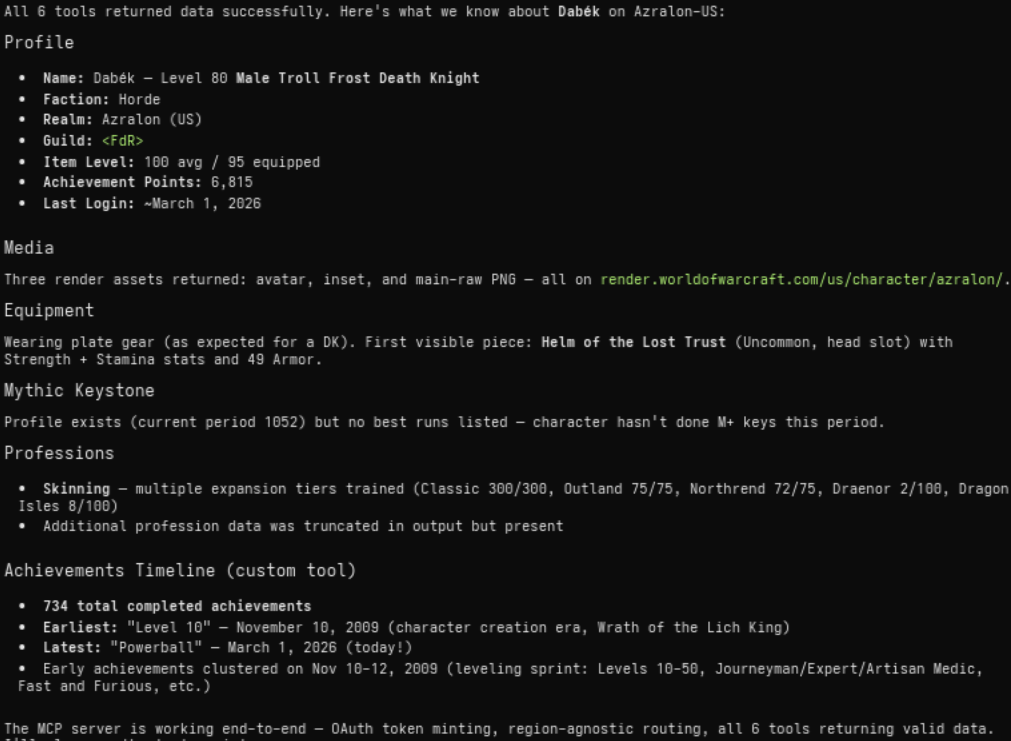
Custom — wow_character_achievementsTimeline builds a chronologically sorted timeline of completed achievements (computed, not a raw Blizzard endpoint).
Region & locale
Every tool accepts two optional parameters:
region — "us" (default), "eu", "kr", or "tw"
locale — "en_US" (default), or any locale supported by the target region (e.g. "es_MX", "de_DE", "fr_FR", "ko_KR")
No region configuration is needed in the environment. The same Battle.net credentials work across all regions.
Environment variables
See .env.example. Only two are required:
Optional auth (OAuth 2.1 for the MCP HTTP endpoint):
MCP_AUTH_SECRET — passphrase that enables OAuth. Used as the login on the /authorize page (for ChatGPT / browser clients), as the client_secret for client_credentials grants, and directly as a static Bearer token for simple clients (Warp, curl, etc.).
MCP_TOKEN_TTL_SECONDS — access token lifetime (default: 3600)
DATABASE_URL — PostgreSQL connection string (e.g. postgresql://user:pass@host:5432/db). When set, OAuth tokens, clients, and auth codes are persisted in PostgreSQL so they survive restarts. When absent, in-memory stores are used. The docker-compose.yml sets this up automatically.
When MCP_AUTH_SECRET is set, the server exposes a full OAuth 2.1 provider:
GET /.well-known/oauth-protected-resource — RFC 9728 metadata
GET /.well-known/oauth-authorization-server — RFC 8414 metadata (includes code_challenge_methods_supported: ["S256"])
POST /register — RFC 7591 dynamic client registration
GET|POST /authorize — authorization code + PKCE flow with passphrase login
POST /token — supports authorization_code (with PKCE) and client_credentials grants
The MCP_AUTH_SECRET value can also be passed directly as a Bearer token (e.g. Authorization: Bearer <your-secret>) — useful for clients like Warp that don't support OAuth flows.
If MCP_AUTH_SECRET is not set, the server runs without auth.
Optional tuning:
LOG_LEVEL — pino log level (default: info)
HTTP_TIMEOUT_MS — request timeout (default: 15000)
HTTP_RETRY_LIMIT — retry count (default: 2)
CACHE_TTL_SECONDS — response cache TTL (default: 300)
CACHE_SIZE — max cached entries (default: 500)
Testing
Integration tests use Node's built-in test runner (node:test) via tsx — no extra test dependencies. The suite spins up the server on a random port with test credentials and verifies OAuth 2.1 auth end-to-end:
Serves /.well-known/oauth-protected-resource metadata
Serves /.well-known/oauth-authorization-server metadata with S256
Registers a new client via POST /register
Rejects /mcp without a token (401 with resource_metadata hint)
Rejects client_credentials with wrong secret (401)
Issues token via client_credentials with correct secret (200)
Completes full authorization_code + PKCE flow (register → authorize → token → /mcp)
Allows /mcp with MCP_AUTH_SECRET as a static bearer token (200)
Rejects /mcp with a bogus token (401)
Docker
docker compose build
docker compose up -d
Secrets are injected via .env on the host (not committed). The container runs as a non-root user with production dependencies only.
The compose stack includes a PostgreSQL instance for persistent OAuth token storage. PostgreSQL data is bind-mounted to ./data/postgres/ on the host (maps to /var/lib/postgresql/data inside the container), so it persists across container recreates, host reboots, and Docker engine upgrades. DATABASE_URL is pre-configured automatically.
NAS / self-hosting note: make sure the data/postgres/ directory is on a reliable filesystem. Back up this folder to preserve all OAuth state.
Architecture
src/
  index.ts                          # entry point — loads env, starts server
  app.ts                            # HTTP server factory (all routes)
  auth.ts                           # OAuth 2.1 provider (metadata, registration, authorize, token, bearer validation)
  config/
    env.ts                          # zod env parsing (credentials + tuning)
    regions.ts                      # region enum, API hosts, OAuth URL
  store/
    types.ts                        # OAuthStore interface + record types
    memory.ts                       # in-memory store (default)
    postgres.ts                     # PostgreSQL store (when DATABASE_URL set)
    index.ts                        # factory — picks store based on env
  mcp/
    tools.ts                        # auto-registers all endpoints + custom tools
    schemas.ts                      # shared zod input schemas
  blizzard/
    tokenManager.ts                 # OAuth client-credentials + single-flight
    client.ts                       # got wrapper: bearer injection, cache, 401 retry
    endpoints/
      types.ts                      # EndpointDef interface, buildPath(), schema helpers
      gamedata.ts                   # 161 Game Data API endpoint definitions
      profileEndpoints.ts           # 35 Profile API endpoint definitions
    schemas/
      characterSchemas.ts           # zod response schemas
      achievementSchemas.ts
    dto/
      characterDto.ts               # normalized character DTO
      timeline.ts                   # achievement timeline builder
  util/
    http.ts                         # got defaults
    cache.ts                        # TTL cache
    logger.ts                       # pino (stderr)
test/
  auth.test.ts                      # OAuth2 auth integration tests
Endpoints are defined declaratively in gamedata.ts and profileEndpoints.ts. Each entry specifies a tool name, path template, namespace type, and zod input schema. The tools.ts module iterates over the registry and auto-registers every entry as an MCP tool, injecting region and locale parameters automatically.


