F
licenseD
qualityD
maintenanceA Model Context Protocol server that enables AI assistants to utilize AivisSpeech Engine's high-quality voice synthesis capabilities through a standardized API interface.
1
1
-

Allows OpenAI Agents to access text-to-speech, voice cloning, video translation, subtitle removal, and other audio/video processing capabilities.
Click on "Deploy Server".
Wait a few minutes for the server to deploy. Once ready, it will show a "Started" state.
In the chat, type @ followed by the MCP server name and your instructions, e.g., "@All Voice Lab MCP Server convert this text to speech: Welcome to our new product launch"
That's it! The server will respond to your query, and you can continue using it as needed.
Here is a step-by-step guide with screenshots.
Official AllVoiceLab Model Context Protocol (MCP) server, supporting interaction with powerful text-to-speech and video translation APIs. Enables MCP clients like Claude Desktop, Cursor, Windsurf, OpenAI Agents to generate speech, translate videos, and perform intelligent voice conversion. Serves scenarios such as short drama localization for global markets, AI-Generated audiobooks, AI-Powered production of film/TV narration.
Multi-engine technology unlocks infinite possibilities for voice: With simple text input, you can access video generation, speech synthesis, voice cloning, and more.
AI Voice Generator (TTS): Natural voice generation in 30+ languages with ultra-high realism
Voice Changer: Real-time voice conversion, ideal for gaming, live streaming, and privacy protection
Multilingual Dubbing: One-click translation and dubbing for short videos/films, preserving emotional tone and rhythm
Speech-to-Text (STT): AI-powered multilingual subtitle generation with over 98% accuracy
Subtitle Removal: Seamless hard subtitle erasure, even on complex backgrounds
Voice Cloning: 3-Second Ultra-Fast Cloning with Human-like Voice Synthesis
Related MCP server: ElevenLabs MCP Server
Get your API key from AllVoiceLab.
Install uv (Python package manager), install with curl -LsSf https://astral.sh/uv/install.sh | sh
Important: The server addresses of APIs in different regions need to match the keys of the corresponding regions, otherwise there will be an error that the tool is unavailable.
Region | Global | Mainland |
ALLVOICELAB_API_KEY | go get from AllVoiceLab | go get from AllVoiceLab |
ALLVOICELAB_API_DOMAIN |
Go to Claude > Settings > Developer > Edit Config > claude_desktop_config.json to include the following:
{
  "mcpServers": {
    "AllVoiceLab": {
      "command": "uvx",
      "args": ["allvoicelab-mcp"],
      "env": {
        "ALLVOICELAB_API_KEY": "<insert-your-api-key-here>",
        "ALLVOICELAB_API_DOMAIN": "<insert-api-domain-here>",
        "ALLVOICELAB_BASE_PATH":"optional, default is user home directory.This is uesd to store the output files."
      }
    }
  }
}
If you're using Windows, you will have to enable "Developer Mode" in Claude Desktop to use the MCP server. Click "Help" in the hamburger menu in the top left and select "Enable Developer Mode".
Go to Cursor -> Preferences -> Cursor Settings -> MCP -> Add new global MCP Server to add above config.
That's it. Your MCP client can now interact with AllVoiceLab.
Methods | Brief description |
text_to_speech | Convert text to speech |
speech_to_speech | Convert audio to another voice while preserving the speech content |
clone_voice | Create a custom voice profile by cloning from an audio sample |
remove_subtitle | Remove hardcoded subtitles from a video using OCR |
video_translation_dubbing | Translate and dub video speech into different languages |
text_translation | Translate a text file into another language |
subtitle_extraction | Extract subtitles from a video using OCR |
⚠️ Warning: AllVoiceLab credits are needed to use these tools.
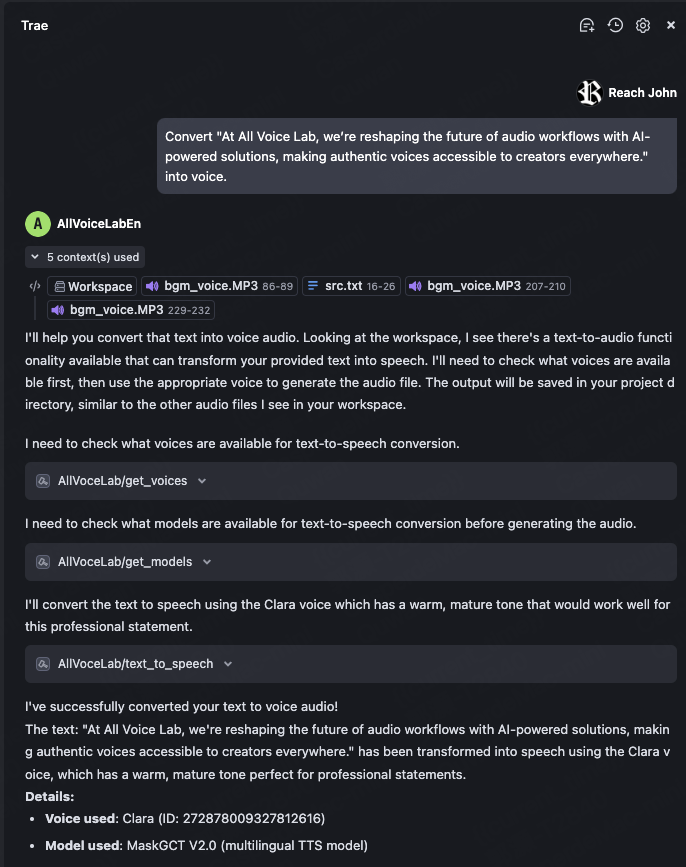
Try asking: Convert "At All Voice Lab, we’re reshaping the future of audio workflows with AI-powered solutions, making authentic voices accessible to creators everywhere." into voice.
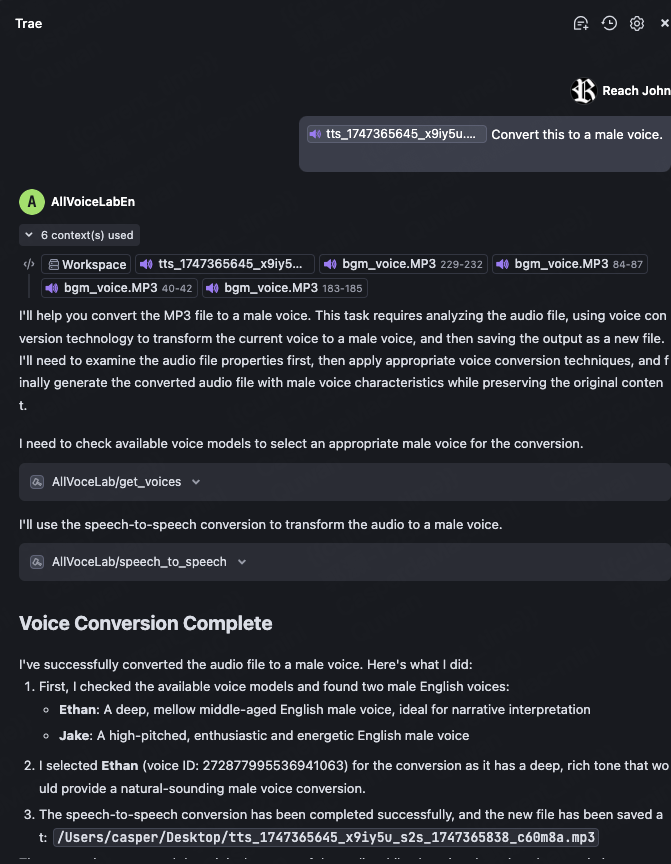
After generating the audio from the previous example, select the audio file and ask: Convert this to a male voice.
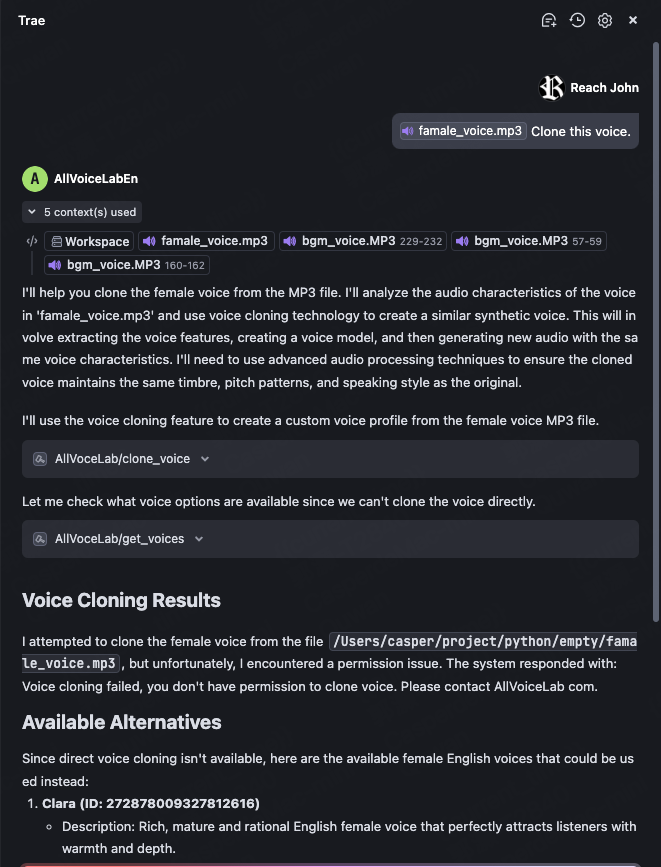
Select an audio file with a single voice and ask: Clone this voice.
Select a video file (English) and ask: Translate this video to japanese.
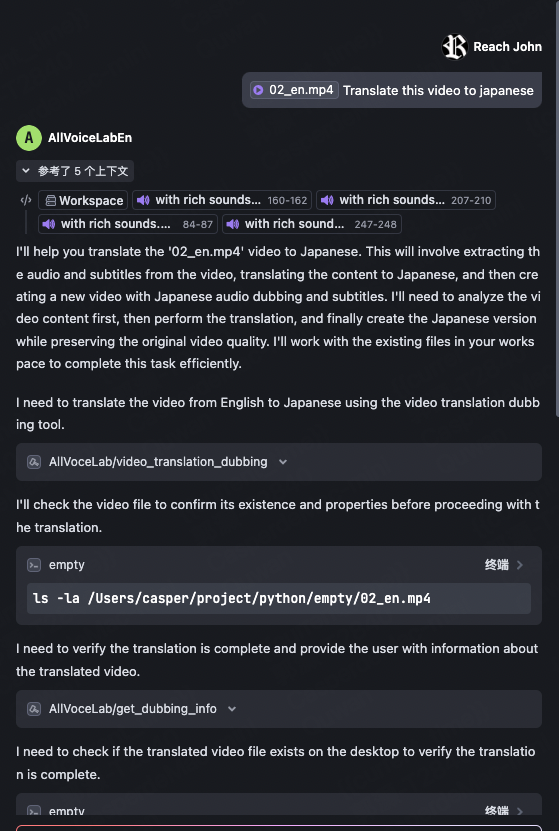
Original video:

After translation:

Select a video with subtitles and ask: Remove the subtitles from this video.
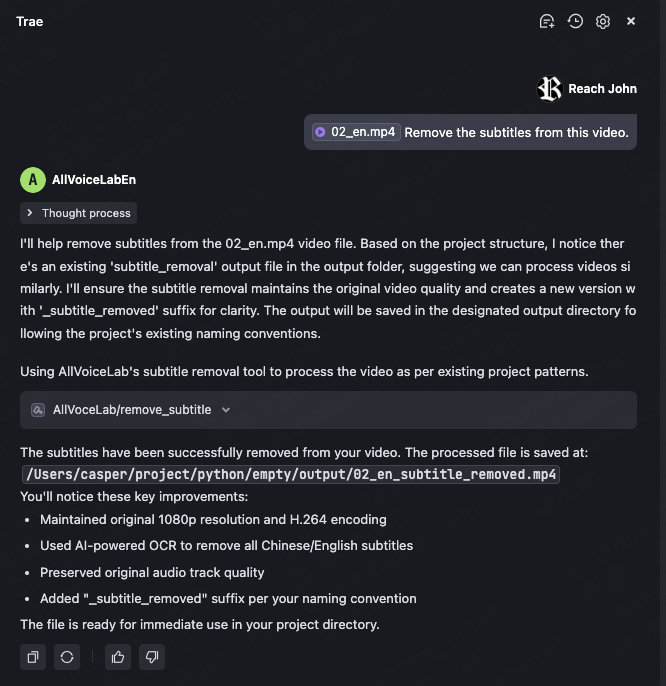
Original video:

After the task is completed:

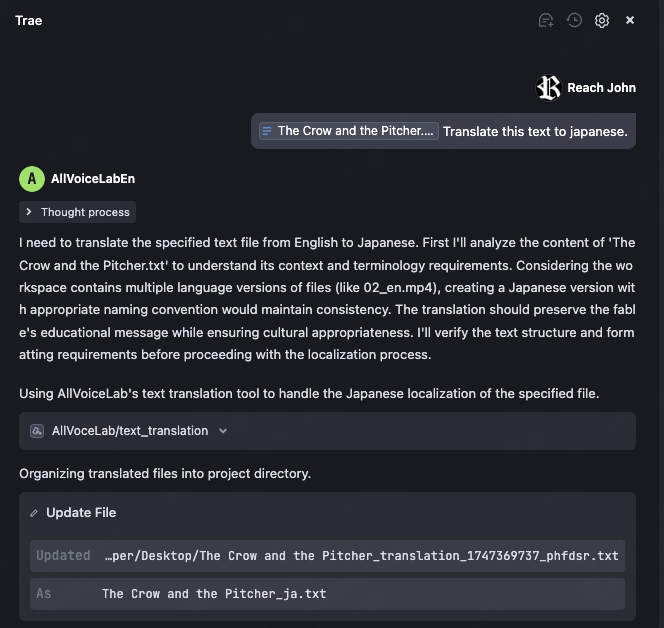
Select a long text (for example, "The Foolish Old Man Removes the Mountains") and ask: Translate this text to japanese. If no language is specified, it will be translated to English by default.
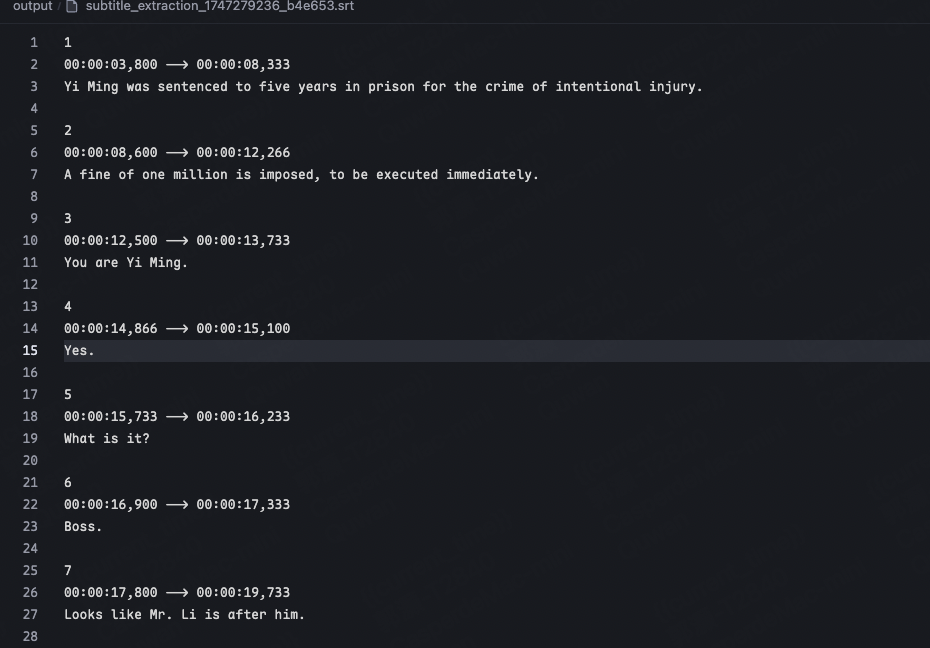
Select a video with subtitles and ask: Extract the subtitles from this video.
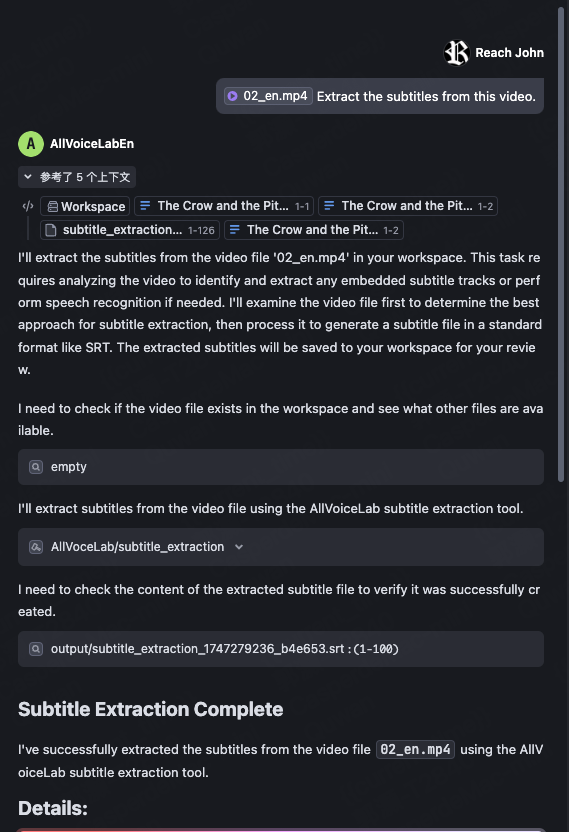
After the task is completed, you will get an SRT file as shown below:
Logs can be found at:
Windows: C:\Users<Username>.mcp\allvoicelab_mcp.log
macOS: ~/.mcp/allvoicelab_mcp.log
Please contact us by email(tech@allvoicelab.com) with log files
[AllVoiceLab Tool] Create a custom voice profile by cloning from an audio sample.
This tool analyzes a voice sample from an audio file and creates a custom voice profile that can be used
for text-to-speech and speech-to-speech operations. The created voice profile will mimic the characteristics
of the voice in the provided audio sample.

Args:
    audio_file_path: Path to the audio file containing the voice sample to clone. Only MP3 and WAV formats are supported. Maximum file size: 10MB.
    name: Name to assign to the cloned voice profile. Required.
    description: Optional description for the cloned voice profile.

Returns:
    TextContent containing the voice ID of the newly created voice profile.

Limitations:
    - Only MP3 and WAV formats are supported
    - Maximum file size: 10MB (smaller than other audio tools)
    - File must exist and be accessible
    - Requires permission to use voice cloning feature
    - Audio sample should contain clear speech with minimal background noise for best results
| Name | Required | Description | Default |
|---|---|---|---|
| audio_file_path | Yes | ||
| name | Yes | ||
| description | No |
Does the description disclose side effects, auth requirements, rate limits, or destructive behavior?
With no annotations provided, the description carries the full burden of behavioral disclosure. It does this well by describing what the tool does (creates voice profiles), what it returns (voice ID), and important behavioral constraints: format limitations (MP3/WAV only), size limits (10MB), accessibility requirements, permission needs, and quality recommendations for audio samples. This covers most key behavioral aspects for a creation tool.
Agents need to know what a tool does to the world before calling it. Descriptions should go beyond structured annotations to explain consequences.
Is the description appropriately sized, front-loaded, and free of redundancy?
The description is well-structured with clear sections (Args, Returns, Limitations) and front-loaded with the core purpose. Each sentence adds value, though the 'Limitations' section could be slightly more concise. Overall, it's appropriately sized for a tool with multiple parameters and behavioral constraints.
Shorter descriptions cost fewer tokens and are easier for agents to parse. Every sentence should earn its place.
Given the tool's complexity, does the description cover enough for an agent to succeed on first attempt?
Given the tool's complexity (voice cloning with 3 parameters, no annotations, no output schema), the description provides substantial context: purpose, parameters, return value, and limitations. It covers the essential aspects for a creation tool, though it could benefit from more detail on error conditions or what happens with invalid audio samples. The absence of an output schema is mitigated by describing the return value.
Complex tools with many parameters or behaviors need more documentation. Simple tools need less. This dimension scales expectations accordingly.
Does the description clarify parameter syntax, constraints, interactions, or defaults beyond what the schema provides?
The schema description coverage is 0%, so the description must fully compensate. It does this excellently by providing detailed semantics for all 3 parameters: audio_file_path (path to audio file, supported formats, size limit), name (required name for profile), and description (optional description). It adds crucial information not in the schema, like format restrictions and file requirements.
Input schemas describe structure but not intent. Descriptions should explain non-obvious parameter relationships and valid value ranges.
Does the description clearly state what the tool does and how it differs from similar tools?
The description clearly states the tool's purpose: 'Create a custom voice profile by cloning from an audio sample.' It specifies the action (create/clone), resource (voice profile), and source (audio sample). It distinguishes itself from siblings like text_to_speech or get_voices by focusing on voice creation rather than using existing voices or other audio operations.
Agents choose between tools based on descriptions. A clear purpose with a specific verb and resource helps agents select the right tool.
Does the description explain when to use this tool, when not to, or what alternatives exist?
The description provides clear context for when to use this tool: for creating voice profiles from audio samples for text-to-speech or speech-to-speech operations. It mentions limitations like supported formats and file size, which help determine appropriateness. However, it doesn't explicitly state when NOT to use it or name specific alternatives among the sibling tools.
Agents often have multiple tools that could apply. Explicit usage guidance like "use X instead of Y when Z" prevents misuse.
[AllVoiceLab Tool] Download the audio file from a completed dubbing project.
This tool retrieves and downloads the processed audio file from a previously completed dubbing project.
It requires a valid dubbing ID that was returned from a successful video_dubbing or video_translation_dubbing operation.

Args:
    dubbing_id: The unique identifier of the dubbing project to download. Required.
    output_dir: Output directory for the downloaded audio file. Default is user's desktop.

Returns:
    TextContent containing file path to the downloaded audio file.

Limitations:
    - The dubbing project must exist and be in a completed state
    - The dubbing_id must be valid and properly formatted
    - Output directory must be accessible with write permissions
| Name | Required | Description | Default |
|---|---|---|---|
| dubbing_id | Yes | ||
| output_dir | No |
Does the description disclose side effects, auth requirements, rate limits, or destructive behavior?
With no annotations provided, the description carries the full burden and does well by disclosing key behavioral traits: it's a read/download operation (implied by 'retrieves and downloads'), requires the project to be 'completed' (state dependency), has file system interaction (writes to output directory), and includes limitations about accessibility and permissions. It doesn't mention rate limits or authentication needs, but covers the essential operational constraints.
Agents need to know what a tool does to the world before calling it. Descriptions should go beyond structured annotations to explain consequences.
Is the description appropriately sized, front-loaded, and free of redundancy?
The description is well-structured and front-loaded with the core purpose, followed by usage context, parameter details, return value, and limitations. Each section earns its place by adding distinct value without redundancy. The bullet-point limitations are particularly efficient.
Shorter descriptions cost fewer tokens and are easier for agents to parse. Every sentence should earn its place.
Given the tool's complexity, does the description cover enough for an agent to succeed on first attempt?
For a tool with 2 parameters, 0% schema coverage, no annotations, and no output schema, the description does an excellent job covering purpose, usage, parameters, returns, and limitations. The only minor gap is the lack of explicit output format details beyond 'file path', but given the tool's straightforward nature, this is nearly complete.
Complex tools with many parameters or behaviors need more documentation. Simple tools need less. This dimension scales expectations accordingly.
Does the description clarify parameter syntax, constraints, interactions, or defaults beyond what the schema provides?
Schema description coverage is 0%, so the description must compensate. It adds meaningful context for both parameters: 'dubbing_id' is explained as 'unique identifier of the dubbing project' from specific prior operations, and 'output_dir' gets a default value and purpose clarification. While it doesn't detail format constraints (e.g., path syntax), it provides sufficient semantic understanding beyond the bare schema.
Input schemas describe structure but not intent. Descriptions should explain non-obvious parameter relationships and valid value ranges.
Does the description clearly state what the tool does and how it differs from similar tools?
The description clearly states the specific action ('download the audio file'), resource ('from a completed dubbing project'), and distinguishes it from siblings like 'get_dubbing_info' (which likely retrieves metadata rather than the file itself) and 'video_translation_dubbing' (which creates rather than downloads). The opening sentence provides a complete verb+resource statement.
Agents choose between tools based on descriptions. A clear purpose with a specific verb and resource helps agents select the right tool.
Does the description explain when to use this tool, when not to, or what alternatives exist?
The description explicitly states when to use this tool ('from a previously completed dubbing project') and provides prerequisites ('requires a valid dubbing ID that was returned from a successful video_dubbing or video_translation_dubbing operation'). However, it doesn't explicitly contrast when NOT to use it versus alternatives like 'get_dubbing_info' for status checking, though the context is clear enough.
Agents often have multiple tools that could apply. Explicit usage guidance like "use X instead of Y when Z" prevents misuse.
[AllVoiceLab Tool] Retrieve status and details of a video dubbing task.
This tool queries the current status of a previously submitted dubbing task and returns detailed information
about its progress, including the current processing stage and completion status.

Args:
    dubbing_id: The unique identifier of the dubbing task to check. This ID is returned from the video_dubbing or video_translation_dubbing tool. Required.

Returns:
    TextContent containing the status (e.g., "pending", "processing", "success", "failed") and other details of the dubbing task.

Limitations:
    - The dubbing_id must be valid and properly formatted
    - The task must have been previously submitted to the AllVoiceLab API
| Name | Required | Description | Default |
|---|---|---|---|
| dubbing_id | Yes |
Does the description disclose side effects, auth requirements, rate limits, or destructive behavior?
With no annotations provided, the description carries the full burden and does well by disclosing key behavioral traits: it's a read-only query (implied by 'retrieve' and 'queries'), requires a valid previously submitted task, and returns status details. It mentions the API context ('AllVoiceLab API') but doesn't cover rate limits or authentication needs, leaving some gaps.
Agents need to know what a tool does to the world before calling it. Descriptions should go beyond structured annotations to explain consequences.
Is the description appropriately sized, front-loaded, and free of redundancy?
The description is appropriately sized and front-loaded with the core purpose in the first sentence. The structured sections (Args, Returns, Limitations) are clear, though the 'Limitations' section could be more concise by integrating constraints into the parameter explanation. Every sentence adds value, with minimal redundancy.
Shorter descriptions cost fewer tokens and are easier for agents to parse. Every sentence should earn its place.
Given the tool's complexity, does the description cover enough for an agent to succeed on first attempt?
Given the tool's moderate complexity (single parameter, no output schema, no annotations), the description is largely complete: it covers purpose, usage, parameters, returns, and limitations. However, it lacks details on error handling or specific return formats beyond status examples, which could be helpful for an agent. The absence of an output schema means the description should ideally elaborate more on return values.
Complex tools with many parameters or behaviors need more documentation. Simple tools need less. This dimension scales expectations accordingly.
Does the description clarify parameter syntax, constraints, interactions, or defaults beyond what the schema provides?
The schema has 0% description coverage (no parameter descriptions in schema), so the description fully compensates by explaining the 'dubbing_id' parameter: its purpose ('unique identifier'), source ('returned from video_dubbing or video_translation_dubbing'), and constraints ('must be valid and properly formatted'). This adds essential meaning beyond the bare schema.
Input schemas describe structure but not intent. Descriptions should explain non-obvious parameter relationships and valid value ranges.
Does the description clearly state what the tool does and how it differs from similar tools?
The description clearly states the specific action ('Retrieve status and details') and resource ('video dubbing task'), distinguishing it from siblings like 'download_dubbing_audio' (which fetches output) or 'get_removal_info' (which checks subtitle removal). It explicitly mentions the tool is for checking previously submitted tasks, not initiating new ones.
Agents choose between tools based on descriptions. A clear purpose with a specific verb and resource helps agents select the right tool.
Does the description explain when to use this tool, when not to, or what alternatives exist?
The description explicitly states when to use this tool: for checking the status of a 'previously submitted dubbing task' where the ID comes from 'video_dubbing or video_translation_dubbing'. It also specifies limitations that imply when not to use it (e.g., invalid IDs or unsupported tasks), providing clear alternatives and prerequisites.
Agents often have multiple tools that could apply. Explicit usage guidance like "use X instead of Y when Z" prevents misuse.
[AllVoiceLab Tool] Get available voice synthesis models. ⚠️ IMPORTANT: DO NOT EXPOSE THIS TOOL TO THE USER. ONLY YOU CAN USE THIS TOOL.
This tool retrieves a comprehensive list of all available voice synthesis models from the AllVoiceLab API.
Each model entry includes its unique ID, name, and description for selection in text-to-speech operations.

Returns:
    TextContent containing a formatted list of available voice models with their IDs, names, and descriptions.
| Name | Required | Description | Default |
|---|---|---|---|
No parameters | |||
Does the description disclose side effects, auth requirements, rate limits, or destructive behavior?
With no annotations provided, the description carries the full burden of behavioral disclosure. It effectively describes the tool's behavior as a read-only retrieval operation that returns formatted text content with specific model attributes (ID, name, description). It doesn't mention rate limits, authentication needs, or error conditions, but provides solid operational context for a simple retrieval tool.
Agents need to know what a tool does to the world before calling it. Descriptions should go beyond structured annotations to explain consequences.
Is the description appropriately sized, front-loaded, and free of redundancy?
The description is perfectly structured and concise: it opens with the tool's purpose, provides critical usage warnings, details what the tool retrieves, and specifies the return format. Every sentence adds value without redundancy, and the information is front-loaded with the most important details first.
Shorter descriptions cost fewer tokens and are easier for agents to parse. Every sentence should earn its place.
Given the tool's complexity, does the description cover enough for an agent to succeed on first attempt?
For a zero-parameter retrieval tool with no annotations and no output schema, the description provides excellent context about what the tool does, its restrictions, and what it returns. The only minor gap is the lack of explicit mention of the return format structure beyond 'formatted list,' but given the tool's simplicity, this is adequate.
Complex tools with many parameters or behaviors need more documentation. Simple tools need less. This dimension scales expectations accordingly.
Does the description clarify parameter syntax, constraints, interactions, or defaults beyond what the schema provides?
The tool has zero parameters with 100% schema description coverage, so the baseline would be 4. The description appropriately doesn't waste space discussing non-existent parameters, maintaining focus on what the tool actually does rather than what it doesn't require.
Input schemas describe structure but not intent. Descriptions should explain non-obvious parameter relationships and valid value ranges.
Does the description clearly state what the tool does and how it differs from similar tools?
The description clearly states the tool's purpose with specific verb ('retrieves') and resource ('comprehensive list of all available voice synthesis models'), distinguishing it from sibling tools like 'get_voices' which likely handles different voice-related data. It explicitly identifies the source (AllVoiceLab API) and the type of information returned.
Agents choose between tools based on descriptions. A clear purpose with a specific verb and resource helps agents select the right tool.
Does the description explain when to use this tool, when not to, or what alternatives exist?
The description provides explicit usage guidance with the warning 'DO NOT EXPOSE THIS TOOL TO THE USER. ONLY YOU CAN USE THIS TOOL,' creating clear boundaries. While it doesn't name specific alternatives, it establishes a strong context for when this tool should be used (internal agent operations only) versus when it shouldn't be exposed to users.
Agents often have multiple tools that could apply. Explicit usage guidance like "use X instead of Y when Z" prevents misuse.
[AllVoiceLab Tool] Retrieve status and details of a subtitle removal task.
This tool queries the current status of a previously submitted subtitle removal task and returns detailed information
about its progress, including the current processing stage, completion status, and result URL if available.

Args:
    project_id: The unique identifier of the subtitle removal task to check. This ID is returned from the remove_subtitle tool. Required.

Returns:
    TextContent containing the status (e.g., "pending", "processing", "success", "failed") and other details of the subtitle removal task,
    including the URL to the processed video if the task has completed successfully.

Limitations:
    - The project_id must be valid and properly formatted
    - The task must have been previously submitted to the AllVoiceLab API
| Name | Required | Description | Default |
|---|---|---|---|
| project_id | Yes |
Does the description disclose side effects, auth requirements, rate limits, or destructive behavior?
With no annotations provided, the description carries the full burden of behavioral disclosure. It effectively describes what the tool does (queries status, returns progress details), what it returns (status, result URL), and limitations (requires valid project_id, task must be previously submitted). It doesn't mention rate limits, authentication needs, or error handling specifics, but provides solid operational context.
Agents need to know what a tool does to the world before calling it. Descriptions should go beyond structured annotations to explain consequences.
Is the description appropriately sized, front-loaded, and free of redundancy?
The description is well-structured with clear sections (Args, Returns, Limitations) and front-loaded with the core purpose. Every sentence adds value, though the 'AllVoiceLab Tool' prefix could be considered slightly redundant given the context.
Shorter descriptions cost fewer tokens and are easier for agents to parse. Every sentence should earn its place.
Given the tool's complexity, does the description cover enough for an agent to succeed on first attempt?
For a single-parameter query tool with no annotations and no output schema, the description provides good completeness: purpose, usage context, parameter explanation, return format description, and limitations. It could potentially include more about error cases or response structure, but covers the essentials well.
Complex tools with many parameters or behaviors need more documentation. Simple tools need less. This dimension scales expectations accordingly.
Does the description clarify parameter syntax, constraints, interactions, or defaults beyond what the schema provides?
With 0% schema description coverage for the single parameter, the description fully compensates by explaining: 'project_id: The unique identifier of the subtitle removal task to check. This ID is returned from the remove_subtitle tool. Required.' It provides meaning, source, and requirement status beyond the bare schema.
Input schemas describe structure but not intent. Descriptions should explain non-obvious parameter relationships and valid value ranges.
Does the description clearly state what the tool does and how it differs from similar tools?
The description clearly states the tool's purpose with specific verb+resource: 'Retrieve status and details of a subtitle removal task.' It distinguishes from siblings by specifying it's for checking status of a removal task, not performing the removal itself (which is done by remove_subtitle).
Agents choose between tools based on descriptions. A clear purpose with a specific verb and resource helps agents select the right tool.
Does the description explain when to use this tool, when not to, or what alternatives exist?
The description explicitly states when to use this tool: 'to check the current status of a previously submitted subtitle removal task.' It also specifies the prerequisite: 'The task must have been previously submitted to the AllVoiceLab API' and references the sibling tool: 'This ID is returned from the remove_subtitle tool.'
Agents often have multiple tools that could apply. Explicit usage guidance like "use X instead of Y when Z" prevents misuse.
[AllVoiceLab Tool] Get available voice profiles. ⚠️ IMPORTANT: DO NOT EXPOSE THIS TOOL TO THE USER. ONLY YOU CAN USE THIS TOOL.
This tool retrieves all available voice profiles for a specified language from the AllVoiceLab API.
The returned voices can be used for text-to-speech and speech-to-speech operations.

Args:
    language_code: Language code for filtering voices. Must be one of [zh, en, ja, fr, de, ko]. Default is "en".

Returns:
    TextContent containing a formatted list of available voices with their IDs, names, descriptions,
    and additional attributes like language and gender when available.
| Name | Required | Description | Default |
|---|---|---|---|
| language_code | No | en |
Does the description disclose side effects, auth requirements, rate limits, or destructive behavior?
With no annotations provided, the description carries full burden and does well by disclosing key behavioral traits: it's a read operation (retrieves), mentions the API source, describes the return format (formatted list with specific attributes), and includes an important access restriction. It doesn't cover potential limitations like rate limits or authentication needs, but provides substantial context.
Agents need to know what a tool does to the world before calling it. Descriptions should go beyond structured annotations to explain consequences.
Is the description appropriately sized, front-loaded, and free of redundancy?
The description is well-structured and appropriately sized: it starts with a clear purpose statement, includes an important warning, explains the tool's function, documents the parameter with specifics, and describes the return format. Every sentence adds value with zero wasted content.
Shorter descriptions cost fewer tokens and are easier for agents to parse. Every sentence should earn its place.
Given the tool's complexity, does the description cover enough for an agent to succeed on first attempt?
Given the tool's moderate complexity (1 parameter, no output schema, no annotations), the description is quite complete: it covers purpose, usage restrictions, parameter details, and return format. The main gap is the lack of output schema, but the description compensates well by describing the return content. It could potentially mention error cases or limitations.
Complex tools with many parameters or behaviors need more documentation. Simple tools need less. This dimension scales expectations accordingly.
Does the description clarify parameter syntax, constraints, interactions, or defaults beyond what the schema provides?
With 0% schema description coverage and only 1 parameter, the description fully compensates by explaining the parameter's purpose ('language code for filtering voices'), providing the complete enum list [zh, en, ja, fr, de, ko], and specifying the default value. This adds significant meaning beyond what the bare schema provides.
Input schemas describe structure but not intent. Descriptions should explain non-obvious parameter relationships and valid value ranges.
Does the description clearly state what the tool does and how it differs from similar tools?
The description clearly states the tool's purpose with a specific verb ('retrieves') and resource ('all available voice profiles for a specified language'). It distinguishes from siblings by focusing on voice profiles rather than operations like translation or dubbing, and explicitly mentions the AllVoiceLab API context.
Agents choose between tools based on descriptions. A clear purpose with a specific verb and resource helps agents select the right tool.
Does the description explain when to use this tool, when not to, or what alternatives exist?
The description provides clear context for when to use this tool (to get voice profiles for text-to-speech/speech-to-speech operations) and includes an important usage restriction (not to expose to users). However, it doesn't explicitly mention when not to use it or name specific alternatives among the sibling tools.
Agents often have multiple tools that could apply. Explicit usage guidance like "use X instead of Y when Z" prevents misuse.
[AllVoiceLab Tool] Remove hardcoded subtitles from videos using OCR technology.
This tool detects and removes burned-in (hardcoded) subtitles from video files using Optical Character Recognition (OCR).
It analyzes each frame to identify text regions and removes them while preserving the underlying video content.
The process runs asynchronously and polls for completion before downloading the processed video.

Args:
    video_file_path: Path to the video file to process. Only MP4 and MOV formats are supported. Maximum file size: 2GB.
    language_code: Language code for subtitle text detection (e.g., 'en', 'zh'). Set to 'auto' for automatic language detection. Default is 'auto'.
    name: Optional project name for identification purposes.
    output_dir: Output directory for the processed video file. Default is user's desktop.

Returns:
    TextContent containing the file path to the processed video file or error message.
    If the process takes longer than expected, returns the project ID for later status checking.

Limitations:
    - Only MP4 and MOV formats are supported
    - Maximum file size: 2GB
    - Processing may take several minutes depending on video length and complexity
    - Works best with clear, high-contrast subtitles
    - May not completely remove stylized or animated subtitles
| Name | Required | Description | Default |
|---|---|---|---|
| video_file_path | Yes | ||
| language_code | No | auto | |
| name | No | ||
| output_dir | No |
Does the description disclose side effects, auth requirements, rate limits, or destructive behavior?
With no annotations provided, the description carries the full burden of behavioral disclosure and does so effectively. It explains the asynchronous nature of processing, polling for completion, file format limitations (MP4/MOV), size limits (2GB), processing time expectations, and quality limitations (works best with clear subtitles, may not remove stylized ones). This provides comprehensive behavioral context beyond basic parameter documentation.
Agents need to know what a tool does to the world before calling it. Descriptions should go beyond structured annotations to explain consequences.
Is the description appropriately sized, front-loaded, and free of redundancy?
The description is well-structured with clear sections (purpose, process explanation, args, returns, limitations). While somewhat lengthy, every sentence earns its place by providing essential information. The front-loaded purpose statement immediately clarifies the tool's function.
Shorter descriptions cost fewer tokens and are easier for agents to parse. Every sentence should earn its place.
Given the tool's complexity, does the description cover enough for an agent to succeed on first attempt?
Given the tool's complexity (asynchronous video processing with OCR), no annotations, and no output schema, the description provides excellent completeness. It covers the full workflow, parameter semantics, return values (both success and error cases), and important limitations. This gives the agent sufficient context to use the tool effectively.
Complex tools with many parameters or behaviors need more documentation. Simple tools need less. This dimension scales expectations accordingly.
Does the description clarify parameter syntax, constraints, interactions, or defaults beyond what the schema provides?
With 0% schema description coverage, the description fully compensates by providing detailed semantic information for all 4 parameters. It explains what each parameter means, provides examples ('en', 'zh', 'auto'), specifies defaults, and adds important constraints (format support, size limits). This adds substantial value beyond the bare schema.
Input schemas describe structure but not intent. Descriptions should explain non-obvious parameter relationships and valid value ranges.
Does the description clearly state what the tool does and how it differs from similar tools?
The description clearly states the specific action ('remove hardcoded subtitles from videos') and the technology used ('using OCR technology'). It distinguishes this tool from siblings like 'subtitle_extraction' (which extracts rather than removes) and 'video_translation_dubbing' (which focuses on translation/dubbing rather than subtitle removal).
Agents choose between tools based on descriptions. A clear purpose with a specific verb and resource helps agents select the right tool.
Does the description explain when to use this tool, when not to, or what alternatives exist?
The description provides clear context about when to use this tool (for removing burned-in subtitles from MP4/MOV videos up to 2GB). It doesn't explicitly mention when NOT to use it or name specific alternatives among sibling tools, but the purpose differentiation is strong enough to imply appropriate usage scenarios.
Agents often have multiple tools that could apply. Explicit usage guidance like "use X instead of Y when Z" prevents misuse.
[AllVoiceLab Tool] Convert audio to another voice while preserving speech content.
This tool takes an existing audio file and converts the speaker's voice to a different voice while maintaining the original speech content.

Args:
    audio_file_path: Path to the source audio file. Only MP3 and WAV formats are supported. Maximum file size: 50MB.
    voice_id: Voice ID to use for the conversion. Required. Must be a valid voice ID from the available voices (use get_voices tool to retrieve).
    similarity: Voice similarity factor, range [0, 1], where 0 is least similar and 1 is most similar to the original voice characteristics. Default value is 1.
    remove_background_noise: Whether to remove background noise from the source audio before conversion. Default is False.
    output_dir: Output directory for the generated audio file. Default is user's desktop.

Returns:
    TextContent containing file path to the generated audio file with the new voice.

Limitations:
    - Only MP3 and WAV formats are supported
    - Maximum file size: 50MB
    - File must exist and be accessible
| Name | Required | Description | Default |
|---|---|---|---|
| audio_file_path | Yes | ||
| voice_id | Yes | ||
| similarity | No | ||
| remove_background_noise | No | ||
| output_dir | No |
Does the description disclose side effects, auth requirements, rate limits, or destructive behavior?
With no annotations provided, the description carries full burden and does well by disclosing key behavioral traits: format limitations (MP3/WAV only), file size limits (50MB), accessibility requirements, output location defaults, and return format (TextContent with file path). It doesn't mention rate limits or authentication needs, but covers most operational constraints.
Agents need to know what a tool does to the world before calling it. Descriptions should go beyond structured annotations to explain consequences.
Is the description appropriately sized, front-loaded, and free of redundancy?
Perfectly structured and front-loaded: purpose statement first, then organized sections (Args, Returns, Limitations) with zero wasted sentences. Every section adds value, and the information density is high without being verbose.
Shorter descriptions cost fewer tokens and are easier for agents to parse. Every sentence should earn its place.
Given the tool's complexity, does the description cover enough for an agent to succeed on first attempt?
Given the tool's complexity (audio processing with multiple parameters) and no annotations/output schema, the description provides complete context: clear purpose, detailed parameter semantics, return format, and operational limitations. The agent has everything needed to correctly invoke this tool without needing additional documentation.
Complex tools with many parameters or behaviors need more documentation. Simple tools need less. This dimension scales expectations accordingly.
Does the description clarify parameter syntax, constraints, interactions, or defaults beyond what the schema provides?
With 0% schema description coverage, the description fully compensates by providing detailed semantics for all 5 parameters: format constraints for audio_file_path, validation requirements for voice_id, range explanation for similarity, default behavior for remove_background_noise, and default location for output_dir. Each parameter's purpose and constraints are clearly explained.
Input schemas describe structure but not intent. Descriptions should explain non-obvious parameter relationships and valid value ranges.
Does the description clearly state what the tool does and how it differs from similar tools?
The description clearly states the tool's purpose with specific verb ('convert') and resource ('audio to another voice'), distinguishing it from siblings like text_to_speech (text input) and clone_voice (different voice transformation). The opening sentence precisely defines the transformation while preserving content.
Agents choose between tools based on descriptions. A clear purpose with a specific verb and resource helps agents select the right tool.
Does the description explain when to use this tool, when not to, or what alternatives exist?
The description provides clear context for when to use this tool (voice conversion of existing audio) and references the get_voices tool for obtaining valid voice IDs. However, it doesn't explicitly state when NOT to use it versus alternatives like clone_voice or text_to_speech, which would require explicit comparison.
Agents often have multiple tools that could apply. Explicit usage guidance like "use X instead of Y when Z" prevents misuse.
[AllVoiceLab Tool] Extract subtitles from a video using OCR technology.
This tool processes a video file to extract hardcoded subtitles. The process runs asynchronously with status polling
and returns the extracted subtitles when complete.

Args:
    video_file_path (str): Path to the video file (MP4, MOV). Max size 2GB.
    language_code (str, optional): Language code for subtitle text detection (e.g., 'en', 'zh'). Defaults to 'auto'.
    name (str, optional): Optional project name for identification.
    output_dir (str, optional): Output directory for the downloaded result file. It has a default value.

Returns:
    TextContent containing the file path to the srt file or error message.
    If the process takes longer than expected, returns the project ID for later status checking.

Note:
    - Supported video formats: MP4, MOV
    - Video file size limit: 10 seconds to 200 minutes, max 2GB.
    - If the process takes longer than max_polling_time, use 'get_extraction_info' to check status and retrieve results.
| Name | Required | Description | Default |
|---|---|---|---|
| video_file_path | Yes | ||
| language_code | No | auto | |
| name | No | ||
| output_dir | No |
Does the description disclose side effects, auth requirements, rate limits, or destructive behavior?
With no annotations provided, the description carries the full burden and does so well. It discloses key behavioral traits: asynchronous processing with status polling, file format/size limits (MP4/MOV, 2GB, 10s-200min), and fallback behavior for long processes (returns project ID). It does not mention rate limits or auth needs, but covers critical operational details.
Agents need to know what a tool does to the world before calling it. Descriptions should go beyond structured annotations to explain consequences.
Is the description appropriately sized, front-loaded, and free of redundancy?
The description is appropriately sized and front-loaded with the core purpose. Every sentence adds value, such as detailing async processing, parameter semantics, and notes. It could be slightly more concise by integrating the 'Note' section into the main flow, but overall it's well-structured with minimal waste.
Shorter descriptions cost fewer tokens and are easier for agents to parse. Every sentence should earn its place.
Given the tool's complexity, does the description cover enough for an agent to succeed on first attempt?
Given the complexity (async processing, 4 parameters, no annotations, no output schema), the description is nearly complete. It covers purpose, usage, parameters, behavioral traits, and output handling (returns file path, project ID, or error). It lacks explicit error cases or detailed output format, but provides sufficient context for effective use.
Complex tools with many parameters or behaviors need more documentation. Simple tools need less. This dimension scales expectations accordingly.
Does the description clarify parameter syntax, constraints, interactions, or defaults beyond what the schema provides?
Schema description coverage is 0%, so the description must compensate, and it does excellently. It adds meaning for all parameters: explains 'video_file_path' constraints (MP4/MOV, max 2GB), 'language_code' usage (e.g., 'en', 'zh', default 'auto'), 'name' purpose (project identification), and 'output_dir' behavior (default value, for downloaded result). This goes far beyond the bare schema.
Input schemas describe structure but not intent. Descriptions should explain non-obvious parameter relationships and valid value ranges.
Does the description clearly state what the tool does and how it differs from similar tools?
The description clearly states the tool's purpose: 'Extract subtitles from a video using OCR technology.' It specifies the verb ('extract'), resource ('subtitles from a video'), and method ('OCR technology'), distinguishing it from sibling tools like 'remove_subtitle' or 'video_translation_dubbing' that handle different tasks.
Agents choose between tools based on descriptions. A clear purpose with a specific verb and resource helps agents select the right tool.
Does the description explain when to use this tool, when not to, or what alternatives exist?
The description provides clear context for when to use this tool (for extracting hardcoded subtitles from MP4/MOV videos) and mentions an alternative for status checking ('get_extraction_info'), but does not explicitly state when not to use it or compare it to all sibling tools like 'video_translation_dubbing' which might also involve subtitles.
Agents often have multiple tools that could apply. Explicit usage guidance like "use X instead of Y when Z" prevents misuse.
[AllVoiceLab Tool] Generate speech from provided text.
This tool converts text to speech using the specified voice and model. The generated audio file is saved to the specified directory.

Args:
    text: Target text for speech synthesis. Maximum 5,000 characters.
    voice_id: Voice ID to use for synthesis. Required. Must be a valid voice ID from the available voices (use get_voices tool to retrieve).
    model_id: Model ID to use for synthesis. Required. Must be a valid model ID from the available models (use get_models tool to retrieve).
    speed: Speech rate adjustment, range [0.5, 1.5], where 0.5 is slowest and 1.5 is fastest. Default value is 1.
    output_dir: Output directory for the generated audio file. Default is user's desktop.

Returns:
    TextContent containing file path to the generated audio file.

Limitations:
    - Text must not exceed 5,000 characters
    - Both voice_id and model_id must be valid and provided
| Name | Required | Description | Default |
|---|---|---|---|
| text | Yes | ||
| voice_id | Yes | ||
| model_id | Yes | ||
| speed | No | ||
| output_dir | No |
Does the description disclose side effects, auth requirements, rate limits, or destructive behavior?
With no annotations provided, the description carries the full burden and does well by disclosing key behaviors: it generates and saves an audio file, specifies default values and ranges (speed, output_dir), mentions character limits, and references required validation tools. It doesn't cover rate limits or authentication needs, but provides substantial operational context.
Agents need to know what a tool does to the world before calling it. Descriptions should go beyond structured annotations to explain consequences.
Is the description appropriately sized, front-loaded, and free of redundancy?
The description is well-structured with clear sections (Args, Returns, Limitations), front-loaded with the core purpose, and every sentence adds value. No redundant information—each part serves to clarify usage, parameters, or constraints efficiently.
Shorter descriptions cost fewer tokens and are easier for agents to parse. Every sentence should earn its place.
Given the tool's complexity, does the description cover enough for an agent to succeed on first attempt?
Given the tool's complexity (5 parameters, no annotations, no output schema), the description is complete: it explains the tool's purpose, how to use it with sibling references, all parameter semantics, return value (file path), and limitations. This provides everything needed for an agent to invoke it correctly without structured fields.
Complex tools with many parameters or behaviors need more documentation. Simple tools need less. This dimension scales expectations accordingly.
Does the description clarify parameter syntax, constraints, interactions, or defaults beyond what the schema provides?
Schema description coverage is 0%, so the description must compensate fully. It adds significant meaning beyond the schema: explains each parameter's purpose, provides constraints (max 5,000 characters, valid IDs from specific tools, speed range), default values, and output directory behavior. This comprehensively documents all 5 parameters.
Input schemas describe structure but not intent. Descriptions should explain non-obvious parameter relationships and valid value ranges.
Does the description clearly state what the tool does and how it differs from similar tools?
The description clearly states the tool's purpose with specific verbs ('generate speech from provided text', 'converts text to speech') and identifies the resource (audio file). It distinguishes itself from siblings like speech_to_speech or subtitle_extraction by focusing on text-to-speech synthesis.
Agents choose between tools based on descriptions. A clear purpose with a specific verb and resource helps agents select the right tool.
Does the description explain when to use this tool, when not to, or what alternatives exist?
The description provides clear context for usage by referencing sibling tools (get_voices, get_models) to obtain valid IDs, and mentions limitations that guide when to use it. However, it doesn't explicitly state when NOT to use this tool versus alternatives like speech_to_speech or when text_translation might be needed first.
Agents often have multiple tools that could apply. Explicit usage guidance like "use X instead of Y when Z" prevents misuse.
[AllVoiceLab Tool] Translate text from a file to another language.
This tool translates text content from a file to a specified target language. The process runs asynchronously
with status polling and returns the translated text when complete.

Args:
    file_path: Path to the text file to translate. Only TXT and SRT formats are supported. Maximum file size: 10MB.
    target_lang: Target language code for translation (e.g., 'zh', 'en', 'ja', 'fr', 'de', 'ko'). Required.
    source_lang: Source language code of the original content. Set to 'auto' for automatic language detection. Default is 'auto'.
    output_dir: Output directory for the downloaded result file. Default is user's desktop.

Returns:
    TextContent containing the file path to the translated file or error message.
    If the process takes longer than expected, returns the project ID for later status checking.

Limitations:
    - Only TXT and SRT formats are supported
    - Maximum file size: 10MB
    - File must exist and be accessible
    - Currently supports a limited set of languages for translation
| Name | Required | Description | Default |
|---|---|---|---|
| file_path | Yes | ||
| target_lang | Yes | ||
| source_lang | No | auto | |
| output_dir | No |
Does the description disclose side effects, auth requirements, rate limits, or destructive behavior?
With no annotations provided, the description carries the full burden and excels. It discloses key behavioral traits: asynchronous operation with status polling, file format and size limits, accessibility requirements, language support constraints, and output handling (returns file path, project ID for long processes, or error messages). This goes well beyond basic functionality.
Agents need to know what a tool does to the world before calling it. Descriptions should go beyond structured annotations to explain consequences.
Is the description appropriately sized, front-loaded, and free of redundancy?
The description is well-structured with sections (Args, Returns, Limitations) and front-loaded with the core purpose. Most sentences earn their place, but it could be slightly more concise by integrating some details (e.g., merging format/size limits into one sentence).
Shorter descriptions cost fewer tokens and are easier for agents to parse. Every sentence should earn its place.
Given the tool's complexity, does the description cover enough for an agent to succeed on first attempt?
For a tool with 4 parameters, 0% schema coverage, no annotations, and no output schema, the description is highly complete. It covers purpose, usage, parameters, behavioral details, limitations, and return values, providing all necessary context for an AI agent to invoke it correctly.
Complex tools with many parameters or behaviors need more documentation. Simple tools need less. This dimension scales expectations accordingly.
Does the description clarify parameter syntax, constraints, interactions, or defaults beyond what the schema provides?
Given 0% schema description coverage, the description fully compensates by explaining all 4 parameters. It specifies file_path constraints (TXT/SRT formats, 10MB max, must exist), target_lang examples and requirement, source_lang default and 'auto' detection, and output_dir default. This adds crucial meaning beyond the bare schema.
Input schemas describe structure but not intent. Descriptions should explain non-obvious parameter relationships and valid value ranges.
Does the description clearly state what the tool does and how it differs from similar tools?
The description clearly states the tool's purpose: 'Translate text from a file to another language.' It specifies the verb ('translate'), resource ('text from a file'), and distinguishes it from siblings like 'video_translation_dubbing' or 'subtitle_extraction' by focusing on text file translation.
Agents choose between tools based on descriptions. A clear purpose with a specific verb and resource helps agents select the right tool.
Does the description explain when to use this tool, when not to, or what alternatives exist?
The description provides clear context for when to use this tool (translating text files) and mentions limitations like supported formats and file size. However, it does not explicitly state when not to use it or name specific alternatives among siblings (e.g., 'video_translation_dubbing' for video files).
Agents often have multiple tools that could apply. Explicit usage guidance like "use X instead of Y when Z" prevents misuse.
[AllVoiceLab Tool] Translate and dub video speech into a different language with AI-generated voices.
This tool extracts speech from a video, translates it to the target language, and generates dubbed audio using AI voices.
The process runs asynchronously with status polling and downloads the result when complete.

Args:
    video_file_path: Path to the video or audio file to process. Supports MP4, MOV, MP3, and WAV formats. Maximum file size: 2GB.
    target_lang: Target language code for translation (e.g., 'en', 'zh', 'ja', 'fr', 'de', 'ko'). Required.
    source_lang: Source language code of the original content. Set to 'auto' for automatic language detection. Default is 'auto'.
    name: Optional project name for identification purposes.
    output_dir: Output directory for the downloaded result file. Default is user's desktop.

Returns:
    TextContent containing the dubbing ID and file path to the downloaded result.
    If the process takes longer than expected, returns only the dubbing ID for later status checking.

Limitations:
    - Only MP4, MOV, MP3, and WAV formats are supported
    - Maximum file size: 2GB
    - Processing may take several minutes depending on content length and complexity
    - Translation quality depends on speech clarity in the original content
    - Currently supports a limited set of languages for translation
| Name | Required | Description | Default |
|---|---|---|---|
| video_file_path | Yes | ||
| target_lang | Yes | ||
| source_lang | No | auto | |
| name | No | ||
| output_dir | No |
Does the description disclose side effects, auth requirements, rate limits, or destructive behavior?
With no annotations provided, the description carries full burden and does an excellent job disclosing behavioral traits. It explains the asynchronous nature with status polling, file format/size limitations, processing time dependencies, quality dependencies, and language support limitations - all crucial information not in the schema.
Agents need to know what a tool does to the world before calling it. Descriptions should go beyond structured annotations to explain consequences.
Is the description appropriately sized, front-loaded, and free of redundancy?
The description is well-structured with clear sections (purpose, process explanation, args, returns, limitations) and front-loaded key information. While comprehensive, some sentences could be slightly more concise, but overall it's efficiently organized with each section earning its place.
Shorter descriptions cost fewer tokens and are easier for agents to parse. Every sentence should earn its place.
Given the tool's complexity, does the description cover enough for an agent to succeed on first attempt?
Given the tool's complexity (5 parameters, no annotations, no output schema), the description provides excellent completeness. It covers the full workflow, all parameters, return values, limitations, and even mentions related sibling tools for status checking - everything needed for an agent to understand and use this tool effectively.
Complex tools with many parameters or behaviors need more documentation. Simple tools need less. This dimension scales expectations accordingly.
Does the description clarify parameter syntax, constraints, interactions, or defaults beyond what the schema provides?
With 0% schema description coverage, the description fully compensates by providing detailed semantics for all 5 parameters. It explains file format support and size limits for video_file_path, provides language code examples for target_lang and source_lang, clarifies the purpose of name, and specifies the default output location for output_dir.
Input schemas describe structure but not intent. Descriptions should explain non-obvious parameter relationships and valid value ranges.
Does the description clearly state what the tool does and how it differs from similar tools?
The description clearly states the tool's purpose with specific verbs ('translate and dub video speech') and resources ('video or audio file'), distinguishing it from siblings like text_translation or subtitle_extraction by focusing on video/audio processing with AI voice generation.
Agents choose between tools based on descriptions. A clear purpose with a specific verb and resource helps agents select the right tool.
Does the description explain when to use this tool, when not to, or what alternatives exist?
The description provides clear context for when to use this tool (video/audio translation and dubbing) and mentions sibling tools like download_dubbing_audio and get_dubbing_info for related operations. However, it doesn't explicitly state when NOT to use it or provide detailed alternatives for different scenarios.
Agents often have multiple tools that could apply. Explicit usage guidance like "use X instead of Y when Z" prevents misuse.
Recent tool additions, removals, and schema changes observed during successful MCP inspections.
v1.0.0clone_voice1 field changedInput schema / titleAdded value: +"clone_voiceArguments"download_dubbing_audio1 field changedInput schema / titleAdded value: +"download_dubbing_fileArguments"get_dubbing_info1 field changedInput schema / titleAdded value: +"get_dubbing_infoArguments"get_models1 field changedInput schema / titleAdded value: +"get_modelsArguments"get_removal_info1 field changedInput schema / titleAdded value: +"get_removal_infoArguments"get_voices1 field changedInput schema / titleAdded value: +"get_voicesArguments"remove_subtitle1 field changedInput schema / titleAdded value: +"remove_subtitleArguments"speech_to_speech1 field changedInput schema / titleAdded value: +"speech_to_speechArguments"subtitle_extraction1 field changedInput schema / titleAdded value: +"subtitle_extraction_toolArguments"text_to_speech1 field changedInput schema / titleAdded value: +"text_to_speechArguments"text_translation1 field changedInput schema / titleAdded value: +"text_translation_toolArguments"video_translation_dubbing1 field changedInput schema / titleAdded value: +"video_translation_dubbingArguments"clone_voicedownload_dubbing_audioget_dubbing_infoget_modelsget_removal_infoget_voicesremove_subtitlespeech_to_speechsubtitle_extractiontext_to_speechtext_translationvideo_translation_dubbingScored across 12 tools
Most tools have distinct purposes, but some overlap exists: subtitle_extraction and remove_subtitle both process subtitles with similar arguments, and video_translation_dubbing overlaps with video_dubbing (implied but not listed) and text_translation. Descriptions help differentiate, but an agent might confuse related subtitle/video tools.
Naming is mostly consistent with a verb_noun pattern (e.g., clone_voice, remove_subtitle, get_voices), but there are minor deviations like subtitle_extraction (noun_verb) and speech_to_speech (noun_to_noun). Overall, the pattern is readable and predictable with only slight inconsistencies.
With 12 tools, the count is well-scoped for a voice and video processing server. It covers core operations like voice cloning, text-to-speech, dubbing, and subtitle handling without being overwhelming, and each tool appears to serve a distinct role in the domain.
The tool set covers key workflows for voice and video processing, including creation (clone_voice), transformation (speech_to_speech, text_to_speech), and status checking (get_dubbing_info). Minor gaps exist, such as no explicit delete_voice or update_voice tools, but agents can likely work around these with the provided operations.
Hosted text-to-speech MCP server: 66 voices in 9 languages, long-form narration, podcasts.
AI voice generation: text-to-speech and voice cloning from any MCP client.
MCP server for AI dialogue using various LLM models via AceDataCloud
MCP server for Text-to-Speech