Alibaba Cloud FC MCP Server
OfficialThe Alibaba Cloud FC MCP Server enables integration of Alibaba Cloud Function Compute capabilities into MCP Client-supported agent applications like Cursor and Cline.
With this server, you can:
Deploy and Update Functions: Package, deploy, and modify custom runtime functions with options to update specific parameters or overwrite existing functions
Manage Functions: Retrieve detailed information, list functions with filtering options, and delete functions within specified regions
Handle Custom Domain Configurations: Query, create, update, and delete domain routing configurations (requires prior CNAME setup)
Version Control: Publish new versions of functions, list all versions, and delete specific versions
Integrate with Agent Applications: Configure and interact through popular agent applications for streamlined development and deployment

Enables deploying and managing serverless functions on Alibaba Cloud Function Compute (FC) service, including creating custom runtime functions, updating configurations, managing custom domain routes, and retrieving function information.
Integrates with Serverless Devs for deploying and managing serverless applications on Alibaba Cloud Function Compute.
Click on "Install Server".
Wait a few minutes for the server to deploy. Once ready, it will show a "Started" state.
In the chat, type
@followed by the MCP server name and your instructions, e.g., "@Alibaba Cloud FC MCP Serverdeploy my 2048 game project to function compute"
That's it! The server will respond to your query, and you can continue using it as needed.
Here is a step-by-step guide with screenshots.
Alibaba Cloud FC MCP Server
This project is the MCP Server for Alibaba Cloud Function Compute (FC) service, based on Serverless Devs and OpenAPI.
Usage Scenarios
Integrate Alibaba Cloud Function Compute capabilities into agent applications that support MCP Client (such as Cursor, Claude, Cline).
Related MCP server: DataWorks MCP Server
Prerequisites
Install Node.js (version 18 or above is required).
Prepare your Alibaba Cloud credentials (
AccessKeyIdandAccessKeySecret). The following permissions are recommended:AdministratorAccess(recommended for full functionality), or at minimum:AliyunFCFullAccess(required)AliyunDevsFullAccess(recommended)AliyunVPCFullAccess(recommended)AliyunLogFullAccess(recommended)AliyunEventBridgeFullAccess(optional)
Quick Start
Method 1: Start from npm package [Recommended for MCP Server users]
You can use the following command to start the MCP server in stdio mode:
ALIBABA_CLOUD_ACCESS_KEY_ID=${your-access-key-id} ALIBABA_CLOUD_ACCESS_KEY_SECRET=${your-access-key-secret} npx alibabacloud-fc-mcp-serverUsing Cursor [Recommended]
Click
or edit the Cursor configuration file (doc), and add the following configuration:
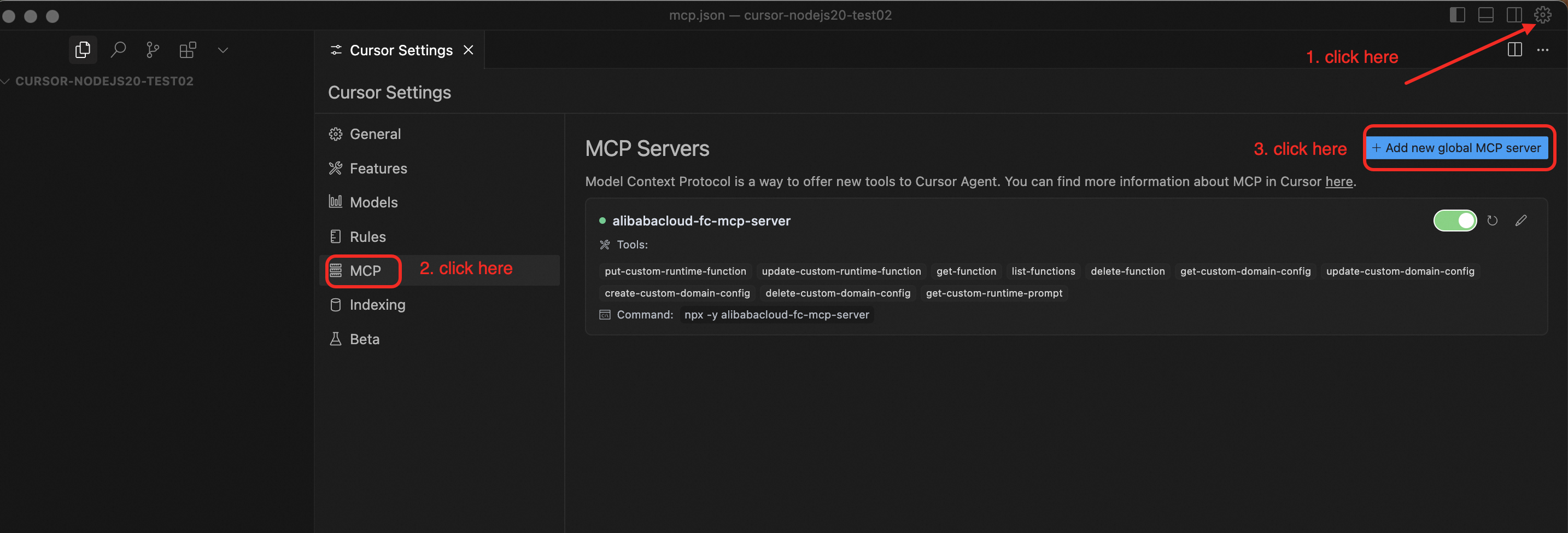
"alibabacloud-fc-mcp-server": {
"command": "npx",
"args": ["-y", "alibabacloud-fc-mcp-server"],
"env": {
"ALIBABA_CLOUD_ACCESS_KEY_ID": "${your-access-key-id}",
"ALIBABA_CLOUD_ACCESS_KEY_SECRET": "${your-access-key-secret}"
}
}
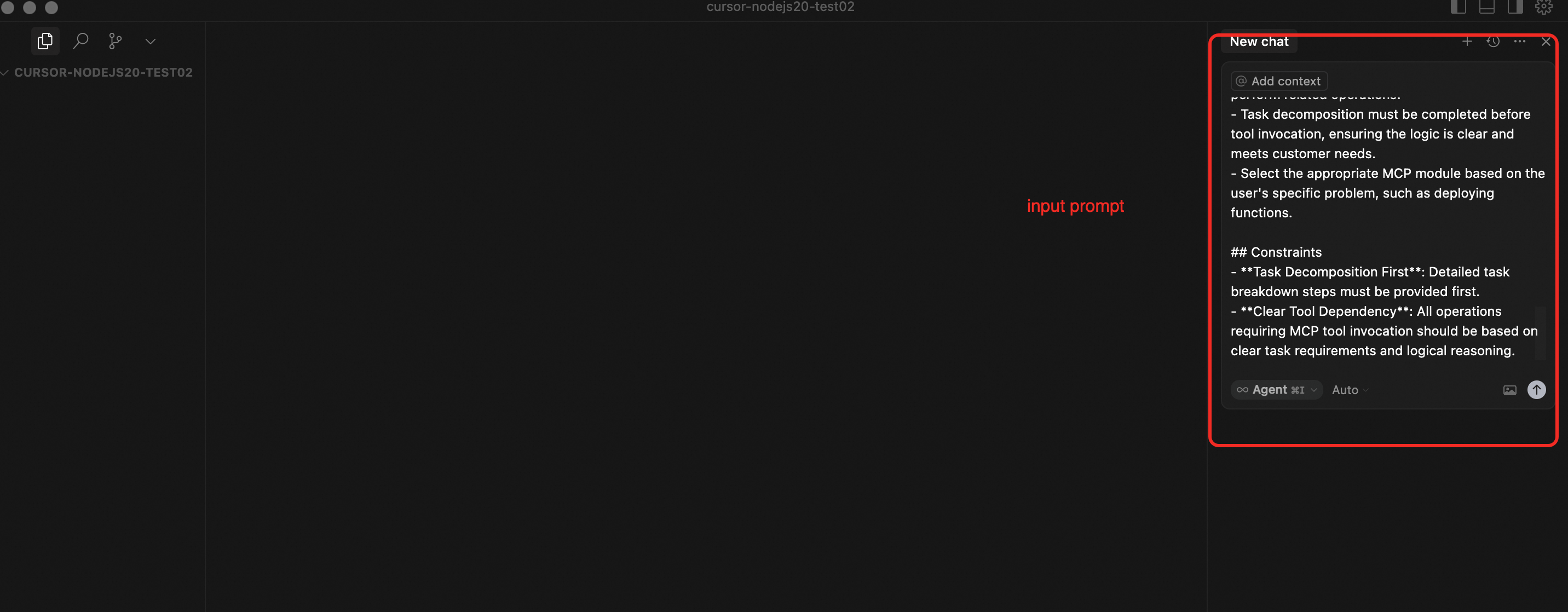
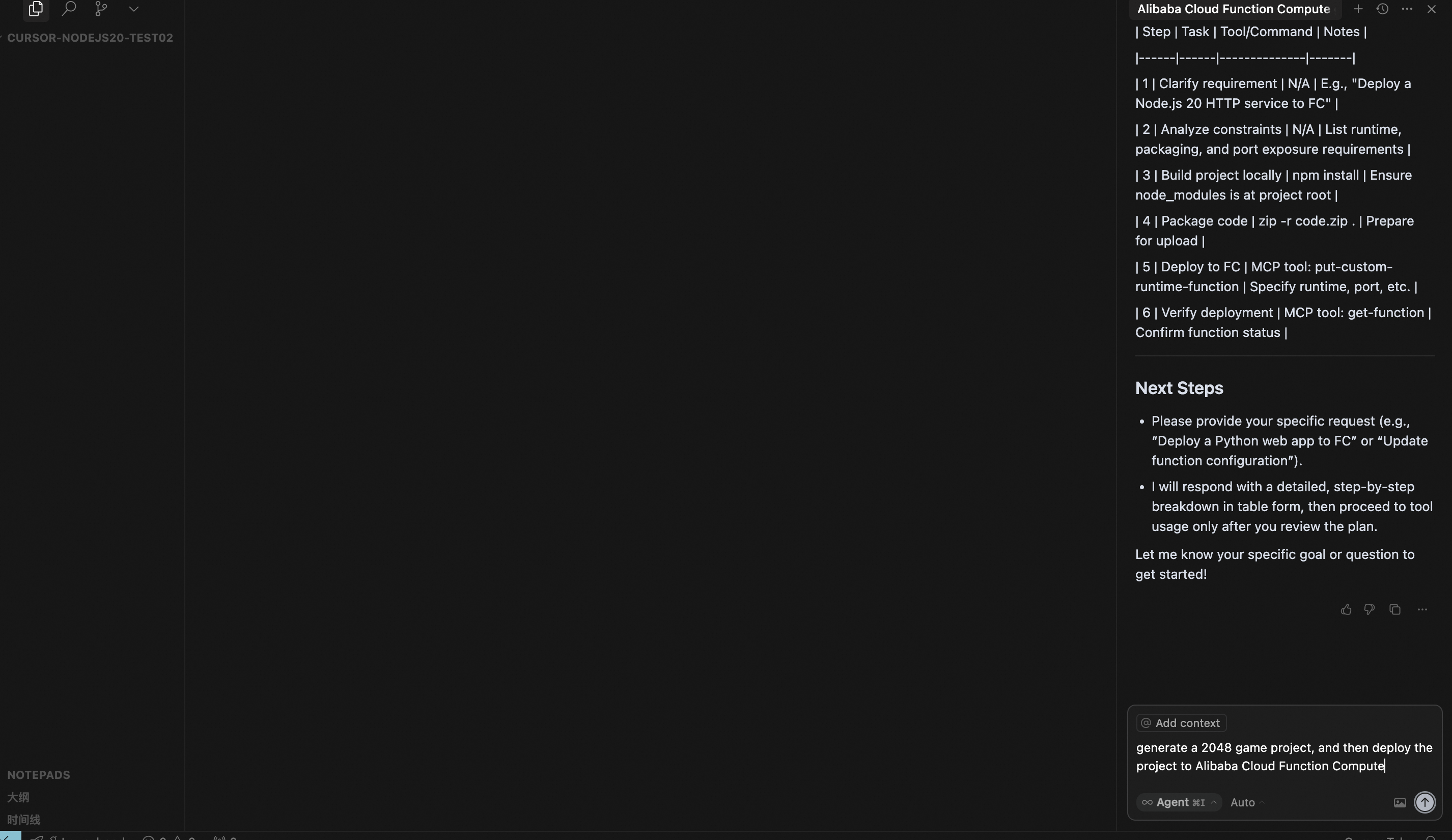
Create a new empty project and open it in Cursor. Chat with Cursor in agent mode. Input the
Promptsbelow to guide the conversation.

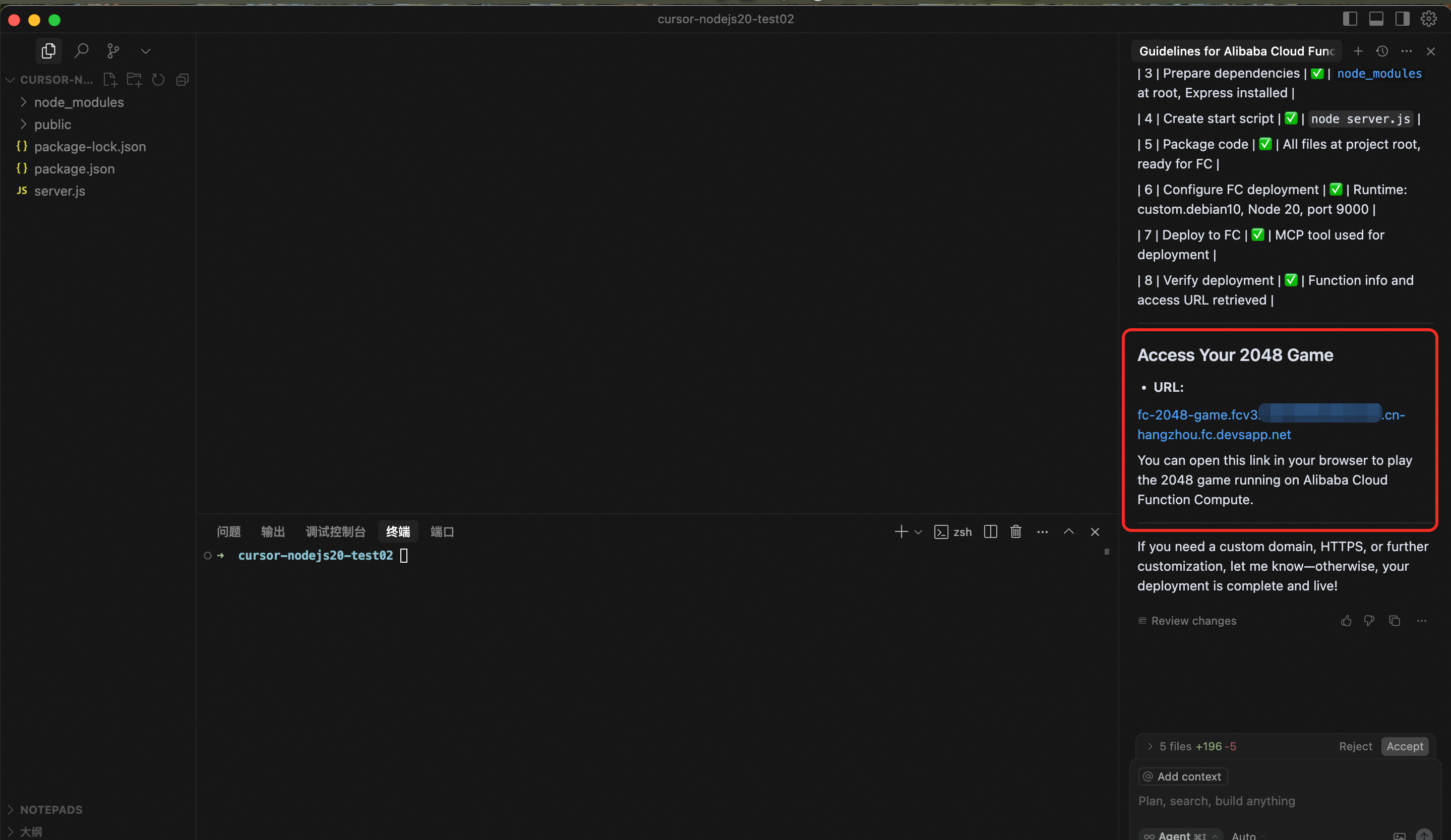
Ask the Cursor agent to generate a 2048 game project, then ask the agent to deploy it to Alibaba Cloud Function Compute.

Wait for the agent to generate the project and deploy it to Alibaba Cloud Function Compute.

Using Cline
Edit the Cline configuration file (doc), and add the following configuration:
"alibabacloud-fc-mcp-server": {
"command": "npx",
"args": ["-y", "alibabacloud-fc-mcp-server"],
"env": {
"ALIBABA_CLOUD_ACCESS_KEY_ID": "${your-access-key-id}",
"ALIBABA_CLOUD_ACCESS_KEY_SECRET": "${your-access-key-secret}"
}
}Method 2: Start from source code [Recommended for MCP Server developers]
First, clone the project and build it:
git clone https://github.com/alibaba/alibabacloud-fc-mcp-server.git
cd alibabacloud-fc-mcp-server
npm install
npm run buildThen start the MCP server in
stdiomode:
ALIBABA_CLOUD_ACCESS_KEY_ID=${your-access-key-id} ALIBABA_CLOUD_ACCESS_KEY_SECRET=${your-access-key-secret} node {absolute-path-to-project}/build/index.jsFinally, configure the MCP server in Cursor or Cline as in Method 1.
Components
Tools
put-custom-runtime-function: Package a project that meets Alibaba Cloud custom runtime requirements, create a function, and deploy the code to that function. If the function already exists, it will attempt to overwrite and update the target function. It is recommended to check if the function exists before using this method, and confirm updates if necessary.update-custom-runtime-function: Update a custom runtime function. Only the provided parameters will be updated; others remain unchanged.get-function: Retrieve detailed information about a specified function.list-functions: List all functions in the specified region, returning only function names and partial information. For full details, useget-function.delete-function: Delete a specified function.get-custom-domain-config: Query the custom domain route configuration.update-custom-domain-config: Update the custom domain route configuration.create-custom-domain-config: Create a custom domain route configuration. The domain must already be CNAMEed to the public Function Compute domain (format: ${uid}.${regionId}.fc.aliyuncs.com, e.g. 14**49.cn-hangzhou.fc.aliyuncs.com), otherwise it will fail to create.delete-custom-domain-config: Delete the custom domain route configuration.get-custom-runtime-prompt: Get the custom runtime prompt. Will be moved to Prompts in the future.
Prompts
# Role
You are a professional Alibaba Cloud Function Compute (FC) Copilot, focused on providing customers with advice on building and deploying code to Function Compute.
## Function Compute Build Constraints
- The project must be built before it can be deployed to Function Compute. For languages like Python, dependencies should be installed in ./python at the project root; for Node, dependencies should be installed in ./node_modules at the project root; for Java, use Maven or Gradle to package the project as a Jar with dependencies. This ensures runtime dependencies can be found.
- The project build must meet the Function Compute runtime constraints.
- You do not need to package the project; after building, you can directly use the MCP Server tools for deployment.
## Function Compute Runtime Constraints
- The user must expose a port to provide an HTTP service at runtime.
- The runtime environment is debian10, with Python 3.10, Node 20, and OpenJDK JRE 21 pre-installed.
- Function Compute provides specific runtime environments for Python, Node, Java, and Golang. Python 3.10 is installed at /opt/python3.10, and /opt/python3.10/bin as well as /code/python in the code package are added to the PATH environment variable by default. Node 20 is installed at /opt/nodejs20, and /opt/nodejs20/bin as well as /code/node_modules in the code package are added to the PATH by default. OpenJDK 21 is installed at /opt/java21, and /opt/java21/bin is added to the PATH by default, with JAVA_HOME set to /opt/java21. If you modify the PATH, you should include the above contents. Golang does not require a runtime environment.
## Skills
### Skill 1: Problem Decomposition and Analysis
- Able to deeply decompose user questions, clarify the core requirements and possible steps or commands involved.
- Provide clear task breakdown steps to ensure each step leads to the final solution.
- Organize answers in tabular form whenever possible.
### Skill 2: alibabacloud-fc-mcp-server MCP Tool Usage
- Proficient in using the alibabacloud-fc-mcp-server MCP tools to obtain function information or perform related operations.
- Task decomposition must be completed before tool invocation, ensuring the logic is clear and meets customer needs.
- Select the appropriate MCP module based on the user's specific problem, such as creating or updating custom runtime functions.
## Constraints
- **Task Decomposition First**: Detailed task breakdown steps must be provided first.
- **Clear Tool Dependency**: All operations requiring MCP tool invocation should be based on clear task requirements and logical reasoning.
- **Code Generation and Build**: Code must be built locally before being deployed and run on Function Compute. Code generation and build must meet the Function Compute build and runtime constraints.MCP MarketPlace Integration
This project is integrated into Alibaba Cloud MCP MarketPlace. You can access it via the following link:
License
This project is licensed under the MIT License. See the LICENSE file for details.
本项目基于 MIT License 开源。详情参见 LICENSE 文件。
Available Tools
12 toolscreate-custom-domain-configB
创建函数计算的域名路由配置,域名必须已经CNAME到函数计算的公网域名(格式为${uid}.${regionId}.fc.aliyuncs.com,例如14**49.cn-hangzhou.fc.aliyuncs.com)上,否则会创建失败。
| Name | Required | Description | Default |
|---|---|---|---|
| region | No | 部署的区域,当前可选的区域是cn-hangzhou, cn-shanghai, cn-beijing, cn-shenzhen, cn-hongkong, ap-southeast-1, ap-southeast-2, ap-southeast-3, ap-southeast-5, ap-northeast-1, eu-central-1, eu-west-1, us-west-1, us-east-1, ap-south-1, me-east-1, cn-chengdu, cn-wulanchabu, cn-guangzhou,默认是cn-hangzhou | cn-hangzhou |
| createCustomDomainConfig | Yes |
TDQS
Does the description disclose side effects, auth requirements, rate limits, or destructive behavior?
With no annotations provided, the description carries the full burden of behavioral disclosure. It mentions the CNAME prerequisite and failure condition, which is useful. However, it doesn't describe what happens on success (e.g., what gets created, response format), whether this is idempotent, what permissions are required, rate limits, or other operational characteristics. For a creation tool with complex nested parameters, this leaves significant behavioral gaps.
Agents need to know what a tool does to the world before calling it. Descriptions should go beyond structured annotations to explain consequences.
Is the description appropriately sized, front-loaded, and free of redundancy?
The description is concise - just two sentences in Chinese. The first sentence states the purpose, and the second provides the critical prerequisite. There's no wasted text or redundancy. However, given the tool's complexity, this brevity comes at the cost of completeness.
Shorter descriptions cost fewer tokens and are easier for agents to parse. Every sentence should earn its place.
Given the tool's complexity, does the description cover enough for an agent to succeed on first attempt?
Given the tool's complexity (creation operation with 2 parameters, complex nested objects, no annotations, no output schema), the description is inadequate. It covers the basic purpose and one prerequisite but misses: parameter explanations, success behavior, error conditions beyond the CNAME check, relationship to sibling tools, and what the created configuration enables. For a tool that creates domain routing configurations with multiple sub-configurations, this leaves too much unexplained.
Complex tools with many parameters or behaviors need more documentation. Simple tools need less. This dimension scales expectations accordingly.
Does the description clarify parameter syntax, constraints, interactions, or defaults beyond what the schema provides?
Schema description coverage is 50%, so the description needs to compensate but doesn't. It mentions nothing about the parameters themselves - not even the existence of 'region' or 'createCustomDomainConfig' object. The description focuses only on a prerequisite (CNAME configuration) rather than explaining what parameters mean or how they interact. With 2 parameters and complex nested objects, this leaves significant gaps in understanding parameter purpose and usage.
Input schemas describe structure but not intent. Descriptions should explain non-obvious parameter relationships and valid value ranges.
Does the description clearly state what the tool does and how it differs from similar tools?
The description clearly states the tool's purpose: '创建函数计算的域名路由配置' (create domain routing configuration for function compute). It specifies the verb ('创建' - create) and resource ('域名路由配置' - domain routing configuration), making the intent unambiguous. However, it doesn't explicitly differentiate from sibling tools like 'update-custom-domain-config' or 'get-custom-domain-config'.
Agents choose between tools based on descriptions. A clear purpose with a specific verb and resource helps agents select the right tool.
Does the description explain when to use this tool, when not to, or what alternatives exist?
The description provides some usage context by stating a prerequisite: '域名必须已经CNAME到函数计算的公网域名...否则会创建失败' (the domain must already be CNAME'd to the function compute public domain, otherwise creation will fail). This is helpful guidance about when the tool will work. However, it doesn't specify when to use this tool versus alternatives like 'update-custom-domain-config' or provide explicit exclusions.
Agents often have multiple tools that could apply. Explicit usage guidance like "use X instead of Y when Z" prevents misuse.
delete-custom-domain-configA
删除函数计算的域名路由配置,CNAME记录不会被删除,需要手动删除CNAME记录
| Name | Required | Description | Default |
|---|---|---|---|
| region | No | 部署的区域,当前可选的区域是cn-hangzhou, cn-shanghai, cn-beijing, cn-shenzhen, cn-hongkong, ap-southeast-1, ap-southeast-2, ap-southeast-3, ap-southeast-5, ap-northeast-1, eu-central-1, eu-west-1, us-west-1, us-east-1, ap-south-1, me-east-1, cn-chengdu, cn-wulanchabu, cn-guangzhou,默认是cn-hangzhou | cn-hangzhou |
| domain | Yes | 域名,例如example.com,域名不能带有'https://'或'http://'等协议内容 |
TDQS
Does the description disclose side effects, auth requirements, rate limits, or destructive behavior?
With no annotations provided, the description carries the full burden. It discloses that the tool deletes domain routing configurations and that CNAME records are not deleted automatically (requiring manual deletion), which adds important behavioral context beyond the basic delete operation. However, it does not mention potential side effects, permissions needed, or error conditions.
Agents need to know what a tool does to the world before calling it. Descriptions should go beyond structured annotations to explain consequences.
Is the description appropriately sized, front-loaded, and free of redundancy?
The description is a single, efficient sentence that directly states the tool's action and a key behavioral note about CNAME records. It is front-loaded with the main purpose and avoids unnecessary words, making it highly concise and well-structured.
Shorter descriptions cost fewer tokens and are easier for agents to parse. Every sentence should earn its place.
Given the tool's complexity, does the description cover enough for an agent to succeed on first attempt?
For a deletion tool with no annotations and no output schema, the description is adequate but has gaps. It covers the main action and a critical side effect (CNAME records not deleted), but lacks details on prerequisites, error handling, or what happens after deletion. Given the complexity and lack of structured data, it could be more complete.
Complex tools with many parameters or behaviors need more documentation. Simple tools need less. This dimension scales expectations accordingly.
Does the description clarify parameter syntax, constraints, interactions, or defaults beyond what the schema provides?
Schema description coverage is 100%, so the schema already documents both parameters ('region' and 'domain') thoroughly. The description does not add any parameter-specific information beyond what the schema provides, such as examples or constraints not in the schema. Baseline 3 is appropriate when schema does the heavy lifting.
Input schemas describe structure but not intent. Descriptions should explain non-obvious parameter relationships and valid value ranges.
Does the description clearly state what the tool does and how it differs from similar tools?
The description clearly states the specific action ('删除' meaning delete) and resource ('函数计算的域名路由配置' meaning function compute domain routing configuration). It distinguishes from siblings by focusing on domain configuration deletion rather than function deletion or other operations, making the purpose unambiguous.
Agents choose between tools based on descriptions. A clear purpose with a specific verb and resource helps agents select the right tool.
Does the description explain when to use this tool, when not to, or what alternatives exist?
The description implies usage for deleting domain routing configurations in function compute, but does not explicitly state when to use this tool versus alternatives like 'update-custom-domain-config' or 'delete-function'. It mentions that CNAME records are not deleted automatically, which provides some context but not explicit guidance on tool selection.
Agents often have multiple tools that could apply. Explicit usage guidance like "use X instead of Y when Z" prevents misuse.
delete-functionC
删除函数计算的函数
| Name | Required | Description | Default |
|---|---|---|---|
| functionName | Yes | 函数名称,函数名称在每个region必须是唯一的。 | |
| region | No | 部署的区域,当前可选的区域是cn-hangzhou, cn-shanghai, cn-beijing, cn-shenzhen, cn-hongkong, ap-southeast-1, ap-southeast-2, ap-southeast-3, ap-southeast-5, ap-northeast-1, eu-central-1, eu-west-1, us-west-1, us-east-1, ap-south-1, me-east-1, cn-chengdu, cn-wulanchabu, cn-guangzhou,默认是cn-hangzhou | cn-hangzhou |
TDQS
Does the description disclose side effects, auth requirements, rate limits, or destructive behavior?
No annotations are provided, so the description carries full burden. It states the destructive action ('delete') but lacks critical behavioral details: whether deletion is permanent, if it requires specific permissions, what happens to associated resources (e.g., versions, triggers), error conditions, or response format. For a destructive tool with zero annotation coverage, this is a significant gap.
Agents need to know what a tool does to the world before calling it. Descriptions should go beyond structured annotations to explain consequences.
Is the description appropriately sized, front-loaded, and free of redundancy?
The description is a single, efficient sentence in Chinese with zero waste. It's front-loaded with the core action and resource, making it immediately understandable. No extraneous information or redundancy.
Shorter descriptions cost fewer tokens and are easier for agents to parse. Every sentence should earn its place.
Given the tool's complexity, does the description cover enough for an agent to succeed on first attempt?
For a destructive tool with no annotations and no output schema, the description is incomplete. It lacks behavioral context (permanence, side effects), usage guidelines, and output expectations. Given the complexity of deletion operations and the absence of structured safety hints, the description should provide more guidance to ensure safe and correct use.
Complex tools with many parameters or behaviors need more documentation. Simple tools need less. This dimension scales expectations accordingly.
Does the description clarify parameter syntax, constraints, interactions, or defaults beyond what the schema provides?
Schema description coverage is 100%, with both parameters ('functionName', 'region') well-documented in the schema. The description adds no parameter semantics beyond what's in the schema (e.g., doesn't explain relationships between parameters or usage nuances). Baseline 3 is appropriate when the schema does the heavy lifting.
Input schemas describe structure but not intent. Descriptions should explain non-obvious parameter relationships and valid value ranges.
Does the description clearly state what the tool does and how it differs from similar tools?
The description '删除函数计算的函数' (delete function compute function) clearly states the action (delete) and target resource (function compute function). It's specific about what gets deleted, though it doesn't explicitly distinguish from sibling tools like 'delete-function-version' or 'delete-custom-domain-config' beyond the resource type.
Agents choose between tools based on descriptions. A clear purpose with a specific verb and resource helps agents select the right tool.
Does the description explain when to use this tool, when not to, or what alternatives exist?
The description provides no guidance on when to use this tool versus alternatives. It doesn't mention prerequisites (e.g., function must exist), when not to use it (e.g., if versions exist), or refer to related tools like 'delete-function-version' or 'list-functions' for verification. The agent must infer usage from the name alone.
Agents often have multiple tools that could apply. Explicit usage guidance like "use X instead of Y when Z" prevents misuse.
delete-function-versionC
删除函数计算的函数版本
| Name | Required | Description | Default |
|---|---|---|---|
| functionName | Yes | 函数名称,函数名称在每个region必须是唯一的。 | |
| region | No | 部署的区域,当前可选的区域是cn-hangzhou, cn-shanghai, cn-beijing, cn-shenzhen, cn-hongkong, ap-southeast-1, ap-southeast-2, ap-southeast-3, ap-southeast-5, ap-northeast-1, eu-central-1, eu-west-1, us-west-1, us-east-1, ap-south-1, me-east-1, cn-chengdu, cn-wulanchabu, cn-guangzhou,默认是cn-hangzhou | cn-hangzhou |
| versionId | Yes | 函数版本ID |
TDQS
Does the description disclose side effects, auth requirements, rate limits, or destructive behavior?
No annotations are provided, so the description carries full burden. It states the action is 'delete' which implies a destructive mutation, but doesn't disclose critical behavioral traits: whether deletion is permanent/reversible, if it affects associated resources (e.g., aliases, triggers), required permissions, or error conditions (e.g., cannot delete active versions).
Agents need to know what a tool does to the world before calling it. Descriptions should go beyond structured annotations to explain consequences.
Is the description appropriately sized, front-loaded, and free of redundancy?
The description is a single, efficient sentence with zero waste. It's front-loaded with the core action and resource, making it immediately understandable without unnecessary elaboration.
Shorter descriptions cost fewer tokens and are easier for agents to parse. Every sentence should earn its place.
Given the tool's complexity, does the description cover enough for an agent to succeed on first attempt?
For a destructive mutation tool with no annotations and no output schema, the description is incomplete. It lacks critical context: behavioral implications (permanence, side effects), prerequisites, error handling, and what happens post-deletion (e.g., confirmation, returned data). The high schema coverage doesn't compensate for these gaps in operational guidance.
Complex tools with many parameters or behaviors need more documentation. Simple tools need less. This dimension scales expectations accordingly.
Does the description clarify parameter syntax, constraints, interactions, or defaults beyond what the schema provides?
Schema description coverage is 100%, with each parameter well-documented in the schema (functionName uniqueness, region enum with default, versionId). The description adds no additional parameter semantics beyond what's already in the schema, so baseline 3 is appropriate.
Input schemas describe structure but not intent. Descriptions should explain non-obvious parameter relationships and valid value ranges.
Does the description clearly state what the tool does and how it differs from similar tools?
The description '删除函数计算的函数版本' clearly states the action (delete) and resource (function version in function computing). It's specific about what gets deleted, though it doesn't explicitly differentiate from sibling tools like 'delete-function' which deletes the entire function rather than a specific version.
Agents choose between tools based on descriptions. A clear purpose with a specific verb and resource helps agents select the right tool.
Does the description explain when to use this tool, when not to, or what alternatives exist?
No guidance is provided on when to use this tool versus alternatives. The description doesn't mention prerequisites (e.g., whether the function version must be inactive), nor does it reference sibling tools like 'delete-function' (for entire functions) or 'list-function-versions' (to see available versions).
Agents often have multiple tools that could apply. Explicit usage guidance like "use X instead of Y when Z" prevents misuse.
get-custom-domain-configC
查询函数计算的域名路由配置
| Name | Required | Description | Default |
|---|---|---|---|
| region | No | 部署的区域,当前可选的区域是cn-hangzhou, cn-shanghai, cn-beijing, cn-shenzhen, cn-hongkong, ap-southeast-1, ap-southeast-2, ap-southeast-3, ap-southeast-5, ap-northeast-1, eu-central-1, eu-west-1, us-west-1, us-east-1, ap-south-1, me-east-1, cn-chengdu, cn-wulanchabu, cn-guangzhou,默认是cn-hangzhou | cn-hangzhou |
| domain | Yes | 域名,例如example.com,域名不能带有'https://'或'http://'等协议内容 |
TDQS
Does the description disclose side effects, auth requirements, rate limits, or destructive behavior?
No annotations are provided, so the description carries the full burden of behavioral disclosure. It states '查询' (query), implying a read-only operation, but doesn't clarify if this requires authentication, what happens on errors, or the format of returned data. For a tool with no annotation coverage, this leaves significant gaps in understanding its behavior and constraints.
Agents need to know what a tool does to the world before calling it. Descriptions should go beyond structured annotations to explain consequences.
Is the description appropriately sized, front-loaded, and free of redundancy?
The description is a single, efficient sentence in Chinese that directly states the tool's purpose without unnecessary words. It's front-loaded with the core action and resource, making it easy to parse. There's no wasted verbiage, and it fits well within a concise format.
Shorter descriptions cost fewer tokens and are easier for agents to parse. Every sentence should earn its place.
Given the tool's complexity, does the description cover enough for an agent to succeed on first attempt?
Given the complexity of a domain configuration query tool with no annotations and no output schema, the description is insufficient. It doesn't explain what the query returns (e.g., routing rules, status), potential errors, or how it interacts with sibling tools. For a tool that likely returns structured data, more context is needed to guide effective use.
Complex tools with many parameters or behaviors need more documentation. Simple tools need less. This dimension scales expectations accordingly.
Does the description clarify parameter syntax, constraints, interactions, or defaults beyond what the schema provides?
Schema description coverage is 100%, with both parameters ('region' and 'domain') well-documented in the schema, including enum values and format rules. The description adds no additional meaning beyond what the schema provides, such as explaining the relationship between parameters. With high schema coverage, the baseline score of 3 is appropriate as the schema handles parameter semantics adequately.
Input schemas describe structure but not intent. Descriptions should explain non-obvious parameter relationships and valid value ranges.
Does the description clearly state what the tool does and how it differs from similar tools?
The description '查询函数计算的域名路由配置' (Query function computing domain routing configuration) states the action (query) and resource (domain routing configuration for function computing), which provides a basic purpose. However, it doesn't distinguish this read operation from its siblings like 'get-function' or 'list-functions', nor does it specify what exactly is being queried (e.g., all configurations vs. a specific one). It's clear but vague on scope.
Agents choose between tools based on descriptions. A clear purpose with a specific verb and resource helps agents select the right tool.
Does the description explain when to use this tool, when not to, or what alternatives exist?
The description provides no guidance on when to use this tool versus alternatives. It doesn't mention sibling tools like 'create-custom-domain-config' or 'update-custom-domain-config', nor does it specify prerequisites (e.g., needing an existing domain). Without any context on usage scenarios or exclusions, the agent lacks direction.
Agents often have multiple tools that could apply. Explicit usage guidance like "use X instead of Y when Z" prevents misuse.
get-functionB
获取创建的函数计算的函数信息
| Name | Required | Description | Default |
|---|---|---|---|
| functionName | Yes | 函数名称,函数名称在每个region必须是唯一的。 | |
| region | No | 部署的区域,当前可选的区域是cn-hangzhou, cn-shanghai, cn-beijing, cn-shenzhen, cn-hongkong, ap-southeast-1, ap-southeast-2, ap-southeast-3, ap-southeast-5, ap-northeast-1, eu-central-1, eu-west-1, us-west-1, us-east-1, ap-south-1, me-east-1, cn-chengdu, cn-wulanchabu, cn-guangzhou,默认是cn-hangzhou | cn-hangzhou |
TDQS
Does the description disclose side effects, auth requirements, rate limits, or destructive behavior?
No annotations are provided, so the description carries the full burden of behavioral disclosure. It states it retrieves information, implying a read-only operation, but doesn't specify whether it requires authentication, rate limits, error conditions, or what information is returned. For a tool with zero annotation coverage, this is a significant gap in transparency.
Agents need to know what a tool does to the world before calling it. Descriptions should go beyond structured annotations to explain consequences.
Is the description appropriately sized, front-loaded, and free of redundancy?
The description is a single, efficient sentence in Chinese that directly states the tool's purpose without unnecessary words. It's appropriately sized and front-loaded, with zero waste, making it easy for an AI agent to parse quickly.
Shorter descriptions cost fewer tokens and are easier for agents to parse. Every sentence should earn its place.
Given the tool's complexity, does the description cover enough for an agent to succeed on first attempt?
Given the tool's complexity (a read operation with 2 parameters), 100% schema coverage, and no output schema, the description is minimally adequate. It states what the tool does but lacks details on behavioral aspects (e.g., authentication, error handling) and doesn't guide usage relative to siblings. Without annotations or output schema, more context would be helpful for completeness.
Complex tools with many parameters or behaviors need more documentation. Simple tools need less. This dimension scales expectations accordingly.
Does the description clarify parameter syntax, constraints, interactions, or defaults beyond what the schema provides?
Schema description coverage is 100%, with both parameters ('functionName' and 'region') well-documented in the schema. The description doesn't add any meaning beyond what the schema provides (e.g., it doesn't explain parameter interactions or usage nuances). Baseline 3 is appropriate when the schema does the heavy lifting.
Input schemas describe structure but not intent. Descriptions should explain non-obvious parameter relationships and valid value ranges.
Does the description clearly state what the tool does and how it differs from similar tools?
The description '获取创建的函数计算的函数信息' clearly states the purpose: retrieving information about a created function in function computing. It specifies the verb '获取' (get/retrieve) and the resource '函数计算的函数信息' (function computing function information). However, it doesn't explicitly differentiate from sibling tools like 'list-functions' or 'get-custom-domain-config', which would require a 5.
Agents choose between tools based on descriptions. A clear purpose with a specific verb and resource helps agents select the right tool.
Does the description explain when to use this tool, when not to, or what alternatives exist?
The description provides no guidance on when to use this tool versus alternatives. It doesn't mention siblings like 'list-functions' (for listing multiple functions) or 'get-custom-domain-config' (for different resource types), nor does it specify prerequisites such as needing an existing function. Usage is implied by the action but not explicitly defined.
Agents often have multiple tools that could apply. Explicit usage guidance like "use X instead of Y when Z" prevents misuse.
list-functionsA
获取函数计算的函数列表,只返回函数名称与部分函数信息,不返回所有函数信息。如果需要获取所有函数信息,请使用get-function工具
| Name | Required | Description | Default |
|---|---|---|---|
| region | No | 部署的区域,当前可选的区域是cn-hangzhou, cn-shanghai, cn-beijing, cn-shenzhen, cn-hongkong, ap-southeast-1, ap-southeast-2, ap-southeast-3, ap-southeast-5, ap-northeast-1, eu-central-1, eu-west-1, us-west-1, us-east-1, ap-south-1, me-east-1, cn-chengdu, cn-wulanchabu, cn-guangzhou,默认是cn-hangzhou | cn-hangzhou |
| prefix | No | 函数名称前缀,用于过滤函数列表 | |
| nextToken | No | 函数列表的下一页token,用于分页查询函数列表。第一页不需要提供 | |
| limit | No | 函数列表的返回数量上限,默认50,最大100 | |
| tags | No | 函数标签,用于过滤函数列表,只返回包含所有标签的函数 | |
| runtime | No | 函数运行时,用于过滤函数列表,只返回指定运行时的函数 |
TDQS
Does the description disclose side effects, auth requirements, rate limits, or destructive behavior?
With no annotations provided, the description carries full burden. It describes the limited return scope ('只返回函数名称与部分函数信息' - returns only names and partial info) which is valuable behavioral context. However, it doesn't mention pagination behavior (implied by nextToken parameter), rate limits, authentication requirements, or error conditions.
Agents need to know what a tool does to the world before calling it. Descriptions should go beyond structured annotations to explain consequences.
Is the description appropriately sized, front-loaded, and free of redundancy?
The description is perfectly concise with two sentences that each earn their place. The first sentence states the purpose and scope, the second provides clear usage guidance. No wasted words or redundant information.
Shorter descriptions cost fewer tokens and are easier for agents to parse. Every sentence should earn its place.
Given the tool's complexity, does the description cover enough for an agent to succeed on first attempt?
For a list operation with no annotations and no output schema, the description provides good context about what information is returned and when to use it versus alternatives. However, it doesn't describe the output format or structure, which would be helpful given the absence of an output schema. The parameter documentation is complete in the schema.
Complex tools with many parameters or behaviors need more documentation. Simple tools need less. This dimension scales expectations accordingly.
Does the description clarify parameter syntax, constraints, interactions, or defaults beyond what the schema provides?
Schema description coverage is 100%, so the schema already fully documents all 6 parameters. The description doesn't add any parameter-specific information beyond what's in the schema. The baseline score of 3 is appropriate when the schema does all the parameter documentation work.
Input schemas describe structure but not intent. Descriptions should explain non-obvious parameter relationships and valid value ranges.
Does the description clearly state what the tool does and how it differs from similar tools?
The description clearly states the action ('获取函数计算的函数列表' - get function list), resource ('函数计算' - function compute), and scope ('只返回函数名称与部分函数信息' - returns only function names and partial information). It distinguishes from sibling 'get-function' by specifying this tool returns limited information while get-function returns all information.
Agents choose between tools based on descriptions. A clear purpose with a specific verb and resource helps agents select the right tool.
Does the description explain when to use this tool, when not to, or what alternatives exist?
The description explicitly provides when to use this tool ('获取函数计算的函数列表' - for listing functions) and when to use an alternative ('如果需要获取所有函数信息,请使用get-function工具' - use get-function for complete function information). This gives clear guidance on tool selection.
Agents often have multiple tools that could apply. Explicit usage guidance like "use X instead of Y when Z" prevents misuse.
list-function-versionsC
获取函数计算的函数版本列表
| Name | Required | Description | Default |
|---|---|---|---|
| functionName | Yes | 函数名称,函数名称在每个region必须是唯一的。 | |
| region | No | 部署的区域,当前可选的区域是cn-hangzhou, cn-shanghai, cn-beijing, cn-shenzhen, cn-hongkong, ap-southeast-1, ap-southeast-2, ap-southeast-3, ap-southeast-5, ap-northeast-1, eu-central-1, eu-west-1, us-west-1, us-east-1, ap-south-1, me-east-1, cn-chengdu, cn-wulanchabu, cn-guangzhou,默认是cn-hangzhou | cn-hangzhou |
| nextToken | No | 函数版本列表的下一页token,用于分页查询函数版本列表。第一页不需要提供 | |
| direction | No | 函数版本列表的排序方向,BACKWARD表示按版本号降序,FORWARD表示按版本号升序 | BACKWARD |
| limit | No | 函数版本列表的返回数量上限,默认50,最大100 |
TDQS
Does the description disclose side effects, auth requirements, rate limits, or destructive behavior?
With no annotations provided, the description carries the full burden of behavioral disclosure but provides minimal information. It states it retrieves a list but doesn't describe pagination behavior (implied by 'nextToken' parameter but not explained), rate limits, authentication requirements, error conditions, or what the output looks like. For a list operation with 5 parameters and no annotations, this leaves significant behavioral gaps.
Agents need to know what a tool does to the world before calling it. Descriptions should go beyond structured annotations to explain consequences.
Is the description appropriately sized, front-loaded, and free of redundancy?
The description is a single, efficient Chinese sentence that states exactly what the tool does without any unnecessary words. It's front-loaded with the core purpose and wastes no space on redundant information. This is an excellent example of conciseness.
Shorter descriptions cost fewer tokens and are easier for agents to parse. Every sentence should earn its place.
Given the tool's complexity, does the description cover enough for an agent to succeed on first attempt?
For a tool with 5 parameters, no annotations, and no output schema, the description is insufficiently complete. It doesn't explain the relationship between parameters, pagination behavior, typical response structure, or error handling. While the schema documents parameters well, the description fails to provide the contextual understanding needed for effective tool use, especially given the absence of annotations and output schema.
Complex tools with many parameters or behaviors need more documentation. Simple tools need less. This dimension scales expectations accordingly.
Does the description clarify parameter syntax, constraints, interactions, or defaults beyond what the schema provides?
The schema description coverage is 100%, with all parameters well-documented in the schema itself. The description adds no additional parameter information beyond what's already in the schema descriptions. According to the rules, when schema coverage is high (>80%), the baseline is 3 even with no param info in the description, which applies here.
Input schemas describe structure but not intent. Descriptions should explain non-obvious parameter relationships and valid value ranges.
Does the description clearly state what the tool does and how it differs from similar tools?
The description '获取函数计算的函数版本列表' clearly states the action ('获取' - get/retrieve) and resource ('函数版本列表' - function version list), making the purpose immediately understandable. It doesn't explicitly differentiate from sibling tools like 'list-functions' or 'get-function', but the focus on versions is clear. This is specific enough to understand what the tool does without being tautological.
Agents choose between tools based on descriptions. A clear purpose with a specific verb and resource helps agents select the right tool.
Does the description explain when to use this tool, when not to, or what alternatives exist?
The description provides no guidance on when to use this tool versus alternatives. There's no mention of when to use 'list-function-versions' versus 'list-functions' or 'get-function', nor any context about prerequisites or typical use cases. The agent must infer usage from the tool name and parameters alone.
Agents often have multiple tools that could apply. Explicit usage guidance like "use X instead of Y when Z" prevents misuse.
publish-function-versionC
将函数的最新代码发布为新版本
| Name | Required | Description | Default |
|---|---|---|---|
| functionName | Yes | 函数名称,函数名称在每个region必须是唯一的。 | |
| region | No | 部署的区域,当前可选的区域是cn-hangzhou, cn-shanghai, cn-beijing, cn-shenzhen, cn-hongkong, ap-southeast-1, ap-southeast-2, ap-southeast-3, ap-southeast-5, ap-northeast-1, eu-central-1, eu-west-1, us-west-1, us-east-1, ap-south-1, me-east-1, cn-chengdu, cn-wulanchabu, cn-guangzhou,默认是cn-hangzhou | cn-hangzhou |
| description | Yes | 函数版本的描述,可以描述一下发布的函数版本的功能。 |
TDQS
Does the description disclose side effects, auth requirements, rate limits, or destructive behavior?
With no annotations provided, the description carries the full burden of behavioral disclosure. It states the tool publishes a new version but doesn't explain what 'publish' entails (e.g., whether it deploys to production, requires specific permissions, affects existing versions, or has rate limits). This is a significant gap for a mutation tool with zero annotation coverage.
Agents need to know what a tool does to the world before calling it. Descriptions should go beyond structured annotations to explain consequences.
Is the description appropriately sized, front-loaded, and free of redundancy?
The description is a single, efficient sentence in Chinese that directly states the tool's purpose without unnecessary words. It's appropriately sized and front-loaded, with every part contributing to clarity.
Shorter descriptions cost fewer tokens and are easier for agents to parse. Every sentence should earn its place.
Given the tool's complexity, does the description cover enough for an agent to succeed on first attempt?
For a mutation tool with no annotations and no output schema, the description is incomplete. It lacks behavioral details (e.g., what 'publish' means operationally, error conditions, or response format) and usage context, leaving significant gaps for an AI agent to understand how to invoke it correctly.
Complex tools with many parameters or behaviors need more documentation. Simple tools need less. This dimension scales expectations accordingly.
Does the description clarify parameter syntax, constraints, interactions, or defaults beyond what the schema provides?
Schema description coverage is 100%, so the schema already documents all three parameters thoroughly. The description doesn't add any meaning beyond what the schema provides about 'functionName', 'region', or 'description'. Baseline 3 is appropriate when the schema does the heavy lifting.
Input schemas describe structure but not intent. Descriptions should explain non-obvious parameter relationships and valid value ranges.
Does the description clearly state what the tool does and how it differs from similar tools?
The description clearly states the action ('发布' meaning 'publish') and resource ('函数的最新代码' meaning 'function's latest code') to create a new version. It's specific about what the tool does but doesn't differentiate from siblings like 'update-custom-runtime-function' or 'put-custom-runtime-function' which might have overlapping purposes.
Agents choose between tools based on descriptions. A clear purpose with a specific verb and resource helps agents select the right tool.
Does the description explain when to use this tool, when not to, or what alternatives exist?
The description provides no guidance on when to use this tool versus alternatives. It doesn't mention prerequisites (e.g., existing function code), exclusions, or comparisons to sibling tools like 'update-custom-runtime-function' or 'delete-function-version' that might be relevant in a versioning workflow.
Agents often have multiple tools that could apply. Explicit usage guidance like "use X instead of Y when Z" prevents misuse.
put-custom-runtime-functionB
将构建完成的匹配阿里云自定义运行时的工程,部署到函数计算。代码工程不需要手动打包,会自动处理。如果函数已存在,则尝试覆盖并更新目标函数。建议使用该方法前先确认函数是否存在
| Name | Required | Description | Default |
|---|---|---|---|
| location | Yes | 本地代码工程的根路径,例如/Users/xxx/my-project,不需要打包为zip | |
| functionName | Yes | 函数名称,函数名称在每个region必须是唯一的。 | |
| region | No | 部署的区域,当前可选的区域是cn-hangzhou, cn-shanghai, cn-beijing, cn-shenzhen, cn-hongkong, ap-southeast-1, ap-southeast-2, ap-southeast-3, ap-southeast-5, ap-northeast-1, eu-central-1, eu-west-1, us-west-1, us-east-1, ap-south-1, me-east-1, cn-chengdu, cn-wulanchabu, cn-guangzhou,默认是cn-hangzhou | cn-hangzhou |
| cpu | No | 函数的 CPU 规格,单位为 vCPU,为 0.05 vCPU 的倍数。 和 diskSize 必须同时存在, 如果仅仅填写 memorySize, cpu 和 diskSize 可以不填。内存规格(以GB计算)与CPU规格的比例必须在1到4之间,例如内存为1024MB,则CPU必须为0.25到1之间,默认为1 | |
| memorySize | No | 函数的内存规格,单位为 MB,最小值为128,最大值为 30720。可以选择的内存规格为:128,256,512,1024,2048,4096,8192,16384,32768。默认为2048。内存规格(以GB计算)与CPU规格的比例必须在1到4之间,例如内存为1024MB,则CPU必须为0.25到1之间 | |
| customRuntimeConfig | Yes | 自定义运行时配置,定义启动命令、参数以及启动的HTTP Server的监听端口 | |
| description | No | 函数的描述,可以描述一下函数的功能。 | |
| diskSize | Yes | 磁盘大小,单位是MB,可选值: 512 | 10240 | |
| instanceConcurrency | Yes | 单实例多并发数。规定了单个实例可以同时同时被多个请求命中的上限,只对自定义运行时与自定义容器镜像运行时生效。范围为[1, 200] | |
| environmentVariables | No | 运行时的环境变量配置 | |
| internetAccess | No | 是否支持从函数实例内访问互联网 | |
| logConfig | No | 日志投递配置。如果配置为auto,则会自动创建SLS日志库并投递日志。如果配置为其他值,则需要配置project和logstore。 | |
| vpcConfig | No | 函数的VPC网络配置。如果配置为auto,则会自动创建VPC、VSwitch与安全组配置。如果配置为其他值,则需要配置vpcId、vSwitchIds与securityGroupId。函数实例会运行在配置的VPC网络中。 | |
| role | No | 函数运行时的角色配置。授予函数计算所需权限的 RAM 角色,使用场景包含:1. 把函数产生的日志发送到您的日志库中。2. 为函数在执行过程中访问其他云资源生成的临时访问令牌。一般可以设置为aliyunfcdefaultrole。角色ARN为acs:ram::****:role/aliyunfcdefaultrole,只需要输入aliyunfcdefaultrole即可 | |
| runtime | No | 函数的运行时环境,对于自定义运行时,当前支持debian10,debian11,debian12 | custom.debian10 |
| timeout | No | 函数执行的超时时间,单位为秒,最小 1 秒,默认 3 秒。函数执行超过这个时间后会被终止执行。 | |
| layers | No | 函数计算的层配置,当前会自动为custom.debian10,custom.debian11,custom.debian12添加默认的公共层 | |
| tags | No | 函数标签的key与value配置 |
TDQS
Does the description disclose side effects, auth requirements, rate limits, or destructive behavior?
With no annotations provided, the description carries full burden for behavioral disclosure. It mentions the tool '尝试覆盖并更新目标函数' (attempts to overwrite and update) which implies mutation, and notes automatic packaging. However, it lacks critical behavioral details: required permissions, whether deployment is idempotent, error handling for conflicts, rate limits, or what happens to existing function configurations during update. For a complex deployment tool with 18 parameters, this is insufficient.
Agents need to know what a tool does to the world before calling it. Descriptions should go beyond structured annotations to explain consequences.
Is the description appropriately sized, front-loaded, and free of redundancy?
The description is appropriately concise with two sentences. The first sentence states the core purpose and key behavior (automatic packaging). The second provides important usage note about update behavior and pre-check recommendation. Both sentences earn their place without redundancy.
Shorter descriptions cost fewer tokens and are easier for agents to parse. Every sentence should earn its place.
Given the tool's complexity, does the description cover enough for an agent to succeed on first attempt?
Given the tool's complexity (18 parameters, mutation operation, no output schema, no annotations), the description is inadequate. It doesn't explain what happens on success/failure, return values, error conditions, or operational constraints. While the schema provides parameter documentation, the description fails to provide the holistic context needed for a deployment tool of this complexity.
Complex tools with many parameters or behaviors need more documentation. Simple tools need less. This dimension scales expectations accordingly.
Does the description clarify parameter syntax, constraints, interactions, or defaults beyond what the schema provides?
Schema description coverage is 100%, so the schema already documents all 18 parameters thoroughly. The description adds minimal parameter semantics: it mentions '代码工程不需要手动打包,会自动处理' (code project doesn't need manual packaging, handled automatically) which relates to the 'location' parameter, and implies update behavior for 'functionName'. However, it doesn't provide additional context beyond what's in the schema descriptions. Baseline 3 is appropriate when schema does heavy lifting.
Input schemas describe structure but not intent. Descriptions should explain non-obvious parameter relationships and valid value ranges.
Does the description clearly state what the tool does and how it differs from similar tools?
The description clearly states the tool's purpose: '将构建完成的匹配阿里云自定义运行时的工程,部署到函数计算' (deploy a built project matching Alibaba Cloud custom runtime to Function Compute). It specifies the verb ('部署' - deploy) and resource ('函数计算' - Function Compute), and mentions automatic packaging. However, it doesn't explicitly differentiate from sibling tools like 'update-custom-runtime-function' beyond mentioning update behavior.
Agents choose between tools based on descriptions. A clear purpose with a specific verb and resource helps agents select the right tool.
Does the description explain when to use this tool, when not to, or what alternatives exist?
The description provides some usage context: '如果函数已存在,则尝试覆盖并更新目标函数' (if the function already exists, it attempts to overwrite and update) and '建议使用该方法前先确认函数是否存在' (suggest confirming if the function exists before using this method). This implies when to use it (for deployment with update capability) but doesn't explicitly contrast with alternatives like 'create' vs 'update' tools or provide clear exclusion criteria.
Agents often have multiple tools that could apply. Explicit usage guidance like "use X instead of Y when Z" prevents misuse.
update-custom-domain-configC
更新函数计算的域名路由配置,修改域名路由配置
| Name | Required | Description | Default |
|---|---|---|---|
| region | No | 部署的区域,当前可选的区域是cn-hangzhou, cn-shanghai, cn-beijing, cn-shenzhen, cn-hongkong, ap-southeast-1, ap-southeast-2, ap-southeast-3, ap-southeast-5, ap-northeast-1, eu-central-1, eu-west-1, us-west-1, us-east-1, ap-south-1, me-east-1, cn-chengdu, cn-wulanchabu, cn-guangzhou,默认是cn-hangzhou | cn-hangzhou |
| domain | Yes | 域名,例如example.com,域名不能带有'https://'或'http://'等协议内容 | |
| updateCustomDomainConfig | Yes |
TDQS
Does the description disclose side effects, auth requirements, rate limits, or destructive behavior?
With no annotations provided, the description carries the full burden of behavioral disclosure. The description only states that it 'updates' and 'modifies' configuration, implying a mutation operation. However, it doesn't disclose important behavioral traits: whether this requires specific permissions, whether the update is idempotent, what happens to existing traffic during the update, whether there are rate limits, or what the response format looks like. For a complex configuration update tool with no annotation coverage, this is a significant gap.
Agents need to know what a tool does to the world before calling it. Descriptions should go beyond structured annotations to explain consequences.
Is the description appropriately sized, front-loaded, and free of redundancy?
The description is extremely concise - just two Chinese phrases that essentially say the same thing. While this avoids verbosity, it's arguably under-specified rather than appropriately concise. The two phrases '更新函数计算的域名路由配置' and '修改域名路由配置' are redundant, with the second adding no new information. However, it does front-load the core purpose without unnecessary elaboration.
Shorter descriptions cost fewer tokens and are easier for agents to parse. Every sentence should earn its place.
Given the tool's complexity, does the description cover enough for an agent to succeed on first attempt?
Given the tool's complexity (3 parameters with nested objects, no annotations, no output schema), the description is woefully incomplete. A tool that updates custom domain configurations for function computing should explain the scope of changes, potential impacts, required permissions, and response expectations. The description provides none of this context, leaving the agent with insufficient information to understand when and how to use this tool effectively.
Complex tools with many parameters or behaviors need more documentation. Simple tools need less. This dimension scales expectations accordingly.
Does the description clarify parameter syntax, constraints, interactions, or defaults beyond what the schema provides?
The description provides no parameter information beyond what's in the schema. With 67% schema description coverage (2 of 3 parameters have descriptions), the schema does substantial documentation work. The description doesn't add any semantic context about parameter relationships, dependencies, or usage patterns. It doesn't explain that 'updateCustomDomainConfig' is a complex object containing protocol, routing, authentication, certificate, TLS, and WAF configurations. The baseline 3 is appropriate given the schema's documentation coverage.
Input schemas describe structure but not intent. Descriptions should explain non-obvious parameter relationships and valid value ranges.
Does the description clearly state what the tool does and how it differs from similar tools?
The description '更新函数计算的域名路由配置,修改域名路由配置' is tautological - it essentially restates the tool name 'update-custom-domain-config' in Chinese. While it mentions 'function computing' and 'domain routing configuration', it doesn't provide a clear, specific verb+resource combination that distinguishes it from sibling tools like 'create-custom-domain-config' or 'get-custom-domain-config'. The description lacks specificity about what aspect of the configuration is being updated.
Agents choose between tools based on descriptions. A clear purpose with a specific verb and resource helps agents select the right tool.
Does the description explain when to use this tool, when not to, or what alternatives exist?
The description provides no guidance on when to use this tool versus alternatives. There are clear sibling tools for creating, deleting, and getting custom domain configurations, but the description offers no indication of prerequisites, when this update operation is appropriate versus creating a new configuration, or what state the domain must be in for this operation to succeed. This leaves the agent with no usage context.
Agents often have multiple tools that could apply. Explicit usage guidance like "use X instead of Y when Z" prevents misuse.
update-custom-runtime-functionB
更新并部署custom runtime函数。如果需要修改代码,必须先完成构建。如果需要更新函数配置,需要提供更新的参数,未提供的参数将保持不变
| Name | Required | Description | Default |
|---|---|---|---|
| location | No | 本地代码工程的根路径,需要部署更新代码时,需要提供本地代码工程的根路径,否则可不提供 | |
| functionName | Yes | 要更新的目标函数名称 | |
| region | No | 部署的区域,当前可选的区域是cn-hangzhou, cn-shanghai, cn-beijing, cn-shenzhen, cn-hongkong, ap-southeast-1, ap-southeast-2, ap-southeast-3, ap-southeast-5, ap-northeast-1, eu-central-1, eu-west-1, us-west-1, us-east-1, ap-south-1, me-east-1, cn-chengdu, cn-wulanchabu, cn-guangzhou,默认是cn-hangzhou | cn-hangzhou |
| cpu | No | 函数的 CPU 规格,单位为 vCPU,为 0.05 vCPU 的倍数。 和 diskSize 必须同时存在, 如果仅仅填写 memorySize, cpu 和 diskSize 可以不填。内存规格(以GB计算)与CPU规格的比例必须在1到4之间,例如内存为1024MB,则CPU必须为0.25到1之间,默认为1 | |
| memorySize | No | 函数的内存规格,单位为 MB,最小值为128,最大值为 30720。可以选择的内存规格为:128,256,512,1024,2048,4096,8192,16384,32768。默认为2048。内存规格(以GB计算)与CPU规格的比例必须在1到4之间,例如内存为1024MB,则CPU必须为0.25到1之间 | |
| customRuntimeConfig | No | 自定义运行时配置,定义启动命令、参数以及启动的HTTP Server的监听端口 | |
| description | No | 函数的描述,可以描述一下函数的功能。 | |
| diskSize | No | 磁盘大小,单位是MB,可选值: 512 | 10240 | |
| instanceConcurrency | No | 单实例多并发数。规定了单个实例可以同时同时被多个请求命中的上限,只对自定义运行时与自定义容器镜像运行时生效。范围为[1, 200] | |
| environmentVariables | No | 运行时的环境变量配置 | |
| internetAccess | No | 是否支持从函数实例内访问互联网 | |
| logConfig | No | 日志投递配置。如果配置为auto,则会自动创建SLS日志库并投递日志。如果配置为其他值,则需要配置project和logstore。 | |
| vpcConfig | No | 函数的VPC网络配置。如果配置为auto,则会自动创建VPC、VSwitch与安全组配置。如果配置为其他值,则需要配置vpcId、vSwitchIds与securityGroupId。函数实例会运行在配置的VPC网络中。 | |
| role | No | 函数运行时的角色配置。授予函数计算所需权限的 RAM 角色,使用场景包含:1. 把函数产生的日志发送到您的日志库中。2. 为函数在执行过程中访问其他云资源生成的临时访问令牌。一般可以设置为aliyunfcdefaultrole。角色ARN为acs:ram::****:role/aliyunfcdefaultrole,只需要输入aliyunfcdefaultrole即可 | |
| runtime | No | 函数的运行时环境,对于自定义运行时,当前支持debian10,debian11,debian12 | |
| timeout | No | 函数执行的超时时间,单位为秒,最小 1 秒,默认 3 秒。函数执行超过这个时间后会被终止执行。 | |
| layers | No | 函数计算的层配置,当前会自动为custom.debian10,custom.debian11,custom.debian12添加默认的公共层 | |
| tags | No | 函数标签的key与value配置 |
TDQS
Does the description disclose side effects, auth requirements, rate limits, or destructive behavior?
No annotations are provided, so the description carries full burden. It mentions that the tool '更新并部署' (updates and deploys), implying a mutation operation, but doesn't disclose critical behavioral traits: whether this requires specific permissions, if it's idempotent, what happens on failure (e.g., partial updates), rate limits, or deployment time. For a complex mutation tool with 18 parameters and no annotations, this is a significant gap in behavioral transparency.
Agents need to know what a tool does to the world before calling it. Descriptions should go beyond structured annotations to explain consequences.
Is the description appropriately sized, front-loaded, and free of redundancy?
The description is concise (two sentences) and front-loaded with the core purpose. Every sentence adds value: the first states what the tool does, the second provides usage guidance. There's no redundant information or unnecessary elaboration, making it appropriately sized for its purpose.
Shorter descriptions cost fewer tokens and are easier for agents to parse. Every sentence should earn its place.
Given the tool's complexity, does the description cover enough for an agent to succeed on first attempt?
Given the tool's complexity (18 parameters, mutation operation, no output schema, no annotations), the description is insufficient. It doesn't explain what 'deploy' entails (e.g., deployment time, rollback options), doesn't mention error handling or response format, and lacks context about when this tool should be used versus sibling tools like 'put-custom-runtime-function'. For a mutation tool with this level of complexity, more comprehensive guidance is needed.
Complex tools with many parameters or behaviors need more documentation. Simple tools need less. This dimension scales expectations accordingly.
Does the description clarify parameter syntax, constraints, interactions, or defaults beyond what the schema provides?
Schema description coverage is 100%, so the schema already documents all 18 parameters thoroughly. The description adds minimal value beyond the schema: it mentions that unspecified parameters remain unchanged during configuration updates, which is useful context for partial updates. However, it doesn't explain parameter interactions or provide additional semantics beyond what's in the schema descriptions, so baseline 3 is appropriate.
Input schemas describe structure but not intent. Descriptions should explain non-obvious parameter relationships and valid value ranges.
Does the description clearly state what the tool does and how it differs from similar tools?
The description clearly states the tool's purpose: '更新并部署custom runtime函数' (update and deploy custom runtime function). It specifies the verb ('更新并部署' - update and deploy) and resource ('custom runtime函数' - custom runtime function). However, it doesn't explicitly differentiate from sibling tools like 'put-custom-runtime-function' or 'update-custom-domain-config', which would be needed for a score of 5.
Agents choose between tools based on descriptions. A clear purpose with a specific verb and resource helps agents select the right tool.
Does the description explain when to use this tool, when not to, or what alternatives exist?
The description provides some usage context: '如果需要修改代码,必须先完成构建。如果需要更新函数配置,需要提供更新的参数,未提供的参数将保持不变' (If code modification is needed, building must be completed first. If updating function configuration, provide updated parameters; unspecified parameters remain unchanged). This implies when to use it (for updating code or configuration) and mentions prerequisites (building before code updates). However, it doesn't explicitly state when NOT to use it or name alternatives like 'put-custom-runtime-function' for creation vs. update scenarios.
Agents often have multiple tools that could apply. Explicit usage guidance like "use X instead of Y when Z" prevents misuse.
TDQS
Each tool has a clearly distinct purpose with no ambiguity. Tools are organized around specific resources (custom-domain-config, function, function-version) and actions (create, delete, get, list, publish, put, update), ensuring agents can easily differentiate between them. For example, list-functions and get-function serve complementary but non-overlapping purposes as described.
Tool names follow a consistent verb-noun pattern throughout, using kebab-case (e.g., create-custom-domain-config, delete-function, get-function). This predictable naming scheme enhances readability and usability for agents, with no deviations or mixed conventions observed.
With 12 tools, the count is well-scoped for managing Alibaba Cloud Function Compute resources. It covers core operations like CRUD for functions, versions, and custom domains, plus publishing and updating, without being overly sparse or bloated. Each tool earns its place in the workflow.
The tool set provides complete CRUD/lifecycle coverage for the domain of Alibaba Cloud Function Compute. It includes creation, retrieval, listing, updating, and deletion for functions, versions, and custom domains, along with publishing and deployment tools, ensuring no obvious gaps for agent operations.
Maintenance
Resources
Unclaimed servers have limited discoverability.
Looking for Admin?
If you are the server author, to access and configure the admin panel.
Related MCP Connectors
A comprehensive Model Context Protocol (MCP) server that enables AI assistants to interact with yo…
The Mercado Pago MCP Server implements the Model Context Protocol to provide AI agents and LLMs with access to Mercado Pago's APIs and tools within compatible development environments. It acts as an intermediary that translates Mercado Pago resources into executable functions (tools) that AI applications can invoke to perform actions and automate flows. The server simplifies integration, enables using documentation to implement or improve code, and optimizes operations through natural language interactions without manual implementations.
MCP server for AI agents to plan, verify, and deploy Cloudflare-native apps.
The Remote MCP server acts as a standardized bridge between LLM applications (like Claude, ChatGPT, and Cursor) and external services, enabling AI agents to access external tools and resources. Its primary capability is providing a centralized search tool to discover other MCP servers and their respective tools. Unlike local implementations, it runs remotely with OAuth authentication and permission controls for security.
Related MCP Servers
- AlicenseNot gradedqualityDmaintenanceA Model Context Protocol server that enables large language models to upload files directly to Alibaba Cloud Object Storage Service (OSS), supporting multiple OSS configurations and specified upload directories.226MIT
- AlicenseCqualityDmaintenanceA Model Context Protocol server that enables AI agents to interact with Alibaba Cloud DataWorks through standardized interfaces, allowing seamless management of DataWorks resources and operations via the DataWorks Open API.10011450Apache 2.0

PolarDB-X MCP Serverofficial
AlicenseNot gradedqualityCmaintenanceA Model Context Protocol server that enables AI agents to interact with Alibaba Cloud PolarDB-X databases through SQL queries, database inspection, and schema exploration.194Apache 2.0- FlicenseBqualityDmaintenanceA Model Context Protocol (MCP) server that can be deployed locally via stdio or remotely via SSE/HTTP endpoints, supporting multiple MCP clients including VS Code, Cursor, Windsurf, and Claude Desktop.1
Appeared in Searches
Latest Blog Posts
- Who's Calling? MCP Hosts Are an Identity Blind Spot (And the Spec Knows It)By Om-Shree-0709 on .mcpAgent IdentityOAuth 2.1
- Your AI Chatbot Just Exposed Your CEO's Salary to an InternBy Om-Shree-0709 on .Agent IdentityMCP SecurityOAuth Delegation
- Why MCP Servers Need Execution Sandboxing (And Why Your Current Stack Isn't Enough)By Om-Shree-0709 on .Agentic AiPrompt InjectionWebAssembly
MCP directory API
We provide all the information about MCP servers via our MCP API.
curl -X GET 'https://glama.ai/api/mcp/v1/servers/aliyun/alibabacloud-fc-mcp-server'
If you have feedback or need assistance with the MCP directory API, please join our Discord server