
F
licenseNot graded
qualityD
maintenanceA Model Context Protocol server that connects AI assistants to MISP threat intelligence platforms. It enables threat intelligence search, IOC lookup, and event analysis through natural conversation.
-

This server is an MCP interface to Illumio PCE, letting you manage security policy, workloads, labels, traffic, and segmentation through natural language or API calls.
Workload management: create, update, delete, and list workloads with labels and IP addresses
Label operations: create, update, delete, and retrieve labels
Ruleset and rule management: create/update/delete rulesets and deny rules, including override deny rules
IP list and service management: full CRUD for IP lists and service definitions
Traffic analysis: query detailed traffic flows and get aggregated summaries with filters for sources, destinations, services, and policy decisions
Automated ringfencing: analyze traffic and create app-to-app segmentation policies, with selective enforcement, dry-run, merge-safe, and batch options
Infrastructure service identification: discover infrastructure apps via graph centrality and dual-pattern scoring
Policy lifecycle: provision draft changes and compare draft vs active policy
Enforcement readiness: score apps on readiness for enforcement with recommendations
Policy coverage: generate coverage reports and find unmanaged traffic
Security analysis: detect lateral movement paths and run compliance checks (PCI-DSS, NIST, CIS)
Event monitoring: query PCE events with severity/type filters
Connection testing: verify PCE connectivity and credentials
Offers containerized deployment of the Illumio MCP server with configuration options for environment variables, volume mounting, and integration with Claude Desktop.
Creates diagram visualizations for Illumio project planning and implementation timelines.
Provides an interface to interact with Illumio PCE (Policy Compute Engine), enabling programmatic management of workloads, labels, and traffic flow analysis in Illumio's zero-trust segmentation platform.
Generates visualizations and interactive components for Illumio data analysis, including application dependencies, traffic patterns, security assessments, and remediation planning.
Click on "Deploy Server".
Wait a few minutes for the server to deploy. Once ready, it will show a "Started" state.
In the chat, type @ followed by the MCP server name and your instructions, e.g., "@Illumio MCP Server show me traffic flows from the last 24 hours"
That's it! The server will respond to your query, and you can continue using it as needed.
Here is a step-by-step guide with screenshots.


📚 Documentation site — installation, getting started, workflows, the full tool reference, and central deployment.
A Model Context Protocol (MCP) server that provides an interface to interact with Illumio PCE (Policy Compute Engine). This server enables programmatic access to Illumio workload management, label operations, traffic flow analysis, automated ringfencing, and infrastructure service identification.
Use conversational AI to talk to your PCE:
Full CRUD on workloads, labels, IP lists, services, and rulesets
Traffic analysis over the whole window — summaries aggregate every flow the PCE returns, not the first 500, and report how much exists vs how much is shown
Aggregate on any label — app/env by default, or business unit,
compliance scope, role+location; whatever dimensions your PCE defines
Shadow-AI / egress discovery — which process talks to which provider, with attribution from RDAP and vendor-published ranges refreshed weekly in CI
Process-qualified policy — "only this binary may reach that app", via Windows egress services and service references in rules
Automated ringfencing — analyze traffic and create app-to-app segmentation policies with one command
Selective enforcement — add deny rules for apps in selective mode with configurable consumer flavors
Infrastructure service identification — discover which apps are infrastructure services using graph centrality analysis, so you know what to policy first
Deny rule management — create, update, and delete deny rules (including override deny for emergencies)
Rules editable in place — update-sec-rule / delete-sec-rule instead of rebuilding a ruleset
Event monitoring — query PCE events with severity and type filters
PCE health checks — verify connectivity and credentials
Tells you when it changed — get-server-changelog reports behaviour changes
to a session whose cached tool list is stale
Related MCP server: OpenCTI MCP Server
Python 3.12 or 3.13 (see requires-python in pyproject.toml)
Access to an Illumio PCE instance
Valid API credentials for the PCE
Clone the repository:
git clone https://github.com/alexgoller/illumio-mcp-server.git
cd illumio-mcp-server
Install dependencies:
uv syncYou should run this using the uv command, which makes it easier to pass in environment variables and run it in the background.
On MacOS: ~/Library/Application\ Support/Claude/claude_desktop_config.json
On Windows: %APPDATA%/Claude/claude_desktop_config.json
Add the following to the custom_settings section:
"mcpServers": {
    "illumio-mcp": {
      "command": "uv",
      "args": [
        "--directory",
        "/path/to/illumio-mcp-server",
        "run",
        "illumio-mcp"
      ],
      "env": {
        "PCE_HOST": "your-pce-host",
        "PCE_PORT": "your-pce-port",
        "PCE_ORG_ID": "1",
        "API_KEY": "api_key",
        "API_SECRET": "api_secret"
      }
    }
  }
}The server runs over HTTP using the MCP Streamable HTTP transport (spec rev 2025-03-26) and validates OAuth 2.1 bearer tokens issued by your IdP. This is Phase 3a: identity is enforced; per-user PCE keys land in Phase 3b.
export MCP_PUBLIC_URL=https://mcp.illumio.example
export MCP_OAUTH_ISSUER=https://login.microsoftonline.com/<tenant-id>/v2.0
export MCP_OAUTH_JWKS_URL=https://login.microsoftonline.com/<tenant-id>/discovery/v2.0/keys
export MCP_OAUTH_AUDIENCE=https://mcp.illumio.example
export MCP_OAUTH_REQUIRED_SCOPE=illumio-mcp.use   # default; override if needed
illumio-mcp-http --host 127.0.0.1 --port 8080
The server refuses to start without these env vars (unless MCP_DEV_INSECURE=1).
MCP clients discover the AS via the standard RFC 9728 endpoint:
GET /.well-known/oauth-protected-resourceUnauthenticated requests to /mcp return 401 with
WWW-Authenticate: Bearer resource_metadata="<URL>", which any spec-compliant
MCP client (Claude Desktop, ChatGPT, MCP Inspector) follows automatically to
run PKCE auth code flow against the configured AS.
MCP_DEV_INSECURE=1 illumio-mcp-httpThe server logs a prominent warning. Do NOT use in production.
GET /healthz — liveness
GET /readyz — readiness (Phase 3a returns the same as healthz; Phase 3b/c will add PCE + JWKS reachability)
The HTTP server supports two ways to source PCE credentials, selected via
MCP_PCE_MODE:
Mode |
| PCE creds | Onboarding | PCE-side audit |
Per-user (default) |
| One PCE API key per authenticated user, encrypted in keystore | User registers via | PCE logs show the real human via per-user API key |
Shared |
| One PCE service-account key from env (same as stdio) | None — works immediately for any authenticated user | PCE logs show the service account; the MCP audit log is the source of truth for "who did what" |
Choose per-user when:
You want PCE-side audit attribution to identify the human
Users are happy to provide their own PCE API key once
You can tolerate the per-user PCE key sprawl (PCE has limits)
Choose shared when:
The PCE limits API keys per user too aggressively for per-user mode
You want zero-friction onboarding (no /setup step)
You're OK relying on the MCP audit log alone for human-level attribution
You operate the PCE service account yourself and rotate it on a schedule
In shared mode, /setup is not mounted, the credential-management tools
(register-pce-credentials, delete-pce-credentials) refuse with a friendly
error, and MCP_KEK is not required. SSO + JWT + role-based authz + audit
log + confirm tokens all still apply identically.
# Shared mode — same env that stdio uses today, plus auth/role config
export MCP_PCE_MODE=shared
export PCE_HOST=https://your-pce.example.com
export PCE_PORT=8443
export PCE_ORG_ID=1
export API_KEY=your_pce_api_key_name
export API_SECRET=your_pce_api_key_secret
# (other auth/role env vars from earlier sections still apply)
illumio-mcp-httpEach authenticated user has their own PCE API key/secret stored in an encrypted SQLite keystore. PCE-side audit logs attribute correctly per human; revoking a user is a single tool call.
Additional env required when running with auth:
export MCP_KEK=$(python -c 'import os, base64; print(base64.b64encode(os.urandom(32)).decode())')
export MCP_KEYSTORE_PATH=/var/lib/illumio-mcp/keys.db   # default: ./data/keys.db
The KEK is never stored next to the database. Loss of KEK = total loss of stored creds (intentional, fail-closed). For production, source MCP_KEK from KMS or Vault rather than the operator's shell.
Onboarding paths (either works):
Browser — visit /setup after authenticating; paste credentials in the form.
MCP client — call the register-pce-credentials tool; the only tool
available before credentials are registered.
Other credential tools:
check-pce-credentials-status — does this user have credentials registered?
delete-pce-credentials — remove this user's credentials.
The server maps each user's IdP groups to one of three internal roles:
reader, operator, admin. Per-tool authorization is enforced by the
dispatcher using the roles metadata on each ToolSpec.
Configure group → role mapping via env (comma-separated):
# A user matching ANY of these groups gets that role; highest role wins.
export MCP_ROLE_GROUPS_ADMIN=sg-illumio-mcp-admin
export MCP_ROLE_GROUPS_OPERATOR=sg-illumio-mcp-operator,sg-illumio-mcp-admin
export MCP_ROLE_GROUPS_READER=sg-illumio-mcp-readonly,sg-illumio-mcp-operator,sg-illumio-mcp-admin

# Optional: fallback role when no group matches. Leave unset to refuse.
# export MCP_ROLE_DEFAULT=reader
Tool-by-tool defaults:
Tool category | Roles allowed | Examples |
Reads | reader, operator, admin |
|
Writes | operator, admin |
|
Provisioning + bulk | admin |
|
A user without a matching role (and no MCP_ROLE_DEFAULT) receives a structured
forbidden_no_role error.
Every dispatcher decision (allow / deny / error) is written to a SQLite audit database. Schema and storage location:
# Defaults to <keystore_dir>/audit.db
export MCP_AUDIT_LOG_PATH=/var/lib/illumio-mcp/audit.db
Audit rows include (ts, sub, iss, tool, decision, reason, role, request_id)
— never tool arguments. The request_id matches the X-Request-Id
response header so external traces can be correlated.
Query examples:
-- Recent denied calls per user
SELECT ts, sub, tool, reason FROM audit_log
WHERE decision='denied'
ORDER BY ts DESC LIMIT 20;

-- Tool-call volume by user
SELECT sub, COUNT(*) FROM audit_log
WHERE ts > date('now', '-7 days')
GROUP BY sub ORDER BY 2 DESC;Tools marked requires_confirm=True (currently provision-policy,
ringfence-batch, register-pce-credentials, delete-pce-credentials) require
a server-issued single-use confirm token in params._meta.confirm_token when
called over HTTP. Stdio mode is unaffected — the operator who launched the
process can call mutating tools directly.
Required env in auth mode:
export MCP_CONFIRM_HMAC_KEY=$(python -c 'import os, base64; print(base64.b64encode(os.urandom(32)).decode())')
# Optional:
# export MCP_CONFIRM_TTL_SECONDS=120
# export MCP_CONFIRM_JTI_PATH=/var/lib/illumio-mcp/jti.db
# export MCP_CONFIRM_FRESH_AUTH_SECONDS=300 # require JWT auth_time within 5 minCall the mutating tool without a token → server returns:
{"error": "confirm_required", "params_hash": "<sha256>", "message": "..."}Call POST /confirm with the JWT and the params_hash:
curl -X POST https://mcp.illumio.example/confirm \
  -H "Authorization: Bearer $JWT" \
  -H "Content-Type: application/json" \
  -d '{"tool":"provision-policy","params_hash":"<sha256>"}'
# → {"confirm_token": "...", "expires_in": 120}
Re-call the tool with the token in params._meta.confirm_token.
Tokens are single-use (replays return confirm_token_replay) and scoped
to (sub, tool, params_hash). Tampering with any field invalidates the token.
Set MCP_CONFIRM_FRESH_AUTH_SECONDS=300 to require the JWT's auth_time
claim to be within the last 5 minutes. Forces the user to re-authenticate
before minting a token — the strongest prompt-injection defense available
without an interactive session model. Requires the IdP to issue auth_time
(Entra and Okta both do for OIDC sign-in flows).
get-workloads — Retrieve workloads with optional filtering by name, hostname, IP, labels, and max results
create-workload — Create an unmanaged workload with name, IP addresses, and labels
update-workload — Update an existing workload's properties
delete-workload — Remove a workload from PCE
get-labels — Retrieve labels with optional filtering by key, value, and max results
create-label — Create a new label with key-value pair
update-label — Update an existing label
delete-label — Remove a label
get-rulesets — Get rulesets with optional filtering by name, description, and enabled status
create-ruleset — Create a new ruleset with scopes
update-ruleset — Update ruleset properties
delete-ruleset — Remove a ruleset
create-deny-rule — Create a deny rule (regular or override deny) in a ruleset
update-deny-rule — Update an existing deny rule
delete-deny-rule — Remove a deny rule
get-iplists — Get IP lists with optional filtering by name, description, FQDN, and max results
create-iplist — Create a new IP list
update-iplist — Update an existing IP list
delete-iplist — Remove an IP list
get-services — Get services with optional filtering by name, port, protocol, and max results
create-service — Create a new service definition
update-service — Update an existing service
delete-service — Remove a service
get-traffic-flows — Get detailed traffic flow data with filtering by date range, source/destination, service, policy decision, and more
get-traffic-flows-summary — Get aggregated traffic summaries grouped by app, env, port, and protocol
create-ringfence — Automated app-to-app segmentation policy creation. Analyzes traffic flows to discover which remote apps communicate with a target app, then creates a ruleset with:
Intra-scope allow rule — all workloads within the app can communicate freely
Extra-scope allow rules — each discovered remote app gets an allow rule on All Services
Selective enforcement mode (selective=true) — adds a deny rule blocking all inbound, with allow rules for known apps processed first. Gets you to enforcement faster than full enforcement mode.
Deny consumer flavors (deny_consumer parameter):
any (default) — IP list Any (0.0.0.0/0) as consumer, deny only at destination. Safest.
ams — All Workloads as consumer, deny pushed to every managed workload. Broader.
ams_and_any — Both. Maximum coverage.
Policy coverage awareness — each rule is annotated as already_allowed (traffic covered by existing policy, created for documentation) or newly_allowed (filling a policy gap). Summary shows how many remote apps are already covered vs need new rules.
skip_allowed parameter — set to true to only create rules for traffic not yet covered by existing policy, producing minimal rulesets that fill gaps only
Merge-safe — detects existing rulesets and rules, never creates duplicates
Dry-run support — preview what would be created without making changes
identify-infrastructure-services — Discover which apps are infrastructure services by analyzing traffic patterns. Builds an app-to-app communication graph and uses dual-pattern scoring to recognize two types of infrastructure:
Provider infra (AD, DNS, shared DB) — consumed by many apps, high in-degree, low out-degree. Consumer infra (monitoring, backup, log shipping) — connects out to many apps, high out-degree, low in-degree.
Two scores are computed per app, and the higher one wins:
Score | Degree metric (40%) | Directionality (30%) | Betweenness (25%) | Volume (5%) |
Provider | In-degree | Consumer ratio (in/total) | Betweenness centrality | Connection volume |
Consumer | Out-degree | Producer ratio (out/total) | Betweenness centrality | Connection volume |
Mixed-traffic dampening: score *= 1 / (1 + min(in_degree, out_degree) * 0.3) — apps with both significant inbound AND outbound connections are business apps, not infrastructure. Pure directional apps (all in OR all out) get no penalty.
Non-production environments (staging, dev, etc.) receive a 50% score penalty since infrastructure services typically live in production.
Apps are classified into tiers:
Core Infrastructure (score >= 75) — monitoring, AD, SIEM, DNS. Policy these first.
Shared Service (score >= 50) — shared databases, message queues. Policy these second.
Standard Application (score < 50) — normal business apps.
Each result includes a dominant_pattern field ("provider" or "consumer") indicating which type of infrastructure the app resembles.
Why this matters: Infrastructure services are consumed by many apps OR connect out to many apps. If you ringfence apps without allowing infrastructure services first, you break dependencies. This tool tells you what to policy first.
provision-policy — Provision pending draft changes to move them from draft to active state. Can provision all pending changes or specific items by href. Includes change descriptions for audit trail.
compare-draft-active — Compare draft vs active policy to preview what would change on provisioning. Shows created, updated, and deleted rulesets, rules, IP lists, and services.
enforcement-readiness — Assess whether an app is ready for enforcement. Analyzes traffic flows, existing policy coverage, enforcement modes, and ringfence status. Returns a readiness score (0-100) with actionable recommendations:
Policy coverage (40 points) — what percentage of traffic is covered by rules
Ringfence exists (20 points) — has a ringfence ruleset been created
Enforcement mode (20 points) — are workloads in full/selective/visibility_only
No blocked traffic (10 points) — no unintended blocks
All remote apps covered (10 points) — no uncovered remote app traffic
ringfence-batch — Ringfence multiple apps at once. Optionally uses identify-infrastructure-services to auto-order apps by infrastructure score (infrastructure first, then standard apps). Supports dry-run mode to preview all changes before applying.
get-workload-enforcement-status — Get enforcement mode status across workloads, grouped by app and environment. Shows counts per mode (idle, visibility_only, selective, full) and identifies apps with mixed enforcement states — a common issue during rollouts.
get-policy-coverage-report — Generate a policy coverage report for an app showing what traffic is covered by existing rules vs what would be blocked. Breaks down by inbound/outbound, identifies uncovered services and remote apps, and provides an overall coverage percentage.
find-unmanaged-traffic — Find traffic involving unmanaged workloads or IP addresses. These are sources/destinations without app/env labels, representing policy blind spots. Filters by direction (inbound/outbound/both) and connection count.
detect-lateral-movement-paths — Detect potential lateral movement paths by analyzing app-to-app traffic patterns. Identifies articulation points (bridge nodes) whose compromise would provide access to otherwise disconnected app groups. Computes reachability from any starting app and traces multi-hop paths up to a configurable depth.
compliance-check — Check policy compliance against frameworks (PCI-DSS, NIST 800-53, CIS Controls, or general best practices). Evaluates segmentation, enforcement modes, high-risk port exposure, and policy coverage. Returns a compliance score with per-check findings (PASS/FAIL/WARNING).
get-events — Get PCE events with optional filtering by event type, severity, status, and result limits
check-pce-connection — Verify PCE connectivity and credentials
The project includes a comprehensive integration test suite that runs against a real PCE using the MCP protocol.
# Set up credentials in .env
cat > .env << EOF
PCE_HOST=your-pce-host
PCE_PORT=8443
PCE_ORG_ID=1
API_KEY=your-api-key
API_SECRET=your-api-secret
EOF

# Run all tests
uv run pytest tests/ -v
The test suite covers:
Tool listing and schema validation
Full CRUD lifecycle for workloads, labels, IP lists, services, rulesets, and deny rules
Traffic flow queries and summaries
Ringfence creation (standard, selective, deny consumer flavors, merge idempotency)
Infrastructure service identification (scoring, sorting, tier classification)
Error handling for missing resources
Understanding rule processing is essential for ringfencing:
Essential rules — built-in, cannot be modified
Override Deny rules — block traffic overriding all allows (emergency use)
Allow rules — permit traffic (ringfence remote app rules go here)
Deny rules — block specific traffic (ringfence deny-all-inbound goes here)
Default action — selective mode = allow-all, full enforcement = deny-all
In selective enforcement, the default is allow-all, so a deny rule is needed to make the ringfence effective. Known remote apps get allow rules (step 3) which are processed before the deny (step 4).
All the examples below were generated by Claude Desktop and with data obtained through this MCP server.
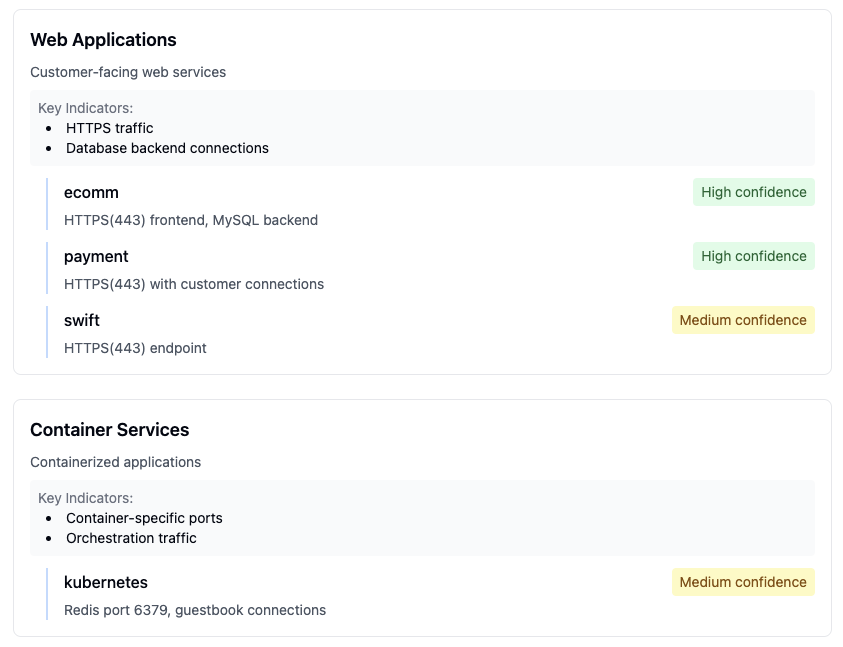 Detailed view of application communication patterns and dependencies
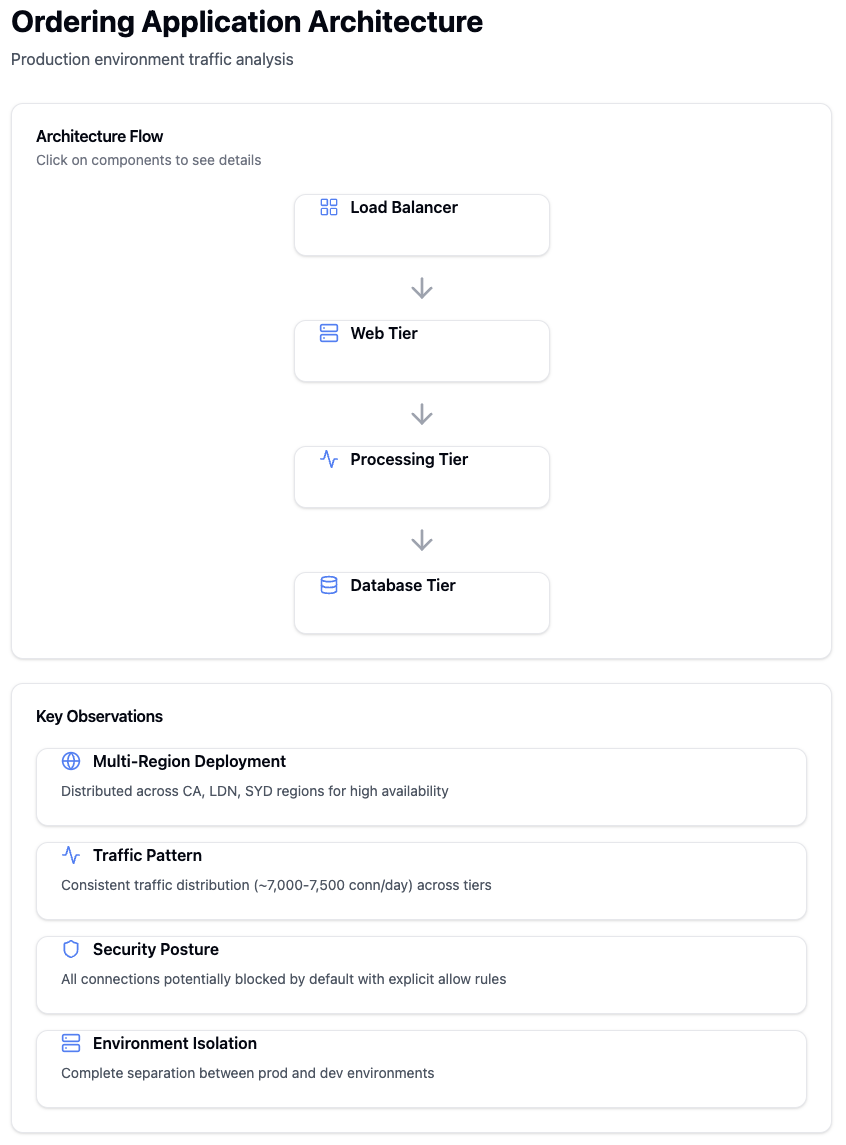 Analysis of traffic patterns between different application tiers
 Overview dashboard showing key infrastructure metrics and status
 Detailed analysis of infrastructure service communications
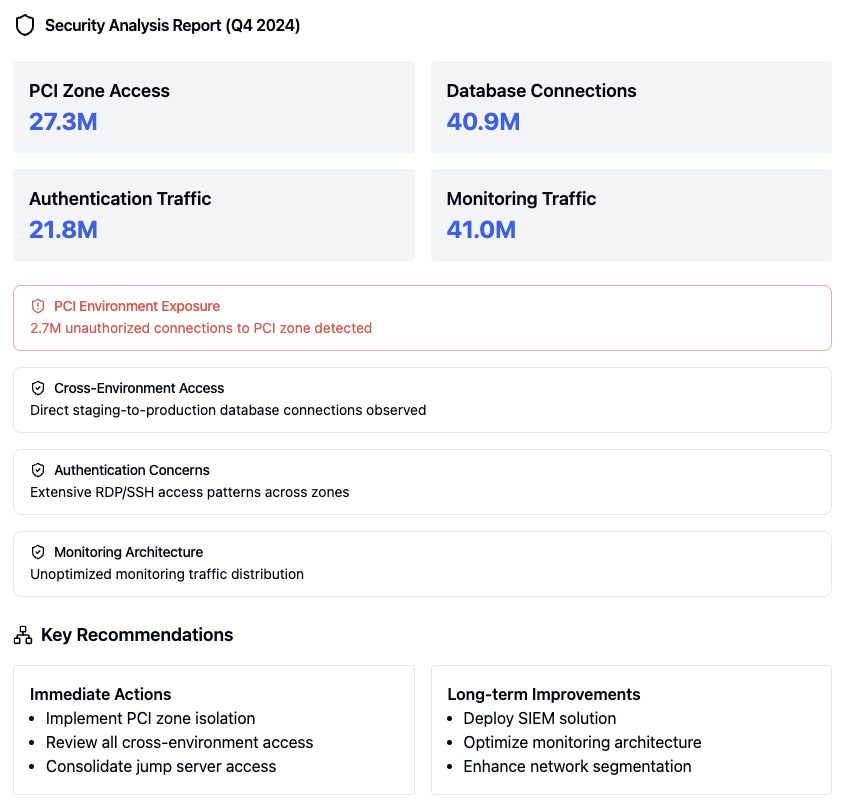 Comprehensive security analysis report
 Security assessment findings for high-risk vulnerabilities
 PCI compliance assessment findings
 SWIFT compliance assessment findings
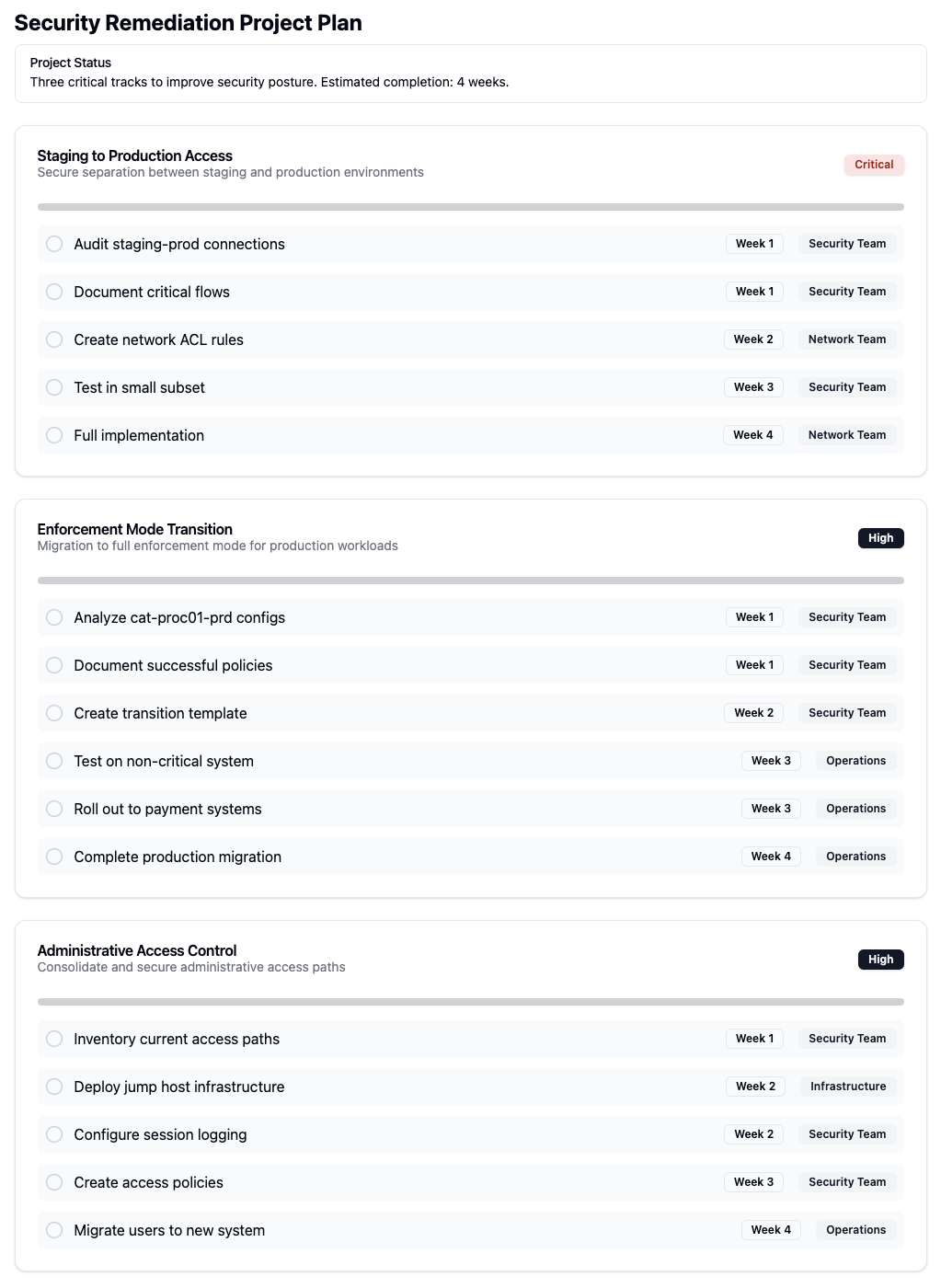 Overview of security remediation planning
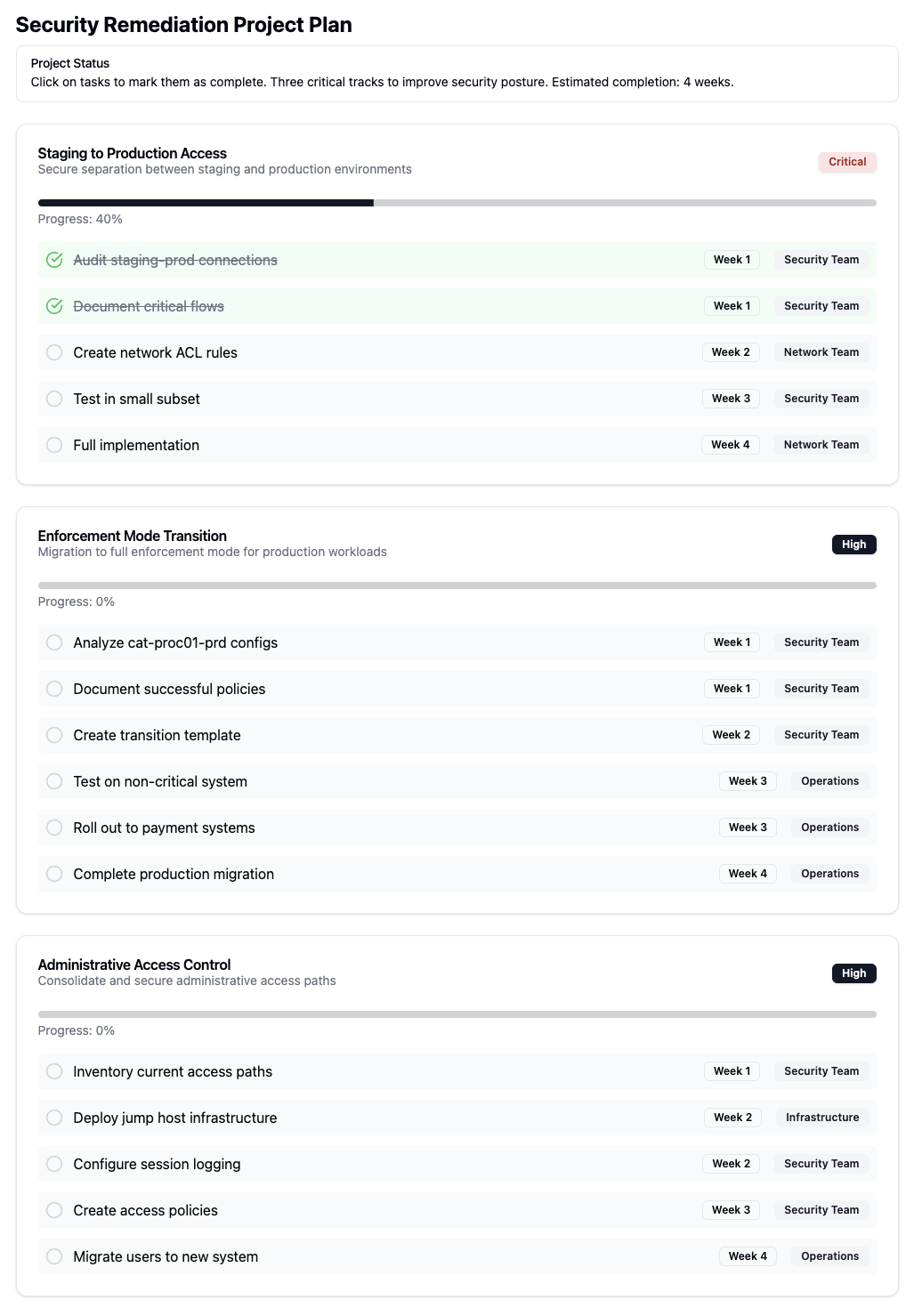 Detailed steps for security remediation implementation
 Management interface for IP lists
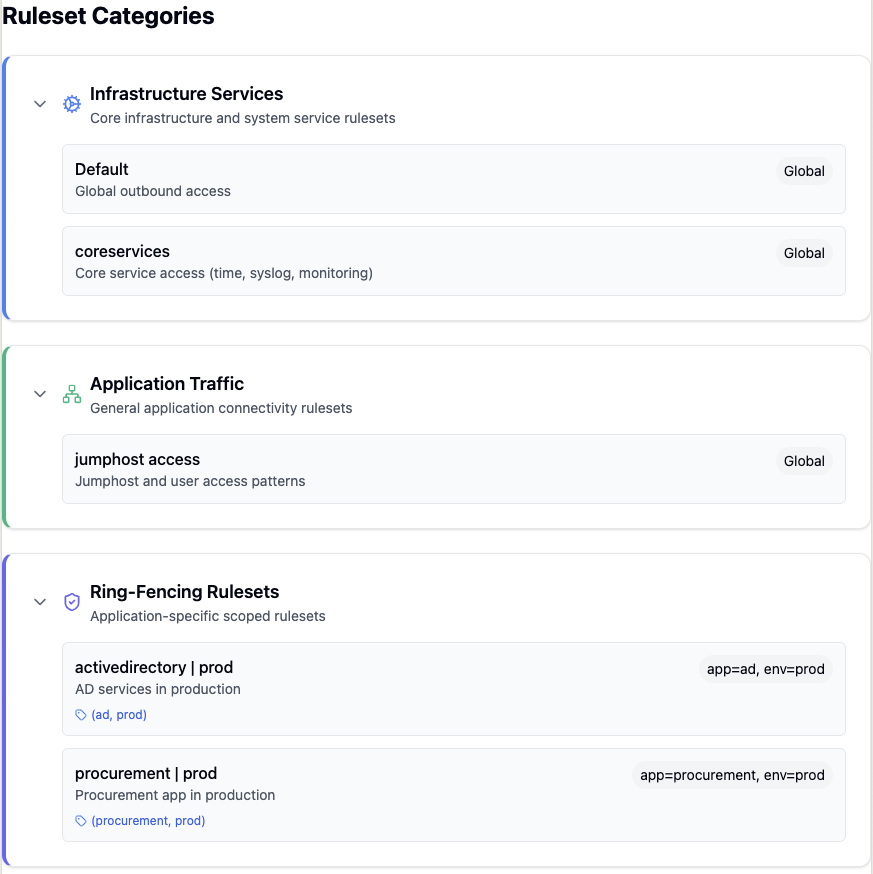 Overview of ruleset categories and organization
 Configuration of application ruleset ordering
 Detailed workload analysis and metrics
 Identification and analysis of workload traffic patterns
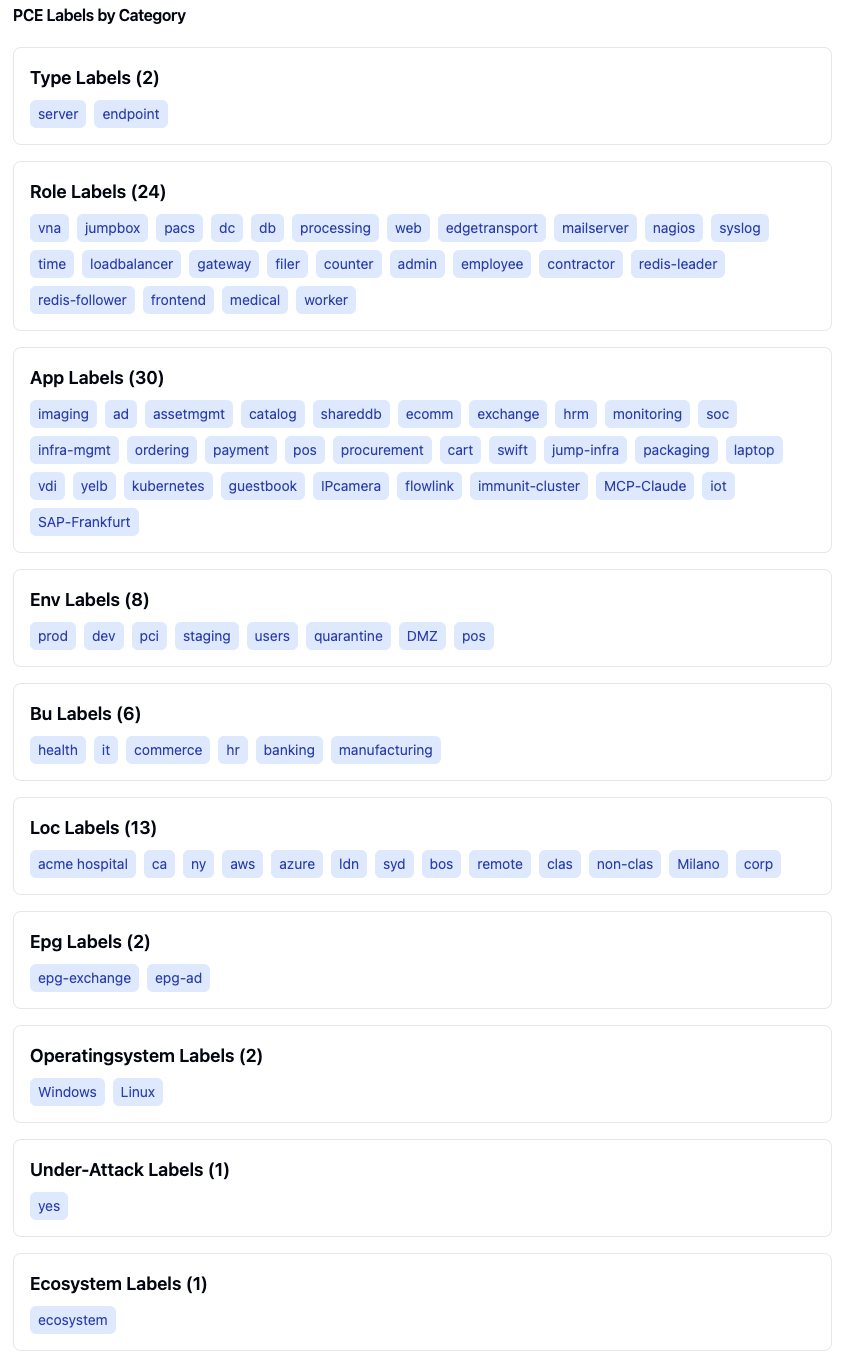 Organization of PCE labels by type and category
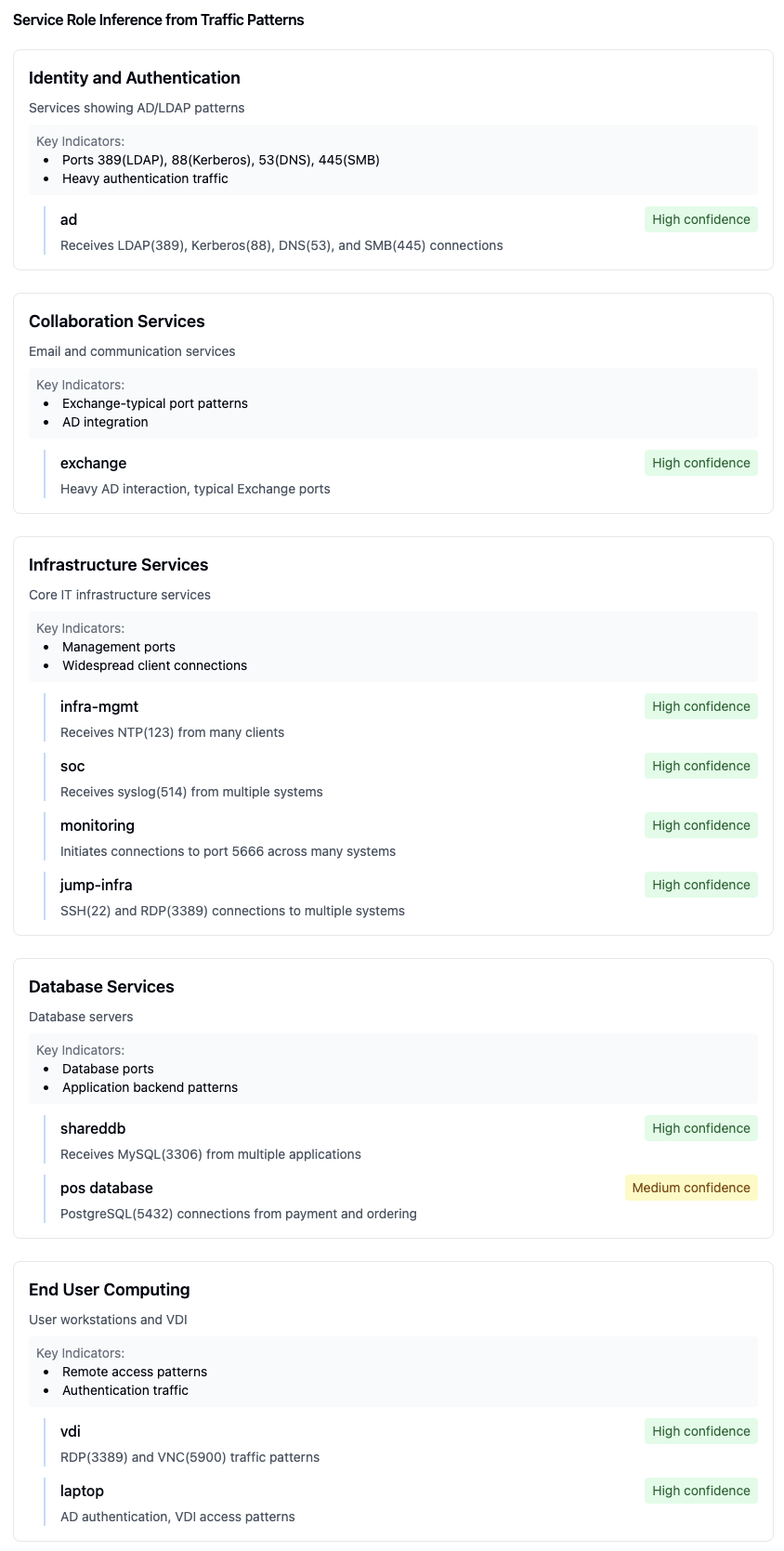 Automatic inference of service roles based on traffic patterns
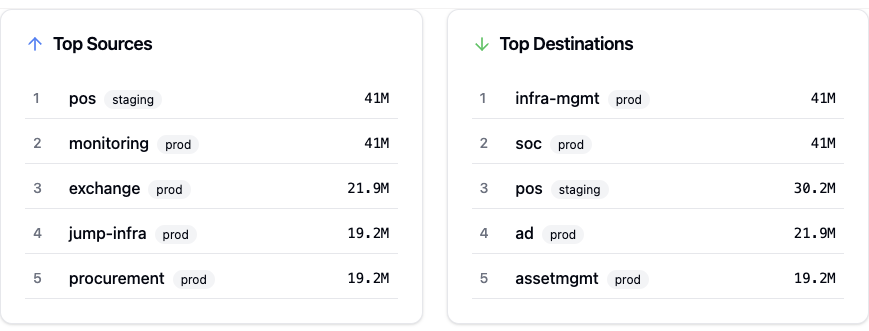 Analysis of top 5 traffic sources and destinations
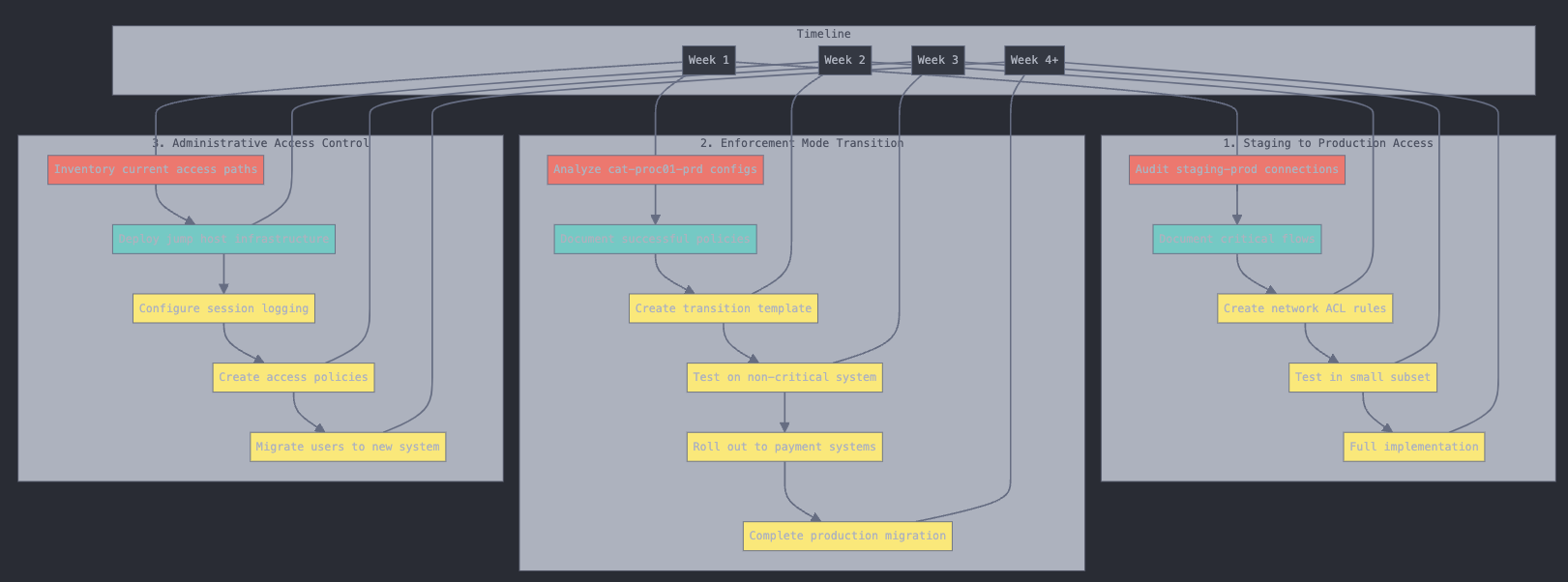 Project implementation timeline and milestones
The ringfence-application prompt helps create security policies to isolate and protect applications by controlling inbound and outbound traffic.
Required Arguments:
application_name: Name of the application to ringfence
application_environment: Environment of the application to ringfence
Features:
Creates rules for inter-tier communication within the application
Uses traffic flows to identify required external connections
Implements inbound traffic restrictions based on source applications
Creates outbound traffic rules for necessary external communications
Handles both intra-scope (same app/env) and extra-scope (external) connections
Creates separate rulesets for remote application connections
The analyze-application-traffic prompt provides detailed analysis of application traffic patterns and connectivity.
Required Arguments:
application_name: Name of the application to analyze
application_environment: Environment of the application to analyze
Analysis Features:
Orders traffic by inbound and outbound flows
Groups by application/environment/role combinations
Identifies relevant label types and patterns
Displays results in a React component format
Shows protocol and port information
Attempts to identify known service patterns (e.g., Nagios on port 5666)
Categorizes traffic into infrastructure and application types
Determines internet exposure
Displays Illumio role, application, and environment labels
Step1: Click "Attach from MCP" button in the interface

Step 2: Choose from installed MCP servers
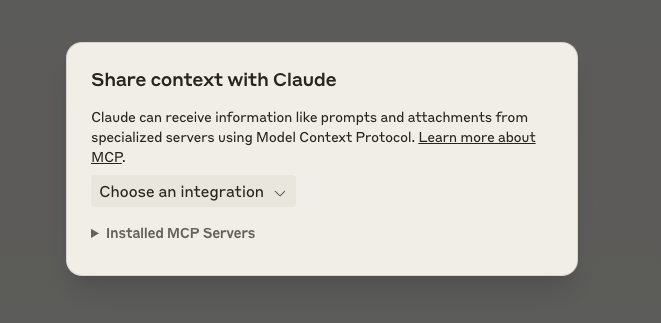
Step 3: Fill in required prompt arguments:
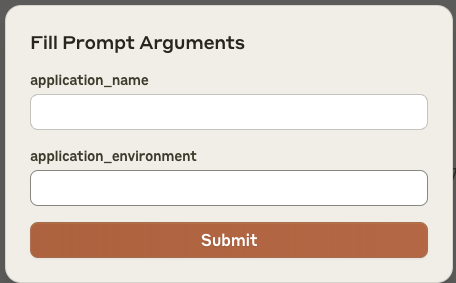
Step 4: Click Submit to send the configured prompt
The MCP server sends the configured prompt to Claude
Claude receives context through the Model Context Protocol
Allows specialized handling of Illumio-specific tasks
This workflow enables automated context sharing between Illumio systems and Claude for application traffic analysis and ringfencing tasks.
The application is available as a Docker container from the GitHub Container Registry.
docker pull ghcr.io/alexgoller/illumio-mcp-server:latestYou can also use a specific version by replacing latest with a version number:
docker pull ghcr.io/alexgoller/illumio-mcp-server:1.0.0To use the container with Claude Desktop, you'll need to:
Create an environment file (e.g. ~/.illumio-mcp.env) with your PCE credentials:
PCE_HOST=your-pce-host
PCE_PORT=your-pce-port
PCE_ORG_ID=1
API_KEY=your-api-key
API_SECRET=your-api-secret
Add the following configuration to your Claude Desktop config file:
On MacOS (~/Library/Application Support/Claude/claude_desktop_config.json):
{
    "mcpServers": {
        "illumio-mcp-docker": {
            "command": "docker",
            "args": [
                "run",
                "-i",
                "--init",
                "--rm",
                "-v",
                "/Users/YOUR_USERNAME/tmp:/var/log/illumio-mcp",
                "-e",
                "DOCKER_CONTAINER=true",
                "-e",
                "PYTHONWARNINGS=ignore",
                "--env-file",
                "/Users/YOUR_USERNAME/.illumio-mcp.env",
                "illumio-mcp:latest"
            ]
        }
    }
}
Make sure to:
Replace YOUR_USERNAME with your actual username
Create the log directory (e.g. ~/tmp)
Adjust the paths according to your system
You can also run the container directly:
docker run -i --init --rm \
  -v /path/to/logs:/var/log/illumio-mcp \
  -e DOCKER_CONTAINER=true \
  -e PYTHONWARNINGS=ignore \
  --env-file ~/.illumio-mcp.env \
ghcr.io/alexgoller/illumio-mcp-server:latestFor development or testing, you can use Docker Compose:
version: '3'
services:
  illumio-mcp:
    image: ghcr.io/alexgoller/illumio-mcp-server:latest
    init: true
    volumes:
      - ./logs:/var/log/illumio-mcp
    environment:
      - DOCKER_CONTAINER=true
      - PYTHONWARNINGS=ignore
    env_file:
      - ~/.illumio-mcp.env
Then run:
docker-compose upFork the repository
Create a feature branch
Commit your changes
Push to the branch
Create a Pull Request
This project is licensed under the GPL-3.0 License. See the LICENSE file for details.
For support, please create an issue.
Are my credentials and the connection to the PCE working?
| Name | Required | Description | Default |
|---|---|---|---|
No parameters | |||
Does the description disclose side effects, auth requirements, rate limits, or destructive behavior?
With no annotations provided, the description carries full burden but offers minimal behavioral insight. It implies a diagnostic/read-only operation but doesn't disclose response format (e.g., success/failure details), error conditions, or side effects (e.g., if it logs attempts). More context on what 'working' entails would help.
Agents need to know what a tool does to the world before calling it. Descriptions should go beyond structured annotations to explain consequences.
Is the description appropriately sized, front-loaded, and free of redundancy?
The description is a single, direct question that efficiently conveys the tool's intent without redundancy. It's front-loaded and wastes no words, making it easy for an agent to parse quickly.
Shorter descriptions cost fewer tokens and are easier for agents to parse. Every sentence should earn its place.
Given the tool's complexity, does the description cover enough for an agent to succeed on first attempt?
Given the tool's simplicity (0 params, no output schema, no annotations), the description is minimally adequate. However, it lacks details on what a successful/failed check returns, which is crucial for a diagnostic tool. Without annotations or output schema, more behavioral context would improve completeness.
Complex tools with many parameters or behaviors need more documentation. Simple tools need less. This dimension scales expectations accordingly.
Does the description clarify parameter syntax, constraints, interactions, or defaults beyond what the schema provides?
The tool has 0 parameters with 100% schema coverage, so no parameter documentation is needed. The description appropriately doesn't discuss parameters, aligning with the schema. A baseline of 4 is applied as it avoids unnecessary parameter details.
Input schemas describe structure but not intent. Descriptions should explain non-obvious parameter relationships and valid value ranges.
Does the description clearly state what the tool does and how it differs from similar tools?
The description clearly states the tool's purpose as checking credentials and connection to PCE, using specific verbs ('check', 'working') and identifying the resource (PCE). However, it doesn't explicitly differentiate from siblings like get-events or get-workloads, which are data retrieval tools rather than connectivity checks.
Agents choose between tools based on descriptions. A clear purpose with a specific verb and resource helps agents select the right tool.
Does the description explain when to use this tool, when not to, or what alternatives exist?
The description provides no guidance on when to use this tool versus alternatives. It doesn't mention prerequisites (e.g., after credential setup), exclusions (e.g., not for data operations), or relate to sibling tools like get-events for actual data access after connection verification.
Agents often have multiple tools that could apply. Explicit usage guidance like "use X instead of Y when Z" prevents misuse.
Check whether PCE credentials are registered for the current user without revealing the secret values.
| Name | Required | Description | Default |
|---|---|---|---|
No parameters | |||
Does the description disclose side effects, auth requirements, rate limits, or destructive behavior?
With no annotations, the description carries the behavioral disclosure burden. It does disclose that secret values are not revealed, which is useful, but it does not state whether the tool returns a simple boolean, what happens when no credentials are registered, or whether any read-only guarantee applies beyond not revealing secrets.
Agents need to know what a tool does to the world before calling it. Descriptions should go beyond structured annotations to explain consequences.
Is the description appropriately sized, front-loaded, and free of redundancy?
The description is a single sentence with no filler. It front-loads the core action and immediately follows with the important privacy qualifier, making every word meaningful.
Shorter descriptions cost fewer tokens and are easier for agents to parse. Every sentence should earn its place.
Given the tool's complexity, does the description cover enough for an agent to succeed on first attempt?
For a zero-parameter status check, the description covers the essential purpose and a key behavioral constraint. It is slightly incomplete because there is no output schema and the description does not explicitly state the return value format, though 'check whether' strongly implies a boolean or status result.
Complex tools with many parameters or behaviors need more documentation. Simple tools need less. This dimension scales expectations accordingly.
Does the description clarify parameter syntax, constraints, interactions, or defaults beyond what the schema provides?
The tool has zero parameters, so the schema already fully documents that no input is needed. The description adds useful context by clarifying that the check is for the current user and that secret values are not exposed.
Input schemas describe structure but not intent. Descriptions should explain non-obvious parameter relationships and valid value ranges.
Does the description clearly state what the tool does and how it differs from similar tools?
The description states a specific verb and resource: checking whether PCE credentials are registered for the current user. It also adds the distinctive qualifier 'without revealing the secret values,' which sets it apart from registration and deletion tools among the siblings.
Agents choose between tools based on descriptions. A clear purpose with a specific verb and resource helps agents select the right tool.
Does the description explain when to use this tool, when not to, or what alternatives exist?
The purpose is clear, so an agent can infer this is for verifying credential registration status. However, it does not explicitly say when to use this versus check-pce-connection or register-pce-credentials, nor does it mention any exclusions or prerequisites.
Agents often have multiple tools that could apply. Explicit usage guidance like "use X instead of Y when Z" prevents misuse.
Compare draft vs active policy to see what would change on provisioning. Shows new, modified, and deleted rulesets, rules, IP lists, and services.
| Name | Required | Description | Default |
|---|---|---|---|
| resource_type | No | Type of resource to compare (default: all) | all |
Does the description disclose side effects, auth requirements, rate limits, or destructive behavior?
With no annotations, the description carries the full burden of behavioral disclosure. It does well by stating this is a comparison operation that 'shows' changes, strongly implying a non-mutating preview rather than an actual provisioning action. It also discloses exactly what categories of changes are reported (new, modified, deleted), though it does not discuss output format, limits, or side effects.
Agents need to know what a tool does to the world before calling it. Descriptions should go beyond structured annotations to explain consequences.
Is the description appropriately sized, front-loaded, and free of redundancy?
Two focused sentences with no filler. The action and purpose are front-loaded, and the output detail is compressed into a single clear list. Every sentence earns its place.
Shorter descriptions cost fewer tokens and are easier for agents to parse. Every sentence should earn its place.
Given the tool's complexity, does the description cover enough for an agent to succeed on first attempt?
Given the tool's low complexity (one optional enum parameter, no required inputs, no nested objects), the description is largely complete for selection and invocation. It explains what the tool does, why you would use it, and what kinds of results to expect. The absence of an output schema or more explicit return-format details is a minor gap, not a blocking one.
Complex tools with many parameters or behaviors need more documentation. Simple tools need less. This dimension scales expectations accordingly.
Does the description clarify parameter syntax, constraints, interactions, or defaults beyond what the schema provides?
The schema already documents the single parameter fully with an enum, a default, and a description, so schema coverage is 100%. The tool description adds little parameter-specific meaning beyond listing resources conceptually; the baseline of 3 is appropriate because the schema does the heavy lifting.
Input schemas describe structure but not intent. Descriptions should explain non-obvious parameter relationships and valid value ranges.
Does the description clearly state what the tool does and how it differs from similar tools?
The description begins with a clear, specific action: 'Compare draft vs active policy' and names the resource (policy) plus the purpose ('to see what would change on provisioning'). It also enumerates the output categories (rulesets, rules, IP lists, services), making the tool's function distinct from siblings like provision-policy or get-rulesets.
Agents choose between tools based on descriptions. A clear purpose with a specific verb and resource helps agents select the right tool.
Does the description explain when to use this tool, when not to, or what alternatives exist?
The phrase 'to see what would change on provisioning' implies this is a pre-check tool used before applying a draft, which provides some usage context. However, there is no explicit when-to-use/when-not-to-use guidance and no named alternatives or exclusions, so the guidance is implied rather than stated.
Agents often have multiple tools that could apply. Explicit usage guidance like "use X instead of Y when Z" prevents misuse.
Check policy compliance against common frameworks (PCI-DSS, NIST, CIS). Identifies workloads in specific compliance scopes and verifies that segmentation policies meet framework requirements.
| Name | Required | Description | Default |
|---|---|---|---|
| app_name | No | Application to check (optional — if omitted, checks all apps) | |
| env_name | No | Environment to check (optional) | |
| framework | No | Compliance framework to check against (default: general). Read the corresponding illumio://compliance/* resource for detailed framework guidance. | general |
| lookback_days | No | Number of days to look back for traffic analysis (default: 30) |
Does the description disclose side effects, auth requirements, rate limits, or destructive behavior?
With no annotations, the description carries the full burden of behavioral disclosure. It states the tool identifies workloads and verifies segmentation policies, but does not explicitly say whether it is a read-only operation, what it returns, or whether there are side effects. 'Check' implies read-only but is not stated.
Agents need to know what a tool does to the world before calling it. Descriptions should go beyond structured annotations to explain consequences.
Is the description appropriately sized, front-loaded, and free of redundancy?
The description is two sentences and front-loads the primary purpose. It is concise with no wasted words, though a more structured breakdown of parameters could improve scannability.
Shorter descriptions cost fewer tokens and are easier for agents to parse. Every sentence should earn its place.
Given the tool's complexity, does the description cover enough for an agent to succeed on first attempt?
With no output schema, the description should explain what a successful check returns or how results are presented. It does not describe return format, error conditions, or how lookback_days influences traffic analysis. For a tool with moderate complexity and no annotations, this is a notable gap.
Complex tools with many parameters or behaviors need more documentation. Simple tools need less. This dimension scales expectations accordingly.
Does the description clarify parameter syntax, constraints, interactions, or defaults beyond what the schema provides?
Schema coverage is 100%, so the schema already documents each parameter. The description mentions 'specific compliance scopes' and 'framework requirements' but does not elaborate on how app_name, env_name, framework, or lookback_days affect the check. Minimal added value beyond the schema.
Input schemas describe structure but not intent. Descriptions should explain non-obvious parameter relationships and valid value ranges.
Does the description clearly state what the tool does and how it differs from similar tools?
The description uses specific verbs ('check', 'identifies', 'verifies') and names the resource (policy compliance) alongside concrete frameworks (PCI-DSS, NIST, CIS). It clearly distinguishes this as a compliance-checking operation, though it doesn't explicitly contrast with sibling tools like enforcement-readiness or get-policy-coverage-report.
Agents choose between tools based on descriptions. A clear purpose with a specific verb and resource helps agents select the right tool.
Does the description explain when to use this tool, when not to, or what alternatives exist?
No usage guidance is provided. The description does not state when to use this tool over alternatives, nor does it mention any prerequisites, exclusions, or conditions that would route an agent here.
Agents often have multiple tools that could apply. Explicit usage guidance like "use X instead of Y when Z" prevents misuse.
Create a deny rule in an existing ruleset. Deny rules block specific traffic (processed after allow rules). Override deny rules (override_deny=true) are the HIGHEST priority — they block traffic even when allow rules exist, meaning 'this must not happen under any circumstances.' Use override deny for emergency isolation, hard compliance blocks, or active attack response — NOT for normal segmentation or ringfencing. Rule processing order: 1) Essential rules, 2) Override Deny (blocks above all), 3) Allow rules, 4) Deny rules, 5) Default action. WRITE OPERATION: changes PCE state. In clients that gate tool calls (Claude Desktop, Claude Code), this pauses for the user to approve it -- the call has not failed and must not be retried while waiting.
| Name | Required | Description | Default |
|---|---|---|---|
| consumers | Yes | Array of consumer (source) references: 'ams' for all workloads, label hrefs, key=value pairs, or 'iplist:<name>' | |
| providers | Yes | Array of provider (destination) references: 'ams' for all workloads, label hrefs, key=value pairs, or 'iplist:<name>' | |
| ruleset_href | No | Href of the ruleset to add the deny rule to (e.g., /orgs/1/sec_policy/draft/rule_sets/123) | |
| ruleset_name | No | Name of the ruleset to add the deny rule to (alternative to ruleset_href) | |
| override_deny | No | If true, creates an override deny rule — the highest priority deny that blocks traffic even if allow rules exist. Means 'this must not happen under any circumstances.' Use for emergency isolation, hard compliance blocks (e.g., PCI zones), or active attack response. If false (default), creates a regular deny rule (processed after allow rules). | |
| ingress_services | Yes | Services this rule covers. Each entry is EITHER an inline port ({'port': 443, 'proto': 'tcp'}), OR a service object by href ({'href': '/orgs/1/sec_policy/draft/services/42'}), OR a service by exact name ({'service': 'All Services'}). Mixing those keys in one entry is an error. For 'any service' use {'service': 'All Services'} — an empty list is rejected by the PCE and {'port': 0} does not mean all ports. Deny rules cannot use services carrying Windows process qualifiers; write those as an allow above a broad deny. | |
| unscoped_consumers | No | Whether to allow unscoped consumers (extra-scope rule) |
Does the description disclose side effects, auth requirements, rate limits, or destructive behavior?
With no annotations provided, the description carries the full behavioral disclosure burden and meets it: it flags 'WRITE OPERATION: changes PCE state,' discloses that gated clients pause for user approval, and warns that 'the call has not failed and must not be retried while waiting.' It also discloses the priority-ordering behavior (override deny blocks above all). This is exactly the operational context an agent needs to avoid retrying a write that is merely awaiting approval.
Agents need to know what a tool does to the world before calling it. Descriptions should go beyond structured annotations to explain consequences.
Is the description appropriately sized, front-loaded, and free of redundancy?
The description is front-loaded with the core action, then structured with a numbered list for processing order and an all-caps 'WRITE OPERATION' flag for the critical warning. Every sentence carries distinct information — purpose, priority semantics, use cases, exclusion, order, and retry behavior — with no filler or repetition of schema content.
Shorter descriptions cost fewer tokens and are easier for agents to parse. Every sentence should earn its place.
Given the tool's complexity, does the description cover enough for an agent to succeed on first attempt?
For a 7-parameter write operation with no annotations and no output schema, the description covers the invocation semantics, use-case selection, priority behavior, and the approval-gating pause comprehensively. The remaining gaps are minor: it doesn't state what a successful response returns or how conflicts with existing rules are handled. These are non-blocking for correct invocation.
Complex tools with many parameters or behaviors need more documentation. Simple tools need less. This dimension scales expectations accordingly.
Does the description clarify parameter syntax, constraints, interactions, or defaults beyond what the schema provides?
Schema description coverage is 100%, so the baseline is 3. The description adds meaning on top by explaining the full rule processing order (1-5), which gives the override_deny parameter its operational weight, and by reinforcing the 'must not happen under any circumstances' semantics. It does not add much for consumers/providers/ruleset addressing, but the schema already documents those thoroughly.
Input schemas describe structure but not intent. Descriptions should explain non-obvious parameter relationships and valid value ranges.
Does the description clearly state what the tool does and how it differs from similar tools?
The description opens with a specific verb+resource: 'Create a deny rule in an existing ruleset,' and immediately defines what a deny rule does (blocks specific traffic, processed after allow rules). It clearly distinguishes override deny rules from regular deny rules, and the tool is unambiguously differentiated from siblings like delete-deny-rule, update-deny-rule, create-ruleset, and create-ringfence.
Agents choose between tools based on descriptions. A clear purpose with a specific verb and resource helps agents select the right tool.
Does the description explain when to use this tool, when not to, or what alternatives exist?
The description gives explicit when-to-use guidance: override deny for 'emergency isolation, hard compliance blocks, or active attack response' and an explicit exclusion — 'NOT for normal segmentation or ringfencing.' The numbered processing order also tells the agent where deny rules sit relative to allow rules. The only gap is that it never names the alternative sibling tool (e.g., create-ringfence) for the normal segmentation case, leaving that to inference.
Agents often have multiple tools that could apply. Explicit usage guidance like "use X instead of Y when Z" prevents misuse.
Create a new IP List in the PCE WRITE OPERATION: changes PCE state. In clients that gate tool calls (Claude Desktop, Claude Code), this pauses for the user to approve it -- the call has not failed and must not be retried while waiting.
| Name | Required | Description | Default |
|---|---|---|---|
| fqdn | No | Fully Qualified Domain Name (optional) | |
| name | Yes | Name of the IP List | |
| ip_ranges | Yes | List of IP ranges to include | |
| description | No | Description of the IP List |
Does the description disclose side effects, auth requirements, rate limits, or destructive behavior?
With no annotations provided, the description carries the full burden of behavioral disclosure. It does well by declaring this a WRITE OPERATION that changes PCE state and explaining the approval-pause behavior and the no-retry rule. This adds significant value beyond the tool name. It could additionally mention the success return format, but the disclosed behavior is substantial.
Agents need to know what a tool does to the world before calling it. Descriptions should go beyond structured annotations to explain consequences.
Is the description appropriately sized, front-loaded, and free of redundancy?
The description is two tightly written sentences with no wasted words. The primary purpose is front-loaded, and the behavioral warning follows. It's efficient and well-structured, though slightly below a 5 because it packs the approval-gating note somewhat densely without formatting breaks.
Shorter descriptions cost fewer tokens and are easier for agents to parse. Every sentence should earn its place.
Given the tool's complexity, does the description cover enough for an agent to succeed on first attempt?
For a create operation with no output schema and no annotations, the description covers the write nature and approval behavior well but doesn't describe what a successful call returns or any prerequisites (e.g., permissions). It's adequate for a straightforward create tool but leaves the agent to infer the response shape.
Complex tools with many parameters or behaviors need more documentation. Simple tools need less. This dimension scales expectations accordingly.
Does the description clarify parameter syntax, constraints, interactions, or defaults beyond what the schema provides?
Schema description coverage is 100%, so the baseline is 3. The description adds no parameter-level detail beyond what the schema already documents for name, ip_ranges, fqdn, and description. The schema fully covers parameter meaning, so the description correctly leaves this to the structured data.
Input schemas describe structure but not intent. Descriptions should explain non-obvious parameter relationships and valid value ranges.
Does the description clearly state what the tool does and how it differs from similar tools?
The description states a specific verb and resource: 'Create a new IP List in the PCE'. The create/update/delete/get verbs on the sibling tools make the action unambiguous. It doesn't explicitly name sibling differentiators, but 'Create' vs 'update-iplist', 'delete-iplist', and 'get-iplists' is self-evident enough to warrant a 4 rather than a 5.
Agents choose between tools based on descriptions. A clear purpose with a specific verb and resource helps agents select the right tool.
Does the description explain when to use this tool, when not to, or what alternatives exist?
The description provides useful contextual guidance about the approval gate in clients like Claude Desktop/Code and explicitly warns against retrying while waiting. However, it doesn't state when to use this tool vs alternatives (e.g., when to create a new IP list vs updating an existing one with update-iplist), so usage context is implied rather than explicit.
Agents often have multiple tools that could apply. Explicit usage guidance like "use X instead of Y when Z" prevents misuse.
Create a label of a specific type and the value in the PCE WRITE OPERATION: changes PCE state. In clients that gate tool calls (Claude Desktop, Claude Code), this pauses for the user to approve it -- the call has not failed and must not be retried while waiting.
| Name | Required | Description | Default |
|---|---|---|---|
| key | Yes | ||
| value | Yes |
Does the description disclose side effects, auth requirements, rate limits, or destructive behavior?
With no annotations, the description takes on the transparency burden. It explicitly states this is a write operation that changes PCE state and explains the approval-gating behavior in clients, including the key caveat that the call must not be retried while waiting. This is valuable behavioral disclosure beyond the schema.
Agents need to know what a tool does to the world before calling it. Descriptions should go beyond structured annotations to explain consequences.
Is the description appropriately sized, front-loaded, and free of redundancy?
Two sentences and no filler. The first sentence states the action, and the second delivers a necessary operational warning. Well front-loaded and appropriately sized.
Shorter descriptions cost fewer tokens and are easier for agents to parse. Every sentence should earn its place.
Given the tool's complexity, does the description cover enough for an agent to succeed on first attempt?
The definition covers side effects and approval handling, which is important for a write operation. However, with 0% schema coverage and no explanation of key/value semantics, valid label types, response behavior, or potential uniqueness constraints, the description is not fully self-sufficient for correct invocation.
Complex tools with many parameters or behaviors need more documentation. Simple tools need less. This dimension scales expectations accordingly.
Does the description clarify parameter syntax, constraints, interactions, or defaults beyond what the schema provides?
Schema description coverage is 0%, so the description must compensate for the undocumented key and value parameters. It mentions 'a specific type and the value' but never explicitly maps type to the key parameter or defines allowed/formatted values. An agent would struggle to confidently populate the parameters.
Input schemas describe structure but not intent. Descriptions should explain non-obvious parameter relationships and valid value ranges.
Does the description clearly state what the tool does and how it differs from similar tools?
The description names a concrete operation—'create a label'—with a resource (label) and context (PCE). It is not a tautology and is distinguishable from update-label and delete-label. However, the phrase 'a specific type and the value' is slightly vague and does not explicitly say key/value.
Agents choose between tools based on descriptions. A clear purpose with a specific verb and resource helps agents select the right tool.
Does the description explain when to use this tool, when not to, or what alternatives exist?
The description gives no guidance about when to choose create-label over update-label or delete-label, and names no alternatives or preconditions. The retry warning is about post-invocation behavior, not tool selection.
Agents often have multiple tools that could apply. Explicit usage guidance like "use X instead of Y when Z" prevents misuse.
Create a ringfencing policy for an application. This analyzes traffic flows to discover which other apps communicate with this app, then creates a ruleset with:
An intra-scope rule allowing all workloads within the app to communicate on All Services
Extra-scope rules for each remote app+env discovered in traffic, allowing them in on All Services The result is a coarse-grained segmentation that controls which apps can talk to each other, reducing risk without requiring per-port policies. WRITE OPERATION: changes PCE state. In clients that gate tool calls (Claude Desktop, Claude Code), this pauses for the user to approve it -- the call has not failed and must not be retried while waiting.
| Name | Required | Description | Default |
|---|---|---|---|
| dry_run | No | If true, analyze traffic and report what would be created without actually creating anything (default: false) | |
| app_name | Yes | Application label value (e.g., 'CRM', 'Ordering', 'ELK') | |
| env_name | Yes | Environment label value (e.g., 'Production', 'Staging', 'Development') | |
| selective | No | If true, adds a deny rule blocking all inbound traffic to the app. In selective enforcement mode the default action is allow-all, so without this deny rule the ringfence has no teeth. Allow rules for known remote apps are processed before the deny rule (rule order: override_deny > allow > deny > default), so known apps pass through and everything else hits the deny. This gets you to enforcement faster than full enforcement mode. | |
| deny_service | No | Service the selective-mode deny rule covers. Defaults to All Services ('deny everything except the allows above'). Narrow it to deny only specific ports. | |
| ruleset_name | No | Custom name for the ringfence ruleset (default: 'RF-<app_name>-<env_name>') | |
| skip_allowed | No | If true, skip creating rules for remote apps whose traffic is already fully allowed by existing policy. Default is false, meaning rules are created for all observed traffic regardless of policy decision. This makes the ringfence ruleset self-documenting — it shows the complete picture of app connectivity. Set to true for minimal rulesets that only fill policy gaps. | |
| deny_consumer | No | Controls which consumers the deny rule targets (only used with selective=true). Illumio pushes deny rules to the source workload, so this choice matters: 'any' (default) = IP list Any (0.0.0.0/0) as consumer, deny rule only written to destination workloads inside the scope. Safest, no impact on remote workloads. 'ams' = All Workloads as consumer, deny rule pushed to every managed workload outside the scope. Broader enforcement but wider blast radius. 'ams_and_any' = both All Workloads and Any IP list, maximum coverage for managed and unmanaged sources. | any |
| lookback_days | No | Number of days to look back for traffic flows (default: 30) |
Does the description disclose side effects, auth requirements, rate limits, or destructive behavior?
With no annotations provided, the description carries the full behavioral burden and does so thoroughly. It explicitly flags 'WRITE OPERATION: changes PCE state,' explains that gated clients may pause for user approval, warns that the call should not be retried while waiting, and details rule ordering and how deny rules are pushed to source workloads. This goes well beyond a generic 'update' warning.
Agents need to know what a tool does to the world before calling it. Descriptions should go beyond structured annotations to explain consequences.
Is the description appropriately sized, front-loaded, and free of redundancy?
The description is long but information-dense, with a numbered list breaking down the generated rules and a clearly separated approval caveat. It is front-loaded with the core purpose. Some detail, such as selective-mode rule ordering, is repeated in the schema, so a couple of sentences could theoretically be trimmed, but the structure keeps it navigable.
Shorter descriptions cost fewer tokens and are easier for agents to parse. Every sentence should earn its place.
Given the tool's complexity, does the description cover enough for an agent to succeed on first attempt?
Given the tool's complexity, nine parameters, and absence of annotations or output schema, the description is very complete: it explains side effects, approval behavior, generated rule types, and coarse-grained intent. The main gap is that it does not describe what the API returns or how to interpret the response after the approval completes, though that is not strictly required for correct invocation.
Complex tools with many parameters or behaviors need more documentation. Simple tools need less. This dimension scales expectations accordingly.
Does the description clarify parameter syntax, constraints, interactions, or defaults beyond what the schema provides?
Schema description coverage is 100%, so the baseline is 3 and the description does not need to re-document parameters. It does add high-level context by explaining the overall policy structure and selective-mode rule ordering, but it does not add unique meaning for most individual parameters beyond what the schema already states.
Input schemas describe structure but not intent. Descriptions should explain non-obvious parameter relationships and valid value ranges.
Does the description clearly state what the tool does and how it differs from similar tools?
The first sentence states a specific verb and resource: 'Create a ringfencing policy for an application.' It then distinguishes the tool's behavior from general policy creation by detailing the intra-scope and extra-scope rules it generates. This makes its function clear even alongside siblings like create-ruleset and ringfence-batch.
Agents choose between tools based on descriptions. A clear purpose with a specific verb and resource helps agents select the right tool.
Does the description explain when to use this tool, when not to, or what alternatives exist?
The description gives clear context: use this when you need a coarse-grained segmentation policy discovered from traffic flows. It explains what the result looks like and even warns about approval pauses in gated clients. However, it does not explicitly contrast itself with alternatives such as ringfence-batch or create-ruleset, so it lacks explicit when-not-to-use guidance.
Agents often have multiple tools that could apply. Explicit usage guidance like "use X instead of Y when Z" prevents misuse.
Create a ruleset in the PCE with support for ring-fencing patterns WRITE OPERATION: changes PCE state. In clients that gate tool calls (Claude Desktop, Claude Code), this pauses for the user to approve it -- the call has not failed and must not be retried while waiting.
| Name | Required | Description | Default |
|---|---|---|---|
| name | Yes | Name of the ruleset (e.g., 'RS-ELK'). Must be unique in the PCE. | |
| rules | No | ||
| scopes | Yes | List of label combinations that define scopes. Each scope is an array of label values. This need to be label references like /orgs/1/labels/57 or similar. Get the label href from the get-labels tool. | |
| description | No | Description of the ruleset (optional) |
Does the description disclose side effects, auth requirements, rate limits, or destructive behavior?
With no annotations provided, the description carries the full behavioral disclosure burden. It explicitly warns that this is a WRITE OPERATION that changes PCE state and describes the approval-pause behavior in gated clients, including the important warning that the call must not be retried while waiting. This is strong context, though it does not cover post-approval outcomes or failure semantics.
Agents need to know what a tool does to the world before calling it. Descriptions should go beyond structured annotations to explain consequences.
Is the description appropriately sized, front-loaded, and free of redundancy?
The description is two efficient sentences with no filler. The most operationally important facts—that this is a write operation and that gated clients pause for approval—are front-loaded, and every clause adds useful information.
Shorter descriptions cost fewer tokens and are easier for agents to parse. Every sentence should earn its place.
Given the tool's complexity, does the description cover enough for an agent to succeed on first attempt?
The write/approval behavior is clearly conveyed and the schema covers most parameter semantics, but the description omits guidance on how this tool relates to the ring-fencing sibling tools and does not describe result/return behavior in the absence of an output schema. For a complex create operation with no annotations, this is adequate but not fully complete.
Complex tools with many parameters or behaviors need more documentation. Simple tools need less. This dimension scales expectations accordingly.
Does the description clarify parameter syntax, constraints, interactions, or defaults beyond what the schema provides?
Schema description coverage is 75%, and the schema already provides rich parameter-level documentation for scopes, rules, ingress/egress services, and name uniqueness. The tool description itself adds no parameter-specific meaning, so it stays at the baseline rather than exceeding what the schema already provides.
Input schemas describe structure but not intent. Descriptions should explain non-obvious parameter relationships and valid value ranges.
Does the description clearly state what the tool does and how it differs from similar tools?
The description states a specific verb and resource: 'Create a ruleset in the PCE', which clearly distinguishes it from update/delete ruleset tools and from workload/IP-list creation tools. However, it does not differentiate it from the closely related create-ringfence or ringfence-batch sibling tools, so it stops one step short of a top score.
Agents choose between tools based on descriptions. A clear purpose with a specific verb and resource helps agents select the right tool.
Does the description explain when to use this tool, when not to, or what alternatives exist?
There is no explicit guidance on when to use this tool versus alternatives, such as create-ringfence, ringfence-batch, or create-deny-rule. Mentioning 'support for ring-fencing patterns' hints at relevance but does not tell an agent when this generic ruleset creation path is preferable to the ring-fence-specific tools.
Agents often have multiple tools that could apply. Explicit usage guidance like "use X instead of Y when Z" prevents misuse.
Create a service in the PCE. Supply at least one of service_ports, windows_services or windows_egress_services. windows_egress_services matches a process on the consumer side and needs a Windows VEN there. WRITE OPERATION: changes PCE state. In clients that gate tool calls (Claude Desktop, Claude Code), this pauses for the user to approve it -- the call has not failed and must not be retried while waiting.
| Name | Required | Description | Default |
|---|---|---|---|
| name | Yes | Name of the service | |
| description | No | Description of the service | |
| service_ports | No | Array of port/protocol definitions | |
| windows_services | No | Inbound Windows process/service qualifiers. Each entry needs at least one of port, process_name, service_name. | |
| windows_egress_services | No | Outbound process qualifiers, matched on the CONSUMER side. Takes process_name/service_name ONLY — the PCE rejects port/proto here, so pair it with service_ports for the port. Requires a Windows VEN on the consumer; non-Windows consumers ignore the process and match on port alone. |
Does the description disclose side effects, auth requirements, rate limits, or destructive behavior?
With no annotations provided, the description carries the full burden and explicitly states 'WRITE OPERATION: changes PCE state.' It also discloses that clients may pause for user approval and that retrying during the wait is incorrect. This meaningfully informs agent behavior beyond the schema.
Agents need to know what a tool does to the world before calling it. Descriptions should go beyond structured annotations to explain consequences.
Is the description appropriately sized, front-loaded, and free of redundancy?
The description is three sentences with no filler: purpose, critical parameter constraint, and an operational warning. Every sentence earns its place, and the most important usage requirement is front-loaded.
Shorter descriptions cost fewer tokens and are easier for agents to parse. Every sentence should earn its place.
Given the tool's complexity, does the description cover enough for an agent to succeed on first attempt?
For a create tool with no annotations and no output schema, the description covers the essential selection, parameter constraints, side-effect, and retry behavior. It does not discuss duplication, authorization, or the return value, but those are less critical for correct invocation.
Complex tools with many parameters or behaviors need more documentation. Simple tools need less. This dimension scales expectations accordingly.
Does the description clarify parameter syntax, constraints, interactions, or defaults beyond what the schema provides?
Schema coverage is 100%, so the baseline is 3, but the description adds real semantics beyond the schema: the at-least-one-of constraint, the consumer-side matching behavior of windows_egress_services, and the note that egress only takes process_name/service_name and must be paired with service_ports. This compensates well for what the schema alone does not convey.
Input schemas describe structure but not intent. Descriptions should explain non-obvious parameter relationships and valid value ranges.
Does the description clearly state what the tool does and how it differs from similar tools?
The description opens with a clear verb and resource: 'Create a service in the PCE.' It then elaborates the three supported service definitions. It does not explicitly contrast with siblings like update-service or get-services, but the action and noun are specific enough for basic differentiation.
Agents choose between tools based on descriptions. A clear purpose with a specific verb and resource helps agents select the right tool.
Does the description explain when to use this tool, when not to, or what alternatives exist?
The description gives practical usage constraints: 'Supply at least one of service_ports, windows_services or windows_egress_services.' It also flags a conditional requirement for windows_egress_services needing a Windows VEN on the consumer. It does not explicitly name alternatives or when not to use this tool, so it misses the top benchmark.
Agents often have multiple tools that could apply. Explicit usage guidance like "use X instead of Y when Z" prevents misuse.
Create a Illumio Core unmanaged workload in the PCE WRITE OPERATION: changes PCE state. In clients that gate tool calls (Claude Desktop, Claude Code), this pauses for the user to approve it -- the call has not failed and must not be retried while waiting.
| Name | Required | Description | Default |
|---|---|---|---|
| name | Yes | ||
| labels | No | ||
| ip_addresses | Yes |
Does the description disclose side effects, auth requirements, rate limits, or destructive behavior?
With no annotations provided, the description carries full responsibility for behavioral disclosure. It explicitly warns that this is a WRITE OPERATION changing PCE state and that gated clients may pause for user approval, adding important operational context beyond the tool name.
Agents need to know what a tool does to the world before calling it. Descriptions should go beyond structured annotations to explain consequences.
Is the description appropriately sized, front-loaded, and free of redundancy?
The description is very concise, with two sentences that each earn their place: one for purpose and one for critical write-approval behavior. It is front-loaded with the core action.
Shorter descriptions cost fewer tokens and are easier for agents to parse. Every sentence should earn its place.
Given the tool's complexity, does the description cover enough for an agent to succeed on first attempt?
Despite the useful gating warning, the description omits parameter guidance, return-value expectations, and any constraints on labels or IP address formats. Since there is no output schema and no annotations, these gaps leave the tool only partially specified for an agent.
Complex tools with many parameters or behaviors need more documentation. Simple tools need less. This dimension scales expectations accordingly.
Does the description clarify parameter syntax, constraints, interactions, or defaults beyond what the schema provides?
Schema description coverage is 0% and the description provides no information about 'name', 'labels', or 'ip_addresses'. The description does not compensate for the schema's lack of parameter documentation.
Input schemas describe structure but not intent. Descriptions should explain non-obvious parameter relationships and valid value ranges.
Does the description clearly state what the tool does and how it differs from similar tools?
The description states a specific action ('Create') and a specific resource ('an Illumio Core unmanaged workload in the PCE'), making the tool's purpose clear. It also distinguishes itself from sibling tools like update-workload and delete-workload.
Agents choose between tools based on descriptions. A clear purpose with a specific verb and resource helps agents select the right tool.
Does the description explain when to use this tool, when not to, or what alternatives exist?
The description implies usage for creating unmanaged workloads, but it does not explicitly compare with alternatives or describe when not to use it. It gives clear context for the operation but no exclusions or alternative routing.
Agents often have multiple tools that could apply. Explicit usage guidance like "use X instead of Y when Z" prevents misuse.
Delete a deny rule from a ruleset by its href WRITE OPERATION: changes PCE state. In clients that gate tool calls (Claude Desktop, Claude Code), this pauses for the user to approve it -- the call has not failed and must not be retried while waiting.
| Name | Required | Description | Default |
|---|---|---|---|
| href | Yes | Deny rule href (e.g., /orgs/1/sec_policy/draft/rule_sets/123/deny_rules/456) |
Does the description disclose side effects, auth requirements, rate limits, or destructive behavior?
With no annotations, the description carries the full burden. It explicitly discloses that this is a write operation that 'changes PCE state' and warns about the approval pause in gated clients, advising against retries. This is valuable non-obvious behavior. It doesn't cover side effects or error cases, but for a single-parameter delete it is strong.
Agents need to know what a tool does to the world before calling it. Descriptions should go beyond structured annotations to explain consequences.
Is the description appropriately sized, front-loaded, and free of redundancy?
Two sentences with no filler. The purpose is front-loaded, and the critical operational warning follows immediately. Every word earns its place; the all-caps 'WRITE OPERATION' is a minor stylistic choice that doesn't harm clarity.
Shorter descriptions cost fewer tokens and are easier for agents to parse. Every sentence should earn its place.
Given the tool's complexity, does the description cover enough for an agent to succeed on first attempt?
For a simple tool with one parameter and no output schema, the description sufficiently covers what it does and the most important runtime behavior (approval gating). Explicit return-value semantics would be nice but are not necessary given the simplicity and absence of an output schema.
Complex tools with many parameters or behaviors need more documentation. Simple tools need less. This dimension scales expectations accordingly.
Does the description clarify parameter syntax, constraints, interactions, or defaults beyond what the schema provides?
Schema coverage is 100%: the href parameter is fully described with an example path format. The description merely restates 'by its href' without adding new detail, so it meets the baseline but does not exceed it.
Input schemas describe structure but not intent. Descriptions should explain non-obvious parameter relationships and valid value ranges.
Does the description clearly state what the tool does and how it differs from similar tools?
The description states a specific verb ('Delete'), a specific resource ('deny rule from a ruleset'), and a selection mechanism ('by its href'). This clearly differentiates it from sibling tools like delete-sec-rule or delete-ruleset without needing to open schemas.
Agents choose between tools based on descriptions. A clear purpose with a specific verb and resource helps agents select the right tool.
Does the description explain when to use this tool, when not to, or what alternatives exist?
The context is clear: use this when deleting a deny rule. It does not explicitly name alternatives (e.g., update-deny-rule for modification), but the operation is unambiguous given the sibling set. The approval-gating note provides additional operational context, though it is more about behavior than tool selection.
Agents often have multiple tools that could apply. Explicit usage guidance like "use X instead of Y when Z" prevents misuse.
Delete an IP List from the PCE. Provide either 'href' or 'name' (but not both) to identify the IP List. WRITE OPERATION: changes PCE state. In clients that gate tool calls (Claude Desktop, Claude Code), this pauses for the user to approve it -- the call has not failed and must not be retried while waiting.
| Name | Required | Description | Default |
|---|---|---|---|
| href | No | Href of the IP List to delete (e.g., /orgs/1/sec_policy/draft/ip_lists/123) | |
| name | No | Name of the IP List to delete (alternative to href) |
Does the description disclose side effects, auth requirements, rate limits, or destructive behavior?
With no annotations provided, the description carries the full burden of behavioral disclosure. It explicitly labels the operation as a WRITE OPERATION that changes PCE state, and discloses that gated clients pause for user approval, warning that the call has not failed and must not be retried. This is exactly the behavioral context an agent needs beyond the action itself.
Agents need to know what a tool does to the world before calling it. Descriptions should go beyond structured annotations to explain consequences.
Is the description appropriately sized, front-loaded, and free of redundancy?
Three tight sentences, each earning its place: action, parameter selection rule, and critical behavioral warning. The most important information is front-loaded, and there is no filler.
Shorter descriptions cost fewer tokens and are easier for agents to parse. Every sentence should earn its place.
Given the tool's complexity, does the description cover enough for an agent to succeed on first attempt?
For a low-complexity tool with two optional parameters and no output schema, the description fully equips an agent to invoke it correctly. It covers resource, identification method, exclusivity constraint, operation type, and client-side behavior. Nothing essential is missing.
Complex tools with many parameters or behaviors need more documentation. Simple tools need less. This dimension scales expectations accordingly.
Does the description clarify parameter syntax, constraints, interactions, or defaults beyond what the schema provides?
Schema coverage is 100% and both parameters have descriptions, so the baseline is 3. The description adds meaningful value by specifying the exclusive-or relationship between 'href' and 'name' ('but not both'), which is not captured in the schema itself.
Input schemas describe structure but not intent. Descriptions should explain non-obvious parameter relationships and valid value ranges.
Does the description clearly state what the tool does and how it differs from similar tools?
The description opens with a specific verb and resource: 'Delete an IP List from the PCE.' This clearly distinguishes it from sibling tools like create-iplist, update-iplist, and get-iplists. No ambiguity about what the tool does.
Agents choose between tools based on descriptions. A clear purpose with a specific verb and resource helps agents select the right tool.
Does the description explain when to use this tool, when not to, or what alternatives exist?
The description explicitly instructs how to identify the resource: provide either 'href' or 'name' but not both. It clearly states the context for use ('Delete an IP List from the PCE'). It does not explicitly name exclusions or alternatives, but the operation is unambiguous and the identification rule is strong guidance.
Agents often have multiple tools that could apply. Explicit usage guidance like "use X instead of Y when Z" prevents misuse.
Delete a label in the PCE WRITE OPERATION: changes PCE state. In clients that gate tool calls (Claude Desktop, Claude Code), this pauses for the user to approve it -- the call has not failed and must not be retried while waiting.
| Name | Required | Description | Default |
|---|---|---|---|
| key | Yes | ||
| value | Yes |
Does the description disclose side effects, auth requirements, rate limits, or destructive behavior?
With no annotations provided, the description carries the full burden of behavioral disclosure. It explicitly warns that this is a write operation that changes PCE state and that approval pauses are not failures, which prevents dangerous retries. This is strong transparency beyond what the schema offers.
Agents need to know what a tool does to the world before calling it. Descriptions should go beyond structured annotations to explain consequences.
Is the description appropriately sized, front-loaded, and free of redundancy?
The description is brief and front-loaded with the core action and state-change warning. The only minor issue is the run-together phrasing 'PCE WRITE OPERATION', which could be misread, but overall every sentence earns its place.
Shorter descriptions cost fewer tokens and are easier for agents to parse. Every sentence should earn its place.
Given the tool's complexity, does the description cover enough for an agent to succeed on first attempt?
For a simple two-parameter delete operation with no output schema, the description covers the most important behavioral context, especially the approval-gating and retry guidance. It is not fully complete because it omits parameter semantics and any side effects of deleting a label, but it is adequate for basic invocation.
Complex tools with many parameters or behaviors need more documentation. Simple tools need less. This dimension scales expectations accordingly.
Does the description clarify parameter syntax, constraints, interactions, or defaults beyond what the schema provides?
The schema has two required parameters, key and value, with 0% description coverage. The tool description does not explain what key and value represent, how they identify the label, or any constraints on their values. The names imply they are label identifiers, but the description provides no real semantic help.
Input schemas describe structure but not intent. Descriptions should explain non-obvious parameter relationships and valid value ranges.
Does the description clearly state what the tool does and how it differs from similar tools?
The description clearly states the action ('Delete a label') and the target resource ('in the PCE'), and explicitly characterizes it as a write operation. It does not explicitly contrast with siblings like create-label or update-label, but the verb and resource make the intended operation clear.
Agents choose between tools based on descriptions. A clear purpose with a specific verb and resource helps agents select the right tool.
Does the description explain when to use this tool, when not to, or what alternatives exist?
The description gives useful operational guidance by warning that gated clients pause for approval and that the call must not be retried while waiting. However, it does not provide explicit guidance about when to choose delete-label over alternatives such as update-label or create-label.
Agents often have multiple tools that could apply. Explicit usage guidance like "use X instead of Y when Z" prevents misuse.
Remove the current user's stored PCE credentials. Idempotent — safe to call even if no credentials are stored. WRITE OPERATION: changes PCE state. In clients that gate tool calls (Claude Desktop, Claude Code), this pauses for the user to approve it -- the call has not failed and must not be retried while waiting.
| Name | Required | Description | Default |
|---|---|---|---|
No parameters | |||
Does the description disclose side effects, auth requirements, rate limits, or destructive behavior?
With no annotations provided, the description carries the full burden of behavioral disclosure, and it delivers. It explicitly states this is a WRITE OPERATION that changes PCE state, discloses idempotency, and warns about approval pauses in gated clients with the crucial guidance that the call has not failed and must not be retried while waiting. This is exemplary behavioral transparency.
Agents need to know what a tool does to the world before calling it. Descriptions should go beyond structured annotations to explain consequences.
Is the description appropriately sized, front-loaded, and free of redundancy?
The description is compact and front-loaded: the core action is in the first sentence, followed by essential behavioral notes. Every sentence earns its place, covering action, idempotency, side-effect, and client-gating behavior without waste.
Shorter descriptions cost fewer tokens and are easier for agents to parse. Every sentence should earn its place.
Given the tool's complexity, does the description cover enough for an agent to succeed on first attempt?
For a parameterless, no-output-schema tool, the description is complete. It tells the agent what is removed, what side effects occur, how to handle approval delays, and that failure is not implied. Nothing essential is missing.
Complex tools with many parameters or behaviors need more documentation. Simple tools need less. This dimension scales expectations accordingly.
Does the description clarify parameter syntax, constraints, interactions, or defaults beyond what the schema provides?
The tool has zero parameters, so the baseline is 4; no parameter semantics are needed. The description accurately reflects that the operation targets the current user's credentials without requiring additional inputs, which fully covers the parameter dimension.
Input schemas describe structure but not intent. Descriptions should explain non-obvious parameter relationships and valid value ranges.
Does the description clearly state what the tool does and how it differs from similar tools?
The description uses a specific verb ('Remove') and a precise resource ('the current user's stored PCE credentials'), clearly distinguishing it from sibling tools like register-pce-credentials and check-pce-credentials-status. An agent knows exactly what operation this performs.
Agents choose between tools based on descriptions. A clear purpose with a specific verb and resource helps agents select the right tool.
Does the description explain when to use this tool, when not to, or what alternatives exist?
The description clearly establishes when this tool is appropriate: remove stored credentials for the current user. It also adds important usage context by noting the operation is idempotent and safe to call even when no credentials are stored, so the agent need not pre-check. It does not explicitly name alternatives, but for a simple delete operation the usage context is clear.
Agents often have multiple tools that could apply. Explicit usage guidance like "use X instead of Y when Z" prevents misuse.
Delete a ruleset from the PCE by its href WRITE OPERATION: changes PCE state. In clients that gate tool calls (Claude Desktop, Claude Code), this pauses for the user to approve it -- the call has not failed and must not be retried while waiting.
| Name | Required | Description | Default |
|---|---|---|---|
| href | Yes | Href of the ruleset to delete (e.g., /orgs/1/sec_policy/draft/rule_sets/123) |
Does the description disclose side effects, auth requirements, rate limits, or destructive behavior?
With no annotations provided, the description carries the behavioral disclosure burden. It explicitly flags this as a WRITE OPERATION that changes PCE state and warns that gated clients will pause for approval, emphasizing that retries are inappropriate while waiting. This is valuable context beyond what the schema or name alone would convey.
Agents need to know what a tool does to the world before calling it. Descriptions should go beyond structured annotations to explain consequences.
Is the description appropriately sized, front-loaded, and free of redundancy?
Two sentences with no filler: the first fronts the core purpose and the second delivers a critical non-obvious operational warning. Every word earns its place, and the all-caps 'WRITE OPERATION' usefully emphasizes the mutation risk.
Shorter descriptions cost fewer tokens and are easier for agents to parse. Every sentence should earn its place.
Given the tool's complexity, does the description cover enough for an agent to succeed on first attempt?
For a one-parameter destructive tool with no output schema and no annotations, the description covers the essential behavior: what is deleted, what changes, and how approval-gated clients behave. It does not describe post-approval responses or failure modes, but this is minor for such a simple operation.
Complex tools with many parameters or behaviors need more documentation. Simple tools need less. This dimension scales expectations accordingly.
Does the description clarify parameter syntax, constraints, interactions, or defaults beyond what the schema provides?
Schema coverage is 100% for the single href parameter, and the schema already includes a descriptive example. The description merely says 'by its href' without adding format constraints, validation rules, or behavioral meaning beyond the schema. Baseline 3 is appropriate.
Input schemas describe structure but not intent. Descriptions should explain non-obvious parameter relationships and valid value ranges.
Does the description clearly state what the tool does and how it differs from similar tools?
The description states a specific action ('Delete a ruleset from the PCE') and the required input mechanism ('by its href'). This clearly differentiates it from sibling delete tools such as delete-workload, delete-deny-rule, and delete-sec-rule by naming the exact resource type.
Agents choose between tools based on descriptions. A clear purpose with a specific verb and resource helps agents select the right tool.
Does the description explain when to use this tool, when not to, or what alternatives exist?
The phrasing implies the tool is used when a ruleset needs to be deleted by href, but it does not explicitly contrast this with alternatives like update-ruleset or delete-deny-rule. No exclusions or prerequisites are mentioned beyond what the schema already states.
Agents often have multiple tools that could apply. Explicit usage guidance like "use X instead of Y when Z" prevents misuse.
Delete a single allow rule from a ruleset, leaving the rest of the ruleset intact. For deny rules use delete-deny-rule. WRITE OPERATION: changes PCE state. In clients that gate tool calls (Claude Desktop, Claude Code), this pauses for the user to approve it -- the call has not failed and must not be retried while waiting.
| Name | Required | Description | Default |
|---|---|---|---|
| href | Yes | Rule href, e.g. /orgs/1/sec_policy/draft/rule_sets/2/sec_rules/3 |
Does the description disclose side effects, auth requirements, rate limits, or destructive behavior?
With no annotations provided, the description fully carries the burden. It declares 'WRITE OPERATION: changes PCE state,' which is a critical side-effect disclosure, and goes further to warn that in gated clients the call pauses for user approval and 'must not be retried while waiting.' This is exemplary behavioral transparency for a mutation tool.
Agents need to know what a tool does to the world before calling it. Descriptions should go beyond structured annotations to explain consequences.
Is the description appropriately sized, front-loaded, and free of redundancy?
Four short sentences with no filler. The core action, sibling alternative, side-effect warning, and retry instruction each earn their place and are ordered logically, from definition to operation to caveats.
Shorter descriptions cost fewer tokens and are easier for agents to parse. Every sentence should earn its place.
Given the tool's complexity, does the description cover enough for an agent to succeed on first attempt?
For a single-parameter delete tool with no output schema, the description supplies all essential context: what it does, when to use, side effects, and client-specific approval behavior. The only minor omission is what happens after approval, but that can be inferred from the call completing normally, so this is essentially complete.
Complex tools with many parameters or behaviors need more documentation. Simple tools need less. This dimension scales expectations accordingly.
Does the description clarify parameter syntax, constraints, interactions, or defaults beyond what the schema provides?
The only parameter, href, has a 100% descriptive schema including an example. The description adds no extra parameter-level semantics, so it correctly rests on the schema. Baseline 3 applies by design.
Input schemas describe structure but not intent. Descriptions should explain non-obvious parameter relationships and valid value ranges.
Does the description clearly state what the tool does and how it differs from similar tools?
The description opens with a specific verb and resource: 'Delete a single allow rule from a ruleset, leaving the rest of the ruleset intact.' It explicitly differentiates from the sibling delete-deny-rule by naming it and stating the condition ('For deny rules use delete-deny-rule'). This leaves no ambiguity about what the tool operates on.
Agents choose between tools based on descriptions. A clear purpose with a specific verb and resource helps agents select the right tool.
Does the description explain when to use this tool, when not to, or what alternatives exist?
It explicitly tells the agent when to use this tool ('allow rule') and when not to ('For deny rules use delete-deny-rule'). The phrase 'leaving the rest of the ruleset intact' also signals that this tool is for single-rule deletion rather than deleting the whole ruleset. This is direct, actionable usage guidance.
Agents often have multiple tools that could apply. Explicit usage guidance like "use X instead of Y when Z" prevents misuse.
Delete a service from the PCE. Identify by href (preferred) or name. WRITE OPERATION: changes PCE state. In clients that gate tool calls (Claude Desktop, Claude Code), this pauses for the user to approve it -- the call has not failed and must not be retried while waiting.
| Name | Required | Description | Default |
|---|---|---|---|
| href | No | Service href (e.g., /orgs/1/sec_policy/draft/services/123) | |
| name | No | Service name (alternative to href) |
Does the description disclose side effects, auth requirements, rate limits, or destructive behavior?
With no annotations, the description carries the full burden and does well: it explicitly flags 'WRITE OPERATION: changes PCE state' and explains the approval-pause behavior in gating clients, including that the call has not failed and must not be retried. This is valuable behavioral disclosure beyond the bare delete action, though it does not mention irreversibility or permission requirements.
Agents need to know what a tool does to the world before calling it. Descriptions should go beyond structured annotations to explain consequences.
Is the description appropriately sized, front-loaded, and free of redundancy?
The description is compact and front-loaded: purpose first, then state-change warning, then approval-pause guidance. Every sentence adds distinct value with no wasted words.
Shorter descriptions cost fewer tokens and are easier for agents to parse. Every sentence should earn its place.
Given the tool's complexity, does the description cover enough for an agent to succeed on first attempt?
For a simple two-parameter delete tool without an output schema, the description covers the essential operational context: the write side effect, the approval delay, and identifier selection. It could explicitly state that at least one of href or name is required, but this is reasonably implied and not a major gap.
Complex tools with many parameters or behaviors need more documentation. Simple tools need less. This dimension scales expectations accordingly.
Does the description clarify parameter syntax, constraints, interactions, or defaults beyond what the schema provides?
Schema description coverage is 100%, so the schema already documents href and name. The description adds only a preference hint ('href preferred') without new semantic detail, so the baseline of 3 is appropriate.
Input schemas describe structure but not intent. Descriptions should explain non-obvious parameter relationships and valid value ranges.
Does the description clearly state what the tool does and how it differs from similar tools?
The description opens with a specific verb and resource: 'Delete a service from the PCE.' This clearly distinguishes it from sibling tools like delete-workload, delete-iplist, or delete-ruleset. The resource scope (PCE service) is unambiguous.
Agents choose between tools based on descriptions. A clear purpose with a specific verb and resource helps agents select the right tool.
Does the description explain when to use this tool, when not to, or what alternatives exist?
The description gives parameter-usage guidance ('Identify by href (preferred) or name') but does not explicitly state when to use this tool versus alternatives like delete-workload or delete-sec-rule. The context is implied by the tool name and resource, but no exclusions or sibling comparisons are provided.
Agents often have multiple tools that could apply. Explicit usage guidance like "use X instead of Y when Z" prevents misuse.
Delete a workload from the PCE. Identify by href (preferred) or name. WRITE OPERATION: changes PCE state. In clients that gate tool calls (Claude Desktop, Claude Code), this pauses for the user to approve it -- the call has not failed and must not be retried while waiting.
| Name | Required | Description | Default |
|---|---|---|---|
| href | No | Workload href (e.g., /orgs/1/workloads/xxxx) | |
| name | No | Workload name (alternative to href) |
Does the description disclose side effects, auth requirements, rate limits, or destructive behavior?
With no annotations, the description carries the full burden and does well: it labels the tool as 'WRITE OPERATION: changes PCE state' and warns that in gated clients the call pauses for user approval, adding that the call has not failed and must not be retried while waiting. This is significant behavioral context, though it does not discuss side effects or reversibility.
Agents need to know what a tool does to the world before calling it. Descriptions should go beyond structured annotations to explain consequences.
Is the description appropriately sized, front-loaded, and free of redundancy?
The description is three short sentences, each earning its place: the action, the identification guidance, and the critical behavioral warning. It is front-loaded with the main purpose and contains no filler.
Shorter descriptions cost fewer tokens and are easier for agents to parse. Every sentence should earn its place.
Given the tool's complexity, does the description cover enough for an agent to succeed on first attempt?
For a destructive operation with no annotations and no output schema, the description covers the essential facts: what is deleted, how to identify it, that it changes PCE state, and the approval-gating behavior affecting retries. It omits finer details like permanence or cancellation handling, but is strong for this tool's complexity.
Complex tools with many parameters or behaviors need more documentation. Simple tools need less. This dimension scales expectations accordingly.
Does the description clarify parameter syntax, constraints, interactions, or defaults beyond what the schema provides?
The schema already provides 100% coverage for both parameters, including the fact that name is an alternative to href. The description reinforces this with 'href (preferred) or name' but adds no new semantic information beyond what the schema already states, so the baseline of 3 is appropriate.
Input schemas describe structure but not intent. Descriptions should explain non-obvious parameter relationships and valid value ranges.
Does the description clearly state what the tool does and how it differs from similar tools?
The description states a specific action and resource: 'Delete a workload from the PCE.' This clearly distinguishes it from sibling tools like delete-deny-rule or delete-iplist, and even from update-workload and create-workload, by naming the workload as the target.
Agents choose between tools based on descriptions. A clear purpose with a specific verb and resource helps agents select the right tool.
Does the description explain when to use this tool, when not to, or what alternatives exist?
It gives invocation-level guidance ('Identify by href (preferred) or name') but does not explicitly describe when to use this tool versus alternatives such as update-workload or other delete-* siblings. No exclusions or alternative routing is provided; the usage context is implied through the tool name and action.
Agents often have multiple tools that could apply. Explicit usage guidance like "use X instead of Y when Z" prevents misuse.
Analyze traffic patterns to detect potential lateral movement paths — chains of connections that could allow an attacker to pivot between applications. Identifies apps that serve as bridges between otherwise disconnected app groups.
| Name | Required | Description | Default |
|---|---|---|---|
| app_name | No | Starting application to analyze paths from (optional — if omitted, analyzes all apps) | |
| env_name | No | Environment to focus on (optional) | |
| max_hops | No | Maximum number of hops to trace (default: 4) | |
| lookback_days | No | Number of days to look back (default: 30) |
Does the description disclose side effects, auth requirements, rate limits, or destructive behavior?
With no annotations, the description carries the full burden. It does disclose the analytical nature ('Analyze traffic patterns', 'detect potential') and the key concept of bridge apps, implying a read-only, heuristic analysis. But it does not mention data dependencies, limitations, or whether results are approximate or require additional validation.
Agents need to know what a tool does to the world before calling it. Descriptions should go beyond structured annotations to explain consequences.
Is the description appropriately sized, front-loaded, and free of redundancy?
Two sentences, zero filler. The primary purpose is stated first, and the bridge-identification detail adds meaningful clarification without bloating the text.
Shorter descriptions cost fewer tokens and are easier for agents to parse. Every sentence should earn its place.
Given the tool's complexity, does the description cover enough for an agent to succeed on first attempt?
This is a moderately complex analysis tool with no output schema and no annotations, so the description needs to explain what the agent will receive and any important caveats. It gives only a high-level notion of output ('identifies apps that serve as bridges') and omits details about result structure, false-positive potential, or how the optional parameters shape the output. An agent would likely need to call it experimentally to understand the results.
Complex tools with many parameters or behaviors need more documentation. Simple tools need less. This dimension scales expectations accordingly.
Does the description clarify parameter syntax, constraints, interactions, or defaults beyond what the schema provides?
The input schema covers 100% of the parameters with clear descriptions. The tool description adds nothing beyond the schema about how these parameters influence the analysis, so the baseline score of 3 is appropriate.
Input schemas describe structure but not intent. Descriptions should explain non-obvious parameter relationships and valid value ranges.
Does the description clearly state what the tool does and how it differs from similar tools?
The description uses a specific verb ('Analyze') and resource ('traffic patterns') and clearly states the outcome: detecting lateral movement paths and identifying bridge apps. This is distinct from siblings like get-traffic-flows, which simply retrieve traffic data, so an agent can tell them apart.
Agents choose between tools based on descriptions. A clear purpose with a specific verb and resource helps agents select the right tool.
Does the description explain when to use this tool, when not to, or what alternatives exist?
The description makes the use case clear: when you need to find potential lateral movement paths or bridge applications. However, it does not explicitly contrast this with alternatives or state when not to use it, so the guidance is implied rather than spelled out.
Agents often have multiple tools that could apply. Explicit usage guidance like "use X instead of Y when Z" prevents misuse.
Find which processes talk to destinations outside this PCE's managed estate - the shadow-IT / unsanctioned-egress question. Returns ranked findings of process -> external destination with port, protocol, the user, current policy decision and volume, preferring an FQDN over a bare IP where the PCE resolved one. Use this instead of get-traffic-flows when the question is 'what is talking out', not 'show me all traffic'.
| Name | Required | Description | Default |
|---|---|---|---|
| limit | No | Max findings returned. Default 50. | |
| process | No | Only these processes. Substring, case-insensitive, e.g. ['claude','chrome']. Omit for all. | |
| end_date | No | End (YYYY-MM-DD). Defaults to now. | |
| start_date | No | Start (YYYY-MM-DD). Overrides lookback_days. | |
| max_results | No | Max flows to pull from the PCE. Capped at 500. | |
| lookback_days | No | Days to look back. Default 7. Ignored if start_date is given. | |
| include_sources | No | Restrict to these sources. Accepts label shorthand 'key=value' (e.g. 'app=vdi'), HREFs, IPs or FQDNs. | |
| policy_decisions | No | Filter by decision, e.g. ['allowed'] to show only egress current policy permits. | |
| only_named_processes | No | Default true. When false, also returns egress with no process attribution (the PCE only reports process names where the VEN has process visibility enabled). |
Does the description disclose side effects, auth requirements, rate limits, or destructive behavior?
No annotations are provided, so the description carries the full burden. It clearly discloses the output shape (ranked process-to-external-destination findings with port, protocol, user, policy decision, and volume) and the FQDN-over-IP resolution behavior. While it doesn't explicitly state read-only semantics, 'Find' and 'Returns' strongly imply a non-mutating operation.
Agents need to know what a tool does to the world before calling it. Descriptions should go beyond structured annotations to explain consequences.
Is the description appropriately sized, front-loaded, and free of redundancy?
Two dense sentences with zero filler. The core purpose is front-loaded, the return value is summarized in the middle, and the routing guidance to a sibling appears at the end. Every clause earns its place.
Shorter descriptions cost fewer tokens and are easier for agents to parse. Every sentence should earn its place.
Given the tool's complexity, does the description cover enough for an agent to succeed on first attempt?
For a 9-parameter tool with no output schema, the description plus fully covered schema provides enough for an agent to call it correctly: purpose, output contents, FQDN preference, and when to choose it are all stated. A minor gap is not distinguishing it from find-unmanaged-traffic, but the main alternative get-traffic-flows is addressed.
Complex tools with many parameters or behaviors need more documentation. Simple tools need less. This dimension scales expectations accordingly.
Does the description clarify parameter syntax, constraints, interactions, or defaults beyond what the schema provides?
The input schema has 100% description coverage, so every parameter is already documented with defaults and filter semantics. The tool description adds general context about the findings' meaning but doesn't add parameter-level detail beyond the schema. A baseline of 3 is appropriate.
Input schemas describe structure but not intent. Descriptions should explain non-obvious parameter relationships and valid value ranges.
Does the description clearly state what the tool does and how it differs from similar tools?
The description opens with a specific verb and resource: 'Find which processes talk to destinations outside this PCE's managed estate', which precisely frames the shadow-IT question. It also names get-traffic-flows as the sibling to avoid, making the tool's unique role immediately clear.
Agents choose between tools based on descriptions. A clear purpose with a specific verb and resource helps agents select the right tool.
Does the description explain when to use this tool, when not to, or what alternatives exist?
Explicitly states when to use this tool instead of an alternative: 'Use this instead of get-traffic-flows when the question is what is talking out, not show me all traffic'. This gives an unambiguous decision rule with a named sibling, requiring no inference.
Agents often have multiple tools that could apply. Explicit usage guidance like "use X instead of Y when Z" prevents misuse.
Assess whether an application is ready for enforcement by analyzing its traffic flows, existing policy coverage, and identifying potential gaps. Provides a readiness score and actionable recommendations.
| Name | Required | Description | Default |
|---|---|---|---|
| app_name | Yes | Application label value (e.g., 'CRM', 'Ordering') | |
| env_name | Yes | Environment label value (e.g., 'Production', 'Staging') | |
| lookback_days | No | Number of days to look back for traffic flows (default: 30) |
Does the description disclose side effects, auth requirements, rate limits, or destructive behavior?
With no annotations, the description carries the burden of behavioral disclosure. It does reveal the analysis process and the output, but it does not explicitly state that this is a read-only assessment or mention permissions, side effects, or underlying data sources. 'Assess' implies no mutation, but that is not made explicit.
Agents need to know what a tool does to the world before calling it. Descriptions should go beyond structured annotations to explain consequences.
Is the description appropriately sized, front-loaded, and free of redundancy?
The description is two concise sentences: the first states the outcome and method, the second states the deliverable. Every phrase earns its place, and the key purpose is front-loaded.
Shorter descriptions cost fewer tokens and are easier for agents to parse. Every sentence should earn its place.
Given the tool's complexity, does the description cover enough for an agent to succeed on first attempt?
For a moderate-complexity assessment tool, the description covers what it analyzes, what it returns, and the inputs are fully covered by the schema. It lacks a score range or example output, but it is sufficiently explicit for an agent to select and invoke the tool correctly.
Complex tools with many parameters or behaviors need more documentation. Simple tools need less. This dimension scales expectations accordingly.
Does the description clarify parameter syntax, constraints, interactions, or defaults beyond what the schema provides?
Schema description coverage is 100%: app_name, env_name, and lookback_days are already documented in the input schema. The tool description adds no parameter-level meaning beyond the schema, so it meets the baseline of 3 but does not exceed it.
Input schemas describe structure but not intent. Descriptions should explain non-obvious parameter relationships and valid value ranges.
Does the description clearly state what the tool does and how it differs from similar tools?
The description names a specific verb ('Assess') and a distinct resource ('whether an application is ready for enforcement'), and details the method ('analyzing traffic flows, existing policy coverage, and identifying potential gaps') and output ('readiness score and actionable recommendations'). This clearly differentiates it from siblings like get-traffic-flows or get-workload-enforcement-status.
Agents choose between tools based on descriptions. A clear purpose with a specific verb and resource helps agents select the right tool.
Does the description explain when to use this tool, when not to, or what alternatives exist?
The description implies the tool is for readiness evaluation before enforcement, but it never explicitly says when to use it versus related tools such as get-traffic-flows, get-policy-coverage-report, or compliance-check. There is no when-to-use / when-not-to-use guidance or naming of alternatives.
Agents often have multiple tools that could apply. Explicit usage guidance like "use X instead of Y when Z" prevents misuse.
Find traffic involving unmanaged (unlabeled) workloads or IP addresses. These are sources or destinations without app/env labels, representing potential policy blind spots.
| Name | Required | Description | Default |
|---|---|---|---|
| top_n | No | Number of top results to return (default: 50) | |
| direction | No | Filter by traffic direction relative to managed workloads (default: both) | both |
| lookback_days | No | Number of days to look back (default: 30) | |
| min_connections | No | Minimum connections to include (filters noise, default: 1) |
Does the description disclose side effects, auth requirements, rate limits, or destructive behavior?
With no annotations provided, the description carries the full behavioral burden. It does usefully define the domain logic ('unmanaged' = no app/env labels on sources or destinations), but it does not disclose output shape, whether results are aggregated, query cost/scale implications, or anything about the return format — significant given the absence of an output schema.
Agents need to know what a tool does to the world before calling it. Descriptions should go beyond structured annotations to explain consequences.
Is the description appropriately sized, front-loaded, and free of redundancy?
Two sentences with zero filler: the first states the action and subject, the second defines the key term and its significance. The core function is front-loaded and every clause earns its place.
Shorter descriptions cost fewer tokens and are easier for agents to parse. Every sentence should earn its place.
Given the tool's complexity, does the description cover enough for an agent to succeed on first attempt?
For a 4-param tool with fully documented optional parameters and sensible defaults, the call contract is reasonably inferable. However, with no output schema, the description should explain what results look like (return format, ordering by 'top'), and it also lacks routing guidance relative to the traffic-related siblings — both are gaps an agent must resolve elsewhere.
Complex tools with many parameters or behaviors need more documentation. Simple tools need less. This dimension scales expectations accordingly.
Does the description clarify parameter syntax, constraints, interactions, or defaults beyond what the schema provides?
Schema coverage is 100%, so the baseline is 3 and descriptors already document all four parameters. The description adds genuine meaning beyond the schema by defining 'unmanaged', which clarifies the central concept the direction parameter ('relative to managed workloads') depends on, adding value the schema alone does not provide.
Input schemas describe structure but not intent. Descriptions should explain non-obvious parameter relationships and valid value ranges.
Does the description clearly state what the tool does and how it differs from similar tools?
Description uses a specific verb+resource ('Find traffic involving unmanaged workloads or IP addresses') and defines the scope precisely: sources or destinations lacking app/env labels. The policy-blind-spot framing differentiates it semantically from sibling traffic tools like get-traffic-flows, though it never names a sibling explicitly.
Agents choose between tools based on descriptions. A clear purpose with a specific verb and resource helps agents select the right tool.
Does the description explain when to use this tool, when not to, or what alternatives exist?
Usage context is implied by 'representing potential policy blind spots' — the agent can infer this is a discovery/analysis tool for surfacing coverage gaps. However, there is no explicit when-to-use guidance, no exclusions, and no mention of alternatives such as get-traffic-flows or detect-lateral-movement-paths that might overlap.
Agents often have multiple tools that could apply. Explicit usage guidance like "use X instead of Y when Z" prevents misuse.
Get container clusters (Kubernetes/OpenShift) registered in the PCE. Shows cluster name, CLAS mode, online status, kubelink version, and node count.
| Name | Required | Description | Default |
|---|---|---|---|
| name | No | Filter by cluster name (partial match) | |
| max_results | No | Maximum results to return (default 50) |
Does the description disclose side effects, auth requirements, rate limits, or destructive behavior?
With no annotations provided, the description carries the behavioral disclosure burden. It implies a read-only operation and lists the returned fields, but it does not explain behavior around filtering, max_results, pagination, or potential prerequisites/errors. This is acceptable for a simple getter but not rich.
Agents need to know what a tool does to the world before calling it. Descriptions should go beyond structured annotations to explain consequences.
Is the description appropriately sized, front-loaded, and free of redundancy?
The description is two concise sentences with no filler. The main action and scope are front-loaded, and the second sentence efficiently summarizes the return fields.
Shorter descriptions cost fewer tokens and are easier for agents to parse. Every sentence should earn its place.
Given the tool's complexity, does the description cover enough for an agent to succeed on first attempt?
For a simple two-parameter getter with no output schema, the description covers the core purpose and the main output fields. It is slightly incomplete in terms of explicit usage guidance and behavioral caveats, but the schema fills in the parameter details.
Complex tools with many parameters or behaviors need more documentation. Simple tools need less. This dimension scales expectations accordingly.
Does the description clarify parameter syntax, constraints, interactions, or defaults beyond what the schema provides?
Schema description coverage is 100%, so the baseline is 3. The description does not add significant parameter-level meaning beyond what the schema already provides, but it does not need to because both parameters are already documented with clear descriptions.
Input schemas describe structure but not intent. Descriptions should explain non-obvious parameter relationships and valid value ranges.
Does the description clearly state what the tool does and how it differs from similar tools?
The description states a specific verb (Get), a specific resource (container clusters), and the scope (registered in the PCE). It further distinguishes itself from workload-level sibling tools by naming cluster-specific output fields such as CLAS mode, kubelink version, and node count.
Agents choose between tools based on descriptions. A clear purpose with a specific verb and resource helps agents select the right tool.
Does the description explain when to use this tool, when not to, or what alternatives exist?
The description provides clear context for when to use the tool: querying container clusters registered in the PCE and viewing their status/version details. It does not explicitly mention when not to use it or point to alternatives, but the scope is clear enough for a simple list/get tool.
Agents often have multiple tools that could apply. Explicit usage guidance like "use X instead of Y when Z" prevents misuse.
Get Container Workload Profiles for a container cluster. These profiles control how Kubernetes pods are managed by Illumio — mapping K8s namespaces to Illumio labels and enforcement modes.
| Name | Required | Description | Default |
|---|---|---|---|
| managed | No | Filter by managed (true) or unmanaged (false) profiles | |
| namespace | No | Filter by Kubernetes namespace name | |
| cluster_href | No | Container cluster href (e.g., /orgs/1/container_clusters/uuid). If omitted, lists all container clusters first. |
Does the description disclose side effects, auth requirements, rate limits, or destructive behavior?
With no annotations, the description carries the burden of behavioral disclosure. It does add context by explaining what the profiles represent and how they control pod management. However, it does not disclose read-only expectations, filtering interactions, pagination, or what happens when no cluster_href is provided (that detail is only in the schema).
Agents need to know what a tool does to the world before calling it. Descriptions should go beyond structured annotations to explain consequences.
Is the description appropriately sized, front-loaded, and free of redundancy?
Two sentences, front-loaded with the action and scope, followed by a concise explanation of domain meaning. Every sentence earns its place and there is no redundant wording or filler.
Shorter descriptions cost fewer tokens and are easier for agents to parse. Every sentence should earn its place.
Given the tool's complexity, does the description cover enough for an agent to succeed on first attempt?
For a simple getter with three optional filters and no output schema, the description plus schema cover most invocation needs. However, the description alone does not mention how to discover the cluster_href (sibling get-container-clusters), nor what a typical response contains. It is adequate but leaves the agent to infer these details.
Complex tools with many parameters or behaviors need more documentation. Simple tools need less. This dimension scales expectations accordingly.
Does the description clarify parameter syntax, constraints, interactions, or defaults beyond what the schema provides?
Schema description coverage is 100%, so the baseline is 3. The description adds no parameter-specific meaning beyond the schema; the phrase 'for a container cluster' loosely aligns with cluster_href but doesn't explain filter semantics or combinations. The schema already handles parameter documentation adequately.
Input schemas describe structure but not intent. Descriptions should explain non-obvious parameter relationships and valid value ranges.
Does the description clearly state what the tool does and how it differs from similar tools?
The description states a clear verb+resource: 'Get Container Workload Profiles for a container cluster.' It also adds a useful conceptual explanation of what these profiles are (mapping K8s namespaces to Illumio labels and enforcement modes). It does not explicitly distinguish itself from sibling tools like get-container-clusters or get-kubernetes-workloads, hence no 5.
Agents choose between tools based on descriptions. A clear purpose with a specific verb and resource helps agents select the right tool.
Does the description explain when to use this tool, when not to, or what alternatives exist?
There is no guidance on when to use this tool versus alternatives such as get-container-clusters, get-kubernetes-workloads, or update-container-workload-profile. The description implies a use case (inspecting profiles for a cluster) but never states conditions, exclusions, or preferred alternatives. The only usage hint (cluster_href behavior when omitted) lives in the schema, not the description.
Agents often have multiple tools that could apply. Explicit usage guidance like "use X instead of Y when Z" prevents misuse.
Get events from the PCE with optional filtering
| Name | Required | Description | Default |
|---|---|---|---|
| status | No | Filter by event status | |
| severity | No | Filter by event severity | |
| created_by | No | Filter by creator (user, agent, or system) | |
| event_type | No | Filter by event type (e.g., 'system_task.expire_service_account_api_keys') | |
| max_results | No | Maximum number of events to return | |
| timestamp_gte | No | Earliest event timestamp (RFC 3339 format) | |
| timestamp_lte | No | Latest event timestamp (RFC 3339 format) |
Does the description disclose side effects, auth requirements, rate limits, or destructive behavior?
No annotations are provided, so the description must carry the behavioral disclosure burden. It only states that events are fetched and that filtering is optional; it does not describe result ordering, pagination behavior, return format, or side-effect-free guarantees, all of which would be useful for a get tool.
Agents need to know what a tool does to the world before calling it. Descriptions should go beyond structured annotations to explain consequences.
Is the description appropriately sized, front-loaded, and free of redundancy?
The description is a single, front-loaded sentence with no filler or redundancy. It communicates the object and action efficiently.
Shorter descriptions cost fewer tokens and are easier for agents to parse. Every sentence should earn its place.
Given the tool's complexity, does the description cover enough for an agent to succeed on first attempt?
For a simple read tool, the core action is adequately conveyed, and all parameters are documented in the schema. However, with no annotations and no output schema, the description does not explain the return shape, default limits beyond the schema default, or how filters combine, leaving an agent to infer those details.
Complex tools with many parameters or behaviors need more documentation. Simple tools need less. This dimension scales expectations accordingly.
Does the description clarify parameter syntax, constraints, interactions, or defaults beyond what the schema provides?
The input schema covers all seven parameters with descriptions, including enum values and a default for max_results, so the description does not need to repeat parameter details. The description adds only the generic notion of 'optional filtering' and no extra semantic nuance, meeting the baseline for high schema coverage.
Input schemas describe structure but not intent. Descriptions should explain non-obvious parameter relationships and valid value ranges.
Does the description clearly state what the tool does and how it differs from similar tools?
The description states a clear verb ('Get'), a resource ('events'), and scope ('from the PCE'), so the core action is understandable. However, it does not elaborate on what kinds of events are included or differentiate itself from event-adjacent siblings like get-server-changelog, so it is not fully distinct.
Agents choose between tools based on descriptions. A clear purpose with a specific verb and resource helps agents select the right tool.
Does the description explain when to use this tool, when not to, or what alternatives exist?
The phrase 'with optional filtering' implies this is a query/list operation, but no explicit guidance is given about when to use this tool versus alternatives. No alternatives are named, and there is no mention of prerequisites or context in which get-events would not be appropriate.
Agents often have multiple tools that could apply. Explicit usage guidance like "use X instead of Y when Z" prevents misuse.
Get IP lists from the PCE with optional filtering
| Name | Required | Description | Default |
|---|---|---|---|
| fqdn | No | Filter by FQDN (supports partial matches) | |
| name | No | Filter IP lists by name (supports partial matches) | |
| ip_address | No | Filter by IP address (supports partial matches) | |
| description | No | Filter by description (supports partial matches) | |
| max_results | No | Maximum number of IP lists to return |
Does the description disclose side effects, auth requirements, rate limits, or destructive behavior?
With no annotations provided, the description carries the full burden of behavioral disclosure. It only states 'Get', implying a read-only operation, but does not mention authentication requirements, rate limits, default behavior when no filters are applied, pagination, or response format. This is a significant gap for a tool that could have side effects or return large datasets.
Agents need to know what a tool does to the world before calling it. Descriptions should go beyond structured annotations to explain consequences.
Is the description appropriately sized, front-loaded, and free of redundancy?
The description is a single, efficient sentence that front-loads the main action. It contains no extraneous words and gets straight to the point, making it easy for an agent to parse quickly.
Shorter descriptions cost fewer tokens and are easier for agents to parse. Every sentence should earn its place.
Given the tool's complexity, does the description cover enough for an agent to succeed on first attempt?
For a tool with 5 optional parameters, no annotations, and no output schema, the description is too minimal. It does not explain the default behavior when no filters are provided (e.g., returns all lists), how max_results interacts with pagination, or what the response structure looks like. An agent may not know what to expect from the call.
Complex tools with many parameters or behaviors need more documentation. Simple tools need less. This dimension scales expectations accordingly.
Does the description clarify parameter syntax, constraints, interactions, or defaults beyond what the schema provides?
The schema has 100% description coverage for all parameters, so the baseline is 3. The tool description adds no additional parameter information beyond stating 'optional filtering', which is redundant with the schema. No extra value is provided beyond what the schema already documents.
Input schemas describe structure but not intent. Descriptions should explain non-obvious parameter relationships and valid value ranges.
Does the description clearly state what the tool does and how it differs from similar tools?
The description clearly states the verb 'Get', the resource 'IP lists', and the context 'from the PCE'. This distinguishes it from sibling tools like create-iplist, update-iplist, and delete-iplist, making the tool's purpose unambiguous.
Agents choose between tools based on descriptions. A clear purpose with a specific verb and resource helps agents select the right tool.
Does the description explain when to use this tool, when not to, or what alternatives exist?
The description implies a read operation but does not explicitly state when to use this tool versus other get tools (e.g., get-rulesets, get-workloads). There is no mention of alternatives or exclusions, leaving usage context largely implied by the name.
Agents often have multiple tools that could apply. Explicit usage guidance like "use X instead of Y when Z" prevents misuse.
Get Kubernetes Workloads (CLAS mode) from a container cluster. Shows Deployments, Services, and other K8s objects managed by Illumio with their labels and policy sync state.
| Name | Required | Description | Default |
|---|---|---|---|
| namespace | No | Filter by Kubernetes namespace | |
| max_results | No | Maximum results to return (default 500) | |
| cluster_href | No | Container cluster href (e.g., /orgs/1/container_clusters/uuid). If omitted, lists all clusters first. |
Does the description disclose side effects, auth requirements, rate limits, or destructive behavior?
With no annotations provided, the description carries the burden of behavioral disclosure. It discloses that the tool operates in 'CLAS mode' and shows policy sync state, which adds context. However, it does not mention pagination behavior beyond the max_results parameter, whether the operation is read-only, or what happens when cluster_href is omitted (though the parameter description partially covers that).
Agents need to know what a tool does to the world before calling it. Descriptions should go beyond structured annotations to explain consequences.
Is the description appropriately sized, front-loaded, and free of redundancy?
The description is two sentences with no wasted words. The main purpose is front-loaded, and the second sentence adds useful output detail. It is appropriately sized for a tool with three parameters and no output schema.
Shorter descriptions cost fewer tokens and are easier for agents to parse. Every sentence should earn its place.
Given the tool's complexity, does the description cover enough for an agent to succeed on first attempt?
The description is adequate for a read-style list tool, but with no annotations and no output schema, it could be more complete. It does not explain what 'CLAS mode' means, how policy sync state is represented, or how the tool behaves when no cluster_href is provided (though the parameter description covers the fallback). An agent could call it correctly, but some behavioral context is missing.
Complex tools with many parameters or behaviors need more documentation. Simple tools need less. This dimension scales expectations accordingly.
Does the description clarify parameter syntax, constraints, interactions, or defaults beyond what the schema provides?
Schema description coverage is 100%, so the schema already documents all three parameters. The description adds minimal parameter meaning beyond the schema: it mentions labels and policy sync state, which relate to the output rather than the parameters. Baseline 3 is appropriate because the schema does the heavy lifting.
Input schemas describe structure but not intent. Descriptions should explain non-obvious parameter relationships and valid value ranges.
Does the description clearly state what the tool does and how it differs from similar tools?
The description states a specific verb ('Get') and resource ('Kubernetes Workloads (CLAS mode) from a container cluster'), and lists what it shows (Deployments, Services, other K8s objects, labels, policy sync state). It is clear enough to distinguish from the sibling 'get-workloads' (which likely targets non-container workloads), though it does not explicitly name that sibling.
Agents choose between tools based on descriptions. A clear purpose with a specific verb and resource helps agents select the right tool.
Does the description explain when to use this tool, when not to, or what alternatives exist?
The description implies usage context: it is for Kubernetes/container cluster workloads managed by Illumio, and the cluster_href parameter description says 'If omitted, lists all clusters first,' which gives some behavioral guidance. However, it does not explicitly state when to use this tool versus alternatives like get-workloads or get-container-clusters, nor does it provide exclusions.
Agents often have multiple tools that could apply. Explicit usage guidance like "use X instead of Y when Z" prevents misuse.
Get labels from the PCE with optional filtering
| Name | Required | Description | Default |
|---|---|---|---|
| key | No | Filter by label key/type, matched exactly (e.g., 'role', 'app', 'env', 'loc'). 'role' will not match 'servicerole' | |
| usage | No | Include label usage flags | |
| value | No | Filter by label value (supports partial matches) | |
| max_results | No | Maximum number of labels to return | |
| include_deleted | No | Include deleted labels |
Does the description disclose side effects, auth requirements, rate limits, or destructive behavior?
No annotations are provided, so the description carries the full burden. It communicates a read-only list operation with optional filtering, but it does not disclose response format, pagination behavior, or default handling of deleted labels. This is minimal but not misleading.
Agents need to know what a tool does to the world before calling it. Descriptions should go beyond structured annotations to explain consequences.
Is the description appropriately sized, front-loaded, and free of redundancy?
The description is a single, front-loaded sentence with no filler. It conveys the resource, operation, and key capability without redundant elaboration.
Shorter descriptions cost fewer tokens and are easier for agents to parse. Every sentence should earn its place.
Given the tool's complexity, does the description cover enough for an agent to succeed on first attempt?
For a simple list tool with well-documented optional parameters, the description is adequate but lean. It does not mention what a label is, what the response looks like, or any default behavior, which matters since there is no output schema and no annotations.
Complex tools with many parameters or behaviors need more documentation. Simple tools need less. This dimension scales expectations accordingly.
Does the description clarify parameter syntax, constraints, interactions, or defaults beyond what the schema provides?
Schema description coverage is 100%, so the schema already documents all five parameters clearly. The description adds no parameter-specific meaning beyond calling the filters 'optional,' which is appropriate but does not elevate the score.
Input schemas describe structure but not intent. Descriptions should explain non-obvious parameter relationships and valid value ranges.
Does the description clearly state what the tool does and how it differs from similar tools?
The description uses a specific verb ('Get') and resource ('labels') with a clear source ('PCE'), and optional filtering is mentioned. It is immediately distinguishable from the label mutation tools like create-label, update-label, and delete-label.
Agents choose between tools based on descriptions. A clear purpose with a specific verb and resource helps agents select the right tool.
Does the description explain when to use this tool, when not to, or what alternatives exist?
The description implies this is the tool to use when retrieving labels, but it does not explicitly state when to use it over alternatives or when not to use it. It provides no exclusions or comparative guidance, so usage context is only implied.
Agents often have multiple tools that could apply. Explicit usage guidance like "use X instead of Y when Z" prevents misuse.
Get pairing profiles from the PCE. Pairing profiles define the initial enforcement mode and labels for VENs when they pair with the PCE.
| Name | Required | Description | Default |
|---|---|---|---|
| name | No | Filter by pairing profile name (partial match) | |
| max_results | No | Maximum results to return (default 50) |
Does the description disclose side effects, auth requirements, rate limits, or destructive behavior?
No annotations are provided, so the description carries full behavioral burden. The verb 'Get' clearly indicates a read operation, but the description does not explicitly state that it is non-mutating, nor does it mention pagination behavior or response characteristics. The domain context is helpful, but behavioral detail beyond the verb is limited.
Agents need to know what a tool does to the world before calling it. Descriptions should go beyond structured annotations to explain consequences.
Is the description appropriately sized, front-loaded, and free of redundancy?
Two sentences with no filler: the first states the action and resource, the second provides essential domain context. The description is front-loaded with the primary purpose and each sentence earns its place.
Shorter descriptions cost fewer tokens and are easier for agents to parse. Every sentence should earn its place.
Given the tool's complexity, does the description cover enough for an agent to succeed on first attempt?
For a simple list/retrieval tool with full parameter schema coverage and no complex behavior, the description is largely complete. It lacks an explicit output schema or description of the return format, but the concept of pairing profiles is defined well enough for an agent to know what the tool returns and when to invoke it.
Complex tools with many parameters or behaviors need more documentation. Simple tools need less. This dimension scales expectations accordingly.
Does the description clarify parameter syntax, constraints, interactions, or defaults beyond what the schema provides?
Schema description coverage is 100%, so the schema already documents both parameters ('name' partial match and 'max_results' default 50). The tool description adds no additional parameter-level semantics, but with full schema coverage the baseline of 3 is appropriate.
Input schemas describe structure but not intent. Descriptions should explain non-obvious parameter relationships and valid value ranges.
Does the description clearly state what the tool does and how it differs from similar tools?
The description clearly identifies the operation as 'Get pairing profiles from the PCE' and explains what pairing profiles are, which is a specific resource not covered by any sibling tool. The phrase 'initial enforcement mode and labels for VENs' adds useful domain context that distinguishes this from other get-* tools.
Agents choose between tools based on descriptions. A clear purpose with a specific verb and resource helps agents select the right tool.
Does the description explain when to use this tool, when not to, or what alternatives exist?
The description implies this tool is used when pairing profiles are needed, but it does not explicitly state when to prefer this tool over alternatives or when not to use it. No exclusions or sibling comparisons are provided, so usage guidance is implied rather than explicit.
Agents often have multiple tools that could apply. Explicit usage guidance like "use X instead of Y when Z" prevents misuse.
Generate a policy coverage report for an app, showing what traffic is covered by existing rules vs what would be blocked. Helps understand how much of an app's traffic is already policy'd.
| Name | Required | Description | Default |
|---|---|---|---|
| app_name | Yes | Application label value | |
| env_name | Yes | Environment label value | |
| lookback_days | No | Number of days to look back for traffic flows (default: 30) |
Does the description disclose side effects, auth requirements, rate limits, or destructive behavior?
With no annotations provided, the description carries the full burden of behavioral disclosure. It explains the report's analytical purpose and the covered-vs-blocked framing, which is useful. However, it doesn't disclose whether the report is read-only, whether it triggers any background computation, or what the output format looks like. The description adds some behavioral context but leaves significant gaps.
Agents need to know what a tool does to the world before calling it. Descriptions should go beyond structured annotations to explain consequences.
Is the description appropriately sized, front-loaded, and free of redundancy?
Two sentences with no filler. The core action and purpose are front-loaded, and the second sentence adds the use-case context. It earns its place, though it could be slightly more compact.
Shorter descriptions cost fewer tokens and are easier for agents to parse. Every sentence should earn its place.
Given the tool's complexity, does the description cover enough for an agent to succeed on first attempt?
For a report-generation tool with no output schema and no annotations, the description should clarify what the report contains and how it's returned. The covered-vs-blocked framing helps, but an agent still doesn't know whether the report is a file, a JSON object, or a summary. Given the tool's moderate complexity and the absence of structured metadata, this is a clear gap.
Complex tools with many parameters or behaviors need more documentation. Simple tools need less. This dimension scales expectations accordingly.
Does the description clarify parameter syntax, constraints, interactions, or defaults beyond what the schema provides?
Schema description coverage is 100%, so the schema already documents all three parameters. The description adds the high-level concept of 'traffic flows' and 'policy'd' but doesn't add meaning beyond the schema's parameter descriptions. Baseline 3 is appropriate since the schema does the heavy lifting.
Input schemas describe structure but not intent. Descriptions should explain non-obvious parameter relationships and valid value ranges.
Does the description clearly state what the tool does and how it differs from similar tools?
The description states a specific verb ('Generate'), a resource ('policy coverage report for an app'), and the report's purpose ('showing what traffic is covered by existing rules vs what would be blocked'). This clearly distinguishes it from sibling tools like get-traffic-flows or get-rulesets, though it doesn't explicitly name a sibling alternative.
Agents choose between tools based on descriptions. A clear purpose with a specific verb and resource helps agents select the right tool.
Does the description explain when to use this tool, when not to, or what alternatives exist?
The description implies when to use it ('Helps understand how much of an app's traffic is already policy'd'), which gives an agent a clear context signal. However, it doesn't explicitly state when not to use it or name alternative tools for related tasks like get-traffic-flows-summary or find-unmanaged-traffic.
Agents often have multiple tools that could apply. Explicit usage guidance like "use X instead of Y when Z" prevents misuse.
Get rulesets from the PCE with optional filtering
| Name | Required | Description | Default |
|---|---|---|---|
| name | No | Filter rulesets by name (supports partial matches) | |
| labels | No | JSON-encoded list of label URIs to filter by scope | |
| enabled | No | Filter by enabled/disabled status | |
| description | No | Filter rulesets by description (supports partial matches) | |
| max_results | No | Maximum number of rulesets to return |
Does the description disclose side effects, auth requirements, rate limits, or destructive behavior?
With no annotations provided, the description itself indicates a read operation ('Get'), but it does not disclose filters' combine behavior (AND vs OR), pagination, or that it returns a list. It is adequate but minimal.
Agents need to know what a tool does to the world before calling it. Descriptions should go beyond structured annotations to explain consequences.
Is the description appropriately sized, front-loaded, and free of redundancy?
The description is one short sentence that includes the core purpose and key feature (filtering) with no fluff. It is appropriately front-loaded.
Shorter descriptions cost fewer tokens and are easier for agents to parse. Every sentence should earn its place.
Given the tool's complexity, does the description cover enough for an agent to succeed on first attempt?
Given no output schema, the tool is a simple list operation with all parameters documented. The description is slightly sparse but sufficient for an agent to call it correctly; the lack of pagination details is minor.
Complex tools with many parameters or behaviors need more documentation. Simple tools need less. This dimension scales expectations accordingly.
Does the description clarify parameter syntax, constraints, interactions, or defaults beyond what the schema provides?
Schema description coverage is 100%, so all five parameters are described in the schema. The description adds no extra param semantics beyond what the schema provides, matching the baseline of 3.
Input schemas describe structure but not intent. Descriptions should explain non-obvious parameter relationships and valid value ranges.
Does the description clearly state what the tool does and how it differs from similar tools?
The description clearly states the action (Get) and the resource (rulesets from the PCE), and mentions filtering. It is specific enough to distinguish from sibling tools like create-ruleset or delete-ruleset, though it does not explicitly name any sibling.
Agents choose between tools based on descriptions. A clear purpose with a specific verb and resource helps agents select the right tool.
Does the description explain when to use this tool, when not to, or what alternatives exist?
The description implies this is a read-only query tool with optional filtering, but it does not state when to use it versus alternatives (e.g., get-rulesets for listing vs. update-ruleset for modifying). No explicit conditions or exclusions are provided.
Agents often have multiple tools that could apply. Explicit usage guidance like "use X instead of Y when Z" prevents misuse.
What changed in this MCP server. Call this when tool behaviour does not match what you expect, after the server has been updated mid-session, or before relying on assumptions formed earlier in a long session -- a cached tools/list and remembered response shapes are not refreshed when the server changes. The unlearn field lists behaviour changes that make previously correct assumptions wrong. Needs no PCE connection.
| Name | Required | Description | Default |
|---|---|---|---|
| since | No | Only report releases newer than this version, e.g. '0.2.0'. Omit for the full history. | |
| unlearn_only | No | Return only the behaviour changes that invalidate earlier assumptions, omitting the feature lists. |
Does the description disclose side effects, auth requirements, rate limits, or destructive behavior?
With no annotations, the description carries the behavioral disclosure burden. It explains that cached tools/list and response shapes are not refreshed on server changes, clarifies the semantics of the `unlearn` field, and states the no-PCE-connection requirement. This goes well beyond a basic changelog summary.
Agents need to know what a tool does to the world before calling it. Descriptions should go beyond structured annotations to explain consequences.
Is the description appropriately sized, front-loaded, and free of redundancy?
The description is compact and front-loaded: purpose first, then usage triggers and a behavioral caveat, then the no-connection note. Every sentence earns its place with no filler or redundant restatement.
Shorter descriptions cost fewer tokens and are easier for agents to parse. Every sentence should earn its place.
Given the tool's complexity, does the description cover enough for an agent to succeed on first attempt?
For a simple optional-parameter introspection tool with no output schema, the description provides enough context for selection and invocation, including the stale-cache caveat and the unlearn behavior. The return structure is not detailed, but 'changelog' combined with the `since` parameter makes it sufficiently inferable.
Complex tools with many parameters or behaviors need more documentation. Simple tools need less. This dimension scales expectations accordingly.
Does the description clarify parameter syntax, constraints, interactions, or defaults beyond what the schema provides?
The schema fully describes both parameters, so the baseline is 3. The description adds value by explaining the `unlearn` field as listing behavior changes that invalidate earlier assumptions, reinforcing the purpose of `unlearn_only` beyond the schema text.
Input schemas describe structure but not intent. Descriptions should explain non-obvious parameter relationships and valid value ranges.
Does the description clearly state what the tool does and how it differs from similar tools?
The description opens with 'What changed in this MCP server,' giving a clear subject and intent. Among the PCE-focused sibling tools, its scope is unambiguous even though it does not explicitly name a sibling alternative.
Agents choose between tools based on descriptions. A clear purpose with a specific verb and resource helps agents select the right tool.
Does the description explain when to use this tool, when not to, or what alternatives exist?
The description provides concrete triggers: call when behavior mismatches expectations, after a mid-session update, or before relying on assumptions from earlier in a long session. It also notes that no PCE connection is required. It lacks explicit when-not-to-use guidance, but the context is strong.
Agents often have multiple tools that could apply. Explicit usage guidance like "use X instead of Y when Z" prevents misuse.
Get services from the PCE with optional filtering
| Name | Required | Description | Default |
|---|---|---|---|
| name | No | Filter services by name (supports partial matches) | |
| port | No | Filter services by port number | |
| proto | No | Filter services by protocol (e.g., tcp, udp) | |
| description | No | Filter services by description (supports partial matches) | |
| max_results | No | Maximum number of services to return | |
| process_name | No | Filter services by process name | |
| egress_process_name | No | Return only services whose windows_egress_services reference this process (substring, case-insensitive). |
Does the description disclose side effects, auth requirements, rate limits, or destructive behavior?
No annotations are present, so the description carries the full burden of behavioral disclosure. It only restates the purpose; it does not explicitly state that this is a read-only operation, has no side effects, how filters combine (AND/OR), what happens with no filters, or any limits. 'Get' implies read-only, but that is not made explicit.
Agents need to know what a tool does to the world before calling it. Descriptions should go beyond structured annotations to explain consequences.
Is the description appropriately sized, front-loaded, and free of redundancy?
The description is a single, tight sentence with no filler. It front-loads the core purpose and filtering capability, making it appropriately concise and easy to parse.
Shorter descriptions cost fewer tokens and are easier for agents to parse. Every sentence should earn its place.
Given the tool's complexity, does the description cover enough for an agent to succeed on first attempt?
With 7 optional parameters, no output schema, and no annotations, the description is too thin. It does not mention the return shape (e.g., list of services), filter combination logic, pagination, or default behavior for max_results. An agent would have to guess important invocation semantics.
Complex tools with many parameters or behaviors need more documentation. Simple tools need less. This dimension scales expectations accordingly.
Does the description clarify parameter syntax, constraints, interactions, or defaults beyond what the schema provides?
Schema description coverage is 100%, so all 7 parameters are already documented in the input schema. The description adds only 'optional filtering' and no parameter-specific meaning beyond what the schema provides, so the baseline score of 3 is appropriate.
Input schemas describe structure but not intent. Descriptions should explain non-obvious parameter relationships and valid value ranges.
Does the description clearly state what the tool does and how it differs from similar tools?
The description uses a specific verb ('get') and resource ('services from the PCE'), and mentions optional filtering. It is clear enough to distinguish from sibling mutation tools like create-service, update-service, and delete-service, though it does not explicitly name alternatives or scope nuances.
Agents choose between tools based on descriptions. A clear purpose with a specific verb and resource helps agents select the right tool.
Does the description explain when to use this tool, when not to, or what alternatives exist?
No explicit when-to-use or when-not-to-use guidance is given. 'Optional filtering' implies this is the tool for retrieving services with filters, but the description does not direct the agent away from or toward any sibling tools, leaving usage context to inference.
Agents often have multiple tools that could apply. Explicit usage guidance like "use X instead of Y when Z" prevents misuse.
Get traffic flows from the PCE with comprehensive filtering options
| Name | Required | Description | Default |
|---|---|---|---|
| end_date | Yes | Ending datetime (YYYY-MM-DD or timestamp) | |
| group_by | No | Dimensions to aggregate by. Any of: process, service_name, user, source, source_app, destination, dest_app, fqdn, ip_list, port, proto, policy, rule, direction. Fewer dimensions gives fewer, larger rows - e.g. ['process','fqdn'] answers 'which binary talks to which external name'. Defaults to a full per-flow breakdown. | |
| query_name | No | ||
| start_date | Yes | Starting datetime (YYYY-MM-DD or timestamp) | |
| max_results | No | ||
| exclude_sources | No | Sources to exclude (label/IP list/workload HREFs, FQDNs, IPs) | |
| include_sources | No | Sources to include. Accepts label shorthand 'key=value' (e.g. 'app=vdi'), which the server resolves to a label HREF, as well as label/IP list/workload HREFs, FQDNs and IPs. Omit to match all sources. | |
| exclude_services | No | ||
| include_services | No | ||
| policy_decisions | No | ||
| exclude_destinations | No | Destinations to exclude (label/IP list/workload HREFs, FQDNs, IPs) | |
| include_destinations | No | Destinations to include. Accepts label shorthand 'key=value' (e.g. 'app=vdi'), as well as label/IP list/workload HREFs, FQDNs and IPs. Omit to match all destinations. | |
| exclude_workloads_from_ip_list_query | No |
Does the description disclose side effects, auth requirements, rate limits, or destructive behavior?
No annotations are provided, so the description carries the full burden of behavioral disclosure. It indicates a read operation via 'Get' but does not mention result size, pagination, time range behavior, defaults, or any side effects. For a tool with 13 parameters and no output schema, this leaves significant behavioral uncertainty.
Agents need to know what a tool does to the world before calling it. Descriptions should go beyond structured annotations to explain consequences.
Is the description appropriately sized, front-loaded, and free of redundancy?
The description is a single, tight sentence with no filler, front-loading the core action and resource. It loses a point only because its brevity sacrifices useful context, but as written it is efficiently structured.
Shorter descriptions cost fewer tokens and are easier for agents to parse. Every sentence should earn its place.
Given the tool's complexity, does the description cover enough for an agent to succeed on first attempt?
Given the tool's complexity (13 parameters, 2 required, no annotations, no output schema), a one-sentence description is insufficient. It does not explain default behavior, how results are returned, the meaning of grouping, or how this relates to get-traffic-flows-summary, so an agent is left without key operational context.
Complex tools with many parameters or behaviors need more documentation. Simple tools need less. This dimension scales expectations accordingly.
Does the description clarify parameter syntax, constraints, interactions, or defaults beyond what the schema provides?
Schema description coverage is only 54%, and the description adds no parameter-specific meaning beyond the generic phrase 'comprehensive filtering options'. It does not compensate for the undocumented parameters such as query_name, max_results, policy_decisions, or include/exclude_services.
Input schemas describe structure but not intent. Descriptions should explain non-obvious parameter relationships and valid value ranges.
Does the description clearly state what the tool does and how it differs from similar tools?
The description uses a clear verb and resource ('Get traffic flows from the PCE') and signals the main capability (comprehensive filtering options). It clearly identifies what the tool does, but it does not differentiate it from the sibling get-traffic-flows-summary, so it falls short of a 5.
Agents choose between tools based on descriptions. A clear purpose with a specific verb and resource helps agents select the right tool.
Does the description explain when to use this tool, when not to, or what alternatives exist?
There is no guidance on when to use this tool versus the closely related get-traffic-flows-summary, nor any exclusions or alternative suggestions. 'Comprehensive filtering options' hints at a use case, but the description fails to state when an agent should pick this tool over its sibling.
Agents often have multiple tools that could apply. Explicit usage guidance like "use X instead of Y when Z" prevents misuse.
Summarize traffic flows as structured JSON. Sections: by_process (which binary talks to which destination, on which port, under which policy, and as which user), external_destinations (traffic leaving the managed estate), blocked (what policy is stopping), app_to_app (coarse view). Prefer this over get-traffic-flows for analysis - it is far smaller and answers the usual questions directly.
| Name | Required | Description | Default |
|---|---|---|---|
| end_date | Yes | Ending datetime (YYYY-MM-DD or timestamp) | |
| query_name | No | ||
| start_date | Yes | Starting datetime (YYYY-MM-DD or timestamp) | |
| max_results | No | ||
| detail_level | No | How much of each section to show. 'standard' (default) shows the top 100 per section; 'full' shows everything that fits the response limit, which can be ~10x the tokens. Analysis always covers the WHOLE window either way -- totals and section_totals are computed over every row, so the numbers are identical; only the displayed rows differ. | |
| exclude_sources | No | Sources to exclude (label/IP list/workload HREFs, FQDNs, IPs). Best case these are hrefs like /orgs/1/labels/57 or similar. Other way is app=env as an example (label key and value) | |
| identity_labels | No | Label dimensions that define an endpoint's identity in app_to_app. Defaults to ['app','env'] because that is how Illumio defines an application, but ANY label this PCE defines works: ['bu'] for a business-unit view, ['compliance','env'] for a compliance view, ['role','loc'] for a tiered one. The response's available_dimensions lists what this PCE actually has. | |
| include_sources | No | Sources to include (label/IP list/workload HREFs, FQDNs, IPs). Best case these are hrefs like /orgs/1/labels/57 or similar. Other way is app=env as an example (label key and value) | |
| exclude_services | No | ||
| include_services | No | ||
| policy_decisions | No | ||
| exclude_destinations | No | Destinations to exclude (label/IP list/workload HREFs, FQDNs, IPs). Best case these are hrefs like /orgs/1/labels/57 or similar. Other way is app=env as an example (label key and value) | |
| include_destinations | No | Destinations to include (label/IP list/workload HREFs, FQDNs, IPs). Best case these are hrefs like /orgs/1/labels/57 or similar. Other way is app=env as an example (label key and value) | |
| exclude_workloads_from_ip_list_query | No |
Does the description disclose side effects, auth requirements, rate limits, or destructive behavior?
With no annotations, the description carries the burden. It explicitly says the output is structured JSON, describes each section, and notes that the result is smaller than the sibling. It does not explicitly state read-only or auth requirements, but the 'get/summarize' verbs and non-destructive framing convey query behavior. No contradictions.
Agents need to know what a tool does to the world before calling it. Descriptions should go beyond structured annotations to explain consequences.
Is the description appropriately sized, front-loaded, and free of redundancy?
The description is a single compact paragraph that front-loads the core function, then lists output sections, then gives a decision rule. Every sentence carries information and there is no padding.
Shorter descriptions cost fewer tokens and are easier for agents to parse. Every sentence should earn its place.
Given the tool's complexity, does the description cover enough for an agent to succeed on first attempt?
For a 14-parameter tool with no output schema or annotations, the description is not fully complete: it covers the output shape and the sibling distinction well, but it does not explain how filters, max_results, query_name, or policy_decisions affect the summary. The schema fills in some gaps, but several ambiguous parameters remain, so an agent may still need to infer behavior.
Complex tools with many parameters or behaviors need more documentation. Simple tools need less. This dimension scales expectations accordingly.
Does the description clarify parameter syntax, constraints, interactions, or defaults beyond what the schema provides?
The description provides no parameter-level guidance. Schema coverage is only 57%, leaving params like query_name, max_results, include/exclude_services, and exclude_workloads_from_ip_list_query without descriptions in either the schema or the tool description. The description's sections don't map to any input parameter, so it fails to compensate for the coverage gap.
Input schemas describe structure but not intent. Descriptions should explain non-obvious parameter relationships and valid value ranges.
Does the description clearly state what the tool does and how it differs from similar tools?
The verb 'Summarize' plus resource 'traffic flows' makes the action and target explicit. Enumerating the four JSON sections (by_process, external_destinations, blocked, app_to_app) gives an agent a clear picture of what it will receive. It also explicitly differentiates from get-traffic-flows, so the purpose is unambiguous.
Agents choose between tools based on descriptions. A clear purpose with a specific verb and resource helps agents select the right tool.
Does the description explain when to use this tool, when not to, or what alternatives exist?
'Prefer this over get-traffic-flows for analysis' is an explicit routing instruction that names the sibling and the condition. The rationale ('far smaller and answers the usual questions directly') helps an agent decide correctly without needing to inspect get-traffic-flows.
Agents often have multiple tools that could apply. Explicit usage guidance like "use X instead of Y when Z" prevents misuse.
Get enforcement mode status across all workloads, grouped by application and environment. Shows counts per enforcement mode and identifies apps with mixed enforcement states.
| Name | Required | Description | Default |
|---|---|---|---|
| app_name | No | Filter by application name (optional) | |
| env_name | No | Filter by environment name (optional) |
Does the description disclose side effects, auth requirements, rate limits, or destructive behavior?
No annotations are provided, so the description carries the burden of behavioral disclosure. It does add some behavioral context (grouping behavior and mixed-state detection) beyond the tool name. However, it does not disclose the response format, whether the operation is read-only, pagination behavior, or what happens when no workloads match.
Agents need to know what a tool does to the world before calling it. Descriptions should go beyond structured annotations to explain consequences.
Is the description appropriately sized, front-loaded, and free of redundancy?
Two sentences with the core purpose front-loaded and a useful second sentence about mixed enforcement states. No wasted words, though the structure could be slightly improved by explicitly noting the read-only nature.
Shorter descriptions cost fewer tokens and are easier for agents to parse. Every sentence should earn its place.
Given the tool's complexity, does the description cover enough for an agent to succeed on first attempt?
Given the tool has 2 optional parameters, 100% schema coverage, and no output schema, the description is adequate but minimal. It explains what the tool does but not what the response looks like, which could matter for an agent deciding whether this tool provides the needed detail versus a more granular tool like get-workloads.
Complex tools with many parameters or behaviors need more documentation. Simple tools need less. This dimension scales expectations accordingly.
Does the description clarify parameter syntax, constraints, interactions, or defaults beyond what the schema provides?
Schema description coverage is 100% (both parameters are described as optional filters), so the schema handles parameter documentation. The description adds marginal value by implying the filters map to grouping dimensions (application and environment), but it doesn't add syntax or format details beyond the schema.
Input schemas describe structure but not intent. Descriptions should explain non-obvious parameter relationships and valid value ranges.
Does the description clearly state what the tool does and how it differs from similar tools?
The description clearly states a specific verb ('get'), a resource ('enforcement mode status'), and adds context about grouping by application/environment and identifying mixed states. This makes the purpose understandable, though it doesn't explicitly distinguish it from related tools like get-workloads or get-rulesets.
Agents choose between tools based on descriptions. A clear purpose with a specific verb and resource helps agents select the right tool.
Does the description explain when to use this tool, when not to, or what alternatives exist?
The description implies when to use this tool (to check enforcement status across workloads) and mentions optional filtering via parameters, but it provides no explicit guidance on when to use it versus a sibling tool, nor any exclusions or alternatives. The usage context is clear enough but not explicitly stated.
Agents often have multiple tools that could apply. Explicit usage guidance like "use X instead of Y when Z" prevents misuse.
Get workloads from the PCE. Use detail_level to control breadth vs depth: 'compact' (default) for tabular overviews of thousands of workloads, 'full' for complete data on specific workloads, 'labels_only' for maximum breadth with just identity and labels.
| Name | Required | Description | Default |
|---|---|---|---|
| name | No | Filter by workload name (supports partial matches) | |
| labels | No | JSON-encoded list of label URIs to filter by | |
| online | No | Filter online (true) or offline (false) workloads | |
| managed | No | Filter managed (true) or unmanaged (false) workloads | |
| hostname | No | Filter by hostname (supports partial matches) | |
| ip_address | No | Filter by IP address (supports partial matches) | |
| description | No | Filter by description (supports partial matches) | |
| max_results | No | Maximum number of workloads to return (default 10000) | |
| detail_level | No | Level of detail. 'compact' (default): tabular summary with key fields and labels. 'full': complete workload data including services, VEN agent, interfaces. 'labels_only': minimal table of href, name, hostname, and labels. | compact |
| enforcement_mode | No | Filter by enforcement mode |
Does the description disclose side effects, auth requirements, rate limits, or destructive behavior?
With no annotations, the description carries the burden of behavioral disclosure. It adds scale context ('tabular overviews of thousands of workloads') and characterizes each detail mode, but it does not disclose output shape, pagination, default result limits, or any side-effect/permission considerations. The behavioral info is limited to what the schema already hints at.
Agents need to know what a tool does to the world before calling it. Descriptions should go beyond structured annotations to explain consequences.
Is the description appropriately sized, front-loaded, and free of redundancy?
Two sentences with no filler. The action is front-loaded and the detail_level guidance is compactly organized by the three enum values with default called out.
Shorter descriptions cost fewer tokens and are easier for agents to parse. Every sentence should earn its place.
Given the tool's complexity, does the description cover enough for an agent to succeed on first attempt?
For a read-only list tool with 10 fully self-describing parameters and no output schema, the description is workable but leaves gaps: it doesn't mention pagination, max_results behavior, or how results are returned (e.g., JSON array vs nested structure). It is adequate but not complete enough to raise above average.
Complex tools with many parameters or behaviors need more documentation. Simple tools need less. This dimension scales expectations accordingly.
Does the description clarify parameter syntax, constraints, interactions, or defaults beyond what the schema provides?
Schema coverage is 100%, so the baseline is 3. The description adds value beyond the schema by explaining the breadth-vs-depth tradeoff and giving a practical rule of thumb for when each detail_level value is appropriate. This is meaningful enrichment of the most consequential parameter.
Input schemas describe structure but not intent. Descriptions should explain non-obvious parameter relationships and valid value ranges.
Does the description clearly state what the tool does and how it differs from similar tools?
The description opens with a specific verb and resource ('Get workloads from the PCE') and clarifies the output options via detail_level. It does not explicitly differentiate from sibling tools like get-kubernetes-workloads or get-workload-enforcement-status, but the core purpose is unambiguous.
Agents choose between tools based on descriptions. A clear purpose with a specific verb and resource helps agents select the right tool.
Does the description explain when to use this tool, when not to, or what alternatives exist?
It gives concrete guidance on choosing detail_level: compact for tabular overviews of thousands, full for specific workloads, labels_only for maximum breadth. However, it never says when to choose this tool over sibling alternatives such as get-kubernetes-workloads or get-traffic-flows, so tool-selection guidance is implied rather than explicit.
Agents often have multiple tools that could apply. Explicit usage guidance like "use X instead of Y when Z" prevents misuse.
Analyze traffic flows to identify infrastructure services in your environment. Builds an app-to-app communication graph and computes centrality metrics to rank apps by how 'infrastructure-like' they are. Infrastructure services (DNS, AD, logging, monitoring platforms, shared databases) are consumed by many apps and should be policy'd first during segmentation rollouts. Returns a ranked list with scores, classification tiers, and connectivity details.
| Name | Required | Description | Default |
|---|---|---|---|
| top_n | No | Number of top results to return (default: 20) | |
| lookback_days | No | Number of days to look back for traffic flows (default: 90) | |
| min_connections | No | Minimum total connections for an edge to be included — filters noise (default: 1) |
Does the description disclose side effects, auth requirements, rate limits, or destructive behavior?
With no annotations, the description carries the behavioral burden. It frames the tool as read-only analysis ('Analyze traffic flows', 'Builds a graph', 'computes centrality metrics') and describes returned artifacts, but it does not explicitly state that no state is changed, nor cover edge cases such as insufficient flow data or permission requirements.
Agents need to know what a tool does to the world before calling it. Descriptions should go beyond structured annotations to explain consequences.
Is the description appropriately sized, front-loaded, and free of redundancy?
Three purposeful sentences: the first states the action, the second explains the computation, and the third gives the use case and output. No fluff, and the main verb is front-loaded.
Shorter descriptions cost fewer tokens and are easier for agents to parse. Every sentence should earn its place.
Given the tool's complexity, does the description cover enough for an agent to succeed on first attempt?
For a read-only analysis tool with no output schema and no annotations, the description covers the important ground: purpose, method, return value, and why the result matters. It could add details on how to interpret scores/tiers or prerequisites, but it is not materially incomplete.
Complex tools with many parameters or behaviors need more documentation. Simple tools need less. This dimension scales expectations accordingly.
Does the description clarify parameter syntax, constraints, interactions, or defaults beyond what the schema provides?
Schema description coverage is 100%, so the schema fully documents all three optional parameters. The description adds no parameter-specific meaning, but it also doesn't need to; the baseline 3 applies.
Input schemas describe structure but not intent. Descriptions should explain non-obvious parameter relationships and valid value ranges.
Does the description clearly state what the tool does and how it differs from similar tools?
The description opens with 'Analyze traffic flows to identify infrastructure services', a specific verb+resource pair, then clarifies the method (app-to-app graph, centrality metrics) and output (ranked list with scores, classification tiers, connectivity details). This clearly differentiates it from siblings like get-traffic-flows or get-traffic-flows-summary, which are raw/summary traffic tools.
Agents choose between tools based on descriptions. A clear purpose with a specific verb and resource helps agents select the right tool.
Does the description explain when to use this tool, when not to, or what alternatives exist?
The description explicitly grounds usage in a segmentation rollout context: infrastructure services 'should be policy'd first during segmentation rollouts.' This gives clear when-to-use guidance, though it does not name alternative tools or state when not to use it.
Agents often have multiple tools that could apply. Explicit usage guidance like "use X instead of Y when Z" prevents misuse.
Provision pending draft policy changes in the PCE. This moves draft rulesets, rules, IP lists, services, and label groups from draft to active state. You can provision all pending changes or specific items by href. WRITE OPERATION: changes PCE state. In clients that gate tool calls (Claude Desktop, Claude Code), this pauses for the user to approve it -- the call has not failed and must not be retried while waiting. Additionally requires an explicit confirm token, so it takes two steps: the first call returns a token to be passed back in the second.
| Name | Required | Description | Default |
|---|---|---|---|
| hrefs | No | List of specific draft hrefs to provision (e.g., ['/orgs/1/sec_policy/draft/rule_sets/123']). If omitted, provisions ALL pending changes. | |
| change_description | No | Description of the provisioning change (for audit trail) |
Does the description disclose side effects, auth requirements, rate limits, or destructive behavior?
With no annotations provided, the description carries the full burden and does well: it explicitly flags WRITE OPERATION, notes PCE state changes, warns about user-approval pauses, and cautions that retries are inappropriate while waiting. It discloses the two-step token flow, though it leaves ambiguous how the token parameter is supplied since no token field appears in the schema.
Agents need to know what a tool does to the world before calling it. Descriptions should go beyond structured annotations to explain consequences.
Is the description appropriately sized, front-loaded, and free of redundancy?
Every sentence earns its place: purpose, scope, write warning, client behavior, and confirmation flow. The write warning is placed prominently and the two-step behavior is communicated in a compact sequence.
Shorter descriptions cost fewer tokens and are easier for agents to parse. Every sentence should earn its place.
Given the tool's complexity, does the description cover enough for an agent to succeed on first attempt?
The description explains the operation well and partially covers return behavior by saying the first call returns a token. However, with no output schema and no token parameter in the input schema, the exact mechanism for passing the token back is unexplained, leaving an important gap for correct invocation.
Complex tools with many parameters or behaviors need more documentation. Simple tools need less. This dimension scales expectations accordingly.
Does the description clarify parameter syntax, constraints, interactions, or defaults beyond what the schema provides?
The input schema already documents both parameters at 100% coverage, including the important 'provisions ALL pending changes' behavior for omitted hrefs. The description adds little beyond that, so the baseline score of 3 applies.
Input schemas describe structure but not intent. Descriptions should explain non-obvious parameter relationships and valid value ranges.
Does the description clearly state what the tool does and how it differs from similar tools?
States a specific verb and resource: 'Provision pending draft policy changes in the PCE.' It clarifies exactly what changes state, naming the affected entity types and the draft-to-active transition, which distinguishes it from siblings like compare-draft-active or enforcement-readiness.
Agents choose between tools based on descriptions. A clear purpose with a specific verb and resource helps agents select the right tool.
Does the description explain when to use this tool, when not to, or what alternatives exist?
Explains when to use the tool: to provision pending draft changes, either all pending changes or specific items by href. It does not explicitly name alternative tools or exclusions, but the described action and the two-step confirmation flow give clear usage context.
Agents often have multiple tools that could apply. Explicit usage guidance like "use X instead of Y when Z" prevents misuse.
Register (or overwrite) PCE credentials for the current authenticated user. After registering, all PCE tools become available in this session. WRITE OPERATION: changes PCE state. In clients that gate tool calls (Claude Desktop, Claude Code), this pauses for the user to approve it -- the call has not failed and must not be retried while waiting.
| Name | Required | Description | Default |
|---|---|---|---|
| label | No | Optional human-readable label for this credential set | |
| api_key | Yes | PCE API key name | |
| pce_host | Yes | PCE hostname or IP address | |
| pce_port | Yes | PCE API port (typically 443 or 8443) | |
| api_secret | Yes | PCE API key secret | |
| pce_org_id | Yes | PCE organisation ID | |
| tls_verify | No | Verify TLS certificates (default true) |
Does the description disclose side effects, auth requirements, rate limits, or destructive behavior?
With no annotations, the description fully carries the behavioral burden, and it does so well: it flags the mutation via 'WRITE OPERATION: changes PCE state' and explains the client-gating pause, including the critical instruction not to retry while waiting. Overwrite semantics are also disclosed.
Agents need to know what a tool does to the world before calling it. Descriptions should go beyond structured annotations to explain consequences.
Is the description appropriately sized, front-loaded, and free of redundancy?
Three short sentences convey purpose, effect, and a crucial behavioral warning with no filler. The most important operational facts are front-loaded.
Shorter descriptions cost fewer tokens and are easier for agents to parse. Every sentence should earn its place.
Given the tool's complexity, does the description cover enough for an agent to succeed on first attempt?
For a write operation with no annotations or output schema, the description covers the essential context: what changes, what becomes available, the approval pause, and retry guidance. Together with fully documented parameters, an agent has enough to invoke it correctly.
Complex tools with many parameters or behaviors need more documentation. Simple tools need less. This dimension scales expectations accordingly.
Does the description clarify parameter syntax, constraints, interactions, or defaults beyond what the schema provides?
Schema description coverage is 100%, so the schema already documents all seven parameters. The description adds no parameter-level meaning, which is acceptable but does not raise the baseline.
Input schemas describe structure but not intent. Descriptions should explain non-obvious parameter relationships and valid value ranges.
Does the description clearly state what the tool does and how it differs from similar tools?
The description names a specific operation ('Register (or overwrite) PCE credentials') tied to 'the current authenticated user' and states the concrete effect: all PCE tools become available in the session. This clearly distinguishes it from sibling tools like delete-pce-credentials and check-pce-credentials-status.
Agents choose between tools based on descriptions. A clear purpose with a specific verb and resource helps agents select the right tool.
Does the description explain when to use this tool, when not to, or what alternatives exist?
The description makes the intended use obvious: register/overwrite credentials for the current user so PCE tools become available. It does not explicitly contrast with alternative status/check tools, but the overwrite wording and availability effect give clear context for when to call it.
Agents often have multiple tools that could apply. Explicit usage guidance like "use X instead of Y when Z" prevents misuse.
Create ringfence policies for multiple applications at once. Optionally auto-discovers infrastructure services and ringfences them first, then standard apps. Uses the same logic as create-ringfence for each app. WRITE OPERATION: changes PCE state. In clients that gate tool calls (Claude Desktop, Claude Code), this pauses for the user to approve it -- the call has not failed and must not be retried while waiting. Additionally requires an explicit confirm token, so it takes two steps: the first call returns a token to be passed back in the second.
| Name | Required | Description | Default |
|---|---|---|---|
| apps | Yes | List of applications to ringfence | |
| dry_run | No | If true, preview what would be created without making changes | |
| auto_order | No | If true, uses identify-infrastructure-services to order apps by infrastructure score (infra first). Default: false | |
| lookback_days | No | Number of days to look back for traffic flows (default: 30) |
Does the description disclose side effects, auth requirements, rate limits, or destructive behavior?
With no annotations provided, the description carries the full burden of behavioral disclosure. It explicitly labels the operation as a WRITE OPERATION that changes PCE state, warns that gated clients pause for user approval, states that the call has not failed and must not be retried, and discloses the two-step token requirement. This is strong and goes well beyond the schema.
Agents need to know what a tool does to the world before calling it. Descriptions should go beyond structured annotations to explain consequences.
Is the description appropriately sized, front-loaded, and free of redundancy?
The description is compact and well-organized. It opens with the purpose, then adds auto-discovery context, connects to create-ringfence, and finishes with side effects and the two-step workflow. Every sentence contributes useful information with no fluff or repetition.
Shorter descriptions cost fewer tokens and are easier for agents to parse. Every sentence should earn its place.
Given the tool's complexity, does the description cover enough for an agent to succeed on first attempt?
For a mutating, multi-step tool with no annotations and no output schema, the description covers the core behavioral contract: side effects, approval pause, retry guidance, and the token-return flow. It is slightly incomplete because the second-step token is not represented in the input schema, so an agent would still need to infer how to pass it back.
Complex tools with many parameters or behaviors need more documentation. Simple tools need less. This dimension scales expectations accordingly.
Does the description clarify parameter syntax, constraints, interactions, or defaults beyond what the schema provides?
Schema description coverage is 100%, so the baseline is 3. The description adds some context around auto-discovery, which maps to auto_order, and explains the confirm-token workflow. However, it does not elaborate on apps, dry_run, or lookback_days, and it mentions a token to pass back without a corresponding input-schema field, a minor inconsistency.
Input schemas describe structure but not intent. Descriptions should explain non-obvious parameter relationships and valid value ranges.
Does the description clearly state what the tool does and how it differs from similar tools?
The first sentence states the exact action and resource: 'Create ringfence policies for multiple applications at once.' The description also references 'the same logic as create-ringfence,' which lets an agent distinguish this batch tool from the single-application sibling without inspecting schemas.
Agents choose between tools based on descriptions. A clear purpose with a specific verb and resource helps agents select the right tool.
Does the description explain when to use this tool, when not to, or what alternatives exist?
The description gives clear operational context: it is for multiple applications, can optionally auto-discover infrastructure services first, and it explains the approval-gating and two-step confirm-token flow. It does not explicitly state when to use create-ringfence instead of this tool, so it falls just short of full when/when-not guidance.
Agents often have multiple tools that could apply. Explicit usage guidance like "use X instead of Y when Z" prevents misuse.
Update a Container Workload Profile to manage Kubernetes pods in Illumio. Set managed=true and assign labels to start managing pods in a namespace. WRITE OPERATION: changes PCE state. In clients that gate tool calls (Claude Desktop, Claude Code), this pauses for the user to approve it -- the call has not failed and must not be retried while waiting.
| Name | Required | Description | Default |
|---|---|---|---|
| managed | No | Set to true to manage pods in this namespace | |
| profile_href | Yes | Full href of the container workload profile (e.g., /orgs/1/container_clusters/uuid/container_workload_profiles/uuid) | |
| assign_labels | No | Illumio labels to assign to pods (e.g., [{'href': '/orgs/1/labels/5'}]) | |
| enforcement_mode | No | Enforcement mode for managed pods |
Does the description disclose side effects, auth requirements, rate limits, or destructive behavior?
With no annotations provided, the description carries the full burden of behavioral disclosure. It explicitly marks the operation as a WRITE OPERATION that changes PCE state, and it explains the approval-gated behavior in Claude Desktop/Claude Code, including the critical instruction that the call should not be retried while waiting. This is unusually transparent and actionable.
Agents need to know what a tool does to the world before calling it. Descriptions should go beyond structured annotations to explain consequences.
Is the description appropriately sized, front-loaded, and free of redundancy?
The description is compact and front-loaded: it states the purpose, gives the key action, and then prominently warns about write behavior and approval gating. Every sentence earns its place, with no redundant filler or buried-critical warnings.
Shorter descriptions cost fewer tokens and are easier for agents to parse. Every sentence should earn its place.
Given the tool's complexity, does the description cover enough for an agent to succeed on first attempt?
Given the 4-parameter tool with 100% schema coverage and no output schema, the description covers the essential operational context: purpose, how to trigger management, mutation side effect, and approval pause behavior. It does not describe return values or prerequisites in prose, but for this tool the schema and description together are sufficient.
Complex tools with many parameters or behaviors need more documentation. Simple tools need less. This dimension scales expectations accordingly.
Does the description clarify parameter syntax, constraints, interactions, or defaults beyond what the schema provides?
Schema description coverage is 100%, so the input schema already documents every parameter. The description mostly rephrases what the schema says about managed and assign_labels without adding new syntax, constraints, or cross-parameter relationships. This meets the baseline but does not exceed it.
Input schemas describe structure but not intent. Descriptions should explain non-obvious parameter relationships and valid value ranges.
Does the description clearly state what the tool does and how it differs from similar tools?
The description clearly identifies the verb ('Update'), the resource ('Container Workload Profile'), and the broader purpose ('manage Kubernetes pods in Illumio'). However, it does not explicitly differentiate this from sibling tools like update-workload or get-container-workload-profiles, so it stops short of full sibling distinction.
Agents choose between tools based on descriptions. A clear purpose with a specific verb and resource helps agents select the right tool.
Does the description explain when to use this tool, when not to, or what alternatives exist?
The description gives clear context and actionable guidance ('Set managed=true and assign labels to start managing pods in a namespace'), but it never says when to choose this tool over alternatives or when not to use it. There is no exclusion or alternative routing, so usage guidance is implied rather than explicit.
Agents often have multiple tools that could apply. Explicit usage guidance like "use X instead of Y when Z" prevents misuse.
Update an existing deny rule in a ruleset. Identify the rule by its href. WRITE OPERATION: changes PCE state. In clients that gate tool calls (Claude Desktop, Claude Code), this pauses for the user to approve it -- the call has not failed and must not be retried while waiting.
| Name | Required | Description | Default |
|---|---|---|---|
| href | Yes | Deny rule href (e.g., /orgs/1/sec_policy/draft/rule_sets/123/deny_rules/456) | |
| enabled | No | Enable or disable the deny rule | |
| consumers | No | Updated consumer references: 'ams', label hrefs, key=value pairs, or 'iplist:<name>' | |
| providers | No | Updated provider references: 'ams', label hrefs, key=value pairs, or 'iplist:<name>' | |
| ingress_services | No | Replaces the rule's services. Services this rule covers. Each entry is EITHER an inline port ({'port': 443, 'proto': 'tcp'}), OR a service object by href ({'href': '/orgs/1/sec_policy/draft/services/42'}), OR a service by exact name ({'service': 'All Services'}). Mixing those keys in one entry is an error. For 'any service' use {'service': 'All Services'} — an empty list is rejected by the PCE and {'port': 0} does not mean all ports. |
Does the description disclose side effects, auth requirements, rate limits, or destructive behavior?
The description explicitly flags 'WRITE OPERATION: changes PCE state,' and goes further by explaining client-side approval gating and the critical retry warning: 'the call has not failed and must not be retried while waiting.' With no annotations provided, this is substantial behavioral disclosure.
Agents need to know what a tool does to the world before calling it. Descriptions should go beyond structured annotations to explain consequences.
Is the description appropriately sized, front-loaded, and free of redundancy?
Three tight sentences: the function, the write-operation warning, and the gating/retry note. Every sentence carries operational value, and the most critical behavior is front-loaded.
Shorter descriptions cost fewer tokens and are easier for agents to parse. Every sentence should earn its place.
Given the tool's complexity, does the description cover enough for an agent to succeed on first attempt?
Between the description and the rich schema, all necessary parameters and the key side-effect behaviors are covered. There is no output schema and no mention of success or error responses, a minor gap for an update operation, but not enough to impede correct invocation.
Complex tools with many parameters or behaviors need more documentation. Simple tools need less. This dimension scales expectations accordingly.
Does the description clarify parameter syntax, constraints, interactions, or defaults beyond what the schema provides?
Schema description coverage is 100%, and each parameter (href, enabled, consumers, providers, ingress_services) already carries detailed descriptions and constraints. The description adds only minimal href identification guidance, so the baseline of 3 is appropriate.
Input schemas describe structure but not intent. Descriptions should explain non-obvious parameter relationships and valid value ranges.
Does the description clearly state what the tool does and how it differs from similar tools?
Description states a specific action ('Update an existing deny rule in a ruleset') and the resource ('deny rule'), with the identifier mechanism ('by its href'). This clearly differentiates it from siblings like create-deny-rule, delete-deny-rule, and update-sec-rule.
Agents choose between tools based on descriptions. A clear purpose with a specific verb and resource helps agents select the right tool.
Does the description explain when to use this tool, when not to, or what alternatives exist?
The phrase 'existing deny rule' implies this is for modifying an existing rule rather than creating or deleting, which is clear contextual guidance. It does not name explicit alternatives or when-not conditions, so it stops short of a 5.
Agents often have multiple tools that could apply. Explicit usage guidance like "use X instead of Y when Z" prevents misuse.
Update an existing IP List in the PCE. Provide either 'href' or 'name' (but not both) to identify the IP List. WRITE OPERATION: changes PCE state. In clients that gate tool calls (Claude Desktop, Claude Code), this pauses for the user to approve it -- the call has not failed and must not be retried while waiting.
| Name | Required | Description | Default |
|---|---|---|---|
| fqdn | No | New Fully Qualified Domain Name (optional) | |
| href | No | Href of the IP List to update (e.g., /orgs/1/sec_policy/draft/ip_lists/123) | |
| name | No | Name of the IP List to update (alternative to href) | |
| ip_ranges | No | New list of IP ranges | |
| description | No | New description for the IP List (optional) |
Does the description disclose side effects, auth requirements, rate limits, or destructive behavior?
With no annotations provided, the description carries the full burden, and it excels: it explicitly flags 'WRITE OPERATION: changes PCE state' and explains that gated clients pause for user approval, adding that the call 'has not failed and must not be retried while waiting.' This is rich safety-relevant behavioral disclosure beyond the schema.
Agents need to know what a tool does to the world before calling it. Descriptions should go beyond structured annotations to explain consequences.
Is the description appropriately sized, front-loaded, and free of redundancy?
Three concise sentences with no filler: purpose, identifier rule, and safety behavior. The most important operational constraint is front-loaded, and every sentence earns its place.
Shorter descriptions cost fewer tokens and are easier for agents to parse. Every sentence should earn its place.
Given the tool's complexity, does the description cover enough for an agent to succeed on first attempt?
For a mutation tool with 5 optional parameters and no output schema, the description provides the essential identifier rule, the state-changing nature, and the approval-pause behavior. It could say whether unspecified fields are overwritten or describe the response, but the schema covers parameter details and the key behavioral gaps are addressed.
Complex tools with many parameters or behaviors need more documentation. Simple tools need less. This dimension scales expectations accordingly.
Does the description clarify parameter syntax, constraints, interactions, or defaults beyond what the schema provides?
Schema coverage is 100%, so the baseline is 3. The description adds meaningful parameter semantics by specifying the exclusivity constraint between href and name, which the schema only implies. It does not repeat field-level details already present in the schema.
Input schemas describe structure but not intent. Descriptions should explain non-obvious parameter relationships and valid value ranges.
Does the description clearly state what the tool does and how it differs from similar tools?
Description starts with a precise verb-resource pair: 'Update an existing IP List in the PCE.' It clearly identifies the object type, the scope, and that it operates on an existing resource, which distinguishes it from create-iplist, delete-iplist, and get-iplists.
Agents choose between tools based on descriptions. A clear purpose with a specific verb and resource helps agents select the right tool.
Does the description explain when to use this tool, when not to, or what alternatives exist?
It gives a clear operational rule: 'Provide either href or name (but not both) to identify the IP List.' This is strong usage guidance for invocation. It doesn't explicitly name alternatives like create-iplist or delete-iplist, but 'Update an existing IP List' implies the tool's context without excluding other cases.
Agents often have multiple tools that could apply. Explicit usage guidance like "use X instead of Y when Z" prevents misuse.
Update an existing label in the PCE. Provide either: 1) href + new_value (optionally with key), or 2) key + value + new_value to identify and update the label. WRITE OPERATION: changes PCE state. In clients that gate tool calls (Claude Desktop, Claude Code), this pauses for the user to approve it -- the call has not failed and must not be retried while waiting.
| Name | Required | Description | Default |
|---|---|---|---|
| key | No | Label type (e.g., role, app, env, loc). Required when using value to identify label, or when using href. | |
| href | No | Label href (e.g., /orgs/1/labels/42). Use this to directly identify the label. | |
| value | No | Current value of the label. Used with key to identify the label when href is not provided. | |
| new_value | No | New value for the label. Always required. |
Does the description disclose side effects, auth requirements, rate limits, or destructive behavior?
With no annotations, the description carries the full burden of behavioral disclosure. It explicitly flags 'WRITE OPERATION: changes PCE state,' and crucially warns that approval-gated clients may pause and that the call must not be retried while waiting. This non-obvious, actionable behavior goes well beyond what the schema conveys.
Agents need to know what a tool does to the world before calling it. Descriptions should go beyond structured annotations to explain consequences.
Is the description appropriately sized, front-loaded, and free of redundancy?
The description is compact and front-loaded: purpose, invocation methods, then the critical write/approval warning. Each sentence earns its place. It loses a point for the misleading 'optionally with key' phrasing, which introduces ambiguity in an otherwise efficient structure.
Shorter descriptions cost fewer tokens and are easier for agents to parse. Every sentence should earn its place.
Given the tool's complexity, does the description cover enough for an agent to succeed on first attempt?
The description covers the core purpose, invocation options, and a key behavioral warning, which is substantial. However, the key/href contradiction creates a real gap that could prevent correct invocation. It also does not mention what happens on success or how to handle cases where both identification methods are provided, making it minimally viable but not complete.
Complex tools with many parameters or behaviors need more documentation. Simple tools need less. This dimension scales expectations accordingly.
Does the description clarify parameter syntax, constraints, interactions, or defaults beyond what the schema provides?
Although schema coverage is 100%, the description's parameter guidance contradicts the schema: it says href + new_value is used 'optionally with key,' while the schema states key is required when using href. This conflicting instruction can mislead an agent into constructing an invalid call. The description also does not clarify precedence if both href and key+value are supplied, so it subtracts value rather than adding it.
Input schemas describe structure but not intent. Descriptions should explain non-obvious parameter relationships and valid value ranges.
Does the description clearly state what the tool does and how it differs from similar tools?
The description opens with a specific verb and resource: 'Update an existing label in the PCE.' This clearly distinguishes it from siblings like create-label, delete-label, and get-labels. It further clarifies the resource scope and that only existing labels are affected.
Agents choose between tools based on descriptions. A clear purpose with a specific verb and resource helps agents select the right tool.
Does the description explain when to use this tool, when not to, or what alternatives exist?
The description provides two explicit identification methods (href-based and key+value-based) and states that new_value is always required. This gives clear context on how to invoke the tool. However, it does not explicitly state when not to use it, such as pointing to create-label for new labels or delete-label for removals, so it falls short of a 5.
Agents often have multiple tools that could apply. Explicit usage guidance like "use X instead of Y when Z" prevents misuse.
Update an existing ruleset in the PCE. Provide either 'href' or 'name' (but not both) to identify the ruleset. WRITE OPERATION: changes PCE state. In clients that gate tool calls (Claude Desktop, Claude Code), this pauses for the user to approve it -- the call has not failed and must not be retried while waiting.
| Name | Required | Description | Default |
|---|---|---|---|
| href | No | Href of the ruleset to update (e.g., /orgs/1/sec_policy/active/rule_sets/123) | |
| name | No | Name of the ruleset to update (alternative to href) | |
| scopes | No | New scopes for the ruleset. Each scope is an array of label identifiers (either href strings like '/orgs/1/labels/42', or key=value strings like 'role=web', or objects with href property). | |
| enabled | No | Whether the ruleset is enabled | |
| description | No | New description for the ruleset |
Does the description disclose side effects, auth requirements, rate limits, or destructive behavior?
With no annotations provided, the description carries the full burden and does so well. It explicitly labels the operation as a WRITE OPERATION that changes PCE state, and it warns that in gated clients the call pauses for user approval and must not be retried. This is valuable behavioral context beyond the schema.
Agents need to know what a tool does to the world before calling it. Descriptions should go beyond structured annotations to explain consequences.
Is the description appropriately sized, front-loaded, and free of redundancy?
The description is compact and front-loaded: it states the operation, then the key identifier constraint, then the critical write/approval behavior. Every sentence contributes necessary information with no filler.
Shorter descriptions cost fewer tokens and are easier for agents to parse. Every sentence should earn its place.
Given the tool's complexity, does the description cover enough for an agent to succeed on first attempt?
For a mutating tool with no annotations and no output schema, the description covers the main things an agent needs: what it updates, how to identify the target, and the approval-pause behavior. It could go further by explaining whether unspecified fields are left unchanged and what the response contains, but the core invocation guidance is complete.
Complex tools with many parameters or behaviors need more documentation. Simple tools need less. This dimension scales expectations accordingly.
Does the description clarify parameter syntax, constraints, interactions, or defaults beyond what the schema provides?
Schema description coverage is 100%, so the baseline is 3. The description adds meaningful value by stating that either 'href' or 'name' must be provided but not both, which is a critical constraint not evident from the schema alone.
Input schemas describe structure but not intent. Descriptions should explain non-obvious parameter relationships and valid value ranges.
Does the description clearly state what the tool does and how it differs from similar tools?
The description clearly states the tool updates an existing ruleset in the PCE, using a specific verb and resource. This distinguishes it from sibling tools like create-ruleset and delete-ruleset without requiring the schema.
Agents choose between tools based on descriptions. A clear purpose with a specific verb and resource helps agents select the right tool.
Does the description explain when to use this tool, when not to, or what alternatives exist?
It gives clear usage context: updating an existing ruleset, rather than creating or deleting one. It does not explicitly name alternatives or provide when-not-to-use guidance, but the 'existing' qualifier and write-operation warning make the intended use clear.
Agents often have multiple tools that could apply. Explicit usage guidance like "use X instead of Y when Z" prevents misuse.
Update an allow rule inside a ruleset, identified by its href. Only the fields you supply change. Use this to refine a rule in place — swapping an inline port for a process-qualified service, for example — instead of rebuilding the ruleset. For deny rules use update-deny-rule. WRITE OPERATION: changes PCE state. In clients that gate tool calls (Claude Desktop, Claude Code), this pauses for the user to approve it -- the call has not failed and must not be retried while waiting.
| Name | Required | Description | Default |
|---|---|---|---|
| href | Yes | Rule href, e.g. /orgs/1/sec_policy/draft/rule_sets/2/sec_rules/3 | |
| enabled | No | Enable or disable the rule | |
| consumers | No | Replaces consumers. Same forms as providers. | |
| providers | No | Replaces providers. 'ams', 'iplist:<name>', 'key=value', or an href. | |
| description | No | New description | |
| egress_services | No | Consumer-side process qualifier: services carrying windows_egress_services, which restrict WHICH PROCESS on the consumer may use this rule. Separate from ingress_services (the provider-side port) — the PCE refuses a Windows egress service in ingress_services. Use both together for 'this binary, to that port'. | |
| ingress_services | No | Replaces the rule's services. Inline port, {href}, or {service: 'name'}. | |
| unscoped_consumers | No | True makes this an extra-scope rule |
Does the description disclose side effects, auth requirements, rate limits, or destructive behavior?
With no annotations provided, the description carries the full behavioral disclosure burden and does so thoroughly. It flags 'WRITE OPERATION: changes PCE state,' explains that in gated clients the call pauses for user approval, and warns that 'the call has not failed and must not be retried while waiting.' It also discloses partial-update semantics with 'Only the fields you supply change.' These are meaningful behavioral traits beyond what the schema conveys.
Agents need to know what a tool does to the world before calling it. Descriptions should go beyond structured annotations to explain consequences.
Is the description appropriately sized, front-loaded, and free of redundancy?
The description is tightly written with no filler. It front-loads the core action and identification method, then efficiently covers the usage rationale, sibling routing, and the critical write-operation approval behavior. Every sentence earns its place.
Shorter descriptions cost fewer tokens and are easier for agents to parse. Every sentence should earn its place.
Given the tool's complexity, does the description cover enough for an agent to succeed on first attempt?
For a mutation tool with no annotations and no output schema, the description is remarkably complete. It covers purpose, scope, the distinction from sibling tools, partial-update behavior, write side effects, approval-pause behavior, and a retry prohibition. The rich parameter schema covers field-level semantics, so nothing an agent needs to invoke this correctly is missing.
Complex tools with many parameters or behaviors need more documentation. Simple tools need less. This dimension scales expectations accordingly.
Does the description clarify parameter syntax, constraints, interactions, or defaults beyond what the schema provides?
Schema coverage is 100%, so the baseline is 3, but the description adds real semantic value beyond the schema. Notably, it explains egress_services as a consumer-side process qualifier distinct from ingress_services, states that the PCE refuses a Windows egress service in ingress_services, and clarifies that both should be used together for 'this binary, to that port.' The partial-update statement also informs how all parameters behave.
Input schemas describe structure but not intent. Descriptions should explain non-obvious parameter relationships and valid value ranges.
Does the description clearly state what the tool does and how it differs from similar tools?
The description states a specific verb and resource: 'Update an allow rule inside a ruleset, identified by its href.' It clearly distinguishes this from the sibling update-deny-rule by explicitly noting 'For deny rules use update-deny-rule.' An agent can tell exactly what this tool does and what it does not do.
Agents choose between tools based on descriptions. A clear purpose with a specific verb and resource helps agents select the right tool.
Does the description explain when to use this tool, when not to, or what alternatives exist?
The description provides explicit guidance on when to use this tool: 'Use this to refine a rule in place... instead of rebuilding the ruleset.' It also names the alternative for deny rules and gives a concrete example use case (swapping an inline port for a process-qualified service). This leaves no ambiguity about when to select it over siblings.
Agents often have multiple tools that could apply. Explicit usage guidance like "use X instead of Y when Z" prevents misuse.
Update an existing service in the PCE. Identify by href (preferred) or name. WRITE OPERATION: changes PCE state. In clients that gate tool calls (Claude Desktop, Claude Code), this pauses for the user to approve it -- the call has not failed and must not be retried while waiting.
| Name | Required | Description | Default |
|---|---|---|---|
| href | No | Service href (e.g., /orgs/1/sec_policy/draft/services/123) | |
| name | No | Service name to find (alternative to href) | |
| new_name | No | New name for the service | |
| description | No | New description | |
| service_ports | No | New port/protocol definitions (replaces existing) | |
| windows_services | No | Replaces the inbound Windows qualifiers. | |
| windows_egress_services | No | Replaces the outbound process qualifiers. |
Does the description disclose side effects, auth requirements, rate limits, or destructive behavior?
With no annotations provided, the description carries the full burden of behavioral disclosure. It explicitly states 'WRITE OPERATION: changes PCE state,' which is the most important behavioral trait. It also discloses the approval-gating behavior in Claude Desktop/Claude Code and warns that the call 'has not failed and must not be retried while waiting.' This is exceptionally useful and prevents an agent from making a dangerous retry.
Agents need to know what a tool does to the world before calling it. Descriptions should go beyond structured annotations to explain consequences.
Is the description appropriately sized, front-loaded, and free of redundancy?
The description is three tightly packed sentences. The first sentence states the action and identification strategy, the second flags the write nature, and the third warns about approval gating and retry. Every sentence earns its place with no filler or repetition.
Shorter descriptions cost fewer tokens and are easier for agents to parse. Every sentence should earn its place.
Given the tool's complexity, does the description cover enough for an agent to succeed on first attempt?
For a mutation tool with no annotations and no output schema, this description covers the essential call-time knowledge: what is updated, how to identify the target, that state changes, and how to handle approval pauses. It does not explicitly explain the effect of omitting fields, but the schema already documents replacement semantics for the array parameters. A short note on 'unspecified fields remain unchanged' would make it fully complete.
Complex tools with many parameters or behaviors need more documentation. Simple tools need less. This dimension scales expectations accordingly.
Does the description clarify parameter syntax, constraints, interactions, or defaults beyond what the schema provides?
Input schema coverage is 100%, so the schema already documents all seven parameters thoroughly. The description adds only the guidance that href is preferred over name, which is a minor semantic clarification. No additional parameter-level meaning is missing because the schema already explains fields, nesting, and replacement semantics.
Input schemas describe structure but not intent. Descriptions should explain non-obvious parameter relationships and valid value ranges.
Does the description clearly state what the tool does and how it differs from similar tools?
The description opens with a specific verb and resource: 'Update an existing service in the PCE.' This clearly distinguishes the tool from create-service, delete-service, and update-* tools targeting other resources like workloads or rulesets. The identification mechanism (href preferred or name) further clarifies scope.
Agents choose between tools based on descriptions. A clear purpose with a specific verb and resource helps agents select the right tool.
Does the description explain when to use this tool, when not to, or what alternatives exist?
The description provides clear context for when to use the tool: when updating an existing service in the PCE, identified by href or name. It also implicitly distinguishes from creation by saying 'existing service.' It does not explicitly name alternatives or exclusions, but the resource-specific language is enough for typical routing.
Agents often have multiple tools that could apply. Explicit usage guidance like "use X instead of Y when Z" prevents misuse.
Update a workload in the PCE. Identify by href (preferred) or name. Provide only fields you want to change. WRITE OPERATION: changes PCE state. In clients that gate tool calls (Claude Desktop, Claude Code), this pauses for the user to approve it -- the call has not failed and must not be retried while waiting.
| Name | Required | Description | Default |
|---|---|---|---|
| href | No | Workload href (e.g., /orgs/1/workloads/xxxx). Preferred identifier. | |
| name | No | Workload name to find (alternative to href). If updating, this finds the workload. | |
| labels | No | Labels to assign (replaces existing labels). Each item has 'key' and 'value'. | |
| hostname | No | New hostname for the workload | |
| new_name | No | New name for the workload | |
| description | No | New description for the workload | |
| ip_addresses | No | New IP addresses (replaces existing interfaces) | |
| enforcement_mode | No | Enforcement mode to set |
Does the description disclose side effects, auth requirements, rate limits, or destructive behavior?
With no annotations provided, the description carries the full burden for behavioral disclosure, and it does this exceptionally well. It explicitly flags this as a WRITE OPERATION that changes PCE state, and explains the user-approval gating behavior in Claude Desktop/Claude Code, including the critical warning not to retry while the call is paused.
Agents need to know what a tool does to the world before calling it. Descriptions should go beyond structured annotations to explain consequences.
Is the description appropriately sized, front-loaded, and free of redundancy?
The description is compact and front-loaded: the core action, identifier strategy, partial-update behavior, and the critical write/approval warning all appear in a few purposeful sentences. No filler or repetition of schema details.
Shorter descriptions cost fewer tokens and are easier for agents to parse. Every sentence should earn its place.
Given the tool's complexity, does the description cover enough for an agent to succeed on first attempt?
For a mutation with 8 optional parameters, no required fields, and no output schema, the description covers everything needed to call it correctly: how to identify the target, how to specify partial changes, and what to expect during an approval-gated write operation. The absence of return-value details is acceptable without an output schema and given the clear operational warning.
Complex tools with many parameters or behaviors need more documentation. Simple tools need less. This dimension scales expectations accordingly.
Does the description clarify parameter syntax, constraints, interactions, or defaults beyond what the schema provides?
Schema coverage is 100%, so the schema already documents all 8 parameters. The description adds meaningful selection semantics by stating that href is the preferred identifier, name is an alternative for finding the workload, and only provided fields will be changed. This exceeds the baseline expected when schema coverage is complete.
Input schemas describe structure but not intent. Descriptions should explain non-obvious parameter relationships and valid value ranges.
Does the description clearly state what the tool does and how it differs from similar tools?
The description states a specific verb ('Update') and a specific resource ('a workload in the PCE'), and clarifies how to identify the target via href or name. This is sufficient to distinguish it from sibling tools like create-workload, delete-workload, and update-label.
Agents choose between tools based on descriptions. A clear purpose with a specific verb and resource helps agents select the right tool.
Does the description explain when to use this tool, when not to, or what alternatives exist?
The description gives clear practical usage context: identify by href (preferred) or name, and provide only the fields to change. It does not explicitly call out when not to use this tool in favor of create-workload or delete-workload, but the update semantics are stated clearly enough that an agent can infer the appropriate scope.
Agents often have multiple tools that could apply. Explicit usage guidance like "use X instead of Y when Z" prevents misuse.
Recent tool additions, removals, and schema changes observed during successful MCP inspections.
v0.8.0add-notecheck-pce-credentials-statuscompare-draft-activecompliance-checkcreate-deny-rulecreate-ringfencecreate-ruleset6 fields changedInput schema / properties / rules / items / properties / egress_servicesAdded value: +{
+ "description": "Consumer-side process qualifier: services carrying windows_egress_services, which restrict WHICH PROCESS on the consumer may use this rule. Separate from ingress_services (the provider-side port) — the PCE refuses a Windows egress service in ingress_services. Use both together for 'this binary, to that port'.",
+ "items": {
+ "oneOf": [
+ {
+ "additionalProperties": false,
+ "properties": {
+ "port": {
+ "type": "integer"
+ },
+ "proto": {
+ "description": "tcp, udp, icmp or a protocol number"
+ },
+ "to_port": {
+ "type": "integer"
+ }
+ },
+ "required": [
+ "port"
+ ]
+ },
+ {
+ "additionalProperties": false,
+ "properties": {
+ "href": {
+ "type": "string"
+ }
+ },
+ "required": [
+ "href"
+ ]
+ },
+ {
+ "additionalProperties": false,
+ "properties": {
+ "service": {
+ "type": "string"
+ }
+ },
+ "required": [
+ "service"
+ ]
+ }
+ ],
+ "type": "object"
+ },
+ "type": "array"
+}Input schema / properties / rules / items / properties / ingress_services / descriptionAdded value: +"Services this rule covers. Each entry is EITHER an inline port ({'port': 443, 'proto': 'tcp'}), OR a service object by href ({'href': '/orgs/1/sec_policy/draft/services/42'}), OR a service by exact name ({'service': 'All Services'}). Mixing those keys in one entry is an error. For 'any service' use {'service': 'All Services'} — an empty list is rejected by the PCE and {'port': 0} does not mean all ports."Input schema / properties / rules / items / properties / ingress_services / items / oneOfAdded value: +[
+ {
+ "additionalProperties": false,
+ "properties": {
+ "port": {
+ "type": "integer"
+ },
+ "proto": {
+ "description": "tcp, udp, icmp or a protocol number"
+ },
+ "to_port": {
+ "type": "integer"
+ }
+ },
+ "required": [
+ "port"
+ ]
+ },
+ {
+ "additionalProperties": false,
+ "properties": {
+ "href": {
+ "type": "string"
+ }
+ },
+ "required": [
+ "href"
+ ]
+ },
+ {
+ "additionalProperties": false,
+ "properties": {
+ "service": {
+ "type": "string"
+ }
+ },
+ "required": [
+ "service"
+ ]
+ }
+]Input schema / properties / rules / items / properties / ingress_services / items / propertiesRemoved value: -{
- "port": {
- "type": "integer"
- },
- "proto": {
- "type": "string"
- }
-}Input schema / properties / rules / items / properties / ingress_services / items / requiredRemoved value: -[
- "port",
- "proto"
-]Input schema / properties / rules / items / properties / rule_typeAdded value: +{
+ "default": "allow",
+ "description": "Type of rule: 'allow' (default), 'deny' to block specific traffic, or 'override_deny' to block traffic overriding ALL allow rules (emergency use only — highest priority deny)",
+ "enum": [
+ "allow",
+ "deny",
+ "override_deny"
+ ],
+ "type": "string"
+}create-servicecreate-workload4 fields changedInput schema / properties / labels / items / keyRemoved value: -{
- "type": "string"
-}Input schema / properties / labels / items / propertiesAdded value: +{
+ "key": {
+ "type": "string"
+ },
+ "value": {
+ "type": "string"
+ }
+}Input schema / properties / labels / items / typeAdded value: +"object"Input schema / properties / labels / items / valueRemoved value: -{
- "type": "string"
-}delete-deny-ruledelete-iplist2 fields changedInput schema / oneOfRemoved value: -[
- {
- "required": [
- "href"
- ]
- },
- {
- "required": [
- "name"
- ]
- }
-]Input schema / properties / href / descriptionPrevious value: -"Href of the IP List to delete"New value: +"Href of the IP List to delete (e.g., /orgs/1/sec_policy/draft/ip_lists/123)"delete-pce-credentialsdelete-ruleset4 fields changedInput schema / oneOfRemoved value: -[
- {
- "required": [
- "href"
- ]
- },
- {
- "required": [
- "name"
- ]
- }
-]Input schema / properties / href / descriptionPrevious value: -"Href of the ruleset to delete"New value: +"Href of the ruleset to delete (e.g., /orgs/1/sec_policy/draft/rule_sets/123)"Input schema / properties / nameRemoved value: -{
- "description": "Name of the ruleset to delete (alternative to href)",
- "type": "string"
-}Input schema / requiredAdded value: +[
+ "href"
+]delete-sec-ruledelete-servicedelete-workload3 fields changedInput schema / properties / hrefAdded value: +{
+ "description": "Workload href (e.g., /orgs/1/workloads/xxxx)",
+ "type": "string"
+}Input schema / properties / name / descriptionAdded value: +"Workload name (alternative to href)"Input schema / requiredRemoved value: -[
- "name"
-]detect-lateral-movement-pathsdiscover-process-egressenforcement-readinessfind-unmanaged-trafficget-container-clustersget-container-workload-profilesget-events3 fields changedInput schema / properties / created_byAdded value: +{
+ "description": "Filter by creator (user, agent, or system)",
+ "type": "string"
+}Input schema / properties / timestamp_gteAdded value: +{
+ "description": "Earliest event timestamp (RFC 3339 format)",
+ "type": "string"
+}Input schema / properties / timestamp_lteAdded value: +{
+ "description": "Latest event timestamp (RFC 3339 format)",
+ "type": "string"
+}get-iplists6 fields changedInput schema / properties / description / descriptionPrevious value: -"Filter by description (optional)"New value: +"Filter by description (supports partial matches)"Input schema / properties / fqdnAdded value: +{
+ "description": "Filter by FQDN (supports partial matches)",
+ "type": "string"
+}Input schema / properties / ip_addressAdded value: +{
+ "description": "Filter by IP address (supports partial matches)",
+ "type": "string"
+}Input schema / properties / ip_rangesRemoved value: -{
- "description": "Filter by IP ranges (optional)",
- "items": {
- "type": "string"
- },
- "type": "array"
-}Input schema / properties / max_resultsAdded value: +{
+ "description": "Maximum number of IP lists to return",
+ "type": "integer"
+}Input schema / properties / name / descriptionPrevious value: -"Filter IP lists by name (optional)"New value: +"Filter IP lists by name (supports partial matches)"get-kubernetes-workloadsget-labels7 fields changedInput schema / properties / include_deletedAdded value: +{
+ "description": "Include deleted labels",
+ "type": "boolean"
+}Input schema / properties / keyAdded value: +{
+ "description": "Filter by label key/type, matched exactly (e.g., 'role', 'app', 'env', 'loc'). 'role' will not match 'servicerole'",
+ "type": "string"
+}Input schema / properties / max_resultsAdded value: +{
+ "description": "Maximum number of labels to return",
+ "type": "integer"
+}Input schema / properties / nameRemoved value: -{
- "type": "string"
-}Input schema / properties / usageAdded value: +{
+ "description": "Include label usage flags",
+ "type": "boolean"
+}Input schema / properties / valueAdded value: +{
+ "description": "Filter by label value (supports partial matches)",
+ "type": "string"
+}Input schema / requiredRemoved value: -[]get-pairing-profilesget-policy-coverage-reportget-rulesets5 fields changedInput schema / properties / descriptionAdded value: +{
+ "description": "Filter rulesets by description (supports partial matches)",
+ "type": "string"
+}Input schema / properties / enabled / descriptionPrevious value: -"Filter by enabled/disabled status (optional)"New value: +"Filter by enabled/disabled status"Input schema / properties / labelsAdded value: +{
+ "description": "JSON-encoded list of label URIs to filter by scope",
+ "type": "string"
+}Input schema / properties / max_resultsAdded value: +{
+ "description": "Maximum number of rulesets to return",
+ "type": "integer"
+}Input schema / properties / name / descriptionPrevious value: -"Filter rulesets by name (optional)"New value: +"Filter rulesets by name (supports partial matches)"get-server-changelogget-services4 fields changedInput schema / properties / description / descriptionPrevious value: -"Filter services by description"New value: +"Filter services by description (supports partial matches)"Input schema / properties / egress_process_nameAdded value: +{
+ "description": "Return only services whose windows_egress_services reference this process (substring, case-insensitive).",
+ "type": "string"
+}Input schema / properties / max_resultsAdded value: +{
+ "description": "Maximum number of services to return",
+ "type": "integer"
+}Input schema / properties / name / descriptionPrevious value: -"Filter services by name"New value: +"Filter services by name (supports partial matches)"get-traffic-flows3 fields changedInput schema / properties / group_byAdded value: +{
+ "description": "Dimensions to aggregate by. Any of: process, service_name, user, source, source_app, destination, dest_app, fqdn, ip_list, port, proto, policy, rule, direction. Fewer dimensions gives fewer, larger rows - e.g. ['process','fqdn'] answers 'which binary talks to which external name'. Defaults to a full per-flow breakdown.",
+ "items": {
+ "type": "string"
+ },
+ "type": "array"
+}Input schema / properties / include_destinations / descriptionPrevious value: -"Destinations to include (label/IP list/workload HREFs, FQDNs, IPs)"New value: +"Destinations to include. Accepts label shorthand 'key=value' (e.g. 'app=vdi'), as well as label/IP list/workload HREFs, FQDNs and IPs. Omit to match all destinations."Input schema / properties / include_sources / descriptionPrevious value: -"Sources to include (label/IP list/workload HREFs, FQDNs, IPs)"New value: +"Sources to include. Accepts label shorthand 'key=value' (e.g. 'app=vdi'), which the server resolves to a label HREF, as well as label/IP list/workload HREFs, FQDNs and IPs. Omit to match all sources."get-traffic-flows-summary2 fields changedInput schema / properties / detail_levelAdded value: +{
+ "description": "How much of each section to show. 'standard' (default) shows the top 100 per section; 'full' shows everything that fits the response limit, which can be ~10x the tokens. Analysis always covers the WHOLE window either way -- totals and section_totals are computed over every row, so the numbers are identical; only the displayed rows differ.",
+ "enum": [
+ "standard",
+ "full"
+ ],
+ "type": "string"
+}Input schema / properties / identity_labelsAdded value: +{
+ "description": "Label dimensions that define an endpoint's identity in app_to_app. Defaults to ['app','env'] because that is how Illumio defines an application, but ANY label this PCE defines works: ['bu'] for a business-unit view, ['compliance','env'] for a compliance view, ['role','loc'] for a tiered one. The response's available_dimensions lists what this PCE actually has.",
+ "items": {
+ "type": "string"
+ },
+ "type": "array"
+}get-workload-enforcement-statusget-workloads11 fields changedInput schema / properties / descriptionAdded value: +{
+ "description": "Filter by description (supports partial matches)",
+ "type": "string"
+}Input schema / properties / detail_levelAdded value: +{
+ "default": "compact",
+ "description": "Level of detail. 'compact' (default): tabular summary with key fields and labels. 'full': complete workload data including services, VEN agent, interfaces. 'labels_only': minimal table of href, name, hostname, and labels.",
+ "enum": [
+ "compact",
+ "full",
+ "labels_only"
+ ],
+ "type": "string"
+}Input schema / properties / enforcement_modeAdded value: +{
+ "description": "Filter by enforcement mode",
+ "enum": [
+ "visibility_only",
+ "full",
+ "idle",
+ "selective"
+ ],
+ "type": "string"
+}Input schema / properties / hostnameAdded value: +{
+ "description": "Filter by hostname (supports partial matches)",
+ "type": "string"
+}Input schema / properties / ip_addressAdded value: +{
+ "description": "Filter by IP address (supports partial matches)",
+ "type": "string"
+}Input schema / properties / labelsAdded value: +{
+ "description": "JSON-encoded list of label URIs to filter by",
+ "type": "string"
+}Input schema / properties / managedAdded value: +{
+ "description": "Filter managed (true) or unmanaged (false) workloads",
+ "type": "boolean"
+}Input schema / properties / max_resultsAdded value: +{
+ "description": "Maximum number of workloads to return (default 10000)",
+ "type": "integer"
+}Input schema / properties / name / descriptionAdded value: +"Filter by workload name (supports partial matches)"Input schema / properties / onlineAdded value: +{
+ "description": "Filter online (true) or offline (false) workloads",
+ "type": "boolean"
+}Input schema / requiredRemoved value: -[
- "name"
-]identify-infrastructure-servicesprovision-policyregister-pce-credentialsringfence-batchupdate-container-workload-profileupdate-deny-ruleupdate-iplist2 fields changedInput schema / oneOfRemoved value: -[
- {
- "required": [
- "href"
- ]
- },
- {
- "required": [
- "name"
- ]
- }
-]Input schema / properties / href / descriptionPrevious value: -"Href of the IP List to update"New value: +"Href of the IP List to update (e.g., /orgs/1/sec_policy/draft/ip_lists/123)"update-label5 fields changedInput schema / oneOfRemoved value: -[
- {
- "required": [
- "href",
- "key",
- "new_value"
- ]
- },
- {
- "required": [
- "key",
- "value",
- "new_value"
- ]
- }
-]Input schema / properties / href / descriptionPrevious value: -"Label href (e.g., /orgs/1/labels/42). Either href or both key and value must be provided to identify the label."New value: +"Label href (e.g., /orgs/1/labels/42). Use this to directly identify the label."Input schema / properties / key / descriptionPrevious value: -"Label type (e.g., role, app, env, loc)"New value: +"Label type (e.g., role, app, env, loc). Required when using value to identify label, or when using href."Input schema / properties / new_value / descriptionPrevious value: -"New value for the label"New value: +"New value for the label. Always required."Input schema / properties / value / descriptionPrevious value: -"Current value of the label"New value: +"Current value of the label. Used with key to identify the label when href is not provided."update-ruleset5 fields changedInput schema / oneOfRemoved value: -[
- {
- "required": [
- "href"
- ]
- },
- {
- "required": [
- "name"
- ]
- }
-]Input schema / properties / href / descriptionPrevious value: -"Href of the ruleset to update"New value: +"Href of the ruleset to update (e.g., /orgs/1/sec_policy/active/rule_sets/123)"Input schema / properties / scopes / descriptionPrevious value: -"New scopes for the ruleset"New value: +"New scopes for the ruleset. Each scope is an array of label identifiers (either href strings like '/orgs/1/labels/42', or key=value strings like 'role=web', or objects with href property)."Input schema / properties / scopes / items / items / descriptionAdded value: +"Label identifier - can be a string (href or key=value) or an object with href property"Input schema / properties / scopes / items / items / oneOfRemoved value: -[
- {
- "description": "Label href or key=value string",
- "type": "string"
- },
- {
- "properties": {
- "href": {
- "description": "Label href",
- "type": "string"
- }
- },
- "required": [
- "href"
- ],
- "type": "object"
- }
-]update-sec-ruleupdate-serviceupdate-workload13 fields changedInput schema / properties / descriptionAdded value: +{
+ "description": "New description for the workload",
+ "type": "string"
+}Input schema / properties / enforcement_modeAdded value: +{
+ "description": "Enforcement mode to set",
+ "enum": [
+ "visibility_only",
+ "full",
+ "idle",
+ "selective"
+ ],
+ "type": "string"
+}Input schema / properties / hostnameAdded value: +{
+ "description": "New hostname for the workload",
+ "type": "string"
+}Input schema / properties / hrefAdded value: +{
+ "description": "Workload href (e.g., /orgs/1/workloads/xxxx). Preferred identifier.",
+ "type": "string"
+}Input schema / properties / ip_addresses / descriptionAdded value: +"New IP addresses (replaces existing interfaces)"Input schema / properties / labels / descriptionAdded value: +"Labels to assign (replaces existing labels). Each item has 'key' and 'value'."Input schema / properties / labels / items / keyRemoved value: -{
- "type": "string"
-}Input schema / properties / labels / items / propertiesAdded value: +{
+ "key": {
+ "type": "string"
+ },
+ "value": {
+ "type": "string"
+ }
+}Input schema / properties / labels / items / typeAdded value: +"object"Input schema / properties / labels / items / valueRemoved value: -{
- "type": "string"
-}Input schema / properties / name / descriptionAdded value: +"Workload name to find (alternative to href). If updating, this finds the workload."Input schema / properties / new_nameAdded value: +{
+ "description": "New name for the workload",
+ "type": "string"
+}Input schema / requiredRemoved value: -[
- "name",
- "ip_addresses"
-]v1.0.0add-notecheck-pce-connectioncreate-iplistcreate-labelcreate-rulesetcreate-workloaddelete-iplistdelete-labeldelete-rulesetdelete-workloadget-eventsget-iplistsget-labelsget-rulesetsget-servicesget-traffic-flowsget-traffic-flows-summaryget-workloadsupdate-iplistupdate-labelupdate-rulesetupdate-workloadScored across 50 tools
Most tools pair a distinct resource with a clear action, and the traffic-analytics tools are explicitly differentiated (e.g. discover-process-egress vs get-traffic-flows). A few names could be initially confused—get-workloads vs get-kubernetes-workloads, get-traffic-flows vs get-traffic-flows-summary—but the descriptions do enough to steer an agent correctly.
The overwhelming majority follow a verb-noun or verb-noun-noun pattern: create-iplist, update-workload, delete-deny-rule, get-traffic-flows-summary. A few tools break the verb-first pattern (enforcement-readiness, compliance-check, ringfence-batch), but these are isolated and remain readable.
50 tools is far beyond the typical well-scoped MCP toolset, and the inventory feels more like a broad API surface than a curated set of agent-facing operations. Many tools are one-off analytics or assessment functions, which makes tool selection heavier than it needs to be.
Core resources like workloads, labels, IP lists, services, rulesets, and deny rules have solid CRUD coverage, and the analytics layer is unusually rich. However, there is no create-sec-rule to add allow rules to an existing ruleset, pairing profiles are read-only, and some container resources are get/update-only—noticeable lifecycle gaps for a policy-management server.
An MCP server that provides an API to LLMs to manage their JumpCloud resources.
A Model Context Protocol server for Wix AI tools
A comprehensive Model Context Protocol (MCP) server that enables AI assistants to interact with yo…
MCP server for secureFlows: token-free URL builders and integration-linting tools for AI agents.