


A
licenseNot graded
qualityF
maintenanceEnables AI assistants to enhance their responses with relevant documentation through a semantic vector search, offering tools for managing and processing documentation efficiently.
11 npm
65
MIT

Processes and returns OI-Wiki content in Markdown format, allowing AI to reference competitive programming documentation and algorithms directly
Utilizes Milvus Lite as a vector database to store and retrieve semantic vectors of OI-Wiki content, enabling semantic search capabilities for competitive programming knowledge
Click on "Deploy Server".
Wait a few minutes for the server to deploy. Once ready, it will show a "Started" state.
In the chat, type @ followed by the MCP server name and your instructions, e.g., "@MCP OI-Wiki explain how to implement Dijkstra's algorithm for shortest path problems"
That's it! The server will respond to your query, and you can continue using it as needed.
Here is a step-by-step guide with screenshots.
让大模型拥有 OI-Wiki 的加成!
使用 Deepseek-V3 对 OI-wiki 当前的 462 个页面做摘要,将摘要嵌入为语义向量,建立向量数据库。
查询时,找到数据库中最接近的向量,返回对应的 wiki markdown。
Related MCP server: MCP Code Indexer
确保你拥有 uv。
首先,下载本仓库:
cd <path of MCP servers>
git clone --recurse-submodules https://github.com/ShwStone/mcp-oi-wiki.git
然后打开你的 MCP 配置文件(mcpo 或 claude):
{
  "mcpServers": {
    "oi-wiki": {
      "command": "uv",
      "args": [
        "--directory",
        "<path of MCP servers>/mcp-oi-wiki",
        "run",
        "python",
        "main.py"
      ]
    }
  }
}可以生成自己的 db/oi-wiki.db。
将 Silicon flow API key 放在 api.key 文件中。
然后运行:
uv run script/request.py在批量推理页面下载摘要结果到 result.jsonl。
最后运行:
uv run script/gendb.py生成新的 db/oi-wiki.db。
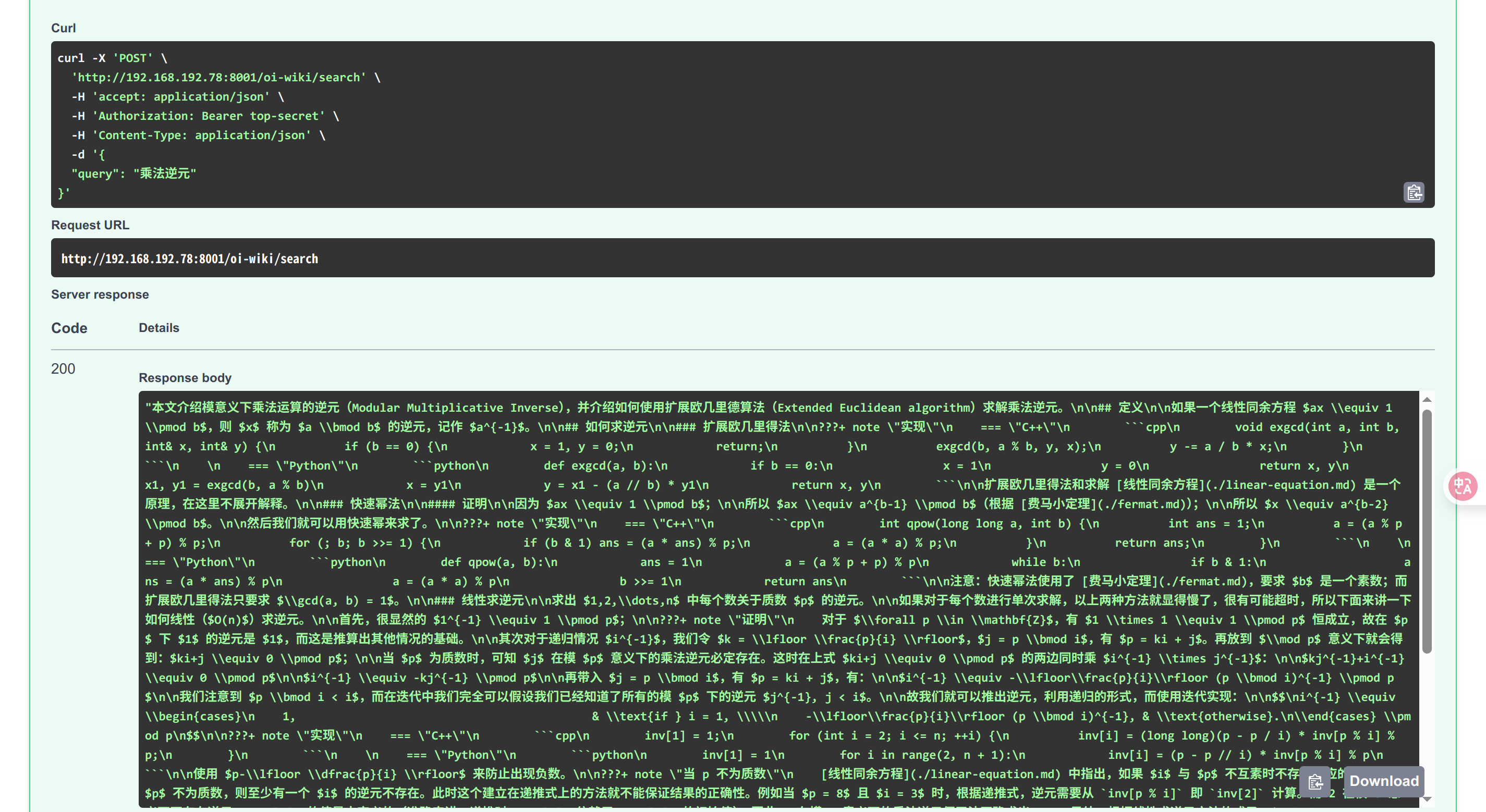
OI Wiki 致力于成为一个免费开放且持续更新的编程竞赛知识整合站点,大家可以在这里获取与竞赛相关的、有趣又实用的知识。本工具能够在 OI-wiki 中搜索相关的知识点。
query 应该比较详细,与要实现的算法/目标相关。比如:“求一个图的最小生成树”,“维护区间加/区间求和”
@ param query 描述要实现的需求
| Name | Required | Description | Default |
|---|---|---|---|
| query | Yes |
Does the description disclose side effects, auth requirements, rate limits, or destructive behavior?
No annotations are provided, so the description carries the full burden of behavioral disclosure. It mentions that the tool searches OI-wiki for knowledge points, but does not disclose critical behavioral traits such as whether it returns a list of results, how results are formatted, if there are rate limits, authentication needs, or error handling. The description is minimal and lacks operational details beyond the basic function.
Agents need to know what a tool does to the world before calling it. Descriptions should go beyond structured annotations to explain consequences.
Is the description appropriately sized, front-loaded, and free of redundancy?
The description is moderately concise but includes an unnecessary first sentence about OI Wiki's mission, which does not directly help in tool selection or invocation. The core tool function and parameter guidance are presented in subsequent sentences, but the structure could be improved by front-loading the tool's purpose more clearly. Overall, it's adequate but not optimally structured.
Shorter descriptions cost fewer tokens and are easier for agents to parse. Every sentence should earn its place.
Given the tool's complexity, does the description cover enough for an agent to succeed on first attempt?
Given the tool's complexity (a search function with no output schema and no annotations), the description is incomplete. It covers the basic purpose and parameter semantics but lacks details on behavioral aspects like result format, error cases, or usage limits. Without annotations or output schema, the description should provide more context to ensure the agent can use the tool effectively, but it falls short in this regard.
Complex tools with many parameters or behaviors need more documentation. Simple tools need less. This dimension scales expectations accordingly.
Does the description clarify parameter syntax, constraints, interactions, or defaults beyond what the schema provides?
The description adds significant meaning beyond the input schema, which has 0% coverage. It explains the 'query' parameter: '描述要实现的需求' (describes the requirement to implement) and provides examples like '求一个图的最小生成树' (find the minimum spanning tree of a graph). This clarifies the parameter's purpose and expected content, compensating well for the lack of schema descriptions, though it could be more detailed on constraints or formats.
Input schemas describe structure but not intent. Descriptions should explain non-obvious parameter relationships and valid value ranges.
Does the description clearly state what the tool does and how it differs from similar tools?
The description clearly states the tool's purpose: '本工具能够在 OI-wiki 中搜索相关的知识点' (This tool can search for relevant knowledge points in OI-wiki). It specifies the verb '搜索' (search) and the resource 'OI-wiki 中的知识点' (knowledge points in OI-wiki). However, it lacks explicit differentiation from siblings (though none exist), and the first sentence about OI Wiki's mission is somewhat tangential to the tool's function.
Agents choose between tools based on descriptions. A clear purpose with a specific verb and resource helps agents select the right tool.
Does the description explain when to use this tool, when not to, or what alternatives exist?
The description provides implied usage guidance through examples: 'query 应该比较详细,与要实现的算法/目标相关。比如:“求一个图的最小生成树”,“维护区间加/区间求和”' (The query should be detailed and related to the algorithm/goal to implement. For example: 'Find the minimum spanning tree of a graph', 'Maintain interval addition/interval summation'). This suggests when to use the tool (for detailed algorithm-related queries) but does not explicitly state when not to use it or mention alternatives, and there are no siblings to compare against.
Agents often have multiple tools that could apply. Explicit usage guidance like "use X instead of Y when Z" prevents misuse.
Recent tool additions, removals, and schema changes observed during successful MCP inspections.
v1.0.0searchScored across 1 tool
With only one tool, there is no possibility of ambiguity or overlap between tools. The single tool has a clearly defined and distinct purpose: searching the OI Wiki for programming competition knowledge.
The single tool name 'search' follows a simple, clear verb pattern. Since there is only one tool, consistency is inherently perfect with no deviations or mixed conventions to evaluate.
A single tool is too few for a server that appears to cover a broad domain like a programming competition knowledge base. The scope suggests needs for browsing, filtering, or accessing specific content beyond just search, making the toolset feel thin and underdeveloped.
The tool surface is severely incomplete for the domain. While search is useful, there are obvious gaps such as listing topics, getting detailed articles, or navigating categories, which limits an agent's ability to fully interact with the wiki's content.
Token-efficient search for coding agents over public and private documentation.
Persistent memory and knowledge graph for AI assistants — keyword + vector + graph search.
Cloud or self-hosted knowledge for AI agents: hybrid search, reranking, GraphRAG, scoped MCP tools.
Apple Developer Documentation with Semantic Search, RAG, and AI reranking for MCP clients