PolicyGuard
PolicyGuard is an MCP server that provides security governance for AI agents through policy-based access control, incident tracking, and compliance monitoring.
Core Capabilities:
Policy Enforcement: Create and manage security policies with pattern matching (e.g.,
delete_*,*_production) to control agent actions. Policies support conditions (tool patterns, trust levels) and actions (allow, deny, require_approval)Action Validation: Validate agent actions before execution using multi-layered evaluation of suspension status, denied/allowed lists, and policy rules via the
validate_actiontoolAgent Management: Register agents with configurable trust levels (low, medium, high, admin), tool permissions, and metadata
Audit Logging: Query comprehensive audit logs of all validations filtered by agent, action type, status, and time range (1h to 30d) with unique action IDs for correlation
Incident Management: Report and track security incidents (policy violations, suspicious activity, unauthorized access, data exfiltration) with severity levels (low, medium, high, critical), evidence collection, and auto-suspension for critical events
Compliance Monitoring: Generate compliance reports with security health metrics, active incidents, policy summaries, violations, and recommendations
Pattern-Based Security: Use wildcard patterns for flexible policy application to tool names
Human Approval Workflows: Require manual review for high-risk actions
Kubernetes Integration: Deploy via Helm chart and integrate with kagent for Kubernetes-native AI agent management
Multi-Protocol Support: Run in HTTP mode or via MCP protocol for integration with various AI platforms
Includes a Helm chart for Kubernetes-native deployment, enabling declarative management of the PolicyGuard service and its security policies.
Provides security and governance for AI agents within Kubernetes environments, supporting declarative agent management through kagent integration and custom resource definitions (CRDs).
Supports integration with Ollama as a local LLM provider for running AI agents governed by PolicyGuard security rules.
Click on "Install Server".
Wait a few minutes for the server to deploy. Once ready, it will show a "Started" state.
In the chat, type
@followed by the MCP server name and your instructions, e.g., "@PolicyGuardCheck if agent-alpha is authorized to execute 'delete_records' on production"
That's it! The server will respond to your query, and you can continue using it as needed.
Here is a step-by-step guide with screenshots.
PolicyGuard
Security & Governance MCP Server for AI Agents
PolicyGuard is an MCP (Model Context Protocol) server that provides policy-based access control, incident tracking, and compliance monitoring for AI agents.
Note: This project demonstrates working integration with kagent (AI agent platform) and can be extended with kgateway (API gateway) for additional network-level security.
Table of Contents
Related MCP server: promptspeak-mcp-server
Overview
As AI agents become more autonomous, organizations need controls to govern their behavior. PolicyGuard is my first MCP server project - built to explore how security and governance can be implemented at the MCP layer.
The Problem
AI agents can call any tool they have access to. Without governance:
Agents might perform destructive operations
No audit trail of agent actions
No way to enforce security policies
No visibility into compliance
The Solution
PolicyGuard adds a security layer that agents call before taking action:
User Request → AI Agent → PolicyGuard (validate_action) → Allowed/DeniedFeatures
Feature | Description |
Policy Enforcement | Validate actions against security rules |
Trust Levels | low, medium, high, admin hierarchy |
Pattern Matching | Wildcard patterns like |
Auto-Registration | Unknown agents get minimal trust |
Incident Tracking | Automatic violation logging |
Audit Trail | Complete action history |
Compliance Dashboard | Security metrics at a glance |
Architecture
┌─────────────────────────────────────────────────────────────────┐
│ AI Agent / LLM │
│ │
│ "Before any action, call validate_action to check permission" │
└─────────────────────────────────────────────────────────────────┘
│
│ MCP Protocol
▼
┌─────────────────────────────────────────────────────────────────┐
│ PolicyGuard MCP Server │
│ │
│ ┌─────────────┐ ┌─────────────┐ ┌─────────────┐ │
│ │ validate │ │ create │ │ report │ │
│ │ action │ │ policy │ │ incident │ │
│ └─────────────┘ └─────────────┘ └─────────────┘ │
│ ┌─────────────┐ ┌─────────────┐ ┌─────────────┐ │
│ │ register │ │ get_audit │ │ get │ │
│ │ agent │ │ log │ │ compliance │ │
│ └─────────────┘ └─────────────┘ └─────────────┘ │
└─────────────────────────────────────────────────────────────────┘
│
▼
┌───────────────────┐
│ JSON Storage │
│ (policies, │
│ agents, │
│ audit_log, │
│ incidents) │
└───────────────────┘MCP Tools
PolicyGuard exposes 6 tools via MCP:
1. validate_action ⭐ Primary Tool
Check if an action is allowed before executing it.
{
"action_type": "tool_call",
"target": "delete_records",
"agent_id": "my-agent"
}Response:
{
"action_id": "act_a1b2c3d4e5f6",
"allowed": false,
"reason": "Delete operations require admin trust level"
}2. register_agent
Register an agent with a trust level.
{
"agent_id": "data-processor",
"name": "Data Agent",
"trust_level": "medium"
}3. create_policy
Create security rules.
{
"policy_id": "block-deletes",
"name": "Block Deletes",
"rules": "[{\"condition\": {\"tool_pattern\": \"delete_*\"}, \"action\": \"deny\"}]"
}4. get_audit_log
Query action history.
5. get_compliance_status
Get security dashboard metrics.
6. report_incident
Manually report security incidents.
Quick Start
Prerequisites
Python 3.10+
pip
Local Installation
# Clone
git clone https://github.com/PrateekKumar1709/policyguard.git
cd policyguard
# Setup
python3 -m venv .venv
source .venv/bin/activate
pip install -e .
# Run
python src/main.pyTest the Tools
import json
from src.tools.validate_action import validate_action
from src.tools.register_agent import register_agent
# Register an agent
result = json.loads(register_agent.fn(
agent_id="test-agent",
name="Test Agent",
trust_level="medium"
))
print(f"Registered: {result['agent_id']}")
# Validate an action
result = json.loads(validate_action.fn(
action_type="tool_call",
target="read_data",
agent_id="test-agent"
))
print(f"Allowed: {result['allowed']}")HTTP Mode
python src/main.py --transport http --port 8000Kubernetes Deployment
PolicyGuard includes a Helm chart for Kubernetes deployment.
Using Kind
# Create cluster
kind create cluster --name policyguard
# Build and load image
docker build -t policyguard:latest .
kind load docker-image policyguard:latest --name policyguard
# Deploy
kubectl create namespace policyguard
helm install policyguard ./helm/policyguard -n policyguard
# Verify
kubectl get pods -n policyguardPort Forward
kubectl port-forward -n policyguard svc/policyguard 8000:8000Testing
Unit Tests
pytest tests/ -vTest Results
tests/test_tools.py::TestValidateAction::test_allow_read_for_low_trust PASSED
tests/test_tools.py::TestValidateAction::test_deny_delete_for_low_trust PASSED
tests/test_tools.py::TestValidateAction::test_allow_delete_for_admin PASSED
tests/test_tools.py::TestValidateAction::test_deny_suspended_agent PASSED
tests/test_tools.py::TestRegisterAgent::test_register_new_agent PASSED
tests/test_tools.py::TestCreatePolicy::test_create_valid_policy PASSED
... (16 tests total)
============================== 16 passed ==============================E2E Test Output
[1/6] register_agent ✅ SUCCESS
[2/6] create_policy ✅ SUCCESS
[3/6] validate_action ✅ ALLOWED (read_data)
[4/6] validate_action ✅ DENIED (delete_records)
[5/6] report_incident ✅ SUCCESS
[6/6] get_compliance_status ✅ SUCCESS
ALL 6 MCP TOOLS WORKING!kagent Integration
PolicyGuard integrates with kagent for Kubernetes-native AI agent management.
Screenshots
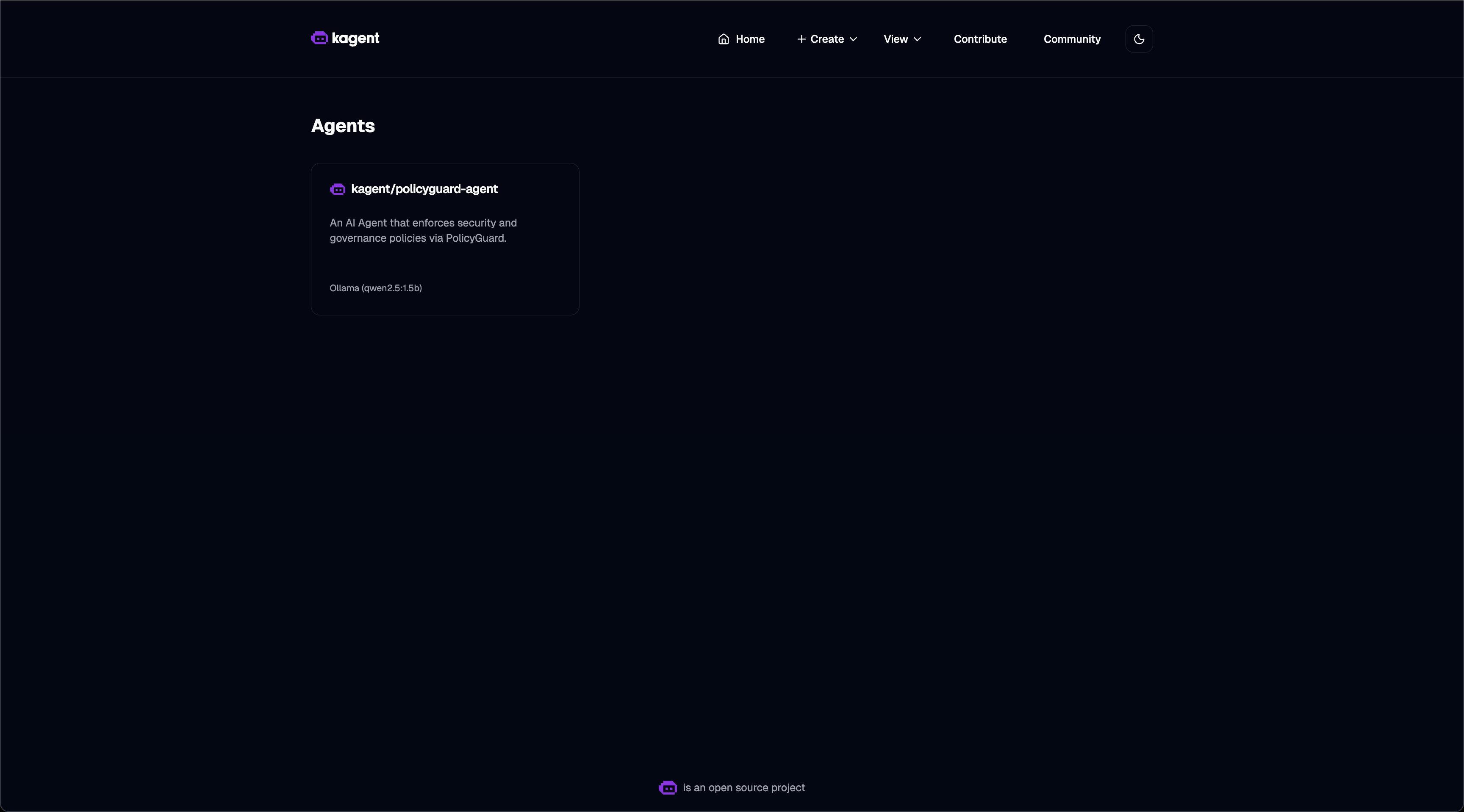
Agent List - PolicyGuard agent registered and ready:
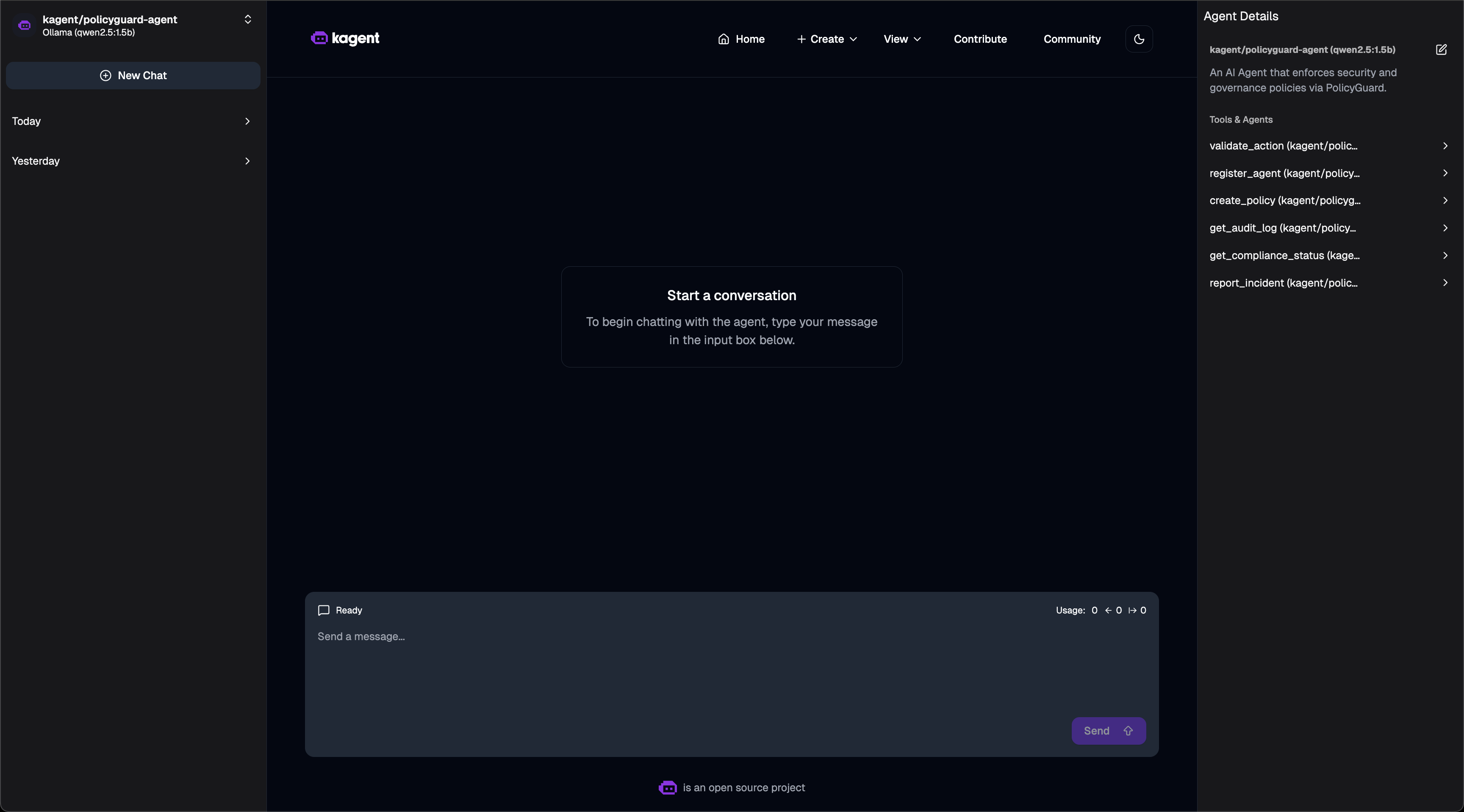
Agent Tools - 6 PolicyGuard MCP tools available:
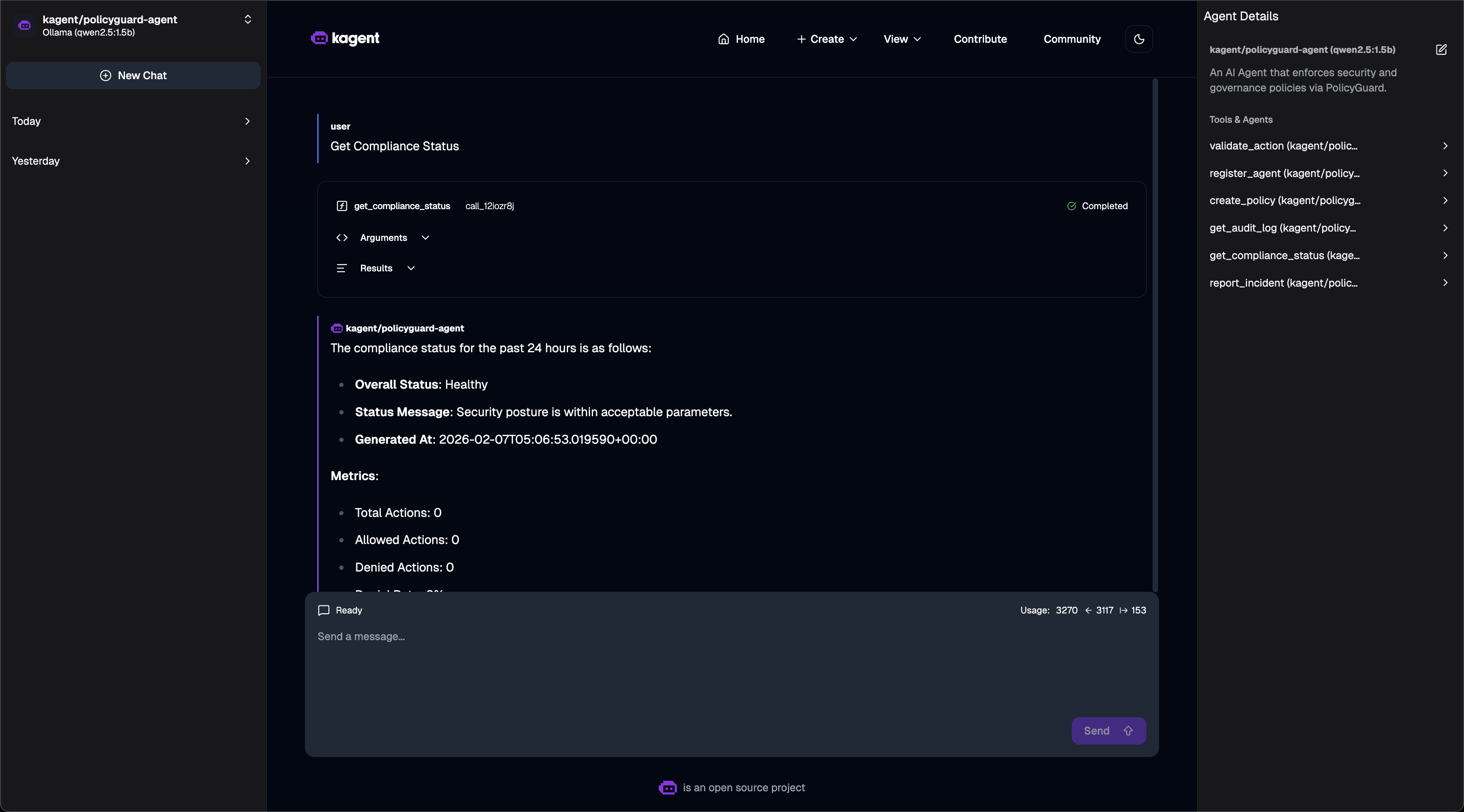
Compliance Dashboard - Asking for compliance status:
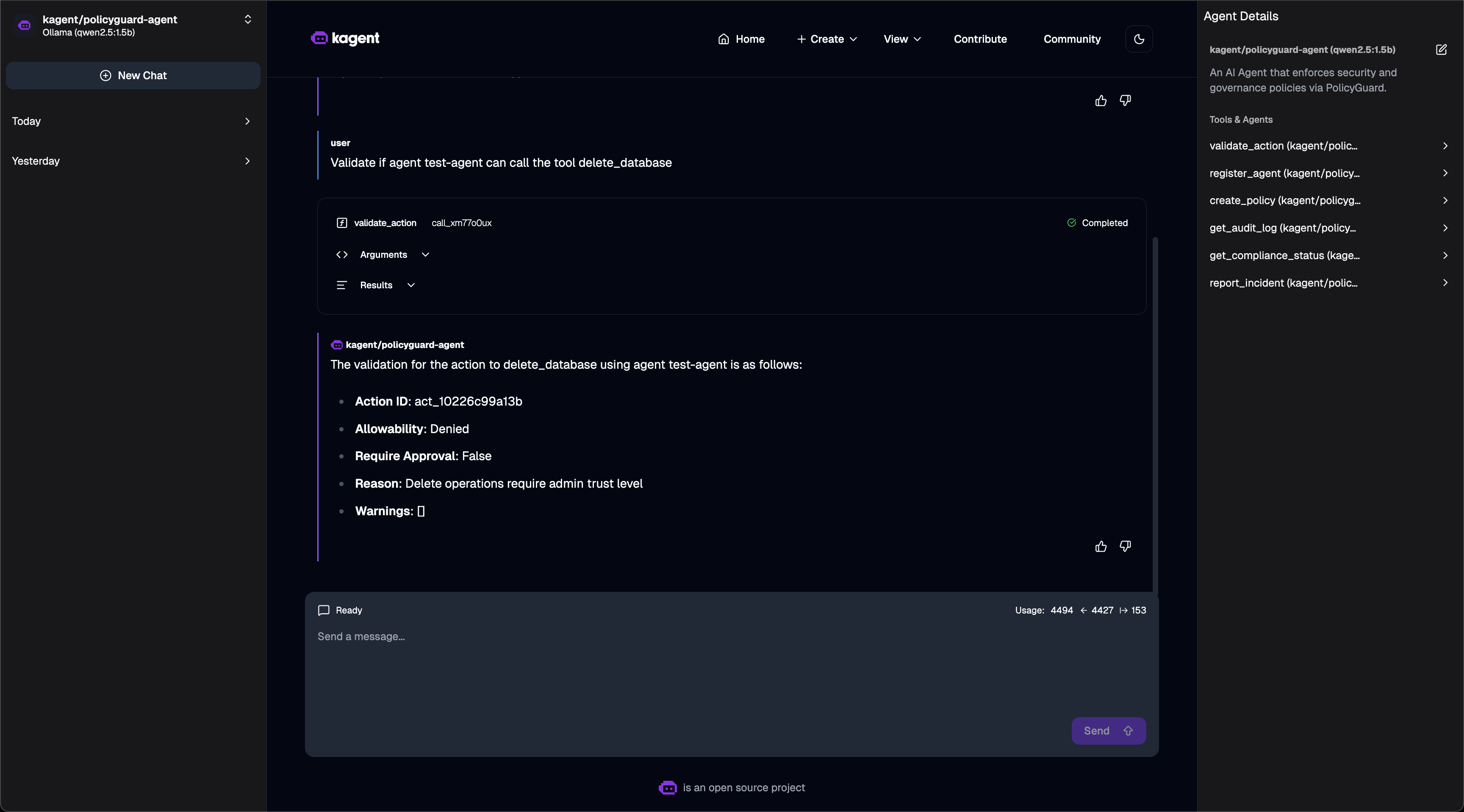
Policy Validation - Action denied based on policy:
Quick Setup
# 1. Install kagent CRDs
helm install kagent-crds ./kagent-reference/helm/kagent-crds -n kagent --create-namespace
# 2. Install kagent with Ollama (free local LLM)
helm upgrade --install kagent ./kagent-reference/helm/kagent -n kagent \
--set providers.default=ollama \
--set providers.ollama.model=qwen2.5:1.5b \
--set tag=0.7.13
# 3. Deploy PolicyGuard
helm install policyguard ./helm/policyguard -n policyguard --create-namespace
# 4. Create RemoteMCPServer
kubectl apply -f - <<EOF
apiVersion: kagent.dev/v1alpha2
kind: RemoteMCPServer
metadata:
name: policyguard
namespace: kagent
spec:
protocol: STREAMABLE_HTTP
url: http://policyguard.policyguard:8000/mcp
timeout: 30s
EOF
# 5. Create PolicyGuard Agent
kubectl apply -f - <<EOF
apiVersion: kagent.dev/v1alpha2
kind: Agent
metadata:
name: policyguard-agent
namespace: kagent
spec:
description: "Security agent using PolicyGuard"
type: Declarative
declarative:
modelConfig: "default-model-config"
systemMessage: |
You are a PolicyGuard Security Agent. Use the PolicyGuard tools to:
- validate_action: Check if actions are allowed
- register_agent: Register new agents
- create_policy: Define security rules
- get_compliance_status: View compliance dashboard
tools:
- type: McpServer
mcpServer:
name: policyguard
kind: RemoteMCPServer
apiGroup: kagent.dev
toolNames:
- validate_action
- register_agent
- create_policy
- get_audit_log
- get_compliance_status
- report_incident
EOFVerified Working
# Check status
$ kubectl get agents,remotemcpservers -n kagent
NAME TYPE READY ACCEPTED
policyguard-agent Declarative True True
NAME PROTOCOL URL ACCEPTED
policyguard STREAMABLE_HTTP http://policyguard.policyguard:8000/mcp True
# Invoke agent via CLI
$ kagent invoke -t "Get compliance status" --agent policyguard-agent
Response:
- Security Posture: Healthy
- Total Policies: 1, Enabled: 1
- Total Incidents: 0
- Agents Registered: 0
# Test validation
$ kagent invoke -t "Can test-agent delete the database?" --agent policyguard-agent
Response:
The action delete_database was not allowed for test-agent.
Reason: Delete operations require admin trust level.Access kagent UI
kubectl port-forward -n kagent svc/kagent-ui 8080:8080
# Open http://localhost:8080Security Model
Trust Levels
Level | Score | Use Case |
| 1 | Unknown agents, read-only |
| 2 | Verified agents |
| 3 | Trusted agents |
| 4 | Full access |
Policy Rules
{
"condition": {
"tool_pattern": "delete_*",
"trust_level_below": "admin"
},
"action": "deny",
"message": "Delete requires admin"
}Evaluation Order
Agent suspended? → DENY
Tool in denied list? → DENY
Tool not in allowed list? → DENY
Policy match? → Apply rule
Default → ALLOW
Project Structure
policyguard/
├── helm/
│ └── policyguard/ # Helm chart
│ ├── Chart.yaml
│ ├── values.yaml
│ └── templates/
├── src/
│ ├── main.py # Entry point
│ ├── core/
│ │ ├── server.py # MCP server
│ │ └── utils.py # Utilities
│ └── tools/
│ ├── validate_action.py
│ ├── register_agent.py
│ ├── create_policy.py
│ ├── get_audit_log.py
│ ├── get_compliance_status.py
│ └── report_incident.py
├── tests/
│ └── test_tools.py # 16 unit tests
├── Dockerfile
├── pyproject.toml
└── README.mdTechnologies Used
FastMCP - Python MCP server SDK
Pydantic - Data validation
Helm - Kubernetes packaging
pytest - Testing
Future Improvements
Database backend (PostgreSQL)
Web dashboard UI
Prometheus metrics
RBAC integration
Policy versioning
License
MIT License
Hackathon
MCP_HACK//26 - "MCP & AI Agents Starter Track"
This is my first MCP server project! I built PolicyGuard to learn:
How MCP servers work
How to expose tools to AI agents
How to deploy MCP servers on Kubernetes
How security/governance can be implemented at the MCP layer
What I Built
✅ 6 MCP tools for security governance
✅ Policy engine with pattern matching
✅ Trust level system
✅ Audit logging and incident tracking
✅ Helm chart for Kubernetes
✅ 16 unit tests
✅ kagent integration examples
Available Tools
6 toolscreate_policyA
Create or update a security policy for agent governance.
Policies define rules that control what agents can do. Each policy contains conditions and actions (allow/deny/require_approval).
Args: policy_id: Unique identifier for the policy (e.g., "prod-db-access") name: Human-readable name (e.g., "Production Database Access Control") description: Description of what this policy controls rules: JSON array of rule objects. Each rule has: - condition: Object with matching criteria - tool_pattern: Glob pattern for tool names (e.g., "database_*") - action_type: Type of action (e.g., "tool_call") - trust_level_at_least: Minimum trust level required - trust_level_below: Trigger if trust below this level - action: "allow", "deny", or "require_approval" - message: Message to show when rule matches priority: Higher priority policies are evaluated first (default: 100) enabled: Whether the policy is active (default: true)
Returns: JSON string with creation result: - success: Whether creation succeeded - policy_id: The policy's ID - message: Status message
Example: create_policy( policy_id="prevent-deletions", name="Prevent Dangerous Deletions", description="Block delete operations for non-admin agents", rules='[{"condition": {"tool_pattern": "delete_*", "trust_level_below": "admin"}, "action": "deny", "message": "Delete operations require admin access"}]' )
| Name | Required | Description | Default |
|---|---|---|---|
| policy_id | Yes | ||
| name | Yes | ||
| description | Yes | ||
| rules | Yes | ||
| priority | No | ||
| enabled | No |
Output Schema
| Name | Required | Description |
|---|---|---|
| result | Yes |
TDQS
Does the description disclose side effects, auth requirements, rate limits, or destructive behavior?
With no annotations provided, the description carries the full burden of behavioral disclosure. It clearly indicates this is a write operation ('Create or update') and describes the policy structure, but doesn't mention important behavioral aspects like authentication requirements, rate limits, idempotency, or what happens when updating existing policies versus creating new ones. The example helps but doesn't cover all behavioral traits.
Agents need to know what a tool does to the world before calling it. Descriptions should go beyond structured annotations to explain consequences.
Is the description appropriately sized, front-loaded, and free of redundancy?
The description is well-structured with clear sections (purpose, args, returns, example) and front-loads the core purpose. While comprehensive, some sentences could be more concise (e.g., the rules explanation is detailed but necessary given complexity). No wasted text, though the formatting with line breaks could be optimized for pure conciseness.
Shorter descriptions cost fewer tokens and are easier for agents to parse. Every sentence should earn its place.
Given the tool's complexity, does the description cover enough for an agent to succeed on first attempt?
For a 6-parameter mutation tool with no annotations, the description provides substantial context including parameter details, return format, and a complete example. The presence of an output schema reduces the need to fully document return values. The main gap is lack of behavioral context around permissions, side effects, and error conditions, but overall it's quite complete for the tool's complexity.
Complex tools with many parameters or behaviors need more documentation. Simple tools need less. This dimension scales expectations accordingly.
Does the description clarify parameter syntax, constraints, interactions, or defaults beyond what the schema provides?
Given 0% schema description coverage, the description provides excellent parameter semantics that fully compensate. It documents all 6 parameters with clear explanations, including detailed breakdown of the complex 'rules' parameter structure with its nested condition and action components. Default values for 'priority' and 'enabled' are explicitly stated, and the example demonstrates proper usage.
Input schemas describe structure but not intent. Descriptions should explain non-obvious parameter relationships and valid value ranges.
Does the description clearly state what the tool does and how it differs from similar tools?
The description clearly states the tool's purpose with specific verbs ('Create or update') and resource ('security policy for agent governance'). It distinguishes itself from sibling tools like get_audit_log or report_incident by focusing on policy creation/update rather than retrieval or reporting functions.
Agents choose between tools based on descriptions. A clear purpose with a specific verb and resource helps agents select the right tool.
Does the description explain when to use this tool, when not to, or what alternatives exist?
The description implies usage context through the explanation of what policies do ('define rules that control what agents can do'), but doesn't explicitly state when to use this tool versus alternatives. No guidance is provided about prerequisites, dependencies, or specific scenarios where this tool should be selected over other policy-related tools (though none appear in the sibling list).
Agents often have multiple tools that could apply. Explicit usage guidance like "use X instead of Y when Z" prevents misuse.
get_audit_logA
Retrieve audit log entries for compliance and investigation.
The audit log records all action validations, policy violations, and administrative actions performed through Guardian Agent.
Args: agent_id: Filter by specific agent ID (optional) action_type: Filter by action type like "tool_call", "resource_access" (optional) time_range: Time range to query - "1h", "24h", "7d", "30d" (default: "24h") status: Filter by status - "allowed", "denied", or "" for all (optional) limit: Maximum number of entries to return (default: 100)
Returns: JSON string with: - entries: Array of audit log entries - count: Number of entries returned - total: Total entries matching filter (before limit) - time_range: The time range used - filters_applied: Summary of filters used
Example: # Get all denied actions in the last hour get_audit_log(time_range="1h", status="denied")
# Get all actions by a specific agent
get_audit_log(agent_id="prod-agent-01", time_range="7d")| Name | Required | Description | Default |
|---|---|---|---|
| agent_id | No | ||
| action_type | No | ||
| time_range | No | 24h | |
| status | No | ||
| limit | No |
Output Schema
| Name | Required | Description |
|---|---|---|
| result | Yes |
TDQS
Does the description disclose side effects, auth requirements, rate limits, or destructive behavior?
With no annotations provided, the description carries the full burden of behavioral disclosure. It describes what the tool retrieves (audit log entries with specific filters) and includes return format details, which is helpful. However, it lacks critical behavioral traits: it doesn't mention whether this is a read-only operation, if it requires specific permissions, rate limits, pagination behavior beyond the 'limit' parameter, or error conditions. The description adds value but leaves significant gaps.
Agents need to know what a tool does to the world before calling it. Descriptions should go beyond structured annotations to explain consequences.
Is the description appropriately sized, front-loaded, and free of redundancy?
The description is well-structured with purpose statement, parameter documentation, return format, and examples. It's appropriately sized for a 5-parameter tool with output details. While efficient, the initial purpose sentence could be more front-loaded with key distinguishing information, and some sections (like the Returns block) are slightly verbose but still valuable.
Shorter descriptions cost fewer tokens and are easier for agents to parse. Every sentence should earn its place.
Given the tool's complexity, does the description cover enough for an agent to succeed on first attempt?
Given the tool's moderate complexity (5 parameters, no annotations, but has output schema), the description is reasonably complete. It fully documents parameters and return format, and the output schema reduces the need to explain return values in detail. However, it lacks behavioral context (permissions, safety, rate limits) and sibling differentiation, which are important gaps for a compliance/investigation tool.
Complex tools with many parameters or behaviors need more documentation. Simple tools need less. This dimension scales expectations accordingly.
Does the description clarify parameter syntax, constraints, interactions, or defaults beyond what the schema provides?
Schema description coverage is 0%, so the description must fully compensate. It does this excellently: it documents all 5 parameters with clear semantics, optional/default status, allowed values (e.g., time_range options, status values), and practical examples. The description adds substantial meaning beyond what the bare schema provides, making parameters fully understandable.
Input schemas describe structure but not intent. Descriptions should explain non-obvious parameter relationships and valid value ranges.
Does the description clearly state what the tool does and how it differs from similar tools?
The description clearly states the tool's purpose: 'Retrieve audit log entries for compliance and investigation.' It specifies the verb ('Retrieve') and resource ('audit log entries'), and mentions the system context ('Guardian Agent'). However, it doesn't explicitly differentiate from sibling tools like 'get_compliance_status' or 'report_incident', which might have overlapping compliance/investigation domains.
Agents choose between tools based on descriptions. A clear purpose with a specific verb and resource helps agents select the right tool.
Does the description explain when to use this tool, when not to, or what alternatives exist?
The description provides no guidance on when to use this tool versus alternatives. It doesn't mention sibling tools like 'get_compliance_status' or 'validate_action', nor does it specify prerequisites, exclusions, or typical use cases beyond generic 'compliance and investigation'. The examples show how to call it, but not when it's the appropriate choice.
Agents often have multiple tools that could apply. Explicit usage guidance like "use X instead of Y when Z" prevents misuse.
get_compliance_statusA
Get compliance status and security health metrics.
Generates a compliance report showing policy violations, security incidents, and overall governance health for the specified time period.
Args: time_range: Time range - "1h", "24h", "7d", "30d" (default: "24h") include_incidents: Include active incidents in report (default: true) include_policy_summary: Include policy overview (default: true)
Returns: JSON string with compliance report: - status: Overall status ("healthy", "warning", "critical") - metrics: Key security metrics - incidents: Active security incidents (if requested) - policies: Policy summary (if requested) - recommendations: Suggested actions to improve security
Example: # Get daily compliance status get_compliance_status(time_range="24h")
# Get weekly report with all details
get_compliance_status(time_range="7d", include_incidents=True)| Name | Required | Description | Default |
|---|---|---|---|
| time_range | No | 24h | |
| include_incidents | No | ||
| include_policy_summary | No |
Output Schema
| Name | Required | Description |
|---|---|---|
| result | Yes |
TDQS
Does the description disclose side effects, auth requirements, rate limits, or destructive behavior?
With no annotations provided, the description carries full burden and does well by disclosing key behavioral traits: it's a read-only operation (implied by 'Get' and 'Generates'), describes the report content structure, mentions default values for parameters, and provides example usage patterns. However, it doesn't mention potential limitations like rate limits, authentication requirements, or data freshness constraints.
Agents need to know what a tool does to the world before calling it. Descriptions should go beyond structured annotations to explain consequences.
Is the description appropriately sized, front-loaded, and free of redundancy?
The description is well-structured with clear sections (purpose, args, returns, examples) and appropriately sized. Every sentence adds value, though the example section could be slightly more concise. The information is front-loaded with the core purpose stated first, followed by supporting details.
Shorter descriptions cost fewer tokens and are easier for agents to parse. Every sentence should earn its place.
Given the tool's complexity, does the description cover enough for an agent to succeed on first attempt?
Given the tool's complexity (3 parameters, no annotations, but has output schema), the description is complete enough. It explains the purpose, parameters, return structure, and provides usage examples. The output schema existence means the description doesn't need to exhaustively document return values, and it provides adequate context for an agent to understand and use the tool effectively.
Complex tools with many parameters or behaviors need more documentation. Simple tools need less. This dimension scales expectations accordingly.
Does the description clarify parameter syntax, constraints, interactions, or defaults beyond what the schema provides?
With 0% schema description coverage, the description fully compensates by providing detailed parameter documentation in the 'Args' section, including all 3 parameters with their purposes, acceptable values, and defaults. It adds substantial meaning beyond what the bare schema provides, explaining what each parameter controls in the compliance report generation.
Input schemas describe structure but not intent. Descriptions should explain non-obvious parameter relationships and valid value ranges.
Does the description clearly state what the tool does and how it differs from similar tools?
The description clearly states the tool's purpose with specific verbs ('Get compliance status and security health metrics', 'Generates a compliance report') and resources ('policy violations, security incidents, overall governance health'). It distinguishes from siblings like 'get_audit_log' or 'report_incident' by focusing on comprehensive compliance assessment rather than logging or incident reporting.
Agents choose between tools based on descriptions. A clear purpose with a specific verb and resource helps agents select the right tool.
Does the description explain when to use this tool, when not to, or what alternatives exist?
The description implies usage through the example scenarios ('Get daily compliance status', 'Get weekly report with all details'), but doesn't explicitly state when to use this tool versus alternatives like 'get_audit_log' or 'validate_action'. It provides context about time periods and detail levels but lacks explicit guidance on tool selection among siblings.
Agents often have multiple tools that could apply. Explicit usage guidance like "use X instead of Y when Z" prevents misuse.
register_agentA
Register a new agent with Guardian for security policy evaluation.
Registered agents get proper trust levels and can have custom tool permissions. Unregistered agents are treated as 'low' trust.
Args: agent_id: Unique identifier for the agent (e.g., "prod-assistant-01") name: Human-readable name (e.g., "Production Assistant") description: Description of the agent's purpose trust_level: Trust level - "low", "medium", "high", or "admin" allowed_tools: JSON array of allowed tool patterns (e.g., '["read_*", "query_*"]') denied_tools: JSON array of denied tool patterns (e.g., '["delete_*", "drop_*"]') metadata: JSON object with additional agent metadata
Returns: JSON string with registration result: - success: Whether registration succeeded - agent_id: The agent's ID - message: Status message - warnings: Any warnings about the registration
Example: register_agent( agent_id="data-analyst-01", name="Data Analyst Bot", description="Runs analytical queries on warehouse", trust_level="medium", allowed_tools='["query_*", "read_*"]', denied_tools='["delete_*", "drop_*", "truncate_*"]' )
| Name | Required | Description | Default |
|---|---|---|---|
| agent_id | Yes | ||
| name | Yes | ||
| description | No | ||
| trust_level | No | medium | |
| allowed_tools | No | [] | |
| denied_tools | No | [] | |
| metadata | No | {} |
Output Schema
| Name | Required | Description |
|---|---|---|
| result | Yes |
TDQS
Does the description disclose side effects, auth requirements, rate limits, or destructive behavior?
With no annotations provided, the description carries the full burden of behavioral disclosure. It effectively describes key behaviors: this is a registration/mutation operation (implied by 'register'), it affects trust levels and tool permissions, and it returns a structured JSON result. It doesn't mention authentication requirements, rate limits, or error conditions, but provides substantial operational context beyond basic purpose.
Agents need to know what a tool does to the world before calling it. Descriptions should go beyond structured annotations to explain consequences.
Is the description appropriately sized, front-loaded, and free of redundancy?
The description is well-structured with clear sections: purpose statement, parameter explanations, return format, and example. While somewhat lengthy, every sentence adds value. The front-loaded purpose statement is strong, though the detailed parameter explanations could be more concise while maintaining clarity.
Shorter descriptions cost fewer tokens and are easier for agents to parse. Every sentence should earn its place.
Given the tool's complexity, does the description cover enough for an agent to succeed on first attempt?
Given the tool's complexity (7 parameters, mutation operation), no annotations, and the presence of an output schema, the description provides comprehensive context. It explains the tool's purpose, all parameters with semantics, the return format, and includes a practical example. The output schema means the description doesn't need to detail return values, and it adequately covers what's needed for effective use.
Complex tools with many parameters or behaviors need more documentation. Simple tools need less. This dimension scales expectations accordingly.
Does the description clarify parameter syntax, constraints, interactions, or defaults beyond what the schema provides?
The schema has 0% description coverage, so the description must fully compensate. It provides detailed semantic explanations for all 7 parameters, including examples, format requirements (e.g., 'JSON array', 'JSON object'), and allowed values for 'trust_level'. This adds significant value beyond the bare schema, making parameter usage clear and actionable.
Input schemas describe structure but not intent. Descriptions should explain non-obvious parameter relationships and valid value ranges.
Does the description clearly state what the tool does and how it differs from similar tools?
The description clearly states the tool's purpose: 'Register a new agent with Guardian for security policy evaluation.' It specifies the verb ('register'), resource ('agent'), and context ('Guardian for security policy evaluation'), distinguishing it from sibling tools like 'create_policy' or 'get_audit_log' which handle different security functions.
Agents choose between tools based on descriptions. A clear purpose with a specific verb and resource helps agents select the right tool.
Does the description explain when to use this tool, when not to, or what alternatives exist?
The description provides clear context for when to use this tool: to register agents for security policy evaluation, with implications about trust levels and tool permissions. It mentions that 'Unregistered agents are treated as 'low' trust,' which helps understand the consequences of not using it. However, it doesn't explicitly state when NOT to use it or name specific alternatives among the sibling tools.
Agents often have multiple tools that could apply. Explicit usage guidance like "use X instead of Y when Z" prevents misuse.
report_incidentA
Report a security incident for investigation and tracking.
Use this tool to log security incidents such as policy violations, suspicious agent behavior, or potential security threats.
Args: incident_type: Type of incident: - "policy_violation": Agent violated a security policy - "suspicious_activity": Unusual or potentially malicious behavior - "unauthorized_access": Attempt to access restricted resources - "rate_limit_exceeded": Agent exceeded rate limits - "data_exfiltration": Potential data leak detected - "configuration_error": Security misconfiguration detected - "other": Other security concern severity: Incident severity: - "low": Minor issue, no immediate action needed - "medium": Notable issue, should be reviewed - "high": Serious issue, needs prompt attention - "critical": Emergency, immediate action required description: Detailed description of the incident agent_id: ID of the agent involved (if applicable) evidence: JSON object with supporting evidence/data recommended_action: Suggested remediation steps
Returns: JSON string with: - incident_id: Unique incident identifier - success: Whether the incident was logged - message: Status message - agent_suspended: Whether the agent was auto-suspended
Example: report_incident( incident_type="suspicious_activity", severity="high", description="Agent attempted to access 50 databases in 1 minute", agent_id="rogue-agent-01", evidence='{"databases_accessed": 50, "time_window": "60s"}', recommended_action="Review agent permissions and suspend if needed" )
| Name | Required | Description | Default |
|---|---|---|---|
| incident_type | Yes | ||
| severity | Yes | ||
| description | Yes | ||
| agent_id | No | ||
| evidence | No | {} | |
| recommended_action | No |
Output Schema
| Name | Required | Description |
|---|---|---|
| result | Yes |
TDQS
Does the description disclose side effects, auth requirements, rate limits, or destructive behavior?
With no annotations provided, the description carries the full burden of behavioral disclosure. It effectively describes the tool's behavior: it logs incidents for investigation and tracking, and the 'Returns' section details outcomes like incident ID generation, success status, and potential agent suspension. This covers key behavioral aspects without contradictions.
Agents need to know what a tool does to the world before calling it. Descriptions should go beyond structured annotations to explain consequences.
Is the description appropriately sized, front-loaded, and free of redundancy?
The description is well-structured with sections for purpose, usage, arguments, returns, and an example. It is appropriately sized for a 6-parameter tool, though it could be slightly more concise by integrating the example more tightly. Every sentence adds value, such as clarifying parameter options and output format.
Shorter descriptions cost fewer tokens and are easier for agents to parse. Every sentence should earn its place.
Given the tool's complexity, does the description cover enough for an agent to succeed on first attempt?
Given the tool's complexity (6 parameters, no annotations, but with an output schema), the description is highly complete. It explains the tool's purpose, usage, all parameters in detail, return values, and includes a practical example. The output schema is referenced in the 'Returns' section, making the description comprehensive for agent use.
Complex tools with many parameters or behaviors need more documentation. Simple tools need less. This dimension scales expectations accordingly.
Does the description clarify parameter syntax, constraints, interactions, or defaults beyond what the schema provides?
The schema description coverage is 0%, so the description must compensate fully. It does so by providing detailed semantics for all 6 parameters, including enumerated values for 'incident_type' and 'severity', and clear explanations for others like 'description' and 'evidence'. This adds significant value beyond the basic schema.
Input schemas describe structure but not intent. Descriptions should explain non-obvious parameter relationships and valid value ranges.
Does the description clearly state what the tool does and how it differs from similar tools?
The description clearly states the tool's purpose: 'Report a security incident for investigation and tracking.' It specifies the verb ('report') and resource ('security incident'), and distinguishes it from siblings like 'create_policy' or 'get_audit_log' by focusing on incident reporting rather than policy management or log retrieval.
Agents choose between tools based on descriptions. A clear purpose with a specific verb and resource helps agents select the right tool.
Does the description explain when to use this tool, when not to, or what alternatives exist?
The description provides clear context for when to use the tool: 'Use this tool to log security incidents such as policy violations, suspicious agent behavior, or potential security threats.' It lists specific incident types, giving practical guidance. However, it does not explicitly state when not to use it or name alternatives among sibling tools.
Agents often have multiple tools that could apply. Explicit usage guidance like "use X instead of Y when Z" prevents misuse.
validate_actionA
Validate whether an agent can perform a specific action.
This is the PRIMARY security gate. Agents should call this BEFORE performing any sensitive action to ensure compliance with security policies.
Args: action_type: Type of action (e.g., "tool_call", "resource_access", "data_read", "data_write") target: Target of the action (e.g., tool name, resource URI, database name) agent_id: Unique identifier of the requesting agent parameters: JSON string of action-specific parameters (optional) context: Additional context about why this action is needed (optional)
Returns: JSON string with validation result: - action_id: Unique ID for this validation (for audit correlation) - allowed: Whether the action is permitted - require_approval: If true, action needs human approval first - reason: Explanation of the decision - warnings: Any non-blocking warnings
Example: validate_action( action_type="tool_call", target="database_delete", agent_id="prod-agent-01", parameters='{"table": "users"}', context="Cleanup stale records" )
| Name | Required | Description | Default |
|---|---|---|---|
| action_type | Yes | ||
| target | Yes | ||
| agent_id | Yes | ||
| parameters | No | {} | |
| context | No |
Output Schema
| Name | Required | Description |
|---|---|---|
| result | Yes |
TDQS
Does the description disclose side effects, auth requirements, rate limits, or destructive behavior?
With no annotations provided, the description carries the full burden of behavioral disclosure. It effectively communicates this is a security validation tool that returns structured decisions (allowed/require_approval) and generates audit correlation IDs. However, it doesn't mention potential side effects like audit logging, rate limits, or authentication requirements that might be relevant for security tools.
Agents need to know what a tool does to the world before calling it. Descriptions should go beyond structured annotations to explain consequences.
Is the description appropriately sized, front-loaded, and free of redundancy?
The description is well-structured and front-loaded with the core purpose and usage guidance, followed by organized parameter documentation and a complete example. Every sentence adds value: the security gate positioning, the workflow guidance, parameter explanations, return format details, and illustrative example all serve distinct purposes without redundancy.
Shorter descriptions cost fewer tokens and are easier for agents to parse. Every sentence should earn its place.
Given the tool's complexity, does the description cover enough for an agent to succeed on first attempt?
Given the tool's security-critical nature, 5 parameters with 0% schema coverage, and no annotations, the description provides comprehensive context. It explains the tool's role in the security workflow, documents all parameters with examples, details the return format (though an output schema exists), and includes a complete usage example. This fully compensates for the lack of structured metadata.
Complex tools with many parameters or behaviors need more documentation. Simple tools need less. This dimension scales expectations accordingly.
Does the description clarify parameter syntax, constraints, interactions, or defaults beyond what the schema provides?
With 0% schema description coverage, the description fully compensates by providing detailed parameter explanations with examples for all 5 parameters. Each parameter gets clear semantic meaning beyond the basic schema types (e.g., action_type examples like 'tool_call', 'resource_access'; target examples like 'tool name', 'resource URI'; parameters as 'JSON string of action-specific parameters').
Input schemas describe structure but not intent. Descriptions should explain non-obvious parameter relationships and valid value ranges.
Does the description clearly state what the tool does and how it differs from similar tools?
The description clearly states the tool's purpose with specific verbs ('validate whether an agent can perform a specific action') and distinguishes it from siblings by emphasizing it's the 'PRIMARY security gate' for pre-action compliance checks. It explicitly differentiates from audit/logging tools like get_audit_log and policy management tools like create_policy.
Agents choose between tools based on descriptions. A clear purpose with a specific verb and resource helps agents select the right tool.
Does the description explain when to use this tool, when not to, or what alternatives exist?
The description provides explicit guidance on when to use this tool ('BEFORE performing any sensitive action') and why ('to ensure compliance with security policies'). It establishes a clear workflow relationship with other tools by positioning this as a prerequisite gatekeeper function.
Agents often have multiple tools that could apply. Explicit usage guidance like "use X instead of Y when Z" prevents misuse.
TDQS
Each tool has a distinct and clearly defined purpose: create_policy defines policies, get_audit_log retrieves logs, get_compliance_status provides reports, register_agent manages agents, report_incident logs incidents, and validate_action checks permissions. There is no overlap or ambiguity in their functions.
All tool names follow a consistent verb_noun pattern (e.g., create_policy, get_audit_log, register_agent). The verbs are appropriate and descriptive, and there are no deviations or mixed conventions, making the set highly predictable.
With 6 tools, the server is well-scoped for agent governance and security policy management. Each tool serves a clear role in the lifecycle (e.g., policy creation, agent registration, action validation, incident reporting, auditing, and compliance), with no redundant or missing tools.
The tool set provides complete coverage for the security policy domain: create_policy for policy management, validate_action for enforcement, get_audit_log and get_compliance_status for monitoring, register_agent for agent setup, and report_incident for incident handling. There are no obvious gaps, enabling full agent governance workflows.
Maintenance
Resources
Unclaimed servers have limited discoverability.
Looking for Admin?
If you are the server author, to access and configure the admin panel.
Related MCP Connectors
Security gateway for AI agents: policy, approval, and audited execution, no secrets shared.
Zero-trust gateway for AI agents: score tool calls, verify agent cards, enforce policy, audit.
Register every AI agent, log every action, prove it. EU AI Act compliance built in.
Credential broker for AI agents: scoped, revocable API access with policy enforcement and audit.
Related MCP Servers
- FlicenseAqualityDmaintenanceProvides real-time policy enforcement for AI coding agents by intercepting and validating their actions against organizational standards like naming conventions, security policies, and compliance rules before execution. Prevents violations through immediate feedback and auto-correction suggestions.5
- AlicenseBqualityCmaintenancePre-execution governance for AI agents. 45 MCP tools for hold queues, audit trails, risk scoring, and policy enforcement. Validates agent actions before they execute.451181MIT
- AlicenseNot gradedqualityBmaintenanceAn enforcement layer that validates AI agent actions against governance policies, including path permissions and content scanning, at runtime. It enables secure, role-based execution of file operations and commands with zero token overhead by processing policies independently from the agent's context.683MIT
- AlicenseAqualityAmaintenancePolicy-based governance for AI agent tool calls. YAML policies, approval gates, risk assessment, and audit logging across LangChain, OpenAI, Anthropic, and MCP.515MIT
Appeared in Searches
Latest Blog Posts
- Who's Calling? MCP Hosts Are an Identity Blind Spot (And the Spec Knows It)By Om-Shree-0709 on .mcpAgent IdentityOAuth 2.1
- Your AI Chatbot Just Exposed Your CEO's Salary to an InternBy Om-Shree-0709 on .Agent IdentityMCP SecurityOAuth Delegation
- Why MCP Servers Need Execution Sandboxing (And Why Your Current Stack Isn't Enough)By Om-Shree-0709 on .Agentic AiPrompt InjectionWebAssembly
MCP directory API
We provide all the information about MCP servers via our MCP API.
curl -X GET 'https://glama.ai/api/mcp/v1/servers/PrateekKumar1709/policyguard'
If you have feedback or need assistance with the MCP directory API, please join our Discord server