MCP Server Reddit
MCP 서버 Reddit
LLM을 위한 Reddit 공개 API에 대한 액세스를 제공하는 모델 컨텍스트 프로토콜 서버입니다. 이 서버를 통해 LLM은 Reddit 콘텐츠와 상호작용할 수 있으며, 프런트페이지 게시물 탐색, 서브레딧 정보 접근, 게시물 댓글 읽기 등이 가능합니다.
이 서버는 redditwarp를 사용하여 Reddit의 공개 API와 상호 작용하고 MCP 프로토콜을 통해 기능을 제공합니다.
비디오 데모 (클릭하여 시청하세요)
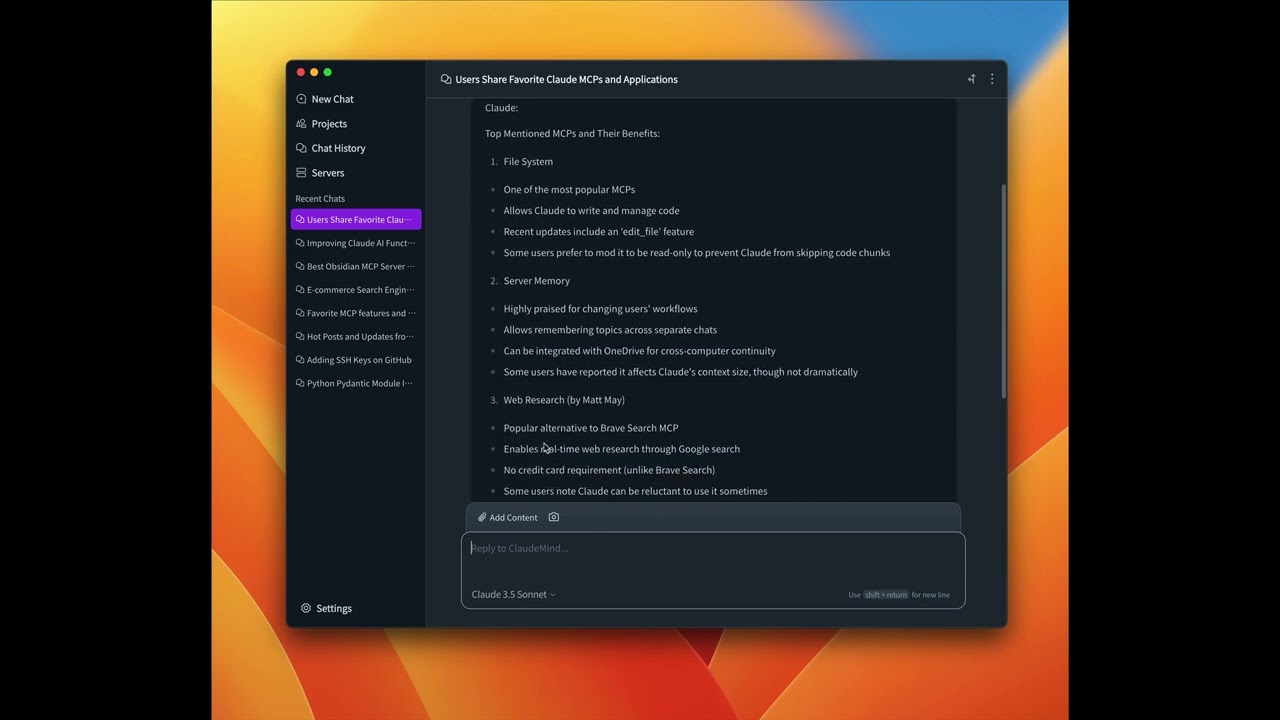
클린데에서의 데모 👇
Related MCP server: Reddit MCP Server
사용 가능한 도구
get_frontpage_posts- Reddit 프론트페이지에서 인기 게시물을 받아보세요선택 인수:
limit(정수): 반환할 게시물 수(기본값: 10, 범위: 1-100)
get_subreddit_info- 서브레딧에 대한 정보를 가져옵니다필수 인수:
subreddit_name(문자열): subreddit의 이름(예: 'Python', 'news')
get_subreddit_hot_posts- 특정 subreddit의 인기 게시물을 받아보세요필수 인수:
subreddit_name(문자열): subreddit의 이름(예: 'Python', 'news')
선택 인수:
limit(정수): 반환할 게시물 수(기본값: 10, 범위: 1-100)
get_subreddit_new_posts- 특정 subreddit의 새 게시물을 가져옵니다.필수 인수:
subreddit_name(문자열): subreddit의 이름(예: 'Python', 'news')
선택 인수:
limit(정수): 반환할 게시물 수(기본값: 10, 범위: 1-100)
get_subreddit_top_posts- 특정 subreddit의 인기 게시물 가져오기필수 인수:
subreddit_name(문자열): subreddit의 이름(예: 'Python', 'news')
선택 인수:
limit(정수): 반환할 게시물 수(기본값: 10, 범위: 1-100)time(문자열): 인기 게시물에 대한 시간 필터(기본값: '', 옵션: '시간', '일', '주', '월', '년', '모두')
get_subreddit_rising_posts- 특정 subreddit에서 인기 게시물 가져오기필수 인수:
subreddit_name(문자열): subreddit의 이름(예: 'Python', 'news')
선택 인수:
limit(정수): 반환할 게시물 수(기본값: 10, 범위: 1-100)
get_post_content- 특정 게시물의 자세한 내용을 가져옵니다.필수 인수:
post_id(문자열): 게시물의 ID
선택 인수:
comment_limit(정수): 반환할 최상위 주석 수(기본값: 10, 범위: 1-100)comment_depth(정수): 주석 트리의 최대 깊이(기본값: 3, 범위: 1-10)
get_post_comments- 게시물의 댓글 가져오기필수 인수:
post_id(문자열): 게시물의 ID
선택 인수:
limit(정수): 반환할 주석 수(기본값: 10, 범위: 1-100)
설치
Clinde 사용(권장)
MCP Server Reddit을 사용하는 가장 쉬운 방법은 Clinde 데스크톱 앱을 사용하는 것입니다. Clinde를 다운로드하고 설치한 후 다음 단계를 따르세요.
Clinde 앱을 엽니다
서버 페이지로 이동
mcp-server-reddit를 찾아 설치를 클릭하세요.
끝! 기술적인 지식은 필요 없습니다. Clinde가 모든 설치 및 구성을 완벽하게 처리해 드립니다.
uv 사용(권장)
uv 사용하면 별도의 설치가 필요하지 않습니다. uvx 사용하여 mcp-server-reddit을 직접 실행합니다.
PIP 사용
또는 pip를 통해 mcp-server-reddit 설치할 수 있습니다.
지엑스피1
설치 후 다음을 사용하여 스크립트로 실행할 수 있습니다.
python -m mcp_server_redditSmithery를 통해 설치
Smithery 를 통해 Claude Desktop용 MCP Server Reddit을 자동으로 설치하려면:
npx -y @smithery/cli install @Hawstein/mcp-server-reddit --client claude구성
Claude.app에 대한 구성
Claude 설정에 추가:
"mcpServers": {
"reddit": {
"command": "uvx",
"args": ["mcp-server-reddit"]
}
}"mcpServers": {
"reddit": {
"command": "python",
"args": ["-m", "mcp_server_reddit"]
}
}Zed에 대한 구성
Zed settings.json에 다음을 추가합니다.
"context_servers": [
"mcp-server-reddit": {
"command": "uvx",
"args": ["mcp-server-reddit"]
}
],"context_servers": {
"mcp-server-reddit": {
"command": "python",
"args": ["-m", "mcp_server_reddit"]
}
},질문의 예
"Reddit 프론트페이지에서 현재 가장 인기 있는 게시물은 무엇인가요?" (get_frontpage_posts)
"r/ClaudeAI subreddit에 대해 알려주세요" (get_subreddit_info)
"r/ClaudeAI 서브레딧의 인기 게시물은 무엇인가요?" (get_subreddit_hot_posts)
"r/ClaudeAI의 최신 게시물을 보여주세요"(get_subreddit_new_posts)
"r/ClaudeAI 역대 최고 게시물은 무엇인가요?" (get_subreddit_top_posts)
"현재 r/ClaudeAI에서 어떤 게시물이 인기 있나요?" (get_subreddit_rising_posts)
"이 Reddit 게시물의 전체 내용과 댓글을 확인하세요: [post_url]"(get_post_content)
"이 Reddit 게시물에 대한 댓글을 요약해 주세요: [post_url]"(get_post_comments)
디버깅
MCP 검사기를 사용하여 서버를 디버깅할 수 있습니다. UVX 설치의 경우:
npx @modelcontextprotocol/inspector uvx mcp-server-reddit또는 특정 디렉토리에 패키지를 설치했거나 해당 디렉토리에서 개발 중인 경우:
cd path/to/mcp_server_reddit
npx @modelcontextprotocol/inspector uv run mcp-server-reddit특허
mcp-server-reddit은 MIT 라이선스에 따라 라이선스가 부여됩니다. 즉, MIT 라이선스의 조건에 따라 소프트웨어를 자유롭게 사용, 수정 및 배포할 수 있습니다. 자세한 내용은 프로젝트 저장소의 LICENSE 파일을 참조하세요.
Available Tools
8 toolsget_frontpage_postsC
Get hot posts from Reddit frontpage
| Name | Required | Description | Default |
|---|---|---|---|
| limit | No | Number of posts to return (default: 10) |
TDQS
Does the description disclose side effects, auth requirements, rate limits, or destructive behavior?
With no annotations provided, the description carries full burden for behavioral disclosure. It states the tool gets posts but doesn't mention whether this is a read-only operation, if it requires authentication, rate limits, pagination behavior, or what format the returned posts will have. For a tool that likely makes external API calls, this leaves significant behavioral gaps.
Agents need to know what a tool does to the world before calling it. Descriptions should go beyond structured annotations to explain consequences.
Is the description appropriately sized, front-loaded, and free of redundancy?
The description is extremely concise at just 5 words, front-loading the core purpose without any unnecessary elaboration. Every word earns its place by specifying what's being retrieved ('hot posts') and from where ('Reddit frontpage'). There's zero waste in this minimal but complete statement of function.
Shorter descriptions cost fewer tokens and are easier for agents to parse. Every sentence should earn its place.
Given the tool's complexity, does the description cover enough for an agent to succeed on first attempt?
Given the tool likely interacts with an external API (Reddit) and has no annotations or output schema, the description is insufficiently complete. It doesn't explain what 'hot' means algorithmically, whether results are personalized or global, authentication requirements, rate limits, or return format. For a tool with external dependencies and no structured behavioral hints, more context is needed.
Complex tools with many parameters or behaviors need more documentation. Simple tools need less. This dimension scales expectations accordingly.
Does the description clarify parameter syntax, constraints, interactions, or defaults beyond what the schema provides?
The description mentions no parameters, while the schema has 1 parameter with 100% coverage (including description, default, and constraints). Since schema_description_coverage is high (>80%), the baseline is 3 even without parameter information in the description. The description doesn't add meaning beyond what the schema already provides about the 'limit' parameter.
Input schemas describe structure but not intent. Descriptions should explain non-obvious parameter relationships and valid value ranges.
Does the description clearly state what the tool does and how it differs from similar tools?
The description 'Get hot posts from Reddit frontpage' clearly states the action (get) and resource (hot posts from Reddit frontpage), making the purpose immediately understandable. However, it doesn't explicitly differentiate from sibling tools like 'get_subreddit_hot_posts' or 'get_subreddit_top_posts', which could cause confusion about when to use this specific tool versus those alternatives.
Agents choose between tools based on descriptions. A clear purpose with a specific verb and resource helps agents select the right tool.
Does the description explain when to use this tool, when not to, or what alternatives exist?
The description provides no guidance on when to use this tool versus alternatives. With siblings like 'get_subreddit_hot_posts' and 'get_subreddit_top_posts' available, there's no indication whether this tool is for the aggregated frontpage versus specific subreddits, or what 'hot' means compared to 'top' or 'new' posts. The lack of context leaves usage decisions ambiguous.
Agents often have multiple tools that could apply. Explicit usage guidance like "use X instead of Y when Z" prevents misuse.
get_post_commentsC
Get comments from a post
| Name | Required | Description | Default |
|---|---|---|---|
| post_id | Yes | ID of the post | |
| limit | No | Number of comments to return (default: 10) |
TDQS
Does the description disclose side effects, auth requirements, rate limits, or destructive behavior?
No annotations are provided, so the description carries the full burden of behavioral disclosure. 'Get comments from a post' implies a read-only operation, but it doesn't specify authentication needs, rate limits, pagination behavior, or error conditions. For a tool with no annotation coverage, this leaves significant gaps in understanding its operational characteristics.
Agents need to know what a tool does to the world before calling it. Descriptions should go beyond structured annotations to explain consequences.
Is the description appropriately sized, front-loaded, and free of redundancy?
The description is a single, efficient sentence with zero wasted words. It's front-loaded with the core purpose and appropriately sized for a simple retrieval tool, making it easy to parse quickly.
Shorter descriptions cost fewer tokens and are easier for agents to parse. Every sentence should earn its place.
Given the tool's complexity, does the description cover enough for an agent to succeed on first attempt?
Given no annotations and no output schema, the description is incomplete for a tool that likely returns structured comment data. It doesn't explain what the return format looks like (e.g., list of comments with fields like author, text, timestamp), error handling, or any dependencies. For a retrieval tool with missing structured context, this is inadequate.
Complex tools with many parameters or behaviors need more documentation. Simple tools need less. This dimension scales expectations accordingly.
Does the description clarify parameter syntax, constraints, interactions, or defaults beyond what the schema provides?
Schema description coverage is 100%, with clear documentation for both parameters (post_id and limit with default and constraints). The description doesn't add any meaningful semantic context beyond what the schema already provides, such as explaining what constitutes a valid post_id or how comments are ordered. Baseline 3 is appropriate when the schema does the heavy lifting.
Input schemas describe structure but not intent. Descriptions should explain non-obvious parameter relationships and valid value ranges.
Does the description clearly state what the tool does and how it differs from similar tools?
The description 'Get comments from a post' clearly states the action (get) and resource (comments from a post), making the purpose immediately understandable. However, it doesn't differentiate from sibling tools like 'get_post_content' which might also retrieve post-related data, so it's not fully distinctive.
Agents choose between tools based on descriptions. A clear purpose with a specific verb and resource helps agents select the right tool.
Does the description explain when to use this tool, when not to, or what alternatives exist?
The description provides no guidance on when to use this tool versus alternatives. With siblings like 'get_post_content' that might retrieve different aspects of a post, there's no indication of when comments are needed versus post content or how this differs from other comment-related tools that might exist in a broader context.
Agents often have multiple tools that could apply. Explicit usage guidance like "use X instead of Y when Z" prevents misuse.
get_post_contentC
Get detailed content of a specific post
| Name | Required | Description | Default |
|---|---|---|---|
| post_id | Yes | ID of the post | |
| comment_limit | No | Number of top-level comments to return (default: 10) | |
| comment_depth | No | Maximum depth of comment tree (default: 3) |
TDQS
Does the description disclose side effects, auth requirements, rate limits, or destructive behavior?
No annotations are provided, so the description carries the full burden of behavioral disclosure. It states 'Get detailed content' but doesn't clarify what 'detailed content' includes (e.g., post body, metadata, comments), whether it's a read-only operation, potential rate limits, or error handling. This is a significant gap for a tool with no annotation coverage.
Agents need to know what a tool does to the world before calling it. Descriptions should go beyond structured annotations to explain consequences.
Is the description appropriately sized, front-loaded, and free of redundancy?
The description is a single, efficient sentence with no wasted words. It's front-loaded with the core purpose ('Get detailed content of a specific post'), making it easy to parse quickly. Every word earns its place, achieving optimal conciseness.
Shorter descriptions cost fewer tokens and are easier for agents to parse. Every sentence should earn its place.
Given the tool's complexity, does the description cover enough for an agent to succeed on first attempt?
Given the complexity (a post retrieval tool with parameters for comments), no annotations, and no output schema, the description is incomplete. It doesn't explain what 'detailed content' entails, how comments are included, or the return format, leaving gaps that could hinder correct tool invocation by an AI agent.
Complex tools with many parameters or behaviors need more documentation. Simple tools need less. This dimension scales expectations accordingly.
Does the description clarify parameter syntax, constraints, interactions, or defaults beyond what the schema provides?
Schema description coverage is 100%, so the schema fully documents all three parameters (post_id, comment_limit, comment_depth) with descriptions, defaults, and constraints. The description adds no additional parameter semantics beyond what the schema provides, meeting the baseline score of 3 for high schema coverage.
Input schemas describe structure but not intent. Descriptions should explain non-obvious parameter relationships and valid value ranges.
Does the description clearly state what the tool does and how it differs from similar tools?
The description clearly states the verb 'Get' and the resource 'detailed content of a specific post', making the purpose understandable. However, it doesn't explicitly differentiate from sibling tools like 'get_post_comments' or 'get_frontpage_posts', which might also retrieve post-related data, so it lacks sibling differentiation for a perfect score.
Agents choose between tools based on descriptions. A clear purpose with a specific verb and resource helps agents select the right tool.
Does the description explain when to use this tool, when not to, or what alternatives exist?
The description provides no guidance on when to use this tool versus alternatives like 'get_post_comments' or 'get_frontpage_posts'. It doesn't mention prerequisites, exclusions, or specific contexts, leaving the agent with no usage instructions beyond the basic purpose.
Agents often have multiple tools that could apply. Explicit usage guidance like "use X instead of Y when Z" prevents misuse.
get_subreddit_hot_postsC
Get hot posts from a specific subreddit
| Name | Required | Description | Default |
|---|---|---|---|
| subreddit_name | Yes | Name of the subreddit (e.g. 'Python', 'news') | |
| limit | No | Number of posts to return (default: 10) |
TDQS
Does the description disclose side effects, auth requirements, rate limits, or destructive behavior?
With no annotations provided, the description carries full burden but offers minimal behavioral context. It doesn't mention whether this is a read-only operation (implied by 'Get'), rate limits, authentication requirements, or what the return format looks like (e.g., list of posts with titles, scores, etc.).
Agents need to know what a tool does to the world before calling it. Descriptions should go beyond structured annotations to explain consequences.
Is the description appropriately sized, front-loaded, and free of redundancy?
The description is a single, efficient sentence that directly states the tool's purpose without any unnecessary words. It's perfectly front-loaded and wastes no space.
Shorter descriptions cost fewer tokens and are easier for agents to parse. Every sentence should earn its place.
Given the tool's complexity, does the description cover enough for an agent to succeed on first attempt?
For a tool with no annotations and no output schema, the description is insufficient. It doesn't explain what 'hot' means algorithmically, what data is returned, or any behavioral constraints. Given the context of multiple sibling tools with different sorting methods, more completeness is needed.
Complex tools with many parameters or behaviors need more documentation. Simple tools need less. This dimension scales expectations accordingly.
Does the description clarify parameter syntax, constraints, interactions, or defaults beyond what the schema provides?
The schema has 100% description coverage, providing clear documentation for both parameters. The description adds no additional parameter semantics beyond what's already in the schema, so it meets the baseline of 3 for adequate coverage without adding value.
Input schemas describe structure but not intent. Descriptions should explain non-obvious parameter relationships and valid value ranges.
Does the description clearly state what the tool does and how it differs from similar tools?
The description clearly states the action ('Get') and resource ('hot posts from a specific subreddit'), making the purpose immediately understandable. However, it doesn't explicitly differentiate from siblings like 'get_subreddit_new_posts' or 'get_subreddit_top_posts', which would require mentioning the 'hot' sorting algorithm specifically.
Agents choose between tools based on descriptions. A clear purpose with a specific verb and resource helps agents select the right tool.
Does the description explain when to use this tool, when not to, or what alternatives exist?
The description provides no guidance on when to use this tool versus alternatives. With siblings like 'get_subreddit_new_posts' and 'get_subreddit_top_posts' available, there's no indication that this tool retrieves posts sorted by Reddit's 'hot' algorithm rather than other sorting methods.
Agents often have multiple tools that could apply. Explicit usage guidance like "use X instead of Y when Z" prevents misuse.
get_subreddit_infoC
Get information about a subreddit
| Name | Required | Description | Default |
|---|---|---|---|
| subreddit_name | Yes | Name of the subreddit (e.g. 'Python', 'news') |
TDQS
Does the description disclose side effects, auth requirements, rate limits, or destructive behavior?
No annotations are provided, so the description carries the full burden of behavioral disclosure. It states the action but doesn't cover critical aspects like whether this is a read-only operation, potential rate limits, authentication needs, error conditions, or what specific information is returned (e.g., description, subscriber count). This leaves significant gaps for safe and effective use.
Agents need to know what a tool does to the world before calling it. Descriptions should go beyond structured annotations to explain consequences.
Is the description appropriately sized, front-loaded, and free of redundancy?
The description is a single, efficient sentence that directly states the tool's purpose without any fluff or redundancy. It's appropriately sized and front-loaded, making it easy to parse quickly.
Shorter descriptions cost fewer tokens and are easier for agents to parse. Every sentence should earn its place.
Given the tool's complexity, does the description cover enough for an agent to succeed on first attempt?
Given the lack of annotations and output schema, the description is incomplete for a tool that likely returns structured data about a subreddit. It doesn't explain what 'information' includes (e.g., metadata, rules, stats), leaving the agent uncertain about the tool's output and how to use it effectively in context.
Complex tools with many parameters or behaviors need more documentation. Simple tools need less. This dimension scales expectations accordingly.
Does the description clarify parameter syntax, constraints, interactions, or defaults beyond what the schema provides?
The input schema has 100% description coverage, with the parameter 'subreddit_name' clearly documented in the schema itself. The description adds no additional parameter details beyond what the schema provides, so it meets the baseline of 3 for adequate but minimal value in this dimension.
Input schemas describe structure but not intent. Descriptions should explain non-obvious parameter relationships and valid value ranges.
Does the description clearly state what the tool does and how it differs from similar tools?
The description clearly states the verb ('Get') and resource ('information about a subreddit'), making the purpose immediately understandable. However, it doesn't distinguish this tool from its siblings (e.g., 'get_subreddit_hot_posts'), which all involve retrieving subreddit-related data but serve different purposes.
Agents choose between tools based on descriptions. A clear purpose with a specific verb and resource helps agents select the right tool.
Does the description explain when to use this tool, when not to, or what alternatives exist?
The description provides no guidance on when to use this tool versus alternatives. With siblings like 'get_subreddit_hot_posts' that also retrieve subreddit data, there's no indication that this tool is for general metadata versus post listings, leaving the agent to guess based on the name alone.
Agents often have multiple tools that could apply. Explicit usage guidance like "use X instead of Y when Z" prevents misuse.
get_subreddit_new_postsC
Get new posts from a specific subreddit
| Name | Required | Description | Default |
|---|---|---|---|
| subreddit_name | Yes | Name of the subreddit (e.g. 'Python', 'news') | |
| limit | No | Number of posts to return (default: 10) |
TDQS
Does the description disclose side effects, auth requirements, rate limits, or destructive behavior?
With no annotations provided, the description carries the full burden of behavioral disclosure. It states the tool retrieves posts but omits critical details such as rate limits, authentication requirements, pagination behavior, error handling, or the format of returned data. This leaves significant gaps for an agent to understand how the tool behaves in practice.
Agents need to know what a tool does to the world before calling it. Descriptions should go beyond structured annotations to explain consequences.
Is the description appropriately sized, front-loaded, and free of redundancy?
The description is a single, efficient sentence that directly states the tool's function without unnecessary words. It is front-loaded and wastes no space, making it easy to parse quickly while conveying the core purpose.
Shorter descriptions cost fewer tokens and are easier for agents to parse. Every sentence should earn its place.
Given the tool's complexity, does the description cover enough for an agent to succeed on first attempt?
Given the lack of annotations and output schema, the description is incomplete for a tool that likely involves API calls with behavioral nuances. It fails to address key contextual aspects like data format, error conditions, or operational constraints, leaving the agent with insufficient information for reliable use.
Complex tools with many parameters or behaviors need more documentation. Simple tools need less. This dimension scales expectations accordingly.
Does the description clarify parameter syntax, constraints, interactions, or defaults beyond what the schema provides?
The input schema has 100% description coverage, clearly documenting both parameters ('subreddit_name' and 'limit') with examples and constraints. The description adds no additional semantic context beyond what the schema provides, so it meets the baseline for adequate but unenhanced parameter information.
Input schemas describe structure but not intent. Descriptions should explain non-obvious parameter relationships and valid value ranges.
Does the description clearly state what the tool does and how it differs from similar tools?
The description clearly states the action ('Get') and resource ('new posts from a specific subreddit'), making the purpose immediately understandable. However, it doesn't explicitly differentiate from siblings like 'get_subreddit_hot_posts' or 'get_subreddit_top_posts' beyond the 'new' qualifier, which is implied but not contrasted.
Agents choose between tools based on descriptions. A clear purpose with a specific verb and resource helps agents select the right tool.
Does the description explain when to use this tool, when not to, or what alternatives exist?
The description provides no guidance on when to use this tool versus alternatives like 'get_frontpage_posts' or other subreddit-specific tools (e.g., 'get_subreddit_hot_posts'). It lacks context about what 'new' means (e.g., chronological order, time frame) or any prerequisites, leaving usage entirely implicit.
Agents often have multiple tools that could apply. Explicit usage guidance like "use X instead of Y when Z" prevents misuse.
get_subreddit_rising_postsC
Get rising posts from a specific subreddit
| Name | Required | Description | Default |
|---|---|---|---|
| subreddit_name | Yes | Name of the subreddit (e.g. 'Python', 'news') | |
| limit | No | Number of posts to return (default: 10) |
TDQS
Does the description disclose side effects, auth requirements, rate limits, or destructive behavior?
No annotations are provided, so the description carries the full burden of behavioral disclosure. It states the action but doesn't mention any behavioral traits such as rate limits, authentication requirements, pagination, or what the return format looks like. This is a significant gap for a tool with no annotation coverage.
Agents need to know what a tool does to the world before calling it. Descriptions should go beyond structured annotations to explain consequences.
Is the description appropriately sized, front-loaded, and free of redundancy?
The description is a single, efficient sentence that directly states the tool's purpose without any wasted words. It is appropriately sized and front-loaded, making it easy to parse quickly.
Shorter descriptions cost fewer tokens and are easier for agents to parse. Every sentence should earn its place.
Given the tool's complexity, does the description cover enough for an agent to succeed on first attempt?
Given the lack of annotations and output schema, the description is incomplete. It doesn't explain what 'rising' means in Reddit's context, the return format, or any behavioral aspects like error handling. For a tool with two parameters and multiple siblings, more context is needed to be fully helpful.
Complex tools with many parameters or behaviors need more documentation. Simple tools need less. This dimension scales expectations accordingly.
Does the description clarify parameter syntax, constraints, interactions, or defaults beyond what the schema provides?
The schema description coverage is 100%, with clear descriptions for both parameters ('subreddit_name' and 'limit'), including defaults and constraints. The description adds no additional parameter semantics beyond what the schema provides, so it meets the baseline of 3 without compensating or detracting.
Input schemas describe structure but not intent. Descriptions should explain non-obvious parameter relationships and valid value ranges.
Does the description clearly state what the tool does and how it differs from similar tools?
The description clearly states the verb ('Get') and resource ('rising posts from a specific subreddit'), making the purpose immediately understandable. It distinguishes itself from siblings like 'get_subreddit_hot_posts' or 'get_subreddit_new_posts' by specifying 'rising' posts, though it doesn't explicitly contrast with them in the text.
Agents choose between tools based on descriptions. A clear purpose with a specific verb and resource helps agents select the right tool.
Does the description explain when to use this tool, when not to, or what alternatives exist?
No guidance is provided on when to use this tool versus alternatives. With siblings like 'get_subreddit_hot_posts' and 'get_subreddit_new_posts', the description lacks any context about what 'rising' means or when it's preferred over other listing tools, leaving usage decisions ambiguous.
Agents often have multiple tools that could apply. Explicit usage guidance like "use X instead of Y when Z" prevents misuse.
get_subreddit_top_postsC
Get top posts from a specific subreddit
| Name | Required | Description | Default |
|---|---|---|---|
| subreddit_name | Yes | Name of the subreddit (e.g. 'Python', 'news') | |
| limit | No | Number of posts to return (default: 10) | |
| time | No | Time filter for top posts (e.g. 'hour', 'day', 'week', 'month', 'year', 'all') |
TDQS
Does the description disclose side effects, auth requirements, rate limits, or destructive behavior?
With no annotations provided, the description carries the full burden of behavioral disclosure. It states what the tool does but provides no information about authentication requirements, rate limits, error conditions, response format, or pagination behavior. For a read operation that likely has API constraints, this is a significant gap.
Agents need to know what a tool does to the world before calling it. Descriptions should go beyond structured annotations to explain consequences.
Is the description appropriately sized, front-loaded, and free of redundancy?
The description is a single, efficient sentence that communicates the core purpose without any wasted words. It's appropriately sized for a straightforward tool and gets directly to the point.
Shorter descriptions cost fewer tokens and are easier for agents to parse. Every sentence should earn its place.
Given the tool's complexity, does the description cover enough for an agent to succeed on first attempt?
For a tool with 3 parameters, no annotations, and no output schema, the description is insufficient. It doesn't explain what 'top' means algorithmically, doesn't describe the return format, and provides no context about authentication or API limitations. The description should do more to compensate for the lack of structured metadata.
Complex tools with many parameters or behaviors need more documentation. Simple tools need less. This dimension scales expectations accordingly.
Does the description clarify parameter syntax, constraints, interactions, or defaults beyond what the schema provides?
Schema description coverage is 100%, so all parameters are well-documented in the schema itself. The description adds no additional parameter information beyond what's already in the schema descriptions. This meets the baseline expectation when schema coverage is complete.
Input schemas describe structure but not intent. Descriptions should explain non-obvious parameter relationships and valid value ranges.
Does the description clearly state what the tool does and how it differs from similar tools?
The description clearly states the verb 'Get' and resource 'top posts from a specific subreddit', making the purpose immediately understandable. It distinguishes from some siblings like 'get_subreddit_info' or 'get_post_comments', but doesn't explicitly differentiate from other post-fetching siblings like 'get_subreddit_hot_posts' or 'get_subreddit_new_posts'.
Agents choose between tools based on descriptions. A clear purpose with a specific verb and resource helps agents select the right tool.
Does the description explain when to use this tool, when not to, or what alternatives exist?
The description provides no guidance on when to use this tool versus alternatives. With siblings like 'get_subreddit_hot_posts', 'get_subreddit_new_posts', and 'get_subreddit_rising_posts' available, there's no indication of what 'top' means or when it's preferable to other sorting methods.
Agents often have multiple tools that could apply. Explicit usage guidance like "use X instead of Y when Z" prevents misuse.
Tool Schema Changelog
Recent tool additions, removals, and schema changes observed during successful MCP inspections.
8 tool updates
- First observed
get_frontpage_posts - First observed
get_post_comments - First observed
get_post_content - First observed
get_subreddit_hot_posts - First observed
get_subreddit_info - First observed
get_subreddit_new_posts - First observed
get_subreddit_rising_posts - First observed
get_subreddit_top_posts
TDQS
Scored across 8 tools
Every tool has a clearly distinct purpose with no ambiguity. The tools are organized by specific resources (frontpage, subreddit, post) and actions (get posts, get comments, get info), making it easy for an agent to select the right tool for each task without confusion.
All tool names follow a consistent verb_noun pattern using snake_case, starting with 'get_' followed by a descriptive resource identifier. This predictable naming scheme enhances readability and usability across the entire tool set.
With 8 tools, the server is well-scoped for its Reddit browsing purpose. Each tool earns its place by covering distinct aspects of Reddit content retrieval, from frontpage and subreddit posts to comments and subreddit information, without being overly sparse or bloated.
The tool set provides comprehensive coverage for browsing and retrieving Reddit content, including posts, comments, and subreddit info. A minor gap exists in the lack of write operations (e.g., posting or voting), but this is reasonable for a read-focused server, and agents can still perform core browsing workflows effectively.
Maintenance
Related MCP Connectors
Reddit MCP server: search posts, subreddit feeds, comments & user profiles as JSON. No API key.
Browse and manage Reddit posts, comments, and threads. Fetch user activity, explore hot/new/rising…
Reddit: Reddit Data API offers streamlined access to Reddit’s public data, like posts, comments.
15 Reddit endpoints. Pay per call in USDC via x402.
Related MCP Servers
- AlicenseNot gradedqualityDmaintenanceA Model Context Protocol server that enables AI assistants like Claude to browse and analyze Reddit content, including searching subreddits, retrieving post details with comments, and viewing trending posts.9MIT
- -licenseNot gradedqualityNot gradedmaintenanceA Model Context Protocol server that enables AI assistants to fetch Reddit content including consensus on topics, top posts, helpful links, and related subreddits.2-
- AlicenseNot gradedqualityDmaintenanceProvides access to public Reddit data through tools for searching subreddits, viewing posts, and reading comments without requiring authentication. It enables Model Context Protocol clients to interact with Reddit's public JSON API via stdio or HTTP transports.16 npmMIT
- FlicenseNot gradedqualityDmaintenanceA read-only Model Context Protocol server that enables browsing subreddits, searching within subreddits, retrieving comment trees, and looking up user activity on Reddit via natural language.-