

A
licenseB
qualityD
maintenanceA server that enhances Claude's reasoning capabilities by integrating DeepSeek R1's advanced reasoning engine to tackle complex reasoning tasks.
1
1
MIT

DeepSeek R1의 고급 추론 엔진을 통합하여 Claude의 추론 능력을 향상시키세요 . 이 서버를 통해 Claude는 deepseek r1 모델의 추론 기능을 활용하여 복잡한 추론 작업을 처리할 수 있습니다.
DeepSeek R1의 추론 기능을 Claude와 완벽하게 통합합니다.
복잡한 다단계 추론 작업을 지원합니다.
신중한 응답을 생성하기 위한 정확성과 효율성을 위해 설계되었습니다.
Related MCP server: DeepSeek-Claude MCP Server
Smithery를 통해 Claude Desktop용 DeepSeek-Claude를 자동으로 설치하려면:
지엑스피1
Python 3.12 이상
uv 패키지 관리자
DeepSeek API 키( DeepSeek 플랫폼 에 가입)
저장소 복제
git clone https://github.com/harshj23/deepseek-claude-MCP-server.git
cd deepseek-claude-MCP-server
UV가 설정되어 있는지 확인하세요
Windows : PowerShell에서 다음을 실행합니다.
powershell -ExecutionPolicy ByPass -c "irm https://astral.sh/uv/install.ps1 | iex"Mac : 다음을 실행하세요.
curl -LsSf https://astral.sh/uv/install.sh | sh가상 환경 만들기
uv venv
source .venv/bin/activate
종속성 설치
uv add "mcp[cli]" httpxAPI 키 설정
Obtain your api key from here : https://platform.deepseek.com/api_keysMCP 서버 구성 claude_desktop_config.json 파일을 편집하여 다음 구성을 포함합니다.
{
    "mcpServers": {
        "deepseek-claude": {
            "command": "uv",
            "args": [
                "--directory",
                "C:\\ABSOLUTE\\PATH\\TO\\PARENT\\FOLDER\\deepseek-claude",
                "run",
                "server.py"
            ]
        }
    }
}
서버 실행
uv run server.py테스트 설정
인터페이스에 도구 아이콘이 표시되는지 확인하세요. 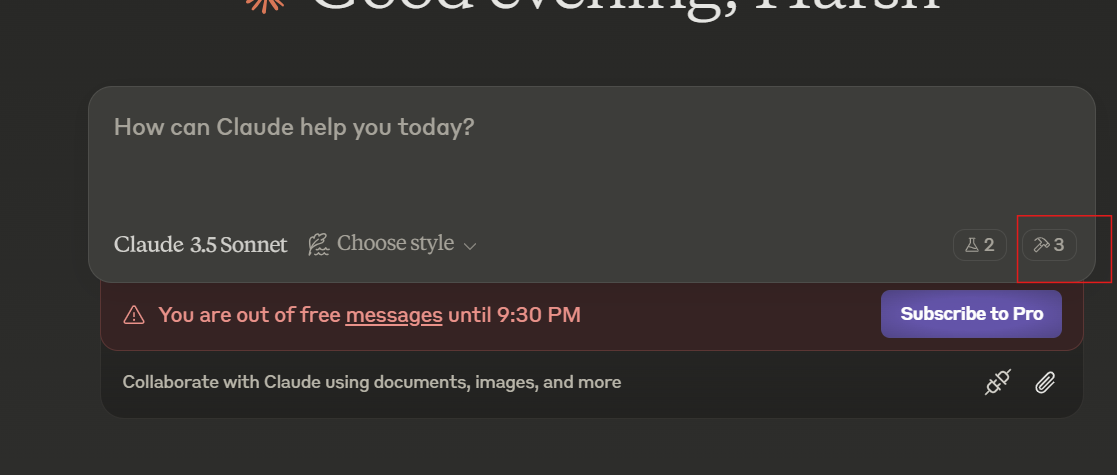
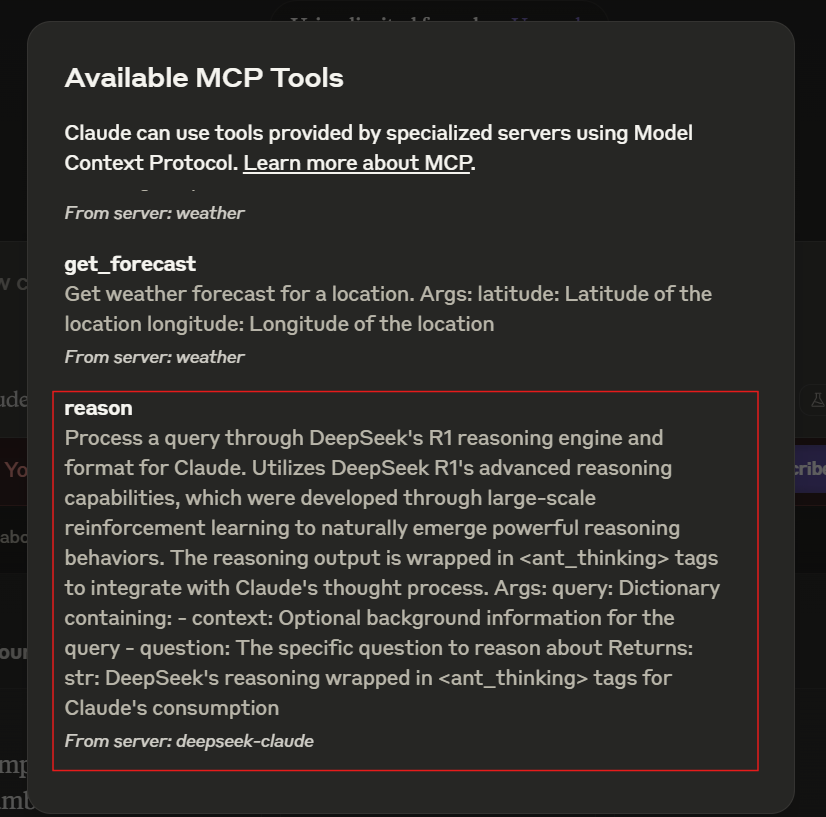
서버가 보이지 않으면 문제 해결 가이드를 참조하세요.
Claude Desktop과 함께 사용하면 서버가 자동으로 시작됩니다. Claude Desktop이 MCP 서버를 감지하도록 구성되어 있는지 확인하세요.
클로드는 고급 추론이 필요한 질문을 받습니다.
해당 쿼리는 처리를 위해 DeepSeek R1로 전달됩니다.
DeepSeek R1은 <ant_thinking> 태그로 묶인 구조화된 추론을 반환합니다.
클로드는 추론을 최종 반응으로 통합합니다.
이 프로젝트는 MIT 라이선스에 따라 라이선스가 부여됩니다. 자세한 내용은 라이선스 파일을 참조하세요.
Process a query using DeepSeek's R1 reasoning engine and prepare it for integration with Claude.

DeepSeek R1 leverages advanced reasoning capabilities that naturally evolved from large-scale
reinforcement learning, enabling sophisticated reasoning behaviors. The output is enclosed
within `<ant_thinking>` tags to align with Claude's thought processing framework.

Args:
    query (dict): Contains the following keys:
        - context (str): Optional background information for the query.
        - question (str): The specific question to be analyzed.

Returns:
    str: The reasoning output from DeepSeek, formatted with `<ant_thinking>` tags for seamless use with Claude.
| Name | Required | Description | Default |
|---|---|---|---|
| query | Yes |
Does the description disclose side effects, auth requirements, rate limits, or destructive behavior?
No annotations are provided, so the description carries the full burden of behavioral disclosure. It mentions the reasoning engine's capabilities and output formatting with tags, but fails to address critical aspects like rate limits, error handling, authentication needs, or performance characteristics. For a tool with no annotation coverage, this leaves significant gaps in understanding its operational behavior.
Agents need to know what a tool does to the world before calling it. Descriptions should go beyond structured annotations to explain consequences.
Is the description appropriately sized, front-loaded, and free of redundancy?
The description is well-structured with clear sections for purpose, technical background, parameters, and returns. It avoids unnecessary fluff, but the second sentence about R1's evolution could be trimmed for brevity without losing clarity. Overall, it's efficient and front-loaded with key information.
Shorter descriptions cost fewer tokens and are easier for agents to parse. Every sentence should earn its place.
Given the tool's complexity, does the description cover enough for an agent to succeed on first attempt?
Given no annotations, no output schema, and a nested parameter structure, the description is moderately complete. It covers the tool's purpose, parameter details, and return format, but lacks information on error cases, performance, or integration specifics. For a tool with such complexity, it should provide more operational context to be fully adequate.
Complex tools with many parameters or behaviors need more documentation. Simple tools need less. This dimension scales expectations accordingly.
Does the description clarify parameter syntax, constraints, interactions, or defaults beyond what the schema provides?
Schema description coverage is 0%, so the description must compensate. It adds meaningful semantics by detailing the 'query' parameter's structure with 'context' and 'question' keys, including that 'context' is optional. This goes beyond the bare schema, providing essential context for parameter usage, though it could specify data types or constraints more explicitly.
Input schemas describe structure but not intent. Descriptions should explain non-obvious parameter relationships and valid value ranges.
Does the description clearly state what the tool does and how it differs from similar tools?
The description clearly states the tool's purpose: 'Process a query using DeepSeek's R1 reasoning engine and prepare it for integration with Claude.' It specifies the verb ('process'), resource ('query'), and technology ('DeepSeek R1'), though it doesn't need to differentiate from siblings since none exist. The purpose is specific but could be more precise about what 'process' entails.
Agents choose between tools based on descriptions. A clear purpose with a specific verb and resource helps agents select the right tool.
Does the description explain when to use this tool, when not to, or what alternatives exist?
The description implies usage by mentioning integration with Claude and the reasoning capabilities, but it lacks explicit guidance on when to use this tool versus alternatives. With no sibling tools, this is less critical, but it doesn't provide context on prerequisites, limitations, or ideal scenarios for application.
Agents often have multiple tools that could apply. Explicit usage guidance like "use X instead of Y when Z" prevents misuse.
Recent tool additions, removals, and schema changes observed during successful MCP inspections.
reasonScored across 1 tool
With only one tool named 'reason', there is no possibility of confusion or overlap with other tools. The tool has a single, clearly defined purpose: processing queries through DeepSeek's R1 reasoning engine for Claude integration.
A single tool inherently demonstrates perfect naming consistency. The tool name 'reason' follows a clear verb-based pattern appropriate for its function, and there are no other tools to create inconsistency.
A single tool server is generally too minimal for most practical applications. While the tool itself performs a specific reasoning task, the server lacks complementary tools for broader reasoning workflows, making it feel incomplete as a standalone server.
The server is severely incomplete for a reasoning engine interface. It provides only query processing without any supporting tools for configuration, history management, different reasoning modes, or result validation. This creates significant gaps that will limit agent effectiveness.
Deterministic reasoning stack for AI agents: simulate, decide & compute, plus cross-domain tools.
Swift AI: Access a wide range of AI models⚡, including OpenAI 🤖,DeepSeek 🔍, Claude 🧠, Gemini 🌟, and.
Multi-model AI debates: GPT-4o, Claude, Gemini & 200+ models discuss, then synthesize insight.
One workspace of tools for Claude and ChatGPT: connect 600+ apps, generate media, build tools.