A
licenseNot graded
qualityD
maintenanceA specialized MCP server that enables AI agents to interact with Reddit, including reading posts, creating content, and managing subreddit configurations.
16 npm
10
Apache 2.0

The Reddit MCP Server enables AI assistants to access and interact with Reddit content through comprehensive tools for reading, analyzing, and posting.
User Analysis: Retrieve detailed user profiles including karma, account age, verification status, moderator roles, engagement insights, activity trends, and community influence. Access comment and post history with flexible filtering options. Authenticated users can check their own profile using who_am_i.
Content Discovery: Fetch top posts from subreddits with customizable time filters (day, week, month, year, all-time). Search for posts across Reddit or within specific communities using keywords. Retrieve specific submissions by URL or ID with comprehensive metadata including scores, upvote ratios, comments, media attachments, awards, and engagement metrics.
Community Insights: Access detailed subreddit statistics including subscriber counts, active users, creation date, descriptions, rules, moderator information, content policies, and allowed submission types. Discover currently trending subreddits with growth patterns.
Content Creation (requires authentication): Create posts in subreddits with support for text (self) and link posts, optional flair selection, and timing recommendations. Reply to posts and comments with engagement optimization features.
AI-Driven Features: Benefit from intelligent analysis of user engagement patterns, post performance metrics, community health indicators, and strategic recommendations. All responses include smartly formatted engagement statistics and AI insights.
Flexible Access: Supports read-only operations with client credentials and authenticated operations with user credentials. Includes comprehensive error handling with clear validation messages.
Allows AI assistants to access and interact with Reddit content, providing tools for analyzing user activity, fetching posts from subreddits, retrieving subreddit statistics, viewing trending subreddits, creating posts with timing recommendations, and replying to posts/comments with engagement optimization.
Click on "Deploy Server".
Wait a few minutes for the server to deploy. Once ready, it will show a "Started" state.
In the chat, type @ followed by the MCP server name and your instructions, e.g., "@Reddit MCP Server show me the top posts from r/Python this week"
That's it! The server will respond to your query, and you can continue using it as needed.
Here is a step-by-step guide with screenshots.
This repository contains a Model Context Protocol server implementation for Reddit that allows AI assistants to access and interact with Reddit content through PRAW (Python Reddit API Wrapper).
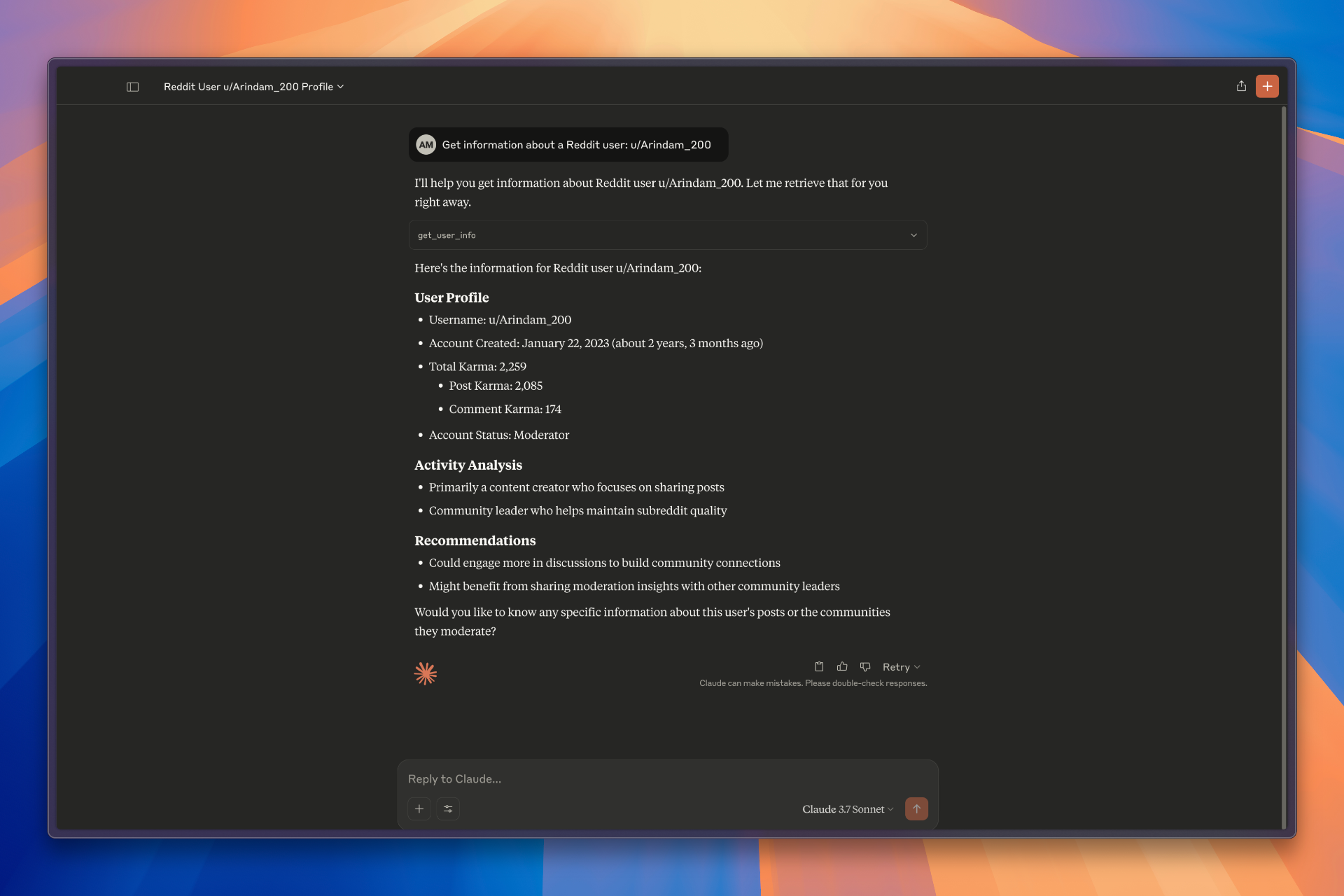
The Model Context Protocol (MCP) is a standard for enabling AI assistants to interface with external services, tools, and data sources. This server implements the MCP specification to provide access to Reddit content.
To know more about MCP, Check this video
Related MCP server: Reddit MCP
Get detailed user information with engagement analysis
Retrieve user comment and post history with flexible filtering
Fetch and analyze top posts from any subreddit
Search for posts across all of Reddit or within specific subreddits using search terms
Get comprehensive subreddit statistics and health metrics
View trending subreddits with growth patterns
Create strategic posts with timing recommendations
Reply to posts and comments with engagement optimization
AI-driven insights and recommendations
Smart response formatting with engagement metrics
Clone this repository
git clone https://github.com/Arindam200/reddit-mcp.git
cd reddit-mcp
Connect to the MCP server
Copy the below json with the appropriate {{PATH}} values:
{
  "mcpServers": {
    "reddit": {
      "command": "{{PATH_TO_UV}}", // Run `which uv` and place the output here
      "args": [
        "--directory",
        "{{PATH_TO_SRC}}", // cd into the repo, run `pwd` and enter the output here
        "run",
        "server.py"
      ],
      "env": {
        "REDDIT_CLIENT_ID": "your_client_id",
        "REDDIT_CLIENT_SECRET": "your_client_secret",
        "REDDIT_USERNAME": "your_username", // Optional for authenticated operations
        "REDDIT_PASSWORD": "your_password" // Optional for authenticated operations
      }
    }
  }
}
You can obtain Reddit API credentials by creating an app at Reddit's app preferences page.
For Claude, save this as claude_desktop_config.json in your Claude Desktop configuration directory at:
~/Library/Application Support/Claude/claude_desktop_config.jsonFor Cursor, save this as mcp.json in your Cursor configuration directory at:
~/.cursor/mcp.jsonRestart Claude Desktop / Cursor
Open Claude Desktop and you should now see Reddit as an available integration.
Or restart Cursor.
The server provides the following tools:
get_user_info(username) - Get detailed user analysis with engagement insights
get_user_comments(username, sort, time_filter, limit) - Get a user's comment history with filtering options
get_user_posts(username, sort, time_filter, limit) - Get a user's post/submission history with filtering options
get_top_posts(subreddit, time_filter, limit) - Get and analyze top posts
search_posts(query, subreddit, sort, time_filter, limit) - Search for posts across Reddit or within a specific subreddit
get_subreddit_stats(subreddit) - Get comprehensive subreddit analysis
get_trending_subreddits() - Get list of trending subreddits
get_submission_by_url(url) - Get a Reddit submission by its URL
get_submission_by_id(submission_id) - Get a Reddit submission by its ID
who_am_i() - Get information about the currently authenticated user
create_post(subreddit, title, content, flair, is_self) - Create an optimized post
reply_to_post(post_id, content, subreddit) - Add a reply with engagement insights
reply_to_comment(comment_id, content, subreddit) - Add a strategic reply
Here are some examples of what you can ask an AI assistant connected to this server:
"Who am I on Reddit?" or "Show my Reddit profile"
"Analyze u/spez's Reddit activity"
"Show me u/spez's recent comments"
"Get the top posts by u/poem_for_your_sprog from the past year"
"Show me the most controversial comments by u/username"
"Show me the top posts from r/Python this week"
"Search for posts about 'machine learning' across all of Reddit"
"Find posts about 'beginner tutorials' in r/learnprogramming from this month"
"Get statistics about r/AskReddit"
"What are the trending subreddits right now?"
"Create a post in r/Python about a new project"
"Reply to this post with an insightful comment"
"What's the best time to post in this subreddit?"
The server provides intelligent analysis in several areas:
User Analysis
Engagement patterns
Activity trends
Community influence
Personalized recommendations
Post Analysis
Performance metrics
Engagement quality
Timing optimization
Content impact assessment
Community Analysis
Health indicators
Growth patterns
Activity metrics
Engagement opportunities
Organized bullet points
Engagement statistics
AI-driven insights
Strategic recommendations
Performance metrics
The server supports two levels of authentication:
Read-only Access
Requires: client_id and client_secret
Allows: Fetching public data, reading posts/comments
Authenticated Access
Requires: All read-only credentials PLUS username and password
Allows: All read-only operations PLUS posting and commenting
Contributions are welcome! Please feel free to submit a Pull Request.
This project is licensed under the MIT License - see the LICENSE file for details.
Create a new post in a subreddit.
Args:
    subreddit: Name of the subreddit to post in (with or without 'r/' prefix)
    title: Title of the post (max 300 characters)
    content: Content of the post (text for self posts, URL for link posts)
    flair: Flair to add to the post. Must be an available flair in the subreddit
    is_self: Whether this is a self (text) post (True) or link post (False)

Returns:
    Dictionary containing information about the created post

Raises:
    ValueError: If input validation fails or flair is invalid
    RuntimeError: For other errors during post creation
| Name | Required | Description | Default |
|---|---|---|---|
| subreddit | Yes | ||
| title | Yes | ||
| content | Yes | ||
| flair | No | ||
| is_self | No |
Does the description disclose side effects, auth requirements, rate limits, or destructive behavior?
With no annotations provided, the description carries the full burden of behavioral disclosure. It does well by mentioning input validation failures and runtime errors, and clarifies the content parameter's dual purpose (text for self posts, URL for link posts). However, it doesn't address important behavioral aspects like authentication requirements, rate limits, whether the operation is idempotent, or what specific information the return dictionary contains.
Agents need to know what a tool does to the world before calling it. Descriptions should go beyond structured annotations to explain consequences.
Is the description appropriately sized, front-loaded, and free of redundancy?
The description is well-structured with clear sections (Args, Returns, Raises) and front-loads the core purpose. Every sentence adds value, though the formatting with section headers could be slightly more concise. The information density is high with minimal wasted words.
Shorter descriptions cost fewer tokens and are easier for agents to parse. Every sentence should earn its place.
Given the tool's complexity, does the description cover enough for an agent to succeed on first attempt?
For a 5-parameter mutation tool with no annotations and no output schema, the description does an excellent job covering parameter semantics and basic error conditions. It falls short of a perfect score because it doesn't fully describe the return value (only states it's a 'dictionary containing information about the created post' without specifying what information) or address authentication/rate limiting concerns that are important for API tools.
Complex tools with many parameters or behaviors need more documentation. Simple tools need less. This dimension scales expectations accordingly.
Does the description clarify parameter syntax, constraints, interactions, or defaults beyond what the schema provides?
Given 0% schema description coverage, the description fully compensates by providing detailed semantic information for all 5 parameters. It explains what each parameter represents, includes constraints (max 300 characters for title), clarifies format options (with/without 'r/' prefix for subreddit), explains the dual nature of the content parameter, and specifies requirements (flair must be available in the subreddit).
Input schemas describe structure but not intent. Descriptions should explain non-obvious parameter relationships and valid value ranges.
Does the description clearly state what the tool does and how it differs from similar tools?
The description clearly states the specific action ('Create a new post') and target resource ('in a subreddit'), distinguishing it from sibling tools that are primarily read operations (like get_submission_by_id, get_top_posts) or other actions (like reply_to_post, join_subreddit). The verb+resource combination is precise and unambiguous.
Agents choose between tools based on descriptions. A clear purpose with a specific verb and resource helps agents select the right tool.
Does the description explain when to use this tool, when not to, or what alternatives exist?
The description provides clear context about when to use this tool (to create posts in subreddits) and implicitly distinguishes it from sibling tools that retrieve or interact with existing content. However, it doesn't explicitly state when NOT to use it or name specific alternatives for similar operations, keeping it from a perfect score.
Agents often have multiple tools that could apply. Explicit usage guidance like "use X instead of Y when Z" prevents misuse.
Get a Reddit submission by its ID.
Args:
    submission_id: The ID of the Reddit submission to retrieve (can be full URL or just ID)
    include_comments: If True, load and return the full comment forest for the post
    comment_replace_more_limit: Limit for replacing "MoreComments" objects (0 for none, None for all)

Returns:
    Dictionary containing structured submission information with the following structure:
    {
        'id': str,  # Submission ID (e.g., 'abc123')
        'title': str,  # Submission title
        'author': str,  # Author's username or '[deleted]' if deleted
        'subreddit': str,  # Subreddit name
        'score': int,  # Post score (upvotes - downvotes)
        'upvote_ratio': float,  # Ratio of upvotes to total votes
        'num_comments': int,  # Number of comments
        'created_utc': float,  # Post creation timestamp (UTC)
        'url': str,  # Full URL to the post
        'permalink': str,  # Relative URL to the post
        'is_self': bool,  # Whether it's a self (text) post
        'selftext': str,  # Content of self post (if any)
        'selftext_html': Optional[str],  # HTML formatted content
        'link_url': str,  # URL for link posts (if any)
        'domain': str,  # Domain of the linked content
        'over_18': bool,  # Whether marked as NSFW
        'spoiler': bool,  # Whether marked as spoiler
        'stickied': bool,  # Whether stickied in the subreddit
        'locked': bool,  # Whether comments are locked
        'archived': bool,  # Whether the post is archived
        'distinguished': Optional[str],  # Distinguishing type (e.g., 'moderator')
        'flair': Optional[Dict],  # Post flair information if any
        'media': Optional[Dict],  # Media information if any
        'preview': Optional[Dict],  # Preview information if available
        'awards': List[Dict],  # List of awards received
        'comments': Optional[List[Dict]],  # present if include_comments is True
        'metadata': {
            'fetched_at': float,  # Timestamp when data was fetched
            'subreddit_id': str,  # Subreddit full ID
            'author_id': str,  # Author's full ID if available
            'is_original_content': bool,  # Whether marked as OC
            'is_meta': bool,  # Whether marked as meta
            'is_crosspostable': bool,  # Whether can be crossposted
            'is_reddit_media_domain': bool,  # Whether media is hosted on Reddit
            'is_robot_indexable': bool,  # Whether search engines should index
            'is_created_from_ads_ui': bool,  # Whether created via ads UI
            'is_video': bool,  # Whether the post is a video
            'pinned': bool,  # Whether the post is pinned in the subreddit
            'gilded': int,  # Number of times gilded
            'total_awards_received': int,  # Total number of awards received
            'view_count': Optional[int],  # View count if available
            'visited': bool,  # Whether the current user has visited
        }
    }

Raises:
    ValueError: If submission_id is invalid or submission not found
    RuntimeError: For other errors during the operation
| Name | Required | Description | Default |
|---|---|---|---|
| submission_id | Yes | ||
| include_comments | No | ||
| comment_replace_more_limit | No |
Does the description disclose side effects, auth requirements, rate limits, or destructive behavior?
With no annotations provided, the description carries the full burden of behavioral disclosure. It effectively describes the tool's behavior: it retrieves structured submission information, optionally includes comments with configurable limits, and raises specific exceptions (ValueError for invalid IDs, RuntimeError for other errors). However, it doesn't mention rate limits, authentication requirements, or whether the operation is idempotent.
Agents need to know what a tool does to the world before calling it. Descriptions should go beyond structured annotations to explain consequences.
Is the description appropriately sized, front-loaded, and free of redundancy?
The description is appropriately structured with clear sections (Args, Returns, Raises), but it's quite lengthy due to the detailed return structure documentation. While this information is valuable, it could be more front-loaded; the core purpose is clear in the first sentence, but the extensive return documentation might be better placed in an output schema.
Shorter descriptions cost fewer tokens and are easier for agents to parse. Every sentence should earn its place.
Given the tool's complexity, does the description cover enough for an agent to succeed on first attempt?
Given the complexity of a Reddit submission retrieval tool with 3 parameters and no output schema, the description is exceptionally complete. It covers purpose, parameter semantics, return structure in detail, and error conditions. The detailed return documentation compensates for the lack of output schema, making this fully self-contained for an AI agent.
Complex tools with many parameters or behaviors need more documentation. Simple tools need less. This dimension scales expectations accordingly.
Does the description clarify parameter syntax, constraints, interactions, or defaults beyond what the schema provides?
The schema description coverage is 0%, so the description must fully compensate. It provides detailed semantics for all three parameters: submission_id (accepts URL or ID), include_comments (loads comment forest), and comment_replace_more_limit (controls MoreComments replacement). This adds significant value beyond the bare schema, explaining what each parameter does and how they interact.
Input schemas describe structure but not intent. Descriptions should explain non-obvious parameter relationships and valid value ranges.
Does the description clearly state what the tool does and how it differs from similar tools?
The description clearly states the tool's purpose: 'Get a Reddit submission by its ID.' It specifies the exact resource (Reddit submission) and action (retrieve), and distinguishes it from siblings like get_submission_by_url (which uses URL instead of ID) and get_top_posts (which lists posts rather than retrieving a specific one).
Agents choose between tools based on descriptions. A clear purpose with a specific verb and resource helps agents select the right tool.
Does the description explain when to use this tool, when not to, or what alternatives exist?
The description provides clear context for when to use this tool: to retrieve a specific Reddit submission by ID. It distinguishes from get_submission_by_url by noting the submission_id parameter 'can be full URL or just ID,' but doesn't explicitly state when to choose this over alternatives like search_posts or when not to use it (e.g., for bulk retrieval).
Agents often have multiple tools that could apply. Explicit usage guidance like "use X instead of Y when Z" prevents misuse.
Get a Reddit submission by its URL.
Args:
    url: The URL of the Reddit submission to retrieve
    include_comments: If True, load and return the full comment forest for the post
    comment_replace_more_limit: Limit for replacing "MoreComments" objects (0 for none, None for all)

Returns:
    Dictionary containing structured submission information with the following structure:
    {
        'id': str,  # Submission ID (e.g., 'abc123')
        'title': str,  # Submission title
        'author': str,  # Author's username or '[deleted]' if deleted
        'subreddit': str,  # Subreddit name
        'score': int,  # Post score (upvotes - downvotes)
        'upvote_ratio': float,  # Ratio of upvotes to total votes
        'num_comments': int,  # Number of comments
        'created_utc': float,  # Post creation timestamp (UTC)
        'url': str,  # Full URL to the post
        'permalink': str,  # Relative URL to the post
        'is_self': bool,  # Whether it's a self (text) post
        'selftext': str,  # Content of self post (if any)
        'selftext_html': Optional[str],  # HTML formatted content
        'link_url': str,  # URL for link posts (if any)
        'domain': str,  # Domain of the linked content
        'over_18': bool,  # Whether marked as NSFW
        'spoiler': bool,  # Whether marked as spoiler
        'stickied': bool,  # Whether stickied in the subreddit
        'locked': bool,  # Whether comments are locked
        'archived': bool,  # Whether the post is archived
        'distinguished': Optional[str],  # Distinguishing type (e.g., 'moderator')
        'flair': Optional[Dict],  # Post flair information if any
        'media': Optional[Dict],  # Media information if any
        'preview': Optional[Dict],  # Preview information if available
        'awards': List[Dict],  # List of awards received
        'comments': Optional[List[Dict]],  # present if include_comments is True
        'metadata': {
            'fetched_at': float,  # Timestamp when data was fetched
            'subreddit_id': str,  # Subreddit full ID
            'author_id': str,  # Author's full ID if available
            'is_original_content': bool,  # Whether marked as OC
            'is_meta': bool,  # Whether marked as meta
            'is_crosspostable': bool,  # Whether can be crossposted
            'is_reddit_media_domain': bool,  # Whether media is hosted on Reddit
            'is_robot_indexable': bool,  # Whether search engines should index
            'is_created_from_ads_ui': bool,  # Whether created via ads UI
            'is_video': bool,  # Whether the post is a video
            'pinned': bool,  # Whether the post is pinned in the subreddit
            'gilded': int,  # Number of times gilded
            'total_awards_received': int,  # Total number of awards received
            'view_count': Optional[int],  # View count if available
            'visited': bool,  # Whether the current user has visited
        }
    }

Raises:
    ValueError: If URL is invalid or submission not found
    RuntimeError: For other errors during the operation
| Name | Required | Description | Default |
|---|---|---|---|
| url | Yes | ||
| include_comments | No | ||
| comment_replace_more_limit | No |
Does the description disclose side effects, auth requirements, rate limits, or destructive behavior?
With no annotations provided, the description carries full burden and does well by documenting error conditions (ValueError for invalid URLs, RuntimeError for other errors) and the detailed return structure. It explains what data is fetched and when comments are included, though it doesn't mention rate limits, authentication needs, or performance characteristics.
Agents need to know what a tool does to the world before calling it. Descriptions should go beyond structured annotations to explain consequences.
Is the description appropriately sized, front-loaded, and free of redundancy?
The description is appropriately front-loaded with the core purpose, but the extremely detailed return structure (40+ fields) could be streamlined. While the return documentation is valuable, it occupies significant space that might be better in an output schema. The Args/Returns/Raises structure is clear but verbose.
Shorter descriptions cost fewer tokens and are easier for agents to parse. Every sentence should earn its place.
Given the tool's complexity, does the description cover enough for an agent to succeed on first attempt?
Given no annotations, 0% schema coverage, and no output schema, the description provides complete context: clear purpose, detailed parameter explanations, comprehensive return structure documentation, and error conditions. For a 3-parameter tool with rich return data, this description leaves minimal gaps for agent understanding.
Complex tools with many parameters or behaviors need more documentation. Simple tools need less. This dimension scales expectations accordingly.
Does the description clarify parameter syntax, constraints, interactions, or defaults beyond what the schema provides?
Schema description coverage is 0%, so the description must compensate fully. It provides excellent parameter semantics: explains what 'url' represents, clarifies that 'include_comments' loads the full comment forest, and defines 'comment_replace_more_limit' with specific values (0 for none, None for all). This adds substantial meaning beyond the bare schema.
Input schemas describe structure but not intent. Descriptions should explain non-obvious parameter relationships and valid value ranges.
Does the description clearly state what the tool does and how it differs from similar tools?
The description clearly states the specific action ('Get a Reddit submission') and resource ('by its URL'), distinguishing it from sibling tools like get_submission_by_id (which uses ID instead of URL) and get_top_posts (which retrieves multiple posts). The verb 'retrieve' is precise and the scope is well-defined.
Agents choose between tools based on descriptions. A clear purpose with a specific verb and resource helps agents select the right tool.
Does the description explain when to use this tool, when not to, or what alternatives exist?
The description implies usage context through the parameter explanations (e.g., include_comments for loading comments), but doesn't explicitly state when to use this tool versus alternatives like get_submission_by_id or search_posts. It provides clear parameter guidance but lacks explicit sibling differentiation in the main description text.
Agents often have multiple tools that could apply. Explicit usage guidance like "use X instead of Y when Z" prevents misuse.
Get information about a subreddit.
Args:
    subreddit_name: Name of the subreddit (with or without 'r/' prefix)

Returns:
    Dictionary containing subreddit information

Raises:
    ValueError: If subreddit_name is invalid or subreddit not found
    RuntimeError: For other errors during the operation
| Name | Required | Description | Default |
|---|---|---|---|
| subreddit_name | Yes |
Does the description disclose side effects, auth requirements, rate limits, or destructive behavior?
With no annotations provided, the description carries the full burden of behavioral disclosure. It adds value by mentioning error conditions ('Raises' section) and clarifying the parameter format ('with or without 'r/' prefix'), but it doesn't cover aspects like rate limits, authentication needs, or what specific information is returned, which are gaps for a tool with no annotations.
Agents need to know what a tool does to the world before calling it. Descriptions should go beyond structured annotations to explain consequences.
Is the description appropriately sized, front-loaded, and free of redundancy?
The description is appropriately sized and front-loaded, with the core purpose stated first. The structured sections (Args, Returns, Raises) add clarity without redundancy. However, the 'Raises' section could be more concise, and the overall text is slightly verbose for such a simple tool.
Shorter descriptions cost fewer tokens and are easier for agents to parse. Every sentence should earn its place.
Given the tool's complexity, does the description cover enough for an agent to succeed on first attempt?
Given the tool's low complexity (1 parameter, no output schema, no annotations), the description is minimally adequate. It covers the basic purpose, parameter semantics, and error handling, but lacks details on return value structure or behavioral traits like rate limits, making it incomplete for optimal agent use.
Complex tools with many parameters or behaviors need more documentation. Simple tools need less. This dimension scales expectations accordingly.
Does the description clarify parameter syntax, constraints, interactions, or defaults beyond what the schema provides?
The schema description coverage is 0%, so the description must compensate. It adds meaning by explaining the 'subreddit_name' parameter format ('with or without 'r/' prefix'), which goes beyond the schema's basic type. However, it doesn't detail constraints like length or valid characters, leaving some semantics uncovered.
Input schemas describe structure but not intent. Descriptions should explain non-obvious parameter relationships and valid value ranges.
Does the description clearly state what the tool does and how it differs from similar tools?
The description clearly states the verb 'Get' and resource 'information about a subreddit', making the purpose explicit. However, it doesn't distinguish this tool from sibling tools like 'get_subreddit_stats' or 'get_trending_subreddits', which also retrieve subreddit-related data, so it lacks sibling differentiation.
Agents choose between tools based on descriptions. A clear purpose with a specific verb and resource helps agents select the right tool.
Does the description explain when to use this tool, when not to, or what alternatives exist?
The description provides no guidance on when to use this tool versus alternatives. It doesn't mention when to choose this over 'get_subreddit_stats' or 'get_trending_subreddits', nor does it specify prerequisites or exclusions, leaving usage context implied at best.
Agents often have multiple tools that could apply. Explicit usage guidance like "use X instead of Y when Z" prevents misuse.
Get statistics and information about a subreddit.
Args:
    subreddit: Name of the subreddit (with or without 'r/' prefix)

Returns:
    Dictionary containing structured subreddit information with the following structure:
    {
        'id': str,  # Subreddit ID (e.g., '2qgzt')
        'display_name': str,  # Subreddit display name (without r/ prefix)
        'title': str,  # Subreddit title
        'public_description': str,  # Public description
        'description': str,  # Full description (can include markdown)
        'subscribers': int,  # Number of subscribers
        'active_user_count': Optional[int],  # Currently active users if available
        'created_utc': float,  # Creation timestamp (UTC)
        'over18': bool,  # Whether marked as NSFW
        'submission_type': str,  # Allowed submission types (any, link, self)
        'allow_images': bool,  # Whether image uploads are allowed
        'allow_videos': bool,  # Whether video uploads are allowed
        'allow_polls': bool,  # Whether polls are allowed
        'spoilers_enabled': bool,  # Whether spoiler tags are enabled
        'wikienabled': bool,  # Whether wiki is enabled
        'user_is_banned': bool,  # Whether current user is banned
        'user_is_moderator': bool,  # Whether current user is a moderator
        'user_is_subscriber': bool,  # Whether current user is a subscriber
        'mod_permissions': List[str],  # Moderator permissions if applicable
        'metadata': {
            'fetched_at': float,  # Timestamp when data was fetched
            'url': str,  # Full URL to the subreddit
            'moderators_count': int,  # Number of moderators
            'rules': List[Dict],  # Subreddit rules if available
            'features': Dict[str, bool],  # Enabled subreddit features
        }
    }

Raises:
    ValueError: If subreddit is invalid or not found
    RuntimeError: For other errors during the operation
| Name | Required | Description | Default |
|---|---|---|---|
| subreddit | Yes |
Does the description disclose side effects, auth requirements, rate limits, or destructive behavior?
With no annotations provided, the description carries the full burden of behavioral disclosure. It effectively describes the tool's behavior by detailing the return structure, including fields like 'user_is_banned' and 'mod_permissions' that imply authentication context, and specifies error conditions ('Raises: ValueError, RuntimeError'), adding valuable context beyond basic functionality.
Agents need to know what a tool does to the world before calling it. Descriptions should go beyond structured annotations to explain consequences.
Is the description appropriately sized, front-loaded, and free of redundancy?
The description is well-structured with clear sections (Args, Returns, Raises) and front-loaded purpose. However, the detailed return structure is lengthy; while informative, it could be more concise by summarizing key fields rather than listing all, but it remains organized and each part serves a purpose.
Shorter descriptions cost fewer tokens and are easier for agents to parse. Every sentence should earn its place.
Given the tool's complexity, does the description cover enough for an agent to succeed on first attempt?
Given the tool's complexity (single parameter but rich return data), no annotations, and no output schema, the description is highly complete. It fully documents the parameter, provides a detailed return structure with nested objects, and specifies error handling, making it sufficient for an agent to understand and use the tool effectively.
Complex tools with many parameters or behaviors need more documentation. Simple tools need less. This dimension scales expectations accordingly.
Does the description clarify parameter syntax, constraints, interactions, or defaults beyond what the schema provides?
The schema description coverage is 0%, so the description must compensate. It adds significant meaning beyond the input schema by explaining the 'subreddit' parameter: 'Name of the subreddit (with or without 'r/' prefix)', clarifying format and usage. This fully documents the single parameter, compensating for the lack of schema descriptions.
Input schemas describe structure but not intent. Descriptions should explain non-obvious parameter relationships and valid value ranges.
Does the description clearly state what the tool does and how it differs from similar tools?
The description clearly states the tool's purpose with a specific verb ('Get') and resource ('statistics and information about a subreddit'), distinguishing it from siblings like 'get_subreddit_info' (which might return different data) and 'get_trending_subreddits' (which focuses on trending rather than specific subreddit stats). The title 'null' is irrelevant as the description stands alone.
Agents choose between tools based on descriptions. A clear purpose with a specific verb and resource helps agents select the right tool.
Does the description explain when to use this tool, when not to, or what alternatives exist?
The description implies usage by specifying it retrieves 'statistics and information about a subreddit', but does not explicitly state when to use this tool versus alternatives like 'get_subreddit_info' or 'get_top_posts'. No exclusions or prerequisites are mentioned, leaving the agent to infer context from the tool name and description alone.
Agents often have multiple tools that could apply. Explicit usage guidance like "use X instead of Y when Z" prevents misuse.
Get top posts from a subreddit.
Args:
    subreddit: Name of the subreddit (with or without 'r/' prefix)
    time_filter: Time period to filter posts (e.g. "day", "week", "month", "year", "all")
    limit: Number of posts to fetch (1-100)
    include_comments: If True, load and return the full comment forest for each post
    comment_replace_more_limit: Limit for replacing "MoreComments" objects (0 for none, None for all)

Returns:
    Dictionary containing structured post information with the following structure:
    {
        'subreddit': str,  # Subreddit name
        'time_filter': str,  # The time period used for filtering
        'posts': [  # List of posts, each with the following structure:
            {
                'id': str,  # Post ID
                'title': str,  # Post title
                'author': str,  # Author's username
                'score': int,  # Post score (upvotes - downvotes)
                'upvote_ratio': float,  # Ratio of upvotes to total votes
                'num_comments': int,  # Number of comments
                'created_utc': float,  # Post creation timestamp
                'url': str,  # URL to the post
                'permalink': str,  # Relative URL to the post
                'is_self': bool,  # Whether it's a self (text) post
                'selftext': str,  # Content of self post (if any)
                'link_url': str,  # URL for link posts (if any)
                'over_18': bool,  # Whether marked as NSFW
                'spoiler': bool,  # Whether marked as spoiler
                'stickied': bool,  # Whether stickied in the subreddit
                'locked': bool,  # Whether comments are locked
                'distinguished': Optional[str],  # Distinguishing type (e.g., 'moderator')
                'flair': Optional[Dict],  # Post flair information if any
                'comments': Optional[List[Dict]],  # present if include_comments is True
            },
            ...
        ],
        'metadata': {
            'fetched_at': float,  # Timestamp when data was fetched
            'post_count': int,  # Number of posts returned
        }
    }

Raises:
    ValueError: If subreddit is invalid or time_filter is not valid
    RuntimeError: For other errors during the operation
| Name | Required | Description | Default |
|---|---|---|---|
| subreddit | Yes | ||
| time_filter | No | week | |
| limit | No | ||
| include_comments | No | ||
| comment_replace_more_limit | No |
Does the description disclose side effects, auth requirements, rate limits, or destructive behavior?
With no annotations provided, the description carries the full burden of behavioral disclosure. It partially succeeds by documenting the return structure and error conditions (Raises section), but misses critical details like rate limits, authentication requirements, or whether this is a read-only operation. The behavioral context is incomplete for a tool with 5 parameters.
Agents need to know what a tool does to the world before calling it. Descriptions should go beyond structured annotations to explain consequences.
Is the description appropriately sized, front-loaded, and free of redundancy?
The description is well-structured with clear sections (Args, Returns, Raises) and front-loads the core purpose. While comprehensive, some details in the Returns section could be more concise, but overall it maintains good information density with minimal wasted text.
Shorter descriptions cost fewer tokens and are easier for agents to parse. Every sentence should earn its place.
Given the tool's complexity, does the description cover enough for an agent to succeed on first attempt?
Given the complexity (5 parameters, no annotations, no output schema), the description provides substantial context including parameter semantics, return structure, and error conditions. However, it lacks behavioral aspects like rate limits or authentication needs, preventing a perfect score despite strong coverage elsewhere.
Complex tools with many parameters or behaviors need more documentation. Simple tools need less. This dimension scales expectations accordingly.
Does the description clarify parameter syntax, constraints, interactions, or defaults beyond what the schema provides?
With 0% schema description coverage, the description fully compensates by providing detailed semantic explanations for all 5 parameters. Each parameter gets clear documentation of its purpose, format constraints, and special values (e.g., 'with or without r/ prefix', '0 for none, None for all'), adding substantial value beyond the bare schema.
Input schemas describe structure but not intent. Descriptions should explain non-obvious parameter relationships and valid value ranges.
Does the description clearly state what the tool does and how it differs from similar tools?
The description clearly states the specific action ('Get top posts') and target resource ('from a subreddit'), distinguishing it from sibling tools like search_posts or get_submission_by_id. It precisely communicates the tool's function without being tautological.
Agents choose between tools based on descriptions. A clear purpose with a specific verb and resource helps agents select the right tool.
Does the description explain when to use this tool, when not to, or what alternatives exist?
The description provides no guidance on when to use this tool versus alternatives like search_posts or get_submission_by_id. It lacks context about appropriate use cases, prerequisites, or comparisons with sibling tools, leaving the agent without selection criteria.
Agents often have multiple tools that could apply. Explicit usage guidance like "use X instead of Y when Z" prevents misuse.
Get currently trending subreddits.
Args:
    limit: Maximum number of trending subreddits to return (1-50)

Returns:
    Dictionary containing list of trending subreddits with their basic info

Raises:
    ValueError: If limit is invalid
    RuntimeError: For errors during the operation
| Name | Required | Description | Default |
|---|---|---|---|
| limit | No |
Does the description disclose side effects, auth requirements, rate limits, or destructive behavior?
With no annotations provided, the description carries the full burden of behavioral disclosure. It mentions error handling (Raises section) and the return format (dictionary with basic info), which adds value beyond the input schema. However, it lacks details on rate limits, authentication needs, or what 'trending' means algorithmically, leaving gaps in behavioral understanding.
Agents need to know what a tool does to the world before calling it. Descriptions should go beyond structured annotations to explain consequences.
Is the description appropriately sized, front-loaded, and free of redundancy?
The description is well-structured and front-loaded, starting with a clear purpose statement followed by organized sections for Args, Returns, and Raises. Every sentence adds value without redundancy, making it efficient and easy to parse for an AI agent.
Shorter descriptions cost fewer tokens and are easier for agents to parse. Every sentence should earn its place.
Given the tool's complexity, does the description cover enough for an agent to succeed on first attempt?
Given the tool's low complexity (1 optional parameter) and lack of annotations/output schema, the description is adequate but has clear gaps. It covers the parameter and basic return format but doesn't explain the 'basic info' structure or provide full behavioral context (e.g., what 'trending' entails). This meets minimum viability but could be more complete.
Complex tools with many parameters or behaviors need more documentation. Simple tools need less. This dimension scales expectations accordingly.
Does the description clarify parameter syntax, constraints, interactions, or defaults beyond what the schema provides?
The description adds significant meaning beyond the input schema, which has 0% coverage. It explains that 'limit' controls the maximum number of trending subreddits returned, specifies the valid range (1-50), and notes it's optional with a default of 5 (implied from schema). This compensates well for the schema's lack of descriptions, though it doesn't detail the structure of the returned basic info.
Input schemas describe structure but not intent. Descriptions should explain non-obvious parameter relationships and valid value ranges.
Does the description clearly state what the tool does and how it differs from similar tools?
The description clearly states the tool's purpose with a specific verb ('Get') and resource ('currently trending subreddits'), making it immediately understandable. It distinguishes itself from siblings like get_subreddit_info or get_top_posts by focusing on trending content rather than specific subreddit details or top posts. However, it doesn't explicitly contrast with all siblings, keeping it at a 4 rather than a 5.
Agents choose between tools based on descriptions. A clear purpose with a specific verb and resource helps agents select the right tool.
Does the description explain when to use this tool, when not to, or what alternatives exist?
The description provides no guidance on when to use this tool versus alternatives. It doesn't mention when to prefer get_trending_subreddits over get_top_posts or search_posts for discovering content, nor does it specify any prerequisites or exclusions. This lack of context leaves the agent without clear usage direction.
Agents often have multiple tools that could apply. Explicit usage guidance like "use X instead of Y when Z" prevents misuse.
Get a user's comment history.
Args:
    username: The username of the Reddit user (with or without 'u/' prefix)
    sort: Sort order for comments - one of: "new", "hot", "top", "controversial"
    time_filter: Time period to filter comments (e.g. "hour", "day", "week", "month", "year", "all")
    limit: Number of comments to return (1-100)

Returns:
    Dictionary containing structured comment history with the following structure:
    {
        'username': str,  # The username
        'sort': str,  # Sort method used
        'time_filter': str,  # Time filter used
        'comments': [  # List of comments
            {
                'id': str,  # Comment ID
                'body': str,  # Comment text content
                'author': str,  # Author's username
                'subreddit': str,  # Subreddit where comment was posted
                'score': int,  # Comment score (upvotes - downvotes)
                'created_utc': float,  # Comment creation timestamp
                'permalink': str,  # Relative URL to the comment
                'link_title': str,  # Title of the post being commented on
                'link_id': str,  # ID of the post
                'parent_id': str,  # ID of parent comment or post
                'is_submitter': bool,  # Whether commenter is the post author
                'stickied': bool,  # Whether comment is stickied
                'distinguished': Optional[str],  # Distinguishing type (e.g., 'moderator')
                'edited': bool,  # Whether comment has been edited
                'gilded': int,  # Number of times gilded
                'controversiality': int,  # Controversy score
                'depth': int,  # Comment depth in thread (0 for top-level)
            },
            ...
        ],
        'metadata': {
            'fetched_at': float,  # Timestamp when data was fetched
            'comment_count': int,  # Number of comments returned
        }
    }

Raises:
    ValueError: If username is invalid, sort method is invalid, or time_filter is invalid
    RuntimeError: For other errors during the operation
| Name | Required | Description | Default |
|---|---|---|---|
| username | Yes | ||
| sort | No | new | |
| time_filter | No | all | |
| limit | No |
Does the description disclose side effects, auth requirements, rate limits, or destructive behavior?
With no annotations provided, the description carries the full burden of behavioral disclosure. It adds some context by detailing the return structure and error cases (Raises section), which helps the agent understand output format and potential failures. However, it lacks critical behavioral traits like authentication requirements, rate limits, or data freshness, which are essential for safe invocation.
Agents need to know what a tool does to the world before calling it. Descriptions should go beyond structured annotations to explain consequences.
Is the description appropriately sized, front-loaded, and free of redundancy?
The description is front-loaded with a clear purpose statement, but it becomes overly verbose by including a full return structure dictionary, which could be summarized or moved to an output schema. The 'Args' and 'Returns' sections are helpful but lengthy, reducing efficiency. Some sentences, like the detailed comment fields, don't earn their place in a tool description meant for agent selection.
Shorter descriptions cost fewer tokens and are easier for agents to parse. Every sentence should earn its place.
Given the tool's complexity, does the description cover enough for an agent to succeed on first attempt?
Given the complexity (4 parameters, no annotations, no output schema), the description is mostly complete. It covers parameters thoroughly, explains the return structure in detail, and includes error cases. However, it misses behavioral aspects like authentication or rate limits, and the verbose return details could be optimized, but it's sufficient for the agent to understand the tool's function and outputs.
Complex tools with many parameters or behaviors need more documentation. Simple tools need less. This dimension scales expectations accordingly.
Does the description clarify parameter syntax, constraints, interactions, or defaults beyond what the schema provides?
The description adds significant meaning beyond the input schema, which has 0% description coverage. It explains each parameter's purpose, provides examples (e.g., 'with or without 'u/' prefix' for username), lists valid values for 'sort' and 'time_filter', and specifies the range for 'limit'. This fully compensates for the schema's lack of documentation, making parameters clear and actionable.
Input schemas describe structure but not intent. Descriptions should explain non-obvious parameter relationships and valid value ranges.
Does the description clearly state what the tool does and how it differs from similar tools?
The description clearly states the tool's purpose: 'Get a user's comment history.' It specifies the verb ('Get') and resource ('user's comment history'), making the function unambiguous. However, it doesn't explicitly differentiate from sibling tools like 'get_user_posts' or 'get_user_info,' which prevents a perfect score.
Agents choose between tools based on descriptions. A clear purpose with a specific verb and resource helps agents select the right tool.
Does the description explain when to use this tool, when not to, or what alternatives exist?
The description provides no guidance on when to use this tool versus alternatives. It doesn't mention sibling tools like 'get_user_posts' for posts instead of comments, or 'get_user_info' for general user data. There's no context about prerequisites, such as authentication needs or rate limits, leaving the agent with no usage differentiation.
Agents often have multiple tools that could apply. Explicit usage guidance like "use X instead of Y when Z" prevents misuse.
Get information about a Reddit user.
Args:
    username: The username of the Reddit user to get info for

Returns:
    Dictionary containing user information with the following structure:
    {
        'username': str,  # User's username
        'created_utc': float,  # Account creation timestamp
        'comment_karma': int,  # User's comment karma
        'link_karma': int,  # User's post/link karma
        'has_verified_email': bool,  # Whether email is verified
        'is_mod': bool,  # Whether user is a moderator
        'is_gold': bool,  # Whether user has Reddit premium
        'has_subscribed': bool,  # Whether user has subscribed to premium
        'is_employee': bool,  # Whether user is a Reddit employee
        'over_18': bool,  # Whether user is marked as NSFW
        'is_suspended': bool,  # Whether account is suspended
        'suspension_expiration_utc': Optional[float],  # When suspension ends if suspended
        'total_karma': int,  # Total karma (comments + posts)
        'subreddit': Optional[Dict],  # User's profile subreddit info if exists
    }

Raises:
    ValueError: If the username is invalid or not found
    RuntimeError: For other errors during the operation
| Name | Required | Description | Default |
|---|---|---|---|
| username | Yes |
Does the description disclose side effects, auth requirements, rate limits, or destructive behavior?
With no annotations provided, the description carries the full burden of behavioral disclosure and does so effectively by documenting the return structure, error conditions (ValueError for invalid usernames, RuntimeError for other errors), and the specific data fields included. It provides comprehensive behavioral context beyond basic functionality.
Agents need to know what a tool does to the world before calling it. Descriptions should go beyond structured annotations to explain consequences.
Is the description appropriately sized, front-loaded, and free of redundancy?
The description is appropriately sized but not optimally structured. While the initial sentence clearly states the purpose, the detailed return structure documentation (while valuable) makes it somewhat dense. Every sentence earns its place, but the information could be more front-loaded with the core purpose emphasized before the detailed return format.
Shorter descriptions cost fewer tokens and are easier for agents to parse. Every sentence should earn its place.
Given the tool's complexity, does the description cover enough for an agent to succeed on first attempt?
Given the tool's moderate complexity (single parameter, no output schema, no annotations), the description provides complete context. It covers purpose, parameter meaning, return structure with all fields documented, and error conditions. For a read-only data retrieval tool, this is comprehensive and leaves no significant gaps for agent understanding.
Complex tools with many parameters or behaviors need more documentation. Simple tools need less. This dimension scales expectations accordingly.
Does the description clarify parameter syntax, constraints, interactions, or defaults beyond what the schema provides?
The description adds significant value beyond the input schema, which has 0% description coverage. It explains that the 'username' parameter refers to 'The username of the Reddit user to get info for,' providing essential semantic context that the schema's title alone doesn't convey. For a single parameter with no schema descriptions, this is highly valuable.
Input schemas describe structure but not intent. Descriptions should explain non-obvious parameter relationships and valid value ranges.
Does the description clearly state what the tool does and how it differs from similar tools?
The description clearly states the tool's purpose with a specific verb ('Get') and resource ('information about a Reddit user'), distinguishing it from siblings like get_user_comments or get_user_posts which retrieve different types of user data. It precisely defines what information is retrieved rather than just restating the tool name.
Agents choose between tools based on descriptions. A clear purpose with a specific verb and resource helps agents select the right tool.
Does the description explain when to use this tool, when not to, or what alternatives exist?
No guidance is provided on when to use this tool versus alternatives like get_user_comments or get_user_posts, nor are there any prerequisites or contextual usage instructions mentioned. The description only explains what the tool does, not when it should be selected over other available tools.
Agents often have multiple tools that could apply. Explicit usage guidance like "use X instead of Y when Z" prevents misuse.
Get a user's post/submission history.
Args:
    username: The username of the Reddit user (with or without 'u/' prefix)
    sort: Sort order for posts - one of: "new", "hot", "top", "controversial"
    time_filter: Time period to filter posts (e.g. "hour", "day", "week", "month", "year", "all")
    limit: Number of posts to return (1-100)

Returns:
    Dictionary containing structured post history with the following structure:
    {
        'username': str,  # The username
        'sort': str,  # Sort method used
        'time_filter': str,  # Time filter used
        'posts': [  # List of posts
            {
                'id': str,  # Post ID
                'title': str,  # Post title
                'author': str,  # Author's username
                'subreddit': str,  # Subreddit name
                'score': int,  # Post score (upvotes - downvotes)
                'upvote_ratio': float,  # Ratio of upvotes to total votes
                'num_comments': int,  # Number of comments
                'created_utc': float,  # Post creation timestamp
                'url': str,  # Full URL to the post
                'permalink': str,  # Relative URL to the post
                'is_self': bool,  # Whether it's a self (text) post
                'selftext': str,  # Content of self post (if any)
                'link_url': str,  # URL for link posts (if any)
                'domain': str,  # Domain of the linked content
                'over_18': bool,  # Whether marked as NSFW
                'spoiler': bool,  # Whether marked as spoiler
                'stickied': bool,  # Whether stickied in the subreddit
                'locked': bool,  # Whether comments are locked
                'distinguished': Optional[str],  # Distinguishing type (e.g., 'moderator')
                'gilded': int,  # Number of times gilded
            },
            ...
        ],
        'metadata': {
            'fetched_at': float,  # Timestamp when data was fetched
            'post_count': int,  # Number of posts returned
        }
    }

Raises:
    ValueError: If username is invalid, sort method is invalid, or time_filter is invalid
    RuntimeError: For other errors during the operation
| Name | Required | Description | Default |
|---|---|---|---|
| username | Yes | ||
| sort | No | new | |
| time_filter | No | all | |
| limit | No |
Does the description disclose side effects, auth requirements, rate limits, or destructive behavior?
With no annotations provided, the description carries the full burden of behavioral disclosure and does so effectively. It describes the return structure in detail, specifies error conditions with 'Raises' (ValueError for invalid inputs, RuntimeError for other errors), and mentions the data fetching timestamp. However, it doesn't cover rate limits, authentication needs, or pagination behavior, leaving some gaps.
Agents need to know what a tool does to the world before calling it. Descriptions should go beyond structured annotations to explain consequences.
Is the description appropriately sized, front-loaded, and free of redundancy?
The description is well-structured with clear sections (Args, Returns, Raises) and front-loads the core purpose. However, the detailed return structure explanation is lengthy; while informative, it could be more concise by summarizing key fields rather than listing all 20+ attributes, especially since there's no output schema.
Shorter descriptions cost fewer tokens and are easier for agents to parse. Every sentence should earn its place.
Given the tool's complexity, does the description cover enough for an agent to succeed on first attempt?
Given the tool's moderate complexity (4 parameters, no annotations, no output schema), the description is mostly complete. It covers purpose, parameters, return structure, and errors. However, it lacks information on behavioral aspects like rate limits, authentication requirements, and whether the tool is read-only or has side effects, which would enhance completeness.
Complex tools with many parameters or behaviors need more documentation. Simple tools need less. This dimension scales expectations accordingly.
Does the description clarify parameter syntax, constraints, interactions, or defaults beyond what the schema provides?
The description adds significant value beyond the input schema, which has 0% description coverage. It explains each parameter's purpose: 'username' accepts Reddit usernames with or without prefix, 'sort' lists valid options, 'time_filter' specifies time periods, and 'limit' defines the range (1-100). This compensates fully for the schema's lack of descriptions.
Input schemas describe structure but not intent. Descriptions should explain non-obvious parameter relationships and valid value ranges.
Does the description clearly state what the tool does and how it differs from similar tools?
The description clearly states the tool's purpose with a specific verb ('Get') and resource ('user's post/submission history'), making it immediately understandable. It distinguishes itself from siblings like 'get_user_comments' (which focuses on comments) and 'get_user_info' (which provides profile information), establishing a clear functional boundary.
Agents choose between tools based on descriptions. A clear purpose with a specific verb and resource helps agents select the right tool.
Does the description explain when to use this tool, when not to, or what alternatives exist?
The description implies usage through parameter explanations but doesn't explicitly state when to use this tool versus alternatives. For example, it doesn't compare with 'search_posts' (which might search across users) or 'get_top_posts' (which might get popular posts regardless of user). The guidance is functional but lacks explicit contextual boundaries.
Agents often have multiple tools that could apply. Explicit usage guidance like "use X instead of Y when Z" prevents misuse.
Join (subscribe to) or leave (unsubscribe from) a subreddit.
Args:
    subreddit_name: Name of the subreddit to join/leave (with or without 'r/' prefix)
    unsubscribe: If True, leave the subreddit instead of joining

Returns:
    Dictionary containing information about the action and subreddit

Raises:
    ValueError: If subreddit name is invalid or subreddit not found
    RuntimeError: For other errors during the operation
| Name | Required | Description | Default |
|---|---|---|---|
| subreddit_name | Yes | ||
| unsubscribe | No |
Does the description disclose side effects, auth requirements, rate limits, or destructive behavior?
With no annotations provided, the description carries the full burden of behavioral disclosure. It mentions potential errors (ValueError, RuntimeError) and the return format (dictionary with action and subreddit info), which adds useful context. However, it lacks details on permissions, rate limits, or side effects (e.g., impact on user profile).
Agents need to know what a tool does to the world before calling it. Descriptions should go beyond structured annotations to explain consequences.
Is the description appropriately sized, front-loaded, and free of redundancy?
The description is well-structured and front-loaded with the core purpose in the first sentence. Subsequent sections (Args, Returns, Raises) are organized efficiently, with each sentence providing essential information without redundancy. No wasted words.
Shorter descriptions cost fewer tokens and are easier for agents to parse. Every sentence should earn its place.
Given the tool's complexity, does the description cover enough for an agent to succeed on first attempt?
Given the tool's moderate complexity (mutation with two parameters) and no annotations or output schema, the description is largely complete: it covers purpose, parameters, returns, and errors. However, it lacks details on authentication needs or rate limits, which are important for a mutation tool.
Complex tools with many parameters or behaviors need more documentation. Simple tools need less. This dimension scales expectations accordingly.
Does the description clarify parameter syntax, constraints, interactions, or defaults beyond what the schema provides?
The schema description coverage is 0%, so the description must compensate. It fully explains both parameters: 'subreddit_name' (name with or without 'r/' prefix) and 'unsubscribe' (if True, leave instead of join). This adds critical meaning beyond the bare schema, clarifying format and default behavior.
Input schemas describe structure but not intent. Descriptions should explain non-obvious parameter relationships and valid value ranges.
Does the description clearly state what the tool does and how it differs from similar tools?
The description clearly states the tool's purpose with specific verbs ('join/subscribe to' and 'leave/unsubscribe from') and identifies the resource ('a subreddit'). It distinguishes this tool from all sibling tools, which are primarily read-only or posting tools, by being the only one that modifies subscription status.
Agents choose between tools based on descriptions. A clear purpose with a specific verb and resource helps agents select the right tool.
Does the description explain when to use this tool, when not to, or what alternatives exist?
The description implicitly provides usage context by explaining the dual functionality (join vs. leave based on the 'unsubscribe' parameter). However, it does not explicitly state when to use this tool versus alternatives (e.g., no comparison to other subscription-related tools, though none exist among siblings), nor does it mention prerequisites like authentication or rate limits.
Agents often have multiple tools that could apply. Explicit usage guidance like "use X instead of Y when Z" prevents misuse.
Post a reply to an existing Reddit comment.
Args:
    comment_id: The ID of the comment to reply to (can be full URL, permalink, or just ID)
    content: The content of the reply (1-10000 characters)

Returns:
    Dictionary containing information about the created reply and parent comment

Raises:
    ValueError: If input validation fails or comment is not found
    RuntimeError: For other errors during reply creation
| Name | Required | Description | Default |
|---|---|---|---|
| comment_id | Yes | ||
| content | Yes |
Does the description disclose side effects, auth requirements, rate limits, or destructive behavior?
With no annotations provided, the description carries full burden. It discloses the mutation nature ('Post a reply'), character limits (1-10000 characters), return format (dictionary with reply and parent info), and error conditions. However, it doesn't mention authentication requirements, rate limits, or whether replies are editable/deletable.
Agents need to know what a tool does to the world before calling it. Descriptions should go beyond structured annotations to explain consequences.
Is the description appropriately sized, front-loaded, and free of redundancy?
Well-structured with clear sections (Args, Returns, Raises) and front-loaded purpose statement. The parameter explanations are efficient but could be slightly more concise by combining format options for comment_id into a single phrase.
Shorter descriptions cost fewer tokens and are easier for agents to parse. Every sentence should earn its place.
Given the tool's complexity, does the description cover enough for an agent to succeed on first attempt?
For a mutation tool with no annotations and no output schema, the description does well by covering purpose, parameters, return format, and error cases. It could improve by mentioning authentication needs or whether this creates publicly visible content, but overall provides substantial context.
Complex tools with many parameters or behaviors need more documentation. Simple tools need less. This dimension scales expectations accordingly.
Does the description clarify parameter syntax, constraints, interactions, or defaults beyond what the schema provides?
With 0% schema description coverage, the description fully compensates by explaining both parameters: comment_id accepts multiple formats (URL, permalink, or ID) and content has character constraints (1-10000). This adds crucial semantic information beyond the bare schema.
Input schemas describe structure but not intent. Descriptions should explain non-obvious parameter relationships and valid value ranges.
Does the description clearly state what the tool does and how it differs from similar tools?
The description clearly states the specific action ('Post a reply') and target resource ('to an existing Reddit comment'), distinguishing it from sibling tools like 'reply_to_post' which targets posts instead of comments. The verb+resource combination is precise and unambiguous.
Agents choose between tools based on descriptions. A clear purpose with a specific verb and resource helps agents select the right tool.
Does the description explain when to use this tool, when not to, or what alternatives exist?
The description implies usage context by specifying it's for replying to comments, but doesn't explicitly state when to use this versus alternatives like 'reply_to_post' or other comment-related tools. It provides clear prerequisites (needs comment_id and content) but lacks explicit exclusion guidance.
Agents often have multiple tools that could apply. Explicit usage guidance like "use X instead of Y when Z" prevents misuse.
Post a reply to an existing Reddit post.
Args:
    post_id: The ID of the post to reply to (can be full URL, permalink, or just ID)
    content: The content of the reply (1-10000 characters)
    subreddit: The subreddit name if known (for validation, with or without 'r/' prefix)

Returns:
    Dictionary containing information about the created reply and parent post

Raises:
    ValueError: If input validation fails or post is not found
    RuntimeError: For other errors during reply creation
| Name | Required | Description | Default |
|---|---|---|---|
| post_id | Yes | ||
| content | Yes | ||
| subreddit | No |
Does the description disclose side effects, auth requirements, rate limits, or destructive behavior?
With no annotations provided, the description carries the full burden of behavioral disclosure. It adds useful context beyond basic functionality: it specifies return format ('Dictionary containing information about the created reply and parent post'), error conditions ('Raises: ValueError, RuntimeError'), and content length constraints ('1-10000 characters'). However, it lacks details on permissions, rate limits, or side effects like post visibility changes.
Agents need to know what a tool does to the world before calling it. Descriptions should go beyond structured annotations to explain consequences.
Is the description appropriately sized, front-loaded, and free of redundancy?
The description is well-structured and front-loaded with the core purpose, followed by organized sections (Args, Returns, Raises). Every sentence adds value: the opening defines the tool, and subsequent sections provide essential operational details without redundancy. It's appropriately sized for a 3-parameter tool with no annotations.
Shorter descriptions cost fewer tokens and are easier for agents to parse. Every sentence should earn its place.
Given the tool's complexity, does the description cover enough for an agent to succeed on first attempt?
Given no annotations and no output schema, the description does a strong job covering basics: purpose, parameters, returns, and errors. However, for a mutation tool (posting a reply), it lacks details on authentication needs, rate limits, or confirmation of success/failure states beyond error mentions. It's mostly complete but has minor gaps in operational context.
Complex tools with many parameters or behaviors need more documentation. Simple tools need less. This dimension scales expectations accordingly.
Does the description clarify parameter syntax, constraints, interactions, or defaults beyond what the schema provides?
Schema description coverage is 0%, so the description must compensate fully. It adds significant meaning beyond the schema: it explains that 'post_id' accepts multiple formats ('full URL, permalink, or just ID'), specifies character limits for 'content' ('1-10000 characters'), and clarifies that 'subreddit' is optional and used 'for validation, with or without 'r/' prefix'. This provides crucial usage context not in the schema.
Input schemas describe structure but not intent. Descriptions should explain non-obvious parameter relationships and valid value ranges.
Does the description clearly state what the tool does and how it differs from similar tools?
The description clearly states the specific action ('Post a reply') and target resource ('to an existing Reddit post'), distinguishing it from sibling tools like 'reply_to_comment' (for comments) and 'create_post' (for new posts). The verb+resource combination is precise and unambiguous.
Agents choose between tools based on descriptions. A clear purpose with a specific verb and resource helps agents select the right tool.
Does the description explain when to use this tool, when not to, or what alternatives exist?
The description implies usage context by specifying it's for replying to 'an existing Reddit post', which naturally excludes creating new posts or replying to comments. However, it doesn't explicitly state when to use this tool versus alternatives like 'reply_to_comment' or provide any exclusions or prerequisites beyond the implied scope.
Agents often have multiple tools that could apply. Explicit usage guidance like "use X instead of Y when Z" prevents misuse.
Search for Reddit posts using a search query.
Args:
    query: The search query/term to search for
    subreddit: Optional subreddit to limit search to (with or without 'r/' prefix). If None, searches all of Reddit
    sort: Sort order for results - one of: "relevance", "hot", "top", "new", "comments"
    time_filter: Time period to filter results (e.g. "hour", "day", "week", "month", "year", "all")
    limit: Number of posts to return (1-100)

Returns:
    Dictionary containing structured search results with the following structure:
    {
        'query': str,  # The search query used
        'subreddit': Optional[str],  # Subreddit searched (None if searching all of Reddit)
        'sort': str,  # Sort method used
        'time_filter': str,  # Time filter used
        'posts': [  # List of matching posts
            {
                'id': str,  # Post ID
                'title': str,  # Post title
                'author': str,  # Author's username
                'subreddit': str,  # Subreddit name
                'score': int,  # Post score (upvotes - downvotes)
                'upvote_ratio': float,  # Ratio of upvotes to total votes
                'num_comments': int,  # Number of comments
                'created_utc': float,  # Post creation timestamp
                'url': str,  # URL to the post
                'permalink': str,  # Relative URL to the post
                'is_self': bool,  # Whether it's a self (text) post
                'selftext': str,  # Content of self post (if any)
                'link_url': str,  # URL for link posts (if any)
                'over_18': bool,  # Whether marked as NSFW
                'spoiler': bool,  # Whether marked as spoiler
                'stickied': bool,  # Whether stickied in the subreddit
                'locked': bool,  # Whether comments are locked
                'distinguished': Optional[str],  # Distinguishing type (e.g., 'moderator')
                'flair': Optional[Dict],  # Post flair information if any
            },
            ...
        ],
        'metadata': {
            'fetched_at': float,  # Timestamp when data was fetched
            'result_count': int,  # Number of results returned
            'search_scope': str,  # "all" or subreddit name
        }
    }

Raises:
    ValueError: If query is empty, sort method is invalid, or time_filter is invalid
    RuntimeError: For other errors during the operation
| Name | Required | Description | Default |
|---|---|---|---|
| query | Yes | ||
| subreddit | No | ||
| sort | No | relevance | |
| time_filter | No | all | |
| limit | No |
Does the description disclose side effects, auth requirements, rate limits, or destructive behavior?
With no annotations provided, the description carries the full burden of behavioral disclosure. It effectively describes the tool's behavior: it performs a search operation (implying read-only, non-destructive), specifies error conditions ('Raises: ValueError, RuntimeError'), and details the return structure. This provides comprehensive behavioral context beyond basic functionality.
Agents need to know what a tool does to the world before calling it. Descriptions should go beyond structured annotations to explain consequences.
Is the description appropriately sized, front-loaded, and free of redundancy?
The description is well-structured with clear sections (Args, Returns, Raises) and efficiently explains parameters and return values. However, it could be more front-loaded; the core purpose is stated first, but the detailed parameter explanations follow immediately, making it slightly dense. Every sentence earns its place, but some redundancy exists in explaining the return dictionary structure.
Shorter descriptions cost fewer tokens and are easier for agents to parse. Every sentence should earn its place.
Given the tool's complexity, does the description cover enough for an agent to succeed on first attempt?
For a tool with no annotations, no output schema, and 0% schema description coverage, the description is highly complete. It covers purpose, all parameters with semantics, detailed return structure, and error conditions. This provides the agent with all necessary information to correctly invoke and interpret results from this search tool.
Complex tools with many parameters or behaviors need more documentation. Simple tools need less. This dimension scales expectations accordingly.
Does the description clarify parameter syntax, constraints, interactions, or defaults beyond what the schema provides?
Given 0% schema description coverage, the description fully compensates by explaining all 5 parameters in detail. It clarifies semantics such as optional subreddit filtering, sort options, time filter meanings, and limit range. This adds significant value beyond the bare schema, which only lists parameter names and types without context.
Input schemas describe structure but not intent. Descriptions should explain non-obvious parameter relationships and valid value ranges.
Does the description clearly state what the tool does and how it differs from similar tools?
The description clearly states the tool's purpose: 'Search for Reddit posts using a search query.' It specifies the verb ('search') and resource ('Reddit posts'), but does not explicitly differentiate from sibling tools like 'get_top_posts' or 'get_submission_by_id', which also retrieve posts. The purpose is clear but lacks sibling distinction.
Agents choose between tools based on descriptions. A clear purpose with a specific verb and resource helps agents select the right tool.
Does the description explain when to use this tool, when not to, or what alternatives exist?
The description implies usage through parameter explanations (e.g., 'If None, searches all of Reddit'), but does not explicitly state when to use this tool versus alternatives like 'get_top_posts' for non-search-based retrieval or 'get_submission_by_id' for specific posts. It provides context for parameter choices but lacks direct guidance on tool selection.
Agents often have multiple tools that could apply. Explicit usage guidance like "use X instead of Y when Z" prevents misuse.
Get information about the currently authenticated user.
Returns:
    Dictionary containing structured user information with the following structure:
    {
        'id': str,  # Full user ID (e.g., 't2_abc123')
        'name': str,  # Username
        'created_utc': float,  # Account creation timestamp
        'comment_karma': int,  # Comment karma
        'link_karma': int,  # Post/link karma
        'total_karma': int,  # Total karma (comments + posts)
        'awardee_karma': int,  # Karma from awards received
        'awarder_karma': int,  # Karma from awards given
        'has_verified_email': bool,  # Whether email is verified
        'is_employee': bool,  # Whether user is a Reddit employee
        'is_friend': bool,  # Whether user is a friend
        'is_gold': bool,  # Whether user has Reddit Premium
        'is_mod': bool,  # Whether user is a moderator
        'is_suspended': bool,  # Whether account is suspended
        'verified': bool,  # Whether account is verified
        'has_subscribed': bool,  # Whether user has subscribed to Premium
        'snoovatar_img': str,  # URL to snoovatar image
        'icon_img': str,  # URL to user's icon
        'pref_show_snoovatar': bool,  # Whether to show snoovatar
        'snoovatar_size': Optional[List[int]],  # Snoovatar dimensions
        'subreddit': Optional[Dict],  # User's profile subreddit info
        'metadata': {
            'fetched_at': float,  # Timestamp when data was fetched
            'is_authenticated': bool,  # Whether user is authenticated
            'is_moderator': bool,  # Whether user is a moderator
            'has_verified_email': bool,  # Whether email is verified
            'has_mail': bool,  # Whether user has unread messages
            'has_mod_mail': bool,  # Whether user has mod mail
            'has_subscribed': bool,  # Whether user has subscribed to Premium
            'in_chat': bool,  # Whether user is in chat
            'in_redesign_beta': bool,  # Whether user is in redesign beta
            'new_modmail_exists': bool,  # Whether user has new modmail
            'pref_no_profanity': bool,  # Whether to filter profanity
            'suspension_expiration_utc': Optional[float],  # When suspension ends if suspended
        }
    }

Raises:
    ValueError: If user authentication is not available
    RuntimeError: For other errors during the operation
| Name | Required | Description | Default |
|---|---|---|---|
No parameters | |||
Does the description disclose side effects, auth requirements, rate limits, or destructive behavior?
With no annotations provided, the description carries full burden and does an excellent job disclosing behavioral traits. It specifies authentication requirements through the 'Raises' section, describes the complete return structure in detail, and documents error conditions. The only minor gap is lack of rate limit or performance characteristics.
Agents need to know what a tool does to the world before calling it. Descriptions should go beyond structured annotations to explain consequences.
Is the description appropriately sized, front-loaded, and free of redundancy?
The description is appropriately front-loaded with the core purpose, but the extensive return value documentation (25+ fields) could be considered verbose for a description. While valuable, it might be better placed in an output schema. The structure is logical but not maximally concise.
Shorter descriptions cost fewer tokens and are easier for agents to parse. Every sentence should earn its place.
Given the tool's complexity, does the description cover enough for an agent to succeed on first attempt?
For a zero-parameter read operation with no annotations and no output schema, the description provides exceptional completeness. It covers purpose, authentication requirements, detailed return structure, and error conditions - everything an agent needs to understand and invoke this tool correctly.
Complex tools with many parameters or behaviors need more documentation. Simple tools need less. This dimension scales expectations accordingly.
Does the description clarify parameter syntax, constraints, interactions, or defaults beyond what the schema provides?
The tool has zero parameters with 100% schema description coverage, so the baseline is 4. The description correctly states no parameters are needed ('currently authenticated user' implies no input required), which aligns perfectly with the empty input schema.
Input schemas describe structure but not intent. Descriptions should explain non-obvious parameter relationships and valid value ranges.
Does the description clearly state what the tool does and how it differs from similar tools?
The description clearly states the specific action ('Get information about') and resource ('currently authenticated user'), distinguishing it from sibling tools like get_user_info which presumably fetches information about other users. The purpose is immediately apparent in the first sentence.
Agents choose between tools based on descriptions. A clear purpose with a specific verb and resource helps agents select the right tool.
Does the description explain when to use this tool, when not to, or what alternatives exist?
The description implies usage context through 'currently authenticated user' and the error handling section mentioning authentication requirements, providing clear when-to-use guidance. However, it doesn't explicitly contrast with alternatives like get_user_info or state when not to use this tool.
Agents often have multiple tools that could apply. Explicit usage guidance like "use X instead of Y when Z" prevents misuse.
Recent tool additions, removals, and schema changes observed during successful MCP inspections.
v1.0.0get_submission_by_id2 fields changedInput schema / properties / comment_replace_more_limitAdded value: +{
+ "default": 0,
+ "title": "Comment Replace More Limit",
+ "type": "integer"
+}Input schema / properties / include_commentsAdded value: +{
+ "default": false,
+ "title": "Include Comments",
+ "type": "boolean"
+}get_submission_by_url2 fields changedInput schema / properties / comment_replace_more_limitAdded value: +{
+ "default": 0,
+ "title": "Comment Replace More Limit",
+ "type": "integer"
+}Input schema / properties / include_commentsAdded value: +{
+ "default": false,
+ "title": "Include Comments",
+ "type": "boolean"
+}get_top_posts2 fields changedInput schema / properties / comment_replace_more_limitAdded value: +{
+ "default": 0,
+ "title": "Comment Replace More Limit",
+ "type": "integer"
+}Input schema / properties / include_commentsAdded value: +{
+ "default": false,
+ "title": "Include Comments",
+ "type": "boolean"
+}get_user_commentsget_user_postsjoin_subredditreply_to_commentsearch_postscreate_postget_submission_by_idget_submission_by_urlget_subreddit_infoget_subreddit_statsget_top_postsget_trending_subredditsget_user_inforeply_to_postwho_am_iScored across 15 tools
Every tool has a clearly distinct purpose with no ambiguity. Tools are well-organized around specific resources (posts, subreddits, users, comments) and actions (create, get, search, join), making it easy for an agent to select the right tool. For example, get_submission_by_id and get_submission_by_url serve the same purpose but through different inputs, which is clear from their names and descriptions.
All tools follow a consistent verb_noun pattern with snake_case throughout (e.g., create_post, get_submission_by_id, search_posts). The naming is predictable and readable, with no deviations in style or convention. Tools like get_user_info and who_am_i both retrieve user information but are clearly distinguished by their naming.
With 15 tools, the server is well-scoped for a Reddit API, covering core functionalities like posting, retrieving submissions, managing subreddits, and user interactions. Each tool earns its place without feeling excessive or thin, providing comprehensive coverage for typical Reddit workflows without overwhelming an agent.
The tool set offers complete CRUD/lifecycle coverage for the Reddit domain, including creating posts, retrieving submissions (by ID, URL, search, top posts), managing subreddits (info, stats, joining), user interactions (info, posts, comments), and replying to posts/comments. There are no obvious gaps, and agents can perform end-to-end operations without dead ends.
Driflyte MCP server which lets AI assistants query topic-specific knowledge from web and GitHub.
An MCP server that integrates with Discord to provide AI-powered features.
Hosted MCP server connecting AI assistants to 9,000+ apps and 40,000+ actions via Zapier.
MCP server for OpenAI API (chat completions, image generation, embeddings) via AceDataCloud