Glama
rajbos

GHAS MCP server (GitHub Advanced Security)

by rajbos

[!Warning]
The calls in this server have been added to the official GitHub MCP Server, so this repo is archived and for learning purposes only!

ghas-mcp-server

MCP server to make calls to GHAS for GitHub repositories.

Currently this has the following tools that are supported:

  • list_dependabot_alerts: List all dependabot alerts for a repository

  • list_secret_scanning_alerts: List all secret scanning alerts for a repository

  • list_code_scanning_alerts: List all code scanning alerts for a repository

Make sure to add these three scopes (read only) to the configured PAT and for the correct organization as well!

Install in VS Code and VS Code Insiders

Use the buttons to install the server in your VS Code or VS Code Insiders environment. Make sure to read the link before you trust it! The links go to vscode.dev and insiders.vscode.dev and contain instructions to install the server.

VS Code will let you see the configuration before anything happens:
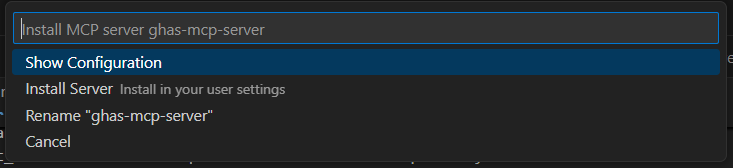
Screenshot of the configuration in VS Code

Example configuration

Add the configurations below to your MCP config in the editor.

Secure option: use the authenticated GitHub CLI

Instead of storing a Personal Access Token (see next section), you can also use the authenticated GitHub CLI. This will use the credentials you have configured in your GitHub CLI. This is useful when you have the GitHub CLI installed and already authenticated.

To use the GitHub CLI for authentication, follow the steps below:

  • Add "GITHUB_PERSONAL_ACCESS_TOKEN_USE_GHCLI": "true" to your environment variables.

  • Ensure you have the GitHub CLI installed and authenticated by running gh auth login.

Configuration:

{
    "mcp": {
        "inputs": [
        ]
    },
    "servers": {
        "ghas-mcp-server": {
            "command": "npx",
            "args": [
                "-y",
                "@rajbos/ghas-mcp-server"
            ],
            "env": {
                "GITHUB_PERSONAL_ACCESS_TOKEN_USE_GHCLI": "true"
            }
        }
    }
  }

Related MCP server: leak-secure-mcp

Configuration with a personal access token

For VS Code it would look like this:

{
    "mcp": {
        "inputs": [
            {
                "id": "github_personal_access_token",
                "description": "GitHub Personal Access Token",
                "type": "promptString",
                "password": true
            }
        ]
    },
    "servers": {
        "ghas-mcp-server": {
            "command": "npx",
            "args": [
                "-y",
                "@rajbos/ghas-mcp-server"
            ],
            "env": {
                "GITHUB_PERSONAL_ACCESS_TOKEN": "${input:github_personal_access_token}"
            }
        }
    }
  }

Results
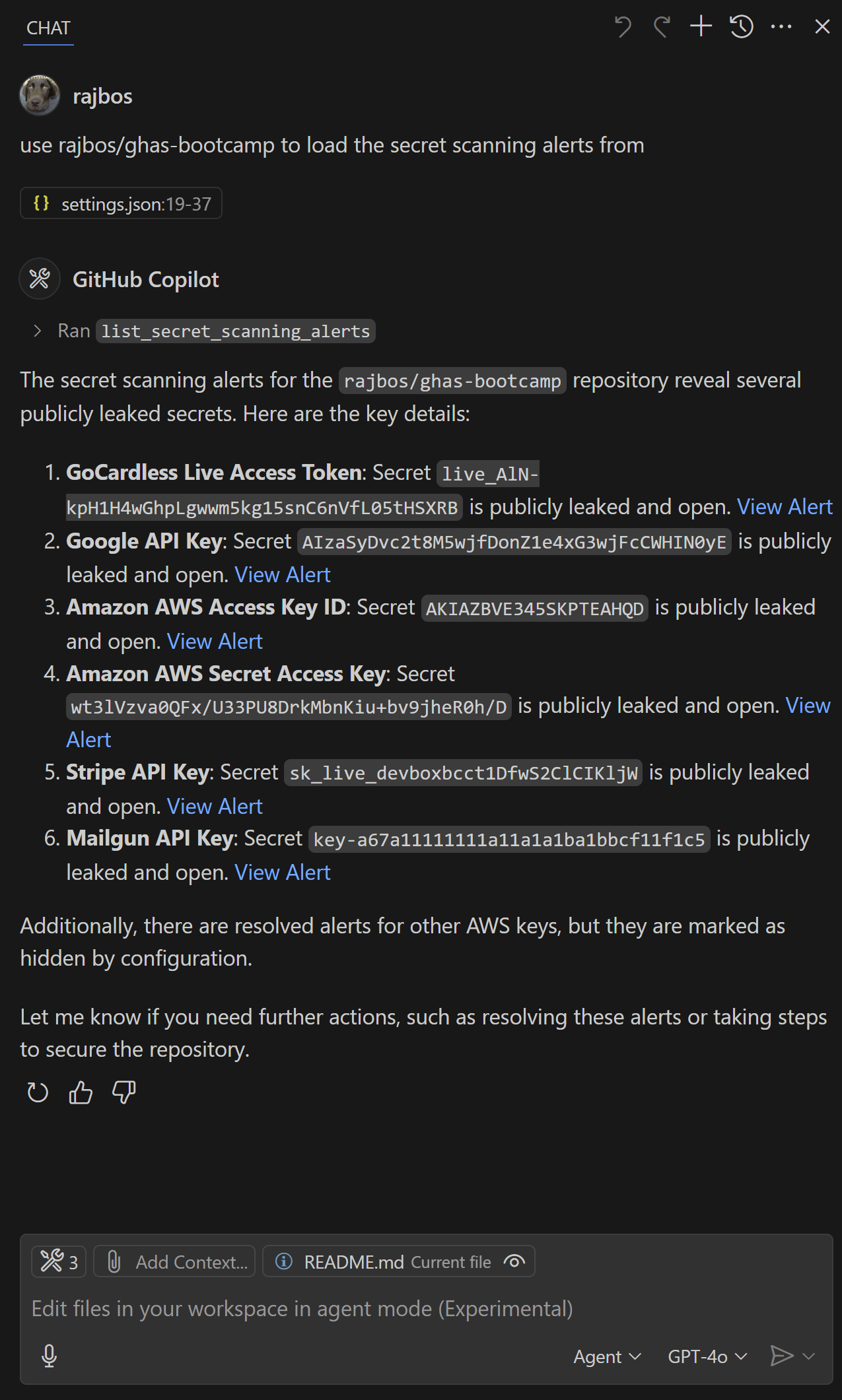
Screenshot of the output inside of VS Code

Contributing

Contributions are welcome! If you have ideas for new tools or improvements, please open an issue or submit a pull request.

Quick Start

# Install dependencies
npm install

# Build the project
npm run build

Project Structure

ghas-mcp-server/
├── src/
│   ├── operations/      # MCP Tools
│   │   └── security.ts
│   └── index.ts         # Server entry point
├── package.json
└── tsconfig.json

Adding Components

The project comes with the GHAS tools in src/operations/security.ts.

Building

  1. Make changes to your tools

  2. Run npm run build to compile

  3. The server will automatically load your tools on startup

Testing the local build

You can test your local build by configuring the locally build version with the following MCP config:

"servers": {
    "ghas-mcp-server": {
        "command": "node",
        "args": [
            "C:/Users/RobBos/Code/Repos/rajbos/ghas-mpc-server/dist/index.js"
        ],
        "env": {
            "GITHUB_PERSONAL_ACCESS_TOKEN_USE_GHCLI": "true"
        }
    }
}

Don't forget to change the path to your local build and build the project first!

Learn More

Available Tools

3 tools
list_code_scanning_alertsC

List the current GitHub Advanced Security code scanning alerts for a repository

ParametersJSON Schema
NameRequiredDescriptionDefault
ownerYes
repoYes

TDQS

C2.9/5.0
Behavior2/5

Does the description disclose side effects, auth requirements, rate limits, or destructive behavior?

With no annotations provided, the description carries the full burden of behavioral disclosure. It mentions 'List the current... alerts' but does not specify whether this is a read-only operation, if it requires authentication, rate limits, pagination, or what the output format entails. This leaves significant gaps in understanding the tool's behavior.

Agents need to know what a tool does to the world before calling it. Descriptions should go beyond structured annotations to explain consequences.

Conciseness5/5

Is the description appropriately sized, front-loaded, and free of redundancy?

The description is a single, efficient sentence that directly states the tool's purpose without unnecessary words. It is front-loaded and appropriately sized, making it easy to parse quickly.

Shorter descriptions cost fewer tokens and are easier for agents to parse. Every sentence should earn its place.

Completeness2/5

Given the tool's complexity, does the description cover enough for an agent to succeed on first attempt?

Given the tool's complexity (listing security alerts), lack of annotations, and no output schema, the description is incomplete. It does not cover behavioral aspects like permissions, response format, or error handling, which are crucial for effective use. The description alone is insufficient for an agent to fully understand how to invoke and interpret results.

Complex tools with many parameters or behaviors need more documentation. Simple tools need less. This dimension scales expectations accordingly.

Parameters3/5

Does the description clarify parameter syntax, constraints, interactions, or defaults beyond what the schema provides?

The input schema has 0% description coverage, but the description does not add any meaning to the parameters 'owner' and 'repo' beyond implying they relate to a GitHub repository. Since there are only 2 parameters, the baseline is 4, but the description fails to compensate for the lack of schema details, such as explaining what 'owner' and 'repo' represent, resulting in a score of 3.

Input schemas describe structure but not intent. Descriptions should explain non-obvious parameter relationships and valid value ranges.

Purpose4/5

Does the description clearly state what the tool does and how it differs from similar tools?

The description clearly states the verb ('List') and resource ('GitHub Advanced Security code scanning alerts for a repository'), making the tool's purpose specific and understandable. However, it does not explicitly differentiate from sibling tools like 'list_dependabot_alerts' or 'list_secret_scanning_alerts', which prevents a score of 5.

Agents choose between tools based on descriptions. A clear purpose with a specific verb and resource helps agents select the right tool.

Usage Guidelines2/5

Does the description explain when to use this tool, when not to, or what alternatives exist?

The description provides no guidance on when to use this tool versus alternatives, such as the sibling tools for Dependabot or secret scanning alerts. It lacks any context about prerequisites, exclusions, or specific scenarios where this tool is preferred, offering only a basic statement of function.

Agents often have multiple tools that could apply. Explicit usage guidance like "use X instead of Y when Z" prevents misuse.

list_dependabot_alertsC

List the current GitHub Dependabot alerts for a repository

ParametersJSON Schema
NameRequiredDescriptionDefault
ownerYes
repoYes

TDQS

C2.9/5.0
Behavior2/5

Does the description disclose side effects, auth requirements, rate limits, or destructive behavior?

No annotations are provided, so the description carries the full burden of behavioral disclosure. It states the tool lists alerts but does not describe key behaviors like whether it requires authentication, rate limits, pagination, or what the output format looks like. For a tool with zero annotation coverage, this lack of detail is a significant gap, warranting a score of 2.

Agents need to know what a tool does to the world before calling it. Descriptions should go beyond structured annotations to explain consequences.

Conciseness5/5

Is the description appropriately sized, front-loaded, and free of redundancy?

The description is a single, efficient sentence: 'List the current GitHub Dependabot alerts for a repository.' It is front-loaded with the core action and resource, with no wasted words or unnecessary details. This makes it highly concise and well-structured, earning a score of 5.

Shorter descriptions cost fewer tokens and are easier for agents to parse. Every sentence should earn its place.

Completeness2/5

Given the tool's complexity, does the description cover enough for an agent to succeed on first attempt?

Given the tool's complexity (listing security alerts), lack of annotations, and no output schema, the description is incomplete. It does not cover behavioral aspects like authentication needs, rate limits, or output format, which are crucial for an AI agent to use the tool effectively. With these gaps, the description falls short of being fully helpful, resulting in a score of 2.

Complex tools with many parameters or behaviors need more documentation. Simple tools need less. This dimension scales expectations accordingly.

Parameters3/5

Does the description clarify parameter syntax, constraints, interactions, or defaults beyond what the schema provides?

The input schema has 2 parameters (owner and repo) with 0% description coverage, meaning the schema provides no semantic details. The description does not add any parameter-specific information, such as explaining what 'owner' and 'repo' refer to or their expected formats. Since the description does not compensate for the low schema coverage, the baseline score of 3 is applied, as it neither adds value nor fully addresses the gap.

Input schemas describe structure but not intent. Descriptions should explain non-obvious parameter relationships and valid value ranges.

Purpose4/5

Does the description clearly state what the tool does and how it differs from similar tools?

The description clearly states the tool's purpose: 'List the current GitHub Dependabot alerts for a repository.' It specifies the verb ('List'), resource ('GitHub Dependabot alerts'), and scope ('for a repository'), which is specific and actionable. However, it does not explicitly differentiate from sibling tools like 'list_code_scanning_alerts' or 'list_secret_scanning_alerts', which reduces the score from a 5 to a 4.

Agents choose between tools based on descriptions. A clear purpose with a specific verb and resource helps agents select the right tool.

Usage Guidelines2/5

Does the description explain when to use this tool, when not to, or what alternatives exist?

The description provides no guidance on when to use this tool versus alternatives. It does not mention sibling tools or any context for choosing this tool over others, such as for dependency-related security issues. Without explicit usage instructions or exclusions, the score is a 2, as it offers minimal guidance beyond the basic purpose.

Agents often have multiple tools that could apply. Explicit usage guidance like "use X instead of Y when Z" prevents misuse.

list_secret_scanning_alertsC

List the current GitHub Advanced Security secret scanning alerts for a repository

ParametersJSON Schema
NameRequiredDescriptionDefault
ownerYes
repoYes

TDQS

C2.8/5.0
Behavior2/5

Does the description disclose side effects, auth requirements, rate limits, or destructive behavior?

With no annotations provided, the description carries the full burden of behavioral disclosure. It states the tool lists alerts but does not describe key traits like whether it requires authentication, has rate limits, returns paginated results, or what the output format is. This leaves significant gaps in understanding how the tool behaves.

Agents need to know what a tool does to the world before calling it. Descriptions should go beyond structured annotations to explain consequences.

Conciseness5/5

Is the description appropriately sized, front-loaded, and free of redundancy?

The description is a single, clear sentence that efficiently conveys the core purpose without unnecessary words. It is appropriately sized and front-loaded, making it easy to understand at a glance.

Shorter descriptions cost fewer tokens and are easier for agents to parse. Every sentence should earn its place.

Completeness2/5

Given the tool's complexity, does the description cover enough for an agent to succeed on first attempt?

Given the tool's complexity (listing security alerts), lack of annotations, no output schema, and low parameter schema coverage, the description is incomplete. It does not provide enough context on behavior, output, or parameter usage, making it inadequate for effective tool invocation.

Complex tools with many parameters or behaviors need more documentation. Simple tools need less. This dimension scales expectations accordingly.

Parameters2/5

Does the description clarify parameter syntax, constraints, interactions, or defaults beyond what the schema provides?

The input schema has 2 parameters with 0% description coverage, so the schema provides no semantic information. The description does not add any meaning to the parameters (owner, repo), such as explaining what they represent or how to format them, failing to compensate for the low schema coverage.

Input schemas describe structure but not intent. Descriptions should explain non-obvious parameter relationships and valid value ranges.

Purpose4/5

Does the description clearly state what the tool does and how it differs from similar tools?

The description clearly states the action ('List') and the resource ('GitHub Advanced Security secret scanning alerts for a repository'), making the purpose specific and understandable. However, it does not explicitly differentiate from sibling tools like 'list_code_scanning_alerts' or 'list_dependabot_alerts', which would be needed for a score of 5.

Agents choose between tools based on descriptions. A clear purpose with a specific verb and resource helps agents select the right tool.

Usage Guidelines2/5

Does the description explain when to use this tool, when not to, or what alternatives exist?

The description provides no guidance on when to use this tool versus alternatives, such as the sibling tools listed. It mentions the context ('for a repository') but lacks explicit when/when-not instructions or comparisons to other alert-listing tools, leaving usage unclear.

Agents often have multiple tools that could apply. Explicit usage guidance like "use X instead of Y when Z" prevents misuse.

TDQS

B3.2/5.0
Disambiguation5/5

Each tool has a clearly distinct purpose targeting different types of GitHub Advanced Security alerts: code scanning, Dependabot, and secret scanning. The descriptions explicitly differentiate the alert types, leaving no ambiguity about which tool to use for each security domain.

Naming Consistency5/5

All tools follow a perfect verb_noun pattern with 'list_' prefix followed by the specific alert type (code_scanning_alerts, dependabot_alerts, secret_scanning_alerts). The naming is completely consistent across all three tools with no deviations in style or structure.

Tool Count3/5

With only 3 tools, the server feels quite thin for GitHub Advanced Security's scope, which includes multiple security domains and potential operations beyond just listing alerts. While the tools cover the core alert types, the count is borderline minimal for what could be a more comprehensive security management interface.

Completeness2/5

The toolset is severely incomplete for GitHub Advanced Security operations. While it covers listing three types of alerts, there are significant gaps: no ability to create, update, dismiss, or resolve alerts; no access to security overviews or metrics; and no coverage of other GHAS features like code scanning analyses or security advisories. This creates dead ends for agents needing to take action on security findings.

Maintenance

ActivityInactive
ResponsivenessSyncing

Resources

Unclaimed servers have limited discoverability.

Looking for Admin?

If you are the server author, to access and configure the admin panel.

Related MCP Connectors

Related MCP Servers

  • A
    license
    C
    quality
    C
    maintenance
    Provides comprehensive tools for managing GitHub projects, milestones, tasks, and sprints. This server integrates deeply with GitHub Projects V2, offering features like automated kanban workflows, sprint planning, and custom field management.
    84
    30
    95
    MIT
  • A
    license
    A
    quality
    Not graded
    maintenance
    Enterprise-grade MCP (Model Context Protocol) server for detecting secrets and sensitive information in GitHub repositories. Scans for 35+ types of secrets including API keys, passwords, tokens, and credentials with production-ready reliability features.
    5
    0
  • F
    license
    A
    quality
    D
    maintenance
    Enables searching and analyzing CVEs and vulnerabilities from multiple sources, optimized for PR review scenarios to help developers identify the latest security issues.
    8
    2

Latest Blog Posts

MCP directory API

We provide all the information about MCP servers via our MCP API.

curl -X GET 'https://glama.ai/api/mcp/v1/servers/rajbos/ghas-mcp-server'

If you have feedback or need assistance with the MCP directory API, please join our Discord server