
Provides tools to refactor, render, and analyze Kubernetes configurations based on Kustomize, including dependency computation and diffing across various overlays and environments.
Click on "Install Server".
Wait a few minutes for the server to deploy. Once ready, it will show a "Started" state.
In the chat, type
@followed by the MCP server name and your instructions, e.g., "@Kustomize MCPShow the diff between the staging and production overlays"
That's it! The server will respond to your query, and you can continue using it as needed.
Here is a step-by-step guide with screenshots.
Kustomize MCP
An MCP server that helps to refactor Kubernetes configuration based on Kustomize.
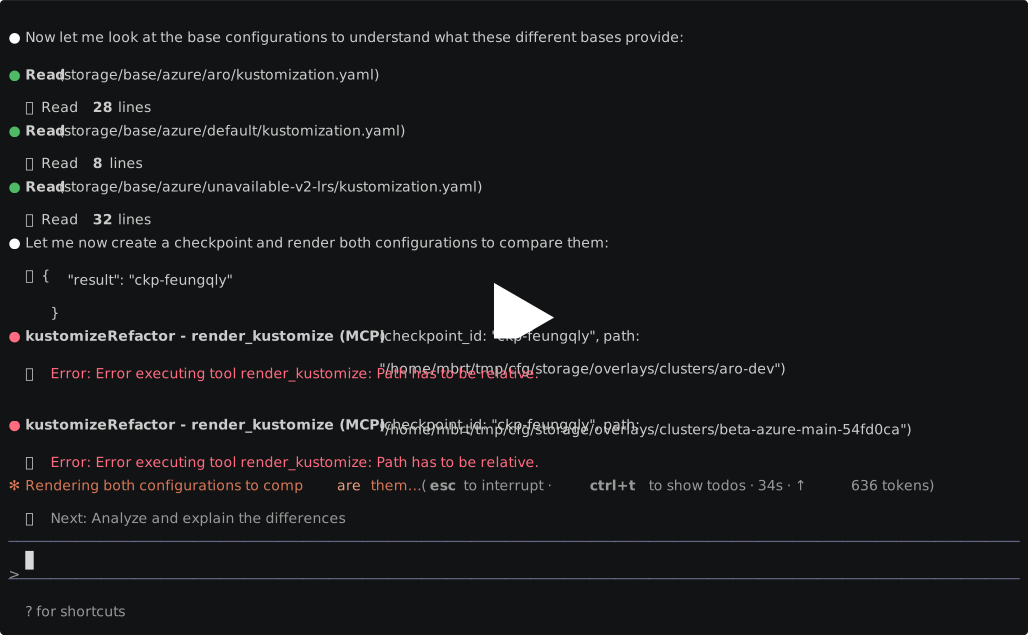
Why? Because Kustomize manifests depend on each other in non-obvious ways, it's hard for a model to understand how a config change may impact multiple environments. This MCP server gives them extra tools to make this safer:
Compute dependencies of a manifest
Render the end result of Kustomize overlays
Provide full and summarized diffs between overlays across directories and checkpoints.
Available Tools
create_checkpoint: Creates a checkpoint where rendered configuration will be stored.clear_checkpoint: Clears all checkpoints or a specific checkpointrender: Renders Kustomize configuration and saves it in a checkpointdiff_checkpoints: Compares all rendered configuration across two checkpointsdiff_paths: Compares two Kustomize configurations rendered in the same checkpointdependencies: Returns dependencies for a Kustomization file
Running the Server
This requires access to your local file system, similarly to how thefilesystem MCP Server works.
Using Docker
Run the server in a container (using the pre-built image):
The Docker image includes:
Python 3.13 with all project dependencies
kustomize (latest stable)
helm (latest stable)
git
Mount your Kustomize configurations to the /workspace directory in the
container to work with them.
If you want to rebuild the image from source:
And use that image instead of ghcr.io/mbrt/kustomize-mcp.
Using UV (Local Development)
Start the MCP server:
The server will start by using the STDIO transport.
Usage with MCP clients
To integrate with VS Code, add the configuration to your user-level MCP
configuration file. Open the Command Palette (Ctrl + Shift + P) and run MCP:
Open User Configuration. This will open your user mcp.json file where you can
add the server configuration.
To integrate with Claude Code, add this to your claude_desktop_config.json:
Replace <PROJECT_DIR> with the root directory of your project.
To integrate with Gemini CLI, edit .gemini/settings.json:
Testing the Server
Run unit tests:
After running the server on one shell, use the dev tool to verify the server is working: