
Enables deployment of the Azure DevOps MCP server on Render's cloud platform for hosted access to Azure DevOps integration capabilities
Click on "Install Server".
Wait a few minutes for the server to deploy. Once ready, it will show a "Started" state.
In the chat, type
@followed by the MCP server name and your instructions, e.g., "@Azure DevOps MCP Proxyshow me active work items assigned to me"
That's it! The server will respond to your query, and you can continue using it as needed.
Here is a step-by-step guide with screenshots.
Azure DevOps MCP (Model Context Protocol)
This project serves as a reference server implementation for the Model Context Protocol (MCP) integrated with Azure DevOps. It enables AI assistants to interact with Azure DevOps resources and perform operations programmatically.
Features
Azure DevOps integration using official Node.js SDK
Support for Model Context Protocol (MCP)
Project management operations
Work item management
Repository operations
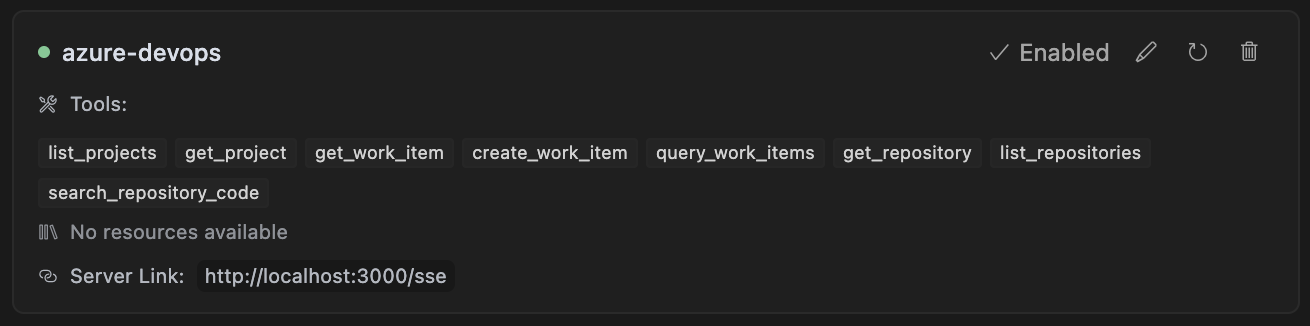
Code search capabilities
Related MCP server: azure-devops-mcp
Prerequisites
Node.js (v18 or higher recommended)
Azure DevOps account with appropriate permissions
Azure DevOps Personal Access Token (PAT)
Installation
Clone the repository:
Install dependencies:
Configure environment variables:
Copy
.env.exampleto.envFill in the required environment variables:
Add to Cursor
Then add to Cursor:
Make sure you use the path http://localhost:3000/sse. You can change ports by defining one in the env.
Environment Configuration
The following environment variables need to be configured in your .env file:
AZURE_DEVOPS_ORG_URL: Your Azure DevOps organization URLAZURE_DEVOPS_PAT: Personal Access Token for Azure DevOpsAdditional configuration variables as specified in
.env.example
Available Scripts
npm run build- Build the TypeScript projectnpm run dev- Run the server in development mode with hot reloadnpm start- Run the production server
License
MIT
