


F
licenseB
qualityD
maintenanceA simple TypeScript-based MCP server that implements a notes system, allowing users to create, list, and generate summaries of text notes via Claude.
1
3
-

플로모에게 메모를 쓰세요.
이것은 Flomo에 메모를 작성하는 데 도움이 되는 TypeScript 기반 MCP 서버입니다.
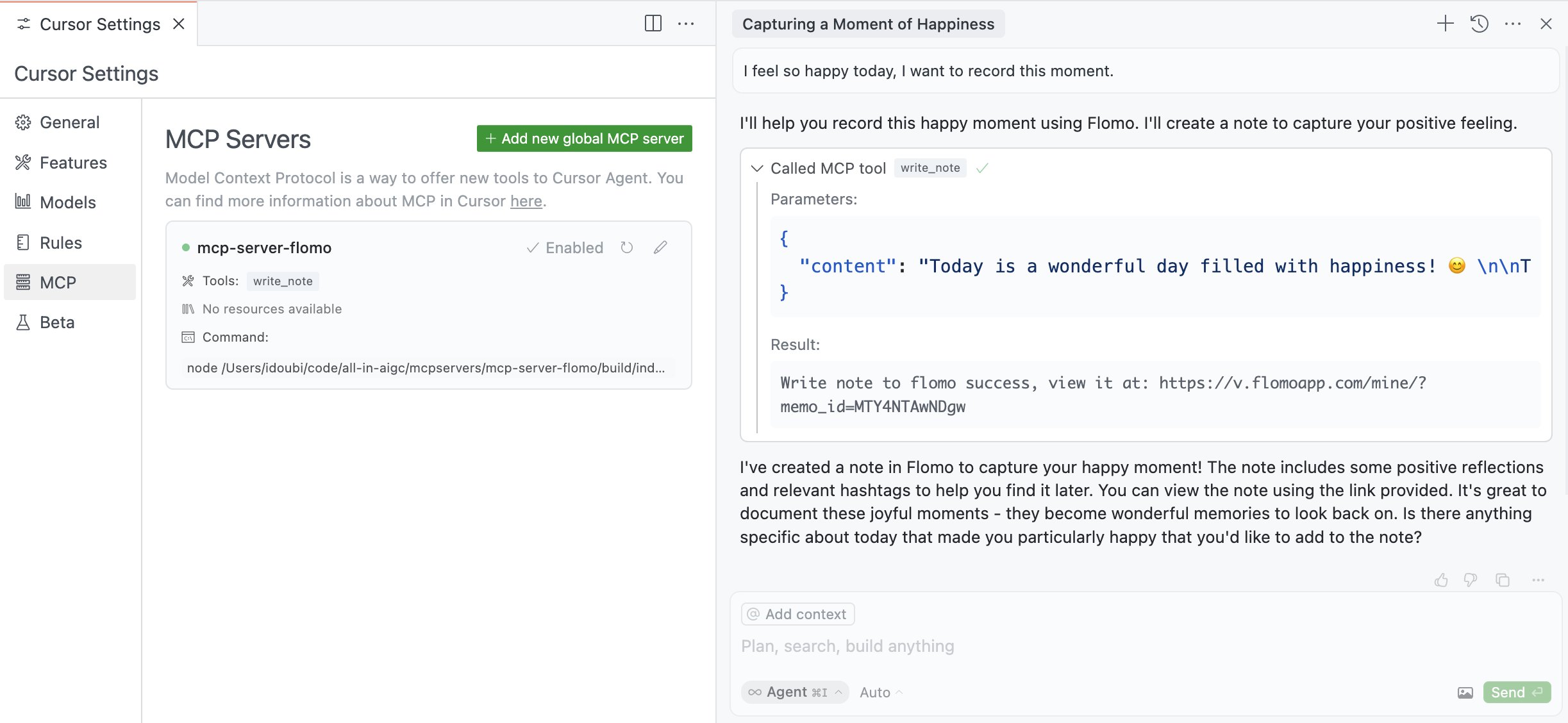
write_note - Flomo에 텍스트 메모 쓰기
필수 매개변수로 콘텐츠를 가져옵니다.
Related MCP server: Browser-use MCP Server
종속성 설치:
지엑스피1
서버를 빌드하세요:
npm run build자동 재빌드를 사용한 개발의 경우:
npm run watchClaude Desktop과 함께 사용하려면 서버 구성을 추가하세요.
MacOS의 경우: ~/Library/Application Support/Claude/claude_desktop_config.json Windows의 경우: %APPDATA%/Claude/claude_desktop_config.json
{
  "mcpServers": {
    "mcp-server-flomo": {
      "command": "npx",
      "args": ["-y", "@chatmcp/mcp-server-flomo"],
      "env": {
        "FLOMO_API_URL": "https://flomoapp.com/iwh/xxx/xxx/"
      }
    }
  }
}
여기에서 Flomo_API_URL을 찾으세요
MCP 서버는 stdio를 통해 통신하므로 디버깅이 어려울 수 있습니다. 패키지 스크립트로 제공되는 MCP Inspector를 사용하는 것이 좋습니다.
npm run inspector검사기는 브라우저에서 디버깅 도구에 액세스할 수 있는 URL을 제공합니다.
Write note to flomo
| Name | Required | Description | Default |
|---|---|---|---|
| content | Yes | Text content of the note with markdown format |
Does the description disclose side effects, auth requirements, rate limits, or destructive behavior?
With no annotations provided, the description carries full burden for behavioral disclosure. It mentions 'write' which implies a mutation operation, but doesn't specify authentication requirements, rate limits, side effects, or what happens on success/failure. This leaves significant gaps for a tool that creates content.
Agents need to know what a tool does to the world before calling it. Descriptions should go beyond structured annotations to explain consequences.
Is the description appropriately sized, front-loaded, and free of redundancy?
The description is extremely concise at just three words, front-loading the essential information with zero wasted words. It efficiently communicates the core purpose without unnecessary elaboration.
Shorter descriptions cost fewer tokens and are easier for agents to parse. Every sentence should earn its place.
Given the tool's complexity, does the description cover enough for an agent to succeed on first attempt?
For a write operation tool with no annotations and no output schema, the description is insufficiently complete. It doesn't address behavioral aspects like authentication, error handling, or what the tool returns, leaving the agent with significant uncertainty about how to properly use this mutation tool.
Complex tools with many parameters or behaviors need more documentation. Simple tools need less. This dimension scales expectations accordingly.
Does the description clarify parameter syntax, constraints, interactions, or defaults beyond what the schema provides?
The schema has 100% description coverage, with the single parameter 'content' clearly documented as 'Text content of the note with markdown format'. The description adds no additional parameter information beyond what the schema provides, meeting the baseline for high schema coverage.
Input schemas describe structure but not intent. Descriptions should explain non-obvious parameter relationships and valid value ranges.
Does the description clearly state what the tool does and how it differs from similar tools?
The description clearly states the action ('write') and target resource ('note to flomo'), providing a specific verb+resource combination. However, with no sibling tools mentioned, there's no opportunity to distinguish from alternatives, preventing a perfect score.
Agents choose between tools based on descriptions. A clear purpose with a specific verb and resource helps agents select the right tool.
Does the description explain when to use this tool, when not to, or what alternatives exist?
The description provides no guidance on when to use this tool versus alternatives, prerequisites, or contextual constraints. It simply states what the tool does without offering usage instructions.
Agents often have multiple tools that could apply. Explicit usage guidance like "use X instead of Y when Z" prevents misuse.
Recent tool additions, removals, and schema changes observed during successful MCP inspections.
v1.0.0write_noteScored across 1 tool
With only one tool, there is no possibility of ambiguity or overlap between tools. The tool 'write_note' has a single, clear purpose that cannot be confused with any other tool in this set.
The naming follows a consistent verb_noun pattern ('write_note'), and with only one tool, there is no inconsistency to evaluate. The pattern is clear and predictable.
A single tool is too few for a note-taking server, as it lacks basic operations like reading, updating, deleting, or searching notes. This minimal set severely limits functionality and will likely cause agent failures in typical workflows.
The tool surface is severely incomplete for a note-taking domain. It only provides write capability, missing essential operations such as get_note, list_notes, update_note, delete_note, and search_notes, which are critical for full lifecycle management.
Markdown-based note-taking with a hosted MCP server. Your notes serve you and your AI.
Hosted MCP server connecting claude.ai, ChatGPT and other AI apps to your own computer
Connect AI to your flomo notes. Search, create, edit notes and manage tags via MCP.
Google Keep-style notes app with an MCP server for AI agents to read/write notes.