# Nova - Resources/Relationships
*Source: https://nova.laravel.com/docs/v5/resources/relationships*
---
- [Community](https://discord.com/invite/laravel)
- [Blog](https://blog.laravel.com)
##### Get Started
- [Installation](/docs/v5/installation)
- [Release Notes](/docs/v5/releases)
- [Upgrade Guide](/docs/v5/upgrade)
##### Resources
- [The Basics](/docs/v5/resources/the-basics)
- [Fields](/docs/v5/resources/fields)
- [Dependent Fields](/docs/v5/resources/dependent-fields)
- [Date Fields](/docs/v5/resources/date-fields)
- [File Fields](/docs/v5/resources/file-fields)
- [Repeater Fields](/docs/v5/resources/repeater-fields)
- [Field Panels](/docs/v5/resources/panels)
- [Relationships](/docs/v5/resources/relationships)
- [Validation](/docs/v5/resources/validation)
- [Authorization](/docs/v5/resources/authorization)
##### Search
- [The Basics](/docs/v5/search/the-basics)
- [Global Search](/docs/v5/search/global-search)
- [Scout Integration](/docs/v5/search/scout-integration)
##### Filters
- [Defining Filters](/docs/v5/filters/defining-filters)
- [Registering Filters](/docs/v5/filters/registering-filters)
##### Lenses
- [Defining Lenses](/docs/v5/lenses/defining-lenses)
- [Registering Lenses](/docs/v5/lenses/registering-lenses)
##### Actions
- [Defining Actions](/docs/v5/actions/defining-actions)
- [Registering Actions](/docs/v5/actions/registering-actions)
##### Metrics
- [Defining Metrics](/docs/v5/metrics/defining-metrics)
- [Registering Metrics](/docs/v5/metrics/registering-metrics)
##### Digging Deeper
- [Dashboards](/docs/v5/customization/dashboards)
- [Menus](/docs/v5/customization/menus)
- [Notifications](/docs/v5/customization/notifications)
- [Authentication](/docs/v5/customization/authentication)
- [Impersonation](/docs/v5/customization/impersonation)
- [Tools](/docs/v5/customization/tools)
- [Resource Tools](/docs/v5/customization/resource-tools)
- [Cards](/docs/v5/customization/cards)
- [Fields](/docs/v5/customization/fields)
- [Filters](/docs/v5/customization/filters)
- [CSS / JavaScript](/docs/v5/customization/frontend)
- [Assets](/docs/v5/customization/assets)
- [Localization](/docs/v5/customization/localization)
- [Stubs](/docs/v5/customization/stubs)
On this page
- [HasOne](#hasone)
- [HasOneOfMany](#hasoneofmany)
- [HasMany](#hasmany)
- [HasOneThrough](#hasonethrough)
- [HasManyThrough](#hasmanythrough)
- [BelongsTo](#belongsto)
- [Peeking at BelongsTo Relationships](#peeking-at-belongsto-relationships)
- [Preventing Peeking at BelongsTo Relationships](#preventing-peeking-at-belongsto-relationships)
- [Nullable Relationships](#nullable-relationships)
- [Title Attributes](#title-attributes)
- [Disable Ordering by Title](#disable-ordering-by-title)
- [Filter Trashed Items](#filter-trashed-items)
- [BelongsToMany](#belongstomany)
- [Pivot Fields](#pivot-fields)
- [Pivot Computed Fields](#pivot-computed-fields)
- [Pivot Actions](#pivot-actions)
- [Title Attributes](#title-attributes-2)
- [Disabling Ordering by Title](#disabling-ordering-by-title)
- [Allowing Duplicate Relations](#allowing-duplicate-relations)
- [MorphOne](#morphone)
- [MorphOneOfMany](#morphoneofmany)
- [MorphMany](#morphmany)
- [MorphTo](#morphto)
- [Nullable MorphTo Relationships](#nullable-morphto-relationships)
- [Peeking at MorphTo Relationships](#peeking-at-morphto-relationships)
- [Preventing Peeking at MorphTo Relationships](#preventing-peeking-at-morphto-relationships)
- [Setting Default Values on MorphTo Relationships](#setting-default-values-on-morphto-relationships)
- [MorphToMany](#morphtomany)
- [Pivot Fields](#pivot-fields-2)
- [Title Attributes](#title-attributes-3)
- [Collapsable Relations](#collapsable-relations)
- [Searchable Relations](#searchable-relations)
- [Relatable Query Filtering](#relatable-query-filtering)
- [Limiting Relation Results](#limiting-relation-results)
- [Creating Inline Relations](#creating-inline-relations)
- [Inline Creation Modal Size](#inline-creation-modal-size)
Resources
# Relationships
Nova ships with a variety of fields out of the box, including fields for text inputs, booleans, dates, file uploads, Markdown, and more.
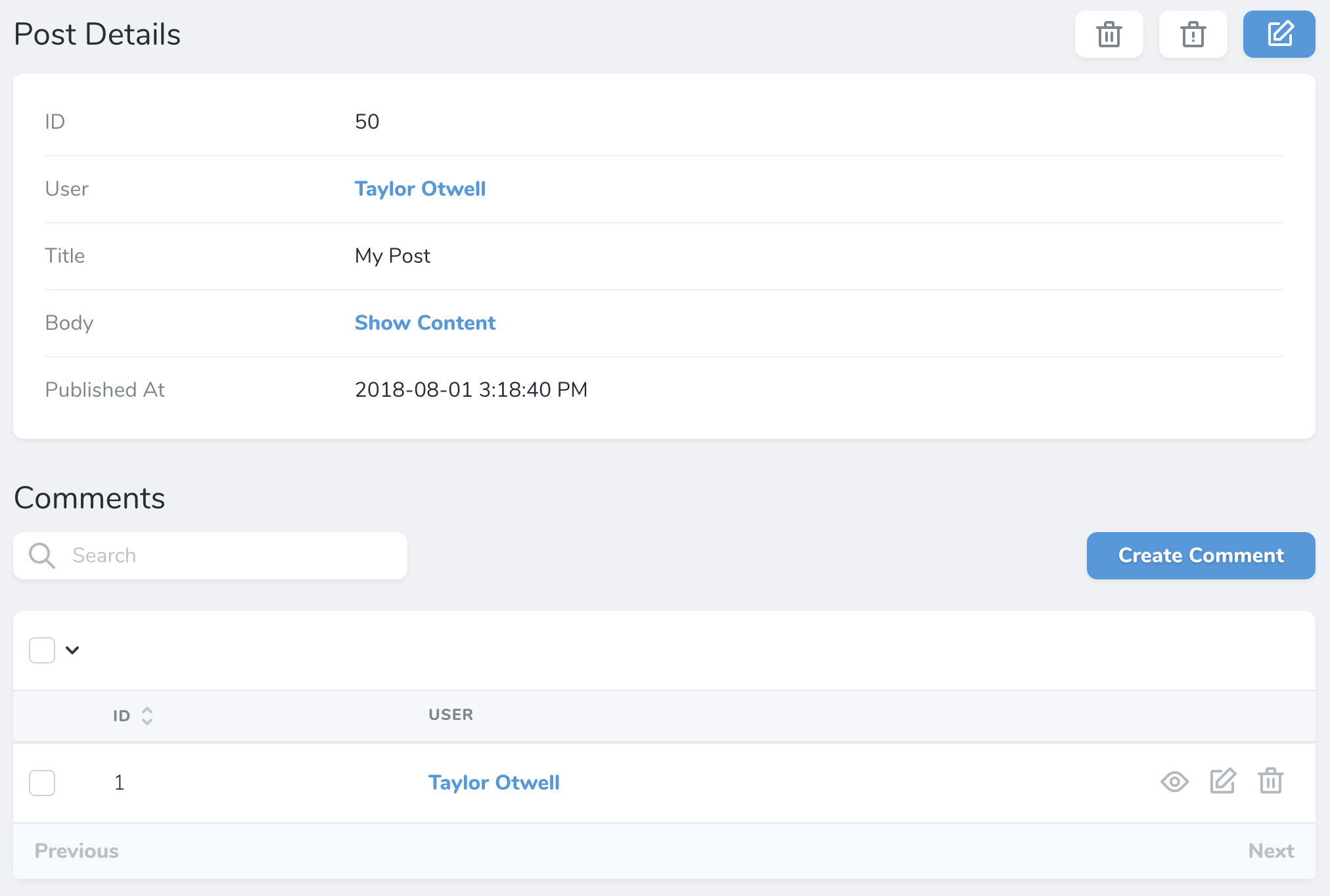
In addition to the variety of fields we’ve already discussed, Nova has full support for all of Laravel’s relationships. Once you add relationship fields to your Nova resources, you’ll start to experience the full power of the Nova dashboard, as the resource detail page will allow you to quickly view and search a resource’s related models:
## [](#hasone) HasOne
The `HasOne` field corresponds to a `hasOne` Eloquent relationship. For example, let’s assume a `User` model `hasOne` `Address` model. We may add the relationship to our `User` Nova resource like so:
Copy
Ask AI
```
use Laravel\Nova\Fields\HasOne;
// ...
HasOne::make('Address'),
```
Like other types of fields, relationship fields will automatically “camel case” the displayable name of the field to determine the underlying relationship method / attribute. However, you may explicitly specify the name of the relationship method by passing it as the second argument to the field’s `make` method:
Copy
Ask AI
```
use Laravel\Nova\Fields\HasOne;
// ...
HasOne::make('Dirección', 'address'),
```
### [](#hasoneofmany) HasOneOfMany
The `HasOne` relationship field can be transformed into an “has one of many” Eloquent relationship using the `ofMany` method. For example, let’s assume a `User` model `hasMany` `Post` models. We may add the “has one of many” relationship to our `User` Nova resource like so:
Copy
Ask AI
```
use App\Nova\Post;
use Laravel\Nova\Fields\HasOne;
// ...
HasOne::ofMany('Latest Post', 'latestPost', Post::class),
```
## [](#hasmany) HasMany
The `HasMany` field corresponds to a `hasMany` Eloquent relationship. For example, let’s assume a `User` model `hasMany` `Post` models. We may add the relationship to our `User` Nova resource like so:
Copy
Ask AI
```
use Laravel\Nova\Fields\HasMany;
// ...
HasMany::make('Posts'),
```
Once the field has been added to your resource, it will be displayed on the resource’s detail page.
When defining `HasMany` relationships, make sure to use the plural form of the relationship so Nova can infer the correct singular resource name:
Copy
Ask AI
```
use Laravel\Nova\Fields\HasMany;
// ...
HasMany::make('Posts'),
```
## [](#hasonethrough) HasOneThrough
The `HasOneThrough` field corresponds to a `hasOneThrough` Eloquent relationship. For example, let’s assume a `Mechanic` model has one `Car`, and each `Car` may have one `Owner`. While the `Mechanic` and the `Owner` have no direct connection, the `Mechanic` can access the `Owner` through the `Car` itself. You can display this relationship by adding it to your Nova resource:
Copy
Ask AI
```
use Laravel\Nova\Fields\HasOneThrough;
// ...
HasOneThrough::make('Owner'),
```
## [](#hasmanythrough) HasManyThrough
The `HasManyThrough` field corresponds to a `hasManyThrough` Eloquent relationship. For example, a `Country` model might have many `Post` models through an intermediate `User` model. In this example, you could easily gather all blog posts for a given country. To display this relationship within Nova, you may add it to your Nova resource:
Copy
Ask AI
```
use Laravel\Nova\Fields\HasManyThrough;
// ...
HasManyThrough::make('Posts'),
```
## [](#belongsto) BelongsTo
The `BelongsTo` field corresponds to a `belongsTo` Eloquent relationship. For example, let’s assume a `Post` model `belongsTo` a `User` model. We may add the relationship to our `Post` Nova resource like so:
Copy
Ask AI
```
use Laravel\Nova\Fields\BelongsTo;
// ...
BelongsTo::make('User'),
```
You may customize the resource class used by the relation field by providing the second and third arguments of the `make` method, which define the name of the relationship and the underlying Nova resource class:
Copy
Ask AI
```
use App\Nova\User;
use Laravel\Nova\Fields\BelongsTo;
// ...
BelongsTo::make('Author', 'author', User::class),
```
### [](#peeking-at-belongsto-relationships) Peeking at BelongsTo Relationships
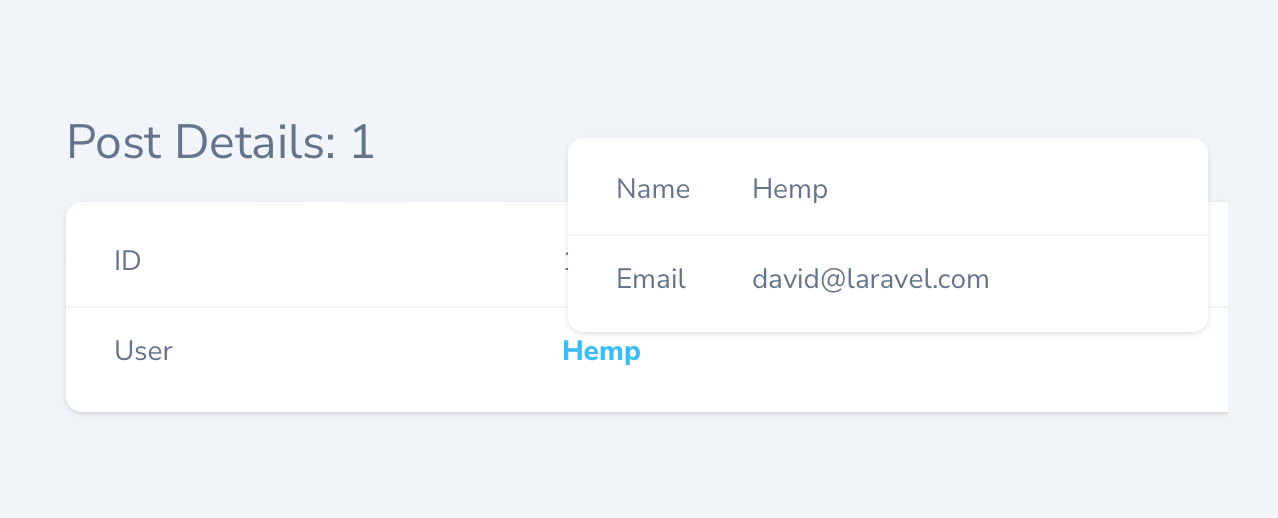
When hovering over a `BelongsTo` link when viewing the index or detail views, Nova will show a small card allowing you to “take a peek” at the linked relation:
### [](#preventing-peeking-at-belongsto-relationships) Preventing Peeking at `BelongsTo` Relationships
Relationship peeking is enabled by default; however, you can prevent the user from peeking at the relation using the `noPeeking` helper on your `BelongsTo` field:
Copy
Ask AI
```
use Laravel\Nova\Fields\BelongsTo;
// ...
BelongsTo::make('Author')
->noPeeking(),
```
You may also use the `peekable` method to determine whether the user should be allowed to peek at the relation:
Copy
Ask AI
```
use Laravel\Nova\Fields\BelongsTo;
use Laravel\Nova\Http\Requests\NovaRequest;
// ...
BelongsTo::make('Author')
->peekable(function (NovaRequest $request) {
return $request->isResourceDetailRequest();
}),
```
#### [](#nullable-relationships) Nullable Relationships
If you would like your `BelongsTo` relationship to be `nullable`, you may simply chain the `nullable` method onto the field’s definition:
Copy
Ask AI
```
use Laravel\Nova\Fields\BelongsTo;
// ...
BelongsTo::make('User')
->nullable(),
```
#### [](#title-attributes) Title Attributes
When a `BelongsTo` field is shown on a resource creation / update page, a drop-down selection menu or search menu will display the “title” of the resource. For example, a `User` resource may use the `name` attribute as its title. Then, when the resource is shown in a `BelongsTo` selection menu, that attribute will be displayed:
