Web3 Research MCP
Web3 研究 MCP
加密货币深度研究 - 免费且完全本地化 🧠
🚀 预览

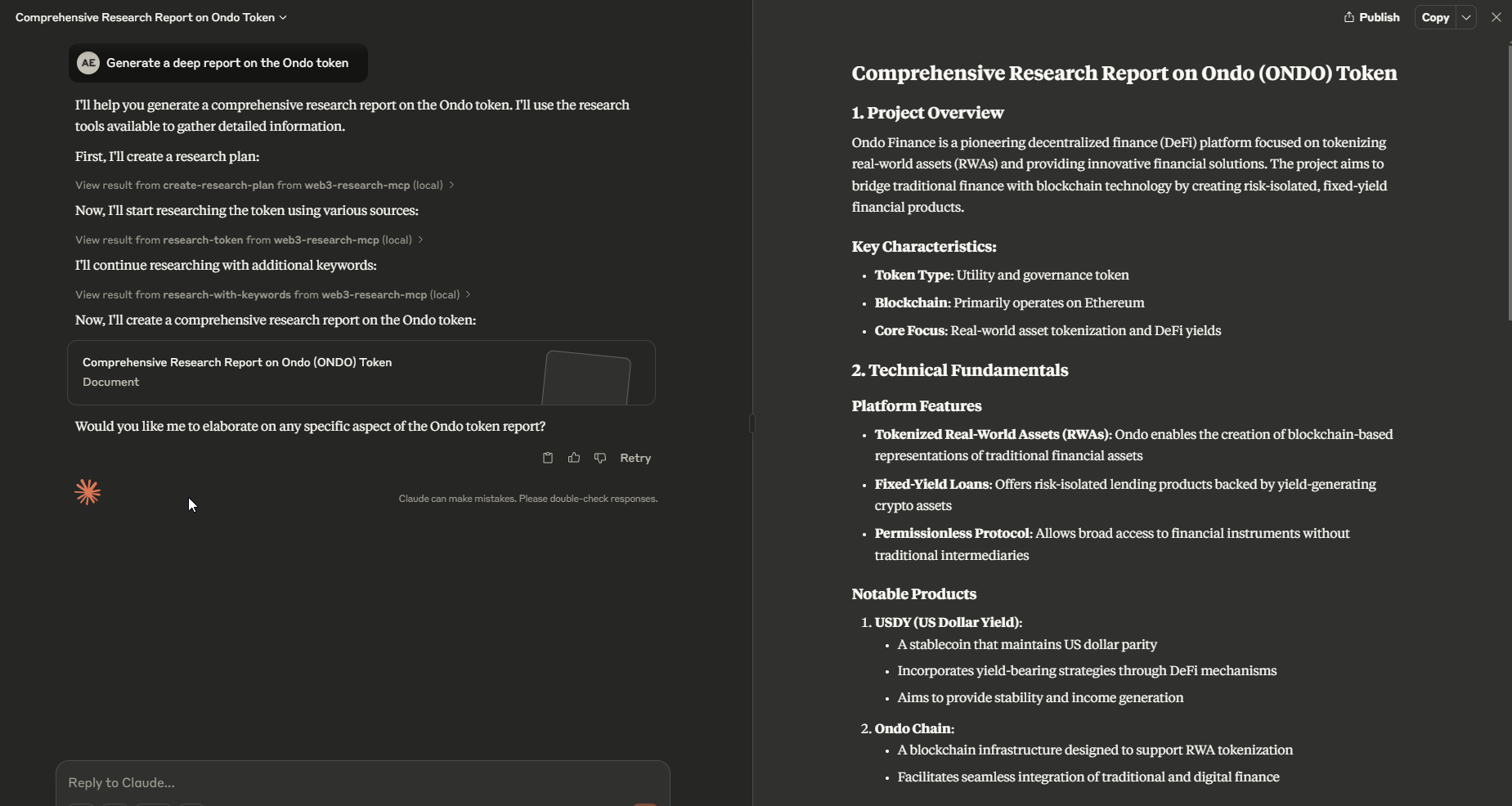
Related MCP server: deeplook
🧠 功能
全面研究:收集关于任何加密货币代币的详细信息
多源分析:跨多个来源进行研究,包括 CoinGecko、CoinMarketCap、DeFiLlama 等
结构化报告:生成涵盖技术基本面、市场数据、社交情绪等的详细报告
资源管理:自动存储搜索结果和内容以供参考
状态跟踪:通过不同阶段和部分跟踪研究进度
📋 要求
Node.js (v16 或更高版本)
🔧 安装与设置
通过 Smithery 安装
要通过 Smithery 自动为 Claude Desktop 安装 web3-research-mcp:
npx -y @smithery/cli install web3-research-mcp --client claude🔌 在 Claude Desktop 中使用
编辑您的 Claude Desktop 配置文件
Windows: %APPDATA%\Claude\claude_desktop_config.json
macOS: ~/Library/Application Support/Claude/claude_desktop_config.json
将此内容添加到您的 Claude Desktop 配置文件中:
{
"mcpServers": {
"web3-research-mcp": {
"command": "npx",
"args": ["-y", "web3-research-mcp@latest"]
}
}
}然后重启 Claude Desktop
🔌 在 Cursor 中使用
前往:Settings -> Cursor Settings -> MCP -> Add new global MCP server 将此内容粘贴到您的 Cursor ~/.cursor/mcp.json 文件中。更多信息请参阅 Cursor MCP 文档。
{
"mcpServers": {
"web3-research-mcp": {
"command": "npx",
"args": ["-y", "web3-research-mcp@latest"]
}
}
}然后重启 Cursor
🛠️ 工具
create-research-plan
为代币创建结构化的研究计划。
参数:
tokenName: 代币全称
tokenTicker: 代币代码
search
执行网页搜索并返回结果。
参数:
query: 搜索查询
searchType: 搜索类型 (web, news, images, videos)
research-with-keywords
使用特定关键词搜索代币并保存结果。
参数:
tokenName: 代币名称
tokenTicker: 代币代码
keywords: 要搜索的关键词数组
update-status
更新研究部分的状态。
参数:
section: 要更新的部分名称 (例如:'projectInfo', 'technicalFundamentals')
status: 该部分的新状态 (planned, in_progress, completed)
fetch-content
从 URL 获取内容并将其保存为资源。
参数:
url: 要获取内容的 URL
format: 输出格式 (text, html, markdown, json)
list-resources
列出所有已保存的可用资源。
search-source
从特定来源搜索关于代币的信息。
参数:
tokenName: 代币名称
tokenTicker: 代币代码
source: 要搜索的来源 (例如:'CoinGecko', 'DeFiLlama', 'News')
coingecko-data
直接从 CoinGecko 公共 API 获取实时市场数据 — 价格、市值、24小时/7天/30天涨跌幅、ATH/ATL、流通供应量、跨链合约地址以及社交/开发链接。绕过 HTML 抓取的 403 问题。
参数:
tokenName: 代币全称 (例如:'Bitcoin')
tokenTicker: 代币代码 (例如:'BTC')
无需 API 密钥。使用免费公共层(约 30 次请求/分钟)。
可选:在环境变量中设置 COINGECKO_API_KEY 以使用 CoinGecko Pro API 密钥。设置后,请求将发送至 https://pro-api.coingecko.com/api/v3 并携带 x-cg-pro-api-key 请求头。请求在 15 秒后超时。
coingecko-search
搜索 CoinGecko 的代币索引并返回带有 CoinGecko ID 的候选匹配项。当代码有歧义时(例如,多个代币使用相同代码)非常有用。
参数:
query: 搜索查询 — 名称、代码或合约地址
defillama-data
直接从 DeFiLlama 公共 API 获取协议数据 — 总 TVL、各链 TVL 分布、费用(24小时/7天/30天/历史总计)、代币地址、融资轮次和链接。绕过 HTML 抓取,适用于最常见的 DeFi 协议查询。
参数:
tokenName: 协议/代币全称 (例如:'Uniswap')
tokenTicker: 代币代码 (例如:'UNI')
无需 API 密钥。使用免费公共 API。请求在 15 秒后超时。协议索引在每个进程中缓存 5 分钟,以避免每次调用都频繁请求 /protocols。
defillama-search
搜索 DeFiLlama 的协议索引并返回带有 slug、TVL 和类别的候选匹配项。当代码有歧义时(例如,多个协议名称相似)非常有用。
参数:
query: 搜索查询 — 协议名称、代码或 slug
📝 提示词
token-research
启动对加密货币代币的全面研究。
参数:
tokenName: 加密货币代币全称
tokenTicker: 代币代码 (例如:BTC, ETH)
🧠 工作原理
研究开始时,会创建一个涵盖代币各个方面的结构化计划
服务器跨多个来源执行信息搜索
搜索结果作为可引用的资源进行存储
研究通过不同部分推进,并进行状态跟踪
生成一份涵盖代币各个方面的综合报告
⚠️ 局限性
某些网站会阻止网页抓取,因此直接获取内容可能会因 403 错误而失败
依赖于搜索结果,这些结果可能并不总是全面的
搜索操作可能会受到速率限制
📄 许可证
本项目采用 Apache License 2.0 许可证 - 详情请参阅 LICENSE 文件。
Available Tools
14 toolscoingecko-dataD
| Name | Required | Description | Default |
|---|---|---|---|
| tokenName | Yes | Full name of the token (e.g., 'Bitcoin') | |
| tokenTicker | Yes | Ticker symbol (e.g., 'BTC') |
TDQS
Does the description disclose side effects, auth requirements, rate limits, or destructive behavior?
Tool has no description.
Agents need to know what a tool does to the world before calling it. Descriptions should go beyond structured annotations to explain consequences.
Is the description appropriately sized, front-loaded, and free of redundancy?
Tool has no description.
Shorter descriptions cost fewer tokens and are easier for agents to parse. Every sentence should earn its place.
Given the tool's complexity, does the description cover enough for an agent to succeed on first attempt?
Tool has no description.
Complex tools with many parameters or behaviors need more documentation. Simple tools need less. This dimension scales expectations accordingly.
Does the description clarify parameter syntax, constraints, interactions, or defaults beyond what the schema provides?
Tool has no description.
Input schemas describe structure but not intent. Descriptions should explain non-obvious parameter relationships and valid value ranges.
Does the description clearly state what the tool does and how it differs from similar tools?
Tool has no description.
Agents choose between tools based on descriptions. A clear purpose with a specific verb and resource helps agents select the right tool.
Does the description explain when to use this tool, when not to, or what alternatives exist?
Tool has no description.
Agents often have multiple tools that could apply. Explicit usage guidance like "use X instead of Y when Z" prevents misuse.
coingecko-searchD
| Name | Required | Description | Default |
|---|---|---|---|
| query | Yes | Search query — name, ticker, or contract address. Returns candidate CoinGecko IDs. |
TDQS
Does the description disclose side effects, auth requirements, rate limits, or destructive behavior?
Tool has no description.
Agents need to know what a tool does to the world before calling it. Descriptions should go beyond structured annotations to explain consequences.
Is the description appropriately sized, front-loaded, and free of redundancy?
Tool has no description.
Shorter descriptions cost fewer tokens and are easier for agents to parse. Every sentence should earn its place.
Given the tool's complexity, does the description cover enough for an agent to succeed on first attempt?
Tool has no description.
Complex tools with many parameters or behaviors need more documentation. Simple tools need less. This dimension scales expectations accordingly.
Does the description clarify parameter syntax, constraints, interactions, or defaults beyond what the schema provides?
Tool has no description.
Input schemas describe structure but not intent. Descriptions should explain non-obvious parameter relationships and valid value ranges.
Does the description clearly state what the tool does and how it differs from similar tools?
Tool has no description.
Agents choose between tools based on descriptions. A clear purpose with a specific verb and resource helps agents select the right tool.
Does the description explain when to use this tool, when not to, or what alternatives exist?
Tool has no description.
Agents often have multiple tools that could apply. Explicit usage guidance like "use X instead of Y when Z" prevents misuse.
coingecko-tickersD
| Name | Required | Description | Default |
|---|---|---|---|
| limit | No | How many top venues to return (sorted by 24h USD volume) | |
| tokenName | Yes | Full name of the token (e.g., 'Bitcoin') | |
| tokenTicker | Yes | Ticker symbol (e.g., 'BTC') |
TDQS
Does the description disclose side effects, auth requirements, rate limits, or destructive behavior?
Tool has no description.
Agents need to know what a tool does to the world before calling it. Descriptions should go beyond structured annotations to explain consequences.
Is the description appropriately sized, front-loaded, and free of redundancy?
Tool has no description.
Shorter descriptions cost fewer tokens and are easier for agents to parse. Every sentence should earn its place.
Given the tool's complexity, does the description cover enough for an agent to succeed on first attempt?
Tool has no description.
Complex tools with many parameters or behaviors need more documentation. Simple tools need less. This dimension scales expectations accordingly.
Does the description clarify parameter syntax, constraints, interactions, or defaults beyond what the schema provides?
Tool has no description.
Input schemas describe structure but not intent. Descriptions should explain non-obvious parameter relationships and valid value ranges.
Does the description clearly state what the tool does and how it differs from similar tools?
Tool has no description.
Agents choose between tools based on descriptions. A clear purpose with a specific verb and resource helps agents select the right tool.
Does the description explain when to use this tool, when not to, or what alternatives exist?
Tool has no description.
Agents often have multiple tools that could apply. Explicit usage guidance like "use X instead of Y when Z" prevents misuse.
create-research-planD
| Name | Required | Description | Default |
|---|---|---|---|
| tokenName | Yes | Token name | |
| tokenTicker | Yes | Token ticker symbol |
TDQS
Does the description disclose side effects, auth requirements, rate limits, or destructive behavior?
Tool has no description.
Agents need to know what a tool does to the world before calling it. Descriptions should go beyond structured annotations to explain consequences.
Is the description appropriately sized, front-loaded, and free of redundancy?
Tool has no description.
Shorter descriptions cost fewer tokens and are easier for agents to parse. Every sentence should earn its place.
Given the tool's complexity, does the description cover enough for an agent to succeed on first attempt?
Tool has no description.
Complex tools with many parameters or behaviors need more documentation. Simple tools need less. This dimension scales expectations accordingly.
Does the description clarify parameter syntax, constraints, interactions, or defaults beyond what the schema provides?
Tool has no description.
Input schemas describe structure but not intent. Descriptions should explain non-obvious parameter relationships and valid value ranges.
Does the description clearly state what the tool does and how it differs from similar tools?
Tool has no description.
Agents choose between tools based on descriptions. A clear purpose with a specific verb and resource helps agents select the right tool.
Does the description explain when to use this tool, when not to, or what alternatives exist?
Tool has no description.
Agents often have multiple tools that could apply. Explicit usage guidance like "use X instead of Y when Z" prevents misuse.
defillama-dataD
| Name | Required | Description | Default |
|---|---|---|---|
| tokenName | Yes | Full protocol/token name (e.g., 'Uniswap') | |
| tokenTicker | Yes | Ticker symbol (e.g., 'UNI') |
TDQS
Does the description disclose side effects, auth requirements, rate limits, or destructive behavior?
Tool has no description.
Agents need to know what a tool does to the world before calling it. Descriptions should go beyond structured annotations to explain consequences.
Is the description appropriately sized, front-loaded, and free of redundancy?
Tool has no description.
Shorter descriptions cost fewer tokens and are easier for agents to parse. Every sentence should earn its place.
Given the tool's complexity, does the description cover enough for an agent to succeed on first attempt?
Tool has no description.
Complex tools with many parameters or behaviors need more documentation. Simple tools need less. This dimension scales expectations accordingly.
Does the description clarify parameter syntax, constraints, interactions, or defaults beyond what the schema provides?
Tool has no description.
Input schemas describe structure but not intent. Descriptions should explain non-obvious parameter relationships and valid value ranges.
Does the description clearly state what the tool does and how it differs from similar tools?
Tool has no description.
Agents choose between tools based on descriptions. A clear purpose with a specific verb and resource helps agents select the right tool.
Does the description explain when to use this tool, when not to, or what alternatives exist?
Tool has no description.
Agents often have multiple tools that could apply. Explicit usage guidance like "use X instead of Y when Z" prevents misuse.
defillama-searchD
| Name | Required | Description | Default |
|---|---|---|---|
| query | Yes | Search query — protocol name, ticker, or slug. Returns candidate DeFiLlama protocols with their slugs. |
TDQS
Does the description disclose side effects, auth requirements, rate limits, or destructive behavior?
Tool has no description.
Agents need to know what a tool does to the world before calling it. Descriptions should go beyond structured annotations to explain consequences.
Is the description appropriately sized, front-loaded, and free of redundancy?
Tool has no description.
Shorter descriptions cost fewer tokens and are easier for agents to parse. Every sentence should earn its place.
Given the tool's complexity, does the description cover enough for an agent to succeed on first attempt?
Tool has no description.
Complex tools with many parameters or behaviors need more documentation. Simple tools need less. This dimension scales expectations accordingly.
Does the description clarify parameter syntax, constraints, interactions, or defaults beyond what the schema provides?
Tool has no description.
Input schemas describe structure but not intent. Descriptions should explain non-obvious parameter relationships and valid value ranges.
Does the description clearly state what the tool does and how it differs from similar tools?
Tool has no description.
Agents choose between tools based on descriptions. A clear purpose with a specific verb and resource helps agents select the right tool.
Does the description explain when to use this tool, when not to, or what alternatives exist?
Tool has no description.
Agents often have multiple tools that could apply. Explicit usage guidance like "use X instead of Y when Z" prevents misuse.
fetch-contentD
| Name | Required | Description | Default |
|---|---|---|---|
| url | Yes | URL to fetch content from (can be a resource:// URL) | |
| format | No | Output format | markdown |
TDQS
Does the description disclose side effects, auth requirements, rate limits, or destructive behavior?
Tool has no description.
Agents need to know what a tool does to the world before calling it. Descriptions should go beyond structured annotations to explain consequences.
Is the description appropriately sized, front-loaded, and free of redundancy?
Tool has no description.
Shorter descriptions cost fewer tokens and are easier for agents to parse. Every sentence should earn its place.
Given the tool's complexity, does the description cover enough for an agent to succeed on first attempt?
Tool has no description.
Complex tools with many parameters or behaviors need more documentation. Simple tools need less. This dimension scales expectations accordingly.
Does the description clarify parameter syntax, constraints, interactions, or defaults beyond what the schema provides?
Tool has no description.
Input schemas describe structure but not intent. Descriptions should explain non-obvious parameter relationships and valid value ranges.
Does the description clearly state what the tool does and how it differs from similar tools?
Tool has no description.
Agents choose between tools based on descriptions. A clear purpose with a specific verb and resource helps agents select the right tool.
Does the description explain when to use this tool, when not to, or what alternatives exist?
Tool has no description.
Agents often have multiple tools that could apply. Explicit usage guidance like "use X instead of Y when Z" prevents misuse.
list-resourcesD
| Name | Required | Description | Default |
|---|---|---|---|
No parameters | |||
TDQS
Does the description disclose side effects, auth requirements, rate limits, or destructive behavior?
Tool has no description.
Agents need to know what a tool does to the world before calling it. Descriptions should go beyond structured annotations to explain consequences.
Is the description appropriately sized, front-loaded, and free of redundancy?
Tool has no description.
Shorter descriptions cost fewer tokens and are easier for agents to parse. Every sentence should earn its place.
Given the tool's complexity, does the description cover enough for an agent to succeed on first attempt?
Tool has no description.
Complex tools with many parameters or behaviors need more documentation. Simple tools need less. This dimension scales expectations accordingly.
Does the description clarify parameter syntax, constraints, interactions, or defaults beyond what the schema provides?
Tool has no description.
Input schemas describe structure but not intent. Descriptions should explain non-obvious parameter relationships and valid value ranges.
Does the description clearly state what the tool does and how it differs from similar tools?
Tool has no description.
Agents choose between tools based on descriptions. A clear purpose with a specific verb and resource helps agents select the right tool.
Does the description explain when to use this tool, when not to, or what alternatives exist?
Tool has no description.
Agents often have multiple tools that could apply. Explicit usage guidance like "use X instead of Y when Z" prevents misuse.
research-sourceD
| Name | Required | Description | Default |
|---|---|---|---|
| source | Yes | Single source to research | |
| tokenName | Yes | Name of the token | |
| tokenTicker | Yes | Ticker symbol of the token |
TDQS
Does the description disclose side effects, auth requirements, rate limits, or destructive behavior?
Tool has no description.
Agents need to know what a tool does to the world before calling it. Descriptions should go beyond structured annotations to explain consequences.
Is the description appropriately sized, front-loaded, and free of redundancy?
Tool has no description.
Shorter descriptions cost fewer tokens and are easier for agents to parse. Every sentence should earn its place.
Given the tool's complexity, does the description cover enough for an agent to succeed on first attempt?
Tool has no description.
Complex tools with many parameters or behaviors need more documentation. Simple tools need less. This dimension scales expectations accordingly.
Does the description clarify parameter syntax, constraints, interactions, or defaults beyond what the schema provides?
Tool has no description.
Input schemas describe structure but not intent. Descriptions should explain non-obvious parameter relationships and valid value ranges.
Does the description clearly state what the tool does and how it differs from similar tools?
Tool has no description.
Agents choose between tools based on descriptions. A clear purpose with a specific verb and resource helps agents select the right tool.
Does the description explain when to use this tool, when not to, or what alternatives exist?
Tool has no description.
Agents often have multiple tools that could apply. Explicit usage guidance like "use X instead of Y when Z" prevents misuse.
research-tokenD
| Name | Required | Description | Default |
|---|---|---|---|
| source | Yes | Source to research (e.g., 'IQ Wiki', 'CoinMarketCap') | |
| tokenName | Yes | Name of the token | |
| tokenTicker | Yes | Ticker symbol of the token |
TDQS
Does the description disclose side effects, auth requirements, rate limits, or destructive behavior?
Tool has no description.
Agents need to know what a tool does to the world before calling it. Descriptions should go beyond structured annotations to explain consequences.
Is the description appropriately sized, front-loaded, and free of redundancy?
Tool has no description.
Shorter descriptions cost fewer tokens and are easier for agents to parse. Every sentence should earn its place.
Given the tool's complexity, does the description cover enough for an agent to succeed on first attempt?
Tool has no description.
Complex tools with many parameters or behaviors need more documentation. Simple tools need less. This dimension scales expectations accordingly.
Does the description clarify parameter syntax, constraints, interactions, or defaults beyond what the schema provides?
Tool has no description.
Input schemas describe structure but not intent. Descriptions should explain non-obvious parameter relationships and valid value ranges.
Does the description clearly state what the tool does and how it differs from similar tools?
Tool has no description.
Agents choose between tools based on descriptions. A clear purpose with a specific verb and resource helps agents select the right tool.
Does the description explain when to use this tool, when not to, or what alternatives exist?
Tool has no description.
Agents often have multiple tools that could apply. Explicit usage guidance like "use X instead of Y when Z" prevents misuse.
research-with-keywordsD
| Name | Required | Description | Default |
|---|---|---|---|
| keywords | Yes | Keywords to search for | |
| tokenName | Yes | Name of the token | |
| tokenTicker | Yes | Ticker symbol of the token |
TDQS
Does the description disclose side effects, auth requirements, rate limits, or destructive behavior?
Tool has no description.
Agents need to know what a tool does to the world before calling it. Descriptions should go beyond structured annotations to explain consequences.
Is the description appropriately sized, front-loaded, and free of redundancy?
Tool has no description.
Shorter descriptions cost fewer tokens and are easier for agents to parse. Every sentence should earn its place.
Given the tool's complexity, does the description cover enough for an agent to succeed on first attempt?
Tool has no description.
Complex tools with many parameters or behaviors need more documentation. Simple tools need less. This dimension scales expectations accordingly.
Does the description clarify parameter syntax, constraints, interactions, or defaults beyond what the schema provides?
Tool has no description.
Input schemas describe structure but not intent. Descriptions should explain non-obvious parameter relationships and valid value ranges.
Does the description clearly state what the tool does and how it differs from similar tools?
Tool has no description.
Agents choose between tools based on descriptions. A clear purpose with a specific verb and resource helps agents select the right tool.
Does the description explain when to use this tool, when not to, or what alternatives exist?
Tool has no description.
Agents often have multiple tools that could apply. Explicit usage guidance like "use X instead of Y when Z" prevents misuse.
searchD
| Name | Required | Description | Default |
|---|---|---|---|
| query | Yes | Search query | |
| searchType | No | Type of search | web |
TDQS
Does the description disclose side effects, auth requirements, rate limits, or destructive behavior?
Tool has no description.
Agents need to know what a tool does to the world before calling it. Descriptions should go beyond structured annotations to explain consequences.
Is the description appropriately sized, front-loaded, and free of redundancy?
Tool has no description.
Shorter descriptions cost fewer tokens and are easier for agents to parse. Every sentence should earn its place.
Given the tool's complexity, does the description cover enough for an agent to succeed on first attempt?
Tool has no description.
Complex tools with many parameters or behaviors need more documentation. Simple tools need less. This dimension scales expectations accordingly.
Does the description clarify parameter syntax, constraints, interactions, or defaults beyond what the schema provides?
Tool has no description.
Input schemas describe structure but not intent. Descriptions should explain non-obvious parameter relationships and valid value ranges.
Does the description clearly state what the tool does and how it differs from similar tools?
Tool has no description.
Agents choose between tools based on descriptions. A clear purpose with a specific verb and resource helps agents select the right tool.
Does the description explain when to use this tool, when not to, or what alternatives exist?
Tool has no description.
Agents often have multiple tools that could apply. Explicit usage guidance like "use X instead of Y when Z" prevents misuse.
search-sourceD
| Name | Required | Description | Default |
|---|---|---|---|
| source | Yes | Source to search (e.g., 'Dune', 'IQ Wiki', 'News') | |
| tokenName | Yes | Name of the token | |
| tokenTicker | Yes | Ticker symbol of the token |
TDQS
Does the description disclose side effects, auth requirements, rate limits, or destructive behavior?
Tool has no description.
Agents need to know what a tool does to the world before calling it. Descriptions should go beyond structured annotations to explain consequences.
Is the description appropriately sized, front-loaded, and free of redundancy?
Tool has no description.
Shorter descriptions cost fewer tokens and are easier for agents to parse. Every sentence should earn its place.
Given the tool's complexity, does the description cover enough for an agent to succeed on first attempt?
Tool has no description.
Complex tools with many parameters or behaviors need more documentation. Simple tools need less. This dimension scales expectations accordingly.
Does the description clarify parameter syntax, constraints, interactions, or defaults beyond what the schema provides?
Tool has no description.
Input schemas describe structure but not intent. Descriptions should explain non-obvious parameter relationships and valid value ranges.
Does the description clearly state what the tool does and how it differs from similar tools?
Tool has no description.
Agents choose between tools based on descriptions. A clear purpose with a specific verb and resource helps agents select the right tool.
Does the description explain when to use this tool, when not to, or what alternatives exist?
Tool has no description.
Agents often have multiple tools that could apply. Explicit usage guidance like "use X instead of Y when Z" prevents misuse.
update-statusD
| Name | Required | Description | Default |
|---|---|---|---|
| status | Yes | New status for the section | |
| section | Yes | Section name to update (e.g., 'projectInfo', 'technicalFundamentals') |
TDQS
Does the description disclose side effects, auth requirements, rate limits, or destructive behavior?
Tool has no description.
Agents need to know what a tool does to the world before calling it. Descriptions should go beyond structured annotations to explain consequences.
Is the description appropriately sized, front-loaded, and free of redundancy?
Tool has no description.
Shorter descriptions cost fewer tokens and are easier for agents to parse. Every sentence should earn its place.
Given the tool's complexity, does the description cover enough for an agent to succeed on first attempt?
Tool has no description.
Complex tools with many parameters or behaviors need more documentation. Simple tools need less. This dimension scales expectations accordingly.
Does the description clarify parameter syntax, constraints, interactions, or defaults beyond what the schema provides?
Tool has no description.
Input schemas describe structure but not intent. Descriptions should explain non-obvious parameter relationships and valid value ranges.
Does the description clearly state what the tool does and how it differs from similar tools?
Tool has no description.
Agents choose between tools based on descriptions. A clear purpose with a specific verb and resource helps agents select the right tool.
Does the description explain when to use this tool, when not to, or what alternatives exist?
Tool has no description.
Agents often have multiple tools that could apply. Explicit usage guidance like "use X instead of Y when Z" prevents misuse.
Tool Schema Changelog
Recent tool additions, removals, and schema changes observed during successful MCP inspections.
5 tool updates
v1.0.4- Added
coingecko-data - Added
coingecko-search - Added
coingecko-tickers - Added
defillama-data - Added
defillama-search
1 tool update
v1.0.0- Changed
list-resources1 field changed- removed
Input schema / additionalPropertiesRemoved value: -false
9 tool updates
- First observed
create-research-plan - First observed
fetch-content - First observed
list-resources - First observed
research-source - First observed
research-token - First observed
research-with-keywords - First observed
search - First observed
search-source - First observed
update-status
TDQS
Scored across 14 tools
Multiple tools appear to serve overlapping purposes: 'search', 'search-source', 'coingecko-search', and 'defillama-search' are hard to distinguish by name alone. Similarly, 'research-source', 'research-token', and 'research-with-keywords' blur together without descriptions to clarify their exact roles.
Tool names mix kebab-case verbs like 'fetch-content' and 'create-research-plan' with noun-only names like 'coingecko-data' and 'defillama-search', plus a bare generic 'search'. There is no consistent verb_noun or domain-prefixed pattern across the set.
Fourteen tools is within a reasonable range for a research-oriented server, but several names appear to cover nearly identical actions, making the set feel padded. The count itself is not extreme, but the apparent duplication reduces the sense that each tool earns its place.
The set covers a plausible web3 research workflow: planning, searching, fetching content, researching tokens/sources, status updates, and pulling market data. However, there are notable gaps in explicit output/result management and no clear end-to-end lifecycle, making completeness mediocre.
Maintenance
Related MCP Connectors
Multi-LLM AI Research & Analysis — smart routing, consensus analysis, due diligence reports
Evidence-backed crypto due diligence with sources, freshness, and a runtime receipt on every call.
Agentic AI runtime: persistent memory, vault, autonomous agents, deep research, DeFi execution.
Signed BTC and macro market intelligence for autonomous research, risk, and trading agents.
Related MCP Servers
- AlicenseDqualityDmaintenanceEnables deep research into cryptocurrency tokens by gathering data from multiple sources like CoinGecko and DeFiLlama to generate structured reports. It allows users to track research progress, fetch web content, and manage resources locally for comprehensive crypto analysis.927 npm4Apache 2.0
- AlicenseAqualityCmaintenanceResearches any company in ~10 seconds using 10 data sources. Returns structured reports with bull/bear verdict for stocks, crypto, and private companies.212AGPL 3.0
- FlicenseAqualityDmaintenanceProvides real-time Web3 research digest with macro news, KOL sentiment, market data, and personalized on-chain wallet analysis through four AI tools.4-
- AlicenseBqualityDmaintenanceProvides AI agents with research tools for AI agent ecosystem analysis, DeFi protocol analysis, and general market research.329 npmMIT